❌

Reading view

iPhone Duo brings Apple into the foldable era with iOS 27

iPhone Duo gives Apple its first foldable iPhone and introduces a hardware format that required considerably more than adding a hinge to an existing handset. The device combines a 7.6-inch inner display with a compact 5.4-inch outer screen, while iOS 27 has been adapted around the different positions, orientations, and multitasking possibilities created by the folding design.

Apple unveiled the device on September 9, positioning it above the conventional iPhone lineup with a starting price of $1,999 in the U.S. Preorders open October 16, followed by availability on October 23 in more than 70 countries and regions.

The pricing puts iPhone Duo firmly into premium-device territory, but the more significant distinction is how much of the underlying iPhone experience has been reconsidered around the larger display.

Two hands hold different devices: one, an A20 Pro folded phone showing a spiral staircase; the other, a tablet displaying a person walking in a red, sunlit corridor with an arched glass ceiling. Both screens feature vibrant architectural scenes.
Image Credit: Apple Inc.

iPhone Duo turns one phone into two screen formats

When closed, iPhone Duo uses a 5.4-inch Super Retina XDR outer display intended to work much like a compact conventional smartphone. Apple says it provides more than 90% of the screen area of iPhone 18 Pro despite the smaller physical footprint.

Opening the device reveals a 7.6-inch OLED Super Retina XDR panel. The inner display is 50% larger than the screen on iPhone 18 Pro Max and uses a nano-texture finish intended to reduce reflections and make the crease less visually prominent.

Both displays support ProMotion refresh rates up to 120Hz, Always-On functionality, HDR, and peak outdoor brightness of 3,000 nits. Apple has also retained the same display aspect ratio between the inner and outer screens, allowing interfaces and content to resize proportionally when the phone is opened or closed.

The design results in some unusual dimensions for an iPhone. Duo measures 5.2mm thick when open and 11.3mm when folded, with a weight of 254 grams. Its frame and hinge cover use grade 5 titanium, while Ceramic Shield 2 protects the outer display, while Ceramic Shield covers the back of the device. The device carries an IP68 water- and dust-resistance rating.

Touch ID is built into the side button rather than relying solely on Face ID, giving users a consistent authentication point regardless of how the phone is positioned.

iPhone Duo makes iOS 27 part of the folding design

iPhone Duo would have limited value as a larger iPhone if applications simply stretched across the inner screen. Apple instead adapted iOS 27 to treat the additional space as a new working area.

Split View brings two applications side by side on an iPhone for the first time. Users can also open two windows from the same app, save pairs of applications for repeated use, and switch between tasks without collapsing everything back into a single full-screen view.

Interface elements have moved as well. Navigation controls, Lock Screen elements, and the Dock can appear along the side of the display to preserve vertical space, while Dynamic Island has been reworked for both screens. When the device is open, the Home Screen can display two pages alongside Today View.

Several physical positions have their own uses. The phone can sit partially folded on a surface for video playback, FaceTime calls, workouts, photography, or StandBy. Apple has also confirmed future support for Apple Pencil with USB-C on either display, extending the inner panel toward note-taking, markup, and sketching.

Third-party developers will determine how useful that larger canvas becomes over time. Netflix, Zoom, and Slack are among the companies already adapting their apps for the folding interface.

The image shows the internal view of an electronic device, likely a tablet or foldable device, with visible circuit boards, components, and an A20 Pro chip labeled “PRO.”.
Image Credit: Apple Inc.

A20 Pro and dual batteries address foldable compromises

Foldable phones create difficult thermal and battery constraints because internal space is divided across two halves. Apple’s response is a custom hardware layout centered on A20 Pro, the same chip used in the iPhone 18 Pro family.

The 2-nanometer processor combines a six-core CPU, seven-core GPU, and dual 16-core Neural Engine. Apple says the chip can deliver up to 35% better sustained performance than iPhone 17 Pro when paired with Duo’s vapor-chamber cooling system.

A custom package connects A20 Pro directly to the vapor chamber, an arrangement designed to manage heat during gaming, AI processing, and prolonged multitasking on the larger display.

Battery capacity is similarly divided. iPhone Duo places a high-energy-density battery in each half of the enclosure and manages them as a single power system. Apple rates the phone for up to 31 hours of video playback using the inner display or up to 44 hours on the outer screen. With both displays used equally, the company estimates up to 24 hours of use per charge.

Wired fast charging can reach 50% in about 20 minutes, while MagSafe or Qi2 wireless charging can reach the same level in approximately 30 minutes.

The worldwide eSIM-only design also frees internal volume for battery capacity. Connectivity includes Apple’s N1 wireless chip with Wi-Fi 7, Bluetooth 6, and Thread, alongside the C2 cellular modem.Cameras use the iPhone Duo displays in new ways

Cameras use the iPhone Duo displays in new ways

The camera system consists of a 48MP Fusion Main camera and 48MP Fusion Ultra Wide. The main sensor also provides an optical-quality 2x option, while video recording reaches 4K Dolby Vision at up to 120 frames per second on the primary camera.

The folding design also gives the cameras capabilities that go beyond their conventional specifications. Users can shoot a selfie with the rear cameras while framing themselves on the outer display, while Duo Preview lets a subject see the live composition from the opposite side of the phone.

Smart Take uses on-device models running on A20 Pro to recognize when people appear ready for a group photo and automatically capture the image. Kid Cue can display Peanuts animations on the outer screen to attract a child’s attention toward the camera.

An under-display FaceTime camera sits beneath the inner panel, while the outer screen uses a 12MP Center Stage camera. Duo FaceTime can also place another participant on the outer display when people are gathered around the device.

Siri AI brings personal-context understanding and onscreen awareness to iOS 27, while the broader Apple Intelligence experience includes new photo-editing tools and other capabilities across apps. On the inner display, users can keep a Siri conversation visible alongside another app.

iPhone Duo will ship in Night Sky and Star White with 256GB, 512GB, 1TB, and 2TB storage options. iPhone Duo will ship with iOS 27.1 when it becomes available on October 23, while Apple says USB-C Apple Pencil support will arrive later in the year.

Two foldable smartphones—the iPhone Duo in sleek silver and the A20 Pro in striking dark blue—are displayed side by side, each partially open, showcasing vivid mountain and desert landscapes on their vibrant iOS 27 screens.
Image Credit: Apple Inc.

The post iPhone Duo brings Apple into the foldable era with iOS 27 appeared first on AppleMagazine.

  •  

Mammotion LUBA mini 2 AWD 1500 REVIEW A Smart Robotic Lawn Mower That Makes Yard Work Easy

Mammotion LUBA mini 2 AWD 1500 Robot Lawn Mower

$1,999.00
Price as of 08/07/2026
We may earn a commission when you buy through our links. This helps support MacSources and keeps our content free. Thank you!

Discover how the Mammotion LUBA mini 2 AWD 1500 performed in real-world testing, from setup and mapping to mowing performance, obstacle avoidance, and whether its premium price is worth the investment.

Like most people with yards, I have a love/hate relationship with yard maintenance. After more than 30 years of mowing, I can honestly say it’s definitely not my thing. I know a lot of people take pride in maintaining their lawns, but I just don’t know how they find the time. There has to be an easier way to get a nicely manicured lawn without sacrificing so much time or dealing with the Midwest heat.

That’s where the Mammotion LUBA mini 2 AWD 1500 came into my life. I had looked at several robotic lawn mowers over the years, but I was always scared off by the price and concerns about reliability. I’d read reviews and heard plenty of horror stories. After a lot of consideration, I finally decided to give the LUBA mini 2 AWD 1500 a try.

Mammotion LUBA mini 2 AWD Mower

Before it even arrived, I had three main criteria I wanted to judge it on: cost versus benefit, ease of use, and overall design.

Why I Chose the LUBA mini 2 AWD 1500

The first consideration was cost, or more accurately, cost versus benefit.

Around $2,000 sounds like a lot of money, and it certainly is. But when you factor in the cost of buying and maintaining mowing equipment, along with the value of your own time, it starts to make more sense. If you currently pay for lawn service, the math gets even more interesting. For an average-sized yard with weekly mowing over a 16 to 18 week season, the investment can come surprisingly close to paying for itself, depending on where you live.

Mammotion LUBA mini 2 AWD Mower

It’s definitely a significant upfront investment, but if you’re already shopping for a robotic mower, you know they aren’t inexpensive. Compared to similar premium models, I found the LUBA mini 2 AWD 1500 to be priced right in the middle of the market.

Features and Specifications

Before I got too far into testing the LUBA mini 2 AWD 1500, I wanted to look at what made this mower different from the other robotic lawn mowers I had considered.

The biggest thing that caught my attention was that there are no boundary wires to bury and no external antenna to install. The LUBA mini 2 AWD 1500 uses a combination of 360° LiDAR and dual-camera AI vision to understand the yard and create its mowing map. For someone who doesn’t want to spend a weekend digging trenches just to install a robot mower, this is a huge advantage.

Mammotion LUBA mini 2 AWD Mower

The LUBA mini 2 AWD 1500 is designed for yards up to 0.37 acres and can manage up to 20 different mowing zones. Since every yard has its own challenges, having the ability to create multiple zones is helpful if you have separate lawn areas, different grass types, or areas you want the mower to avoid.

Another big feature is the all-wheel-drive system. The LUBA mini 2 AWD 1500 can handle slopes up to 80% (38.6°), which is impressive for a residential mower. My yard definitely gave it some challenges, especially with my steep ditch, and while the mower handled the incline well, the muddy areas were still a challenge.

For cutting, Mammotion included both a main cutting disc and a dedicated edge-cutting disc. The edge cutter is designed to get closer to fences, walls, and flower beds, which means less time spent following behind with a string trimmer.

FeatureSpecification
Lawn CoverageUp to 0.37 acres
Mowing ZonesUp to 20 zones
Drive SystemAll-Wheel Drive
Maximum Slope80% (38.6°)
Navigation360° LiDAR + Dual-Camera AI Vision
Battery6.1Ah
Cutting SystemMain cutting disc + edge cutting disc
ConnectivityBluetooth, Wi-Fi, and 4G
AppMammotion App

Setup Experience

The second thing I wanted to evaluate was ease of use. How easy would it be for an average person to get it out of the box, set it up, and start mowing?

Some robotic mowers seem like they require a degree from NASA, SpaceX, or MIT just to get started. I’m none of those. While I consider myself fairly tech-savvy, there are still some areas where I struggle.

Fortunately, the LUBA mini 2 AWD 1500 wasn’t one of them.

Mammotion LUBA mini 2 AWD Mower

Right out of the box, the mower comes fully assembled. There was no feeling like I was putting together an IKEA electronics kit. I simply unpacked everything and laid it out next to the large, easy-to-follow Quick Guide. Although Mammotion includes a detailed instruction manual, I honestly found the Quick Guide to be all I needed.

I downloaded the Mammotion app from the App Store, created an account, and started following the setup instructions. The app is straightforward and includes a digital user guide, FAQs, maintenance information, tutorial videos, and even winter storage instructions. It doesn’t double as a snowblower, though. That would’ve been pretty cool. Maybe in a future version.

Setting up the charging station was simple. You just need a flat location with access to power. My LUBA mini 2 AWD 1500 arrived with roughly a 60% battery charge, so I was able to connect it using Bluetooth and Wi-Fi almost immediately. I have an outdoor router, so the connection process was quick and painless, although it’s recommended to have your router or access point reasonably close.

Mammotion LUBA mini 2 AWD Mower

Mapping the Yard

Once everything was connected, the fun really began.

The LUBA mini 2 AWD 1500 is capable of maintaining multiple lawns, but I decided to start with just my front yard because my backyard is separated by a privacy fence. Later, I even mapped and mowed my neighbor’s front yard across the driveway.

Mammotion LUBA mini 2 AWD Mower

You can let the mower automatically map your property or manually drive it around the perimeter. I chose the manual option.

I have to admit, I probably looked like a kid on Christmas morning driving the mower around with the app like it was a remote-control car. My yard has a steep drainage ditch that often fills with water, so I wanted precise control over the boundaries.

Mammotion LUBA mini 2 AWD Mower

I did attempt to include the ditch since the LUBA mini 2 AWD 1500 is rated for slopes up to 80%, but the muddy, bare areas proved to be too much. Honestly, I expected that, so it wasn’t a deal breaker.

After mapping the perimeter, I selected my mowing pattern. Naturally, I wanted that checkerboard look you see on perfectly manicured golf courses.

Before the first mow, I did have to install a firmware update. Thankfully, it didn’t take very long. I also configured my mowing schedule, selected a voice, and adjusted some sound settings.

One thing that immediately stood out was just how quiet the mower is. It’s quiet enough that I actually scheduled it to mow in the middle of the night.

Mammotion LUBA mini 2 AWD Mower

Smart Navigation and Obstacle Avoidance

The technology behind the LUBA mini 2 AWD 1500 is probably one of the biggest reasons someone would choose this mower over a traditional robotic mower.

Instead of relying on a physical boundary wire, the mower uses LiDAR and AI cameras to understand its surroundings. This helps it navigate around obstacles, move through different areas of the yard, and make decisions about where it needs to go next.

Mammotion LUBA mini 2 AWD Mower

I was especially interested to see how the obstacle avoidance would work because my yard has plenty of things that could potentially get in the way. Between pets, wildlife, and everyday yard surprises, a mower needs to know when to stop.

I didn’t have to wait long to see the obstacle detection system in action.

My four-legged furry friends were naturally curious about the strange new machine roaming the yard. Every time they approached, the LUBA mini 2 AWD 1500 stopped immediately before continuing once the area was clear.

That gave me a lot of confidence. Whether you have pets, kids, or unexpected wildlife wandering through your yard, it’s reassuring to know the mower is paying attention to its surroundings.

Mammotion LUBA mini 2 AWD Mower

The Mammotion app also gives you a lot of control over the mower. You can create and adjust maps, manage up to 20 mowing zones, set schedules, and customize mowing patterns. The ability to make changes digitally instead of physically changing the yard setup is one of the things that makes a robotic mower like this appealing.

Mowing Performance

Once everything was configured, the LUBA mini 2 AWD 1500 went right to work.

The mowing pattern looked great, and I was impressed with how consistently it maintained the lawn. It handled tight spaces well thanks to its omni-directional front wheels and navigated around my yard with very little intervention from me.

Mammotion LUBA mini 2 AWD Mower

The biggest benefit, though, was simply getting my time back. Instead of spending my weekends behind a mower in the summer heat, I could let the LUBA mini 2 AWD 1500 handle the work while I did something else.

Mammotion LUBA mini 2 AWD Mower

App Experience

The Mammotion app ended up being one of my favorite parts of the overall experience.

Beyond the initial setup, it makes scheduling, mapping, and changing mower settings very straightforward. Everything from firmware updates to maintenance information is available within the app, along with tutorial videos and helpful documentation.

I never felt overwhelmed trying to figure out how to use it, and that’s saying something considering how many smart home products tend to overcomplicate things.

Mammotion LUBA mini 2 AWD Mower

Design

When I said earlier that I was off to the races, I meant it.

The LUBA mini 2 AWD 1500 reminds me of an oversized futuristic remote-control Indy car. Five-year-old me would have thought it was the coolest thing ever, and honestly, adult me isn’t far behind. My neighbors certainly noticed it.

The LiDAR dome on top gives it a bit of a spaceship appearance, which only adds to its futuristic look.

Mammotion LUBA mini 2 AWD Mower

Not only does it perform well, but it’s also a genuinely attractive piece of technology. Mammotion’s design team clearly put thought into both the appearance and functionality. I wish more companies approached product design this way.

Battery and Maintenance

One of the biggest benefits of a robotic mower is not having to constantly think about mowing, and the LUBA mini 2 AWD 1500 is designed around that idea.

The mower automatically returns to its charging station when needed and resumes mowing once it has enough power. The intelligent battery management system also includes features designed to help extend battery life, including charging limits and low-temperature protection.

Routine maintenance is straightforward. Mammotion includes extra blades and cleaning supplies, which means you have what you need for basic upkeep right out of the box.

Mammotion LUBA mini 2 AWD Mower

Final Thoughts

At the end of the day, the Mammotion LUBA mini 2 AWD 1500 has saved me both time and effort while keeping my yard looking like it was maintained by a professional lawn care crew.

The only downside is that it still can’t trim around edges, so I have to get out the string trimmer every few weeks. Maybe Mammotion will come up with a trimmer attachment someday.

The company includes extra blades and cleaning supplies to help with routine maintenance, which is a nice touch.

Overall, I found the LUBA mini 2 AWD 1500 incredibly easy to set up, simple to operate, and impressively safety-conscious. Every time I see it quietly making its way across the lawn, I can’t help but smile. It brings out the kid in me all over again.

If you haven’t made the jump to a robotic lawn mower yet, the LUBA mini 2 AWD 1500 is definitely worth considering. Even if you already own another robotic mower, you may find yourself tempted to upgrade. As my father said, using it makes you feel a little like George Jetson.

For more information, visit mammotion.com

💾

Enjoy the videos and music you love, upload original content, and share it all with friends, family, and the world on YouTube.
  •  

Apple Lawsuit: OpenAI Seeks Dismissal of Trade Secrets Case

Apple lawsuit against OpenAI has reached its first major procedural challenge, with the ChatGPT developer asking a US federal judge to dismiss allegations that it acquired or used trade secrets taken by former Apple employees.

OpenAI submitted its 31-page dismissal motion on Wednesday in the US District Court for the Northern District of California. The filing argues that Apple has not adequately identified protectable trade secrets or alleged facts showing that OpenAI misappropriated confidential information.

Apple filed the case on July 10 against OpenAI, its io Products hardware operation, former Apple Vice President Tang Yew Tan, and former electrical engineer Chang Liu. The complaint accuses the defendants of obtaining information connected to Apple’s product development, manufacturing, components, testing, and supply chain operations.

The allegations have not been proven, and OpenAI denies possessing or seeking Apple’s trade secrets. US District Judge Edward Davila must now decide whether Apple’s complaint contains enough factual detail for the litigation to continue.

OpenAI Challenges the Apple Lawsuit

OpenAI’s motion focuses initially on how Apple described the information it claims was stolen. According to OpenAI, the complaint relies on generalized product-development categories without identifying the protected information with enough precision.

Trade secret plaintiffs face a difficult balance at the beginning of litigation. Apple must describe the protected material sufficiently to establish a plausible legal claim, but revealing the material publicly could expose the same information it is trying to protect.

Sensitive details can later be handled under seal or through a protective order. At the dismissal stage, however, Apple must still provide enough information for the court to distinguish genuine trade secrets from general engineering knowledge, employee experience, or skills acquired through years of work.

OpenAI argues that Apple has not crossed that threshold. Its motion says the complaint fails to establish ownership of a protectable trade secret and does not plausibly allege that OpenAI acquired, disclosed, or used such information.

The filing also disputes the commercial premise behind Apple’s accusations. OpenAI says it is developing products that are different from Apple’s hardware and has no need or desire to use the iPhone maker’s confidential material.

That position does not settle whether information was taken. A company can potentially misappropriate trade secrets even when its eventual product has a different design. The court’s immediate task is narrower: determining whether Apple has alleged facts that could support its claims if those facts are later proven.

The image shows a large, circular modern building surrounded by trees, with the sun rising or setting in the background. The sleek, white architecture resembles Apple’s campus—an icon often seen in discussions about their Q2 earnings.
Apple Park | Image Source: Google

Disputed Access to Apple Information

Apple’s complaint centers partly on Chang Liu, who spent eight years working as a senior system electrical engineer at the company before joining OpenAI in January 2026.

Apple alleges that Liu retained an Apple-issued computer and accessed confidential technical information after leaving. It claims he exploited residual authentication access on multiple occasions to obtain internal documents while already working for OpenAI.

OpenAI presents a different explanation. It says Apple employees contacted Liu after his departure and asked him to help locate files needed for ongoing Apple work. The company published redacted messages that it says support this account.

OpenAI argues that Apple’s systems and policies allowed personal and corporate information to become intermingled through iCloud accounts. Former employees, it says, could retain access to Apple files without requesting it or realizing that access remained active.

The motion maintains that Apple cannot treat the foreseeable effects of its own access-management practices as proof that former employees intentionally stole data. Apple, in contrast, alleges that its records document repeated access to restricted information rather than an accidental discovery of lingering permissions.

These competing accounts are likely to become central if the case enters discovery. Authentication logs, downloaded files, device records, internal communications, and employment timelines could establish whether access was deliberate, what information was obtained, and whether it reached anyone working on OpenAI products.

A dismissal motion normally tests whether the complaint states a legally sufficient claim. It is not a trial, and the judge is not expected to resolve every factual disagreement using competing evidence at this point.

Tang Tan and OpenAI’s Hardware Team

Apple separately accuses Tang Tan, OpenAI’s chief hardware officer, of seeking confidential information from Apple employees during recruiting conversations.

Tan spent more than 24 years at Apple and worked on products including the iPhone, Apple Watch, AirPods, and iPod. He later helped establish io Products with former Apple design chief Jony Ive and other collaborators. OpenAI acquired the hardware company as part of its effort to create a family of devices built around artificial intelligence.

Apple alleges that Tan used confidential project names, retained internal materials, and encouraged job candidates to discuss unreleased components or bring physical parts to interviews. OpenAI rejects the claim that these interactions formed a coordinated effort to collect Apple secrets.

OpenAI says Tan repeatedly instructed employees that confidential information from previous employers could not be brought into its organization. It also offers an alternative explanation for an Apple offboarding document found in his possession, arguing that Tan retained it to help incoming employees comply with Apple’s departure procedures.

Apple’s position is that the document and recruiting communications must be examined alongside the other alleged conduct. It describes the events as part of a connected campaign rather than isolated employment or administrative issues.

The dispute comes during intense competition for engineers capable of developing consumer AI hardware. Apple alleges that more than 400 former employees have moved to OpenAI, although hiring people from a competitor does not by itself establish trade secret misappropriation.

A company must generally connect recruitment to the acquisition, disclosure, or use of protected information. OpenAI is relying heavily on that distinction, presenting Apple’s lawsuit as an attempt to respond to employee departures and its difficulties competing for AI talent.

A man with light skin, short brown hair with some gray, and blue eyes—resembling Sam Altman of rocket company fame—wears a black suit, white shirt, and black polka dot tie while posing against a dark gray background.
Image Credit: Getty Images

Apple Seeks Immediate Restrictions

OpenAI’s dismissal request arrives shortly after Apple asked the court for a preliminary injunction. Apple wants restrictions imposed while the lawsuit proceeds, arguing that it could suffer harm if its confidential information is used during OpenAI’s hardware development.

The requested relief would prevent OpenAI and the individual defendants from acquiring, accessing, using, or disclosing the alleged trade secrets. Apple has also requested expedited discovery and forensic examination of relevant devices and accounts.

OpenAI says those restrictions are unnecessary because it does not possess or want Apple’s protected information. It has described Apple’s request as based on false information and has offered to cooperate in addressing specific concerns.

The two companies also disagree over their communications before the lawsuit. Apple initially said its concerns had been raised with OpenAI months earlier. OpenAI responded that Apple’s outside lawyers contacted the wrong person after confusing names and incorrectly described a conversation with OpenAI’s general counsel.

OpenAI says Apple did not present the specific accusations before filing the case and that the companies had previously discussed resolving any access issues. Apple has since provided additional information in support of its injunction request, including allegations involving other former employees.

These disputes have moved beyond ordinary court filings. OpenAI published messages and emails on its website to support its version of events, calling Apple’s lawsuit aggressive and poorly investigated. Apple has primarily presented its account through formal legal submissions.

Judge Davila could dismiss some or all of Apple’s claims, deny the motion, or allow Apple to amend its complaint with more specific allegations. Even a dismissal would not necessarily end the case if permission to revise the complaint is granted.

The next scheduled public test is an October 1 hearing covering Apple’s preliminary injunction and request for early discovery. That proceeding may determine whether OpenAI faces immediate limits on its hardware work before the underlying trade secret claims receive a full evidentiary review.

The post Apple Lawsuit: OpenAI Seeks Dismissal of Trade Secrets Case appeared first on AppleMagazine.

  •  
  •  

Ancient Footprints in Kenya Hint at Bigger Bodies and Group Behavior among Early Human Relatives

One of 1.43-million-year-old footprints found at the GaJi10 site in the Koobi Fora Formation in northern Kenya; a 15-cm (6-inch) ruler is shown for scale. Image credit: Kay Behrensmeyer.

A set of 1.43-million-year-old fossil footprints preserved along the margin of an ancient lake in northern Kenya is offering paleoanthropologists new evidence about the size, gait and social lives of the beings who made them and reopening questions about which species they belonged to.

The post Ancient Footprints in Kenya Hint at Bigger Bodies and Group Behavior among Early Human Relatives appeared first on Sci.News: Breaking Science News.

  •  

“Impossible” Synthetic Motion Opens Faster-Than-Light Speed Possibilities for Extreme Physics Research

A new type of synthetic motion developed at City University of New York (CUNY) gives physicists access to impossible, faster-than-light speeds in an experimental environment. Previously, for researchers to explore such extremes of physics, their only option was simulations, and such real-world effects could not be studied in any practical sense.

In a recent paper published in Nature, scientists from CUNY’s Advanced Science Research Center (ASRC) revealed their new wave amplification technique, which mimics motion without any physical movement.

The synthetic motion machine relies on radio frequencies modulated around a ring-shaped structure to create the illusion of motion.

Extreme Black Holes

The SUNY team traces its inspiration back to the work of Sir Roger Penrose more than fifty years ago, when the scientists proposed a scenario in which a particle could leech energy from a black hole.

Frame-dragging measurements, which involve the pull on spacetime around the edge of a black hole’s ultra-fast rotation, have become a major focus for astrophysics in recent years. Penrose was interested in the region where this pull occurs, known as the ergosphere. He suggested that a particle entering the ergosphere may be torn into two pieces, one of which would fall into the black hole, while the half that escaped would contain even greater energy than the original particle.

Another physicist, Yakov Zel’dovich, built on Penrose’s work to describe a more general version of this effect. He predicted that a sufficiently fast-rotating object could transfer energy to a wave, amplifying it.

A Synthetic Motion Machine

In their quest to study how a rotating body can amplify a wave, the researchers produced a radio-frequency device that mimics a spinning motion. Crucially, this mimicry is unbound by certain physical constraints on motion, allowing for incredible speeds beyond what can be mechanically produced, opening up new experimental possibilities.

“Our approach facilitates a new method of wave–matter interaction in which waves with selected rotational properties extract energy from synthetic time-engineered rotation, producing a form of broadband selective amplification,” said principal investigator Andrea Alù, Distinguished Professor and Einstein Professor of Physics at the CUNY Graduate Center and founding director of the CUNY ASRC’s Photonics Initiative.

“This successful experiment moves ideas about extreme rotational dynamics from theory to practice and creates a versatile experimental platform for exploring a broad range of phenomena at the intersection of astrophysics, wave physics, and quantum science,” said lead author Hadiseh Nasari, a postdoctoral researcher with the CUNY ASRC’s Photonics Initiative. “The work has implications for advances in fundamental science and in communications, optics, and photonics.”

Mimicking Motion

For the project, the CUNY team constructed a ring of networked electronic resonators, whose properties were rapidly modulated in a precisely timed sequence, producing a traveling pattern around the ring. The device itself is stationary, yet the modulated pattern led electromagnetic waves to react as though the device were spinning at the speed of the pattern.

“Waves with the appropriate rotational characteristics extracted energy from the system and became amplified, reproducing the essential physics of the Penrose–Zel’dovich process,” said co-lead author Hady Moussa, a former PhD student with the CUNY ASRC Photonics Initiative. “Our approach relies on engineered metamaterials that are designed to control how waves propagate.

This work in developing synthetic motion has implications far beyond just a single theory on wave amplification. Researchers can now access previously unattainable rotational speeds in experimental physics work thanks to the new device.

Beyond those experimental possibilities, this technique could be used in communication and optics applications, including quantum systems. Future work will involve adapting this revolutionary technique beyond the initial problem into practical technologies for information processing and exploring the universe’s most extreme physics.

The paper, “Observation of Floquet Rotational Super-Radiance,” appeared in Nature on July 8, 2026.

Ryan Whalen covers science and technology for The Debrief. He holds an MA in History and a Master of Library and Information Science with a certificate in Data Science. He can be contacted at ryan@thedebrief.org, and follow him on Twitter @mdntwvlf.

  •  

Wet Harzburgite and Dry Basalt Slabs Maintain Ongoing Seismic Stagnation

A new study in Nature Communications reports that subducting slabs can become effectively “stalled” for long periods—not simply due to mantle temperature or plate motion, but because distinct rock assemblages within the downgoing plate alter how the slab interacts with the surrounding mantle. Using geophysical constraints combined with thermodynamic modeling, the researchers argue that slab dynamics depend on whether the slab interior is dominated by hydrated ultramafic lithologies or by comparatively dry basaltic components.

The central finding is that wet harzburgite—an olivine-rich, ultramafic rock—can sustain slab stagnation by promoting hydration-related weakening processes and controlling the timing and location of mineral transformation. In parallel, the team shows that dry basaltic slab assemblages can also contribute to stagnation, but through a different pathway: by limiting certain water-driven reactions while still maintaining a mechanically coherent, slow-moving interface at depth.

According to the authors, the fate of volatiles is the key variable. As the slab descends, pressure and temperature drive phase changes and dehydration reactions. These reactions can either increase or decrease the effective viscosity and friction along plate boundaries, shifting the balance between slab pull and mantle resistance. Where hydration is sustained, water remains available to weaken lithospheric portions that would otherwise become too rigid to decouple.

In the wet harzburgite scenario, dehydration and metamorphic reactions are predicted to sustain zones of reduced strength within the slab, preventing it from sinking efficiently into the lower mantle. This creates a feedback loop: slower descent limits thermal loss, which in turn preserves conditions that keep the weakening processes active.

In the dry basaltic scenario, the model emphasizes that even without abundant water, basaltic mineralogy can maintain mechanical coupling over a broader depth range. The study suggests that dry assemblages may delay the development of decoupling horizons, thereby prolonging stagnation until the slab eventually transitions to a different rheological regime.

The researchers also connect their results to the observed diversity of subduction-zone behavior, where some slabs advance smoothly while others appear to linger at mantle depths. By treating rock composition explicitly rather than assuming uniform slab properties, the work offers a framework for interpreting why similar plate boundary geometries can yield markedly different slab lifetimes.

Crucially, the analysis links mineral stability, dehydration partitioning, and viscosity contrasts into a single physical narrative. This moves slab “stalling” away from a purely geometric explanation and toward a lithology-driven process that can be tested against seismic signatures.

The findings will likely influence how future models incorporate water budgets and rock types in subduction simulations. If validated by geophysical observations, the wet-versus-dry assemblage distinction could become a practical lever for predicting which slabs will stagnate and for how long.

In short, the study portrays slab stagnation as a sustained state maintained by the contrasting rheological effects of hydrated harzburgite and comparatively dry basaltic materials, reshaping our understanding of how deep Earth water and rock chemistry govern plate evolution.

Subject of Research: Subduction zone dynamics and slab stagnation mechanisms

Article Title: Slab stagnation sustained by wet harzburgite and dry basaltic slab assemblages.

Article References: Shi, D., Shen, Y., Zhao, R. et al. Nature Communications (2026). https://doi.org/10.1038/s41467-026-75639-9

Image Credits: AI Generated

DOI: 10.1038/s41467-026-75639-9

Keywords: slab stagnation; subduction; wet harzburgite; dry basaltic assemblage; dehydration; mantle rheology; volatiles; mineral transformations

  •  

Seguir o que se passa no Parlamento pode ser mais simples. LegisMotion quer mostrar como com “inteligência legislativa”

A LegisMotion é portuguesa e usa IA para “descomplicar” o que se passa no Parlamento, ajudando perceber o que muda a nível legislativo, porque importa e porque pode ser necessário agir. Ao TEK Notícias, Ricardo Rodrigues, fundador do projeto, explica como tudo funciona.

The post Seguir o que se passa no Parlamento pode ser mais simples. LegisMotion quer mostrar como com “inteligência legislativa” appeared first on Tek Notícias.

  •  

Bumblebees Display Emotion-Like Reactions to Sweet and Bitter Tastes

Gibbons et al. showed that bumblebees are capable of modifying their response to noxious stimuli in order to get a higher sugar reward. Image credit: Ralphs Fotos.

Slow-motion video reveals that buff-tailed bumblebees (Bombus terrestris) respond to sweet and bitter tastes with distinct, context-dependent behaviors resembling mammalian expressions of pleasure and disgust, adding fresh evidence to the debate over insect consciousness.

The post Bumblebees Display Emotion-Like Reactions to Sweet and Bitter Tastes appeared first on Sci.News: Breaking Science News.

  •  

Midwife Debriefing After Birth Boosts Perinatal Mental Health

A groundbreaking study from Edith Cowan University (ECU) has demonstrated that a structured, midwife-led birth debrief significantly enhances women’s emotional wellbeing postpartum—a development that could redefine standard maternity care. Conducted at Fiona Stanley Hospital, this research tested a standardized conversation guide for birth debriefings, co-designed with midwives, healthcare managers, and maternity advocates to ensure clinical and emotional relevance.

The intervention centers on an emotionally safe, woman-led discussion facilitated by midwifery expertise and therapeutic communication techniques. According to ECU Research Fellow Dr. Kate Buchanan, such debriefings empower women to reflect on and make sense of their childbirth experience, addressing unresolved questions or distress that may persist after hospital discharge. This approach contrasts markedly with typical critical incident debriefs, which focus on clinical review and involve medical staff rather than midwives, and psychological debriefings aimed solely at trauma patients.

Over 100 women participated in the pilot, reporting high satisfaction levels with the midwife-led conversations. Many described the experience as clarifying, validating, and empowering. Participants particularly valued having the discussion with a midwife they already knew, underlining the importance of continuity of care in emotional processing. Dr. Buchanan highlights that midwives, with their holistic understanding of birth as a profound life event, are uniquely positioned to foster this dialogue.

Significantly, the study underscores the potential of midwife-led debriefs to mitigate birth trauma, a condition affecting roughly 30% of women globally. Women who self-identified as having experienced birth trauma rated the opportunity to talk about their birth with a midwife as the most beneficial aspect of the intervention. This therapeutic exchange may offer relief by deepening understanding of the birth events and connecting mothers to further psychological support if needed.

Despite the additional time and resource investment required, hospital management at Fiona Stanley confirmed the intervention’s feasibility and sustainability, emphasizing the importance of allocated time and ongoing training for midwives. The potential long-term benefits, including reductions in mental health burdens and healthcare costs associated with untreated birth trauma, offer compelling justification for integrating debriefs into routine postnatal care.

This innovative research contributes to expanding the global movement toward integrating psychosocial care within maternal health services. By establishing a replicable model that combines clinical expertise with patient-centered communication, the study positions midwife-led birth debriefing as an essential standard in supporting maternal mental health.

The findings were published in BMC Public Health under the title “Co-design and feasibility testing of a midwife-led birth debrief: an implementation science project,” funded by the Women and Infants Research Foundation. As the movement toward holistic postpartum care gains momentum, this study cements the critical role of midwives not only as birth attendants but also as key agents of emotional support in women’s transition to motherhood.


Subject of Research: People
Article Title: Co-design and feasibility testing of a midwife-led birth debrief: an implementation science project
News Publication Date: 16-Apr-2026
Web References: https://doi.org/10.1186/s12889-026-27342-z
Keywords: Maternal mental health, birth trauma, midwife-led intervention, postpartum care, psychosocial support, implementation science

  •  

Chiens, chats et stress : ce que révèle cette étude pourrait surprendre leurs propriétaires

Que vous trouviez du réconfort dans un regard fidèle ou dans un ronronnement discret, la science commence seulement à comprendre ce que ces interactions ont vraiment comme effet sur notre bien-être. Et ce n’est pas exactement ce que l’on croyait.

  •  

James Webb Space Telescope | Extremely High Redshift Failure

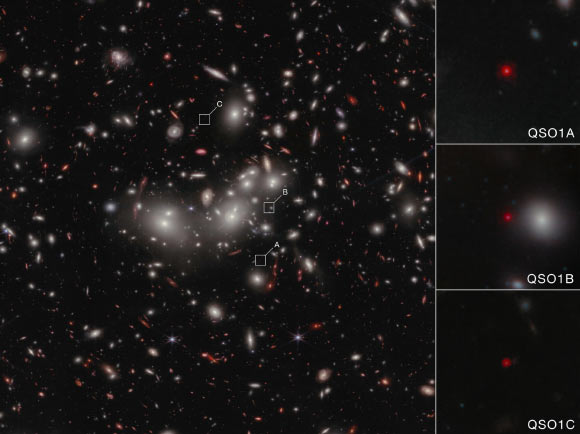
The James Webb Space Telescope (JWST) has observed what appear to be very distant red galaxies challenging the standard big bang theory. Misidentifying some Brown Dwarf stars within our Milky Way as these red distant galaxies brings into question the existing cosmological models.

  •  

How Box Created 13 New Types of Jobs Because of A.I.

Box, a Silicon Valley software maker, expects to have more employees, not fewer, as it hires A.I. architects, A.I. solutions managers and other new A.I.-related positions.
  •  

Webb Spots Supermassive Black Hole Older Than Its Home Galaxy

This Webb/NIRCam image shows the little red dot Abell2744-QSO1, magnified and triply imaged by galaxy cluster Abell 2744. Image credit: NASA / ESA / CSA / Lukas Furtak, Ben-Gurion University / Alyssa Pagan, STScI.

Astronomers using the NASA/ESA/CSA James Webb Space Telescope have found an enormous black hole in the early Universe that appears to predate its own host galaxy, raising fresh questions about how the cosmos’ first supermassive monsters were born.

The post Webb Spots Supermassive Black Hole Older Than Its Home Galaxy appeared first on Sci.News: Breaking Science News.

  •  

Upright Walking and Larger Brains May Explain Why 90% of Humans Favor Their Right Hand

Reconstruction of Homo erectus.

New research from the University of Oxford and the University of Reading suggests bipedalism and expanding brain size helped drive the overwhelming dominance of right-handedness in humans.

The post Upright Walking and Larger Brains May Explain Why 90% of Humans Favor Their Right Hand appeared first on Sci.News: Breaking Science News.

  •  

Brownian Motions and Quantifying Randomness in Physical Systems

Stochastic calculus has come a long way since Robert Brown described the motion of pollen through a microscope in 1827. It’s now a key player in data science, quant finance, and mathematical biology. This article is drawn from notes I wrote for an undergraduate statistical physics course a few months ago. There won’t be any...
  •  
❌