❌

Reading view

Extreme weather reshapes how soils store and release carbon

Beneath every step we take, soils hold one of the planet’s largest reservoirs of carbon, a vast, slow-moving bank of organic matter that quietly regulates how much of the world’s carbon stays locked away and how much escapes into the atmosphere as greenhouse gas. Now a sweeping new review warns that climate-driven extremes, droughts, floods, and wildfires, are rewriting the rules of that subterranean economy in ways that conventional models and land-management practices have not yet caught up with. The analysis, led by environmental scientist Nanthi Bolan of the University of Western Australia and colleagues, including a corresponding authorship by Bolan himself, synthesizes a substantial body of global evidence on how extreme weather reshapes carbon inputs to soil, microbial processing, erosion, and the sequestration of carbon that underpins soil health, water retention, nutrient cycling, and agricultural productivity.

The work, published in the journal Carbon Research, is notable for the scale of its underlying evidence base. On 14 January 2026, the authors searched Google Scholar, PubMed, and Web of Science using terms spanning climate change, extreme weather, soil carbon, microbial activity, decomposition, erosion, dissolved organic matter, and leaching. The initial sweep returned 14,218 records; after removing duplicates and screening for eligibility, 3,754 articles remained for bibliometric and qualitative analysis. From those, 187 publications were selected for detailed synthesis based on relevance, methodological rigor, and the substantive quality of their findings. Keyword co-occurrence patterns were mapped with VOSviewer, a bibliometric tool that reveals the intellectual architecture of a research field. The result is a critical review grounded in structured literature screening rather than new experimental data, but its synthesis offers one of the most comprehensive maps yet of how extremes rearrange the soil carbon cycle.

The review’s central finding is that no two extremes act alike. Drought, the most widespread disturbance, operates largely through the plant side of the equation. When rainfall fails, photosynthesis slows, plant biomass production falls, and the total flux of carbon entering soils through roots, residues, and litter declines. There is a nuance here: under moderate water stress, plants may temporarily shift a greater proportion of their fixed carbon belowground, investing in roots to chase moisture. But prolonged drought overwhelms that compensatory response. Microbial biomass shrinks, litter decomposition stalls, and the living engine of the soil carbon cycle idles. Then comes the deceptive twist: when rain finally returns, rewetting triggers a rapid pulse of carbon dioxide as starved soil microbes seize upon the accumulated substrates left behind by months of suspended activity. That post-drought CO₂ flush, the review emphasizes, can erase much of the apparent “savings” that accumulated during the dry period. Across the assembled evidence, repeated and multi-year drought was consistently associated with declining soil organic carbon, with grasslands and arable croplands showing particularly pronounced losses, ecosystems that happen to anchor much of the world’s food production.

Flooding tells the opposite story, but it ends in many of the same places. Water saturation chokes off oxygen diffusion through soil pores, forcing microbial metabolism into anaerobic pathways. That shift changes everything downstream. Prolonged waterlogging can drive the chemical reduction of iron oxyhydroxides, minerals that in oxygenated conditions act as microscopic glues binding organic carbon to soil particles. When those minerals dissolve, the carbon they held is released as dissolved organic carbon, which can then be stripped away by erosion and leaching and exported to rivers, lakes, and ultimately the ocean. The review stresses, however, that flooding is not unambiguously a carbon loss story. Wetlands and other periodically inundated ecosystems can accumulate and retain enormous carbon stocks precisely because water constrains decomposition. Whether a flood event releases carbon or banks it depends on the interplay between plant inputs, oxygen availability, and hydrological transport, a delicate balance that shifting rainfall regimes are actively destabilizing.

Wildfire is the most dramatic and immediately visible of the three forces, and its effects cascade on multiple timescales. Combustion directly strips vegetation, litter, and soil organic matter, transferring carbon to the atmosphere in hours. But fire also rearranges the physical and biological landscape of the soil in subtler ways: it can increase erosion by removing protective ground cover, alter soil wettability in ways that change hydrological behavior, restructure microbial communities, and expose previously protected carbon, once shielded inside aggregates or mineral associations, to fresh decomposition. There is a paradoxical bright spot. Pyrogenic carbon, the charcoal-like residue of incomplete combustion, is chemically recalcitrant and can persist in soils for centuries or millennia, functioning as a long-term carbon sink. Whether a fire leaves a landscape as a net carbon source or stabilizes some of its carbon in pyrogenic form depends on fire severity, soil moisture, fuel load, ecosystem type, and the trajectory of post-fire recovery. The review is clear that this balance cannot be predicted from fire alone; it is contingent, site by site, on conditions that vary widely across the globe.

Perhaps the most consequential theme running through the synthesis is that carbon responses cannot be inferred from the type of extreme event alone. Land use, soil mineralogy, hydrology, salinity, vegetation composition, microbial community makeup, and the timing of events within a season all determine whether carbon ends up stored, mobilized, or released. Iron and aluminum oxyhydroxides and clay minerals, for instance, provide mineral protection that can shield organic matter even under stress, while sandy or low-clay soils offer little such refuge. Managed croplands respond differently from native grasslands; saline coastal soils behave differently from acidic forest soils. And compound events, drought followed by wildfire, or alternating drought and flooding in rapid succession, may produce effects that are qualitatively different from those of isolated disturbances, as when a dried landscape burns more intensely, or when post-fire soils, stripped of vegetation, wash away in the first heavy rain. The review argues that the climate science and soil science communities have largely studied these disturbances one at a time, while the real world increasingly delivers them in combination.

The implications for climate mitigation and adaptation are substantial. Soil organic carbon is frequently invoked in national climate pledges and voluntary carbon markets as a bankable sink, yet the review suggests that the security of that bank depends heavily on how often and how severely extremes strike. If multi-year droughts steadily drain carbon from grasslands and croplands, or if fires repeatedly reset accumulation cycles, the effective permanence of soil carbon storage becomes far more fragile than many accounting frameworks assume. Conversely, protecting and rebuilding soil carbon delivers benefits well beyond climate: it improves water retention in drought-prone regions, supports nutrient cycling, stabilizes soil structure against erosion, and sustains the microbial diversity on which fertility depends. Carbon stewardship, in other words, is not separable from food security or ecosystem resilience; it is the same problem viewed from different angles.

The authors are candid about the limits of the current evidence base. The article does not report newly generated datasets and does not present a dedicated limitations section, and its conclusions rest on a qualitative synthesis of selected publications. Consequently, they call for improved and more consistent evidence across soil types, land uses, and both terrestrial and aquatic environments, and across multiple temporal scales, from the instantaneous CO₂ pulse after rewetting to the multi-decadal trajectory of carbon storage. Standardizing measurements of carbon pools, microbial functions, and event intensity, they argue, would make results comparable across ecosystems and enable more confident generalization, something the field currently struggles to achieve given heterogeneous methods and site-specific reporting.

Looking forward, the review sketches a research agenda that is as technologically ambitious as it is mechanistically focused. The authors recommend integrating high-resolution remote sensing with ground observations, advanced spectroscopy, molecular analyses, and integrated modeling to track carbon as it moves through soils and into waterways. They single out several priorities: characterizing microbial genomic and functional diversity as it responds to stress, quantifying carbon stoichiometry, probing the interactions between organic matter and iron and aluminum oxyhydroxides, understanding clay-mineral protection mechanisms, tracking long-term storage outcomes, and systematically studying the sequencing of compound extreme events. Each of these threads addresses a gap in the mechanistic chain that links a weather event in the atmosphere to a molecule of carbon, stabilized or released, in the soil.

What emerges from the review is a picture of the soil carbon cycle not as a stable background process but as a dynamic, contested system whose behavior under climate extremes is far less predictable than once assumed. The same storm that floods a rice paddy and exports carbon to a river delta may, a few hundred kilometers away, end a drought and briefly green a grassland, with opposite consequences for the atmosphere. As extremes grow more frequent and more compound, the review makes the case that understanding, and safeguarding, the carbon held beneath our feet will require science that is as interconnected and as restless as the weather itself.

Keywords

soil organic carbon, extreme weather, drought, flooding, wildfire, carbon sequestration, microbial activity, dissolved organic carbon, erosion, pyrogenic carbon, climate change, soil health

Subject of Research: Impacts of climate change-induced extreme weather events (drought, flooding, wildfire) on carbon dynamics in soil

Article Title: Impacts of climate change-induced extreme weather events on carbon dynamics in soil

Article References: Bolan, N., Messiga, A. J., Sharma, S., Mukherjee, S., Bolan, S., Salehin, S. M. U., Rupngam, T., Rajan, N., Zhang, T., Yang, Y., Jagadesh, M., & Siddique, K. H. M. (2026). Impacts of climate change-induced extreme weather events on carbon dynamics in soil. Carbon Research, 5(1), Article 58. https://doi.org/10.1007/s44246-026-00300-5

Image Credits: AI Generated

DOI: 10.1007/s44246-026-00300-5

Keywords: adaptation of land management practices to climate extremes, challenges to conventional soil carbon models, Climate change impacts on soil carbon storage, effects of droughts and floods on soil microbial activity, global evidence on soil carbon dynamics, implications for greenhouse gas emissions, influence of extreme weather on nutrient cycling and water retention, resilience of soil carbon reservoirs to climate, review of climate-driven soil carbon processes, soil erosion and carbon loss due to extreme weather, soil health and agricultural productivity under climate stress, wildfire influence on soil organic matter

  •  

LINK spacecraft gets close to NASA's Swift Observatory, but not close enough to save it

LINK, the satellite sent to boost the orbit of NASA's Swift Observatory, may have had to give up on its mission, but LINK's manufacturer and operator Katalyst Space hasn't completely abandoned the spacecraft to its cosmic demise.

NASA called off LINK's mission to rendezvous with its Neil Gehrels Swift Observatory when the specialized probe encountered a thruster control issue. LINK was delivered to orbit on July 3, aboard an air-launched Northrop Grumman Pegasus XL rocket, but began to spin uncontrollably about three weeks after reaching space. Swift's orbit began decaying faster than expected last year, due to increased solar activity, and LINK was designed to rendezvous with Swift, grapple it, and then raise the observatory to a more stable altitude.

LINK's Swift Boost mission was considered a "Hail Mary" attempt from its onset. NASA's discovery of Swift's swiftly decaying orbit meant the Arizona-based Katalyst had less than a year to design, manufacture and test LINK before needing to launch. Now, with both of their missions on the short-track for destruction, NASA and Katalyst are left both trying to get the most out of their spacecraft with the time each has left.

LINK's failure means Swift is destined to burn up in Earth's atmosphere before the end of the year, and LINK itself is expected to fall to the same fate within just the next few weeks. But the probe's inability to save Swift hasn't stopped Katalyst from getting as much data from LINK as it can. Though a closer rendezvous is no longer in the cards, the spacecraft managed to successfully fire all three of its electric propulsion thrusters and adjust its orbit to fly within 7.5 to 9 miles (12 to 15 kilometers) of Swift. Katalyst was also able to deploy all three of LINK's robotic arms, which would have been used to grapple Swift for its orbital adjustment.

Swift launched in November 2004, and has been studying high-energy phenomena like gamma-ray bursts, supernovas, black-hole ejections and fast radio bursts across the universe for more than 20 years. Despite its impending demise, two of Swift's three science instruments — its X-ray Telescope (XRT) and Ultraviolet/Optical Telescope (UVOT) — were turned back on in late August after being shut down in February to minimize atmospheric drag on the spacecraft in anticipation of LINK's now defunct orbital boost efforts.

With the option for LINK to raise Swift's orbit now off the table, Katalyst and NASA are working to perform whatever technology demonstrations are possible aboard the spacecraft, in the hopes the technology can be used to service other satellites on missions in the future.

  •  

NASA, NFL Team Up to Showcase Space, Aeronautics Innovation

Football
A football floats in microgravity aboard the International Space Station, high above the Earth.
Credit: NASA

Through a new collaboration between NASA and the National Football League (NFL), the agency will soon bring America’s strengths in space exploration and aeronautics innovation to the football field.

NASA will conduct flyovers, astronaut appearances, and fan engagement at NFL games across the United States as part of its new Inspiration Tour.

“This is the first season NASA is taking part in flyovers at NFL games, bringing the excitement of America’s space program directly to fans across the country,” said NASA Administrator Jared Isaacman. “We’re returning to the Moon, building a Moon Base, advancing fission-powered spacecraft, and pushing the boundaries in aeronautics, science, and discovery. Achieving those ambitions will take the very best of America, and partnering with the NFL gives us an incredible platform to inspire the next generation to look up and imagine the possibilities.”

NASA participation is targeted for the following games. Additional details will be released prior to each game, and more dates may be added:

  • 1 p.m., Sunday, Sept. 13: Pittsburgh Steelers vs. Atlanta Falcons in Pittsburgh
  • 1 p.m., Sunday, Sept. 20: Baltimore Ravens vs. New Orleans Saints in Baltimore
  • 1 p.m., Sunday, Oct. 4: Philadelphia Eagles vs. Los Angeles Rams in Philadelphia
  • 1 p.m., Sunday, Oct. 11: New York Jets vs. Cleveland Browns in East Rutherford, New Jersey

Flyovers scheduled at some of the games will showcase NASA’s fleet of aircraft, which are used for high-speed testing, high-altitude research, astronaut training, and more. Regularly flying the aircraft maintains the health of the fleet and publicly demonstrates new technologies that may be applied to future commercial air travel.  

With stops across the nation and led by Isaacman, NASA’s Inspiration Tour convenes academic, industry, and public sector stakeholders to connect the agency with the people, technologies, and organizations that drive American leadership in space.

The tour will culminate in MAX POWER, a public exposition of American air and space innovation, Nov. 7 and Nov. 8, on and near the agency’s Kennedy Space Center in Florida. Held in honor of America’s historic 250th anniversary, the multi-day, family-friendly event will showcase the next-generation aircraft, spacecraft, autonomous vehicles, and technologies that will help define the future of transportation in air and space.

For more information about MAX POWER and the agency’s missions, visit:

https://www.nasa.gov/maxpower

-end-

Camille Gallo / Jessica Taveau
Headquarters, Washington
202-358-1600
camille.m.gallo@nasa.gov / jessica.c.taveau@nasa.gov

Share

Details

Last Updated
Sep 10, 2026
Editor
Jessica Taveau
  •  

The Iran War Is Pushing Global Coal Use to Record Highs

Five years after virtually every world leader agreed to “phase down” the burning of coal for climate reasons, the fuel is more widely used than ever.

© Ahmad Mulia Panjaitan/Associated Press

Coal barges in East Kalimantan, Indonesia, last month.
  •  

What comes after the moon? Artemis II commander and pilot shift to 'emeritus' status at NASA

Three of NASA's Artemis II astronauts are starting off the school year with new assignments.

Artemis II commander Reid Wiseman and pilot Victor Glover, both NASA astronauts, will transition into "emeritus status" in September, the space agency announced on Wednesday (Sept. 9). Meanwhile, Canadian mission specialist Jeremy Hansen shared a video on X on Tuesday (Sept. 8) concerning his already-announced transfer from active duty to reserve status in the Canadian military.

The fourth Artemis II astronaut, NASA mission specialist Christina Koch, appears to still be on active duty, as no announcements have been made saying otherwise.

The Artemis II quartet flew around the moon in April, becoming the first people to go beyond low Earth orbit since 1972. The historic journey was widely expected to be the last step in active astronaut duty for at least some of the mission's four astronauts, especially Hansen, who had waited for a flight assignment for 17 years in part due to how Canadian Space Agency funding is allocated. (Robotics provided by the CSA form a minority share of international space partnerships with NASA, and astronaut flight rates are tied to funding.)

The Artemis II astronauts made a series of public appearances together this summer, culminating on Aug. 28 when President Trump awarded them the Congressional Space Medal of Honor. Hansen was only the second non-American to receive the award, which had previously been given to just 30 astronauts total.

While NASA's Wednesday announcement about Glover and Wiseman did not explicitly state that the duo are exiting active astronaut duty, their new role is described as allowing the astronauts to assist NASA as consultants and "individuals with a high degree of technical and professional knowledge," while allowing them to do other things.

The two astronauts are expected to help NASA plan future Artemis program missions. "I'm grateful they will continue sharing what they learned with our astronauts, flight controllers and engineers as we prepare for Artemis III in 2027 and the missions that follow," NASA administrator Jared Isaacman said in the statement.

three men and one woman hug inside a space capsule

From left: The Artemis II crew — NASA astronaut Christina Koch, Canadian Space Agency astronaut Jeremy Hansen, and NASA astronauts Reid Wiseman and Victor Glover — take time out for a group hug inside the Orion spacecraft on April 6, 2026. (Image credit: NASA)

Glover, who also retired from the U.S. Navy recently, will now assume a full-time role at his alma mater, California Polytechnic State University in San Luis Obispo, which has aerospace and space programs. The news was announced by the university on Wednesday, but the position took effect on Sept. 1. Glover will be an administrative leader providing advice to senior leadership on education, research and workforce strategies, according to Cal Poly.

"The most meaningful moments of my NASA career were supporting astronauts and their families through missions, and mentoring interns and new hires as they began their own journeys in technical and public service," Glover wrote Wednesday in a post on X about the career change.

Wiseman did not share any specific updates about his career plans on social media. The astronaut also exited active astronaut duty temporarily between 2020 and 2022 when he was chief of the astronaut office for NASA, a role that precludes flying in space as the chief is involved in flight assignments. Wiseman left that role and resumed active astronaut duty before being assigned to Artemis 2, which occurred shortly before the public announcement of the mission's crew in April 2023.

"NASA gave me tremendous responsibility, supported me through two space missions — and my time as chief astronaut — and was always there for my family when we needed it most," Wiseman said in the NASA statement about his career change. "I'm thrilled to continue serving future missions and programs through the emeritus program."

The mission continues! pic.twitter.com/2R6Dwb63bSSeptember 8, 2026

Hansen's Artemis 2 duties officially concluded on Sept. 2, according to his X account, and the astronaut — who has been based out of Houston since 2009 — posted a new video of himself Wednesday walking in the woods in Canada. Hansen said he has retired as a colonel with the Royal Canadian Air Force and is now a reservist working with 3 Canadian Space Division, which is essentially Canada's Space Force.

"The intention of that is to continue to serve Canada and government — the Canadian Space Agency — when it makes sense, to help us take advantage of some of the extraordinary opportunities that are before us right now," Hansen said in the video, adding that he will divulge more details about that work shortly.

Hansen also said he accepted a role as honorary national president with the Canadian military's Air Cadet League of Canada, which the astronaut has often said helped equip him with both flying and leadership skills when Hansen was growing up.

Additionally, Hansen pledged to "continue to share the moon joy" both as an individual and with his crew. For example, he recently joined a Canadian keynote-speakers bureau in which he plans to speak about how to accomplish personal "moonshots." In October, Hansen will also co-release "Earthrise: A Canadian Astronaut's Journey Into Deep Space" (HarperCollins Publishers, 2026) — a book that discusses his career and Artemis 2 — which he co-wrote with Canadian author John Larsen.

  •  

UK’s New North Sea Drilling Push Sparks Questions Over Climate Costs and Tiny Job Gains

UK’s New North Sea Drilling Push Sparks Questions Over Climate Costs and Tiny Job Gains

A fresh round of North Sea oil and gas approvals is raising eyebrows, with critics questioning why officials would expend so much political capital for such minimal economic return. The pattern feels familiar: significant political risk taken on for gains that appear vanishingly small once the numbers are examined closely.

The justification offered so far has been vague at best—essentially, that untapped resources exist and shouldn’t be ignored while people face economic hardship. But if the reasoning hinges on supporting struggling oil and gas workers, the math simply doesn’t add up. The Jackdaw gasfield, expected to receive approval imminently, will create just 27 direct full-time jobs. The Rosebank oilfield, likely to follow, will support an estimated 450 UK-based positions over its entire operational lifetime.

Compare these figures to the broader picture: the UK’s net zero economy already employs 300,000 people directly, with plans for 400,000 additional jobs in the pipeline. The wider green economy sustains more than 600,000 jobs altogether. Given these numbers, a just transition strategy—one that moves fossil fuel workers into the growing renewable energy sector—would seem to offer far better outcomes for workers and communities alike than doubling down on new drilling projects that promise so little in return.

The decision arrives at a moment when climate impacts are increasingly difficult to ignore, making the calculus behind expanding fossil fuel extraction even harder to justify on economic grounds alone.

The post UK’s New North Sea Drilling Push Sparks Questions Over Climate Costs and Tiny Job Gains first appeared on EnviroLink Network.

  •  

Is Burnham trying to appease Trump? Or Reform? What other reason is there for these North Sea oil plans? | George Monbiot

Climate catastrophe is on our doorstep – yet Labour’s impending approval of further drilling will bring more pain for negligible gains

Pinch yourself, it’s happening again. Here is a Labour government spending a vast amount of political capital to earn tiny material gains while risking huge political losses. It occurred repeatedly under Keir Starmer, and now – with the impending decision to approve further gas and oil drilling in the North Sea – it is happening under Andy Burnham. You rack your brains to explain it, but no rational explanation comes.

Burnham is studiously cryptic about his reasons. His clearest statement to date goes as follows: “There is a resource there. When people are struggling, we can’t ignore that.” Does he mean that oil and gas workers are struggling? If so, this decision will be of little use to them. The Jackdaw gasfield, likely to be approved this week, will generate a grand total of 27 direct full-time jobs. The Rosebank oilfield, whose approval is likely to follow soon, will support 450 UK-based jobs during its lifetime. Yet the UK’s net zero economy directly employs 300,000 people, and a further 400,000 jobs are planned. The rest of the green economy employs more than 600,000. A just transition for fossil fuel workers, securing jobs in the green economy, is better for everyone.

George Monbiot is a Guardian columnist

Continue reading...

© Photograph: Jack Taylor/Reuters

© Photograph: Jack Taylor/Reuters

© Photograph: Jack Taylor/Reuters

  •  

August Ties for Hottest Month on Record

Sweltering summer temperatures put last month on par with July 2023 for global warmth, scientists said. More records could be broken in the months ahead.

© Yonhap News Agency, via Reuters

A vendor cooled off with a frozen water bottle in a market in Seoul on Aug. 6.
  •  

SpaceX rocket taxi returns after Roman Telescope launch | Space photo of the day for Sept. 8, 2026

People stand on a lawn watching a long structure descend to Earth.

This might look like a rocket launching off Earth, but it's actually a rocket booster perfectly landing on our planet after fulfilling its duty. (Image credit: Chelsea Gohd)

On Aug. 30, the Nancy Grace Roman Space Telescope launched into space aboard a SpaceX Falcon Heavy rocket — then, after completing their job, the rocket's boosters safely landed back on Earth. Watching the events unfold, Space.com's Chelsea Gohd caught one of these beautiful landings on camera as onlookers at NASA's Kennedy Space Center watched in awe.

What is it?

The Roman Space Telescope is NASA's next great observatory, meant to revolutionize how we view the cosmos. Equipped with instruments like a coronagraph that can directly image exoplanets and a Wide-Field Instrument (WFI) that has a massively wide field of view, it's designed to work with big names like the Hubble Space Telescope and James Webb Space Telescope and reveal our universe's intricacies on a grand scale.

But to get to space, like any other space telescope, it needed a rocket to ferry it there. In this case, that was SpaceX's Falcon Heavy rocket. Falcon Heavy is about 230 feet (70 meters) tall and can lift nearly 141,000 pounds (64 metric tons) of payload to low Earth orbit. And importantly, Falcon Heavy's two boosters are reusable.

After launching a payload to space, the boosters split and each lands back on Earth in an upright position. In the image above, Gohd captured one of those boosters landing in the distance.

Why is it incredible?

Though we hear about it so often, there is something undeniably dreamlike about living in a time when a rocket can land its parts back on Earth so precisely. I was also there for the launch of the Roman Space Telescope in Florida, and it was breathtaking to watch such a huge piece of equipment navigate mid-air and straighten itself before landing. The crowd in the picture was equally astonished while the event unfolded.

My mother texted me just after she watched the Roman Space Telescope launch live online, exclaiming that the booster's landing looked just like a taxi returning to its station, getting ready for the next task. I hadn't thought about it that way before, but she was correct.

One of the boosters that participated in Roman's launch landed at Landing Zone 2 and the other hit the ground at Landing Zone 40. As NASA explained in a statement, one of these boosters carried out its very first mission while the other was on its third.

Now, the next spectacle to take our breath away will be Roman's very first images of the universe. Those are expected to drop next year.

  •  

Labor Day in space: NASA astronauts get the holiday off

Like most of their compatriots here on terra firma, the three Americans living off Earth will get to put their feet up today (Sept. 7).

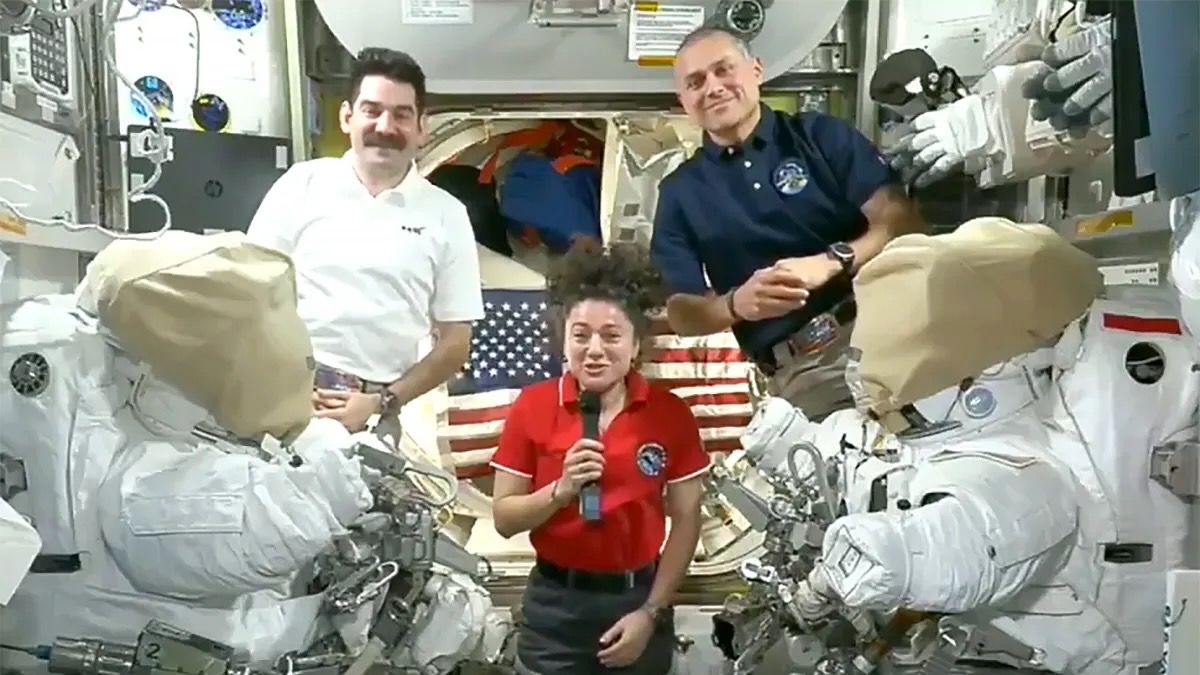
NASA astronauts Jack Hathaway, Jessica Meir and Anil Menon will get Labor Day off aboard the International Space Station (ISS), the agency said on Friday (Sept. 4). European Space Agency astronaut Sophie Adenot, the first French woman ever to perform a spacewalk, will also be off duty.

However, the three Russian cosmonauts living on the ISS will have to clock in as usual.

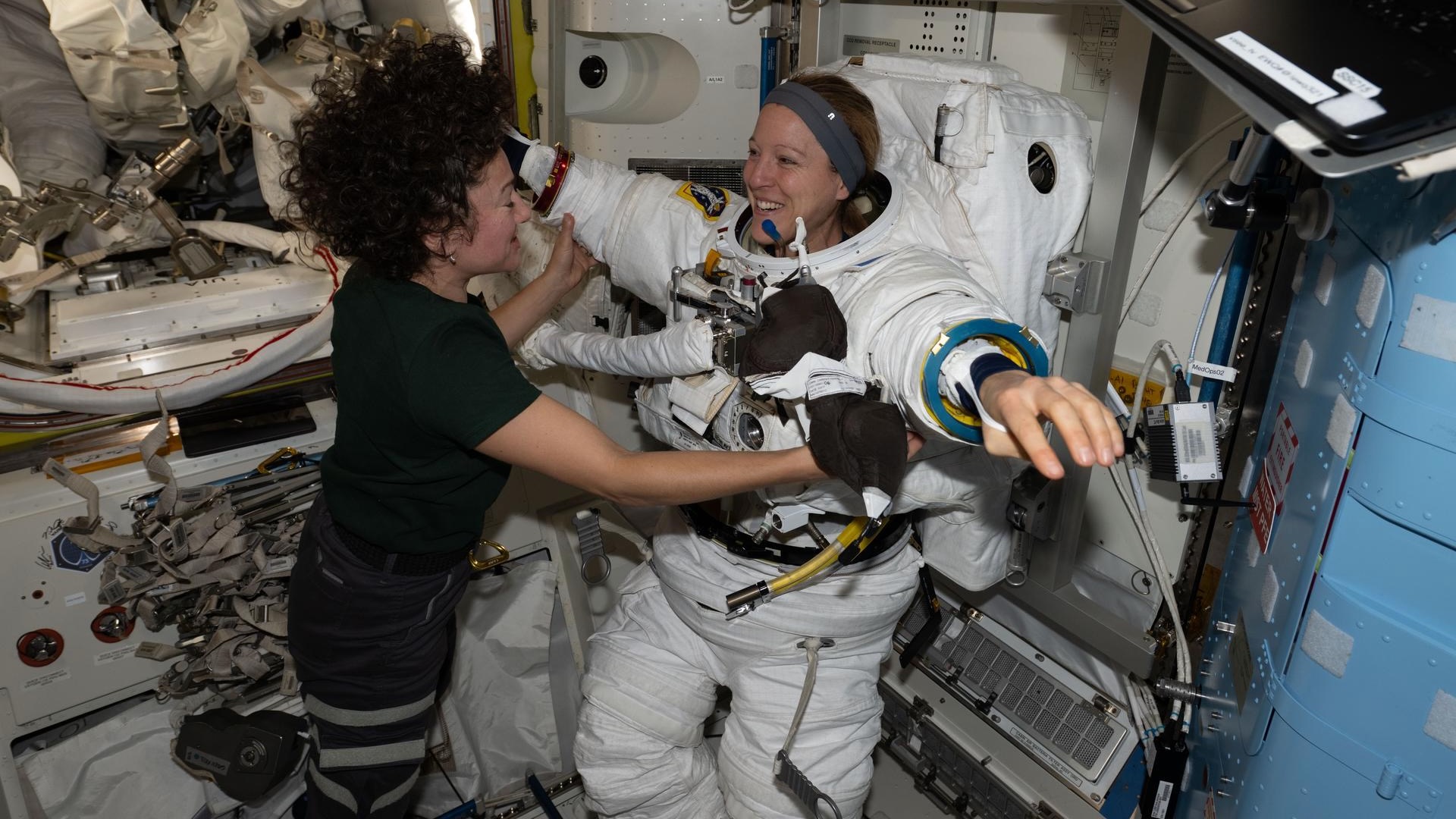
a woman in a black polo shirt helps a smiling woman put on a white spacesuit aboard the space station

NASA astronaut Jessica Meir (left) and the European Space Agency's Sophie Adenot work together inside the International Space Station’s Quest airlock during spacesuit fit and leak checks. (Image credit: NASA)

The trio — Pyotr Dubrov, Andrey Fedyaev and Anna Kikina — "will be busy monitoring the Progress 94 resupply spacecraft when it undocks on Monday, packed with trash and obsolete gear, from the Poisk module," NASA officials said in an update on Friday.

"It will be replaced by the Progress 96 resupply spacecraft after it launches from Kazakhstan's Baikonur Cosmodrome on Sept. 9 for an automated docking two days later to Poisk’s vacated port," they added.

Adenot, Feyaev, Hathaway and Meir arrived at the ISS in mid-February on SpaceX's Crew-12 mission. Dubrov, Kikina and Menon are relative newcomers, reaching the station aboard a Russian Soyuz spacecraft on July 14.

NASA astronauts on long-duration missions to the ISS generally work a relatively normal schedule, getting weekends and major holidays off. Such downtime is crucial to mission success, as it helps the spaceflyers stay happy, healthy and productive.

They may not be able to mark the holidays in exactly the same ways we do here on Earth, however. For example, the astronauts won't be grilling any hamburgers or hot dogs today, as open flames are verboten on the ISS.

As today's schedule shows, international crewmates do not always have the same days off in orbit. But they try to celebrate major holidays like Christmas together, both to cement the bonds that exist between them and to take the sting out of being so far away from family and friends.

  •  

App Tracking Transparency: Apple Faces $2.7 Billion UK Lawsuit

App Tracking Transparency is at the center of a new UK lawsuit seeking approximately $2.7 billion (£2 billion), putting one of the most recognizable iPhone privacy features under fresh legal pressure. The claim follows earlier challenges to the tracking system in France, but this action seeks compensation for developers who say Apple imposed unfair restrictions on their businesses while favoring its own advertising services.

Filed on September 3 at London’s Competition Appeal Tribunal, the case represents another dispute over the rules behind the familiar permission prompt. Apple rejects the allegations and maintains that it follows the same App Tracking Transparency requirements as other developers.

The amount being sought is not a fine or an awarded payment. It is the claimants’ estimate of losses, which Apple disputes.

What the App Tracking Transparency Lawsuit Alleges

The action was brought by ATT Collective Action Limited, whose director, Ann Pope, previously led antitrust enforcement at the UK Competition and Markets Authority. Law firm Hausfeld is representing the proposed class.

According to Hausfeld’s announcement of the claim, developers argue that Apple introduced the framework unfairly, without adequate consultation, and applied more burdensome requirements to outside businesses than to its own services.

The complaint focuses partly on consent. It alleges that third-party developers must obtain permission under data-protection law and then secure an additional approval through the iOS tracking prompt. Apple’s advertising services, the claimants argue, operate under a less demanding process.

Developers also contend that the introduction left them insufficient time to adapt business models dependent on advertising.

These are allegations about how the system was designed and introduced—not established findings in this UK case. The claimants’ stated position is that privacy protections should remain compatible with fair treatment of businesses.

App Tracking Transparency | Two iPhones display Apple’s “Find My” app settings in dark mode, showing options like “Notify When Left Behind,” separation alerts, device locations, and contact sharing. The interface offers users easy access to Find My alerts and seamless integration with AirTag tracking.
Image Credit: AppleMagazine

What the Tracking Prompt Actually Protects

For someone using an iPhone, App Tracking Transparency offers a direct choice about a practice that previously could be difficult to see.

An app may want to connect information about your activity with information gathered through other companies’ apps or websites. That connection can help advertisers build a profile, target advertisements, or measure whether an advertising campaign led to a purchase.

Under Apple’s explanation of the tracking rules, apps must request permission before carrying out the tracking covered by the framework. Choosing “Ask App Not to Track” blocks access to the system advertising identifier and prohibits using other identifying information to perform that tracking instead.

The feature arrived with iOS 14.5 in 2021. It does not remove advertisements, make an app anonymous, or serve as a universal switch for every kind of data collection.

That boundary matters. A retailer remembering purchases made within its own service is not automatically doing the same thing as an advertising company linking activity across unrelated businesses.

The disagreement concerns whether those distinctions, and the consent processes built around them, give Apple an unfair commercial advantage.

App Tracking Transparency | iOS 16 | iPhone 14

Apple Says the Same Rules Apply to Everyone

Apple has responded directly to the lawsuit, defending the feature as a way to give people control over tracking across other companies’ services.

In a statement reported by AFP, a spokesperson said: “Apple is bound by the exact same requirements as all developers under ATT.”

The company also pointed to support for the feature from customers and privacy advocates.

That response challenges the foundation of the developers’ case. Apple presents App Tracking Transparency as a rule based on the type of data activity involved. The claimants argue that its practical operation places competing advertising businesses at a disadvantage.

Resolving that disagreement requires more than comparing the appearance of two permission screens. The underlying data uses, consent requirements, and commercial effects all matter.

Why Free Apps Are Part of the Dispute

Advertising can support both sides of an app business. A developer may sell advertising space inside a free app while also buying advertisements elsewhere to attract new users.

A change to tracking can therefore affect how much an app earns and how confidently its developer can measure spending on promotion.

Consider a small game studio. It needs to know whether an advertising campaign brings in players who keep using the game. If measurement becomes less precise, deciding where to spend the next marketing dollar becomes harder. Separately, advertisers may value the game’s available ad space differently when less information is available for targeting.

That explains the commercial concern without proving the legal claim. Losing revenue after a privacy change does not, by itself, establish that the change was unlawful.

There is also a consumer interest that cannot be reduced to advertising performance. Someone choosing not to be tracked is expressing a preference about personal information, not making a promise to preserve a developer’s previous income.

The difficult question is whether that preference can be protected through a system that treats competing businesses fairly.

France Has Already Examined the Consent Process

The UK action arrives after a separate French competition investigation found problems with the implementation of App Tracking Transparency.

In its March 2025 decision, France’s Autorité de la concurrence distinguished between the legitimate objective of protecting privacy and the way Apple pursued it.

The authority criticized multiple consent requests and differences in treatment between Apple and outside publishers. It also highlighted the position of smaller businesses that lack the extensive first-party data available to large platforms.

Importantly, the French authority did not argue that people should lose the ability to refuse tracking. It said adjustments to the framework could address competition concerns while retaining privacy protections.

That distinction leaves room for changes to wording, consent flows, or implementation without automatically requiring the removal of the feature. The French decision, however, does not determine liability or compensation in the separate UK proceedings.

The Claim Is for Developers, Not iPhone Owners

The official claim website describes a proposed action for UK-based app developers affected since April 2021. It estimates losses across the group rather than offering a fixed payment to everyone who owns an iPhone.

The proposed scope includes developers earning advertising revenue from third-party iOS apps and developers spending money to attract users to those apps. Whether compensation becomes available depends on the proceedings and their outcome.

For U.S. readers, the filing does not announce a change to domestic iPhone settings or create a consumer refund program. There is no reason to grant an app tracking permission simply because its developer objects to the framework.

Businesses following the case should also distinguish registering interest from receiving compensation. The claim website currently invites affected organizations to provide their details; it is not distributing a settlement.

A smartphone screen displays the "Privacy & Security" settings, highlighting iPhone App Permissions for Location Services and Tracking, with the Apple logo in the bottom right corner.

The post App Tracking Transparency: Apple Faces $2.7 Billion UK Lawsuit appeared first on AppleMagazine.

  •  

Who Needs Jupiter?

A photograph of Uranus against a black background.

A planned flagship spacecraft to Uranus was aiming to use Jupiter for a gravitational boost to shorten its journey to the outer solar system. Now that the mission’s launch date has been pushed back, it’ll need to find another way to its target.

Redesigning the Route

Uranus and Neptune, the ice giants of our solar system, have been comparatively neglected by humanity’s fleet of interplanetary probes. While all of the other major bodies have been visited by at least an orbiter or even a lander, the most detailed exploration we’ve done of these two planets happened when the Voyager 2 spacecraft went screaming past on its way toward interstellar space.

A two-panel top down view of the solar system with different trajectories overplotted.

Schematics of different trajectories within the solar system. Left: The path the Galileo spacecraft took to Jupiter. This path arrived nearly parallel to the planet’s motion. Right: One of the proposed paths to Uranus. This path will intersect the planet’s orbit at a much steeper angle to shorten the flight time. Click to enlarge. [Simon et al. 2026]

So it was no surprise when a panel of scientists and engineers charged with setting scientific exploration priorities between 2023 and 2032 recommended finally sending a spacecraft to Uranus, depositing it into orbit around the planet, and keeping it there for a while to collect data. The study itself suggested a basic design for the mission: a pair of spacecraft, one orbiter and one sacrificial atmospheric probe, collectively weighing about 4,000 kg.

Getting these spacecraft to their destination will be a challenge The thriftiest path to get to Uranus, a trajectory called a Hohmann transfer that’s been used for other missions aimed elsewhere in the solar system, would take 16–17 years. Rather than accept the long wait, the original authors suggested that the mission instead fly toward Jupiter, using the giant planet’s massive gravitational tug to slingshot the spacecraft toward Uranus.

However, this plan relied on Jupiter being in just the right place when the spacecraft approached. This in turn relied on the mission launching sometime in 2031 or 2032: any earlier or later, the slingshot would be aimed in the wrong direction. Now that timelines and budgets have slipped for this flagship mission, hitting this launch window seems unlikely. And, without the boost from Jupiter, the mission will have to cross 20 au of open interplanetary space on its own.

Solar Electric Propulsion to the Rescue

A 3-row figure showing the same interplanetary probe flanked by every-growing sets of solar panels.

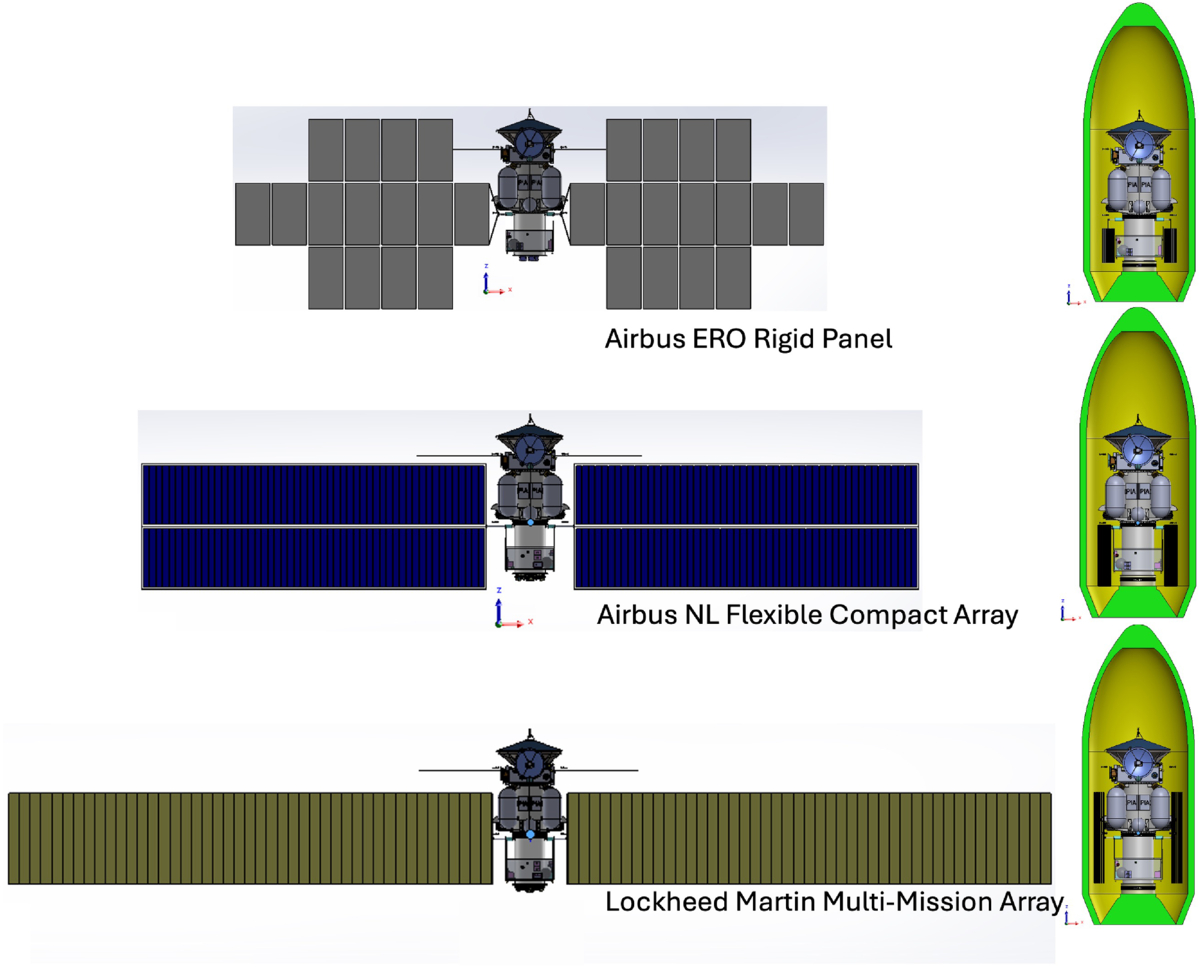
Several proof-of-concept designs for the mission’s SEP components. How these designs would be packaged into a rocket fairing for launch is shown at right. Click to enlarge. [Simon et al. 2026]

Recently, a team led by Amy Simon, NASA Goddard Space Flight Center, took on this challenge and tried to chart a new path through the solar system. The team realized that solar electric propulsion (SEP), a technique that relies on using solar panels to create electricity and accelerate ions to create thrust, might offer a path forward. By using SEP, the mission could leave Earth, unfurl wings of solar panels, then gradually accelerate for as long as there was enough sunlight to power the engine.

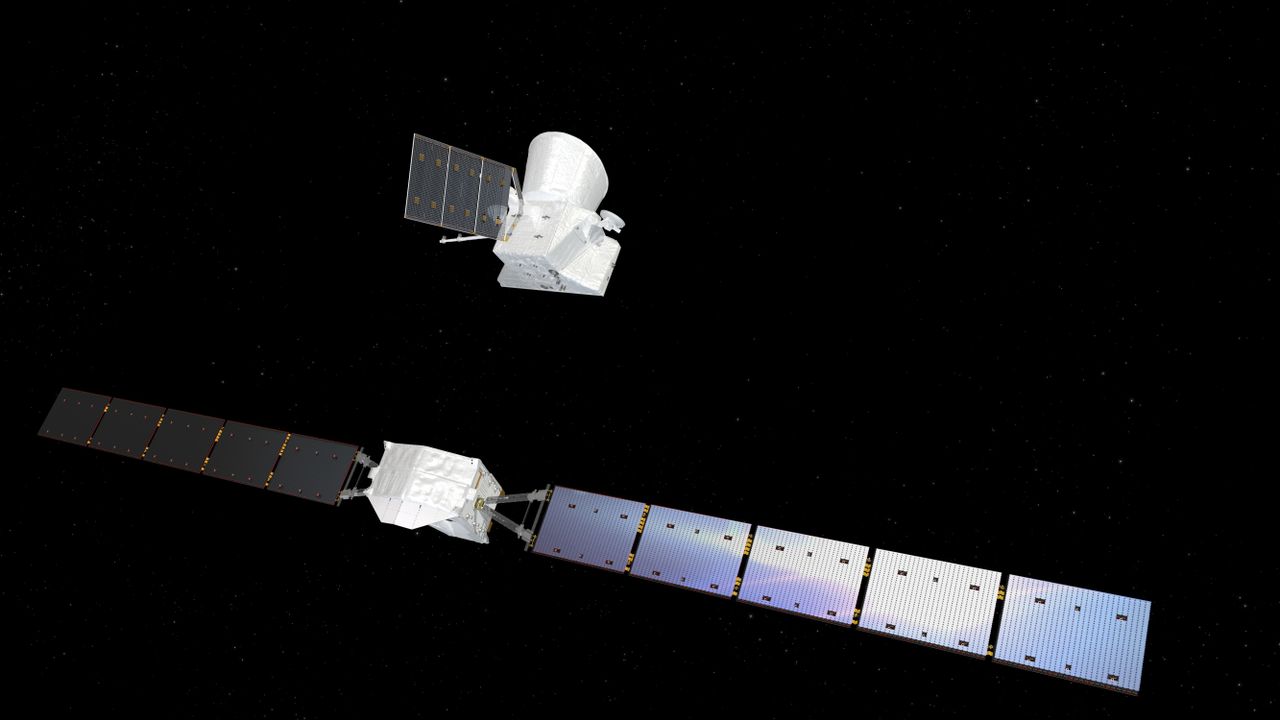
The power levels would likely get too low just a few astronomical units into their journey, but that would be enough: after discarding the SEP stage, the mission could coast to Uranus on a journey that would take only 13 years. Even better, this technology has a proven flight history and would require little maturation or development. The BepiColombo mission to Mercury is currently using SEP, and similar techniques are used on satellites in Earth orbit today.

Simon and collaborators also took on a number of other challenges that have cropped up since the mission was proposed, including fewer available plutonium power sources and a re-assessment of Uranus’s rings that revealed hazards in the original flight path. Their work brings the mission closer to the launch pad and illustrates how much iteration goes into the spacecraft that finally takes to the stars.

Citation

“Uranus Orbiter and Probe: Mission Challenges and Concept Updates Since the Origins, Worlds, and Life Decadal Survey,” Amy A. Simon et al 2026 Planet Sci. J. 7 143. doi:10.3847/PSJ/ae680c

The post Who Needs Jupiter? appeared first on AAS Nova.

  •  

'A new mission starting today': 8 years after launch, BepiColombo begins Mercury arrival

After nearly eight years traveling through the inner solar system, the trailblazing BepiColombo spacecraft has finally begun its arrival at Mercury.

The joint European Space Agency (ESA)-Japanese Aerospace Exploration Agency (JAXA) mission reached a major milestone today (Sep. 3), entering its arrival phase at one of our sun's least-studied planets. BepiColombo's Mercury Transfer Module (MTM), the main power and propulsion system that has ferried a dual stack of planetary probes through space for nearly eight years, released its payload to kick off a sequence of operations that will ultimately place the two spacecraft in Mercury's orbit.

The separation left ESA's Mercury Planetary Orbiter (MPO) and JAXA's Mercury Magnetospheric Orbiter, known as Mio, together for their final approach, which will take about six more months. "It will basically be a new mission starting today," said Bruno Sousa, ESA's head of operations definition and engineering, during today's mission livestream.

BepiColombo launched aboard an Ariane 5 rocket from Europe's Spaceport at the Guiana Space Center in Kourou, French Guiana, on Oct. 19, 2018, beginning a journey that was expected to take about seven years. To assist its plunge sunward, the spacecraft's trajectory has included one flyby of Earth, two of Venus and six of Mercury, as it has shed more and more gravitational energy during to slow its approach to the system's innermost planet.

"It's one of the most complicated missions we have ever flown," Sousa said. The mission was made even more complicated in April 2024, when a solar panel issue reduced the available power for MTM's electric thrusters. Engineers devised a lower-thrust trajectory that saved BepiColombo's mission but delayed its Mercury arrival from December 2025 to November 2026.

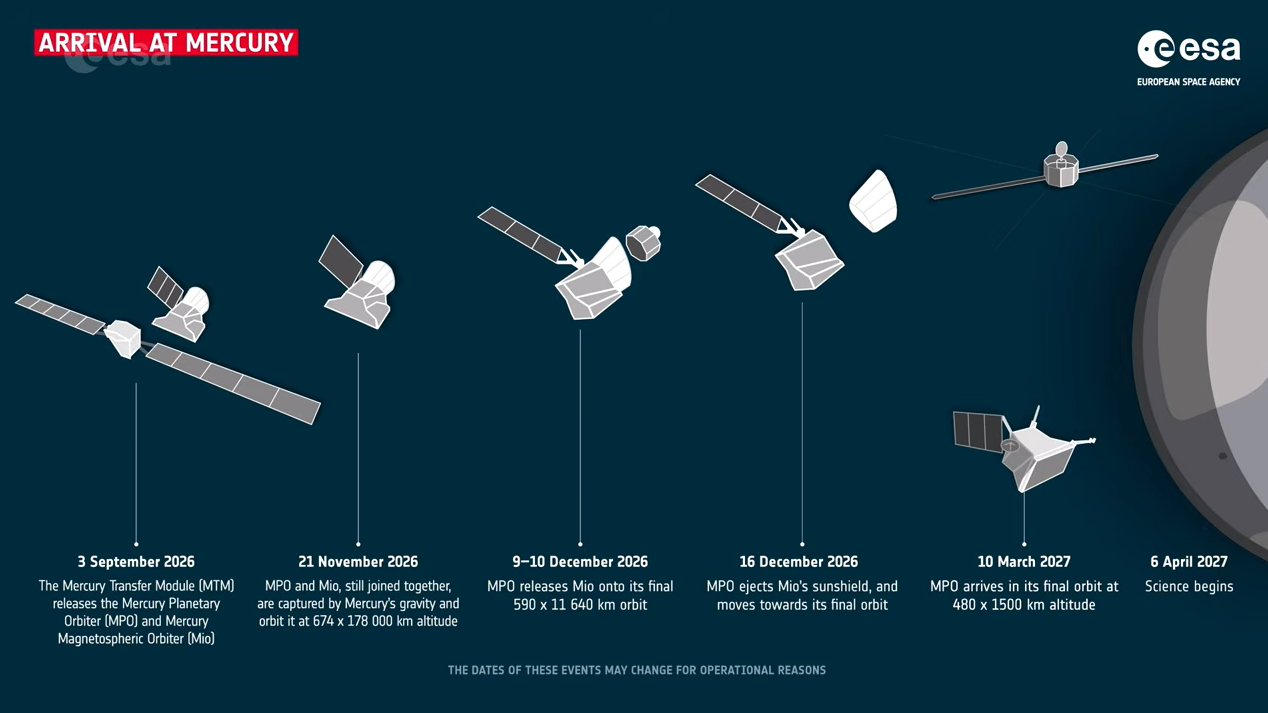
Today's maneuver doesn't place BepiColombo in orbit around Mercury quite yet. MPO and Mio will spend the next several weeks navigating toward the planet ahead of orbital insertion on Nov. 21. "Arriving to Mercury is not as simple as other missions that do a big maneuver and they are there," said Elsa Montagnon, BepiColombo's operations manager. "In our case, it's going to be six months of continuous activities."

The Nov. 21 arrival will begin a sequence of 16 maneuvers to progressively lower and reshape BepiColombo's orbit. Mio is scheduled to separate from MPO around Dec. 9 and settle into a highly elliptical polar orbit. MPO will jettison Mio's MOSIF sunshield (Magnetospheric Orbiter Sunshield and Interface Structure) on Dec. 16, then continue lowering its own altitude before reaching its own polar orbit on March 10, 2027.

A spacecraft separation illlutration showing different stages of flight.

BepiColombo's arrival at Mercury will take about six months. (Image credit: European Space Agency)

BepiColombo is scheduled to begin science operations on April 6, 2027, with MPO and Mio studying Mercury simultaneously from complementary orbits. MPO will focus on Mercury's surface composition, geology and planetary interior, while Mio will investigate the planet's magnetic field and its interaction with the solar wind.

Today's separation took place at 8:00 a.m. EDT (1200 GMT), but confirmation of that event didn't come for more than an hour following its scheduled execution. Acquisition of signal from BepiColombo came just before 10 a.m. EDT (1400 GMT), followed by a positive telemetry reading indicating the spacecraft was where it was supposed to be.

"I'm again extremely relieved," Montagnon said. "That the telemetry comes exactly at the moment we expect it, and that we see in the telemetry that the configuration of the spacecraft is the correct one," she said, "this is the best case scenario."

  •  

New York Climate ‘Superfund’ Law Falls in Court

The court said the measure, which required energy companies to pay $75 billion to the state, conflicted with federal law.

© Cindy Schultz for The New York Times

Kathy Hochul, New York’s governor, signed the law in 2024 and several other states have considered similar measures.
  •  

SuperDuper’s “Follow-Up”

Dave Nanian:

Recent versions of xOS (that is, macOS, iOS, iPadOS, etc) have Data Protection Classes from A to D that get assigned to files and folders.

[…]

The thing is, though, is that these files and folders are inaccessible unless the user is logged in, and the screen is unlocked. A few seconds after the screen locks (or you log out), the keys are purged, and they cannot be read.

[…]

That means the files any application considers to be worth protection cannot be accessed when a backup usually happens.

[…]

You may have noticed that if you had an overnight backup, when you unlock your screen, a copy starts to run. It’s typically quite brief, thanks to ⚡️Turbo Smart Update, but it might surprise you anyway. […] During your overnight copy, SuperDuper kept track of the files that it couldn’t access due to their protection class. And now that it can access them, it’s making sure they get backed up.

This seems like the right thing to do. Time Machine also does it. A backup app should try to make as faithful a backup as possible. I kind of find it annoying, though. Sometimes it can’t do a Turbo Smart Update, and so the backup that should already be done may end up taking another 30 minutes or more. The best thing to do is schedule backups while you’re using your Mac to avoid SuperDuper needing to do such “follow-ups.”

I wrote some code to try to figure out which files I have that are using data protection. Interestingly, the URLFileProtection API seems to not work on macOS. I used the lower level getattrlist() instead. Nanian recommends fcntl(). I didn’t find any protected files that I actually care about, just caches and derived data from Apple’s own apps. But, in theory, Apple or a third-party app could be saving actual user data using data protection.

Previously:

  •  
❌