A conhecida marca UGREEN lançou uma estação de carregamento da linha Nexode Pro, a qual é equipada com seis portas USB-C, uma porta USB-A e uma saída CC (corrente contínua) dedicada, oferecendo uma potência combinada de até 300W.
Assim como um novo modelo de carregador da Satechi que cobrimos recentemente, a estação da UGREEN ostenta uma tela colorida que exibe a potência total de saída, tensão, corrente e o protocolo de carregamento de cada dispositivo conectado. Ela também conta com controles sensíveis ao toque na parte superior, que permitem alternar entre cinco modos de operação.
Divulgação/UGREEN
As portas USB-C1, USB-C2 e USB-C3 suportam até 140W cada uma. Já as portas USB-C4 e USB-C5 fornecem até 100W cada, enquanto a USB-C6 tem capacidade de 30W. A porta USB-A, por sua vez, fornece 22,5W e está localizada ao lado da saída CC, de 240W.
Divulgação/UGREEN
Segundo a fabricante, a estação de carregamento consegue recarregar dois MacBooks Pro em até 50% em cerca de 28 minutos. O carregador também conecta-se ao aplicativo da UGREEN via Bluetooth ou Wi-Fi, permitindo monitorar dispositivos conectados, alternar modos de operação, personalizar a tela e instalar atualizações de firmware.
NOTA DE TRANSPARÊNCIA: O MacMagazine recebe uma pequena comissão sobre vendas concluídas por meio de links deste post, mas você, como consumidor, não paga nada mais pelos produtos/serviços usando os nossos links de afiliado.
Na semana passada, pesquisadores revelaram falhas de segurança nas configurações de proxy da Retransmissão Privada (Private Relay) do iCloud+, que também afetam navegadores baseados no WebKit que utilizam a API 1Application programming interface, ou interface de programação de aplicações. de proxy para privacidade, expondo o endereço IP dos assinantes do serviço. Pois bem, não demorou muito para que surgisse o primeiro processo relacionado ao caso.
A ação coletiva foi movida pelo escritório jurídico Clarkson, que você talvez lembre pelo envolvimento no processo sobre o adiamento dos recursos de inteligência artificial (IA) apresentados durante a WWDC24, o que resultou em um acordo o qual previu o pagamento de US$250 milhões a clientes em dezembro do ano passado.
Como sambemos, a Retransmissão Privada oferece proteção para ocultar o seu endereço IP e dificultar a ciência sobre os seus acessos na web por parte de provedores de internet e terceiros, direcionando o seu tráfego para duas camadas de proteção.
O novo caso menciona o problema na Retransmissão Privada que faz a sua barreira ser burlada nos iOS em qualquer site compatível com as Chaves-senha (Passkeys) — algo que acontece pois o dispositivo do usuário faz uma requisição web fora do próprio navegador sempre que o usuário faz login, ignorando o Private Relay — e acusa a Apple de publicidade enganosa, declarações falsas ou deturpadas e fraude.
[A Apple] sabia, ou deveria saber, que as declarações contestadas eram falsas, enganosas, fraudulentas e ilegais, no momento em que a ré fabricou, comercializou, anunciou, rotulou e vendeu as assinaturas [do iCloud+].
Convidada a comentar o caso pelo 9to5Mac, a Apple ainda não se pronunciou sobre o tema. Tim Giordano, um dos sócios do escritório, por outro lado, disse que a empresa traiu a confiança de usuários “expondo-os ao mesmo rastreamento, criação de perfis e segmentação sobre os quais a Apple os alertava”.
O texto completo da ação coletiva pode ser conferido nesse link [PDF].
Notas de rodapé
1
Application programming interface, ou interface de programação de aplicações.
Do roupeiro PAX à cozinha completa, passando pela sala, casa de banho e escritório, os Planificadores do IKEA permitem visualizar, personalizar e testar combinações de móveis e espaços em 3D directamente no browser.
An international team of paleontologists has identified a new species of early sauropodomorph dinosaur in Zimbabwe, adding to growing evidence that southern Africa hosted a richer diversity of dinosaurs during the Late Triassic epoch than previously recognized.
Os pesquisadores de segurança Talal Haj Bakry e Tommy Mysk descobriram uma vulnerabilidade no macOS a qual permite que apps confiáveis sejam substituídos por softwares maliciosos, mas o seu funcionamento é mais complexo do que parece à primeira vista.
A brecha é iniciada por arquivos de execução de aplicativos baixados pela internet, que são silenciosamente substituídos por malwares (provavelmente compactados no formato .tar). Há, porém, um grande asterisco para que o ataque seja bem sucedido, suficiente para aliviar a preocupação de muitos: ele exige que já exista um acesso prévio a esse Mac para funcionar corretamente.
A execução decorre da ausência de uma segunda verificação do Gatekeeper (sistema de defesa do macOS quanto aos arquivos de um determinado aplicativo), checando a segurança dos apps apenas durante a primeira execução. As modificações até podem condicionar a abertura de uma caixa de diálogo, mas essas permissões são solicitadas em nome do arquivo executável baixado originalmente pelo usuário, o que diminui descrenças sobre a segurança da ação.
A melhor forma de se prevenir é evitar o download de arquivos e executáveis por parte de fontes desconhecidas, inclusive nos casos em que o que foi baixado é associado a um software da sua confiança. A brecha, vale lembrar, não afeta nada baixado pela Mac App Store.
Os pesquisadores relataram o problema à Apple, que optou por encerrar o caso sem resolver a falha.
Siri Wolfram Alpha integration helped create one of the defining moments in the early history of consumer artificial intelligence. When Apple introduced Siri with iPhone 4S in October 2011, users were not merely given another form of voice control. They could ask a spoken question and receive a calculated answer rather than a page of search results.
Questions involving mathematics, measurements, dates, nutrition, astronomy and factual comparisons could be routed to Wolfram Alpha, a computational knowledge engine launched in 2009. Siri handled the conversation, while Wolfram Alpha supplied structured information and calculations behind many of the responses.
The experience could feel remarkably advanced for its time. Asking how many days remained before a holiday, comparing the populations of two cities or converting miles into kilometers no longer required opening Safari, entering a query and selecting a website.
That direct path from natural language to a useful answer established an expectation that continues shaping AI products today.
Its technological roots extend to research conducted at SRI International, including work associated with the DARPA-funded CALO project. The objective was to develop systems capable of learning, organizing information and helping people complete everyday tasks.
SRI later spun the technology into Siri Inc., founded by a team including Dag Kittlaus, Adam Cheyer and Tom Gruber. The company released a standalone Siri app for iPhone in early 2010.
The original product was designed around actions rather than ordinary web search. A user could ask for a restaurant reservation, request a taxi, check entertainment listings or search for local services. Siri attempted to understand the intent and connect the request with an appropriate online provider.
This approach was ambitious because the assistant needed to coordinate several different systems. Speech had to be converted into text, the request had to be interpreted, context had to be considered and an external service had to return something useful.
Apple acquired Siri in April 2010. Steve Jobs had personally recognized the potential of moving beyond a collection of apps toward a conversational layer capable of reaching them on behalf of the user.
When the assistant returned as an integrated feature of iPhone 4S, Apple had narrowed some aspects of the original startup vision while making the technology accessible to a much larger audience.
Siri could send messages, create reminders, place calls, manage calendar events, check weather conditions and answer questions. Apple initially labeled the feature as a beta, an unusual decision for a prominent part of a new iPhone launch.
The beta label acknowledged that natural-language interaction remained unpredictable. Accents, ambiguous phrasing, network conditions and external data providers could all influence whether a request succeeded.
Image Source: Google
Siri Wolfram Alpha Made Answers Feel Immediate
Siri Wolfram Alpha became especially memorable because it showed the difference between retrieving information and computing an answer.
A conventional search engine could locate pages containing a formula. Wolfram Alpha could apply that formula to the values supplied by the user. It could interpret units, compare quantities, calculate probabilities and organize factual data into a structured response.
That distinction allowed Siri to appear more knowledgeable than a voice interface simply reading search results aloud.
A request such as “What is 15% of $86?” could return the calculation directly. A question about the distance between planets could produce a value without requiring the user to inspect several websites. Wolfram Alpha could also answer unusually specific requests, including information about aircraft flying overhead when the necessary location and aviation data were available.
The system was not a large language model. It did not generate open-ended prose in the way current AI assistants do. Wolfram Alpha relied on curated data, symbolic computation, algorithms and formal representations of knowledge.
That structure provided an advantage that remains relevant: many answers could be calculated and traced through defined information rather than improvised statistically.
Early Siri combined several specialized capabilities instead of depending on one system to do everything. One provider might supply restaurant information, another could handle maps and Wolfram Alpha could process computational questions.
The assistant acted as the conversational coordinator.
This architecture made Siri seem like one intelligence even though the response could come from a network of separate services. Modern AI platforms have returned to a similar idea through tools, agents and external data connections. A language model may manage the conversation while calling a calculator, calendar, search engine or business system when a task requires reliable external action.
Siri demonstrated that model on a consumer smartphone more than a decade earlier.
A Small Integration Created a Large Expectation
The Wolfram Alpha partnership influenced how people began judging digital assistants.
Before Siri, voice features on phones were commonly associated with rigid commands such as calling a contact or selecting music. Siri invited users to speak more naturally and attempt questions that would previously have been typed into a browser.
The results were inconsistent, but successful interactions changed perceptions immediately. The iPhone appeared capable of understanding intent, reaching into a knowledge system and returning a concise answer through one conversational interface.
That apparent simplicity concealed substantial infrastructure. Speech recognition, language interpretation, location, personal context and external databases all had to work together quickly enough to preserve the feeling of a conversation.
Wolfram Alpha also gave Apple access to expertise that would have taken years to reproduce internally. Stephen Wolfram had spent decades building Mathematica and computational systems before launching the public knowledge engine.
Following the Siri announcement, Wolfram described the integration as a characteristically direct Steve Jobs decision: users wanted access to knowledge and actions without unnecessary intermediate steps.
That idea became more influential than any individual answer Siri provided.
The assistant did not need to show how many services had participated. It needed to understand the request and return the result.
Early Siri Also Revealed the Limits of the Model
The first version of Siri could feel futuristic one moment and frustrating the next.
Some questions reached Wolfram Alpha correctly, while similar wording could trigger a web search or an unrelated response. Siri occasionally struggled to determine whether the user wanted a calculation, a local result or an action inside the phone.
Wolfram Alpha responses were also better suited to some subjects than others. Mathematical and scientific questions matched its computational structure, while casual conversation, current events and subjective requests required different sources.
Network dependence created another weakness. Early Siri processing relied heavily on remote servers, so delays or outages could make a basic request fail even when the iPhone itself was functioning normally.
Those limitations foreshadowed the central challenge surrounding modern assistants. A convincing interface encourages people to ask almost anything, but no single technical system performs equally well across every type of request.
Current generative AI can produce more natural language and handle a wider range of topics. It can also create confident errors when factual grounding is weak. The computational approach represented by Wolfram Alpha remains valuable precisely because some questions require verified data and exact calculation rather than fluent speculation.
The story behind the first Siri steps is therefore not only about an old iPhone feature. It shows that a powerful assistant needs more than a conversational personality. It requires access to dependable tools, structured knowledge and the ability to recognize when another system should provide the answer.
Siri Wolfram Alpha offered that lesson in 2011, long before AI assistants became capable of writing essays, interpreting screens and acting across apps.
O Apple TV adquiriu antecipadamente os direitos de produção de “Peculiar Stars”, o vindouro (e bastante disputado) romance de Rebecca Yarros, autora conhecida pela série de livros “Empyrean”.
A aquisição foi confirmada pelo serviço no X. A série será produzida pelo Apple Studios e contará com Yarros como produtora executiva, por meio da sua empresa Full Measures Productions.
A new tale of survival and romance from bestselling author Rebecca Yarros.
Apple Studios will develop Peculiar Stars, and Yarros will serve as executive producer through her banner Full Measures Productions. pic.twitter.com/g2KTQ6ZnSL
Uma nova história de sobrevivência e romance da autora best-seller Rebecca Yarros.
O Apple Studios desenvolverá “Peculiar Stars”, e Yarros será produtora executiva por meio da sua produtora, a Full Measures Productions.
“Peculiar Stars” será publicado em novembro e acompanhará uma jovem que fica presa em uma ilha deserta com um membro da família do seu noivo — o que transformará sua visão sobre o amor.
Quando eles são finalmente resgatados e retornam aos seus mundos repletos de privilégios, expectativas e segredos, esse retorno se mostra muito mais perigoso do que a ilha onde estavam.
De acordo com o Deadline, a Apple ainda está à procura de um roteirista para escrever a adaptação. No livro, a história terá um ritmo lento, se desenrolando por 543 dias na ilha supracitada.
O Apple TV está disponível no aplicativo Apple TV em mais de 100 países e regiões, seja em iPhones, iPads, Apple TVs, Macs, dispositivos Android, smart TVs ou online — além de também estar em aparelhos como Roku, Amazon Fire TV, Chromecast com Google TV, consoles PlayStation e Xbox. O serviço custa R$29,90 por mês, com um período de teste gratuito de 7 dias. Por tempo limitado, quem comprar e ativar um novo iPhone, iPad, Apple TV ou Mac ganha 3 meses do Apple TV. Ele também faz parte do pacote de assinaturas da empresa, o Apple One.
NOTA DE TRANSPARÊNCIA: O MacMagazine recebe uma pequena comissão sobre vendas concluídas por meio de links deste post, mas você, como consumidor, não paga nada mais pelos produtos/serviços usando os nossos links de afiliado.
Agora, o mesmo veículo informou que a Apple corrigiu a vulnerabilidade em questão em uma atualização (muito provavelmente remota) lançada em 3 de julho — mais de um ano após ter sido alertada sobre a falha.
Tyler Murphy, cofundador da EasyOptOuts e responsável por relatar a falha à Apple inicialmente, disse ter sido informado de que o caso estava sob investigação. A Apple afirmou a ele que a vulnerabilidade havia sido corrigida em março de 2026, o que não aconteceu. Nos meses seguintes, a Apple disse estar analisando o problema novamente […] por isso, Murphy contatou o 404 Media para tornar o caso público.
Como já informamos, o envio de um email para um usuário que possuía o recurso de privacidade ativado — email esse que acabava sendo rejeitado como spam — fazia com que o endereço real da pessoa aparecesse nos registros do remetente.
O 404 Media confirmou que a vulnerabilidade foi corrigida, mas ainda aponta que os usuários devem ser cautelosos.
A falha que fazia com que o recurso Ocultar Meu E-mail da Apple vazasse endereços ocultos para os remetentes foi corrigida. No entanto, não acreditamos que o risco para os usuários do recurso tenha sido eliminado. Como emails legítimos podiam ser rejeitados (gerando uma devolução ou bounce), revelando seu endereço oculto, e como os registros de transferência de email são frequentemente armazenados, presumimos que qualquer endereço oculto vinculado a um endereço do Ocultar Meu E-mail criado antes de 7 de julho de 2026 pode ter sido exposto e ainda pode constar em registros de terceiros.
A Apple, vale lembrar, já foi alvo até mesmo de uma ação judicial devido à falha, com os autores da ação buscando o reconhecimento de uma ação coletiva. Eles alegam que a Apple violou uma lei da Califórnia sobre publicidade enganosa e outras normas de proteção ao consumidor, pois a empresa sabia que o recurso não funcionava conforme anunciado.
O aplicativo Numbers permite criar planilhas, das mais básicas às mais avançadas, usando o seu iPhone, iPad ou Mac.
Se você for um assinante do Apple Creator Studio, é possível utilizar o Preenchimento Mágico (Magic Fill). Com ele, padrões são reconhecidos e colunas inteiras podem ser preenchidas instantaneamente.
Abra uma planilha que contenha uma tabela e adicione conteúdo a pelo menos duas células na coluna que deseja preencher. Em seguida, siga um dos dois procedimentos:
Selecione as células com um padrão estabelecido e as células que deseja preencher. Escolha “Célula” e “Preenchimento Mágico das Células”;
Caso o Numbers reconheça um padrão quando você estiver inserindo dados, um menu aparecerá com as sugestões. Toque/clique em “Preenchimento Mágico da Coluna” para preencher as células da coluna com os resultados sugeridos.
Pesquisadores da Group-IBapontaram a existência de um novo malware para macOS chamado ClickLock Stealer, que usa uma falsa verificação da Cloudflare para enganar os usuários, roubando dados sensíveis.
Mirando usuários na Itália, nos Estados Unidos, na Jordânia e no Reino Unido, os criminosos iniciam o ataque simulando uma verificação de CAPTCHA da Cloudflare e, na sequência, convencem a vítima a copiar e colar um comando no Terminal do Mac.
Após a execução, o malware é instalado enquanto exibe uma falsa tela de progresso. Se o usuário optar por tentar interromper a instalação ou não seguir de alguma forma com o processo, ele fecha todos os aplicativos visíveis, deixando apenas uma janela para inserir a senha do macOS. O ciclo de insistência do software pode passar dos 3 dias (algo em torno de 83 horas, segundo o estudo).
Depois de instalado, o malware começa a coletar senhas de navegadores, extensões de carteiras de criptomoedas, arquivos de carteiras digitais, dados de gerenciadores de senhas e outras informações comprometedoras.
Segundo os especialistas, o ClickLock Stealer começou a ser distribuído em maio passado, passando despercebido por todos os mecanismos de pesquisa até recentemente. Ele foi identificado em 33 países, em sua maioria europeus, sem veiculação a algum grupo de crime cibernético, distribuído muito possivelmente por uma campanha de engenharia social do tipo ClickFix.
O estudo recomenda aos usuários que nunca colem comandos de websites no Terminal, independentemente de como a página se parece ou do que ela alega fazer, e a nunca entregar a sua senha a espaços extraoficiais (como comandos) — caso você perceba que a execução de outros aplicativos está sendo encerrada. Se você desconfiar que a sua máquina foi infectada com o malware, revogue as sessões dos seus navegadores e altere todas as credenciais potencialmente comprometidas.
Siri Wolfram helped define the original promise of Apple’s voice assistant. When Siri debuted on the iPhone 4S in 2011, it could answer factual and computational questions without sending users through a list of search results. Ask about a mathematical calculation, scientific quantity, historical statistic or unit conversion, and Wolfram Alpha could provide a structured answer.
That partnership gave early Siri something many modern AI assistants still struggle to guarantee: a source designed to compute answers rather than produce plausible sentences. Wolfram Alpha was not a chatbot. It was a computational knowledge engine built around curated data, symbolic mathematics and algorithms.
Siri AI enters a far more ambitious era. Apple now wants its assistant to hold natural conversations, understand personal context, interpret images, find information across apps and complete actions. Yet the old Siri Wolfram relationship remains useful for understanding what Apple gained, what was lost as assistants became more conversational and why verified computation may become even more valuable in the generative AI age.
Siri Wolfram Was Built Around Answers
The original Siri Wolfram integration reflected a straightforward idea: users wanted direct answers without manually searching, opening websites and comparing sources.
Wolfram Alpha was particularly effective for questions with a computable result. It could solve equations, compare financial data, convert measurements, retrieve astronomical information, calculate dates and present structured scientific facts. Siri provided the voice interface, while Wolfram supplied the knowledge engine behind selected responses.
A user could ask how many days remained until a date, calculate a percentage, compare populations or request information about a mathematical concept. Siri translated the spoken request and delivered the result in a format suitable for the iPhone.
The experience was narrow compared with modern generative AI, but it had a valuable discipline. Wolfram Alpha attempted to determine an answer from structured information. It did not need to improvise an explanation every time.
That made Siri Wolfram especially useful for mathematics, science, education and quick factual calculations. The assistant could sound intelligent because it was connected to a system built to compute.
Image Source: Google
What Siri Wolfram Alpha Could Do Well
Siri Wolfram Alpha worked best when the request had a definable structure. Arithmetic, percentages, conversions, equations and statistics were natural categories. The system could also retrieve information about weather history, geography, nutrition, astronomy, transportation and other data-rich subjects.
The integration helped make Siri feel different from ordinary web search. Instead of showing several links, the assistant could present one answer with supporting figures or charts.
That approach had limitations. Wolfram Alpha could only respond effectively when it understood the request and had the relevant data or computational method. It was not designed for open-ended conversation, personal writing, emotional nuance or the countless informal questions users ask assistants.
Siri also relied on several external services, with Wolfram Alpha handling only certain knowledge categories. The experience could therefore feel inconsistent. One request produced a polished computational response, while another returned a web search or a limited canned answer.
Still, the partnership demonstrated a principle Apple has never fully abandoned: the best assistant does not need to create every answer itself. It needs to route each request to the system most qualified to handle it.
Generative AI Changed the Definition of an Assistant
Modern AI assistants are expected to do far more than retrieve facts. Users want them to explain ideas, write messages, summarize documents, analyze images, brainstorm projects and remember the direction of a conversation.
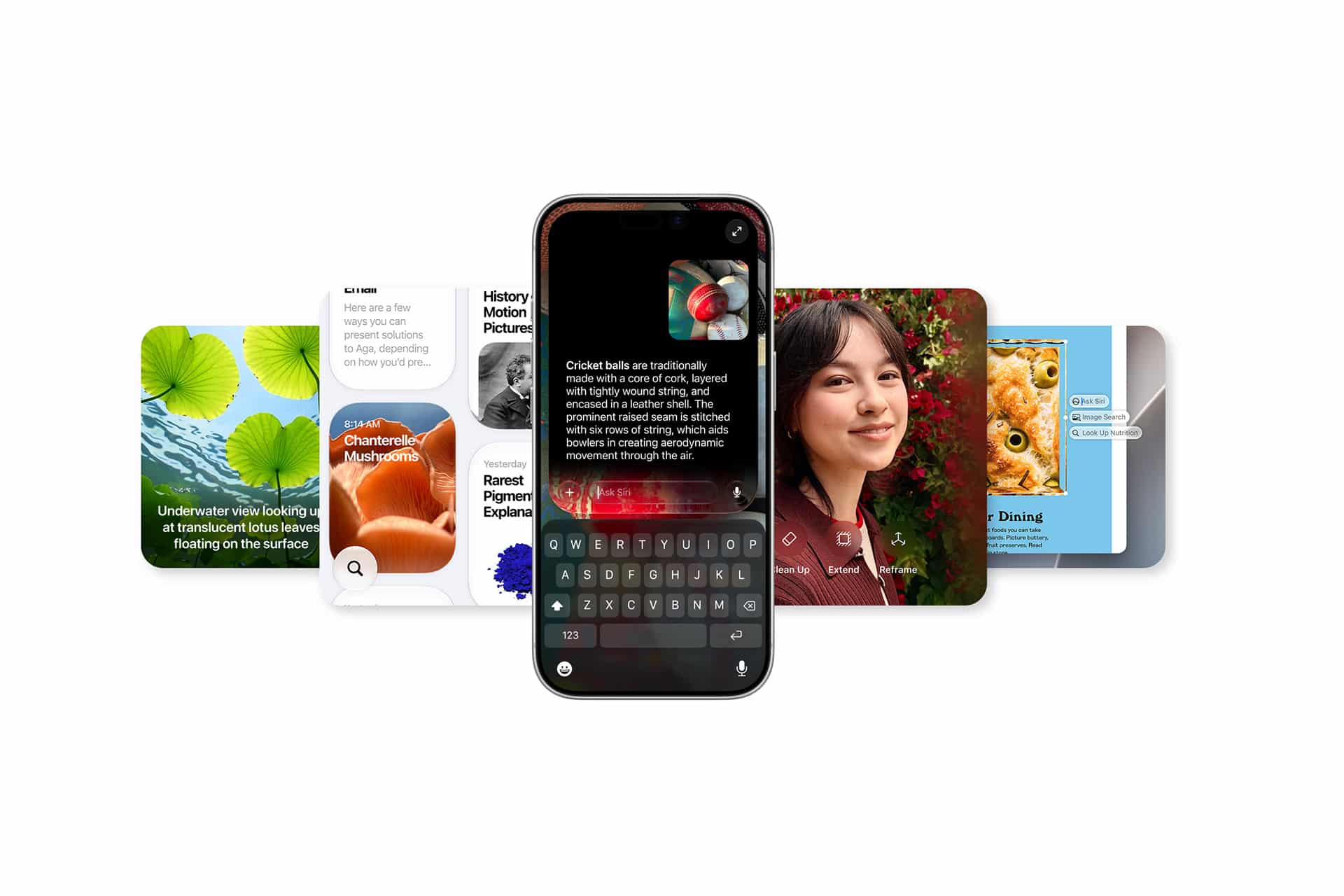
Siri AI is Apple’s response to that expanded expectation. Powered by Apple Intelligence and Apple Foundation Models, the new assistant can handle open-ended requests and continue natural conversations. It can use personal context from supported apps, understand onscreen content and connect requests with app actions.
This is a dramatic expansion from the Siri Wolfram era. The old model was largely transactional: ask a question, receive an answer. Siri AI is intended to interpret intent, understand relationships between information and help complete a larger task.
A user may ask Siri AI to find a restaurant recommendation buried in Messages, locate a hotel confirmation in Mail and add the details to a travel note. That request involves personal context and several system services rather than one public factual answer.
The assistant becomes less like a talking search box and more like an operating-system layer.
Image Credit: Apple Inc.
Conversation Creates a Reliability Problem
Generative AI makes assistants more flexible, but it also introduces uncertainty. A language model can produce an elegant response even when the underlying information is incomplete or wrong. The same fluency that makes the assistant enjoyable can make an inaccurate answer sound convincing.
The old Siri Wolfram model avoided much of that risk within its strongest categories. A mathematical calculation came from a computational engine. A unit conversion followed a defined relationship. A data query could be tied to structured information.
Siri AI needs both capabilities. It needs conversational intelligence for requests that cannot be reduced to a formula, while retaining access to reliable tools for tasks that demand precision.
Apple can use specialized systems for calculations, calendars, maps, weather, app actions and personal information rather than asking one generative model to invent every result. Foundation models can understand the request, then direct the work to an appropriate source.
That structure would preserve the strongest lesson from Siri Wolfram: intelligence also means knowing when not to guess.
Personal Context Is the New Knowledge Engine
Wolfram Alpha gave Siri access to public computational knowledge. Siri AI adds a second knowledge source: the user’s own information.
Apple says Siri AI can understand personal context across messages, emails, photos, notes and other supported content. It can help retrieve a detail without requiring the user to remember which app contains it.
This changes the assistant’s value. Wolfram Alpha could explain the distance between two cities. Siri AI could find the hotel reservation, identify the arrival time and retrieve the message where a friend recommended a nearby restaurant.
That personal layer also requires stricter privacy. Apple uses on-device processing for many requests and Private Cloud Compute when more processing power is required. The company has designed the system so personal data does not become part of an ordinary cloud AI profile.
Siri Wolfram answered questions about the world. Siri AI is being designed to answer questions about the user’s place within it.
Image Credit: Apple Inc.
Apps Complete the Transition
Siri AI also moves beyond knowledge by connecting directly with apps through App Intents. Developers can expose content and actions so the assistant can help users complete tasks instead of only describing how to do them.
That could include editing a photo, retrieving a document, starting a workout, updating a task or sending information through a supported app. Onscreen awareness adds another route, allowing users to ask about content already visible without explaining every detail again.
Wolfram Alpha remains valuable because some questions require specialized computation. App Intents extend the same routing philosophy into actions. Siri does not need to contain every capability internally. It needs to understand the request and connect it with the correct tool.
This may become the defining structure of Siri AI: one conversational interface backed by models, apps, services, personal context and specialized knowledge engines.
The Old Siri Still Has a Lesson for the New One
Siri Wolfram belonged to a more limited assistant era, but its underlying approach was disciplined. The system used a specialized source for questions that demanded structured knowledge and computation.
Siri AI has a wider assignment. It must converse naturally, interpret images, understand personal information and complete actions across Apple devices. That breadth can make Siri far more useful, but only if Apple preserves dependable pathways for calculations and factual tasks.
The future assistant should not choose between Wolfram-style precision and generative flexibility. It should combine them. A conversational model can understand what the user wants. A computational engine can provide the numerical answer. Personal context can supply relevant details. App Intents can complete the task.
The old Siri Wolfram integration showed that a voice assistant could make expert knowledge accessible through one spoken request. Siri AI now aims to place conversation, personal context and action around that foundation.
The assistant has become larger, more personal and more capable. Its credibility will still depend on something the 2011 version understood well: when a question has a correct answer, intelligence should calculate before it speaks
A Samsung associou o lançamento dos Galaxy Z Fold 8, Fold 8 Ultra e Flip 8 à estreia de Homen-Aranha: Um Novo Dia, prevista para 29 de julho. O anúncio revela pela primeira vez imagens reais dos novos dispositivos, e confirma que a tecnologia Flex Titanium pode finalmente resolver o maior problema dos dobráveis.
Today, lepidosaurs -- the reptile group that includes lizards, snakes and New Zealand’s tuatara -- are among the most diverse vertebrates on Earth, but their earliest evolutionary history remains poorly understood.
When you think of an asteroid impact, you’re probably imagining something like the cataclysmic event that nearly wiped out the dinosaurs. In an astonishingly rare event, a rock the size of the island of Manhattan could come hurtling from deep space towards Earth and destroy the world.
On the contrary, asteroids are generally leftover debris from the primordial solar system that didn’t become part of a larger body, like a planet or moon, and they’re not particularly rare. Scientists estimate that there are about 1 billion asteroids and comets classified as near-Earth objects, or NEOs. NEOs are generally much smaller than the asteroid that killed the dinosaurs. They range from weakly held-together piles of rubble 200 meters (700 feet) across, to the minuscule 2024 BX1, approximately 44 centimeters (17 inches) across.
For several decades, astronomical surveys of the sky have looked for these asteroids. NASA’s Center for Near-Earth Object Studies (CNEOS) Fireball and Bolide Database has records of over 1,000 incidents of objects colliding with our planet since the mid-1990s. Among these is a set of 11 objects that scientists detected before they hit Earth, known as imminent impactors. Finding imminent impactors allows scientists unique opportunities to study the smallest building blocks of the solar system, enabling them to learn more about asteroid composition, structure, and history.
A team of scientists recently conducted a study on how the newly built Vera Rubin Observatory could detect more imminent impactors before they strike Earth. They examined the CNEOS Fireball and Bolide Database impact records spanning February 1, 1994, to January 1, 2026, for records of the asteroids’ coordinates, velocities, and the energy they released at the time of collision.
They found that 343 NEOs met this criterion, including 5 known imminent impactors. Using these recorded data, they reconstructed the objects’ pre-impact characteristics. The team predicted the asteroids’ orbital paths from the recorded coordinates and velocity. Assuming the objects were spherical, they estimated the size from velocity and impact energy. From this information about the asteroids’ state before impact, the team could then simulate whether the Rubin Observatory would have detected them.
When small asteroids hit Earth, they mostly burn up in the atmosphere, producing a bright flash that is relatively easy to spot compared to when they are in space. The Rubin Observatory can see objects up to 10 billion times dimmer than the brightest star in the night sky, Sirius. To predict if the Rubin Observatory can detect dim NEOs, the team used the solar system simulator SORCHA. SORCHA takes an observatory’s specifications and the physical properties of the NEOs and uses these to determine whether the observatory could detect them. It also estimates the measured sizes and speeds of the NEOs, and predicts when the observatory would have seen them.
At the Rubin Observatory, an imminent impactor is considered discovered if it’s observed at least 3 separate times over 15 days before hitting Earth. So this team applied this same criterion to their simulation. They found that of their 343 impactors, SORCHA estimated that the Rubin Observatory would have discovered 14 of them before impact.
They also found that SORCHA predicted 4 additional impactors that could have been observed at least once, potentially allowing scientists to search other telescope data for evidence of their existence in pre-collision images. Based on these results, the team estimated that the Rubin Observatory could find 4% of all objects longer than 1 meter (3 feet) before they hit Earth. This percentage of discovery translates to 1 to 2 imminent impactors detected every year, at least double their current discovery rate.
The ability to more consistently find imminent impactors would allow researchers to study the smallest pieces of the solar system in detail and to draw general conclusions about the properties of objects that could potentially collide with Earth. This would also allow scientists to more accurately calculate the orbits of imminent impactors, determine where more meteorites land to recover them, and keep tabs on the extremely rare but more hazardous large impactors for planetary defense initiatives. So, humanity can learn more about the ancient solar system, and hopefully avoid going the way of the dinosaurs while doing so!
Actualmente, existen alternativas a los gases de efecto invernadero para determinados usos industriales, pero es importante evaluar con rigor su impacto climático. El grupo de investigación FOTOAIR de la Universidad de Castilla La Mancha ha estudiado el comportamiento atmosférico de un gas alternativo, el 2 fluorobutano. Los resultados muestran que tiene un tiempo de vida y un potencial de calentamiento global muy inferior a las estimaciones previas y a los límites regulatorios. Estos hallazgos evidencian la importancia de caracterizar rigurosamente los nuevos gases antes de su uso para reducir su impacto ambiental.
A lawsuit filed in California claims the automaker’s philanthropic arm stole technology intended to help poor farmers, but it is not clear to what end.

 Login