A shortage of one common nutrient could help cancer cells and viruses hide from the immune system. Researchers at Rockefeller University found that a shortage of arginine, an amino acid obtained from food and produced by the body, can interrupt the cellular machinery needed to make MHC-I proteins. These proteins act as a surveillance system, [...]
This image of the sun — the sharpest ever snapped — was captured by the NSF Inouye solar telescope. (Image credit: NSF, NSO, AURA, MPS, Inouye Tel)
Scientists have captured the sharpest image ever of our sun's surface. This view has revealed incredible new details about the inner mechanisms driving stellar activity.
What is it?
An international team of researchers using the U.S. National Science Foundation's Inouye Solar Telescope has captured the highest-resolution view of the sun's surface.
In analyzing observations from this telescope, the team, made up of researchers from the National Solar Observatory, the NSF NCR High Altitude Observatory and the German Max Planck Institut für Sonnensystemforschung, discovered strange patterns on the sun's surface. The whirling patterns, they found, are actually evidence of what's called Kelvin-Helmholtz instability (KHI), or instability that happens when there is a change in velocity of fluids.
Why is it incredible?
This image is groundbreaking. Capturing the highest-resolution view of the sun's surface is a massive accomplishment, and in the time-lapse video above, you can even see the fluid dynamics on the surface of the sun in motion.
But this view is much more than a beautiful, high-resolution image. These observations have revealed swirls on the sun's surface at the edges of the magnetic areas, allowing the team to identify KHI on the sun's surface. This fluid instability has long been suspected on the sun, but these observations are the first time they have ever been directly seen like this.
“We believe that the discovery of Kelvin-Helmholtz Instability in the solar photosphere, backed up by analysis of numerical simulations, is a major step forward in our understanding of the dynamics and evolution of solar and stellar plasma, and will serve as a basis for future discoveries," David Boboltz, the deputy director at the National Solar Observatory, said in a statement.
A paper describing these findings was published recently in the journal Nature.
Pluto's atmosphere appears to be freezing out as the dwarf planet moves ever further away from the sun, according to careful observations of Pluto astronomers made as it was seen passing in front of stars in the sky.
Pluto is already cold. Its surface temperature is about –382 degrees Fahrenheit (–230 degrees Celsius), while its upper atmosphere is a little warmer at –333 degrees Fahrenheit (–203 degrees Celsius). As Pluto moves away from the sun it will grow even colder and its nitrogen-rich atmosphere should start to collapse and freeze out, condensing as frost on the frigid surface.
Now, a team led by Amanda Sickafoose of Arizona's Planetary Science Institute believe they have seen the onset of this process. "We're at a particularly interesting point for Pluto," said Sickafoose in a statement. "Our work suggests that the atmosphere has recently started decreasing in pressure."
Pluto's orbit is highly elliptical and very oblique to the ecliptic plane of the solar system. In fact, so eccentric is Pluto's orbit that for ten years either side of its perihelion in 1989 (when Pluto was closest to the sun), it was actually closer to the sun than Neptune was.
However, ever since 1989 Pluto has been moving away from the sun on its 248-year-long orbit – we've not even seen Pluto complete half of its orbit yet since its discovery in 1930. Pluto will reach its furthest point from the sun – called aphelion – in the year 2114 when it will be about 49 astronomical units (7.3 billion kilometers/4.6 billion miles) distant.
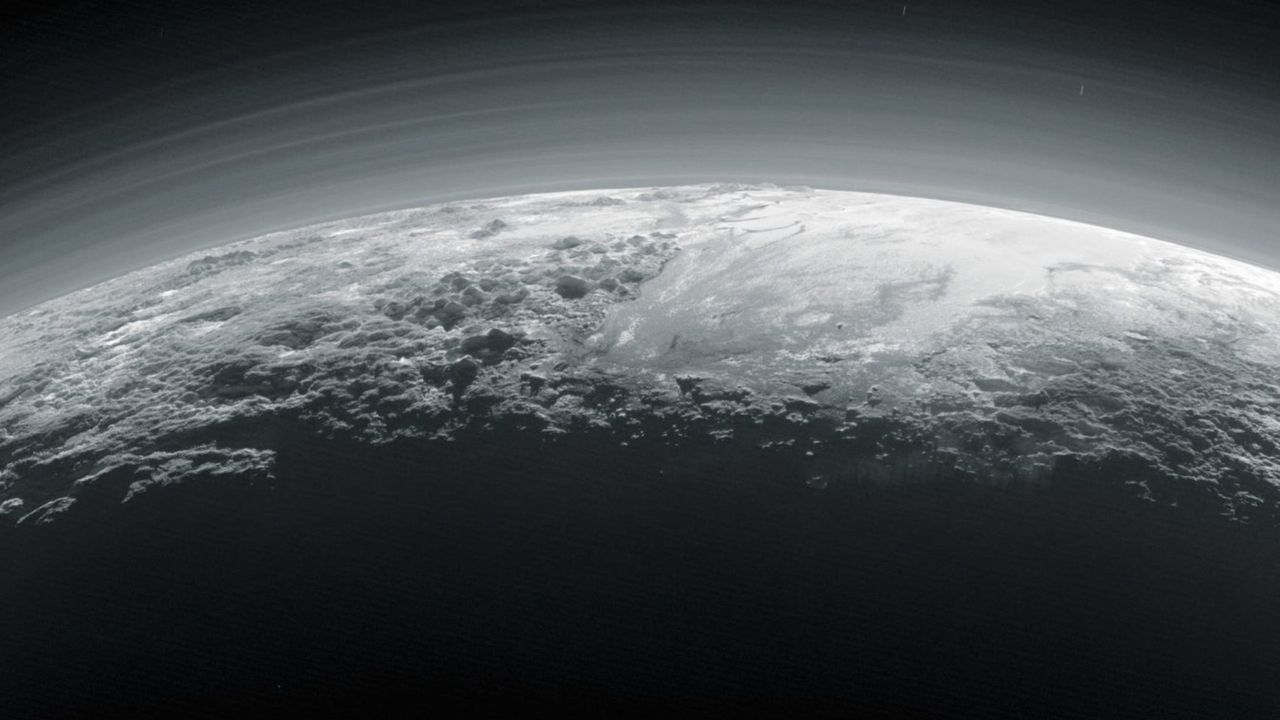
When NASA's New Horizons mission flew past Pluto in July 2015, it measured Pluto's atmospheric pressure to be 10 microbars. This is a tiny amount, millions of times lower than the atmospheric pressure on Earth, resulting from Pluto's thin nitrogen atmosphere that also contains hazes made from organic molecules including methane and carbon monoxide.
An image taken by NASA's New Horizons spacecraft that offered scientists the first look at Pluto's atmosphere in infrared wavelengths when it was taken in July 2015. (Image credit: NASA/JHUAPL/SwRI)
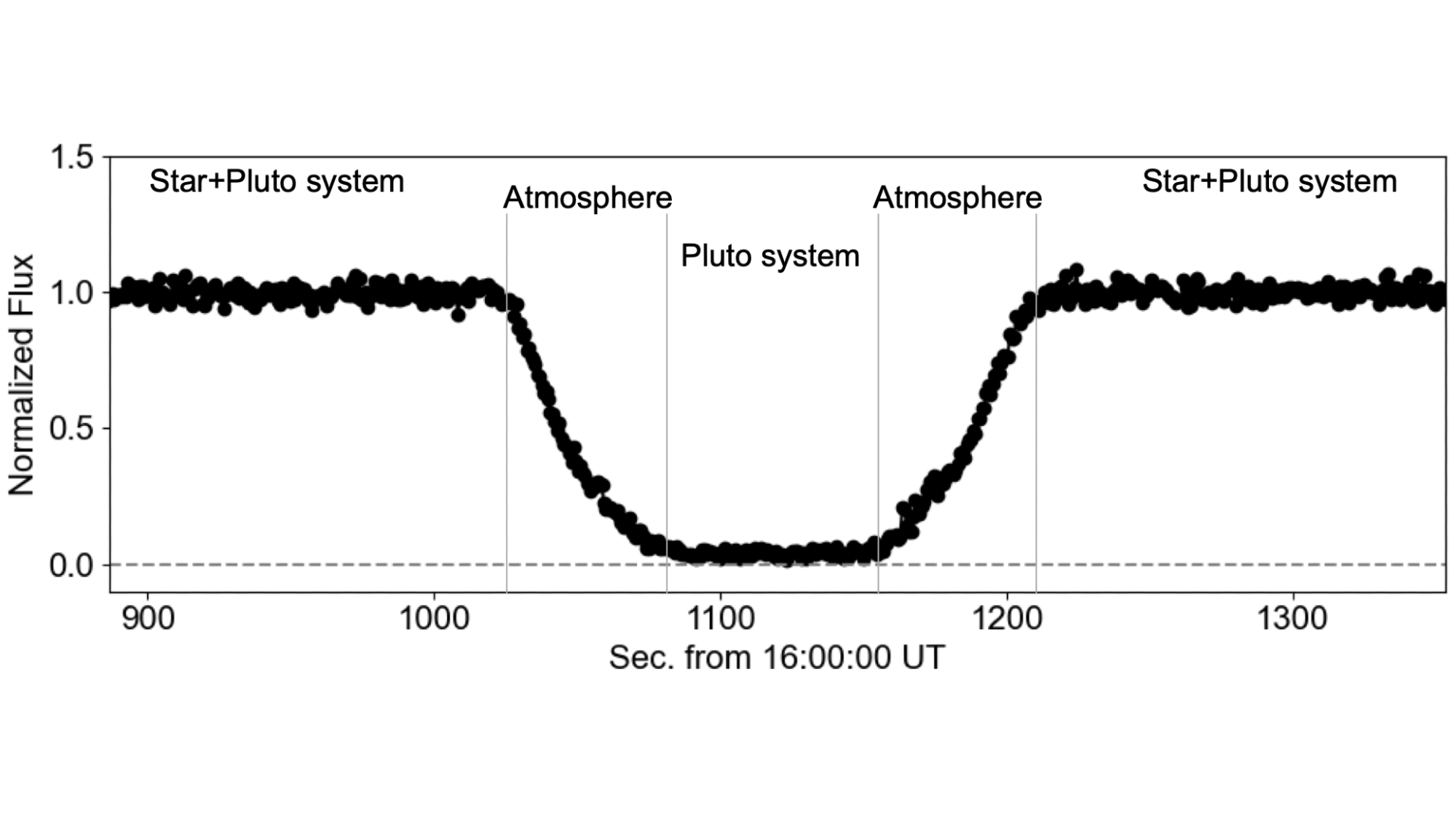
With New Horizons now having flown past Pluto and deeper into the Kuiper Belt, astronomers have to instead rely on more distant and less direct means of keeping tabs on Pluto's atmosphere. From our point of view on Earth, Pluto is sometimes seen to pass in front of a distant star. This is called a stellar occultation. When an airless body, such as an asteroid, occults (or hides) a background star the star's light winks out in an instant, before suddenly reappearing. When there is an atmosphere involved, however, the light of the star doesn't go out all at once when blocked by Pluto, but steadily fades as the atmosphere scatters and refracts the starlight before the star vanishes behind the dwarf planet's solid body.
Between 2017 and 2023, Sickafoose's team probed Pluto's atmosphere during ten occultations of stars ranging in brightness from about magnitude 12 to magnitude 18, far below naked-eye visibility.
Observing stellar occultations is not always a simple matter. They are not visible from everywhere on Earth, but only along narrow tracks, often in difficult to reach areas. The tracks, which are just a few kilometers wide, are effectively Pluto's shadow falling on the Earth. By spacing observers across the width of the track, it is possible to measure the extent of Pluto's atmosphere (there usually also has to be an unlucky observer just outside the track to confirm that is indeed the edge of the shadow track).
"I'm constantly amazed at how the simple technique of watching starlight dim and reappear allows us to study a thin atmosphere – a few millionths of the Earth's – on a world two-thirds the size of our moon and 30 times farther from the sun," said Sickafoose.
Of the ten occultations, four could be seen from observatories in multiple locations, which meant that the different observatories could confirm each other's results.
"We often prefer to observe predicted occultations that have shadow paths over large observatories because that equipment and data have proven successful," said Sickafoose. "Then, we try to improve those datasets by collaborating with local observers in the shadow paths."
Light curve from the June 1, 2026 occultation, observed from Savannah Skies Observatory in Chillagoe, Queensland, Australia. The gray vertical lines indicate different stages of the occultation. The baseline flux level contains combined light from the star and the Pluto system (Pluto plus all of its moons). The flux drops gradually as the starlight bends and scatters in Pluto's atmosphere, reaching nearly zero flux as defined by only light coming from the Pluto system. As the star appears on the other side of Pluto, the light gradually reappears in the atmosphere before returning to full strength. (Image credit: A. Sickafoose/Planetary Science Institute)
Previous work had suggested that Pluto's atmosphere began freezing out in 2018, but Sickafoose's team found that actually, Pluto's atmosphere remained constant from 2015 to midway through 2021. However, between mid-2021 and the last occultation that Sickafoose's team observed in 2023, Pluto's atmospheric pressure dropped by 16 per cent.
The pressure drop was deduced from the light curves, which show how the star's brightness changed with time during an occultation. The light curves revealed that while the structure of Pluto's upper atmosphere remained fixed, the lower atmosphere changed.
Sickafoose's team interprets this as being the haze particles settling towards lower latitudes. This is what is expected to happen when the atmospheric pressure drops.
"I am hopeful that we'll be able to get more data in the next years to decades to specifically confirm or refute this trend," said Sickafoose.
It is thought that Pluto's atmosphere won't have completely frozen onto the dwarf planet's surface by the time it reaches aphelion, and then as Pluto begins moving in towards the sun once more the feeble solar heating that Pluto receives will slowly begin to increase, causing nitrogen frost to sublimate from the surface and thicken the atmosphere once more.
The Oort Cloud is one of the strangest places in the Solar System because it has never been seen directly. Astronomers infer its existence from the paths of long-period comets: icy bodies that spend most of their lives in deep space and only occasionally fall toward the Sun. NASA describes the Oort Cloud as a […]
Planetary researchers analyzing images from NASA’s New Horizons spacecraft have found evidence that liquid nitrogen may still be seeping up from beneath the dwarf planet’s giant glacier, Sputnik Planitia, marking the first suggested case of recently flowing liquid on Pluto’s surface.
It makes sense to think that the T3SS didn’t evolve into the bacterial flagellum, but that the bacterial flagellum shed some protein parts to become a T3SS.
A protein called TRAILshort may act as a central immune brake that limits T-cell responses and CAR-T therapy. Cancer cells can weaken the immune system by producing a protein that prevents its most important defenders from attacking. Mayo Clinic researchers have identified how this protein works, revealing a possible target for treatments designed to improve [...]
Today was a cloudy and rainy day In my part of Florida and I was bored, so I decided to try Tahoe 27 Beta 2. I did a thorough cleaning of my Mac mini, made two SupeDuper clones and Time Machine backup. I'm happy to report the download and installation went as smooth as maple slurple! I'm still working my way through it but so far all seems well. I'm sure some minor glitches may occur along the way, but overall it seems solid.
Hi!
I apologize if this is easy to solve. I've read every article Apple has on the subject and still can't figure it out. In the Menu Bar, there is a crescent moon icon. Today it is filled in with white. When I click it, a box pops up telling me that Focus is on. Somehow Do Not Disturb is involved, as it is "On".
I cannot figure out how to turn off all Focus and turn off all Do Not Disturb. I've clicked each section and box to no avail. I also can't figure out how I turned this stuff on (by...
A Apple TV 4K é a melhor opção de set-top box para quem quer aproveitar ao máximo todos os serviços e recursos disponibilizados pela empresa.
O que torna essa experiência tão mágica é o sistema operacional tvOS, feito especialmente para esse produto. Para garantir todos os recursos mais recentes e também as correções de erros, é imprescindível manter o OS sempre atualizado.
Veja como conferir qual versão do tvOS sua Apple TV está rodando!
NOTA DE TRANSPARÊNCIA: O MacMagazine recebe uma pequena comissão sobre vendas concluídas por meio de links deste post, mas você, como consumidor, não paga nada mais pelos produtos/serviços usando os nossos links de afiliado.
Como ocorre com os outros sistemas operacionais da Apple, o watchOS é frequentemente atualizado. Com isso, o seu Apple Watch recebe não só novos recursos, como também correções de segurança importantes.
Neste artigo, mostraremos como é possível conferir qual versão do sistema o seu smartwatch está rodando no momento, veja só! ⌚️
Material: alumínio ou titânio Cores: cinza-espacial, prateado, ouro rosa, preto brilhante, natural, dourado ou ardósia Tamanho: 42mm ou 46mm Conectividade: GPS ou GPS + Cellular Pulseiras: esportiva ou estilo milanês
NOTA DE TRANSPARÊNCIA: O MacMagazine recebe uma pequena comissão sobre vendas concluídas por meio de links deste post, mas você, como consumidor, não paga nada mais pelos produtos/serviços usando os nossos links de afiliado.
T cells may use a previously unknown CD64-dependent pathway to attack acute myeloid leukemia. T cells are generally thought to identify cancer through a well-established molecular recognition system. Yet when researchers removed a key part of that system from acute myeloid leukemia (AML) cells, the immune cells continued killing them. The unexpected result led scientists [...]
O macOS é o sistema operacional que equipa os computadores da Apple, os Macs.
Para receber os novos recursos e estar sempre protegido contra ataques ou brechas de segurança, é recomendável manter o seu dispositivo atualizado para a última versão disponível.
Veja como conferir qual versão do sistema seu Mac está usando! 👨💻
Cores: preto-espacial ou prateado Tela: padrão ou nano-texture Chips: M5 Pro ou M5 Max Memória: 24GB, 36GB, 48GB, 64GB ou 128GB Armazenamento: 1TB, 2TB, 4TB ou 8TB
Cores: preto-espacial ou prateado Tela: padrão ou nano-texture Chips: M5, M5 Pro ou M5 Max Memória: 24GB, 36GB, 48GB, 64GB ou 128GB Armazenamento: 1TB, 2TB, 4TB ou 8TB Adaptador de energia: USB-C de 70W ou 96W
Cores: azul-céu, prateado, estelar ou meia-noite Chip: M5 Memória: 16GB, 24GB ou 32GB Armazenamento: 512GB, 1TB, 2TB ou 4TB Adaptador de energia: USB‑C de 30W, 35W com duas portas ou 70W
Cores: azul-céu, prateado, estelar ou meia-noite Chip: M5 Memória: 16GB, 24GB ou 32GB Armazenamento: 512GB, 1TB, 2TB ou 4TB Adaptador de energia: USB‑C de 30W, 35W com duas portas ou 70W
NOTA DE TRANSPARÊNCIA: O MacMagazine recebe uma pequena comissão sobre vendas concluídas por meio de links deste post, mas você, como consumidor, não paga nada mais pelos produtos/serviços usando os nossos links de afiliado.
Saber a versão do sistema operacional que o seu dispositivo da Apple está rodando atualmente é muito importante — seja para buscar alguma ajuda com o suporte ou para saber se é a mais recente disponibilizada pela empresa.
Esse processo pode ser feito de um jeito supersimples no seu iPhone ou iPad, como mostraremos em detalhes nos parágrafos a seguir. Veja só! 🙂
NOTA DE TRANSPARÊNCIA: O MacMagazine recebe uma pequena comissão sobre vendas concluídas por meio de links deste post, mas você, como consumidor, não paga nada mais pelos produtos/serviços usando os nossos links de afiliado.
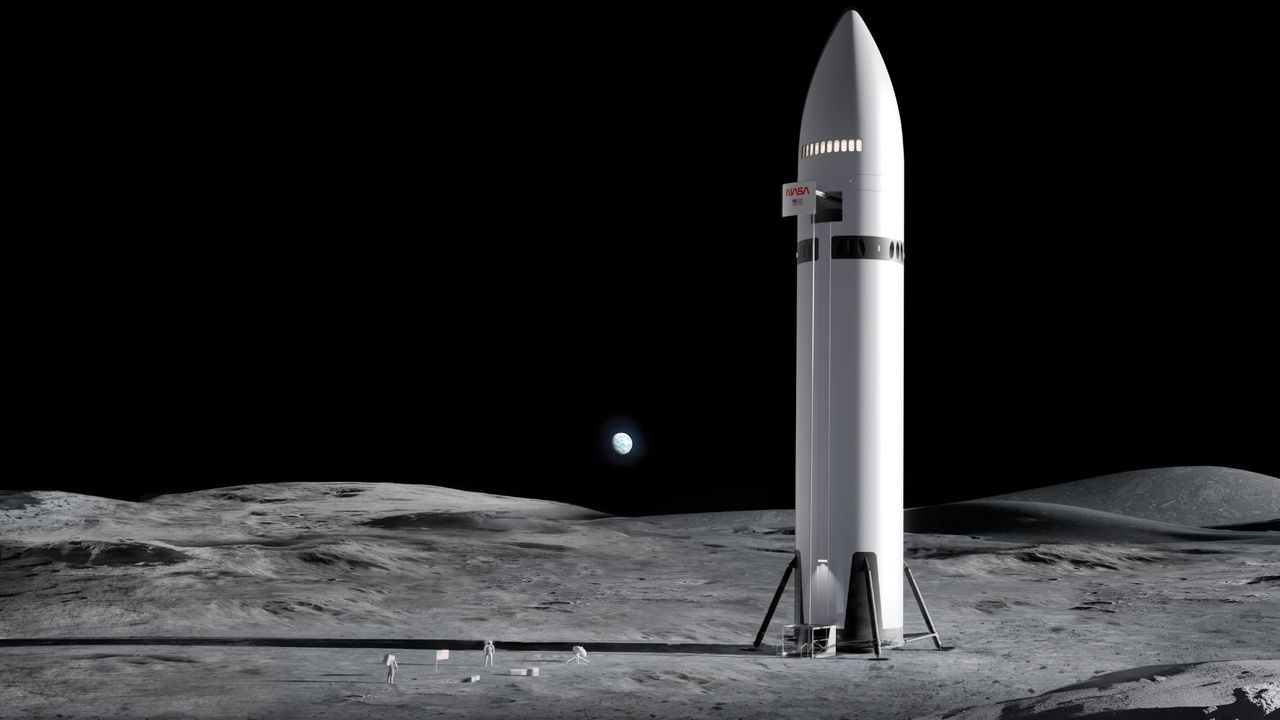
The company plans to build factories on the moon, using robots to do much of the heavy lifting, Elon Musk said on Tuesday (Aug. 4) during SpaceX's first-ever quarterly earnings call.
"We are going to land a lot of tonnage on the moon," he said. "We're going to build the factories on the moon. The robots will be helpful with that."
This is not a newly revealed vision; Musk first laid it out in February, in a blog post that announced SpaceX's purchase of xAI, a company that the billionaire entrepreneur founded in 2023. But Musk doubled down on it this week, showing investors that off-Earth manufacturing is very much front-of-mind for SpaceX.
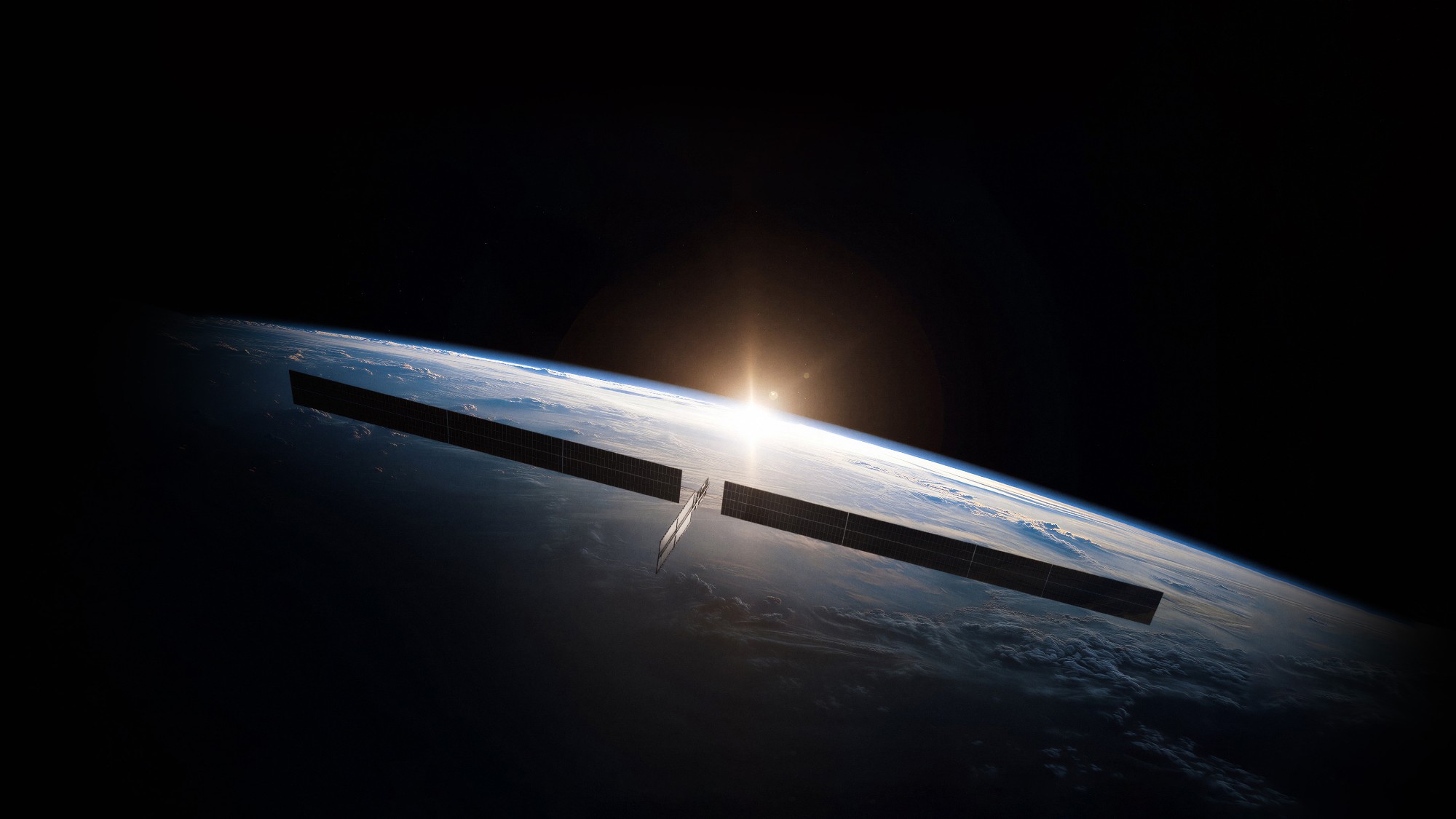
The factories in question will build SpaceX's Starmind AI satellites, if all goes according to plan. The company aims to operate a million-strong Starmind constellation in Earth orbit in the coming years, and then go farther afield with the craft after that.
Eventually, SpaceX wants to launch locally made Starmind satellites off the lunar surface using electromagnetic mass drivers — basically, extremely powerful rail guns.
"Using robots on the moon to scale up manufacturing on the moon — which, I know it sounds, like, super sci-fi right now, but it's going to happen — will enable us to build the mass accelerator on the moon," Musk said.
"And if you have a mass accelerator on the moon, and you have solar and radiator production on the moon, you can — I know this sounds totally nuts — but you can you can probably scale to 1,000 times the economy of Earth in terms of intelligence launched to space, but probably, you know, maybe even a million times," he added.
"Solar and radiator production" refers to the manufacture of key Starmind satellite components: solar panels to power them and radiators to dump the large amounts of heat they'll produce into the vacuum of space.
A rendering of one of SpaceX's planned "Starmind" AI satellites in orbit. (Image credit: SpaceX)
Musk didn't provide details about the robotic lunar labor force. But he's presumably counting on Optimus, a humanoid robot built by another one of his companies, the carmaker Tesla. Musk has previously said that SpaceX will launch some Optimus units to Mars in the near future, to help pave the way for human settlement of the Red Planet.
Those robots will fly on Starship, SpaceX's fully reusable next-gen megarocket, which is currently gearing up for its 14th test flight. Indeed, Starship is key to most of the company's plan's both in Earth orbit and beyond.
"Starship aims to quadruple payload capacity and reduce launch costs by 10 times compared to our Falcon 9 rocket, unlocking significant capabilities across all of our business segments," SpaceX Chief Financial Officer Bret Johnsen said during Tuesday's earnings call.
"We continue to make progress building the infrastructure required to support thousands of Starship launches per year, including accelerating Raptor and launch vehicle production, the buildout of our gigabays, and making significant progress towards activating multiple launch pads at Starbase and in Cape Canaveral at Pad 39A and Pad 37," he added. (Raptor is the engine that powers Starship, and Starbase is SpaceX's South Texas site, which serves as the current hub of Starship manufacturing, testing and launch activities.)
Tuesday's call was a landmark for SpaceX — its first as a publicly traded company. Musk founded SpaceX as a private concern in March 2022 and took it public this past June, via the richest IPO in history.
The IPO raised $86 billion and valued SpaceX at $1.77 trillion. Only six American companies had higher market capitalizations at the time — NVIDIA, Apple, Alphabet (Google), Microsoft, Amazon and the semiconductor manufacturer Broadcom. (Market caps fluctuate all the time, going up and down with companies' stock prices.)
The main point of Tuesday's call was to discuss SpaceX's first-ever earnings report, which covered the second quarter of this year. The company's revenue over that stretch was $7.8 billion, a 92% increase over the same period in 2025, according to the report. SpaceX lost more money than it made during Q2 2026, but the shortfall was considerably smaller than in Q2 2025 — $541 million versus $1.0 billion.
Astronomers using the 4-m Daniel K. Inouye Solar Telescope in Hawaii have detected tiny plasma vortices on the Sun’s surface (photosphere) for the first time, revealing a long-suspected process that could transport energy into the million-degree corona.
Picture it: A swarm of tiny robot helicopters descends through a reddish-brown sky, landing gracefully on the Martian surface. What are they wearing? Tiny capes.
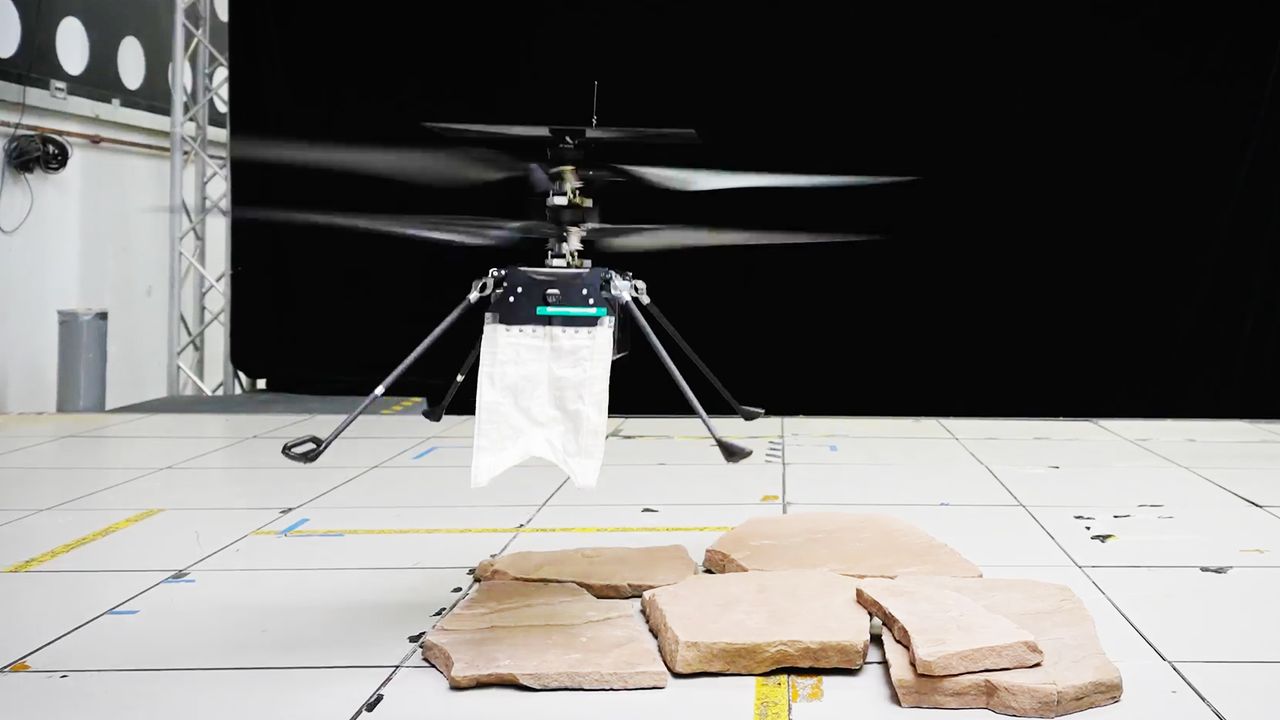
NASA's SkyFall mission will send a trio of mini rotorcraft to Mars equipped with ground penetrating radar technology which happens to look like little capes. These uniquely designed swaths of fabric look decidedly strange or even accidental in new videos from NASA's Jet Propulsion Laboratory (JPL) that show the little drones practice landing. But these capes are actually flexible antennae that will allow the craft to peer beneath the Red Planet's surface in search of water ice.
"The only way to detect shallow subsurface ice remotely is to fly close to the ground," Adrian Tang, SkyFall’s ground-penetrating radar lead instrument scientist at JPL, said in a statement on Thursday (Aug. 6). "By flying low and slow, a SkyFall helicopter could capture radar images that resolve the fine layering where dry soil gives way to ice, detecting its presence and mapping its extent."
Orbiting spacecraft have studied Mars for decades, imaging the planet and mapping it with radar. But from orbit, their radar is unable to see the first few feet of material just below the planet's surface — a zone where scientists expect to find shallow ice deposits mixed in with the rocks and dust. This work could be important for future astronauts who need to better understand the ground below their feet for safety reasons, and for future travelers searching for accessible ice to process for drinking water, oxygen and fuel.
Skyfall will follow in the footsteps of Ingenuity, the first rotorcraft on another world, which hitched a ride to Mars aboard NASA's Perseverance rover. The new choppers are based heavily on Ingenuity, which weighed just 4 pounds (1.8 kilograms) here on Earth. But Skyfall will be more capable than Ingenuity, whose main job was to show that choppers can explore the thin skies of Mars.
SkyFall's tiny cape ground-penetrating radar, which uses a type of flexible antenna called Vivaldi that was invented back in 1978, is designed to survey up to 16 feet (5 meters) below the Martian surface. The radar will be able to reach anywhere from several yards below the planet's surface to the uppermost layers of surface material.
And the antenna's unique design ensures that the SkyFall drones will be able to make these subsurface observations without damaging the equipment during landing.. The antenna is extremely lightweight, and the team miniaturized it to be both the right size and shape to fit the tiny helicopters, which sit just 6 inches (15 centimeters) above the ground at rest. The tricky thing was, the designers had to miniaturize the radar antennae while maintaining functionality. But they did just that, and these tiny radar capes will be able to bend and move out of the way as the rotorcraft do their thing, flying above and landing on the Red Planet.
"Although we managed to shrink the antenna quite a bit, it is about 1.5 times longer than the helicopter’s legs," Christine Gebara, SkyFall ground-penetrating radar mechanical lead at JPL, added in the statement.
"That means during landing, the Vivaldi has to bend out of the way — and if it lands on a rock, it bends even further," she added. "But when the helicopter takes off again, the antenna must spring back into place for data collection. Because SkyFall is expected to make dozens of flights exploring Mars, we needed an antenna that could repeatedly handle those pressures without losing its shape in flight."
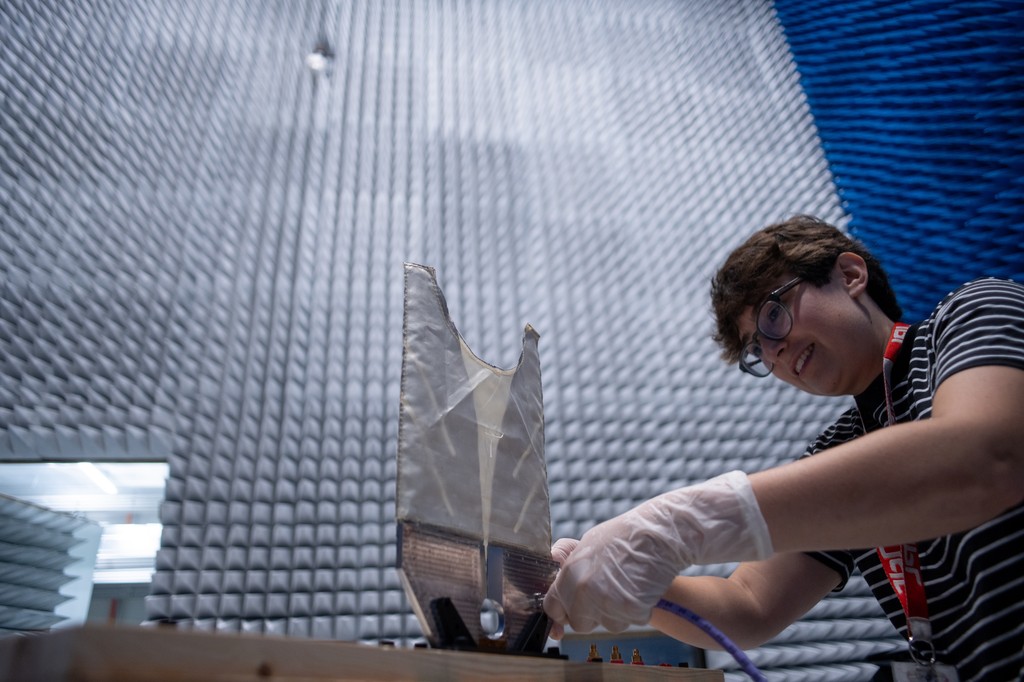
A radar engineer at NASA JPL works to test the antenna on the SkyFall helicopter. (Image credit: NASA/JPL-Caltech)
To make these little capes capable of withstanding incredible feats on another world, the engineers behind the helicopters covered the antenna in layers of polyester and Vectran, a flexible (but incredibly strong) material that was previously used for the airbag that cushioned NASA's Spirit and Opportunity Mars rovers during their touchdowns in 2004. The antenna's shape is also reinforced with flexible fiberglass tape springs and a lightweight structure. In total, each antenna weighs a miniscule 5 ounces (142 grams).
But a crafty design isn't enough. Getting to Mars is no small feat, and NASA needs to be sure that these little helicopters and their gear are up to the challenge. So, in JPL's Environmental Test Laboratory, which recreates different elements of environments beyond Earth, the SkyFall team put the rotorcraft and its little radar antenna to the test. They bent and flexed the antenna over and over, recreating multiple landings on the surface, exposed the craft to extreme temperatures, and continually checked to make sure that, throughout this testing, the helicopter could still transmit and receive radar signals. At the end of this testing, the antenna had endured 200 simulated Mars landings and was still working just fine. That is more than twice the number of landings expected from the mission.
"This test checked every box it was supposed to and answered our biggest technical questions," Tang added. "While we still have work ahead of us before the antenna is fully flight-qualified, this was a major milestone, and the hardware performed exactly as expected."
The trio of SkyFall helicopters will put their radar capes to the ultimate test when they fly to Mars. NASA plans to launch this mission to the Red Planet in 2028 aboard NASA's Space Reactor-1 Freedom, the first nuclear fission-powered interplanetary spacecraft.
The final resting place of SpaceX's moon-smashing rocket has been found.
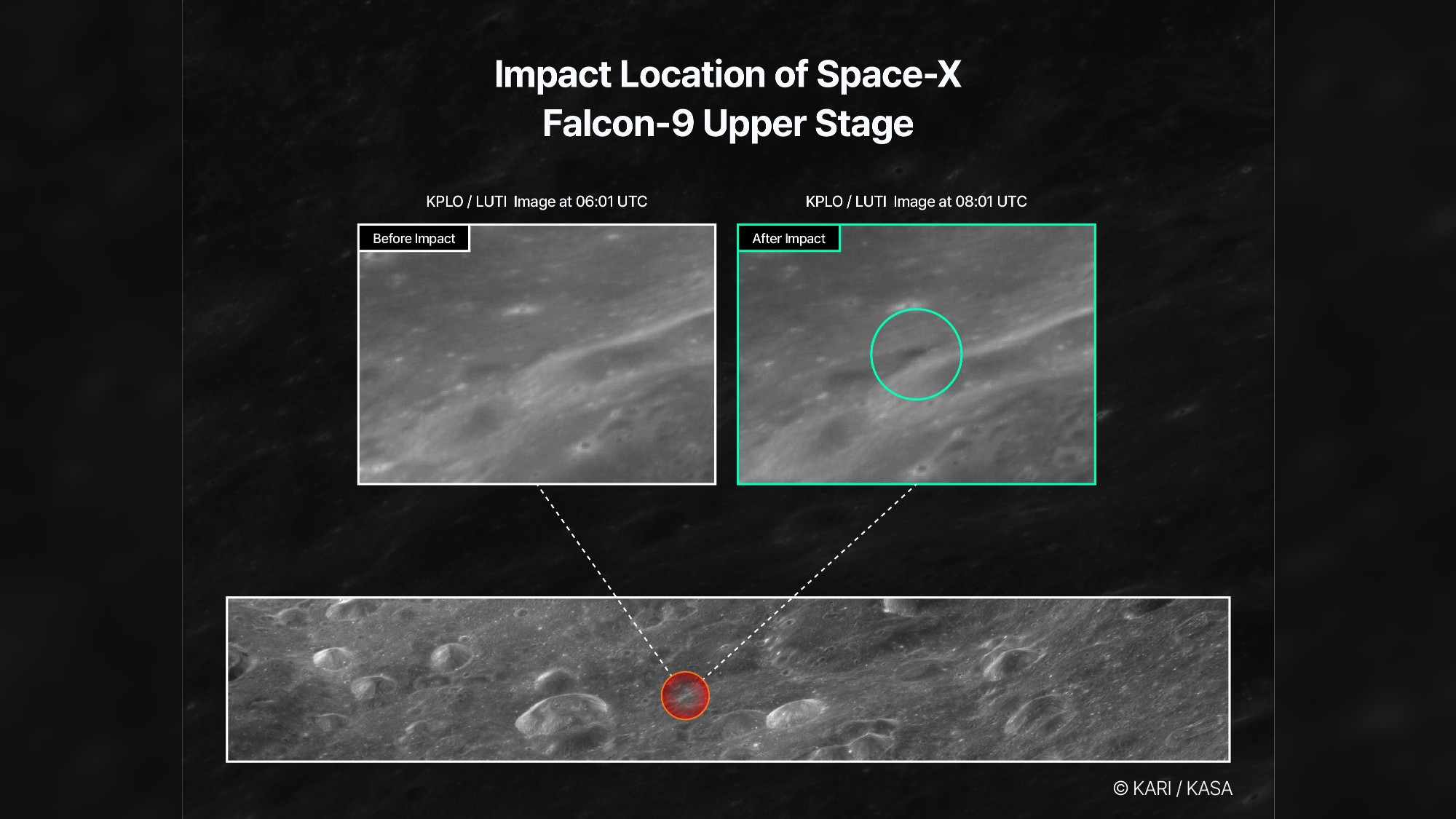
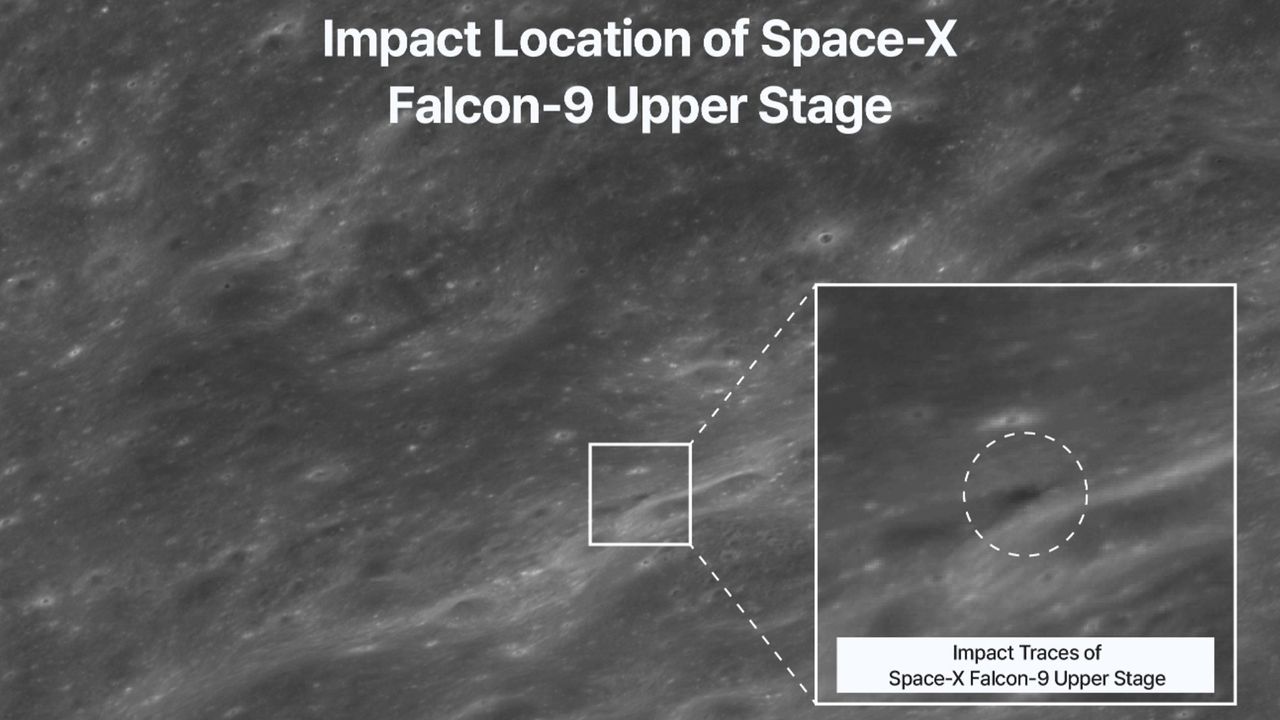
The Korea Pathfinder Lunar Orbiter, known as Danuri, has captured imagery of the crater blasted out by the Falcon 9 upper stage that slammed into the moon early on Wednesday morning (Aug. 5).
"Danuri began observations about 30 minutes before the collision and, through orbit control, passed over the impact site multiple times, conducting a total of 8 imaging sessions," officials with the Korea Aerospace Research Institute (KARI) said via X this morning (Aug. 6). "Through this observation, changes in the terrain around the impact site and traces of ejecta spread were confirmed."
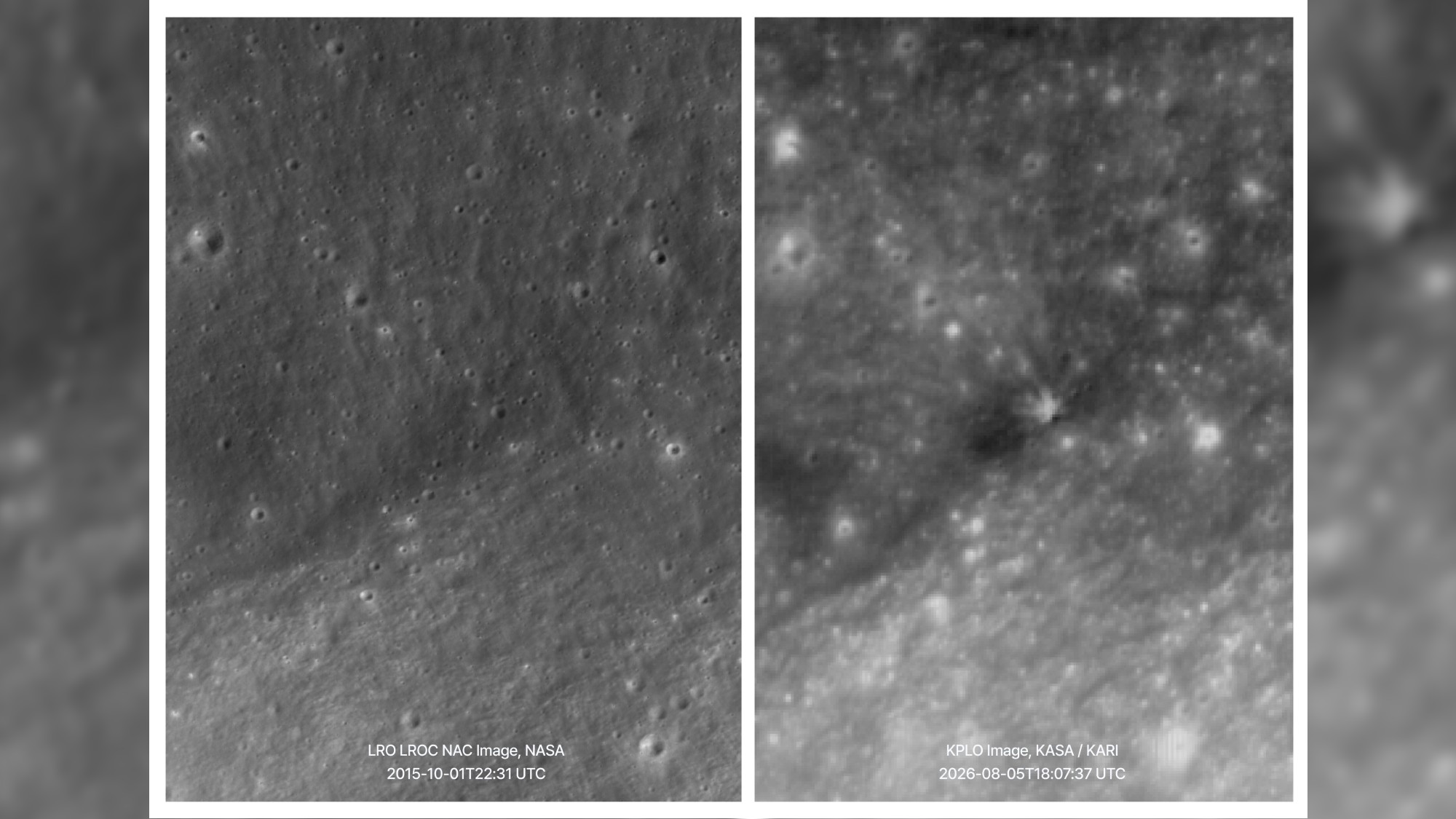
"Danuri secured both pre-collision and immediate post-collision footage, enabling analysis of changes caused solely by the collision and providing important research data," they added in the X post, which shared several before-and-after images of the impact site.
Before-and-after imagery of the impact site. (Image credit: KARI)
The Falcon 9 in question launched on Jan. 15, 2025, sending two private robotic moon landers — Firefly Aerospace's Blue Ghost and ispace's Resilience — to a high, moon-crossing Earth orbit. The duo then made their own way to the moon; Blue Ghost landed successfully on March 2 of that year, but Resilience crashed during its touchdown attempt.
The Falcon 9's first stage came back to Earth shortly after liftoff for recovery and reuse, as such boosters commonly do. Falcon 9 upper stages, by contrast, are expendable. SpaceX usually disposes of them in Earth's atmosphere, but the upper stage on the Blue Ghost-Resilience mission used almost all of its fuel getting its payloads to their distant destination. So the 8,800-pound (4,000 kilograms) rocket body remained up there, orbiting Earth — until solar activity and gravitational forces pushed it on a collision course for the moon.
Another before-and-after image, with the "before" photo taken by NASA's Lunar Reconnaissance Orbiter back in 2015. (Image credit: KARI)
That collision occurred at 2:34 a.m. EDT (0634 GMT) on Wednesday, according to KARI officials — right in line with predictions. Scientists calculated some other parameters ahead of time as well. For example, the rocket body probably hit the moon at about 5,400 mph (8,690 kph), gouging out a crater up to 89 feet (27 meters) wide.
The new observations by Danuri, as well as future work by other lunar probes, will help verify such predictions.
"The observation data secured by Danuri will be linked with follow-up observations from NASA's Lunar Reconnaissance Orbiter (LRO) and utilized in international collaborative research," KARI officials said in the X post.
It may be that some ground-based telescopes caught the impact as well. Astronomers at the Instituto de Astrofísica de Andalucía in Spain believe they captured a video of ejected material blasting off of the lunar surface around the predicted time of impact:
Our team at @iaa_csic has captured the impact on the Moon of the upper stage of a Falcon 9 rocket. We attach a preliminary video showing the evolution of the ejected material. The black area corresponds to the lunar disk @SpaceX @JuanLuisRizos @elonmusk @tiempobrasero @A3Noticias… pic.twitter.com/5Ry7hRdCeSAugust 6, 2026
The Falcon 9 upper stage wasn't the first rocket body to slam into the moon. The third stage of a Chinese Long March 3C crashed into the lunar surface on March 4, 2022, for example. And the third stage of NASA's Saturn V rocket gouged out craters during multiple Apollo moon missions.
Danuri is South Korea's first lunar probe. The spacecraft launched on Aug. 4, 2022 atop a Falcon 9 and began circling the moon four months later. It carries six payloads, five of them provided by Korean universities and research organizations. The sixth is a NASA instrument called ShadowCam, which hunts for signs of water ice in permanently shadowed regions at the lunar poles.
A spent rocket body hitting the moon made headlines this week, but the reality is that the unplanned collision by a SpaceX upper stage was just the latest in a long history of human-made objects meeting their end by impacting the lunar surface.
Astronomers around the world kept their telescopes trained on the moon early Wednesday morning (Aug. 5), when the rocket stage from a January 2025 U.S. commercial lunar landing mission was calculated to strike the celestial body. Though the fate of the SpaceX Falcon 9 part was unintentional — solar activity and gravitational forces caused the stage to slam into the moon — the impact offered a rare opportunity to try to observe the flash from the impact and the plume of lunar material it sent flying.
By noon (EDT) on Wednesday, there were no confirmed reports of the impact being caught on film, but a telescope in Chile spotted the debris plume, according to the Associated Press.
"This rare occurrence has decades of history, going back to the Apollo era," wrote Jared Isaacman, NASA's administrator, in a post to his social media accounts. "The reality is that meteoroids strike the lunar surface hourly, with impacts comparable to this upper stage occurring roughly every six days."
Inventorying the impacts
The moon is peppered with the scattered metal remains of missions that missed their mark, came down too quickly or were purposefully sent careening into the regolith to learn more about the makeup of Earth's natural satellite.
In fact, the very first mission to successfully fly by the moon was intended to be an impactor. The former Soviet Union's Luna 1 probe was designed to hit the moon but instead zoomed past its target and entered orbit around the sun on Jan. 2, 1959.
Luna 2, launched nine months later, became humanity's first object to reach the lunar surface, purposefully slamming into Sinus Lunicus ("Bay of Lunik"), along the southeastern edge of Mare Imbrium, on Sept. 14, 1959.
The U.S. followed suit, though not as NASA intended, with the Ranger 4 probe impacting the far side of the moon on April 26, 1962. The mission had included an impactor, but both it and its lander failed to operate due to a failure to deploy the spacecraft's solar arrays.
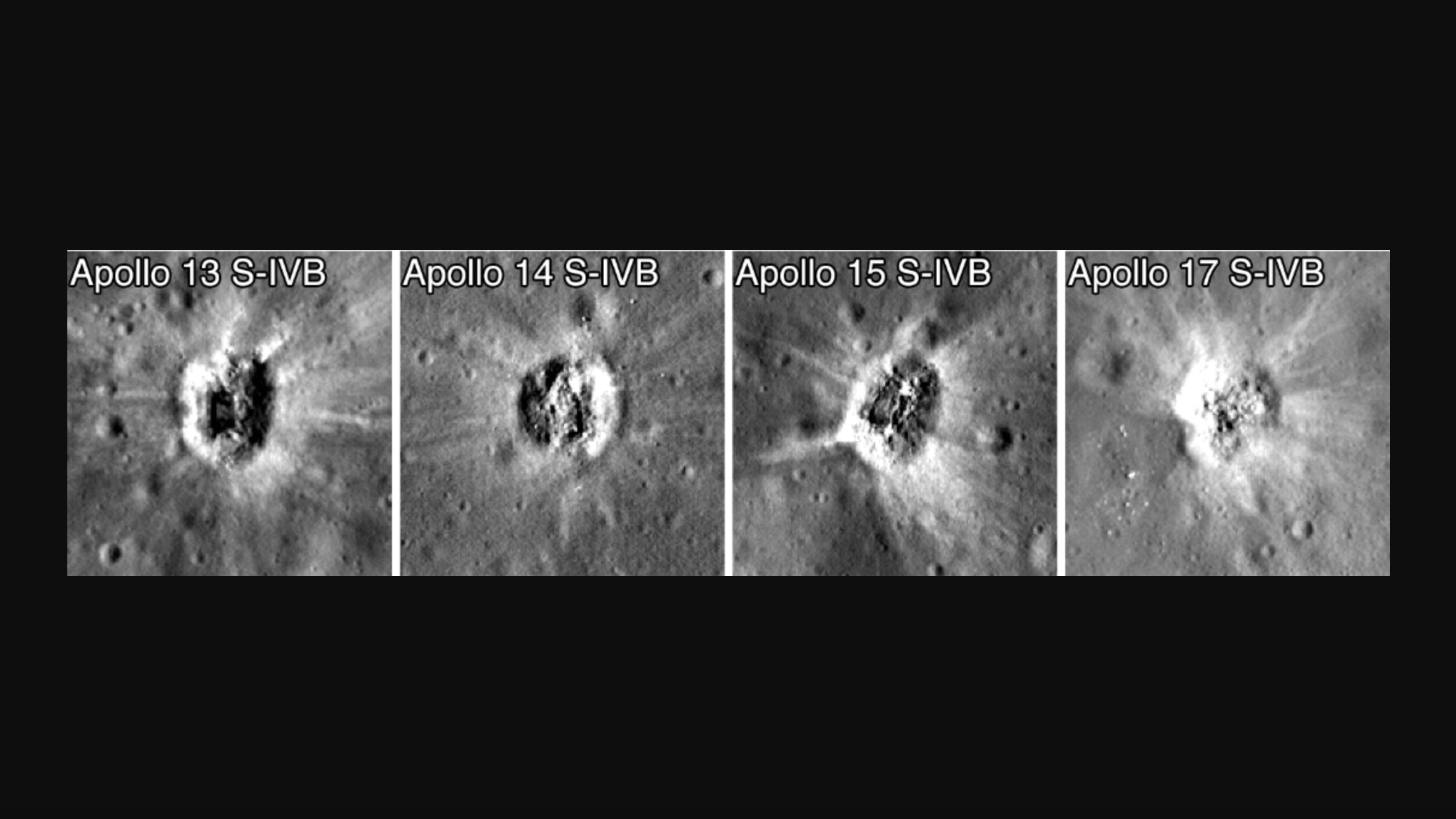
Once humans began arriving on the moon with NASA's Apollo program, scientists found another reason to direct spent rocket and spacecraft stages into a collision course with the surface. Beginning with Apollo 11 in 1969 and concluding with Apollo 16 in 1972, seismometers were placed on the moon to measure natural "moonquakes" and the effects on the moon when the missions' Saturn SIV-B stages and Apollo lunar module descent stages made hard landings.
The data collected helped geologists learn more about the interior makeup of the moon, including that a rocky mantle exists under the outer crust.
These four images, captured by NASA's Lunar Reconnaissance Orbiter, show craters formed by impacts of Apollo SIV-B stages. Crater diameters range from 35 to 40 meters (38.2 to 43.7 yards) in the longest dimension. (Image credit: NASA/Goddard/Arizona State University)
After Apollo, planned impacts (and missions) slowed down, if not outright stopped, but the SpaceX collision on Wednesday was not the first in more than 50 years. Between 1993 and today, 11 probes — four from China, three from Japan, two from the U.S. and one each from India and the European Space Agency (ESA) — were intentionally deorbited at the end of the end of their missions around the moon.
Some of these impacts were performed to discard the craft, but others — like Lunar Prospector, LCROSS and Chandrayaan-1 — helped confirm the presence of water by examining the resulting plume.
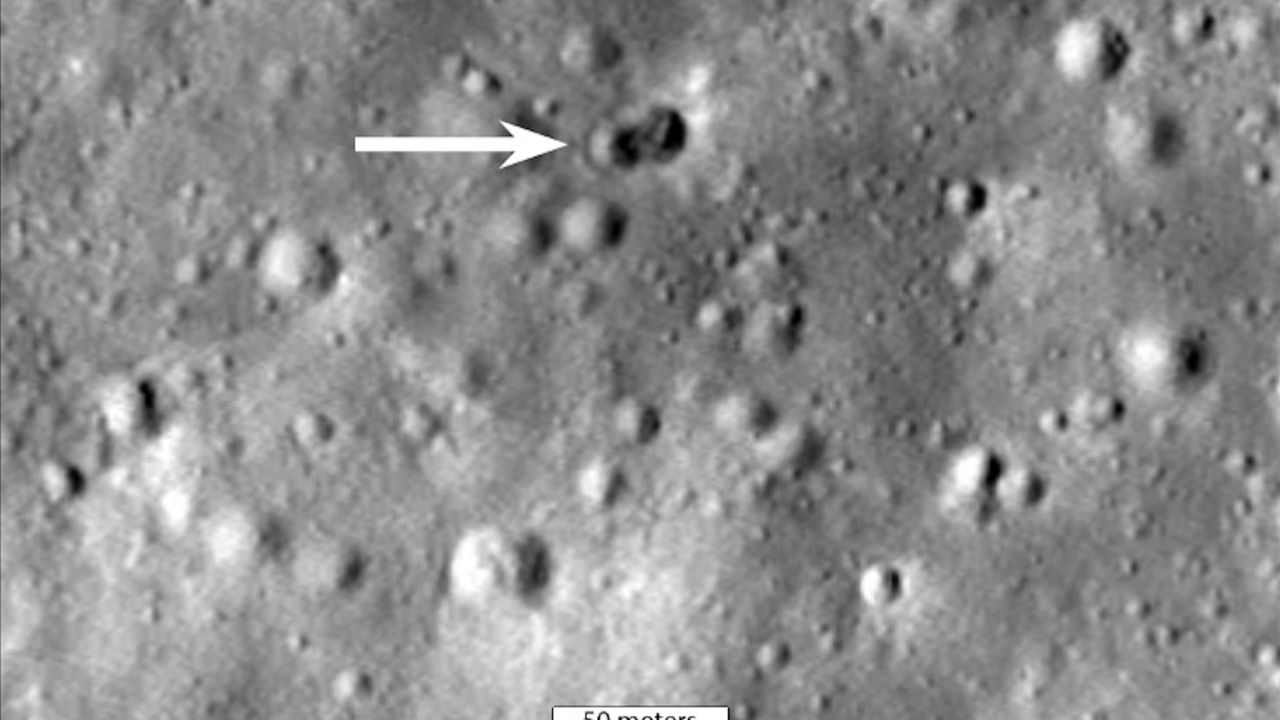
Unintentional collisions are fewer in number, as are rocket stages, but are not unprecedented. A rocket body that hit the moon's far side in March 2022, leaving behind a small double crater, was later identified as a Long March 3C rocket that launched China's Chang'e 5-T1 mission around the moon in 2014.
Litter versus liability
Without a large human population on the moon, the risk that these planned and unplanned impacts present at current is minimal. But the concern rises as NASA and other world space agencies, as well as commercial interests, begin to increase the pace on establishing their now-planned sustainable facilities for astronauts to live and work on the lunar surface.
"The future lunar base will incorporate reusable spacecraft that not only deliver astronauts and payloads, but also become part of the infrastructure itself," Isaacman said in his post, referring to how reuse can be a way to reduce the number of vehicles needed to be discarded of on the moon.
The Artemis Accords, an internationally agreed-upon set of standards led by NASA and currently signed onto by 70 countries, also includes a provision for its members that spacecraft and their associated rocket components must be disposed of safely.

 Login

 A shortage of one common nutrient could help cancer cells and viruses hide from the immune system. Researchers at Rockefeller University found that a shortage of arginine, an amino acid obtained from food and produced by the body, can interrupt the cellular machinery needed to make MHC-I proteins. These proteins act as a surveillance system, [...]