❌

Reading view

Transit-based exoplanet survey finds its first microlensing exoplanet

NASA’s Transiting Exoplanet Survey Satellite (TESS) mission has notched up its first discovery of an exoplanet via a method known as microlensing. The planet is a “super Jupiter” known as Gaia23bra b, and TESS observed it when the planet and its host star acted as a gravitational lens, magnifying the light from a second, more distant background star.

Astronomers have several ways of finding planets beyond our solar system. The most successful of these by far – and the one that TESS was designed for – is the transit method, which is responsible for roughly 75% of all exoplanet detections to date. This approach relies on observing the periodic dimming of a star’s light as a planet passes between the star and an observer here on Earth.

The transit method does have limitations, however. The main limitation is that we can see transits for only a small number of planets, namely those with orbital planes that are almost exactly edge-on to Earth. An alternative approach known as photometric microlensing is somewhat more flexible in this respect, as it relies on the star-planet system magnifying the light from a background star, which is known as the source. This magnification occurs because the gravitational pull of the planet-star system warps space, bending and magnifying the source’s light (as Albert Einstein predicted as part of his general theory of relativity) like a lens and producing characteristic spikes in its brightness.

A second bite at the exoplanetary cherry

Astronomers initially identified a planet in the Gaia23bra system using observations made in 2023 by the European Space Agency’s now-retired Gaia space telescope. However, while Gaia picked up the unexpected brightening of a background star, it did not identify this event as coming from a binary-star system, and it could not pick out the planet itself because its observations were too sparse, explains Mallory Harris, an astronomer at the University of New Mexico, US who led the TESS study.

In the new work, Harris and colleagues scoured TESS data from the same period. Because TESS’ observations were much denser – it observed the region every 200 seconds for nearly 60 days – they were able to identify extra features in the brightness of the light curve that indicated the presence of a planet in the system. Subsequent analyses revealed that this planet is about 1.63 times the size of Jupiter, and it orbits its host – an orange dwarf star 20% smaller than our Sun – at a distance similar to that of Jupiter from our Sun.

Complementary techniques

The transit technique is particularly sensitive to planets that orbit close to their star because these planets are the most likely to transit and block out most of their host stars’ light as they pass in front of them. In contrast, Harris explains that microlensing is most sensitive to planets orbiting at Earth-like distances or further from their stars, making it better for studying planetary systems more like our own solar system. “With microlensing, we can find smaller planets with greater orbital distances, including worlds in the habitable zone of their star and even farther away,” she says.

The transit technique and microlensing are therefore complementary because each reveals a category of planet that the other may not be able to detect, adds team member Diana Dragomir. The only problem, Harris notes, is that microlensing observations are limited-time opportunities. “Microlensing events happen once and they’re gone – they don’t repeat,” Harris says. “I like to joke that we’ll probably find the first Earth analogue with microlensing and then wave at it as it goes by because we’ll never see it again.”

That said, Harris says that Gaia23bra will be an important observing target for the Nancy Grace Roman Space Telescope. “Microlensing is currently the only method capable of detecting Earth‑mass planets at Earth‑like orbital distances,” she explains. “We already knew that this technique could find planets, because it has done so in the past using ground-based observatories.

“What we demonstrated in this work is that high-cadence observations (even with low spatial precision) and high-precision long-baseline observations can work together to find a microlensing planet. And that it is possible to specifically do this by pairing TESS observations with those from another instrument.”

This synergy between long-time-scale surveys and high cadence observations could be therefore applied towards future searches for potentially habitable worlds, she tells Physics World. Although Gaia was retired last January, making it unlikely that astronomers will find many additional events via a Gaia–TESS combination, Harris adds that there could nevertheless be other microlensing planets in the past eight years of archived TESS observations. “I’m excited to see whether there are other events like this already hiding in the TESS data and whether future surveys can work together with TESS to find more microlensing planets in different parts of the galaxy,” she says.

The post Transit-based exoplanet survey finds its first microlensing exoplanet appeared first on Physics World.

  •  

AI model helps physics Nobel laureate out of a decade-old mathematical jam

Two theoretical physicists – including a Nobel laureate – have solved a mathematical problem that flummoxed them for 10 years with help from Claude, the large language model (LLM) developed by the US-based firm Anthropic. In addition to its importance for fundamental physics, the result is significant because it offers further evidence that artificial intelligence (AI) is reshaping the nature of research in some fields.

The problem that kept Francesco Zamponi and Giorgio Parisi awake at night originates in the field of complex systems and relates to a phenomenon known as jamming. “Jamming describes a sudden transition at which a fluid system becomes completely rigid, yet remains disordered,” explains Zamponi, a physicist at the Sapienza Università di Roma, Italy.

To visualize this, Zamponi suggests imagining a box filled with spheres (such as tennis balls) that are floating in zero gravity, free from friction or weight. When there are only a few spheres in the box, they have plenty of room to move, bouncing off each other and the box like a classical gas. However, if you add more spheres or inflate the existing ones, space becomes increasingly scarce, and a sphere that tries to move soon impinges on its neighbours. Eventually, a critical density is reached, and every sphere is securely held by those around it, causing the entire system to “lock up” into a state where no more movement is possible.

If the spheres freeze into a regular, geometric pattern, they form a crystal-like structure that resembles carefully stacked oranges at the market. If they are compressed or added quickly, though, a crystal cannot form. Instead, they freeze into a completely disordered packing state, like a traffic jam.

Generalizing the problem

Moving beyond physical spheres into more abstract territory, Zamponi notes that jamming is an example of a highly general mathematical problem known as constraint satisfaction. “In this framework, the spatial positions of the spheres act as the variables, or degrees of freedom, while the strict rule that no two spheres can overlap serves as the constraint,” he explains. As more variables are incorporated, Zamponi adds, satisfying all the rules simultaneously becomes increasingly difficult.

Because of this precise mathematical mapping, jamming concepts are widely applied in neuroscience and artificial intelligence. In a machine learning model or a biological brain, for example, the synaptic weights represent the degrees of freedom, while the data classifications or memories that must be learned serve as the constraints.

“Just like physical spheres, an artificial neural network undergoes a jamming transition,” Zamponi observes. “In the ‘liquid’ phase, the network easily configures its weights to satisfy all constraints, allowing it to classify data perfectly. But when tasked with too much data, it hits a wall, corresponding to the ‘solid’ phase. It can then no longer satisfy all the conditions, and it begins to make errors.”

A surprising relation

In 2014, Parisi, who received half of the 2021 Nobel Prize in Physics for “the discovery of the interplay of disorder and fluctuations in physical systems from atomic to planetary scales”, and Zamponi spotted a surprising relation in the theory of jamming. Working with colleagues in the US and France, they found that in numerical calculations, two mathematical parameters, denoted a and b and related to the scaling of the distribution of contact forces and inter-sphere gaps as the system reaches the jamming point, mysteriously add up to 1. These parameters are very important for characterizing the physical structure of the packing, but try as the researchers might, they could not obtain a formal mathematical proof that a + b = 1.

Asking generative AI for help was Parisi’s idea. The problem was well-suited for machine assistance because it was well-defined, with a clear conjecture and a known numerical answer but no analytical proof. He and Zamponi chose Claude because it boasts more advanced coding and mathematical reasoning capabilities than other models of its kind.

Even so, they didn’t ask it for the proof immediately. “We first prompted Claude to replicate the numerical calculations our group had developed a decade ago,” Zamponi explains. “Once it had successfully reproduced those exact results, we took the natural next step and asked it: ‛If a + b = 1, can you prove why?’”

The model produced an initial conceptual path that was essentially correct, but that contained minor mathematical errors and required several iterative refinements and verifications. Still, Zamponi says, the “core intuition” belonged to the AI: “We had spent years looking for a complicated solution – like deeply hidden structural symmetry – but Claude showed us that the solution was far simpler; it was right there in front of us, but we had just missed it.

“The new proof connects our infinite-dimensional theory, which is more abstract but mathematically rigorous, with a framework developed at the same time by our colleague Matthieu Wyart and his team at the École Polytechnique Fédérale de Lausanne (EPFL),” Zamponi continues. “Wyart’s theory is built on more concrete physical notions, but it relies nevertheless on some assumptions.” The new result, he tells Physics World, confirms that both starting points lead to the same physical laws.

“More important than the industrial revolution or the birth of the Internet”

Zamponi believes that the advent of generative AI could be on par with, or even more important than, the industrial revolution or the birth of the Internet. As a “telescope for the mind”, he says it could become indispensable for research, allowing scientists to test ideas at unprecedented speeds. It could also lower specialization barriers and facilitate interdisciplinary work by unlocking complex literatures that would otherwise take too long to master.

On the downside, though, Zamponi is concerned that LLMs also encourage the production of poor-quality, pseudo-scientific research, straining the peer-review system. “We desperately need to figure out how to filter and review this influx,” he says. “We also need to design novel pedagogical frameworks to responsibly integrate tools like Claude into undergraduate and graduate research courses.

“To use these tools responsibly, we believe transparency is key. This is why we chose to publish our full conversation with Claude alongside our paper. If an AI sparks a genuinely new idea, we believe that its ‘thought processes’ should be public record.”

Jamming and random sequential absorption

Zamponi is now applying the approach detailed in the new work, which is published in Journal of Statistical Mechanics: Theory and Experiment, to a problem involving the random sequential absorption (RSA) of hard hyperspheres. This classic protocol for generating random packings involves introducing spheres one by one at completely random positions. “It is a vital tool for understanding the geometry of void spaces and packing efficiency, which directly relates to finding optimal error-correcting codes and navigating the mathematical ‘curse of dimensionality’,” Zamponi says.

While both RSA and jamming transitions describe how systems of hard spheres lock up, they represent two fundamentally different physical processes, he explains. In traditional jamming, particles are mobile and fluid and they continuously rearrange and relax until the entire system undergoes a collective, sudden transition into a rigid, solid-like state. RSA, on the other hand, is a strictly out-of-equilibrium, irreversible process where particles never move once placed. RSA therefore reaches a “saturation” limit rather than a true collective jamming transition.

The post AI model helps physics Nobel laureate out of a decade-old mathematical jam appeared first on Physics World.

  •  

Matter-antimatter symmetry measurement sets new precision record

A new measurement of the ground-state hyperfine splitting in antihydrogen shows that it is identical to that of normal hydrogen to within four parts per million – two orders of magnitude more precise than previous experiments. Although the measurement by CERN’s ALPHA collaboration did not reveal any asymmetries between matter and antimatter, the result is nevertheless a milestone in the search for reasons why the universe appears to be made up almost entirely of matter, with only minute amounts of antimatter.

According to the Standard Model of particle physics, all matter particles have a corresponding antimatter particle that is identical to them in every way apart from their charge and magnetic properties, which are reversed. If this model is correct, then the Big Bang that formed our universe nearly 14 billion years ago should have generated equal amounts of antimatter and matter. But in that case, neither we nor almost everything else we observe should exist, because pairs of antimatter and matter particles annihilate each other whenever they collide.

“This apparent lack of antimatter in the universe remains one of the biggest mysteries in modern physics and suggests there is something about antimatter and matter that we do not understand,” says Timothy Friesen of the University of Calgary, Canada, one of the lead authors of a Nature paper on the new measurement.

Measuring antihydrogen

To look for subtle asymmetries that might explain why matter triumphed and antimatter all but disappeared, ALPHA is performing precise measurements on the simplest antimatter atom: antihydrogen, which consists of an antiproton bound to an antielectron, or positron.

These measurements take place at the CERN Antiproton Decelerator Facility using the ALPHA-2 antihydrogen apparatus, which is designed to prevent antihydrogen from coming into contact with normal matter. It does this by confining the antimatter within a cylindrical Penning–Malmberg trap under an extremely high vacuum and surrounded by strong superconducting magnets. These magnets suspend the antimatter in the trap so that it does not touch the walls of the container it is held in, preventing it from annihilating before measurements can take place.

In the latest work, the ALPHA collaboration focused on a parameter known as hyperfine splitting. This splitting occurs because magnetic interactions between the spins of the antiproton and positron cause the positronic ground state in antihydrogen to split into four sublevels, which the researchers label |a⟩, |b⟩, |c⟩ and |d⟩.

In hydrogen, the magnitude of this hyperfine splitting has been measured extremely precisely – we know its value to within a few parts per trillion – and it is particularly sensitive to the structure of the proton. Measuring this splitting in antihydrogen with the same precision would therefore be an excellent way of searching for differences between matter and antimatter. Previously, however, the most sensitive measurements only managed a precision of 400 parts per million (ppm).

In pursuit of precision

To push beyond this level, the ALPHA researchers applied pulses of microwaves at frequencies between 28 GHz and 31 GHz to induce the positron spin flip transitions |c⟩ → |b⟩ and |d⟩ → |a⟩ between the hyperfine levels of ground-state (2S and 1S) antihydrogen atoms. By measuring the frequencies at which these transitions occurred, they could then calculate the hyperfine splitting energy.

“At a magnetic field of 1 Tesla, we measured the hyperfine splitting for antihydrogen to a precision of 4 ppm – a result that has allowed for one of the best comparisons of matter-antimatter symmetry in antihydrogen ever,” Friesen says.

While the new measurement is precise enough to push experiments into a regime that is sensitive to the structure of the antiproton, Friesen notes that it is still five orders of magnitude less precise than comparable measurements in ordinary hydrogen. “The comparisons at this level of precision with matter hydrogen are identical, and our current models of physics therefore still hold,” he says.

The team does have some ideas for further improvements. “To push the measurement to improved precisions we are aiming to induce antiproton spin flip transitions, since these can be less sensitive to magnetic field inhomogeneities, which are our biggest systematic uncertainty,” Friesen explains. “This, combined with laser cooling the antihydrogen samples to reduce the width of our spectroscopic line-shapes, could help improve the precision by at least another factor of 100.”

The post Matter-antimatter symmetry measurement sets new precision record appeared first on Physics World.

  •  

Solar tower power plants get a data boost

“Solar towers” that convert sunlight into heat could play a useful role in the renewable energy transition, but high installation costs and complex requirements limit their attractiveness to commercial operators. A team of researchers from Germany’s Karlsruher Institut für Technologie (KIT) and the German Aerospace Center (DLR) is now taking steps to change that. By creating a freely accessible database of information about how these plants work, they aim to accelerate research on solar thermal energy and drive improvements that could allow the technology to be more widely deployed in the future.

Unlike photovoltaic panels, concentrating solar power (CSP) plants do not convert sunlight directly into electricity. Instead, they generate heat by using an array of movable mirrors called heliostats to funnel sunlight onto a receiver located at the top of a tower. This heat can be used to drive a turbine to produce electricity immediately, but it can also be stored and used to generate electricity at night or on cloudy days. Depending on the plant’s location and setup, the heat could even be used directly for industrial applications and district heating.

The problem, explains study leader Kaleb Phipps, is that operating solar power tower plants safely and efficiently is a complex and expensive task. “CSP technologies have the potential to help the transition to a renewable energy system,” says Phipps, a research fellow at KIT’s Scientific Computing Center. “However, they are still not financially viable and there are operating challenges associated with them.”

Before researchers can develop and reliably test new, improved processes, Phipps explains that they need access to real-world operational CSP data. “We believe that modern data-driven machine learning methods like ours can help solve a lot of these problems,” he says.

849 gigabytes of operational data

To construct their database, which is known as PAINT, researchers collected data from the CSP tower near Jülich, Germany. These data include the exact positions of the tower’s 2014 mirrors, their dimensions, how they are warped and the way they rotate and tilt. The team also obtained fine-grained weather data for the entire 2021-2024 period under study, plus a further 218 000 images to help determine whether the mirrors were efficiently directing sunlight precisely to the top of the tower.

All in all, the PAINT database contains 849 gigabytes of operational data organized using the SpatioTemporal Asset Catalog (STAC) standard. To make these data FAIR (findable, accessible, interoperable and reusable), the researchers developed software to simplify access to the database and then published the data in a way that is freely available to all users.

Their goal, they say, is for other researchers to use this FAIR database to develop “digital twins”, or virtual replicas, of real-world CSP plants. When combined with machine-learning models, such twins can be used to answer questions such as whether the mirrors are aligned for maximal light absorption (one of the most important parameters for efficient operation) in near real time.

Community reaction

“The fact that we are receiving many positive responses regarding the data and that people seem to appreciate it is our biggest success,” Phipps says. Such responses are especially gratifying, he adds, because constructing databases like PAINT can be an arduous task.

“The main difficulties were about collecting the data, cleaning and unifying it into standard formats and parsing and organising all the metadata, which was originally complete chaos,” Phipps recalls. “We therefore put a lot of time and effort into creating standardized and automated workflows so that the process is as transparent as possible and can be reused for future data.”

The team also faced challenges when trying to convince peers that this work counted as “research”, he adds. “The fact that the data itself didn’t directly result in a new algorithm or method meant that lots of people didn’t believe we would be able to publish the results or achieve anything with them,” says Phipps. “Luckily, we were able to prove the doubters wrong.”

While the PAINT database currently contains data from only one CSP, the KIT researchers, who report their work in Nature Energy, are hoping to expand it. “We really need contributions from other CSP power plants around the world to transform the database into a truly international and diverse source for researchers,” Phipps says. “As data from different facilities is added in the future, it will be possible to develop a common standard for open operational data in solar tower research. This would speed up the development and promote a widespread adoption of this technology.”

The post Solar tower power plants get a data boost appeared first on Physics World.

  •  

Quantum entanglement explains why strange metals are so strange

Illustration showing a cubic lattice of electrons glowing with an eerie green light
Correlation explanation: Quantum entanglement between electrons in strange metals appears to account for some of their unusual behaviour. (Courtesy: Harald Ritsch / TU Wien)

“Strange” metals owe at least some of their peculiar properties to the quantum entanglement of their electrons. This finding comes from physicists at the Vienna University of Technology in Austria, who used a concept from quantum information science to guide their experiments. A similar approach, they say, could also yield a better understanding of certain high-temperature superconductors and other correlated quantum materials.

Electrons travel relatively unimpeded through most metals, but in the 1980s, scientists identified puzzling exceptions in certain cuprate high-temperature superconductors. Further examples of this “strange” metal behaviour subsequently turned up in other classes of materials, including heavy-fermion materials, pnictides and organic compounds. This resistive behaviour cannot be explained by theories that treat electrons as independent, non-interacting particles, nor by theories that include interactions while treating electrons as quasiparticles. And although multiple recent theoretical works suggested a possible role for entanglement, experimental evidence was lacking.

A novel statistical tool

To investigate further, a team led by solid-state physicist Silke Bühler-Paschen used facilities at the Institut Laue-Langevin (ILL) in Grenoble, France to perform inelastic neutron scattering measurements on a heavy-fermion metal with the chemical formula Ce3Pd20Si6. According to team member Federico Mazza, who conducted this part of the study, the scattered neutrons would normally each transfer their energy to individual particles.

However, when the researchers analysed their data using a concept called quantum Fisher information – roughly, a measure of how sensitively a quantum state depends on a given parameter – they found that they could not explain what they were seeing in terms of particles behaving independently. Instead, the data indicated that groups of at least nine quantum-entangled entities were acting collectively. Mazza says this provides direct evidence of highly multipartite quantum entanglement in the material – and, in turn, a new way of understanding why strange metals are so strange.

The parent state of high-temperature superconductivity

The strange metal state is of great interest because physicists consider it the “parent” state of high-temperature superconductivity, though it also occurs across other materials platforms. “We had suspected that some of the intriguing properties of this state might be related to entanglement but were not able to pin it down until now,” Bühler-Paschen explains. “The results are a great success for us. They confirm that our unusual approach of using methods from quantum information science for solid-state physics studies of novel materials can reveal fundamentally new insight.”

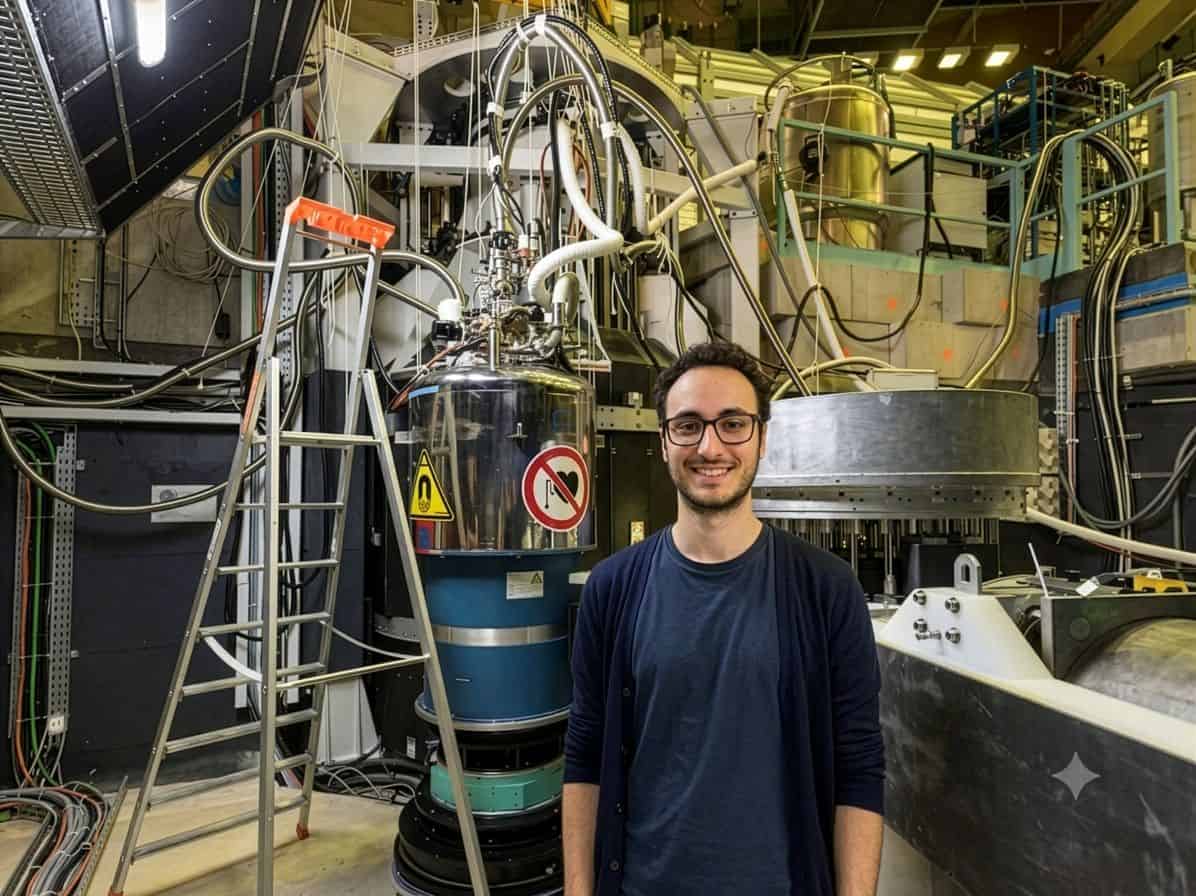
Photo of Federico Mazza in the lab at the ILL
Neutron scattering: Federico Mazza at the Institut Laue Langevin. (Courtesy: ILL Grenoble)

The experiments, which are detailed in Nature Physics, were not without challenges. For starters, the researchers needed to identify an ideal material to study the effect they were looking for and then grow it as a large, high-quality single crystal. Once they secured inelastic neutron scattering beamtime at the ILL’s powerful high-resolution triple-axis spectrometer – a difficult feat in itself – Bühler-Paschen notes that they had to obtain and analyse the data at the highest standards and support it with simulations. “Last but not least, [we had to] communicate with our peers that multipartite entanglement contains valuable information beyond correlation functions and scaling analyses,” Bühler-Paschen recalls.

Rather than being a “detail” of one particular material, Bühler-Paschen says the team’s result suggests that enhanced multipartite entanglement might be an integral part of the strange metal state. Verifying this, however, will require studies on other strange metals across materials classes, she says.

“Looking further ahead, we can envision that this aspect of strange metals finds application in quantum devices,” she tells Physics World. “It could also help us better understand high-temperature superconductors and other materials in which electrons are so strongly correlated that they lose their (quasi)particle nature.”

The post Quantum entanglement explains why strange metals are so strange appeared first on Physics World.

  •  

Super-loud gravitational waves offer a new way to study black hole event horizons

An exceptionally loud gravitational wave signal has offered an unprecedented glimpse into the region of space near a black hole’s event horizon – the “surface of no return” beyond which nothing, not even light, can escape the pull of gravity. Denoted GW250114, the signal originated from the merger of two black holes, and its unusual strength and clarity meant that astrophysicists could extract information from it that was previously only accessible via theoretical modelling.

Physicists describe a black hole’s event horizon in terms of two parameters: the black hole’s rotation frequency ΩH and its surface gravity κ. When an object falls into a black hole, it appears to orbit at ΩH because of a phenomenon known as frame dragging in which the black hole literally drags nearby spacetime along with it as it rotates. This means that objects near a black hole’s edge are constantly in motion relative to observers on Earth.

Regions of space near an event horizon can be described very well theoretically, but observational data has been hard to come by – at least until recently. “Gravitational waves are changing that,” says Sizheng Ma, a postdoctoral researcher at Canada’s Perimeter Institute who led the new study alongside astrophysicist Ling Sun and PhD student Neil Lu from the ARC Centre of Excellence for Gravitational Wave Discovery (OzGrav) and the Australian National University.

Gravitational waves are ripples in spacetime produced whenever dense astronomical objects such as black holes and neutron stars collide. With facilities such as the Laser Interferometer Gravitational-Wave Observatory (LIGO), Virgo and KAGRA (Kamioka Gravitational Wave Detector) now routinely recording these ripples, Ma says, “something that once sounded almost like science fiction – learning about black-hole horizons through observations – is now becoming a real scientific programme”.

From prediction to observation

In earlier theoretical work, Ma and colleagues in Japan, China and the US predicted that if Einstein’s general theory of relativity is correct, the gravitational waves produced when two black holes merge should carry information about the near-horizon region during the final stage of the merger. This information takes the form of a gravitational-wave component known as a direct wave that oscillates around a value that is twice that of ΩH. “The big question was whether such a signal could actually be seen in real gravitational-wave data,” Ma says.

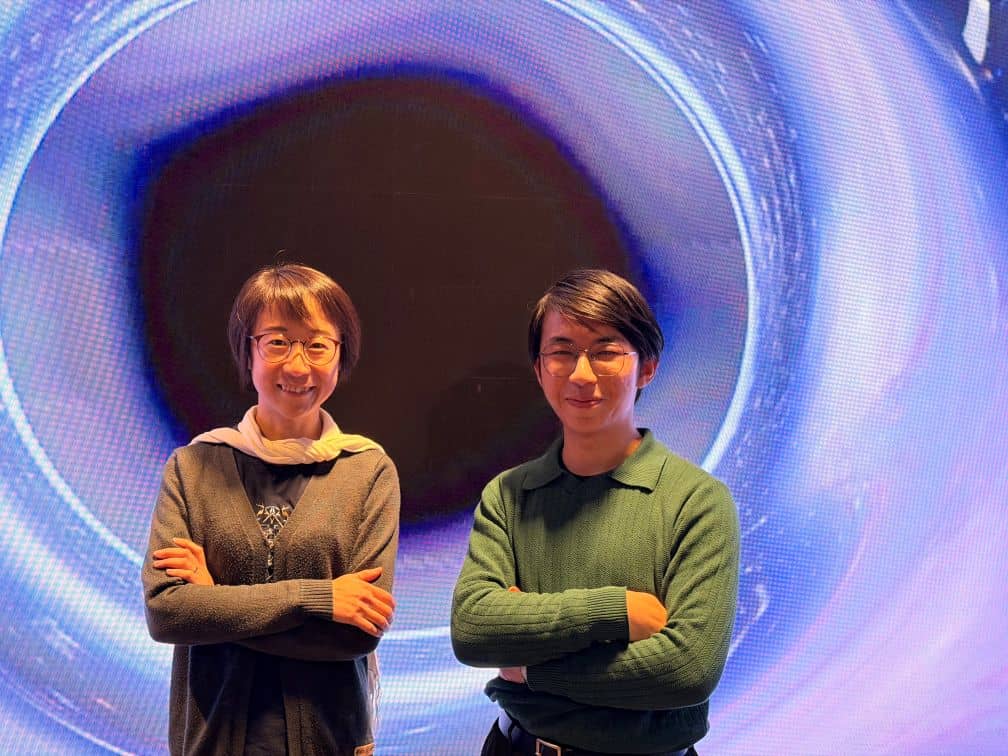
Photo of Ling Sun and Neil Lu standing in front of a glowing pixelated backdrop depicting a black hole surrounded by a swirl of blue and purple
Observing an event horizon: Team members Ling Sun and Neil Lu from the ARC Centre of Excellence for Gravitational Wave Discovery (OzGrav) and the Australian National University. (Courtesy: OzGrav/Swinburne University)

The main challenge, he explains, is that gravitational-wave data are hard to interpret. “Interesting features can appear for many reasons, so we had to be very cautious,” he says. “We needed to separate this possible direct-wave signature from the much stronger and better-known ‘ringdown’ signal of the final black hole, and then check whether the remaining pattern behaved as the theory predicted.”

When the LIGO-Virgo-KAGRA network detected GW250114 last year, the astrophysicists realized they were in luck. With a network signal-to-noise ratio of approximately 80, this event was around three times louder than LIGO’s first gravitational-wave signal in 2016, and it gave the team a rare opportunity to test their prediction against data. “Our new analyses have allowed us to decrypt the signal and measure ΩH and κ for the first time,” Ma says.

“A new way of studying black holes”

Even with an unusually clear signal, Ma acknowledges that the work required “careful modelling and many double-checks to make sure we were not overinterpreting a feature in the noise”. But if the team’s interpretation holds up, Ma tells Physics World that their method could become a new way of studying black holes. Gravitational-wave observations have already enabled scientists to study how black holes orbit, merge and settle down, Ma notes. The present work extends this by offering access to the near-event-horizon region during the merger’s final stage.

“That gives us a new observational handle on some of the most extreme predictions of Einstein’s theory, allowing us to perform sharper tests of this theory and better understand how black holes form and relax after a merger,” he says. “It also allows us to explore whether the near-horizon region behaves exactly as Einstein predicted.”

The researchers’ next step will be to improve their direct-wave model so that it describes realistic black hole mergers in greater detail. “On the observational side, we want to apply the analysis to more gravitational-wave events,” Ma says. “The result detailed in this study comes from one exceptionally loud and clean event, so the most convincing confirmation would be to see the same kind of near-horizon signature in other black-hole mergers.”

The good news is that as gravitational-wave detectors continue to improve, the researchers hope to collect more such high-quality events. “These will allow us to test whether this pattern appears consistently in the way general relativity predicts and eventually turn this first result into a more systematic way of studying the regions near black hole horizons,” Ma says.

The research is published in Nature.

The post Super-loud gravitational waves offer a new way to study black hole event horizons appeared first on Physics World.

  •  

Metasurface grating gives solar telescopes a boost

A compact optical technology that has already proved its worth in Earth-bound applications could be on its way to space after researchers at the University of California San Diego, US showed that it can map the Sun’s magnetic field just as well as traditional instruments. By making polarization gratings from specially engineered metasurfaces rather than a complex assembly of optics, the researchers say that future solar-observing missions could benefit from reduced complexity and cost as well as size.

“Our work makes use of recent advancements in nanoscale optical technologies to help improve the hardware for making astronomical observations of the Sun,” says study leader Noah Rubin of UC San Diego’s Jacobs School of Engineering. “We believe this is one of the first times that metasurface optics – which have been a subject of intense interest in both academic research and industry for about a decade – have been used to improve scientific instrumentation of any kind outside of a lab/academic proof-of-concept.”

Polarized light and solar magnetic fields

Although light emitted by the Sun is generally unpolarized – that is, the light waves do not vibrate along a particular axis – strong magnetic fields that develop near sunspots can polarize this light via the quantum mechanical Zeeman effect. These magnetic fields are closely associated with space weather events such as solar storms that can damage electronic infrastructure both on Earth and in orbit. Studying the Sun’s magnetic activity by monitoring areas of polarized light is thus an important step towards detecting or predicting such storms in time to take protective action.

Usually, measuring the polarization state of light means analysing different polarization directions using a device such as a waveplate that mechanically rotates between exposures. Rubin compares this process to taking several photographs through polarized sunglasses held at different angles, then combining them to obtain a fuller picture of what’s going on.

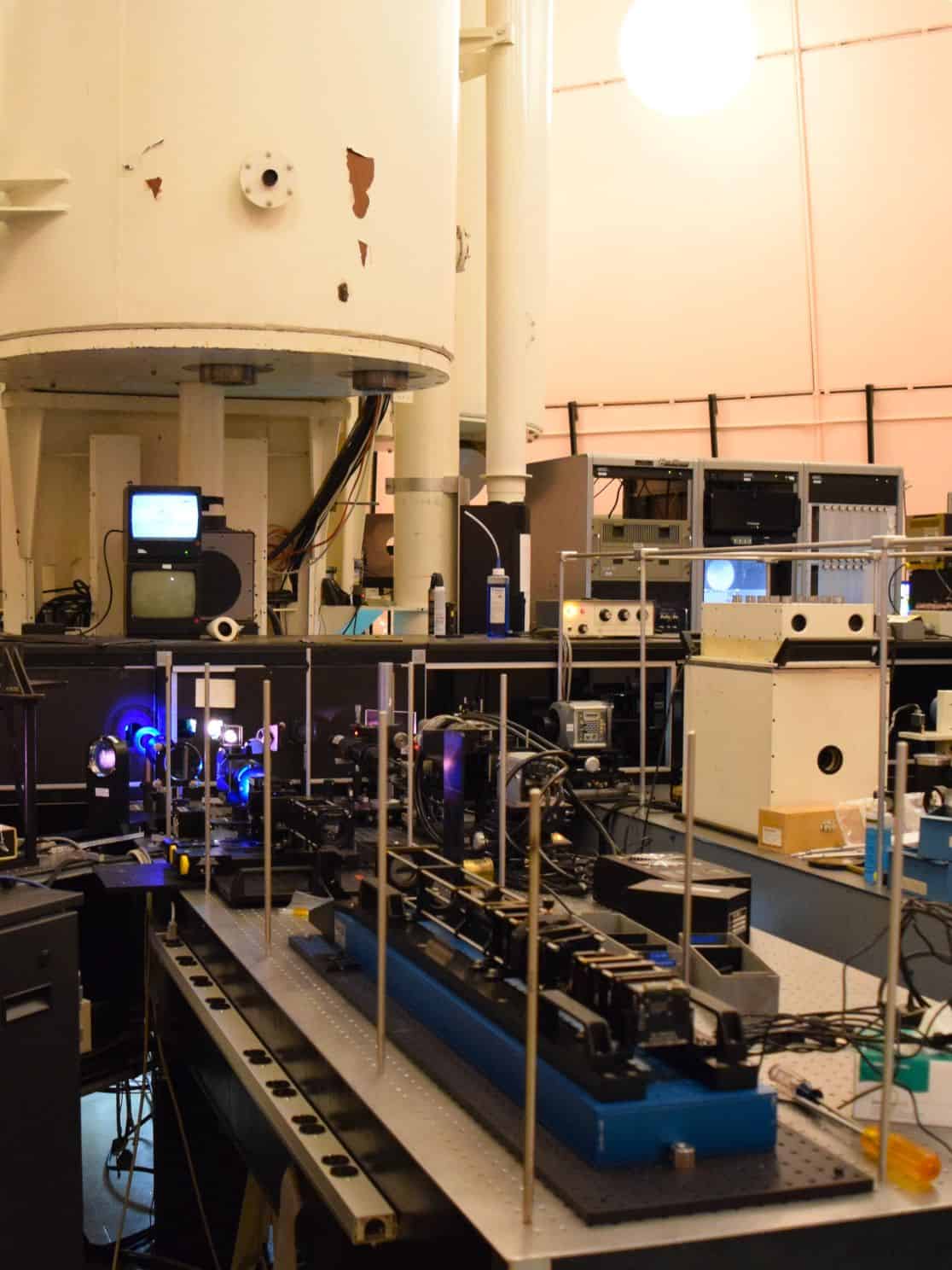
Photo of the custom-built telescope being tested at the Dunn Solar Telescope
Test rig: Sunlight from the top of the Dunn Solar Telescope’s 136-foot-tall tower travels 228 feet underground and is reflected back up to this room at ground level, where it passes through an optical system (blue lights, background) before reaching the team’s custom-built telescope (foreground). (Courtesy: Noah Rubin)

While this technique works, and instruments that use it have already been sent into space, the image analysis process is very time-consuming. It also requires an external power source, and the need to mechanically rotate the waveplate introduces extra complexity and cost, says Rubin.

“In space-based applications, a satellite itself can be moving while this component reorients, causing a highly undesirable blurring effect,” he explains. “As a result, designers of these systems often invest considerable resources into mechanical remediation and engineering to correct the motion of the telescope on the satellite, and this frequently ends up being substantially more expensive than the telescope optics themselves.”

A metasurface solution

In the new study, which is detailed in Science Advances, Rubin and colleagues solved this problem by creating a polarization-sensitive metasurface that splits light into its different polarization components. A camera-like system containing this metasurface polarization grating can then form multiple images of a scene in parallel. Rubin explains that each image in this scene is analysed with respect to a different polarization state, meaning that the system can measure the polarization of light simultaneously and passively in a single camera frame.

Rubin notes that this technique of condensing an instrument that would ordinarily involve a complex assembly of optics into a single, flat surface has previously made its way into applications as diverse as facial recognition in mobile phones and the preparation of complex photon states in quantum optics experiments. “In this work, we show that these advantages translate to polarization imaging in astronomy,” he tells Physics World.

Comparable results

Working with industrial partners at BAE Systems Space & Mission Systems in Colorado, US (formerly known as Ball Aerospace, which Rubin describes as “well-known for its involvement in the development of the James Webb Space Telescope, Hubble and countless other NASA missions”), the team designed a specialized telescope built around such a metasurface polarization grating. They also deployed their instrument on the Dunn Solar Telescope in New Mexico, US, and showed that they could quantitatively map the magnetic fields in sunspots by capturing simultaneous polarization images of these spots.

The researchers report that their results were comparable to those obtained by the state-of-the-art NASA Solar Dynamics Observatory mission in-orbit, highlighting what Rubin calls “the significant advantages that these metasurface components can offer when designed in conjunction with more traditional optical systems”. The UC San Diego team is now exploring ways of integrating its technology into future NASA solar-observing space missions.

The post Metasurface grating gives solar telescopes a boost appeared first on Physics World.

  •  

Metamaterial boosts heat transfer on the nanoscale

Specially engineered materials known as metamaterials can boost heat transfer over nanoscale distances compared with conventional materials, thanks to the coupling of quasiparticles known as surface phonon polaritons. This new result, from researchers at Carnegie Mellon University, Stanford University and Purdue University, all in the US, could help improve technologies such as on-chip cooling and thermophotovoltaic systems.

The maximum radiative heat transfer between two macroscopic-sized objects at different temperatures can be estimated by assuming that the objects are “black bodies”. These are ideal entities that absorb all the radiation falling on them and emit thermal radiation according to Planck’s law. This approximation breaks down, however, when the objects are placed within a few hundred nanometres of each other. In this case, they begin to exchange heat much more strongly thanks to a phenomenon known as near-field enhancement, which can exceed the far-field black body limit by several orders of magnitude. This effect is already put to good use in technologies such as heat extraction and thermophotovoltaic systems.

Until now, near-field enhancement had only been observed and studied in naturally occurring materials, such as polar dielectrics, doped semiconductors and metals, explain the study leaders, mechanical engineer Sheng Shen at Carnegie Mellon and electrical engineer Shanhui Fan from Stanford. Although theoretical studies have predicted that metamaterials could surpass the performance limits of naturally occurring materials, there had not previously been any experimental demonstration of metamaterial-enhanced near-field radiative heat transfer. Identifying such metamaterials would be of great use as it would allow the effect to be exploited more widely.

Heat transfer increased by up to four times

Shen, Fan and colleagues observed enhanced near-field radiative heat transfer in a nanodevice platform comprising metamaterials based on arrays of gold split-ring resonators patterned on silicon nitride membranes. The researchers positioned the metamaterials so that they faced each other across a nanoscale gap, observing that heat transfer between them increased by as much as four times compared with similar setups using ordinary materials.

As well as confirming that radiative heat transfer is enhanced over short distances for these metamaterials, the results suggest that the interaction between metamaterials and surface phonon polaritons is responsible for the increase. These quasiparticles are produced by phonons, which are vibrations of the crystalline lattice, as they interact with oscillating electromagnetic fields at the material surface – in this case, those at the surface of the gold metamaterial structures. This coupling allows heat to tunnel across the gap between them and the silicon nitride membranes more efficiently – something that increases the energy flow between the two, explains Shen.

Heat management applications

According to the researchers, the effect could help enhance and manipulate heat exchange at the nanoscale and could find applications in next-generation cooling for high-performance microelectronics, thermophotovoltaic systems for waste-heat harvesting and high-sensitivity infrared detection.

There are still a number of challenges to overcome before such applications see the light of day, however. On the theoretical side, notes Fan, the complex interactions between the metamaterial units and their supporting substrate make numerical calculations and analyses exceptionally difficult. “To address this difficulty, we have developed a numerical tool based on fluctuational electrodynamics to design the structures, alongside a coupled-mode theory model to fully elucidate the underlying physics,” he says.

Experimentally, measuring nanowatt-level radiative heat exchange across a sub-micron gap also demands extreme precision. The researchers tackled this challenge by designing an on-chip device using a “suspended thermal bridge” method that transforms the minute heat exchange into a measurable temperature rise. Indeed, they succeeded in detecting heat flow of less than 1 nW in these nanodevices.

They report their work in Nature.

The post Metamaterial boosts heat transfer on the nanoscale appeared first on Physics World.

  •  

Powerful cosmic winds may have destroyed galaxies in the early universe

A galaxy that formed around a billion years after the Big Bang is in its death throes thanks to a powerful galactic wind that is blasting its gas into space, say astronomers at Australia’s Swinburne University of Technology. The discovery, which is based on data from the James Webb Space Telescope (JWST) and the Atacama Large Millimeter/submillimeter Array (ALMA) in Chile, could help explain why some of the universe’s earliest massive galaxies ceased to form new stars.

One of the JWST’s most surprising discoveries is that when the universe was between one and two billion years old, it already contained large numbers of massive galaxies. Astronomers think these galaxies may have acquired most of their mass in intense bursts of star formation. But at some point, that process stopped: in technical terms, the galaxies became quiescent.

“These galaxies seemed to have formed all their stars very quickly and then they suddenly died, all within the first two billion years of the universe being formed,” says Rebecca Davies, who led the new research.

The CRISTAL-02 galaxy

One possible explanation for the onset of quiescence is that when galaxies collide with each other, the resulting winds “blow away” the hydrogen fuel required for new stars to form. To investigate this hypothesis, Davies and colleagues focused on a galaxy called CRISTAL-02, which was one of 20 galaxies in the recent ALMA-CRISTAL survey of early star-forming galaxies.

“When we looked at the data, it stood out because it was the only one that showed strong evidence for a galaxy wind,” Davies explains. “We saw this as an excellent opportunity to study how winds impacted the evolution of galaxies in the early universe.”

The light from CRISTAL-02 travelled for approximately 12.7 billion years to reach us, meaning that we see it as it was one billion years after the Big Bang. Because the universe has been expanding since then, the galaxy’s spectra appear highly red-shifted. This meant the Swinburne astronomers needed the JWST’s infrared-sensing capabilities to analyse a spectral feature known as the hydrogen-alpha (Hα) line that is normally red. They also used ALMA to analyse CRISTAL-02’s C II line, which comes from ionized carbon and has a (non-redshifted) wavelength of 158 mm. Both emission lines can yield important information about the properties of early galaxies.

Living fast and dying young

From the ALMA-CRISTAL survey’s measurements of Hα luminosity, astronomers knew that CRISTAL-02 forms stars at a rate of around 260 M☉ per year. This is about three times the average value for “main-sequence” star-forming galaxies at similar mass and redshifts.

The latest observations, however, suggest that it won’t maintain this pace for long. Davies and colleagues identified a huge plume of C II emissions that extends as far as 7 kiloparsecs (kpc) to the north-east of CRISTAL-02, making it almost as long as the galaxy itself. This is a telltale sign that gas is being driven out of the galaxy. The fact that the gas in this plume is blue-shifted by 100 km s-1 lends further support to this explanation.

If this rapid blowout continues, Davies says that CRISTAL-02 will cease to exist in less than 50 million years. But the team’s findings may have implications beyond the fate of this single galaxy. “Our results could help to explain how some of the earliest massive quiescent galaxies in the universe behave,” she tells Physics World. “When the JWST started observing distant galaxies in 2022, it found far more evolved galaxies in the early universe than models predicted. These galaxies seemed to have formed all their stars very quickly and then suddenly died, all within the first two billion years of the universe. The galaxy we discovered seems to be following this path.”

Learning about the early universe

Davies explains that because the early universe was much more compact than it is now, collisions between galaxies were common. During such collisions, gas funnels towards the galactic centres, triggering strong bursts of star formation but also producing strong winds that eventually drive the gas away. “If many early galaxies collide and experience rapid growth, then it may not be surprising at all that we see so many dead galaxies in the early universe,” she says.

The researchers stress that the present work, which is detailed in the Monthly Notices of the Royal Astronomical Society, is based on a case study of just one galaxy. They now need to observe other early, massive galaxies caught during periods of intense growth to determine whether they, too, experience powerful winds that could rapidly expel their gas and stop them from forming stars.

The post Powerful cosmic winds may have destroyed galaxies in the early universe appeared first on Physics World.

  •  

Frost spreads across surfaces via suspended ‘ice bridges’

Frost can spread not only along surfaces but also via suspended “ice bridges” that form above them. The discovery of this previously unknown frost-propagation pathway could lead to new ways of making surfaces that resist frost growth, thereby improving the performance of devices that operate in cold, humid environments.

Frost accumulation is a major problem in refrigerators, aeroplanes and heat pumps, to name just a few. On the microscale, it primarily spreads from one individual freezing water droplet to the next via two-dimensional bridges, or causeways, that temporarily form on the surface of an object. Although the wettability of the surface is known to affect the spreading process, the mechanism behind this effect was poorly understood.

Ice bridges can grow in two distinct spatial modes

To learn more, a team led by physicist Nenad Miljkovic at the University of Illinois Urbana-Champaign, US imaged the channel-forming process using high-speed high-resolution optical microscopy combined with a profilometry technique called focal plane shift imaging (FPSI). They found that frost can spread in two distinct ways. On hydrophilic surfaces, causeways form along the substrate, in line with current theoretical models. On superhydrophobic surfaces, however, the situation is quite different. Here, frost spreads via ice bridges that are suspended above the surface in three-dimensional space.

This suspended or “out-of-plane” growth mode represents a fundamentally different pathway for frost propagation, says team member Siyan Yang, the first author of a Nature Physics  paper about the work. Previous studies likely overlooked this mechanism, Yang adds, because of limitations in experimental observations.

Superhydrophobic coatings nearly double the frost propagation time

The researchers also studied the growth rate of the different bridge types. They found that suspended bridges grew slower than bridges on the surface due to the reduced thermal coupling between the bridges and the cold substrate.  This reduced coupling correspondingly reduces the vapour pressure difference between ice and water droplets (which depends on surface droplet geometry, itself controlled by wettability) and drives down ice growth. Indeed, the team found that the speed at which frost spreads fell more than 80% in this mode.

To test the practical relevance of their findings, the researchers applied superhydrophobic coatings to metre-sized structures such as the finned-tube aluminium heat exchangers commonly found in air conditioners, refrigerators and automotive systems. Condensation frosting on such systems poses a major efficiency challenge because frost has an inherently low thermal conductivity. When it accumulates on heat exchangers, it therefore severely impedes heat being exchanged with the surrounding air.

On uncoated commercial heat exchangers that are inherently hydrophilic, the team found that frost rapidly forms and spreads across the fins. “In the superhydrophobic counterparts, however, the onset of frost formation is delayed, and it propagates much more slowly,” Yang says. In the two kinds of commercial systems they tested, she adds, applying superhydrophobic coatings nearly doubled the frost propagation time.

The results suggest that designers of anti-frost surfaces could benefit from trying this new strategy, Yang says. “Rather than focusing solely on delaying initial ice nucleation, surfaces could be engineered to control the geometry of ice-bridge growth and interrupt frost spreading, thereby improving the performance and energy efficiency of a host of equipment operating in cold and humid environments,” she tells Physics World.

The team is now investigating how surface chemistry and surface structures influence suspended ice-bridge formation and frost propagation. “We are also exploring ways to translate the fundamental mechanism into scalable anti-frost coatings and heat-exchanger technologies,” Yang reveals. “Ultimately, our goal is to establish predictive design rules that connect microscale ice-bridge dynamics with real-world frost management performance.”

The post Frost spreads across surfaces via suspended ‘ice bridges’ appeared first on Physics World.

  •  

Machine vision begins to work like the human eye

Artificial vision is employed in applications ranging from self-driving cars to advanced robotics. However, most “artificial eyes” do not work well in complex real-world conditions, such as sudden strong glare, dimness or uneven light levels. Such devices also rely on complex and rigid electronic circuitry to adjust their sensitivity to light and on post-algorithmic processing for accurate image recognition. A research team headed up at the University of Electronic Science and Technology of China and Penn State in the US has now developed a new adaptive photomemristor structure that does not suffer from any of these problems, allowing for machine vision that truly adapts to natural and complex light fluctuations, just like human eyes.

Sight is one of our most important senses: we acquire over 80% of the information from our environment through our eyes. Indeed, the human eye is so sensitive that it can process visual information under varied lighting levels with a photodetection dynamic range of more than 160 dB. This allows us to watch a film in a dark room or drive in the glare of oncoming headlights. Until now, however, artificial eyes have lacked this so-called dynamic self-adaptation.

Memristors for improving light adaptation

In recent years, researchers have been looking into neuromorphic devices that mimic the way biological structures work. These devices can be engineered to behave very much like neurons in the human brain, which learn by reconfiguring the strengths of the connections (synapses) between neurons. Memristors (or memory resistors) are excellent in this respect because they can bring this learning functionality to the connections in electronic circuits.

Rather than being fixed, the resistance of memristors changes depending on the current or voltage previously applied to them. This means that specific resistances can be programmed into the devices and subsequently stored. Importantly, the “remembered” value of the resistive state persists even when the power is switched off, making it a non-volatile form of electronic memory.

Photomemristors are a type of memristor that can change their resistance in response to both voltage/current and light and could therefore be used in advanced optical systems.

Reversible water absorption and desorption

In the new work, reported in Nature Communications, a team led by materials scientist Jia Zhu made a highly adaptive optoelectronic synapse from the composite material TiO₂/PEDOT:PSS. The TiO2 absorbs light, converting it into a photocurrent that then passes through the conductive surface of the PEDOT:PSS polymer. This intrinsic photothermal effect, explains Zhu, triggers reversible water absorption and desorption on the polymer surface, which in turn impacts the device’s conductivity.

“This process allows the device to automatically suppress the photoresponse under intense bright light and amplify its sensitivity under dim weak light,” he says. “In extreme strong-light conditions, its photocurrent can even drop below the dark current level, allowing for an ultralow-sensitivity state similar to human eye pupil constriction.”

A high image recognition accuracy

Zhu tells Physics World that when integrated with artificial neural networks, the new adaptive vision system achieves a high image recognition accuracy of 91.3% in dynamically changing mixed-light scenarios, including glare, dim shadow and alternating brightness. It also eliminates the need for bulky auxiliary circuits and complex real-time computing algorithms,  reducing power consumption and hardware volume.

The new work is a first step towards making next-generation neuromorphic vision systems that could be used in practical applications. “Our adaptive photomemristor vision system can effectively resist strong glare from oncoming vehicle headlights, accurately identify pedestrians, lane lines and traffic signals in complex day–night alternating light environments, so greatly improving the safety of autonomous driving,” Zhu explains.

The technology could also be widely applied to humanoid robots, outdoor intelligent monitoring equipment, aerial reconnaissance and portable intelligent vision terminals, he adds.

Looking ahead, the researchers will now focus on optimizing the material formula of the compound studied in this work and improve its fabrication. They will also be working on complete system-level integration, including array device packaging, signal readout modules and adaptive control units, with the aim of constructing a fully functional bionic artificial eye prototype. “We will then verify whether this biomimetic dynamic regulation strategy can be extended to other oxide/polymer composite memristor systems to develop a universal design principle for high-performance light-adaptive neuromorphic devices,” says Zhu.

The post Machine vision begins to work like the human eye appeared first on Physics World.

  •  

Antineutrino detectors could spot signs that a fusion reactor is producing weapons-grade plutonium

Telltale patterns of antineutrino emissions could reveal whether fusion reactors have been reconfigured to produce material for nuclear weapons, say physicists in the US. Although commercial fusion power plants are still some years away, members of the team at Virginia Tech and Princeton University argue that it is nevertheless useful to develop robust ways of monitoring their output now, to ensure the technology is not misused.

“Neutrinos cannot be shielded, their signatures cannot be spoofed and they can be detected from a distance, either onsite or offsite, allowing for nonintrusive monitoring of reactor operation,” says team member Patrick Huber, a physicist at Virginia Tech’s Center for Neutrino Physics. Better still, the team’s calculations show that existing antineutrino detectors such as Virginia Tech’s mobile MiniCHANDLER are sensitive enough to spot these signatures.

The DT process and nuclear proliferation

Most fusion technologies rely on the deuterium-tritium (DT) fusion process, which occurs when a deuterium nucleus (a proton bound to a neutron) and a tritium nucleus (one proton and two neutrons) fuse to produce helium-4, a free neutron and large amounts of energy. Because fissile materials are not directly involved in this reaction, the nuclear proliferation risk of fusion reactors is widely regarded as being much lower than that of fission power plants.

That said, if neutrons released in the DT process were combined with small amounts of material such as uranium-238 or thorium-232 in the “blanket” that surrounds the DT fuel in the fusion reactor, it would, in principle, be possible to use the reactor to produce plutonium-239 or uranium-233. Both materials are used in nuclear weapons, and a gigawatt-scale fusion reactor operating in this mode could produce tens of kilograms per week – enough for several first-generation bombs.

Checking for nuclear fingerprints

Crucially, though, this clandestine production would not necessarily go unnoticed. Whenever radioisotopes in the blanket absorb neutrons during the fusion process, they give off a distinctive pattern of antineutrinos. And according to the Princeton-Virginia Tech team’s simulations, the current generation of antineutrino detectors is already capable of distinguishing this pattern from the one produced during normal reactor operations.

In the current study, which appears in Phys. Rev. Applied, the researchers focused on the plutonium antineutrino signal. Using a Monte Carlo particle transport code called MCNP6, they modelled the output of a simplified toroidal fusion reactor with an outer radius of 6.2 m and an inner radius of 2.0 m. This reference reactor would operate at a typical power density, and Huber explains that it would produce a total of 1500 MW of power through plasma fusion via the DT reaction. The team also analysed two designs for the “blanket”: one featuring a molten salt (LiF-BeF2 or FLiBe) and one that relied on dual-coolant lead-lithium (DCLL).

Next, the two Princeton members of the team, Alexander Glaser and Robert James Goldston, defined and evaluated a reference fissile material production scenario. As part of this, they estimated both the plutonium production rate and the energy release that occurs as some of the covertly introduced nuclear material undergoes fission. Huber explains that this evaluation provided the first part of the antineutrino background signal.

Glaser and Goldston then analysed the neutron activation and antineutrino signatures driven by neutrons emanating from the fusion plasma. These provided the second part of the background. Finally, the team used these signatures to assess the detectability of covert fissile material production against the combined background from neutron activation and cosmogenic antineutrinos.

Based on these simulations, the team concluded that a detector like MiniCHANDLER could pick up on the production of a few kg of plutonium over 30 days – a result that Huber says should be applicable to any fusion power system that relies on DT fusion. Importantly, he points out that unlike some alternatives, antineutrino-based monitoring does not require inspectors to have access to reactor buildings and could allow plants to be monitored around the clock.

Practical advantages

The idea of using antineutrinos to detect illicit nuclear material production is not new. It dates back to the 1970s, and the two Princeton team members have previously worked on nuclear monitoring and verification for a variety of nuclear reactors and nuclear fuel-cycle facilities (including some in Iran). Given the rapid development of fusion energy systems, Hubner tells Physics World it was “a natural next step” to consider non-intrusive, antineutrino-based monitoring options for them, too. He adds that the group has been studying possible safeguards for fusion reactors since the early 2010s and was part of an IAEA consultancy on the topic in 2013.

As well as optimizing the design of detector systems, Huber says he and his colleagues are also interested in studying thorium as an alternative “fertile” material. “Even though the fission signature would be weaker compared with the uranium reference case analysed in this study, the results we have reported on already suggest that such an effort is well justified,” he says.

The post Antineutrino detectors could spot signs that a fusion reactor is producing weapons-grade plutonium appeared first on Physics World.

  •  

Mouldable glass screen could make mammograms clearer and much more comfortable

A new glass screen containing nanoclusters of copper iodide could create higher-resolution X-ray images using a much lower dose of radiation. The scintillating screen, which also works underwater, can be moulded into curved shapes, overcoming key limitations of the conventional rigid, flat-panel detectors used for many medical imaging applications. These include mammography, say the researchers at King Abdullah University of Science and Technology (KAUST), Saudi Arabia, and the University of Hamburg, Germany, who developed it.

X-ray scintillators capture X-rays passing through an object and convert them into flashes of visible light to form a digital image, explains physicist Mehmet Bayindir of KAUST and the University of Hamburg. The more efficient the scintillator is at this conversion, the clearer the final image and the lower dose of radiation required to generate it.

He and his colleagues’ detailed analyses of a scintillator containing nanoclusters of copper, iodine and an organic ligand revealed a fascinating phenomenon: its photoluminescence and radioluminescence pathways appear to have distinct physical origins. This implies that the scintillating light yield – that is, how much visible light a material emits when struck by high-energy X-rays – can be separated from its standard photoluminescence quantum yield (how efficiently the material converts absorbed ultraviolet or visible light into a different wavelength of light).

Until now, Bayindir explains, it was assumed that a material must have high photoluminescence efficiency to perform well when excited by X-rays. “Breaking this assumption directly challenges conventional wisdom and opens up a promising new design space for making high-performance scintillators – provided that materials highly responsive to radiation can be engineered of course.”

Enter amorphous quantum systems

In recent years, researchers have been looking into cubane-type [Cu4I4L4, L: organic ligand] nanocluster glasses (NCGs) for use in this context. These belong to a family of hybrid transparent luminescent amorphous materials that show much promise for X-ray scintillation applications.

In their latest work, detailed in ACS Energy Letters, Bayindir and colleagues studied several stable alkyl-phosphine ligand-based NCGs. In these amorphous zero-dimensional quantum systems, ionizing radiation is mostly absorbed by the heavy iodine and copper elements at the cluster cores. The researchers used these NCGs to make large-area, free-standing scintillating screens – both planar and conformal – with ultrasmooth surfaces, using a fabrication methodology that they developed in their lab.

The screens are robust and can image samples – both electronic and biological – with sub-3 µm spatial resolution. They also work underwater, something that is difficult for conventional screens. The researchers demonstrated this by capturing a very clear scan of a fish’s tail in water that was indistinguishable from an image taken in air.

Such a glass scintillator represents a significant milestone, says team leader Osman Bakr. “Indeed, the level of precision we obtained allows us to capture highly detailed, high-contrast X-ray images of complex internal microstructures, such as the delicate anatomy of a microscopic insect and an electronic memory card, to cite but two examples,” he says.

X-ray imaging systems that curve to fit a person’s body

“Combined with the fact that this new nanocluster glass becomes almost rubbery when heated to 42 °C, we can mould it into any three-dimensional shape at low temperatures,” study lead author Bashir Hasanov adds. “This could allow for X-ray imaging systems that curve to fit a person’s body and overcomes the limitations of conventional rigid, flat-panel detectors.”

One possible application is in mammography, he notes. Today, a major drawback of current mammography machines is that breast tissue must be firmly compressed between flat panels so that it can be imaged. This is very uncomfortable – and even painful – and deters many women from going for a scan.

“One in 20 women around the world will be diagnosed with breast cancer in their lifetime, with annual cases projected to reach 3.2 million and related deaths climbing to 1.1 million by 2050,” says Bayindir. “Many of these fatalities stem from late-stage diagnosis.

Nearly one-third of women miss their initial mammogram appointments, something that significantly increases their risk of succumbing to the disease. “While the reasons for this vary, the medical literature frequently cites the physical discomfort of tissue compression,” says Bakr. “What is more, because current guidelines recommend starting routine mammography screenings at age 40, cumulative lifetime exposure to X-ray radiation remains a clinical concern for many. Our long-term objective is to completely redefine this clinical experience.”

Indeed, the researchers say they would now like to bring this quantum glass out of the lab and into real-world applications. Bakr tells Physics World that his team’s immediate next step is to scale up the geometric dimensions of its mouldable screens while maintaining perfect thickness and clarity. “This would move us closer to full-scale clinical prototyping for 3D conformal medical imaging.”

“We are also designing a novel detector architecture capable of high-resolution imaging on curved surfaces using an array of specialized optical sensors,” he reveals.

The post Mouldable glass screen could make mammograms clearer and much more comfortable appeared first on Physics World.

  •  

‘Superallowed’ alpha decay seen for the first time

Physicists headed up by a team at the University of Tennessee, Knoxville, and the Radioactive Isotope Beam Factory (RIBF) at RIKEN in Japan say they have measured the alpha decay of tellurium-104 for the first time. The feat could help us better understand how alpha particles form inside atomic nuclei, which is one of the least understood problems in nuclear science.

Alpha radioactivity was discovered over 125 years ago and it is the process whereby an atomic nucleus emits an alpha particle, which is a helium nucleus consisting of two protons and two neutrons that are strongly bound. The alpha particle exits the nucleus by quantum-mechanical tunnelling through the energy barrier surrounding the nucleus. While this model broadly explains the lifetimes of radioactive nuclei, a big question remains, however, says study lead Robert Grzywacz at the University of Tennessee, Knoxville. This is: how do alpha particles form in the nucleus and where can they exist as “pre-formed” structures inside it before they leave?

Tellurium-104 is particularly suited to studying alpha radioactivity, he says, because it is predicted to have the highest chance of pre-forming alpha particles of all heavy nuclei. “Such a strong enhancement of preformation shouldn’t be possible in theory because the matter in heavy nuclei is uniformly distributed,” Grzywacz explains. “There must, therefore, be an extra mechanism that causes alpha particles to locally ‘clump’ or ‘cluster’.”

In their experiments, he and his colleagues set about measuring the alpha particles produced by tellurium-104. This was no easy task because this isotope of tellurium can only be observed during the decay of xenon-108, which itself is extremely difficult to make in the laboratory.

Pulses of alpha particles

The researchers did their work at Japan’s RIKEN accelerator complex, which consists of four coupled cyclotrons that accelerate a beam of  xenon-124 onto a beryllium production target. The collisions between the two produces xenon-108 and then tellurium-104. The tellurium-104 finally decays into tin-100.

Grzywacz and co-workers say they succeeded measuring pulses of alpha particles produced in short succession by the tellurium-104. They measured the half-life of the radioisotope as being 7.2 ns, which is the shortest known alpha decay half-life for alpha particle emission from a heavy nucleus. More importantly, when corrected for the tunnelling effect – using a parameter known as the reduced width, which separates quantum tunnelling from inherent alpha particle emission from the nucleus – they were able to confirm that the probability of an alpha particle pre-forming in the nucleus was much higher than expected from theory calculations.

The possibility that tellurium-104 could show such “superallowed” alpha decay was first put forward more than 60 years ago, but it has been impossible to observe experimentally, says Grzywacz. “We started our search for this decay more than 20 years ago at Oak Ridge National Laboratory and later at JAEA in Tokai (Japan). We proposed the present experiment in 2018 at RIKEN but because of the covid-19 pandemic, we had to repeat the proposal in 2022. The experiment was deemed to be of ‘very high priority’ and we performed our experiments almost exactly two years ago, in June 2024.”

The work, which is detailed in Nature, will be important for understanding how alpha particle form in nuclei and will push the theory to explain where and how nuclear cluster can form, says Grzywacz. “More than 300 nuclei – and importantly, almost all superheavy nuclei – decay via alpha particle emission. Lighter nuclei may also naturally form ‘alpha condensates’, but in heavier nuclei, it is not obvious how this happens.”

Grzywacz told Physics World that he and his colleagues will now need to measure alpha particle energies with better precision in order to constrain the preformation they have observed.

The post ‘Superallowed’ alpha decay seen for the first time appeared first on Physics World.

  •  

Encapsulation enhances surface structure imaging of 2D quantum material

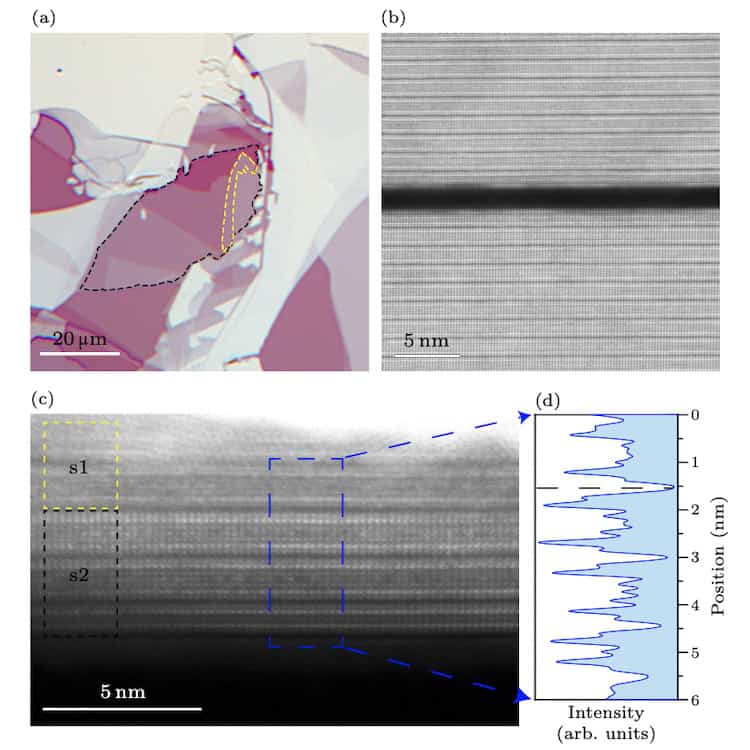
Preserving MBT’s septuple-layer surface
Surface preservation (a) Optical image of MBT-on-MBT sample, with the capping flake s1 and target flake s2 outlined in yellow and black, respectively. (b) TEM image of a homojunction interface with a thick capping layer, showing a substantial interface gap. (c) TEM image of an optimized interface using a thin capping flake s1 on the target s2. (d) The intensity profile extracted from the blue dashed box confirms that both the bottom surface of s1 and the top surface of s2 maintain a distinct seven-atom septuple-layer structure, demonstrating effective surface preservation. (Courtesy: Luo et al., Chin. Phys. Lett. 43 050713)

Thanks to a novel encapsulation technique, researchers at Fudan University in Shanghai, China, have succeeded in imaging the surface structure of the atomically thin topological quantum material MnBi2Te4 (MBT) for the first time. The work could help advance our understanding of the intrinsic properties of this technologically important class of materials and enable their use in novel devices.

The electronic, magnetic and topological properties of materials thinned down to atomic-scale thicknesses are very different to those of their bulk counterparts. They can, for example, be employed to study exotic quantum states that could prove useful for a host of advanced applications, such as next-generation spintronics and dissipationless electronics.

Before such devices see the light of day, however, we need to understand these emergent properties, which means accurately determining the surface atomic structure of these materials. This is no easy task because these surface structures are extremely sensitive to their environment. What is more, the most common technique used to study them, transmission electron microscopy (TEM), requires samples to be prepared as lamellae, which degrades them, changing their structure. The high-energy electron irradiation beam in the microscope does them no good either.

In the new work, a team led by Yuanbo Zhang of the State Key Laboratory of Surface Physics and department of physics at Fudan University, studied the topological quantum material MBT. This is the only intrinsic magnetic topological insulator made in the laboratory so far and can be used to study novel topological states – such as the quantum anomalous Hall effect and axion-insulator physics – many of which are fundamentally governed by surface states.

MBT’s surface is exceptionally vulnerable

Like other sensitive 2D materials, explains study co-author Jingjing Gao, MBT’s surface is exceptionally vulnerable to external perturbations, such as ambient air exposure, heat or standard electron microscopy preparation. These degrade the surface layer and irreversibly alter its structure. Indeed, a previous TEM study also revealed that the septuple-layer structure of an MBT flake transforms into a Bi2Te3-like quintuple layer configuration under ambient conditions.

To overcome this problem, Gao and colleagues developed a protective encapsulation technique that successfully shields the delicate surface structure of MBT from its environment and protects it during TEM sample preparation.

The researchers examined two types of encapsulating materials. The first was hexagonal boron nitride (hBN), which is chemically inert and already routinely employed to protect 2D materials. The second was a thin flake of MBT itself, which provides  a “homomaterial” capping layer. They encapsulated the MBT in one of these two materials immediately after they had exfoliated (or shaved off) flakes of MBT from a bulk sample. They did this inside an inert argon-filled glovebox.

An atomic-scale barrier

The protective layer acts like an atomic-scale barrier that isolates the MBT surface from oxygen, moisture, ion-beam damage and other environmental disturbances produced during the focused-ion beam processing used to prepare the samples for TEM. It also protects the MBT from the high-energy electron irradiation in the imaging microscope.

The researchers found that the homomaterial encapsulation is especially protective because the atomically similar layers can intimately contact with a minimal interfacial gap.

The technique strongly reduces defect formation, so the original lattice structure remains stable throughout the entire TEM workflow, explains Gao. “We therefore succeeded in safeguarding the ‘true’ surface throughout, allowing us to visualize the intrinsic septuple-layer structure at atomic resolution for the first time.”

The work will be important for both understanding intrinsic magnetic topological insulators and for developing quantum devices from these materials in the future, she tells Physics World. “Making such devices will demand exceptionally stringent requirements for sample surface and interface quality. This is because the MBT’s unique topological and magnetic properties are hosted by its surface states and even minor atomic reconstruction can distort its intrinsic quantum behaviour.”

Looking ahead, the researchers, who detail their work in Chinese Physics Letters, say they will now be looking to construct heterostructure devices with high-quality intrinsic surfaces and interfaces based on MBT. They will also make use of their encapsulation strategy to fabricate and study magnetic topological heterostructures.

“We will also explore topological superconductivity by interfacing MBT with superconductors, thereby advancing the development of topological quantum computing platforms,” reveals Gao.

The post Encapsulation enhances surface structure imaging of 2D quantum material appeared first on Physics World.

  •  

New class of magnons live a hundred times longer

University of Vienna researchers
From left to right: University of Vienna researchers Rostyslav Serha, Andrii Chumak, David Schmoll and Sebastian Knauer standing in front of a cryostat. (Courtesy: Ian Ehm)

Bosonic quasiparticles such as magnons show much promise for enabling on-chip quantum information technologies that can be scaled down to the nanoscale, but their too-short lifetime has held back such applications until now. An international team of physicists says it has now increased this lifetime by a hundredfold, thanks to the discovery of a new class of magnons known as short-wavelength dipole-exchange magnons.

Magnons are the collective oscillations of coupled magnetic spins in a material. They are particularly promising for next-generation computing because they could allow for information processing based on the wave-like dynamics of these spins rather than the flow of electrons, thereby significantly reducing energy losses. They can also naturally couple to many other fundamental quasiparticles, such as phonons and photons, which makes them ideal as the building blocks for hybrid quantum systems.

The main drawback of magnons, however, is that they die too fast, explains Andrii Chumak of the University of Vienna, who led this latest study. “Indeed, their lifetimes are typically limited to a few hundred nanoseconds, something that puts a hard ceiling on what we can do with them in a quantum architecture.”

A lifetime of up to 18 µs

In this work, which is detailed in Science Advances, the researchers discovered short-wavelength dipole-exchange magnons in highly pure, single-crystal yttrium iron garnet (YIG) spheres held at millikelvin temperatures. These magnons last for up to 18 µs, which is nearly two orders of magnitude longer than that previously observed for these quasiparticles.

As often in science, the discovery was accidental, says Chumak. “We had prepared three YIG spheres with varying degrees of purity for planned quantum experiments with superconducting qubits, and we simply wanted to characterize these spheres and identify the one that hosted the longest magnon lifetime,” he recalls.

“An 18 microsecond lifetime places magnon coherence on a par with that of typical transmon superconducting qubits used in today’s quantum processors,” he tells Physics World. “This reshapes the role magnons can play in hybrid quantum architectures – from lossy intermediaries to robust quantum memories and low-loss links able to mediate interactions between distant qubits on a chip.”

A programmable on-chip “quantum bus”

And that’s not all: long-lived magnons coupled to superconducting circuits could act as a programmable on-chip “quantum bus”, entangling many distant quantum bits (qubits) made from these hybrid structures along a common waveguide, rather than only nearest neighbours, he adds. The results also point to a clear materials-science route to push magnon lifetimes even further, in particular by continuing to reduce rare-earth impurity concentrations in YIG.

There is a way to go before real-world applications see the light of day, however. For one, the researchers still have some physics to understand, but that is what makes the project so intriguing for them, they say.

Chumak says that the most immediate future step in his team’s work will be an echo-type experiment to measure the lifetime of these magnons directly, rather than inferring it from the so-called parametric instability threshold, as was done in this work. “In parallel, we will need to learn how to excite and detect these short-wavelength magnons efficiently using nanoscale transducers, which is essential before they can be integrated with superconducting qubits.”

“The field of quantum magnonics is still very young compared to other quantum platforms,” Chumak notes, “so it will take some time before we reach actual quantum computing applications – but the path is now much more concrete than it was a year ago.”

The post New class of magnons live a hundred times longer appeared first on Physics World.

  •  

Soot from rocket launches is polluting Earth’s upper atmosphere

Black carbon particles released by rocket launches remain in the upper atmosphere for much longer than sooty particles produced by sources on the ground. This finding, which comes from a study led by researchers at University College London (UCL), UK, suggests that the soot created in deploying “megaconstellations” containing hundreds or thousands of satellites could have poorly understood and potentially serious consequences for the Earth’s climate.

“Rocket launches are a unique source of pollution, injecting harmful chemicals directly into the upper layers of the atmosphere and contaminating Earth’s last remaining relatively pristine environment,” says the study’s lead author, UCL atmospheric chemist Connor Barker.

The number of rockets being launched into space has increased dramatically since 2019, and the trend shows few signs of stopping. This year has already seen more launches than the whole of 2020, and space industry experts believe the eventual total could surpass 2025’s figure of 329. The increase has primarily been driven by the Falcon 9 rockets launched by the US firm SpaceX, though China also logged a record 92 launch attempts in 2025.

“An unregulated geoengineering experiment”

In the new work, Barker and colleagues analysed data from rocket launches and satellite re-entries from 2020 to 2022. Their results, which they detail in Earth’s Future, show that the soot particles lingering in the upper atmosphere are 540 times more effective at altering climate than ground-based soot emissions from sources such as cars and power plants.

“Space industry pollution is like an unregulated geoengineering experiment,” says Barker. Soot particles from burning kerosene in rocket fuel absorb sunlight, he explains, which prevents it from reaching the Earth’s surface. The result is a small cooling effect, which might sound like a good thing in the context of rising global temperatures. However, Barker stresses that this cooling is minimal compared to the global warming caused by other human-generated emissions, while the particles themselves could have “many other serious unintended consequences”.

Predictions likely to underestimate future impact

As well as quantifying recent space industry emissions, the researchers make predictions about future ones. According to their calculations, by 2029 the space industry will be releasing about 870 tonnes of soot into the atmosphere each year. By way of comparison, Baker notes that according to the latest UK government figures, the annual emissions of the country’s entire passenger car fleet amounted to just 728 tonnes.

The team based its predictions on projections of data from 2020-2022, which is considered the beginning of the megaconstellation satellite era. Because of this, Barker cautions that they are likely to be underestimates, making the problem even more urgent. “It is critical that we understand the environmental impacts of satellite megaconstellations now while their impact is small, before any unforeseen consequences are difficult to reverse or repair,” he tells Physics World.

While scientists have made great progress in the last few years, Baker says that are still large uncertainties in our emission estimates for the industry and our understanding of how they affect the atmosphere. “We hope that this work spurs further research to measure space industry emissions and highlights the need to regulate the geoengineering impacts of the space industry,” he says.

Team leader Eloise Marais, a professor of atmospheric chemistry and air quality at UCL, echoes this sentiment. “So far, there has been limited effort to effectively regulate this type of pollution,” she says.

The researchers are now working on an emissions tracker to visualize these emissions across the entire space age. “We are also using satellite imagery to remotely detect and quantify rocket launch emissions,” Barker reveals.

The post Soot from rocket launches is polluting Earth’s upper atmosphere appeared first on Physics World.

  •  

Asymmetric weather pattern reveals exoplanet’s true atmosphere

Thanks to new “transit” observations of the hot Jupiter exoplanet WASP-94A b using the James Webb Space Telescope (JWST), researchers at Johns Hopkins University in the US have discovered a striking weather pattern on this distant world. Their work could help provide a clearer picture of the atmospheres on exoplanets, which has been very limited until now.

When an exoplanet passes in front of (or transits) its host star, some of the light from that star passes through the planet’s atmosphere. By detecting this light using telescopes, either ground-based or in space, astronomers are able to obtain the exoplanet’s atmospheric light spectrum.

A team led by Sagnick Mukherjee and David Sing has now analysed data on WASP-94A b from the space-based JWST and have found that the mornings on this exoplanet are extremely cloudy – with water absorption features in the spectrum – while its evenings are very clear. Clouds likely form on the planet’s colder, permanent nightside where temperatures are low enough for minerals to condense. Winds then carry those clouds towards the morning limb (the leading edge of the atmosphere), explains Mukherjee.

“As these cloud particles are dragged farther toward the hotter dayside, the clouds evaporate or sink deeper, leaving the evening side much clearer,” he says. “This is a clear discovery of a planet-wide cloud cycle in action on a distant exoplanet.”

Part of a broader survey

The researchers, who detail their findings in Science, decided to study WASP-94A b as part of a broader survey of exoplanet atmospheres with the JWST called the “Grand Tour Program”. The goal of this project, says Mukherjee, is to better understand the composition of these exoplanets and the physical processes at play in their atmospheres.

One of the main difficulties encountered during such observations is how small the signals that we are trying to look at are, he explains. However, in this case, the asymmetry between the morning and evening side of the planet was rather dramatic, which made it possible to separately probe the two.

Until now, researchers only had access to a single averaged spectrum of WASP-94A b – and indeed most other exoplanets studied over the last decade –from observations made by the Hubble telescope, for example. The chemical composition of the exoplanet’s atmosphere was therefore highly biased, says Mukherjee, and it was thought that the levels of oxygen and carbon there were hundreds of times higher than on the Sun. “This finding baffled us because this result could not be explained by planet formation theories. The new data show that WASP-94A b only contains only about five times as much oxygen and carbon.”

“Being able to resolve the cloudy morning and clear evening separately therefore gives us a much cleaner view of what the atmosphere is actually made of,” Mukherjee tells Physics World. “And this is not just relevant to hot-Jupiters like WASP-94A b, but might be extended to all exoplanet atmospheres that we are trying to understand using the transit method.”

“One of the most exciting aspects”

For Mukherjee, this is one of the most exciting aspects of the JWST era. “We are taking a step beyond simply detecting the atmospheres of distant planets and are now beginning to map their weather, chemistry, and three-dimensional structure in extraordinary detail.”

Indeed, using WASP-94A b as a benchmark, the Johns Hopkins team has already studied eight other hot gas giants and discovered the same distinctive cloud cycle on two other worlds: WASP-39 b and WASP-17 b. “Inspired by these observations, our collaboration, co-led by David Sing, myself and our colleague Guangwei Fu, is about to receive more than 180 hours of new JWST data to understand weather on diverse exoplanets and measure how their weather and cloud-coverage vary with planet temperature and gravity,” reveals Mukherjee.

The post Asymmetric weather pattern reveals exoplanet’s true atmosphere appeared first on Physics World.

  •  

Sunlight can produce correlated pairs of photons

Producing pairs of correlated or entangled photons usually requires a complex laser system. Now, however, researchers at China’s Xiamen University have shown that these crucial ingredients in quantum optics experiments can come from a far more basic source: sunlight. The discovery could simplify optical systems that rely on a process known as spontaneous parametric down-conversion (SPDC), allowing the technology to be deployed in space and other locations with limited or no access to electricity.

SPDC occurs when a short-wavelength photon passes through a nonlinear crystal and gets converted into twin photons with a longer wavelength. Traditionally, the initiating (pump) photon in this paired-photon source comes from a coherent laser. However, recent research suggested that fully coherent light sources might not be strictly necessary, and that partially coherent sources might also be able to drive SPDC.

A Sun-tracking system

In the new work, researchers led by Wuhong Zhang and Lixiang Chen took this idea even further. Could sunlight – which is inherently incoherent – also drive SPDC?

In principle, Zhang and Chen suspected the answer was “yes”. After all, a ray of sunlight, like a laser beam, is just a stream of photons. The problem is that unlike photons from a laser, the brightness and incidence angle of solar photons is constantly changing. This makes it difficult to collect enough pump photons to produce correlated photon pairs at high rates.

To overcome this problem, the researchers installed a Sun-tracking system on the roof of their laboratory building. This was essentially a telescope mount that moves with the Sun to collect light continuously throughout the day. They then worked out how to efficiently couple this collected sunlight into a multi-mode fibre and transmit it into their laboratory. There, they used the light to pump a nonlinear crystal made of periodically poled potassium titanyl phosphate (PPKTP). Within this crystal, the SPDC process converted pump photons into correlated photon pairs, demonstrating that it is indeed possible to use sunlight to generate photon pairs with strong position correlations.

The team faced numerous challenges along the way. The low spatial coherence and temporal instability of sunlight needed to be mitigated, and the coupling into the fibre needed to be very efficient. However, Chen notes that sunlight does have one advantage over traditional laser sources. “Sunlight is inherently broadband in its spectrum, so it can precisely provide any favourable wavelength,” he says. “This means it could be adapted to diverse application scenarios.”

Towards laser-free and electricity-independent SPDC light sources

According to Zhang, the team’s work shows that laser-free and electricity-independent SPDC light sources are possible. Potential applications could include correlation-enhanced sensing in remote areas and space-based quantum key distribution and teleportation, and he tells Physics World that one of the team’s next goals is to test the system in outdoor environments.

Chen adds that the system, which is described in Advanced Photonics, could also become a platform for fundamental studies of how the coherence of light affects the photon-splitting process in SPDC. He and his colleagues are now focusing on improving the efficiency of their sunlight collection system; optimizing the design of their nonlinear crystal so that it is better adapted to the Sun’s broadband spectrum; and implementing advanced image reconstruction techniques such as compressed sensing. “We think that introducing AI technologies such as artificial neural networks and deep learning into such imaging systems will be a key priority in going forward,” Chen says. “They will inform us on how to exploit sunlight more efficiently to implement various advanced quantum information protocols.”

The post Sunlight can produce correlated pairs of photons appeared first on Physics World.

  •  

Altermagnets can turn neighbouring materials altermagnetic, too

Altermagnets can transfer their unusual magnetic properties to nonmagnetic materials placed next to them, say theorists in China and the US. This so-called “proximity effect” had already been observed in ferromagnets and superconductors, but it is new for altermagnets, which were only recognized as a distinct class of magnetic materials in 2024. If confirmed experimentally, the team says the effect could aid the development of advanced quantum materials with applications in fields such as spintronics, valleytronics and fault-tolerant quantum computing.

In ferromagnets, proximity effects make it possible to tune properties such as magnetic anisotropy, coercivity and exchange bias in nonmagnetic materials that have acquired magnetic polarization from a neighbouring ferromagnet. Similarly, ordinary materials that have picked up superconducting correlations from a nearby superconductor are a mainstay of experiments on topological superconductivity and topological quantum computing.

In the latest research, physicists led by Tong Zhou of the Eastern Institute of Technology in Ningbo sought to understand whether altermagnets could likewise transfer their behaviour to a neighbouring material. To do this, they created a model of a van der Waals bilayer heterostructure in which the bottom layer is a two-dimensional (2D) altermagnet, V2Se2O, while the top layer is a non-magnetic semiconductor, PbO.

Zhou explains that the vanadium atoms in V2Se2O form two opposite-spin sublattices that are connected by rotational symmetry rather than by simple translation or inversion. This complex structure is what gives V2Se2O its characteristic altermagnetic spin splitting, with a band structure in which spin-up and spin-down electrons have different energies that vary in periodic patterns. V2Se2O also has a so-called spin texture, which is a pattern of spin polarization that produces a net zero magnetization in the material.

First-principles calculations

Using first-principles calculations, the researchers found that the distinctive symmetry-patterned magnetism of V₂Se₂O can indeed transfer into the PbO layer across the interface between them. As a result, Zhou says the originally spin-degenerate bands of PbO develop a clear momentum-dependent spin splitting.

Importantly, this pattern is not arbitrary. Instead, it follows the symmetry expected from the altermagnetic order of V2Se2O. What is more, the real-space spin density of the PbO mirrors the symmetry of the V2Se2O, showing that it has inherited altermagnetism rather than simply becoming generically spin polarized.

When the researchers rearranged the V2Se2O into a conventional antiferromagnetic configuration with no alternating spin splitting, they found that the induced splitting in PbO disappeared. They also observed that the degree of induced splitting decreases when the PbO is placed further away from the V2Se2O, confirming the proximity effect.

As a final piece of evidence, the researchers searched for similar proximity effects in other altermagnetic systems, ranging from insulators to metals and covering material platforms with 3D architectures as well as 2D ones. “Even graphene, one of the most common 2D materials, can acquire altermagnetic characteristics when interfaced with CrSb, which is an experimentally well-established altermagnet,” Zhou notes.

Altermagnets as interfacial “spin-pattern generators”

One of the work’s main implications is that altermagnets could be used to generate spin patterns in many otherwise non-magnetic materials, Zhou tells Physics World. “This means that instead of searching only for intrinsic altermagnets, we can now design ‘proximitized’ altermagnetic systems by combining an altermagnet with a semiconductor, metal or superconductor,” he says.

In semiconductors, Zhou notes, the altermagnetic proximity effect can induce controllable spin and valley splitting, which are promising for spintronics and valleytronics devices, respectively. In superconductors, meanwhile, the effect can generate momentum-dependent spin splitting without the need to apply an external magnetic field or introduce net magnetization – something that Zhou says offers a new route toward topological superconductivity and the Majorana modes that could revolutionize fault-tolerant quantum computing. “More generally, this effect provides a versatile platform for designing field-free spin devices, topological quantum devices and multifunctional van der Waals heterostructures,” he says.

Looking ahead, Zhou and colleagues say they would now like to observe the altermagnetic proximity effect in heterostructures fabricated in the laboratory. They also want to find out how to control the strength of the effect – for example, by changing interlayer spacing, stacking, strain, gating and possibly even layer twisting.

“More fundamentally, an important question is how fast and how reversibly altermagnetic order, and therefore the altermagnetic proximity effect, can be reconfigured dynamically,” Zhou says. “That would be especially interesting for controlling spin-dependent transport and topological phases in real time.”

The research is described in  Physical Review Letters.

The post Altermagnets can turn neighbouring materials altermagnetic, too appeared first on Physics World.

  •  
❌