A Primate Labsanunciou hoje o Geekbench 7, a geração mais recente de sua popular ferramenta de benchmark, que traz conjuntos de dados maiores e mais exigentes para o processamento de GPUs 1Graphics processing units, ou unidade de processamento gráfico., testes multi-core reformulados, entre outras novidades.
A Primate Labs afirma que o benchmark de GPU reformulado concentra-se em aprendizado de máquina e criação de conteúdo para refletir a forma como as GPUs são utilizadas atualmente. Ele inclui agora testes que rastreiam rostos e aplicam efeitos de filtro em tempo real a vídeos, realizam upscaling de imagens com aprendizado de máquina e desfocam fundos em transmissões de videoconferência.
Já os benchmarksmulti-core foram projetados para refletir melhor o comportamento real dos softwares, visto que as novas cargas de trabalho só utilizam múltiplas threads quando as tarefas simuladas exigem.
Divulgação/Primate Labs
A Primate Labs adicionou ainda um teste expandido de edição de fotos, com um conjunto mais abrangente de edições. Ademais, a carga de trabalho de biblioteca de fotos oferece suporte à importação e ao processamento de formatos de imagem como JPEG XL e DNG. Além disso, os novos testes de áudio e vídeo agora incluem suporte a AV1 e Opus, além de simular cargas de trabalho de streaming e consumo de conteúdo.
No mais, ele tem a mesma aparência do Geekbench 6 — e a licença Pro continua custando US$100 (com desconto para US$80 até 6 de agosto). A versão Pro permite realizar benchmarks offline — sem envio de dados para o Geekbench Browser — e abrange todas as plataformas desktop compatíveis (macOS, Windows e Linux).
É possível baixar gratuitamente o Geekbench 7 para macOS e outros sistemas operacionais nessa página. A versão para iOS/iPadOS ainda não foi atualizada na App Store.
Notas de rodapé
1
Graphics processing units, ou unidade de processamento gráfico.
O Mozilla Firefox foi atualizado hoje para a versão 153, tanto no macOS quanto no iOS/iPadOS. Entre as várias novidades introduzidas pelo update, estão os Contêineres (Containers), que permitem separar as diferentes partes da sua vida online na mesma janela do navegador.
Assim como a extensão Multi-Account Containers, o novo recurso torna possível logar em diferentes contas sem precisar abrir uma outra instância do Firefox. Ao recorrer aos Contêineres (que ainda estão em preview, diga-se), você também mantém os seus cookies e dados de anúncios direcionados isolados em ambientes distintos.
Segundo a Mozilla, ao tornar um recurso desse tipo em uma ferramenta nativa do navegador, a versão 153 livra usuários de ter que procurar por um add-on, além de facilitar a abertura, a criação e o gerenciamento de contêineres de páginas que você já costuma acessar. Usuários de longa data do Multi-Account Containers, no entanto, não serão deixados de lado, uma vez que a nova solução mantém “a funcionalidade, a flexibilidade e a identidade visual” da extensão.
Nesse preview, já é possível abrir páginas em contêineres específicos, customizá-los com nomes, cores e ícones da sua escolha e gerenciá-los diretamente do menu “Configurações”. Para abrir uma aba contêiner, basta clicar com o botão direito do mouse ou tocar e segurar no botão de nova aba (+) e selecionar a opção correspondente.
Outras novidades
Agora, é possível compartilhar qualquer página com um código QR ao clicar com o botão direito do mouse em uma aba e ir em Compartilhar » Gerar código QR.
Divulgação/Mozilla
Também passou a ser possível juntar múltiplos PDFs em um único documento ao arrastar um arquivo do tipo para a barra lateral de PDF, bem como adicionar imagens como novas páginas de um documento usando o editor de PDF nativo do Firefox.
Ademais, digitar “pick color”, “color picker” ou “eyedropper” na barra de endereço agora faz com que o seletor de cores nativo do Firefox, o Pick a color, seja ativado. Na mesma toada, o Firefox passou a permitir que usuários digitem “labs” ou “experiment” na barra de endereço para acessar a ação rápida “Open Firefox Labs” facilmente.
Usuários de Mac, por sua vez, notarão que o atalho de teclado fn (tecla representada por um globo) F agora é suportado pelo Firefox, permitindo entrar rapidamente no modo de tela cheia do macOS.
O ícone de acesso à localização do usuário agora fica destacado em vermelho sempre que um site obtém acesso às suas coordenadas, além de ficar visível em páginas de resultados de busca (antes ele era ocultado).
Divulgação/Mozilla
Por fim, o assistente Smart Window (ainda em beta) agora permite selecionar diferentes modelos de inteligência artificial (IA) diretamente da sua interface, e a Nova aba (New Tab) do recurso ganhou uma barra de endereço mais familiar para acessar sites ou pesquisar na web.
Divulgação/Mozilla
O Firefox 153 já está disponível para download tanto no desktop quanto em dispositivos móveis. Em ambos os casos, o update também introduz uma série de correções de bugs e melhorias de desempenho, as quais podem ser conferidas aqui e na página do browser na App Store.
A new study in Nature Communications reports that subducting slabs can become effectively “stalled” for long periods—not simply due to mantle temperature or plate motion, but because distinct rock assemblages within the downgoing plate alter how the slab interacts with the surrounding mantle. Using geophysical constraints combined with thermodynamic modeling, the researchers argue that slab dynamics depend on whether the slab interior is dominated by hydrated ultramafic lithologies or by comparatively dry basaltic components.
The central finding is that wet harzburgite—an olivine-rich, ultramafic rock—can sustain slab stagnation by promoting hydration-related weakening processes and controlling the timing and location of mineral transformation. In parallel, the team shows that dry basaltic slab assemblages can also contribute to stagnation, but through a different pathway: by limiting certain water-driven reactions while still maintaining a mechanically coherent, slow-moving interface at depth.
According to the authors, the fate of volatiles is the key variable. As the slab descends, pressure and temperature drive phase changes and dehydration reactions. These reactions can either increase or decrease the effective viscosity and friction along plate boundaries, shifting the balance between slab pull and mantle resistance. Where hydration is sustained, water remains available to weaken lithospheric portions that would otherwise become too rigid to decouple.
In the wet harzburgite scenario, dehydration and metamorphic reactions are predicted to sustain zones of reduced strength within the slab, preventing it from sinking efficiently into the lower mantle. This creates a feedback loop: slower descent limits thermal loss, which in turn preserves conditions that keep the weakening processes active.
In the dry basaltic scenario, the model emphasizes that even without abundant water, basaltic mineralogy can maintain mechanical coupling over a broader depth range. The study suggests that dry assemblages may delay the development of decoupling horizons, thereby prolonging stagnation until the slab eventually transitions to a different rheological regime.
The researchers also connect their results to the observed diversity of subduction-zone behavior, where some slabs advance smoothly while others appear to linger at mantle depths. By treating rock composition explicitly rather than assuming uniform slab properties, the work offers a framework for interpreting why similar plate boundary geometries can yield markedly different slab lifetimes.
Crucially, the analysis links mineral stability, dehydration partitioning, and viscosity contrasts into a single physical narrative. This moves slab “stalling” away from a purely geometric explanation and toward a lithology-driven process that can be tested against seismic signatures.
The findings will likely influence how future models incorporate water budgets and rock types in subduction simulations. If validated by geophysical observations, the wet-versus-dry assemblage distinction could become a practical lever for predicting which slabs will stagnate and for how long.
In short, the study portrays slab stagnation as a sustained state maintained by the contrasting rheological effects of hydrated harzburgite and comparatively dry basaltic materials, reshaping our understanding of how deep Earth water and rock chemistry govern plate evolution.
Subject of Research: Subduction zone dynamics and slab stagnation mechanisms
Article Title: Slab stagnation sustained by wet harzburgite and dry basaltic slab assemblages.
Testes independentes realizados pela West Coast Labs mostram que manter o NordVPN ligado 24 horas seguidas aumenta o consumo de bateria em apenas 1,4% no Android e 1,8% no iOS.
The partnership, a first of its kind for the artificial intelligence company, will use the prediction market’s data to power some search results about the soccer tournament.
Welcome to this edition of The Intelligence Brief… This week, a new milestone has been reached in space technology, with the launch of the world’s first satellite equipped with a commercial betavoltaic nuclear power system. The satellite was carried to orbit on a a SpaceX Falcon 9 rocket on Tuesday, and in our analysis, we’ll be looking at 1) how the next generation of compact nuclear power systems are now being tested aboard the first City Labs BOHR satellite, 2) how the satellite converts radioactive decay into electricity, and why this technology could eventually help to facilitate long-term space missions to the Moon and other locales, 3) the advantages and hurdles this novel tritium-based power system faces, and 4) what this all could mean for the future of nuclear powered spacecraft used in deep-space missions.
Quote of the Week
“This is a historic step for commercial nuclear power in space.”
— Peter Cabauy, CEO of City Labs
If you enjoy the news and perspectives offered by The Debrief, make sure that you aren’t missing our stories by making us one of your “preferred sources” on Google News. You can simply follow this link to add The Debrief to your list of favorites, and you can read more about Google’s preferred sources in our article here.
Get all the latest stories from The Debrief, with more breaking stories at the end of this week’s newsletter.
The First Nuclear-Powered Satellite is Now in Orbit
Tuesday marked a new chapter in the quest for novel power systems for spacecraft, with the launch of the world’s first satellite equipped with a commercial betavoltaic nuclear power system.
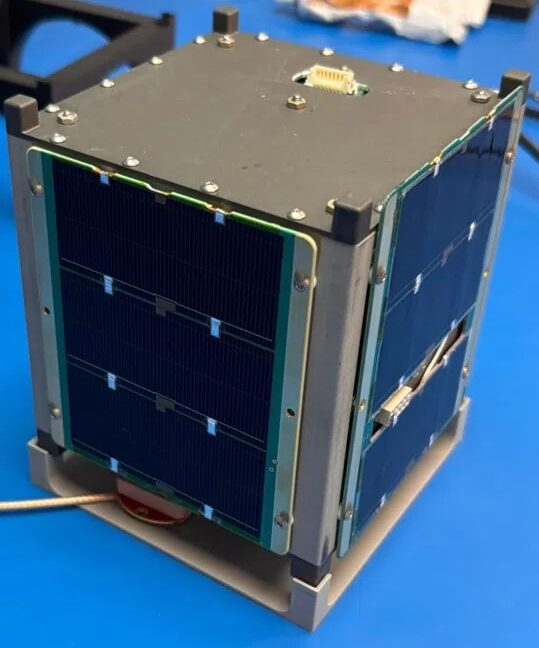
The City Labs Betavoltaic Orbital High-Reliability (BOHR) satellite was carried to space on board a SpaceX Falcon 9 rocket, and in the coming weeks will begin tests to determine whether miniature nuclear batteries can reliably generate electricity in space.
Designed primarily as a proof of concept, the first BOHR satellite will rely on conventional solar panels for its primary power system. However, the first-of-its-kind spacecraft also carries the company’s proprietary “NanoTritium” betavoltaic power source, which, according to the company, uses beta particles emitted during the radioactive decay of tritium that are converted into electricity.
In a statement, Peter Cabauy, CEO of City Labs, called this week’s launch “a historic step for commercial nuclear power in space,” adding that the BOHER satellite “demonstrates that safe, compact, and regulatory-approved nuclear power systems are ready for routine commercial deployment.”
“This capability enables persistent, always-on payload operations that are not constrained by sunlight or battery life,” Cabauy added.
Harnessing the Power of Beta Radiation
The innovative satellite was carried to space earlier this week as part of the recent SpaceX Transporter-17 mission.
“On Tuesday, July 7 at 12:12 a.m. PT, Falcon 9 launched the Transporter-17 mission to low-Earth orbit from Space Launch Complex 4E (SLC-4E) at Vandenberg Space Force Base in California,” read an update that appeared at the SpaceX website announcing the successful launch that carried the City Labs BOHR satellite to space.
“Transporter-17 was a dedicated smallsat rideshare mission,” SpaceX’s update earlier this week added. “There were 81 payloads on this flight, including cubesats, microsats, hosted payloads, and orbital transfer vehicles carrying eight of those payloads to be deployed at a later time.”
Following the satellite’s successful delivery to orbit, its power systems will begin testing the feasibility of beta radiation as a primary driver to produce electricity. In the past, radioisotope thermoelectric generators have been used to propel landmark space missions, such as Voyager 1 and Voyager 2. By contrast, BOHR’s beta radiation system does not rely on heat generated by radioactive decay, which allows for a compact power source that, if all goes according to plan, could one day be deployed in future missions to support spacecraft operating in environments where sunlight is limited. Such applications include the permanently shadowed craters on the Moon and future missions into the outer solar system.
Primarily, City Labs says a tritium-based system is also more beneficial than traditional nuclear fuels like plutonium since it emits relatively low-energy radiation. This, the company says, makes it easier to shield and safer to handle during spacecraft assembly and launch.
Challenges Ahead
The technology does face significant hurdles, however. One involves the fact that tritium is presently still one of the world’s rarest—and most expensive—radioactive materials. Right now, with only around 20 kilograms produced annually throughout the world, the limited quantity and exorbitant costs (current prices reach tens of thousands of dollars per gram) make large-scale adoption anytime in the near term a significant challenge.
There are also regulatory considerations, as noted in a news article released this week by the American Nuclear Society (ANS) following the launch. “In 2019, National Security Presidential Memorandum – 20 (NSPM-20) laid out updates to the process for launching spacecraft containing nuclear systems,” the article states.
“Now the Department of Transportation, which includes the Federal Aviation Administration (FAA), directs the coordination of various agencies to review the safety analysis for missions with nuclear components,” the ANS news brief added, noting that the FAA updated its launch regulations in 2020.
Despite the existence of a few hurdles and other considerations, the mission nonetheless marks an important milestone in the development of next-generation spacecraft power systems. If successful, BOHR could demonstrate that compact betavoltaic power sources are a viable complement to solar energy, opening new possibilities for long-duration missions in some of the darkest and most remote regions of the solar system.
The proliferation of nuclear power in space got a little more real Tuesday with the launch of a small satellite developed by a Florida-based company specializing in nuclear micro-power technology.
The satellite from Miami-based City Labs is named BOHR, short for Betavoltaic Orbital High-Reliability, and it launched on a SpaceX rideshare mission Tuesday alongside 80 other payloads. SpaceX's Falcon 9 rocket released the BOHR satellite into an orbit between 350 and 400 miles (nearly 600 km) in altitude.
Da Sony à Bose, da Apple à Sennheiser, selecionámos 11 modelos de auscultadores sem fios e 17 auriculares wireless em promoção durante os Amazon Prime Day. Poderá encontrar descontos até 58%.
The Guardrails Alliance, which has raised $5 million, is positioning itself as a populist effort that will take on the pro-A.I. interests trying to influence this year’s elections.
Um estudo da Oxylabs fez uma análise às ofertas de emprego nos Estados Unidos e concluiu que o Python se afirma como a linguagem de programação mais mencionada como requisito, seguindo-se SQL.
OpenAI said that a coalition of states had opened an investigation over a wide range of its practices, including its handling of user data, safety of minors and advertising activities.
Two Times tech reporters and their editor talk about assessing the sky-high valuation of the rocket and satellite maker, the potential economic impact of its public debut and the role of the world’s richest man in it all.

 Login