❌

Reading view

Los kraken reales del Cretácico. Fábricas vivas de anticuerpos. - Ciencia Fresca

Kraken y Linfocitos B - Ciencia fresca - Cienciaes.com

Hoy, en Ciencia Fresca, Ángel R. Lozano nos invita a viajar hasta los océanos del Cretácico para descubrir a unos sorprendentes depredadores gigantes que recuerdan a los legendarios kraken. Un estudio publicado en Science revela que enormes pulpos con tentáculos de hasta 19 metros pudieron competir con mosasaurios y tiburones en la cima de la cadena alimentaria marina. Gracias a un novedoso método denominado “minería digital de fósiles”, los investigadores han averiguado cómo eran estas criaturas a partir de mandíbulas fósiles y sus marcas de desgaste. Además, Jorge Laborda explora otro avance fascinante: la posibilidad de convertir células del sistema inmunitario en auténticas fábricas vivas de anticuerpos. Un nuevo trabajo demuestra que es posible reprogramar células madre de la médula ósea para producir defensas terapéuticas de forma duradera y adaptable.

💾

  •  

Sugar may not make children hyperactive: across two dozen controlled trials the sugar did nothing measurable. In one small experiment, what changed was the parent — mothers who thought their sons had been given sugar rated them as more hyperactive and hovered closer.

We are writers and editors reading the research, not clinicians, paediatricians, or child psychologists. What follows is reflection on published studies, not guidance for any individual family. The findings here are drawn from controlled research; population-level patterns are not prescriptions for your own child.

Feed some children sugar and others a sugar-free sweetener, and make sure nobody knows who got which. When you do that, the sugar does nothing measurable to how the children behave. That is the result pooled across roughly two dozen experiments in a 1995 review, and it has held up for three decades.

The children on sugar do not get more wound up. What changes, in a separate line of research, is the adult watching them.

Two dozen trials, no measurable effect

The anchor is a review published in JAMA in 1995 by Mark Wolraich, David Wilson and J. Wade White, then in the Department of Pediatrics at Vanderbilt University. Pulling together the controlled trials available at the time, they concluded that “sugar (mainly sucrose) does not affect the behavior or cognitive performance of children”. Reviewers note the analysis covered 23 experiments across 16 scientific papers, which is where the “two dozen” figure comes from.

This does not prove sugar can never matter. A small effect, or an effect in some particular group of children, could not be ruled out. What the pooled trials showed was no demonstrable change in behaviour, not certainty that sugar is harmless for everyone. The popular version tends to flatten into “sugar has no effect, full stop,” which the data does not quite support.

Why the trial design matters

The strength of the finding comes from how strict the rules were. To count, a study had to feed children a set amount of sugar, compare it against a look-alike sweetener, and keep everyone in the dark about which was which: the children, the parents, and the research staff all had to be kept from knowing.

That last part shapes everything. If a parent does not know sugar was served, they cannot pin behaviour on it. Picture a parent watching a child eat cake at a party and then act up: the parent has already decided what caused it. Take away that knowledge, and the effect disappears. Which raises the obvious question of where the effect was coming from in the first place.

The experiment where the parent was the variable

A study published a year earlier, in 1994, answered it about as directly as an experiment can. Daniel Hoover and Richard Milich, at the University of Kentucky, tested thirty-five boys, aged five to seven, whose mothers described them as sensitive to sugar.

The trick was in what the mothers were told. As the authors put it: “In the experimental group, mothers were told their children had received a large dose of sugar, whereas in the control condition mothers were told their sons received a placebo; all children actually received the placebo (aspartame).” Every boy got the sugar-free sweetener, but half the mothers were told their sons had been loaded with sugar.

The only thing that varied was the belief planted in the mother. And that belief moved the ratings. The authors report: “Mothers in the sugar expectancy condition rated their children as significantly more hyperactive.” How much trouble they saw tracked the story they had been given, not anything the child had eaten.

The behaviour that actually shifted was the mother’s own. The authors note that these mothers “exercised more control by maintaining physical closeness, as well as showing trends to criticize, look at, and talk to their sons more than did control mothers.” 

This is one small study of thirty-five boys, so read it as a vivid demonstration of how the effect works, not a universal law about all parents. The direction, though, is hard to miss. Told a child had been given sugar, a mother hovered closer, watched harder, and found more to correct.

Why the belief outlasts the evidence

The 1995 authors had a plain explanation for why the belief persists despite the trials: expectation and simple association.

Sugar tends to turn up alongside the things that wind children up. Birthday parties, holidays, late nights, crowds of other children, a break from routine. The cake is present at the chaos, so the cake gets the blame.

An expectation, once held, tends to confirm itself in ways that are hard to spot from the inside. A parent who believes sugar causes trouble watches the child more closely after sugar, and closer watching finds more to flag. The child does not have to change for the report to change. Anyone who has scrutinised someone more carefully because they were warned to expect a problem has run a small version of this experiment without meaning to.

None of this means sugar is good for children. This is not an argument about diet or dental health, which are separate questions with their own evidence. The narrow claim is only this: under blinded conditions, the behaviour change so many adults are sure they have seen does not seem to show up.

The sugar-and-hyperactivity story may end up being less about children than about how confidently an adult can misread a moment once they already know what the answer is supposed to be.

If you are worried about a child’s attention or activity levels,  we recommend you consult a paediatrician or child psychologist rather than making any decisions on articles such as this.

The post Sugar may not make children hyperactive: across two dozen controlled trials the sugar did nothing measurable. In one small experiment, what changed was the parent — mothers who thought their sons had been given sugar rated them as more hyperactive and hovered closer. appeared first on Space Daily.

  •  

Un altro pilastro dell'industria tedesca chiude una fabbrica: 216 dipendenti a casa

Non c'è pace per il settore dell'industria automobilistica tedesca, per anni la locomotiva dell'Europa intera e non soltanto della Germania. Oggi, però, i tempi d'oro sono un ricordo agrodolce perché adesso bisogna fronteggiare una crisi quasi senza precedenti. Il terremoto che sta sconquassando il Gruppo Volkswagen e l'intera automotive teutonica non fa sconti neppure alle <strong>aziende di componentistica.</strong> L'ultima "vittima" di questo momento buio è <strong>Magna</strong>, uno dei più grandi fornitori automobilistici a livello mondiale, che ha annunciato la chiusura definitiva e in anticipo sui tempi dello stabilimento situato a Dorfprozelten, nella Bassa Franconia. Purtroppo, ben <strong>216 dipendenti</strong> perdono il proprio impiego.<h2>Una chiusura non senza polemiche</h2>La notizia della dismissione anticipata della fabbrica di Magna ha destato scalpore perché giunge in aperta violazione di un percorso di salvataggio che sembrava aver dato i suoi frutti appena pochi anni fa. Nel 2023, infatti, l'azienda e il sindacato<a href="https://www.hdmotori.it/volkswagen-articoli-n603489-volkswagen-accordo-sindacati-ig-metall-dettagli/"> <strong>IG Metall</strong></a> avevano raggiunto un’intesa per garantire la continuità dell'impianto fino alla fine del 2028.Quell'accordo, che aveva già richiesto il sacrificio di circa 200 posti di lavoro, era stato accettato dai dipendenti proprio con la speranza di proteggere il futuro della fabbrica. Invece, la produzione di <strong>specchietti retrovisori esterni </strong>e<strong> interni</strong> cesserà definitivamente a metà del <strong>2027</strong>, con circa un anno e mezzo di anticipo rispetto a quanto pattuito.<h2>Le ragioni della resa</h2>Secondo quanto dichiarato dai vertici di Magna, lo stabilimento <strong>non è più sostenibile</strong> dal punto di vista economico nonostante i passati investimenti e le misure di riduzione dei costi messe in campo. La dirigenza punta il dito contro uno scenario di mercato estremamente negativo e una gestione operativa che non offre più margini di manovra.La crisi di Dorfprozelten si inserisce in un contesto più variegato che vede l’intero comparto della componentistica auto alle prese con <strong>volumi di produzione in calo</strong>, la necessità di investimenti massicci nelle nuove tecnologie di propulsione e una pressione sui costi diventata insostenibile.<h2>Lo scontro con i sindacati e la politica</h2>La reazione della IG Metall è stata ovviamente pesantissima, dicendo esplicitamente che il comportamento di Magna equivale a un <strong>"tradimento"</strong> degli accordi presi. Secondo il sindacato, l'azienda di componentistica non avrebbe rispettato gli impegni di localizzare nuovi prodotti nel sito o di trasferire commesse da altri impianti per saturare la capacità produttiva di Dorfprozelten.Un punto critico riguarda la tecnologia dei <strong>cristalli liquidi per specchietti (LC)</strong>: considerata una soluzione del futuro, non sarebbe mai stata portata alla maturità per la produzione in serie, nonostante i <strong>finanziamenti pubblici</strong> ricevuti dal Land della Baviera per il suo sviluppo.<h2>L'impatto sul territorio e sul settore</h2>Per la comunità di Dorfprozelten, questa chiusura rappresenta una sconfitta e, soprattutto, la scomparsa di uno dei più importanti datori di lavoro industriali della zona. Il colosso Magna, che conta oltre <strong>170.000 dipendenti</strong> in tutto il mondo e si occupa persino dell'assemblaggio completo di vetture per marchi come <a href="https://www.hdmotori.it/robot-umanoidi-fabbriche-auto/">BMW</a> e <a href="https://www.hdmotori.it/nuova-mercedes-benz-classe-c-elettrica-produzione-ungheria/">Mercedes </a>nel suo sito austriaco di Graz, sembra dunque aver deciso di riorganizzare le proprie capacità produttive sacrificando i siti meno efficienti. Un campanello d'allarme molto preoccupante, non solo per la Germania, ma per tutta l'Europa delle quattro ruote.FOTO: <span class="ippd7e">RONNY HARTMANN</span>

Il miglior iPhone di sempre? Apple iPhone 17 Pro, compralo al miglior prezzo da Digitalparadise.it a 1,073 euro.

CLICCA QUI PER CONTINUARE A LEGGERE

  •  

Move over, GPS: Navigation satellites in low-Earth orbit are making a comeback

New navigation satellites in low-Earth orbit could provide 100 times stronger signal strength compared to GPS and other global navigation satellite systems operating from higher orbital altitudes—enabling greater location accuracy within dense cities, under thick foliage, and even inside buildings. Such signals would also likely prove more resilient to interference at a time when commercial flights, maritime shipping, and even various smartphone apps face increasingly widespread disruption from GPS jamming.

That vision may start to take shape when the first six production satellites of California-based Xona Space Systems are scheduled to launch in October 2026, with early service starting in 2027. Once the full constellation of 258 Pulsar satellites has been launched in the following years, Xona claims that customers will be able to accurately pinpoint their locations anywhere on Earth to within several centimeters.

“That added power means that we can get into that indoor environment that GPS can't get to today,” Adrien Perkins, co-founder and VP of engineering at Xona Space Systems, told Ars. “Our higher power allows you to get into those jamming environments a lot further than you would with GPS by itself.”

Read full article

Comments

© Xona Space Systems

  •  

Nearly half of South Korea’s roughly 51 million citizens share just four family names — Kim (about 21.5 percent of the population), Lee (14.7 percent), Park (8.4 percent) and Choi (4.7 percent) — a legacy of the country’s history: commoners were only formally granted surnames within the last 150 years, and many took those already held by nobility

In South Korea’s 2015 census, one in five people was named Kim: 21.5 percent of the population, or 10.69 million people. Next came Lee at 14.7 percent, Park at 8.4 percent and Choi at 4.7 percent. Add those four together and you approach half a country of roughly 51 million. Stretch the list to the ten most common surnames and you cover 63.9 percent of everyone, barely down from 64.1 percent in 2000.

Picture that in a Seoul subway carriage. A dozen people named Kim might be sitting together, none of them related. So why does a country of tens of millions run on such a short list of names?

The answer sits mostly in the last two centuries of Korean history.

Why the pool of names is so small

For most of the Joseon dynasty, a surname was a sign of rank, not something everyone had. Family names belonged to the yangban, the aristocracy. Commoners and enslaved people generally had none. The story of Korea’s few surnames is really the story of how everyone below the aristocracy eventually got one, and which names they reached for.

The spread began long before any law required it. A study of one prefecture’s census records, reported by Moon Ki-hoon in The Korea Herald, found that the share of local households without a surname fell from 45 percent in 1681 to just 6 percent in 1816.

The 1894 turning point and the rush to noble names

The legal end of the class system came with the Gabo Reform of 1894. When surnames finally became universal, the people newly free to choose one tended to pick from a small set of high-status clans. Kim, Lee and Park were the obvious picks, and for a clear reason.

Andrew Eungi Kim, a professor at Korea University’s Graduate School of International Studies, told ESPN that “those names were the most prestigious for having produced large numbers of kings, royalties and other historically significant figures.” In a society where family line shaped your opportunities, choosing such a name carried real weight. The top three surnames now cover 44.6 percent of the population, a share that has barely moved since the Joseon era.

Once taken, those names held firm. Yumi Moon, a historian of East Asia at Stanford University, explained the taboo against dropping an inherited name: “Changing your surname [which is] inherited from your ancestors is disgraceful, according to the custom of the olden.” A name chosen for advantage in one generation became, in the next, an ancestral inheritance nobody would think to change.

Living with a short list of names

So many shared names creates practical problems, and Koreans built a workaround into the system: the bon-gwan, or ancestral seat. Two people can both be named Kim yet belong to completely separate clans, each traced to a different founding region. The largest, the Gimhae Kim clan, has around 4 million members, with the Gyeongju Kim adding roughly 1.5 million more.

That distinction once mattered in law. An old rule banned marriage between two people who shared both a surname and an ancestral seat. In practice, millions of unrelated Gimhae Kim could not marry one another. The Constitutional Court ruled the ban unconstitutional on 16 July 1997. A revised Civil Code, narrowing the ban to close blood relatives, took effect on 31 March 2005.

Custom has proved harder to shift than law. Kim Beom-jun, a professor at Sungkyunkwan University, notes that “In Korea, the Confucian tradition still runs deep with people, an example of which is the practice of not allowing their children to use different surnames from those of their fathers.” He does not expect the mix to change: “I don’t think there will be many changes in the portions of family names in the future, either,” he said.

There is one quiet source of new variety. The 2015 census recorded 5,582 distinct surnames, more than 4,800 of them newly registered since 2000. Most came from naturalised citizens writing foreign names into Hangul. The list is growing at the edges even as its centre holds. Whether a handful of clans can keep anchoring the identity of a slowly diversifying country is the open question the census leaves behind. 

The post Nearly half of South Korea’s roughly 51 million citizens share just four family names — Kim (about 21.5 percent of the population), Lee (14.7 percent), Park (8.4 percent) and Choi (4.7 percent) — a legacy of the country’s history: commoners were only formally granted surnames within the last 150 years, and many took those already held by nobility appeared first on Space Daily.

  •  

Best business laptop deals 2026 — Top picks from HP, Asus, Dell, starting at $548

A business laptop is a critical decision that impacts productivity. Let’s just say, I’ve made the wrong choice before, and the results weren’t nice. But don’t worry, I learned from my mistake and made a much better choice. You can also learn from my experience, as since then, I’ve extensively researched and tested the best business laptops.

The best deals ultimately depend on your workflow. For instance, the choice for an office worker using everyday business apps like Google Workspace and Microsoft 365 differs much from a colleague editing 4K video and running CAD and 3D rendering programs. The key factors to consider are performance, storage, portability, security, and connectivity, based on your unique needs.

Whether seeking a mid-range or high-end option, you don’t need to stress to find it. With my long experience running through many business laptops, I’ve compiled the top picks from Dell, Asus, HP, and other known brands, starting from $548.

Best business laptop deals: Quick links

Best business laptop deals: Under $600

Powered by Qualcomm's Snapdragon X processor, this Copilot+ PC combines 16GB of memory, a 512GB SSD, a 14-inch 2K touchscreen, Wi-Fi 6E, and up to 32.25 hours of battery life for students and everyday productivity.View Deal

Powered by Qualcomm's Snapdragon X processor, this Copilot+ PC pairs 16GB of memory with a 512GB SSD, a 14-inch WUXGA display, USB4, Wi-Fi 6E, and up to 29 hours of battery life.View Deal

Powered by Intel's Core i7-1355U processor, this laptop combines a 15.6-inch 120Hz Full HD display, 512GB SSD, WiFi 6, and plenty of ports, making it a dependable choice for schoolwork and everyday computing. It only has 8GB of RAM though.View Deal

Best business laptop deals: Under $1000

Powered by an AMD Ryzen AI 7 processor, HP's laptop combines 16GB of DDR5 memory, a 1TB PCIe Gen4 SSD, a 16-inch touchscreen, Wi-Fi 6, and built-in Copilot+ AI features for everyday productivity and creative work.View Deal

Powered by an AMD Ryzen 7 processor, Lenovo's laptop combines a 15.3-inch touchscreen display, 16GB of DDR5 memory, a 512GB SSD, Wi-Fi 6, and up to 15 hours of battery life for everyday productivity and study, as we found in our review.View Deal

The Intel ThinkPad E16 Gen 3 pairs a Core Ultra 7 255H processor with 16GB of DDR5 memory, a 1TB PCIe Gen4 SSD, and a 16-inch WUXGA IPS display for demanding workloads.

Customize the setup (16GB of RAM and 1TB of storage) and use coupon code THINK2SAVEJULY to get the best price.View Deal

Built for demanding workloads, this 16-inch laptop scored 4 stars in our review. It combines desktop-class performance, a huge 99.9Wh battery, expandable storage up to 6TB, advanced cooling, and modern connectivity in a slim aluminum design for professionals on the move.

Use our exclusive coupon code TRGBM168 at checkout.View Deal

Best business laptop deals: Over $1000

Powered by an Intel Core i7 processor and Nvidia GeForce RTX 5060 graphics, this laptop, which held up well in our review, pairs a color-accurate 15.6-inch QHD 165Hz display with 16GB DDR5 memory and a 1TB SSD for demanding creative workloads.View Deal

A clean, professional 16-inch laptop with a touchscreen you'll actually use. As we found when we went hands-on with it, the Intel Core Ultra 9 285H runs 16 cores up to 5.3GHz and includes an NPU for Copilot+ AI features. 32GB of DDR5-5600 in a dual-channel config gives you genuine multitasking headroom — not just enough to get by. View Deal

Available at Walmart, this 18-inch Asus powerhouse combines an AMD Ryzen 9 processor, Nvidia GeForce RTX 5070 graphics, 32GB DDR5 memory, a 1TB SSD, and a stunning 240Hz Nebula display for demanding creative and professional workloads.View Deal

This 15-inch Lenovo laptop pairs an Intel Core i7-14700HX processor with Nvidia GeForce RTX 5060 graphics, 16GB RAM, a 1TB SSD, and a color-rich 165Hz OLED display.View Deal

The AMD-powered ThinkPad E16 Gen 3 combines a Ryzen 5 processor with 16GB of DDR5 memory, a 1TB PCIe Gen4 SSD, and a 16-inch WUXGA IPS display for dependable everyday productivity and multitasking.

Customize the setup (16GB of RAM and 1TB of storage) and use coupon code THINK2SAVEJULY to get the best price.View Deal

Available at Best Buy, HP's 16-inch laptop combines an AMD Ryzen 9 processor, Nvidia GeForce RTX 5060 graphics, 16GB of memory, a 1TB SSD, and a vibrant 2.5K 165Hz OLED display for demanding creative workloads.View Deal

  •  

Anthropic’s ‘free’ Fable offer — a token lock-in trap for users?

It’s not so much generosity that’s behind Anthropic’s decision to extend free access to its most advanced model, Fable, for paid subscribers until July 19, analysts say. Its a last-minute move to grab users, data and model evaluation results.

After the free-access period, Anthropic plans to convert Fable to a pay-per-use model, at $10 per million input tokens and a whopping $50 for 1 million output tokens.

That is double the price of its next most advanced model, Opus 4.8, for input and output tokens. “We’re extending Claude Fable 5 access on all paid plans, as well as keeping Claude Code’s weekly rate limits 50% higher, through July 19,” Anthropic’s team said in a July 12 tweet.

Anthropic keeps extending Fable because it does not yet know what its flagship is worth, said Sanchit Vir Gogia, principal analyst at Greyhound Research. “A vendor confident in its price does not move the same cutoff twice in six days, both times at the wire,” Gogia said.

Anthropic is essentially pushing deadlines to test its products, while users gain by being able to put their toughest tasks to Fable, Gogia said.

Anthropic, which did not immediately reply to a request for comment about the situation, has already seen plenty of action with Fable and its sister model Mythos. Both have been touted as the company’s most advanced models yet.

Fable stumbles, then reappears

Fable was officially launched June 9. Just three days later, on June 12, the US government put export controls on it after Amazon researchers bypassed Fable’s safeguards, prompting the model to identify software vulnerabilities and demonstrate an exploit. 

After Anthropic scrambled to address the issues — and after the export controls were lifted — Fable was relaunched July 1.

Fable’s freebie extension comes after OpenAI’s latest model, ChatGPT 5.6 Sol, became generally available July 9. Sol is cheaper at $5 per one million tokens input, and $30 for 1 million output tokens.

Anthropic and OpenAI are competing aggressively to build market share, said Jack Gold, principal analyst at J. Gold Associates. “Anthropic and OpenAI are looking to go public and the more users they have, the more attractive it is — even if they are not yet producing income,” he said.

In some ways, the two companies are following a well-trodden path to get customers hooked on their products and turned into paying customers. That’s what Meta, Google and Microsoft, for instance, have done over the years with various “free” offers that later morphed into paid products. 

Plus, said Gold, ”The more users you have, the better you can train your models across multiple data sets.”

That’s a potential boon for proprietary large language model (LLM) vendors offering free tokens in a bid to lock enterprises and vendors into their AI environments. But numerous experts have warned enterprises not to fall for that tactic. Instead, they argue enterprises should diversify AI development across multiple AI and cloud vendors, and adopt open-source models.

An LLM space race?

According to LLM benchmarks maintained by Artificial Analysis, Fable is the most intelligent model currently available, with Sol just behind it in second place. One benchmark by LiveBench places Sol as being better in reasoning, with Fable better at math, data analysis, instruction following and language. Both models have advantages in coding.

Meanwhile, Cursor and SpaceXAI on July 8 unveiled Grok 4.5, which the companies said can “handle difficult, long-running tasks that require creatively using tools to solve problems, whether in software engineering, data science, finance, legal work, or anything else you do on a computer,” the company said in a blog entry.

Its pricing is even more aggressive than Fable and ChatGPT 5.6 Sol. Grok 4.5 charges $2 for 1 million input tokens and $6 for 1 million output tokens.

There are growing concerns about tokenmaxxing, where enterprises rack up billions of dollars in token spending, blowing past usage limits before finance controls are implemented.

Enterprises might decide to spend more on models such as Mythos and Fable — if the benefits are tangible, said Max Leaming, head of data science and AI solutions at ManpowerGroup. Fable and Mythos may “actually be less expensive to use in spite of the spiked token cost because it’s far more efficient,” he said.

A company might find that the models use fewer tokens, are faster, and can reduce compute time, he said. “Even though the per-token costs may go up, we may see overall costs go down,” Leaming said.

  •  

The ASUS ROG gaming monitor is down to a record-low price at Amazon — buy it now for under $900

Asus ROG Swift Gaming Monitor

SAVE $400: As of July 16, the ASUS ROG Swift 32-inch gaming monitor is down to $899 at Amazon. That's a 31% discount from its $1,299.99 list price.


The ASUS ROG Swift 32-inch 4K OLED gaming monitor is back at its record-low price at Amazon, dropping to $899 from $1,299.99. That’s a $400 discount, or 31% off one of ASUS’s premium gaming displays. This deal brings its QD-OLED panel, ultra-fast 240Hz refresh rate, and 0.03ms response time to a much more approachable price.

The ASUS ROG Swift 32-inch gaming monitor is built around a 4K QD-OLED panel that delivers sharper visuals, deeper blacks, and more vibrant colors than a typical LCD display. With a 240Hz refresh rate and ultra-fast 0.03ms response time, it’s designed for fast-paced games where smoother motion and quick reactions matter.

This monitor isn’t just for gaming. ASUS says it covers 99% of the DCI-P3 color range and supports true 10-bit color, making it a solid option for photo editing, video work, and other creative tasks where accurate colors matter. It also supports HDR with deeper contrast and brighter highlights for more realistic-looking scenes.

ASUS has also built in features to help the OLED panel stay in top shape over time. A custom cooling system with improved airflow and graphene film helps manage heat, while OLED Care tools work in the background to reduce the risk of burn-in.

Your GPU deserves better. Give it an ASUS ROG Swift 32-inch 4K OLED gaming monitor for $899.

  •  

Hands-on with Tiny Vinyls new tiny record player

the tiny vinyl player next to a standard turntable on a white media console

UPDATE: Jul. 16, 2026, 5:00 a.m. EDT After a four-day delay, Tiny Vinyl's new record player and accessories are now available for purchase at Target (both in stores and online). A representative for the company attributed the wait to "typical site updating processes." Our original story follows.

Shop Tiny Vinyl's new accessories:


The miniature record maker Tiny Vinyl has announced some tiny accessories for its pocket-sized singles, including a new Tiny Vinyl Player ($49.99), storage crate ($19.99), and display frame ($14.99). The lineup is available exclusively at Target starting today, July 12.

Tiny Vinyl debuted last August as a new way for music lovers to enjoy some of their favorite artists' singles in physical format. (For my fellow Millennials out there, they're basically a new take on HitClips.) Each four-inch, fully functional Tiny Vinyl record has one song per side and is numbered, making them highly collectible. The current Tiny Vinyl catalog features releases from several dozen artists, including BTS, Chappell Roan, Doechii, Kid Cudi, Noah Kahan, and Zara Larsson.

In a press release, Tiny Vinyl co-founder Neil Kohler said the company's new accessories are a direct response to fan requests. Co-founder Jesse Mann added: "These new products give music fans and collectors everything they need to build out their own little Tiny Vinyl universe, a setup as fun and personal as the music they love."

Hands-on with Tiny Vinyl's new player and accessories

the tiny vinyl player, crate, and display stand on a white media console
Tiny Viny's new accessories range in price from $15 to $50. Credit: Haley Henschel / Mashable

Tiny Vinyl records are playable on many standard turntables at 33 1/3 RPM, making the Tiny Vinyl Player an inessential novelty purchase for most adults who are already into the vinyl-collecting hobby. I think it has much more appeal as a "baby's first record player" that parents buy for their kids. My younger self would've had her American Girl Dolls DJing with it. (American Girl actually sells a toy turntable for the same price already, but it's not functional.)

The player is a manual belt-drive turntable in a box with a faux leather exterior. It's about the size of a loaf of bread. Inside, there's a small storage pocket, a simple control panel, and built-in speakers. It has Bluetooth support if you'd prefer to pair it with a nicer wireless speaker or headphones instead. You can also plug in a wired speaker on the back.

The storage pocket can comfortably fit about six Tiny Vinyl records — preferably, ones you're not precious about. When the player's lid is shut, it hits the corners of their gatefolds unless they're pushed to the back of the pocket.

a close-up of a woman's hand holding three tiny vinyl records in front of the tiny vinyl player
They are, indeed, tiny vinyl. Credit: Haley Henschel / Mashable

The player's control panel features a power button, an audio output selector with an LED indicator light, and a volume slider. When it's on, its silicon platter doesn't start spinning until you unlock its plastic tonearm, raise it with its cue lever, and move it over the platter. The tonearm and its lock are a little delicate; those are the only parts I'd be worried about a child accidentally breaking.

Tiny Vinyl sent me three different mini-records to test on the player. It offers the kind of audio quality you'd expect for $50: pretty tinny, muffled, and a little distorted. (I also played the records on my regular turntable for comparison's sake, and they sounded 10 times better.) On the upside, I couldn't hear the player's interior mechanisms at all when it was on — it runs really quietly.

a close-up of the tiny vinyl player
The Tiny Vinyl Player supports Bluetooth and wired speakers. (That blue indicator light means it's paired with my JBL Charge 5.) Credit: Haley Henschel / Mashable

The Tiny Vinyl Player comes with a USB cord and power adapter. A company representative told me that it should only be plugged into an outlet, as hooking it up to a laptop or another device with a USB port won't give it enough juice to work.

The Tiny Vinyl Crate can hold up to 30 Tiny Vinyl records. It has the same pebbled pleather finish as the player and is designed to sit beneath it. There are four indents on its surface where the player's feet are supposed to go.

the tiny vinyl player on top of the tiny vinyl crate
The Tiny Vinyl Storage Crate can hold up to 30 mini-records. (I only had three on hand.) Credit: Haley Henschel / Mashable

Tiny Vinyl's new 2x2 Frame is meant to showcase your four favorite Tiny Vinyl covers. Its build quality is also on par for the price: It's made with MDF (medium-density fiberboard) and an acrylic pane. Right out of the box, my initial review unit was splitting in several spots and had dried adhesive on some of its corners. (Update: It was probably a pre-production fluke. Tiny Viny's rep sent over two replacements that were both in perfect condition.)

The display frame comes with four clear plastic sleeves bearing the Tiny Vinyl logo. The company rep confirmed that these are made from polypropylene, which won't damage your records with off-gassing over time like polyvinyl chloride (PVC) sleeves.

Vinyl is back in a not-tiny way

a tiny vinyl record on a standard turntable
Tiny Vinyl records work on many standard turntables. Credit: Haley Henschel / Mashable

The press release noted that Tiny Vinyl's inception was motivated by two recent trends: miniature collecting and vinyl collecting. The former gained popularity amid the COVID-19 pandemic, largely thanks to videos of miniature builds on social media. They tap into viewers' desire for control, fascination with craft, and penchant for the adorable, experts told NPR last spring.

The vinyl revival, meanwhile, has been brewing for nearly two decades now. According to a report from the Recording Industry Association of America (RIAA), U.S. vinyl sales have seen 19 years of consecutive growth. Last year, they hit $1 billion in revenue for the first time. (That's not even counting pre-owned vinyl.) Call it the Taylor Swift effect: The singer-songwriter's 12th studio album, The Life of a Showgirl, sold over 1.6 million copies on vinyl last year, per a report from Luminate, an entertainment industry analytics company. That's 5.5 times as many units as the second-bestselling vinyl release of 2025, Sabrina Carpenter's Man's Best Friend, which sold 292,000 copies.

There are several factors behind the vinyl resurgence, two being mere nostalgia and consumers' growing interest in owning physical media. Another is because popular artists like Swift (and their labels) are embracing the format alongside their fans.

In recent years, this has increasingly involved a strategy of releasing multiple vinyl variants of the same album as a means of driving sales, according to another Luminate report. These special, often limited-edition pressings boost the collectible factor and fuel fan FOMO. (For her part, Swift released 11 different vinyl variants of TLOAS, including nine webstore exclusives that were only available for a short time.) Tiny Vinyl records, which are chart-eligible with the RIAA and Billboard, are yet more variants to hunt down.

  •  

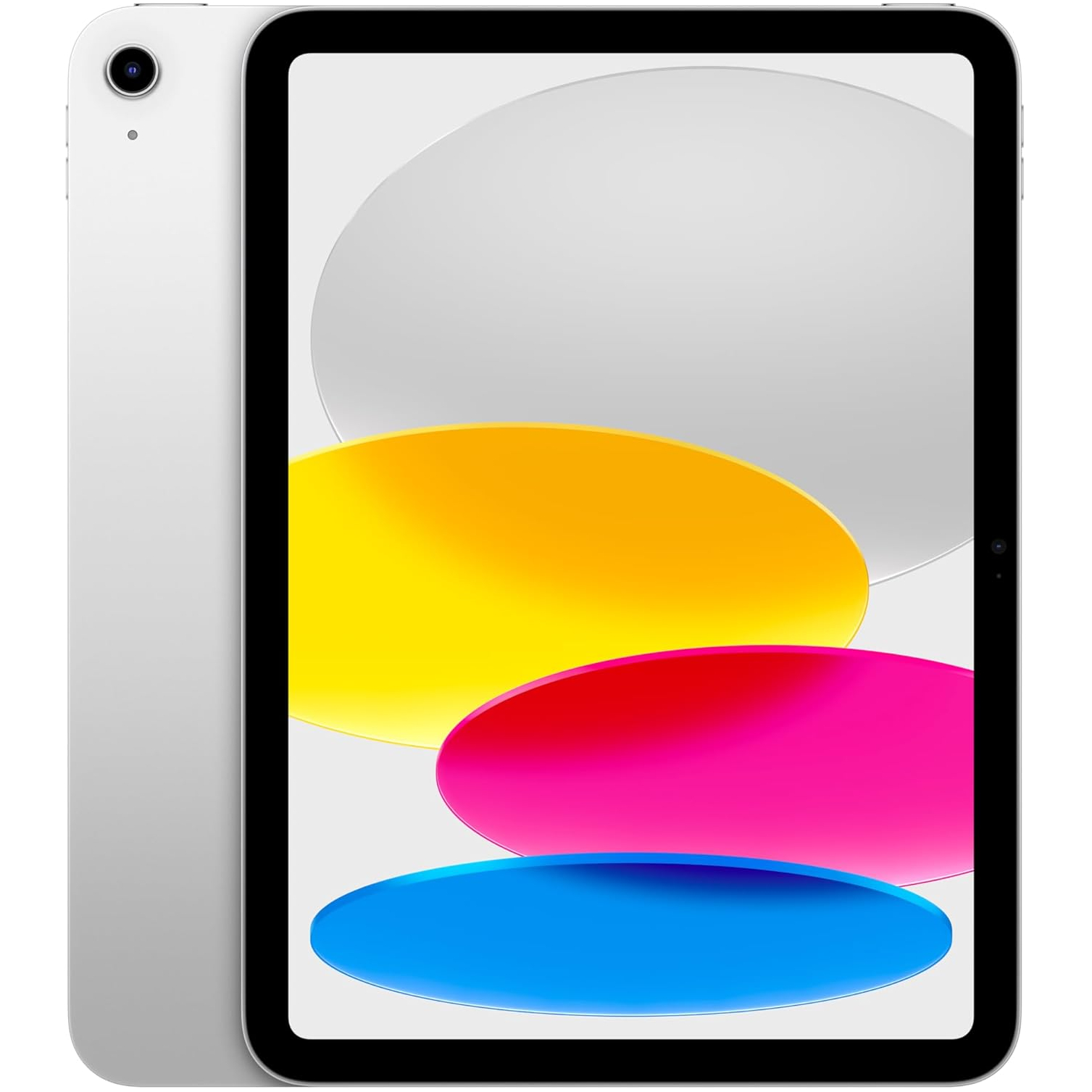
Amazon flips the bird to Apple — drops iPad (A16) price back down to pre-hike level

It was the news none of us wanted to hear, but at the turn of the new financial year in Australia, Apple made the move to raise Australian prices across its entire product lineup. The tech giant has often been better than other tech companies at absorbing increased supply-chain costs, but the current RAM and component crisis meant it could no longer hold out.

Perhaps the biggest and most upsetting increase affected the delightfully affordable MacBook Neo, but even the iPad wasn’t immune, with the company’s entry-level iPad (A16) seeing its price surge to AU$749, an increase of AU$150.

If you were hoping to grab one for yourself, but were put off by the increase (we wouldn’t blame you), then Amazon could have just answered your prayers, as it has knocked it back down to its pre-increase price of AU$599.

Beating its Prime Day price by a cool AU$70, now is prime time (pardon the pun) to scoop up Apple’s most affordable iPad at a price that’s slightly easier to stomach. The A16 chip is a good fit for streaming, browsing, note-taking, video calls and light productivity, while our iPad 11-inch (2025) review found it zippy for everyday apps. It doesn’t support Apple Intelligence, but that’s unlikely to bother most casual tablet buyers.View Deal

OK, so this might not be the absolute best iPad discount ever — it dropped to AU$499 during the recent EOFY sales — but for Amazon to bring the asking price back down to its longtime RRP is worth shouting about.

At its previous full price of AU$599, we could confidently say that the iPad 11-inch (2025) ranks as the best iPad for most people and the best cheap tablet overall.

Not only does the aforementioned A16 chip mean it’s quick in use, but a 10-hour battery life and crisp 10.9-inch screen make it a stellar choice for scrolling, streaming, video calling and light gaming.

Amazon has only discounted the 128GB variant, and while the Cellular model also gets a discount, it’s nowhere near as impressive as the Wi-Fi-only alternative. Do note, however, that the AU$150 saving only applies to the silver and pink models. The blue colourway is down to AU$699, while yellow has been left untouched.

I don’t expect this discount to last forever, and it’s anyone's guess if and when it’ll receive a similar saving in the future. If you missed out during EOFY and weren’t taken by the Prime Day price, this is an opportune time to pounce.

  •  

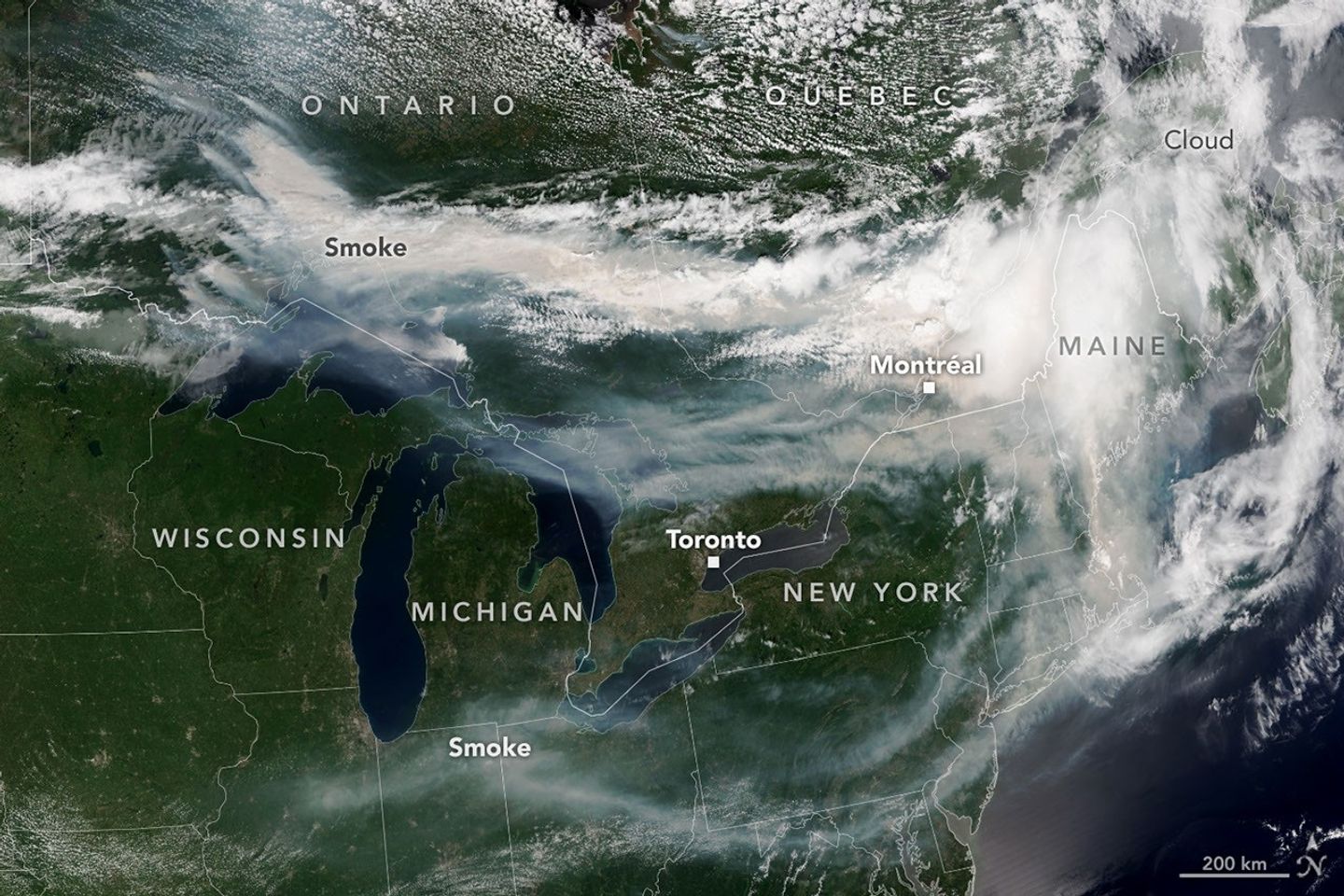
Ontario Wildfire Smoke Moves East

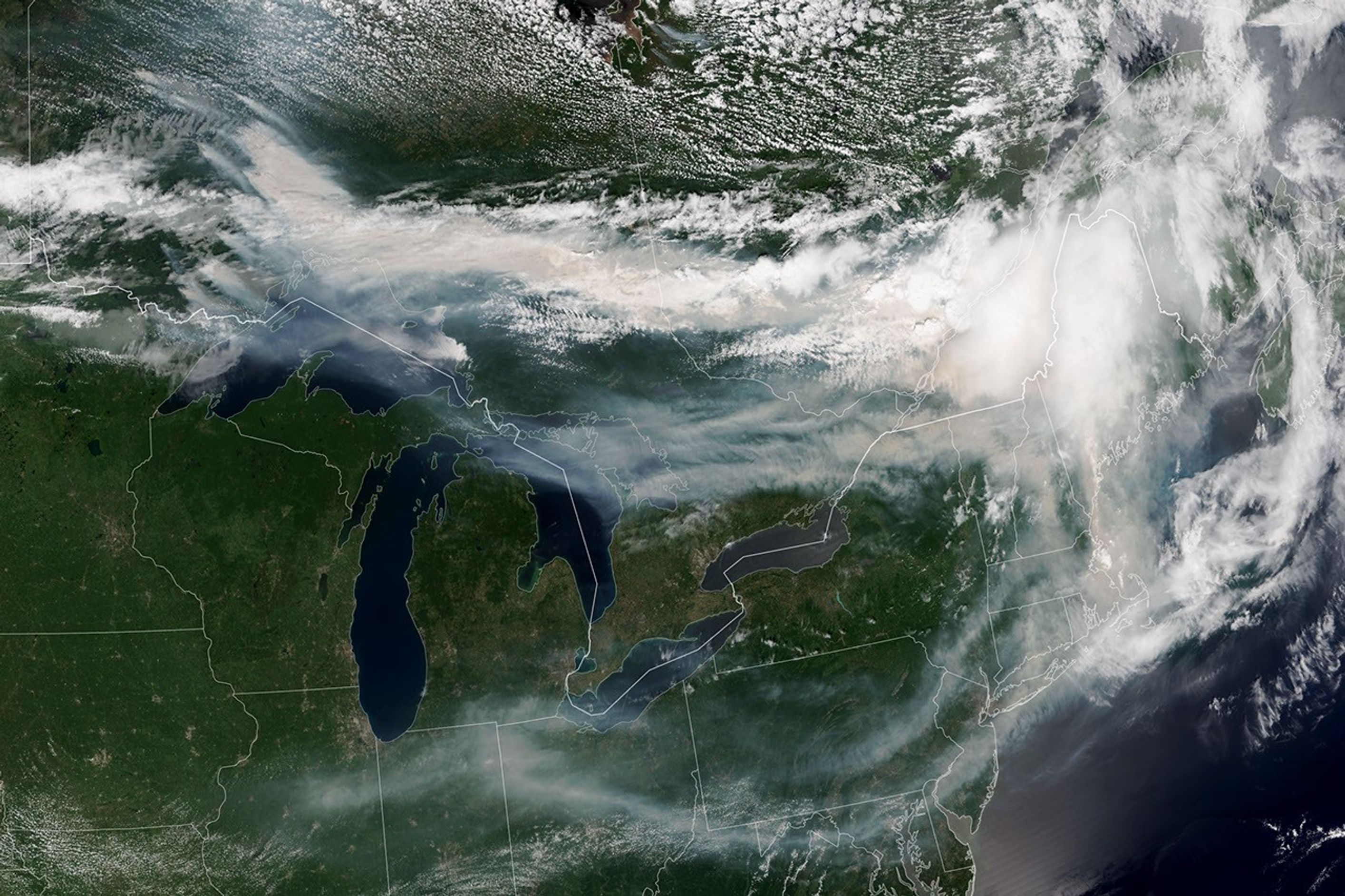
A satellite image shows brown smoke from wildfires in Ontario, Canada, streaming east across parts of Canada and the U.S. Areas of white clouds are mixed in with the smoke.
Smoke from wildland fires pours eastward over Canada and the U.S. in an image captured on the afternoon of July 14, 2026, by the VIIRS (Visible Infrared Imaging Radiometer Suite) on the NOAA-21 satellite.
NASA Earth Observatory/Lauren Dauphin

After a slow start to Canada’s 2026 fire season, activity picked up by the end of June amid dry, warm conditions and returned closer to the 25-year average. By mid-July, almost 850 fires were actively burning across the country, according to the Canadian Interagency Forest Fire Centre. More than 180 of those were burning in Ontario.

This NOAA-21 image, acquired on the afternoon of July 14, 2026, shows smoke billowing from the Ontario fires. Winds carried the smoke primarily southeast over much of the southern part of the province, as well as parts of Quebec and the U.S. Midwest and Northeast, tinting the sky shades of gray and yellow and the Sun orange in many areas.

The smoke’s impact on air quality varied, depending largely on altitude. In areas where smoke was high in the atmosphere, air quality impacts were negligible; where it drifted closer to the ground, conditions worsened. Air quality in Toronto, for instance, reached unhealthy levels, according to AirNow. People in the southern parts of the province were also grappling with a heat wave, compounding the health risks.

Much of the smoke came from fires in Northwestern Ontario, where eight blazes saw significant growth on July 13 and 14. The fires prompted officials to issue evacuation orders for several communities in this part of the province, according to news reports.

As of July 14, fires across Canada have burned 1.9 million hectares (4.7 million acres) since the start of the year—still well below the season totals from the extreme fire years of 2023 and 2025. How the rest of the season plays out remains to be seen. A seasonal fire outlook—compiled by wildland fire experts from the U.S., Canada, and Mexico—shows where fire conditions are more or less likely through July, August, and September.

NASA Earth Observatory image by Lauren Dauphin, using VIIRS data from NASA EOSDIS LANCE , GIBS/Worldview , and the Joint Polar Satellite System (JPSS). Story by Kathryn Hansen.

Downloads

A satellite image shows brown smoke from wildfires in Ontario, Canada, streaming east across parts of Canada and the U.S. Areas of white clouds are mixed in with the smoke.

July 14, 2026

JPEG (3.96 MB)

References & Resources

You may also be interested in:

Stay up-to-date with the latest content from NASA as we explore the universe and discover more about our home planet.

Fighting Fire With Fire
3 min read

In fire-prone ecosystems in Australia’s Northern Territory, prescribed burns are lit to minimize the severity of fires later in the…

Article
Fires Tear Through Nebraska Grasslands
3 min read

Dry, warm, and windy conditions across the U.S. Great Plains led to extreme fire activity in March 2026.

Article
Cottonwood Fire Chars Utah
5 min read

The blaze burned more than 150 square miles and swept through parts of a ski resort.

Article

The post Ontario Wildfire Smoke Moves East appeared first on NASA Science.

  •  

Moon phase today: What the Moon will look like on July 16

An image of a full moon.

The Moon is starting to reappear on its right side (this will be the left side if you're in the Southern Hemisphere). This means we're in the Waxing Crescent portion of the lunar cycle.

What is today’s Moon phase?

As of Thursday, July 16, NASA's Daily Moon Guide tracker tells us the Moon phase is in Waxing Crescent phase, with just 5% of its surface visible.

Even with visual aids, this is too small a surface area illuminated for us to be able to make out any surface features on the Moon.

When is the next Full Moon?

The next Full Moon will take place on July 29.

What are Moon phases?

The Moon completes one full cycle around Earth in about 29.5 days, moving through eight different phases along the way, NASA explains. Although the same side of the Moon always faces our planet, the amount of sunlight reflecting off its surface changes as it travels around Earth. This changing angle of illumination is what makes the Moon appear to transform throughout the month, from a thin crescent to a half-lit Moon and eventually a fully illuminated Full Moon, before starting the cycle again.

New Moon - The Moon is between Earth and the sun, so the side we see is dark (in other words, it's invisible to the eye).

Waxing Crescent - A small sliver of light appears on the right side (Northern Hemisphere).

First Quarter - Half of the Moon is lit on the right side. It looks like a half-Moon.

Waxing Gibbous - More than half is lit up, but it’s not quite full yet.

Full Moon - The whole face of the Moon is illuminated and fully visible.

Waning Gibbous - The Moon starts losing light on the right side. (Northern Hemisphere)

Third Quarter (or Last Quarter) - Another half-Moon, but now the left side is lit.

Waning Crescent - A thin sliver of light remains on the left side before going dark again.

  •  

Ontario Wildfire Smoke Moves East

A satellite image shows brown smoke from wildfires in Ontario, Canada, streaming east across parts of Canada and the U.S. Areas of white clouds are mixed in with the smoke.
Smoke from wildland fires pours eastward over Canada and the U.S. in an image captured on the afternoon of July 14, 2026, by the VIIRS (Visible Infrared Imaging Radiometer Suite) on the NOAA-21 satellite.
NASA Earth Observatory/Lauren Dauphin

After a slow start to Canada’s 2026 fire season, activity picked up by the end of June amid dry, warm conditions and returned closer to the 25-year average. By mid-July, almost 850 fires were actively burning across the country, according to the Canadian Interagency Forest Fire Centre. More than 180 of those were burning in Ontario.

This NOAA-21 image, acquired on the afternoon of July 14, 2026, shows smoke billowing from the Ontario fires. Winds carried the smoke primarily southeast over much of the southern part of the province, as well as parts of Quebec and the U.S. Midwest and Northeast, tinting the sky shades of gray and yellow and the Sun orange in many areas.

The smoke’s impact on air quality varied, depending largely on altitude. In areas where smoke was high in the atmosphere, air quality impacts were negligible; where it drifted closer to the ground, conditions worsened. Air quality in Toronto, for instance, reached unhealthy levels, according to AirNow. People in the southern parts of the province were also grappling with a heat wave, compounding the health risks.

Much of the smoke came from fires in Northwestern Ontario, where eight blazes saw significant growth on July 13 and 14. The fires prompted officials to issue evacuation orders for several communities in this part of the province, according to news reports.

As of July 14, fires across Canada have burned 1.9 million hectares (4.7 million acres) since the start of the year—still well below the season totals from the extreme fire years of 2023 and 2025. How the rest of the season plays out remains to be seen. A seasonal fire outlook—compiled by wildland fire experts from the U.S., Canada, and Mexico—shows where fire conditions are more or less likely through July, August, and September.

NASA Earth Observatory image by Lauren Dauphin, using VIIRS data from NASA EOSDIS LANCE , GIBS/Worldview , and the Joint Polar Satellite System (JPSS). Story by Kathryn Hansen.

Downloads

A satellite image shows brown smoke from wildfires in Ontario, Canada, streaming east across parts of Canada and the U.S. Areas of white clouds are mixed in with the smoke.

July 14, 2026

JPEG (3.96 MB)

References & Resources

You may also be interested in:

Stay up-to-date with the latest content from NASA as we explore the universe and discover more about our home planet.

Fighting Fire With Fire

3 min read

In fire-prone ecosystems in Australia’s Northern Territory, prescribed burns are lit to minimize the severity of fires later in the…

Article

Fires Tear Through Nebraska Grasslands

3 min read

Dry, warm, and windy conditions across the U.S. Great Plains led to extreme fire activity in March 2026.

Article

Cottonwood Fire Chars Utah

5 min read

The blaze burned more than 150 square miles and swept through parts of a ski resort.

Article
  •  

How to watch The Open 2026: Free Live Streams, TV Channels & Preview — Round 1

Watch The Open 2026 live streams, as the oldest golf tournament in the world returns for its 154th staging, at the links of Royal Birkdale. Scottie Scheffler will defend his crown won 12 months ago, while Rory McIlroy and local favorite Tommy Fleetwood – born minutes away in nearby Southport – are also among the leading contender's for golf's original major.

After winning by four strokes at Royal Portrush in 2025, Scheffler is trying to become the first Open champion to successfully defend their crown since Padraig Harrington in 2008-09. Yet the world number one will be smarting from missing his first cut in 78 tournaments after failing to make the weekend at the Scottish Open a week ago. He'll tee it up with world number three Matt Fitzpatrick and 2024 champion Xander Schauffele.

Fleetwood is seeking to become the first English winner of the Claret Jug since Nick Faldo in 1992. He goes out in a stellar group with 2021 champion Jon Rahm and Jordan Spieth, who won the last time the tournament was held at Royal Birkdale in 2017. Further home hopefuls include Aaron Rai, the reigning PGA Champion, and Justin Rose who exploded as an amateur here in 1998.

Rory McIlroy will also fancy his chances. The two-time reigning Masters champion finished strongly at the Scottish Open last weekend, with a final-round 64.

Blessed with a beautiful art deco clubhouse, the course is a cracker and conditions are set to be warm, which will bring its own challenge of controlling the ball on a links course by the sea.

Read on for our guide on where to watch The Open 2026 online, on TV and potentially for free wherever you are. Scroll down for the Round 1 tee times.

Can you watch The Open 2026 for free?

The Open coverage is predominantly locked behind a paywall, but there are a couple of ways to watch some free live streams from Royal Birkdale.

The Open app (available via the Apple Store and Google Play) will show coverage from Featured Groups over the course of the four days.

That will focus solely on those particular three or four groups, though, so for more exhaustive coverage, you'll have to look elsewhere. In the US there are free trials available that will let you tune in for nothing.

The tournament is being shown on NBC and USA Network, which are both carried by YouTube TV (10-day free trial), DirecTV Stream (5-day free trial) and Hulu+Live TV (3-day free trial).

Alternatively, you can live stream The Open 2026 on Peacock for next to nothing by taking advantage of the Walmart Plus 30-day trial for $1.

In Australia, Kayo Sports has a 7-day free trial to watch the tournament.

Traveling abroad right now? You can use a VPN to watch the Open Championship 2026 for free as if you were right at home.

Use a VPN to watch The Open 2026 live streams

A VPN is handy piece of software that can make your device appear as if it's back in your home country, so you can unlock your usual service. The best VPN right now? We recommend NordVPN – it does everything and comes with up to 75% off.

🟩 NordVPN – get the world's best VPN

Not having a VPN is like leaving your front door wide open in a busy city – anyone can walk right in and take a peek.

TechRadar regularly reviews all the biggest and best VPN providers and NordVPN is our #1 choice.

✅ Up to 75% off today
✅ 3 extra months free
✅ Unlocks all necessary streaming services

Get NordVPN and stream The Open 2026 from anywhere.View Deal

How to watch The Open 2026 live streams in the US

US flag banner

The Open 2026 coverage is shared between NBC, USA Network and Peacock in the US. All NBC coverage is being simulcasted on Peacock.

Rounds 1 and 2 air on NBC Sports Network/Peacock from 1.30am-4am, and on USA Network from 4am-3.30pm. Round 3 airs on USA from 5am-7am, and on NBC/Peacock from 7am-3pm. Round 4 airs on USA from 4am-7am, and on NBC/Peacock from 7am-finish. All times ET.

The Peacock price starts at $10.99/month or $109.99/year for a plan that carries live sports. However, you can access Peacock virtually for free with a Walmart Plus 30-day trial for $1.

NBC and USA Network, meanwhile, are available through Sling – specifically the Blue plan, which starts at $45.99/month. It includes NBC, ABC and Fox in select locations, plus FS1, USA Network, FX and more.

Alternatively, both channels are also carried by YouTube TV and Hulu + Live TV, each of which offers a free trial to new users.

If you're traveling outside of the US, you can make use of NordVPN to catch the action.

How to watch The Open 2026 live streams in the UK

UK flag

(Image credit: Future)

In the UK, The Open Championship 2026 is being shown on Sky Sports, via the Sky Sports Main Event and Sky Sports Golf channels.

Sky Sports plans start from £35/month, or £20 if you're an existing Sky subscriber. Alternatively, grab a Now Sports subscription from £14.99/day or £34.99/month.

Outside the UK right now? Use NordVPN to access your preferred coverage of The Open Championship.

How to watch The Open 2026 live streams in Australia

Australian flag

(Image credit: free)

In Australia, The Open 2026 is being televised on Fox Sports via Foxtel, with live streaming available via Kayo Sports.

Kayo Sports starts at AU$30 per month after a 7-day free trial. Or you can get your first month for AU$1.

If you're currently out of Australia but want to watch your usual Open coverage, you'll need to get yourself a VPN, as per the instructions above.

How to watch The Open 2026 live streams in Canada

Canada

(Image credit: Other)

In Canada, The Open 2026 is exclusive to TSN.

If you don't have cable, the TSN Plus streaming service costs CA$29.99/month or CA$249.99/year. However, you can currently get three months for CA$59.99.

If you're out of Canada but still want to tune in, explore the VPN route set out above, which will help you access your accounts from anywhere.

The Open 2026 FAQs

What are the Round 1 tee times?

(All times BST, which is -5 hours from ET)

6:35 a.m. Matthew Baldwin, Thomas Detry, James Nicholas

6:46 a.m. Michael Kim, David Hillier, Andy Sullivan

6:57 a.m. Ryan Fox, Andrew Novak, Matthew Jordan

7:08 a.m. Henrik Stenson, Max Homa, Joe Dean

7:19 a.m. Robert MacIntyre, Rickie Fowler, Alex Fitzpatrick

7:30 a.m. David Duval, Martin Couvra, Matthew Southgate

7:41 a.m. Sungjae Im, Daniel Brown, Fifa Laopakdee*

7:52 a.m. Gary Woodland, Jake Knapp, Jordan Smith

8:03 a.m. Francesco Molinari, Tom McKibbin, Lev Grinberg*

8:14 a.m. Hennie du Plessis, Jose Luis Ballester, Dan Bradbury

8:25 a.m. Angel Ayora, Victor Perez, Mateo Pulcini*

8:36 a.m. Stewart Cink, Scott Vincent, Joakim Lagergren

8:47 a.m. Michael Thorbjornsen, Kota Kaneko, Travis Smyth

9:03 a.m. Alex Smalley, Sam Stevens, Ryo Hisatsune

9:14 a.m. Akshay Bhatia, Harris English, Rasmus Hojgaard

9:25 a.m. Ben Griffin, Hideki Matsuyama, Min Woo Lee

9:36 a.m. Russell Henley, Justin Rose, Viktor Hovland

9:47 a.m. Justin Thomas, Alex Noren, Jason Day

9:58 a.m. Scottie Scheffler, Tyrrell Hatton, Bryson DeChambeau

10:09 a.m. Jordan Spieth, Tommy Fleetwood, Jon Rahm

10:20 a.m. Brian Harman, Si Woo Kim, Nick Taylor

10:31 a.m. Ryan Gerard, Maverick McNealy, David Puig

10:42 a.m. Kazuma Kobori, Tom Sloman, David Howard*

10:53 a.m. Antoine Rozner, Ren Yonezawa, Caleb Surratt

11:04 a.m. MJ Daffue, Frederic Lacroix, Jack McDonald

11:15 a.m. Jeongwoo Ham, Ryutaro Nagamo, Alejandro De Castro Piera*

11:41 a.m. John Parry, Eric Cole, Tiger Christensen

11:52 a.m. Eugenio Chacarra, Matt Wallace, Max Greyserman

12:03 p.m. Michael Brennan, Sahith Theegala, Laurie Canter

12:14 p.m. Cameron Smith, Keith Mitchell, Stuart Grehan*

12:25 p.m. Sepp Straka, Joaquin Niemann, Kurt Kitayama

12:36 p.m. Sami Valimaki, Shaun Norris, Jackson Suber

12:47 p.m. Darren Clarke, Adrien Saddier, Bernd Wiesberger

12:58 p.m. Keegan Bradley, Corey Conners, Casey Jarvis

1:09 p.m. Matt McCarty, Harry Hall, Haotong Li

1:20 p.m. Padraig Harrington, Marco Penge, Michael Hollick

1:31 p.m. Tom Kim, Billy Horschel, Mason Howell*

1:42 p.m. Johnny Keefer, Pierceson Coody, Keita Nakajima

1:53 p.m. Louis Oosthuizen, Jesper Svensson, Jack Buchanan

2:09 p.m. Bud Cauley, Jayden Schaper, Lucas Herbert

2:20 p.m. Kristoffer Reitan, Patrick Reed, JT Poston

2:31 p.m. Chris Gotterup, Sam Burns, Adam Scott

2:42 p.m. Collin Morikawa, JJ Spaun, Nicolai Hojgaard

2:53 p.m. Shane Lowry, Aaron Rai, Brooks Koepka

3:04 p.m. Cameron Young, Wyndham Clark, Ludvig Aberg

3:15 p.m. Rory McIlroy, Xander Schauffele, Matt Fitzpatrick

3:26 p.m. Jacob Bridgeman, Rasmus Neergaard-Petersen, Tim Wiedmeyer*

3:37 p.m. Patrick Cantlay, Daniel Berger, Nico Echevarria

3:48 p.m. Peter Uihlein, Alistair Docherty, Francesco Laporta

3:59 p.m. Cameron John, Austen Truslow, Sam Bairstow

4:10 p.m. Naoyuki Kataoka, Marcus Plunkett, Baard Bjoernevik

4:21 p.m. Kazuki Higa, Jiho Yang, Nevill Ruiter*

Round 2:

6:35 a.m. John Parry, Eric Cole, Tiger Christensen

6:46 a.m. Eugenio Chacarra, Matt Wallace, Max Greyserman

6:57 a.m. Michael Brennan, Sahith Theegala, Laurie Canter

7:08 a.m. Cameron Smith, Keith Mitchell, Stuart Grehan

7:19 a.m. Sepp Straka, Joaquin Niemann, Kurt Kitayama

7:30 a.m. Sami Valimaki, Shaun Norris, Jackson Suber

7:41 a.m. Darren Clarke, Adrien Saddier, Bernd Wiesberger

7:52 a.m. Keegan Bradley, Corey Conners, Casey Jarvis

8:03 a.m. Matt McCarty, Harry Hall, Haotong Li

8:14 a.m. Padraig Harrington, Marco Penge, Michael Hollick

8:25 a.m. Tom Kim, Billy Horschel, Mason Howell

8:36 a.m. Johnny Keefer, Pierceson Coody, Keita Nakajima

8:47 a.m. Louis Oosthuizen, Jesper Svensson, Jack Buchanan

9:03 a.m. Bud Cauley, Jayden Schaper, Lucas Herbert

9:14 a.m. Kristoffer Reitan, Patrick Reed, JT Poston

9:25 a.m. Chris Gotterup, Sam Burns, Adam Scott

9:36 a.m. Collin Morikawa, JJ Spaun, Nicolai Hojgaard

9:47 a.m. Shane Lowry, Aaron Rai, Brooks Koepka

9:58 a.m. Cameron Young, Wyndham Clark, Ludvig Aberg

10:09 a.m. Rory McIlroy, Xander Schauffele, Matt Fitzpatrick

10:20 a.m. Jacob Bridgeman, Rasmus Neergaard-Petersen, Tim Wiedemeyer,

10:31 a.m. Patrick Cantlay, Daniel Berger, Nico Echavarria

10:42 a.m. Peter Uihlein, Alistair Docherty, Francesco Laporta

10:53 a.m. Cameron John, Austen Truslow, Sam Bairstow

11:04 a.m. Naoyuki Kataoka, Marcus Plunkett, Baard Bjoernevik Skogen

11:15 a.m. Kazuki Higa, Jiho Yang, Nevill Ruiter

11:41 a.m. Matthew Baldwin, Thomas Detry James Nicholas

11:52 a.m. Michael Kim, Daniel Hillier, Andy Sullivan

12:03 p.m. Ryan Fox, Andrew Novak, Matthew Jordan

12:14 p.m. Henrik Stenson, Max Homa, Joe Dean

12:25 p.m. Robert MacIntyre, Rickie Fowler, Alex Fitzpatrick

12:36 p.m. David Duval, Martin Couvra, Matthew Southgate

12:47 p.m. Sungjae Im, Daniel Brown, Fifa Laopakdee

12:58 p.m. Gary Woodland, Jake Knapp, Jordan Smith

1:09 p.m. Francesco Molinari, Tom McKibbin, Lev Grinberg

1:20 p.m. Hennie du Plessis, Jose Luis Ballester Barrio, Dan Bradbury

1:31 p.m. Angel Ayora, Victor Perez, Mateo Pulcini

1:42 p.m. Stewart Cink, Scott Vincent, Joakim Lagergren

1:53 p.m. Michael Thorbjornsen, Kota Kaneko, Travis Smyth

2:09 p.m. Alex Smalley, Sam Stevens, Ryo Hisatsune

2:20 p.m. Akshay Bhatia, Harris English, Rasmus Hojgaard

2:31 p.m. Ben Griffin, Hideki Matsuyama, Min Woo Lee

2:42 p.m. Russell Henley, Justin Rose, Viktor Hovland

2:53 p.m. Justin Thomas, Alex Noren, Jason Day

3:04 p.m. Scottie Scheffler, Tyrrell Hatton, Bryson DeChambeau

3:15 p.m. Jordan Spieth, Tommy Fleetwood, Jon Rahm

3:26 p.m. Brian Harman, Si Woo Kim, Nick Taylor

3:37 p.m. Ryan Gerard, Maverick McNealy, David Puig

3:48 p.m. Kazuma Kobori, Tom Sloman, David Howard

3:59 p.m. Antoine Rozner. Ren Yonezawa, Caleb Surratt

4:10 p.m. MJ Daffue, Frederic Lacroix, Jack McDonald

4:21 p.m. Jeongwoo Ham, Ryutaro Nagano, Alejandro De Castro Piera

Who are the recent Open winners?

2025 – Scottie Scheffler
2024 – Xander Schauffele
2023 – Brian Harman
2022 – Cameron Smith
2021 – Collin Morikawa

2020 – N/A
2019 – Shane Lowry
2018 – Francesco Molinari
2017 – Jordan Spieth

2016 – Henrik Stenson

Can I follow The Open 2026 on my mobile?

Of course! Each of the major broadcasters has streaming services that you can access through mobile apps or via your phone's browser.

And, as we've mentioned above you can watch action from Featured Groups at the tournament on The Open app (available via the Apple Store and Google Play).

You can also stay up-to-date with all of the key highlights on the PGA's official social media channels on YouTube (@PGATour), Instagram (@PGATour), TikTok (@PGATour) and Facebook (@PGATour).

We test and review VPN services in the context of legal recreational uses. For example:1. Accessing a service from another country (subject to the terms and conditions of that service).2. Protecting your online security and strengthening your online privacy when abroad.We do not support or condone the illegal or malicious use of VPN services. Consuming pirated content that is paid-for is neither endorsed nor approved by Future Publishing.

  •  

NYT Connections Sports Edition today: Hints and answers for July 16, 2026

A phone displaying the New York Times game 'Connections.'

Today's Connections: Sports Edition will be easier if you watch Indiana sports.

As we've shared in previous hints stories, this is a version of the popular New York Times word game that seeks to test the knowledge of sports fans.

Like the original Connections, the game is all about finding the "common threads between words." And just like Wordle, Connections resets after midnight, and each new set of words gets trickier and trickier — so we've served up some hints and tips to get you over the hurdle.

If you just want to be told today's puzzle, you can jump to the end of this article for the latest Connections solution. But if you'd rather solve it yourself, keep reading for some clues, tips, and strategies to assist you.

What is Connections: Sports Edition?

The NYT's latest daily word game has launched in association with The Athletic, the New York Times property that provides the publication's sports coverage. The sports Connections can be played on both web browsers and mobile devices and require players to group four words that share something in common.

This Tweet is currently unavailable. It might be loading or has been removed.

Each puzzle features 16 words, and each grouping of words is split into four categories. These sets could comprise anything from book titles, software, country names, etc. Even though multiple words will seem like they fit together, there's only one correct answer.

If a player gets all four words in a set correct, those words are removed from the board. Guess wrong and it counts as a mistake — players get up to four mistakes before the game ends.

This Tweet is currently unavailable. It might be loading or has been removed.

Players can also rearrange and shuffle the board to make spotting connections easier. Additionally, each group is color-coded with yellow being the easiest, followed by green, blue, and purple. Like Wordle, you can share the results with your friends on social media.

Here's a hint for today's Connections: Sports Edition categories

Want a hint about the categories without being told the categories? Then give these a try:

  • Yellow: Indiana

  • Green: Big dogs

  • Blue: Horse riding

  • Purple: Famous domes

Here are today's Connections: Sports Edition categories

Need a little extra help? Today's connections fall into the following categories:

  • Yellow: Indiana Teams

  • Green: Bulldogs

  • Blue: Equestrian Equipment

  • Purple: ___Dome

Looking for Wordle today? Here's the answer to today's Wordle.

Ready for the answers? This is your last chance to turn back and solve today's puzzle before we reveal the solutions.

Drumroll, please!

The solution to today's Connections: Sports Edition #661 is...

What is the answer to Connections: Sports Edition today?

  • Indiana Teams: COLTS, FEVER, HOOSIERS, PACERS

  • Bulldogs: BUTLER, GONZAGA, MISSISSIPPI STATE, YALE

  • Equestrian Equipment: BIT, REINS, SADDLE, STIRRUPS

  • ___Dome: ASTRO, FARGO, GEORGIA, SUPER

Don't feel down if you didn't manage to guess it this time. There will be new sports Connections for you to stretch your brain with tomorrow, and we'll be back again to guide you with more helpful hints.

Are you also playing NYT Strands? See hints and answers for today's Strands.

If you're looking for more puzzles, Mashable's got games now! Check out our games hub for Mahjong, Sudoku, free crossword, and more.

Not the day you're after? Here's the solution to yesterday's Connections.

  •  

NYT Connections hints today: Clues, answers for July 16, 2026

Connections game on a smartphone

The NYT Connections puzzle today is not too difficult if you're precise.

Connections is the one of the most popular New York Times word games that's captured the public's attention. The game is all about finding the "common threads between words." And just like Wordle, Connections resets after midnight and each new set of words gets trickier and trickier—so we've served up some hints and tips to get you over the hurdle.

If you just want to be told today's puzzle, you can jump to the end of this article for today's Connections solution. But if you'd rather solve it yourself, keep reading for some clues, tips, and strategies to assist you.

What is Connections?

The NYT's latest daily word game has become a social media hit. The Times credits associate puzzle editor Wyna Liu with helping to create the new word game and bringing it to the publications' Games section. Connections can be played on both web browsers and mobile devices and require players to group four words that share something in common.

This Tweet is currently unavailable. It might be loading or has been removed.

Each puzzle features 16 words and each grouping of words is split into four categories. These sets could comprise of anything from book titles, software, country names, etc. Even though multiple words will seem like they fit together, there's only one correct answer.

If a player gets all four words in a set correct, those words are removed from the board. Guess wrong and it counts as a mistake—players get up to four mistakes until the game ends.

This Tweet is currently unavailable. It might be loading or has been removed.

Players can also rearrange and shuffle the board to make spotting connections easier. Additionally, each group is color-coded with yellow being the easiest, followed by green, blue, and purple. Like Wordle, you can share the results with your friends on social media.

Here's a hint for today's Connections categories

Want a hint about the categories without being told the categories? Then give these a try:

  • Yellow: Beauty regimen

  • Green: Dark colors

  • Blue: Exact

  • Purple: A speck

Meet The Mashable 101: Our list of the content creators shaping the internet today

Here are today's Connections categories

Need a little extra help? Today's connections fall into the following categories:

  • Yellow: Skincare products

  • Green: Shades of black

  • Blue: Associated with precision

  • Purple: Starting with tiny marks

Looking for Wordle today? Here's the answer to today's Wordle.

Ready for the answers? This is your last chance to turn back and solve today's puzzle before we reveal the solutions.

Drumroll, please!

The solution to today's Connections #1131 is...

What is the answer to Connections today

  • Skincare products: CLAY MASK, EYE CREAM, PEEL, TONER

  • Shades of black: CHARCOAL, INK, JET, PITCH

  • Associated with precision: BULLSEYE, CLOCKWORK, LASER, NEEDLE

  • Starting with tiny marks: DOT MATRIX, PERIOD PIECE, POINT BREAK, SPOT REMOVER

Are you also playing NYT Strands? Get all the Strands hints you need for today's puzzle.

If you're looking for more puzzles, Mashable's got games now! Check out our games hub for Mahjong, Sudoku, free crossword, and more.

Not the day you're after? Here's the solution to yesterday's Connections.

  •  

Linux no Mega Drive? Dev faz sistema rodar no Sega 32X com só 256 KB de RAM

A comunidade entusiasta de Linux não tem limites. Assim como Doom é portado para qualquer eletrônico que tenha um chip, o sistema operacional do pinguim também é instalado em qualquer nível de hardware. Uma prova disso é o SO em um SEGA 32X, aquela expansão do Mega Drive, com duas CPUs de 23 MHz e incríveis 256 KB de memória RAM, tamanho muito menor que qualquer foto de celular hoje em dia.

O responsável por essa façanha é o desenvolvedor espanhol conhecido como "cakehonolulu", que conseguiu compilar e inicializar o kernel Linux junto com o BusyBox no antigo acessório de 16 bits lançado em 1994.

Embora o SEGA 32X fosse considerado potente para sua época, trazendo dois processadores Hitachi SuperH SH2 de 23 MHz para auxiliar o antigo processador Motorola 68000 do Mega Drive, além de expandir a paleta para até 32.000 cores na tela, fazê-lo rodar um sistema operacional moderno trouxe desafios significativos.

Mesmo o Linux ainda é muito para um hardware tão defasado

Entre os principais obstáculos enfrentados pelo desenvolvedor estavam a quantidade extremamente limitada de memória RAM, a ausência de sincronização de hardware e a falta de acesso direto a portas UART (para comunicação serial). Além disso, cakehonolulu teve que superar bugs de agendador e insistiu no desafio extra de fazer multiprocessamento simétrico funcionar, para que o Linux pudesse utilizar ambos os núcleos de processamento SH2 de forma cooperativa.

Sega-Genesis-32X

Para alcançar o sucesso, ele contou com o auxílio do kit de desenvolvimento Chilly Willy, do projeto "linuxmd", de cartuchos flash baseados em FPGA da Krikzz e de documentações antigas sobre a arquitetura dos chips da Hitachi.

Curiosamente, esse não é o primeiro projeto retrô de cakehonolulu: ele também foi o responsável por portar o Linux para o Atari Jaguar (console de 1993). Para o programador, esses ports complexos em hardwares antigos e exóticos não são apenas hobbies, mas servem como um portfólio de engenharia que ele espera utilizar para se destacar no mercado e conseguir um novo emprego na área de tecnologia.

E se você não sabe nada de Linux, dá uma conferida nessas coisas que você provavelmente não sabia sobre o sistema do pinguim.

{{WHATSAPP_CHANNEL}}

  •  

Quordle hints and answers for Thursday, July 16 (game #1634)

Looking for a different day?

A new Quordle puzzle appears at midnight each day for your time zone – which means that some people are always playing 'today's game' while others are playing 'yesterday's'. If you're looking for Wednesday's puzzle instead then click here: Quordle hints and answers for Wednesday, July 15 (game #1633).

Quordle was one of the original Wordle alternatives and is still going strong now more than 1,500 games later. It offers a genuine challenge, though, so read on if you need some Quordle hints today — or scroll down further for the answers.

Enjoy playing word games? You can also check out my NYT Connections today and NYT Strands today pages for hints and answers for those puzzles, while Marc's Wordle today column covers the original viral word game.

SPOILER WARNING: Information about Quordle today is below, so don't read on if you don't want to know the answers.

Quordle today (game #1634) — hint #1 — Vowels

How many different vowels are in Quordle today?

• The number of different vowels in Quordle today is 4*.

* Note that by vowel we mean the five standard vowels (A, E, I, O, U), not Y (which is sometimes counted as a vowel too).

Quordle today (game #1634) — hint #2 — repeated letters

Do any of today's Quordle answers contain repeated letters?

• The number of Quordle answers containing a repeated letter today is 2.

Quordle today (game #1634) — hint #3 — uncommon letters

Do the letters Q, Z, X or J appear in Quordle today?

• No. None of Q, Z, X or J appear among today's Quordle answers.

Quordle today (game #1634) — hint #4 — starting letters (1)

Do any of today's Quordle puzzles start with the same letter?

• The number of today's Quordle answers starting with the same letter is 0.

If you just want to know the answers at this stage, simply scroll down. If you're not ready yet then here's one more clue to make things a lot easier:

Quordle today (game #1634) — hint #5 — starting letters (2)

What letters do today's Quordle answers start with?

• I

• P

• Y

• A

Right, the answers are below, so DO NOT SCROLL ANY FURTHER IF YOU DON'T WANT TO SEE THEM.

Quordle today (game #1634) — the answers

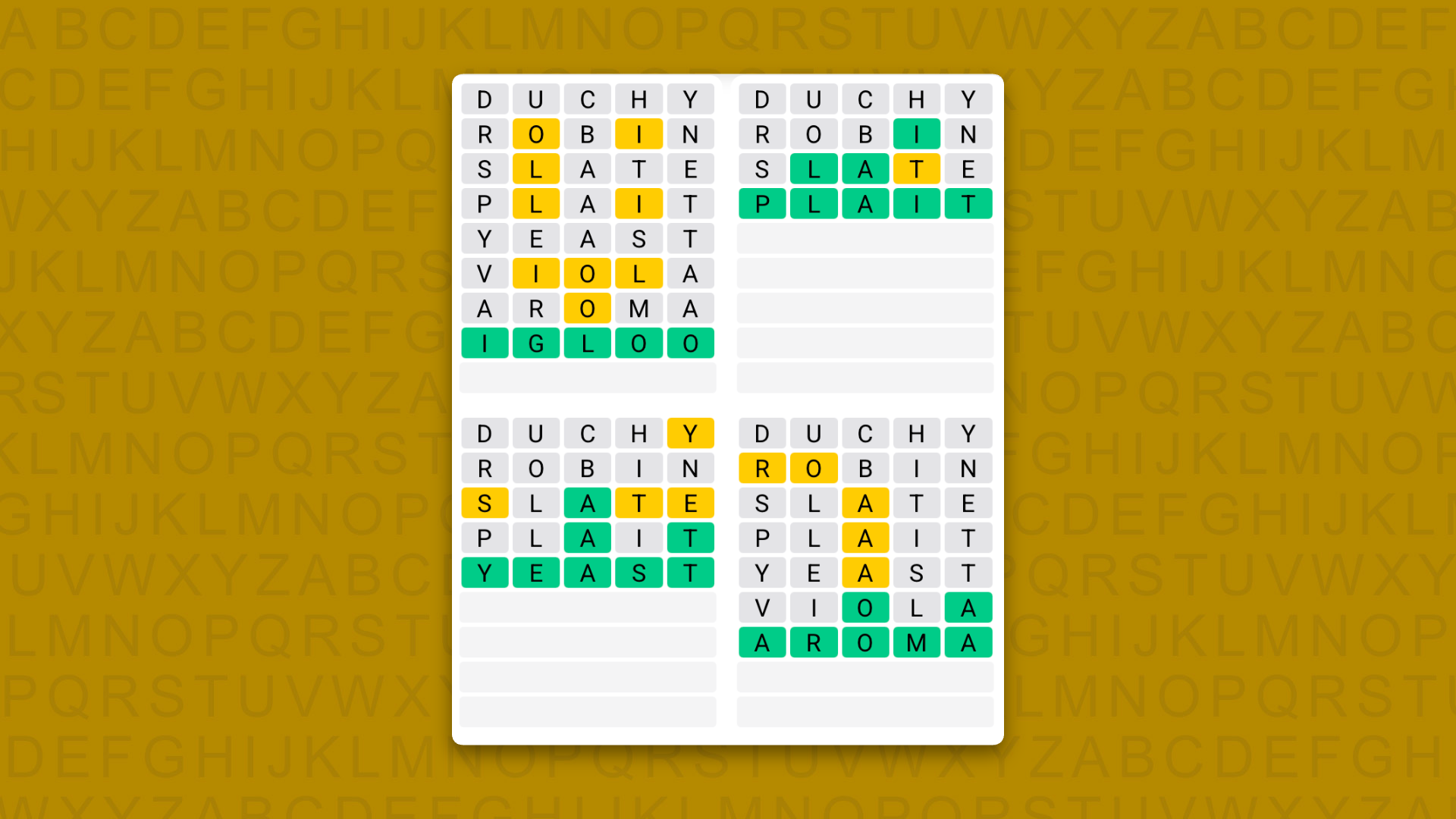
Quordle answers for game 1634 on a yellow background

(Image credit: Merriam-Webster)

The answers to today's Quordle, game #1634, are…

  • IGLOO
  • PLAIT
  • YEAST
  • AROMA

This was a tricky game — mainly due to two words ending in vowels.

I thought I had exhausted all words ending in the letter O, before I finally got to one ending in two of them.

Daily Sequence today (game #1634) — the answers

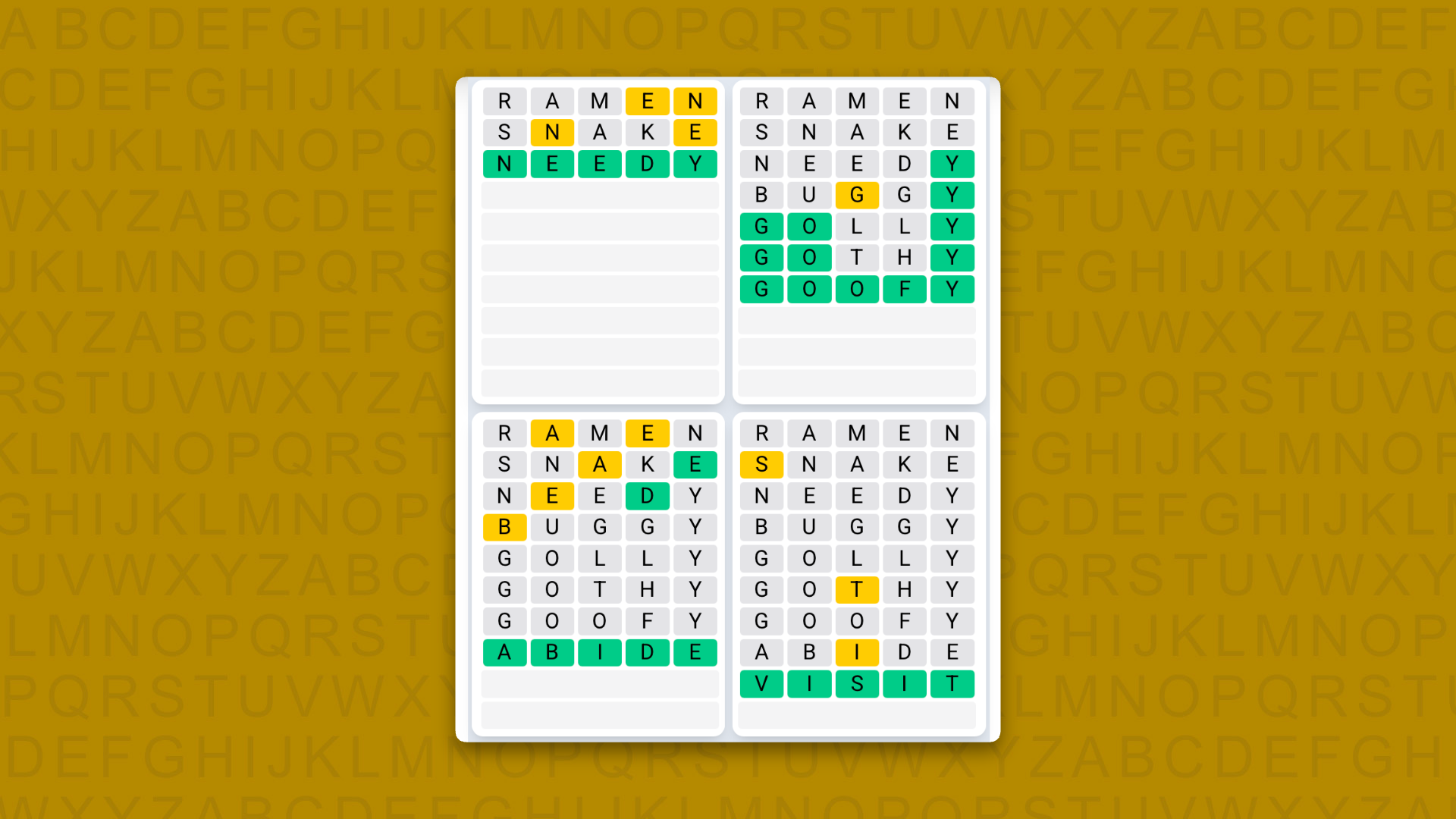
Quordle Daily Sequence answers for game 1634 on a yellow background

(Image credit: Merriam-Webster)

The answers to today's Quordle Daily Sequence, game #1634, are…

  • NEEDY
  • GOOFY
  • ABIDE
  • VISIT

Quordle answers: The past 20

  • Quordle #1633, Wednesday, 15 July: PROXY, BRICK, BROTH, SURGE
  • Quordle #1632, Tuesday, 14 July: EBONY, AVOID, RODEO, CUTIE
  • Quordle #1631, Monday, 13 July: VOICE, BISON, BURNT, BUILT
  • Quordle #1630, Sunday, 12 July: STAIN, BINGO, LARVA, DICEY
  • Quordle #1629, Saturday, 11 July: WORTH, PRONG, DINGO, DRUID
  • Quordle #1628, Friday, 10 July: GREET, STEAK, DUSKY, HAUTE
  • Quordle #1627, Thursday, 9 July: CRUMP, PHONE, SHINY, STONY
  • Quordle #1626, Wednesday, 8 July: GHOST, TREND, EXALT, ALONG
  • Quordle #1625, Tuesday, 7 July: ARRAY, SUITE, KIOSK, BOULE
  • Quordle #1624, Monday, 6 July: TRAWL, SPICE, PIANO, SHARK
  • Quordle #1623, Sunday, 5 July: PINEY, SWOON, TITLE, PINTO
  • Quordle #1622, Saturday, 4 July: ARGUE, MOTEL, OPERA, TRUCE
  • Quordle #1621, Friday, 3 July: AVERT, MOTOR, MANIC, WORDY
  • Quordle #1620, Thursday, 2 July: BULKY, PARSE, BELOW, MOVIE
  • Quordle #1619, Wednesday, 1 July: EASEL, OTTER, LYRIC, SHACK
  • Quordle #1618, Tuesday, 30 June: HALVE, DRYER, THERE, MINTY
  • Quordle #1617, Monday, 29 June: SLURP, CRACK, CRANK, PHONY
  • Quordle #1616, Sunday, 28 June: RUPEE, TOPAZ, FULLY, BEING
  • Quordle #1615, Saturday, 27 June: PRINT, MARRY, SADLY, BICEP
  • Quordle #1614, Friday, 26 June: JUICE, ARRAY, BONEY, SKIFF

  •  
❌