An asteroid now bears the name of beloved musician Elliott Smith, thanks to one ambitious filmmaker.
Elliott Smith passed away at the age of 34 in 2003, but his impact and his music continue to connect with people around the world. And his influence has now extended to space, thanks to independent filmmaker Orlando Campopiano, who worked to get an asteroid named "Elliottsmith."
"I hope this introduces at least one new person to Elliott's brilliant discography, and I'm happy to see a permanent legacy in the stars! To have this tribute to him blessed by the estate and discoverers is also a great honor," Campopiano told Stereogum.
While listening to the song "Shooting Star," from Smith's album "From a Basement on the Hill," which was released in 2004 following his death, Campopiano had the idea to try and get an asteroid named after Smith, he told Stereogum.
He took this inspiration and ran with it, connecting with Smith's estate and working together to submit a proposal to the International Astronomical Union (IAU), which gives official names to cosmic objects, including asteroids. Maybe there are some Elliott Smith fans at the IAU, because the organization actually said yes.
With this positive response, Asteroid (861969) 2014 OS439 is now officially "Elliottsmith."
The asteroid Elliotsmith (861969) visualized in our solar system. (Image credit: NASA)
The asteroid was discovered back in 2014 by the Pan-STARRS 1 (Panoramic Survey Telescope and Rapid Response System) project in Hawai'i.
The IAU's announcement of the renaming reads: "Steven Paul 'Elliott' Smith (1969–2003) was an influential, Oscar-nominated American songwriter. His intricate music left a lasting impact on many musicians. Asteroid 861969 honors his birth date, August 6, 1969. Smith often used celestial motifs in his work, notably in the song 'Shooting Star,' which, in hindsight, symbolizes his brief but brilliant light."
As this classification states, this asteroid is more than just a random rock in the sky. Its previous, numerical name 861969 happens to perfectly mirror Smith's birthday. This cosmic alignment makes it feel like this naming was truly meant to be.
Last year, NASA's Lucy spacecraft encountered a bi-lobed asteroid that is a chunk of an even larger rocky body that was smashed apart in an almighty collision 155 million years ago. This little pitstop happened on Lucy's way to a rendezvous with the Trojan asteroids that shadow Jupiter around the sun.
The asteroid 52246 Donaldjohanson, better known as "DJ" to Lucy's mission scientists and named after the paleoanthropologist who discovered the Lucy hominin fossil in Ethiopia in 1974, orbits the sun in the inner part of the main asteroid belt between Mars and Jupiter.
The true Lucy fossil dates back in time 3.2 million years and is an important link in the evolutionary chain that led to homo sapiens. Likewise, primitive asteroidal bodies are somewhat like fossilized remnants of the building blocks of the solar system's planets, including Earth. Understanding the make-up of these asteroids and where they formed versus where they are now can provide crucial insights into how Earth was assembled and where its organic materials and water may have come from.
Lucy flew past DJ in April of 2025. It is a pretty primitive asteroid, meaning that it has, or once upon a time had, certain volatile materials such as water-ice, as well as plenty of carbon — all things that can be removed thermally over time. Most objects that contain volatiles originate in the outer solar system, where it is cold enough that the volatiles do not sublimate away.
Within DJ's composition, Lucy detected iron-bearing phyllosilicates, which are a mineral formed in the presence of liquid water.
"Phyllosilicates are an indication that water was present and there was some degree of aqueous alteration," Simone Marchi, a planetary scientist from the South-west Research Institute and lead of the study into DJ, told Space.com.
However, for DJ to have had water, it must have formed further out from the sun, possibly in the outer asteroid belt.
"But DJ belongs to the inner asteroid belt so that's already intriguing," said Marchi.
The spectral evidence also indicates DJ was only partially altered by water, which Marchi says tells us something about its history.
"The aqueous alteration terminated early, and though we don't know why, we can speculate. In order to have aqueous alteration there needs to be some internal heating [usually via radioactive elements] and if something forms later than everything else then there will be less heat [since many of the radioactive elements will have already decayed]. Or perhaps there was just less water to start with where it formed."
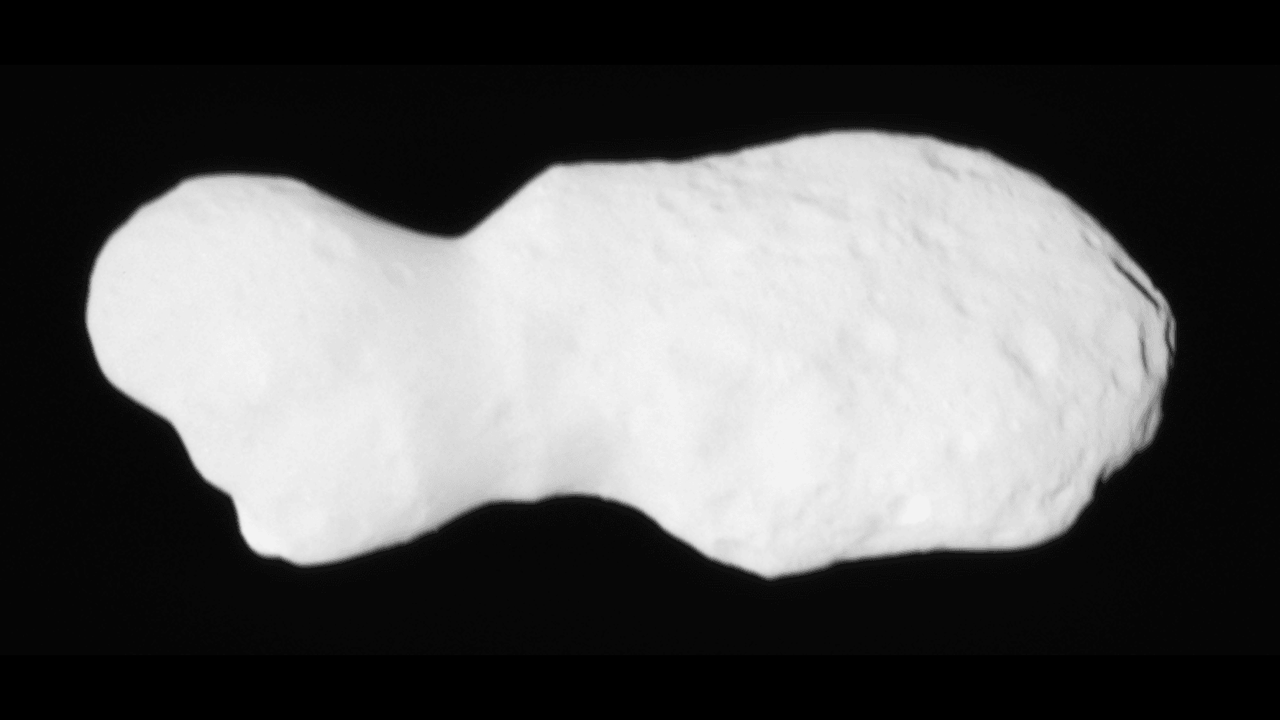
The main belt carbonaceous asteroid (52246) Donaldjohanson as observed by the NASA Lucy Spacecraft on April 20, 2025. Here the grey-scale optical image, acquired with the L'LORRI instrument, is overlain by a false-color map indicating the gravitational slopes on the asteroid’s surface. (Image credit: NASA/GSFC/SwRI/JHU-APL/DLR)
What we do know is that DJ was once part of a much larger asteroid that suffered a giant impact 155 million years ago, causing the parent body to break apart into a number of chunks, the largest being the 45-mile-wide (73-kilometer-wide) asteroid 163 Erigone. Consequently, the remains of this parent asteroid, including DJ, are collectively referred to as the Erigone family.
DJ's violent origin may also explain its shape, which features two lobes joined together by a narrower and relatively smooth neck.
"We have now seen many small bodies in the solar system that appear to have this bi-lobed shape, and that's across a wide range of sizes," said Marchi.
For example the near-Earth asteroids 25142 Itokawa, which was visited by the first Japanese Hayabusa mission in 2005, and 4149 Toutatis that was encountered by China's Chang'e 2 in 2012, are both bi-lobed. So too is the tiny asteroid Selam, which is a satellite of the asteroid 152830 Dinkinesh visited by Lucy in 2023. Then there are cometary bodies including 67P Churyumov–Gerasimenko visited by the Rosetta mission and comet 19P/Borrelly, imaged by NASA's Deep Space 1 spacecraft in 1999.
These objects are all different sizes, different types and in different locations, but they all share the same structure. However, Marchi cautions that they might not all form the same way. For example, the neck between the lobes of comets such as 67P might form through erosion via sublimation and outgassing as the comet gets closer to the Sun, whereas for asteroids it might indicate a history of being involved in a giant impact, the resulting fragments coming together to be bound by gravity – a so-called contact binary.
Lucy now continues onwards, scheduled to encounter its first trojan asteroid, known as 3548 Eurybates, in August 2027. Trojans are asteroids that have been captured by Jupiter's gravity at the L3 and L4 Lagrange points, 60 degrees in front and 60 degrees behind Jupiter itself.
"We think that the Trojans, based on our understanding of the solar system, formed further out and then were captured where they are today following the early shuffling of the planets," said Marchi. "This shuffling could also have been the origin of DJ, so there could be a connection there between DJ and the Trojans."
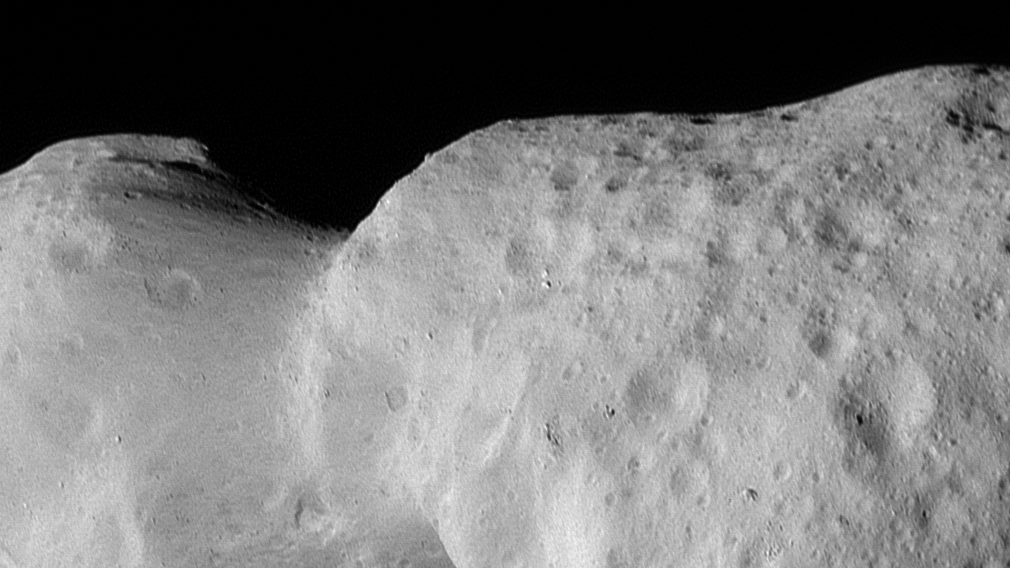
The asteroid Donaldjohanson is seen in detail in this Lucy image. (Image credit: The asteroid Donaldjohanson as seen by the Lucy Long-Range Reconnaissance Imager (L’LORRI). This is one of the most detailed images returned by NASA’s Lucy spacecraft during its flyby. )
Compositionally, the majority of trojans are expected to be even more primitive than DJ, containing more carbon, water and other volatile materials that would sublimate if they got too close to the sun.
That is all except one: Eurybates.
"It is the only one of our targets that from spectroscopy appears to be relatively similar to DJ. It's not identical, but it is closer in composition to DJ than the other Trojans, so it will be intriguing to compare them," said Marchi.
Indeed, any similarities will help tell us how asteroids were herded around during the first few hundred million years of solar system history following the formation of the planets. Jupiter and Saturn, especially, began migrating inwards and then out again. In doing so, their gravity pushed and pulled minor bodies all over the place, as did the gravity of Uranus and particularly Neptune as they edged outwards. These migrations led to the formation of the asteroid belt and the Kuiper belt, and ejected trillions of bodies into the wide orbits of the Oort Cloud.
"The key question is, if DJ has been relocated in the inner asteroid belt, then how many other asteroids came along with it and ended up being closer to the Earth, where they could have delivered some water, some organics and other things to our planet?" asked Marchi.
Lucy will visit six of Jupiter's trojans, which in total number over 15,300 discovered so far. Far from lumps of rock, the trojans, along with DJ and Dinkinesh (which is the Ethiopian name for the Lucy fossil), are windows into the past, and the storytellers of the Earth's most ancient history.
Lucy's findings from Donaldjohanson were published on Thursday (June 18) in the journal Science.
We’re used to a lot of different natural things falling out of the sky. These can include snow, rain, and sometimes even frogs (yes, really). All of these relate to weather phenomena. Far more exotic things fall from the sky that are not related to weather. Earth is pelted by about 14 tons of micrometeoritesContinue reading "A meteorite impact may have once rained gold on Western Australia – new study"
Even small asteroids lead complex lives. During its flyby of the asteroid Donaldjohanson last year, NASA’s Lucy spacecraft revealed the asteroid to be a wobbly, peanut-shaped body that has undergone a lot of activity in its relatively short history. Formed as fragments coalesced after a violent collision 155 million years ago, the asteroid was transformed by the small but inexorable force of the Sun’s radiation, all while retaining signs of the brief presence of liquid water in its distant past.
Zooming through the main asteroid belt toward one of the Jupiter Trojan asteroid groups, the Lucy spacecraft collected the first close-up images and other data at Donaldjohanson on April 20, 2025, as it passed 650 miles away from the asteroid. The data revealed that, instead of spinning simply around one axis like most other asteroids and planets, Donaldjohanson has a more complicated two-axis rotation. Scientists also saw Donaldjohanson’s peanut shape and the craters and ridges on its surface.
A timelapse video made from images taken by NASA’s Lucy spacecraft as it approached the asteroid Donaldjohanson on April 20, 2025. The L’LORRI (Lucy Long Range Reconnaissance Imager) instrument, the spacecraft’s high-resolution black-and-white imager, collected these images over two hours as the spacecraft rapidly closed in on the asteroid from an initial separation of more than 58,000 miles (93,000 km), until the spacecraft passed a mere 650 miles (1000 km) from the 5-mile- (8 km-) wide asteroid.
NASA/Goddard/SwRI/JHU-APL
Lucy’s encounter with the asteroid was planned as a dress rehearsal for the spacecraft and mission team before its primary asteroid encounters, which begin with Lucy’s flyby of the Trojan asteroid Eurybates on Aug. 12, 2027. The instruments performed as expected, and, as a bonus, scientists got a rare opportunity to study a previously unexplored asteroid up close and to compare it to two asteroids with similar compositions but different histories: Bennu, the target of NASA’s OSIRIS-REx sample-return mission, and Ryugu, the site of JAXA’s (Japan Aerospace Exploration Agency) Hayabusa2 sample-return mission.
With Earth-based telescopes, observers saw fluctuations in the light Donaldjohanson reflects, regular patterns of peaks and valleys, typical of an elongated object rotating once every 10.5 Earth days. But Lucy’s data revealed another pattern: Donaldjohanson appears to be rotating like a wobbly top. Paper authors reported that the asteroid rotates end-over-end once every 10.5 Earth days, and wobbles back and forth around its long axis once every 26.5 days.
The asteroid Donaldjohanson is shown slowly rotating in a tumbling, non-principal axis motion, with its angular momentum vector and rotation axes indicated. The surface is colored by gravity slope, which measures the angle between the local surface and the direction of gravity. Higher values (warmer colors) indicate steeper terrain relative to the local gravitational pull. Regions with limited stereo image coverage have been masked out where the shape model is less well constrained.
Kel Elkins/NASA’s Science Visualization Studio/DLR
Peanut shape
While the Earth-based observations hinted at Donaldjohanson’s elongated shape, the Lucy flyby revealed a “bilobate” structure: two lobes connected by a neck, like a peanut. These lobes are likely two fragments from an asteroid collision that gently came together afterward by their mutual gravity.
Donaldjohanson likely rotated at least 10 times faster when it formed, having slowed to its current rate in the last 20 to 60 million years, the team estimates. As it slowed, the balance between the centrifugal force pushing things apart and gravity pulling things together changed and loose rocky material slid down slopes creating the worn-down appearance of many craters, as the flyby images showed.
The paper’s authors say that the asteroid’s slowing rotation is likely caused by a subtle consequence of solar heating known as the YORP effect. Each part of the asteroid’s Sun-warmed surface radiates heat away as infrared light, and that radiation imparts a tiny recoil force to the surface. Because the asteroid’s shape isn’t symmetric, this results in a net torque, or twist, that can change the asteroid’s rotation. Thus, YORP can slow asteroid spins down or speed them up, as in the case of Bennu (once every four hours) and Ryugu (once about every seven hours), which both likely used to rotate much slower than they do today.
Fleeting water
As it passed by Donaldjohanson at 30,000 mph, Lucy recorded the signatures of iron-rich clay minerals on the surface. These clays must have formed in the distant past with the help of liquid water. However, the exposure must have been brief, Lucy scientists concluded, because iron in clays tends to be replaced with other elements, such as magnesium, as water lingers.
Indeed, scientists saw magnesium-rich clays at Bennu and Ryugu, which suggested prolonged water exposure, perhaps lasting millions of years, when they were still part of larger asteroids.
This difference in water exposure history, and other characteristics, may mean that the parent bodies of these asteroids formed at different times or in different regions of the solar system before relocating to the main belt.
Compare, contrast
Donaldjohanson is thought to be made from rocky remnants of a larger, carbon- and water-rich asteroid that collided with another object in the main asteroid belt. Bennu and Ryugu are thought to have formed in the same way and in the same region.
But Donaldjohanson is different. At 155 million years old, it is much younger than Bennu and Ryugu, which formed 1 to 2 billion years ago. Donaldjohanson also has remained in the asteroid belt since birth, while its wandering cousins migrated into orbits around the Sun that bring them close to Earth’s orbit about once a year (which made them perfect close targets for sample return missions).
During its April 20, 2025, encounter with the main-belt asteroid Donaldjohanson, NASA’s Lucy spacecraft discovered evidence for iron-rich clays on the surface using its infrared spectrometer. These clays, which are similar to those found in carbon-rich meteorites such as QUE 97990, indicate that water was briefly present in the asteroid during the distant past.
NASA/Goddard/SwRI/Dan Gallagher
“It’s helpful for scientists to compare Donaldjohanson with asteroids like Bennu and Ryugu, which are seemingly similar asteroids, because every subtle difference is another clue to our origin story,” said Simone Marchi, Lucy deputy principal investigator and lead author of the study at the Boulder, Colorado, office of the Southwest Research Institute.
“Once we start learning more about the Trojans, a completely different population of space rocks with very different histories, our understanding of solar system formation is destined to be challenged,” said Marchi.
Named after a fossilized skeleton of a human ancestor discovered in Ethiopia in 1974, NASA’s Lucy will be the first mission to explore Jupiter’s Trojan asteroids, a population of well-preserved space rocks that formed early in our solar system’s history and could help scientists understand how the planets formed and moved around before settling in their current configuration.
Lucy’s principal investigator is based out of the Boulder, Colorado, branch of Southwest Research Institute, headquartered in San Antonio. NASA’s Goddard Space Flight Center in Greenbelt, Maryland, provides overall mission management, systems engineering, and safety and mission assurance. Lockheed Martin Space in Littleton, Colorado, built the spacecraft. Lucy is the 13th mission in NASA’s Discovery Program. NASA’s Marshall Space Flight Center in Huntsville, Alabama, manages the Discovery Program for the agency’s Science Mission Directorate in Washington.
For more information on NASA’s Lucy mission, visit:
Zooming through the main asteroid belt toward one of the Jupiter Trojan asteroid groups, the Lucy spacecraft collected the first close-up images and other data at Donaldjohanson on April 20, 2025, as it passed 650 miles away from the asteroid. The data revealed that, instead of spinning simply around one axis like most other asteroids and planets, Donaldjohanson has a more complicated two-axis rotation. Scientists also saw Donaldjohanson’s peanut shape and the craters and ridges on its surface.
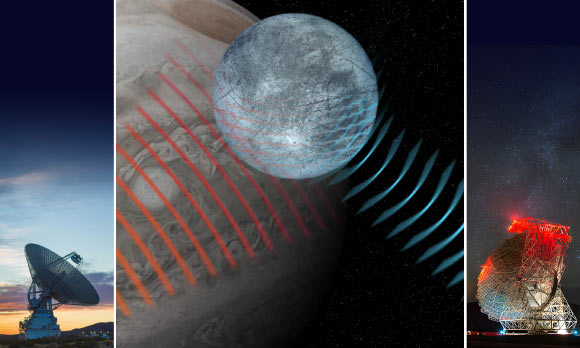
Using NASA’s Goldstone Solar System Radar and NSF’s Green Bank Telescope, astronomers from the University of California, Los Angeles, confirmed that the icy surface of Jupiter’s moon Europa scatters radio energy in an unusually strong and complex way not seen on rocky worlds.
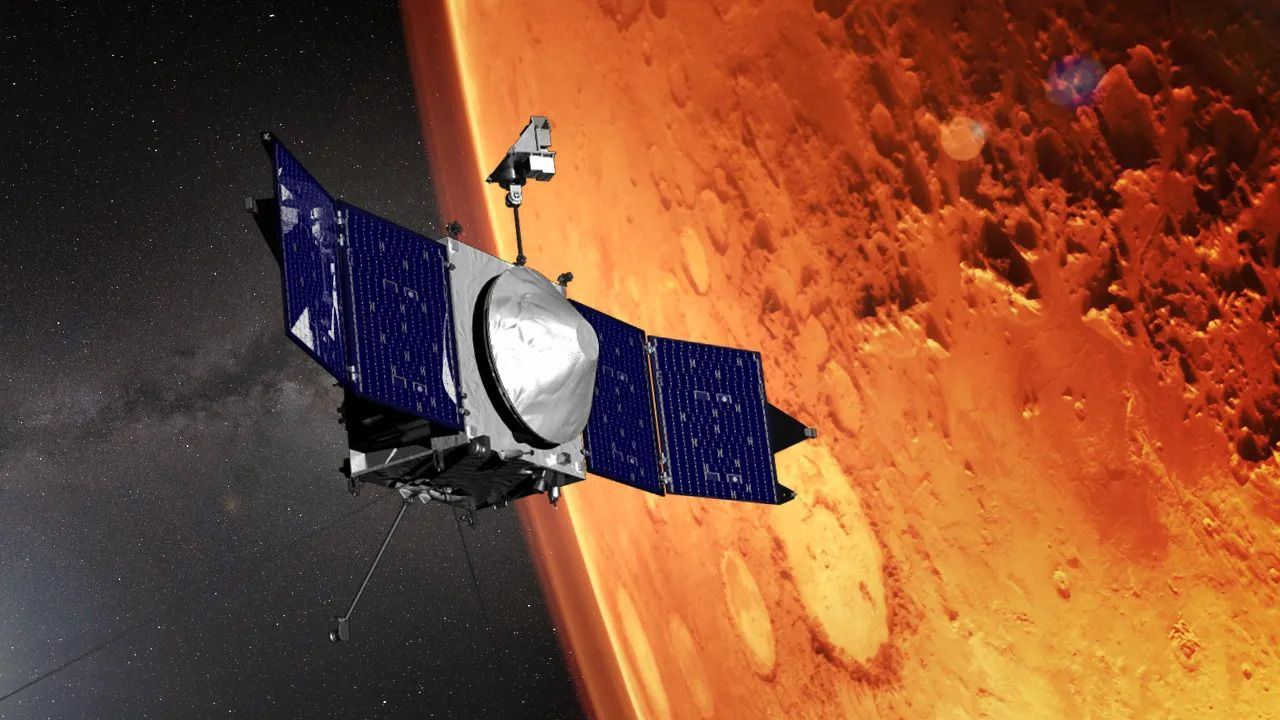
NASA's MAVEN Mars mission ended after 11 years, having revealed how the planet lost its atmosphere and served as a key communications relay for surface missions.
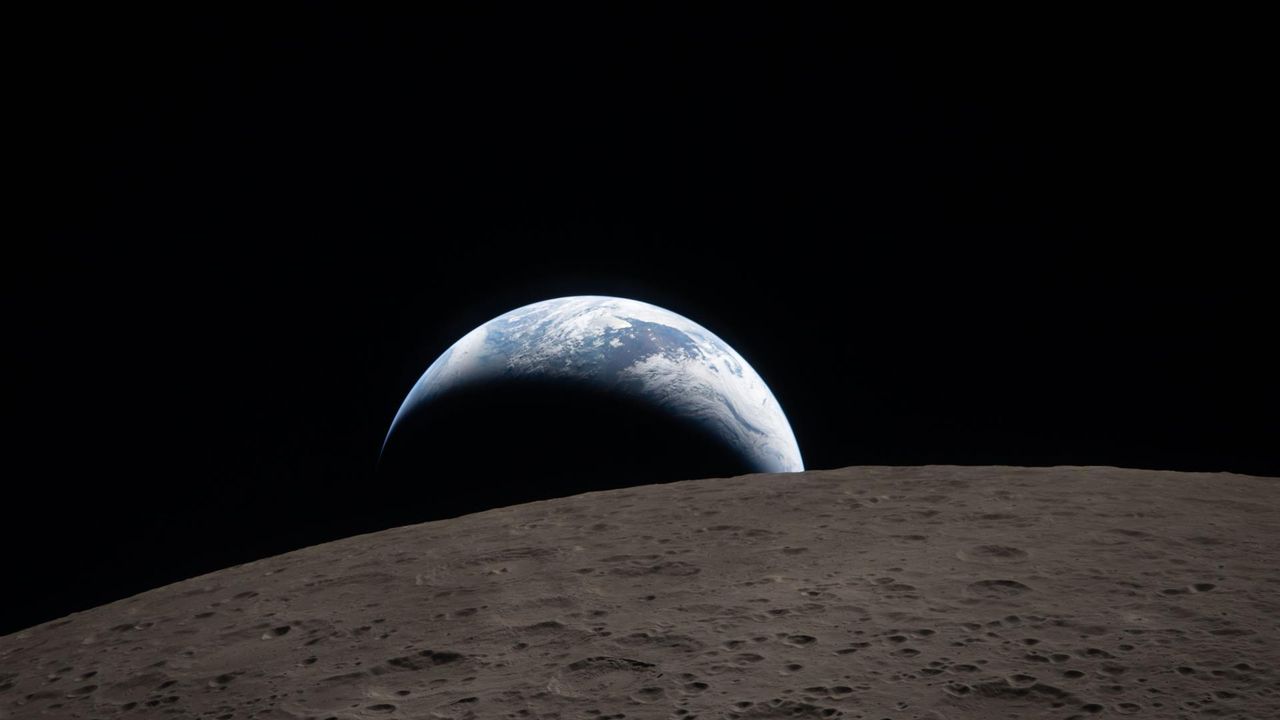
A laser system, previously tested on board the International Space Station, helped to stream video directly from the Artemis 2 mission on its way around the moon.
The hunt for Planet Nine continues as new discoveries make the Solar System’s biggest mystery even harder to solve. Is there a massive undiscovered planet on the outer reaches of the Solar System? The idea has been around since before the discovery of Pluto in the 1930s. Labeled as planet X, prominent astronomers had put [...]
A rare meteorite recovered from the Sahara Desert could be a fragment of a Moon-size body that met a violent end in the earliest days of the solar system.
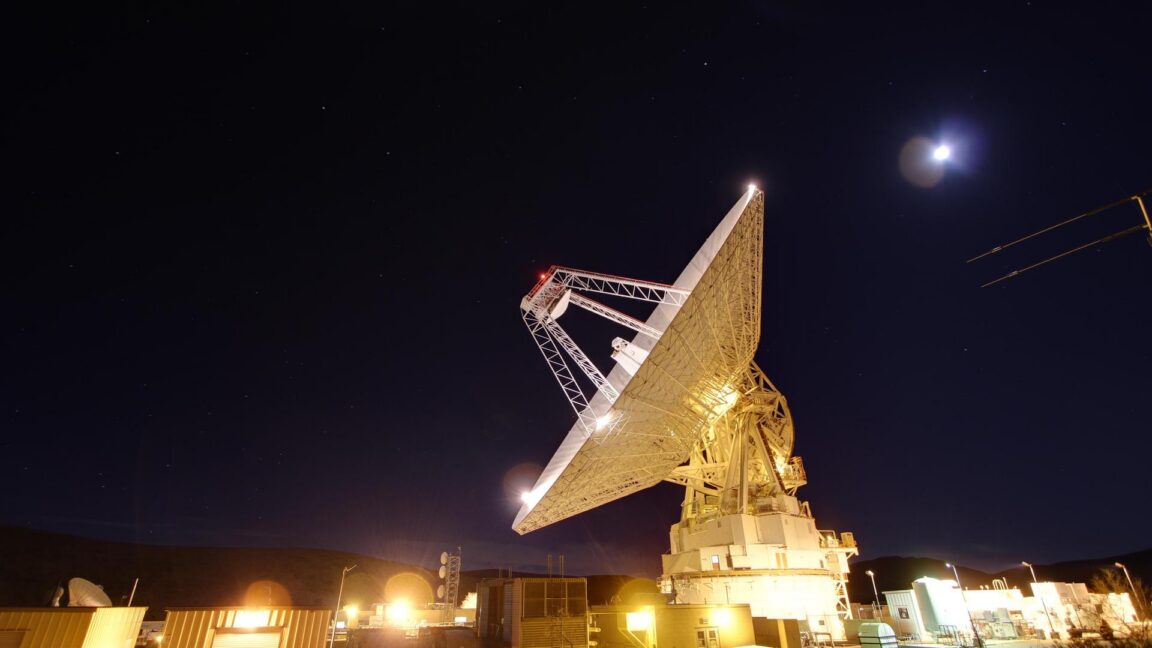
NASA pushed its Deep Space Network beyond its limits during the Artemis I mission nearly four years ago. The global array of deep space communications antennas couldn't keep up with the routine demands of 40 robotic science missions and the extraordinary surge required by NASA's Orion space capsule as it flew around the Moon.
The experience in late 2022 reduced or delayed downlinks from several high-profile science missions, including the James Webb Space Telescope and Mars rovers, as the data-hungry Artemis I mission took priority on NASA's communications network. And that was before the first Artemis mission with astronauts onboard. When Artemis II launched April 1, NASA called upon the Deep Space Network (DSN) again to connect Mission Control to the Orion capsule as it soared more than a quarter of a million miles from Earth.
With a crew of four flying inside the spacecraft, the agency's appetite for data from Orion on Artemis II was even higher than it was on Artemis I. But at a little more than nine days, the Artemis II mission was shorter than the 25 days Artemis I spent in space, helping alleviate the communications overload. Artemis I also launched 10 small CubeSats into deep space, many of which required tracking and telecom services from the DSN. Artemis II carried fewer CubeSats.

 Login