NASA has announced a new commercial partnership for the next satellite headed to the Red Planet.
California-based Relativity Space will design, build and launch the spacecraft that carries NASA's Aeolus instrument suite to orbit around Mars, where the probe will be the first to provide daily measurements of the planet's global environment. Aeolus will collect data on Martian dust and cloud cover, winds and temperatures, according to a NASA release.
"Public-private partnerships like this are a force multiplier for science," NASA Administrator Jared Isaacman said in a statement on Wednesday (June 17).
The newly announced relationship, and others between NASA and private industry, is designed to allow the agency to concentrate its resources on important science discovery. "By pairing NASA’s world‑class instruments with commercial innovation and investment, we can deliver more science, more often, and reduce the time it takes to get essential data into the hands of researchers preparing for future human missions to Mars," Isaacman said.
Aeolus consists of four instruments, designed to work in tandem to create a complete picture of the Martian atmosphere and its behavior. In addition to refining scientific models for the Martian environment, NASA plans to use the data to reduce risks to future robotic and crewed missions landing on Mars' surface.
The science suite includes the Doppler Wind and Temperature Sounder (DWTS‑Ozone), in collaboration with GATS, designed to measure wind speeds and temperatures present up to 37 miles (60 kilometers) above the ground. The Thermal Limb Sounder (TLS), designed with Xiomas Technologies, will create vertical temperature profiles and provide data on atmospheric dust and cloud cover, while the Surface Radiometric Sensor Package (SuRSeP) collects compositional data on those clouds and dust, and tracks how the Martian surface absorbs, stores and releases energy, like heat. Finally, Aeolus' Wide‑Field Context Camera (WFCC) will take daily images to assess atmospheric activity across the whole of Mars.
Relativity Space's Terran 1 rocket successfully blasted off for its test flight but malfunctioned three minutes after liftoff. (Image credit: Relativity Space)
NASA is targeting 2028 for the launch of the Aeolus mission, which will be designed and built at NASA's Ames Research Center in California, where it will also be integrated on Relativity's spacecraft for testing ahead of launch. NASA has committed to support Aeolus' scientific operations for at least one Martian year (approximately 687 Earth days). However, the agency has historically extended its missions to Mars, when able.
NASA was recently forced to end operations of its MAVEN (Mars Atmosphere and Volatile Evolution) probe around Mars, after an anomaly led to a loss of communications with the satellite, but the spacecraft ran for more than a decade beyond its original one-year mission. The agency's only two active satellites orbiting the Red Planet are the Mars Reconnaissance Orbiter (MRO) and Mars Odyssey, which are both operating nearly two decades or more, respectively, beyond their initial mission timelines.
For its part, Relativity will be in charge of designing the Mars-bound spacecraft and will also be responsible for launch and for satellite operations in space. The company's pathfinder launch vehicle, the Terran 1 rocket, lifted off for the first and only time in March 2023, but it failed to reach orbit. The company then pivoted to development of the bigger, partially reusable Terran R rocket, which is expected to debut sometime later this year. Eric Schmidt, who served as Google CEO from 2001 to 2011, was appointed to lead Relativity in March 2025.
Google, Microsoft, OpenAI, and others want to help enterprises demonstrate that their AI applications are behaving themselves through the creation of a new foundation.
The Appia Foundation will, it explained rather impenetrably, “establish modular specifications that provide a connecting layer to bridge foundational global standards with practical, trusted assessments across the global AI value chain.”
Those specifications will help AI users ascertain whether the systems they are using meet all the obligations that apply to them in the form of standards and regulations, it said. It’s a challenging task with so much regional variation in requirements, and where the EU, for example, is more tightly controlled than the US.
The Foundation has established a set of criteria to demonstrate conformity with what is expected. There are two layers: the Requirements and Guidance layers will help users determine what is actually required, while the Assessment Enablement layer will look at how those requirements are evaluated.
Appia stressed that what it is offering are not standards — which are set by recognized international bodies such as ISO/IEC — but a means of assessing what those standards mean and how they can be used by organizations. However, the Foundation said that some of the criteria that it is introducing may become standards themselves after a period of time.
The Appia Foundation is hosted by the Linux Foundation’s Joint Development Foundation, and its other members include Arm, Ericsson, Mastercard, Mitsubishi Electric, Omron, Schneider Electric, and Siemens. It is also looking to bring academics and government into the fold, so that it can establish an advisory board.
New research reveals how an unusual celestial object resembling a cosmic “bullseye” could offer clues to one of the most perplexing phenomena in our universe.
The research, undertaken by physicists Pierre Sikivie and Yuxin Zhao at the University of Florida, focuses on an astronomical feature quite unlike any other—the galaxy LEDA 1313424, whose concentric rings have garnered it the apt nickname of the “Bullseye galaxy.”
Based on Sikivie and Zhao’s recent research, detailed in a new paper that appeared in The Astrophysical Journal, quantum behavior related to long-mysterious dark matter may hold the key to the galaxy’s unusual appearance.
Unraveling a Bullseye Galaxy’s Circular Secrets
In the past, astronomers have attempted to explain LEDA 1313424’s unusual concentric appearance as the likely result of an ancient collision between two galaxies.
Not so, according to Sikivie and Zhao, who now take a vastly different approach by arguing that a better explanation may involve a Bose-Einstein condensate of axions, a variety of extremely light hypothetical particles.
A stunning Hubble Telescope view of the Bullseye galaxy (Image Credit: NASA, ESA, I. Pasha (Yale), P. van Dokkum (Yale)).
This concept has much deeper roots that go back close to a century ago, when the first galaxy featuring an unusual concentric ring was discovered. This example, dubbed the Cartwheel galaxy, was only the first in a succession of similar astronomical discoveries involving galaxies with “ringed” appearances that incorporate as many as three annular features.
Unraveling an Annular Enigma
Explaining why these galaxies look this way has remained elusive. One theory proposed by astronomers, as noted earlier, involves impacts between two galaxies, which could create waves of density whose ripples become evident in ring-like structures surrounding the resulting galaxies.
However, a discovery in 2025 by Imad Pasha, a Yale University astronomer, and his colleagues presented an even stranger development in this ongoing concentric saga: the discovery of a galaxy that possesses not three rings, but nine of them. With its discovery, this remarkable celestial object’s unusual appearance garnered the nickname now familiar to us: “The Bullseye galaxy.”
Artist’s concept detailing the annular features encircling LEDA 1313424 (Image Credit: NASA, ESA, Ralf Crawford (STScI))
One theory that astronomers believed may account for the galaxy’s nine concentric structures had been a hypothetical impact—and a very energetic one—that occurred about 56 million years ago. However, while investigating this possibility, Sikivie and Zhao say a problem emerged: this would mean that the outermost ring in the galaxy would have had to travel at a speed of 758 miles per second as it blasted outward from the galaxy’s center.
This speed, they say, is impossible to reconcile with what astronomers can already discern about the nature of the supposed collusion, as well as the well-characterized behavior of galactic material observed in other regions of the cosmos.
An Alternative Approach
In an effort to get to the bottom of the mystery behind this unique galaxy, Sikivie and Zhao have put forward an alternative idea: that the rings in the Bullseye galaxy might instead be a byproduct of dark matter’s mysterious properties.
According to astronomers, dark matter is believed to be a nonluminous material that populates our universe, contributing around 85% of its total mass. Despite its ubiquity, direct detections that could confirm its existence have remained elusive.
However, there are some intriguing cosmic phenomena that astronomers are aware of that are very good candidates for being indirect evidence of this mysterious material. These observations include gravitational motion that occurs in galaxies, whereby the accumulation of dark matter is believed to manifest in the appearance of spherical halos encircling them.
In the past, Sikivie has explored this possibility, and whether current prevailing theories about dark matter, such as the idea that hypothetical particles known as axions, may offer the best interpretation of the physical reality behind dark matter.
If dark matter is indeed related to axions, it would also be required to obey what astrophysicists call conservation of angular momentum. According to Sikivie, when axions and galaxies interact, a phenomenon should emerge where portions of dark matter halos closest to the center would become oriented in structural forms known as “caustic rings.”
“We had earlier proposed that disk galaxies have caustic rings of dark matter with a pattern of ring radii, very similar to the pattern of ring radii observed in LEDA 1313424,” Sikivie recently said.
With this idea in mind, Sikivie and Lhao then turned their attention to the mysterious bullseye of LEDA 1313424 and “fitted the observed ring radii to the pattern of ring radii in the caustic ring interpretation,” from which they discerned that “LEDA’s rings are the imprint of caustic rings of dark matter on the baryonic matter in LEDA’s disk.”
Strange Quantum Behaviors
A further aspect of the researchers’ theory involves the quantum behavior that axions are expected to engage in.
Under extremely cold conditions, these hypothetical dark matter particles could collectively occupy the same quantum state, forming what is known as a Bose-Einstein condensate—a strange state of matter in which quantum effects become visible on macroscopic scales.
According to the team, such a condensate could interact with ordinary matter in ways that match astronomical observations. If the duo is correct, this could imply that ring-shaped galaxies such as LEDA may not result from galactic collisions at all—instead, these unique cosmic structures might be evidence of dark matter axions that have undergone Bose-Einstein condensation.
Presently, much like dark matter, axions have remained hypothetical and frustratingly difficult to detect. Of course, given their elusiveness, this also makes them a very good candidate in terms of helping scientists close in on the dark matter mystery, and new models are helping to provide potentially compelling new resolutions for such problems.
For now, mysterious ringed galaxies remain mysterious. However, as the work of researchers like Sikivie and Lhao progresses, one of astronomy’s more unusual recent discoveries is gradually coming into focus, while providing fresh insight into the intriguing quantum nature of dark matter.
Micah Hanks is the Editor-in-Chief and Co-Founder of The Debrief. A longtime reporter on science, defense, and technology with a focus on space and astronomy, he can be reached atmicah@thedebrief.org. Follow him on X @MicahHanks, and at micahhanks.com.
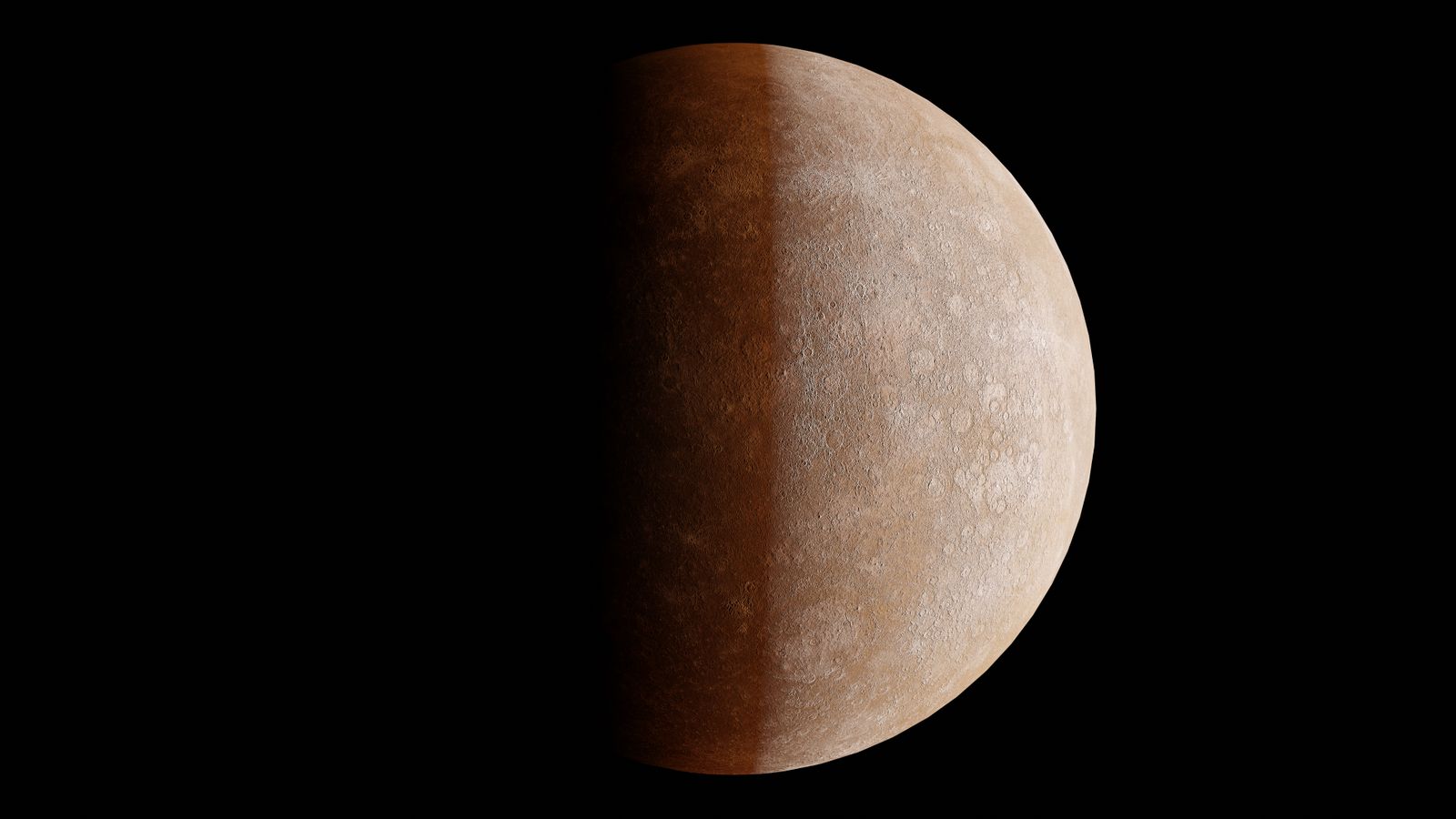
Mercury is the closest planet to the Sun, and for a long time that was reason enough to assume it could not hold ice anywhere. The surface in direct sunlight can reach well over 400 degrees Celsius. And yet there is water ice on Mercury, tucked into craters near its poles where the Sun has never reached, and a NASA spacecraft has confirmed it.
The claim sounds like a contradiction. The explanation is geometry.
The radar hint
The first sign came in 1991, when the Arecibo radio telescope in Puerto Rico bounced radar off Mercury and picked up unusually bright patches near both poles. Bright radar returns of that kind are the sort of thing water ice produces, and many of the patches lined up with large impact craters that the Mariner 10 spacecraft had mapped in the 1970s.
It was a strong hint rather than proof. Radar brightness can be caused by other materials too, so for two decades the polar patches were a promising suspect awaiting a closer look.
Why ice can survive next to the Sun
The reason ice is even possible on the hottest planet comes down to how Mercury sits. Its spin axis is almost perfectly upright relative to its orbit, tilted by only about a hundredth of what Earth manages. With essentially no tilt, the floors of deep craters near the poles never catch a single ray of sunlight.
Those permanently shadowed floors are among the coldest places in the solar system, far colder than anywhere on Pluto, sitting at roughly minus 170 degrees Celsius and staying there for billions of years. A planet can bake on average and still keep a few pockets that the Sun has never touched. Ice trapped in one of them has nowhere to go.
What MESSENGER actually showed
The closer look came from MESSENGER, the NASA spacecraft that orbited Mercury from 2011 to 2015. In 2012 its team reported not one measurement but three that pointed the same way.
Its neutron spectrometer detected the signature of hydrogen concentrated at the north pole, in the amounts you would expect from buried water ice. Its laser altimeter found the polar deposits were either unusually bright or unusually dark exactly where the temperature models said surface ice, or ice under a dark covering, should sit. And those thermal models tied the whole picture together. Taken together, as the mission team concluded, water ice is the main constituent of Mercury’s north polar deposits.
The convergence is the point. Any one of those readings could be argued with. Three independent methods agreeing is much harder to dismiss, which is why 2012 is when the radar suspicion became a confirmed finding.
The ice is mostly hidden
One detail complicates the tidy image of gleaming polar ice. Across most of the deposits, the ice is not exposed at the surface at all. It is buried under a dark layer, thought to be rich in complex organic compounds, in the spots that are cold enough to preserve buried ice but a little too warm to keep it stable right at the surface.
Only in the very coldest craters does the ice sit exposed and bright. So the picture is layered: dark organic material on top, water ice beneath, with the proportions set by exactly how cold each crater floor stays.
What is still open
Where the water came from is not fully settled. Impacts from comets and water-bearing asteroids are the usual explanation, with some contribution possible from chemistry driven by the solar wind. However it arrived, the cold traps near the poles held on to it.
The same phenomenon turns up at the Moon’s poles, which matters for anyone planning to use lunar ice as a resource. Mercury itself will get another visitor before long: the European and Japanese BepiColombo mission is on its way and due to settle into orbit in the coming years, carrying instruments that can sharpen what MESSENGER began. The headline is already secure. There is ice on the planet nearest the Sun, and it has been there, in the dark, for a very long time.
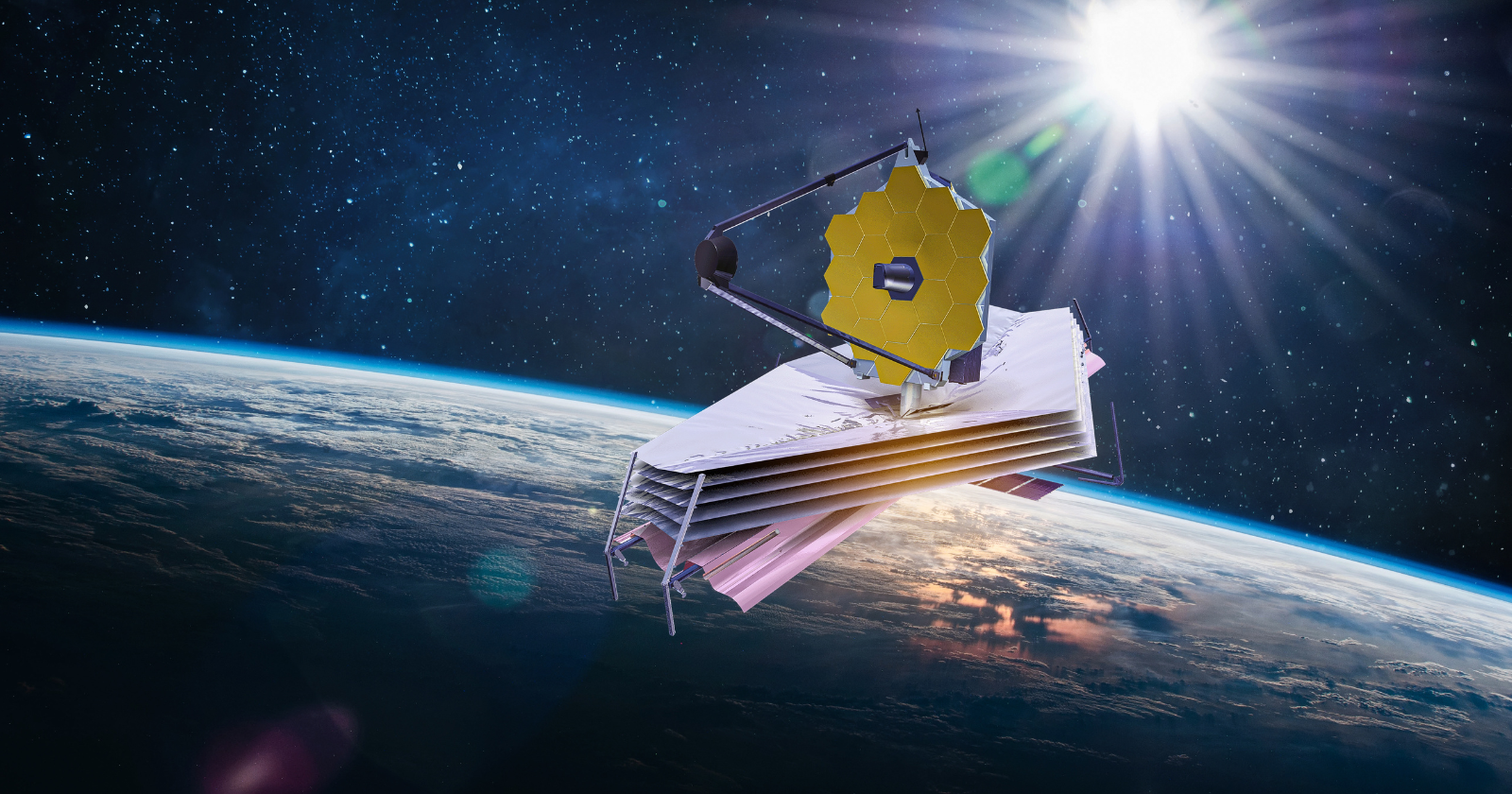
When the James Webb Space Telescope launched on 25 December 2021, it carried a list of 344 single points of failure. Each one was a step or a part where a single fault would have crippled the mission, with no second chance and no way to send anyone to fix it. The telescope cleared all of them. It now sits about a million miles from Earth, doing the most sensitive infrared astronomy ever attempted, on roughly the power of a household kettle.
Both halves of that are true, and both are worth taking apart, because the figures are precise and the precision is the point.
344 ways to fail
The number comes from Mike Menzel, Webb’s lead mission systems engineer at NASA, who has said the observatory launched with 344 single-point failures on its books. A single point of failure, in engineering terms, is a place where one thing going wrong takes everything with it. Most spacecraft have a handful. Webb had hundreds.
About 80 per cent of them were tied to the deployment, the slow unfolding of a telescope that had been folded up to fit inside its rocket. That sequence relied on roughly 140 release mechanisms, 70 hinge assemblies, eight motors, some 400 pulleys, and around a quarter of a mile of cable, each of which had to work on command, in order, the first time.
What made the list so unforgiving was the destination. Webb was not going to low orbit, where Hubble could be visited and repaired by astronauts five times. It was going somewhere no crew can reach, which meant the usual safety net, send someone up to fix it, did not exist. Every one of the 344 had to hold on its own.
The fortnight that decided it
The riskiest part was the sunshield, a five-layer screen the size of a tennis court that has to separate and tension without tearing or snagging. It is the single most complex deployment ever flown, and it is the reason so much of the risk was packed into the first two weeks.
The sunshield reached its final, tensioned shape on 4 January 2022, ten days after launch. The project manager at the time, Bill Ochs, told reporters that finishing it retired somewhere between 70 and 75 per cent of the single-point failures on the original list. The rest fell away as the mirror segments locked into place over the following days. By the end of the fortnight, the most dangerous machine NASA had ever unfolded had unfolded.
Less power than a kettle
Here the popular line is right, with one number worth pinning down. The spacecraft and its four instruments run on about one kilowatt. The solar array is built to deliver closer to two kilowatts, but that extra capacity is margin, sized so the telescope still has enough as the panels degrade over its mission.
So the working figure is about a kilowatt, and a lot of household kettles draw more than that, particularly the three-kilowatt kind common outside North America. A telescope unpacking the early universe really does run on less electricity than the appliance that makes your tea.
The reason it can is the sunshield again. Webb has to keep its detectors extraordinarily cold, down to around 7 kelvin on one instrument, and cooling is usually the most power-hungry thing a cold spacecraft does. By parking the sunshield between the telescope and the Sun, Webb does most of that cooling passively, simply by sitting in deep shade, rather than by running power-hungry refrigeration. The shade that protects it also keeps its electricity bill tiny.
A million miles out
That deep shade only works at the right address. Webb orbits the Sun-Earth point known as L2, about 1.5 million kilometres away, near enough a million miles, where it can keep the Sun, Earth, and Moon all behind a single shield.
It also means the telescope is on its own. The same distance that makes the observatory work is the distance that made the 344 single points of failure so tense, because none of them could be reached if they jammed. The achievement was not just building something this delicate. It was building something this delicate that had to survive its own unpacking, unattended, a million miles from the nearest spanner.
It has been returning science since July 2022.
The list of 344 is now history, which is the only acceptable place for a list like that to end up.
Even small asteroids lead complex lives. During its flyby of the asteroid Donaldjohanson last year, NASA’s Lucy spacecraft revealed the asteroid to be a wobbly, peanut-shaped body that has undergone a lot of activity in its relatively short history. Formed as fragments coalesced after a violent collision 155 million years ago, the asteroid was transformed by the small but inexorable force of the Sun’s radiation, all while retaining signs of the brief presence of liquid water in its distant past.
Zooming through the main asteroid belt toward one of the Jupiter Trojan asteroid groups, the Lucy spacecraft collected the first close-up images and other data at Donaldjohanson on April 20, 2025, as it passed 650 miles away from the asteroid. The data revealed that, instead of spinning simply around one axis like most other asteroids and planets, Donaldjohanson has a more complicated two-axis rotation. Scientists also saw Donaldjohanson’s peanut shape and the craters and ridges on its surface.
A timelapse video made from images taken by NASA’s Lucy spacecraft as it approached the asteroid Donaldjohanson on April 20, 2025. The L’LORRI (Lucy Long Range Reconnaissance Imager) instrument, the spacecraft’s high-resolution black-and-white imager, collected these images over two hours as the spacecraft rapidly closed in on the asteroid from an initial separation of more than 58,000 miles (93,000 km), until the spacecraft passed a mere 650 miles (1000 km) from the 5-mile- (8 km-) wide asteroid.
NASA/Goddard/SwRI/JHU-APL
Lucy’s encounter with the asteroid was planned as a dress rehearsal for the spacecraft and mission team before its primary asteroid encounters, which begin with Lucy’s flyby of the Trojan asteroid Eurybates on Aug. 12, 2027. The instruments performed as expected, and, as a bonus, scientists got a rare opportunity to study a previously unexplored asteroid up close and to compare it to two asteroids with similar compositions but different histories: Bennu, the target of NASA’s OSIRIS-REx sample-return mission, and Ryugu, the site of JAXA’s (Japan Aerospace Exploration Agency) Hayabusa2 sample-return mission.
With Earth-based telescopes, observers saw fluctuations in the light Donaldjohanson reflects, regular patterns of peaks and valleys, typical of an elongated object rotating once every 10.5 Earth days. But Lucy’s data revealed another pattern: Donaldjohanson appears to be rotating like a wobbly top. Paper authors reported that the asteroid rotates end-over-end once every 10.5 Earth days, and wobbles back and forth around its long axis once every 26.5 days.
The asteroid Donaldjohanson is shown slowly rotating in a tumbling, non-principal axis motion, with its angular momentum vector and rotation axes indicated. The surface is colored by gravity slope, which measures the angle between the local surface and the direction of gravity. Higher values (warmer colors) indicate steeper terrain relative to the local gravitational pull. Regions with limited stereo image coverage have been masked out where the shape model is less well constrained.
Kel Elkins/NASA’s Science Visualization Studio/DLR
Peanut shape
While the Earth-based observations hinted at Donaldjohanson’s elongated shape, the Lucy flyby revealed a “bilobate” structure: two lobes connected by a neck, like a peanut. These lobes are likely two fragments from an asteroid collision that gently came together afterward by their mutual gravity.
Donaldjohanson likely rotated at least 10 times faster when it formed, having slowed to its current rate in the last 20 to 60 million years, the team estimates. As it slowed, the balance between the centrifugal force pushing things apart and gravity pulling things together changed and loose rocky material slid down slopes creating the worn-down appearance of many craters, as the flyby images showed.
The paper’s authors say that the asteroid’s slowing rotation is likely caused by a subtle consequence of solar heating known as the YORP effect. Each part of the asteroid’s Sun-warmed surface radiates heat away as infrared light, and that radiation imparts a tiny recoil force to the surface. Because the asteroid’s shape isn’t symmetric, this results in a net torque, or twist, that can change the asteroid’s rotation. Thus, YORP can slow asteroid spins down or speed them up, as in the case of Bennu (once every four hours) and Ryugu (once about every seven hours), which both likely used to rotate much slower than they do today.
Fleeting water
As it passed by Donaldjohanson at 30,000 mph, Lucy recorded the signatures of iron-rich clay minerals on the surface. These clays must have formed in the distant past with the help of liquid water. However, the exposure must have been brief, Lucy scientists concluded, because iron in clays tends to be replaced with other elements, such as magnesium, as water lingers.
Indeed, scientists saw magnesium-rich clays at Bennu and Ryugu, which suggested prolonged water exposure, perhaps lasting millions of years, when they were still part of larger asteroids.
This difference in water exposure history, and other characteristics, may mean that the parent bodies of these asteroids formed at different times or in different regions of the solar system before relocating to the main belt.
Compare, contrast
Donaldjohanson is thought to be made from rocky remnants of a larger, carbon- and water-rich asteroid that collided with another object in the main asteroid belt. Bennu and Ryugu are thought to have formed in the same way and in the same region.
But Donaldjohanson is different. At 155 million years old, it is much younger than Bennu and Ryugu, which formed 1 to 2 billion years ago. Donaldjohanson also has remained in the asteroid belt since birth, while its wandering cousins migrated into orbits around the Sun that bring them close to Earth’s orbit about once a year (which made them perfect close targets for sample return missions).
During its April 20, 2025, encounter with the main-belt asteroid Donaldjohanson, NASA’s Lucy spacecraft discovered evidence for iron-rich clays on the surface using its infrared spectrometer. These clays, which are similar to those found in carbon-rich meteorites such as QUE 97990, indicate that water was briefly present in the asteroid during the distant past.
NASA/Goddard/SwRI/Dan Gallagher
“It’s helpful for scientists to compare Donaldjohanson with asteroids like Bennu and Ryugu, which are seemingly similar asteroids, because every subtle difference is another clue to our origin story,” said Simone Marchi, Lucy deputy principal investigator and lead author of the study at the Boulder, Colorado, office of the Southwest Research Institute.
“Once we start learning more about the Trojans, a completely different population of space rocks with very different histories, our understanding of solar system formation is destined to be challenged,” said Marchi.
Named after a fossilized skeleton of a human ancestor discovered in Ethiopia in 1974, NASA’s Lucy will be the first mission to explore Jupiter’s Trojan asteroids, a population of well-preserved space rocks that formed early in our solar system’s history and could help scientists understand how the planets formed and moved around before settling in their current configuration.
Lucy’s principal investigator is based out of the Boulder, Colorado, branch of Southwest Research Institute, headquartered in San Antonio. NASA’s Goddard Space Flight Center in Greenbelt, Maryland, provides overall mission management, systems engineering, and safety and mission assurance. Lockheed Martin Space in Littleton, Colorado, built the spacecraft. Lucy is the 13th mission in NASA’s Discovery Program. NASA’s Marshall Space Flight Center in Huntsville, Alabama, manages the Discovery Program for the agency’s Science Mission Directorate in Washington.
For more information on NASA’s Lucy mission, visit:
Zooming through the main asteroid belt toward one of the Jupiter Trojan asteroid groups, the Lucy spacecraft collected the first close-up images and other data at Donaldjohanson on April 20, 2025, as it passed 650 miles away from the asteroid. The data revealed that, instead of spinning simply around one axis like most other asteroids and planets, Donaldjohanson has a more complicated two-axis rotation. Scientists also saw Donaldjohanson’s peanut shape and the craters and ridges on its surface.
Wealth tax criticized by billionaires and Gavin Newsom would levy a one-time 5% tax on residents worth over $1bn
A popular proposal in California to impose a wealth tax on billionaires has gained enough signatures to qualify for the ballot in November, state officials announced on Wednesday.
The news is set to intensify an already heated debate around the tax, which has pitted tech moguls and the state’s governor, Gavin Newsom, against the labor union backing the measure.

 Login