❌

Reading view

Experimental Copper-Based Drug Clears Alzheimer’s Plaques and Boosts Memory in Mice

Using the APP/PS1 mouse model of familial Alzheimer’s disease, Pyun et al. investigated the effect of Cu(ATSM) on brain microvascular abundance and function of P-glycoprotein and the associated effects on exogenous amyloid-beta clearance, brain amyloid burden, and cognitive function. Image credit: Pyun et al., doi: 10.1021/acschemneuro.6c00252.

Copper diacetyl bis(4-methyl-3-thiosemicarbazone), or Cu(ATSM), restored a key waste-removal system in the brain, reducing toxic amyloid-beta buildup and improving spatial memory in lab models of Alzheimer’s disease, according to a team of researchers at Monash University.

The post Experimental Copper-Based Drug Clears Alzheimer’s Plaques and Boosts Memory in Mice appeared first on Sci.News: Breaking Science News.

  •  
  •  

Astronomers May Have Found Supernova Remnant near Milky Way’s Central Black Hole

This composite image contains X-rays from Chandra and XMM-Newton missions (shown in blue) as well as radio data from the MeerKAT telescope (shown in red) in South Africa. These have been combined with an optical image from the Pan-STARRS telescopes in Hawai’i (red, green, and blue). Image credit: NASA / CXC / UCLA / Zhu et al. / ESA / XMM-Newton / PanSTARRS / MeerKAT / CSA / STScI / SAO / L. Frattare & P. Edmonds.

Using NASA’s Chandra X-ray Observatory and ESA’s XMM-Newton satellite, astronomers identified a possible remnant of ancient stellar explosion just a few dozen light-years from Sagittarius A*, a supermassive black hole at the center of our Milky Way Galaxy.

The post Astronomers May Have Found Supernova Remnant near Milky Way’s Central Black Hole appeared first on Sci.News: Breaking Science News.
  •  

SchrΓΆdinger’s Cat Gets Stranger: Physicists Demonstrate Quantum States No One Has Seen Before

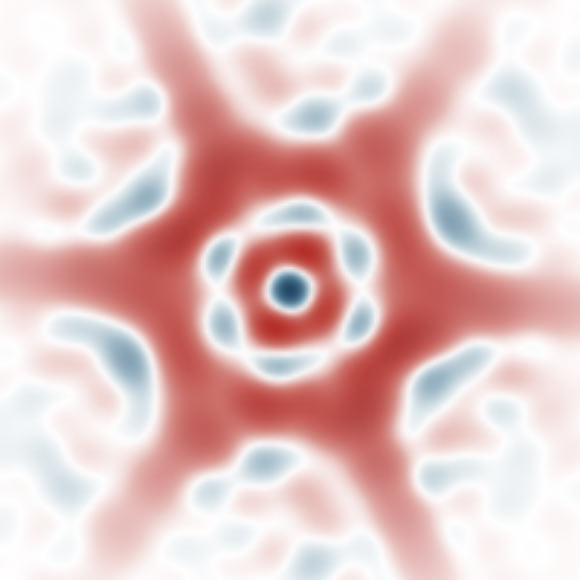
Quantum mechanics defies classical intuition, most famously through SchrΓΆdinger’s cat, where systems exist in superpositions of opposing states. Such superpositions are central to quantum technologies. Quantum β€˜cat’ states have been realized in harmonic oscillators, but implementations were largely limited to Fock, displaced, or Gottesman-Kitaev-Preskill states. A different class of macroscopic superpositions, where an oscillator is squeezed along orthogonal axes so that its positional variance is simultaneously larger and smaller than the Heisenberg limit, was proposed previously but remained unrealized. Saner et al. introduce a trapped-ion hybrid spin-oscillator system enabling an experimental realization of these β€˜siblings’ of SchrΓΆdinger’s cat. Image credit: Saner et al., doi: 10.1103/k1xk-yt42.

Physicists at the University of Oxford have engineered a new class of β€˜cat states’ -- quantum superpositions constructed not from ordinary wave packets, but from deeply exotic, nonclassical components -- opening unexpected paths toward more resilient quantum computers.

The post SchrΓΆdinger’s Cat Gets Stranger: Physicists Demonstrate Quantum States No One Has Seen Before appeared first on Sci.News: Breaking Science News.
  •  

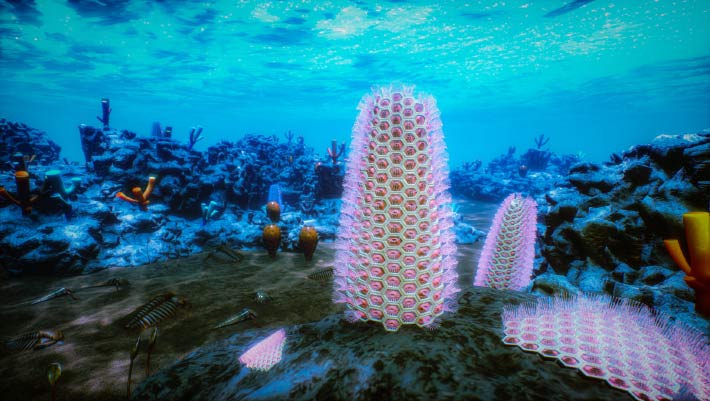
Earth’s Earliest Animals May Have Thrived Too Easily to Evolve

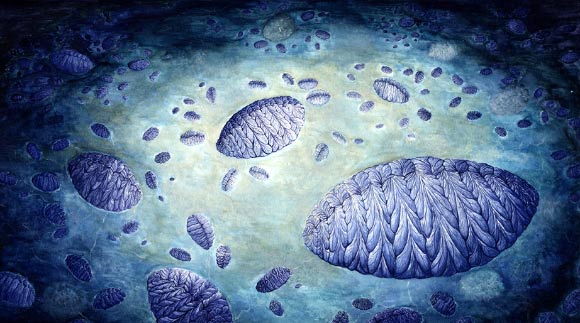
Artist’s reconstruction of the Fractofusus community: the bottom right features a large Fractofusus around which there are 5 to 8 medium specimens clustered; each of the medium specimens also has small specimens clustered around them; the small specimens therefore form an independent double cluster pattern, namely clusters of clusters. Image credit: C.G. Kenchington.

Fossils from some of the oldest-known animals on Earth, dating from 574 million years ago (Ediacaran period), suggest that cloning, not competition, dominated the Ediacaran seas, slowing evolution until environmental stress helped drive the rise of sexual reproduction and a burst of biodiversity.

The post Earth’s Earliest Animals May Have Thrived Too Easily to Evolve appeared first on Sci.News: Breaking Science News.
  •  

Lunar Meteorite Preserves Evidence of Colossal Asteroid Strike

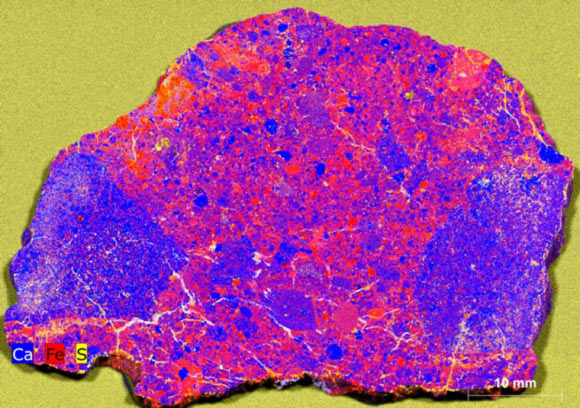
XRF map of 7.53 g slice of NWA 12593: calcium (Ca) and iron (Fe) illustrate the location and diversity of clasts; sulfur (S) highlights the location of cracks and terrestrial weathering. Image credit: Crow et al., doi: 10.1130/G54386.1.

Planetary scientists analyzing a lunar meteorite known as Northwest Africa (NWA) 12593 have uncovered evidence of an asteroid impact that occurred 3.5 billion years ago on the Moon, helping to reconstruct a period of intense bombardment that left lasting marks across the inner Solar System.

The post Lunar Meteorite Preserves Evidence of Colossal Asteroid Strike appeared first on Sci.News: Breaking Science News.

  •  

Acheulean Toolmakers Chose Their Stone with Surprising Precision

A reconstruction of Homo longi in his habitat. Image credit: Chuang Zhao.

Geochemical analysis of 780,000-year-old stone tools from Israel suggests Acheulean (or Acheulian) hominins repeatedly sought specific basalt sources, revealing sophisticated planning and deep knowledge of their landscape.

The post Acheulean Toolmakers Chose Their Stone with Surprising Precision appeared first on Sci.News: Breaking Science News.

  •  

Astronomers Finally Find Milky Way’s Missing Black Hole Wind

This image shows the evidence for the wind blowing away from Sagittarius A*: the white dot in the center of the image shows the supermassive black hole; in orange is data from ALMA, mapping the location of cold gas composed of carbon monoxide in the image; in blue is X-ray data from Chandra; a large cone-shaped cavity, visible as an absence of cold gas in the ALMA data, is filled by hot X-ray-emitting gas in the Chandra data. Image credit: NASA / CXC / UMass / Wang et al. / ALMA / ESO / NAOJ / NRAO / Longmore et al. / Minniti et al.

After a 50-year search, astronomers have uncovered evidence that Sagittarius A* -- the 4.3-million-solar-mass black hole that resides at the center of our Milky Way Galaxy -- is blowing a hot cosmic wind into its surroundings, carving out a giant cavity near the Galaxy’s heart.

The post Astronomers Finally Find Milky Way’s Missing Black Hole Wind appeared first on Sci.News: Breaking Science News.

  •  

Geoscientists Find Vast Fan-Shaped Structure beneath Antarctica’s Ice

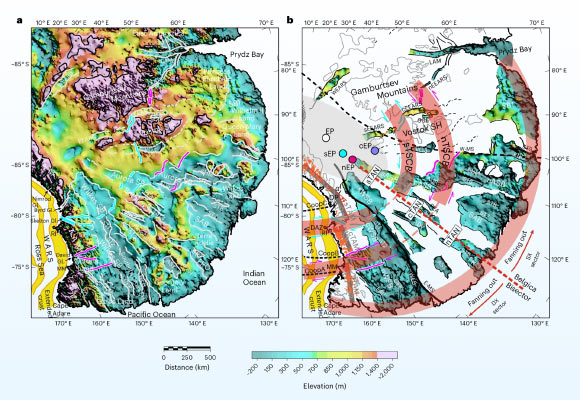
Fault-controlled basins and interpreted structural frame in the newly-identified East Antarctic Fan-Shaped Basin Province. Image credit: Armadillo et al., doi: 10.1038/s41561-026-01991-6.

By combining seismic, gravity and topographic data, a team of researchers from Italy, Switzerland, Germany and the United Kingdom found that several well-known subglacial basins in East Antarctica are part of a single fan-shaped province whose origins trace back to ancient continental stretching.

The post Geoscientists Find Vast Fan-Shaped Structure beneath Antarctica’s Ice appeared first on Sci.News: Breaking Science News.
  •  

Fish Fossils from Early Paleocene Fill 10-Million-Year Gap after Dinosaur Extinction

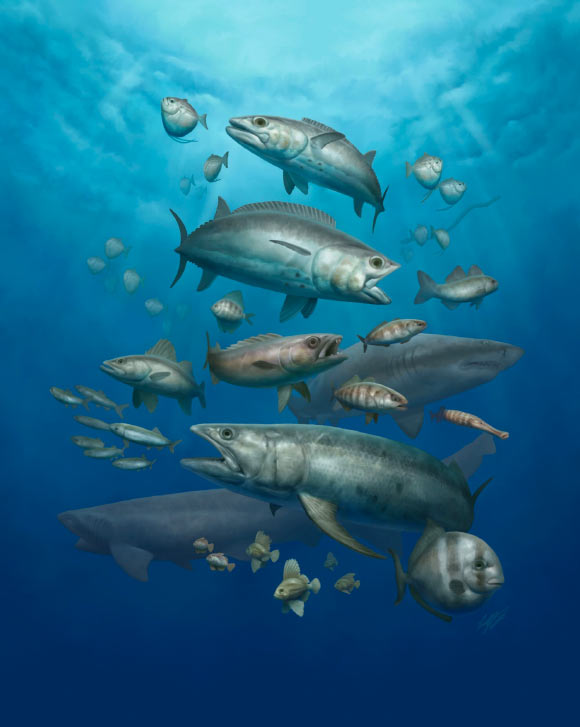
Marine fishes from the Early Paleocene site of Qreiya 3 in the Eastern Desert of Egypt. Image credit: Ian Baylatry.

Paleontologists have described an assemblage of marine fish fossils from the 62.2-million-year-old site of Qreiya 3 in the Eastern Desert of Egypt, providing a window into this transition.

The post Fish Fossils from Early Paleocene Fill 10-Million-Year Gap after Dinosaur Extinction appeared first on Sci.News: Breaking Science News.
  •  

Half-Ton Cattle Relatives Roamed Europe 4 Million Years Ago

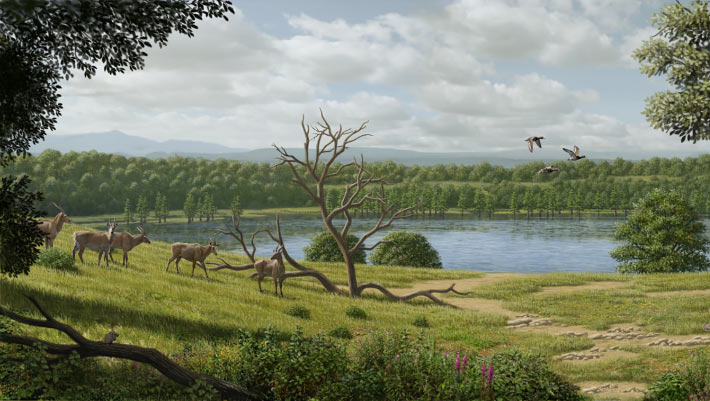
Paleoartistic reconstruction of the environment in the surrounding of Camp dels Ninots maar lake during the Early Pliocene. Image credit: Mauricio AntΓ³n.

Near-complete bovine skeletons unearthed the Early Pliocene site of Camp dels Ninots in northeastern Spain reveal that the ancestors of today’s buffalo and cattle were already growing to impressive sizes long before humans arrived on the continent.

The post Half-Ton Cattle Relatives Roamed Europe 4 Million Years Ago appeared first on Sci.News: Breaking Science News.
  •  

Webb Weighs Most Distant Inactive Black Hole Ever Found

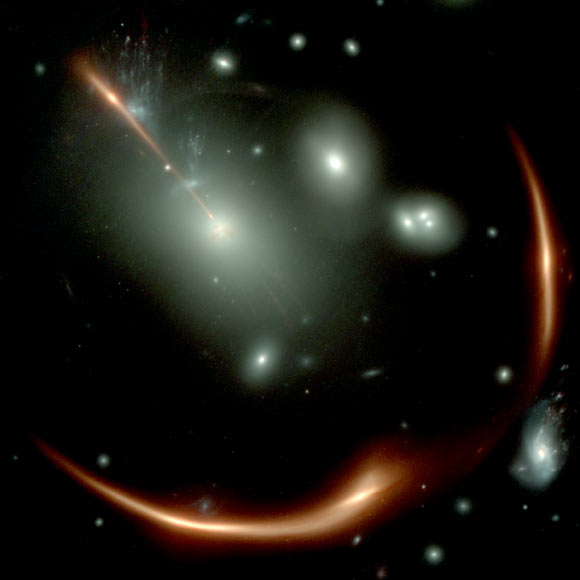
This Webb image shows the highly distorted red galaxy MRG-M0138 seen through a foreground cluster of galaxies (white sources). Image credit: NASA / ESA / CSA / Webb.

A supermassive black hole 6 billion times the mass of the Sun lurks in MRG-M0138, a gravitationally lensed quiescent galaxy seen when the Universe was just 3 billion years old, according to an analysis of data collected by the NIRSpec Integral Field Spectrograph onboard the NASA/ESA/CSA James Webb Space Telescope.

The post Webb Weighs Most Distant Inactive Black Hole Ever Found appeared first on Sci.News: Breaking Science News.
  •  

Giant Scorpions Ruled Ancient Britain during Devonian Period

Praearcturus gigas. Image credit: Franz Anthony.

Paleontologists have confirmed that Praearcturus gigas, a creature that prowled shallow waters during the Devonian period, 415 million years ago, is the largest scorpion ever found.

The post Giant Scorpions Ruled Ancient Britain during Devonian Period appeared first on Sci.News: Breaking Science News.

  •  

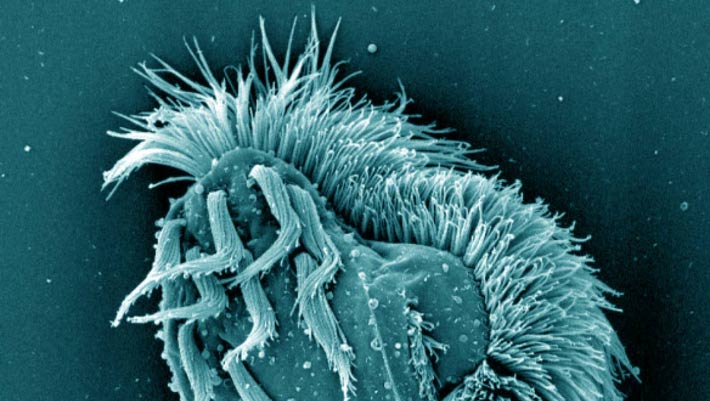
When Food Runs Short, This Single-Celled Organism Turns into Giant Cannibal to Survive

Euplotes gigatrox. Image credit: Ben Larson & Samuel Lord.

Euplotes gigatrox, a new species of ciliate collected from a seawater filtration system on the Caribbean Island of CuraΓ§ao, can transform into a cannibalistic β€˜supergiant,’ raising new questions about the complexity of life at the microscopic scale.

The post When Food Runs Short, This Single-Celled Organism Turns into Giant Cannibal to Survive appeared first on Sci.News: Breaking Science News.
  •  

Meteorite Found in Africa Preserves Evidence of Long-Lost Massive Protoplanet

This is an artist impression of the protoplanetary disk around HD 107146. Image credit: A. Angelich / NRAO / AUI / NSF.

The Northwest Africa (NWA) 12774, an angrite meteorite discovered in the Sahara Desert, likely in Mauritania, appears to be a fragment of a vanished protoplanet, offering the strongest evidence yet that a large planetary body formed and was later destroyed during the Solar System’s chaotic infancy.

The post Meteorite Found in Africa Preserves Evidence of Long-Lost Massive Protoplanet appeared first on Sci.News: Breaking Science News.
  •  

Ancient Oceans Began Losing Oxygen Millions of Years before End-Triassic Mass Extinction

Early Earth. Image credit: Peter Sawyer / Smithsonian Institution.

Chemical traces preserved in ancient rocks indicate that marine environments were deteriorating long before the catastrophe that wiped out vast numbers of species at the end of the Triassic period, around 201 million years ago.

The post Ancient Oceans Began Losing Oxygen Millions of Years before End-Triassic Mass Extinction appeared first on Sci.News: Breaking Science News.

  •  

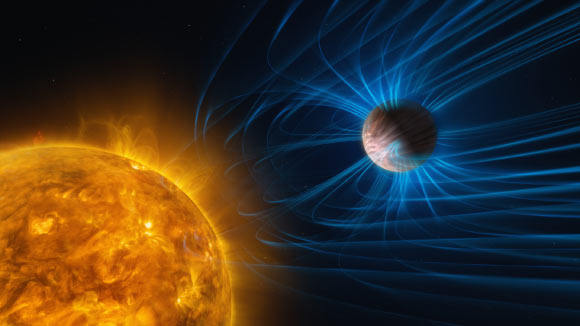
Astronomers Detect Clearest Signs Yet of Magnetic Fields on Extrasolar Planets

This illustration shows magnetic activity in an ultra-hot Jupiter. Image credit: ESO / M. Kornmesser / L. CalΓ§ada.

By tracking fierce winds racing through the atmospheres of seven ultra-hot Jupiters, astronomers have uncovered the strongest evidence yet that magnetic fields shape weather on worlds beyond our Solar System.

The post Astronomers Detect Clearest Signs Yet of Magnetic Fields on Extrasolar Planets appeared first on Sci.News: Breaking Science News.

  •  

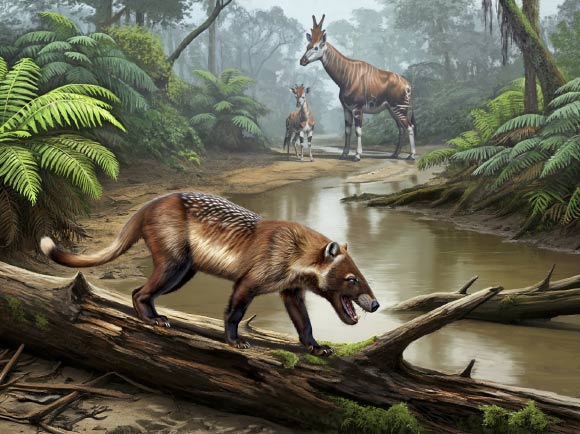
Paleontologists Identify New Hyaenodont Species in Pakistan

Metapterodon anari. Image credit: Steven Jasinski / SergeyAtrox1.

Paleontologists have recovered the fossilized remains of three hyaenodont species, including one previously unknown to science, from Miocene sediments in Pakistan.

The post Paleontologists Identify New Hyaenodont Species in Pakistan appeared first on Sci.News: Breaking Science News.
  •  
❌