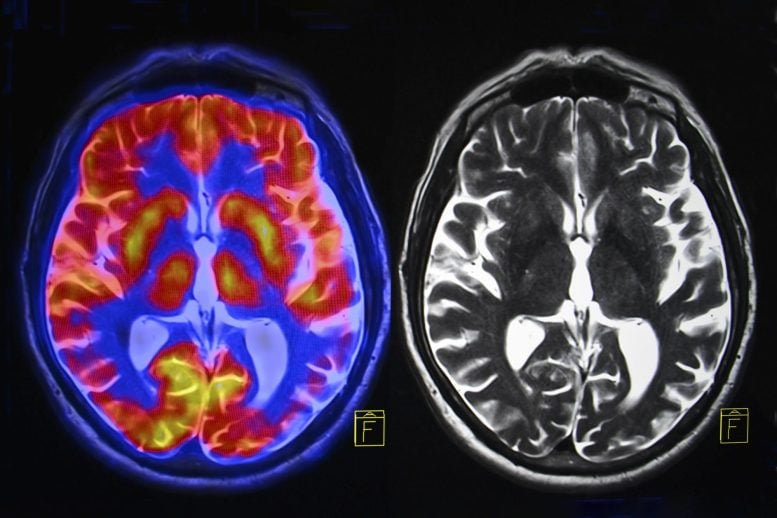
Brain scans have uncovered two biologically distinct forms of autism hidden within the spectrum. An international team of researchers has identified at least two biologically distinct forms of autism by examining how different regions of the brain communicate with one another. The findings could help advance more precise and personalized approaches to autism care and [...]
Researchers have uncovered a previously underappreciated mechanism involved in Alzheimer’s disease and developed a compound that interrupts it. For decades, Alzheimer’s research has largely focused on amyloid plaques and tau tangles, the protein abnormalities that accumulate in the brain as the disease progresses. Yet despite billions of dollars in research and numerous drug development efforts, [...]
When you imagine a waterfall, what comes to mind? Maybe a misty cascade into a blue pool surrounded by trees. Perhaps the roar of water splashing down, as well. It’s a big mystery how brain activity differs when imagining a waterfall versus seeing or hearing one in real life. Brain scans now suggest some activity when you imagine something is similar to what happens when you see or hear the real thing.
But that overlap did not appear in brain areas that deal with single senses. Instead, it showed up in high-level brain networks. These are ones that handle inputs from multiple types of senses.
Researchers shared these findings March 31 in Neuron.
Imagining a scene such as this one activates various areas of the brain, a new study shows. sara_winter/iStock/Getty Images Plus
Neuroscientist Rodrigo Braga led the research. “When I was a teenager,” he says, “I remember the first time realizing that there’s like a voice I can hear in my head.” This “internal monologue” narrates one’s own thoughts.
“That’s really strange,” Braga recalls thinking. “Why is it that we experience those thoughts and sensations almost as if we’re perceiving them?”
He’s spent years trying to answer that question. He now works at Northwestern University’s Feinberg School of Medicine. It’s in Chicago, Ill. In a new study, his team asked eight people to imagine scenes, faces, someone else speaking, their own internal monologues and other sounds. All the while, an MRI machine scanned their brains.
Having hours of MRI data on all eight people allowed the team to create individualized brain maps for each. These showed how each person’s brain activity changed during imagination.
The imagination prompts that people got were open-ended. One was: “Imagine a castle on a hill.” Another: “Imagine a rock song playing on the radio.” After each prompt, the scientists asked people what they saw and heard in their heads. The questions probed how vivid each imagined experience had been — how clear and realistic it felt.
After completing the brain scans, Braga’s team asked follow-up questions. These explored what made some mental images more vivid than others.
Under the hood of imagination
The researchers grouped their data into two buckets. In one, they put the data on imagined locations and events. In the other, they grouped the data on imagined speech and language.
When people were thinking about locations or events, they reported highly vivid sights in their mind’s eye. Activity also went up in their brains’ “default network A.” This is a system of nerve cells in the brain — neurons — known to process real spatial information.
When people thought about speech or language, they reported hearing highly vivid sounds in their heads. Activity also spiked in their brains’ language network. This system of neurons is usually involved when someone reads or listens to speech.
In short, imaginary sights and sounds both enlisted parts of the brain used to process real experiences.
But imagined sensations did not activate sight- and sound-specific parts of the brain. Rather, the default network A and language network respond to new information — no matter what sense it had entered through.
Other studies have found that when someone imagines a certain object they’ve just seen, vision-specific brain regions light up. In this study, prompts to imagine more general scenes did not do that.
That might be because the basic visual areas of the brain respond to details like edges, colors and lines, says Nathan Anderson. Those fine details might matter when someone is asked to picture a real object they saw. But, he notes, “people don’t necessarily imagine fine details when they are imagining a [general] scene.” So the neurons that handle specific visual details aren’t needed. Anderson is a neuroscientist who took part in the study. He works at Brigham Young University in Provo, Utah.
These findings don’t surprise Stephen Kosslyn. Since the prompts didn’t ask people to imagine detailed sights or sounds, he says it makes sense that the brain regions linked to those tasks didn’t light up. Kosslyn is a neuroscientist at Harvard University in Cambridge, Mass. He did not take part in the new work.
Open-ended prompts are a strength of the study, says Alfredo Spagna. A psychologist, he works at John Cabot University in Rome, Italy, and did not take part in the study. Everyday mental imagery is likely closer to imagining a castle on a hill than it is to picturing the tiny details of something you just saw, he says. So the open-ended prompts used here probably closely mimic what’s happening in our brains day-to-day.
But there’s still much to learn about how the brain conjures sights and sounds that feel so real. “This is one of the many papers that will come out in the next years that try to break down this obscure concept of vividness,” says Spagna.
Researchers at LMU have found a new type of electricalrhythm in the central thalamus, a small area deep inside the brain. Published in Nature Human Behaviour, the study suggests that this rhythm could serve as a biological indicator of conscious states.
A Signal That Tracks Awareness
This rhythm allows researchers to closely track certain states of consciousness. It appears during wakefulness and REM sleep, but disappears as soon as non-REM sleep begins. In non-REM sleep, slower brain waves take over, and the thalamic signal fades.
The signal does more than just appear with consciousness. It also changes as the brain moves between different states. For example, the rhythm becomes stronger during REM sleep, which lets researchers see small shifts in awareness even within the same stage of sleep.
“Our results show that the central thalamus plays an important role in regulating brain states,” said Dr. Aditya Chowdhury, lead author of the study. “In the context of existing research, our results show that this small deep-lying brain structure could actively influence our states of consciousness.”
Professor Tobias Staudigl, who led the research team, argues the signal’s consistency makes it more than just an interesting discovery. “These characteristic rhythm patterns can be reliably attributed to specific states and thus have the potential to serve as a measurable biological signature of states of consciousness,” Staudigl said.
Getting Inside the Deepest Part of the Brain
Recording electrical activity from deep brain structures is one of neuroscience’s most persistent technical problems. Standard surface EEG can detect general patterns from the brain’s outer layers, but it misses details from deeper areas. Since the thalamus sits at the center of the brain, it has remained largely inaccessible through non-invasive methods.
The LMU team had a rare chance to study this. Their research involved patients already undergoing deep-brain stimulation therapy for epilepsy, which uses electrodes in the thalamus to help control seizures. These electrodes let the researchers record signals directly from inside the thalamus, something that is almost never possible otherwise.
The team combined these recordings with surface EEG, eye-tracking, and detailed sleep-stage analysis. This approach allowed them to see how thalamic activity changes as patients transition between wakefulness and different sleep stages. Their findings offer the most detailed picture yet of what the thalamus actually does as consciousness changes.
Medical Implications
Disorders of consciousness, like coma, vegetative state, and minimally conscious state, are some of the hardest problems in neurology. One reason is that doctors have lacked reliable biological markers to assess patients’ awareness. The thalamic rhythm found in this study could help solve that problem.
If this signal truly tracks brain states linked to consciousness, it could help doctors evaluate awareness in patients who cannot communicate, guide treatment choices, and monitor how patients respond to care over time. The researchers believe it could also be used to improve deep brain stimulation therapy by allowing doctors to adjust treatment based on real-time thalamic activity rather than general clinical signs.
Staudigl was recently awarded funding by the European Research Council to explore the clinical potential of this discovery and to develop applications for treating neurological disease.
Understanding consciousness has always been one of science’s most difficult challenges. While the study does not answer the fundamental question of what consciousness is, these findings provide a consistent, measurable signal that indicates how the brain moves between conscious and unconscious states.
Austin Burgess is a writer and researcher with a background in sales, marketing, and data analytics. He holds an MBA, a Bachelor of Science in Business Administration, and a data analytics certification. His work focuses on breaking scientific developments, with an emphasis on emerging biology, cognitive neuroscience, and archaeological discoveries.
Synesthesia is a trait that some people have in which one kind of sensory input triggers other senses. To someone with synesthesia, different colors may have different tastes. Or hearing certain sounds may cause them to see certain shapes.
This phenomenon is not a mental illness. Rather, it is considered a form of neurodiversity. Up to 4 percent of people may have some form of synesthesia.
This trait takes many forms. Grapheme-color is one type. This means that a person sees letters or numbers in different colors. For instance, when a person sees the number 7, it may always appear yellow. About 1 percent of people share this trait.
Another type is called chromesthesia. That’s when hearing a sound causes a person to see colors or shapes around them. Historians think that Vincent van Gogh, a 19th-century painter, may have had this trait. He described seeing colors around him when he played the keys of a piano.
Other famous artists, such as singer and songwriter Billie Eilish, have described this experience, too. “Everything that I make I’m already thinking of what color it is, and what texture it is, and what day of the week it is, and what number it is, and what shape,” the musician told iHeart Radio.
Scientists are not sure exactly what causes synesthesia. But they believe it is at least partly linked to a person’s genes.
A new study suggests that subtle changes in the brain’s immune cells could help explain why some people remain mentally sharp despite Alzheimer’s pathology. For decades, Alzheimer’s research has focused on the buildup of amyloid plaques and tau tangles, the two hallmark features of the disease. Yet a puzzling reality has continued to challenge scientists: [...]
Cambridge researchers used lab-grown human brain and spinal cord tissues to uncover a hidden mechanism that blocks nerve repair. By reversing that biological brake, they restored the ability of damaged nerve fibers to regrow. Scientists at the University of Cambridge have created miniature brain and spinal cord circuits in the lab that mimic the neural [...]
Scientists have uncovered an early brain mechanism that may help explain why people carrying the APOE4 gene face a higher risk of Alzheimer’s disease. For millions of people who carry the APOE4 gene, the strongest known genetic risk factor for Alzheimer’s disease, changes in brain activity may start years before memory problems become noticeable. Researchers [...]
A new study challenges the long-held idea that habits form only through slow, gradual repetition. What if your habits don’t form through countless repetitions over months or years? What if the brain can decide, almost instantly, that a behavior is no longer worth thinking about? That possibility is at the center of a new Johns [...]
Brain scans suggest long COVID’s biggest clues may lie in the brain’s emotion centers, not widespread inflammation. A new brain imaging study suggests that persistent symptoms of long COVID may not be driven by ongoing brain inflammation, as many researchers have suspected. Scientists in Finland used advanced imaging techniques to examine the brains of people [...]
Researchers suggest that old psychoanalytic ideas and modern brain science may be describing the same mental processes from different angles. More than a century after Sigmund Freud developed his influential theories of the mind, some researchers believe modern neuroscience may be arriving at surprisingly similar conclusions. A new paper published in the neurocognitive journal Entropy [...]
Volcano Hazards • Lahars • Rain + Ash = Mudflow • Go back to Strange Sounds Heavy rain on Mount Merapi triggered a “cold lava” flood — a lahar — surging downriver, killing people and dragging vehicles. When intense rainfall hits ash-covered slopes, loose volcanic debris turns into a fast-moving slurry that can carry boulders, […]
Earth Oddities • Strange Geological Phenomena • Landslides & Mudflows • Heavy Rainfall Threshold Failures • Go back to Strange Sounds A deadly landslide struck an eastern DR Congo coltan mining area after heavy rainfall, killing more than 200 people (reported). Heavy rainfall triggered a catastrophic slope failure at a coltan mining site in eastern […]
Earth Systems • Extreme Rainfall • Landslides & Mudflows • Go back to Strange Sounds Parts of Minas Gerais, Brazil, reportedly received about 21 inches (533 mm) of rain in roughly six hours. Landslides and flooding followed, with at least 64 reported deaths and thousands displaced. This deep dive explains why intense rainfall can trigger […]
By tracking eye movements in zebrafish, researchers identified four different types of sleep, analogous to the complex sleep patterns of humans and other animals.
New research from the University of Oxford and the University of Reading suggests bipedalism and expanding brain size helped drive the overwhelming dominance of right-handedness in humans.

 Login

 Brain scans have uncovered two biologically distinct forms of autism hidden within the spectrum. An international team of researchers has identified at least two biologically distinct forms of autism by examining how different regions of the brain communicate with one another. The findings could help advance more precise and personalized approaches to autism care and [...]