❌

Reading view

Scientists Discover Key Alzheimer’s “Tipping Point” That May Decide Who Gets Dementia
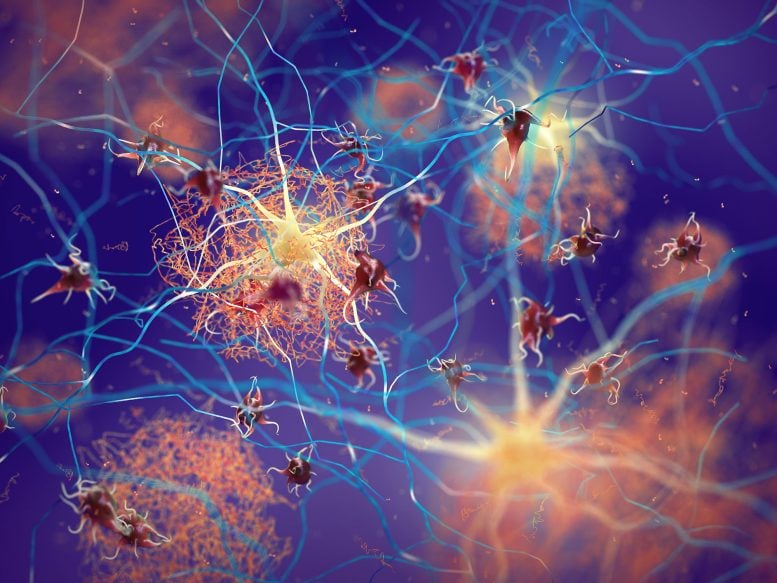
Amyloid Plaques Neurons Alzheimer's DementiaA new study suggests that subtle changes in the brain’s immune cells could help explain why some people remain mentally sharp despite Alzheimer’s pathology. For decades, Alzheimer’s research has focused on the buildup of amyloid plaques and tau tangles, the two hallmark features of the disease. Yet a puzzling reality has continued to challenge scientists: [...]
  •  

Cambridge Scientists Just Reversed a Form of Nerve Damage Once Thought Permanent

Damaged Neuron Brain Nerve CellCambridge researchers used lab-grown human brain and spinal cord tissues to uncover a hidden mechanism that blocks nerve repair. By reversing that biological brake, they restored the ability of damaged nerve fibers to regrow. Scientists at the University of Cambridge have created miniature brain and spinal cord circuits in the lab that mimic the neural [...]
  •  

Scientists Uncover the Earliest Brain Changes That May Predict Alzheimer’s Decades Before Symptoms

Genetic Brain Disorders DNA Helix Mental HealthScientists have uncovered an early brain mechanism that may help explain why people carrying the APOE4 gene face a higher risk of Alzheimer’s disease. For millions of people who carry the APOE4 gene, the strongest known genetic risk factor for Alzheimer’s disease, changes in brain activity may start years before memory problems become noticeable. Researchers [...]
  •  

Surprising New Study Challenges a Century-Old Theory of Habit Formation

Habit Human BrainA new study challenges the long-held idea that habits form only through slow, gradual repetition. What if your habits don’t form through countless repetitions over months or years? What if the brain can decide, almost instantly, that a behavior is no longer worth thinking about? That possibility is at the center of a new Johns [...]
  •  

Researchers Suspected Brain Inflammation in Long COVID but Found Something Else

Color Black White Brain ScansBrain scans suggest long COVID’s biggest clues may lie in the brain’s emotion centers, not widespread inflammation. A new brain imaging study suggests that persistent symptoms of long COVID may not be driven by ongoing brain inflammation, as many researchers have suspected. Scientists in Finland used advanced imaging techniques to examine the brains of people [...]
  •  

Scientists Discover Surprising Similarities Between Freud’s Ideas and Modern Neuroscience

Human Anatomy 3D Brain RenderingResearchers suggest that old psychoanalytic ideas and modern brain science may be describing the same mental processes from different angles. More than a century after Sigmund Freud developed his influential theories of the mind, some researchers believe modern neuroscience may be arriving at surprisingly similar conclusions. A new paper published in the neurocognitive journal Entropy [...]
  •  

Upright Walking and Larger Brains May Explain Why 90% of Humans Favor Their Right Hand

Reconstruction of Homo erectus.

New research from the University of Oxford and the University of Reading suggests bipedalism and expanding brain size helped drive the overwhelming dominance of right-handedness in humans.

The post Upright Walking and Larger Brains May Explain Why 90% of Humans Favor Their Right Hand appeared first on Sci.News: Breaking Science News.

  •  
❌