❌

Normal view

PLOS Issues Expression of Concern for Yangtze River Delta Study

21 October 2026 at 23:17

The PLOS One editors have issued an expression of concern for a 2024 case study concerning the digital economy, innovation factor allocation and industrial structure transformation in China’s Yangtze River Delta city cluster. The notice, published on October 21, 2026, states that the article was identified as one of a series of submissions for which the journal has concerns about the integrity or reliability of the peer-review process. Readers are advised to interpret the original study with this issue in mind.

The notice does not report a new scientific finding, identify an error in the paper or evaluate the study’s scientific validity. According to the editors, PLOS did not assess the article’s integrity or scientific validity when following up on the matter. The expression of concern therefore records a concern about the circumstances surrounding peer review rather than announcing that the study’s data, methods or conclusions have been disproved. The editors also state that they have no concerns regarding the authors’ conduct during the peer-review process.

The affected article was published in PLOS One in 2024 under the title “Digital economy, innovation factor allocation and industrial structure transformation—A case study of the Yangtze River Delta city cluster in China.” The supplied notice does not provide the study’s findings, population details, analytical methods, model estimates, uncertainty measures or specific mechanisms linking the subjects named in the title. As a result, the notice does not support conclusions about the relationship between digital-economy development, innovation factors and industrial structure in the region, nor does it establish whether any reported association or causal effect is reliable.

For the wider research record, the immediate effect is that the 2024 article is accompanied by an editorial notice questioning the integrity or reliability of its peer-review process. The notice does not provide details about the submissions or explain the specific basis for the journal’s concerns. It also does not announce a correction, replacement analysis or revised conclusion. The central status of the paper’s scientific validity remains unevaluated in the supplied material, while the issue is sufficiently significant for PLOS One to advise readers to consider it when interpreting the study.

Subject of Research: A PLOS One expression of concern concerning peer-review reliability in a Yangtze River Delta regional-economy case study.

Article Title: Expression of Concern: Digital economy, innovation factor allocation and industrial structure transformation—A case study of the Yangtze River Delta city cluster in China

Article References: The PLOS One Editors (2026). Expression of Concern: Digital economy, innovation factor allocation and industrial structure transformation—A case study of the Yangtze River Delta city cluster in China. PLOS One, 21(10), e0360867. https://doi.org/10.1371/journal.pone.0360867

Image Credits: AI Generated

DOI: 10.1371/journal.pone.0360867

Keywords: PLOS One, expression of concern, peer review, research integrity, digital economy, innovation factors, industrial structure, Yangtze River Delta, China, Expression, Concern, Digital

Researchers See Gas Swirling Around a Growing Baby Planet

28 September 2026 at 17:00

WISPIT 2b

Astronomers seem to find something new every time they point a telescope at WISPIT 2, a 5-million-year-old solar-mass star located 430 light-years away. New high-resolution radio observations provide the best view yet of how the young planets of this system interact with the disk that feeds them.

Detecting Distant Planets

In 2025, astronomers carrying out the WIde Separation Planets In Time (WISPIT) survey — a targeted search for widely separated giant planets around young Sun-like stars — revealed a dusty disk surrounding the star WISPIT 2. Orbiting within this disk is a 4.9-Jupiter-mass planet, WISPIT 2b, at 57 au from the star. This makes WISPIT 2 just the second star to host a confirmed, directly imaged planet within its protoplanetary disk. Even more remarkable, WISPIT 2b was detected in Hα, showing that the planet is still growing by accreting gas from the disk.

Later observations confirmed the presence of a second planet, WISPIT 2c, which has an estimated mass of 8–12 Jupiter masses and orbits the star at 15 au. On top of these planetary discoveries, researchers have also found that WISPIT 2 is two stars rather than one!

Best View Yet of the WISPIT 2 System

observations of WISPIT 2 showing the disk in three different ways

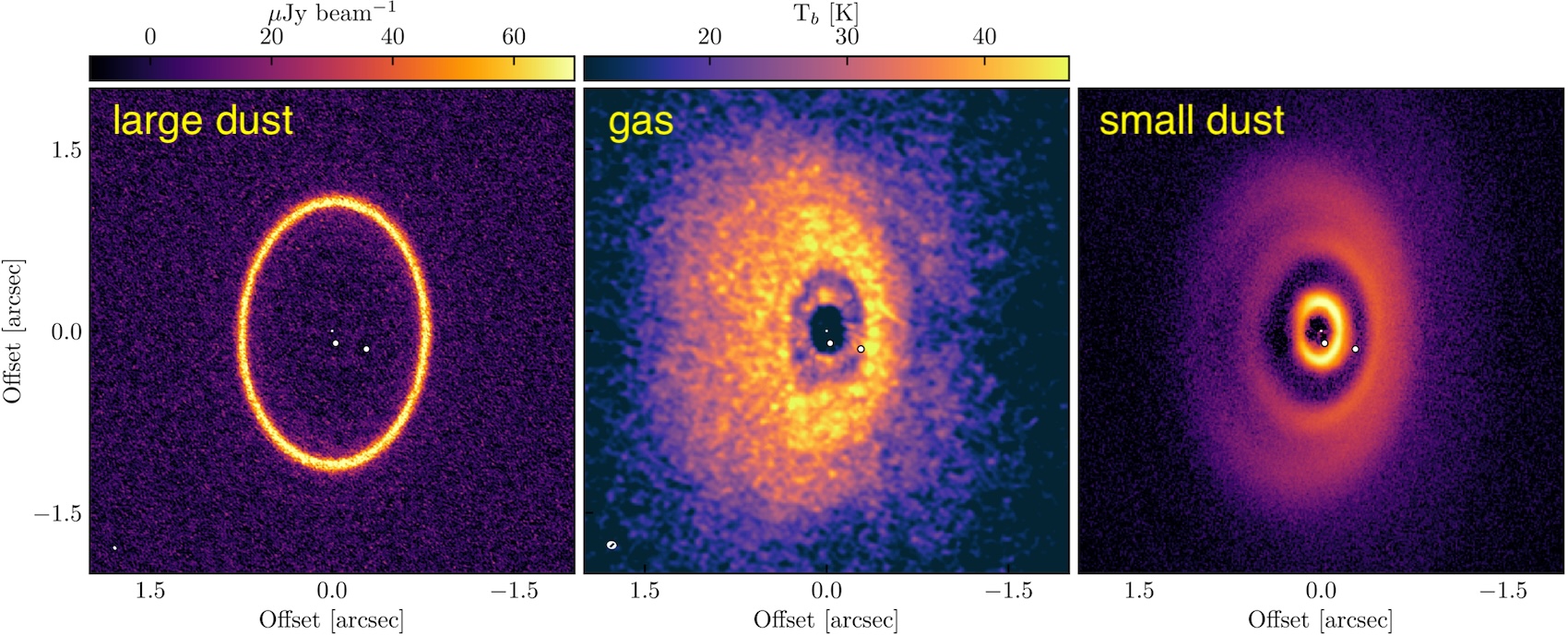
New observations of WISPIT 2 from ALMA (left and center panels) and previous observations from the Very Large Telescope (right panel). The star is shown by the small dot at the very center, and the planets are indicated by the two white circles. Click to enlarge. [Adapted from Benisty et al. 2026]

Now, a team led by Myriam Benisty (Max Planck Institute for Astronomy) has presented new high-resolution observations of the WISPIT 2 system from the Atacama Large Millimeter/submillimeter Array (ALMA). These observations show the distribution of gas and large dust particles within the disk. When combined with existing observations of small dust grains, the new data demonstrate how these components of the disk interact with each other and with the system’s planets.

The distribution of gas within the disk, traced by emission from carbon monoxide, roughly follows the pattern seen in previous observations of small dust grains: the orbits of WISPIT 2b and 2c are depleted of gas and dust, demonstrating how the young planets have carved their own berths within the disk, creating a gap at WISPIT 2b’s orbit and a cavity around the star.

dust continuum emission around WISPIT 2 showing the location of a faint dust ring

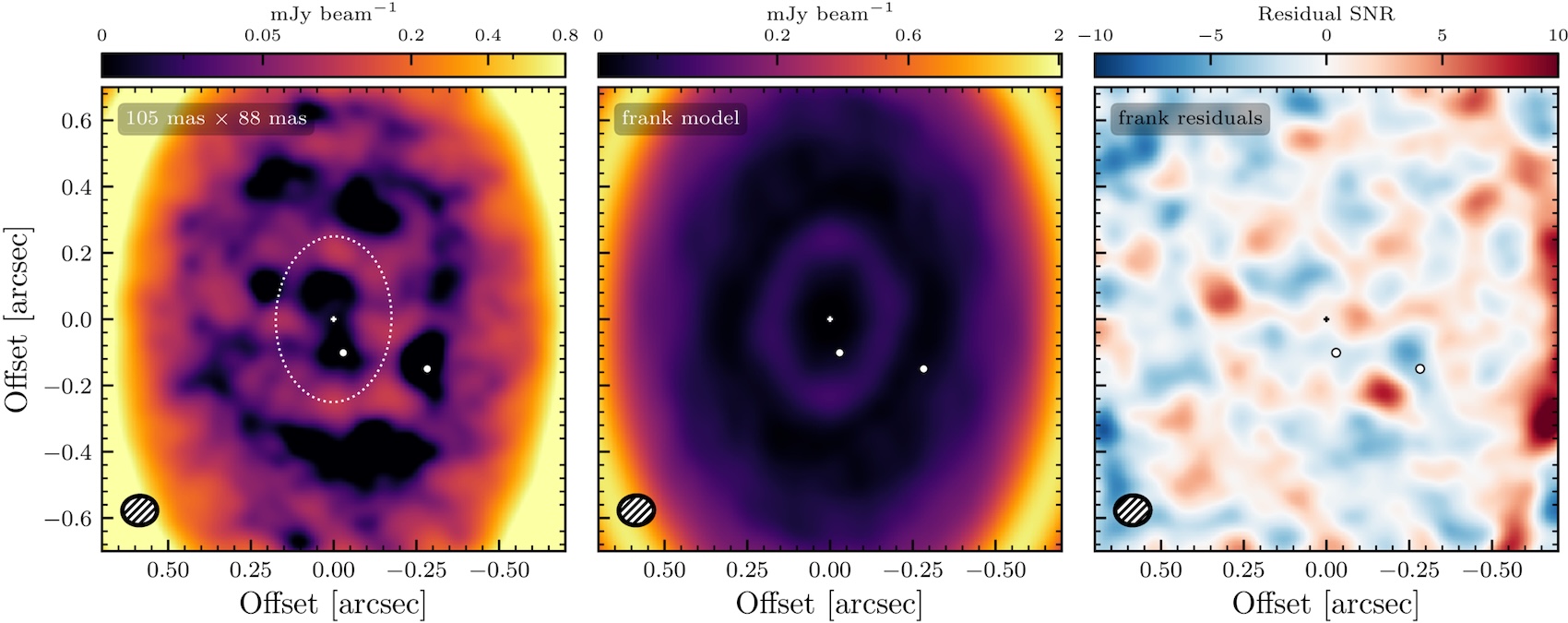
The left panel shows the dust continuum emission zoomed in on the star (plus sign) and planets (circles). The dotted line shows the location of a faint ring, which is modeled in the center panel. The right panel shows the residuals. Click to enlarge. [Benisty et al. 2026]

The new observations of larger dust particles show a bright ring of emission well outside the orbits of both planets, plus a faint ring in between the two planets that is newly detected in dust continuum emission. This faint ring lines up with a ring in both the gas and small dust grain data, showing that dust and gas are able to journey inward from the outer disk, past the orbit of WISPIT 2b. However, there is no gas or dust detected interior to WISPIT 2c’s orbit, and WISPIT 2c does not appear to be accreting, suggesting that this material is unable to move inward to WISPIT 2c’s orbit and beyond.

Spiral Wakes Making a Splash

velocity field showing gas swirling around WISPIT 2b

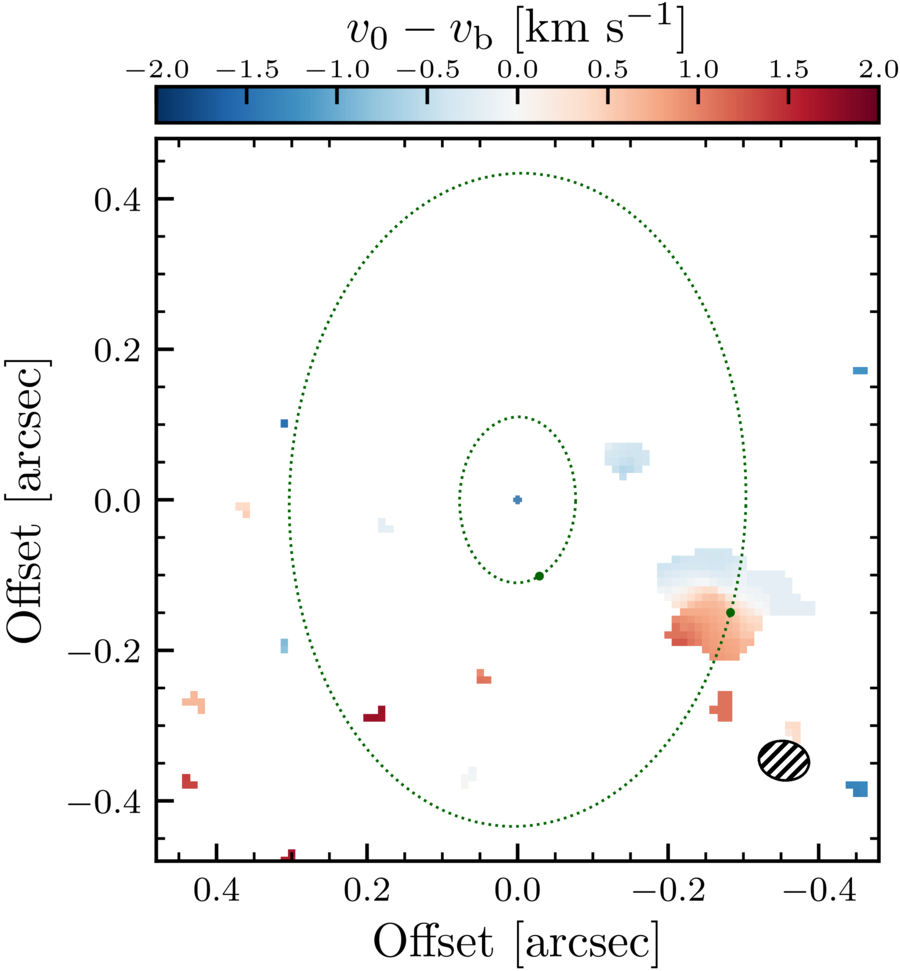
Velocity field showing the gas swirling around WISPIT 2b, which is indicated by the green circle farther from the star. [Benisty et al. 2026]

The new ALMA observations allowed Benisty and coauthors to analyze how WISPIT 2b is interacting with the disk. Kinematic maps of the disk showed that the typical emission pattern of a rotating disk is interrupted near WISPIT 2b. The team determined that this feature is due in part to spiral wakes driven by the planet as it orbits within the disk, with potential contributions from local heating or a circumplanetary disk.

Spiral wakes have been spotted in other protoplanetary disks, but this is the first time researchers have been able to definitively associate this feature with a planet rather than other causes, such as gravitational instabilities. Looking ahead, future high-resolution spectroscopic observations of WISPIT 2b and its surroundings will offer researchers an unprecedented opportunity to compare the properties of the planet and its spiral wake against the predictions of simulations — advancing toward a powerful new way to study exoplanets embedded in protoplanetary disks.

Citation

“Mapping the WISPIT 2 Planet-Hosting Cavity at Sub-Hill-Radius Scales,” Myriam Benisty et al 2026 ApJL 1009 L32. doi:10.3847/2041-8213/aea214

The post Researchers See Gas Swirling Around a Growing Baby Planet appeared first on AAS Nova.

A Sneak Peek into Early-Universe Star Formation with Boötes I

22 September 2026 at 17:00

star-forming region N44

Editor’s Note: Astrobites is a graduate-student-run organization that digests astrophysical literature for undergraduate students. As part of the partnership between the AAS and astrobites, we occasionally repost astrobites content here at AAS Nova. We hope you enjoy this post from astrobites; the original can be viewed at astrobites.org.

Title: Probing the IMF in the Early Universe — Direct Measurements in the Boötes I UFD with JWST/NIRCam
Authors: Keyi Ding et al.
First Author’s Institution: University of Maryland
Status: Published in ApJ

The Stellar Initial Mass Function

plot of different formulations of the initial mass function

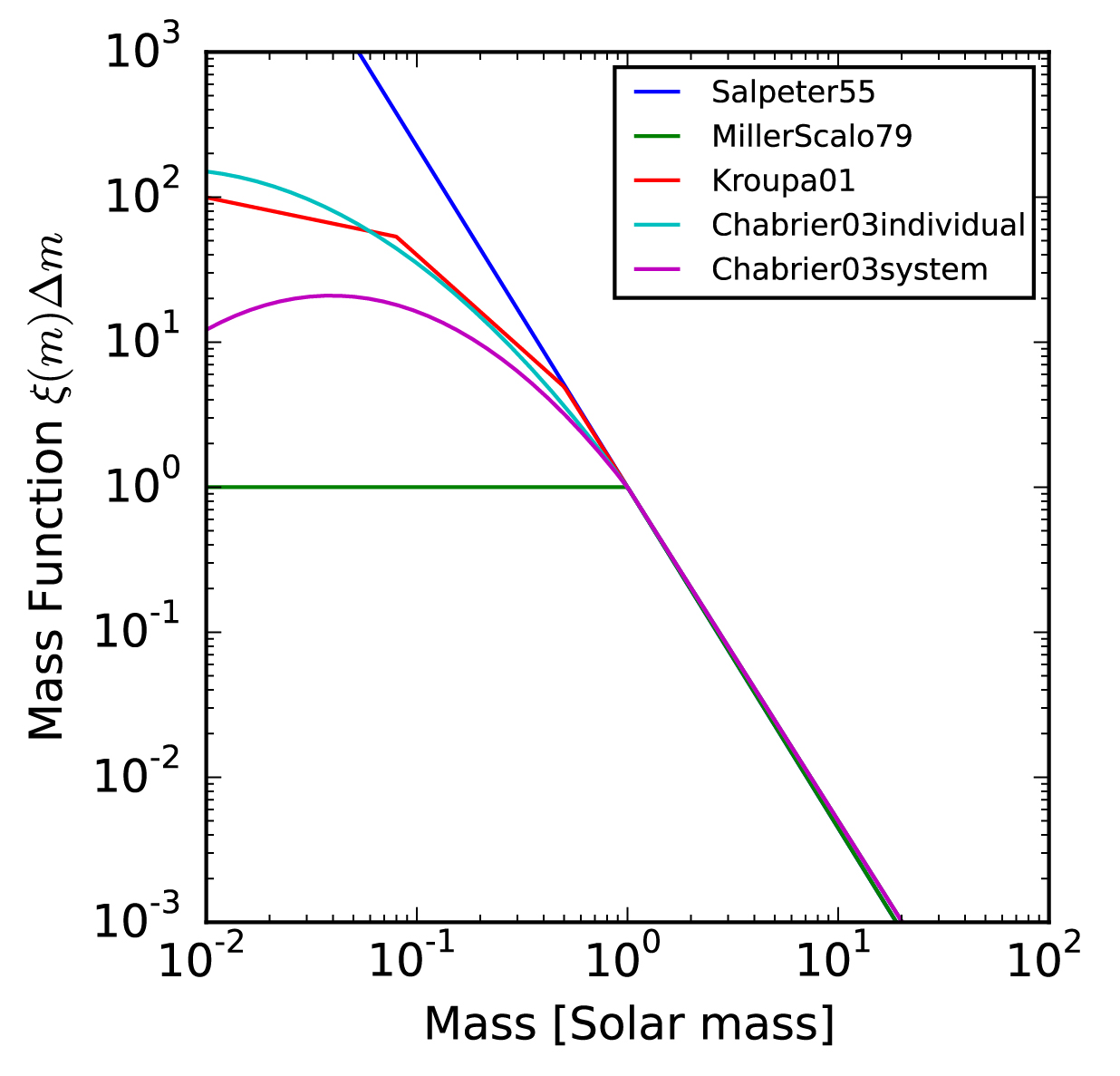
Figure 1: Several different formulations for the IMF. Astronomers have found that the Milky Way IMF seems to follow either a broken power law (Kroupa), or a log-normal (Chabrier) distribution. [JohannesBuchner; CC BY-SA 4.0]

A fundamental concept in astronomy is the stellar initial mass function (IMF). The IMF describes the number of stars of each mass that form from a single birth cloud. If the IMF has a negative slope, it means most stars are low in mass; if it has a positive slope, it means most stars are high in mass. Figure 1 shows some examples of commonly used IMFs, all of which have a negative slope, since we see far more low-mass stars than high-mass stars in the Milky Way. You may notice that several models deviate from a straight line at about 0.5 solar mass. This point, known as the turnover or critical mass, is crucial in determining the exact shape of the IMF.

For a relatively simple concept, the IMF is shaped by incredibly complicated underlying physical mechanisms. Things like turbulence, magnetic fields, and chemical enrichment all play a role in shaping the observed IMF. Additionally, the IMF is a pretty fundamental quantity. An enormous amount of astronomy research relies on assumptions made about the IMF. For example, since most stars are low in mass, and low-mass stars are dimmer, astronomers use the IMF to convert the amount of light in a galaxy to the number of stars; if there are more or fewer low-mass stars than we expect, our measurements will be wrong.

A big question surrounding the IMF is whether or not it’s universal. In the Milky Way, astronomers have been able to measure the IMF accurately, and they have found that it seems to be the same regardless of which bunch of stars we use to measure it.1 However, we know that galaxies in the early universe were very different compared to today. Things get tricky when you acknowledge that most measurements made of early-universe galaxies rely on modeling tools that are entirely reliant on assuming an IMF. This gnarly little detail makes measuring the IMF in the early universe especially valuable to astronomers.

What Makes Ultra-Faint Dwarfs So Special?

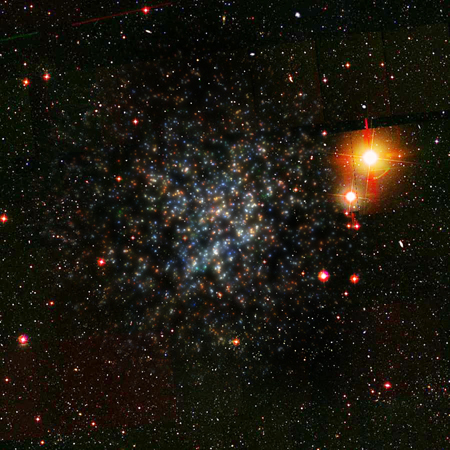
Today’s authors attempt to measure the early-universe IMF using a local relic, an ultra-faint dwarf galaxy (UFD). You might describe UFDs as “incredibly funky little galaxies.” They’re much less massive than the Milky Way, with about 10,000 times less stellar mass. What stars they do have tend to be very old and metal poor. The nature of UFDs has led many astronomers to think of them as fossils: relatively untouched galaxies formed in the early universe. Since we think UFDs are fossils of earlier galaxies, measuring the IMF in a UFD tells us whether the IMF was the same in the early universe as it is today. The authors focus on Boötes I, a relatively luminous UFD orbiting the Milky Way. Figure 2 shows Boötes I as seen by the Sloan Digital Sky Survey.

Boötes I

Figure 2: Boötes I as seen by the Sloan Digital Sky Survey. Because they’re so diffuse, UFDs look less like galaxies and more like groups of stars. [Vasily Belokurov – SDSS-II Collaboration]

The IMF in Boötes I

Measuring the IMF can get tricky — it’s typically pretty difficult to measure the mass of each individual star in a galaxy. Thankfully, Boötes I is close enough that we can do exactly that! Using JWST’s NIRCam instrument, today’s authors obtain imaging of Boötes I that is sensitive enough to extract roughly 10,000 stars belonging to the galaxy.

To measure the IMF from the observed population of stars, the authors use a modified version of Starwave, a Bayesian inference tool. In short, the tool takes in some assumptions about the population of stars in the galaxy, then generates many potential color–magnitude diagrams for various parameter selections. You can then assess how well each simulated color–magnitude diagram fits the observed data, thus determining likely parameters for the stellar population. The authors apply their tool for three different IMF models, testing how close the IMF in Boötes I is to that of the Milky Way. This allows them to determine how well the IMF compares to that of the Milky Way, which is typically thought of as a broken power law or log-normal distribution. If the IMF in Boötes I aligns with the Milky Way’s IMF, we’ll have a solid piece of evidence for a truly invariant IMF across cosmic time, allowing astronomers to rest easy knowing our modeling efforts haven’t been bunk this whole time.

So… What Did We Learn?

The authors find that a single power law can be ruled out to a good degree of confidence. This is good, as Milky Way studies show undeniable evidence of a turnover in the distribution. The broken power law and log-normal models both fit the observed data relatively well, aligning well with Milky Way–derived IMFs. All in all, they find solid evidence for an invariant IMF in the early universe.

However, they are unable to say with absolute certainty that the IMF is invariant. Given that their data are nearly perfect (that is, it’s pretty much impossible to get better data for Boötes I), the authors emphasize that a larger sample of UFD IMFs is needed to truly rule out an invariant IMF, but we’re certainly taking steps in the right direction! As the age-old saying goes, “more data are needed!”

Original astrobite edited by Maggie Verrico.

  1. Editor’s Note: The Milky Way IMF may vary from star cluster to star cluster; as described in this AAS Nova highlight from 8 July 2026, recent research using data from the Gaia spacecraft has found evidence for IMF variation in our galaxy. ↩︎

About the author, Drew Lapeer:

Drew is a first-year PhD student at the University of Massachusetts Amherst. They are broadly interested in the evolution of galaxies, with a focus on the impact of cosmic feedback on the galactic ecosystem. In their free time, they enjoy reading, rock climbing, hiking, and baking!

The post A Sneak Peek into Early-Universe Star Formation with Boötes I appeared first on AAS Nova.

❌