A native Australian millet may carry the genetic fingerprints of thousands of years of Aboriginal harvesting, storage, and plant management. Seen from the air, Channel Country resembles a vibrant and vast tapestry, with a network of waterways crisscrossing the land. Spread across more than 280,000 square kilometers in outback Australia, it is one of the [...]
Angela Nissel smiles through the pain. | Image: Angela Nissel
Angela Nissel's latest book, Good Grief, Pass the Bread, Mom Is Dead, is my kind of memoir. Sure, it's a deeply emotional tale about caring for a terminally ill parent. But it's delivered with the sort of gallows humor that I often turn to to get me through tough times.
Of course, that sort of dark humor should come as no surprise from Nissel. She first made a splash with The Broke Diaries, which grew out of a blog she kept in college detailing her daily struggles and, at times, embarrassment at being a broke student. Eventually she went on to produce and write for hit shows including Scrubs and The Boondocks.
“Sometimes books tell you more than the content,” says Tim White, as he lines up carefully dust-jacketed books and pamphlets in plastic sleeves on temporary shelves in Melbourne University’s Wilson Hall.
He’s preparing his stall for this weekend’s Melbourne Rare Book Fair. For people like White, who runs independent bookshop Books for Cooks, the book as a physical object is just as important as what’s inside it.
Christopher Nolan's The Odyssey has been a lightning rod for controversy ever since the first casting and design reveals, igniting afresh with each new trailer. The film has garnered plenty of well-deserved accolades (and earnings) since its release, and yet somehow the debates rage on between classicists and the general public alike—all this over an adaptation of an epic poem that's been around since roughly the 8th century BCE.
My take: the IMAX scale might be epic, but Nolan gives the story an intimate feel, weaving a captivating, nearly three-hour cinematic spell. While the magic slowly starts to dissipate once one leaves the theater, the powerful imagery will resonate for days. And the film gave me, personally, a fresh perspective on the central character of Odysseus.
When the United States ratified the 13th amendment in 1865, federal lawmakers very nearly outlawed slavery for good — but not entirely. Tucked within arguably the most important corner of the US constitution is a massive caveat: “neither slavery nor involuntary servitude, except as a punishment for crime whereof the party shall have been duly convicted, shall exist within the United States” (emphasis added.)
In the 160-some years since that amendment, a quieter type of forced servitude has lived on in the US: prison labor. From the debt peonage of the post-Civil War reconstruction era to the privatized contracting of the 21st century, prison labor is a massive money maker, generating $11 billion worth of revenue in 2022 alone.
As horrifying a thought as it is, one of the companies still benefiting from the practice is in the news for another reason: spreading a gut-busting diarrhea parasite through mass-produced shredded lettuce in grocery stores and fast food outlets.
It turns out that Taylor Farms, the agricultural company widely believed to be behind the cyclospora outbreak currently raging throughout the US, is also heavily involved in modern-day forced labor.
In reporting from 2023 that was resurfaced this week on social media, the publication Prison Legal News revealed that Taylor Farms was contracting labor from the Arizona Department of Correction, Rehabilitation, and Reentry for the low, low price of just $4.75 an hour — far below the cost to pay a non-incarcerated worker the federal minimum wage. (And to be clear, that’s not the hourly wage paid to the inmate, which is capped at $1.50 in Arizona.)
Taylor Farms is just one firm involved in the practice in Arizona. Others include Hickman’s Egg Farms, NatureSweet, and Televerde, each of which contracted labor from Arizona DCRR’s for-profit arm, Arizona Correctional Industries. That company’s job is basically to churn out bulk goods for the state of Arizona, like license plates, though it also makes quite a bit of money selling the labor-hours of incarcerated people to private companies.
Worse yet, some of those incarcerated workers may have been here as non-citizens — meaning it would be illegal to employ them in the same low-wage jobs if they weren’t being held in detention. As Prison Legal noted at the time, at least 26 prisoners employed by these companies had been detained by ICE, meaning that outside of incarceration, hiring them would have been illegal. To put it bluntly: their status as prisoners was the only thing that made the arrangement legal.
In all, the DCRR told Prison Legal it had hired out 15,700 “Mexican nationals” between 2008 and 2023, though couldn’t say how many of those workers were undocumented immigrants.
As Ruben Reyes, director of the American Immigration Lawyers Association told the publication at the time: “I’m venturing a guess that a large majority of the people who are labeled a Mexican national by [DCRR] are unauthorized to work here.”
Put into context, the revelation is a horrifying twist in an already nauseating story of corporate greed and deregulation. Though the institution of slavery may have been formally abolished, its legacy lives on — fully embraced by the for-profit companies pumping our food supply full of parasites.
Taylor Farms didn’t respond to a request for comment.
Two plants that cause neurotoxicity and paralysis in the tiniest doses are also known to counter pain, malaria, cancer and pests. For the first time, researchers discovered a way to recreate these powerful compounds in the lab, helping lead the way to improved, naturally sourced therapeutics.
Desenvolvida em colaboração com David Li, criador de projetos como a Blob Opera e Viola the Bird, Splash Canvas é uma experiência do Google Arts & Culture que combina pintura digital e IA com criaturas marinhas, que interagem com os utilizadores à medida que exploram o seu lado mais criativo.
Everyone knows that great gimmicks are the key to hiring top developers for your startup.
That's why small AI startup LemonLime—which "optimizes your existing data to work with AI"—has so many of them. Want a job interview? Score a perfect 7/7 on the company's own "Is it a Lemon or a Lime?" game. Or—hear me out—get something permanently tattooed on your flesh.
LemonLime has tried both tactics in the past few weeks. The tattoo stunt generated the most publicity, of course, much of it negative. According to a writeup in Inc., seven people took the deal and got tattooed with the LemonLime logo during a party.
Agents withdraw Jerry Falade’s hotly anticipated debut after saying they can no longer authenticate ‘how the manuscript evolved’
A high-profile publishing deal for a debut crime novel has collapsed after doubts emerged over whether artificial intelligence played a role in writing it.
The hotly anticipated manuscript Call Me, I’ll Hide the Body, by Jerry Falade, was withdrawn from sale by its agent despite reportedly receiving an offer for more than $2m (£1.5m) from Minotaur, owned by Macmillan US, as part of a 14-way auction. The plan was to publish it in 2028.
Playing as recent arrival Lena, your challenges include learning a new language and uncovering family secrets – its developer hopes it will spread ‘a little more compassion’
The cosy house-sorting sim has become a much-loved staple of the PC indie scene. Titles such as Unpacking, A Little to the Left and Momento charm players with their detailed interiors and quiet narratives of lives lived and shared within the same four walls. For Clean Start, Polish developer Serious Sim has taken a different approach – here you play as domestic cleaner, Lena, an immigrant who has arrived in an unspecified western country with little knowledge of the local language, and a family to support back home.
From here, you’re tasked with cleaning a series of houses and apartments, polishing tables, tidying shelves and scrubbing muddy pawprints from kitchen floors. It seems you’re able to rearrange the rooms, giving them a personal feel, which is after all one of the most pleasing elements of the genre. You can also, we are reassured, pet the dog.
I wanted our last family games night to be the best fun we’ve ever had. Maybe we should have stuck with Mario Kart …
It is the end of an era for the Diamond family. For 20 years, there have been five of us living together. It has not been easy. Militant vegan daughters, sons who have inherited Scottish tempers, and a youngest child who attracts trouble like an industrial magnet, have meant our house has been conflict-laden at times. Throw in the fact that we are beset with all manner of mental health bobbins and chronic illnesses that resulted in two of our three kids almost dying in hospitals and you get a family that is combustible – but extremely close.
Through it all, we had games. They always brought us back together. Not just us all hunkering over Super Mario Kart like some kind of UN-mandated family therapy, but the conversations that happen when any of us spy another playing something new. Games are a cultural touchstone that helped us crack through the veneer of disagreements and distrust and remind us that we have more things in common than we sometimes feel.
Hidden gems can be unearthed, but you have to dig deep into the bargain bins of countless outdated Fifas, Wii Fits without the controllers and partially finished quizshow games
As an eternally optimistic charity shop fan, I hold on to the fantasy that one day I’ll walk into my local Oxfam and find a pristine copy of the Sega Saturn shooter Burning Rangers for £1.50. Or perhaps a box full of old Neo Geo carts for a quid each. Sadly, this is now unlikely. Charity shops have caught on to the fact that old video games – like old vinyl albums – are highly collectible, and so they’re putting the good stuff on eBay. That’s fine, it’s their job to raise money, not to provide opportunist swine like me with bargains. But what games can you find tucked away in your local branch of Barnardo’s? To find out I visited about 40 charity stores across the country. Here is what I discovered on the shelves … And please do share your own charity shop gaming finds in the comments!
Deep underground the player joins a colony of ruthlessly exploited pit workers who could be taking on the bosses. How things play out will depend on you
It is rare for video games to feature industrial action as a key theme, but it does happen. There’s the shady Dockworker’s Union in Disco Elysium and the Orbital Workers Union in space adventure Tacoma; then there is Lynx, the evil union-bashing corp in Hardspace: Shipbreaker. Soon we can add A Line Held Tight, a visual novel that puts workers’ rights – and workers’ lives – at the very centre of the narrative.
In the distant future, a colony of miners digs far beneath the surface of an isolated planet, searching for veins of some exotic ore, protected from the poisonous atmosphere within giant mech suits. But the working conditions are woeful and as a strike looms, an unpopular employee named the Canary must decide whether or not to stand with colleagues and fight against suppression. The player, of course, takes on the role of the Canary, navigating personal as well as political struggles in a world rendered in stark monochrome.
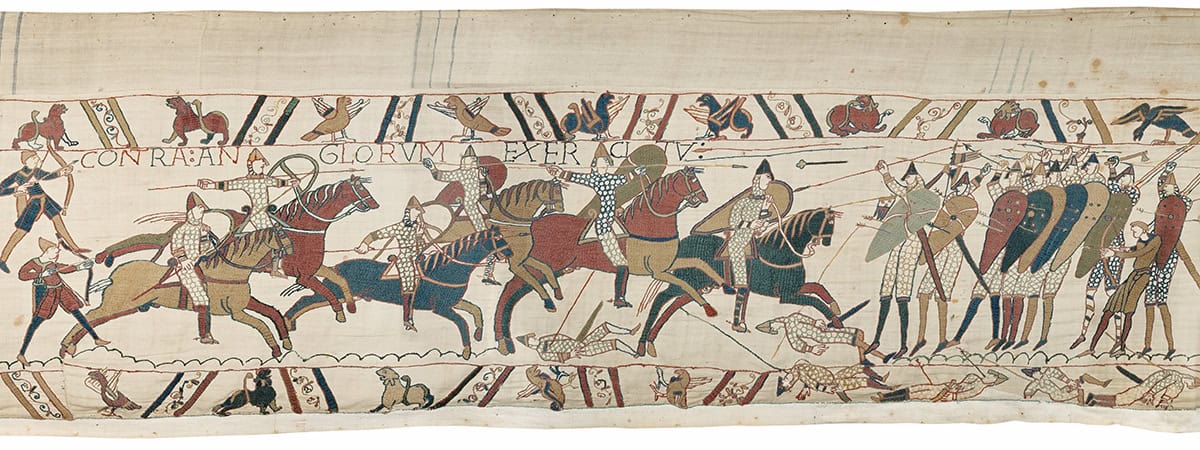
A few years ago, I was lucky enough to see the Bayeux Tapestry – the famous embroidered cloth depicting the Norman invasion of England in 1066. More than 900 years old, this historic piece of art is only 50 cm wide but more than 68 m long. It’s also extremely fragile, which why I was astonished when I heard that the Bayeux Tapestry was going to leave its home in Normandy and be transported across the English Channel to the UK.
I’m fascinated by how non-invasive optical techniques have been crucial in advancing our understanding of the tapestry
So what’s all this got to with physics? Well, I’m fascinated by how physics – and specifically, non-invasive optical techniques – have been crucial in advancing our understanding of the tapestry and its historical significance. Thanks to physics-based equipment developed by hi-tech manufacturers, we’ve learned about how the Bayeux Tapestry was initially made, what damage it subsequently suffered, how it was repaired, and the nature of its current condition.
Such information is vital not only for increasing our historical awareness, but also for current conservators who want to understand the tapestry’s underlying condition and find out how to preserve it for future generations. And before the pedants write in, yes I know that while it’s known as the Bayeux Tapestry, technically it’s an embroidery. That means it was created by stitching woollen threads onto a linen backing, which is helpful to know when reviewing the physics involved.
Optical sleuthing
The beauty of using optical methods to study the Bayeux Tapestry is that they are non-destructive and non-intrusive – and so can typically be applied in situ. In 2017 a three-year project was started, in which conservationists used high-resolution 2D imaging, photogrammetry, multimodal scanning and advanced image reconstruction techniques to determine the tapestry’s condition and conservation needs. The project revealed considerable information about how this artwork was created and modified over time.
Thanks to these high-resolution images, we now have a single digital map of the entire tapestry, making it possible to zoom in and look at individual threads. It’s yielded information such as the width of stitches and the positions where the wool threads cross the original linen background. As a result, historians now believe the tapestry was made by a single group of embroiderers, who – knowing the skills that existed at the time – were probably based in Canterbury, UK.
Techniques such as infrared spectroscopy and fluorescent and reflection ultraviolet imaging have revealed information about what’s underneath the surface of the tapestry
From the size and direction of the stitches, we also think the outlines of the figures were stitched first, with the shapes filled in afterwards using coloured wools in a strict, specific order. Meanwhile, techniques such as infrared spectroscopy and fluorescent and reflection ultraviolet imaging have revealed information about what’s underneath the surface of the tapestry. In particular, they’ve located the presence of stains such as glue, wax (dripped from candles that lit the tapestry) and even oil from the hands of people who touched it.
Infrared light passing through the dark-coloured wools have also revealed original sketch lines that were drawn on the linen base before the wool stitching started. It reveals the original artist’s draft, likely to be someone familiar with manuscript drawing – perhaps an illuminator of religious books.
Researchers in France, led by Stéphane Le Mouélic from Nantes University, who originally did a PhD in astrophysics, have also used computer software to combine more than 440 overlapping 2D photos taken from multiple angles to create a detailed 3D model of the Bayeux Tapestry (J. Cult. Heritage71 211).
It digitally “irons out” all the sags and wrinkles in the line fabric, recreating the original, “flat” tapestry and allowing the original physical shape of the artwork to be revealed for the first time. The 3D model can be viewed for free at the Bayeux Museum website, allowing historians, researchers and members of the public to study it without having to handle the delicate material.
Physics-based techniques have also allowed us to deal with the fact that parts of the fabric have been repaired over the last 900 plus years. Some of those repairs used non-authentic dyes and colours, while others covered up the original stitching. But using computer vision and image processing, threads that were added later can be subtracted digitally, providing a clearer, corrected view of what the original tapestry looked like.
Finally, optical tools can help keep the tapestry safe for future generations. Museum curators need to know if the cloth is sagging, tearing, or changing shape over time. Instead of putting heavy tools on the cloth, lasers can scan the cloth to accurately map of the contours of its surface. By repeating this exercise every few years, conservationists can spot if any part of the cloth has stretched or sagged, enabling minor problems to be rectified before they end up causing significant damage.
Without the huge amount of investigative and restorative work carried out, the Bayeux Tapestry would never have been allowed to make the journey to London
In 2025 Le Monde newspaper reported that experts had, over the previous five years, meticulously documented 24,204 stains, 9646 holes and 30 tears in the artwork. Without the huge amount of investigative and restorative work carried out, the Bayeux Tapestry would never have been allowed to make this year’s journey to London. Advanced and detailed optical measurement has “de-risked” the tapestry’s trip.

 Login

 A native Australian millet may carry the genetic fingerprints of thousands of years of Aboriginal harvesting, storage, and plant management. Seen from the air, Channel Country resembles a vibrant and vast tapestry, with a network of waterways crisscrossing the land. Spread across more than 280,000 square kilometers in outback Australia, it is one of the [...]