Private fusion companies have raised almost $4.5bn in funding over the past year – a 70% increase year-on-year. That is according to a report on the state of the fusion industry, which was published yesterday by the Fusion Industry Association (FIA). The report – The Global Fusion Industry in 2026 – also finds that private fusion endeavours now employ over 16,000 people worldwide.
Magnetic confinement, in which magnetic fields are used to contain a high-temperature plasma, is the most popular fusion technique, being used by 48% of firms according to the report. Inertial confinement, which uses rapid compression, usually by lasers, to create a confined plasma for a short period of time, is employed by 21% of firms – with other techniques such as magneto-inertial making up the remainder.
While electricity generation is a main target for private fusion companies, many also see the technology being applied to space propulsion, with other markets including marine propulsion, hydrogen fuel and industrial heat.
The funding boost for this year’s figures has come from major funding rounds, with CFS raising $863m in August 2025 while Inertia Enterprises, Helion Energy and Proxima Fusion have raised about $1.5bn in total this year.
Ambitious goals
The first FIA report on the fusion industry was published in 2021, where it found that private fusion endeavours had received over $1.8bn of funding since the 1990s.
The 2021 report discovered that over two-thirds of the 35 companies surveyed thought that electricity generated from fusion would enter the grid in the 2030s, with a further 20% thinking it would more likely come in later decades.
That confidence, however, has grown – with this year’s report finding that 71% expect the first fusion plant to deliver commercial electricity by the 2030s.
Indeed, FIA chief executive Andrew Holland says he is “confident” that commercial fusion will be delivered in the 2030s.
“Alongside private investment, fusion companies still need the support of governments to address common challenges including the availability of resilient materials and the fusion fuel cycle,” he says. “The governments that update their programmes and funding priorities to meet the sector’s needs today will be the ones to capitalize on this vital emerging industry.”
The report comes as General Fusion has become the first fusion company to be publicly listed. It joined the Nasdaq exchange with $150m in fresh funding, which is expected to go towards the firm’s Lawson tokamak programme that is expected to be complete in 2028.
It is one of the most extraordinary feats of military history – how the Carthaginian general Hannibal managed to cross the Alps with an army of 46,000 men, 7000 horses and 37 war elephants in 218 BCE.
Hannibal’s method was to catch the Romans by surprise by starting from what is present-day France and crossing the Alps into what is now northern Italy.
Yet the exact route that Hannibal’s army took remains a mystery and has been debated for decades given that no records by contemporary historians have survived.
The route crossing Col du Clapier – passing first through Grenoble and Aiton before descending into the Po Valley – appeared to be the likely candidate, but recent analysis has suggested an alternative southerly route via the Col de la Traversette.
Using route modelling and elevation data, the team found that the Col du Clapier route would have required 6.28 × 10¹² joules of energy, while Col de la Traversette, however, would have needed 5.42 × 10¹² J.
Yet even on that route, the 15-day crossing would have required 230 tonnes of food and supplies.
The authors calculate that the army would still have lost about a fifth of their body fat reserves during the crossing, which explains the high mortality rate among men.
Yet on the Col de la Traversette route, the war elephants would have fared better, losing just 4% of their reserves. This may explain why some 30 elephants are estimated to have made it through to fight in the Battle of the Trebia – the first major battle of the Second Punic War.
“The new analysis does not eliminate all ambiguity, but it does strengthen the case for the Traversette route by demonstrating that it would better accommodate the demands of moving a large army that included elephants through extremely difficult alpine terrain,” notes Berti.
A major astronomy facility in the Andes has begun a 10-year survey of the Southern sky with the aim of creating the most comprehensive, cinematic record of the universe ever made.
Based in Cerro Pachón in the Andes, the Vera C Rubin Observatory is named in honour of the US astronomer and dark-matter pioneer Vera Rubin.
The observatory is funded by the US National Science Foundation and the Department of Energy along with international partners including France and the UK.
Last year the observatory released its first images, featuring millions of galaxies and Milky Way stars and thousands of asteroids in exquisite detail. This was then followed by further commissioning work as well as an “operational readiness” review.
Now that is complete, the LSST has today begun its 10-year mission. It will now take a ultrawide, ultrahigh-definition picture of the southern night sky every 3–4 nights, replicating the process over a decade to produce almost 1000 full images of sky.
This will be used to plot the positions and measure the brightness of objects in the sky to help improve our understanding of dark matter and dark energy.
The survey will examine 20 billion galaxies as well as produce the most detailed star map of the Milky Way, imaging 17 billion stars and cataloguing some six million small objects within our solar system including asteroids.
When the LSST survey is complete, the final dataset will contain billions of objects with trillions of measurements, all accessible through regular data releases.
“It is amazing and humbling as we start the Legacy Survey of Space and Time, after more than two decades of incredible work by our dedicated team,” says Vera C Rubin Observatory director Bob Blum. “Rubin Observatory is for everyone; the LSST will change how we do astronomy and astrophysics, allowing researchers anywhere to participate in cutting-edge science.”
Officials at the CERN particle-physics lab near Geneva have turned off the Large Hadron Collider (LHC) for the last time. Over the coming four years, the accelerator complex will be upgraded to prepare for the High-Luminosity LHC (HiLumi LHC) that is set to start operations in 2030.
Taking decades to plan and construct, the LHC began circulating its first proton beams in September 2008 garnering attention from the world’s media. Yet days later the accelerator suffered an electrical fault that delayed first proton collisions for a year.
In the past decade, the LHC has also discovered more than 85 hadrons, put limits on the discovery of new particles, examined the imbalance between matter and antimatter and explored the nature of the quark–gluon plasma.
A new adventure
The LHC will now make way for HiLumi LHC that will increase the collider’s luminosity by a factor of up to ten. This will enable precision studies of the Higgs boson and enhance the potential to uncover phenomena beyond the Standard Model.
The shutdown will involve upgrading about 1.2 km of the 27 km ring by including 11-12 T superconducting magnets and superconducting “crab” cavities — that reduce the angle at which the bunches cross — to increase the number of collisions at the two detectors.
The ATLAS and CMS detectors will also be upgraded to cope with between 140 and 200 proton–proton collisions in every “bunch crossing”, compared to around 60 during the last LHC run.
German accelerator physicist Oliver Brüning, who is director for accelerators and technology at CERN, says that the LHC has “exceeded every expectation”.
“For nearly two decades, it has transformed our understanding of the universe and inspired generations of scientists, engineers and citizens around the world,” adds Brüning. “We say goodbye to the LHC as we have known it, while preparing to welcome its successor: the HiLumi LHC, which will extend this scientific adventure far into the future.”
The Nobel-prize-winning Belgian theoretical physicist François Englert, whose work led to the discovery of the Higgs boson, died on 18 June at the age of 93.
Englert’s studies, which he carried out in the early 1960s with his colleague Robert Brout, demonstrated that fundamental particles can acquire mass by interacting with a field that permeates the universe. The work set in motion a decades-long hunt for the Higgs boson, which was finally discovered at the CERN particle-physics lab near Geneva in 2012.
Born in Brussels, Belgium, on 6 November 1932, Englert studied electrical engineering at the Free University of Brussels (ULB) before switching to physics and completing a PhD at the university in 1959.
For two years he then worked at Cornell University before returning to ULB in 1961, where he remained for the rest of his career.
New particle
“Spontaneous symmetry breaking” is a well-known concept in condensed-matter physics where it had been used to explain how, for example, unordered regions of a magnetic material could suddenly align themselves in a specific direction.
In the early 1960s, the Japanese–American particle physicist Yoichiro Nambu adapted the phenomenon into quantum field theory.
Working at the ULB, Englert and Brout took inspiration from Nambu’s work and in 1964 the pair proposed that the weak and electromagnetic interactions could be united by spontaneous symmetry breaking.
Higgs, who independently came to the same conclusion as Brout and Englert, showed that the particles that carried the weak force acquired their mass through interactions with an all-pervasive field, now known as the Higgs field with the interactions occurring via the Higgs boson.
In 2012 at CERN’s Large Hadron Collider, physicists working on the LHC’s giant ATLAS and CMS detectors discovered the Higgs boson with a mass of about 125 GeV.
The following year, Englert shared half of the 2013 Nobel Prize in Physics with Higgs “for the theoretical discovery of a mechanism that contributes to our understanding of the origin of mass of subatomic particles, and which recently was confirmed through the discovery of the predicted fundamental particle, by the ATLAS and CMS experiments”.
Brout died in 2011 so was not given the Nobel prize as it is not awarded posthumously.
As well as the Nobel prize, Englert won many other awards including the Francqui Prize, awarded by the Francqui Foundation in 1982, the Wolf Prize in Physics (2004) and the American Physical Society J J Sakurai Prize (2010). In 2013, he was ennobled a baron by King Albert II of Belgium.
Particle physicist John Ellis from King’s College London, who has spent most of his career at CERN, told Physics World that he will remember Englert for his “his modest and polite demeanour, despite his evident and justified pride in his ground-breaking work”.
“His memory lives on as one of the founders of the Standard Model and an originator of one of its greatest puzzles, the Brout-Englert-Higgs mechanism for breaking symmetries and generating particle masses,” adds Ellis. “How long will it be before we understand this remarkable, yet crucial, aspect of Nature?”
Quantcore is a spin-out from the University of Glasgow and is based at the university’s Advanced Research Centre.
Quantcore builds the superconducting processors, resonators and sensors used in quantum computers and certain sensing systems. The firm uses niobium-based components, which can operate at higher temperatures than materials currently used in quantum computers. The firm recently received £2.5m in seed funding from several backers.
The qBIG award, now in its fourth year, is sponsored by the UK-based venture capital firm Quantum Exponential and includes a £10,000 cash prize as well as mentoring from Quantum Exponential and business support from the IOP. The award was presented yesterday in London at the Economist Commercialising Quantum 2026 event.
Accepting the prize on behalf of the company, Quantcore chief executive officer Jack Brennan says he is “delighted” to win the award.
“The previous winners are a great example of up-and-coming quantum companies, and it’s a privilege to be part of that list,” he says. “A huge thanks to the qBIG group for choosing Quantcore, and a huge thanks to my fantastic team for working so hard to build the company.”
Two runners up were commended by the IOP. One is Mater-AI, which develops thermoelectric materials for energy conversion and cooling. The other is Skydiamond, which produces lab-grown diamonds that can be used in quantum computing as a material for creating qubits.
“The UK quantum industry is going from strength to strength – and is becoming a major growth engine,” says Louis Barson, IOP’s director of science, business & education. “The qBIG prize is all about celebrating the strong pipeline of new physics-powered quantum innovators like Quantcore coming through – and giving them a platform to help accelerate that growth.”
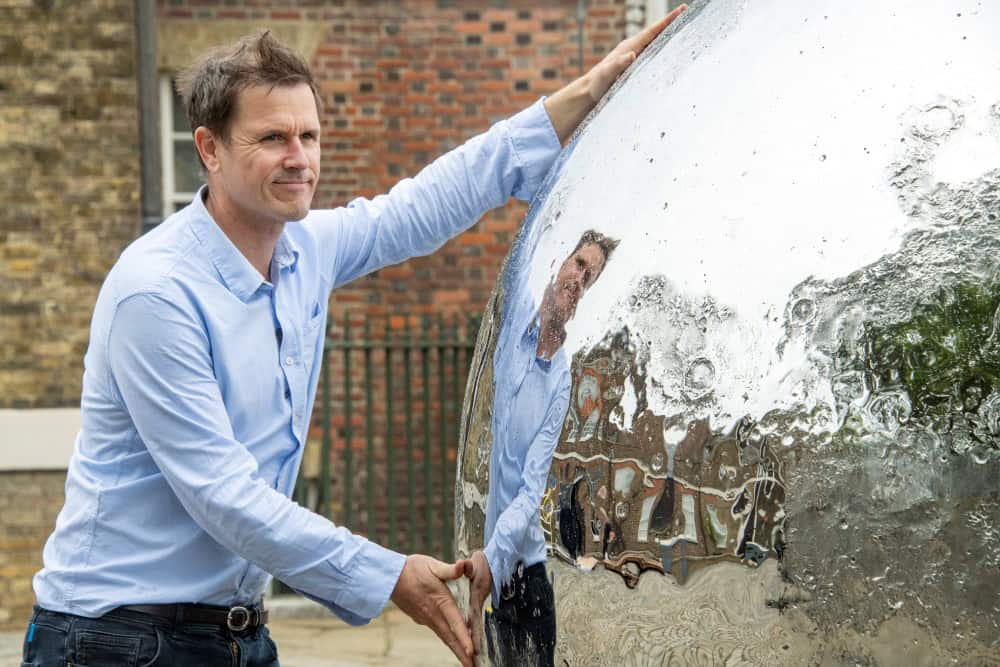
Dubbed Mirror Moon it has been created by British artist Luke Jerram and is open for public display today at the observatory.
The artwork is 2 m in diameter and is made of stainless steel. It uses accurate topographic data collected from NASA missions to map the features of the Moon onto the mirrored steel surface.
This includes craters, valleys, mountains and smooth lava fields as well as details from the heavily cratered far side of the Moon.
The installation opens as the NASA Artemis crewed missions foster a renewed interest in the Moon. A crewed lunar landing – Artemis IV – is currently set for 2028.
The Royal Observatory Greenwich is the home of Greenwich Mean Time and the Prime Meridian, and since its founding in 1675 astronomers have used the observatory to study the Moon.
Moonstruck: British artist Luke Jerram with Mirror Moon. (Courtesy: National Maritime Museum)
Jerram is best known for his large-scale public engagement artworks including Museum of the Moon and the Earth artwork Gaia, both of which have been displayed internationally.
Jerram says that the observatory has been an “inspiration” for his work as an artist.
“I hope Mirror Moon will inspire generations of visitors to have an interest in contemporary science, art and the wonder of the night’s sky,” he adds.
To mark the installation, Royal Museums Greenwich are selling 20 limited-edition mini versions of the artwork for £2000 each.
Each one is hand signed and numbered by Jerram and includes a presentation box, bespoke display stand and certificate of authenticity.
Researchers at the Polytechnic University of Hauts-de-France have used fractal mathematics to create a new non-invasive method that can distinguish genuine artworks from forgeries (Surf. Topogr.: Metrol. Prop. 14 025016).
Art forgery is a growing problem worldwide and traditional authentication of an artwork relies on expert opinion, historical research, pigment analysis and digital techniques.
While these approaches can be effective, they are also resource‑intensive and can sometimes still be inconclusive.
The new technique works by capturing the subtle patterns created by an artist’s brushwork – patterns so consistent that they act like a morphological signature unique to that particular artist.
By converting high-resolution images of the artwork into 3D‑like topological maps the researchers created a microscopic “texture” of a painting, measuring how rough or detailed the surface is using fractal dimensions – a mathematical ratio that measures how densely a fractal shape occupies space as it scales.
The fractal dimensions are calculated for the whole artwork as well as for selected homogeneous areas that are representative of brushwork.
“Fractal analysis gives us a measurable fingerprint of an artist’s brushwork without needing to sample or disturb the painting,” notes lead researcher Francois Berkmans.
The researchers tested the fractal method on works attributed to the Dutch painter Vincent van Gogh finding that the well‑documented fake The Plowmen was a strong outlier compared to other works while the recently authenticated Sunset at Montmajour aligned closely with Van Gogh’s known painting.
Using eight works for each artist, the approach also successfully separated the stylistic signatures of Van Gogh with that of the 17th‑century painter David Klöcker Ehrenstrah.
The researchers say that the technology can improve authentication, especially when combined with other techniques such as chemical analysis.
“This approach won’t replace traditional expertise, but it significantly strengthens it,” adds Berkmans. “Our results show that our technique can clearly point out genuine artists and reliable detect known forgeries.”
Fusion is usually performed via two types of plasma confinement. Magnetic involves using magnetic fields to hold stable a hydrogen plasma, while inertial confinement uses rapid compression, usually by lasers, to create a confined plasma for a short period of time.
In the late 1990s, scientists working on the TCV tokamak found that a certain plasma shape — dubbed negative triangularity – can help to keep the hot plasma stable and better contained.
The award-winning work build on the progress made in the decades since to show that such a configuration can lead to enhanced plasma confinement.
Indeed, the findings highlight how negative‑triangularity plasmas are no longer a niche idea but can work reliably, at high performance, and in reactor‑relevant conditions making them promising for real fusion power.
Stefano Coda from the Swiss Federal Technology Institute of Lausanne
Awarded each year, the PPCF prize aims to highlight work of the highest quality and impact published in the journal. The award was judged on originality, scientific quality and impact as well as being based on community nominations and publication metrics.
The journal is now seeking nominations for next year’s prize, which will focus on papers in the following areas: foundational and discovery plasma physics; astrophysical, space and ionospheric plasmas; laboratory astrophysics, high energy density physics; low temperature, dusty and industrial plasmas, and inertial fusion.
Below, Coda talks to Physics World about prize, the importance of recognition and what advice he has for early-career researchers.
What does winning the 2026 PPCF Outstanding Paper Prize mean to you?
This prize is especially meaningful as it recognizes a line of research that has long been associated with our facility TCV but has taken decades to enter the mainstream. Negative triangularity is now considered a realistic option for a fusion power plant. The success of this paper confirms our group’s longstanding and continuing leadership in this effort.
How important is it that researchers receive recognition for their work?
Recognition takes several different forms. It begins with the simple act of acceptance of a publication through the peer-review process. The broader recognition that comes from downloads, citations, and ultimately the propagation of a scientific idea – the replication of an experiment, the application of a theory, a practical implementation of a conceptual notion – is the engine that keeps propelling science forward by giving it visibility and credibility. Researchers are driven primarily by curiosity and the desire to contribute new knowledge, so recognition is most meaningful when it reflects genuine scientific impact. Prizes and awards are then the cherry on the cake!
What advice would you give to early-career researchers looking to pursue a career in plasma physics?
Do not lose sight of the beauty of the science. Plasma physics is enormously complex, full of unsolved mysteries, and yet still rooted largely in classical physics. It is an exceptionally exciting time for the field with applications ranging from manufacturing to biology, and above all nuclear fusion, whose tantalising promise of abundant clean energy is driving tremendous momentum in both the public and private sectors. But whatever direction you choose, it will be rewarding if you keep your eye on the beauty of the science.
Astronomer Jessica Dempseyhas become director-general of the Square Kilometre Array Observatory (SKAO), which will be the world’s largest and most sensitive radio telescope when it opens next year. Dempsey will now serve a five-year term as director-general and succeeds Philip Diamond, who held the role since 2012.
Three decades in the making, the SKAO is based in South Africa and Australia and consists of 197 dishes and 131 072 antennas to study how galaxies form, the nature of dark matter, and whether life exists on other planets.
The Australian side, known as SKA-Low, will focus on low-frequency obervations, while South Africa’s SKA-Mid will observe mid-range frequencies.
The headquarters of the organization is based in the UK at Jodrell Bank and SKAO has 13 full members, which includes China, Germany and India.
From film star to the stars
Dempsey studied both astrophysics and theatre and film science as an undergraduate at the University of New South Wales before becoming an actor in the late 1990s.
Dempsey then did a PhD in astronomy at UNSW, graduating in 2007 before working at the James Clerk Maxwell Telescope at Mauna Kea Observatory in Hawaii, becoming operations manager in 2012 and then deputy director of the telescope in 2016.
In 2022 Dempsey became director of the Netherlands Institute for Radio Astronomy and throughout her career has championed more equitable opportunity and experience for women and all underrepresented individuals in science, in 2023 becoming professor of ethics in astronomy at Radboud University.
Dempsey says it is “humbling” to lead the organization and is “passionately dedicated” to its success.
SKAO is currently preparing for the start of “science verification”, in which astronomers will gain access to the first SKAO data. This is due to begin for the SKA-Low telescope in Australia in the second half of 2027.
“As someone who loves nothing more than building and running telescopes, there is not a better time to be asked to take up this role – we are just getting to the cool stuff,” adds Dempsey. “This is a daring project, unprecedented in scale and scope, and it will need the skills of every single team member on three continents and all the support of our broad global partnership to see it come to light.”
Diamond, meanwhile, noted that the observatory is in “very good hands” with Dempsey’s appointment.
“This is a demanding role, with the need to balance scientific, political, diplomatic, financial and many other considerations,” adds Diamond. “I have full faith in [Dempsey’s] ability to lead this extraordinary organization through its next chapter.”
With a PhD in nuclear physics, Paul Howarth has had a long career in the nuclear sector, working on the European Fusion Programme and at British Nuclear Fuels, as well as co-founding the Dalton Nuclear Institute at the University of Manchester. He was a non-executive board director of the National Physical Laboratory and served as chief executive officer of the National Nuclear Laboratory.
Howarth became president-elect of the Institute of Physics (IOP) in September 2025. In February he became IOP president after space physicist Michele Dougherty stepped aside from the role to avoid any conflicts of interest given her position as executive chair of the Science and Technology Facilities Council. Howarth is set to be IOP president until 2029. Physics World recently caught up with Howarth to find out more about his career and vision for physics.
What originally sparked your interest in physics?
I think it probably came from my father. He was a research chemist. We lived in Cheshire near the Jodrell Bank Observatory and its iconic Lovell Telescope. I was fascinated by that and it captivated my interest in astronomy and so I did a degree in physics and astrophysics at the University of Birmingham.
You stayed at Birmingham to do a PhD in nuclear fusion. What attracted you to that field?
It goes back to my interest in astronomy and the ability to use mathematics to describe the universe. Yet by the end of the degree, I was fascinated by nuclear fusion as an energy source and a sustainable means of clean energy for society. During my PhD, I got to work on the JET tokamak in Oxfordshire, which was wonderful. It was when JET was doing its first deuterium-tritium plasma shot, which was an exciting time.
After your PhD, you worked for British Nuclear Fuels. Why did you make that move and what appealed about the commercial side of physics?
In the 1990s there was quite a bit of uncertainty about the direction of nuclear fusion, but I’d always been fascinated by the huge monolith structures of nuclear power stations. So I didn’t hesitate when an opportunity arose to work at Sellafield – a huge site in north-west England with more than 200 nuclear facilities – on understanding the physics of plutonium.
You then served as chief executive officer of the UK’s National Nuclear Laboratory. How did that come about?
At British Nuclear Fuels I was working to build the case for the next generation of nuclear power plants. But in the early 2000s it was less clear that nuclear was going to be part of the UK’s energy policy. So British Nuclear Fuels was broken up into organizations such as the Nuclear Decommissioning Authority. But I was determined to continue to make the case for new nuclear build and ended up helping the UK government create a National Nuclear Laboratory to maintain sovereign nuclear capability, becoming chief executive officer in 2011.
What did that role involve?
We had contracts to support all aspects of the UK’s nuclear programme as well as build the case for future nuclear. We worked on the front end of the fuel cycle, on reactor technology, on future reactors, on legacy waste management and decommissioning. I had the responsibility for running about £2–3bn of critical nuclear real estate and infrastructure.
Many countries, not just the UK, are showing a renewed enthusiasm for nuclear – what do you attribute that to?
Yes, it’s a fascinating time for nuclear. I think things are heading now towards small modular reactors and advanced reactor systems. Larger nuclear plants are more efficient but it is possible to trade that off for smaller plants. This opens up the opportunity for others to potentially invest in nuclear. So we see, for example, individuals like Bill Gates and others who are looking at nuclear power.
That’s the challenge – to effectively support all aspects of physics. I don’t want to be in a position where we are pitching one area against another
Paul Howarth
Do you see parallels with the fusion industry and how that has grown in the past decade?
Absolutely. I think a very similar thing has happened. Of course, there’s still the engineering challenges associated with scaling up fusion but good progress is being made. And other players and entities, like Tokamak Energy and First Light Fusion, are looking at entering the market, which is great.
Having retired from the NNL in 2025, what drew you to the role of IOP president?
It was the opportunity to give something back to physics. Physics is such an important discipline that is needed across all aspects of society and through my time working in physics, I’ve seen the benefits that it brings.
What things excite you as you take up this position?
When we look across society, the impact that physics is having is massive – whether that is in data centres, artificial intelligence, net zero, medicine or even food supplies. One of the things I would like to achieve during my presidency is to qualify and quantify that impact. The role that physics can play is going to be fascinating and to be part of that journey is exciting.
What are your priorities as president?
One is to nudge the dial on getting physics recognized in society as a really valuable and important discipline. This includes making sure that schools are properly equipped and resourced for teaching physics as well as having more teachers with a physics background. This would then hopefully translate into more people studying the subject at A-level and degree level.
Machine learning The IOP’s Physics and AI Impact Pathfinder report highlighted the role of physics as both enabler and beneficiary of AI. (Courtesy: iStock/metamorworks)
Yes, it’s a challenging time at the moment. We’ve been working hard to ensure that the impact is properly assessed and that we are doing what we can to champion and support some of these critical disciplines in physics. I can understand the direction of travel from UKRI, which is the importance that the investment underpins and supports economic growth. And there are some key critical disciplines such as quantum computing, autonomous system robotics and fusion that continue to be supported and where funding has actually increased. But what we are concerned about is the potential adverse or detrimental effects of a reprioritization that may move funding away from some critical areas in physics, such as particle physics, astronomy and nuclear physics. That is a concern because they are fundamentally important disciplines.
Could there be an impact on people wanting to go into these areas?
What I worry about is the negative impact on university physics departments that work in those areas. It’s also those areas of physics that really captivate people to study the subject. But there is a knock-on effect on other areas too because many people who study physics go into engineering, which is crucial for other industry sectors – whether it’s around detectors, data systems, data acquisition, electronics, power systems, automotive, aerospace, defence or nuclear energy. So I worry that the reprioritization is not properly assessing the impact and the benefit the subjects have.
How is the IOP tackling this issue?
We need to ensure that we fight the case for those areas of physics, because they are so important. We need to find a path that ensures we maintain these critical areas but also ensure that investment is being made to support economic growth as a whole.
How do you strike that balance between being vocal about the cuts, but also needing to support emerging areas of physics?
I think that’s the challenge – to effectively support all aspects of physics. I don’t want to be in a position where we are pitching one area against another. It’s the totality of the capability, and that’s all aspects of physics and the interrelationship between those disciplines too. We should celebrate where there is growth in new and exciting areas. But equally, we must protect those areas that are fundamental pillars of physics.
Are there any opportunities even in this difficult situation?
As we continue to engage government and other stakeholders on these funding changes, there is an opportunity to define physics’ impact as a benefit to society as well as big opportunities for science-driven growth arising from increased investment in key areas. I believe that a developed nation like the UK, which has a very good international standing, should continue to invest in all aspects of the discipline.
What other challenges lie ahead?
It is really important that we remain an inclusive discipline and we also need to get our heads around the impact of AI on physics. The IOP has already done some work with the community in this area with the Physics and AI Impact Pathfinder report, which highlighted the role of physics as both enabler and beneficiary of AI, and also explored the discipline-specific views physicists hold regarding AI in science and society. I am interested in us understanding more about what AI means for physics and being a physicist, how we embed AI in the training of physicists so physicists can use it and become better physicists. I would be keen for the IOP to carry out more work to understand the impact it’s clearly going to have.
How do you see the subject evolving over the coming decade?
I think that society is embracing what science and technology, and in particular physics, can do. We need to help ensure that the next generation of physicists are being appropriately trained to become good physicists. In fundamental physics, there are some fascinating things developing like bringing together cosmology and quantum physics, understanding quantum gravity, the nature of time and what’s happening down at the particle physics level. It feels as if something’s coming together. I’d love to be around when physics can finally pull all of that together and go “we’ve got it – the light bulb’s gone on”.
John Hill has become director of the Brookhaven National Laboratory in Long Island, New York, after serving as interim lab director since September. Hill will now oversee Brookhaven’s 3000-strong team of scientists, engineers and technicians as well as manage the lab’s annual $900m budget.
Brookhaven opened in 1947 as one of the first three US national labs, the others being Argonne and Oak Ridge. Brookhaven carries out a wide range of research in the physical, biomedical and environmental sciences and is home to seven Nobel-prize-winning discoveries.
Brookhaven operated the Relativistic Heavy Ion Collider (RHIC) until it shut down in February. RHIC collided heavy nuclei such as gold and copper to produce a quark-gluon plasma – a state of matter thought to have been present in the very early universe.
In 2020, Brookhaven was chosen to host the next-generation Electron-Ion Collider (EIC). Costing about $2bn, the EIC will smash together electrons and protons to probe the strong nuclear force and the role of gluons in nucleons and nuclei.
Building the EIC involves revamping the RHIC accelerator as well as adding an electron ring and other components with the first experiments starting the 2030s.
As well as RHIC and the EIC, Brookhaven is also home to other big-science projects including the National Synchrotron Light Source II, which opened in 2015 at a cost of $912m.
A Brookhaven career
With a PhD in physics from the Massachusetts Institute of Technology, Hill joined Brookhaven as a postdoc in 1992 before leading the lab’s X-ray scattering group from 2001 to 2013.
He then became deputy associate laboratory director for energy and photon sciences until becoming the lab’s deputy director for science and technology from 2023 to 2025.
In September 2025 he became interim director following the resignation of the theoretical physicist JoAnne Hewitt.
In the role, Hill will also become president of Brookhaven Science Associates – a partnership between Stony Brook University and the science and tech firm Battelle – that manage and operate Brookhaven on behalf of the US Department of Energy.
Hill notes that he is “very excited” to lead the lab in the coming years. “Brookhaven is entering a defining decade, and I’m honoured to take on this role at this time,” he says. “The vision we have for our future is a powerful one, including delivering the nation’s next particle collider and advancing science across a range of critical areas.”

 Login