
❌

Normal view

Demon in the AI machine: bias, bad data and the burden of proof

30 September 2026 at 14:30

Picture a room where every photon bouncing off a doorbell camera, every acoustic reflection captured by a passing delivery drone, and every drop of ambient thermal noise is fed directly into a Bayesian inference engine. This is the courtroom depicted in director Timur Bekmambetov’s 2026 film Mercy, which delves deep into the murky boundary between artificial intelligence (AI) and human behaviour.

Set in 2029, the film features Los Angeles police detective Chris Raven, who is also the defendant, played with an increasingly desperate, sweat-soaked intensity by Chris Pratt (Jurassic World, Guardians of the Galaxy). He is starting his trial at a staggering 97.5% probability of guilt.

The judge sitting across from him isn’t a human in robes, but an AI avatar named Judge Maddox, brought to life with icy, terrifying calm by Rebecca Ferguson (Silo, Dune). Raven has precisely 90 minutes to look into the municipal network, cross-reference any telecommunication data recorded by the system, and drive that probability score down below 92%, or a focused acoustic shockwave will end his life by rupturing his internal organs on the spot.

Mercy has not filled critics with delight (it got a score of just 24% on the Rotten Tomatoes “Tomatometer”) but audiences are finding much to enjoy in it (81% on the Rotten Tomatoes “Popcornmeter”). Beneath the reasonably compelling visuals and a home-movie-night-worthy whodunnit lies a fascinating (and possibly accidental) masterclass in the limits of computational physics.

The premise of the “Mercy Capital Court” rests entirely on a classic piece of scientific hubris: the concept of “Laplace’s Demon”. The concept dates back to 1814, when French mathematician Pierre-Simon Laplace postulated that if an intellect knew the exact position and momentum of every atom in the universe, it could calculate the past and future with absolute certainty. Judge Maddox is Hollywood’s latest incarnation of that demon, vacuuming up petabytes of data from the urban landscape under the assumption that total observation inevitably yields objective truth.

As the film unfolds within its high-stress 90-minute limit, reality asserts itself through the unavoidable laws of measurement and noise. The court treats its data streams as pure, classical bits; but the reality is that the physical world generating those feeds is still fundamentally chaotic. A camera feed misses a vital angle because of atmospheric diffraction; a digital packet drops over a high-latency mesh network; and a corrupted timestamp introduces entropy into the dataset.

Ferguson’s AI character acts less like an objective judge and more like the ultimate “black box” algorithm: impenetrable, unyielding and bound by the feedback loops of its own training data. This is not just cinematic exaggeration but mirrors the real-world crisis of predictive risk-assessment tools like COMPAS.

Used across American bail and sentencing hearings, COMPAS was famously exposed for generating disproportionately high risk scores for Black defendants, regardless of actual reoffending rates. It was a stark lesson in how automated systems codify historical bias under the guise of neutral maths. So when Pratt’s character desperately feeds fresh evidence into the system to shift his 97.5% guilt probability, he too is fighting a version of algorithmic bias. This is a feedback loop where an initial prediction, once generated by a closed-source formula, becomes nearly impossible for a human to contest.

The absurdity of the courtroom’s execution chair – where a single computational calculation yields an instantaneous, violent sentence – amplifies the real-world stakes of automated misidentification. In recent years, away from the cinema screen, law-enforcement reliance on automated tools, particularly facial-recognition software, has already led to disastrous false arrests.

With innocent citizens including Robert Williams and Christopher Gatlin being jailed for crimes they didn’t commit due to faulty algorithm matches, we have already seen what happens when police and courts outsource critical human judgement to automated systems with known failure rates. Mercy takes this terrifying precedent to its absolute extreme, demonstrating what happens when we strip away human discretion, constitutional due process, and the right to meaningful cross-examination in favour of algorithmic convenience.

Ultimately, the film succeeds as both a relentless, clock-ticking thriller and a thought-provoking slice of near future paranoia. Bekmambetov’s direction keeps the 2029 world feeling real enough to suspend disbelief, while Ferguson provides a wonderfully nuanced counterweight to Pratt’s frantic energy.

More than anything, the film serves as a stark reminder that no matter how much data we feed an AI, an algorithm cannot understand context, empathy or justice. As AI continues to creep into real-world courtrooms, the film’s message is clear: substituting automated probability for human reason doesn’t remove human bias, it merely automates it.

  • 2026 Amazon MGM Studios 1 hr 41 min

The post Demon in the AI machine: bias, bad data and the burden of proof appeared first on Physics World.
Belarusian sculptor unveils artwork honouring US physicist Jim Gates

16 September 2026 at 15:30

Belarusian sculptor Pavel Wilimaytis has created a portrait of the theoretical physicist Jim Gates who is based at the University of Maryland and Brown University.

Gates is best known for his work on supersymmetry and superstring theory as well as the connections between quantum physics and information theory. He is also known for his outreach in particular the PBS series The Elegant Universe.

Wilimaytis, who has been living in Saint-Jorioz in France for the past three years, has a hearing impairment and chooses people to sculpt based on the “human presence in their faces”.

“For the first eight years of his life, Pavel perceived the world outside of language,” Wilimaytis’ mother Natallia told Physics World. “Before he learned to understand words, he already knew how to feel people: their warmth and coldness, light and shadow, pain, tension, kindness or inner closedness. Not what a person says about themselves, but what emanates from them before any words.”

Wilimaytis noticed photos of Gates online and was struck by the physicist’s “warmth, openness and distinctive charisma”.

“There is the quiet generosity of a scientists and teacher known for his exceptional ability to open the world of knowledge to others,” notes Wilimaytis.

The portrait of Gates, standing around 30 cm tall, was first modelled in plasticine and then cast in Acrystal – a water-based mineral composite material.

The sculpture forms part of Pavel’s sculptural series devoted to figures in science and culture. The series – “The lesser-known faces of famous people” – also includes Nikola Tesla, Marie Curie and Erwin Schrödinger.

In an e-mail to Natallia, Gates noted that he was “absolutely delighted” by the sculpture.

The post Belarusian sculptor unveils artwork honouring US physicist Jim Gates appeared first on Physics World.

Beyond the data: art meets climate at the edge of the world

26 June 2026 at 15:00

“The most beautiful thing we can experience is the mysterious,” wrote Albert Einstein. “It is the source of all true art and science.” It is a reminder that wonder – particularly in the natural world – lies at the heart of both disciplines. When it comes to an issue as multifaceted and emotive as climate change, it feels only natural to turn to art as well as science to make sense of what is happening around us.

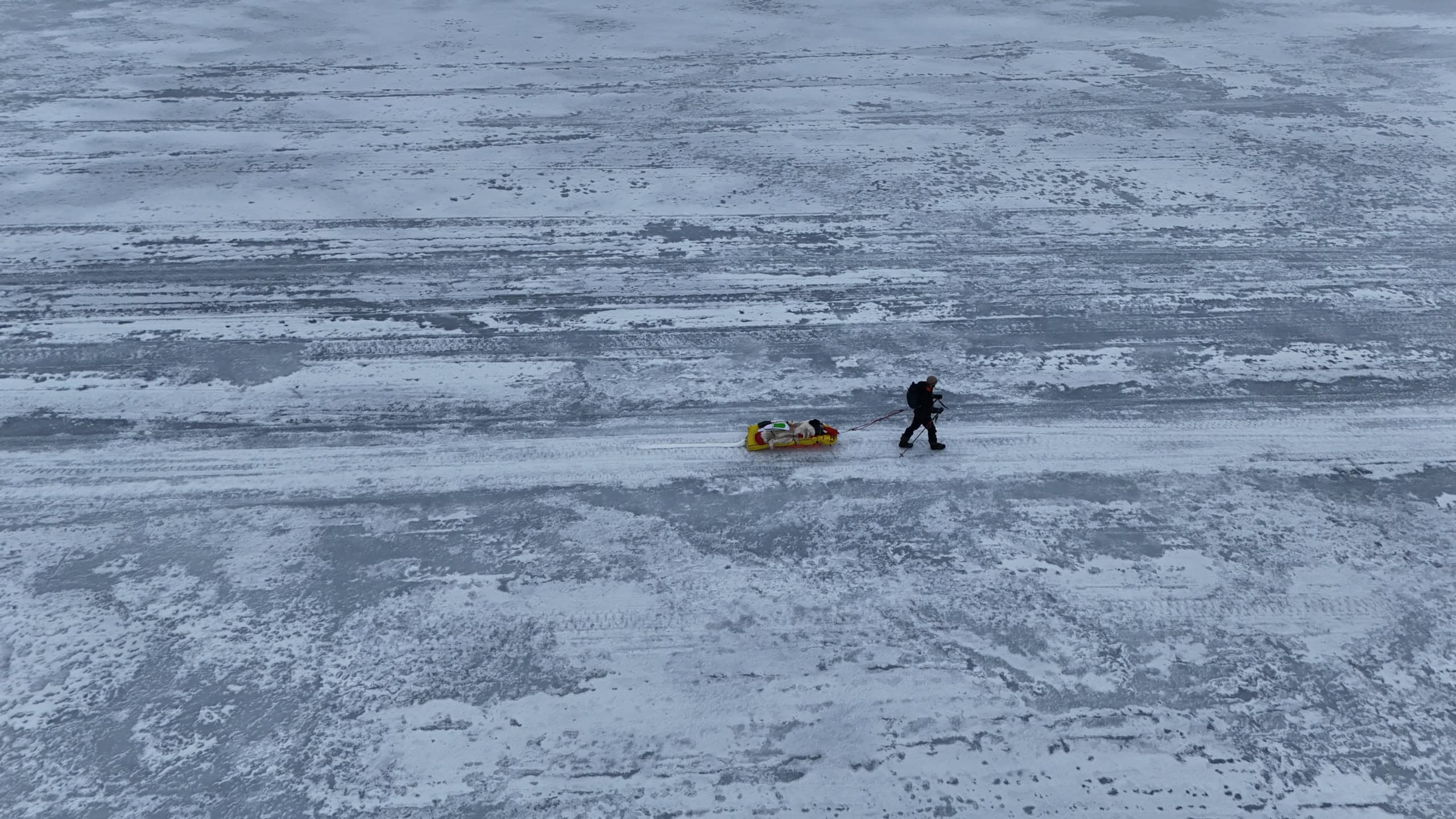
The latest episode of Physics World Stories brings together two artists doing exactly that. Host Andrew Glester speaks first with Tom Bailey, a performance and environmental artist from Bristol-based creative company Mechanimal. Bailey has recently returned from an extraordinary 600 kilometre journey through the Arctic borderlands — spanning Norway, Finland and Sweden — travelling by ski, sledge, foot and boat, and occasionally dressed as a reindeer.

Drone shot of artist Tom Bailey pulling a sled along an ice sheet in the Arctic
Arctic art Tom Bailey on his 600 km climate journey and performance tour in the Arctic borderlands. (Courtesy: Tom Bailey and Natasha Soonchild)

Travelling between festival performances, Bailey immersed himself in a region undergoing dramatic change: shifting weather patterns, transforming landscapes, and growing international interest in its mineral resources, raising urgent questions about governance and access. Central to his vision is a “more-than-human” perspective, advocating for nature to have formal representation in international decision-making, not merely as a resource to be managed, but as a presence with its own legitimate interests.

A climate video game with beautiful music

Composer Naomi Hart approaches the crisis from a different angle. After a conversation with her daughter about fears for the future left her saddened but resolute, she channelled that emotion into Save Progress – a short video game exploring how human connection can help us to think about the world and the choices ahead. In the podcast, Hart talks about her creative choices; the game combines an intentionally old-school design with specially composed synthesizer music. Save Progress takes around 10 minutes to play: give it a try.

  • To keep track of how physicists are investigating climate change and developing solutions, visit the Environment and Energy section of the Physics World website.

The post Beyond the data: art meets climate at the edge of the world appeared first on Physics World.

💾

Stunning Moon sculpture unveiled at Royal Observatory Greenwich

12 June 2026 at 12:15

A spectacular new lunar art installation has been installed at the Royal Observatory Greenwich.

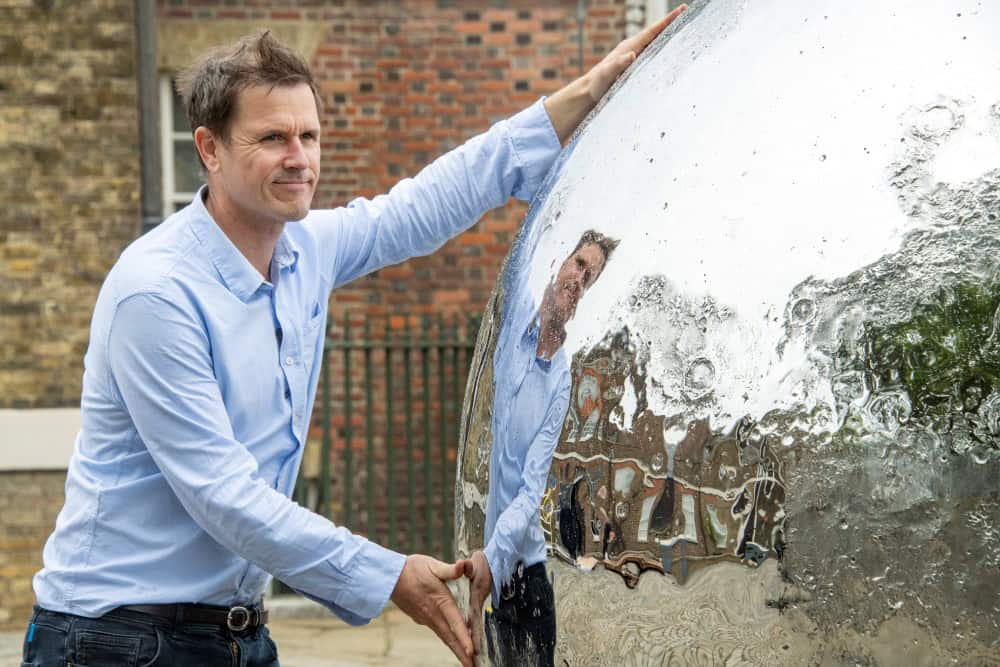
Dubbed Mirror Moon it has been created by British artist Luke Jerram and is open for public display today at the observatory.

The artwork is 2 m in diameter and is made of stainless steel. It uses accurate topographic data collected from NASA missions to map the features of the Moon onto the mirrored steel surface.

This includes craters, valleys, mountains and smooth lava fields as well as details from the heavily cratered far side of the Moon.

The installation opens as the NASA Artemis crewed missions foster a renewed interest in the Moon. A crewed lunar landing – Artemis IV – is currently set for 2028.

The Royal Observatory Greenwich is the home of Greenwich Mean Time and the Prime Meridian, and since its founding in 1675 astronomers have used the observatory to study the Moon.

Luke Jerram with Mirror Moon
Moonstruck: British artist Luke Jerram with Mirror Moon. (Courtesy: National Maritime Museum)

Jerram is best known for his large-scale public engagement artworks including Museum of the Moon and the Earth artwork Gaia, both of which have been displayed internationally.

Jerram says that the observatory has been an “inspiration” for his work as an artist.

“I hope Mirror Moon will inspire generations of visitors to have an interest in contemporary science, art and the wonder of the night’s sky,” he adds.

To mark the installation, Royal Museums Greenwich are selling 20 limited-edition mini versions of the artwork for £2000 each.

Each one is hand signed and numbered by Jerram and includes a presentation box, bespoke display stand and certificate of authenticity.

The post Stunning Moon sculpture unveiled at Royal Observatory Greenwich appeared first on Physics World.

Fractal maths helps distinguish genuine artworks from forgeries

11 June 2026 at 09:00

Researchers at the Polytechnic University of Hauts-de-France have used fractal mathematics to create a new non-invasive method that can distinguish genuine artworks from forgeries (Surf. Topogr.: Metrol. Prop. 14 025016).

Art forgery is a growing problem worldwide and traditional authentication of an artwork relies on expert opinion, historical research, pigment analysis and digital techniques.

While these approaches can be effective, they are also resource‑intensive and can sometimes still be inconclusive.

The new technique works by capturing the subtle patterns created by an artist’s brushwork – patterns so consistent that they act like a morphological signature unique to that particular artist.

By converting high-resolution images of the artwork into 3D‑like topological maps the researchers created a microscopic “texture” of a painting, measuring how rough or detailed the surface is using fractal dimensions – a mathematical ratio that measures how densely a fractal shape occupies space as it scales.

The fractal dimensions are calculated for the whole artwork as well as for selected homogeneous areas that are representative of brushwork.

“Fractal analysis gives us a measurable fingerprint of an artist’s brushwork without needing to sample or disturb the painting,” notes lead researcher Francois Berkmans.

The researchers tested the fractal method on works attributed to the Dutch painter Vincent van Gogh finding that the well‑documented fake The Plowmen was a strong outlier compared to other works while the recently authenticated Sunset at Montmajour aligned closely with Van Gogh’s known painting.

Using eight works for each artist, the approach also successfully separated the stylistic signatures of Van Gogh with that of the 17th‑century painter David Klöcker Ehrenstrah.

The researchers say that the technology can improve authentication, especially when combined with other techniques such as chemical analysis.

“This approach won’t replace traditional expertise, but it significantly strengthens it,” adds Berkmans. “Our results show that our technique can clearly point out genuine artists and reliable detect known forgeries.”

The post Fractal maths helps distinguish genuine artworks from forgeries appeared first on Physics World.

❌