❌

Normal view

An Enhanced Formation Channel for Galactic Dual-Line Gravitational-Wave Sources: von Zeipel–Lidov–Kozai Effect in Triples Involving Sgr A*

24 July 2026 at 17:00
Wen-Fan Feng et al 2026 ApJL 1003 L35
According to calculations, in a 4-year period researchers may detect of order one compact binary system in which the binary’s inspiral and the spin of its neutron star component both produce gravitational waves.

The post An Enhanced Formation Channel for Galactic Dual-Line Gravitational-Wave Sources: von Zeipel–Lidov–Kozai Effect in Triples Involving Sgr A* appeared first on AAS Nova.

Trajectory-Agnostic Asteroid Detection in TESS with Deep Learning

23 July 2026 at 17:00
Brian P. Powell et al 2026 AJ 172 14
Unlike traditional “shift and stack” algorithms, a newly developed asteroid-detection method requires no assumptions on speed or direction; this method can be applied to upcoming time-domain surveys.

The post Trajectory-Agnostic Asteroid Detection in TESS with Deep Learning appeared first on AAS Nova.

Researchers Spot Hydrocarbons Surprisingly Close to a Quasar Pair

22 July 2026 at 17:00

J0749+2255

Researchers have detected molecules containing rings and chains of carbon atoms in the vicinity of a rare pair of quasars. The trends in the distribution of these molecules are unexpected, suggesting that more work is needed to understand the conditions surrounding active supermassive black holes.

Infrared Eyes on Molecules in Space

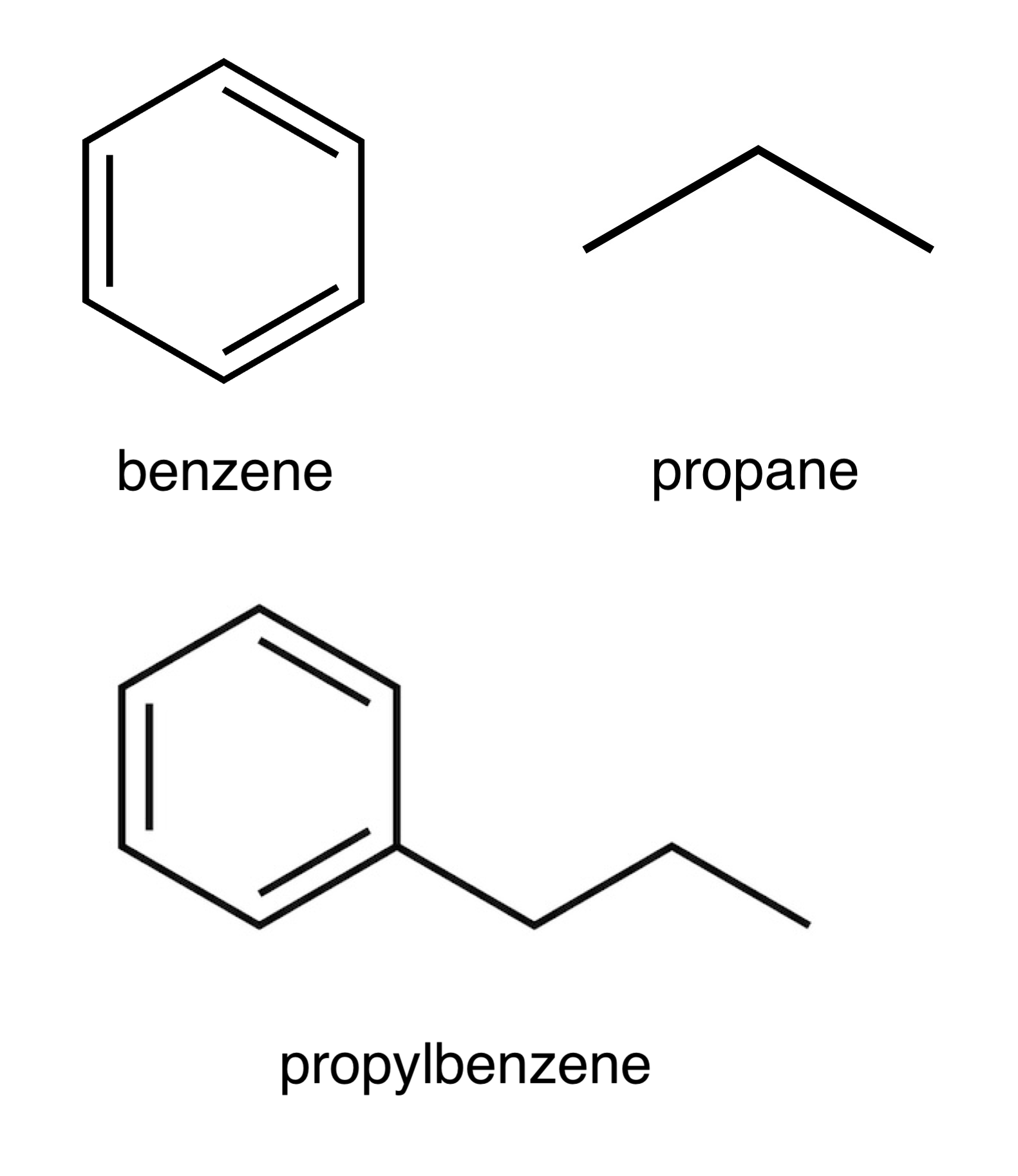
skeletal formulae of aromatic and aliphatic molecules

Examples of aromatic and aliphatic hydrocarbons. Benzene (top left) is the simplest aromatic molecule. Propane (top right) is a simple aliphatic molecule. Propylbenzene (bottom) is an aromatic molecule with an aliphatic chain branching off of it. In these “skeletal” formulae, there is a carbon atom at each vertex, and the remaining atoms (not depicted) are all hydrogens. Single lines indicate single chemical bonds, and double lines indicate double bonds. [Wikipedia; Public Domain]

Across the universe, atoms are combining to form molecules, and our ability to study molecules in distant realms has never been better. JWST is particularly attuned to emissions from molecules engaged in a kind of chemical yoga, stretching their bonds and flexing the angles between their atoms.

JWST’s sensitive infrared eyes have allowed researchers to study the distribution, creation, and destruction of both aromatic (containing one or more rings of carbon atoms in which certain electrons spread out within the ring) and aliphatic (containing chains of carbon atoms) hydrocarbons. These molecules have been spotted in a wide array of environments, and now, astronomers are finding them in more distant and more extreme environments than ever before.

Distant Discovery

SDSS J074922.96+225511.7, or J0749+2255 for short, is a quasar pair seen 3 billion years after the Big Bang. The two feasting supermassive black holes are roughly 12,000 light-years apart, giving researchers a glimpse into the late stages of a galaxy merger and a harsh environment in which to study the survival and destruction of molecules.

Researchers studying J0749+2255 with JWST have previously reported the detection of a 3.3-μm emission feature from aromatic molecules. Now, C. E. Mentzer (University of Missouri), Aigen Li (University of Missouri), and Xuejuan Yang (Xiangtan University) have analyzed JWST spectra of J0749+2255 and found not just widespread aromatic emission at a rest-frame wavelength of 3.3 μm, but also aliphatic emission at 3.4 μm, which they attribute to carbon chains branching off from the aromatic molecules. This likely makes J0749+2255 the most distant galaxy in which both aromatic and aliphatic emission has been detected.

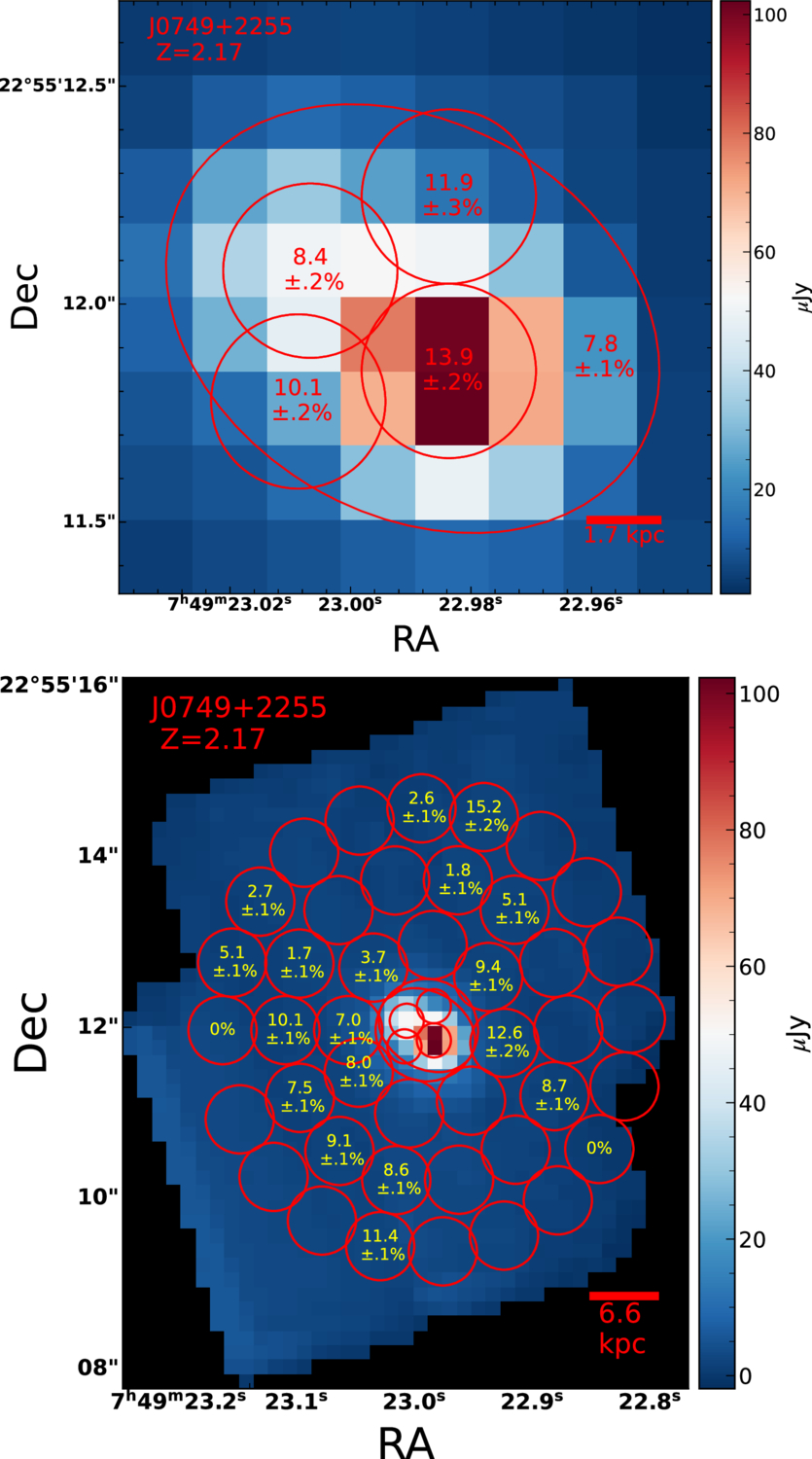
analysis results showing the aliphatic fraction across the quasars and the surrounding region

Aliphatic fractions in the bright central region surrounding the two quasars (top) and in the outer regions (bottom). [Mentzer et al. 2026]

Unexpected Trends

Mentzer, Li, and Yang subdivided the observations into 47 regions and measured the strength of the 3.3- and 3.4-μm features in each region. This analysis found strong aromatic emission nearest the quasars and showed that the fraction of carbon atoms bound up in aliphatic chains is highest close to the quasars.

Both of these findings are unexpected: the harsh radiation environment near the two active black holes is thought to break apart chains of carbon atoms attached to aromatic rings (which should decrease the 3.4-μm emission) and possibly destroy small aromatic molecules (which should decrease the 3.3-μm emission) — yet both of these features are strongest near the quasar cores where the radiation should be most capable of molecular destruction.

The authors speculated that the analysis regions centered on the quasars are large enough that they contain gas that hasn’t been pummeled by the quasars’ intense radiation and outflows, leaving molecules intact and able to produce the observed emission. However, this doesn’t explain the trend of stronger 3.3- and 3.4-μm emission closer to the quasars — necessitating further research into the emitting behavior of aromatic and aliphatic molecules under the extreme conditions of a dual quasar’s neighborhood.

Citation

“Widespread Detection of Aromatic and Aliphatic Emission in the Dual Quasar J0749+2255 at Cosmic Noon,” C. E. Mentzer et al 2026 ApJL 1005 L38. doi:10.3847/2041-8213/ae7e86

The post Researchers Spot Hydrocarbons Surprisingly Close to a Quasar Pair appeared first on AAS Nova.

Turbulence-Coupled Electrodynamics of the Martian Year 34 Global Dust Storm on Mars

22 July 2026 at 17:00
Chali Idosa Uga et al 2026 Planet. Sci. J. 7 126
Researchers show that the global martian dust storm in Mars year 34 warmed the lower atmosphere and led to greater electrical charging and stronger electric fields compared to a dust-free atmosphere.

The post Turbulence-Coupled Electrodynamics of the Martian Year 34 Global Dust Storm on Mars appeared first on AAS Nova.

Nonthermal X-Ray Emission Associated with Supra-Arcade Downflows in the Late Decay Phase of a Solar Flare

21 July 2026 at 17:00
Hanya Pan et al 2026 ApJ 1001 89
Researchers show a connection between non-thermal hard X-ray emission and a tadpole-shaped downflow, strengthening the association between these flows and magnetic reconnection.

The post Nonthermal X-Ray Emission Associated with Supra-Arcade Downflows in the Late Decay Phase of a Solar Flare appeared first on AAS Nova.

Postperihelion Optical Low-Resolution Spectroscopy of Interstellar Comet 3I/ATLAS

20 July 2026 at 17:00
Hideyo Kawakita et al 2026 ApJL 1000 L60
Spectra of 3I/ATLAS as it retreated from its encounter with the Sun show that the comet’s mixing ratios of CN, C3, and C2 with respect to water are similar to those of solar system comets, while NH2 is depleted.

The post Postperihelion Optical Low-Resolution Spectroscopy of Interstellar Comet 3I/ATLAS appeared first on AAS Nova.

Featured Image: A Rare Pair of Galaxies Lacking Dark Matter

20 July 2026 at 17:00

This image, which combines a background view from the Dark Energy Camera Legacy Survey with two inset images from the Very Large Telescope, shows an unusual pair of galaxies in the Fornax Cluster. The galaxies FCC 224 and FCC 240 are under scrutiny because they may have formed via a high-velocity collision between dwarf galaxies — the so-called “bullet-dwarf” model. Using new spectroscopy from the Very Large Telescope, Maria Luísa Buzzo (Yale University) and collaborators analyzed the ages and kinematics of the galaxies’ stars as well as the unusually bright globular clusters swirling around each galaxy. These data suggest that both galaxies are deficient in dark matter, and their stellar populations and globular clusters are all roughly 10 billion years old. The lack of dark matter and the uniform stellar ages are both consistent with the bullet-dwarf model, in which the collision strips away dark matter and ignites a burst of star formation. Since this type of collision can create more than two remnants, the team suggests searching along the trajectory defined by FCC 224 and FCC 240 for more fragments from the collision, some of which may contain the galaxies’ lost dark matter. To learn more about these galaxies and what they might mean for the bullet-dwarf mechanism, be sure to check out the full research article linked below.

Citation

“Dark-Matter-Deficient Twins: FCC 224 and FCC 240 as Possible Analogs of NGC 1052-DF2 and DF4,” Maria Luísa Buzzo et al 2026 ApJ 1005 15. doi:10.3847/1538-4357/ae7349

The post Featured Image: A Rare Pair of Galaxies Lacking Dark Matter appeared first on AAS Nova.

❌