 Login
Rare Martian meteorite reveals new chapter in the volcanic history of Mars
25 July 2026 at 05:00
A rare meteorite discovered in the Arizona desert is giving scientists one of their clearest windows yet into

In addition to model development, the Mars Climate Modeling Center (MCMC) conducts cutting-edge scientific research on the past and present atmosphere and climate of Mars.

The Mars Climate Modeling Center (MCMC) conducts atmospheric and climate science research using the NASA Ames Mars Global Climate Models (MGCMs), advancing our understanding of Mars’ climate today, in its ancient past, and as a target for future exploration.
Mars’ climate is governed by three interacting cycles — dust, water, and carbon dioxide (CO₂) — that vary across seasons and from year to year. MCMC scientists use the MGCMs to study these cycles and the processes that drive them, including:
This research is carried out by a team of civil servant and contractor scientists, postdoctoral researchers, and students, often in collaboration with universities and other NASA centers. You can read more about individual MCMC team members and their science on the Group Members page. A full list of MCMC research papers, conference presentations, and technical reports is available on the Publications page.
The post MCMC Science appeared first on NASA Science.
The Mars Climate Modeling Center (MCMC) presents the webserver, a website for interactive plotting and downloading Mars Global Climate Model (MGCM) output.
The model visualization tool offers the most accessible introduction to Mars Global Climate Model (MGCM) data. It is an online dashboard that allows users to interactively plot, explore, and download model output stored on the NAS Data Portal (see the MGCM Output tab for more information).
You can explore, plot, and download the MGCM output through our user-friendly web interface.
Link to the WebserverIf you use the web interface in your research, please cite it as follows:
Web Interface (APA):
NASA Ames Mars Climate Modeling Center. (2024, August 14). Data Portal Web Interface [Web tool]. NASA Ames Research Center, NASA. https://data.nas.nasa.gov/mcmc/portals/web-interface/

The post MCMC Webserver appeared first on NASA Science.
Hey, Space Fans! Every weekend here at Space.com, you may have noticed we highlight the latest episode of the podcast This Week In Space, a TWiT show co-hosted by yours truly and my friend and colleague Rod Pyle, a space historian and editor of the National Space Society magazine Ad Astra.
This Week In Space episodes usually drop each Saturday, but this week we're doing something a bit different. To mark the 50th anniversary of NASA's Viking landings (Viking 1 touched down on Mars on July 20, 1976), Rod and I will host a special live taping of the podcast to discuss all things Martian starting at 1:30 p.m. EDT (1730 GMT). It should last up to 90 minutes.
Joining us on the podcast will be:
During our discussion, we'll touch on the personal and scientific impacts of NASA's Viking Mars landings and look at where Mars exploration may go in the modern age. We might even discuss the best places for the hunt for signs of life: the surface or inside Martian caves?
So if you're a Mars fan or a casual space aficionado, join us today at 1:30 p.m. EDT to get a detailed look at NASA's Viking Mars landings and their lasting impact on Martian exploration.
NASA MAVEN (Mars Atmosphere and Volatile Evolution) mission scientists have uncovered a key puzzle piece in understanding certain types of auroras on Mars, finding that they form in a similar way to Earth-based auroras.
Results published Thursday in Nature Communications show the same mechanism that circulates and catapults charged particles into Earth’s atmosphere is happening at Mars on much smaller scales because of differences in the two planets’ magnetic fields.
The MAVEN spacecraft, in orbit around Mars, experienced a loss of signal with ground stations on Earth on Dec. 6, 2025. On June 3, NASA declared the mission had concluded after finding the spacecraft to be unrecoverable. However, data from the mission is still being used to inform NASA science and future missions to Mars.
When the Sun’s magnetic field lines get close to Earth’s magnetosphere, the large magnetic bubble protecting the planet, they can reconnect and inject energy and mass throughout Earth’s magnetosphere and magnetotail, ultimately firing electrons back into the atmosphere to generate Earth’s auroras. This process, called the Dungey cycle, drives electrical currents, accelerates charged particles that create auroras, and controls the circulation of plasma in Earth’s magnetosphere and ionosphere.
This new study shows that a miniature version of the Dungey cycle is happening over Mars’ strong crustal magnetic fields, which gives scientists a better look into the physics of Martian auroras.
“We knew that magnetic reconnection was happening at Mars but did not expect it to be like the Dungey cycle,” said Shaosui Xu, lead author of the study and associate research physicist at the Space Sciences Laboratory at the University of California, Berkeley.
Mars does not have a global magnetic field like Earth. Earth’s magnetic field is created by our planet’s churning core, while Mars has numerous miniature magnetospheres that arise from intensely magnetized crust scattered around the planet. These regions were formed around 4 billion years ago when lava cooled in the presence of Mars’ ancient global magnetic field, which has since disappeared due to intense solar wind stripping the planet’s atmosphere.
The MAVEN mission has observed highly localized auroras over these crustal fields, similar to Earth’s auroras at the poles, but it wasn’t until now that scientists could fully understand the physics of how they form. The study used several instruments aboard the MAVEN spacecraft to build up a picture of the Dungey-like behavior: the Magnetometer and Solar Wind Electron Analyzer instruments, which were used to determine the magnetic configuration and derive electrical currents, and the STATIC (Suprathermal and Thermal Ion Composition) instrument, which was used to measure plasma flows in the ionosphere.
“We really pushed the limit of STATIC to get the data we needed,” said Xu. “It was the final piece to the puzzle in understanding these localized auroras.”
The realization that a Dungey-like cycle was happening within these crustal magnetic fields answered the question of how the electrons were being energized to create the auroras. It also shows that a Dungey-like mechanism can happen on both large and small scales, giving more insight into where in the solar system this process could be taking place.
“This is a remarkable result that changes how we think of Martian auroras and is another important step toward understanding why Mars and Earth have evolved so differently despite being governed by the same underlying physics.” said Shannon Curry, MAVEN’s principal investigator and a research scientist at the Laboratory for Atmospheric and Space Physics at the University of Colorado Boulder. “I am incredibly proud of our team’s work on this discovery and excited to uncover new insights into the Red Planet and its evolution.”
By finding out more about this process, scientists also are gaining a better understanding of how the solar environment interacts with the Red Planet as a whole, which is essential for future robotic and crewed missions.
“I remember in graduate school discussing with my advisor how the cycling of crustal magnetic fields could work at Mars,” said Xu. “It’s incredible to be part of the team that found the answer to that question.”
The MAVEN mission is part of NASA’s Mars Exploration Program portfolio. The mission’s principal investigator is based at the Laboratory for Atmospheric and Space Physics at the University of Colorado Boulder, which also is responsible for managing science operations and public outreach and communications. NASA’s Goddard Space Flight Center in Greenbelt, Maryland, manages the MAVEN mission. Lockheed Martin Space built the spacecraft and is responsible for mission operations. NASA’s Jet Propulsion Laboratory in Southern California provides navigation and Deep Space Network support.
For more information on NASA’s MAVEN mission, visit:
https://science.nasa.gov/mission/maven/
Karen Fox / Alana Johnson
Headquarters, Washington
240-285-5155 / 202-672-4780
karen.c.fox@nasa.gov / alana.r.johnson@nasa.gov
Lonnie Shekhtman
NASA’s Goddard Space Flight Center, Greenbelt, Md.
lonnie.shekhtman@nasa.gov
Planetary researchers have found the first evidence that bursts of energetic particles from the Sun could warm the lower atmosphere of Mars during massive dust storms, hinting at an unexpected link between space weather and Martian climate.
The post Space Weather May Warp Martian Weather during Dust Storms, Planetary Scientists Suggest appeared first on Sci.News: Breaking Science News.
You're looking at history. What might seem like a simple black-and-white picture of some rocks is actually the first photograph ever taken on the surface of Mars.
Bright and early on the morning of July 20, 1976, NASA's Viking 1 lander touched down on the surface of Mars. This moment 50 years ago marked the first fully successful touchdown on the Red Planet, and, pretty much as soon as it landed, Viking 1 captured the first image of the Martian surface.
The Soviet Union had already made multiple Mars landing attempts, all of them failures to some degree. The nation's Mars 3 lander did manage to survive its landing initially in December 1971, but it lost contact less than two minutes later.
Viking 1 did more than just survive. While its mission tasked the lander with studying the planet for 90 days after landing, it lasted over six years on the planet and made some incredible observations. The Viking 1 lander worked in tandem with an orbiter by the same name, and was soon joined at Mars by Viking 2, another lander/orbiter pair.
It has now been 50 years since Viking 1's historic first, which opened our eyes to the Martian surface. And NASA has kept improving technologies and exploring further on Mars ever since. Agency rovers began scouring the planet's surface in the 1990s, so we have gathered data on the planet's surface for decades upon decades at this point.
But in 1976, no one had ever seen the surface of Mars close up. This view was preceded by science fiction like Ray Bradbury's "The Martian Chronicles," which painted fantastical possibilities about what it might really be like on Mars. With Viking 1's view, we finally got some concrete evidence of the reality on the planet.
In 50 years, our understanding of Mars, our solar system and beyond has grown tremendously. But with each major accomplishment, we can look back at previous milestones such as this to see the stepping stones that paved the way to get us there.
Swelling from a razor-thin crescent into a cratered world before fading back into the darkness, Mars gave NASA's Psyche spacecraft both a spectacular view — and a 1,000-mph boost toward its namesake asteroid.
A new time-lapse video released by NASA, stitched from images taken throughout May, captures the probe's month-long encounter with Mars. On May 15, Psyche swooped within 2,864 miles (4,609 kilometers) of the surface, using the planet's gravity to boost its speed and adjust its trajectory toward asteroid Psyche, a metal-rich world in the main asteroid belt between Mars and Jupiter that the spacecraft is scheduled to reach in 2029.
"This gravity assist was years in the making, and the navigation team nailed it — Psyche flew by Mars on exactly the trajectory we needed to set us on a path to rendezvous with the asteroid in the summer of 2029," Bob Mase, Psyche's project manager at NASA's Jet Propulsion Laboratory in California, said in a statement.
Approaching from a steep or what scientists call a "high phase" angle relative to the sun, Psyche initially caught Mars as a slender crescent with just 4 percent of its disk illuminated and its thin atmosphere glowing in scattered sunlight, Hannah Zigo, a Psyche team member at the Arizona State University, said in a NASA video accompanying the statement.
As the spacecraft closed in, the video follows Mars steadily expanding to reveal numerous craters puncturing its surface, the ancient double-ringed Huygens crater and the south polar ice cap before receding in the spacecraft's rearview.
The flyby served a dual purpose. By aiming Psyche's suite of instruments at a well-studied world, engineers say they calibrated and validated the spacecraft's scientific payload ahead of its 2029 destination.
"We didn't anticipate big discoveries, given how extensively the planet has been studied," Lindy Elkins-Tanton, principal investigator for the Psyche mission at the University of California, Berkeley, said in the statement, "but we did complement Mars science with the data we collected through Psyche's unique perspective."
All three of the spacecraft's science instruments performed as expected, according to NASA. Its gamma-ray and neutron spectrometer, designed to determine the asteroid's elemental makeup, detected the predicted surge of escaping neutrons during closest approach, confirming its operational readiness.
The mission's magnetometer, which will search for evidence that asteroid Psyche is the metallic core of an early planetesimal, recorded its first magnetic signature from a planetary body since its launch in 2023, detecting the bow shock where the solar wind meets Mars' magnetic environment.
Psyche's twin multispectral cameras also passed their calibration tests, capturing the frames for the time-lapse while spotting Mars' tiny moons, Phobos and Deimos, from a distance, the NASA statement read.
Spotting the moons served as "a practice for the satellite search that we'll use at the asteroid Psyche to look for any moonlets there," Jim Bell, a planetary scientist at Arizona State University who leads the multispectral imager instrument team, said in the statement.
With Mars in its rearview and its instruments fully vetted, Psyche remains locked on course for its summer 2029 rendezvous with the metal asteroid.
"The spacecraft is in great shape, and we're on schedule to resume sustained thrusting with the solar-electric propulsion system later this fall," Mase said.
Editor’s Note: Astrobites is a graduate-student-run organization that digests astrophysical literature for undergraduate students. As part of the partnership between the AAS and astrobites, we occasionally repost astrobites content here at AAS Nova. We hope you enjoy this post from astrobites; the original can be viewed at astrobites.org.
Title: Mars as an Exoplanet: Lessons from a Planet at the Edge of Habitability
Authors: Stephen R. Kane et al.
First Author’s Institution: University of California, Riverside
Status: Published in PSJ
If you’re a fan of Stranger Things like me, you’ll know of the Upside Down: a mirror world similar to our own, but with very different rules. Imagine Mars in the Upside Down, where it is no longer our next-door neighbor but a planet hundreds of light-years away. An astronomer on this Upside Down Earth would be looking at a distant speck with a transit signal barely distinguishable from noise. In this world, Mars would no longer be familiar but completely foreign, with unknown properties. Kane et al. suggest that treating Mars as if it were a stranger is a useful way to think about exoplanet science today.
JWST is hunting for atmospheres on small rocky planets around other stars. However, only a select few Mars-like exoplanets have been discovered (Figure 1). This is because sub-Earth planets are small and hard to detect, testing the bounds of current technology. The ones that have been discovered, such as TRAPPIST-1h and Kepler-138b, were detected due to favorable geometry. They happen to orbit very close to a low-mass star or sit in resonant multi-planet systems, which amplify the signal we are looking for. True Mars analogs with low flux and moderate orbital periods remain out of reach. This is precisely what makes Mars itself so important scientifically — it is the only planet of this type we can study up close.
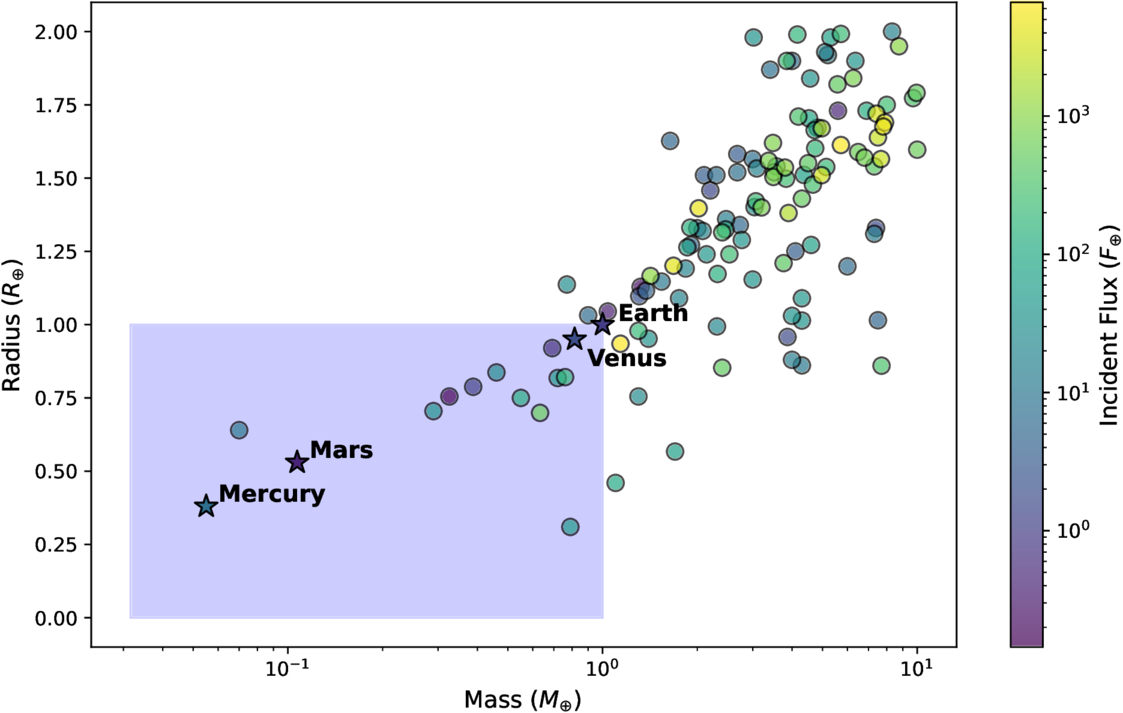
Figure 1: A plot of confirmed exoplanets by mass and radius. Most confirmed exoplanets are larger and more massive than Earth. Mars-like planets (dots in the blue box) are rare in confirmed exoplanet detections. [Kane et al. 2026]
We know a lot about Mars in comparison to other planets thanks to rovers (such as Curiosity and Perseverance), atmospheric orbiters (such as Mars Atmosphere and Volatile EvolutioN and the Mars Orbiter Mission), and other science missions (Figure 2). We know it once had water features with neutral pH and favorable chemistry for life from sedimentary evidence at the Gale and Jezero craters. We know its atmosphere is 95% CO2 with a surface pressure less than 1% of Earth’s. We know it once had an active magnetic dynamo, but the dynamo died out about 4 billion years ago, leading to solar wind steadily stripping away Mars’s atmosphere over time.
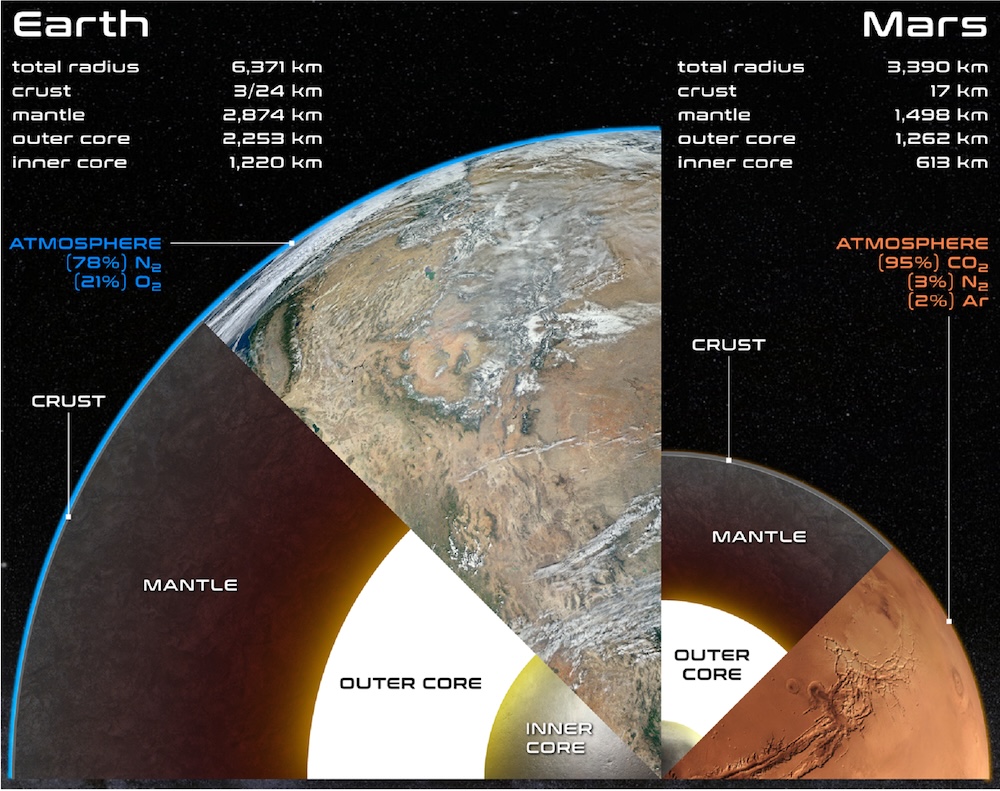
Figure 2: Earth and Mars to scale, showing their internal structures and atmospheres. Despite being neighbors, Mars is dramatically smaller with a thin CO2 atmosphere, similar to the planets JWST is struggling to characterize. [Kane et al. 2026]
JWST is currently studying the small rocky TRAPPIST-1 planets and is finding little evidence of atmospheres. The authors of today’s article explore the idea that these exoplanets are similar to Mars and perhaps are undergoing processes that strip away their atmospheres and create optimal conditions for life only for short durations. Using Mars as a blueprint, the authors show how we can better understand exoplanet processes, including volatile delivery and loss, photochemistry, climate evolution, obliquity forcing, planetary architecture, and intrinsic magnetism. For example, measurements of noble gases directly fingerprint Mars’s atmospheric escape process, and the authors argue these give us a calibration framework for interpreting future exoplanet spectra.
The upcoming Nancy Grace Roman Space Telescope’s microlensing survey will start revealing how common true Mars analogs actually are throughout the galaxy, while the future Habitable Worlds Observatory will attempt direct imaging of nearby candidates with unprecedented precision. Together, these missions will tell us whether Mars-like outcomes (brief habitability, catastrophic atmospheric loss, barren surfaces, etc.) are the default fate for small rocky planets. Interpreting that data will require the exact framework this article builds: one grounded in the only Mars analog we can study in detail.
Original astrobite edited by Sandy Chiu.
About the author, Ben Sherwin:
I am a physics PhD student and a National Science Foundation Graduate Research Fellow at Stanford University, working with Josh Frieman. I am interested in theoretical and observational cosmology, specifically in cross-correlations between the cosmic microwave background and tracers of large-scale structure.
The post What if Mars Were a Stranger (Thing)? appeared first on AAS Nova.
Half a century after first putting hardware down on Mars, NASA is looking to explore the Red Planet's skies.
On July 20, 1976, the Viking 1 lander touched down in the western reaches of Chryse Planitia (the "Golden Plain"), a large circular landform that lies 22.5 degrees north of the Martian equator.
It was the first-ever Mars landing for NASA. Viking 1, along with its twin Viking 2, went on to conduct the first fully successful mission on the Red Planet's surface. (The Soviet Union's Mars 3 probe survived its touchdown attempt on Dec. 2, 1971 but died less than two minutes later.) And those missions have left a rich and intriguing legacy.
Viking 1 and Viking 2 — which touched down in a different Red Planet region on Sept. 3, 1976 — were sent to the surface to search for signs of life on Mars. (Each mission also featured an orbiter, which studied the planet from above.)
The landers did this using three different experiments, two of which returned negative results. But the third, called Labeled Release (LR), was different. LR observed a steady stream of carbon dioxide gas coming from dirt into which it had introduced nutrients — a possible sign of microbial metabolism.
Some scientists deemed the LR results a likely life detection. But most disagreed, ascribing them to abiotic reactions and stressing that, overall, the Viking data paint a picture of a dead planet.
That disagreement illustrates one of the main legacies of the Viking program: It showed researchers that hunting for extraterrestrial life is a complicated business, and they needed to learn more about Mars before attempting the search again on the Red Planet.
NASA didn't send a surface craft to Mars for another two decades, a hiatus caused in part by the Vikings' ambiguous results and high price tag, as well as a shifting of funds to the nascent space shuttle program.
The dry spell was broken in July 1997, when the agency's Pathfinder lander touched down in Chryse Planitia, about 530 miles (850 kilometers) from Viking 1. The main goals of Pathfinder's mission were to demonstrate a new "faster, better, cheaper" method of Mars exploration, prove out a new airbag-based landing system and get a mobile robot onto the red dirt.
Pathfinder achieved all of these objectives, notching the third by deploying a small rover named Sojourner. The little wheeled robot stumbled across rounded pebbles — strong evidence that they had been exposed to flowing water.
This discovery helped shape a new NASA Mars exploration strategy, one that aims to make an informed search for alien life after "following the water." Life as we know it depends on water, so the agency built rovers designed to hunt for signs of past liquid water and potentially habitable environments.
The twin golf-cart-sized rovers Spirit and Opportunity landed in 2004, and the car-sized Curiosity followed suit in August 2012. Then came Perseverance, which landed inside Mars' Jezero Crater in February 2021.
All of these wheeled explorers found evidence of past aqueous environments. Curiosity and Perseverance — with their more extensive and sophisticated scientific payloads — delved even deeper, discovering complex organic molecules that may have been produced by life as we know it.
The two latter rovers are continuing their work; both remain active on the Red Planet. (Pathfinder and Sojourner operated for about three months; Spirit was declared dead in 2010 and Opportunity fell victim to a Mars dust storm in 2018.)
Perseverance has collected a variety of Mars samples, which NASA wants to return to Earth for detailed study. As the Vikings' experience suggests, such a level of intense scrutiny may be necessary to make a definitive detection of life on Mars, if it indeed exists. (Getting those samples home is not a foregone conclusion, however; NASA's original plan was deemed too expensive, and it's now looking into a new return strategy.)
Perseverance also carried a little robotic companion, which heralded a new phase of Red Planet exploration — the Ingenuity helicopter.
Ingenuity was a technology demonstration, designed to show that rotorcraft could effectively ply the thin Red Planet skies. (Mars' atmosphere is just 1% as dense as that of Earth at sea level.)
The $80 million mission was a rousing success. The 4-pound (1.8 kilograms) Ingenuity was expected to make just five short hops on Mars but ended up flying 72 times over the course of nearly three years of activity. (Its first flight occurred on April 19, 2021, and its last was on Jan. 18, 2024.)
So NASA aimed higher, drawing up plans for future helicopter missions that could collect valuable scientific data. And such a mission is on course to launch in 2028, if all goes according to plan: Skyfall, which will send three Ingenuity-like choppers to Mars on a nuclear-powered rocket.
"Equipped with a suite of scientific instruments, these aerial scouts will map hidden ice deposits and analyze weather patterns," NASA officials wrote in a description of Skyfall. "The mission will also demonstrate how aerial vehicles can generate wide terrain and subsurface maps to identify safe and resource-rich destinations for future American astronauts venturing to Mars."
And Skyfall could be just another step toward even more ambitious aerial exploration on the Red Planet. NASA's Jet Propulsion Laboratory in Southern California, which built and operated Ingenuity, is looking into larger, more capable Mars helicopters that could do a wider variety of work on the Red Planet.
This is all part of Viking 1's legacy. That historic touchdown on Mars half a century ago lifted exploration up — all the way into the skies of another world.

New NASA imagery has revealed a growing Martian “crescent” and surface details on the Red Planet as the agency’s Psyche spacecraft recently completed a flyby of Earth’s nearby planetary neighbor.
Launched on October 13, 2023, Psyche is currently on its way toward a rendezvous with a metal-rich asteroid after which the space probe was named. Now, in a series of composite images captured as the spacecraft flew past Mars during a gravity assist in early May, the growing crescent shape of the Red Planet is shown in successive views of Earth’s nearby planetary neighbor.
“After these views were captured by the spacecraft’s multispectral imager instrument, Mars began to overfill the field of view as Psyche made close approach with the planet and captured a series of high-resolution images of the surface,” read a NASA statement accompanying the imagery.
In several of the images, Mars appears as a thin sliver due to the high phase angle of approach as Psyche made its way toward the planet. In the days that followed, the crescent is shown as it appears to “grow” as more sunlight illuminates its surface.
The recent crescent features weren’t all that Psyche captured during its recent near approach to Mars. In additional images released by the American space agency, the Martian surface appeared in colorful views obtained by the spacecraft’s multispectral imager instrument.
The resulting “mosaic” was created from four separate images acquired near the end of Psyche’s recent visit, shown in enhanced color that highlights several details visible on the Martian surface.
Traveling along a southwesterly path with relation to the Martian poles, the mosaic imagery appears slightly blurry, as it represents close to six minutes of travel above the planet. According to NASA, pixel scale resolution in the imagery “varies from 381 meters per pixel on the right to 440 meters per pixel on the left.”
Color enhancements to the imagery, collected with the imager’s green, blue, and near-infrared filters, reveal additional details about the various features of the volcanic region of Mars that Psyche flew over on May 15, 2026, known as the Iapygia region.
This area comprises part of the Martian southern highlands, and in the recent imagery, Fournier crater—the largest shown in the new imagery—can be seen, alongside hills, cliffs, and other features, including the irregular Oenotria Scopuli cliff system, forming one side of the boundary of a massive ancient impact feature on the Red Planet.
Additional details about the new imagery, as well as information about Psyche’s mission, can be found on NASA’s official mission page.
Micah Hanks is the Editor-in-Chief and Co-Founder of The Debrief. A longtime reporter on science, defense, and technology with a focus on space and astronomy, he can be reached at micah@thedebrief.org. Follow him on X @MicahHanks, and at micahhanks.com.
