❌

Normal view

Noble Gases Along for the Ride

24 July 2026 at 17:00

A rendering of an orange and grey planet against a dark background.

What can some neon trapped in a chunk of rock tell us about Earth’s formation and the protosolar nebula? Quite a lot, as detailed in a recent study in The Planetary Science Journal.

Noble Mysteries

By analyzing rocks pulled from mid-ocean ridges, geologists have concluded that there are tiny amounts of noble gases in the deep interior of Earth. That’s a strange statement upon reflection: how did these gases, which are famously apathetic to essentially all other elements, end up embedded within rocks thousands of kilometers underground? Since their passivity rules out the potential of a chemical reaction that formed them in place, they must have been in the mantle since the very beginning of Earth’s history.
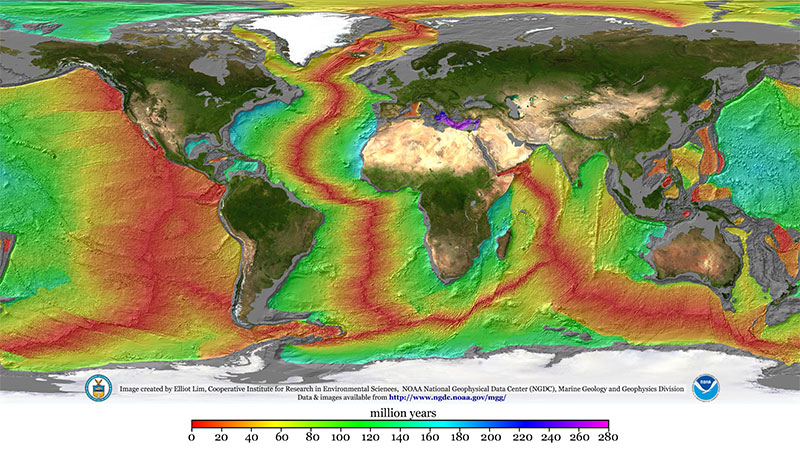
A map of Earth with the continents shown normally but the sea colored according to age.

A map illustrating the age of the seafloor. Mid-ocean ridges stand out clearly in red. By sampling material from these ridges, planetary scientists can infer the composition of Earth’s deep interior. Click to enlarge. [Mr. Elliot Lim, CIRES and NOAA/NCEI]

There are a few scenarios for how this could have happened. Though it’s possible that these inert species were delivered to the early Earth encapsulated within primitive meteorites or in solids contaminated by ions from the solar wind, at least some fraction of these elements likely came directly from the gaseous nebula that surrounded the earliest protoplanets.

That last option is especially exciting to present-day planetary scientists interested in constraining Earth’s formation history because it requires some very specific conditions. Since light noble gases like neon don’t dissolve well in seawater, they must have dissolved into a magma ocean — meaning the nebula was still around when Earth was large enough to have a molten surface. That already restricts us to a very specific time in the solar system’s history, but it doesn’t say much about the specific size of the proto-Earth other than “big,” and it doesn’t say much about the state of the nebula other than “it existed.” Recently, Vincent Savignac and Eve Lee (University of California, San Diego; McGill University) successfully refined these constraints to pin down information about both the early Earth and the nebula that surrounded it.

Infant Earths

Savignac and Lee began by growing a grid of infant Earths on their computers via models of gas accretion and atmosphere–magma interactions. Each simulation started with a different proto-Earth mass and nebular density, and each one yielded a different amount of neon in Earth’s deep interior. Excitingly, only a small handful of the scenarios tested ended up with values similar to those observed.
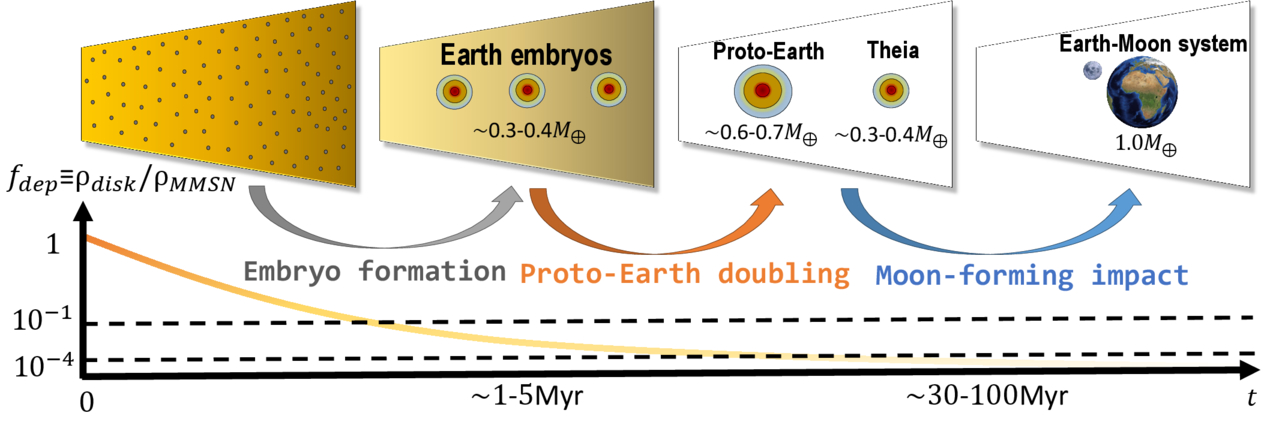
A cartoon of small cores surrounded by gaseous envelopes eventually merging into the Earth.

A schematic of Earth’s formation via embryo formation (when the noble gases enter the mantle) followed by mergers. Click to enlarge. [Savignac & Lee 2026]

On the mass axis, the team found a narrow range of acceptable conditions. If a proto-Earth was less than about 20% of Earth’s present-day mass, it couldn’t accrete much gas. This let it cool rapidly, freezing the magma ocean and shutting down neon dissolution before too much could be trapped inside. On the other hand, if a proto-Earth was more than about 40% of Earth’s present-day mass, it would accrete too much gas, stay molten for too long, and be left with too much neon. On the density axis, the researchers found that when the nebula accreted on to the proto-Earth, it must have been fairly depleted compared to its initial density. This implies that the whole process happened at the end of the nebula’s life, just before it was completely blown away by the proto-Sun.

Savignac and Lee demonstrated that these constraints are robust against the later stages of Earth’s evolution. In its later years, Earth either suffered or benefited from a giant impact, depending on your feelings about the Moon, but the researchers showed that this event doesn’t pose a problem for their models. Overall, this study builds a delightful link between rocks from our deep oceans and the particulars of Earth’s formation, demonstrating the unique power of planetary science to tie together different scientific fields.

Citation

“Constructing the Earth’s Formation History Using Deep Mantle Noble Gas Reservoirs,” Vincent Savignac and Eve J. Lee 2026 Planet Sci. J. 7 135. doi:10.3847/PSJ/ae64f7

The post Noble Gases Along for the Ride appeared first on AAS Nova.
Researchers Spot Hydrocarbons Surprisingly Close to a Quasar Pair

22 July 2026 at 17:00

J0749+2255

Researchers have detected molecules containing rings and chains of carbon atoms in the vicinity of a rare pair of quasars. The trends in the distribution of these molecules are unexpected, suggesting that more work is needed to understand the conditions surrounding active supermassive black holes.

Infrared Eyes on Molecules in Space

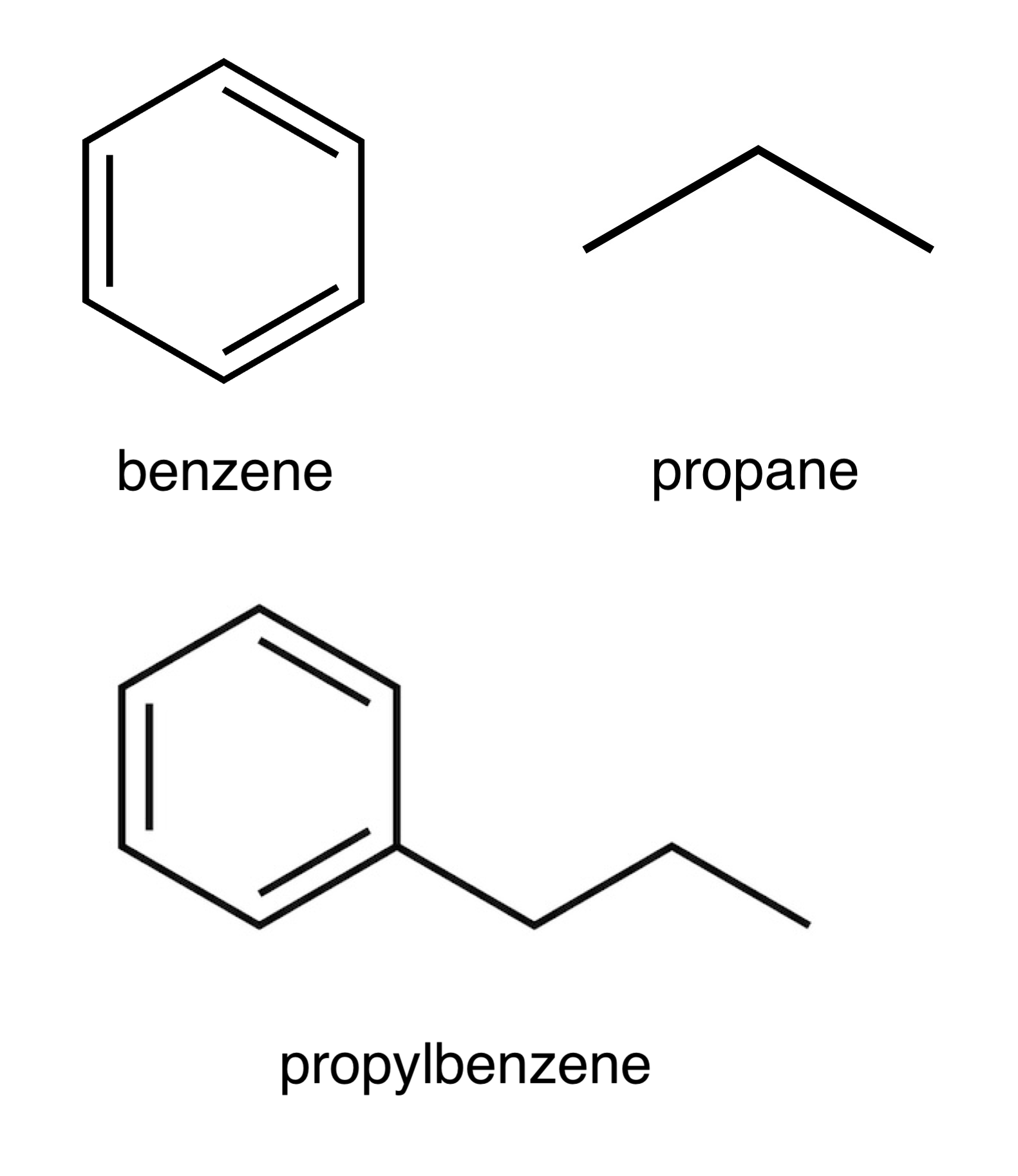
skeletal formulae of aromatic and aliphatic molecules

Examples of aromatic and aliphatic hydrocarbons. Benzene (top left) is the simplest aromatic molecule. Propane (top right) is a simple aliphatic molecule. Propylbenzene (bottom) is an aromatic molecule with an aliphatic chain branching off of it. In these “skeletal” formulae, there is a carbon atom at each vertex, and the remaining atoms (not depicted) are all hydrogens. Single lines indicate single chemical bonds, and double lines indicate double bonds. [Wikipedia; Public Domain]

Across the universe, atoms are combining to form molecules, and our ability to study molecules in distant realms has never been better. JWST is particularly attuned to emissions from molecules engaged in a kind of chemical yoga, stretching their bonds and flexing the angles between their atoms.

JWST’s sensitive infrared eyes have allowed researchers to study the distribution, creation, and destruction of both aromatic (containing one or more rings of carbon atoms in which certain electrons spread out within the ring) and aliphatic (containing chains of carbon atoms) hydrocarbons. These molecules have been spotted in a wide array of environments, and now, astronomers are finding them in more distant and more extreme environments than ever before.

Distant Discovery

SDSS J074922.96+225511.7, or J0749+2255 for short, is a quasar pair seen 3 billion years after the Big Bang. The two feasting supermassive black holes are roughly 12,000 light-years apart, giving researchers a glimpse into the late stages of a galaxy merger and a harsh environment in which to study the survival and destruction of molecules.

Researchers studying J0749+2255 with JWST have previously reported the detection of a 3.3-μm emission feature from aromatic molecules. Now, C. E. Mentzer (University of Missouri), Aigen Li (University of Missouri), and Xuejuan Yang (Xiangtan University) have analyzed JWST spectra of J0749+2255 and found not just widespread aromatic emission at a rest-frame wavelength of 3.3 μm, but also aliphatic emission at 3.4 μm, which they attribute to carbon chains branching off from the aromatic molecules. This likely makes J0749+2255 the most distant galaxy in which both aromatic and aliphatic emission has been detected.

analysis results showing the aliphatic fraction across the quasars and the surrounding region

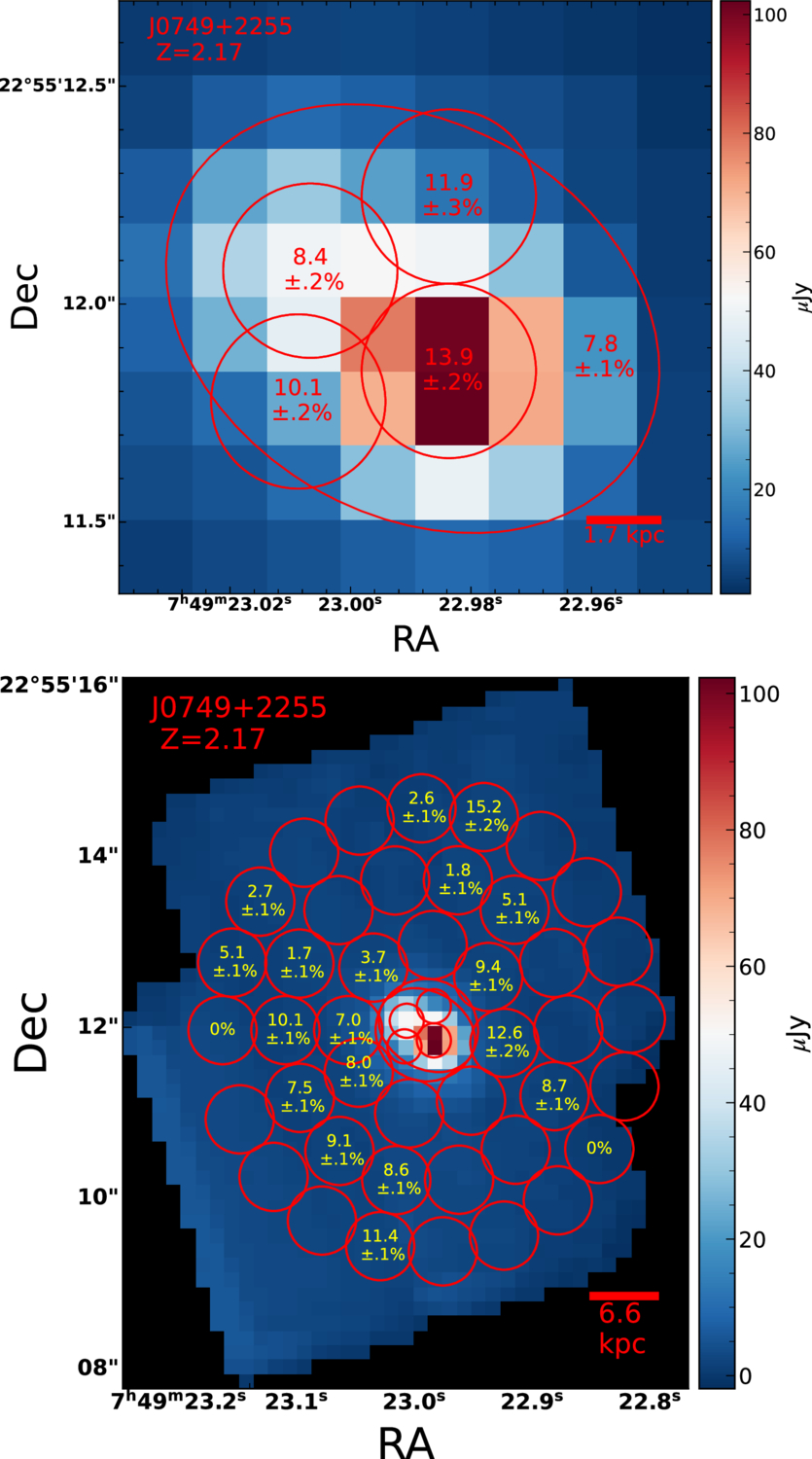
Aliphatic fractions in the bright central region surrounding the two quasars (top) and in the outer regions (bottom). [Mentzer et al. 2026]

Unexpected Trends

Mentzer, Li, and Yang subdivided the observations into 47 regions and measured the strength of the 3.3- and 3.4-μm features in each region. This analysis found strong aromatic emission nearest the quasars and showed that the fraction of carbon atoms bound up in aliphatic chains is highest close to the quasars.

Both of these findings are unexpected: the harsh radiation environment near the two active black holes is thought to break apart chains of carbon atoms attached to aromatic rings (which should decrease the 3.4-μm emission) and possibly destroy small aromatic molecules (which should decrease the 3.3-μm emission) — yet both of these features are strongest near the quasar cores where the radiation should be most capable of molecular destruction.

The authors speculated that the analysis regions centered on the quasars are large enough that they contain gas that hasn’t been pummeled by the quasars’ intense radiation and outflows, leaving molecules intact and able to produce the observed emission. However, this doesn’t explain the trend of stronger 3.3- and 3.4-μm emission closer to the quasars — necessitating further research into the emitting behavior of aromatic and aliphatic molecules under the extreme conditions of a dual quasar’s neighborhood.

Citation

“Widespread Detection of Aromatic and Aliphatic Emission in the Dual Quasar J0749+2255 at Cosmic Noon,” C. E. Mentzer et al 2026 ApJL 1005 L38. doi:10.3847/2041-8213/ae7e86

The post Researchers Spot Hydrocarbons Surprisingly Close to a Quasar Pair appeared first on AAS Nova.

What if Mars Were a Stranger (Thing)?

21 July 2026 at 17:00

Mars from Mars Global Surveyor

Editor’s Note: Astrobites is a graduate-student-run organization that digests astrophysical literature for undergraduate students. As part of the partnership between the AAS and astrobites, we occasionally repost astrobites content here at AAS Nova. We hope you enjoy this post from astrobites; the original can be viewed at astrobites.org.

Title: Mars as an Exoplanet: Lessons from a Planet at the Edge of Habitability
Authors: Stephen R. Kane et al.
First Author’s Institution: University of California, Riverside
Status: Published in PSJ

Mars in the Upside Down

If you’re a fan of Stranger Things like me, you’ll know of the Upside Down: a mirror world similar to our own, but with very different rules. Imagine Mars in the Upside Down, where it is no longer our next-door neighbor but a planet hundreds of light-years away. An astronomer on this Upside Down Earth would be looking at a distant speck with a transit signal barely distinguishable from noise. In this world, Mars would no longer be familiar but completely foreign, with unknown properties. Kane et al. suggest that treating Mars as if it were a stranger is a useful way to think about exoplanet science today.

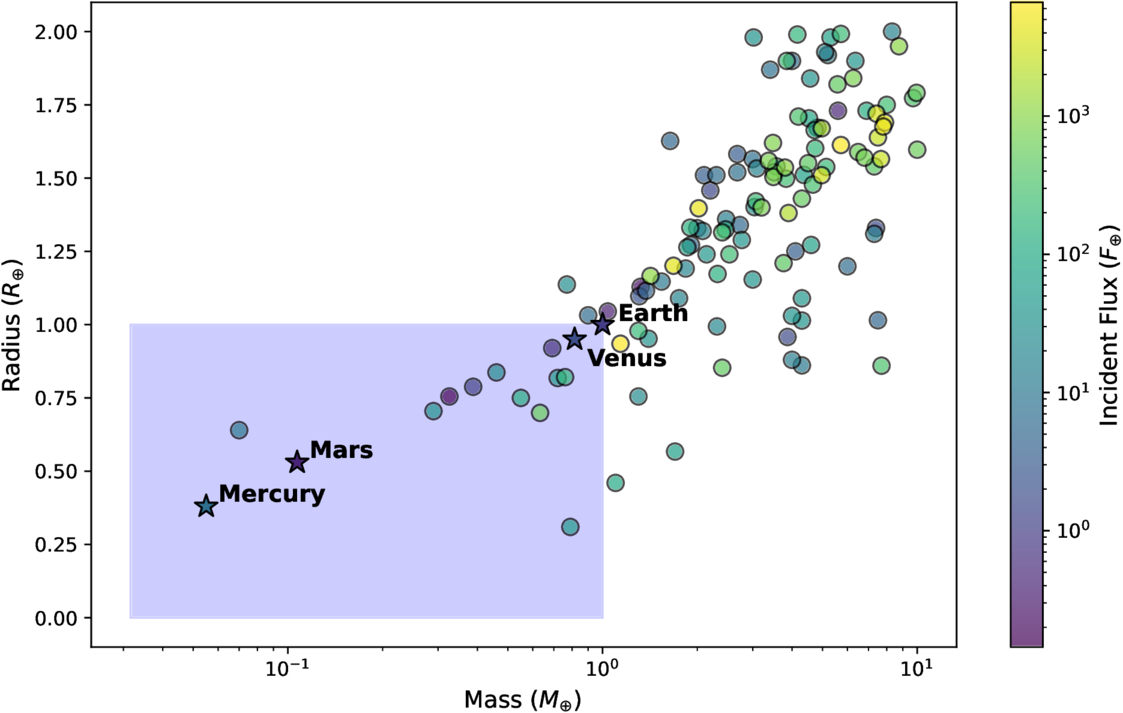
JWST is hunting for atmospheres on small rocky planets around other stars. However, only a select few Mars-like exoplanets have been discovered (Figure 1). This is because sub-Earth planets are small and hard to detect, testing the bounds of current technology. The ones that have been discovered, such as TRAPPIST-1h and Kepler-138b, were detected due to favorable geometry. They happen to orbit very close to a low-mass star or sit in resonant multi-planet systems, which amplify the signal we are looking for. True Mars analogs with low flux and moderate orbital periods remain out of reach. This is precisely what makes Mars itself so important scientifically — it is the only planet of this type we can study up close.

Plot of planetary radius versus planet mass, with symbols colored by incident stellar flux.

Figure 1: A plot of confirmed exoplanets by mass and radius. Most confirmed exoplanets are larger and more massive than Earth. Mars-like planets (dots in the blue box) are rare in confirmed exoplanet detections. [Kane et al. 2026]

Getting to Know Mars, Getting to Know All About Mars

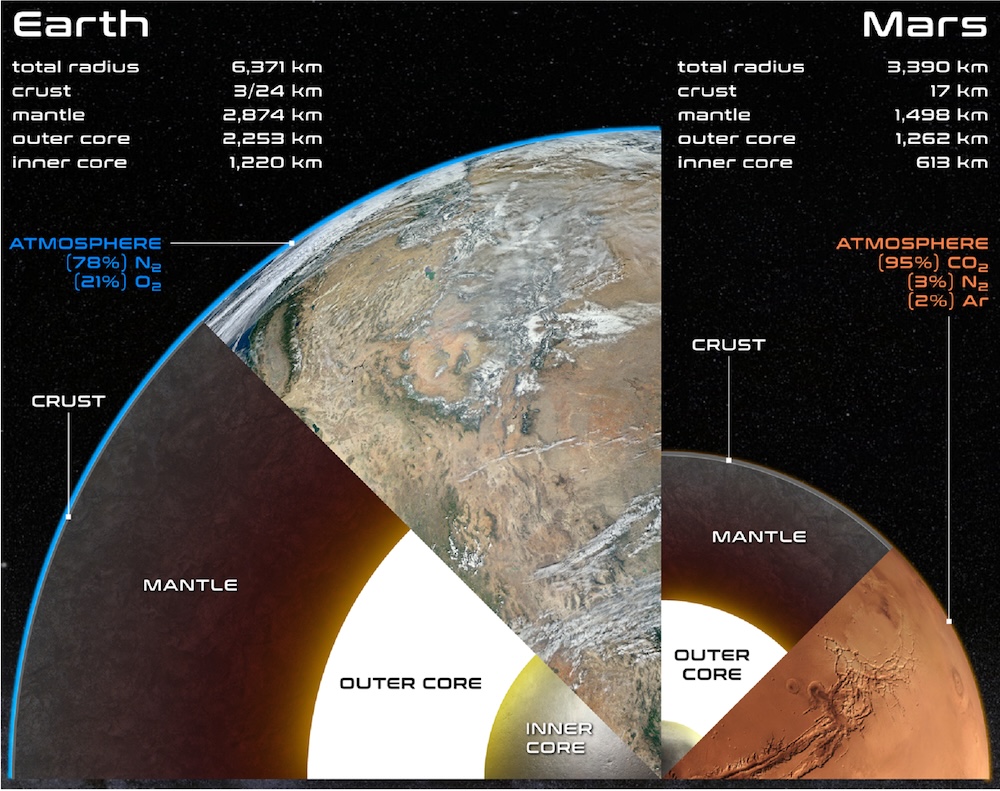
We know a lot about Mars in comparison to other planets thanks to rovers (such as Curiosity and Perseverance), atmospheric orbiters (such as Mars Atmosphere and Volatile EvolutioN and the Mars Orbiter Mission), and other science missions (Figure 2). We know it once had water features with neutral pH and favorable chemistry for life from sedimentary evidence at the Gale and Jezero craters. We know its atmosphere is 95% CO2 with a surface pressure less than 1% of Earth’s. We know it once had an active magnetic dynamo, but the dynamo died out about 4 billion years ago, leading to solar wind steadily stripping away Mars’s atmosphere over time.

Diagram showing Earth and Mars to scale

Figure 2: Earth and Mars to scale, showing their internal structures and atmospheres. Despite being neighbors, Mars is dramatically smaller with a thin CO2 atmosphere, similar to the planets JWST is struggling to characterize. [Kane et al. 2026]

But in the Upside Down, we would know none of this since Mars would be so distant. With current technology, this Upside Down Mars would be essentially undetectable using transit signals, radial velocity measurements, and spectrographs.

Beyond Our Backyard

JWST is currently studying the small rocky TRAPPIST-1 planets and is finding little evidence of atmospheres. The authors of today’s article explore the idea that these exoplanets are similar to Mars and perhaps are undergoing processes that strip away their atmospheres and create optimal conditions for life only for short durations. Using Mars as a blueprint, the authors show how we can better understand exoplanet processes, including volatile delivery and loss, photochemistry, climate evolution, obliquity forcing, planetary architecture, and intrinsic magnetism. For example, measurements of noble gases directly fingerprint Mars’s atmospheric escape process, and the authors argue these give us a calibration framework for interpreting future exoplanet spectra.

The upcoming Nancy Grace Roman Space Telescope’s microlensing survey will start revealing how common true Mars analogs actually are throughout the galaxy, while the future Habitable Worlds Observatory will attempt direct imaging of nearby candidates with unprecedented precision. Together, these missions will tell us whether Mars-like outcomes (brief habitability, catastrophic atmospheric loss, barren surfaces, etc.) are the default fate for small rocky planets. Interpreting that data will require the exact framework this article builds: one grounded in the only Mars analog we can study in detail.

Original astrobite edited by Sandy Chiu.

About the author, Ben Sherwin:

I am a physics PhD student and a National Science Foundation Graduate Research Fellow at Stanford University, working with Josh Frieman. I am interested in theoretical and observational cosmology, specifically in cross-correlations between the cosmic microwave background and tracers of large-scale structure.

The post What if Mars Were a Stranger (Thing)? appeared first on AAS Nova.

Featured Image: A Rare Pair of Galaxies Lacking Dark Matter

20 July 2026 at 17:00

This image, which combines a background view from the Dark Energy Camera Legacy Survey with two inset images from the Very Large Telescope, shows an unusual pair of galaxies in the Fornax Cluster. The galaxies FCC 224 and FCC 240 are under scrutiny because they may have formed via a high-velocity collision between dwarf galaxies — the so-called “bullet-dwarf” model. Using new spectroscopy from the Very Large Telescope, Maria Luísa Buzzo (Yale University) and collaborators analyzed the ages and kinematics of the galaxies’ stars as well as the unusually bright globular clusters swirling around each galaxy. These data suggest that both galaxies are deficient in dark matter, and their stellar populations and globular clusters are all roughly 10 billion years old. The lack of dark matter and the uniform stellar ages are both consistent with the bullet-dwarf model, in which the collision strips away dark matter and ignites a burst of star formation. Since this type of collision can create more than two remnants, the team suggests searching along the trajectory defined by FCC 224 and FCC 240 for more fragments from the collision, some of which may contain the galaxies’ lost dark matter. To learn more about these galaxies and what they might mean for the bullet-dwarf mechanism, be sure to check out the full research article linked below.

Citation

“Dark-Matter-Deficient Twins: FCC 224 and FCC 240 as Possible Analogs of NGC 1052-DF2 and DF4,” Maria Luísa Buzzo et al 2026 ApJ 1005 15. doi:10.3847/1538-4357/ae7349

The post Featured Image: A Rare Pair of Galaxies Lacking Dark Matter appeared first on AAS Nova.

❌