Tattoos are pretty permanent decisions, and laser removal is often described as more painful than actually getting them in the first place. But what about a design that can only be seen when you want to see it? Engineers at the University of Colorado Boulder are working on a new type of tattoo ink to answer that question. Their dye is specifically concocted to physically alter depending on exposure to visible or ultraviolet (UV) light.
The team described their invention in a study published earlier this month in the journal Matter & Light, and they didn’t only demonstrate the capabilities in the lab on silicone and pig skin. One of its creators, Carson Bruns, has already tattooed himself with the ink.
“[It’s] almost a tradition,” the study co-author recently told Nature.
Bruns, a nanoscientist at UC Boulder, previously developed a now-commercialized tattoo product called “Magic Ink” that turns magenta depending on its exposure to UV light. To highlight its efficacy, Bruns gave himself “solar freckles” as a method to track his exposure to sunlight. In similar fashion, he recently completed a similar session on his leg using the disappearing ink.
The formula currently comes in three colors—yellow, blue, and magenta—and essentially relies on the same principles behind transition lenses and some textiles. Each dye is composed of tiny spheres of acrylic glass. These beads contain photochromes, which are chemical compounds engineered to absorb specific light wavelength photons. In this case, the photochomic dye’s spheres begin in their original color, but then flatten into transparency after absorbing corresponding light photons exposed to UV rays. The dye remains this way until it absorbs visible light photons, which destroys the chemical bond and allows the spheres to return to their original shape.
Aside from the lab tests, Bruns tattooed his own leg over about 12 months using various dye combinations, all of which responded as intended to UV and visible light exposure. The ink also remained effective for over two years—but the team’s intention is go beyond a nifty parlor trick. Future ink iterations may be particularly useful in medical procedures, such as temporary markings to help maintain accuracy during direct radiotherapy sessions. For now, however, the photochromic tattoo dyes remain for laboratory (and Bruns’) use only until further safety assessments are completed.
Just over 40 years ago, what began as a routine safety test at the Chernobyl nuclear power plant (or Chornobyl in Ukrainian) in Soviet Ukraine spiraled into one of the most recognizable disasters of the 20th century. The reactor exploded and burned, spewing chunks of nuclear debris into the sky. Among that toxic litter were countless tiny “hot particles,” fragments of nuclear fuel smaller than the width of a human hair (somewhere between 8 and 50 micrometers across). Those particles are called hot because they’re highly radioactive, and still are four decades later. Today, scientists entering the areas of the Chernobyl Exclusion Zone where the hot particles are located are required to wear a full protective suit.
But after decades of study, scientists still know surprisingly little about what their particles are made of at the molecular level. A team of researchers from Germany recently set out to change that by analyzing six particles collected from two sites in the Exclusion Zone using synchrotron X-ray diffraction. Surprisingly, they discovered the particles remained far more chemically stable than they had expected. Their crystal structures were largely intact, suggesting they changed little since forming during the disaster and its aftermath.
The hot particles thrown out of the Chernobyl plant fall into three general categories. The first is fuel that remains chemically and physically similar to the reactor’s original uranium dioxide. The second type consists of fuel that melted during the explosion and fused to its zirconium-alloy protective casing. The third type is fire-damaged fuel.
As the reactor’s graphite burned for 10 days after the explosion, the intense heat oxidized some of the fuel into other uranium compounds.
Particles, crystals…and dogs
For this particular study, the team sourced their six samples from two areas in the exclusion zone, and all three hot particle categories were represented. Two came from asphalt in Pripyat, roughly 2 miles from the reactor, while the other four came from farm soil samples in Kopachi, about 3 miles away.
With the samples selected, the researchers isolated individual particles pulled from the soil, mounted each type to a tiny tungsten electrode, and then sent them to the European Synchrotron Radiation Facility in Grenoble, France. There, a team analyzed the particles using intense X-rays produced by a synchrotron, a circular particle accelerator. The researchers rotated each particle in an X-ray beam, measuring it from roughly 2,000 different angles. Watching how the x-rays bounced off all that material revealed how its atoms were arranged, showing which compounds each particle was made of and, most importantly for this study, how intact its crystal structure remained.
Hot particle from the 1986 reactor accident: The nuclear fuel particle is partially fused with zirconium oxide. Image: Laura Stalmann.
They expected to see particles that had been broken down by years of exposure to the elements. Instead, the crystal structures were still largely intact. That surprising finding suggests the particles are far more chemically stable than previously assumed, holding their radioactive contents locked inside their crystal structures.
Though some of the particles showed more oxidation (of a loss of electrons when they interact with other chemicals) than others, two showed virtually none at all. Importantly, two of the particles pulled from the same soil near Kopachi included both a sample heavily oxidized and one that was largely untouched. The authors suggest that if weathering from the environment were the cause of the oxidation, then both particles sitting side by side should look similar. Instead, they say the oxidation likely happened during the disaster itself, when the reactor fire baked some of the fuel for days.
That timeline is potentially good news for the areas around the power plant. If the particles are indeed holding onto that radioactive material and not oxidizing, that could mean less harmful material is making its way into the soil and, in turn, the surrounding ecosystem. Still, the researchers quickly caveat any broad claims. These were just six samples, after all. Making any wider claim about the soil in the region generally would require more research.
Though it’s still too early to say with any certainty, that lack of leaching dangerous material into the environment could partly help explain why the exclusion zone has become home to an ever-growing neighborhood of furry mammals in recent years. In fact, the area’s lack of humans has made it a thriving ecosystem for foxes, bears, and bison. It’s a modern, albeit a little unorthodox, example of rewilding. Of course, even in this new frontier, the consequences of a nuclear disaster aren’t totally absent. A recent study of roaming dogs living in the Chernobyl Exclusion Zone, many believed to be descendants of dogs left by their owners during the 1986 evacuation, show distinct genetic differences from dogs in an area just 10 miles away.
Timekeeping has officially entered its nuclear age. Two independent teams, one in Vienna, Austria and another in Beijing, China have built working thorium-229 nuclear clock prototypes. Rather than track changes in an atom’s electrons the way that current atomic clocks do, these nuclear versions use a laser that’s tuned to the frequency where a thorium nucleus flips between two energy states for potentially even more accurate time keeping. Scientists believe this new approach could one day make the clocks far more reliable than any existing atomic timekeeper.
To put that in perspective, current atomic clocks can keep time with an uncertainty of 1 second every 300 million years. Scientists predict that more advanced nuclear clocks could move that metric into the billions of years. That could open the door to probing some of the universe’s hardest-to-measure phenomena, like notoriously elusive dark matter. The Chinese clock and Austrian clock were detailed in a pair of studies published this week in the journal Nature.
“The great advantage of the new nuclear clock in Vienna is that, if you use atomic nuclei rather than atoms, much higher precision is possible in principle,” Thorsten Schumm, a study co-author and professor at the Vienna University of Technology, said in a statement.
The thorium crystal and the laser beam. Image: TU Wien.
How nuclear clocks work
The world’s network of atomic clocks is already mind-bogglingly accurate. They also underpin a slew of modern necessities, from GPS to internet communication. Atomic clocks work by tuning a laser to the exact frequency of light that makes an atom’s electron jump between two levels.
Nuclear clocks, as the name suggests, go even deeper. They target jumps inside of an atom’s nucleus. Lasers focus on vibrations from a single nucleus rather than the whole atom. For those who weren’t paying all that much attention in chemistry class, a nucleus is tens of thousands of times smaller than the atom surrounding it.
Luca Toscani de Col (top right) working on the nuclear clock in the Vienna lab. Image:Matthias Heisler, TU Wien.
Keeping time in a nuclear clock requires keeping the laser tuned to the nucleus as it switches between states. This process is sometimes colloquially referred to as “squishing” the nucleus. Squishing atomic nuclei usually requires an enormous amount of energy. However, the isotope Thorium-229, is a rare exception, which is why both teams at Vienna University of Technology and Tsinghua University in Beijing built their clocks around it.
“The basic idea is simple: you have a laser and you have thorium,” Schumm added. “The laser changes the energy state of the thorium nuclei, and the thorium nuclei are used to stabilize the frequency of the laser.”
Nuclear is still catching up to atomic
These two prototype clocks are many years in the making. The thorium crystal used for both was grown separately, but around the same time. So far, testing reportedly shows the version in China is about six times as stable than the clock in Vienna. The Vienna prototype, meanwhile, is reportedly the first nuclear clock that stabilizes itself the way atomic clocks do. Schumm recently told the South China Morning Post this parallel development has led to a “fierce but friendly global competition.”
Nuclear clocks may eventually far surpass their atomic forebears, but they aren’t there yet. Researchers estimate the new prototype may drift by about one second every 30 million years. That’s roughly 10 times worse than the cesium clocks that currently define the official second.
Still, researchers expect that stronger, more efficient lasers and better thorium crystals will make each new generation of nuclear clocks ever more accurate, until they eventually surpass atomic clocks altogether. Who manages to get their first remains to be determined.
In September 1976 physicist Masao Doi, then working at Tokyo Metropolitan University, published two groundbreaking papers. The work – published in Journal of Physics A – cast classical stochastic many-body problems in the mathematical language samiliar to that of quantum-field theory (9 1465 and 9 1479).
Although this happened at a time when theoretical field methods in statistical mechanics were getting into full swing, this gem of deep scientific insight remained hidden for many years.
Indeed, it was reinvented several times, most notably in 1980 by Peter Grassberger and Martin Scheunert from the University of Wuppertal, who also highlighted the many applications for the theory.
Following conversations with Grassberger at a meeting organised by the Centre Européen de Calcul Atomique et Moléculaire in September 1985, Luca Peliti from the University of Rome went about putting Doi’s theory into a path integral formalism, thus making it amenable to renormalisation.
That same year he published a letter on the renormalisation group treatment of a reaction-diffusion process, using the framework that was named Doi-Peliti field theory (J. Phys. France46 1469).
The works by Doi and Peliti quickly became viewed as fundamental building blocks to calculate not only asymptotics but also systematic approximations of observables in reaction-diffusion processes.
Theoretical physicist John Cardy from the University of Oxford, used Doi-Peliti theory as a work-horse for reaction-diffusion processes.
In the 2000s, Cardy and colleagues produced not only a string of renormalisation group treatments of reaction-diffusion processes, but also reviews and tutorials at different levels of technicality, which made Doi-Peliti field theory accessible to many of us.
Key insights
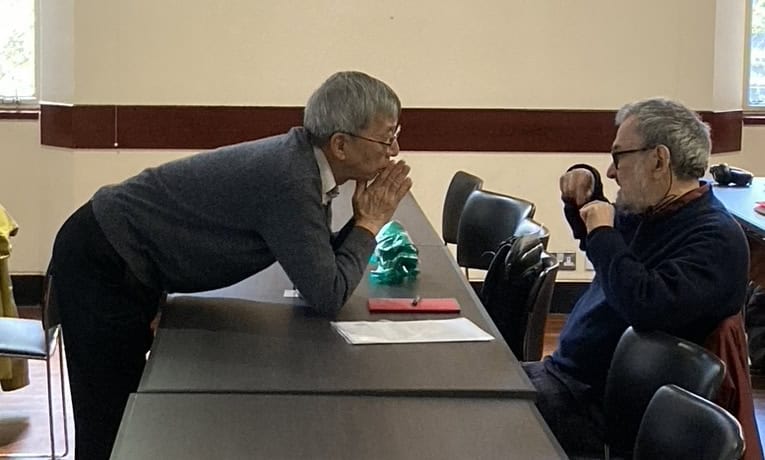
Eye to eye: Doi (left) and Peliti met for the first time at the event in Cambridge (courtesy: Gunnar Pruessner)
In 2018 Doi became chief scientist at the Wenzhou Institute of the University of Chinese Academy of Sciences and was well-known for his work in polymer and soft-matter physics.
Yet when my former PhD student Ziluo Zhang joined the Wenzhou Institute as a postdoc in 2023, he found that Doi was unaware that the field theory bears his name and the many developments since its inception.
In a relaxed atmosphere, some of the key players explained how their insights came about.
Doi-Peliti field theory is a brilliant concept conceived by brilliant minds. One might be tempted to speculate how many more theories have been spun off and developed that are attributed – or even unattributed – to the pair without them ever knowing.
An upcoming special issue of Journal of Physics A will be dedicated to the Doi-Peliti field theory.
In a lab at the Okinawa Institute of Science and Technology (OIST) in Japan, a slab of diamond smaller than a pencil eraser hangs from a carbon fiber rod about 5 centimeters (2 inches) long. The rod is attached to a graphite plate that floats in mid-air above four magnets. Nobody touches it. When a […]
The NASA Exoplanet Exploration Program (ExEP) has a curated list of 164 nearest Sun-like stars that are easily visible from Earth. This list represents the first targets for a proposed large space telescope specially designed to find life in the universe, currently known as the Habitable Worlds Observatory (HWO).
After the HWO is completed, likely sometime in the 2040s, scientists will use the specialized telescope to directly image planets in those star systems. The telescope will search around Sun-like stars for planets in a region known as the habitable zone, where temperatures allow liquid water to exist. Scientists hope to find Earth-like planets with liquid water in the habitable zones of other stars.
While the 164 stars on ExEP’s list have qualities that make them good candidates for study, it remains unknown how many actually have terrestrial planets within their habitable zones. A team of scientists at Arizona State University used simulated data for ExEP’s 164 stars and their hypothetical planetary systems to assess which are most likely to have habitable worlds. Their results would help the HWO prioritize which star systems to observe.
The team started with a subset of 134 stars on ExEP’s list with no known exoplanets, giving researchers the freedom to simulate potential worlds around them. They used a software model called the DYNAmical Multi-planet Injection TEster (DYNAMITE) to predict the possibility that an unseen planet exists around each star by generating 100,000 simulated planetary systems around it. The simulations use mathematical formulas based on observations of real exoplanets to determine the sizes and orbital characteristics of hypothetical gas giants and rocky exoplanets. DYNAMITE then determines whether these planetary systems would be stable and include a terrestrial exoplanet in the star’s habitable zone.
The other 30 stars in the ExEP’s list have known exoplanets, but none of them are rocky planets in habitable zones. To predict whether these stars have unseen terrestrial planets in their habitable zones, the team used the same DYNAMITE process as before with the additional requirement that each star must have an exoplanet matching the one already found.
The space around a Sun-like star can be divided into three regions. The region closest to the star is too hot for liquid water to persist on an exoplanet’s surface, while the region farthest from the star is so cold that any water on an exoplanet would be frozen solid. Between these lies the habitable zone, where temperatures would allow liquid water to exist. However, it’s also possible that a combination of light and gravity could create habitable temperatures on large enough moons orbiting gas giants even beyond a star’s main habitable zone. Illustration by Andrew Bizal.
To increase the chances of finding a terrestrial planet in a habitable zone, the team also investigated potentially habitable moons orbiting gas giants in these systems. For each simulation that included a gas giant, the team inserted between 2 and 23 moons, with masses between 10% of Earth’s Moon and 50% of Earth. Then they simulated the surface temperatures of these moons based on how much starlight they receive and how strongly their host planet pulls on them. They deemed the moons potentially habitable if they were large enough to retain an atmosphere and had a temperature ideal for liquid water, even if they were not technically in their stars’ habitable zones.
For each star, the team calculated a metric based on the probabilities that the star had a terrestrial planet in its habitable zone, that the planet would remain in a stable habitable zone for at least 2 billion years, and that the star had a potentially habitable moon. They called this probability statistic a rankingmetric and used it to compare star systems.
Based on the ranking metric, the team found that the dimmer and cooler stars on their list generally had better chances of hosting a habitable-zone terrestrial planet than the brighter, hotter stars. They also found that stars without known exoplanets ranked more favorably. Around 70% of the stars with known exoplanets had less than a 1% probability of hosting a terrestrial planet in their respective habitable zones. Additionally, fewer than 0.1% of their simulated moons were habitable.
Overall, the researchers concluded that the HWO should prioritize observing cooler, Sun-like stars with no known exoplanets. They claimed that the exoplanets with known characteristics in their sample set were of sizes and in positions that made it unlikely for other exoplanets to be in their systems’ habitable zones. Even with expanded habitability criteria for moons, it would be very unlikely for HWO to find another Earth orbiting a gas-giant exoplanet. They ranked 47 stars in the highest-priority category (A Tier), 51 stars in the middle category (B Tier), and 66 stars in the lowest category (C Tier) to observe with HWO.
At the end of their study, the team remarked that the proposed HWO represents a potential next step in the search for other Earths, but scientists still need to identify the best targets for this future telescope. The HWO telescope should be able to image rocky exoplanets directly, so thorough research to prepare a list of high-priority targets will help avoid overlooking other Earths.
Desalination is used to produce fresh drinking water from seawater, but it also generates a highly concentrated waste stream known as brine. Disposing of this brine is a major challenge and is often achieved through deep-well injection, in which the waste is pumped underground, an approach that can be expensive. Oil and gas production creates similarly saline wastewater, which is often managed in the same way.
In this work, the researchers developed a modelling platform to evaluate different strategies for managing these waste streams and to determine whether it is more cost effective to dispose of brine or to treat it further and recover additional water using solar-powered technologies. They applied the framework to two case studies: the Kay Bailey Hutchison Desalination Plant in Texas, a large inland desalination facility, and produced water from the Permian Basin, one of the most productive oil-producing regions in the United States.
The study compared a range of desalination technologies, including reverse osmosis, which uses membranes to separate water from dissolved salts, and thermal desalination methods that use heat to evaporate and recover water. Solar technologies included photovoltaic panels that generate electricity and solar thermal systems that provide heat. The researchers found that for desalination brine, the most cost-effective solar-powered option was photovoltaic combined with reverse osmosis, while solar-thermal desalination remained relatively expensive because of the cost of solar collectors and heat storage. For highly saline oilfield wastewater, zero-liquid-discharge systems, which recover almost all of the water and leave behind solid salts, could be economically attractive because they reduce or eliminate costly brine disposal.
More broadly, the findings suggest that renewable energy could help make desalination and wastewater treatment more sustainable, particularly in water-stressed regions. By identifying cost-effective ways to increase water recovery and reduce brine disposal, the work could support wider water reuse and potentially enable valuable minerals to be recovered from waste streams rather than discarded.
When a material does not have inversion symmetry, particles within it will move in different directions when they have different spin states. This is because the asymmetry of the material creates an effective electric field that couples the particles’ spin and momentum. The behaviour is called the Rashba effect, and it allows researchers to manipulate electron spins without requiring a magnetic field.
Surface plasmons are waves of oscillating electrons that travel along a metal surface when it interacts with light. In this work, the researchers investigated surface plasmons to see if they could create something like the Rashba effect but in a completely symmetrical material. To do this, they shone polarized light onto a periodic gold nanostructure (a plasmonic crystal) and measured how the resulting plasmon modes behaved, comparing what happened for left- and right-circularly polarized light.
They observed that differently polarized light caused the plasmon modes to split according to the light’s spin (polarization), mimicking Rashba spin splitting. Instead of being caused by the lack of symmetry in the material, the tightly focused light interacts with the anisotropic gold grating. The gold grating has lines running in one direction, meaning that light polarized along the grating lines behaves differently from light polarized across them. When light is tightly focused, its polarization is no longer identical everywhere, so the light experiences different combinations of birefringence and dichroism depending on its propagation direction. This creates a geometric phase gradient that gives left- and right-circularly polarized light opposite momentum shifts, causing the observed spin splitting. The researchers describe this mechanism as a geometric linear birefringence-linear dichroism effect.
The findings show that Rashba-like spin splitting does not necessarily require structural asymmetry and suggest that researchers may be able to achieve spin-controlled optical behaviour using simpler symmetric metasurfaces rather than increasingly complex asymmetric nanostructures.
When waves travel through complex environments (such as acoustics), repeated scattering is usually a problem because it scrambles wavefronts and distorts the information they carry. As a result, most approaches seek to suppress or compensate for scattering. In this work, however, the researchers take the opposite approach and show that scattering itself can be harnessed to manipulate waves.
The challenge is to design a disordered medium so that multiple scattering produces a desired outcome. This is difficult because the scattering matrix, which describes how waves are transformed by the medium, depends sensitively on the positions of many individual scatterers. Finding a configuration that performs a target operation can therefore be like searching for a destination in a vast landscape. The researchers used a mathematical tool known as the generalized Wigner-Smith operator, which reveals how small changes in scatterer positions modify the scattering matrix. In effect, it acts as a local map of the design landscape, guiding the system toward target unitary transformations while maintaining near-perfect transmission.
The team demonstrated the concept using an acoustic waveguide containing eighty metallic cylinders. By carefully arranging the scatterers, they controlled how different waveguide modes were converted into one another, enabling operations known as braiding. Similar to weaving strands in a braid, braiding exchanges modes in a prescribed sequence. A particularly striking example is non-Abelian braiding, where changing the order of those exchanges produces different outcomes. Such order-dependent operations are of great interest in topological quantum computing and can also manipulate information encoded in classical waves. The researchers demonstrated this behavior experimentally using a compact multiple-scattering medium only a few wavelengths thick, avoiding the long structures required in previous wave-based braiding schemes.
The significance of the work extends well beyond braiding. The same design principle can realize a broad range of unitary transformations, suggesting that complex media can be programmed to process information carried by waves rather than simply transmit it. Although practical implementations will still face challenges such as loss, bandwidth, and fabrication constraints, the work offers a new way of thinking about disorder. Instead of treating scattering as an obstacle to overcome, researchers may be able to harness it as a resource to build compact, reconfigurable devices for communications, imaging, signal processing, and wave-based computation.
The 2026 Nobel Prize for Physics has gone to Francis Halzen for his “decisive contributions to the IceCube Neutrino Observatory and the discovery of high-energy neutrinos of astrophysical origin”.
In this episode of the Physics World Weekly podcast I am joined by the University of Oxford neutrino physicist Kirsty Duffy and Physics World’s Matin Durrani to talk about this year’s prize. This is the fifth time a Nobel prize has been awarded for work on neutrinos, and we explore why physicists are so enamoured with these elusive particles.
In this podcast we refer to my video conversation with Francis Halzen and his colleague James Roth and to Halzen’s book Quarks & Leptons. Kirsty Duffy presents the Even Bananas series of videos about neutrinos.
This podcast is supported by American Elements, the world’s leading manufacturer of engineered and advanced materials. The company’s ability to scale laboratory breakthroughs to industrial production has contributed to many of the most significant technological advancements since 1990 – including LED lighting, smartphones, and electric vehicles.
A new study showing how tumour cells behave when surrounded by a disordered microenvironment could help cancer researchers by providing a biophysics model describing how cancers spread within the human body.
Researchers led by Michael Sixt, head of the Cellular Morphodynamics Group and Edouard Hannezo, leader of the Physical Principles in Biological Systems Group both at the Institute of Science and Technology Austria (ISTA), in collaboration with scientists from the UK’s Francis Crick Institute, have constructed a microfluidic chip experiment and associated computer simulation that shows how heterogeneity (disorder) surrounding a tumour can drive metastasis.
Cancers spread when individual cells detach from the tumour cell collective and invade previously healthy tissue. Whether detachment occurs depends on both genetics and the local microenvironment – including blood vessels, immune cells, signalling molecules and connective tissue. To replicate cancer cells squeezing through pores between the fibres of the tissues they are invading, the researchers created forests of pillars mounted on microfluidic devices for tumour cells to squash past.
As detailed in their recent Science Advances paper, the geometry for some forests was a square lattice of 9 µm-diameter pillars evenly spaced with 9 µm gaps between them, while other forests had their pillars arranged in a disorderly pattern created by moving each pillar from its ordered position by a random angle and distance.
“There were no suitable tools for designing mathematically defined disorder. So I had to write completely new software that can define those patterns, and then translate that into designs that can be manufactured [via standard semiconductor lithography techniques] into microfluidic devices,” explains biotech data science consultant Saren Tasciyan, who designed the microfluidic devices as part of his PhD with the Sixt Group.
The team used a combination of fluorescence imaging and light microscopy to track the behaviour of cancer cells – kept alive for up to eight days thanks to cell culture medium – after they were introduced into the centre of each respective pillar forest. These experiments revealed that the tumour cell collective was more likely to break apart when faced with a heterogeneous environment to navigate compared with a more regular geometry.
In the heterogeneous conditions “we found that the first cells detach, exactly as happens in a cancer metastasis,” says Sixt. The team also observed the pillars increasingly rough up the surface of the spreading cell interface, resulting in finger-like protrusions – from whose tips the cells were more likely to detach.
“When the cell interface moves through this landscape the effects accumulate over time,” continues Sixt, who asked his colleague Hannezo to create computer simulations to verify the experimental results, and study the process over longer periods than the cells could survive.
“Each cell was modelled as a bead that moves through an environment,” says Hannezo group postdoc Zuzana Dunajová, a computational scientist specializing in biological physics, who built the model. These beads are attracted to one another, and move through different geometries that mimic those on the microfluidic devices, she explains.
“I kept seeing the same behaviour in my simulations – the beads detached from the collective more often in the disordered environment compared to the ordered. This was very exciting from the physics perspective because it’s not something that we see just in this particular cell type or system, but suggests a more general principle in living, or active systems. The roughness of the cancer-cell invasion actually follows the same kind of universal behaviour as we see in other systems, such as combustion of paper, spreading of fires or drying coffee drops,” enthuses Dunajová.
Next, Sixt – who hopes these insights will help researchers developing new cancer therapies – plans to study whether cell detachment in a disordered microenvironment leads to epigenetic modifications (heritable changes that do not alter the DNA code) and then later on to genetic modifications. “I want to consider whether the detachment process can drive the single cell evolution into something malignant,” Sixt concludes.
Two independent teams have realized the first clocks based on transitions within atomic nuclei. The new nuclear clocks represent the culmination of more than 20 years of research and could become vital tools in precision tests of fundamental physics.
Today’s most accurate clocks “tick” whenever an electron transitions between two specific hyperfine levels in the ground state of an atom. These atomic clocks form a vital part of technologies such as satellite navigation and telecommunications networks. They also contribute to fundamental research in dark matter searches and gravitational wave detection.
Traditionally, the hyperfine levels used in atomic clocks are separated by gaps with frequencies in the microwave range. However, more modern atomic clocks use higher-frequency optical transitions. Known as optical clocks, they are more precise because they “tick” more often within a given period, enabling finer measurements of time passing.
Clocks based on atomic nuclei could, in principle, be more precise still. First proposed in the late 1990s, they are less prone to disturbances from electromagnetic fields, and they exploit transitions at even higher (ultraviolet) frequencies. Getting such clocks to work, however, proved no easy feat, because driving these narrow nuclear transitions requires highly stable lasers with extremely small bandwidths.
It’s about time
Two independent teams are now reporting a breakthrough in this field. Writing in Nature, they describe realizing working nuclear clocks based on transitions in nuclei of thorium-229.
Members of the first team, which is led by Ekkehard Peik at the Physikalisch-Technische Bundesanstalt (PTB) in Germany and Thorsten Schumm from TU Wien in Austria and includes colleagues in Germany, Austria and Czechia, had previously made several key advances. Peik and Schumm’s group were the first to demonstrate laser excitation of the thorium-229 nuclear transition. They were also the first to embed thorium-229 within crystals of calcium fluoride (CaF2), creating a solid-state device which, unlike (optical) atomic clocks, does not use trapped atoms or ions.
The second team, led by Shiqian Ding from Tsinghua University and including collaborators at 13 other institutions across China, has likewise chalked up notable achievements, including a demonstration of the first continuous-wave narrow-linewidth UV laser at the crucial wavelength of 148.4 nm. Because China has limited access to thorium-229, Ding and colleagues also developed an approach for growing small single crystals that requires only 1.4 μg of the isotope.
Running like clockwork
In the latest work, both teams used thorium-229 embedded in millimetre-sized CaF2 crystals and driven by narrow-linewidth, continuous-wave UV lasers, although the nonlinear processes used to generate the laser light were different. They also both used direct absorption spectroscopy through the crystal to monitor how well they were exciting the nuclear resonance, plus a feedback loop to lock the laser frequency onto the desired transition. They thus created stabilized nuclear clocks that they could compare continuously to frequency standards derived from atomic clocks.
At this point, the teams’ efforts diverged. Whereas Schumm and colleagues were able to embed more thorium-229 into their CaF2 crystals, Ding and colleagues generated laser light at higher powers. Both features tend to produce more stable clocks with a higher signal-to-noise ratio, although the fractional frequency instability in the Tsinghua device was lower, at 5 x 10-13/√τ/s (where τ is the averaging time), compared to 3 x 10-12/√τ/s in the PTB-TU Wien collaboration.
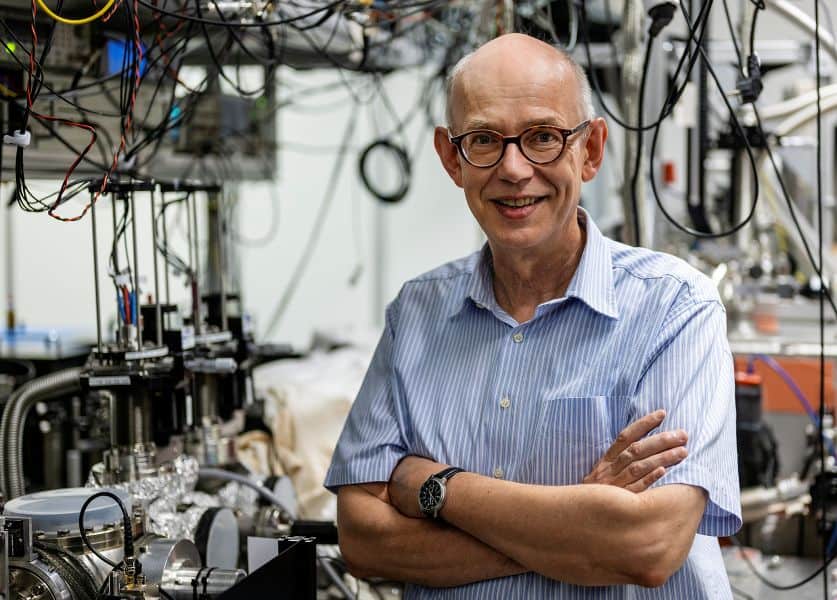
Promising transition: Ekkehard Peik with the nuclear clock experiment at PTB. In 2003, Peik and his then-colleague Christian Tamm identified a transition in the radioactive isotope thorium-229m as a promising basis for a nuclear clock. (Courtesy: PTB)
The PTB-TU Wien team applied their nuclear clock to fundamental physics, using it to search for ultralight scalar dark matter couplings and constrain fluctuations/drifts in the nuclear transition energy. Their results set limits on how dark matter can couple to photons and the strong nuclear force that are comparable to those derived from today’s best atomic clocks.
The primary focus of Ding and colleagues’ work was on technical aspects such as high-power vacuum ultraviolet (VUV) interrogation, clock performance, inter-crystal reproducibility and metrological consistency. The clock transition frequencies they measured in two independently fabricated crystals agreed both with each other and with previous measurements of the thorium-229 transition made using VUV frequency combs at JILA in the US.
Heading for higher precision
Peik says that he and his team are now working on boosting their laser power, improving the signal-to-noise ratio in their detectors, and studying the structure of the thorium dopant in their crystal to understand what determines the linewidth of the nuclear resonance within it. “We have now seen 30 kHz linewidth, but the natural linewidth should be way below 1 Hz, which would enable more stable clock operation,” he tells Physics World.
Ding says that an important next step for his team is to develop better host crystals than CaF2, which could lead to a substantially narrower nuclear transition and improve both stability and accuracy. He is also interested in creating a trapped-ion thorium nuclear clock that would be more isolated from its environment and could re-use many of the quantum control techniques developed for atomic and ion clocks. “It is technically much more difficult, but I think this route may ultimately provide the highest accuracy,” he says.
Victor Flambaum, a theorist from the University of New South Wales, Australia who was not involved in either project, calls the teams’ devices the “first prototypes of nuclear clocks”. He is excited by their potential for uncovering new physics effects, such as those produced by dark matter, which are expected to be very small. “We have shown that in nuclear clocks these effects are strongly enhanced,” he says.
Protonic ceramic electrochemical cells (PCECs) function as fuel cells, converting hydrogen into electricity, or as electrolysers, where electricity is used to split water into hydrogen and oxygen. This makes them useful in hydrogen energy systems because surplus electricity from integrated energy sources like nuclear, hydropower and geothermal can be converted into hydrogen, stored, and later converted back into electricity. Inside PCECs, two electrodes are separated by a ceramic electrolyte that controls the movement of hydrogen ions, which are protons.
Unfortunately, manufacturing the proton-conducting ceramic electrolyte layer is cumbersome. Long processing times involve multiple steps, including intensive ball-milling and high-temperature sintering, making protonic ceramics expensive to produce. In this work, the researchers investigated how PCECs could be manufactured more affordably, more rapidly and with better performance.
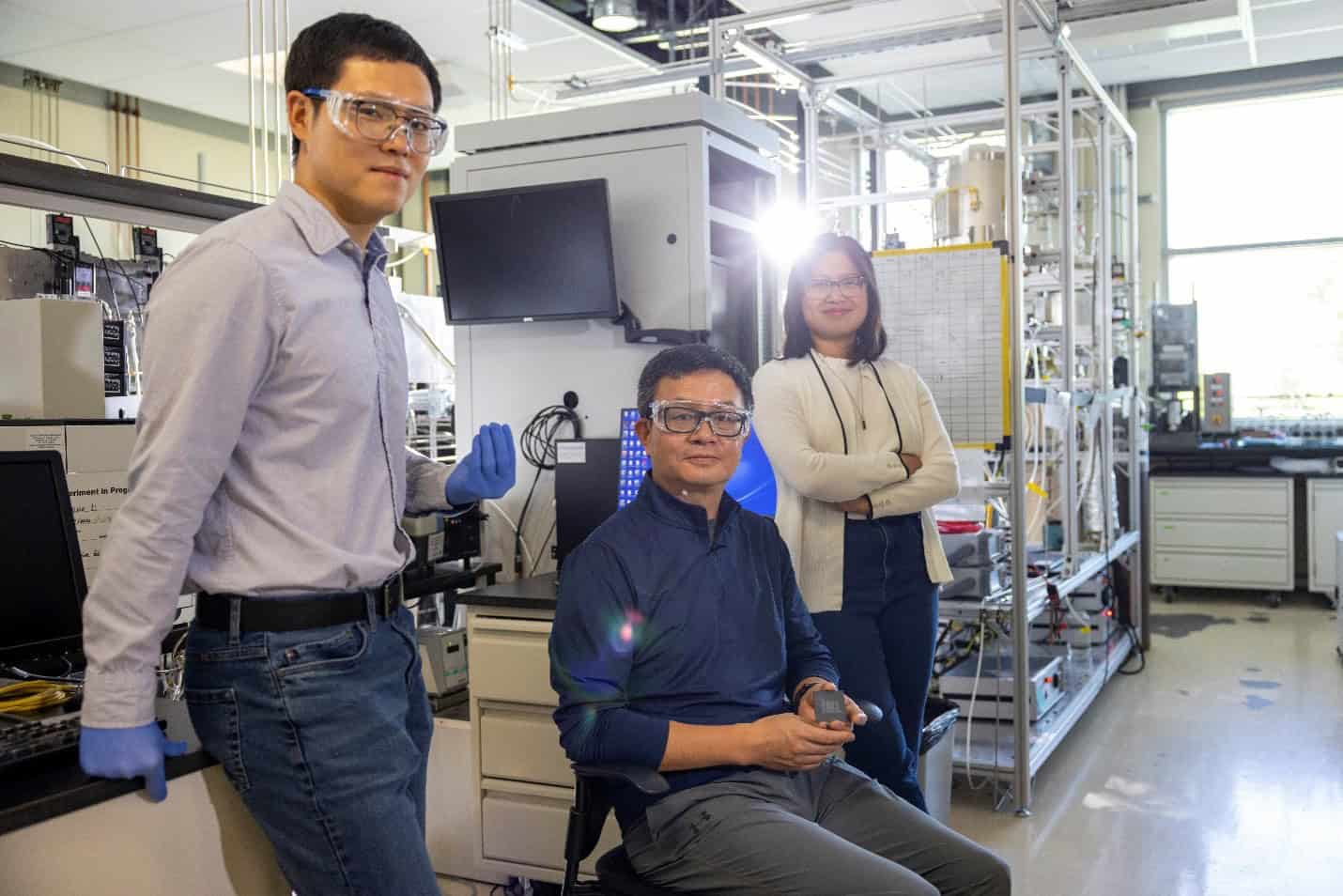
From left to right: Wei Tang, Dong Ding, and Wenjuan Bian, with a 5 cm × 5 cm protonic ceramic electrochemical cell fabricated using the team’s new n-SSR method. (Courtesy: Dong Ding/Idaho National Laboratory)
Instead of using larger precursor particles and grinding them for many hours, they started with nano-sized precursor powders. This enabled them to remove the ball-milling step entirely and reduce production time from 85 hours to 33 hours. In addition, it produced a finer electrolyte powder whose smaller particles packed together and sintered more easily, allowing the ceramic to become dense at temperatures around 100 °C lower than those required by the conventional method. The resulting electrolytes had lower electrical resistance, improving cell performance.
Compared with cells made using the conventional synthesis method, the new cells delivered up to 32% higher peak power density in fuel cell mode and 40% higher electrolysis current density at 600 °C, while maintaining stable operation for more than 500 hours. The process also reduced estimated electrolyte-powder fabrication costs by 25-29% and was successfully demonstrated in larger-area cells. This work could help accelerate the deployment of protonic ceramic electrochemical technologies for hydrogen production and energy conversion.
A quark is a fundamental building block of matter. There are six types known as flavours of quark: up, down, strange, charm, bottom, and top. Quarks combine to form particles known as hadrons. Most ordinary matter is made from up and down quarks, for example, a proton consists of two up quarks and one down quark, while a neutron consists of one up quark and two down quarks. Electrons belong to a different family of particles called leptons and are not made of quarks.
Particle physicists continuously test the Standard Model of particle physics to search for signs of new phenomena. One possibility is that quarks possess anomalous magnetic or electric dipole moments, which would indicate physics beyond the Standard Model. However, quarks are never observed in isolation because they are confined inside particles such as protons and neutrons.
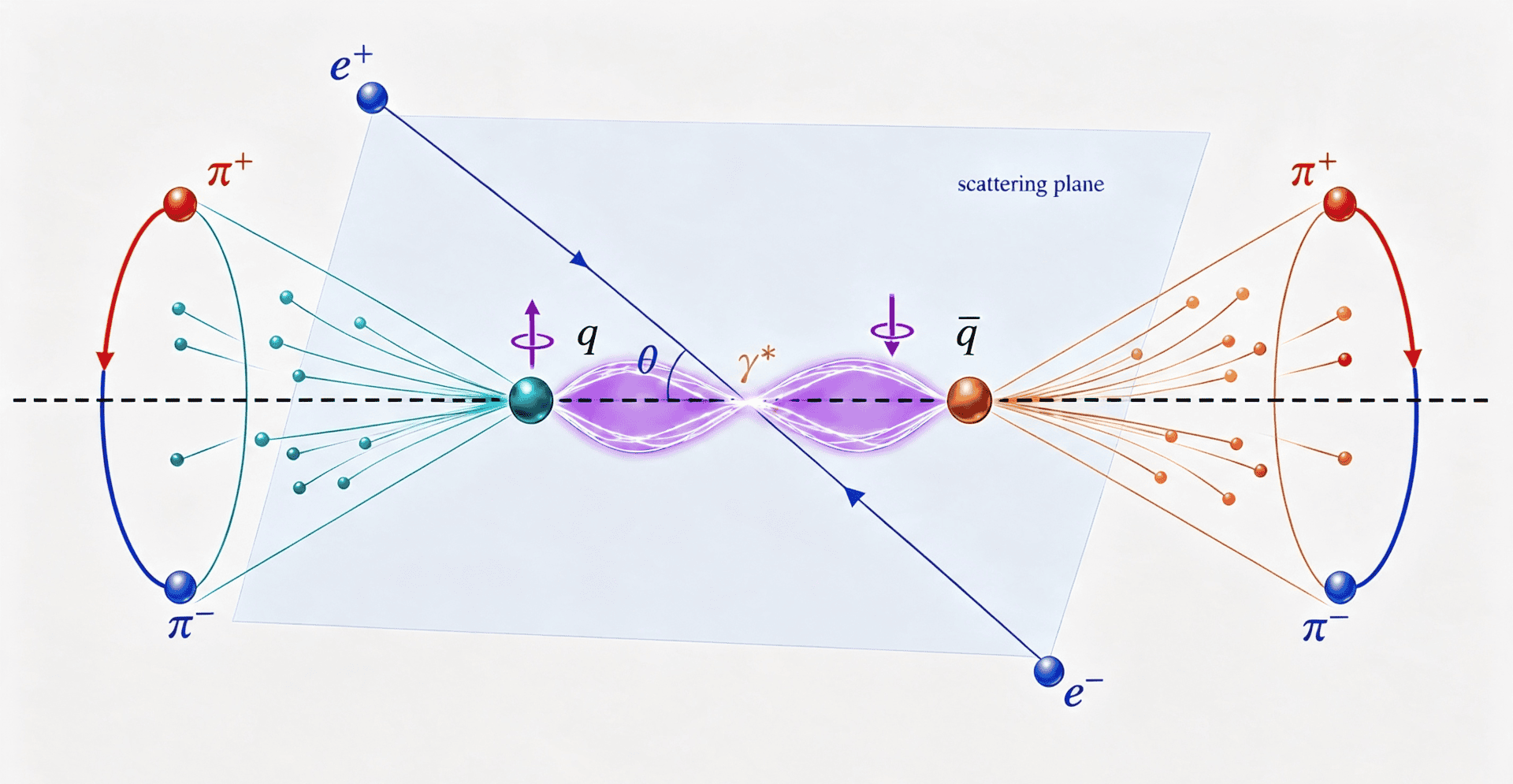
Schematic of the entanglement-based probe for quark electromagnetic dipole interactions. An electron-positron collision produces an entangled quark-antiquark pair. Anomalous magnetic or electric dipole interactions modify the spin correlation of the pair to be opposite orientation, leading to distinct azimuthal angular distributions of the fragmented hadrons. (Courtesy: Xin-Kai Wen/Chinese Academy of Sciences)
In this work, the authors study electron-positron collisions, which can produce quark-antiquark pairs. These quarks subsequently fragment into hadrons. By analysing the directions in which the hadrons emerge, information about the spins of the original quarks can be reconstructed. The authors show that anomalous magnetic or electric dipole interactions would modify the quantum-entangled spin state of the quark-antiquark pair in a characteristic way, producing either a spin-triplet state (for magnetic dipole interactions) or a spin-singlet state (for electric dipole interactions). These changes lead to measurable signatures in the angular distributions of the resulting hadrons. Rather than searching for an excess of events, the method probes changes in the spin-correlation structure of the quark-antiquark system.
The work introduces a new entanglement-based approach for probing the electromagnetic properties of light quarks. By connecting quantum spin correlations in hadron production with possible quark dipole interactions, it provides a complementary method for searching for physics beyond the Standard Model using collider data.
In magnets, the magnetic moments of electrons, known as spins, usually align in an ordered pattern. However, in a spin liquid, the spins never settle into a fixed arrangement. Instead, they continue to fluctuate collectively even at very low temperatures. In a chiral spin liquid, these fluctuations have a preferred handedness, similar to the difference between left and right hands or clockwise and anticlockwise rotation.
This research focuses on the pyrochlore lattice, a three-dimensional structure made of interconnected tetrahedra. Because of this geometry, the spins cannot all simultaneously satisfy their preferred interactions, making the system “frustrated”. This frustration can prevent conventional magnetic order and create the conditions needed for spin-liquid behaviour.
The researchers classified all possible chiral spin-liquid states allowed by the symmetries of the pyrochlore lattice. They then built theoretical models and performed simulations to predict how these states would appear in experiments. One unusual feature of spin liquids is that the collective motion of the spins can behave as if it creates emergent gauge fields, which resemble electromagnetic fields. The researchers found that some chiral spin liquids are dominated by these emergent gauge fields, while others are influenced more strongly by the spin-like excitations themselves.
The researchers showed that different chiral spin liquids have distinct signatures, providing a way to distinguish them experimentally. Their results offer a roadmap for identifying and classifying elusive three-dimensional chiral spin liquids in real materials.
Carbon is the 4th most abundant element in the universe. It’s everywhere, from the air you breathe to the carbohydrates in your food to the petroleum in the Earth’s crust. Like most elements, carbon was not created by the Big Bang, but came from 2 different types of stars that fuse lighter elements together.
Massive stars at least 8 times the Sun’s mass fuse 3 helium atoms into a carbon atom in their cores, through a mechanism called the triple-alpha process. They eventually expel this carbon into space, either through a stream of material called astellar wind or at the end of their lives during a core-collapse supernova.
Meanwhile, low-to-intermediate-sized stars between ½ and 8 times the Sun’s mass also induce the triple-alpha process. But unlike massive stars, they produce carbon not in their cores, but in a dense shell of helium that surrounds them during an advanced stage known as the asymptotic giant branch or AGB. AGB stars undergo cycles of swelling and contraction, during which they shed some of their material into space.
While scientists understand these processes, the contribution of each star type to the carbon supply in the universe remains uncertain. To address this, a team of scientists modeled how the chemical elements in the Milky Way Galaxy change over time with different contributions from the 2 carbon-creating processes. They then verified their findings by comparing them with the actual carbon concentration in the Milky Way.
To obtain the benchmark for the Milky Way Galaxy’s carbon content, the team turned to the catalog of stars observed by the Apache Point Observatory Galactic Evolution Experiment (APOGEE) survey. They selected 14,066 stars that were large and bright enough to yield reliable data but, unlike AGB and massive stars, were still at a stage of life when their newly produced carbon was still confined to their cores. The researchers used the carbon in the outer layers of these stars, known as subgiants, as a compositional record of the gas from which they formed, thereby estimating the Galaxy’s carbon content during their formation.
The scientists started with a computer program developed by another team that models how the Milky Way’s chemistry changes over time. First, the team calculated the potential amount of carbon produced by different types of stars using estimates from earlier studies. Then, they incorporated these results into a model that accounts for how stars form, fuse elements, and release carbon into the Galaxy, using a simulation program called the Versatile Integrator for Chemical Evolution, or VICE. The researchers ran 14 versions of this model, each assuming a different contribution of carbon from AGB stars relative to massive stars.
In their computer model, the Milky Way Galaxy began as a set of 200 concentric rings, each containing its own population of stars, different speeds at which stars form, and varying amounts of gas available to form new stars. The team then stitched these rings together by having stars migrate between them. They allowed these model Galaxies to settle over 10 billion years, then picked a random sample of 14,066 simulated stars to compare their carbon content with carbon in the same number of observed subgiants from APOGEE.
The team’s model most closely reproduced the actual carbon content of the Milky Way’s subgiant stars when AGB stars contribute between 10% and 40% of the Galaxy’s carbon, with the strongest agreement occurring at 15% to 30%. Even though they found that massive stars are the dominant source of carbon, they also found that smaller AGB stars could produce carbon more efficiently than previously thought, though they take longer to become carbon sources than their larger counterparts.
The team concluded that their estimates of how much carbon comes from AGB and massive stars provide a benchmark for future studies, as the connection between the production of elements inside stars and the processes by which those same stars lose mass remains poorly understood. They suggested that future researchers analyze larger sample sizes, examine other galaxies, and use data from future surveys to better understand the chemical history of the universe.
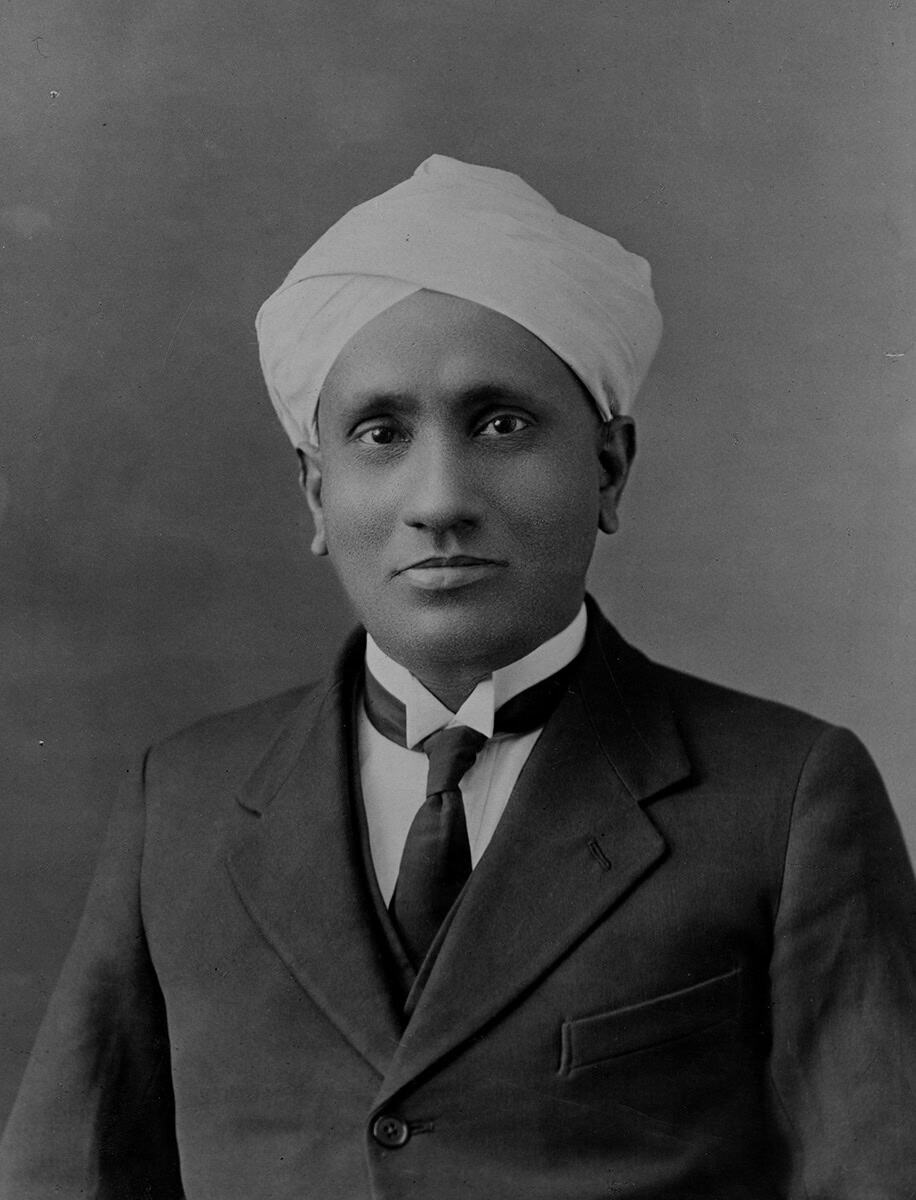
Cocksure and confident C V Raman sailed to Stockholm in 1930 convinced he’d win that year’s Nobel Prize in Physics. (Photograph by A Bortzells Tryckeri, courtesy of AIP Emilio Segrè Visual Archives, W F Meggers Gallery of Nobel Laureates Collection)
How confident, or perhaps delusional, do you have to be to travel to Stockholm because you’re so certain you’ll be awarded a Nobel prize? Most of us wouldn’t have the time, money or self-belief to go to Sweden and hang out at the Royal Swedish Academy of Sciences on the off-chance that we might win. But one person who did just that was the Indian physicist Chandrasekhara Venkata (C V) Raman in 1930.
Back in those days, travelling from India to Sweden wasn’t a case of jumping on a jet plane, but involved a long, two-month journey by sea. So if he wanted to arrive in Stockholm in time for the award ceremony on 10 December 1930, Raman knew he couldn’t wait until the prize was formally announced in mid-November to set sail. In July 1930 he therefore booked passage for himself and his wife, the couple arriving in Stockholm on 9 December of that year.
Raman’s audacity, belief and the arduous journey paid off. He was duly awarded the 1930 Nobel Prize in Physics “for his work on the scattering of light and for the discovery of the effect named after him”, namely Raman scattering. In doing so, Raman became the first person from India to win a scientific Nobel prize – the poet, playwright and musician Rabindranath Tagore having previously won the 1913 Nobel Prize in Literature.
Obsessive nature
Born on 7 November 1888 in the city of Thiruchchirappalli in Tamil Nadu, Raman was a child prodigy, who at 16 came top in physics at the University of Madras and published his first research paper aged just 18. Appointed a professor of physics at the University of Calcutta in 1913, Raman had a long obsession with winning a Nobel prize. In 1924, upon being elected a fellow of the Royal Society, he was asked during the award ceremony what was next in line for him. “The Nobel prize of course!” he replied.
The discovery that bagged Raman the coveted prize in fact began on another sea voyage
The discovery that bagged him the coveted prize in fact began on another sea voyage. In 1921 Raman was travelling back from Southampton to Bombay (now Mumbai) on the SS Narkunda, having taken part in the Second Congress of the Universities of the Empire in Oxford. Rather than lounging on the sun deck or drinking in the bar, Raman spent the 15-day journey examining and analysing the deep blue colours of the Mediterranean, Red and Arabian seas with his pocket Nicol prisms, a small telescope and a diffraction grating.
In fact, Raman did more than just take data. While on board, he wrote up his findings in a short letter that he mailed to the journal Nature while the ship was docked at Aden in Yemen. Published on 20 October 1921, it gives Raman’s address as “SS Narkunda, near Aden” (Nature108 242). He then wrote another paper to Nature (108 367) titled “The colour of the sea”, this time with the byline “SS Narkunda, Bombay Harbour”.
The spectrum of blue colours of the vast sea fascinated Raman and made him question the previous belief, primarily from the work by Lord Rayleigh, that the colour is simply due to the reflection of the sky – and has nothing to do with the colour of the water itself. Raman challenged this notion in his follow-up Nature paper, which was published on 17 November 1921.
Natural fascination C V Raman was awarded the 1930 Nobel Prize in Physics for discovering that light can change colour when passing through a material because some photons scatter inelastically off it. Now known as “Raman scattering”, he came up with the idea while sailing from the UK to India in 1921 and taking measurements of the deep blue colour of the sea. (Courtesy: iStock/Ciuvelic Razvan)
“It was abundantly clear from the observations,” he writes, “that the blue colour of the deep sea is a distinct phenomenon in itself.” Raman believed that light diffracts as it passes through the water and concluded: “An interesting possibility that should be considered is that the diffracting particles may, at least in part, be the molecules of the water themselves.”
This curiosity led him to a series of experiments over the next few years, primarily carried out by his students at Calcutta University, culminating in the discovery that light changes its wavelength and energy when it passes through any material. The change in wavelength and energy, in fact, is a fingerprint of the material itself.
His discovery of what became known as the Raman effect is what eventually won him his most cherished recognition – the 1930 Nobel Prize in Physics. One of the many applications of Raman’s discovery is Raman spectroscopy, which uses the scattering of laser light to establish the chemical make-up of a material and forms the basis of airport security scanners.
Indian impact
Raman’s Nobel prize was significant not just for the scientific advancements that his discovery enabled, but also for the far-reaching impact it engendered in India, where opposition to the British Raj was gathering speed. In fact, he won the award less than a year after the declaration of Purna Swaraj – complete independence – on 26 January 1930 in a session of the Indian National Congress in Lahore.
For a country reeling under colonial rule and fighting for its identity, Raman’s Nobel prize could not have come at a better time to instil hope and aspirations to millions of people around the country. In fact, he holds the honour of being the first physicist outside western Europe or the US to win the Nobel Prize in Physics.
Dream trip C V Raman (far left) picking up the 1930 Nobel Prize in Physics in Stockholm alongside (from left to right) fellow winners Hans Fischer (chemistry), Karl Landsteiner (medicine) and Sinclair Lewis (literature). (No known copyright restrictions, photographer unknown. Source: Wikimedia Commons)
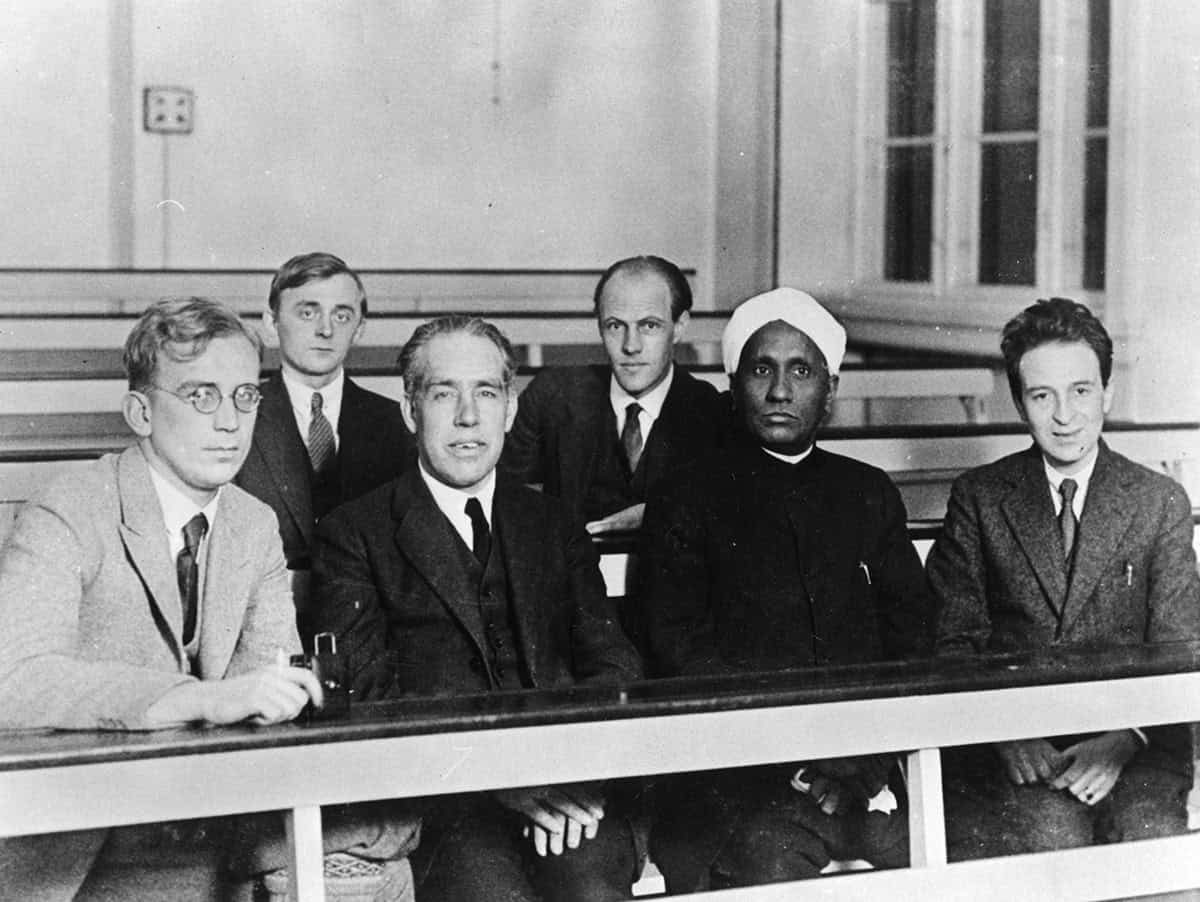
Raman was fully aware of the impact that the prize would have in India, where research was far less developed than that enjoyed by his counterparts in, say, Cambridge, Göttingen or Copenhagen. In 1929 he therefore hesitantly wrote a letter to the Danish Nobel-prize-winner Niels Bohr, asking for his “influential support” for the 1930 Nobel prize. The request of such “personal character”, he explained, was only because he believed that Bohr would “sympathize with the scientific aspirations of India”.
Unbeknownst to Raman, Bohr had already nominated him for a Nobel prize in 1929 – that year’s prize going to Louis de Broglie for wave–particle duality – and he did so again in 1930. We now know a total of 10 different people nominated Raman for that year’s prize, including de Broglie as well as Ernest Rutherford and Charles Wilson.
Raman’s research and notoriety led to many students being attracted to Calcutta, with the physics department becoming a centre of world-class research
Raman’s research and notoriety led to many students being attracted to Calcutta (now Kolkata), with the physics department becoming a centre of world-class research despite its small size and the lack of an established scientific culture and infrastructure in India. Other leading physicists to have worked there include the astrophysicist Meghnad Saha and the theorist Satyendra Nath Bose in what some have touted as a “golden era” for Indian science.
Sadly, it ended prematurely a few years after Raman’s Nobel prize due to conflicts between these three leading scientists. This was partly due to parochialism and partly, as his biographer, the condensed-matter physicist Ganeshan Venkataraman famously put it, Raman’s “Himalayan ego and sharp tongue”.
Moving on
In 1933 Raman left Calcutta, becoming the first Indian director of the Indian Institute of Science (IISc, earlier the Tata Institute of Science) in Bangalore (now Bengaluru). Rutherford, when asked by the institute’s council as to who should replace the outgoing director Martin Forster, had made it clear there was no need to seek directors in Britain when India had a “distinguished candidate in the shape of Raman”.
Mixing of minds C V Raman (second right) personally wrote to Niels Bohr (second left) for his support for the 1930 Nobel prize. The pair are shown here at the Niels Bohr Institute, Copenhagen, alongside George Gamow (far left) and Oskar Klein (far right) and Charles (back row, left) and Ebbe Rasmussen (back row, right). (Courtesy: AIP Emilio Segrè Visual Archives, Margrethe Bohr Collection)
In 1934 he went on to found the Indian Academy of Science, which was significant in that it provided a way for researchers across the country to communicate and discuss research findings. Just as important, however, was the fact that membership of the academy was reserved exclusively for Indian scientists, effectively signalling an act of rebellion against the British.
Raman’s time at the IISc was controversial. On one occasion, he turned down the application for a research fellowship by a female student – the biochemist Kamala Sohonie – because he believed women were not competent to conduct research. Raman reversed his decision, albeit with humiliating conditions, after Sohonie staged a Gandhian-style protest (Satyagraha) outside his office.
Within three years, Raman was forced to resign from the directorship following a fallout with the council, primarily for allegations of bias towards physics research and overshadowing other areas of research of the institute. He remained a professor at the IISc until retiring in 1948. Later that year, he founded the Raman Research Institute with which he was actively involved until his death in 1970 at the age of 82.
Raman’s legacy
Despite his controversial past, Raman is still the flag-bearer of Indian physics, owing to the Nobel prize and the global recognition he enjoyed. India holds a National Science Day every year on 28 February to mark the occasion in 1928 when Raman and his associate Kariamanickam Srinivasa Krishnan announced their discovery of Raman scattering to the media. The work was reported in newspapers on 29 February and was formally published on 31 March 1928 in a paper entitled “A new type of secondary radiation” (Nature121 502 ).
Almost a century on from his success, however, India has not yet produced another home-grown Nobel-prize-winning physicist. Raman’s nephew Subrahmanyan Chandrasekhar did share the 1983 Nobel Prize in Physics with William Fowler for his work on the evolution of stars, but he was based in the UK and then the US when the work for which he was recognized was carried out.
Raman’s divisive personality and sharp opinions turned more people against him than his ingenuity and scientific legacy ever won over
Sadly, Raman’s divisive personality and sharp opinions turned more people against him than his ingenuity and scientific legacy ever won over. His obsession with global recognition can be sensed from his reaction upon first receiving news of his Nobel prize, which came while he was en route to Stockholm. Learning of the award from his Calcutta collaborator Suri Bhagavantam, Raman’s first reaction was to ask if he was the sole awardee or whether he was to “share the bed with other strangers”.
Given his “Himalayan ego”, it should perhaps come as no surprise that Raman decided to travel to Stockholm on a whim. We do not have any documentation about what he thought or did on that two-month voyage. But for him, at least, it was a journey that was not wasted.
Find out more from Preetish Kakoty about C V Raman’s life on the Physics World Weekly podcast.
SmarAct proudly supports Physics World‘s Nobel Prize coverage, advancing breakthroughs in science and technology through high-precision positioning, metrology and automation. Discover how SmarAct shapes the future of innovation at smaract.com.
An important low-carbon technology is the hydrogen fuel cell, which can be used in vehicles, backup power systems and other applications. Fuel cells convert hydrogen into electricity, producing only water as a by-product. A key process inside the cell is the oxygen reduction reaction, in which oxygen from the air is reduced at the cathode. This reaction is relatively slow and is one of the main factors limiting fuel-cell performance.
To speed up this step, platinum catalysts are used. While highly effective, platinum is expensive and gradually degrades during operation. Much research therefore focuses on reducing the amount of platinum required while improving performance and catalyst lifetime. One approach is to use platinum alloys, where a cheaper metal is mixed with platinum to improve efficiency. However, these alloying metals can gradually leach out, causing the catalyst to lose activity over time.
In this work, the researchers aimed to address the trade off between catalytic activity and long-term durability by investigating two alloy catalysts, platinum-copper (PtCu) and platinum-iron (PtFe). These were attached to a two-dimensional material, similar to graphene, called a MXene, which can improve performance while helping to hold the nanoparticles in place and enhance their stability. PtCu/MXene showed the highest catalytic activity, as copper modifies the platinum surface to improve oxygen reduction and accelerate the reaction. PtFe/MXene was less active but more durable, with strong Fe-O-MXene interactions helping to stabilise the catalyst during long-term operation.
By using in-situ X-ray spectroscopy, the researchers were able to observe the catalysts during operation and identify the structural and electronic changes responsible for their performance. This revealed how alloy composition and catalyst supports influence activity and durability, the study provides a roadmap for developing improved catalysts for future fuel cells.
In some materials, when many electrons interact very strongly, they behave collectively like a quantum fluid with unusual properties. One example is a Fractional Quantum Hall state, which occurs in a two-dimensional system under a strong magnetic field. In this state, the electrons form a topologically ordered quantum fluid that supports unusual collective excitations.
A Fractional Chern Insulator aims to recreate the same type of physics without requiring such a strong magnetic field. Instead, the crystal lattice and electronic band structure are engineered to mimic the effects of the magnetic field.
The electron fluid has an internal geometric structure that describes how electrons are correlated with one another. When this internal geometry oscillates collectively, it produces a special excitation known as a graviton mode.
In this work, the authors developed new mathematical tools and performed large-scale computer simulations to search for graviton modes in lattice-based systems. They then smoothly transformed a known Fractional Quantum Hall state into a Fractional Chern Insulator and showed that the graviton mode persists throughout the transition.
Graviton modes were already known to exist in Fractional Quantum Hall systems and have recently been observed experimentally. However, it was unclear whether they could survive in a Fractional Chern Insulator because the crystal lattice breaks some of the symmetries that are thought to protect these excitations.
Min Long from Meng’s research group at the University of Hong Kong and Zeno Bacciconi from Dalmonte’s group at the ICTP, Università di Bologna. Picture taken by Cheng Huang during Zeno’s visit in Hong Kong. (Courtesy: Dalmonte/Università di Bologna)
The authors found that graviton modes do survive on the lattice. They showed that the Fractional Chern Insulator graviton is not a completely new excitation, but is continuously connected to the graviton found in Fractional Quantum Hall systems. They also found that the graviton decays much more slowly than many researchers expected, meaning it remains a well-defined excitation. Finally, the work suggests that graviton modes could provide a valuable experimental signature for identifying exotic topological phases such as Fractional Chern Insulators.
“It is remarkable how geometric excitations can govern the behavior of inherently discrete lattices, demonstrating unexpected universal features of topological quantum matter.“ – Zi Yang Meng, The University of Hong Kong, and Marcello Dalmonte, Università di Bologna.

 Login