 Login
Meta launches an open-weight AI model that runs on Macs
15 October 2026 at 21:04
Meta and Apple have teamed up for the launch of the social media giant's newest model, Muse Spark Open, which will run locally on Apple silicon.


We're about eight days into Amazon's new line of Kindles, and users are already reporting problems with its display.
While the 2026 Amazon Kindles bring notable improvements over previous iterations, users have started reporting display oddities (via Android Authority). One user on Reddit provided a photo of their basic Kindle, showcasing the "light bleed" effect they're experiencing. The post reads, "I wanted to ask if you think these very bright lights around the edges of the new basic Kindle are normal."
The problem only seems to appear when the Kindle is in dark mode. This "light bleed" is most apparent along the edges of the device's bezels. Since it's in dark mode, the glow mirrors the white text that you'd read. As the user states, their other device doesn't have such an issue, as the black background presses against the bezels. However, this 2026 edition falters in this regard.
Others believe this is not normal, as they recount experiences with a Paperwhite 2024, which didn't have this problem. Users report similar problems with their 2026 Kindle; however, some haven't noticed an issue. Many call for those with this light bleed issue to contact Amazon for a replacement, but that might be easier said than done.
Amazon delivered to Android Authority: "It’s correct that when a device is in dark mode with brightness at max in a dark setting, customers may see a glow around the edges of the book. However, this was expected in order for us to achieve a color bezel, and only appears in certain conditions like when in dark mode with high brightness."
If the light bleed becomes too much of an eyesore, Amazon recommends lowering your brightness in dark mode.
Light bleeding in new basic 2026from r/kindle
Many users on Reddit have voiced their frustrations with this development. Amazon's 2026 Kindle lineup is its most redesigned series in years. The company overhauled its display, delivering a reverse-stack that drops the raised bezels so everything sits flush. As a result, Amazon made the Kindle lighter and thinner.
The six-inch Kindle for $150 delivers 16GB of storage, six weeks of battery, and quickens its book-opening speed by 30%. Consumers will also find a $200 Kindle Paperwhite and a $250 Signature Edition. Another major announcement was the Bluetooth page-turner remote. Amazon calls this the Kindle Click. Many of the current Kindles are available now for shipping.
If you're looking at the Paperwhite and Colorsoft models, you'll have to pre-order them.

This episode of the Physics World Weekly podcast features Ignacio Cirac, who has won the 2026 Isaac Newton Medal and Lecture for his “pioneering contributions that founded modern quantum information science, uniting profound theoretical insight, experimental vision, and exceptional scientific leadership shaping quantum physics and technology worldwide”.
Cirac is director of the theory division at the Max-Planck-Institute for Quantum Optics in Germany.
In conversation with Physics World’s Michael Banks, Cirac explains how an early interest in mathematics and science fiction drew him to quantum information – along with the field’s potential to create new technologies.
He talks about his collaboration in the 1990s with Peter Zoller to design quantum simulators and computers based on trapped-ion qubits. Cirac weighs up the pros and cons of the qubit technologies available today and highlights the benefits of systems based on Rydberg atoms.
Looking to the future, Cirac cautions against quantum hype and points out that it is still not clear how quantum technologies will be used in the future. He also calls on European academics to maintain their scientific excellence and for more money to be invested in the continent’s quantum industries.
This podcast is supported by American Elements, the world’s leading manufacturer of engineered and advanced materials. The company’s ability to scale laboratory breakthroughs to industrial production has contributed to many of the most significant technological advancements since 1990 – including LED lighting, smartphones, and electric vehicles.
The post Ignacio Cirac: Newton Medal winner looks to the future of quantum technology appeared first on Physics World.
Francis Halzen wins the 2026 Nobel Prize in Physics “for decisive contributions to the IceCube Neutrino Observatory and the discovery of high-energy neutrinos of astrophysical origin”.
The prize will be awarded in Stockholm, Sweden on 10 December and is worth SEK 12 million (about $1.2 million).
Born in Belgium, Halzen is based at the University of Wisconsin–Madison in the US. Nearly four decades ago Halzen realized that the ice at the South Pole could be used to detect cosmic neutrinos. The first attempt was called AMANDA, which was completed in 2000 but not large enough to be up to the task. It was expanded to create IceCube by the end of 2010.
IceCube comprises thousands of light detectors in a cubic kilometre of Antarctic ice. Occasionally a neutrino will interact with the ice and create particles that generate light as they travel through the ice. By tracking these particles, Halzen and colleagues can determine where in the sky the neutrino came from.
Speaking on the telephone shortly after the announcement Halzen said, “It was a great surprise and I didn’t expect it. It’s a great pleasure to hear about this prize.”
He added, “When I reflect on this moment, I have to say how lucky I am. This was an adventure where success was not guaranteed, but we overcame many challenges. It was a long journey. I want to emphasize again how lucky I was to take contributions from collaborators. It feels strange. I hope it reflects on the courageous people who joined me on this project. Many talented people joined me on this journey.”
He was also thankful for the support of his university, “I was lucky to be in the right place [Wisconsin] when this idea [to build IceCube] came up.”
Commenting on whether neutrinos could be used to communicate with extra-terrestrial beings, Halzen quipped, “This has already been proposed by several friends of mine. It has been speculated that this would be an ideal way to communicate with aliens but I don’t think I will go there. I think we have enough realistic problems to deal with right now to make neutrino astronomy a reality.”
When asked what he will do for the rest of today, Halzen replied “I’m working on a proposal. I hope this prize will help get it approved.”
“Halzen had the idea together with a colleague in 1988 to use the ice at the South Pole as a medium to detect neutrinos,” said Mark Pearce, chair of the Nobel Committee for Physics, who is also an astroparticle physicist at KTH Royal Institute of Technology in Stockholm.
Pearce adds, “Halzen has spearheaded an international collaboration of more than 450 people from 58 institutions in 14 countries around the world to realize this enormous neutrino detector.”
Halzen is the first sole winner of the Nobel Prize in Physics since Georges Charpak won it in 1992, with Pierre-Gilles de Gennes being the previous lone laureate in 1991.
This is the fifth Nobel prize related to neutrinos. The first went to the discovery of the muon neutrino, which was recognized by the Nobel committee in 1988. It was followed by the first observation of the neutrino itself (1995), the detection of cosmic neutrinos (2002), and the discovery of neutrino oscillations – the fact that neutrinos can switch from one type to another – in 2015.
Pearce explains why physicists are so fascinated by the elusive subatomic particle: “The neutrino has such peculiar properties, the fact it interacts so infrequently in material, and in this case it’s a way of bringing information about distant cosmic sources that we are unable to acquire in other ways.”
Halzen was born in Tienen, Belgium, in 1944. He graduated with an MSc in physics from the University of Louvain in 1966 and then a PhD from the same university in 1969.
After a stint at the CERN particle-physics lab, he moved to the University of Wisconsin–Madison in 1972, where he also became the principal investigator on the AMANDA neutrino observatory in Antarctica and the IceCube project.
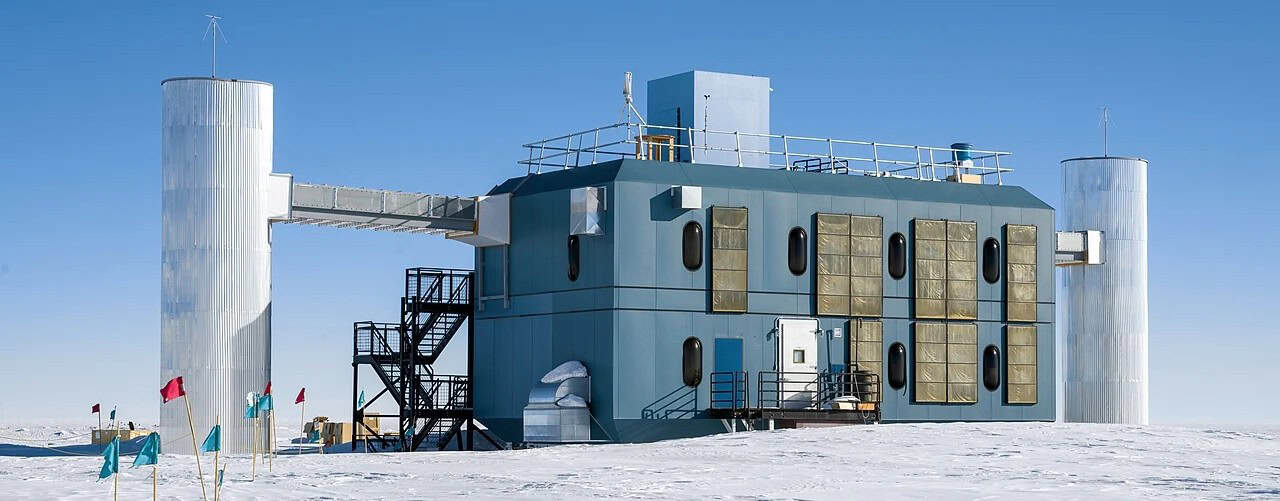
IceCube was completed in late 2010. Then, it comprised 5160 digital optical modules suspended along 86 strings, each up to 2.5 km long and embedded under the ice at the Amundsen-Scott South Pole Station. The strings are spaced to create a total detector volume of a cubic kilometre. Neutrinos interact with matter only extremely weakly, so the array instead detects the tiny flashes of Cherenkov light produced when the neutrinos collide with hydrogen or oxygen nuclei inside the ice and create secondary particles. Under ideal circumstances, the detector signal can be used to work out where in the sky the neutrino came from.
In 2013 the IceCube Collaboration published details of its observation of 28 extremely high-energy particle events, created by neutrinos with energies of at least 30 TeV. The findings represented the first evidence for high-energy cosmic neutrinos, which originate from outside the solar system.
Two years later, IceCube confirmed the cosmic origin of high-energy neutrinos with an independent search in the Northern Hemisphere. This study examined muon neutrinos reaching IceCube through the Earth, using the planet to filter out the large background of atmospheric muons. Data analysis suggested that more than half of the 21 neutrinos detected above 100 TeV were of cosmic origin.
In 2018 IceCube, along with astronomers working on two gamma-ray telescopes, found compelling evidence that a known blazar – called TXS 0506+056a and located about 4 billion light-years from Earth – was a source of high-energy neutrinos detected by IceCube. This was an important milestone in multimessenger astronomy, whereby astronomical objects are studied by observing several different types of radiation.
Another breakthrough came in 2021 when IceCube was the first to spot an interaction called a Glashow resonance. This interaction was first predicted in 1960 and involves the collision of high-energy antineutrino with an electron to create a W boson. In 2022 the galaxy NGC 1068 was identified as a source of high-energy neutrinos and in 2023 IceCube showed that the Milky Way is also a source of high-energy neutrinos.
Earlier this year an upgrade of IceCube added more than 600 new light sensors in five new holes drilled in the ice near the centre of the detector.
Physics World is brought to you by IOP Publishing, which has a portfolio of more than 100 journals, around half of which are published jointly with or on behalf of partner societies and research organizations. Francis Halzen has published more than 150 papers with IOP Publishing and you can explore them here.
SmarAct proudly supports Physics World‘s Nobel Prize coverage, advancing breakthroughs in science and technology through high-precision positioning, metrology and automation. Discover how SmarAct shapes the future of innovation at smaract.com.
The post Francis Halzen wins Nobel Prize in Physics appeared first on Physics World.
The facts are simple enough.
Abdus Salam shared the 1979 Nobel Prize in Physics with Sheldon Glashow and Steven Weinberg for “their contributions to the theory of the unified weak and electromagnetic interaction between elementary particles, including, inter alia, the prediction of the weak neutral current”.
What Salam had done was to incorporate the Higgs mechanism – co-discovered by his colleague at Imperial College London Tom Kibble – into electroweak theory, which unifies the electromagnetic and weak forces.
As the Imperial theorist Claudia de Rham said in a 2024 interview with Physics World, Salam’s work “changed the way we see the world by underlining the importance of symmetry and by showing how some forces – which may appear different – are actually linked”.
But Salam, who died in 1996 after suffering from a cruel neurodegnerative disease, did more than unify the weak and electromagnetic interactions. He also became the first – and so far the only – person from Pakistan to win a science-related Nobel prize, yet for a long time remained overlooked in his homeland.
Salam was born on 29 January 1926 in the Punjabi city of Jhang in what was then British India. A child genius, he studied mathematics at Government College, Lahore, completing his master’s degree in 1946 with record marks (getting 765/850 or 90%).
Later that year Salam moved to the UK after winning a scholarship to study at St John’s College, Cambridge, studying initially mathematics and then physics, gaining a double first-class honours in 1949.
Back home, India was in turmoil, with a growing demand for independence from the British, and the Muslims seeking a homeland for themselves.
As a Muslim himself, Salam would no doubt have celebrated when Pakistan was created during the partition of India, with the country coming into existence at the stroke of midnight (0.00 a.m.) on 14 August 1947.
After completing his PhD in quantum electrodynamics at Cambridge in 1951, Salam returned to Pakistan, taking up a teaching post at Government College, keen to establish a research base in the fledgling country. But lacking journals, colleagues or any proper scientific infrastructure in Pakistan, Salam realized he would have to go abroad again.
“Either I must leave my country or leave physics,” he said. “And with great anguish I choose to leave my country.”
In 1954 Salam went back to Cambridge for three years before appointed a professor of applied mathematics at Imperial in 1957. He later switched to Imperial’s physics department, where he set up a renowned theoretical-physics group that he led for much of the rest of his life.
In 1964 Salam also founded the International Centre for Theoretical Physics (ICTP) in Trieste, Italy, to help support physicists from developing nations.
But Pakistan was always in his heart. Salam served for 13 years as presidential science adviser in Pakistan and in the 1970s also played a slighly murky role in the country’s nuclear-weapons programme.
Upon winning a Nobel prize in 1979, Pakistan had existed for only 32 years, meaning it, along with Austria, is the joint 13th quickest nation to win a Nobel Prize in Physics, according to our Physics World infographic.
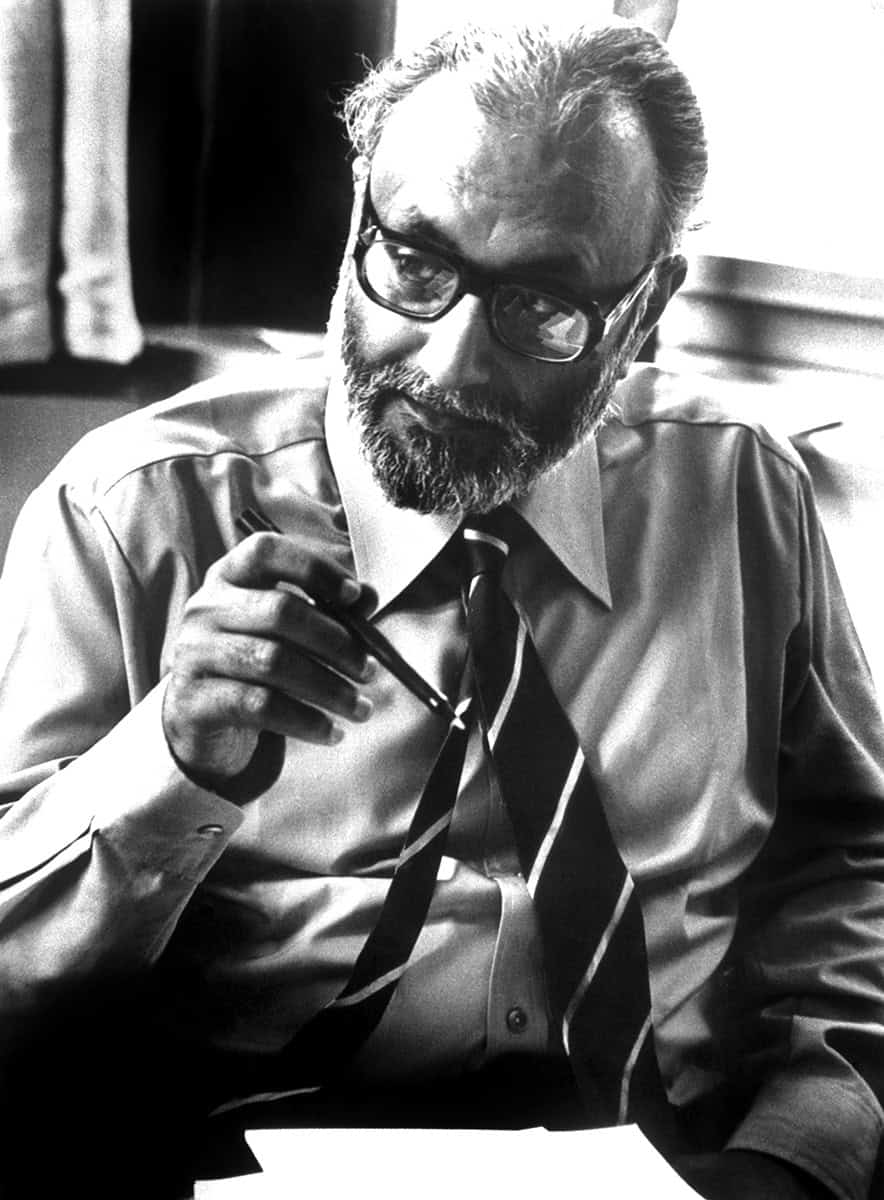
At the official Nobel banquet in Stockholm on 10 December 1979, Salam thanked the Nobel Foundation and the Royal Swedish Academy of Sciences. “Pakistan,” he declared, “is deeply indebted to you for this.”
Yet back home, little was made of Salam’s impressive award. Most Pakistanis are Sunnis but Salam was an Ahmadi, part of a minor Islamic movement founded in the late 19th century by the religious leader Mirzā Ghulām Ahmad (1835–1908).
Such was the opposition in Pakistan to the Ahmadis that in 1974 the country’s parliament declared them non-Muslims – heretics essentially – and the constitution was altered to reflect that fact.
Pakistan’s decision to outcast the Ahmadis profoundly affected Salam. As he wrote in his diary: “Declared non Muslim. Cannot cope.” Having previously been largely a “cultural Muslim”, Salam now saw his religious beliefs re-awakened.
Belatedly, Pakistan did offer some formal recognition in the form of a two rupee stamp in 1998, but it is surprising the country has not done much more. In 2016 Physics World reported that then Pakistani prime minister Nawaz Sharif was going to rename the National Centre for Physics at Quaid-i-Azam University in Islamabad as the Professor Abdus Salam Centre for Physics – but, as far as I can tell, that has not taken place.
Imperial, in contrast, renamed its main library in honour of Salam in 2023 and this year has been celebrating the centenary of his birth. The ICTP was also renamed after him in 1997.
A few years ago Zakir Thaver and Omar Vandal produced a wonderful documentary film called Salam: the First ****** Nobel Laureate. Directed by the physicist Anand Kamalakar, it explores in detail the strange relationship between Salam and Pakistan, which surely should have done more to honour its greatest physicist.
I can’t imagine other countries doing so little for their first Nobel prize winners as Pakistan has for Salam.
SmarAct proudly supports Physics World‘s Nobel Prize coverage, advancing breakthroughs in science and technology through high-precision positioning, metrology and automation. Discover how SmarAct shapes the future of innovation at smaract.com.
The post Abdus Salam: Pakistan’s first (and so far only) physics Nobel prize-winner appeared first on Physics World.
Cyril Hilsum, a former president of the Institute of Physics (IOP), which publishes Physics World, died on 23 September at the age of 101. In the 1970s Hilsum made pioneering contributions to liquid crystals paving the way for TV and computer liquid-crystal displays that are still widely used today.
Hilsum was born on 17 May 1925 and completed a degree in physics at University College London in 1945. He then joined the Admiralty Research Laboratory in Teddington before working at the Services Electronics Research Laboratory in Baldock.
Throughout his career, Hilsum focused on developing commercial applications for many areas of his research including creating the UK’s first semiconductor laser.
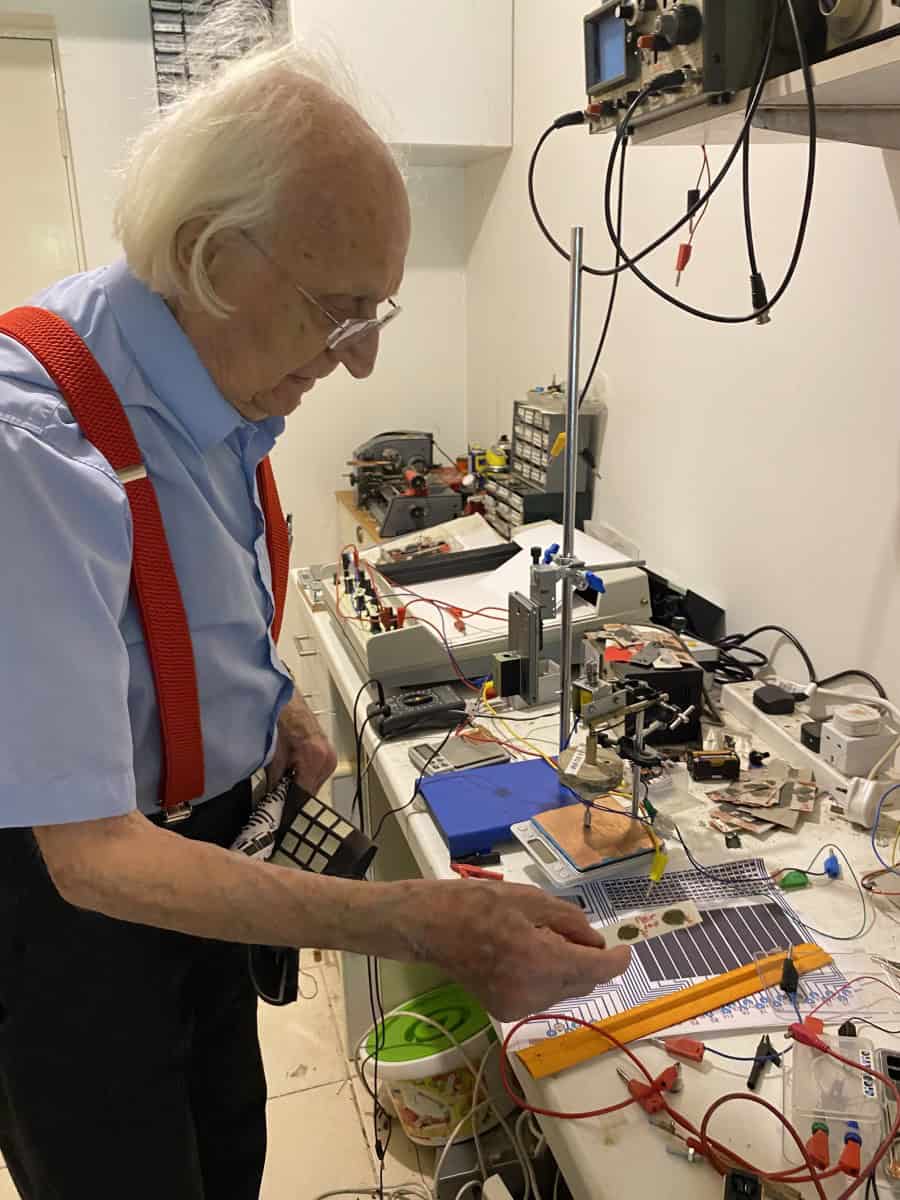
In 1964 he moved to the Royal Radar Research Establishment in Malvern, Worcestershire, developing the first microwave oscillator based on the negative resistance effect in the semiconductor gallium arsenide.
His work on miniature radar systems led to Claribel, a device that detected the trajectory of a bullet and could be used to locate snipers.
He also led a team that developed the first stable liquid crystals that could be used in flat panel displays, an invention that garnered £100m in royalties for the British government.
In 1983 Hilsum was appointed chief scientist of GEC Hirst Research Centre, where he later became research director two years later.
Hilsum officially retired in 1995 aged 70, but worked part-time as chief science officer for Infi-tex Ltd, which produces force sensors for use in textiles.
Hilsum served as president of the IOP between 1988 and 1990, in which year he was also appointed a Commander of the Order of the British Empire (CBE) for his “services to the electrical and electronics industry”.
Over his career, Hilsum was honoured with many prizes including three awards from the IOP: the Max Born Prize in 1987, the Faraday Medal (1988) as well as the Richard Glazebrook Medal and Prize (1998).
In 2007 he was awarded the Royal Society’s Royal Medal “for his many outstanding contributions and for continuing to use his prodigious talents on behalf of industry, government and academe to this day”.
Hilsum also encouraged more women to have careers in physics and engineering. He sponsored the Karen Burt Award at the Women’s Engineering Society, which was named after his daughter, an engineer, who died in 1997 aged 42.
Hilsum celebrated his 100th birthday last year at a special event held at the Royal Society of Chemistry.
Former IOP president Frances Saunders, who worked in liquid-crystal displays, told Physics World that Hilsum was a “true pioneer in applied physics”, adding that as well as finding applications for such emerging technologies he always wanted to ensure that the underlying physics or material science was properly understood.
“What also made him stand out was his vision for where a technology might go – in the early developments of LCDs his vision was that the display would become the computer with the computer chips attached to the back of the display and interacted with via touch screens,” adds Saunders. “He was right, of course, as we now have tablets and smart phones that do just that.”
The post Cyril Hilsum, former GEC research boss and Institute of Physics president, dies aged 101 appeared first on Physics World.
Palliative care has long been framed as a specialist discipline reserved for hospices and oncology wards, but a growing body of evidence insists it belongs everywhere people approach the end of life, including nursing homes, where a large share of deaths in ageing societies now occur. A new qualitative study from Sweden, published in BMC Nursing, offers an unusually candid look at what happens inside care teams after they receive structured palliative care education, and the central finding is striking: training changes how staff think, but thinking alone does not change care. The researchers, Camilla Ekeblom, Carina Lundh Hagelin and Jane Österlind of Marie Cederschiöld University in Stockholm, found that the value of an educational intervention depends on an intricate alignment between individual emotions, relational dynamics and organisational realities, and that when any one of these dimensions falls out of step, the benefits of education can quietly dissolve.
The study set out to explore how nursing home staff reason about providing palliative care after participating in an interprofessional educational intervention, abbreviated in the literature as IPEI. Rather than measuring outcomes with questionnaires, the team chose a descriptive qualitative design, interviewing eighteen staff members drawn from five Swedish nursing homes. The participants represented the full spectrum of people who actually deliver and manage care: registered nurses, assistant nurses, a physician, first-line managers and designated palliative care champions. This breadth matters, because palliative care in nursing homes is not delivered by any single profession; it emerges, or fails to emerge, from the daily interplay of people with different training levels, responsibilities and emotional exposures to dying residents.
Data were collected through semi-structured individual interviews conducted between March and April 2024, and analysed using inductive qualitative content analysis, a method that allows themes to rise from the material itself rather than being forced into pre-existing theoretical boxes. From this analysis, three main categories emerged, and together they map the terrain on which palliative care is actually practised. The first concerns managing one’s own emotions, thoughts and attitudes. The second addresses the significance of relationships, communication and interactions in care. The third captures how staff navigate norms, assumptions and organisational structures in everyday palliative care. The categories correspond, respectively, to the individual, relational and organisational dimensions of the work, and the authors argue that it is the interplay among all three, not any single factor, that determines whether good palliative care becomes possible.
The individual dimension is perhaps the most human part of the findings. Staff described the ongoing internal work of confronting their own feelings about death, ageing and suffering, and of examining assumptions they carried about what palliative care even means. A recurring tension in the literature, echoed here, is the tendency to equate palliative care narrowly with end-of-life care, the final days and hours, rather than understanding it as an approach that can and should be integrated into everyday care over a longer trajectory. The interviews suggested that the educational intervention gave participants opportunities for personal as well as professional development, creating space to reflect on attitudes that had previously gone unexamined. In this sense, education functioned less like a knowledge transfer and more like a mirror, prompting staff to notice how their own emotional responses shaped their clinical decisions.
The relational dimension proved equally consequential. Palliative care in a nursing home is saturated with communication: conversations with residents about what matters to them, exchanges with distressed relatives, coordination between assistant nurses who know the residents intimately and nurses and physicians who carry clinical responsibility. The participants’ reasoning placed relationships and interactions at the heart of care provision, indicating that no amount of theoretical knowledge substitutes for the ability to build trust, listen and communicate across professional boundaries. This is where the interprofessional design of the intervention appears to have paid off. By bringing different professions into a shared educational space, the programme created a common language and, implicitly, a shared understanding of what the team was trying to achieve together, something that fragmented, profession-specific training often fails to produce.
The third dimension, the organisational, is where the study’s message becomes most uncomfortable for policymakers and care home leadership. Staff described navigating norms and assumptions embedded in their workplaces, along with structural conditions that could either support or obstruct a palliative approach. Staffing levels, routines, leadership priorities and workplace culture all shape what is practically possible on a shift where residents are dying, families are anxious and time is scarce. The authors’ conclusion is explicit on this point: providing palliative care was not solely a matter of enhancing staff knowledge. Knowledge and the conditions for care are shaped through the interplay between staff attitudes, their reasoning about care, relational dynamics and organisational conditions. When these dimensions align and mutually reinforce one another, favourable conditions for palliative care may be supported; when they do not, even well-trained staff may find their intentions frustrated.
Why does this matter on a societal scale? Nursing homes accommodate older people with complex needs and account for a large proportion of deaths, which makes palliative care a central component of care in these settings rather than an occasional emergency. Yet access to palliative care remains unequal, particularly for older people, and staff in long-term care often lack sufficient training. The demographic arithmetic is unforgiving: as populations age, the number of people who will die in nursing homes rises, and the quality of their final months depends heavily on the competence and confidence of the workforce that cares for them. Studies like this one move the conversation beyond the simplistic assumption that a training course fixes the problem, and toward a systems view in which education is necessary but insufficient on its own.
The study also carries a methodological lesson for how we evaluate educational interventions in care settings. Much of the existing research measures knowledge gains or self-reported confidence before and after training. Those metrics are useful, but they cannot reveal how staff actually reason about applying what they have learned in the messy reality of daily care. By using inductive content analysis of interviews, the Swedish team surfaced the texture of that reasoning: the hesitations, the emotional labour, the negotiations with colleagues and managers, the quiet adjustments between ideal practice and what the shift allows. The findings suggest that interprofessional educational initiatives work best when they combine theoretical knowledge with opportunities for reflection and practical application, allowing staff to translate concepts into their own working context rather than leaving translation to chance.
There are limits worth noting. The study involved eighteen participants in five Swedish nursing homes, interviewed at a single point in time after the intervention, and qualitative findings are not designed to be statistically generalised. The researchers themselves submitted the work for ethical review, receiving approval from the Swedish Ethical Review Authority, and obtained written informed consent from all participants, but the transferability of the results to other health systems will depend on how similar those systems’ nursing homes and educational programmes are to the Swedish context. Still, the three-dimensional framework that emerged, individual, relational and organisational, offers a portable lens that other teams can use to examine their own settings, and it aligns with a broader international consensus that palliative care competence must be built at every level of an organisation simultaneously.
The most durable insight from this research may be its refusal to locate the solution in any single place. Staff who completed the intervention perceived it as an opportunity for growth, and their reasoning showed genuine movement in how they understood palliative care as an ongoing approach rather than a final act. But their accounts also made clear that attitudes, relationships and structures must pull in the same direction for that understanding to reach residents’ bedsides. For nursing homes everywhere, the implication is a practical checklist of a different kind: train your staff together, give them room to reflect, examine the norms your workplace quietly enforces, and make sure the organisation’s daily conditions match what the education teaches. Where those elements align, palliative care stops being an aspiration and becomes, simply, the way care is done.
Subject of Research: Nursing home staff's reasoning about providing palliative care after an interprofessional educational intervention
Article Title: “Nursing home staff’s reasoning about providing palliative care following an educational intervention – a qualitative interview study”
Article References: Ekeblom, C., Lundh Hagelin, C., & Österlind, J. (2026). “Nursing home staff’s reasoning about providing palliative care following an educational intervention – a qualitative interview study”. BMC Nursing, 25(1), Article 956. https://doi.org/10.1186/s12912-026-05480-4
Image Credits: AI Generated
DOI: 10.1186/s12912-026-05480-4
Keywords: palliative care, nursing homes, older people, interprofessional education, qualitative research, nursing education, end-of-life care, care staff attitudes, organisational conditions, Sweden, BMC Nursing, healthcare workforce
Most galaxies have a massive black hole near their center. But some black holes may be far from the middle, drifting through the galaxy for billions of years. Astronomers say these wanderers could help answer a question about the early universe: how did the first black holes form? A black hole can begin to wander […]
The post Black Holes on the Move May Reveal How Galaxies Grew appeared first on Knowridge Science Report.
