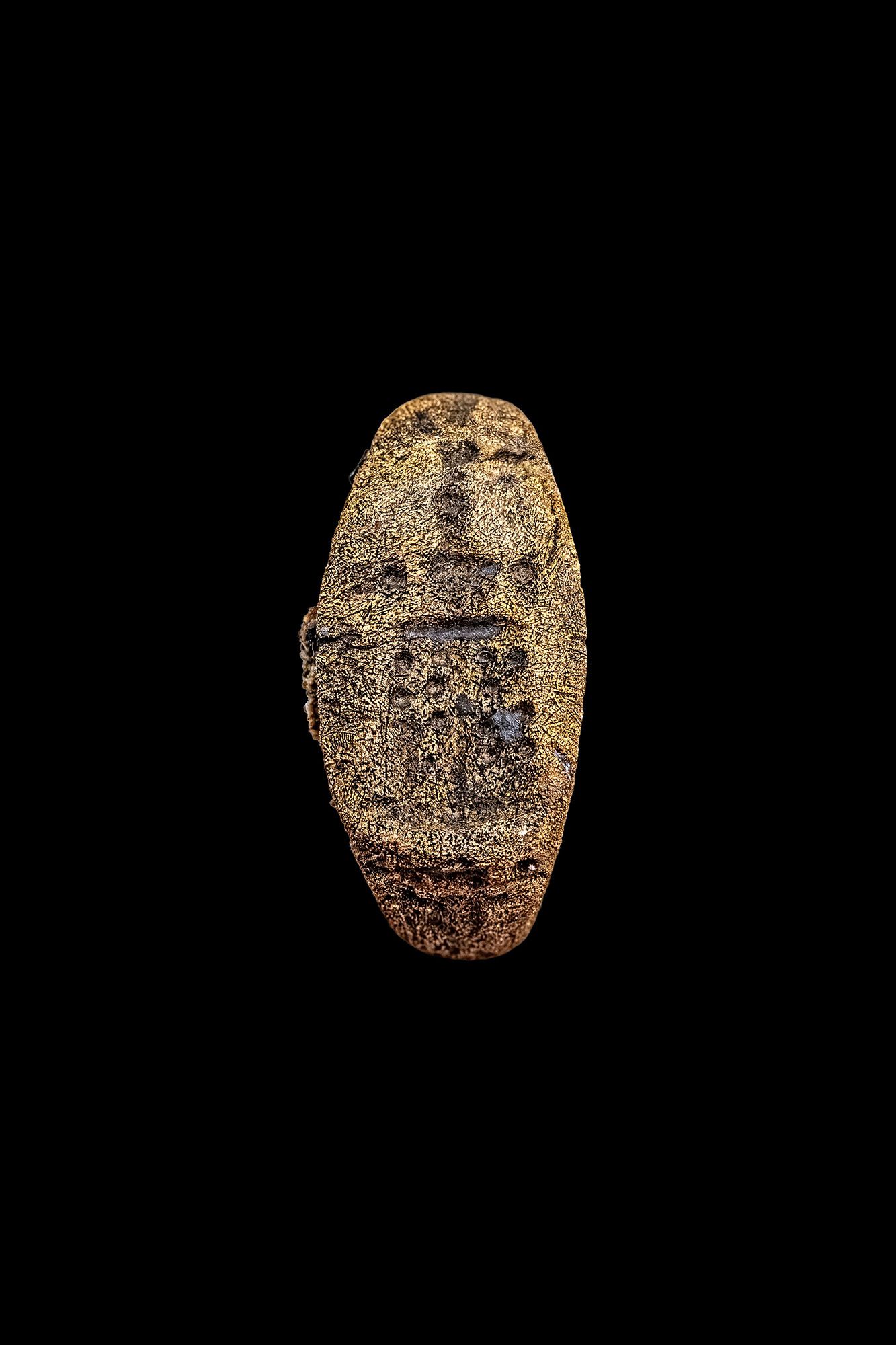
A bronze signet ring depicting the Lighthouse of Alexandria, a wonder of the ancient world, has been discovered underwater in the Mediterranean off Alexandria, Egypt.
A joint team from the European Institute for Underwater Archaeology (IEASM) and the Egyptian Ministry of Tourism and Antiquities found the artifact in the remains of a palace on the now-submerged island of Antirhodos, marking the first time a signet ring featuring the image of the lighthouse has been found, the IEASM team said in a statement.
The image on the ring is similar to depictions of the lighthouse that have been previously found on coins dating to the second century, representatives of IEASM said.
"The discovery of the ring-signet is even more important as it has been excavated in the legendary palace of the Island of Antirhodos, that once was a centre of power," Franck Goddio, president of IEASM, said in the emailed statement.
The palace was used by Egyptian pharaohs who reigned during the Ptolemaic period (304 to 30 B.C.), a dynasty of rulers descended from one of Alexander the Great's generals. The lighthouse was built on the island of Pharos around 280 B.C. and stood more than 328 feet (100 meters) tall. Some ancient writers, such as Pliny the Elder, considered it among the wonders of the world, and it continued to be used into the Middle Ages, until earthquakes and erosion resulted in its destruction and disappearance beneath the sea.
While the lighthouse was modified over time, it would have had a statue, possibly of Zeus, at the top holding an oil lamp that helped guide mariners.
Whoever was wearing a signet ring could have used it to make an impression on soft materials, such as clay and wax, to create a seal. The discovery of the ring in the remains of the palace at Antirhodos suggests that the palace was used for administrative functions related to the lighthouse, representatives of IEASM said in the statement.
Even though the ring's engraving is somewhat worn, it likely depicts the lighthouse, said Doris Behrens-Abouseif, a professor emeritus of history of art and archaeology at the University of London who has written about the lighthouse but was not part of the research team.
There are "thousands of coins from Alexandria showing a similar depiction of the lighthouse," she told Live Science in an email. Those coins date to the Ptolemaic or Roman (29 B.C. to A.D. 395) periods, she noted.
Behrens-Abouseif added that she wasn't familiar enough with rings from Alexandria to comment on whether this is the only ring that contains this image.
Other scholars told Live Science that they, too, believe that this ring depicts the lighthouse, with two scholars noting that it may feature smoke coming from a lamp at top.
The "most interesting thing about the new signet ring engraved gem is an asymmetrical feature at its peak," which "may depict a plume of smoke from the oil lamp in the hand of the crowning statue," Andrew Chugg, an independent researcher who wrote the book "The Pharos Lighthouse in Alexandria: Second Sun and Seventh Wonder of Antiquity" (Routledge, 2024), said in an email.
Margaret Miles, a professor emeritus of art history and classics at the University of California, Irvine, also noticed the possible plume of smoke. Miles noted in an email that this "ring could have been used as a signet ring by a merchant from Alexandria who used the profile of the [lighthouse] to signal his location in Alexandria. The lighthouse was famous, so it became a symbol of the city."
Research off the coast of Alexandria over the past few years, including the discovery of 22 massive blocks, has revealed more information about the lighthouse, including how exactly it looked, which is helping researchers who are trying to digitally reconstruct it.
Are you a fan of mummies and hieroglyphs? Find out with our ancient Egypt quiz!
Archaeologists have unearthed evidence that men, women and children were subjected to violence within their communities in ancient Scandinavia — and that these victims were buried in unusual places, such as pits or wells or under a family's house or yard.
During the Scandinavian Iron Age and Viking Age (from roughly 500 B.C. to A.D. 1050), violent encounters between individuals and communities steadily increased, resulting in archaeological evidence of elite warrior burials and mass graves from battles.
To better understand the context of violence in the Iron and Viking ages, researchers analyzed 192 human bones from people buried in domestic areas at settlements in what are now Denmark, Norway and Sweden.
"The fact is that not all bodies ended up in monumental burial mounds in the Iron and Viking Ages, or even in more modest urnfields and cemeteries," the researchers wrote in a study published Sept. 28 in the Journal of Archaeological Method and Theory. Rather, some bodies — or pieces of bodies — were placed in postholes, pits, floors, wells, houses, yards and feasting halls.
The archaeologists discovered that at least 12 of the individuals had sustained a violent injury around the time of death. Half of those cases involved head trauma, while four people suffered multiple injuries. Most of the victims of violence were adult males, but there were two females and a child as well.
In one Iron Age house in Denmark, built sometime between 500 and 1 B.C., archaeologists discovered a frontal bone from the skull of a child who died between the ages of 2 and 4 years old.
The skull of a child aged 2 to 4 from Aalborg, seen from different angles, and showing the damage from a sword cut. The skull was later placed on the floor of a house. (Image credit: National Museum of Denmark)
"Our DNA analyses show that it is a small boy who has been cut with a sword," study first author Marianne Hem Eriksen, an archaeologist at the National Museum of Denmark, said in a translated statement. "The child's skull was placed on the floor of a house where people continued to live. This means that someone has walked over a child's skull day after day."
Radiocarbon dating revealed that the child's skull is significantly older than the house itself, by as many as two centuries, suggesting the bone may have been kept for some time before being placed in the house floor, according to the study.
At a Viking Age site dated to around 750 to 1050, archaeologists found a young woman's skull in a well near a cluster of four small houses. "The woman's skull bore traces of blows and was buried in a well," Eriksen said. She may have been cut or slashed with a sword or ax and, like the child, her bones may have been kept for a significant amount of time before being buried in the well. "These glimpses of lives lived from the past show how fascinatingly different people must have thought about life and death," Eriksen said.
And at the Viking Age site of Gammel Lejre, a royal feasting hall that many experts consider to be the inspiration for the epic Old English poem "Beowulf," archaeologists found the burial of a man whose skeleton bore numerous blunt force injuries, several of which had healed, and which attested to a difficult and likely painful life. His skeleton was discovered directly south of the feasting hall.
The study of bones in domestic areas "opens up a completely new understanding of Iron Age society, of the occurrence of violence and of the handling of the dead," Eriksen said. "The results show a much greater complexity in the everyday life and world of imagination of the time than we often attribute to Iron Age people."
But it is unclear exactly why these particular people were the victims of violence and why they were buried in such unusual ways. One possible scenario, the researchers wrote in the study, is that these were victims of violent domestic encounters rather than warfare. Their deaths may also have been the result of socially acceptable corporal punishment or some form of aggression within the community.
Given the increase in social inequality and rise in violence in the Iron and Viking ages, the researchers suspect that precarious community members may have been targeted.
"Not all lives were equally grieved and commemorated in the Iron and Viking Ages of Scandinavia," the researchers wrote. "We may question whether some lives were already considered disposable."
See how much you know about ancient norsemen with our Viking quiz!
The ancient Egyptians practiced human sacrifice around 5,000 years ago, a period shortly after the country was first unified, a new study finds.
In the new study,Roselyn Campbell, an anthropology researcher at Purdue University, re-examined 46 skulls from individuals who were buried near royal tombs that belonged to King Djer, King Djet and Meretneith (a woman who likely ruled Egypt at times), and were built near the ancient sacred city of Abydos. All three rulers lived during the first dynasty, a period that started around 5,000 years ago when Upper Egypt and Lower Egypt were unified into one kingdom. The sacrificed retainers were buried next to the tomb of the king they had served.
Researchers first excavated the royal burial site in the early 20th century. At the time, the excavator, Flinders Petrie, believed that the hundreds of other burials found near the royal tombs contained nonroyals, such as retainers and other people who served the king. Moreover, it appeared that these nonroyals had been sacrificed after the king they had served died, in the belief that they could serve the king in the afterlife.
However, Petrie was unable to identify evidence of fatal skeletal trauma, and his idea that they were sacrificed has been debated ever since. Petrie reburied most of the human remains, but 46 skulls were retained and preserved in the Duckworth Collections at the University of Cambridge.
In the new study, published Monday (Oct. 5) in the journal Frontiers in Environmental Archaeology, Campbell re-examined these 46 skulls using modern forensic techniques and information about the marks that different types of trauma leaves on human skeletons. Campbell found that 18 of the skulls have signs of trauma that were likely fatal — indicating that these individuals were likely sacrificed, according to a statement from the journal. Specifically, Campbell found that many of the skulls had linear fractures, which Petrie had mistaken for damage that occurred after burial.
Mike P Shepherd via AlamyMike P Shepherd via Alamy
Linear fractures "occur when the cranium strikes or is struck by a relatively large object with low overall force; because of the cranium's globular shape, the impact of the blow disperses across the cranial vault," Campbell wrote in the study. "While linear fractures are not always immediately lethal, they often cause intracranial lesions and/or hemorrhage, which can quickly cause loss of consciousness and death if surgery [to relieve pressure] is not performed."
Campbell told Live Science in an email that it's difficult to identify the weapon or object that was used. "Based on comparative forensic and archaeological studies, the most likely implement would have been flat and relatively light, probably made out of something like wood rather than stone," she said.
The practice of human sacrifice seems to have ended in the second dynasty of Egypt. Evidence for human sacrifice is limited and seems to be confined mainly to the first dynasty. Petrie theorized that they were retainers to the king based on the fact that some were buried with gravestones that had titles such as seal-bearer which suggested that they served the king.
"As far as we can tell, this particular type of retainer sacrifice seems to have ended with the close of the First Dynasty, which means it [lasted] around two centuries or possibly less," Campbell said.
Jacobus van Dijk, an Egyptologist at Groningen University in the Netherlands who was not involved with the study, welcomed the new research. The "existence of retainer sacrifice in early Egypt has always been controversial and Dr Campbell's research adds an important argument in support of scholars who, like myself, believe this custom was practised in Egypt in the early dynastic period," he told Live Science in an email.
He noted he was surprised at the method used for human sacrifice, because depictions of ritual killing on wooden labels "seems to indicate that the victim was kneeling with his hands tied behind his back being stabbed in the chest with a knife."
Are you a fan of mummies and hieroglyphs? Find out with our ancient Egypt quiz!
Archaeologists have discovered a temple dedicated to the Roman war god Mars in the wooded foothills of the Taunus mountains in Germany. The temple was part of a military settlement that was built in the third century to defend the border of the Roman Empire against Germanic tribes.
The Roman military constructed thousands of forts across Europe, northern Africa and western Asia while expanding the empire, and most of these fortifications had an adjacent settlement, called a "vicus," that was occupied primarily by merchants, families and other civilians.
Since 2024, archaeologists have been excavating the Kapersburg Roman fort and its adjacent vicus in Hesse, roughly 16 miles (26 kilometers) north of Frankfurt, according to a Sept. 25 translated statement from the Hessen State Office for Monument Preservation.
One of the highlights of the current excavation is the unexpected discovery of a Roman temple, Kai Mückenberger, an archaeologist with Hessen Archaeology, a part of the Hesse State Office for Monument Preservation, said in a translated video. "Inside the temple, we found several fragments of a dedicatory inscription," he said. Experts have already translated a portion of the inscription, which mentions that the temple was dedicated to Mars, the Roman god of war.
"We also have the remains of a Mars [statue]," Mückenberger said, as well as a statuette of "a winged figure holding a palm branch and laurel wreath," which is likely the ancient Roman goddess Victoria, a personification of victory in battle.
When archaeologists first excavated the Kapersburg fort near the turn of the 20th century, they discovered that it was built in the early second century, likely under either Emperor Trajan, who ruled from A.D. 98 to 117, or Emperor Hadrian, who reigned from A.D. 117 to 138 and expanded the Roman Empire further into northern England, building Hadrian's Wall. The Kapersburg fort was used by a unit of Roman soldiers and cavalry for about a century and a half, until around A.D. 275.
Although the fort's defensive structures and some of its walls have been visible since antiquity, practically nothing was known about its nearby vicus prior to the excavations that began in 2024, according to Mückenberger.
"The astonishing thing is the exquisite preservation of the archaeological layers that start right beneath the forest floor," Mückenberger said. These layers, which include burnt material, almost never survive in agricultural areas but have been well preserved at the vicus. "This is an incredible learning process and a gain in knowledge for us," Mückenberger added.
During their excavations, the research team discovered far fewer houses than they expected. However, they found much more evidence of craft activities, such as blacksmith pits and ovens for drying wheat and baking bread.
"These are all very technical elements related to local services, indicating that we're in a kind of intermediate area not directly adjacent to the fort itself, but perhaps more like the fort's craft area," Mückenberger said.
The temple and votive statues provide new insight into the Roman world of beliefs on the border of the empire, according to the statement. But when the fort was no longer useful, the Romans leveled the camp and replaced it with residential buildings, the archaeologists discovered.
Mückenberger and his team plan to continue their excavation of the site next year.
From Augustus to Nero, see how much you know about ancient Rome's famous leaders with our Roman emperor quiz!
This burial urn depicts a person, accompanied by skulls, as they are received into the Maya underworld. (Image credit: The Walters Art Museum; (CC0 1.0 Universal))
QUICK FACTS
Name: Urn with jaguars and skulls
What it is: A ceramic burial urn
Where it is from: Guatemala
When it was made: Circa A.D. 600 to 900
This colorful ceramic urn depicts a person wearing a jaguar costume and surrounded by human skulls, about to be received into the Maya underworld. The urn once held the bones of an ancestor for their descendants to venerate.
The urn was anonymously gifted to The Walters Art Museum in Baltimore in 2008. According to the museum, the urn is about 17.5 inches (44.5 centimeters) tall and was likely produced in Guatemala by the K'iche' Maya people more than a millennium ago. Originally, the urn probably had an elaborate lid that was tied on with string through the loops near the lip of the vessel, but it is now missing.
The decoration on the urn is striking. A person wearing a jaguar costume splashed with blood — claws and teeth bared — looks out at the viewer from the center of the urn. This individual may be a deceased ruler who is entering the world of the dead, which is symbolized by two pairs of human skulls and the dark figures of two Maya gods of the underworld. Behind the underworld gods are raised spikes representing thorns of the tropical kapok tree (Ceiba pentandra).
The Maya believed that the kapok tree, which was also called the Maya "world tree" or the Yaxche, had roots in the aquatic underworld, so its depiction on this funerary urn may reflect how it is a conduit between realms, according to The Walters Art Museum. Jaguars also held important spiritual meaning to the Maya; they were thought to move fluidly between the three realms — sky, Earth and underworld. Therefore, the depiction of the deceased ruler wearing a jaguar costume to enter the underworld may have suggested that they could also mediate between the world of the living and the Maya gods.
This colorful and symbol-laden urn shows that death was not an ending for the Maya, according to The Walters Art Museum, and that the urn "serves as a graphic reminder of how the dissolution of the body could be a positive change, transforming a beloved ancestor into an honored spirit who would continue to guide the living for eternity."
For more stunning archaeological discoveries, check out our Astonishing Artifacts archives.
Nearly 2 million years ago, a leopard in Africa sank its teeth into the face of an early human. This bite etched tiny tooth marks into the unlucky person’s jawbone. That bone now speaks to a chilling early chapter in our history: when humans were prey.
The fossil belongs to Homo habilis. It’s one of the earliest members of our genus. (Homo includes modern humans and our closest relatives.) At first glance, the bone marks look like scratches. But a recent, close analysis tells another story. The bite marks suggest leopards hunted these early folk.
That discovery helps solve a fossil mystery. It also raises questions about a time when humans held a more precarious spot in the food web. Sometimes people ate meat. Other times, they were the meat being eaten.
That threat of becoming prey to some other predator likely shaped how humans evolved. To survive, our ancestors learned to count on each other for protection. They may have lived and worked in groups, sharing information about dangers and teaching each other skills. Over generations, these behaviors could have helped people become more cooperative and successful.
Today, it’s easy to imagine our early ancestors as fearless hunters, chasing prey across ancient savannas. But that image reflects a time late in our evolution. Before we became one of the world’s most successful predators, we first had to survive life as prey.
The cliffs of Olduvai Gorge in Tanzania have yielded a trove of ancient human fossils. They preserve evidence of a time when human survival on the savanna meant competing with — and sometimes losing to — powerful predators.ChrisCrafter/iStock/Getty Images Plus
When humans were on the menu
Much of what scientists have learned about ancient humans comes from fossils found at Olduvai Gorge, in Tanzania. Since the 1930s, researchers have unearthed many bones from our early ancestors at this site in southeastern Africa. They include a pair of tooth-marked jawbones.
Sharp stones likely served as knives. Cut marks on animal bones suggest early humans ate meat. This led many scientists to assume H. habilis was a hunter. But these early people may have dined on leftovers scavenged from bigger, stronger predators.
The bitten human jawbones add another angle to this story.
Marina Vegara-Riquelme studies our human ancestors and their fossils at the University of Alcalá in Spain. She led a team that examined H. habilis bones using artificial intelligence, or AI. Her group wanted to know what animal had left its bite marks on a human jaw.
Different carnivores have different eating habits. Hyenas often scavenge dead carcasses. Leopards, in contrast, rarely eat meat they didn’t kill. Knowing which one left the marks would suggest whether the H. habilis had been hunted or died some other way.
Tooth marks produced by a leopard are visible on this Homo habilis jawbone. Two pits, shown in insets, matched bite marks from a leopard.M. Vegara-Riquelme et al/Annals of the New York Academy of Sciences 2025
Even experts can struggle to tell apart the tooth marks of a leopard from those of a hyena, Vegara-Riquelme notes. But AI can. By comparing thousands of details, it can spot patterns too subtle for the human eye to see. Her team used thousands of tooth-mark images from modern carnivores to train the AI. Then they showed it the bones in question.
“Two Homo habilis specimens show tooth marks most likely inflicted by leopards,” Vegara-Riquelme says. That makes it look less like scavenging.
Study co-author Manuel Domínguez-Rodrigo co-directs the Institute of Evolution in Africa in Madrid, Spain. To him, it’s clear how the encounter ended. “That individual was preyed upon,” he says. “Not scavenged.”
If true, what had the lives of H. habilis been like with lions and leopards as neighbors? Could survival have required new traits that helped our ancestors ascend the food web?
Homo habilis, which lived about 2.4 million to 1.4 million years ago, got its name — “handy man” — from its use of stone tools. Homo erectus, which emerged around 1.9 million years ago, had body proportions similar to modern humans.Man_Half-tube/DigitalVision Vectors/Getty Images
Life in a world of predators
For millions of years before H. habilis, our ape ancestors spent most of their time in trees. They might venture to the ground now and then. But when danger emerged, they’d dart into the trees and out of reach.
By the time H. habilis evolved, humans were walking upright (though not as well as today’s H. sapiens), spending far more time on the ground.
An open savanna offered new opportunities. Ambling upright helped early humans travel farther. It also gave them a better vantage to spot potential food across the landscape. But being out in the open may have made them easier targets, too, for powerful predators.
Craig Stanford studies predator and prey relationships among primates. He’s an evolutionary biologist at the University of Southern California in Los Angeles. He’s spent years in Tanzania watching Africa’s monkeys work together and protect one another.
Life on the open savanna would have been risky for early humans, he says. Even if predators killed only a few people, the threat would have shaped how early species lived and behaved.
“Predation may have been rare, but that doesn’t mean it was unimportant,” Stanford says. “There’s no question that predation influenced our evolution.”
Many prey species rely on group living for protection. “You have more eyes to detect a predator coming,” Stanford explains. When one animal spots danger and yells an alarm, others can run or climb to safety.
And safety in numbers isn’t just about watching. It can also help to fight back.
Many primates find safety in numbers. Largely tree-dwelling colobus monkeys, like these, have been known to team up to defend their group against a much larger chimpanzee.kunstbada/Creatas Video+/Getty Images Plus
In Tanzania, Stanford saw male colobus monkeys work together to fend off threats. They would leap onto chimpanzees that threatened them. An adult male chimp weighs about 54 kilograms (120 pounds); a colobus monkey only about 9 kg (20 lbs). “So three [monkeys] together weigh half of what the chimp weighs,” Stanford says. “They’re biting the chimps.” Such group attacks could fend off a chimp.
Early humans on the open savanna may have similarly benefited from teaming up. Faced with threats from big cats, people who were more alert and willing to cooperate may have been more likely to survive. If so, they could have passed along those traits to their offspring.
Survival wasn’t just about not becoming someone else’s meal, though. It also was about getting access to your own high-quality food. Here, too, cooperation would have helped.
Briana Pobiner works at the Smithsonian’s National Museum of Natural History in Washington, D.C. She studies what ancient humans ate and how they got their food. Marks on fossil bones can say a lot about this, she says.
Early humans would have cut meat from wherever they could get it. Consider butchery marks on bones that don’t have a lot of meat on them — “like ankle bones and lower foot and leg bones,” says Pobiner. Here, she says, “We think [humans] mostly got the scraps after the predators ate.”
Such a pattern suggests people were scavenging.
Marks of stone-tool butchery show up here, on a roughly 1.5-million-year-old animal bone from Kenya.B. Pobiner
With large prey, early humans likely ate after big carnivores had already taken the better meat. That doesn’t mean these humans didn’t hunt. They may have captured smaller animals on their own. Taking down large prey, however, would have been much harder and more dangerous.
“Early humans probably got the not-great parts of animals when they were able to eat meat,” Pobiner says. “The predators were getting the best parts.”
Fossils can’t directly show cooperation. But the bone markings suggest humans gained better access to meat over time. Researchers think teamwork may have helped make that possible.
Working in groups would have given humans a better chance of getting larger prey and better meat. Sharing meat may have strengthened social bonds. Plus, large carcasses are hard for one person to process or defend.
Such cooperation may have paved the way for humans to become more successful.
Human species across time
This chart shows the emergence (and later die-offs) of many humans — Homo species — throughout the past 3 million years. Notice how far apart H. habilis and H. sapiens are.
Adapted from H. Thompson/Science News
Learning to control fire
People likely evolved group living for several reasons, cautions Richard Wrangham. He works at Harvard University in Cambridge, Mass. As a biological anthropologist, he studies how fire has shaped human evolution.
Around 1.8 million to 1.5 million years ago, fossils show the rise of a new species of human, Homo erectus. Compared to earlier species, such as H. habilis, H. erectus had longer legs, a larger body and a bigger brain. These changes suggest humans were better adapting to life on the ground. This may have included sleeping there rather than in trees.
Here, fire also may have been key. “Once you’ve got fire, it increases the amount of protection against predators substantially,” Wrangham says. Flames and smoke would have scared off big cats, especially at night. He says, “I would imagine that there was much more predation of [early humans] prior to fire.”
Groups able to control fire may no longer have needed to retreat to trees each night. Sleeping on the ground would have marked a major shift in human evolution. With time, arms got shorter. Legs got longer. Walking and running became more efficient. Such changes would have made them more effective hunters, too.
People who could travel long distances could also track prey across broad savannas.
Controlling fire may have protected early humans from predators. For many reasons, it likely changed how they lived, slept — and ate. Some scientists, such as Richard Wrangham, argue that cooking (with fire) is what allowed humans to ascend to the top of the food web.
Cooked food is easier to digest. That extra energy could have allowed brains to grow bigger and more complex. Wrangham explored this idea in the 2010 book, Catching Fire: How Cooking Made Us Human.
Ours is the only human species alive today. But earlier in history, multiple human species lived — and evolved — beside each other. Fossils suggest that not all of these species advanced at the same pace. The pressures of avoiding predators while getting enough food may have nudged some species higher in the food web. As a result of these gradual changes, some species flourished. All but one of them — H. sapiens — died out.
By 300,000 years ago, stone-tipped spears appeared. Archaeologists found dozens of these along with the bones of hunted and butchered animals at a site in Germany. The find suggests that people had become skilled hunters. They planned ahead and worked in groups to hunt big animals. No longer just surviving within their ecosystem, humans were beginning to dominate it.
Those leopard bites on ancient jawbones remind us that humans haven’t always been on top. Our ancestors came to survive by working together, sharing resources and developing new tools and skills. Over time, these behaviors helped people shift from fearing predators to competing with them.
That almost nothing hunts us is a fairly recent development. Our history has been shaped by our vulnerability and the behaviors that allowed our ancestors to survive long enough to thrive.
One of Dublin's "lost" medieval castles has been found hiding in plain sight inside University College Dublin's Roebuck Castle. New research reveals that substantial remains of the Norman castle of Roebuck, an important fortress on one of the approach roads into the medieval city of Dublin, are preserved within the modern-day building.
A new study sheds light on how Syrian archaeologists risked their lives to rescue approximately 30,000 priceless artifacts from the Deir ez-Zor Museum during the summers of 2014 and 2015 as the city faced the imminent threat of capture by the Islamic State of Iraq and Syria (ISIS), also known as Daesh.
About 40 years ago, researchers found ancient ship carvings on a temple wall in Cyprus, possibly all carved at once at the tail end of the Bronze Age, around the time of the infamous Bronze Age collapse. Then, decades later, a new study revealed they had missed nearly two dozen ancient carvings.
For many, the Bayeux Tapestry conjures images of clinker-built ships, prancing horses, the Normans feasting on chicken on the eve of the Battle of Hastings, and the arrow in King Harold's eye that ended centuries of Anglo-Saxon rule.
Sir John Gage, a key figure in Henry VIII's dissolution of the monasteries, saved a dangerous Catholic book from likely destruction, a new study suggests. The identification of six lost pages of a medieval bestseller—illicitly prized by Catholics in the Reformation—as belonging to Gage, exposes the split loyalties of one of Tudor England's great survivors.
Archaeologists have analyzed insect remains preserved in the 7th to 9th centuries AD funerary cave of Cruz de la Esquina, Gran Canaria, and found that it was used by the island's Indigenous people for food storage before being adapted into a burial site. The findings have been published in the journal Antiquity.
Archaeologists rarely identify a settlement from one object. They combine buildings, hearths, tools, food remains, activity areas, and patterns of rebuilding to understand a site.
Nearly 1,000 bones and teeth from three Granada caves show that Neolithic cannibalism was not one practice or one event. The dates and traces point to different stories.
For many, the Bayeux Tapestry conjures images of clinker-built ships, prancing horses, the Normans feasting on chicken on the eve of the Battle of Hastings, and the arrow in King Harold's eye that ended centuries of Anglo-Saxon rule.
Sir John Gage, a key figure in Henry VIII's dissolution of the monasteries, saved a dangerous Catholic book from likely destruction, a new study suggests. The identification of six lost pages of a medieval bestseller—illicitly prized by Catholics in the Reformation—as belonging to Gage, exposes the split loyalties of one of Tudor England's great survivors.
Sir John Gage, a key figure in Henry VIII's dissolution of the monasteries, saved a dangerous Catholic book from likely destruction, a new study suggests. The identification of six lost pages of a medieval bestseller—illicitly prized by Catholics in the Reformation—as belonging to Gage, exposes the split loyalties of one of Tudor England's great survivors.
Archaeologists have analyzed insect remains preserved in the 7th to 9th centuries AD funerary cave of Cruz de la Esquina, Gran Canaria, and found that it was used by the island's Indigenous people for food storage before being adapted into a burial site. The findings have been published in the journal Antiquity.
Archaeologists have analyzed insect remains preserved in the 7th to 9th centuries AD funerary cave of Cruz de la Esquina, Gran Canaria, and found that it was used by the island's Indigenous people for food storage before being adapted into a burial site. The findings have been published in the journal Antiquity.
The Black Death is often remembered as a single catastrophic event that swept across Europe between 1347 and 1353, killing millions. Yet the disease did not disappear after that first devastating outbreak. For more than four centuries, plague continued to return in recurring waves, reshaping communities, economies and societies across Europe and beyond. A new study led by researchers at the University of Tartu sheds fresh light on this long and complex history by analyzing the DNA of the plague bacterium preserved in archaeological human remains. The study is published in the journal Proceedings of the National Academy of Sciences.

 Login