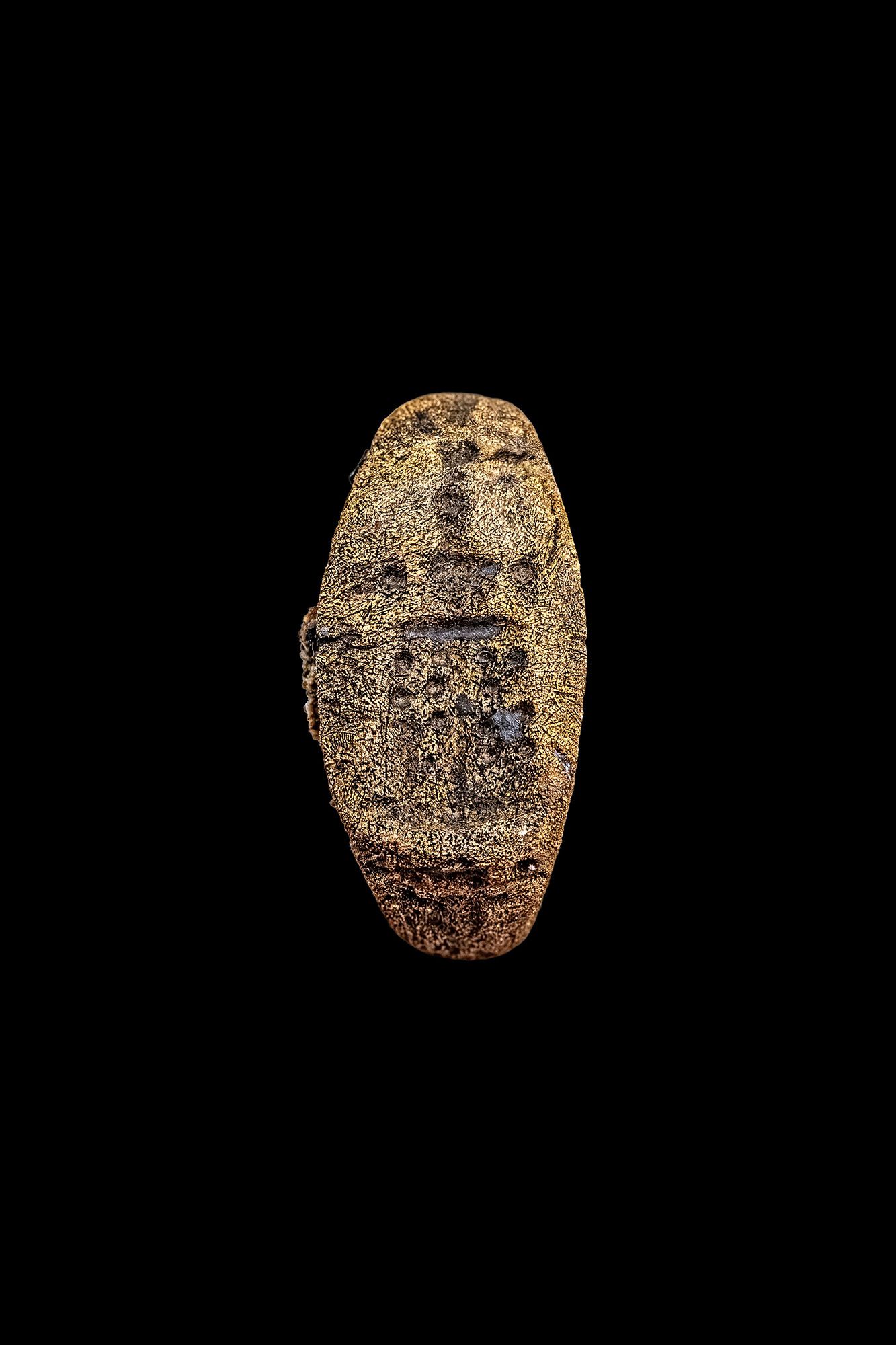
A bronze signet ring depicting the Lighthouse of Alexandria, a wonder of the ancient world, has been discovered underwater in the Mediterranean off Alexandria, Egypt.
A joint team from the European Institute for Underwater Archaeology (IEASM) and the Egyptian Ministry of Tourism and Antiquities found the artifact in the remains of a palace on the now-submerged island of Antirhodos, marking the first time a signet ring featuring the image of the lighthouse has been found, the IEASM team said in a statement.
The image on the ring is similar to depictions of the lighthouse that have been previously found on coins dating to the second century, representatives of IEASM said.
"The discovery of the ring-signet is even more important as it has been excavated in the legendary palace of the Island of Antirhodos, that once was a centre of power," Franck Goddio, president of IEASM, said in the emailed statement.
The palace was used by Egyptian pharaohs who reigned during the Ptolemaic period (304 to 30 B.C.), a dynasty of rulers descended from one of Alexander the Great's generals. The lighthouse was built on the island of Pharos around 280 B.C. and stood more than 328 feet (100 meters) tall. Some ancient writers, such as Pliny the Elder, considered it among the wonders of the world, and it continued to be used into the Middle Ages, until earthquakes and erosion resulted in its destruction and disappearance beneath the sea.
While the lighthouse was modified over time, it would have had a statue, possibly of Zeus, at the top holding an oil lamp that helped guide mariners.
Whoever was wearing a signet ring could have used it to make an impression on soft materials, such as clay and wax, to create a seal. The discovery of the ring in the remains of the palace at Antirhodos suggests that the palace was used for administrative functions related to the lighthouse, representatives of IEASM said in the statement.
Even though the ring's engraving is somewhat worn, it likely depicts the lighthouse, said Doris Behrens-Abouseif, a professor emeritus of history of art and archaeology at the University of London who has written about the lighthouse but was not part of the research team.
There are "thousands of coins from Alexandria showing a similar depiction of the lighthouse," she told Live Science in an email. Those coins date to the Ptolemaic or Roman (29 B.C. to A.D. 395) periods, she noted.
Behrens-Abouseif added that she wasn't familiar enough with rings from Alexandria to comment on whether this is the only ring that contains this image.
Other scholars told Live Science that they, too, believe that this ring depicts the lighthouse, with two scholars noting that it may feature smoke coming from a lamp at top.
The "most interesting thing about the new signet ring engraved gem is an asymmetrical feature at its peak," which "may depict a plume of smoke from the oil lamp in the hand of the crowning statue," Andrew Chugg, an independent researcher who wrote the book "The Pharos Lighthouse in Alexandria: Second Sun and Seventh Wonder of Antiquity" (Routledge, 2024), said in an email.
Margaret Miles, a professor emeritus of art history and classics at the University of California, Irvine, also noticed the possible plume of smoke. Miles noted in an email that this "ring could have been used as a signet ring by a merchant from Alexandria who used the profile of the [lighthouse] to signal his location in Alexandria. The lighthouse was famous, so it became a symbol of the city."
Research off the coast of Alexandria over the past few years, including the discovery of 22 massive blocks, has revealed more information about the lighthouse, including how exactly it looked, which is helping researchers who are trying to digitally reconstruct it.
Are you a fan of mummies and hieroglyphs? Find out with our ancient Egypt quiz!
The ancient Egyptians practiced human sacrifice around 5,000 years ago, a period shortly after the country was first unified, a new study finds.
In the new study,Roselyn Campbell, an anthropology researcher at Purdue University, re-examined 46 skulls from individuals who were buried near royal tombs that belonged to King Djer, King Djet and Meretneith (a woman who likely ruled Egypt at times), and were built near the ancient sacred city of Abydos. All three rulers lived during the first dynasty, a period that started around 5,000 years ago when Upper Egypt and Lower Egypt were unified into one kingdom. The sacrificed retainers were buried next to the tomb of the king they had served.
Researchers first excavated the royal burial site in the early 20th century. At the time, the excavator, Flinders Petrie, believed that the hundreds of other burials found near the royal tombs contained nonroyals, such as retainers and other people who served the king. Moreover, it appeared that these nonroyals had been sacrificed after the king they had served died, in the belief that they could serve the king in the afterlife.
However, Petrie was unable to identify evidence of fatal skeletal trauma, and his idea that they were sacrificed has been debated ever since. Petrie reburied most of the human remains, but 46 skulls were retained and preserved in the Duckworth Collections at the University of Cambridge.
In the new study, published Monday (Oct. 5) in the journal Frontiers in Environmental Archaeology, Campbell re-examined these 46 skulls using modern forensic techniques and information about the marks that different types of trauma leaves on human skeletons. Campbell found that 18 of the skulls have signs of trauma that were likely fatal — indicating that these individuals were likely sacrificed, according to a statement from the journal. Specifically, Campbell found that many of the skulls had linear fractures, which Petrie had mistaken for damage that occurred after burial.
Mike P Shepherd via AlamyMike P Shepherd via Alamy
Linear fractures "occur when the cranium strikes or is struck by a relatively large object with low overall force; because of the cranium's globular shape, the impact of the blow disperses across the cranial vault," Campbell wrote in the study. "While linear fractures are not always immediately lethal, they often cause intracranial lesions and/or hemorrhage, which can quickly cause loss of consciousness and death if surgery [to relieve pressure] is not performed."
Campbell told Live Science in an email that it's difficult to identify the weapon or object that was used. "Based on comparative forensic and archaeological studies, the most likely implement would have been flat and relatively light, probably made out of something like wood rather than stone," she said.
The practice of human sacrifice seems to have ended in the second dynasty of Egypt. Evidence for human sacrifice is limited and seems to be confined mainly to the first dynasty. Petrie theorized that they were retainers to the king based on the fact that some were buried with gravestones that had titles such as seal-bearer which suggested that they served the king.
"As far as we can tell, this particular type of retainer sacrifice seems to have ended with the close of the First Dynasty, which means it [lasted] around two centuries or possibly less," Campbell said.
Jacobus van Dijk, an Egyptologist at Groningen University in the Netherlands who was not involved with the study, welcomed the new research. The "existence of retainer sacrifice in early Egypt has always been controversial and Dr Campbell's research adds an important argument in support of scholars who, like myself, believe this custom was practised in Egypt in the early dynastic period," he told Live Science in an email.
He noted he was surprised at the method used for human sacrifice, because depictions of ritual killing on wooden labels "seems to indicate that the victim was kneeling with his hands tied behind his back being stabbed in the chest with a knife."
Are you a fan of mummies and hieroglyphs? Find out with our ancient Egypt quiz!
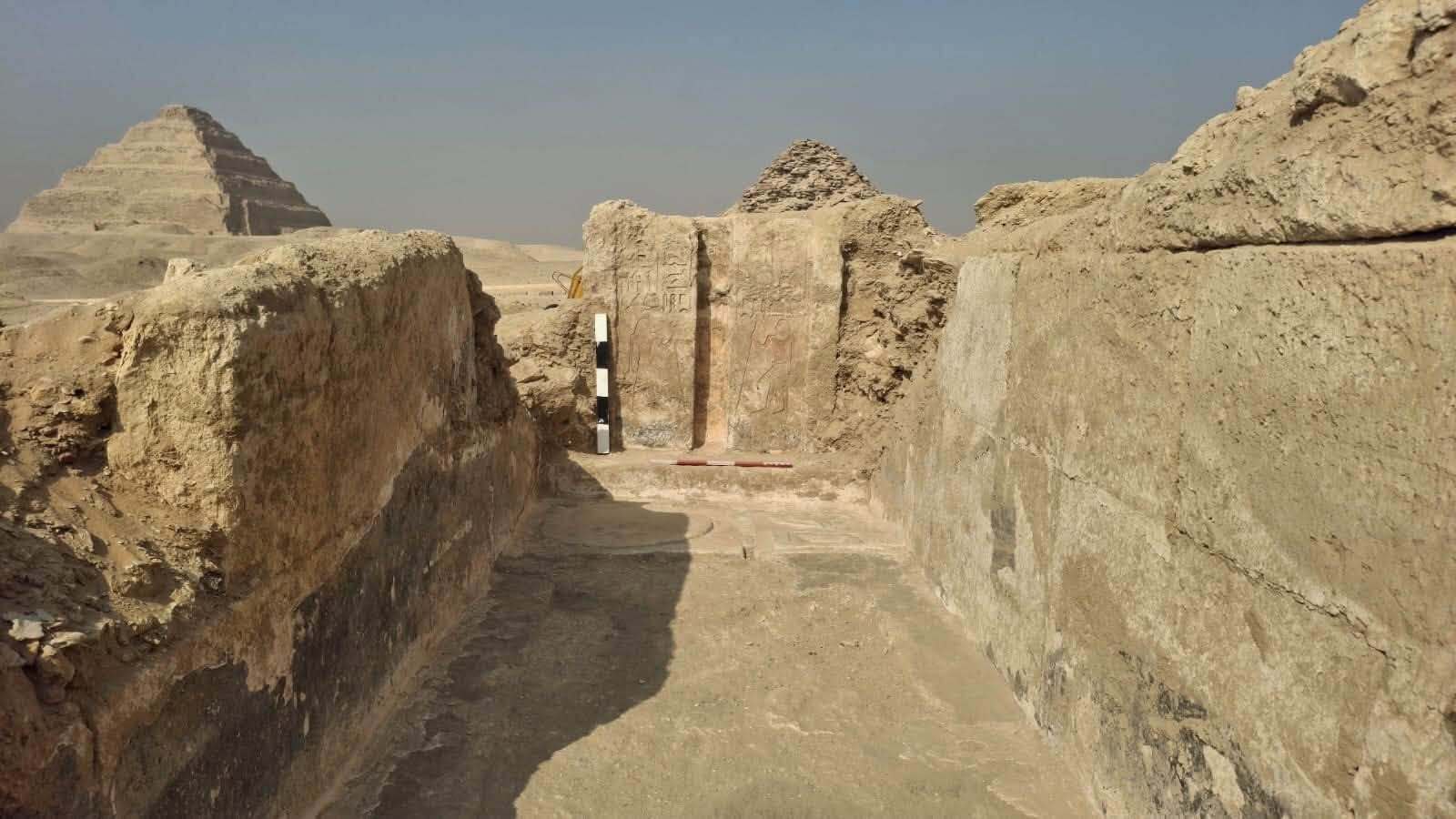
Archaeologists in Egypt have discovered an ancient tomb belonging to the "keeper of the secrets of royal decrees," they announced following an excavation at Saqqara.
The decorated burial belongs to an official named Sekhentio-Ptah, who lived during the Old Kingdom (2649 to 2150 B.C.), a period that's famous for the building of the pyramids, including those at Giza.
While the title "keeper of the secrets of royal decrees" may sound mysterious, it was likely a more bureaucratic position, said Ann Macy Roth, a clinical professor of Egyptology at New York University who was not involved with the excavation.
It "probably merely means that as someone in charge of royal documents and the people who write them, he has access to confidential information," Roth told Live Science in an email. "It's a common title among royal scribes."
The official Sekhentio-Ptah had a number of other titles, according to his tomb, including "Overseer of all the King's Works" and "Overseer of Royal Documents," representatives of Egypt's Ministry of Tourism and Antiquities wrote in a translated statement.
Within the tomb, archaeologists found an offering table, a purification basin and two false doors. The false door is a symbolic door, commonly found in ancient Egyptian tombs, that was believed to allow the soul to exit and enter the tomb at will. The design of the false doors places them in the late fifth or early sixth dynasty, around 4,350 years ago, Roth said.
Part of the newfound tomb, which dates to well over 4,000 years ago. (Image credit: Photo courtesy of the Egyptian Ministry of Tourism and Antiquities )
More than 100 shabtis (also spelled ushabtis) were found in the tomb. Ancient Egyptians believed these figurines would act as servants for the deceased in the afterlife. The team also discovered a wooden statue of a falcon (possibly related to the falcon-headed god Horus) and the remains of cartonnage, a plastered material used on mummies. The mummy of Sekhentio-Ptah was not identified.
Looking at the photos and information the ministry released, Roth said it's likely this tomb was reused for later burials — something that was commonly done in ancient Egypt. She said the shabtis found in the tomb likely belong to later burials and the cartonnage is likely from mummies that were buried in the tomb at a later date.
The team discovered the tomb in the Bubasteion (also spelled Bubasteum) area of Saqqara, a place that was commonly used forcat burials in later times such as the late period (circa 664 to 332 B.C). The site was associated with Bastet, a cat-shaped goddess associated with fertility and protection. However, the statement didn't mention any cat burials found in this particular tomb.
Live Science reached out to the excavation team but did not hear back by the time of publication.
See how much you know about mummies with our mummy quiz.
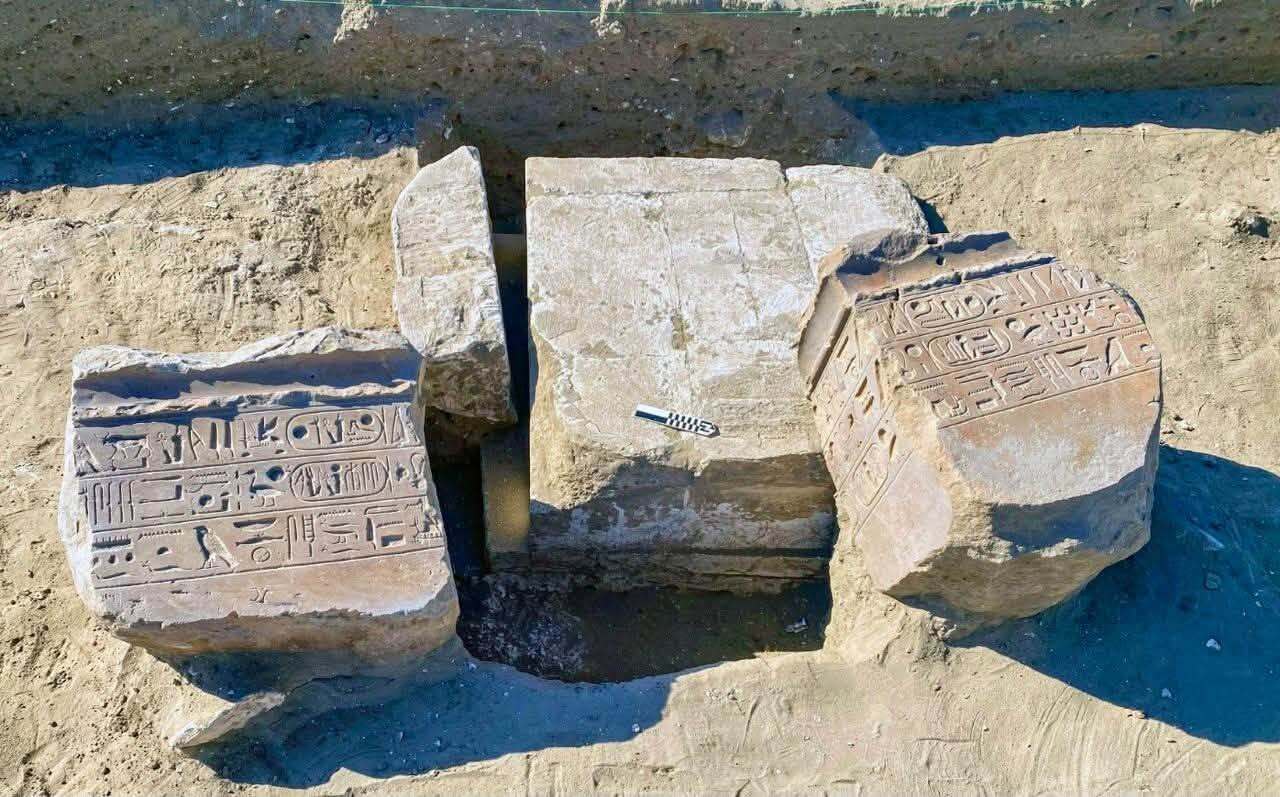
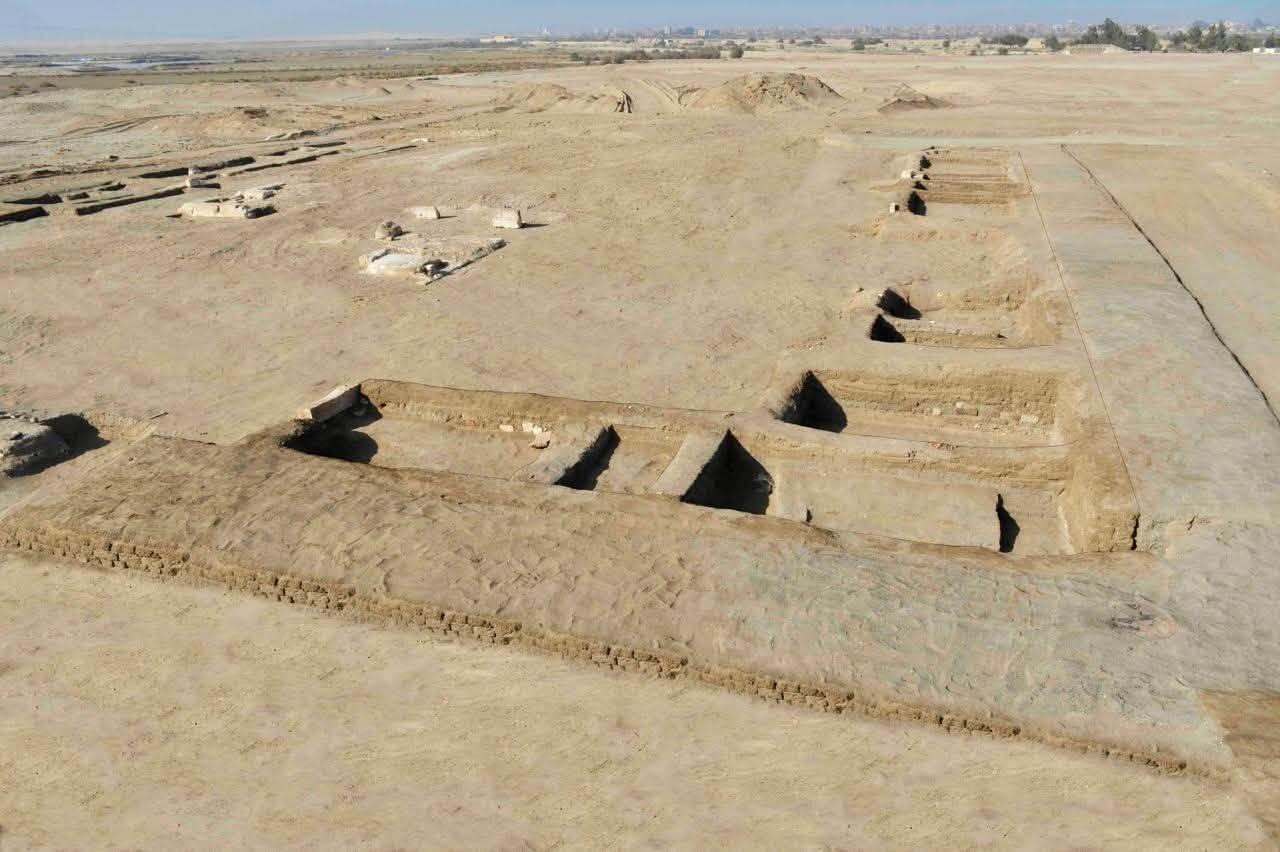
A 3,200-year-old Egyptian inscription found near an ancient military road may indicate the location of a long-lost city, archaeologists have announced.
Found at the site of Tell Abu Seifi (also spelled Seify), the inscription mentions Ramesses II, who reigned from about 1279 to 1213 B.C. It says that Horus, a falcon-headed ancient Egyptian god associated with the sky and war, is the "Lord of the City of Mesn," representatives of the Egyptian Ministry of Tourism and Antiquities said in a translatedstatement.
The team also found the remains of a temple dedicated to Horus at the archaeological site, they said in the statement. Unfortunately, "the temple was almost completely destroyed," making it difficult to get much information from it, Hesham Hussein, the director general of Delta and Sinai Archaeology at Egypt's Ministry of Tourism and Antiquities and a leader of the research team, told Live Science in an email.
Tell Abu Seifi is located by the Suez Canal, near the north Sinai Desert and the eastern Nile Delta. The presence of both the inscription that mentions Mesn and a temple of Horus at the site means there is a strong possibility that Tell Abu Seifi is, in fact, Mesn (also spelled Mesen), according to the statement. However, Hussein cautioned that more research is needed for archaeologists to be certain.
The ministry’s statement called Mesn a "lost city," and it is difficult to determine precisely when the city was founded or how large it was. "Because its archaeological identification has remained uncertain, we cannot currently provide a reliable estimate of its total extent or population," Hussein said.
If Tell Abu Seifi is Mesn, it seems to have existed for a long time. A bronze seal that was previously found at Tell Abu Seifi and dates to the Ptolemaic period (circa 304 to 30 B.C.) also has an inscription that says, "Horus, Lord of Mesen," Hussein noted, and coffins dating to the Ptolemaic period previously found at the site have similar inscriptions.
Horus also seems to have been extremely important to the people of Mesn. "The title "Horus, Lord of Mesen" directly connects the deity with the place, and the archaeological evidence from Tell Abu Seify supports the importance of this cult," Hussein said.
A view of more of the inscriptions, which were written in the name of Ramesses II. (Image credit: Photo courtesy of the Egyptian Ministry of Tourism and Antiquities)
Way of Horus
Tell Abu Seifi is located near what the ancient Egyptians called the "Way of Horus" (or "Ways of Horus"), a road that connected the eastern Nile Delta with the southern Levant and was dotted with fortresses.
Peter Brand, a professor of history at the University of Memphis in Tennessee who was not involved in the excavation, said the evidence indicates that Tell Abu Seifi, which is near the modern-day city of Qantara, is Mesn. "Several fortifications were built along the 'Ways of Horus' and Mesen, near modern Qantara, was likely one of the 'jumping off' points for Egyptian armies departing for Canaan, Lebanon, and Syria," he told Live Science in an email.
A road leading out of Africa and into the Middle East was key, as the Egyptians went on several military campaigns to expand their empire around that time.
"The Egyptian empire dominated this part of the Middle East," Brand said. "Ramesses II's father had built a series of the forts along the Ways and Ramesses himself marched his armies across Sinai during his military campaign." This included his famous Battle of Kadesh, in what is now Syria, against the Hittite Empire, a kingdom based in Anatolia (modern-day Turkey).
The site's temple also hints at its importance.
Part of the site, which may actually be part of Mesn, a long-lost city from ancient Egypt. (Image credit: Photo courtesy of the Egyptian Ministry of Tourism and Antiquities)
The "temple of the god Horus of Mesen was the most important religious center in the area," Brand said. He noted that the newfound inscription mentions "how Ramesses II restored a statue of Horus of Mesen." Remarkably, the pedestal of a statue just like this was previously found at the site.
These two clues indicate that Tell Abu Seifi is Mesn, Brand said.
Waiting for more evidence
Other scholars were not ready to identify Tell Abu Seifi as Mesn. James Hoffmeier, an archaeologist and professor at Trinity International University who has conducted extensive work in the region, said that while the case is strong, he wants to see more evidence, such as ceramics from the site, to be sure.
One problem is that similar inscriptions mentioning Mesn have been found at other sites in the region, raising the question of whether those sites could be Mesn, Gregory Mumford, an anthropology professor at the University of Alabama at Birmingham who was not involved in the excavations, told Live Science in an email. These sites include a fortress at Kom el-Qolzoum on the Suez and a fort at Tjaru in the northwest Sinai Desert. Mumford proposed that Mesn could be a broad area that encompasses multiple sites in the region.
Other scholars also said more information on the discoveries was needed.
Oren Siegel, an Egyptology professor at the University of Toronto who was not involved in the excavation, said this is a "really exciting find" but he wants to wait for more information before commenting in detail.Shirly Ben Dor Evian, an Egyptology professor at the University of Haifa in Israel who wasn't involved in the excavation, also said more information, particularly on the hieroglyphic inscriptions, was needed.
Research into the site is ongoing. Hussein noted that, interestingly, historical records show there was a second settlement named Mesn located in southern Egypt.
Are you a fan of mummies and hieroglyphs? Find out with our ancient Egypt quiz!
The ancient Egyptians sometimes reused crafted materials. This block, which features a battle scene, was likely created during the reign of Amenhotep II between 1427 and 1400 B.C., during the 18th dynasty. But when it was discovered, the block was being used as part of the foundation of the unfinished mortuary temple of Ramesses IV (who ruled from 1153 to 1147 B.C., during the 20th dynasty).
The painted sandstone slab was discovered in Luxor in 1912 by Egyptologist Herbert E. Winlock, who later became the director of the Metropolitan Museum of Art, which has the block in its collection. In his original publication describing the artifact, Winlock wrote that it featured a scene of an Egyptian pharaoh slaying his enemies with a bow and arrow. "The block may be taken as one of the best preserved specimens of the great imperial pictorial-relief yet discovered," he wrote.
The excellent preservation of the artifact and its vibrant colors was likely due to its reuse in Ramesses IV's temple foundations, Catharine Roehrig, the Met's curator emerita of Egyptian art, wrote in a 2008 explanation of the relief fragment.
Measuring roughly 24 by 45 inches (61 by 115 centimeters), the painted sandstone carving was likely part of a larger scene depicting an Egyptian pharaoh vanquishing an enemy army, according to Roehrig. The pharaoh's chariot and horses appear in the upper-right corner, while a rival soldier tries to avoid being trampled to death. Three of the enemies have been pierced by arrows.
The pointed beards and distinctive clothing suggest the enemies were ancient Syrians or possibly the Hyksos, a Semitic-speaking foreign dynasty that ruled Egypt from around 1640 to 1530 B.C., during the Second Intermediate Period, James P. Allen, former curator of Egyptian art at the Met, wrote in 2005. The battle scene may therefore reflect historical conflicts fought between dynasty 18 pharaohs like Amenhotep II and Asiatic rulers.
But the relief was unlikely to have been created as a commemoration of a specific historical battle. "Their primary purpose was to portray the pharaoh in his role as the victorious defender of Egypt," Roehrig wrote.
For more stunning archaeological discoveries, check out our Astonishing Artifacts archives.
The dagger buried with Princess Ita, which is now on display at the Egypt Museum. (Image credit: Sameh Abdel Mohsen, Egypt Museum photographer)
Several ancient Egyptian princesses buried with bows, arrows and a dagger may have trained with those weapons during their lives, possibly using them while hunting or practicing archery, a controversial new study suggests.
Researchers examined the remains of six royal individuals who lived during Egypt's Middle Kingdom nearly 4,000 years ago. After analyzing the muscle-attachment sites on these bones, the researchers suggested that certain pronounced areas might be linked to repeated activities such as archery and weapon handling.
"Members of the royal family, especially the women, were active participants in skilled, physically demanding activities such as archery and hunting," study first author Zeinab Hashesh, an archaeologist at Beni-Suef University in Egypt, said in a statement.
The finding, published Friday (July 17) in the journal Frontiers in Environmental Archaeology, challenges the assumption that weapons placed in the women's tombs were largely ceremonial. It may also provide new information about the health and physical activities of royal women.
However, bioarchaeologists who were not involved in the study told Live Science that skeletal changes cannot reliably indicate a specific activity. Age, body size, genetics and other repetitive movements can produce similar results, they said.
Royals rediscovered in a museum basement
The French archaeologist Jacques de Morgan found the royal burials in the 1890s. (Image credit: Gallica Digital Library via Wikimedia Commons)
In the 1890s, French archaeologist Jacques de Morgan excavated a site near the tomb of pharaohs Amenemhat II and Amenemhat III. From these excavations, de Morgan found various royal individuals, whose partial remains were later stored at the Egyptian Museum in Cairo.
For decades, the remains were forgotten about. But in 2020, museum workers rediscovered the bones during a museum curation project. The collection included King Hor, Princess Ita, Khenmet, Itaweret and Noub-Hotep, as well as an unidentified woman who may have been Princess Sathathormeryt (also spelled Sithathoriunet). Four of the women are believed to have been daughters of the pharaoh Amenemhat II.
However, the skeletons' identities depend heavily on those 19th-century labels, which "means that we cannot be certain how reliable they really are," Sonia Zakrzewski, a bioarchaeologist at the University of Southampton in the U.K. who was not involved in the research, told Live Science in an email. Most of the individuals' skulls were missing, and only around 22% to 58% of each skeleton survived. Their soft tissues had largely decayed into powder, but the remaining bones allowed the team to estimate the sex and age and look for injuries, diseases and signs of physical activity.
Princess Ita, who died between the ages of 28 and 34, had pronounced attachment sites on parts of her right shoulder, arm and hand. The team suggested that these changes could reflect repeated gripping and weapon handling, possibly involving the ornate dagger found in her tomb.
Princess Noub-Hotep, who died in her early 40s, had strongly developed attachment sites in her forearms and right hand. De Morgan had discovered "arrows with their barbs in an astonishing state of preservation" in the princess's tomb, according to an 1896 issue of the journal American Anthropologist.
Similarly, Princess Itaweret showed robust attachment sites around her shoulder and chest, while Khenmet had pronounced features on her arms and shoulders. King Hor also displayed differences between muscle attachments on the left and right sides of his body.
The authors argued that these patterns fit actions involved in drawing back a bowstring — a process that can create muscular asymmetry between the left and right upper body. They also posited that these muscular patterns could be from gripping objects like daggers or maces and suggested the weapons buried with the royals weren't just symbolic.
Experts remain doubtful
Despite the pronounced attachment sites on these individuals' bones, Zakrzewski said it's unknown if the royals got buff through archery or some other activity.
The sites on the bones show that "certain muscles appear to have been repeatedly used, but the actual cause of that use is uncertain," she said. "We cannot say therefore that these skeletal changes necessarily are associated with the use of weaponry," especially since the researchers didn't look at comparison groups from the Nile Valley or elsewhere.
An old photo of Dashur Pyramid, where the royal individuals were found. (Image credit: Rijksmuseum via Wikimedia Commons)
Zakrzewski added that it's unknown why artifacts like arrows were included in the tombs. Perhaps they were meant to be "used by individuals associated with the deceased," she said.
Scott Haddow, a bioarchaeologist at the University of Turin in Italy who was not involved in the study, noted that some of the skeletal changes were present on both sides of the remains.
"Archery is a highly asymmetrical activity; finding generalized, bilateral robusticity in some bones (with some asymmetry observed in other bones) does not make a particularly strong case for these individuals practicing archery," he told Live Science via email.
The individuals' ages at death could also explain the differences. Khenmet was between 35 and 45 when she died, while Noub-Hotep was approximately 40 to 44. Muscle-attachment sites are influenced by aging, as well as by body size and genetics, Haddow said.
Princess versus pauper
One of the study's largest caveats was the absence of a comparative group, which would have shown how unusual the changes were compared with other Egyptians from the same period.
"It would be very useful to know how much such side differences exist in contemporaneous Egyptians, whether royal or not," Zakrzewski said.
Besides missing a comparison with a "control" group, other experts believe that the researchers are reading too much into the weapons being buried with the royals.
"Although the presence of funerary artifacts (e.g., arrows, daggers) makes the princesses' involvement in such activities plausible, the authors provide limited biomechanical or biomedical evidence to substantiate this claim," Sébastien Villotte, an anthropologist at the French National Center for Scientific Research, told Live Science via email.
He added that "a more robust approach would involve comparing these individuals to non-elite contemporaries from the same region and period. This would help determine whether such degenerative changes (at these locations) were common in the general population (who were unlikely to engage in the same activities) or truly indicative of elite-specific behaviors."
Although the study has a number of uncertainties, Zakrzewski said they shouldn't diminish the value of examining the remains. "It allows us to sort of put flesh on the bones and understand more about their lives," she said.
Archaeologists have discovered 18 ancient tombs in an Egyptian town along the Mediterranean Sea.
The tombs — which were unearthed in Marina el-Alamein (also spelled Alamin), about 60 miles (100 kilometers) west of Alexandria — date to the Ptolemaic (322 to 30 B.C.) or Roman (30 B.C. to A.D. 395) period, the Egyptian Ministry of Tourism and Antiquities said in a translated statement announcing the find.
During the Ptolemaic period, Egypt was ruled by the descendants of one ofAlexander the Great's generals, while the Roman period started with the death of Cleopatra VII, when Egypt became incorporated into the Roman Empire as a province.
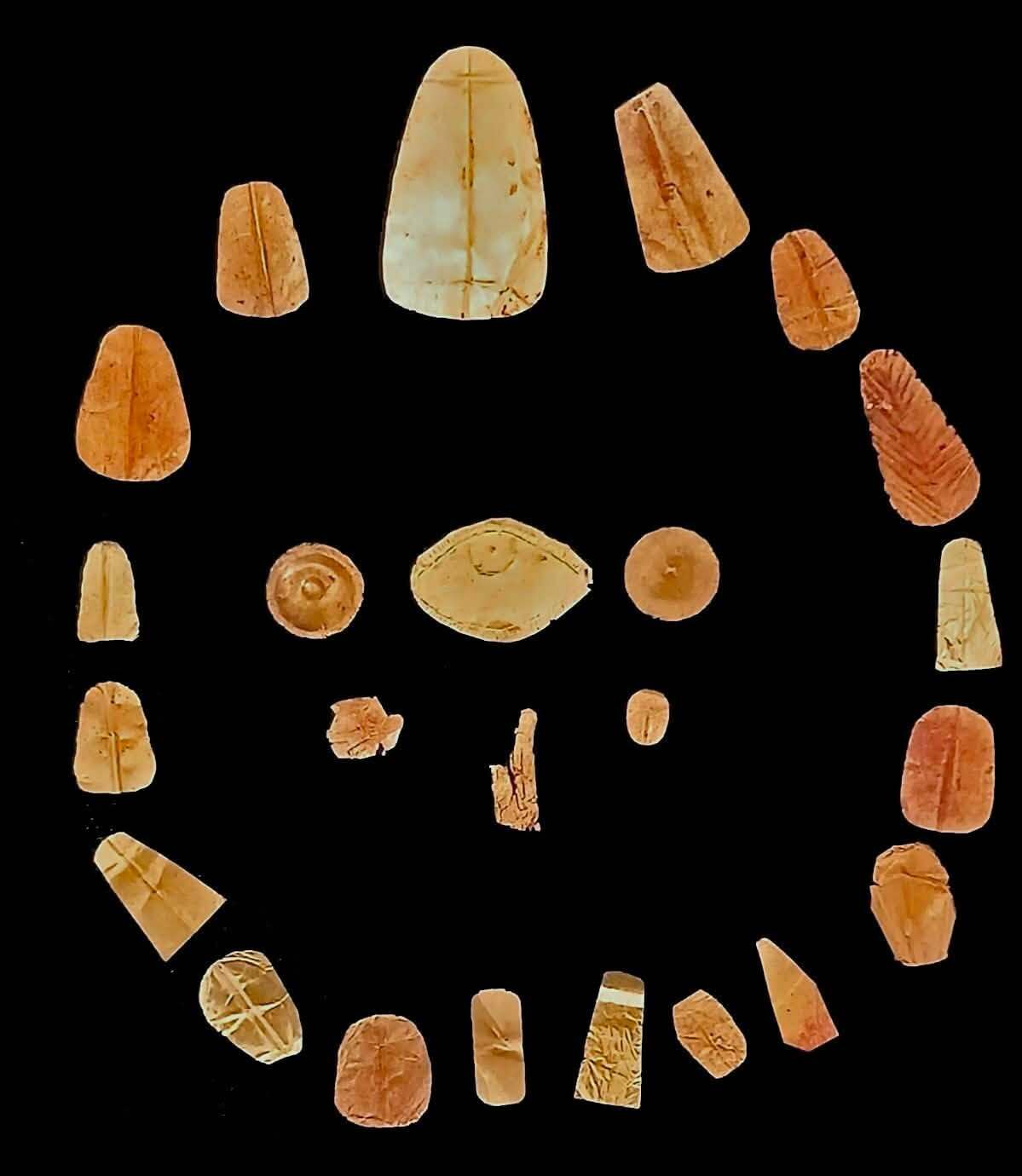
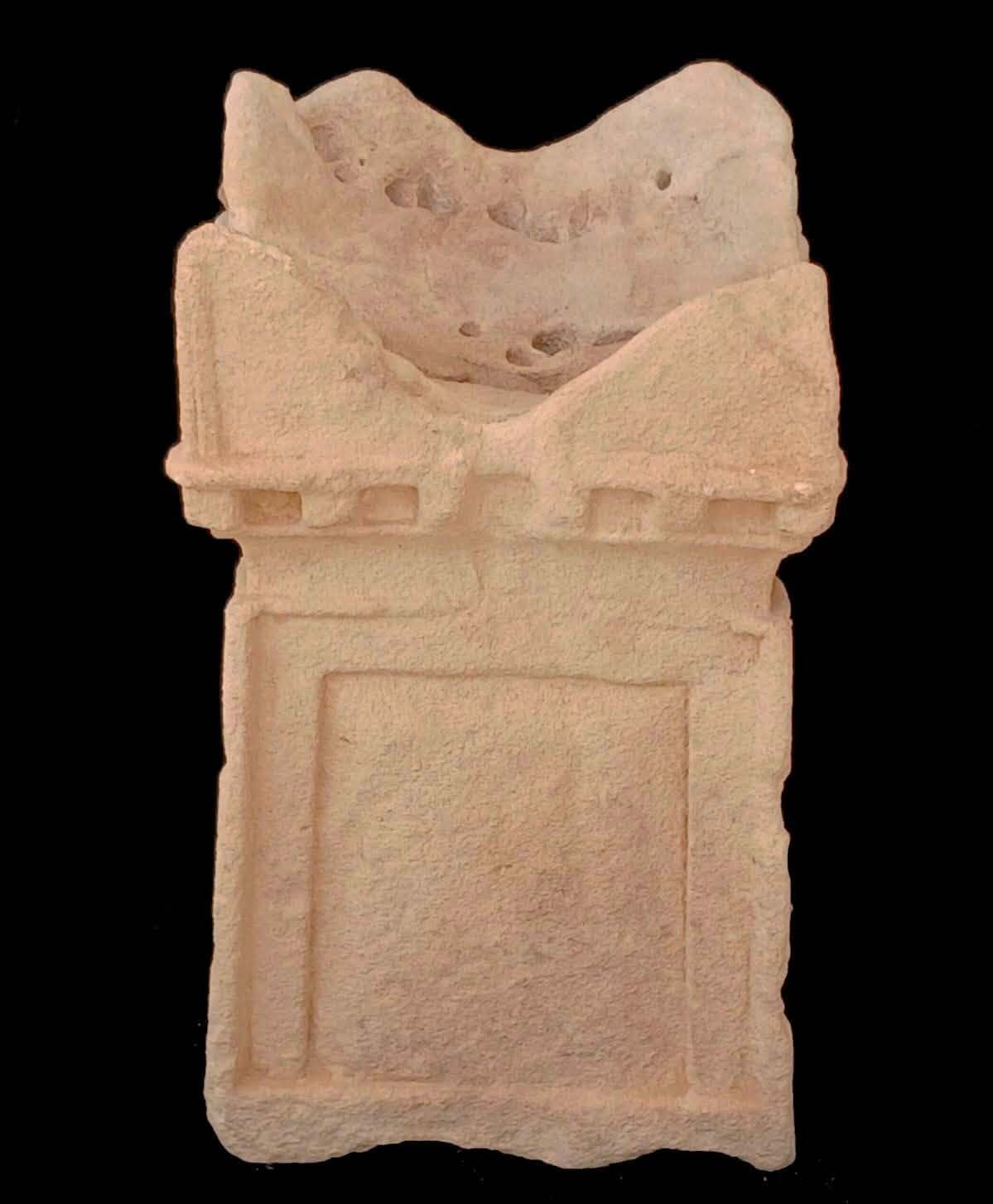
The team noted that 11 of the tombs had been carved deep into the ground, while the seven others were located closer to the ground's surface. The tombs held many artifacts — most notably, 24 "gold tongues" that were likely put into the mouths of mummies, and an offering altar with a base designed to look like a false door.
An entrance to one of the tombs in Marina el-Alamein (also spelled Alamin). (Image credit: Courtesy of the Egyptian Ministry of Tourism and Antiquities)
"The false door is one of the oldest and most recognizable elements of ancient Egyptian funerary architecture. In traditional Egyptian belief, it symbolized the interface between the worlds of the living and the dead, through which the deceased could spiritually receive offerings presented by the living," Hesham Hussein, the undersecretary for Lower Egypt and Sinai archaeology at Egypt's Ministry of Tourism and Antiquities, told Live Science in an email.
The fact that the design of a false door was carved into the altar "suggests that the symbolic meaning of the false door remained important even as its architectural function evolved," Hussein added.
Gold tongues from ancient Egypt
Gold tongues have been found in mummies at a number of ancient Egyptian sites. The ancient Egyptians considered gold to be the flesh of the gods, and they believed gold tongues could help the deceased communicate with them in the afterlife.
Some of the gold tongues discovered inside the tombs. The ancient Egyptians believed these tongues could help the deceased communicate in the afterlife. (Image credit: Courtesy of the Egyptian Ministry of Tourism and Antiquities)
"Gold tongues are a well-documented feature of some burials dating to the Ptolemaic and Roman periods in Egypt," Hussein said. "They are generally interpreted as symbolic funerary amulets intended to enable the deceased to speak in the afterlife, particularly during the judgment before Osiris, or more broadly to communicate and recite sacred formulas in the next world."
Interestingly, one of the newly found gold tongues is shaped like the "Eye of Horus." Horus was a falcon-headed god associated with the sky and warfare. Artifacts shaped like his eye are often found in Egypt and were used to ward off evil, according to the statement.
However, it's unclear if some of these artifacts are actually gold tongues, Attilio Mastrocinque, a retired archaeology professor formerly at the University of Verona in Italy, told Live Science. Mastrocinque has written extensively about Greek and Roman religion but was not involved in this excavation.
After looking at the photos posted by the ministry, he noted that one appears to show a wheat ear. Wheat ears were associated with fertility and images of them were popular in the ancient world. The newfound artifact looks similar to silver wheat ears that have been found in Roman sanctuaries in Europe, Mastrocinque added.
An offering altar with a base that resembles a false door. (Image credit: Courtesy of the Egyptian Ministry of Tourism and Antiquities)
Altar with a false door?
False doors are commonly found in ancient Egyptian tombs and offering altars are often near these doors. In this case, the base of an offering altar resembles a false door.
Krzysztof Jakubiak, an archaeology professor at the University of Warsaw who has excavated at Marina el-Alamein in the past but was not involved in the recent excavation, noted that this find likely needs additional analysis.
"I would exercise caution in asserting a direct comparison between the iconographic motifs visible on the discovered altar and those of the false door iconography," Jakubiak told Live Science in an email. He said it's possible that the altar was not finished and its existing appearance simply resembles a false door.
Hala Mostafa, an archaeology professor at Ain Shams University said in an email that he thought the altar may depict the hieroglyphic sign for "offering" rather than a false door.
An unfinished statue of the goddess Aphrodite, who was associated with love and beauty. (Image credit: Courtesy of the Egyptian Ministry of Tourism and Antiquities)
Goddess statue and other finds
One of the tombs contained an 8.2-foot-long (2.5 meters) granite coffin whose lid was still on when the tomb was discovered. The team is currently examining the skeletal remains found inside.
Other finds included an incomplete statue of Aphrodite, a Greek goddess associated with love and beauty. During ancient Egypt's Ptolemaic dynasty, Greek culture and religion became increasingly popular in Egypt. Mastrocinque said it will be interesting to see if there is a structure for Aphrodite near the statue
"It is important to know where this statue has been found," Mastrocinque told Live Science in an email. "Was there a little cultic place of Aphrodite within this funerary complex?"
Dorota Dzierzbicka, director of the Polish-Egyptian Archaeological Mission to Marina el-Alamein, said that the new finds, along with finds made at the site in the past, reveal that the town was "a culturally diverse community in which Egyptian and Graeco-Roman traditions coexisted and blended in everyday life and funerary practices." She noted that the new discoveries were made by Egyptian archaeologists who work at the site.
See how much you know about mummies with our mummy quiz!
In most areas of archaeology, excavators painstakingly dig layer by layer to reveal not just buried artifacts but also charred seeds, broken bones and microscopic grains of ancient pollen. This delicate process is followed by months of intensive lab work to study the newfound remains. But there is one kind of archaeologist that takes a different approach to understanding the past. Experimental archaeologists replicate how people did things in the past, using techniques they recreate from archaeological information and modern knowledge.
In this excerpt, Kean meets two men who used ancient techniques to diligently mummify a human body in an effort to understand how ancient Egyptians took care of their dead.
Cultures throughout history have mummified their dead, and a handful still do today, but Egyptian mummies remain the most iconic. Unfortunately, the Egyptians wrote down virtually nothing about their embalming process. This leaves experimental archaeology as one of the few avenues available for understanding mummification, and several practitioners have indeed re-created mummies in modern times. In most cases, they work with animals, but a few intrepid souls have mummified human beings, most famously when Bob Brier and Ronn Wade did so in 1994.
Wade grew up wanting to be a mortician like his father. After a stint as a medic in the Vietnam War, he became an anatomist and eventually the head of Maryland's state anatomy board. Brier also has training in anatomy, but is an Egyptologist by training and passion. He's accumulated so many books on Egypt over his life that he rents a second apartment just to accommodate them. Brier and Wade selected their mummy from the pool of people in Baltimore who donated their bodies to science. Ultimately, they settled on a seventy-six-year-old Caucasian man who died of a heart attack. His identity remains secret, but a bit crassly, Wade nicknamed him E. M. Balm.
For authenticity's sake, Brier and Wade used replicas of pharaonic-era tools and materials, including linen wraps, an oddly wide wooden embalming table, and copper and obsidian blades — although they quickly abandoned the copper ones, which couldn't cut flesh well. Before starting on their mummy, they practiced one important step on other cadavers: extracting the brain. Instead of using full cadavers for this, they obtained some decapitated heads leftover from a medical school's plastic surgery class. ("They were looking a little weird," Brier recalls. "They'd had facelifts and such.")
From some scant references, Brier knew that Egyptian embalmers removed the brain by inserting a hooked rod through the nostrils, but the details were vague. Brier and Wade first tried scooping the brain out with such a rod, but the tissue proved too soft and wouldn't come out. They finally took to squirting water up the cadaver's nose, then used the rod to whisk the brain into a slurry. After that, it poured right out. "Like a milkshake," Brier says. "A strawberry milkshake to be exact."
Skills honed, the duo began making their mummy in May 1994. The first step involved removing his organs.
Different organs met different fates in Egypt. Unclear about the purpose of the brain, embalmers typically threw it away. The heart, in contrast, was left in situ [in place]; it was considered the seat of all thinking, emotion, and intelligence. Abdominal organs were carefully extracted and preserved. Following this protocol, Brier and Wade made a 3½-inch [9 centimeters] incision in their cadaver's abdomen and removed the spleen, liver, gallbladder, lungs, and twenty-two feet [6.7 meters] of intestines. Given their size, extracting the liver and lungs required some creative geometry and determined squeezing. The most difficult part involved detaching the lungs from the heart while working blind inside such a tiny hole.
With the organs removed, the pair cleaned the abdomen with palm wine and myrrh, then stuffed frankincense into the skull. This was an important ritual step to prepare the body for the afterlife, and also helped kill microbes and mask bad smells. Ancient embalmers used other sacred substances as well, often imported from Europe and Asia at great cost — pistachio resin, beeswax, castor oil. Ramses the Great's mummy had peppercorns from India shoved up his nose.
Next, Brier and Wade dehydrated the body using natron, a mineral of equal parts salt and baking soda that forms naturally in Egyptian wadis, or dry gullies. Like a sponge, natron sucks the moisture out of flesh, leaving it too dry to support bacteria, maggots, beetles, and other putrefying agents; the leftover tissue is essentially jerky. (Fully committed to authenticity, Brier dug the natron himself in Egypt, and recalls that sneaking hundreds of pounds of unidentified white powder through customs at JFK Airport was one of the more ticklish aspects of the project. Luckily, he was traveling with a film crew, and could hide the powder in suitcases amid their equipment.)
In their lab, Brier and Wade placed the mummy's spleen, lungs, liver, and intestines into bowls and covered them with natron. They also packed 29 linen bags of the powder into the body's empty torso, laid the body on top of 211 more pounds [96 kilograms], and dumped 583 additional pounds [264 kg] over it. They kept the body in Wade's old office, with the heat cranked up to 104 degrees F [Fahrenheit, or 40 degrees Celsius] and dehumidifiers running night and day to simulate Egyptian air.
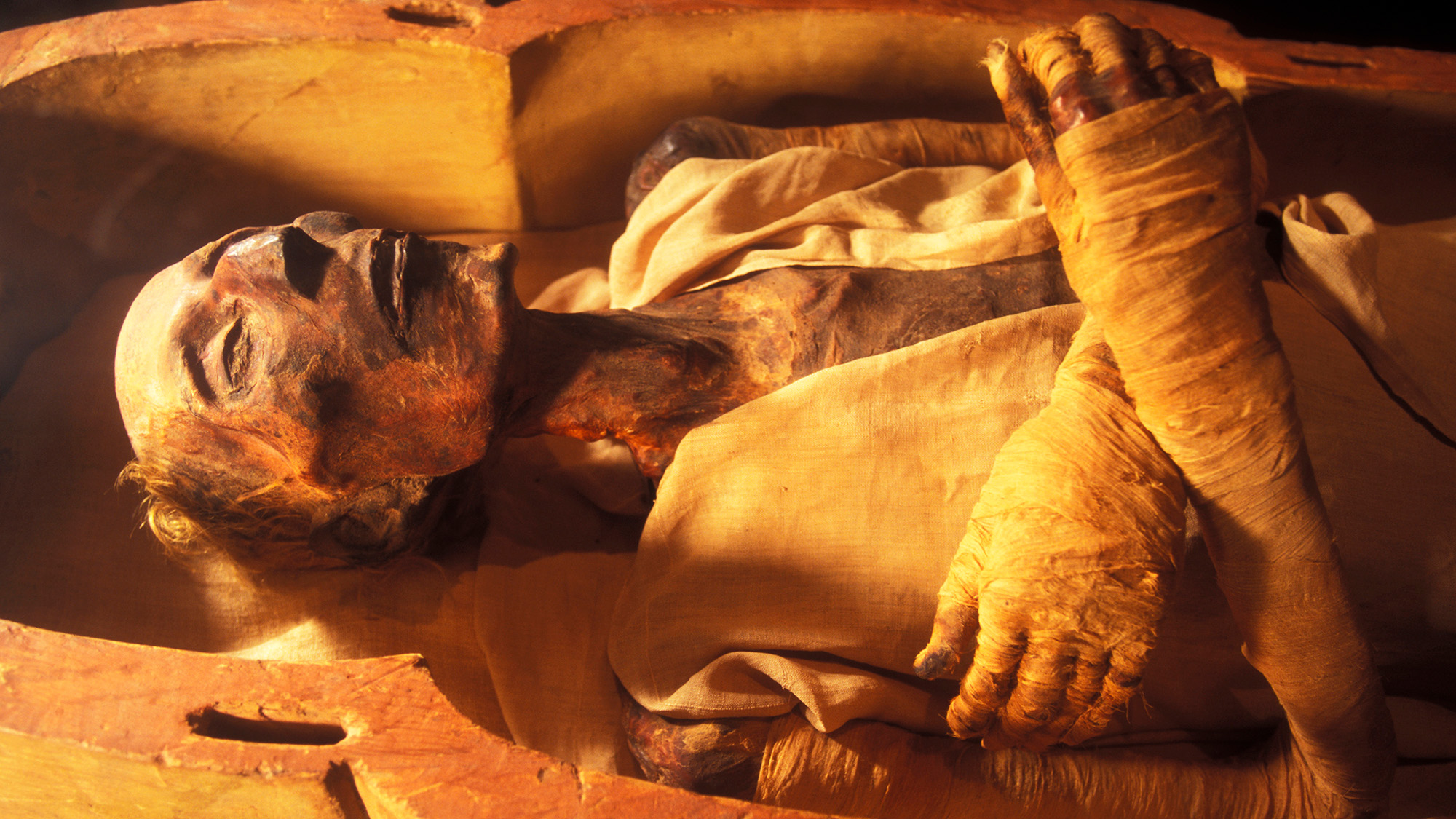
Over the next five weeks, the natron on top turned crusty and brown from absorbing bodily juices, forcing Brier and Wade to crack through it with an iron rod. (Today Brier remembers the odor as acrid but not unpleasant, although news reports at the time say he and Wade donned surgical masks against the smell.) Regardless, the sight of the body beneath thrilled Brier. As it dries, the skin of mummies tightens and shrivels, especially on the face and scalp. The lips retract to reveal the teeth, and skin with less melanin turns brown-yellow. Brier always wondered whether those changes resulted from the immediate mummification process, or from several thousand years of weathering in Egypt's arid climate. One glance at his mummy and Brier knew the answer: even after five weeks, "he looked just like Ramses the Great," he recalls, with leathery skin, a beaky nose, and wispy hair sticking up. The embalming process, not time, made the iconic mummies we know today.
Ramses II's long-preserved mummy. Experts have recreated the mummification process to learn more about how the ancient Egyptians preserved their dead. (Image credit: Patrick Landmann via Getty Images)
Beyond changing the body's appearance, the dehydration process left the limbs as stiff as tree branches, and dropped its weight from 188 pounds [85 kg] to just 79 [36 kg]. (Thirty-one pounds [14 kg] of that represented the removal of organs.) The organs drying in the bowls withered as well, which helped explain another mystery of Egyptian mummification: as other archaeologists have noted, embalmers typically placed the organs in so‑called canopic jars, funerary vessels with slim necks — so slim that it seemed impossible to fit the larger organs inside. But the natron shrunk them down enough to slip right in.
After removing him from the natron, Brier and Wade gave Mr. Balm a full body massage with lotus, cedar, and palm oils, another step that, while important ritualistically, also had pragmatic benefits — restoring flexibility to the joints, making the mummy easier to handle. This accomplished, they wrapped the body in linen bandages. (Embalmers in ancient times started with the hands and feet, wrapping each digit separately, then proceeded to the arms, legs, and torso. The penis was individually wrapped as well — or, if embarrassingly shriveled, a cod‑piece of stiff linen was bound in place.) At this point, they let the mummy dry for three more months in the arid office, which dropped its weight to 51 pounds [23 kg]. Afterward, they added several more layers of wrappings. In between the layers, they slipped magic amulets and scraps of papyrus with spells on them, a common practice in ancient times.
For the past three decades, the mummy has been lying in a metal casket in Maryland, stored at room temperature. Brier and Wade have partially unwrapped it twice to check for rot, but found nothing amiss. "He's dead and well," says Brier.
LITTLE, BROWN
Dinner With King Tut: How Rogue Archaeologists Are Re-Creating the Sights, Sounds, Smells, and Tastes of Lost Civilizations
Finalist for the 2026 PEN/E.O. Wilson Literary Science Writing Award | LOS ANGELES TIMES BESTSELLER | INDIE BESTSELLER | The New Yorker's Best Books of 2025
Whether it's the mighty pyramids of Egypt or the majestic temples of Mexico, we have a good idea of what the past looked like. But what about our other senses: The tang of Roman fish sauce and the springy crust of Egyptian sourdough? The boom of medieval cannons and the clash of Viking swords? The frenzied plays of an Aztec ballgame...and the chilling reality that the losers might also lose their lives?
See how much you know about mummies with our mummy quiz!

 Login