❌

Normal view

Space weather caused a 16-minute train delay in 1848: 'Our research has a hint of a detective story'

16 September 2026 at 23:00

Detective work by a team of space-weather experts has discovered the truth about a historical event that had been thought to be the first-ever case of technological disruption by geomagnetic activity from the sun, but has now been shown to have taken place seven years later.

From it being too hot or too wet to leaves on the track or cows on the line, there's a fine tradition of what the British public consider to be flimsy excuses for delays on the trains. Yet an 1871 edition of the journal Nature describes a very different event that caused a train departing Exeter, in Devon on the south-west coast of the U.K., to be delayed by 16 minutes: a solar storm that flooded the railway signals' electrical telegraph network with current.

"The Exeter train delay is a fascinating story because it sits right at the point where emerging technologies first began to encounter the realities of the space environment," said Jim Wild, who is a professor of space physics at Lancaster University and also the President of the Royal Astronomical Society, in a statement.

The event has frequently been cited as the first example of a solar storm disrupting technology on Earth, but when a team led by Wild went back through historical records to investigate further, they found that things didn't add up.

The original report in Nature stated that the electrical disturbance occurred at 10:05pm local time on Oct. 18, 1841. However, Wild's team found that particular train line didn't open until 1846.

So, they delved deeper into the history books to figure out the truth.

"Our research has a hint of a detective story — piecing together a wide range of archived records to better understand a historically severe space-weather event," said team-member Mike Hapgood, a space weather expert at RAL Space, which is the UK's National Space Laboratory, in Oxfordshire.

Combining data from railway timetables, old newspapers, plus historic reports of solar observations and the northern lights and digitized geomagnetic data, Wild and Hapgood's team were able to conclude that the most likely date for the train delay was Oct. 18, 1848, which coincided with a strong solar storm that hit Earth.

This revised date knocks it off top spot in the chronological list of such events. The first recorded disruption to electrical technologies is now a disturbance on the Midland railway network, which had lines covering much of the U.K., in March 1847.

"Although this means it is not the earliest recorded space weather impact, it remains one of the first clear examples of solar activity disrupting critical infrastructure," Wild said. "It also demonstrates the value of combining scientific records with contemporary newspaper reports and archival documents when reconstructing historic space weather events."

A view of a yellow sphere with some flares coming off of it.

Solar storms have been playing havoc with electrical technology on Earth since the 1840s. (Image credit: NASA/SDO)

The case reminds us that space weather has been a hazard to technology and modern systems for a long time, and isn't just a recent problem.

"Society has been experiencing the effects of space weather on technology for almost as long as electrical technologies have existed," said Wild.

The most dramatic example is the aforementioned Carrington event of 1859, representing the most significant solar storm on record as it caused telegraph poles to spark and battery power supplies to be disrupted. By this point, telegraph operators had grown used to electrical disturbances associated with auroral activity, but even the Carrington storm shocked them — quite literally in some cases, as extra current ran down the telegraph lines — with its ferocity. Should a similar event occur today, it would cause huge black outs, knock out power grids, disrupt communications and fry satellites.

"While today's space weather [monitoring] capabilities are far more advanced than anything available in the 1800s, the modern technologies we depend on are also much more vulnerable to solar storms," said Hapgood.

The current solar cycle 25 peaked in Oct. 2024 and we are just beginning to come out of an extended period of maximum activity. However, it remains to be seen how the rest of this cycle will play out before reaching solar minimum in about 2030. We've already seen severe geomagnetic storms caused by space weather in May 2024 — will we experience another powerful storm before the decade is out?
NASA’s Moon Orbiter Spots New, ‘Once-in-Century’ Moon Crater

16 September 2026 at 19:06
6 Min Read

NASA’s Moon Orbiter Spots New, ‘Once-in-Century’ Moon Crater

Black-and-white image of a textured, cratered surface. Two black arrows near the center point inward toward a small, dark, circular feature.
A zoomed-in view of the Moon made from images from NASA’s Lunar Reconnaissance Orbiter Camera. (More information at the bottom of article.)
Credits: NASA Goddard/Intuitive Machines/Robert Wagner

It started as a routine data-quality check. But as Robert Wagner, a scientist with NASA’s Lunar Reconnaissance Orbiter (LRO), scanned a giant Moon map on his computer screen, an unusually large bright spot circled by a dark halo caught his eye, as it implied that surface material in that area had been shaken up.

“I just stopped, dropped everything, and started looking into what that spot was,” said Wagner, an image-processing specialist from Intuitive Machines who works with data from the Lunar Reconnaissance Orbiter Camera (LROC) system.

By comparing before and after images of the Moon, Wagner realized he had discovered the largest, newly formed crater ever found in the solar system, as scientists reported Wednesday in Science Advances. This discovery highlights the value of NASA’s Moon orbiter data in studying a dynamic landscape as the agency advances a sustained human presence and expanded scientific and commercial activity on the Moon.

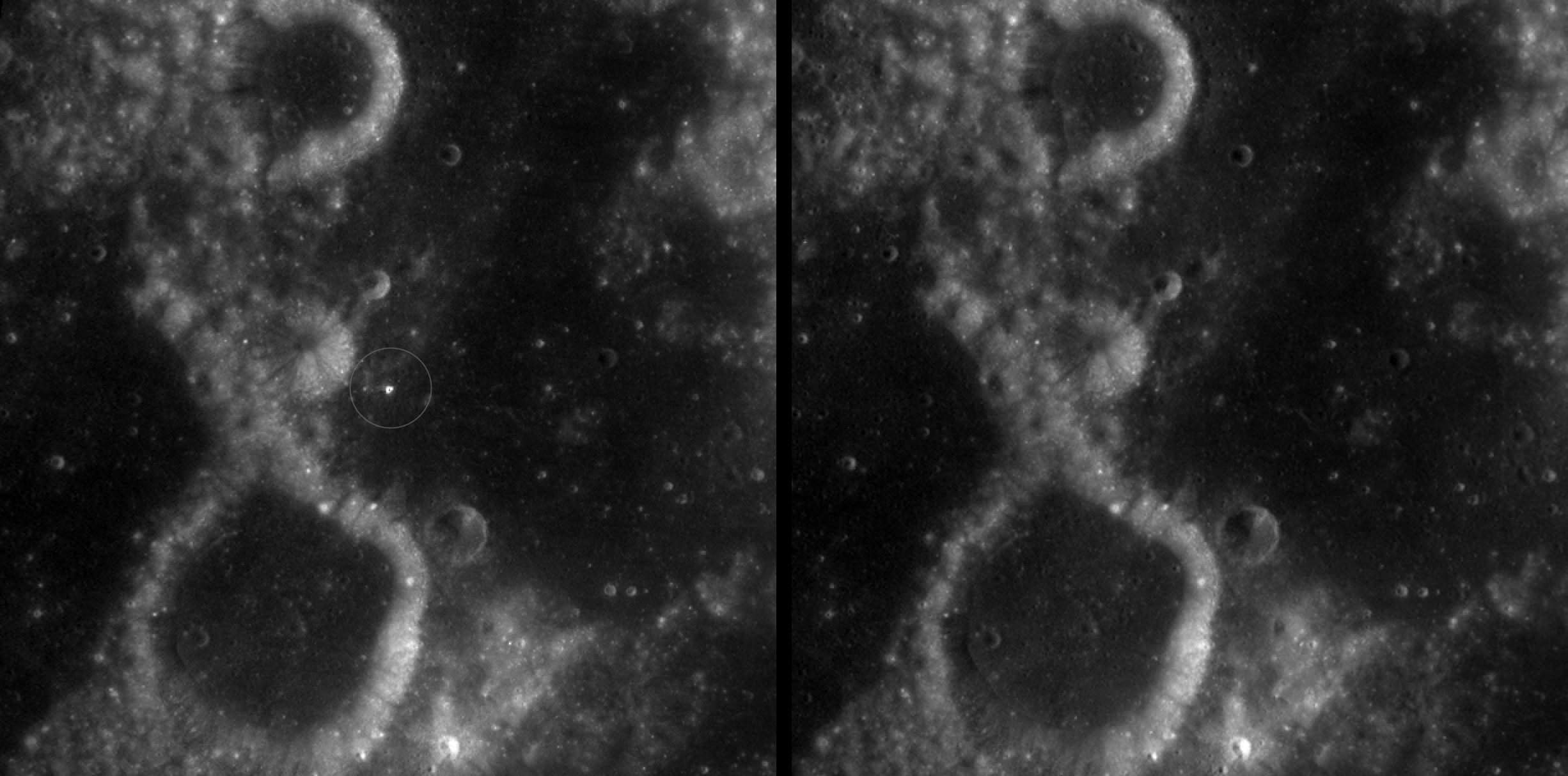
Two nearly identical black-and-white images appear side by side, separated by a vertical black line. Each shows a dark, uneven surface with scattered small circular depressions and several larger round formations with bright, raised rims. In the left image, a thin white circle marks a small, white spot near the center; there is no circled, white spot in the the corresponding area in the right image.
A zoomed-in view of McGetchin crater, circled on the left, next to a “before” image on the right. The panel on the left is made from images captured by NASA’s Lunar Reconnaissance Orbiter Wide-Angle Camera in summer 2025; the right panel was made from images taken in spring 2011. The white spot is not the crater itself, but rather material flung out of the crater, which formed when a rock, possibly this size of a three- to six‑story building, crashed into the Moon between April 11 and May 22, 2024 – a once-in-a-century event, as scientists reported on Sept. 15, 2026, in a pair of papers in Science Advances. The area shown in the images is 38 miles wide.
NASA Goddard/Intuitive Machines/Robert Wagner

Officially named McGetchin after pioneering lunar scientist Tom McGetchin, the crater formed on the Moon’s eastern edge sometime between April 11 and May 22, 2024, after a comet or asteroid the size of a three- to six-story building hit the surface.
 
The crash left a crater, 728 feet wide, that spans the length of two football fields. And at 141 feet deep, the crater could fit three vertically stacked yellow school buses.
 
Scientists estimate that an impact of this magnitude happens on the Moon about once in a century or even longer.

Moon takes some hits

For more than 17 years, LRO has been circling the Moon and using its seven instruments to map the topography, surface composition, temperature, and radiation environment there. The spacecraft’s team has identified at least 1,000 new impact craters throughout the mission and flagged 100,000 more surface changes from an object smashing into the Moon or from the debris that flung out after.

With no atmosphere to slow them or burn them up, space rocks and other objects easily reach the lunar surface. Most are much smaller compared to the object that carved out McGetchin crater. The smallest craters scientists can distinguish from LRO images are about 30 feet wide, the length of a three-story building laid on its side, made by rocks about 43 inches wide, the size of a monster-truck tire. Scientists estimate that impacts of this scale produce about 140 new craters across the Moon each year. But most new ones are made by microscopic projectiles that leave holes too small to identify in orbital images.

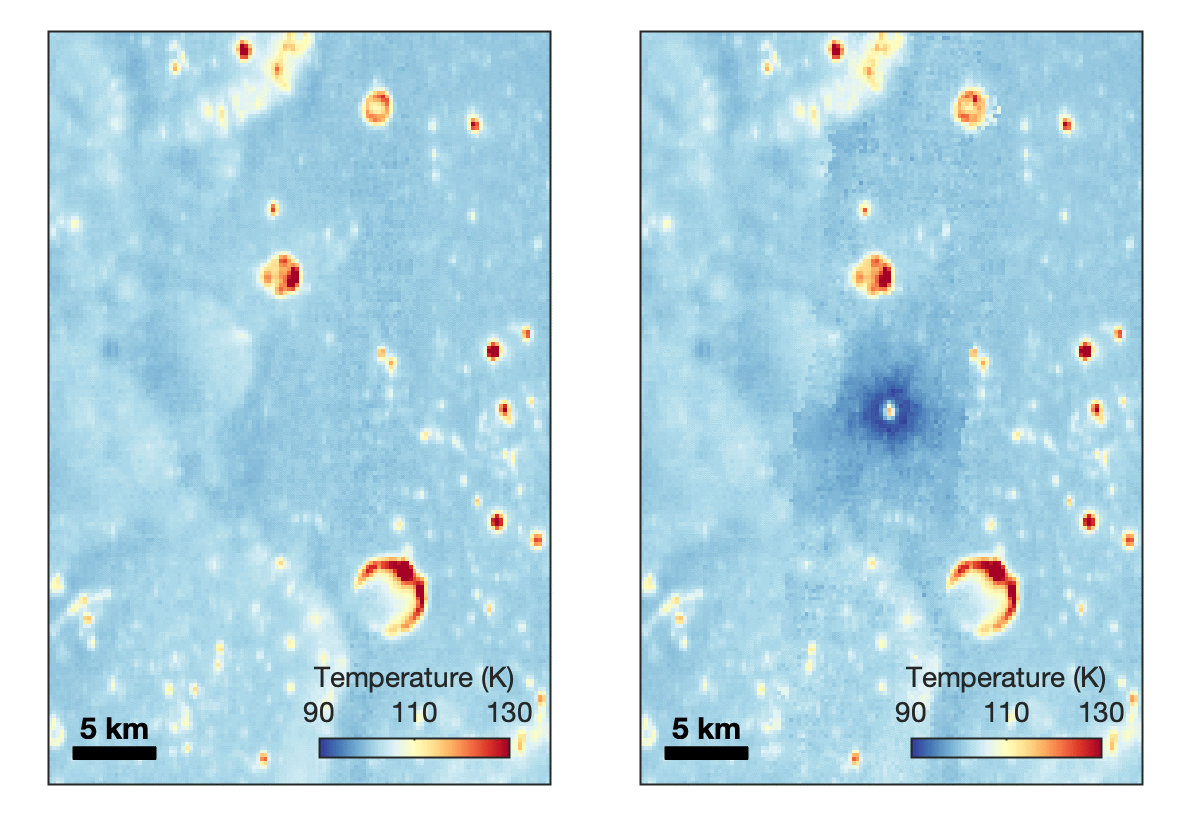
With its numerous instruments, the spacecraft can observe changes to the lunar surface that aren’t apparent in the LROC images alone. After the crater was discovered, scientists working with LRO’s thermal instrument, Diviner, made follow-up observations of the site. They found a 4-mile-wide area around the crater that is about 16 degrees Fahrenheit cooler at night than its surroundings.

Animated temperature map that alternates between two images. A vertical strip through the center blinks on and off, revealing a dark blue circular area surrounding a small white spot near the middle. The pale blue map also contains scattered yellow, orange, and red spots and rings, including a large, curved red-and-yellow feature near the lower center. A 5-kilometer scale bar appears at lower left, and a color key ranges from 90 kelvin in dark blue to 130 kelvin in dark red.
This animated image set shows an area on the eastern limb of the Moon before and after McGetchin crater formed there sometime between April 11 and May 22, 2024. The post-impact image was constructed using data taken by NASA’s Lunar Reconnaissance Orbiter (LRO) thermal instrument, Diviner, between Nov. 15, 2025, and Feb. 18, 2026, after scientists discovered the crater in visible-light images taken by LRO’s Wide-Angle Camera. Pre-impact temperatures are from the Diviner Global High-Resolution Mosaics (GHRM). The crater formed on the Moon after a comet or asteroid, possibly the size of a six-story building, hit the surface in a rare, once-in-a-century collision. The dark blue strip that flashes into view reveals a 4-mile-wide “cold spot” around the crater that is about 16 degrees Fahrenheit cooler at night than its surroundings. This cooling happens because an impact fluffs up regolith around a crater, making it less dense and therefore less able to retain heat. Scientists on the Diviner team reported this finding in a paper published on Sept. 16, 2026, in Science Advances. The red and yellow spots indicate areas typically associated with rocks excavated by long-ago impacts which, though still at cryogenic temperatures like their surroundings, remain slightly warmer at night.
NASA Goddard/UCLA/JHU APL

Reporting in a second paper Wednesday in the same journal, researchers say that the cooling happens because the impact fluffs up the regolith around the crater, making it less dense and therefore less able to retain heat.

The large extent of this “cold spot” is striking, scientists say, because it shows that impacts can modify the Moon’s surface far beyond the crater itself. These physical changes could affect how rover wheels interact with the surface, for instance.

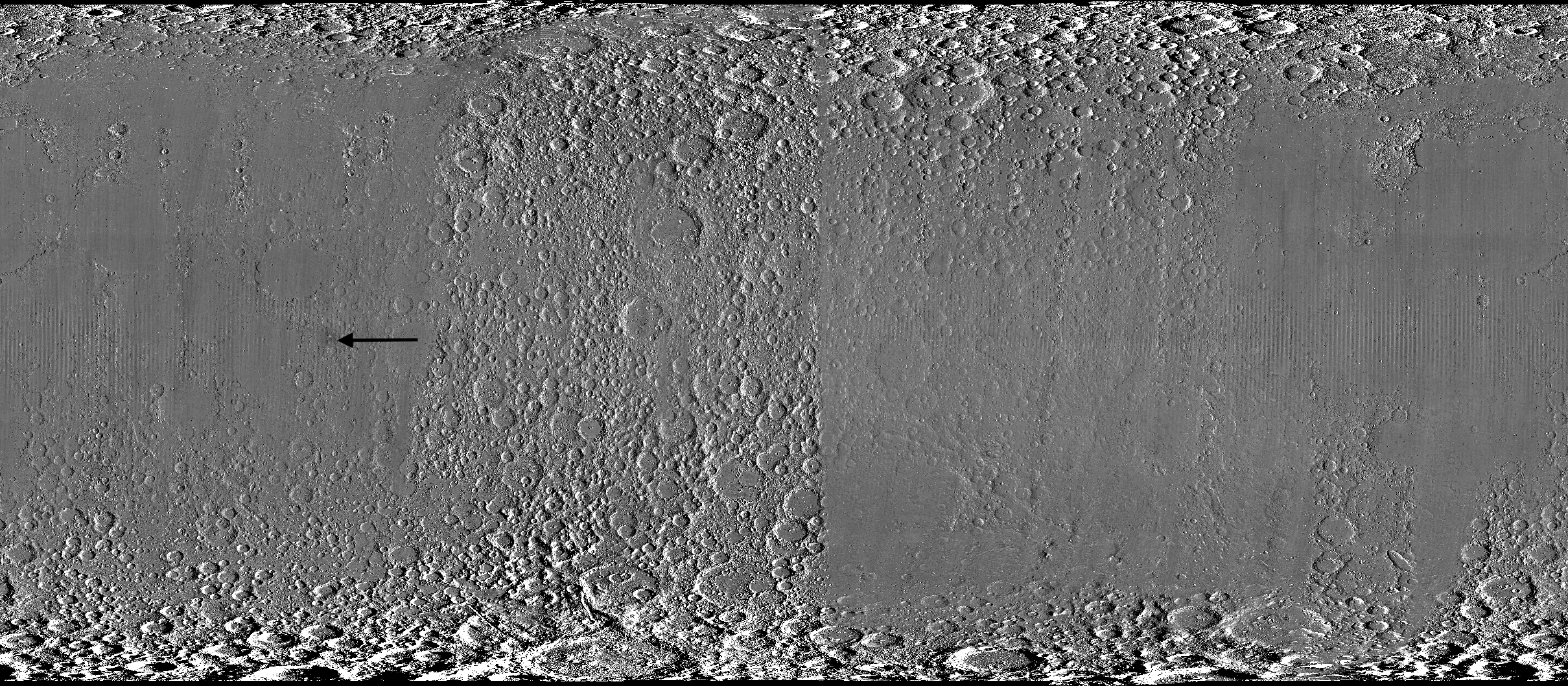
Wide black-and-white image of a rough, uneven surface densely covered with circular depressions and raised areas. The upper and lower edges are especially rugged, while the center is smoother and divided by subtle vertical bands. A black arrow left of center points toward a faint, narrow vertical mark.
A global view of the Moon made by stitching together hundreds of images from the Wide-Angle Camera aboard NASA’s Lunar Reconnaissance Orbiter (LRO). Robert Wagner, image processing specialist for LRO, made this map using two sets of mages taken several years apart. He used a software designed to highlight any changes between the two sets. Anything that stayed the same turned gray; anything different showed up as bright or dark patches. A black arrow just left of center points to McGetchin crater.
NASA Goddard/Intuitive Machines/Robert Wagner

Road to discovery

The LROC system collects images from about 60 miles above the Moon as LRO loops from pole to pole. The system includes two cameras that capture high‑resolution black‑and‑white images and one camera for moderate‑resolution multispectral images. Over the years and thousands of passes, scientists have built maps detailed enough to spot not only new craters, but also landslides, landers, seismic faults, and even hints of lava tubes.

LROC scientists regularly analyze close-up images of small portions of the Moon’s surface taken by the Narrow-Angle Camera. Using these images, they look for changes that are typically less than 30 feet across. But every few years the team searches for large (wider than 150 feet) features by creating global Moon maps and comparing them to older versions.

Square black-and-white image of a dark, uneven surface. At the center is a dark, roughly circular depression surrounded by a bright irregular area, with long streaks of lighter material radiating outward in all directions.
An overhead, close-up view of McGetchin crater that was taken on Dec. 5, 2025, by NASA’s Lunar Reconnaissance Orbiter (LRO) Narrow-Angle Camera (NAC). After the crater was discovered on Oct. 24, 2025, in global images from LRO’s Wide-Angle Camera, which captures broad views with pixels the size of American football fields, scientists turned to the NAC, which takes much sharper views at about 3 feet per pixel. The NAC images, taken as LRO flew over the impact site again, revealed the crater size, shape, and how the surrounding terrain was affected by the impact that carved McGetchin. The image covers an area that’s ¾ mile wide.
NASA Goddard/Intuitive Machines
Square black-and-white image of a dark, gently uneven surface scattered with small circular depressions. Near the center is a small oval crater with a bright raised rim and dark interior. Fine, bright streaks radiate outward from the crater across the surrounding surface.
This view from the side (55° away from straight down) towards the east, covers an area of the Moon that’s about 1.5 miles wide. It was taken by NASA’s Lunar Reconnaissance Orbiter Narrow-Angle Camera on March 3, 2026.
NASA Goddard/Intuitive Machines

That’s what Wagner was doing on Oct. 24, 2025, when he came across McGetchin. Using images from LROC’s Wide-Angle Camera, which captures broad views with pixels the size of football fields, he stacked hundreds of “before” and “after” frames with software designed to highlight change. Anything that stayed the same turned gray while anything different showed up as bright or dark patches.

While the process sounds straightforward, spotting real craters requires a lot of manual work. The software flags every tiny shift in lighting or shadow, generating hundreds of false alarms. For this reason, Wagner typically verifies the software, looking for small fuzzy halos around pixel‑wide bright points, which indicate splashes of regolith around a new crater.

Spanning hundreds of pixels, McGetchin stood out immediately. “It was by far the most obvious impact debris pattern I’ve ever seen in one of these images,” Wagner said.

After his discovery, scientists turned to the Narrow-Angle Camera, which takes much sharper views at about 3 feet per pixel. This camera’s close-up images, taken as LRO flew over the impact site again, revealed the crater size, shape, and how the surrounding terrain was affected. These images also helped researchers estimate the size and force of the rock fragment that formed the new crater, details that are expected to appear in a future paper.

Banner image caption: A zoomed-in view of the Moon, with debris around McGetchin crater visible as a white spot circled by a dark halo just right of center of the image (marked with black arrows). This is the view that Robert Wagner saw on Oct. 24, 2025, during a routine data-quality check. Wagner is an image processing specialist for NASA’s Lunar Reconnaissance Orbiter Camera, a system of three cameras. Using images from the Wide-Angle Camera (WAC), which captures broad views with pixels the size of American football fields, he stacked hundreds of images captured by WAC over the last several years with software designed to highlight change. Anything that stayed the same is gray; anything that changed showed up as bright or dark patches. The stripes in the image are due to slight changes in lighting between the older and newer images. This image composite shows an area of the Moon approximately 900 miles across.

About the Author

Lonnie Shekhtman

Lonnie Shekhtman

Senior Science Writer

Shekhtman helps communicate NASA planetary science to the world through news and feature stories on NASA.gov, videos for NASA+ and YouTube, and by working with the media. She reports on lunar and Mars science and exploration; NASA's search for life; missions to Venus, Titan, and Jupiter's Trojan asteroids; and many other topics related to NASA's exploration of our solar system and beyond.

Keep Exploring

Discover More Topics From NASA

Simplified Summary

Scientists discovered a crater on the Moon that formed sometime between April 11 and May 22, 2024, after a comet or asteroid the size of a three- to six-story building hit the surface.   The crash left a crater, 728 feet wide, that spans the length of two football fields. And at 141 feet deep, the crater could fit three vertically stacked yellow school buses.

The post NASA’s Moon Orbiter Spots New, ‘Once-in-Century’ Moon Crater appeared first on NASA Science.

NASA’s Moon Orbiter Spots New, ‘Once-in-Century’ Moon Crater

16 September 2026 at 19:06
6 Min Read

NASA’s Moon Orbiter Spots New, ‘Once-in-Century’ Moon Crater

Black-and-white image of a textured, cratered surface. Two black arrows near the center point inward toward a small, dark, circular feature.
A zoomed-in view of the Moon made from images from NASA’s Lunar Reconnaissance Orbiter Camera. (More information at the bottom of article.)
Credits:
NASA Goddard/Intuitive Machines/Robert Wagner

It started as a routine data-quality check. But as Robert Wagner, a scientist with NASA’s Lunar Reconnaissance Orbiter (LRO), scanned a giant Moon map on his computer screen, an unusually large bright spot circled by a dark halo caught his eye, as it implied that surface material in that area had been shaken up.

“I just stopped, dropped everything, and started looking into what that spot was,” said Wagner, an image-processing specialist from Intuitive Machines who works with data from the Lunar Reconnaissance Orbiter Camera (LROC) system.

By comparing before and after images of the Moon, Wagner realized he had discovered the largest, newly formed crater ever found in the solar system, as scientists reported Wednesday in Science Advances. This discovery highlights the value of NASA’s Moon orbiter data in studying a dynamic landscape as the agency advances a sustained human presence and expanded scientific and commercial activity on the Moon.

Two nearly identical black-and-white images appear side by side, separated by a vertical black line. Each shows a dark, uneven surface with scattered small circular depressions and several larger round formations with bright, raised rims. In the left image, a thin white circle marks a small, white spot near the center; there is no circled, white spot in the the corresponding area in the right image.
A zoomed-in view of McGetchin crater, circled on the left, next to a “before” image on the right. The panel on the left is made from images captured by NASA’s Lunar Reconnaissance Orbiter Wide-Angle Camera in summer 2025; the right panel was made from images taken in spring 2011. The white spot is not the crater itself, but rather material flung out of the crater, which formed when a rock, possibly this size of a three- to six‑story building, crashed into the Moon between April 11 and May 22, 2024 – a once-in-a-century event, as scientists reported on Sept. 15, 2026, in a pair of papers in Science Advances. The area shown in the images is 38 miles wide.
NASA Goddard/Intuitive Machines/Robert Wagner

Officially named McGetchin after pioneering lunar scientist Tom McGetchin, the crater formed on the Moon’s eastern edge sometime between April 11 and May 22, 2024, after a comet or asteroid the size of a three- to six-story building hit the surface.
 
The crash left a crater, 728 feet wide, that spans the length of two football fields. And at 141 feet deep, the crater could fit three vertically stacked yellow school buses.
 
Scientists estimate that an impact of this magnitude happens on the Moon about once in a century or even longer.

Moon takes some hits

For more than 17 years, LRO has been circling the Moon and using its seven instruments to map the topography, surface composition, temperature, and radiation environment there. The spacecraft’s team has identified at least 1,000 new impact craters throughout the mission and flagged 100,000 more surface changes from an object smashing into the Moon or from the debris that flung out after.

With no atmosphere to slow them or burn them up, space rocks and other objects easily reach the lunar surface. Most are much smaller compared to the object that carved out McGetchin crater. The smallest craters scientists can distinguish from LRO images are about 30 feet wide, the length of a three-story building laid on its side, made by rocks about 43 inches wide, the size of a monster-truck tire. Scientists estimate that impacts of this scale produce about 140 new craters across the Moon each year. But most new ones are made by microscopic projectiles that leave holes too small to identify in orbital images.

With its numerous instruments, the spacecraft can observe changes to the lunar surface that aren’t apparent in the LROC images alone. After the crater was discovered, scientists working with LRO’s thermal instrument, Diviner, made follow-up observations of the site. They found a 4-mile-wide area around the crater that is about 16 degrees Fahrenheit cooler at night than its surroundings.

Animated temperature map that alternates between two images. A vertical strip through the center blinks on and off, revealing a dark blue circular area surrounding a small white spot near the middle. The pale blue map also contains scattered yellow, orange, and red spots and rings, including a large, curved red-and-yellow feature near the lower center. A 5-kilometer scale bar appears at lower left, and a color key ranges from 90 kelvin in dark blue to 130 kelvin in dark red.
This animated image set shows an area on the eastern limb of the Moon before and after McGetchin crater formed there sometime between April 11 and May 22, 2024. The post-impact image was constructed using data taken by NASA’s Lunar Reconnaissance Orbiter (LRO) thermal instrument, Diviner, between Nov. 15, 2025, and Feb. 18, 2026, after scientists discovered the crater in visible-light images taken by LRO’s Wide-Angle Camera. Pre-impact temperatures are from the Diviner Global High-Resolution Mosaics (GHRM). The crater formed on the Moon after a comet or asteroid, possibly the size of a six-story building, hit the surface in a rare, once-in-a-century collision. The dark blue strip that flashes into view reveals a 4-mile-wide “cold spot” around the crater that is about 16 degrees Fahrenheit cooler at night than its surroundings. This cooling happens because an impact fluffs up regolith around a crater, making it less dense and therefore less able to retain heat. Scientists on the Diviner team reported this finding in a paper published on Sept. 16, 2026, in Science Advances. The red and yellow spots indicate areas typically associated with rocks excavated by long-ago impacts which, though still at cryogenic temperatures like their surroundings, remain slightly warmer at night.
NASA Goddard/UCLA/JHU APL

Reporting in a second paper Wednesday in the same journal, researchers say that the cooling happens because the impact fluffs up the regolith around the crater, making it less dense and therefore less able to retain heat.

The large extent of this “cold spot” is striking, scientists say, because it shows that impacts can modify the Moon’s surface far beyond the crater itself. These physical changes could affect how rover wheels interact with the surface, for instance.

Wide black-and-white image of a rough, uneven surface densely covered with circular depressions and raised areas. The upper and lower edges are especially rugged, while the center is smoother and divided by subtle vertical bands. A black arrow left of center points toward a faint, narrow vertical mark.
A global view of the Moon made by stitching together hundreds of images from the Wide-Angle Camera aboard NASA’s Lunar Reconnaissance Orbiter (LRO). Robert Wagner, image processing specialist for LRO, made this map using two sets of mages taken several years apart. He used a software designed to highlight any changes between the two sets. Anything that stayed the same turned gray; anything different showed up as bright or dark patches. A black arrow just left of center points to McGetchin crater.
NASA Goddard/Intuitive Machines/Robert Wagner

Road to discovery

The LROC system collects images from about 60 miles above the Moon as LRO loops from pole to pole. The system includes two cameras that capture high‑resolution black‑and‑white images and one camera for moderate‑resolution multispectral images. Over the years and thousands of passes, scientists have built maps detailed enough to spot not only new craters, but also landslides, landers, seismic faults, and even hints of lava tubes.

LROC scientists regularly analyze close-up images of small portions of the Moon’s surface taken by the Narrow-Angle Camera. Using these images, they look for changes that are typically less than 30 feet across. But every few years the team searches for large (wider than 150 feet) features by creating global Moon maps and comparing them to older versions.

Square black-and-white image of a dark, uneven surface. At the center is a dark, roughly circular depression surrounded by a bright irregular area, with long streaks of lighter material radiating outward in all directions.
An overhead, close-up view of McGetchin crater that was taken on Dec. 5, 2025, by NASA’s Lunar Reconnaissance Orbiter (LRO) Narrow-Angle Camera (NAC). After the crater was discovered on Oct. 24, 2025, in global images from LRO’s Wide-Angle Camera, which captures broad views with pixels the size of American football fields, scientists turned to the NAC, which takes much sharper views at about 3 feet per pixel. The NAC images, taken as LRO flew over the impact site again, revealed the crater size, shape, and how the surrounding terrain was affected by the impact that carved McGetchin. The image covers an area that’s ¾ mile wide.
NASA Goddard/Intuitive Machines
Square black-and-white image of a dark, gently uneven surface scattered with small circular depressions. Near the center is a small oval crater with a bright raised rim and dark interior. Fine, bright streaks radiate outward from the crater across the surrounding surface.
This view from the side (55° away from straight down) towards the east, covers an area of the Moon that’s about 1.5 miles wide. It was taken by NASA’s Lunar Reconnaissance Orbiter Narrow-Angle Camera on March 3, 2026.
NASA Goddard/Intuitive Machines

That’s what Wagner was doing on Oct. 24, 2025, when he came across McGetchin. Using images from LROC’s Wide-Angle Camera, which captures broad views with pixels the size of football fields, he stacked hundreds of “before” and “after” frames with software designed to highlight change. Anything that stayed the same turned gray while anything different showed up as bright or dark patches.

While the process sounds straightforward, spotting real craters requires a lot of manual work. The software flags every tiny shift in lighting or shadow, generating hundreds of false alarms. For this reason, Wagner typically verifies the software, looking for small fuzzy halos around pixel‑wide bright points, which indicate splashes of regolith around a new crater.

Spanning hundreds of pixels, McGetchin stood out immediately. “It was by far the most obvious impact debris pattern I’ve ever seen in one of these images,” Wagner said.

After his discovery, scientists turned to the Narrow-Angle Camera, which takes much sharper views at about 3 feet per pixel. This camera’s close-up images, taken as LRO flew over the impact site again, revealed the crater size, shape, and how the surrounding terrain was affected. These images also helped researchers estimate the size and force of the rock fragment that formed the new crater, details that are expected to appear in a future paper.

Banner image caption: A zoomed-in view of the Moon, with debris around McGetchin crater visible as a white spot circled by a dark halo just right of center of the image (marked with black arrows). This is the view that Robert Wagner saw on Oct. 24, 2025, during a routine data-quality check. Wagner is an image processing specialist for NASA’s Lunar Reconnaissance Orbiter Camera, a system of three cameras. Using images from the Wide-Angle Camera (WAC), which captures broad views with pixels the size of American football fields, he stacked hundreds of images captured by WAC over the last several years with software designed to highlight change. Anything that stayed the same is gray; anything that changed showed up as bright or dark patches. The stripes in the image are due to slight changes in lighting between the older and newer images. This image composite shows an area of the Moon approximately 900 miles across.

About the Author

Lonnie Shekhtman

Lonnie Shekhtman

Senior Science Writer

Shekhtman helps communicate NASA planetary science to the world through news and feature stories on NASA.gov, videos for NASA+ and YouTube, and by working with the media. She reports on lunar and Mars science and exploration; NASA’s search for life; missions to Venus, Titan, and Jupiter’s Trojan asteroids; and many other topics related to NASA’s exploration of our solar system and beyond.

Keep Exploring

Discover More Topics From NASA

Simplified Summary

Scientists discovered a crater on the Moon that formed sometime between April 11 and May 22, 2024, after a comet or asteroid the size of a three- to six-story building hit the surface.
 
The crash left a crater, 728 feet wide, that spans the length of two football fields. And at 141 feet deep, the crater could fit three vertically stacked yellow school buses.

New Study Explains Why Venus Has No Moon

15 September 2026 at 19:38
NASA’s Mariner 10 spacecraft captured this view of Venus in February 1974. Image credit: NASA / JPL-Caltech.

Dr. Stephen Kane from the University of California, Riverside and colleagues offer a tidy explanation for one of the Solar System’s enduring puzzles: why Venus, so similar to Earth in size and mass, has no moon at all.

The post New Study Explains Why Venus Has No Moon appeared first on Sci.News: Breaking Science News.

Celebrate International Observe the Moon Night with NASA

15 September 2026 at 17:15

In April, the world watched as four humans circled the Moon for the first time in over 50 years with NASA’s Artemis II mission. On Saturday, Sept. 19, the public is invited to look up again with NASA events across the country, including the International Observe the Moon Night celebration held at NASA’s Goddard Space Flight Center Visitor Center in Greenbelt, Maryland.

Graphic advertising International Observe the Moon Night.
This year, NASA will celebrate International Observe the Moon Night with people around the world on Sept. 19.
NASA/Vi Nguyen

International Observe the Moon Night is an annual celebration that brings people together to learn about the Moon and explore our connection to Earth’s nearest celestial neighbor. Since the program began in 2010, people around the world have participated through lunar observations, hands-on activities, artwork, music, and more.
 
At NASA Goddard, this year’s celebration will highlight the agency’s ongoing exploration of the Moon, including the historic Artemis II mission. Visitors can peer behind the scenes to learn more about what it took to make Artemis II’s journey around the Moon a success and discover how Goddard scientists and engineers are helping advance our understanding of the Moon, solar system, and beyond.
 
The event will run from 6 p.m. to 9 p.m. EDT.
 
Throughout the event at NASA Goddard, visitors can take part in interactive hands-on activities, create artwork and crafts, and capture selfies at a photo kiosk. Telescopes will also be set up outside (depending on weather), giving attendees an opportunity to observe the Moon and other astronomical objects up close. Inside the Visitor Center, guests can even see a real Apollo 14 Moon rock on display.

  • At 6:30 p.m., Dr. Amanda Nahm, planetary scientist at NASA Headquarters, will explore the lunar science and Moon joy from Artemis II.
  • At 7:30 p.m., Ernie Wright, scientific visualizer at NASA Goddard, will offer a more technical look at how scientists use real data to create videos and visualizations of the Moon.
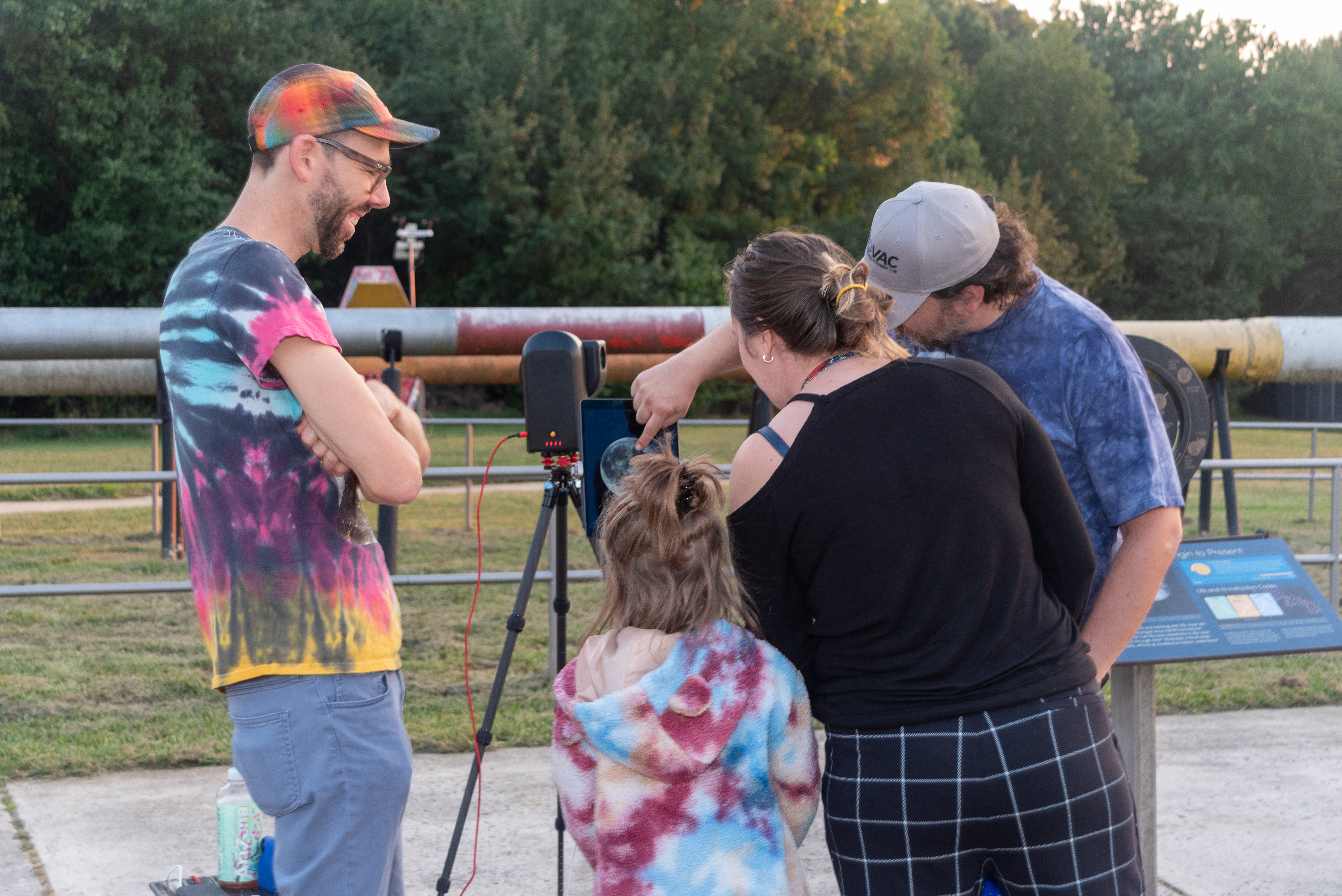
A child and two adults look at a tablet screen with a telescope’s display showing the full Moon. Another person stands to the left, smiling and looking on.
A family observes the Moon through a telescope at NASA’s Goddard Space Flight Center in Greenbelt, Md. during the International Observe the Moon Night celebration on Saturday, Sept. 14, 2024.
NASA/Britt Griswold

The event will also offer a chance to learn more about the groundbreaking research happening at NASA Goddard as scientists work to unlock the secrets of the Moon with missions like the Lunar Reconnaissance Orbiter (LRO) and explore our solar system and the universe beyond.
 
International Observe the Moon Night at Goddard is free and family friendly. Registration is not required, although registering in advance will help the Visitor Center team plan for the event. The event will take place rain or shine, and free parking is available at the Visitor Center.
 
Additional event details, including registration, accessibility and other logistics: https://www.nasa.gov/goddard/visitor-center/events-and-programs/.
 
For people who cannot travel to Greenbelt, there are opportunities to participate in International Observe the Moon Night from all around the planet. Join lunar observers around the world by observing the Moon with friends and family, attending a virtual event or finding an event in your area. Learn more and register your participation at go.nasa.gov/ObserveTheMoon.
 
International Observe the Moon Night is sponsored by NASA’s LRO mission and the Solar System Exploration Division of NASA’s Goddard Space Flight Center, with support from many partners. The celebration is a way for people to pause and look up at our future destination, as NASA prepares for deep space missions to the Moon and beyond.
 
To learn about NASA’s Artemis program, visit:
https://www.nasa.gov/artemis
 
To learn about LRO, visit:
https://www.nasa.gov/lro

Share

Details

Last Updated
Sep 15, 2026

Making rocket fuel out of Mars' thin air: New breakthrough could make it happen

15 September 2026 at 17:00

Astronauts could travel back to Earth from Mars using rocket fuel converted directly from the carbon dioxide in the Red Planet's atmosphere, using a technique known as electrochemical reduction, a recent study reports.

It's an old method involving electrolysis, which is the application of an electrical current to drive a chemical reaction, but the new trick produces methane pure enough to be used as liquid propellant. (A number of rocket engines these days burn liquid oxygen and liquid methane — including the Raptors that power Starship, the rocket SpaceX is developing to help humanity get to Mars.)

"The work we're doing is basically taking CO2 and using electricity to convert it into carbon-containing fuels and chemicals," said Carter Racine in a statement. Racine is a Ph.D. student in mechanical engineering at Texas A&M University and a member of the study team, which was led by University of Mississippi chemical engineer Ahmed Badreldin.

"You can't bring up everything you need [on Mars] from Earth, because every additional kilogram adds enormous cost and complexity to launch and escape Earth's gravity," added Badreldin. "So the question becomes, How do we make the fuels and chemicals needed for space exploration from the resources already available at the destination?"

One answer is electrochemical reduction, which takes place in an electrolyzer, with electrons flowing from the negatively charged anode to the positively charged cathode. Water at the anode is oxidized, meaning it loses an electron, which is transferred to the carbon dioxide at the cathode, where one of its atoms gains an electron and becomes what chemists refer to as "reduced" (meaning its oxidation state is lowered). It can then react with the hydrogen and oxygen atoms that have split from the oxidized water molecules.

The anode contains a catalyst, and the choice of material for the catalyst dictates what carbon-based compounds are produced when the reduced carbon reacts with the hydrogen and oxygen. For example, a gold catalyst leads to the production of carbon monoxide (CO), while copper produces more complex compounds including alcohols, ethanol and methane (CH4).

What makes the work of Badreldin's team stand apart from previous experiments is that they have developed a nanometer-scale copper catalyst doped in nitrogen that is able to produce nearly pure methane.

Electrochemical reduction of carbon dioxide has been used to produce methane before, in applications on Earth. The problem is, those methods have produced a lot of byproducts alongside methane. On Earth we have complex equipment that separates the methane from the other unwanted compounds, but astronauts are not going to be able to take such unwieldy devices to Mars when every kilogram counts. That's a problem, because for methane to be used as a liquid propellant in rocket fuel it needs to be pure.

artist's illustration of a small human outpost on mars

NASA wants to send astronauts to Mars in the late 2030s or early 2040s. (Image credit: NASA)

However, the specific copper catalyst used by Badreldin's team is able to preferentially produce methane over other compounds, thereby creating it pure without having to refine it. And there's plenty of carbon dioxide available on Mars to use: While Mars' atmosphere is thin, it is nonetheless composed of 96% carbon dioxide.

Even if astronauts never go to Mars, the usefulness of this technique on Earth is clear. Rather than drilling for this natural gas, we can create methane from the carbon dioxide already in our atmosphere.

"We want to do that because right now many of these carbon-based products ultimately come from virgin fossil resources," said Racine. "If we can make them using captured CO2 and renewable electricity, it could reduce reliance on virgin fossil carbon and help close the carbon cycle."

Consequently, electrochemical reduction has also been suggested for use on Earth as a carbon sequestration technique, drawing carbon dioxide out of our atmosphere where it acts as an unwanted greenhouse gas.

The problem with that is, converting carbon dioxide into methane to be burned as a fuel simply releases that carbon dioxide straight back into the atmosphere in a net-zero cycle. Ideally, we want to lock that carbon dioxide away from the atmosphere for a long period of time, but Badreldin doesn't think the technology is ready yet.

"What we are ultimately interested in is seeing whether we can move beyond simply recycling CO2 and toward pathways that are net-negative," he said. "That means using CO2 as a carbon source while converting it into products where the carbon is stored or used long enough that it is not immediately released back into the atmosphere."

It should be noted that the best way to alleviate climate change is to cease burning all fossil fuels, including methane. However, using methane created from electrochemical carbon dioxide reduction in a net-zero process rather than drilling for it could help during the transition from fossil fuels to renewable resources.

The study reporting this research was published in April in the journal ACS Catalysis.

Curiosity rover spots odd 'footprints' on Mars | Space photo of the day for Sept. 15, 2026

15 September 2026 at 15:00

A close-up of the Martian surface with a wide, shallow pit.

A broad pit that looks almost like a "footprint" on Mars is unlike anything researchers have ever seen on the Red Planet. (Image credit: NASA/JPL-Caltech/MSSS)

Is that a footprint on Mars? Sorry to burst your bubble, but no. However, scientists have found a strange feature unlike anything they've seen before on the Red Planet's surface.

What is it?

While NASA's Perseverance rover is the newest addition to the agency's robotic Red Planet fleet, its cousin Curiosity is still going strong and finding strange and unusual things on Mars 14 years after landing.

In new observations captured on Mars' Mount Sharp, the Curiosity team has identified "features unlike quite anything we have seen in the past," Michelle Minitti, deputy principal investigator for Curiosity's Mars Hand Lens Imager (MAHLI), said in a statement.

These mysterious features are a bunch of broad, shallow pits scattered across the Martian bedrock.

Why is it incredible?

While little pits and divots are common to find on the Martian surface, these wide, shallow pits that researchers saw with Curiosity are quite different from surface features that have been seen before.

"The pits of this week were much broader and shallower than past features and were not accompanied by obvious objects that were once in the pits," Minitti said.

The team collected as much data as they could on the strange pits using Curiosity's various instruments, including MAHLI, the Mastcam camera, ChemCam (the Chemistry and Camera complex) and APX (Alpha Particle X-Ray Spectrometer).

They have so far found interesting layers in the pit material that seems chemically different from the main bedrock.

But we will have to wait and see what else researchers might be able to learn about these odd pits. How did they form? How long have they existed? What can they tell us about the history of Mars?

Scientists Discover the Moon May Have Formed in Just Five Hours

15 September 2026 at 14:13
Moon FormationThe Moon may have emerged largely intact within hours of the colossal impact that shaped its birth. Earth has an unusually large moon for a planet of its size and position in the solar system, yet scientists still do not fully understand how that companion came to exist. Now, researchers from the Southwest Research Institute [...]

Interstellar comet 3I/ATLAS likely formed where its star's light couldn't touch it

14 September 2026 at 20:00

It has now been just over a year since the comet 3I/ATLAS first captured the world's attention as the third known object to fly through our solar system from beyond. Astronomers are still learning new things about where exactly it came from.

For the first time ever, they've been able to study charged particles in the tail of the interstellar comet. This has told them that 3I/ATLAS contains more nitrogen than the typical comet from our own solar system — revealing a tantalizing clue about how the strange comet formed.

"Finding that it's so rich in nitrogen tells us it likely formed in extremely cold conditions, far from its home star," Lea Ferellec, a research fellow at Northumbria University, said in a statement.

Ferellec's group used the William Herschel Telescope in Spain's Canary Islands. One of this telescope's instruments is a fiber-optic weave named, well, WEAVE. WEAVE lets astronomers do spectroscopy — which splits incoming light into its spectrum. Different chemical elements absorb and emit different wavelengths of light, marking that spectrum with different characteristic fingerprints. With spectroscopy, astronomers can look at a celestial object's light, pick out the fingerprints, and reconstruct the stuff inside.

Other astronomers have measured 3I/ATLAS with spectroscopy, but they've mostly examined the comet's coma, a shell of gas that forms when the sun’s heat sublimates the comet’s ice into vapor.

Of course, a coma is not the only feature that forms as a comet approaches the sun. Close in, a comet is battered by the torrent of the sun's solar wind, which pushes the comet's material away into a distinctive tail. In the process, the solar wind's high-energy particles strike the comet's molecules and electrify them into charged ions.

If astronomers can identify a tail's ions, they can find chemicals and learn information they can't from the coma alone. This is a tricky task. When fellow interstellar comet 2I/Borisov visited our solar system in 2019, astronomers identified traces of its ions, but they couldn't make out what those ions actually were.

WEAVE, which switched on in 2023, is powerful and sensitive enough to change that. When Ferellec and colleagues turned WEAVE on 3I/ATLAS in late 2025, they could count ions like nitrogen, carbon dioxide and carbon monoxide in the strange comet's tail.

A streak of white shows interstellar comet 3I/ATLAS in the center of a starry night sky

Another view of comet 3I/ATLAS. (Image credit: International Gemini Observatory/NOIRLab/NSF/AURA/Shadow the Scientist. Image Processing: J. Miller & M. Rodriguez (International Gemini Observatory/NSF NOIRLab)/T.A. Rector (University of Alaska Anchorage/NSF NOIRLab)/M. Zamani (NSF NOIRLab).)

Comparing these figures can hint at where a comet formed. For example, a comet with a higher ratio of nitrogen to carbon monoxide tends to have formed in a colder birthplace. Ferellic's group found that 3I/ATLAS has a much higher ratio than most of the comets that we observe in our solar system.

In particular, Ferellec and colleagues estimate that 3I/ATLAS formed somewhere colder than -240°C. If this comet was born in a distant star system, then, it formed in that system's outer reaches. In other words, 3I/ATLAS likely formed in a place where little of its star's light could touch it.

"This object gives us a rare chance to study material that formed somewhere completely different to our own solar system," Ferellec said in the statement. "Every one of these objects we study helps us understand a little more about how planets form around other stars."

Ferellec and colleagues published their work in the journal Monthly Notices of the Royal Astronomical Society on Sept. 7.

Mercury Has Shrunk Even More than Planetary Scientists Thought

14 September 2026 at 19:41
This color image of Mercury was generated from three MESSENGER images taken through filters sensitive to light in different wavelengths. Image credit: NASA / Johns Hopkins University Applied Physics Laboratory / Carnegie Institution of Washington.

The Solar System’s smallest planet has contracted by nearly 19 km (12 miles) across, as crater debris masked telltale wrinkles on its surface, according to new research led by the German Aerospace Center’s Institute of Space Research.

The post Mercury Has Shrunk Even More than Planetary Scientists Thought appeared first on Sci.News: Breaking Science News.

No cities on the moon — there isn't enough water, scientists say (op-ed)

14 September 2026 at 16:00

The discovery of water at the poles of the moon has inspired speculation about whether we can build there – cities, industrial neighborhoods, places where people work and live. But is there enough water, and can we use it efficiently enough? In their new article in Frontiers in Space Technologies, Dr. Martin Elvis and Dr. Jonathan McDowell do the math. Even at the most generous estimates of the available water and recycling efficiency, a city of one million people would only last 100 years before all the water runs out. In this guest editorial, which Frontiers in Space Technologies provided, Elvis breaks down what we can and can't do with the technology available.

The discovery of water in dark craters at the moon's poles has sparked a "moon rush" to establish bases there, and then villages, cities and heavy industry. How sustainable is this rush?

Soon after the moon was formed, asteroids bombarded it, creating its pockmarked topography. Near the moon's poles, there are dozens of crater floors that have not seen direct sunlight in about four billion years. Many of these cryogenically cold "pits of eternal darkness" are below a temperature of 110 Kelvin (minus 262 degrees Fahrenheit), forming "cold traps" in which water ice won't sublimate away by more than a millimeter in a billion years, even in the vacuum at the moon's surface. And there is water to freeze: some of those asteroids brought it along with them. Since 2013 we have known that that water is still there, possibly as much as a billion tons of it, thanks to a succession of moon-orbiting missions that have mapped out likely locations in increasing detail.

The presence of water at the lunar poles changes everything about human visits to the moon. Suddenly it is practical to envisage a "moon village" where people could survive without importing every last bit from Earth. They could grow their own food and have showers and functional toilets, unlike the astronauts on the International Space Station (ISS). This possibility has sparked ambitions from the likes of Jeff Bezos to move heavy industry to the moon and Elon Musk's aims to have "self-growing cities" there. These are enticing visions, but are they attainable?

The good news

We realized that we could make a first feasibility estimate simply by looking at how much power and water a large population would use on the moon, and how long a city of 100,000 or one million people could survive there. How sustainable is a city on the moon?

The good news is that power, even without nuclear reactors, is not a problem. That's because the rims of the craters containing the pits of eternal darkness are in almost permanent sunlight. (That's why they are sometimes, slightly incorrectly, referred to as the "peaks of eternal light.") Up on those highly illuminated rims it would be possible to generate three gigawatts of electricity using kilometer-tall towers covered with photovoltaic arrays. It should be possible to manufacture solar panels on the moon. There's certainly plenty of silicon. This could even make AI data centers on the moon possible, by placing them near these sunny peaks. That would be the start of a true lunar economy.

a crescent-shaped rim of a lunar crater

Shackleton Crater, near the moon's south pole, is thought to harbor large amounts of water ice on its permanently shadowed floor. (Image credit: NASA/GSFC/Arizona State University)

The bad news

The bad news is that, even assuming a generous one billion tons of water to start with, without recycling the answer to our question of sustainability is that the city would last only a few years. Even in the best-case scenario, with 98% efficient recycling of water — the same as achieved on the ISS — a one-million-person city will run out of water in just over a century. That is a problem for sustainable moon settlement. And today's best estimates of the amount of water on the moon are about 30 times less than a billion tons, shortening the time to water exhaustion by the same factor. This means that even a small city would run dry after just a decade or so. A moon village with a thousand people, or even a town with 10,000 people, would instead be sustainable for several centuries or more.

There are potential solutions. We could improve the efficiency of water recycling by a factor of five or more; lower water usage from new techniques such as vertical farming; import water, probably from accessible asteroids; or, simply, find more water. Of these it may be this last hope that is most promising. Current water surveying techniques do not reach below the surface more than a few meters, while the rubble-like rocks of the surface regolith typically extend tens of meters down and may contain water in the cold traps. If the ambitious plans of the space billionaires are to be realized, then finding more water will be the first step.

Mercury May Have Shrunk Far More Than Scientists Realized—and Its Cratered Surface Was Hiding the Evidence

14 September 2026 at 13:35

Mercury has been slowly shrinking for billions of years. But scientists studying the smallest planet in the solar system may have overlooked just how dramatic that transformation has been because some of the evidence has literally been buried.

A new study suggests Mercury’s battered, crater-covered surface has concealed a significant fraction of the faults created as the planet cooled and contracted. After accounting for those hidden geological structures, researchers estimate Mercury may have shrunk by as much as 7.2 miles (11.6 kilometers) in radius—up to 30% more than previous estimates based on the same tectonic record.

The findings could alter models of how Mercury’s interior evolved and raise an interesting possibility beyond the planet itself. For instance, scientists may also be underestimating how much other rocky worlds, particularly the Moon, have contracted.

“Combined with the contractional strain map from Broquet and Andrews-Hanna (2026a), we show that radial contraction may have been underestimated by 10%–30%,” researchers write. “Our radial contraction correction should be considered as a lower bound.”

In the study published in Geophysical Research Letters, researchers led by Dr. Gaku Nishiyama of the German Aerospace Center (DLR) examined a longstanding mystery in Mercury’s geology.

As a rocky planet loses heat, its interior contracts. Much like the skin of a drying fruit, the planet’s rigid exterior must accommodate a shrinking interior, producing faults and enormous cliff-like features known as lobate scarps, along with wrinkle ridges and other shortening structures.

Scientists therefore use the crustal shortening recorded by these structures as a geological ruler to determine how much Mercury has contracted.

The problem is that those structures aren’t distributed across Mercury the way scientists might expect.

If cooling caused the entire planet to contract, the resulting deformation should be comparatively widespread. Instead, previous mapping has revealed regions filled with large scarps alongside enormous areas where surprisingly few contractional structures have been identified.

Dr. Nishiyama and his colleagues investigated whether at least part of that discrepancy could be an illusion created by Mercury’s extraordinarily battered surface.

Mercury’s Craters May Be Hiding Its Wrinkles

The researchers constructed a global map of Mercury’s surface roughness using topographic measurements acquired from NASA’s MESSENGER mission and a global digital terrain model produced from spacecraft imagery.

They then compared that roughness with previously cataloged tectonic structures.

Findings showed that fault scarps and other shortening structures were preferentially identified in smoother terrain, while rougher regions contained substantially fewer detectable structures. The relationship remained apparent across geographic scales extending to roughly 93 miles or about 150 kilometers.

That is counterintuitive because tectonic ridges themselves create topographic roughness. If roughness and plate movements were unrelated, areas with scarps might be expected to be slightly rougher than the surrounding terrain.

Instead, the researchers found the opposite.

One explanation is evident around relatively young impact craters such as Rachmaninoff. Large impacts blasted enormous quantities of debris across the surrounding landscape, producing thick blankets of material and secondary craters. In some locations, long tectonic structures appear to lose relief as they approach these deposits—consistent with the older structures being progressively hidden under impact material.

Other faults may still exist but become difficult to recognize against heavily cratered terrain. Once the surrounding topography becomes rough enough, a weathered ridge only a little higher than the background landscape can effectively disappear into the geological noise.

There is also a third possibility.

Heavily cratered regions may contain thick, porous layers of broken rock called regolith. During planetary contraction, some deformation could be absorbed as pores collapse rather than producing large faults visible from orbit. Alternatively, deformation could create faults too small for current observations to resolve. The researchers say available evidence cannot yet rule out that possibility.

Mercury Could Have Shrunk by More Than 7 Miles

Whatever mechanism is responsible, Dr. Nishiyama and his colleagues argue the relationship creates a systematic bias, where scientists see more evidence of contraction where Mercury’s surface makes that evidence easier to preserve and identify.

The team developed a correction using comparatively smooth regions, where tectonic structures appear less affected by this bias.

Applied to an earlier global estimate of 5.2 miles (8.3 kilometers) of radial contraction, the correction increased Mercury’s estimated shrinkage to roughly 7.2 miles or about 11.6 kilometers.

Depending on which tectonic structures are included, the researchers estimate surface roughness could have caused previous calculations to underestimate Mercury’s contraction by roughly 10% to 30%. They also caution that their corrected figure may itself represent a lower limit.

Ultimately, Mercury’s shrinking surface effectively records what has happened deep inside the planet.

The amount of contraction constrains how quickly Mercury lost heat, the thickness of its insulating regolith, the abundance of heat-producing elements, and even the composition and freezing history of its enormous metallic core. The revised estimate, for example, favors models involving a thinner regolith and lower sulfur content in Mercury’s core than some previous estimates.

Scientists may soon get a much sharper look.

The ESA-JAXA BepiColombo mission’s laser altimeter will eventually measure Mercury’s topography at scales as small as about 330 feet or 100 meters, possibly revealing geological relationships that MESSENGER could not resolve.

And Mercury may not be the only world whose geological record has been hiding in plain sight.

The Moon’s highlands are even rougher than Mercury’s cratered plains—by roughly 40% at the little-over 6-mile (10-kilometer) scale examined by the researchers. Yet evidence suggests the Moon contracted less than some thermal models estimate. If rough terrain similarly hides lunar faults, part of that difference might reflect structures scientists haven’t been able to see.

In other words, Mercury’s missing wrinkles may expose a wider problem in planetary geoscience. The more battered an ancient world becomes, the more effectively its later surface can erase the visible record of what happened before it.

“Investigating roughness alongside tectonic landforms may therefore refine our understanding of the lunar thermal evolution as well,” researchers conclude. “Mars could also be subject to this roughness effect, while topographic smoothing due to fluvial and aeolian processes may introduce more complex correlation between surface roughness and shortening structures.”

Study: Nishiyama, G., Broquet, A., Tosi, N., Preusker, F., Stark, A., Hussmann, H., & Hauber, E. “Underestimation of Planetary Contraction Due to Obscuration by Surface Roughness: The Case of Mercury.” Geophysical Research Letters 53, (2026). 

Tim McMillan is a retired law enforcement executive, investigative reporter and co-founder of The Debrief. His writing typically focuses on defense, national security, the Intelligence Community and topics related to psychology. You can follow Tim on Twitter: @LtTimMcMillan.  Tim can be reached by email: tim@thedebrief.org or through encrypted email: LtTimMcMillan@protonmail.com 

Is there a hidden 'Planet 9' in our solar system?

14 September 2026 at 13:00

For more than a century, astronomers have been captivated by the idea that an undiscovered planet could be lurking in the furthest reaches of our solar system.

The search for this elusive, hypothetical planet has taken many forms over the decades. The discovery of Neptune in 1846 demonstrated that an unseen planet might be inferred from its gravitational effects on other worlds. Based on this, the search for a ninth planet began in earnest, seemingly culminating with the discovery of Pluto by astronomer Clyde W. Tombaugh in 1930.

However, decades later in August 2006, Pluto's long-held planetary status was withdrawn after its formal reclassification as a dwarf planet, launching a debate over the Kuiper Belt object's identity that continues today. Yet beyond the controversy over how Pluto should be classified, the quest to determine whether a hidden ninth planet may exist in our solar system continues — and some astronomers are more confident than ever that its discovery could be imminent.

What do we know?

The story of our solar system's unconfirmed ninth planet takes us back to the early decades of the last century. At that time, astronomers began to suspect that, much like Neptune's discovery based on irregularities in the motion of Uranus, evidence of even more distant planets might begin to surface through similar observations. This prompted American astronomer Percival Lowell to advance the idea that orbital irregularities displayed by both Uranus and Neptune could point to the existence of a distant, unknown planet — one he dubbed "Planet X."

Today, although Lowell's name for this hypothetical planet is sometimes used interchangeably with the idea of a "Planet Nine," the concepts are slightly different. While the early search for Planet X relied on observations of the motion of Uranus and Neptune, new data that included Voyager 2's encounters with those planets in the 1980s helped reveal that their orbital behavior could be explained without the introduction of an unknown ninth planet.

By contrast, modern proponents of the existence of a ninth planet focus their searches further out, looking instead to orbital peculiarities in smaller objects that occupy the distant reaches of the solar system. This approach to solving the Planet Nine mystery was put forward in 2016 by Caltech astronomers Konstantin Batygin and Michael Brown, who argued that an undiscovered planet could account for the odd orbital patterns displayed by several extreme trans-Neptunian objects in the distant solar system.

a blue orb on a black, starry background

An illustration of the hypothesized Planet Nine. (Image credit: Mark Garlick/Science Photo Library/Getty Images)

What remains unknown?

In 2024, the Caltech team presented additional findings, which specifically focused on long-period, low-inclination objects that are known to traverse Neptune's orbit.

"These objects are dynamically unstable, so the population has to be continuously replenished," Batygin recently told Space in an email. "In our 2024 work, we found that Planet Nine naturally produces the observed population, whereas the model without Planet Nine is strongly inconsistent with the data once observational biases are accounted for."

According to Batygin, the Planet Nine theory can potentially explain several unusual attributes about the distant solar system, which include the phenomena of orbital clustering, large perihelion distances some objects exhibit, the presence of retrograde bodies, and objects with highly inclined orbits (meaning their orbital paths are tilted at large angles).

Right now, Batygin says the only thing still lacking from the growing body of evidence is a direct detection of Planet Nine itself. Still, while he concedes that such direct detections remain elusive, he also maintains that something must account for the current data he, Brown, and others have collected.

"If the observed dynamical structure is real," Batygin told Space, "there is presently no comparably compelling alternative theoretical explanation."

a series of concentric rings on a starry background

The existence of a roughly Neptune-mass Planet Nine could explain why the few known extreme trans-Neptunian objects seem to be clustered together in space. The diagram was created using WorldWide Telescope. (Image credit: Caltech/R. Hurt (IPAC))

The mystery continues

Fortunately, powerful facilities like the Vera C. Rubin Observatory in Chile could soon provide the observations currently missing from the body of data needed to support the existence of a ninth planet.

In the meantime, some promising additional discoveries have been made in recent years, which could help to strengthen the statistical case for things like orbital clustering being related to an undiscovered object at the edge of the solar system.

However, Batygin advises that astronomers should be cautious in interpreting such findings.

"I would say the picture has become more complicated, rather than simply stronger or weaker," Batygin told Space. "One has to be careful about quoting a single significance for 'clustering,' because the theory does not predict that every distant object should be clustered."

As far as what would offer the clearest support for Planet Nine's existence — short of obtaining direct visual confirmation — Batygin says ongoing discoveries of distant objects in the solar system, and the patterns that emerge in their behavior, could provide the most promising new data.

"For me, the clearest non-imaging evidence would be for the dynamical patterns in the outer solar system to sharpen dramatically as the sample grows," Batygin told Space, noting that this would particularly be the case "if several independent observables converge on the same Planet Nine parameters."

"If a much larger, well-characterized sample simultaneously exhibited the predicted apsidal structure, orbital-plane structure, perihelion distribution, inclination distribution, and Neptune-crossing population, it would become very difficult to explain the observations without a common gravitational perturber," Batygin says.

With an ever-growing number of powerful ground and space-based observatories going into service, it could be just a matter of time before we receive the final confirmation that a ninth planet has been lurking out there—or that another explanation can be proven to account for its apparent gravitational fingerprints.

Until then, the search for Planet Nine remains much like what "Planet X" was more than a century ago: a captivating idea awaiting a breakthrough observation — one that could lead to a major discovery that significantly expands our knowledge of the solar system.

NASA, IBM launch new AI model for studying the moon

12 September 2026 at 11:00

We've been studying the moon for a long time. NASA has gathered mountains of data over decades of lunar missions and studies. The data collected by the Lunar Reconnaissance Orbiter (LRO) alone, for example, exceeds that of all NASA's other planetary missions combined.

Analyzing all this information takes lots of time and effort from researchers. So, NASA and IBM have developed an AI model to help sift through the moon data — an advance the agency announced on Thursday (Sept. 10). The open-source model, called the NASA-IBM Lunar Foundation Model, is currently available for free at Hugging Face.

"NASA has spent decades building an extraordinary scientific record of the moon, but collecting data is only part of the job," NASA's Kevin Murphy, chief science data officer and acting chief data and AI officer, said in the announcement.

The new AI model can help researchers with tasks like mapping craters, finding young volcanic features, and modeling possible locations of water ice near the lunar poles, according to NASA.

In the announcement, Murphy said that NASA needs to make scientific data easier to explore and use. To this end, NASA has been developing and releasing science-focused AI models with IBM. Previous models include one focused on Earth observation and another for heliophysics.

This is part of a larger trend of AI use in planetary science. Space agencies and private space companies around the world have been looking into how AI models can help with analysis to increase scientific productivity, reduce costs and streamline workflows.

"The NASA-IBM Lunar Foundation Model shows what's possible when we bring AI to NASA's petabytes of scientific data," Murphy said in the announcement. "That's a real opportunity we see with AI: turning large-scale data into new discoveries."

The AI model was mostly trained on data from the LRO mission. Over 17 years, NASA's lunar orbiter has compiled a nearly complete mosaic of images that detail the moon's surface in high definition.

The sun may once have swallowed a super-Earth planet and could still be hiding the evidence

11 September 2026 at 17:00

Our star and primary energy source that makes life on this planet possible may also be a cosmic cannibal. That's according to new research that suggests the sun may have swallowed a super-Earth planet billions of years ago in its early history. And our star may still be hiding the evidence.

The scientists behind this research think that the fingerprints of this violent consumption of a planet may still exist within the solar interior. Super-Earths are common occupants of other planetary systems, and these findings can explain why the solar system lacks such a world.

"Our new study suggests that a planet several times more massive than Earth may have fallen into the young sun and left a lasting chemical imprint deep inside it," Mutlu Yildiz, of Ege University, Turkey, said in a statement.

Yildiz and colleagues theorize that the sun's act of planetary infanticide may help to explain differences between observations of the sun and what is predicted by models of stellar evolution. This includes the depth of the sun's convection zone and the so-called sound-speed structure just below the convection zone.

It could also explain why the surface of the sun is depleted of the element lithium.

"By modelling the sun's evolution and comparing the results with precise observations of its interior, we find that the ingestion of a super-Earth could help explain long-standing differences between standard solar models and observations, including subtle changes in the sun's internal structure and its depleted lithium abundance," Yildiz said. "We were interested in whether these problems might have a common origin in the early chemical history of the sun."

The researcher explained that young stars like the sun during its infancy are surrounded by vast flattened clouds of gas and dust called protoplanetary discs, where substantial amounts of material can move between the disc and the star.

"Since planets are made of material that is chemically different from the gas in the disc, we wondered whether the early engulfment of a planet could have left a chemical signature inside the young sun," Yildiz said.

What happened to the sun's planetary meal?

Using advanced stellar evolution software, Yildiz and colleagues tested their idea by investigating different ways the sun could have swallowed a planet.

Their results found the best fit for the sun's current characteristics was the cannibalism of a planet between five and ten times the mass of the Earth, a type of planet called a super-Earth. This could explain the strange, unpredicted characteristics of the sun.

We thought planetary engulfment might affect the solar structure but did not expect the calculations to converge on such a specific super-Earth mass range," said Professor Yildiz. "That was one of the most interesting outcomes of the study."

An irregular orange sphere surrounded by a swirling blue line

An artist’s impression of a star engulfing a planet. The blue line traces the path of the planet as it spirals toward the star and ultimately collides with it. (Image credit: NASA, ESA, CSA, Ralf Crawford (STScI))

The team's research is supported by previous studies that suggests one or more super-Earth planets could have formed with the orbit of Mercury, the closest planet to the sun.

These worlds would have then migrated through the protoplanetary disk surrounding the infant sun before crashing into the star.

But this new study leaves open the possibility that something else, other than this violent collision with the sun, may explain the discrepancies in measurements of the sun's interior and its lithium content. The team's model doesn't need a planet to have been totally engulfed by the sun.

A cracked grey sphere next to a growing orange sphere

An illustration of a former super-Earth survivor escaping after an encounter with the sun (Image credit: Robert Lea (created with Canva))

Currently, this idea is based on computer modelling and unexplained solar features, but the researchers think that the predicted structural and chemical signature of a planetary engulfment could still exist within our star and could be detected.

"The earlier work proposed that a super-Earth could have formed and migrated into the young sun. Our paper asks whether the sun itself could still carry observable evidence that such an engulfment actually happened, and we believe it could," Yildiz concluded. "The next step is to see if these fingerprints can be independently detected."

The research was published on Thurs (Sept. 10) in the journal Monthly Notices of the Royal Astronomical Society.

Wavy alien dune fields stretch across Mars | Space photo of the day for Sept. 11, 2026

11 September 2026 at 15:00

Purple colored dune fields on Mars.

A dune field on Mars, as seen by the Mars Reconnaissance Orbiter. (Image credit: NASA/JPL-Caltech/University of Arizona)

Are those purple, wavy, alien thumbprints? Or perhaps an otherworldly ocean? Nope! It's actually a dune field on Mars, colored purple.

What is it?

Across the Martian surface are all sorts of unique features in the rocky, dusty surface material. In this false-color image, snapped by the HiRISE (High Resolution Imaging Science Experiment) camera on NASA's Mars Reconnaissance Orbiter, you can see the incredible and strange ripples of a dune field on Mars.

"Our science goal for this observation is to observe any changes from a previous image we acquired in 2011," a statement sharing the image reads. "For this footprint, the target enlarged and centered more over the dune field, which is located on the floor in the northern half of an unnamed impact crater."

Why is it incredible?

Spacecraft like MRO, with its HiRISE camera, have opened our eyes to the incredible features across the Martian surface.

From dune fields like we see here to craters and ancient riverbeds, these views have helped scientists piece together the planet's incredible, dynamic history. For decades, observations from orbit around Mars and by rovers on the planet's surface have helped to solve at least part of the mystery of what Mars was once like.

Researchers are still looking for signs that unequivocally point to life once existing on the planet. But so far, observations have showed that, billions of years in the past, Mars had abundant surface water — lakes, rivers perhaps even a huge ocean. In analyzing the material in and near ancient waterways on the planet with NASA's Perseverance rover, researchers have already found evidence that could possibly link to biosignatures.

While this image might look like a strange but beautiful purple-colored desktop background, photos like it this can be essential clues for scientists hunting for answers.

4.6-Billion-Year-Old Meteorite Reveals a Surprisingly Strong Primordial Magnetic Field

Artistic Illustration of Early Solar System MagnetismAncient meteorite minerals reveal a surprisingly strong magnetic field from the solar system’s first 200,000 years. About 4.6 billion years ago, before the Sun and planets existed in their familiar forms, the solar system was a vast cloud of gas and dust. Within a few million years, this “solar nebula” collapsed and flattened into a [...]
❌