❌

Normal view

Could United Launch Alliance's money problems finally force its owners to sell?

11 September 2026 at 12:00

Pretty much every rocket company in the United States, save one, has embraced two fundamental tenets: reusability and diversification.

Most famously, SpaceX branched out from reusable rockets to pursue and dominate a growing spectrum of space services: cargo delivery, human spaceflight, satellite production, broadband, and, perhaps soon, orbital data centers and in-space manufacturing. Blue Origin is evolving from a pure rocket company into a satellite manufacturer, robotics developer, and, most recently, a potential competitor for SpaceX's Starlink network.

Rocket Lab used a different approach to diversify after achieving success with its small Electron launch vehicle. The company relocated its headquarters from New Zealand to Southern California, started building spacecraft and payloads, and then went on a spree of corporate acquisitions to expand into satellite communications and take on a new role as a merchant supplier of satellite components and sensors. It's now in a stage of advanced development of its partially reusable next-generation Neutron launch vehicle.

Read full article

Comments

© United Launch Alliance

Rocket Report: Europe joins the commercial launch club; a Ravn X sighting?

11 September 2026 at 12:00

Welcome to Edition 9.10 of the Rocket Report! This week we're celebrating a historic moment in Europe when a German rocket company successfully put its launch vehicle into orbit. Isar Aerospace became the first purely commercial European company to reach orbit, and impressively it did so on just its second launch attempt. How quickly can they scale up operations? How quickly will the second European launch firm reach this goal? Big questions, which for now we don't have answers to.

As always, we welcome reader submissions, and if you don't want to miss an issue, please subscribe using the box below (the form will not appear on AMP-enabled versions of the site). Each report will include information on small-, medium-, and heavy-lift rockets as well as a quick look ahead at the next three launches on the calendar.

Isar Aerospace takes a huge step forward. Isar Aerospace, founded in 2018 by three students at a German university, successfully launched a privately developed rocket into low-Earth orbit on Saturday from a Norwegian spaceport inside the Arctic Circle. The two-stage rocket, Spectrum, became the first fully commercial launch vehicle in Europe to reach orbit, Ars reports. With Saturday’s success, Isar becomes the clear leader among a pack of several European launch startups vying to inject some competition into Europe’s stagnant launch market.

Read full article

Comments

© Isar Aerospace

FAST telescope completes survey, mapping 156,411 galaxies in largest hydrogen gas atlas

11 September 2026 at 11:33

In one of the most ambitious mapping efforts in the history of radio astronomy, China’s Five-hundred-meter Aperture Spherical radio Telescope — better known as FAST — has delivered a cosmic atlas of staggering proportions. The FASHI team, headquartered at the National Astronomical Observatories of the Chinese Academy of Sciences (NAOC), has announced the second data release of the FAST All Sky HI Survey, published as a cover story in the journal Science China Physics, Mechanics & Astronomy. Just two years after the survey’s first data release catalogued 41,741 galaxies, the new edition explodes that figure to 156,411 extragalactic sources detected in neutral hydrogen — nearly a fourfold leap that firmly establishes FASHI as the largest census of atomic hydrogen gas in galaxies ever compiled.

The scale of the achievement is difficult to overstate. FASHI DR2 now spans roughly 19,500 square degrees of sky, equivalent to 47.3 percent of the entire celestial sphere, and reaches out to redshifts below z = 0.09 — distances of well over a billion light years. For comparison, the previous benchmark in this field, the ALFALFA survey conducted with the now-collapsed Arecibo telescope in Puerto Rico, charted approximately 31,500 hydrogen-bearing galaxies across about 7,000 square degrees. FASHI DR2 has thus quintupled the galaxy count of its Arecibo predecessor while covering nearly three times the sky area, and it has done so with a sensitivity roughly 0.7 times deeper than ALFALFA’s, measured as a median noise level of 0.57 mJy per beam at a velocity resolution of 6.4 kilometers per second. In radio astronomy, lower numbers mean better sensitivity — and FASHI’s numbers are among the best ever achieved in a blind, wide-area survey.

The engine behind this performance is FAST itself. With its 500-meter dish nestled in the karst hills of Guizhou Province, the telescope remains the most sensitive single-dish radio instrument on Earth at the 21-centimeter wavelength of neutral hydrogen. The survey exploited a 19-beam receiver array, allowing the telescope to sweep the sky in an efficient drift-scan mode that turned routine transits of the sky above the dish into a torrent of data. Crucially, the instrument maintained exceptional stability across five full years of observing, from August 2020 through July 2025. In surveys of this kind, calibration drifts and instrumental fluctuations can quietly corrupt weak extragalactic signals; FAST’s long-term steadiness meant that faint hydrogen emission from distant galactic disks could be stacked, averaged and trusted.

Neutral hydrogen — the primordial fuel of star formation — is invisible to optical telescopes. The 21-centimeter spectral line, produced when the electron in a hydrogen atom flips its spin relative to the proton’s, provides the only direct tracer of the cold atomic gas from which galaxies build their stars. Detecting this feeble signal across cosmological distances requires both enormous collecting area and exquisite receiver stability. A blind HI survey, unlike targeted observations, simply listens to every direction on the sky and catalogs whatever whispers back, making it an unbiased inventory of gas-rich galaxies regardless of their optical brightness, dust content or morphology. That is precisely why such surveys are prized: they catch the dim, gas-dominated dwarfs and bloated hydrogen clouds that optical catalogs systematically miss.

To give the hydrogen detections physical meaning, the FASHI team cross-matched their radio catalog with the two great optical spectroscopic endeavors of the current era: the Dark Energy Spectroscopic Instrument survey and the Sloan Digital Sky Survey. This cross-identification yielded precise optical counterparts for approximately 64,000 sources, anchoring the hydrogen detections to galaxies with measured distances, stellar masses and star-formation rates. From these matches the team constructed a completeness-corrected statistical sample of more than 109,000 galaxies — a sample robust enough to push fundamental measurements into territory previously beyond reach.

The flagship result of the release is a new measurement of the HI mass function, the statistical distribution describing how many galaxies of a given hydrogen mass populate the local universe. Thanks to the sheer sample size and FAST’s depth, the team extended the reliable measurement range of this function down to hydrogen masses of about one million solar masses — roughly 10 to the power 6.2 in solar mass units — a regime where only the faintest dwarf galaxies live. These smallest gas reservoirs are the building blocks of galaxy evolution, the raw material that hierarchically assembles larger systems, and their census has long been fragmentary. Equally striking is the derived cosmic density of neutral hydrogen: Ω_HI equals (4.71 ± 0.03 statistical ± 0.40 systematic) × 10⁻⁴ in units of h₇₀³ Mpc⁻³ dex⁻¹. The statistical uncertainty is a mere 0.6 percent — the most precise determination of the universe’s atomic hydrogen budget ever made at low redshift.

Why does such a number matter? The cosmic HI density tracks how much raw fuel exists for future star formation, and comparing its evolution across cosmic time constrains how galaxies acquire and exhaust their gas. Because atomic hydrogen sits at the interface between the intergalactic medium and the star-forming interstellar medium, its abundance is a sensitive probe of gas accretion onto dark matter halos and of the feedback processes that heat or expel gas from galaxies. Baryonic matter, after all, is hidden in far more places than stars: cold gas, warm gas, plasma in and around halos. A precision measurement of the hydrogen component anchors models of where ordinary matter resides within the cosmic web of dark matter.

The applications of the new catalog ripple far beyond that single number. For galaxy evolution studies, the 156,411 detections provide direct observational constraints on gas accretion, star formation feedback and galaxy transformation — the processes that turn blue, gas-rich spirals into passive red systems. For cosmology, the HI mass function tests galaxy formation models within the prevailing dark matter framework. For large-scale structure work, the survey complements optical galaxy catalogs to trace the so-called HI cosmic web, revealing how diffuse gas threads through filaments and pools in voids — architecture that optical surveys alone can only infer. The dataset will also aid gravitational-wave and transient science: rapid localization of the host galaxies of gravitational-wave events depends on accurate galaxy catalogs, and an inventory of hundreds of thousands of nearby galaxies sharpens those host identifications. Finally, FASHI serves as a pathfinder for the Square Kilometre Array, the giant interferometric observatory under construction in Australia and South Africa, providing benchmark samples against which next-generation interferometric surveys will calibrate their systems and select their targets.

The trajectory of the project tells its own story. When FASHI DR1 appeared, it broke ALFALFA’s long-standing record for the largest blind HI survey. With DR2, the team argues, FASHI has moved from record-breaking to benchmark-setting — a transition that observers of Chinese radio astronomy describe as the shift from follower to leader in 21-centimeter science. The cover of the journal issue reinforces the mood: a warm sunset scene evoking the faint 21-centimeter photons from distant galaxies arriving at FAST after journeys of billions of light years, messengers of the cold gas that permeates the universe.

The survey’s story is also one of institutional perseverance. The work is led by NAOC in collaboration with the Guizhou Radio Astronomical Observatory, the Shanghai Astronomical Observatory, the CAS South America Center for Astronomy, Peking University and other partner institutions, with funding from the National Natural Science Foundation of China, the Chinese Academy of Sciences and the Ministry of Science and Technology of China. Sustained national investment in a single flagship instrument has now produced a dataset whose statistical power no other facility can currently match at these wavelengths.

The full FASHI DR2 source catalog has been released to the public through the FAST data portal, a decision that will likely seed hundreds of follow-up studies in the coming years, from targeted observations of hydrogen-rich dwarfs to statistical analyses of gas in galaxy groups and environmental studies of gas stripping in clusters. As the SKA era approaches, FASHI DR2 stands as both a scientific foundation and a demonstration: that a single dish, used patiently and precisely over five years, can still redraw the map of the gaseous universe. With nearly half the sky covered and a quarter of a million more square degrees potentially within reach, the question is no longer whether FAST will extend the hydrogen frontier, but how far.

Subject of Research: The FAST All Sky HI Survey (FASHI) second data release — a blind survey of extragalactic neutral hydrogen (21 cm) sources using the FAST telescope, measuring the HI mass function and cosmic HI density.

Article Title: FAST All Sky HI Survey completes “two-step leap” — from 41,741 to 156,411 galaxies, China’s FAST telescope maps the largest cosmic gas atlas

Article References: FAST All Sky HI Survey completes “two-step leap” — from 41,741 to 156,411 galaxies, China’s FAST telescope maps the largest cosmic gas atlas. https://doi.org/10.1007/s11433-026-3072-1 Original publication

Image Credits: AI Generated

DOI: 10.1007/s11433-026-3072-1

Keywords: FAST telescope, FASHI survey, neutral hydrogen, HI mass function, cosmic web, galaxy evolution, 21 cm line, ALFALFA, radio astronomy, Square Kilometre Array, dark matter halos, cosmology

Plasma whirlpools on the sun could trigger solar flares

11 September 2026 at 11:30

The most detailed pictures of the sun ever taken have caught a surprising new feature. High-energy whirlpools, it seems, speckle the surface of our star.

The sun is a giant ball of superhot, electrically charged gas called plasma. The sun’s surface is unstable, the new images hint. That instability — the swirling plasma — could end up twisting the sun’s magnetic field. And that, in turn, could build up energy that later gets unleashed as a solar explosion.

This could explain why the sun occasionally flings out violent bursts of radiation. Known as solar flares, such outbursts shape space weather. They, in turn, can affect technology on and around Earth.

Researchers shared their new findings August 5 in Nature.  

This is the most detailed footage of the sun’s surface ever taken. The Daniel K. Inouye Solar Telescope in Hawaii recorded it. The video reveals swirling, whirlpool-like structures in magnetized plasma near a sunspot. These structures offer new clues to how magnetic energy moves through the sun’s surface — and what might cause solar flares and explosions.

Big telescope spies tiny details

The Daniel K. Inouye Solar Telescope sits near the summit of the Haleakalā volcano in Maui, Hawaii. The biggest solar telescope in the world, its 4-meter (13-foot) mirror captured the new images.

They show swirls of plasma across a patch of sun 19 kilometers (12 miles) wide. It’s a “level of detail that was simply invisible until now,” says David Kuridze. An astrophysicist, he works at the National Solar Observatory in Boulder, Colo.  

To get such a crisp view, Kuridze’s team had to fix blurring caused by Earth’s atmosphere. This removed distortions that would have ruined the images, says Leon Ofman. He works at the Catholic University of America in Washington, D.C. An astrophysicist, he did not take part in the new study.

The new pictures brought highly magnetized regions on the sun’s surface into focus. There are millions of these regions, called solar magnetic elements. The borders between these elements churn with a special type of instability, Kuridze’s group found. It’s called the Kelvin-Helmholtz instability, or KHI.  

A KHI occurs when two layers of fluid — such as plasma — move next to each other at different speeds. A small disruption in the balance of these two forces can cause curling motions. Those motions roll up into waves. 

Scientists have seen a KHI in some ocean waves and clouds on Earth. They’ve also spotted it in the atmospheres of Jupiter and the sun. But no one has ever seen it on the sun’s surface — until now. 

A KHI could turn energy from swirling plasma into the energy behind solar explosions. This helps explain how energy moves from inside the sun to its exterior, Ofman says, “affecting us on Earth and beyond.” 

Do you have a science question? We can help!

Submit your question here, and we might answer it an upcoming issue of Science News Explores

World’s first zinc Hall-effect thruster fires in space on its maiden attempt

10 September 2026 at 22:54

A satellite has fired a Hall-effect thruster fueled by solid zinc in orbit for the first time, giving spacecraft designers a new option for electric propulsion.

Muon Space completed the test on July 1 aboard SERT-III, a dedicated propulsion test spacecraft. The mission tested the company’s Starlight propulsion system under real orbital conditions.

The thruster fired successfully on its first attempt. Telemetry matched ground-test predictions, while orbital tracking detected a measurable change in the spacecraft’s trajectory.

Zinc aims at xenon

Hall-effect thrusters have become a standard choice for efficient satellite propulsion. Most systems use xenon or krypton, which require high-pressure storage and add complexity to spacecraft designs.

Starlight takes a different approach. Its propellant comes as solid zinc, which remains stable at room temperature and does not need a pressurized tank.

That could simplify spacecraft integration and ground operations. Zinc also costs less than traditional noble-gas propellants and has a much broader supply base.

Those factors matter as satellite operators deploy larger constellations. Cutting propulsion hardware and propellant costs can become significant when the same system flies across dozens of spacecraft.

Muon says Starlight can support orbit raising, station keeping, and controlled deorbiting on small and medium-sized satellites.

The system also addresses a practical challenge that has followed electric propulsion for years. Satellite operators need efficient thrusters, but propulsion hardware must also fit tight spacecraft mass and integration constraints.

SERT-III tests hardware

Muon designed SERT-III specifically to examine how the propulsion system behaves in space. The spacecraft carried sensors to measure performance, spacecraft interactions, and material deposited by the thruster plume.

Ground testing had already established expected performance across different throttle levels and operating conditions. The orbital test provided a chance to see whether those results held up in microgravity.

They did. The thruster fed and vaporized zinc reliably during the firing, according to Muon. Tracking data also confirmed that the spacecraft experienced the expected thrust.

Engineers also watched for unwanted zinc deposition around the spacecraft. Thermoelectric Quartz Crystal Microbalance sensors detected less deposition near the thruster than conservative preflight models predicted.

That result gives engineers more data for understanding how zinc behaves after leaving the thruster. It should also help refine plume and contamination models for future spacecraft.

Muon CEO Jonny Dyer called the orbital firing a major milestone for electric propulsion. He said the company chose to acquire Starlight Propulsion because zinc could address persistent problems in the propulsion supply chain.

The test also avoided putting experimental hardware on a primary customer mission. SERT-III gave engineers a spacecraft dedicated to collecting propulsion data without placing another mission at risk.

Customer missions next

Muon now plans to incorporate the flight data into further development of Starlight. Engineers will focus on reliability, manufacturing, and plume management as the system moves toward production.

The company expects its current-generation thruster to reach customer spacecraft before the end of 2026. Muon is also developing a larger second-generation system. It plans to test Gen2 in orbit during the first quarter of 2027.

That version will target larger spacecraft and could expand zinc-based Hall propulsion beyond the smaller satellite market. If the upcoming tests confirm the early results, solid-metal propellant could become a practical alternative for more commercial spacecraft.

Europe will go it alone on Venus mission after NASA yanks radar instrument

10 September 2026 at 20:09

The European Space Agency is moving "full steam ahead" with development of a robotic mission to Venus after NASA officials determined they were unlikely to fulfill a commitment to provide a US-built radar instrument for the spacecraft, the mission's project scientist said.

The European orbiter, named Envision, will map the Venusian surface at 10 times higher resolution than the last radar mission sent to Venus by NASA in the 1990s. The planet is enshrouded in a blanket of thick clouds of sulfuric acid, rendering its mysterious surface unseen by optical cameras in orbit. Radar is the most effective way to penetrate the clouds of Venus to reveal the terrain below, and scientists will use Envision to look for signs of active volcanism.

NASA and ESA signed a memorandum of understanding in 2024 outlining their partnership on Envision. NASA agreed to supply a US-made synthetic aperture radar instrument, Envision's primary means of mapping the surface of Venus, along with providing tracking and communications support through NASA's Deep Space Network. In exchange, ESA would include US researchers on Envision's science team. Europe would build the Envision spacecraft and the rest of its science instruments and provide the launch on an Ariane 6 rocket.

Read full article

Comments

© ESA/Paris Observatory/VR2Planets

4.6-Billion-Year-Old Meteorite Reveals a Surprisingly Strong Primordial Magnetic Field

Artistic Illustration of Early Solar System MagnetismAncient meteorite minerals reveal a surprisingly strong magnetic field from the solar system’s first 200,000 years. About 4.6 billion years ago, before the Sun and planets existed in their familiar forms, the solar system was a vast cloud of gas and dust. Within a few million years, this “solar nebula” collapsed and flattened into a [...]

Scientists May Have Cracked the Mystery of the Moon’s Unequal Hemispheres

10 September 2026 at 18:49
Earth Behind Far Side of MoonChang’e-6 samples suggest the Moon’s two very different sides may have formed when uneven heating drove magma from one hemisphere to the other. The Moon presents two dramatically different faces. Its Earth-facing hemisphere is rich in dark volcanic plains, while the farside is dominated by older highlands and a much thicker crust. New analyses of [...]

Black Hole Winds Are 100 Times More Powerful Than Astronomers Thought

10 September 2026 at 18:14
Illustration of Supermassive Black Hole BlastAstronomers once thought winds generated by supermassive black holes affected only their host galaxies, but a recent study found that their energy can also reach surrounding galaxies. Winds from a supermassive black hole can carry energy far beyond the galaxy that contains it. New observations show that this influence can extend roughly 300,000 light-years and [...]

Mars astronauts could live in houses 3D-printed from freeze-dried yeast

10 September 2026 at 16:00

In order to survive, the first humans to reach Mars will immediately need a safe and reliable place to set up shop. But building on Earth’s neighbor is immensely more challenging than construction projects at home. The Martian surface is a practically airless vacuum, constantly bombarded with radiation, and regularly reaches temperatures as low as -81 degrees Fahrenheit.

However, there is a very specific process on Earth that approximates similar conditions to the Red Planet: freeze-drying. According to researchers at The Hong Kong University of Science and Technology, the same method used to preserve perishable foods could also inspire sturdy and even recyclable 3D-printed houses on Mars. The secret ingredients? Everyday gelatin and yeast. The novel approach is detailed in a study published today in the journal Chem Circularity.

“My inspiration came from freeze-dried fruits that become harder. So I asked myself if we can take advantage of that and make some materials,” Jishen Qiu, a study co-author and civil engineer, said in a statement.

The combination of materials are simple: sand and an adhesive binder. Since gluing tiny rocks together requires specialized stickiness, Qiu’s team invented a new concoction from gelatin and lab engineered yeast. When mixed, the yeast microbes become coated with adhesive proteins similar to those used by mussels to anchor on stones underwater. The goop is then extruded through a 3D printer nozzle into an extremely cold, low-pressure environment, where it solidifies as the water instantly freezes and converts from ice to vapor. The final result is a light, porous, foam-like material that remains very resilient.

“This is actually strong enough to build a one- or two-story building on Earth—whose gravity is three times that of Mars,” explained Qiu. “So, you can probably easily build a multistory building on Mars with the material.”

Qiu and his collaborators know they must first start small before expanding to Martian neighborhoods. Their prototype domes are only about the size of a wine cork at this point, but their compressive strength is comparable to low-grade concrete.

Engineers have experimented with 3D-printed structures to use on the moon and Mars for years, but many of these still require steps like melting down rocks or lunar regolith. These methods usually require a lot of extra energy, which may limit their utility. Qiu’s technique requires comparatively little energy, although he admits it’s still unclear if yeasts can withstand life on Mars. That said, the team’s early results are a promising step towards simple, efficient, and sturdy buildings beyond Earth. If nothing else, yeast also lends itself to trial-and-error.

“As long as there’s one yeast that’s still alive, you can grow them again,” added Qiu.

The post Mars astronauts could live in houses 3D-printed from freeze-dried yeast appeared first on Popular Science.

Mercury may have shrunk much more than we thought, new study hints

10 September 2026 at 14:00

Mercury, which is about one-third the size of Earth, may have shrunk more in its evolution than scientists originally thought.

A new study suggests that the tiny planet may have contracted 10% to 30% more than previous models suggested — meaning the planet’s total diameter shrunk almost 12 miles (19 km) since Mercury was formed. (Mercury’s diameter today is roughly 3,032 miles (4,880 km).

Previous missions overlooked the extent of the shrinkage because impact-crater debris on Mercury's surface hid the evidence, according to a study published Thursday (Sept. 10) in the journal Geophysical Research Letters. That size difference is important when researchers consider the planet's history, said Gaku Nishiyama, a planetary scientist at the German Aerospace Center Institute of Space Research and an author of the study.

"Because Mercury's evolution is driven by its cooling, the amount of contraction — an indicator of the extent of cooling — is one of the most important observables that can be compared to models for estimating its evolution scenario," Nishiyama told Live Science in an email.

There could also be implications for the planet's composition. For example, more shrinkage at Mercury could mean the planet would have a larger metal core and fewer light elements, such as silicon, inside that core, according to an American Geophysical Union statement.

"The interior of Mercury would reflect its formation," Nishiyama said, and possibly hint at the innermost part of our solar system. "Therefore, to understand how our solar system has evolved up to now, information that can be extracted from this estimation — such as core composition and initial temperature condition — is critical."

A violent history

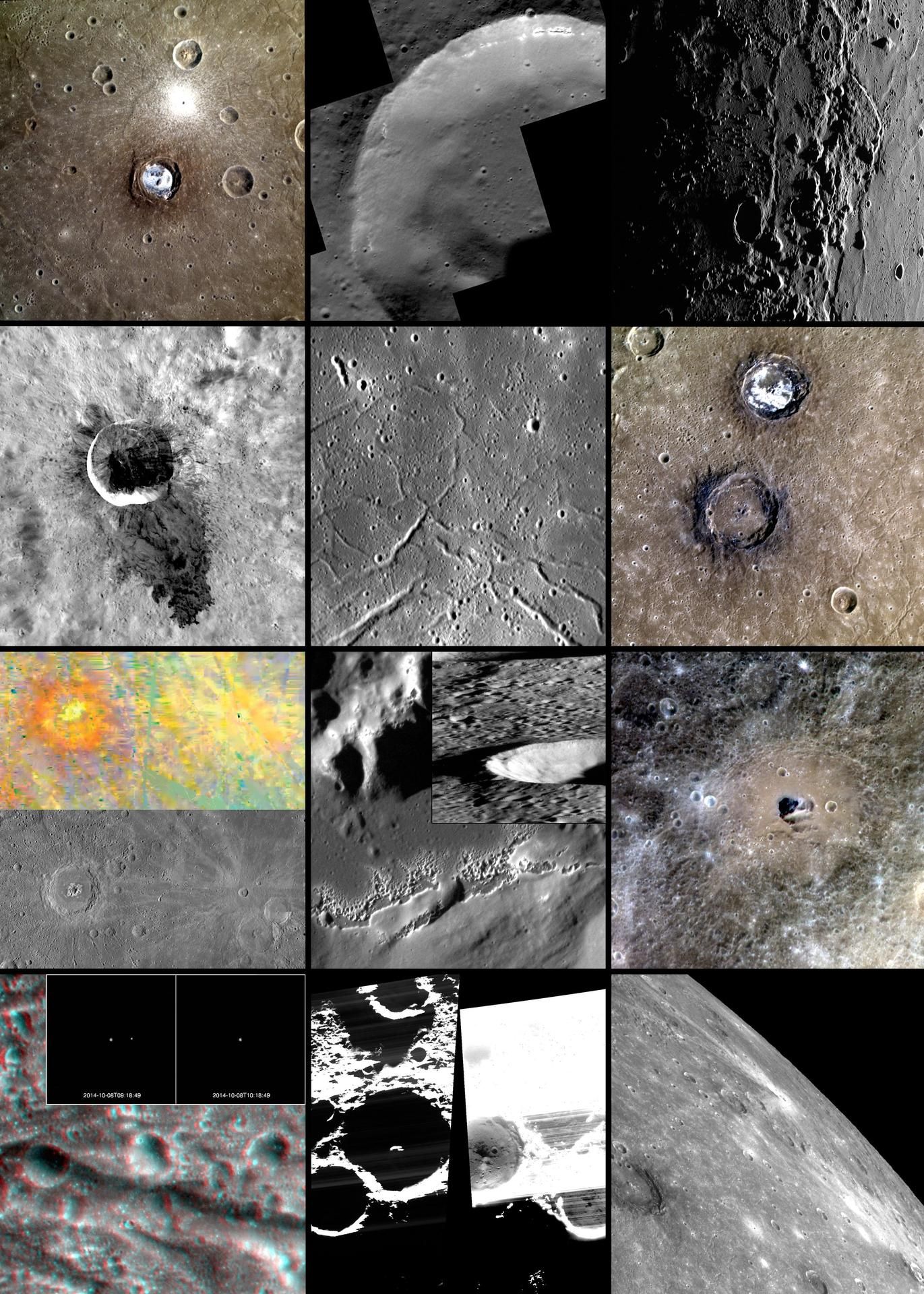
A series of images of the surface of Mercury from space.

Observations from NASA's MESSENGER spacecraft (examples shown here) helped the team build new maps of the planet's shrinkage. (Image credit: NASA/Johns Hopkins University Applied Physics Laboratory/Carnegie Institution of Washington)

Mercury and the rest of the solar system planets formed due to the gradual collisions and aggregations of rock and gas upon asteroids and comets. Some of those impacts that created the planets also released a lot of heat. Mercury has been slowly cooling from those ancient impacts, and its interior has been shrinking along the way.

While this kind of cooling affects the entire planet's landscape, impact craters can mask the effects because each crash into the surface generates its own surface changes, including debris and new divots. The craters build up over time, making it difficult to spot more ancient geology underneath.

Nishiyama's team compared two sets of maps from Mercury, using data from NASA's MESSENGER mission, which orbited Mercury between 2011 and 2015. One set of maps charted geological features showing contraction, and the other set estimated the roughness of the planet's surface. Their work covered the entire surface and demonstrated that the most rugged spots on the planet have fewer wrinkles from shrinking. In other words, according to Nishiyama, the debris from more recent impacts is covering up the evidence of shrinking.

Nishiyama said more information will help to confirm the estimate. Such data could come from the European Space Agency's BepiColombo spacecraft, which began its arrival sequence at Mercury earlier this month after nearly eight years of space travel. Once the mission settles in, the spacecraft will take higher-resolution imagery of the surface than MESSENGER did. Nishiyama's team expects BepiColombo to pick up smaller impact craters, as well as scarps and ridges, that could further refine the measurements.

"Stay tuned for future topography measurements by BepiColombo," Nishiyama said. "Future data from laser altimetry on BepiColombo will collect more information on planetary contraction by measuring topography more precisely."

Artemis II commander and pilot become NASA's first astronaut emeriti

10 September 2026 at 12:30

The commander and pilot of NASA's Artemis II mission have gained a new distinction five months after splashing down from the Moon: They're not fully retiring from the space agency.

Reid Wiseman and Victor Glover are the first astronauts to join NASA's emeritus program, enabling them to continue to support the work being done at Johnson Space Center in Houston. They will remain available to train and mentor the current workforce while still being able to pursue employment and opportunities outside of NASA.

"I have asked NASA ... to not use the term 'retire' as much, but technically emeritus is a retirement program," Glover told collectSPACE.com on Wednesday. "It's something we have typically done for scientists when they have groundbreaking research, and they want to go back to academia to teach or to research and publish."

Read full article

Comments

© NASA/Kim Shiflett

❌