 Login
The Mic Is On. So Is Live Auto-Tune.
11 September 2026 at 10:02
As audiences demand perfection from live performances, pitch correction technology has become an increasingly common way for singers to deliver.



Editor’s Note: Astrobites is a graduate-student-run organization that digests astrophysical literature for undergraduate students. As part of the partnership between the AAS and astrobites, we occasionally repost astrobites content here at AAS Nova. We hope you enjoy this post from astrobites; the original can be viewed at astrobites.org.
Title: Thermal Electrons in the Radio Afterglow of Relativistic Tidal Disruption Event ZTF22aaajecp/AT 2022cmc
Authors: Lauren Rhodes et al.
First Author’s Institution: McGill University
Status: Published in ApJ
Tidal disruption events (TDEs, see Figure 1), which occur when a star gets a little too close to a supermassive black hole (SMBH) and gets ripped apart, are a hot topic across the electromagnetic spectrum. During a TDE, the star can no longer hold itself together under the gravitational pull of the SMBH. Some bits of the star end up accreting onto the black hole, which can launch a temporary outflow, or, in especially dramatic cases, a relativistic jet.
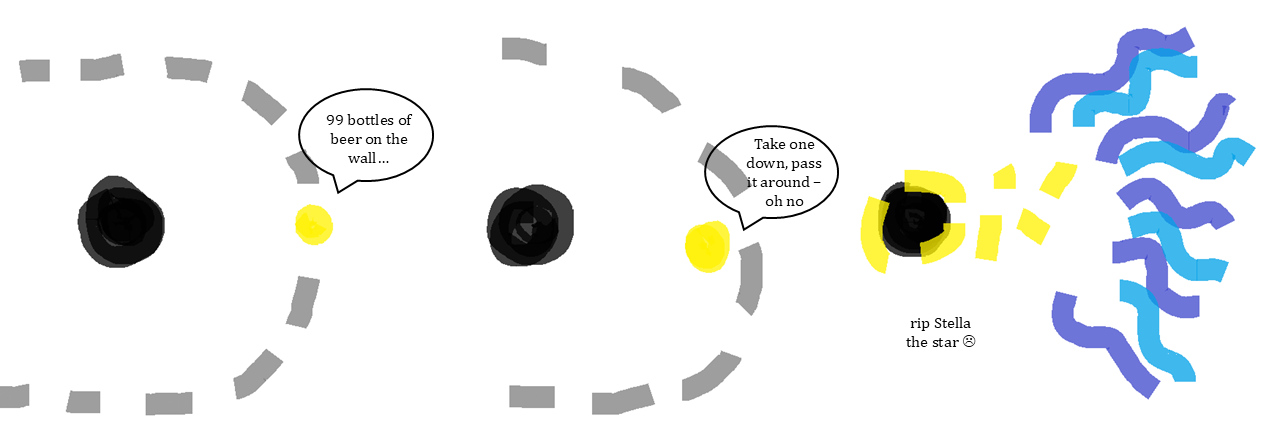
Figure 1: Timeline of events leading to a tidal disruption event. [Chloe Klare]
Usually, TDEs are discovered in the X-ray (after all, not many transients are powerful enough to generate an X-ray flare) or in the optical (thanks to high-cadence, wide-field surveys like the Zwicky Transient Facility and the Legacy Survey of Space and Time). However, radio is a particularly useful regime for TDE searches, especially in dusty host galaxies where we cannot see the optical TDE signatures at all; while dust obscures optical light, the radio is unaffected! There is just one catch: how exactly can we identify a TDE based on only its radio emission?
The radio light in a TDE is generated via synchrotron radiation — which is caused by fast moving electrons in strong magnetic fields — and originates in jets or shocks. Unfortunately, this is also the case in AGN, the primary extragalactic source of variable radio emission, and it can be difficult to distinguish between the two. Additionally, the amount of light we see from synchrotron radiation at a given frequency depends on how energy is distributed among the electrons in the source, which is unknown. Perhaps the simplest case — or at least the one you’ll learn about first in your undergraduate statistical mechanics course — is that the energy is distributed among the electrons thermally (left panel in Figure 2). However, most radio transients associated with black holes are assumed to have non-thermal electron energy distributions, usually where there are exponentially many more low-energy electrons than high-energy electrons (right panel in Figure 2).
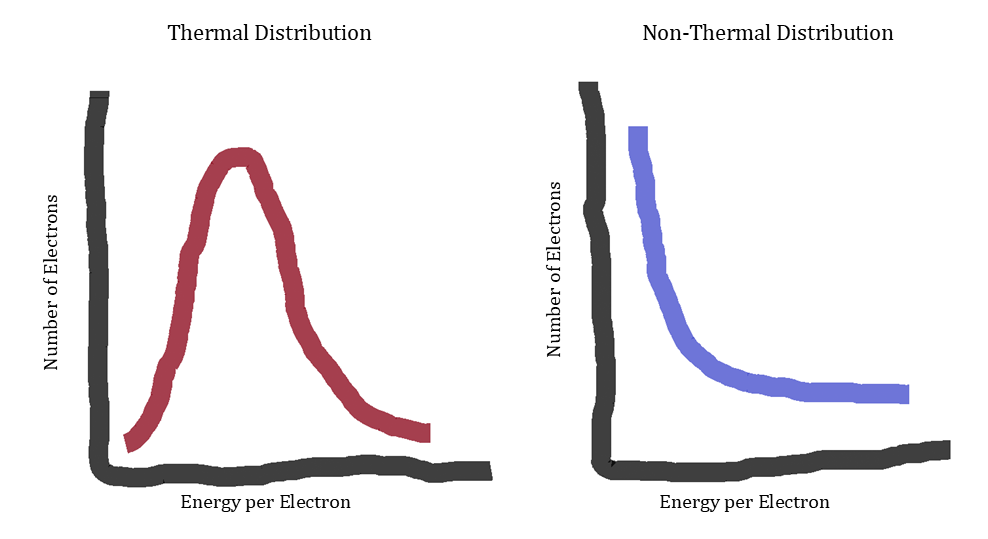
Figure 2: Energy can be distributed among the electrons in a source either thermally (left panel), where most electrons have a medium amount of energy, or non-thermally (right panel), where most electrons have a small amount of energy. Often, extragalactic radio transients are assumed to originate from non-thermal electrons, but today’s article argues why we shouldn’t ignore thermal electrons. [Chloe Klare]
This includes today’s authors, who have focused on one particular TDE, ZTF22aaajecp/AT2022cmc (I’m sure everyone mispronounces her name), or 2022cmc for short. 2022cmc is a special TDE: it is one of only five TDEs suspected to have launched a relativistic jet, and it has the highest redshift (z ~ 1.2) of the five. It was observed first in the optical and then in the X-ray and radio. The X-ray emission was highly variable for 400 days post-TDE, and then disappeared, and the first 100 days of radio emission indicated there was a relativistic outflow. At the time, it was concluded that the jet shut off and the X-ray emission ceased. However, the story doesn’t end there; the authors of today’s article continued to observe 2022cmc in the radio for an additional 900 days at frequencies spanning about 1–100 GHz.
Our authors had two key observing strategies: wide frequency coverage and long duration. Measuring the change in brightness with observing frequency, or the spectral energy distribution (SED), is important for determining which processes are responsible for the radio emission, since thermal electrons and non-thermal electrons will produce different SEDs. On the other hand, measuring the change in brightness over time, or the light curve, is important for determining what is happening at the source, such as whether there is a jet and, if so, how long it lasts. Here, our authors combine light curves at six different frequencies (Figure 3) and SEDs at nine different epochs (Figure 4) to investigate both.
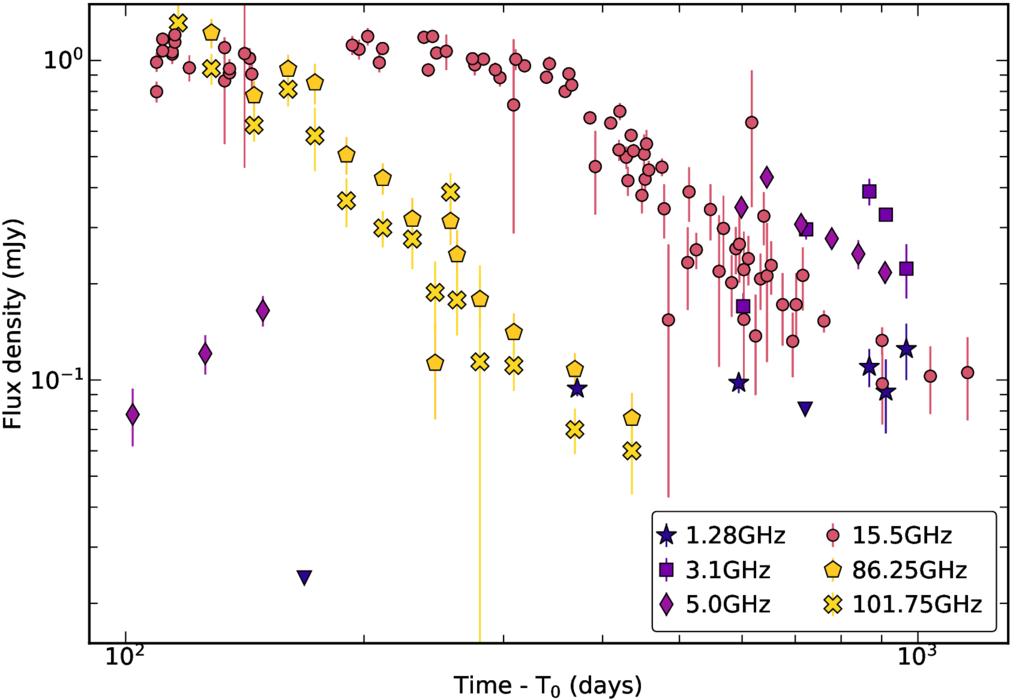
Figure 3: Light curves spanning six frequencies and 900 days obtained by today’s authors. [Rhodes et al. 2025]
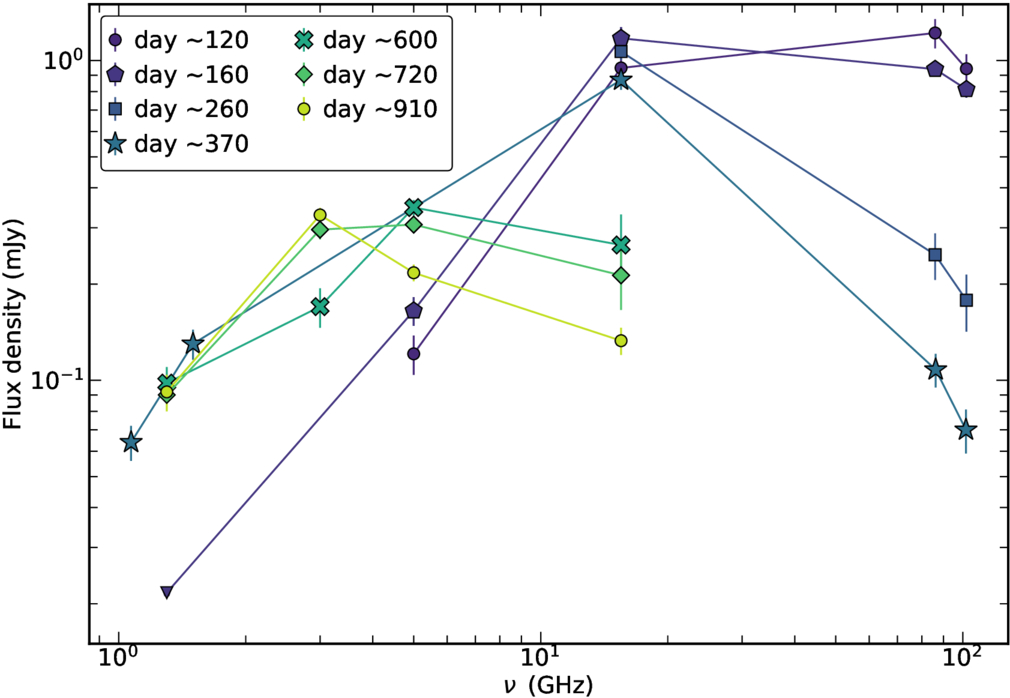
Figure 4: Nine epochs of radio SEDs, which show the peak moving to lower frequencies over time. [Rhodes et al. 2025]
Our authors find a couple of interesting results. First, in the time domain, they find the highest-frequency light curves fade with time, while the lower-frequency light curves increase initially, hit peaks at different times (after 300 days at 15.5 GHz, and after 800 days at 1.3 GHz), and then begin to decay. The spectral evolution is even more intriguing; the SED is always peaked, and the peak shifts to lower frequencies over time, which is typical for an expanding emission region. At frequencies below the peak, the SED doesn’t change much. However, the high-frequency side of the SED shows confusing behavior: early on, it has a very steep slope (the amount of light drops off sharply at higher frequencies), but it eventually flattens.
Next, our authors consider three possibilities to explain these observations. They first consider synchrotron radiation from only non-thermal electrons in a relativistic jet (Figure 5), which is the canonical model for a gamma-ray burst radio afterglow. Initially, the jet is so fast that all its radio light is relativistically beamed in one direction (like a flashlight), and we can only see the jet if it’s pointed directly at us. Eventually, the jet slows down enough that it is no longer beamed, and light is emitted in all directions (like a light bulb). At this point, we see the light fade over time, which is exactly what happened in the high-frequency light curves. However, there is one glaring problem: this model cannot possibly explain the observed long-lasting steep SED at high frequencies. So, our authors discard this theory.

Figure 5: The left image shows what a black hole–generated jet looks like in the rest frame of the jet itself. As long as the jet isn’t moving too fast, this is what we see too. However, if the material in the jet is moving near the speed of light, we observe a relativistically beamed jet (right image). [Chloe Klare]
Lastly, our authors keep the thermal/non-thermal electrons combo and ditch the jet entirely, modeling a spherical outflow. Excitingly, this model best fits the observations, and, most importantly, can explain the mysterious high-frequency behavior. Initially, most of the radio emission originates in the thermal electron population, which produces more light at higher frequencies. As the outflow expands, the non-thermal electrons begin to dominate, and the SED transforms into the classic non-thermal synchrotron shape.
Ideally, our authors want to compare 2022cmc to other TDEs, but few TDEs have such thorough follow-up observations. They speculate that thermal electrons were important in the radio evolution of one of the few such TDEs, Swift J1644, and recommend we revisit its emission models. More broadly, they recommend two future priorities: first, we need extensive radio observations for larger samples of TDEs, especially around 100 GHz, where the thermal electrons contribute most to the SED; secondly, we should stop neglecting thermal electrons not just in TDE models, but in models of any black hole jets, including gamma-ray bursts and X-ray binaries. While this work addresses only one event, one thing is clear. For theorists and observers alike, there is a myriad of exciting work to be done, so it’s no wonder TDEs have garnered so much attention lately.
︎Original astrobite edited by Flavia Pascal.
About the author, Chloe Klare:
I’m a PhD student in astronomy and astrophysics at Penn State (with a physics minor, so I get to use my semester spent in QFT for something!). I study active galactic nuclei (in the radio!), and I’m currently looking for baby synchrotron jets in active galactic nuclei.
The post Thermal Electrons Can Explain the Mysterious Radio Behavior of a Tidal Disruption Event appeared first on AAS Nova.
Amelia Dimoldenberg says publicists ignored her interview show for years but she can now be picky over A-list guests
Just a decade ago, Amelia Dimoldenberg found it impossible to drum up any mainstream celebrities to come on her mock date YouTube show, in which she chats awkwardly with guests over chicken and chips.
Even persuading a local actor connected with her London youth club to come on took years of prodding. Managers of A-listers with movies or albums to push instead battled to claim a spot on the hallowed cushions of the primetime TV chatshow sofa.
Continue reading...
© Photograph: Chicken Shop Date
© Photograph: Chicken Shop Date
© Photograph: Chicken Shop Date
E hoje é dia de MacMagazine no Ar! 😃 Esta é a 695ª edição do nosso podcast.
A edição é obra do Eduardo Garcia [@edugarcya].
00:00:00 Introdução00:11:19 Rumor: Apple aumentará preços dos iPhones 17 na semana que vem00:20:04 Apple Watch poderá ganhar novos formatos no futuro00:29:14 “iPhone Ultra” poderá ter lançamento inicial restrito aos Estados Unidos00:44:36 Jeff Pu: “iPhone 18” terá 12GB de RAM e Ilha Dinâmica redesenhada00:54:05 Apple continua desenvolvendo iPhone comemorativo de vidro, diz Gurman01:09:36 EncerramentoNosso podcast está disponível no Apple Podcasts, no Spotify, no YouTube, no Amazon Music, no Deezer, num perfil do SoundCloud ou diretamente num feed RSS.
Proteja sua vida digital com a NordVPN, a VPN mais rápida e confiável do mercado. Navegue com segurança em redes Wi-Fi públicas, mantenha sua privacidade online e acesse conteúdos de qualquer lugar do mundo sem restrições. Assine agora a NordVPN e descubra por que milhões de usuários — incluindo nós, do MacMagazine — confiam nela para uma internet mais livre e segura. Aproveite a oferta exclusiva com mais de 70% de desconto e 4 meses grátis!
Todas as nossas gravações do podcast são transmitidas ao vivo pelo YouTube, com interação via (Super) Chats.
E hoje é dia de MacMagazine no Ar! 😃 Esta é a 694ª edição do nosso podcast.
A edição é obra do Eduardo Garcia [@edugarcya].
00:00 Introdução05:22 OpenAI classifica processo da Apple como “podre desde a raiz” e pede arquivamento20:16 Siri AI poderá ter limites de uso e exigir assinatura, sugere Tim Cook29:08 Supostos óculos da Apple poderão ter foco em recursos de saúde38:39 Apple inicia preparativos para o evento de lançamento dos próximos iPhones45:10 Apple Brasil é processada em R$300 milhões por não verificar a idade em jogos de azar52:54 EncerramentoNosso podcast está disponível no Apple Podcasts, no Spotify, no YouTube, no Amazon Music, no Deezer, num perfil do SoundCloud ou diretamente num feed RSS.
O Dia dos Pais está chegando e a Insider preparou uma seleção de kits de presentes para diferentes estilos de pais, com opções como atleta, treino, moderno, essencial, casual, tech e outros! São combinações de peças pensadas para o dia a dia de cada perfil, tornando a escolha do presente muito mais fácil. Comprando até o dia 8 de agosto, você ainda ganha frete grátis e brindes cumulativos (meias, cueca/calcinha ou boné/sutiã, a depender do valor da compra). E, como sempre, o cupom MACMAGAZINE acumula com os descontos já oferecidos pela Insider. O nosso link já leva você para a loja com o cupom aplicado; ao comprar por ele, você também ajuda o MacMagazine!
Todas as nossas gravações do podcast são transmitidas ao vivo pelo YouTube, com interação via (Super) Chats.
E hoje é dia de MacMagazine no Ar! 😃 Esta é a 693ª edição do nosso podcast.
A edição é obra do Eduardo Garcia [@edugarcya].
00:00 Introdução03:56 Apple fatura US$109,4 bilhões no 3º trimestre fiscal de 202617:37 Apple Upgrade: programa de leasing é lançado com iPhones, iPads, Macs e Apple Watches29:04 “Apple Glass” poderá ser revelado na WWDC27 e vir sem câmeras35:47 Apple Watch deverá passar por grandes mudanças nos próximos anos43:28 Apple poderá lançar três dispositivos de casa inteligente em breve, incluindo um smart hub49:19 Epic Games Store está agora disponível para iPhone no Brasil52:39 EncerramentoNosso podcast está disponível no Apple Podcasts, no Spotify, no YouTube, no Amazon Music, no Deezer, num perfil do SoundCloud ou diretamente num feed RSS.
Todas as nossas gravações do podcast são transmitidas ao vivo pelo YouTube, com interação via (Super) Chats.
E hoje é dia de MacMagazine no Ar! 😃 Esta é a 692ª edição do nosso podcast.
A edição é obra do Eduardo Garcia [@edugarcya].
00:00:00 Introdução00:08:25 Apple Music e Apple One ficam mais caros no Brasil e nos EUA00:12:32 Apple poderá lançar programa de assinatura de iPhones, iPads, Macs e Apple Watches em breve00:24:55 Apple deverá lançar diversos novos Macs em breve, incluindo Mac mini com os chips M5 Pro e “M6”00:33:51 Vazamento confirma abertura variável na câmera do “iPhone 18 Pro Max”00:41:54 Código do iOS 27 faz referência a iPhone com mais de uma bateria00:54:32 Jason Sudeikis quer que “Ted Lasso” tenha pelo menos mais 2 temporadas01:05:23 EncerramentoNosso podcast está disponível no Apple Podcasts, no Spotify, no YouTube, no Amazon Music, no Deezer, num perfil do SoundCloud ou diretamente num feed RSS.
Todas as nossas gravações do podcast são transmitidas ao vivo pelo YouTube, com interação via (Super) Chats.
E hoje é dia de MacMagazine no Ar! 😃 Esta é a 691ª edição do nosso podcast.
A edição é obra do Eduardo Garcia [@edugarcya].
00:00:00 Introdução00:03:39 Apple processa OpenAI por suposto roubo de segredos comerciais00:24:30 Chip “M7 Ultra” poderá suportar até 1,5TB de memória e mirar servidores de IA, revela Gurman00:31:35 iPad mini com tela OLED poderá chegar em breve; iPads de entrada e Air, em 202700:43:26 Leaker revela possível capacidade da bateria do “iPhone Ultra”00:47:31 Rumor: “iPhone 20” abandonará alumínio e voltará a usar vidro na traseira00:54:56 Apple libera primeiras betas públicas do iOS 27, iPadOS 27, macOS 27, watchOS 27 e tvOS 2701:02:32 EncerramentoNosso podcast está disponível no Apple Podcasts, no Spotify, no YouTube, no Amazon Music, no Deezer, num perfil do SoundCloud ou diretamente num feed RSS.
Todas as nossas gravações do podcast são transmitidas ao vivo pelo YouTube, com interação via (Super) Chats.
The fastest spinning pulsars in the universe are often quite difficult to detect. Leveraging multiple observations from the largest single-dish telescope in the world, researchers have discovered six previously undetected pulsars.
Globular clusters, compact collections of tens of thousands to millions of stars, are highly dense and rife with dynamical interactions. These active environments are ideal factories for the formation of millisecond pulsars — the extremely fast-spinning cores of once-massive stars, shining beams of radio emission from their poles. One way millisecond pulsars are thought to form is when a pulsar in a binary system steals mass from its companion star, transferring angular momentum and causing the pulsar to spin up. The densely packed environment in a globular cluster provides ample opportunity for a pulsar to acquire a companion to siphon.
However, millisecond pulsars in distant globular clusters are notoriously difficult to detect. Traditional pulsar searches that rely on a single observation tend to miss millisecond pulsars, many of which have signals too faint to be distinguished from noise or radio interference. Instead, researchers must rely on a different method to find these fast-spinning pulsars.
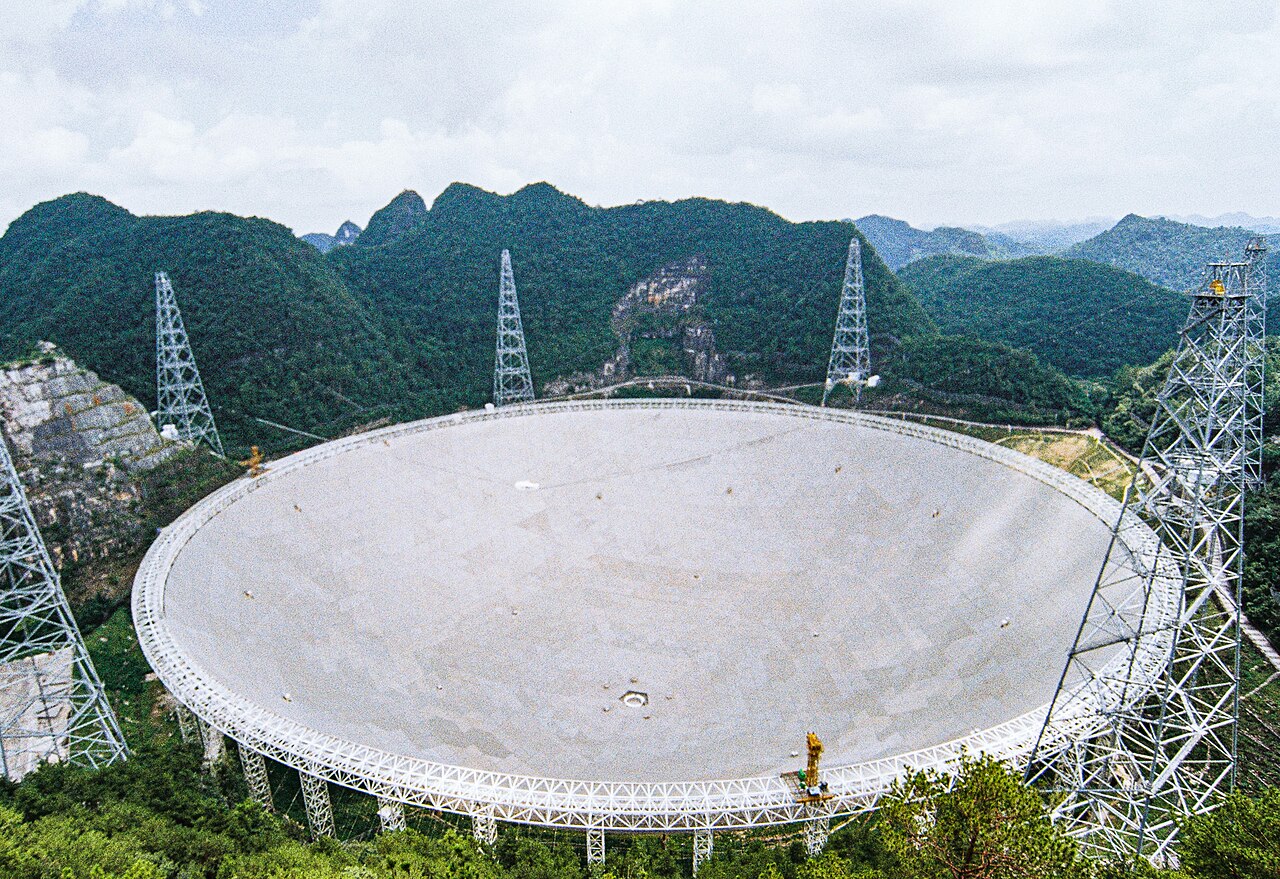
FAST, the 500-meter single-dish radio telescope located in southwestern China. [Wikipedia user SCJiang; CC BY 4.0]
To find faint millisecond pulsars, researchers have developed the stack search method, in which multiple radio observations are combined to tease out faint signals and decrease noise. Reliably stacking observations across epochs requires stability; isolated millisecond pulsars, now no longer spinning up after losing their companion, have very stable rotation periods, making them ideal targets for the stack search method. To date, the stack search method has successfully identified nine isolated globular cluster millisecond pulsars using data from the Arecibo, Parkes, and Green Bank radio telescopes.
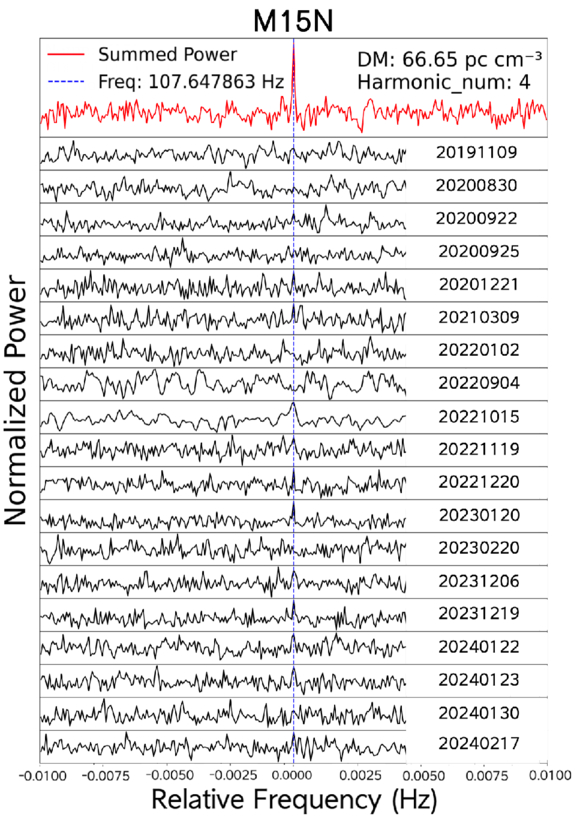
Power spectra from a discovered millisecond pulsar M15N. The black solid lines show the 19 individual observations of the pulsar, and the red solid line in the top panel shows the stacked spectrum. The stack search method pulls out a clear pulsar signal. [Dai et al. 2026]
While previous studies identified brighter pulsars in the targeted globular clusters, the authors confirmed that all six newly discovered pulsars are too weak to be reliably recovered from single-epoch searches, underscoring the importance of the stack search method. In particular, this search increased the known pulsar populations of NGC 6517 and M15 by 27% and 18%, respectively, suggesting that a meaningful fraction of globular cluster pulsars are easily missed in traditional pulsar searches. Future studies employing this stack search method will continue to detect faint millisecond pulsars, unlocking this elusive population for further exploration.
“The Stack Search Tests on FAST Data: Discovery of Six Faint Isolated Millisecond Pulsars in NGC 6517 and NGC 7078 (M15),” Yinfeng Dai et al 2026 ApJL 1002 L31. doi:10.3847/2041-8213/ae5dbb
The post Stacking Up the Discovery of Six Millisecond Pulsars appeared first on AAS Nova.
To probe the chemistry of cold pre-stellar cores, researchers investigated Lynds 1544 and made the first-ever spatially resolved map of methanimine — a simple molecule that may be involved in the formation of amino acids in space — in this environment.

The chemical structure of methanimine, CH2NH. [Ben Mills]
Today’s research article, led by Yuxin Lin (Max Planck Institute for Extraterrestrial Physics), focuses on a molecule called methanimine (CH2NH). CH2NH is the simplest molecule in a class of nitrogen-containing compounds called imines, and it’s thought to be an important stepping-stone in the creation of amino acids.
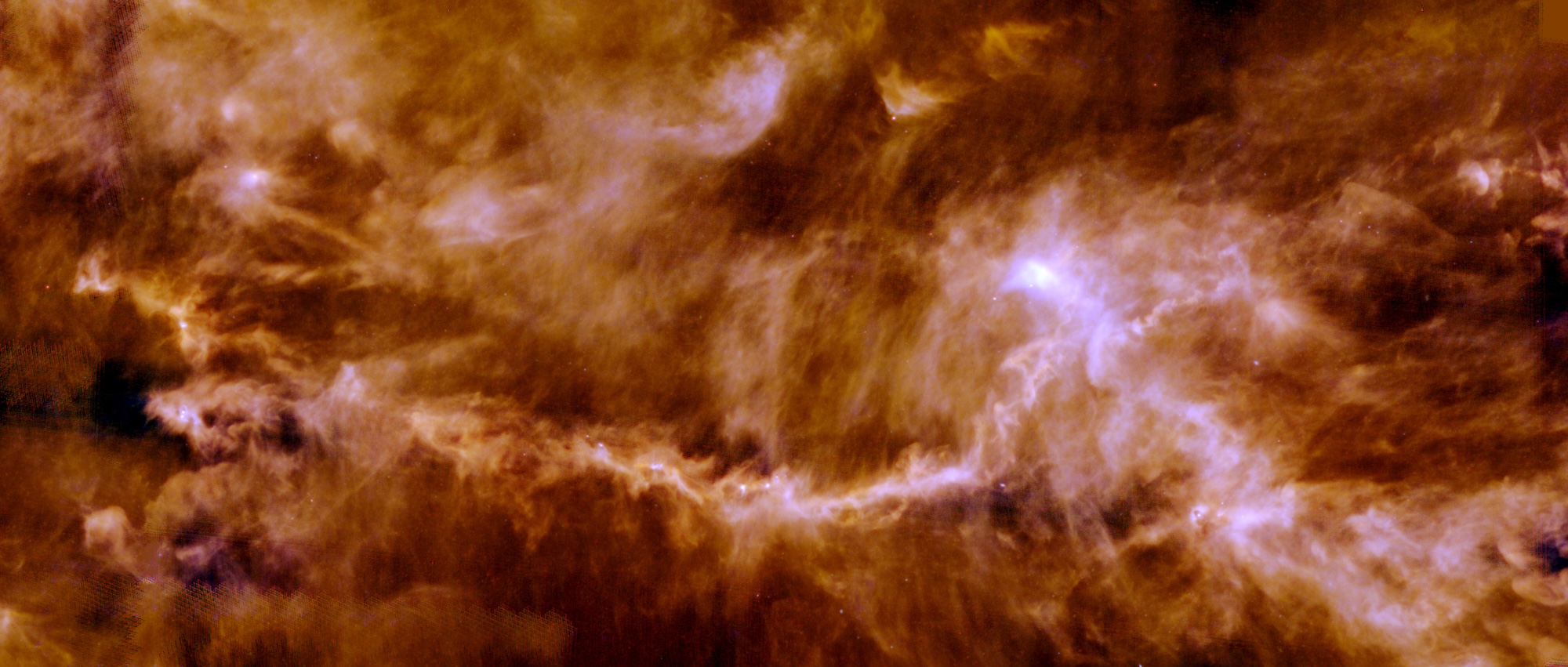
A Herschel Space Observatory view of the Taurus Molecular Cloud, where L1544 resides. This star-forming region is about 450 light-years away. [ESA/Herschel/PACS, SPIRE/Gould Belt survey Key Programme/Palmeirim et al. 2013]
Lin and collaborators searched for CH2NH within Lynds 1544 (L1544), a pre-stellar core in the nearby Taurus Molecular Cloud. Pre-stellar cores — condensed, gravitationally bound clumps of cold gas within a molecular cloud — represent an early stage in the process of star formation, just before the gas collapses to form a protostar.
L1544 has been the subject of many astrochemical investigations, and previous studies have revealed that it contains a complex, chemically differentiated envelope surrounding a dense core in which many chemical species have frozen out onto dust grains, leaving the gas depleted of these species.
Using the Institute for Radio Astronomy in the Millimetre Range 30-meter radio telescope, Lin’s team mapped the distribution of CH2NH across L1544. This isn’t the first time that CH2NH has been detected in a cold pre-stellar core, but it’s the first time that the molecule has been mapped in a spatially resolved way in such an environment. This allows researchers to compare the distribution of CH2NH to other molecules in the core and build an understanding of the chemistry behind its formation.
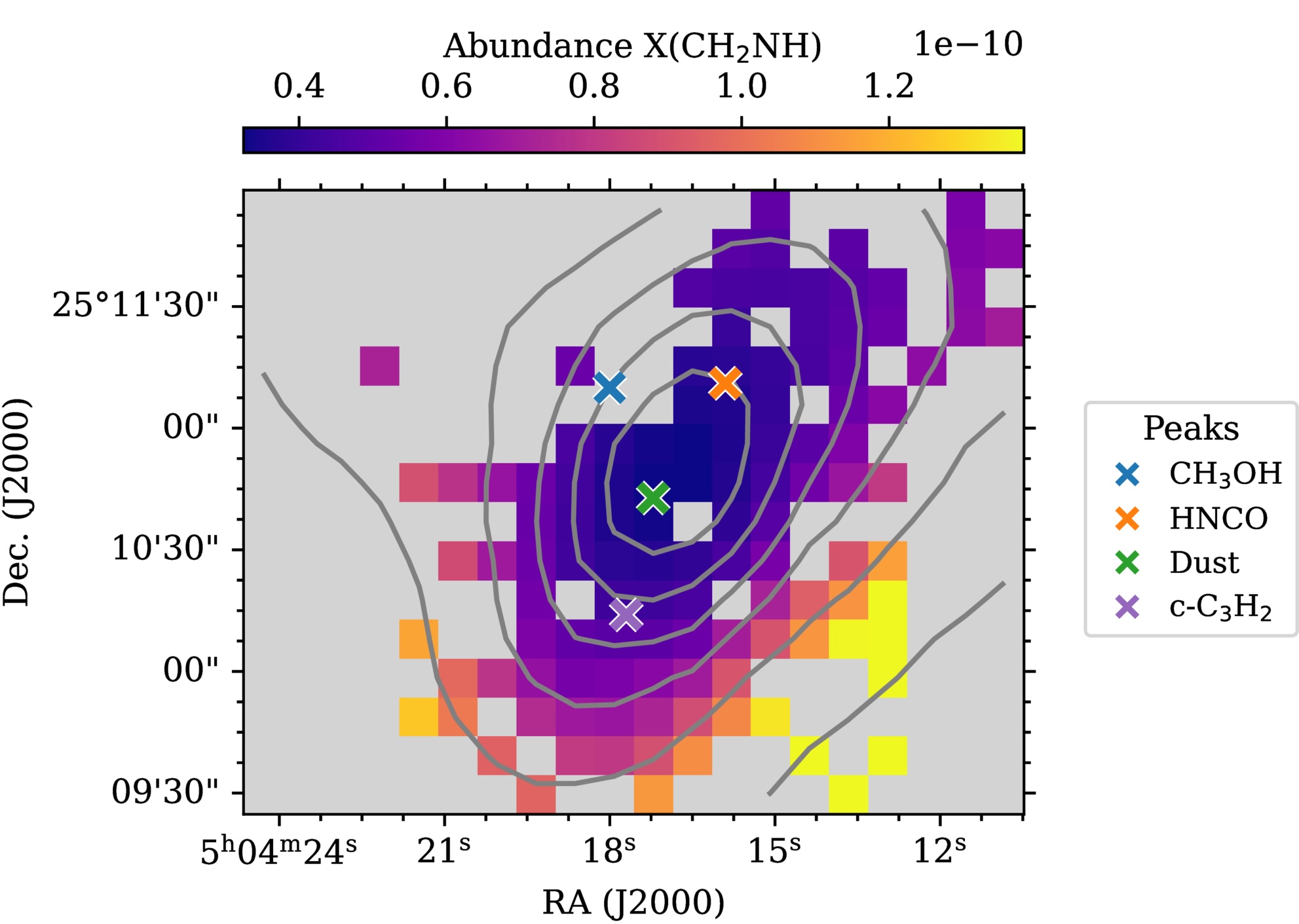
Abundance of CH2NH in L1544. The contours indicate the column density of molecular hydrogen. The crosses show where the emission from other chemical species is at its peak. Click to enlarge. [Adapted from Lin et al. 2026]
In the outer layers of the core, where the gas is less dense, ultraviolet light creates reactive chemical species called radicals that can spur the formation of CH2NH. In the interior of the core, dense gas prevents the incursion of ultraviolet light. This means that few radicals are created that can help form CH2NH molecules, and the molecules that do form tend to freeze out onto dust grains, disappearing from the gas.
The discovery of CH2NH throughout L1544 suggests that the precursors to complex organic molecules can form during the cold, calm pre-stellar core phase of star formation, allowing these molecules to be inherited by nascent planetary systems.
“First Mapping of Prebiotic Molecule CH2NH in a Prestellar Core,” Yuxin Lin et al 2026 ApJL 996 L32. doi:10.3847/2041-8213/ae2c76
The post Mapping a Molecular Building Block in a Pre-Stellar Core appeared first on AAS Nova.
Editor’s Note: For the remainder of 2025, we’ll be looking at a few selections that we haven’t yet discussed on AAS Nova from among the most-downloaded articles published in AAS journals this year. The usual posting schedule will resume January 2nd.
In a collaborative effort between the Search for Extraterrestrial Intelligence (SETI) Institute and the Penn State Extraterrestrial Intelligence Center, Sofia Sheikh (SETI Institute) and team turned inward to expand the search for intelligent life in the universe. Right here on Earth, humans have created a laboratory of technological signatures that can be detected from space — if another Earth-like civilization is out there, could they detect us? Using theoretical modeling, the authors determined the reaches of various human technosignatures such as radio transmissions, optical and infrared emission, satellites, and other probes sent into space. They found humanity’s strongest signals, radio transmissions, could be detected as far as 12,000 light-years away.
Scientists search for intelligent civilizations by hunting for signs of technology — signals or patterns that natural phenomena cannot explain. While we cannot expect other intelligent life to look exactly like Earth’s, many SETI projects have surveyed the skies for hypothetical signals far exceeding humanity’s own technological advancements. Taking a step back, Sheikh and collaborators considered where human technology is currently and what present-day instrumentation could pick up on if we were to search for ourselves. This “Earth detecting Earth” paradigm recenters the search for intelligent life and provides a multiwavelength framework for understanding the detectability of technology on far-away worlds.

Maximum distances that Earth’s technosignatures could be detected by current technology. Click to enlarge. [Sheikh et al 2025]
What exactly are Earth’s many technosignatures, and how far could our current technology detect them? The most prominent and farthest detectable signal comes from radio transmissions. As the authors noted, these signals come from multiple sources: targeted radar transmissions used to characterize planets and asteroids, radio transmissions used to communicate between space probes and ground stations (e.g., space telescopes, Mars rovers, etc.), and radio leakage from Earth’s communication systems like cell towers and broadcasting stations. Additionally, there are atmospheric technosignatures from air-polluting compounds, optical and infrared emission from cities, targeted lasers from telescopes, and interplanetary and interstellar probes sent into space. All of these combined create a constellation of technosignatures detectable across a range of distances from Earth. This study underscores the importance of assessing Earth’s technology and detection capabilities, and repeating this type of study as technological advancements continue will enhance the search for intelligent life.
Sofia Z. Sheikh et al 2025 AJ 169 118. doi:10.3847/1538-3881/ada3c7
The post Selections from 2025: Could Earth Detect Earth? appeared first on AAS Nova.
Editor’s Note: For the remainder of 2025, we’ll be looking at a few selections that we haven’t yet discussed on AAS Nova from among the most-downloaded articles published in AAS journals this year. The usual posting schedule will resume January 2nd.
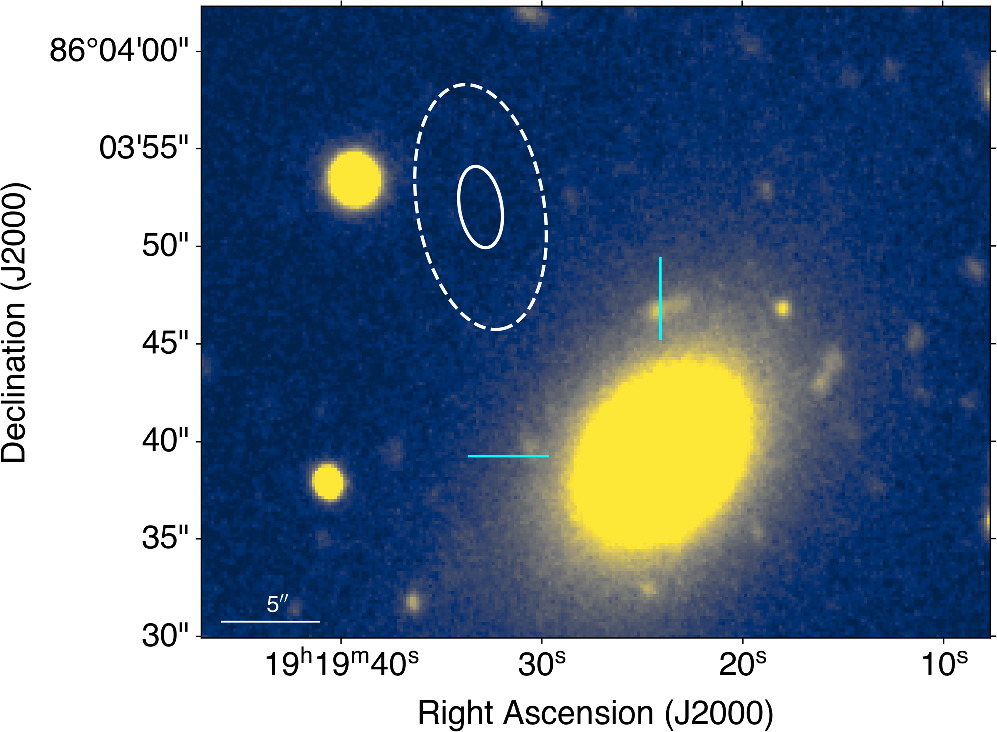
Gemini-North image of the FRB 20240209A localization region (white lines) and the source’s likely host galaxy (cyan crosshairs). [Shah et al. 2025]
Fast radio bursts are brief, intense flashes of radio waves from sources across the universe. Aside from one fast radio burst that has been associated with a magnetar within our own Milky Way, the source of these outbursts remains mysterious, and precise localization of these bursts is key to pinning down their origins; fast radio bursts that come from galaxies with active star formation may be linked to “prompt” formation channels like core-collapse supernovae or young magnetars, while bursts that arise in quiescent galaxies might be due to “delayed” formation pathways such as neutron stars that are born from merging white dwarfs.
FRB 20240209A is similar to other repeating fast radio bursts in terms of the shape of its individual bursts as well as its tendency to undergo periods of high and low bursting activity. Its location makes it quite unusual, though: it’s the only repeating fast radio burst known to come from a quiescent galaxy, and it’s the only burst — repeating or not — that has been found in an elliptical galaxy. If confirmed to originate from a globular cluster, FRB 20240209A would also be only the second known fast radio burst source to come from this type of environment. Shah’s team explored multiple possible origin stories for FRB 20240209A, including the possibility that the source was ejected from its host galaxy. The team favors an origin involving a magnetar formed through the collapse or merger of a compact object.
Vishwangi Shah et al 2025 ApJL 979 L21. doi:10.3847/2041-8213/ad9ddc
The post Selections from 2025: A Repeating Fast Radio Burst in a Quiescent Galaxy appeared first on AAS Nova.
This image shows the Owens Valley Radio Observatory Long Wavelength Array (OVRO-LWA), a recently upgraded collection of 352 antennas spanning 2.4 kilometers east of the Sierra Nevada mountain range in California. A research team led by Ivey Davis (California Institute of Technology) recently outlined their survey that uses OVRO-LWA to study space weather on young Sun-like stars. The Study of Space Weather Around Young Suns (SWAYS) uses both OVRO-LWA and a 0.5-meter optical telescope to observe white-light stellar flares and any accompanying low-frequency radio emission from five stars with temperatures of 5000–6000K and ages of 100–800 million years. Though detections of stellar flares are common, the bursts of radio emission associated with flares and coronal mass ejections have yet to be identified conclusively on other stars. Previous studies have focused on M-dwarf stars, whose strong magnetic fields and plasma environments might limit the production of radio bursts, and have lacked the dedicated monitoring needed to detect transient bursts — problems that SWAYS has solved. To learn more about the instrumentation and design behind SWAYS, be sure to check out the research article linked below.
“A Dedicated System for Coordinated Radio and Optical Monitoring of the Space Weather of Young, Solar-Type Stars,” Ivey Davis et al 2025 ApJ 993 82. doi:10.3847/1538-4357/adfbe9
The post Featured Image: Studying the Space Weather of Young Suns appeared first on AAS Nova.
Fast blue optical transients are a rare class of emerging transients, the source of which is not yet known. A recent study of the most luminous known object in this class, AT2024wpp, reveals clues about their identity.
In 2018, a network of robotic survey telescopes spotted a new transient source toward a galaxy 200 million light-years away. It was bright and getting brighter rapidly, rising in just a few days to become 10–100 times brighter than the brightest supernovae.
That transient, AT2018cow, was the first of now tens of known sources like it that are too blue, too rapidly evolving, and too luminous to be ordinary supernovae. Despite the growing number of luminous fast blue optical transients (FBOTs) discovered, exactly what causes them is still up for debate.
Enter AT2024wpp: the most luminous known fast blue optical transient to date. In about a month and a half, this record-breaking event radiated away more than 1044 Joules — which is roughly equivalent to the Sun’s radiative output over 8 billion years. Nayana A. J. (University of California, Berkeley) and collaborators carried out an extensive multi-wavelength observing campaign to track the behavior of AT2024wpp from 2 to 280 days after it was first discovered, making it only the second FBOT to undergo such detailed study. This research article describes the team’s findings at radio and X-ray wavelengths.
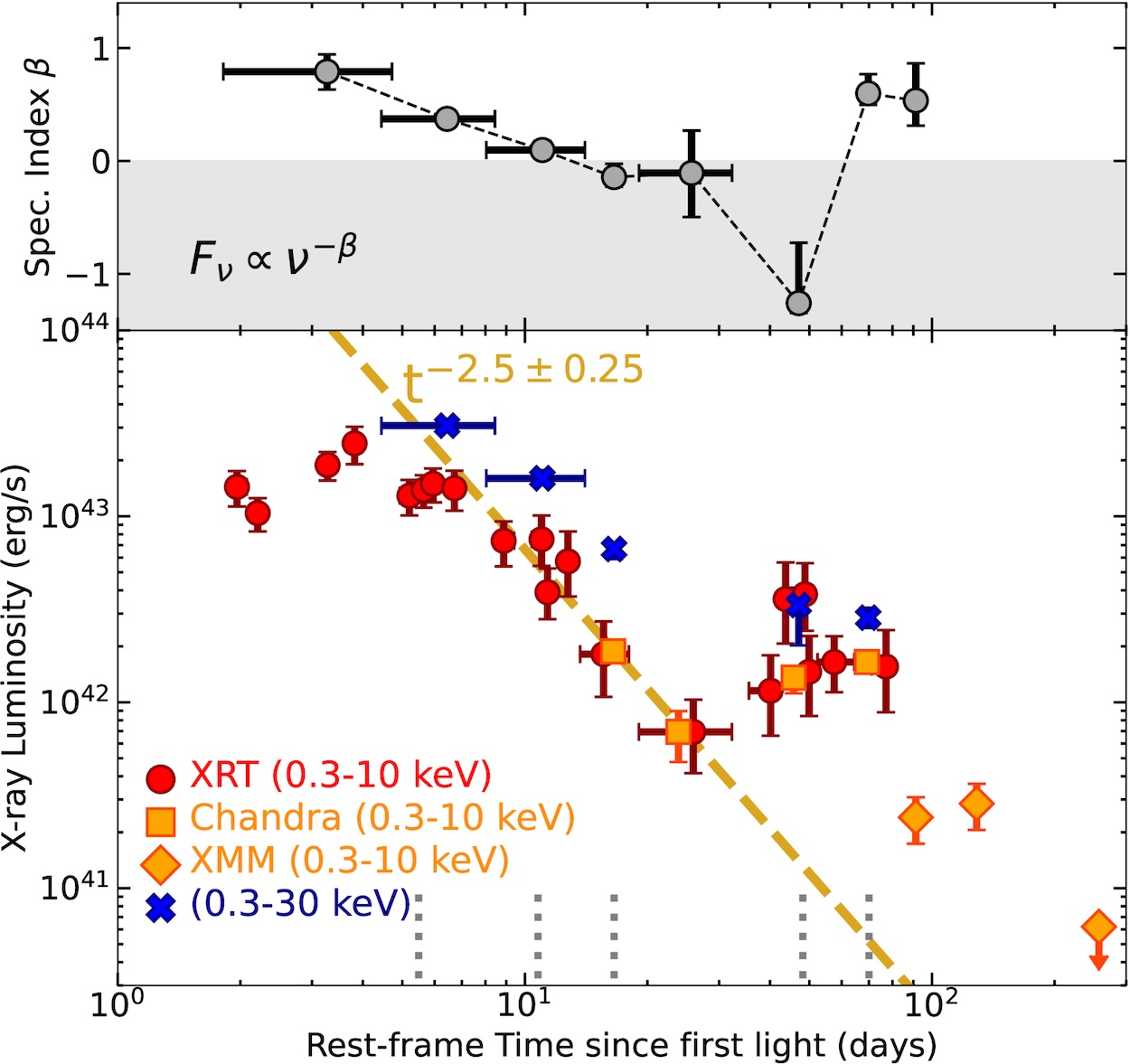
X-ray behavior of AT2024wpp. The top plot demonstrates the hardening of the spectral index (i.e., shifting toward higher energies) around the peak at 50 days. Click to enlarge. [Nayana A. J. et al. 2025]
These observations revealed that AT2024wpp’s X-ray emission remained bright and constant for 7 days before plummeting until day 30. The emission then rocketed up again, peaking at day 50, and shifted toward higher energies. Finally, things settled down to a lower brightness around day 75. In the radio, AT2024wpp’s behavior was complex, showing a never-before-seen meteoric rise at millimeter wavelengths around 17–32 days.
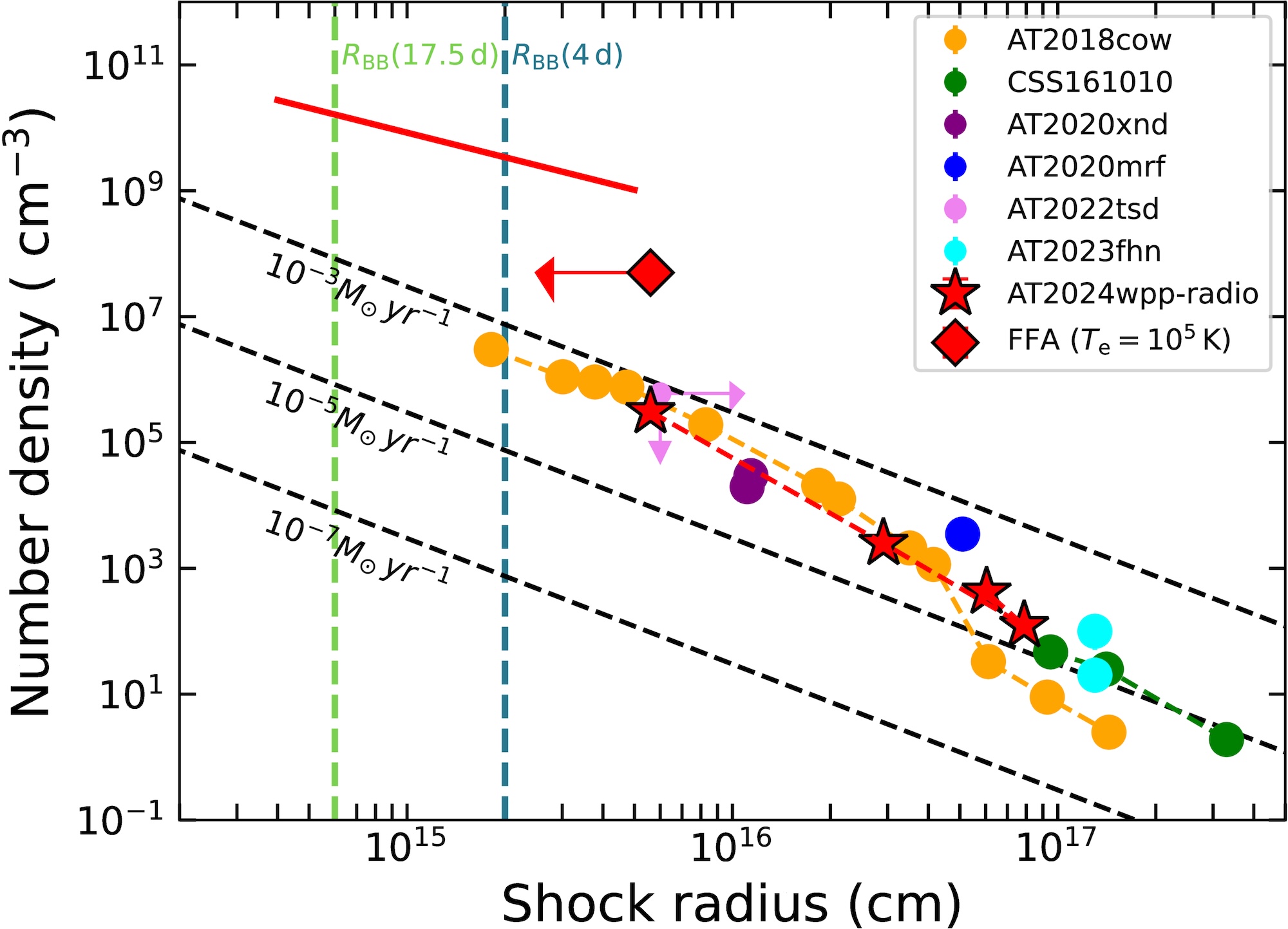
Comparison of the density of the material surrounding AT2024wpp (red stars) and other FBOTs. Click to enlarge. [Nayana A. J. et al. 2025]
Based on these observations, the team favors a scenario involving a central compact object — a black hole or a neutron star — that is rapidly accreting matter from its surroundings. This accretion powers outflows that accelerate to more than 40% the speed of light and send a shock through dense material around the system. Notably, the team found that the density of the surrounding material is similar among FBOTs that have bright radio emission, including AT2024wpp. This suggests that similar processes are responsible for setting up these events.
The team pointed to two scenarios from the literature that are compatible with their data. In the first, a newborn neutron star or black hole collides with a stellar companion, ripping the star apart and accreting its remains. In the second, a Wolf–Rayet star (a massive star that has shed much of its atmosphere and is nearing its eventual end as a supernova) is tidally disrupted by a neutron star or a black hole. Though it’s not possible to narrow the possibilities further, the immense energies involved tilt things in favor of a black hole rather than a neutron star.
Though FBOTs remain mysterious, additional multi-wavelength studies like this one can help to illuminate their origins. And with the Ultraviolet Transient Astronomy Satellite (ULTRASAT) and UltraViolet EXplorer (UVEX) missions slated to launch within the next five years, we can expect many more FBOT discoveries in the near future.
“The Most Luminous Known Fast Blue Optical Transient AT 2024wpp: Unprecedented Evolution and Properties in the X-Rays and Radio,” Nayana A. J. et al 2025 ApJL 993 L6. doi:10.3847/2041-8213/ae0b4d
The post Investigating the Most Luminous Known Fast Blue Optical Transient appeared first on AAS Nova.
Catastrophic encounters between stars and massive black holes usually take place in the nuclei of galaxies, but not always. Researchers recently reported on the brightest-ever radio emission from an off-nuclear tidal disruption event caused by a wandering or recoiling black hole.
Tidal disruption events occur when a star ventures too close to a massive black hole. The tidal forces of the black hole stretch the star until it’s partially or entirely disrupted, sometimes causing jets or outflows to spray from the shredded star. One thing that often distinguishes a tidal disruption event from the sea of other possible transients is the location, close to the nucleus of a galaxy.
But not all tidal disruption events happen in the center of a galaxy. In rare cases, a massive black hole roaming elsewhere in a galaxy may encounter a star, sending out a tell-tale signal in an unexpected location.
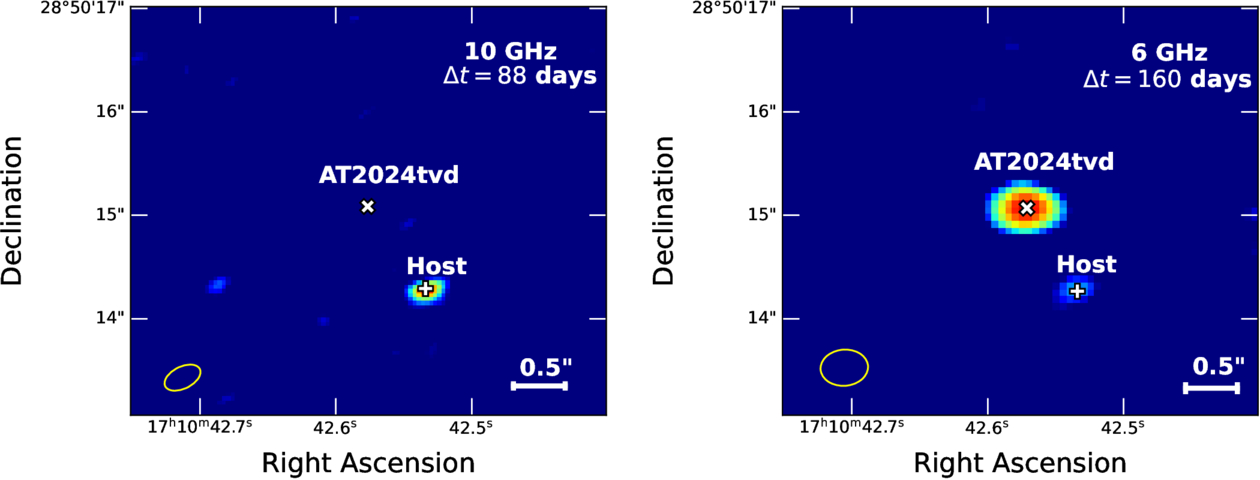
Radio observations of AT 2024tvd on two dates after its optical discovery. The tidal disruption event was not detected at 88 days post-discovery (left) and outshone the center of its host galaxy on 160 days post-discovery (right). Click to enlarge. [Sfaradi et al. 2025]
Less than three months after AT 2024tvd was discovered, Itai Sfaradi (University of California, Berkeley) and collaborators launched a months-long radio-wavelength observing campaign using the Very Large Array, the Atacama Large Millimeter/submillimeter Array, the Arcminute Microkelvin Imager Large Array, the Allen Telescope Array, and the Submillimeter Array. Radio observations are critical for investigating jets and outflows from tidal disruption events.
The observations, which spanned centimeter and millimeter wavelengths, revealed two emission peaks from the tidal disruption event. The first peak occurred roughly 131 days after the event was discovered, and the second followed at day 194.
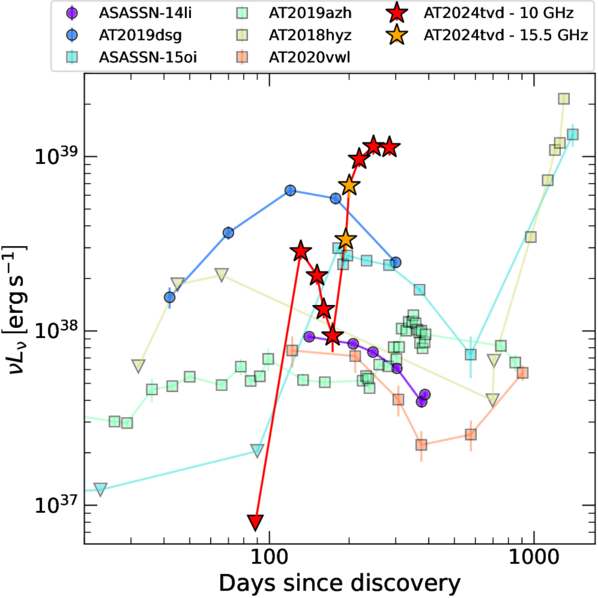
Demonstration of the fast evolution of AT 2024tvd’s radio emission (red and orange stars) compared to other radio-bright tidal disruption events (other symbols). [Sfaradi et al. 2025]
To understand the origin of the fast-evolving, extremely bright radio emission from AT 2024tvd, Sfaradi’s team modeled the emission that would arise from outflows and jets. For both wide-angle outflows and narrow jets, the team considered both prompt — arising simultaneously with the event’s optical detection — and delayed sources.
The team’s modeling highlighted several possible scenarios. In the first, both bright radio peaks arose from a single outflow that was launched about 84 days after the star met its doom. The double-peaked behavior is due to the outflow interacting with a complex distribution of material surrounding the black hole. It’s also possible for the two peaks to arise from separate outflows or jets, one launched around 84 days and the other around either 170 or 190 days, depending on whether the second source is a mildly relativistic outflow or a relativistic jet.
Sfaradi and collaborators posited that AT 2024tvd’s unusual radio behavior could be due to its off-nuclear location, but they acknowledged that this event might simply occupy a region of tidal disruption event parameter space that had yet to be explored. Sensitive interferometric or polarimetric observations may reveal more about how AT 2024tvd interacts with its environment, helping to illuminate the nature of this rare event.
“The First Radio-Bright Off-Nuclear TDE 2024tvd Reveals the Fastest-Evolving Double-Peaked Radio Emission,” Itai Sfaradi et al 2025 ApJL 992 L18. doi:10.3847/2041-8213/ae0a26
The post Investigation of the First Radio-Bright Off-Nuclear Tidal Disruption Event appeared first on AAS Nova.
Neutron stars don’t stick around for long after they’re born. Recent research has now uncovered just how fast they flee.
Human beings require many years of care and support from their parents before they’re able to venture forth into the world. This is an embarrassingly long process compared to the standard for animals like deer and horses, whose offspring are ready to walk mere minutes after birth. However, baby neutron stars, some of the densest objects in the known universe, put all life on Earth to shame with their immediate self-reliance: after a fiery birth from a supernova explosion, these stars flee the site of their creation at hundreds of kilometers per second.
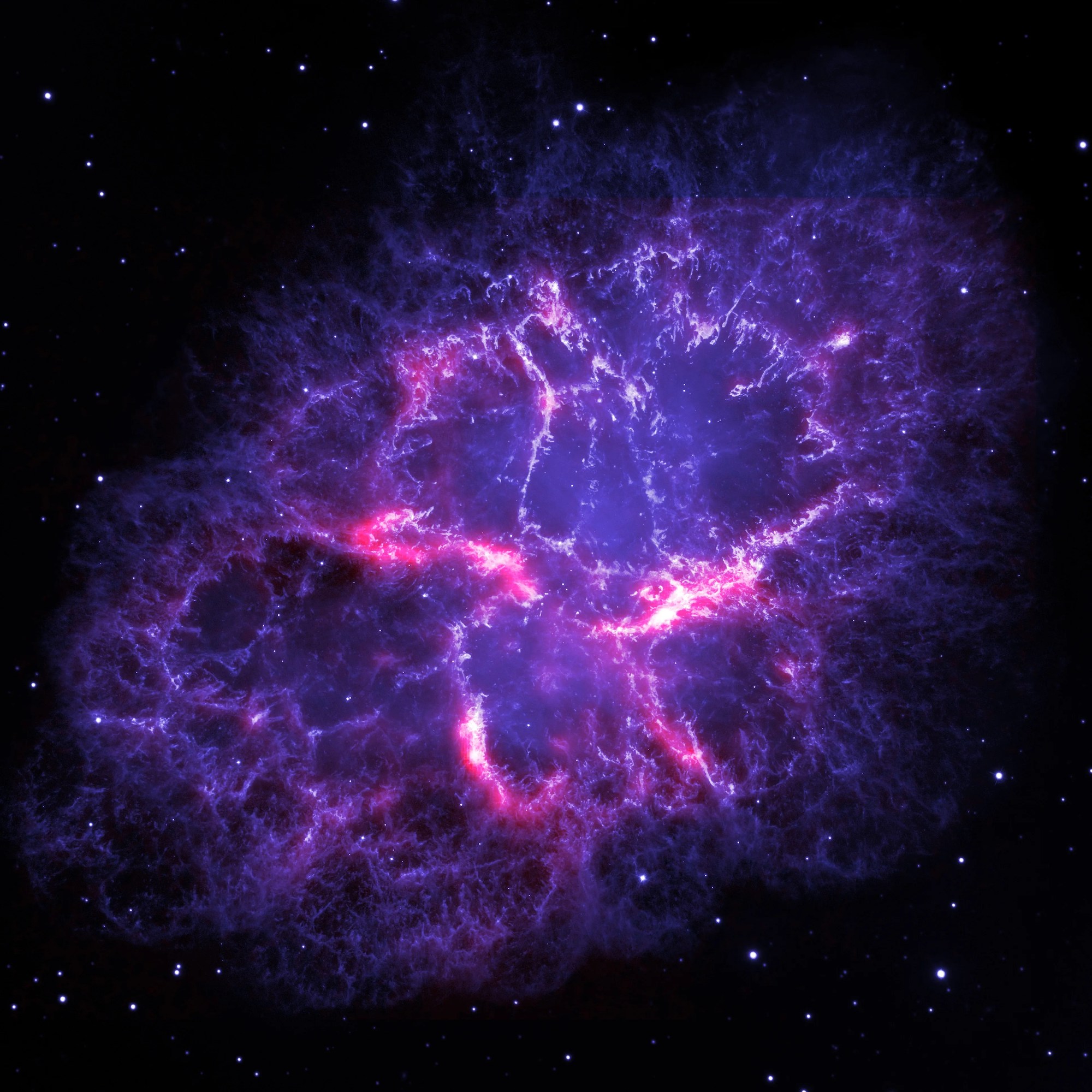
Hubble Space Telescope and Herschel Space Observatory image of the Crab Nebula, which is the remnant of a supernova explosion. [ESA/Herschel/PACS/MESS Key Programme Supernova Remnant Team; NASA, ESA and Allison Loll/Jeff Hester (Arizona State University)]
By measuring the characteristic speeds of these “kicks,” astronomers can deduce how asymmetric the preceding collapse must have been, along with other information about the earliest moments of the supernova. Though measuring the speed of something so small from the other side of the galaxy is no easy task, Disberg and Mandel’s recent publication in The Astrophysical Journal Letters takes on the challenge.
The pair first began by examining measurements of neutron stars known to be less than 10 million years old, which is extremely young in an astronomical context. Since these objects haven’t had time to be slowed down or altered from their course by passing stars or the galactic tide, their present-day speeds should be the same as their natal kicks. The researchers found that while every neutron star had its own unique kick velocity, the distribution of all the velocities followed a log-normal pattern with a peak near 150–200 km/s.
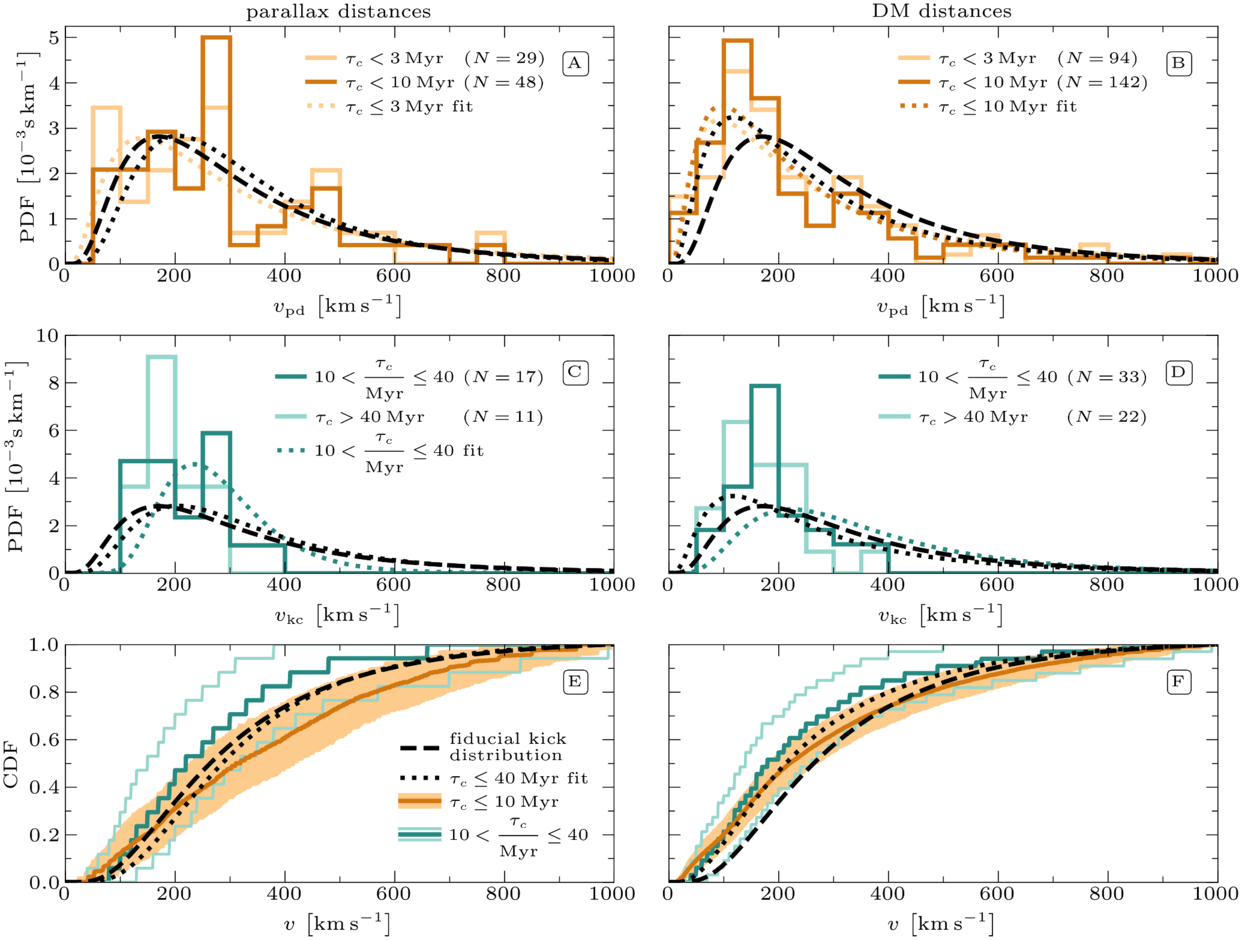
Measured kick velocities (histograms) and fit distributions (curves) for different subsamples. Click to enlarge. [Disberg & Mandel 2025]
Going forward, other astronomers focused on modeling supernovae, orbits within the galaxy, and binary-star evolution can use this distribution either to sanity check their models or as inputs to other simulations. Through slow accumulation of studies like this, each with its own quantified measurement of some property in the galaxy, we come to understand our universe more fully and unlock our ability to make ever more models and predictions.
“The Kick Velocity Distribution of Isolated Neutron Stars,” Paul Disberg and Ilya Mandel 2025 ApJL 989 L8. doi:10.3847/2041-8213/adf286
The post Kicking Neutron Stars from the Nest appeared first on AAS Nova.
Editor’s Note: Astrobites is a graduate-student-run organization that digests astrophysical literature for undergraduate students. As part of the partnership between the AAS and astrobites, we occasionally repost astrobites content here at AAS Nova. We hope you enjoy this post from astrobites; the original can be viewed at astrobites.org.
Title: Quasar Lifetime Measurements from Extended Lyα Nebulae at z∼6
Authors: Dominika Ďurovčíková et al.
First Author’s Institution: MIT Kavli Institute for Astrophysics and Space Research
Status: Published in ApJ
Observations have shown that galaxies, from our own Milky Way to far out into the distant universe, often host supermassive black holes at their centres. While the exact growth history of supermassive black holes is still uncertain, astronomers think that they likely begin as much less massive black holes, which grow primarily by eating up gas in a process known as accretion. As gas falls into the black hole, it releases a huge amount of energy, allowing astronomers to observe accreting black holes even when they’re billions of light-years away from us. The most luminous accreting supermassive black holes are known as quasars.
A supermassive black hole pulls gas in towards itself due to the force of gravity, but light emitted by the gas simultaneously exerts an outward pressure known as radiation pressure. The faster gas is being pulled into the black hole, the more light is emitted by the gas, and the stronger the pressure becomes. Eventually, the pressure will win out over gravity, preventing the black hole from accreting more gas. The theoretical maximum rate at which a black hole could accrete gas, without the gas being blown out by radiation pressure, is known as the Eddington rate.
If you took a black hole that initially weighed about 100 times the mass of our Sun and consistently fed it at the Eddington rate, it would take about 1 billion years to grow to the size of a supermassive black hole. However, measurements of quasar lifetimes suggest that black holes don’t continuously accrete at the Eddington rate, and instead, black holes go through phases of accretion. As a result, we should not expect to find supermassive black holes within the first billion years of the universe’s history.
But the universe loves to throw astronomers curveballs. Indeed, we have observed quasars less than 1 billion years after the Big Bang, suggesting that this simple picture of supermassive black hole growth is not quite right. Many mechanisms have been proposed as ways to speed up black hole growth, including accretion rates higher than the Eddington rate, mergers between two black holes, and phases of obscured growth during which the black hole accretes at the Eddington rate, but most of the light released in this process is hidden from view.
Today’s authors tackle the question of whether black holes have substantial phases of obscured growth by measuring the lifetimes of early universe quasars. Previous measurements have suggested that these quasars have only been active for less than 1 million years. However, the method that was previously used could be underestimating quasar lifetimes if there was a period of obscured growth. To determine whether this is the case, today’s authors use a different, independent method of measuring the quasar’s lifetime; if there’s a significant mismatch between the two age estimates, then it’s likely that the quasar has had significant periods of obscured growth.
The key to the methods used by today’s authors is that they probe different lines of sight to the quasar. Previous methods quantified the effect of a quasar’s light on the intergalactic medium (the diffuse gas in between galaxies) along the line of sight from the quasar to us. The method used in today’s article measures the size of a nebula of ionised gas, in the plane of the sky, at a right angle to the line of sight. While light from the quasar may have been obscured along our line of sight, it’s unlikely to have also been obscured at a different angle at the exact same time.
A quasar emits a lot of photons capable of ionising hydrogen, and as a result, a quasar can carve out bubbles of ionised gas in the otherwise neutral circumgalactic medium. The size of the ionised gas bubble, or nebula, grows at the speed of light, so if you know the size of the nebula, you can estimate the time since quasar activity began. Today’s authors looked for ionised gas in the circumgalactic medium of six early universe quasars, all of which are estimated to have very short lifetimes based on line-of-sight measurements.
To observe ionised nebulae in the circumgalactic medium, today’s authors use observations from the Very Large Telescope’s Multi-Unit Spectroscopic Explorer (MUSE). The first three panels of Figure 1 show you (left to right) the quasar; the point-spread function (PSF), or a model of how the quasar’s light diffracts as it’s observed by MUSE; and the image of the region surrounding the quasar once you subtract the PSF from the image. Each pixel is colour-coded by brightness. The last two panels also show the PSF-subtracted image, but are instead colour-coded by the ratio of signal to noise in each pixel. In the last panel, the signal has been smoothed out, and you can see the structure of a nebula (outlined in red) emerge from the image.
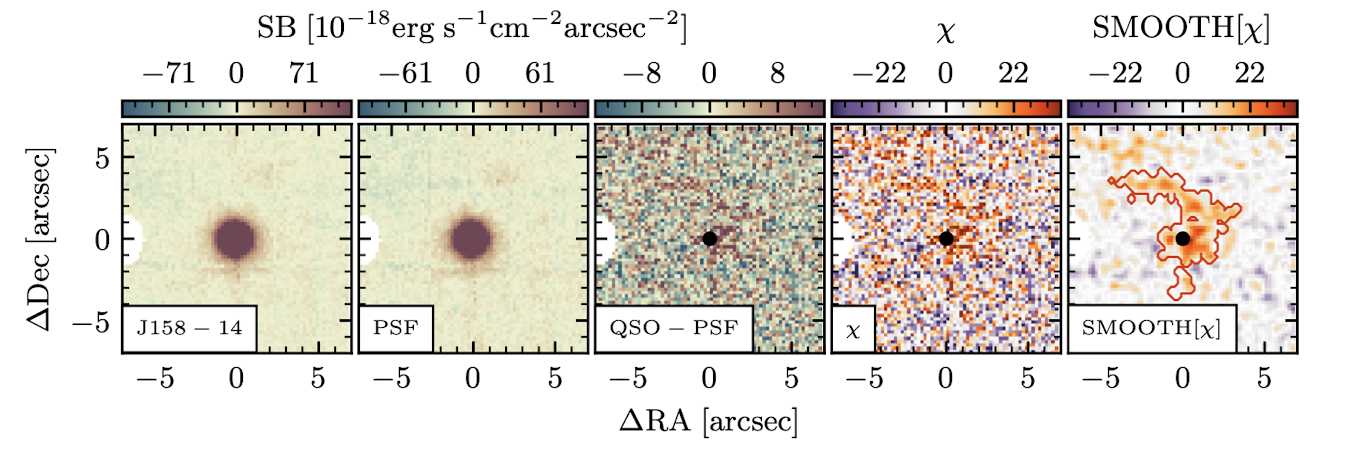
Figure 1: To observe the nebula (red outlined region in the rightmost panel), you have to subtract out the light coming from the quasar (leftmost panel). [Adapted from Ďurovčíková et al. 2025]
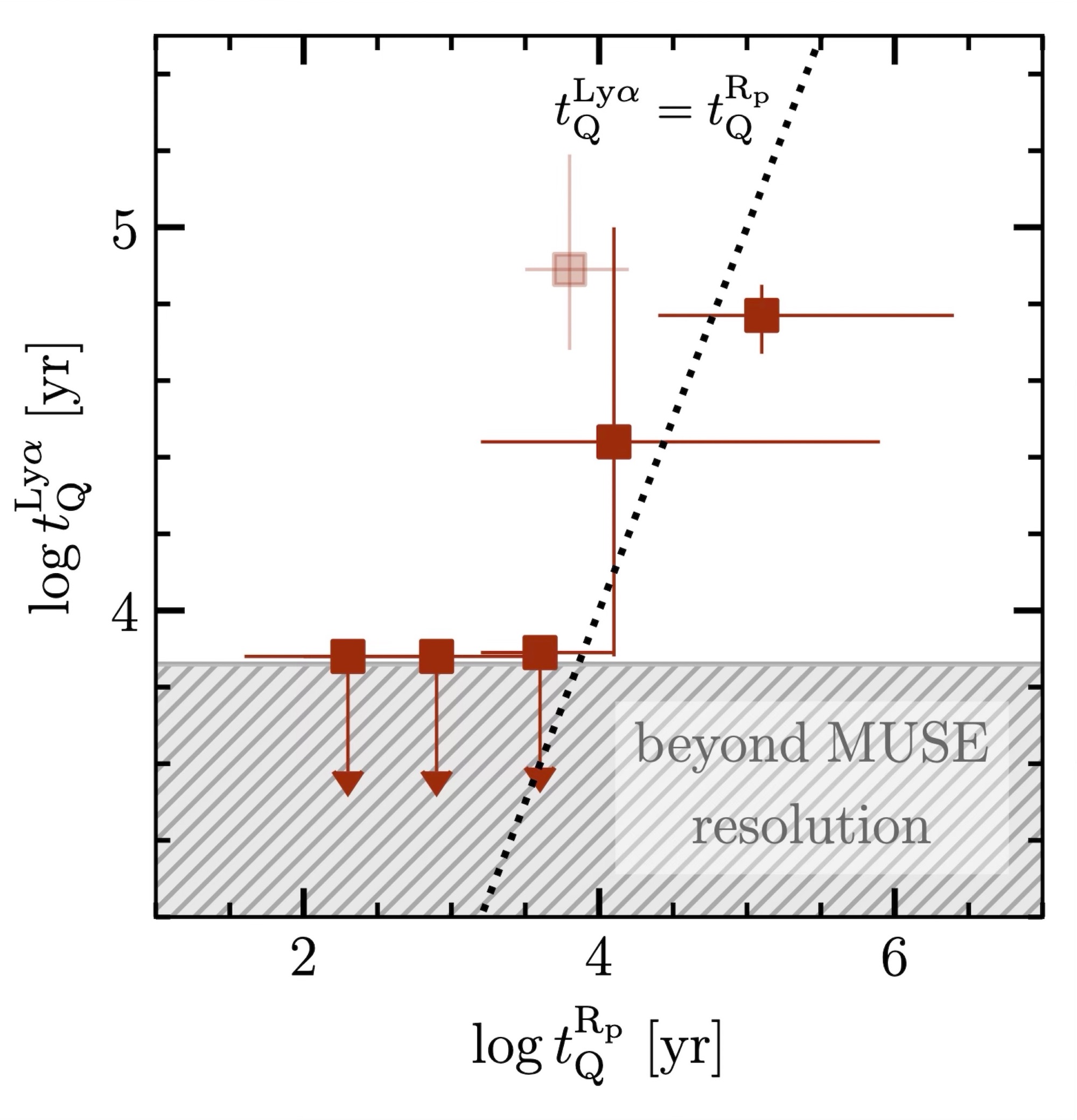
Figure 2: The age estimates derived by today’s authors (y-axis) are similar to the line-of-sight age estimates (x-axis), and generally follow a one-to-one relationship, suggesting that line-of-sight obscuration effects are not leading astronomers to underestimate the age of a quasar. [Adapted from Ďurovčíková et al. 2025]
Age estimates from the two methods are broadly pretty consistent, suggesting that obscuration effects are not causing one method to be severely underestimating the lifetime of a quasar. Therefore, for these six quasars, it seems unlikely that their growth can be primarily explained by phases of obscured growth. Instead, some other mechanism must have allowed these black holes to grow rapidly during the early universe and reach their supermassive sizes.
The mystery of how supermassive black holes can grow so quickly is still to be solved, but today’s article shows us that we haven’t been missing phases of obscured growth. The results of today’s article provide an independent measurement of quasar lifetimes, which models of supermassive black hole growth should be able to explain.
Original astrobite edited by Cesily King.
About the author, Nathalie Korhonen Cuestas:
Nathalie Korhonen Cuestas is a second-year PhD student at Northwestern University, where her research focuses on the chemical evolution of galaxies.
The post Are Quasars Growing in Secret? appeared first on AAS Nova.
To measure properties of a pulsar accurately, astronomers have to stack many individual observations together to boost the signal above the noise. But what if there was a more clever, more effective way to add observations than simple stacking?
Pulsars, or rapidly spinning neutron stars that emit narrow cones of radio waves, are often referred to as the galaxy’s lighthouses. Just like a sailor looking to shore might see a periodic flash when a lighthouse’s beacon sweeps over their ship, so too would radio telescopes aimed at a pulsar detect a “pulse” when its beam sweeps across Earth. However, although this comparison to lighthouses is a powerful analogy, it starts to break down when considering the speed and strength of these flashes.
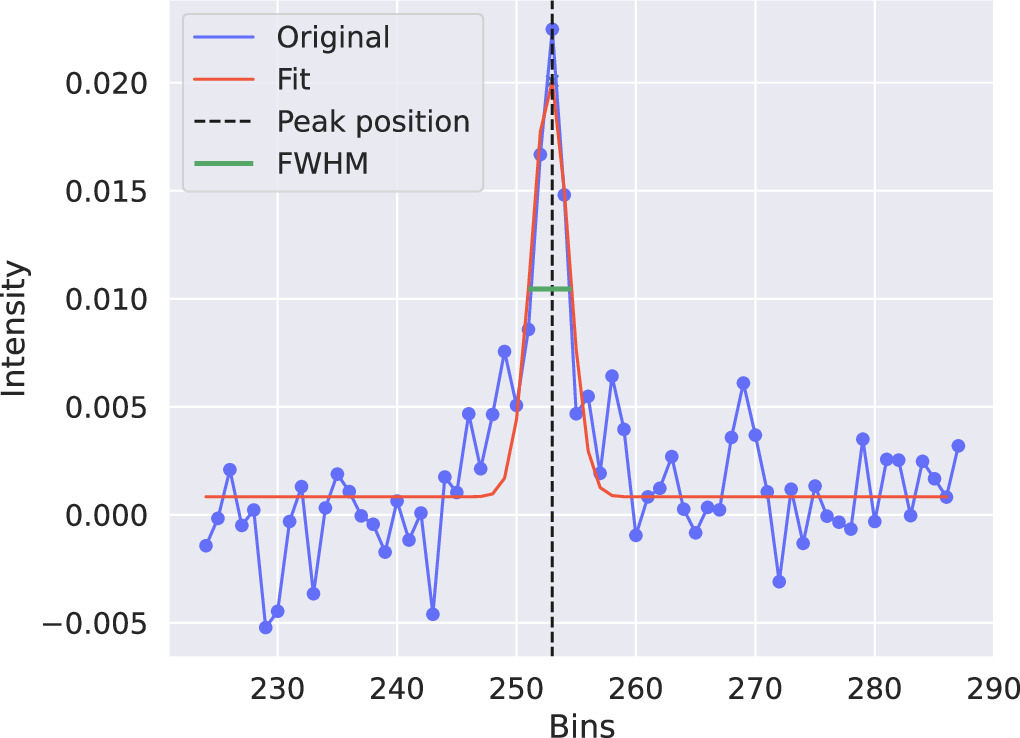
An example of one noisy individual pulse. Click to enlarge. [Sosa Fiscella et al. 2025]
This practice rests of the subtle assertion that every individual pulse is just a noisy variation of the same unchanging pulse profile. But is that safe to assume? And can we improve the precision of our measurements by doing something more complex than simple stacking? These are the questions recently tackled by a team of astronomers led by Sofia V. Sosa Fiscella (Rochester Institute of Technology) in research published in The Astrophysical Journal.
The researchers focused on one particularly bright source named PSR J2145−0750 that was observed by the Green Bank Telescope for two hours in 2017. This pulsar is so bright that it’s possible to measure quantities like the pulse width, height, center, and total energy of individual pulses, not just the final stack. The team did just that for each of the more than 200,000 pulses in their dataset and assigned each one a vector of four numbers. When they next sorted the pulses into distinct groups, they found that there were indeed correlations among these variables: for example, pulses with higher maximum heights tended to arrive earlier and be narrower than the overall average.
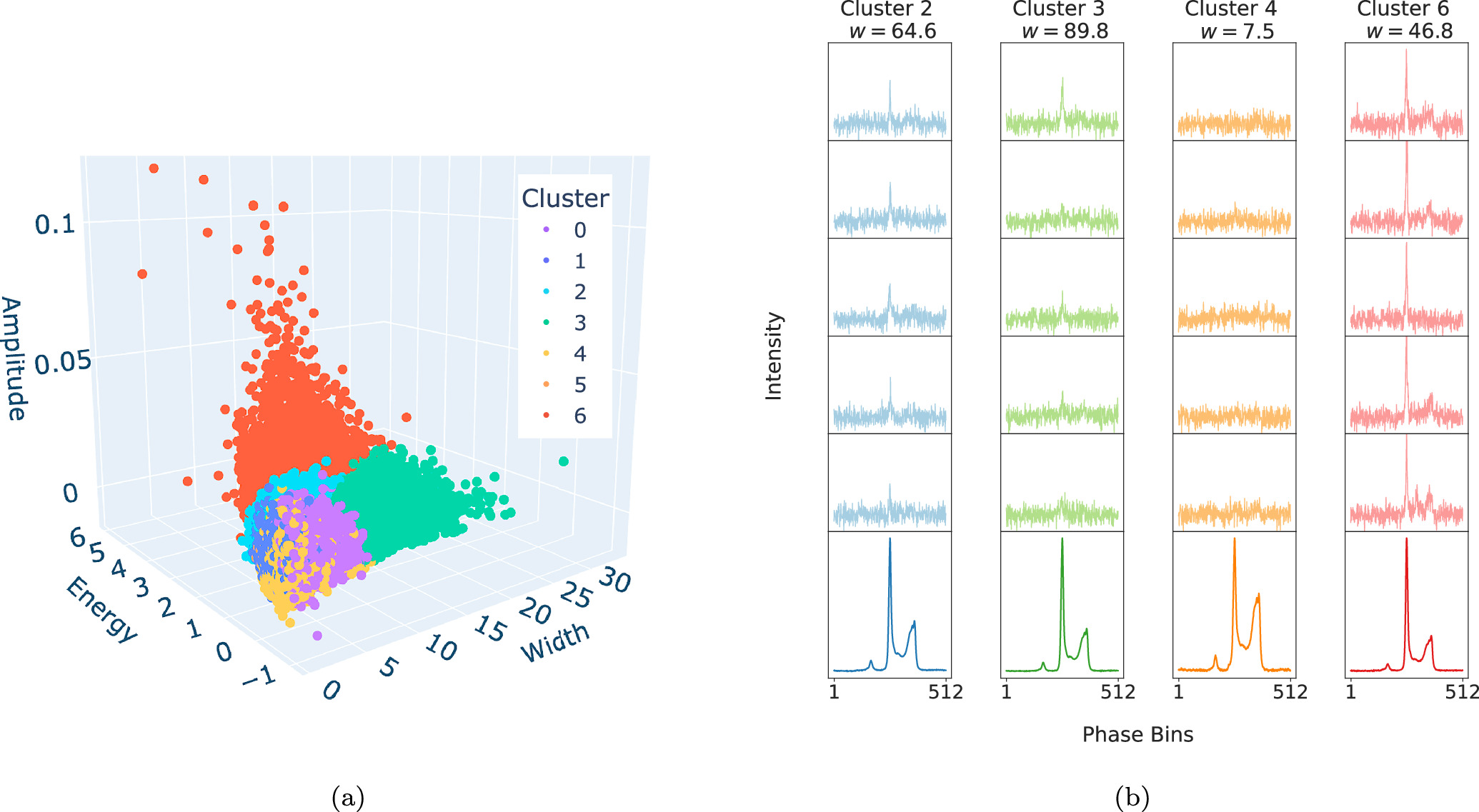
A visual representation of the different pulse clusters. Each point corresponds to one pulse. Click to enlarge. [Sosa Fiscella et al. 2025]
Though the team cautions that this new method will likely only be relevant for the pulsars for which we can measure individual pulses, they also point out that as better telescopes come online, we’ll be able to do that for more pulsars. In the meantime, astronomers can take comfort in the fact that as our technological abilities improve, so do our abilities to squeeze as much from our data as possible.
“Improving Pulsar Timing Precision with Single Pulse Fluence Clustering,” Sofia V. Sosa Fiscella et al 2025 ApJ 984 111. doi:10.3847/1538-4357/adc1c2
The post Cluster Before Stack: A New Algorithm for Pulsar Timing appeared first on AAS Nova.


