❌

Normal view

Canon RF 20mm f/1.4L VCM review: Wide, bright and built for the dark

10 September 2026 at 12:00

The Canon RF 20mm f/1.4L VCM is an intriguing lens for photographers who want a wide field of view without sacrificing aperture. Its f/1.4 maximum aperture makes it particularly appealing for astrophotography, while the 20mm focal length offers plenty of room for landscapes, architecture and other wide-view scenes.

We took the lens out to the dark skies of Wales to photograph the night sky and the Perseids, giving it a real-world test in some of the best conditions we could find.

With a premium L-series build and a price tag to match, there's a lot to consider before adding this lens to your kit. We wanted to find out how it actually performs in the real world, and whether it's worth the investment.

Canon RF 20mm f/1.4L VCM: Design

Canon RF 20mm f/1.4L VCM on a table

It's a nice size and weight, despite not being the smallest lens. (Image credit: Kimberley Lane)
  • Premium, solid build
  • Surprisingly manageable for an f/1.4 lens
  • A few small quirks keep it from being flawless

The Canon RF 20mm f/1.4L VCM feels like a proper L-series lens from the moment you pick it up. It's solid and reassuringly well-built, but it never felt excessively heavy or awkward on the camera. At 1.41 pounds (519 grams), it's certainly not a tiny 20mm prime, but the weight is well balanced and it was comfortable to carry and shoot with. And considering it'll often be used for astrophotography, it'll be on a tripod a lot of the time anyway.

The focus and control rings both feel smooth and nicely weighted, while the switches and customizable buttons are easy to find without having to look at the lens. The weather-resistant build is another bonus for outdoor shooting, which will come in handy if you also use the lens for landscapes where you might encounter inclement weather.

The dedicated aperture ring is also a nice feature, especially if you prefer having more physical controls rather than relying on the camera body and remembering which dial is set to each setting. Plus, the clickable nature of the aperture ring is an ASMR dream.

Canon RF 20mm f/1.4L VCM: Performance

milky way

The wide 20mm focal length and fast f/1.4 aperture are perfect for astrophotography. (Image credit: Kimberley Lane)
  • Excellent low-light performance
  • Sharp in the center with some corner softness
  • f/1.4 makes a real difference under dark skies

A fast 20mm is a pretty exciting combination for astrophotography. It gives us plenty of sky to play with, while the f/1.4 aperture pulls in a lot of light. Under those dark skies, the Milky Way came through beautifully, with plenty of detail without needing to resort to boosting the ISO too high.

We took the lens out to Carmarthenshire in Wales under Bortle 3 skies to photograph the night sky during the peak of the Perseids, which also coincided with the new moon — the perfect recipe for astrophotography.

The center of the frame is where this lens is at its best. Stars are crisp and well-defined, which is exactly what we want from a lens that is being used for astrophotography. The edges aren't quite as impressive, though. There is some softness and a little stretching of the stars towards the outer parts of the frame, particularly when the lens is wide open. It's not enough to ruin an image, but it becomes obvious when zooming in and pixel-peeping at the corners.

Canon RF 20mm f/1.4L VCM: Functionality

Canon RF 20mm f/1.4L VCM on a table
It's a very practical choice for everyday shooting.Kimberley Lane
Canon RF 20mm f/1.4L VCM on a table
Kimberley Lane
  • Quick and reliable autofocus performance
  • Customizable controls are genuinely useful
  • A practical choice for everyday shooting

The Canon RF 20mm f/1.4L VCM is very straightforward to use out in the field — especially in the dark. The autofocus was quick and reliable during testing, and for everyday shooting of landscapes, or even for video, this means there's very little to think about.

The customizable controls are useful, too. The lens function button and control ring can be assigned to different settings, allowing you to put the controls you use most within easy reach. It's a small thing, but being able to set the lens up around your personal shooting style makes it feel more intuitive and can save a surprising amount of time.

Key specifications:

Focal length: 20mm
Aperture: Constant f/1.4
Weight: 1.14 pounds (519 g)
Dimensions: 3 x 3.9 inches (76.5 x 99.3 mm)
Filter thread: 67 mm

The 67mm filter thread is another practical advantage, as it's a common filter size, so you won't necessarily need to invest in an entirely new set of filters if you already own that size.

The lens doesn't feature a ton of bells and whistles, but that's not a bad thing. It's designed to be picked up and used without much fuss, and after spending time with it, we found that its simplicity is one of its strengths.

Should you buy the Canon RF 20mm f/1.4L VCM?

The Canon RF 20mm f/1.4L VCM lens makes the most sense for photographers who regularly work in low light or want a dedicated wide-angle prime. Astrophotographers are likely to get the most from it, but it also has plenty to offer for landscapes, architecture, interiors and environmental photography.

Its biggest appeal over a zoom is its f/1.4 aperture. If you already have a wide-angle zoom but regularly find yourself having to bump up your ISO in low light, this lens fills that gap while also offering the control of a fast prime.

However, it's a fairly specialist addition to a lens lineup, and the price makes it tricky to justify if you only occasionally shoot wide. If you need the flexibility of changing focal lengths, or if you primarily shoot distant subjects, you'd be served better by a zoom or longer lens

If this lens isn't for you

Canon RF 16mm f/2.8 STM on a white backgroundCheaper option

Canon RF 16mm f/2.8 STM

The Canon RF 16mm f/2.8 STM is a much more affordable way into Canon's full-frame RF wide angle range, and it's much smaller and lighter. It lacks the 20mm f/1.4L's fast aperture, L-series glass and premium build, but if you're just starting out, or you only occasionally shoot wide, it could be a better option.

Canon RF 14mm f/1.4L VCM on a white backgroundIf you want to shoot wider

Canon RF 14mm f/1.4L VCM

If 20mm isn't wide enough, the Canon RF 14mm f/1.4L VCM gives a noticeably more expansive view while keeping the same fast f/1.4 aperture. It's a slightly more specialist choice for dedicated astrophotographers who want to capture as much sky or landscape as possible.

Canon RF 15-35mm F2.8 L is USM on a white backgroundIf you want more versatility

Canon RF 15-35mm F2.8L IS USM

If you don't want to be stuck with one focal length, the Canon 15-35mm f/2.8L IS USM is the obvious choice for astrophotographers. The focal range covers a much wider variety of photography styles, making it more practical for everyday shooting.

ZWO Seestar S50 Pro smart telescope review

1 September 2026 at 12:04

The ZWO Seestar S50 Pro was released on Aug. 25, 2026. It's a smart telescope that ships with everything you need to get started with astronomy and solar observations, eliminating the need to buy any other accessories.

It is controlled through the Seestar app on a smartphone and offers automatic slewing and autofocused views of galaxies, nebulas, star clusters and more. That said, in our experience, it sometimes needs manual adjustment with the on-screen joystick to perfect centering.

This being the Pro version of the original S50, which released three years prior, it's more expensive; you'll be paying $450 more than the original S50, with the S50 Pro coming in at $999. For that you get double the storage capacity (128 GB instead of 64 GB) and a higher resolution (4K not Full HD). ZWO claims the Pro has an extended battery life of nine hours, though we can't test this yet because the app version responsible for this uplift from the originally stated seven hours (version 3.3.1) wasn't released during testing.

So are these upgrades enough to warrant the extra spend?

ZWO Seestar S50 Pro review

ZWO Seestar S50 Pro: Design

ZWO Seestar S50 Pro on a tripod against a green shed
The Seestar S50 Pro comes in white with a compact mini carbon fiber tripod.Jase Parnell-Brookes
Someone pressing the power button on the ZWO Seestar S50 Pro
Only two buttons feature on the telescope itself, a large power button and a smaller reset button underneath.Jase Parnell-Brookes
ZWO Seestar S50 Pro on a tripod against a green background
A dual lens system mirrors the S30 Pro's design and even has the same resolution.Jase Parnell-Brookes
  • Lightweight and easy to carry in the case provided
  • Dual-lens system mirrors the S30 Pro
  • Simple, two-button design and an easy push-on solar filter

The Seestar S50 Pro is instantly recognizable as a smart telescope. A neat, rounded and glossy plastic casing protects the fragile but automatic optical and electrical insides that power this pocket rocket. Only two buttons are found on the entire device: a large power button on the side enveloped by a ring of light that glows when powered on, and a small reset button on the bottom of the telescope.

Specifications

Image resolution: 8.3 MP (3840 x 2160)
Aperture: 50mm (1.96 inches)
Focal length: 260 mm
Storage: 128 GB internal
Field of view: 2.8 degrees (tele) / 63 degrees (wide)
Mount: Motorized alt-azimuth (EQ mode supported)
Battery: 9 hours (currently untested)
Weight: 6 pounds (2.72 kg)

The carry case that the S50 Pro ships in looks like black compressed polystyrene but has neat latches and a red handle that tucks away in a slot at the top, making it easy to pack — similar to a drone case. This is much better than some of the bags you can buy for smart telescopes as it feels more rigid and secure. The S50 Pro and its tripod and solar filter all ship together and are snugly held inside.

ZWO Seestar S50 Pro on a tripod against a green shed
Everything feels more polished and refined in the design of the S50 Pro, compared with the S30 Pro.Jase Parnell-Brookes
ZWO Seestar S50 Pro on a tripod against a green shed
The carry case is cleverly designed and feels very protective with snug fit of the telescope and accessories inside.Jase Parnell-Brookes
ZWO Seestar S50 Pro on a tripod against a green shed
Built into the case are two latches and a red handle that pushes into a groove to facilitate compact stowing.Jase Parnell-Brookes

It's light, too. We weighed it all, and the whole setup weighs 8.6 pounds (3.9 kilograms) fully packed, 6 pounds (2.7 kg) of that being the S50 Pro itself. It's also small; we measured it at 5.7 x 10.6 x 5.4 inches (146 x 270 x 138 mm), including the rubber feet on the bottom. Incidentally, we like that because it means you don't have to use the tripod if you don't want to.

We even received a bunch of ZWO-branded stickers that, if we were so inclined, we could pop on the telescope. But we're probably going to give them to the nephews.

ZWO Seestar S50 Pro on a tripod against a green shed
A 3/8-inch tripod thread on the bottom fits most photographic tripods, but a small carbon fiber tripod ships with it.Jase Parnell-Brookes
ZWO Seestar S50 Pro on a tripod against a green shed
The carbon fiber tripod is light and locks in place with metal twist locks.Jase Parnell-Brookes
ZWO Seestar S50 Pro on a tripod against a green shed
Rubber feet reduce vibrational interference and grip smooth, uneven surfaces without trouble.Jase Parnell-Brookes

Everything is controlled via the Seestar app, the same as all the other ZWO Seestar telescopes. This is typical for smart telescopes, which are almost always operated via an app.

As usual, and as we said in our S30 Pro review, it has a 3/8-inch tripod thread underneath, but the tripod itself is very small. We ended up using a larger photographic Gitzo carbon fiber tripod without the tripod head. But beware — if you're going to do this, take the tripod head off first. It won't fit the 1/4-inch thread of your standard mirrorless camera, which is likely what your tripod footplate will be.

ZWO Seestar S50 Pro: Performance

  • Aligns and tracks automatically
  • Live stacking reveals faint objects quickly
  • Solar eclipses can be shot as photo or video timelapses

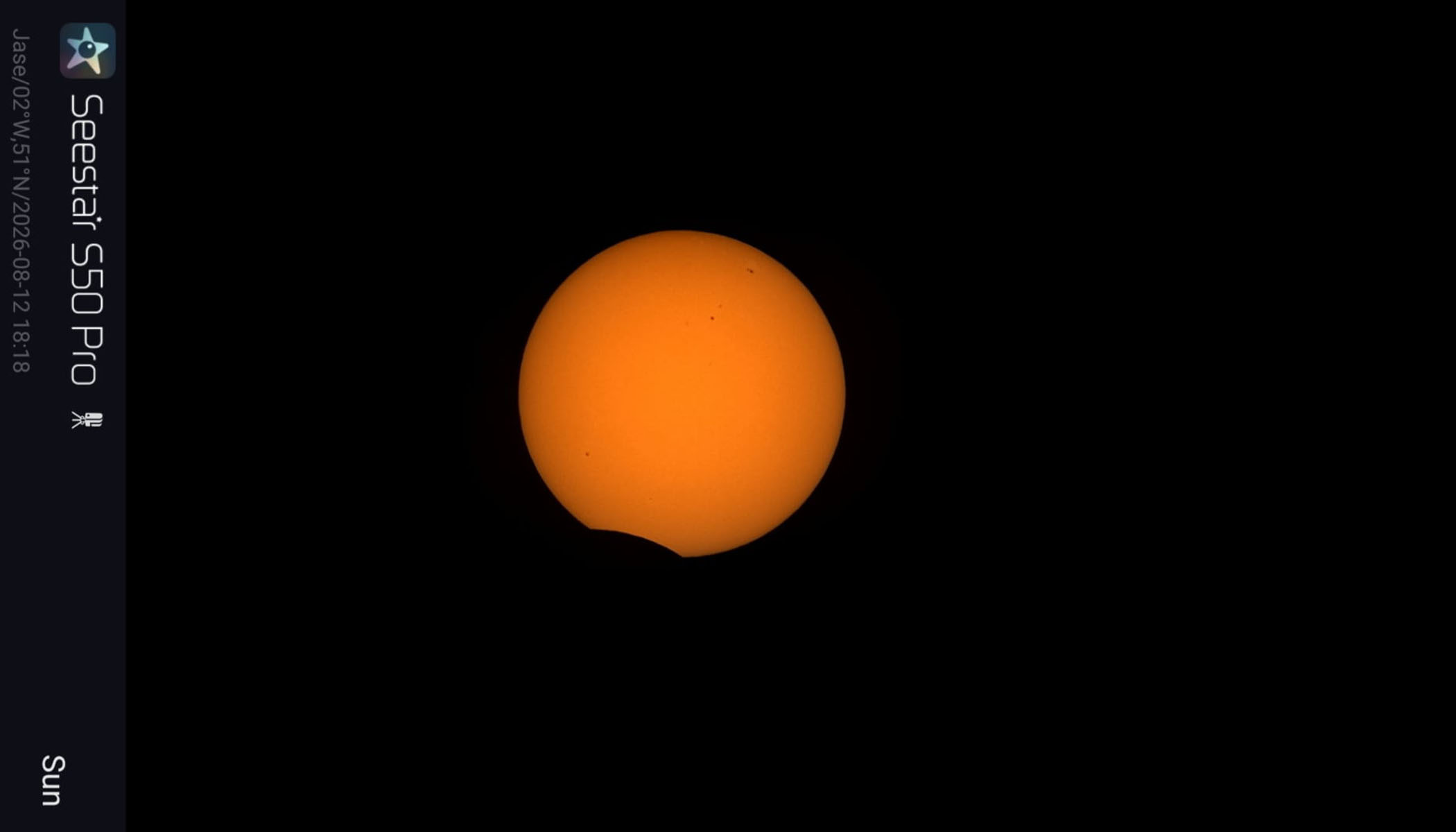
Observational images of the night sky and the sun taken with the ZWO Seestar S50 Pro smart telescope

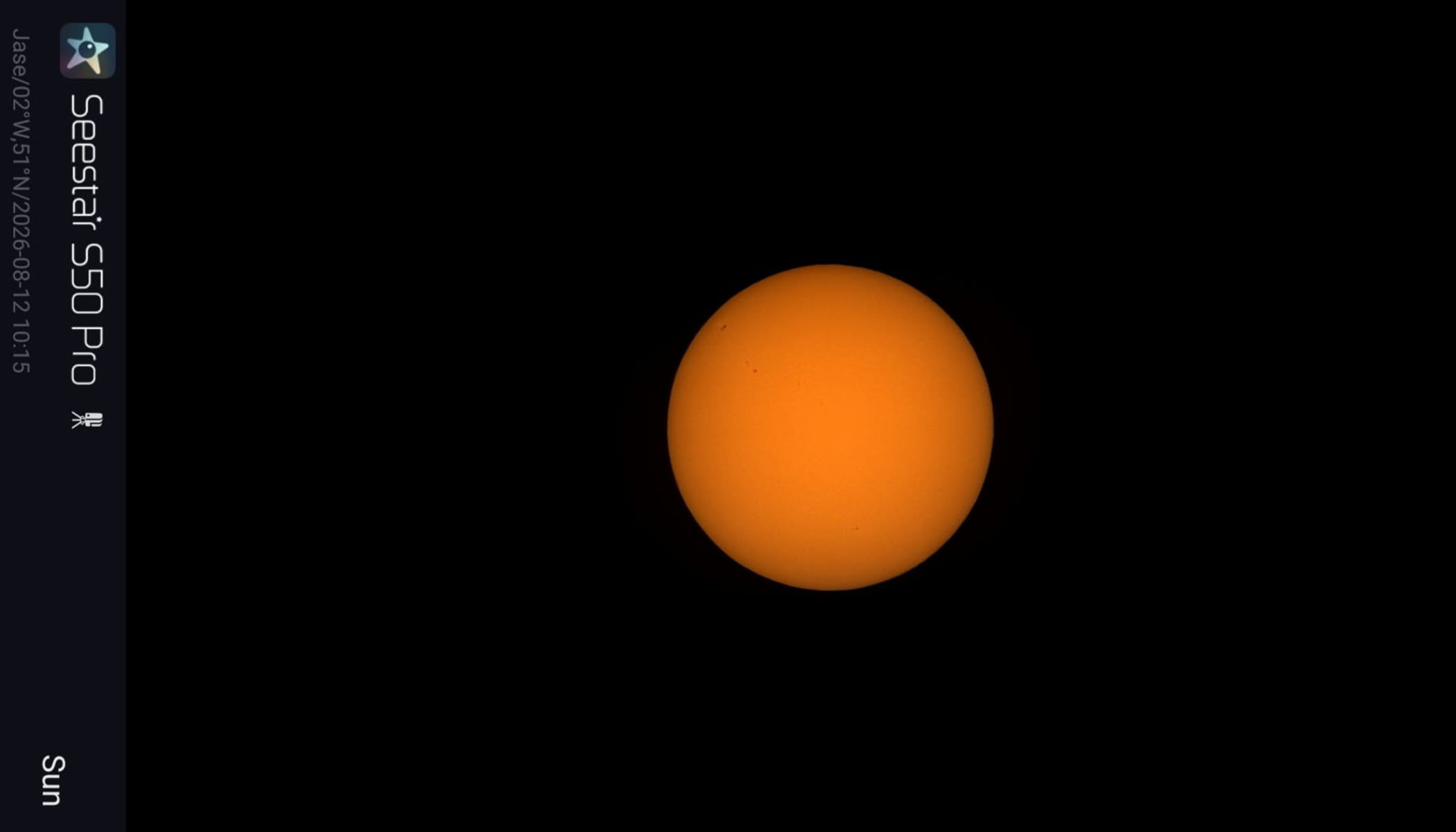
Sunspots can be seen on the photosphere of the sun, and the push-on solar filter that ships with the telescope gives it a warm, orange hue. (Image credit: Jase Parnell-Brookes)

It took a matter of minutes for the live-stacking feature to give us clear and bright views of any object we slewed to. Live-stacking enables the smart telescope to take image after image to produce more detailed results of dim deep sky objects.

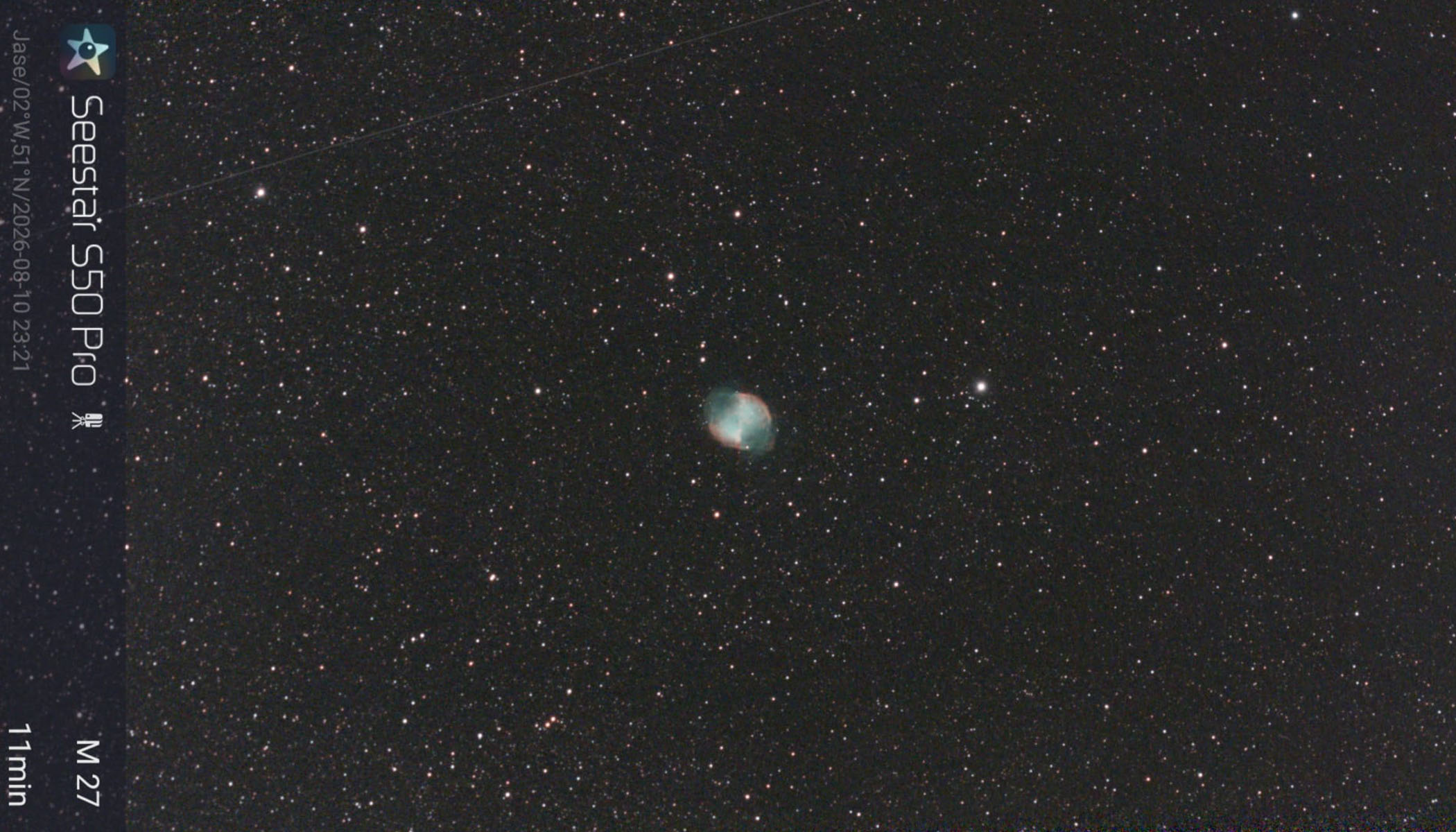
M27, the Dumbbell Nebula, was our standout favorite during testing, which we imaged over 10 minutes and 20 seconds. The final image captured the vibrant greenish blue core shining through, sandwiched by the red and orange glow of the nitrogen, hydrogen-alpha and sulfur.

Observational images of the night sky and the sun taken with the ZWO Seestar S50 Pro smart telescope

Color and detail are impressive on the Dumbbell Nebula, but we wish it was larger in the frame. (Image credit: Jase Parnell-Brookes)

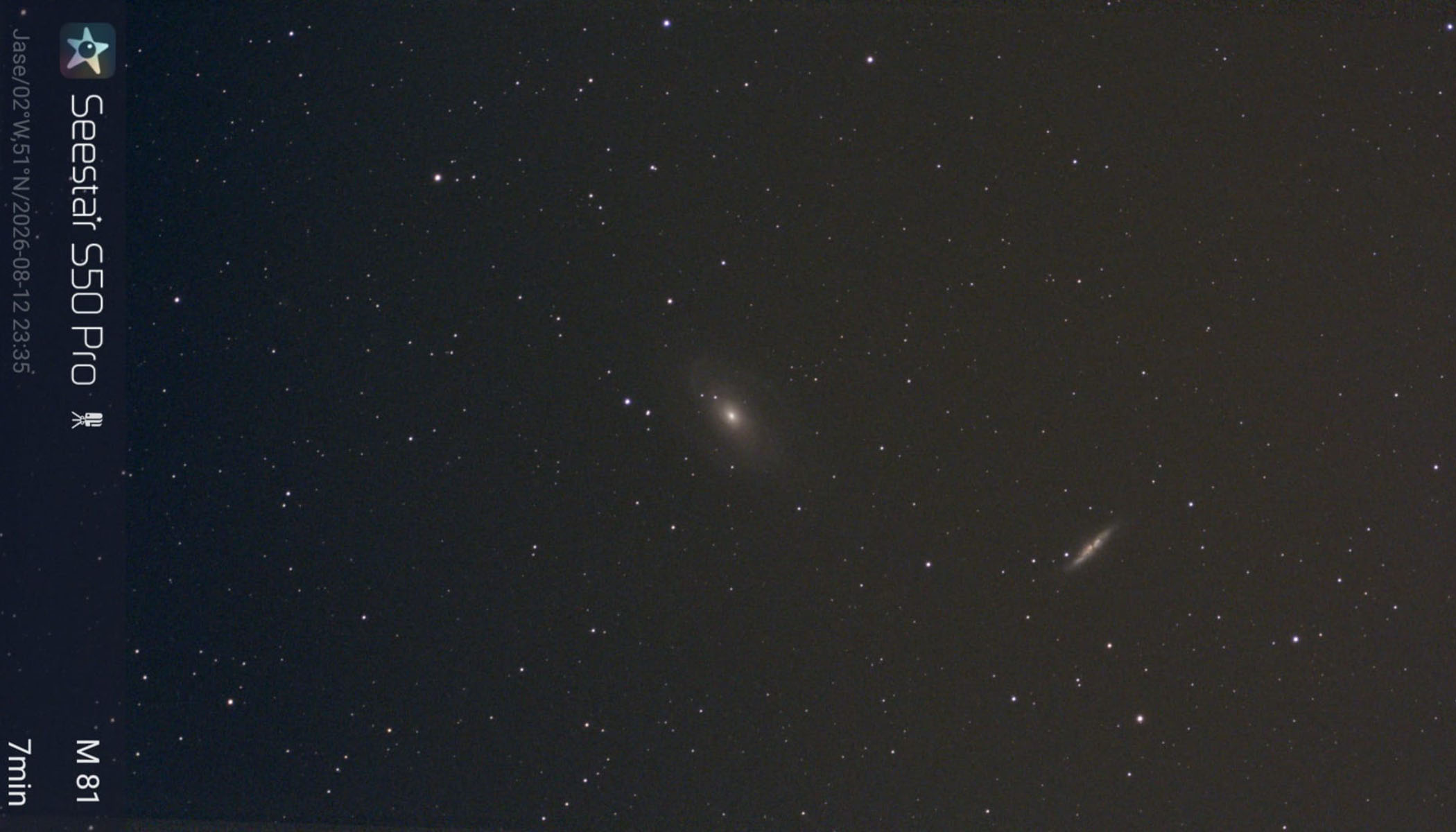
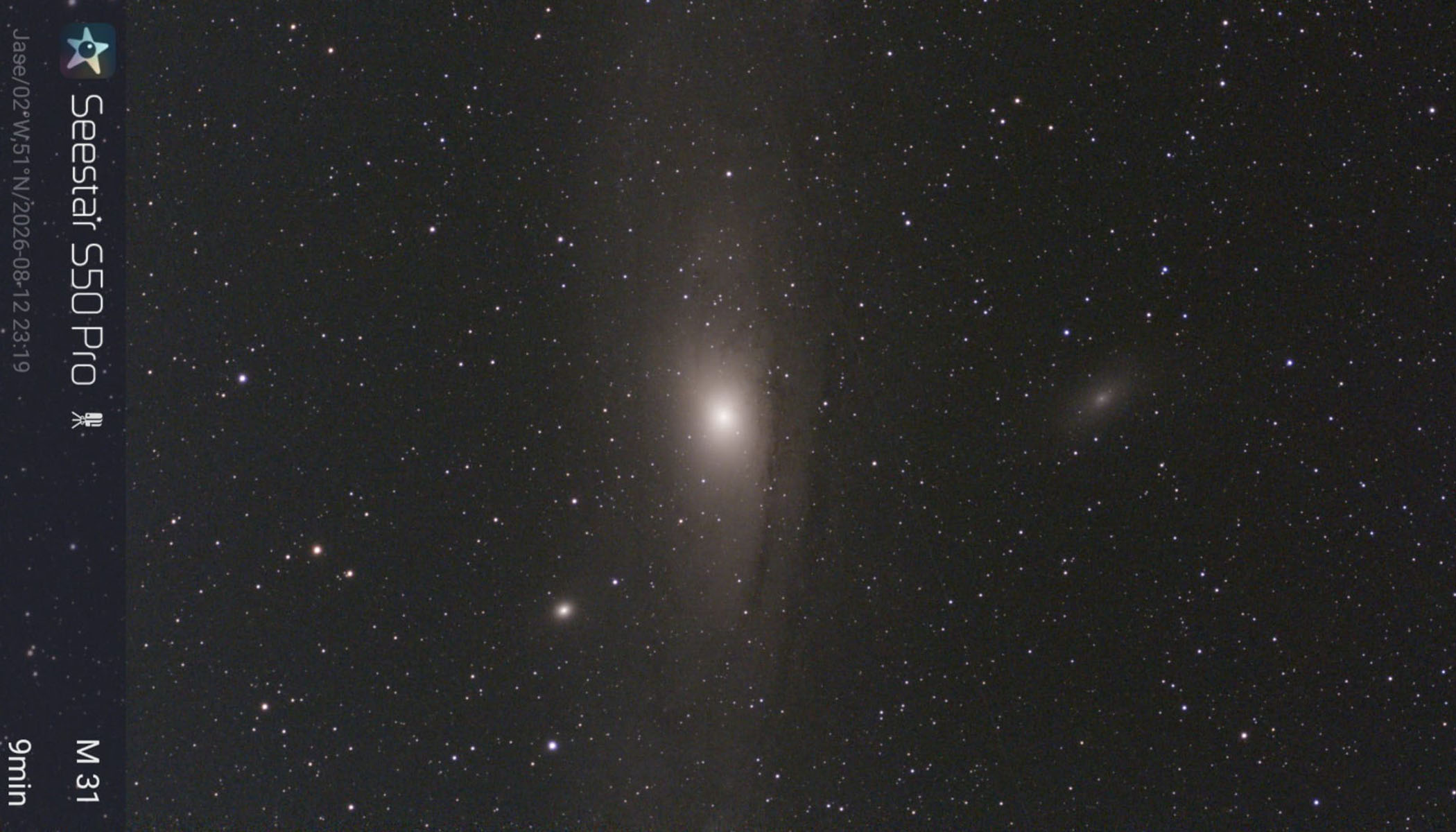
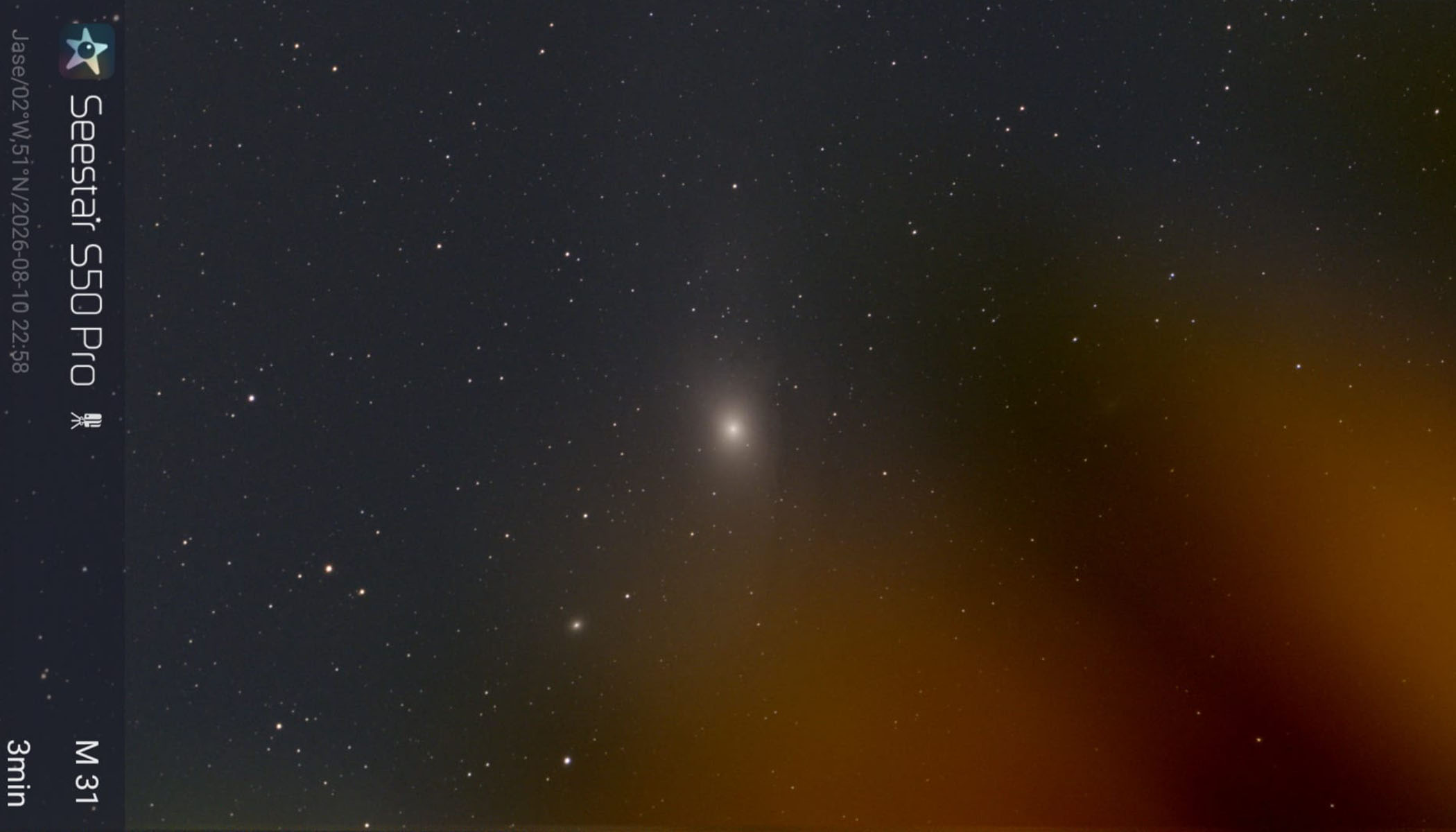
Other notable objects we observed included M31 (the Andromeda Galaxy), which had good shape and reasonable clarity over the nine-minute exposure and filled the frame nicely considering this is an 8.3 MP image. It's also possible to image M81 (Bode's Galaxy) and M82 (the Cigar Galaxy) together on the S50 Pro due to the wider field of view, and after only 6 minutes and 30 seconds' exposure time we saw clear arms on M81 and fragmented detail and deep coloring in M82 which we were pleased with.

Observational images of the night sky and the sun taken with the ZWO Seestar S50 Pro smart telescope

Some spirals seen in M81 and detail seen in M82 in this seven-minute exposure. (Image credit: Jase Parnell-Brookes)

Observational images of the night sky and the sun taken with the ZWO Seestar S50 Pro smart telescope

The Andromeda Galaxy really fills the frame when observing with the S50 Pro. (Image credit: Jase Parnell-Brookes)

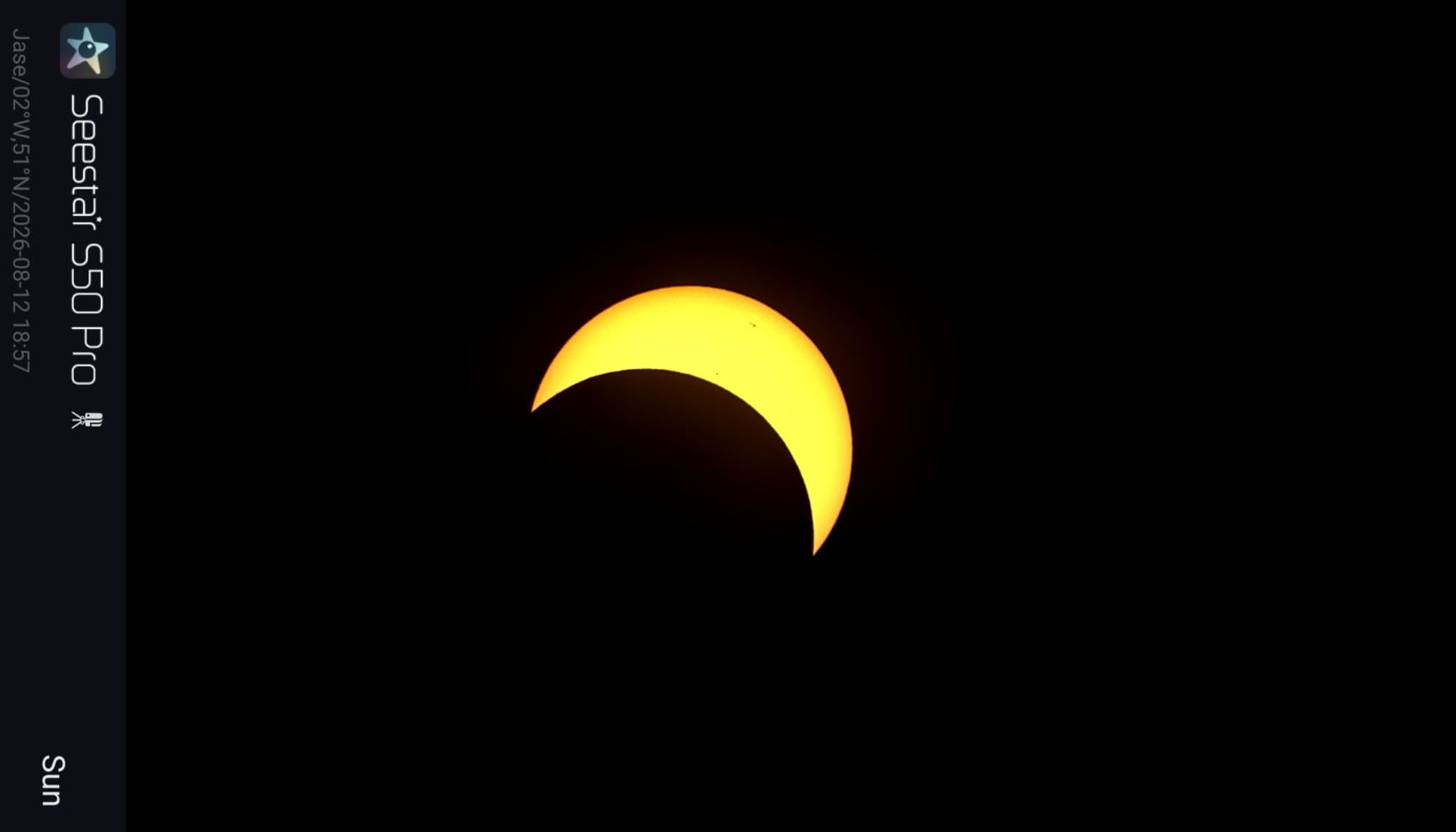
We also observed the sun, both before, during and after the Aug. 12, 2026 solar eclipse. Sunspots were clearly visible on the S50 Pro, and the solar filter that ships with the S50 Pro as standard gives it a warm orange tone, which is pleasing, even if we couldn't see much other detail like granules or faculae. However, we wouldn't expect that with a smart telescope of this spec at this price point.

Observational images of the night sky and the sun taken with the ZWO Seestar S50 Pro smart telescope

The start of the Aug. 12, 2026 solar eclipse was promising with crisp edges, sunspots and a warm orange tone with well-balanced exposure. (Image credit: Jase Parnell-Brookes)

Something that did frustrate us, though, was the S50 Pro's automatic exposure metering. This became most apparent during the Aug. 12, solar eclipse when taking a timelapse video.

The sun was overexposed most of the time, only allowing the darkest of sunspots to appear on the surface, but as the moon moved in front of the sun the exposure kept changing up and down, which it also did when clouds moved in front. The resulting timelapse was fun to share with friends and family over instant messaging but was far from ideal.

Observational images of the night sky and the sun taken with the ZWO Seestar S50 Pro smart telescope

During the solar eclipse on Aug. 12, 2026 the metering of the telescope skewed and we were left with an overexposed sun. (Image credit: Jase Parnell-Brookes)

We also urge you to use a taller photographic tripod or similar when observing, due to our first session of nighttime imaging being obscured by a nearby tree bending into view during a long exposure, thanks to an occasional gust of wind.

Observational images of the night sky and the sun taken with the ZWO Seestar S50 Pro smart telescope

Due to the tripod being so short, sometimes trees bend into view with gusts of wind. Frustrating for long exposures. (Image credit: Jase Parnell-Brookes)

ZWO Seestar S50 Pro: Functionality

ZWO Seestar S50 Pro on a tripod against a green shed
The solar filter pushes on to the front of the lens assembly.Jase Parnell-Brookes
ZWO Seestar S50 Pro on a tripod against a green shed
The telescope as viewed without solar filtration.Jase Parnell-Brookes
  • Smartphone app is easy to use
  • A few niggles irk us, like typos and mislabelling
  • Zero-backlash motor purportedly reduces wind interference

Setting up the Seestar S50 Pro is easy, and if we hadn't run into some synchronization issues with the app, or if we had used the NFC (near-field communication) feature, it could have been up and running in around five minutes.

Things being as they were, though, we had to restart and reinstall the app once or twice, with the telescope not visible to connect with in the app. It took around 30 minutes total, which is no big deal for a first-time setup, but it's something to consider.

There were a few niggles that struck us as odd, considering ZWO's outstanding ability to produce high-end astronomy products. Namely, we experienced the Seestar S50 Pro naming the sun as the moon (it was a few hours before the solar eclipse and it's possible it got visually confused because of the solar filter). There was also a typo when checking if the sun is "in the fram."

Plus, when observing long exposures, ZWO's Seestar mascot clung to the side of the screen and couldn't be removed. These are nothing super major but are all things we would like to see addressed before spending $999.

Screenshots from the zwo seestar app on smartphone

A few quirks of the Seestar app have us wondering if this has been given a final once-over. (Image credit: Jase Parnell-Brookes)

Everything about the S50 Pro's functions is almost identical to the S30 Pro, which we reviewed in April 2026. Live-stacking of 10-second exposures reduces the signal-to-noise ratio and improves details over time. It automatically slews to and autofocuses on subjects. The S50 Pro also has plate-solving in order to orient itself on the stars of the night sky as most smart telescopes do. It has an equatorial mode for better subject tracking, and it's operated by the same Seestar app.

One big difference, however, is the S50 Pro's zero-backlash motor, which is used for tracking subjects. Compared with the S30 Pro's stepper motor, which is internally geared, the S50 Pro has more precise tracking and better resistance to wind movement. We saw clear and sharp images produced during testing, but there was minimal wind on the nights we tested, so further observations are required to confirm how much of a difference this really makes to the average user.

ZWO Seestar S50 Pro on a tripod against a green shed

The telescope fits snugly into the compact carry case. (Image credit: Jase Parnell-Brookes)

Should you buy the ZWO Seestar S50 Pro?

Buy it if:

✅ You need the extra light-gathering of the 50mm aperture

✅ You want a compact smart telescope that comes with a protective carry case and accessories

✅ You don't mind dropping nearly $1,000 on one device

Don't buy it if:

❌ You need something smaller and lighter

❌ Traditional observation is more appealing

❌ You want a budget smart telescope

If you don't have a smart telescope already and haven't tried any other ZWO smart telescopes, the S50 Pro is an easy win. It sits at the top of ZWO's smart telescope range, has the joint-largest aperture they offer, the joint-highest resolution and ships with everything you need to get started, even a solar filter for daytime observing. It's the best ZWO smart telescope currently available.

However, unless you have nearly $1,000 to spend on an instrument such as this, there are cheaper alternatives that do almost as well at a much lower price point. ZWO's own S30 Pro is $300 cheaper and bags a large amount of the same features and specifications as the S50 Pro. At nearly half the price, the S50 gives you the same aperture, but you will be restricted to much lower resolution.

If this product isn't for you

ZWO SeeStar S30 Pro on a white backgroundIf you want something cheaper

ZWO Seestar S30 Pro

Save $300 and grab the S30 Pro for the same resolution and most of the features but with a smaller 30mm aperture. You probably won't notice much difference between the two if you're an occasional backyard observer with limited technical interest.

Read our full ZWO Seestar S30 Pro review

dwarflab dwarf mini on a white backgroundIf you want something smaller

DwarfLab Dwarf Mini

It may only be 2 MP in resolution but it is far more compact. The DwarfLab Dwarf Mini is a darned sight more affordable, too. You could buy two or three for the price of one Seestar S50 Pro, depending what offers you can find.

Read our full Dwarflab Dwarf Mini review

Celestron Origin product image on a white background.If you want something bigger

Celestron Origin Intelligent Home Observatory

One for backyard use and special astronomy trips, the much larger and heavier Celestron Origin (a reflector) comes in just shy of the Seestar S50 Pro's resolution but can produce detailed 6.4 MP images. However, it has recently been superseded by Celestron's Origin II, which matches the 8.3 MP resolution of ZWO's telescope here, if you have the coin.

Read our full Celestron Origin review

Apple accuses OpenAI of destroying evidence as trade-secrets fight intensifies

1 September 2026 at 00:44

OpenAI

Apple ratcheted up its lawsuit against OpenAI on Monday, telling a federal judge that the ChatGPT maker is destroying evidence while a former iPhone engineer used a confidential Apple circuit schematic in his new job.

In a court brief filed in support of expedited discovery, Apple said OpenAI is actively destroying crucial evidence in the Northern District of California case, which accuses the AI company, hardware chief Tang Yew Tan, former Apple engineer Chang Liu, and io Products of misappropriating hardware trade secrets. Apple also alleged that Liu “not only downloaded a confidential Apple circuit schematic but also used it in his work” at OpenAI.

The filing comes as Apple presses for early document production, forensic imaging of devices and accounts, and depositions of key witnesses. OpenAI has sought to dismiss the suit and has opposed Apple’s request for a fast-track discovery schedule and a preliminary injunction that would bar defendants from using or disclosing alleged Apple secrets while the case proceeds.

Apple sued in July, claiming a pattern of theft after OpenAI hired hundreds of former Apple employees and acquired Jony Ive’s hardware startup io. The complaint centers on Liu, an eight-year Apple senior systems electrical engineer who left in January 2026, and Tan, a 24-year Apple veteran who led iPhone and Watch product design and is now OpenAI’s chief hardware officer. Apple says Liu kept an Apple-issued laptop, exploited residual network access and an authentication bug, and downloaded dozens of confidential files—engineering presentations, specs for unreleased products, and manufacturing details for main logic boards—while already working for OpenAI. Tan, Apple alleges, used internal Apple project names in interviews and encouraged recruits to bring parts, prototypes, and supplier information.

OpenAI has denied the claims, calling the lawsuit careless and “oddly personal,” and saying it has no interest in Apple’s trade secrets. It has published messages it says show Apple employees contacting Liu after he left and asking for technical help, and it argues Apple delayed raising the core allegations for months.

As Bloomberg News’ Chris Welch and other reporters covering the Silicon Valley hardware race have noted, the case sits at the collision of two of tech’s most closely watched product efforts: Apple’s next devices under new CEO John Ternus and OpenAI’s push into consumer hardware after buying io. A hearing on Apple’s expedited-discovery motion is scheduled for Oct. 1 before Judge Edward Davila, though the court could rule sooner. Both companies declined additional comment beyond prior statements.

MacDailyNews Take: If you have nothing to hide, you don’t need a shredder. If your first device depends on Apple’s trade secrets, you definitely don’t want the schematics on your laptops.

Judge Davila gets this in October. Until then, OpenAI can keep insisting it’s all a misunderstanding. Apple is simply asking the court to look before the hard drives get “accidentally” wiped.


‎
Please help support MacDailyNews — and enjoy subscriber-only articles, comments, chat, and more — by subscribing to our Substack: macdailynews.substack.com. Thank you!

Support MacDailyNews at no extra cost to you by using this link to shop at Amazon.

The post Apple accuses OpenAI of destroying evidence as trade-secrets fight intensifies appeared first on MacDailyNews.

MacVoices #26195: Live! – Apple, Intel, and Trump, Glenn Fleishman’s Fruit Specs, and LastPass Hacked…Again

By: Chuck
29 June 2026 at 13:20
The panel examines a Bluetooth-related earbuds vulnerability, debating whether the issue lies in the protocol or Apple’s proprietary pairing approach, and why the implications feel unsettling. Chuck Joiner, David Ginsburg, Eric Bolden, Ben Roethig, Marty Jencius, Jim Rea, Jeff Gamet, and Guy Serle also touch on a useful tool born from a creator’s own workflow before turning to another LastPass incident and where it puts them on the trust spectrum. 

💾

MacVoices #26179: Flip The Script – Dmytro Melnyk on Building AI Into Trusted MacPaw Products

By: Chuck
16 June 2026 at 13:43
From the Flip the Script event in San Francisco, Dmytro Melnyk, Chief Product Officer for MacPaw, discusses his role and the importance of the company’s careful approach to adding AI across products, from both the developer and customer viewpoints.. He explains why some users want frictionless AI while others resist it over privacy, cost, and complexity, and outlines Eney's goal of combining many Mac utility tasks into one assistant with a pay-as-you-go model. 

💾

NJIT Professor’s Polymer Proposal Wins $125,000 ACS Grant

11 August 2026 at 20:19

A new research project at the New Jersey Institute of Technology is taking a closer look at a strange but important behavior in rubber-like materials: their properties can depend on what happened to them before. With a $125,000 New Directions grant from the American Chemical Society Petroleum Research Fund, chemical and materials engineering professor Gennady Gor and his students will investigate how petroleum-derived polymers absorb fluids, swell, contract and change their elasticity over time. The work could improve predictions of how elastomers perform in everything from industrial seals to oil and gas equipment.

Elastomers are polymers capable of undergoing large, reversible deformations. Silicone, neoprene and natural or synthetic rubber are familiar examples. Their molecular chains can stretch, rearrange and return toward their original configuration, giving these materials their characteristic flexibility. Yet exposure to liquids or vapors can dramatically alter that behavior. Hydrocarbon molecules may enter the polymer network, pushing molecular chains apart and causing the material to expand. At the same time, the absorbed fluid can change the polymer’s stiffness, strength and ability to recover its original shape.

Gor’s project focuses on a phenomenon known as hysteresis, in which a material’s current state depends not only on its present conditions but also on the path it took to reach them. For an elastomer, that means the material may respond differently when it is swelling than when it is shrinking, even if its size and surrounding environment are identical. The difference can arise from molecular rearrangements, delayed relaxation or changes in the interactions between polymer chains and absorbed molecules. Such path-dependent behavior is central to understanding why materials sometimes fail to return fully to their previous mechanical state.

The question is especially relevant for petroleum-related technologies. Elastomers are widely used as O-rings, gaskets and seals because they can deform to fill microscopic gaps and maintain a hermetic barrier. In oil and gas environments, however, these components may encounter complex mixtures of hydrocarbons under pressure and at elevated temperatures. If a seal swells excessively, softens or loses its ability to recover after repeated exposure, it can become unreliable. A better understanding of hysteresis could help engineers select materials and operating conditions that reduce leakage and extend component lifetimes.

The new study represents a shift for Gor’s Laboratory for Materials Interfaces. His previous research has largely examined porous adsorbent materials, which collect molecules on their internal surfaces. Elastomers are different: they do not need pores to take up substantial amounts of fluid. Instead, molecules diffuse into the polymer matrix and interact with its flexible chains. The resulting process is more like a sponge absorbing liquid, although the molecular mechanisms are governed by diffusion, thermodynamics and the elasticity of the polymer network.

Günel Nabiyeva, a fourth-year doctoral student, will lead much of the experimental effort with undergraduate chemical engineering student Elitsa Mileva and second-year doctoral student Supun Rangana. The team has already begun collecting data on how rubber deforms in the presence of liquids and vapors. For Mileva, who has spent considerable time reviewing the scientific literature, the grant will provide an opportunity to move deeper into laboratory work. Nabiyeva describes the project as a new system for the research group because the laboratory has not previously studied elastomers in this way.

The researchers will expose polymer samples to controlled concentrations of hydrocarbon vapors and track how the materials respond. Their measurements will combine swelling, fluid uptake and elasticity rather than treating these properties separately. This approach is essential because a polymer can gain mass and volume while simultaneously becoming softer or, under some conditions, displaying a more complicated mechanical response. Different hydrocarbons may produce different results because their molecular size, chemical structure and compatibility with the polymer influence how quickly they enter the material and how strongly they interact with its chains.

Rangana will contribute expertise in ultrasonic sensing, which can measure subtle changes without physically contacting or damaging the sample. Ultrasonic waves travel through a material in ways that depend on its density, structure and mechanical properties. By analyzing changes in wave transmission or reflection, scientists can detect variations in stiffness and internal condition with high precision. Coupling these measurements to vapor exposure could reveal how quickly elasticity changes as molecules enter the polymer and whether the material follows the same path during desorption as it did during absorption.

The team hopes its results will fill a gap in the fundamental understanding of polymer hysteresis. Although hysteresis is well known in many areas of physics and engineering, relatively few studies have examined how history-dependent elasticity develops in swollen elastomers. The new measurements may help distinguish reversible molecular motions from more persistent structural changes and improve models used to predict polymer performance. Ultimately, the researchers aim to make elastomer behavior less mysterious and more reliable, helping engineers design seals and flexible components that remain dependable across repeated cycles of chemical exposure, swelling and recovery.

Subject of Research: Elastomers, petroleum-derived polymers, polymer swelling, elasticity and hysteresis

Article Title: Ultrasonic Experiments Aim to Reveal Why Rubber Remembers Its History

Web References: Gennady Gor’s NJIT profile; NJIT Laboratory for Materials Interfaces

Image Credits: Courtesy of New Jersey Institute of Technology

Keywords

Elastomers, polymers, hysteresis, rubber, polymer swelling, ultrasonic sensors, materials science, chemical engineering, petroleum research, NJIT

Baader AstroSolar Filter Film OD 5.0 review

10 August 2026 at 16:24

Baader AstroSolar Filter Film OD 5.0 is one of those "secret" astronomy products that looks almost too simple to be special. In its most familiar form, it’s a thin, silvery A3 or A4 sheet of metalized film that can be cut and mounted in cardboard, plastic or commercial filter cells. Surely it’s better to have a pre-made filter for your camera? Go to any solar eclipse, and you’ll get your answer: experienced eclipse photographers, solar observers and anyone wanting to safely point a camera or binoculars at the sun very often rely on Baader AstroSolar Filter Film OD 5.0.

Its popularity does not come from its ruggedness nor its out-of-the-box convenience. Whether bought as a loose sheet for making filters or as ready-made Baader solar filters for binoculars, camera lenses and telescopes, it enables super-sharp captures of sunspots on the sun, allowing much faster shutter speeds than some rival solar filter materials.

Although a brighter Baader AstroSolar Filter Film OD 3.8 Photo Film is also available (which is not designed for visual use), this review focuses on the Baader AstroSolar Filter Film OD 5.0, both as a practical DIY filter material and as the core of ready-made solar filters.

Baader AstroSolar Filter Film OD 5.0: Design

Baader AstroSolar Filter Film OD 5.0
Baader AstroSolar Film can be used to make solar filters for all kinds of equipment.Jamie Carter
Baader AstroSolar Filter Film OD 5.0
Baader AstroSolar Film can be used for all kinds of solar images.Jamie Carter
  • Thin and delicate
  • Perfect for crafting homemade solar filters
  • Available as A4 and A5 sheets and ready-made filters

The defining feature of Baader AstroSolar Filter Film is how little there is to it. The film is extremely thin — around 0.01 mm — and feels much more fragile than tougher solar polymer materials. That can be disconcerting the first time you handle it. It wrinkles easily, but should never be pulled tight. However, initial fears are misplaced because a good homemade solar filter does not require the film to be flat. In fact, it should be mounted slightly slack, because wrinkles and ripples in the filter material actually improve the image.

The real design advantage is that AstroSolar Film is hugely versatile and can be cut to suit almost anything. A single sheet can be used to make a front filter for a telephoto lens or two, as well as for a couple pairs of binoculars. Any filter must always go over the front of the optics, never behind them. For binoculars, make a filter for one objective lens for safe one-eyed viewing and securely cap the other.

Key specifications:

Product type: AstroSolar Safety Film OD 5.0 solar filter film
Material: Metalized film
Thickness: Around 0.01 mm
Light reduction: OD 5.0 blocks 99.999% of visible sunlight
Solar color: Neutral white
Formats: Loose sheets and pre-made filters

The film is sold as a loose sheet of material for DIY use in four sizes: ECO (140x155 mm/5.5x6 in), A4 (20x29 mm/8x12 in), 100x50mm/40x20 in, and Giant (117x117 mm/46x46 in). Also sold are the ASTF: AstroSolar Telescope Filter OD 5.0 (80-280mm), ASSF: AstroSolar Spotting Scope Filter OD 5.0 (50-150mm) and ASBF: AstroSolar Binocular Filter OD 5.0 (50-100mm). All come in multiple sizes.

They are, of course, neater and more durable than homemade cardboard versions, but the optical principle is exactly the same. Besides, the loose sheet version is more attractive if you have several lenses or binoculars to cover, or if you want to make a filter that precisely fits a specific lens hood.

Baader AstroSolar Filter Film OD 5.0: Performance

Baader AstroSolar Filter Film OD 5.0
An image of a partial solar eclipse in 2023, taken using a Baader filter.Jamie Carter
Baader AstroSolar Filter Film OD 5.0
AstroSolar Film gives the sun a neutral white appearance.Jamie Carter
  • Sharp solar detail
  • Neutral white color
  • Suits cameras and binoculars

Although its versatility makes it unusual, making DIY solar filters won’t be for everyone. However, the main reason to choose Baader AstroSolar Filter Film is for its image quality. When used correctly, it produces a sharp, high-contrast, white-light view of the sun. Sunspots appear cleanly defined, the solar limb looks crisp and the image has a neutral white tone, rather than the deep orange produced by some polymer filters.

That white rendering will not be to everyone’s taste. Casual eclipse watchers often expect the sun to look orange through solar filters because that is how it often appears through eclipse glasses and some glass or polymer solar filters. Baader’s version is a lot more clinical. For photographers, however, that is an advantage. A neutral white solar disk is easy to warm up later in editing, while a heavily colored orange image gives a little less flexibility. It all depends on your point of view.

The sharpness advantage comes from the fact that it allows shorter exposures, something that becomes more obvious as the focal length increases. In a short-lens or wide-field composition, the sun is small, so differences between filter materials are less obvious.

On a 400mm, 500mm or 600mm lens, where sunspots and the edge of the solar disk matter more, Baader AstroSolar Film OD 5.0 shows why it has such a strong reputation among eclipse photographers. In our tests at 400m set to f/8 and ISO 100, we found that exposures of 1/800s and 1/1,000s achieved the best results.

Baader AstroSolar Filter Film OD 5.0
An image of the sun using 1/2,000s exposure. Jamie Carter
Baader AstroSolar Filter Film OD 5.0
An image of the sun using 1/1,000s exposure. Jamie Carter
Baader AstroSolar Filter Film OD 5.0
An image of the sun using 1/800s exposure. Jamie Carter
Baader AstroSolar Filter Film OD 5.0
An image of the sun using 1/250s exposure. Jamie Carter

It also works well with binoculars. In fact, we’ve been traveling to watch solar eclipses using the same DIY solar filter fashioned from Baader AstroSolar Film OD 5.0 for a decade. Over the years, it’s been reinforced with plastic tape to extend its lifespan. It turns a pair of 10x50 binoculars into a safe solar-viewing instrument for the partial phases of an eclipse (just remember to cap the non-filtered lens).

The use of Baader AstroSolar Film is, of course, solely for capturing the partial phases of a solar eclipse, allowing safe imaging of the shrinking solar crescent. If you’re in the path of totality and about to watch a total solar eclipse, you’ll need to gently remove the filter when it gets dark.

That makes a homemade slip-on filter particularly attractive: it can be designed to slide off quickly, avoiding the fiddly delay of unscrewing a hot, threaded plastic or metal filter during the brief moments of totality. It’s wise to have an empty shirt pocket ready to take that filter for the few minutes of totality, which will keep it safe until the post-totality partial phases a few minutes later.

Baader AstroSolar Filter Film OD 5.0: Functionality

Baader AstroSolar Filter Film OD 5.0
Homemade filters can be built from the A3 or A4 sheets of AstroSolar film.Jamie Carter
Baader AstroSolar Filter Film OD 5.0
Ready-made Baader solar filters use the same core AstroSolar material.Jamie Carter
  • Easy to use for DIY projects
  • Works across many optical devices
  • Safety checks required

If you buy a solar filter that uses Baader AstroSolar Filter Film OD 5.0, you have an excellent product that requires care when traveling and storing. If you purchase it as a sheet of material, it requires some time and patience as well as cardboard, tape, glue and scissors to custom-build your own Baader AstroSolar Solar Filter for almost any optical device. That’s a huge advantage over many screw-in photographic filters, which only fit specific thread sizes.

As you’d expect, making a new solar filter for any new gear from an existing sheet of Baader AstroSolar Filter Film is much cheaper than investing in an all-new screw-in photographic filter.

The DIY construction is simple: two cardboard rings sandwich the film, then a short cardboard sleeve fits snugly over the lens hood, binocular objective or telescope tube. The result should be secure enough that it cannot fall off accidentally, but easy enough to remove deliberately. It’s a good idea to have some masking tape handy in your camera bag for added security, particularly if it’s windy and/or the sun is low on the horizon.

Whether your solar filter is pre-made or homemade, it’s important to inspect it before use, especially when using Baader AstroSolar Filter Film. Any holes, tears, or scratches are reasons to stop using the filter.

Should you buy Baader AstroSolar Filter Film?

Buy it if:

✅ You want to make your own solar filters.

✅ You need filters for camera lenses and binoculars.

✅ You want sharp, white-light solar images.

Don't buy it if:

❌ You want the simplest possible eclipse-viewing option.

❌ You don’t have the patience to craft your own solar filter.

❌ You prefer an orange solar image.

Baader AstroSolar Filter Film OD 5.0 is neither the most robust nor the quickest solution for casual eclipse viewing. Its delicate construction demands careful handling, storage and inspection before every use. For some users, a ready-made polymer or glass filter will be less stressful.

However, for photographers and binocular users, it’s hard to beat. It is light, sharp, adaptable and available in various forms for different solar imaging needs. Its greatest strength is that it allows you to create exactly the filter you need, whether that’s for a 400mm camera lens, one side of a pair of binoculars, a compact travel telescope or any other equipment.

Treat it gently and mount it securely, and Baader AstroSolar Filter Film remains one of the most useful solar filter materials available.

Cigar, Cigarillo, and Pipe Smoking: Lung Cancer Risk and Screening Eligibility

9 August 2026 at 05:26

A new study published in the British Journal of Cancer is challenging the way lung-cancer risk is discussed among people who do not smoke conventional cigarettes. Researchers led by S. Vaja, J.L. Dickson and C. Horst examined the effects of cigar, cigarillo and pipe smoking, focusing on two questions with immediate public-health consequences: how these products influence the likelihood of developing lung cancer and whether their users are being identified as eligible for screening.

Lung-cancer prevention strategies have traditionally been built around cigarette consumption, especially the number of cigarette packs smoked per year. This measure, known as pack-years, combines smoking intensity and duration. One pack-year generally represents smoking 20 cigarettes a day for one year. Because cigars, cigarillos and pipes are used differently from cigarettes, their tobacco exposure is harder to convert into the same standardized measurement. That difference can leave regular users outside the systems designed to identify people at high risk.

The study addresses a persistent misconception: that alternative combustible tobacco products are inherently safer because they are not smoked in the same way as cigarettes. Cigar and pipe users may inhale less deeply or less frequently, but the smoke still contains carcinogenic compounds produced by burning tobacco. These include polycyclic aromatic hydrocarbons, tobacco-specific nitrosamines, volatile organic compounds and fine particulate matter. The precise dose entering the lungs can vary substantially, yet repeated exposure can still damage airway cells and contribute to mutations associated with cancer development.

Cigarillos occupy a particularly complicated position because they range from small, cigarette-like products to larger cigars that may be smoked over a longer period. Their nicotine content and smoke volume can also differ widely. Some users inhale cigarillo smoke deeply, while others do not. Pipes introduce another set of variables, including the duration of a smoking session, the amount of tobacco burned and the frequency with which the pipe is used. These differences make simple comparisons difficult, but they do not eliminate the biological hazards of combustion.

According to the research, the central concern is not only whether cigar, cigarillo and pipe smoking increases lung-cancer risk, but also whether current screening rules recognize that risk. Lung-cancer screening commonly relies on age and a history of cigarette smoking measured in pack-years. People who have smoked other combustible tobacco products may therefore be classified as having insufficient exposure, even when their cumulative tobacco use has been substantial. If risk is underestimated at the eligibility stage, some people could miss the opportunity to detect a tumour before symptoms appear.

Screening works by identifying disease at an earlier and more treatable stage, often using low-dose computed tomography, or LDCT. Unlike a conventional CT scan, LDCT uses a lower radiation dose to create detailed images of the lungs. Its effectiveness depends on selecting people whose probability of developing lung cancer is high enough to justify the benefits and potential harms of testing. Those harms include false-positive findings, unnecessary follow-up procedures, anxiety and cumulative radiation exposure. The challenge is to expand access without encouraging indiscriminate scanning.

The researchers’ analysis highlights why tobacco history needs to be recorded in greater detail. A questionnaire that asks only whether someone smokes cigarettes can overlook the frequency, duration and type of cigar, cigarillo or pipe use. It may also fail to capture former users whose exposure occurred years earlier. More comprehensive risk models could incorporate the number of products used, smoking intensity, years since quitting, inhalation patterns and additional factors such as age, occupational exposure, air pollution and family history.

The findings also carry a message for people who use these products socially or intermittently. Risk is not determined solely by whether smoking occurs every day. The biological impact depends on cumulative exposure, the composition of the product and how smoke is inhaled. Occasional use may carry less risk than heavy, long-term use, but “less” does not mean “none.” Combustible tobacco remains fundamentally different from non-combustible nicotine products because burning creates the toxic mixture responsible for much of the damage to the respiratory system.

The study does not suggest that every cigar or pipe smoker should automatically undergo a CT scan. Instead, it points to a gap between real-world tobacco exposure and the simplified categories used in many screening policies. The authors’ work could encourage clinicians and policymakers to assess alternative tobacco use more systematically and to investigate whether existing eligibility thresholds should be adapted. Any change would require careful validation, because screening recommendations must balance earlier diagnosis against the risks of testing people who are unlikely to benefit.

The broader lesson is that lung-cancer risk cannot be reduced to a single cigarette-based number. As smoking patterns evolve and tobacco products diversify, prevention programmes must keep pace with the ways people actually consume tobacco. The study by Vaja and colleagues adds evidence that cigar, cigarillo and pipe smoking deserve a more visible place in lung-health research and clinical risk assessment. For now, the clearest preventive message remains unchanged: avoiding all combustible tobacco products offers the strongest protection, while anyone with a history of substantial use should discuss their individual risk with a healthcare professional.

Subject of Research: The effects of cigar, cigarillo and pipe smoking on lung-cancer risk and eligibility for lung-cancer screening.

Article Title: The effect of cigar, cigarillo and pipe smoking on lung cancer risk and screening eligibility.

Article References: Vaja, S., Dickson, J.L., Horst, C. et al. “The effect of cigar, cigarillo and pipe smoking on lung cancer risk and screening eligibility.” British Journal of Cancer (2026). https://doi.org/10.1038/s41416-026-03578-9

Image Credits: AI Generated

DOI: 10.1038/s41416-026-03578-9

Keywords: lung cancer, cigar smoking, cigarillo smoking, pipe smoking, tobacco exposure, cancer screening, low-dose CT, smoking-related cancer, public health, epidemiology

Where to buy last-minute solar eclipse glasses and viewing gear before August 12

7 August 2026 at 14:35

Even though August 12's solar eclipse won't be much to look at for observers in the U.S., it'll be even less impressive if you can't look at it at all. In order to see the partial phases, you MUST wear a pair of certified solar glasses or solar binoculars to view the sun safely.

The American Astronomical Society states, "ISO 12312-2 specifies the properties that a solar viewer should have in order to protect your eyes from injury and provide a comfortable view."

With the eclipse fast approaching, there is still time to pick up some last-minute solar viewing equipment, but some retailers are already selling out and won't be able to deliver before Wednesday, August 12.

Here are the best options you can still get hold of before the solar eclipse.

This 5-pack of solar eclipse glasses from Lunt is ideal for viewing parties, for the whole family to use or just to have spare pairs for future eclipses.

They're ISO 12312-2 certified and Prime members can get them on free next-day delivery.View Deal

This 2-pack of solar glasses from Soluna is super affordable, ISO 12312-2 certified and is even available for same-day delivery in some areas.View Deal

The Celestron EclipSmart 12x50 solar binoculars provide safe solar viewing with 12x magnification, and Prime members still have time to have them delivered before August 12.

But there's a rather large caveat here. Buying them mere days before a solar eclipse is arguably the worst possible time to purchase them, as this is when they're most expensive. For example, last October, they went down to $26.82. (Ah, capitalism).

So unless you plan on observing the sun all-year round, perhaps stick to the solar glasses for now and buy them in a few months when they're cheap so you're ready for the next one.View Deal

If you don't want to pay the inflated price for the solar binoculars, or you already have a pair of binoculars, these DayStar filters are a great option that fit on the front of the objective lenses to protect both your eyes and the lenses.

They come in various sizes, although they aren't suitable for objective lenses under 50mm.

While BHPhoto doesn't give exact shipping dates, you could still get them before the eclipse.View Deal

For the tech-nerds who want to take photos or a time-lapse of the eclipse, the Dwarf Mini is an affordable and portable smart telescope that comes with a solar filter and provides effortless solar imaging.

It was cheaper at the beginning of July, but it's still a great investment that you can use day and night all year round, so we wouldn't let the higher price put you off. Plus, it's still much more affordable than most, if not all, other smart telescopes.

Prime members can get same-day delivery (depending on location).

Read our full Dwarf Mini reviewView Deal

Now feels like the right time to grab a smart telescope, we reckon you can't get better than the ZWO SeeStar S30 Pro, and the included solar filter is ideal for capturing images or time-lapses of the eclipse. Plus, it produces absolutely stunning astro-images, too.

You can still get it before August 12 from BHPhoto, but we wouldn't wait too much longer.View Deal

3 Best Cheap Gaming Laptops (2026): Lenovo, MSI, Alienware

7 August 2026 at 12:00
As gaming laptop prices continue to rise, it’s increasingly difficult to find affordable options that aren’t terrible. Here are your best options based on performance and cost.

Apple Lawsuit: OpenAI Seeks Dismissal of Trade Secrets Case

By: Hannah
6 August 2026 at 19:02

Apple lawsuit against OpenAI has reached its first major procedural challenge, with the ChatGPT developer asking a US federal judge to dismiss allegations that it acquired or used trade secrets taken by former Apple employees.

OpenAI submitted its 31-page dismissal motion on Wednesday in the US District Court for the Northern District of California. The filing argues that Apple has not adequately identified protectable trade secrets or alleged facts showing that OpenAI misappropriated confidential information.

Apple filed the case on July 10 against OpenAI, its io Products hardware operation, former Apple Vice President Tang Yew Tan, and former electrical engineer Chang Liu. The complaint accuses the defendants of obtaining information connected to Apple’s product development, manufacturing, components, testing, and supply chain operations.

The allegations have not been proven, and OpenAI denies possessing or seeking Apple’s trade secrets. US District Judge Edward Davila must now decide whether Apple’s complaint contains enough factual detail for the litigation to continue.

OpenAI Challenges the Apple Lawsuit

OpenAI’s motion focuses initially on how Apple described the information it claims was stolen. According to OpenAI, the complaint relies on generalized product-development categories without identifying the protected information with enough precision.

Trade secret plaintiffs face a difficult balance at the beginning of litigation. Apple must describe the protected material sufficiently to establish a plausible legal claim, but revealing the material publicly could expose the same information it is trying to protect.

Sensitive details can later be handled under seal or through a protective order. At the dismissal stage, however, Apple must still provide enough information for the court to distinguish genuine trade secrets from general engineering knowledge, employee experience, or skills acquired through years of work.

OpenAI argues that Apple has not crossed that threshold. Its motion says the complaint fails to establish ownership of a protectable trade secret and does not plausibly allege that OpenAI acquired, disclosed, or used such information.

The filing also disputes the commercial premise behind Apple’s accusations. OpenAI says it is developing products that are different from Apple’s hardware and has no need or desire to use the iPhone maker’s confidential material.

That position does not settle whether information was taken. A company can potentially misappropriate trade secrets even when its eventual product has a different design. The court’s immediate task is narrower: determining whether Apple has alleged facts that could support its claims if those facts are later proven.

The image shows a large, circular modern building surrounded by trees, with the sun rising or setting in the background. The sleek, white architecture resembles Apple’s campus—an icon often seen in discussions about their Q2 earnings.
Apple Park | Image Source: Google

Disputed Access to Apple Information

Apple’s complaint centers partly on Chang Liu, who spent eight years working as a senior system electrical engineer at the company before joining OpenAI in January 2026.

Apple alleges that Liu retained an Apple-issued computer and accessed confidential technical information after leaving. It claims he exploited residual authentication access on multiple occasions to obtain internal documents while already working for OpenAI.

OpenAI presents a different explanation. It says Apple employees contacted Liu after his departure and asked him to help locate files needed for ongoing Apple work. The company published redacted messages that it says support this account.

OpenAI argues that Apple’s systems and policies allowed personal and corporate information to become intermingled through iCloud accounts. Former employees, it says, could retain access to Apple files without requesting it or realizing that access remained active.

The motion maintains that Apple cannot treat the foreseeable effects of its own access-management practices as proof that former employees intentionally stole data. Apple, in contrast, alleges that its records document repeated access to restricted information rather than an accidental discovery of lingering permissions.

These competing accounts are likely to become central if the case enters discovery. Authentication logs, downloaded files, device records, internal communications, and employment timelines could establish whether access was deliberate, what information was obtained, and whether it reached anyone working on OpenAI products.

A dismissal motion normally tests whether the complaint states a legally sufficient claim. It is not a trial, and the judge is not expected to resolve every factual disagreement using competing evidence at this point.

Tang Tan and OpenAI’s Hardware Team

Apple separately accuses Tang Tan, OpenAI’s chief hardware officer, of seeking confidential information from Apple employees during recruiting conversations.

Tan spent more than 24 years at Apple and worked on products including the iPhone, Apple Watch, AirPods, and iPod. He later helped establish io Products with former Apple design chief Jony Ive and other collaborators. OpenAI acquired the hardware company as part of its effort to create a family of devices built around artificial intelligence.

Apple alleges that Tan used confidential project names, retained internal materials, and encouraged job candidates to discuss unreleased components or bring physical parts to interviews. OpenAI rejects the claim that these interactions formed a coordinated effort to collect Apple secrets.

OpenAI says Tan repeatedly instructed employees that confidential information from previous employers could not be brought into its organization. It also offers an alternative explanation for an Apple offboarding document found in his possession, arguing that Tan retained it to help incoming employees comply with Apple’s departure procedures.

Apple’s position is that the document and recruiting communications must be examined alongside the other alleged conduct. It describes the events as part of a connected campaign rather than isolated employment or administrative issues.

The dispute comes during intense competition for engineers capable of developing consumer AI hardware. Apple alleges that more than 400 former employees have moved to OpenAI, although hiring people from a competitor does not by itself establish trade secret misappropriation.

A company must generally connect recruitment to the acquisition, disclosure, or use of protected information. OpenAI is relying heavily on that distinction, presenting Apple’s lawsuit as an attempt to respond to employee departures and its difficulties competing for AI talent.

A man with light skin, short brown hair with some gray, and blue eyes—resembling Sam Altman of rocket company fame—wears a black suit, white shirt, and black polka dot tie while posing against a dark gray background.
Image Credit: Getty Images

Apple Seeks Immediate Restrictions

OpenAI’s dismissal request arrives shortly after Apple asked the court for a preliminary injunction. Apple wants restrictions imposed while the lawsuit proceeds, arguing that it could suffer harm if its confidential information is used during OpenAI’s hardware development.

The requested relief would prevent OpenAI and the individual defendants from acquiring, accessing, using, or disclosing the alleged trade secrets. Apple has also requested expedited discovery and forensic examination of relevant devices and accounts.

OpenAI says those restrictions are unnecessary because it does not possess or want Apple’s protected information. It has described Apple’s request as based on false information and has offered to cooperate in addressing specific concerns.

The two companies also disagree over their communications before the lawsuit. Apple initially said its concerns had been raised with OpenAI months earlier. OpenAI responded that Apple’s outside lawyers contacted the wrong person after confusing names and incorrectly described a conversation with OpenAI’s general counsel.

OpenAI says Apple did not present the specific accusations before filing the case and that the companies had previously discussed resolving any access issues. Apple has since provided additional information in support of its injunction request, including allegations involving other former employees.

These disputes have moved beyond ordinary court filings. OpenAI published messages and emails on its website to support its version of events, calling Apple’s lawsuit aggressive and poorly investigated. Apple has primarily presented its account through formal legal submissions.

Judge Davila could dismiss some or all of Apple’s claims, deny the motion, or allow Apple to amend its complaint with more specific allegations. Even a dismissal would not necessarily end the case if permission to revise the complaint is granted.

The next scheduled public test is an October 1 hearing covering Apple’s preliminary injunction and request for early discovery. That proceeding may determine whether OpenAI faces immediate limits on its hardware work before the underlying trade secret claims receive a full evidentiary review.

The post Apple Lawsuit: OpenAI Seeks Dismissal of Trade Secrets Case appeared first on AppleMagazine.

❌