In August 2026, a series of powerful winter storms transformed parts of northern Chile’s Atacama Desert, covering the famously dry landscape in an unusual layer of snow. Snow is not unheard of in the Atacama. Significant falls occurred in 2025 and, before that, in 2011. But one of the August 2026 storms stood out because [...]
Construir uma base na Lua é muito mais do que levar astronautas até lá. A NASA procura soluções para produzir energia, extrair oxigénio do regolito lunar e fabricar no próprio local materiais que possam ser usados na construção e nas operações.
Puerto Rico went from no drought to widespread extreme drought in just months as rainfall collapsed and water shortages spread. Puerto Rico usually enters its wet season in May. In 2026, however, the expected rains largely failed to arrive through late August, leaving much of the U.S. territory in drought. The prolonged dry spell has [...]
The European Space Agency is moving "full steam ahead" with development of a robotic mission to Venus after NASA officials determined they were unlikely to fulfill a commitment to provide a US-built radar instrument for the spacecraft, the mission's project scientist said.
The European orbiter, named Envision, will map the Venusian surface at 10 times higher resolution than the last radar mission sent to Venus by NASA in the 1990s. The planet is enshrouded in a blanket of thick clouds of sulfuric acid, rendering its mysterious surface unseen by optical cameras in orbit. Radar is the most effective way to penetrate the clouds of Venus to reveal the terrain below, and scientists will use Envision to look for signs of active volcanism.
NASA and ESA signed a memorandum of understanding in 2024 outlining their partnership on Envision. NASA agreed to supply a US-made synthetic aperture radar instrument, Envision's primary means of mapping the surface of Venus, along with providing tracking and communications support through NASA's Deep Space Network. In exchange, ESA would include US researchers on Envision's science team. Europe would build the Envision spacecraft and the rest of its science instruments and provide the launch on an Ariane 6 rocket.
The commander and pilot of NASA's Artemis II mission have gained a new distinction five months after splashing down from the Moon: They're not fully retiring from the space agency.
Reid Wiseman and Victor Glover are the first astronauts to join NASA's emeritus program, enabling them to continue to support the work being done at Johnson Space Center in Houston. They will remain available to train and mentor the current workforce while still being able to pursue employment and opportunities outside of NASA.
"I have asked NASA ... to not use the term 'retire' as much, but technically emeritus is a retirement program," Glover told collectSPACE.com on Wednesday. "It's something we have typically done for scientists when they have groundbreaking research, and they want to go back to academia to teach or to research and publish."
A giant 29-square-mile iceberg broke from Greenland’s Petermann Glacier and survived a collision with Joe Island that might have shattered a more fragile berg. Summer is the busiest time of year for iceberg activity in Greenland’s glacier-fed fjords, and 2026 brought another dramatic example. In August, a huge iceberg separated from Petermann Glacier on Greenland’s [...]
New Mexico’s largest reservoir plunged to just 1.4 percent capacity in July 2026, revealing the dramatic impact of prolonged drought and record early snowmelt. NASA is using satellite data to help water managers understand the shrinking supply and prepare for future shortages. When astronaut John Glenn remarked on the landscape below him while orbiting Earth [...]
NASA’s Neil Gehrels Swift Observatory is back to business after months flying in a stripped-down mode while it waited for a rescue mission that ultimately failed. On August 26, the agency switched Swift’s Ultraviolet/Optical Telescope and X-ray Telescope back on. A third instrument, the Burst Alert Telescope (BAT), remains offline while a team works to return it to data collection in the coming weeks.
Earlier this month, Link, the Katalyst Space spacecraft that was originally set to rescue Swift conducted in-space tests and maneuvers to test its capabilities for future, and hopefully successful, missions.
“Katalyst continues to demonstrate as many of LINK’s capabilities in space as possible, to collect data to inform future spacecraft servicing technology and operations,” per a statement from NASA on September 4.
It also snapped a few photos of Swift from about 9 miles away. “We got so close, but so far,” Katalyst’s CEOGhonhee Lee told the Associated Press.
LINK fires all three of its xenon-fueled thrusters simultaneously in this image captured by the spacecraft on August 30, 2026. Image: Katalyst Space.
The shutdowns, put in place in February, were part of an effort to give Swift more time. The observatory has studied powerful explosions called gamma-ray bursts since 2004. Unlike other low-orbit satellites, Swift does not have a propulsion system that can counteract the pull of the Earth orbit. At the same time, increased solar activity has caused the Earth’s upper atmosphere to expand, increasing the atmospheric drag on Swift faster than anticipated.
That force would eventually cause the satellite to fall into the Earth’s atmosphere and burn up. So, in 2025, NASA enlisted Katalyst Space to build Link to capture Swift and lift it into higher orbit. However, those plans were scrapped on August 19 after Link went into an uncontrollable spin.
With science operations now resumed, NASA believes Swift will reach an altitude 185 miles (300 kilometers) for the next one to two months. After that threshold, “operating the telescope becomes difficult, and the spacecraft’s rate of descent quickly increases,” the agency explained in a statement.
At that point, the satellite’s 22-year observation of the cosmos will finally come to an end. It’s expected to fall back to Earth sometime between October and late December. One thing is for certain, Swift served us well.
For the first time, astronomers combined Hubble and Webb space telescopes to hunt down some of the smallest, faintest objects ever spotted in the outer Solar System.
Dr. Delia Santiago-Materese wants things to get complex
From terrestrial animals to experiments in microgravity and Martian clouds, this NASA program scientist’s career path links diverse challenges. Today, she supports a mission to Saturn’s moon Titan, a world teeming with organic molecules that could hold valuable clues about the origin of life.
When novelty is your hobby, you already have a large part of the recipe for a career full of challenges. That is why Dr. Delia Santiago-Materese describes her path within NASA as “meandering.” Her diverse roles have taken her to low Earth orbit, to the clouds of Mars, and to the surroundings of Jupiter. Now, they are also bringing her closer to the surface of Titan, an intriguing moon of Saturn. Woven together by her exploring spirit and a perennial curiosity, all these experiences have one point in common: life.
Today, Santiago-Materese is part of the Planetary Science Division at NASA Headquarters in Washington. The main decoration in her office is a model of Jupiter, larger than a basketball, resting next to a scale model of the spacecraft exploring it, Juno. Small black and red pins with the inscription “Dragonfly” rest in the center of a round table. Several framed diplomas cover a wall. From here, Santiago-Materese does “a little bit of everything” on any given workday as a program scientist for the Juno and Dragonfly missions, and for the Discovery program, which features a portfolio of several missions in our cosmic neighborhood.
This medley of roles is no coincidence. Santiago-Materese describes herself as someone who does not pursue a single goal, but rather diverse interests that she discovers along the way. “I am always looking for something new to add to my experiences,” she says, “because I think I also get bored easily.”
Santiago-Materese holds her model of Jupiter, just outside her office. As a program scientist for Juno—a mission studying this planet—for Dragonfly, and for the Discovery program, she guides these projects by promoting leadership based on kindness and respect: “Every person brings something unique.”
NASA/Noelia González
The daughter of a military family, Santiago-Materese was born in Spain by coincidence. Her roots are actually on another continent: her mother is Mexican-American and her father is Puerto Rican. From her time in Spain, she only keeps some baby photos; she lived part of her life in Texas and then in California, which she considers her home—despite having spent her childhood summers in San Sebastián, Puerto Rico. It was in the Golden State where she first imagined herself as a veterinarian and decided to study Biological Sciences. And it was during her studies at Stanford University, “just around the corner” from NASA’s Ames Research Center in California’s Silicon Valley, that Santiago-Materese discovered astrobiology.
This elective course brought her closer to a discipline that, to some extent, was in its infancy. Today, NASA’s Astrobiology Program investigates life in the universe on many levels: how it began, how it evolved here on Earth, and where it might exist elsewhere. And that was how Santiago-Materese realized that biology and space were not two isolated things, she recounts.
Rodents, Insects, and Martian Clouds
After finishing her studies, Santiago-Materese completed a one-year internship at the San Francisco Zoo. But the unknown that astrobiology presents continued to intrigue her, so she went back to one of her professors to inquire more about it. She asked around and found someone at Lockheed Martin, a company that often contracts with NASA on space projects. They were looking for people for a new project studying the nutrition of the food bars for rodents traveling to space aboard the space shuttle.
Santiago-Materese has applied that formula ever since: identifying what truly interests her and finding the right person to ask questions. If people “don’t know what you’re interested in, they can’t help you,” she explains. After experience with the Space Shuttle Program, including managing databases for science payloads aboard the space shuttle, she went on to work with the International Space Station, which was then beginning its legacy of over 25 years in Earth orbit. She supported the development of biological experiments in microgravity, this time with fruit flies. But Santiago-Materese wanted to keep moving farther from Earth and investigate future space destinations.
This curiosity led her to the Martian sky. As part of her graduate studies at the University of California, Santa Cruz, Santiago-Materese investigated the Martian atmosphere, focusing on ice in the clouds and the development of climate models for the Red Planet. She earned her master’s degree and would later return to complete her doctorate under the NASA Pathways program, which is one of the agency’s primary early-career hiring pathways. She would defend her thesis six months after giving birth to her first daughter (one of the achievements she is most proud of, she says). That is why, although she loves the “weird” planets of the outer solar system, she is “more of a Mars person,” by training.
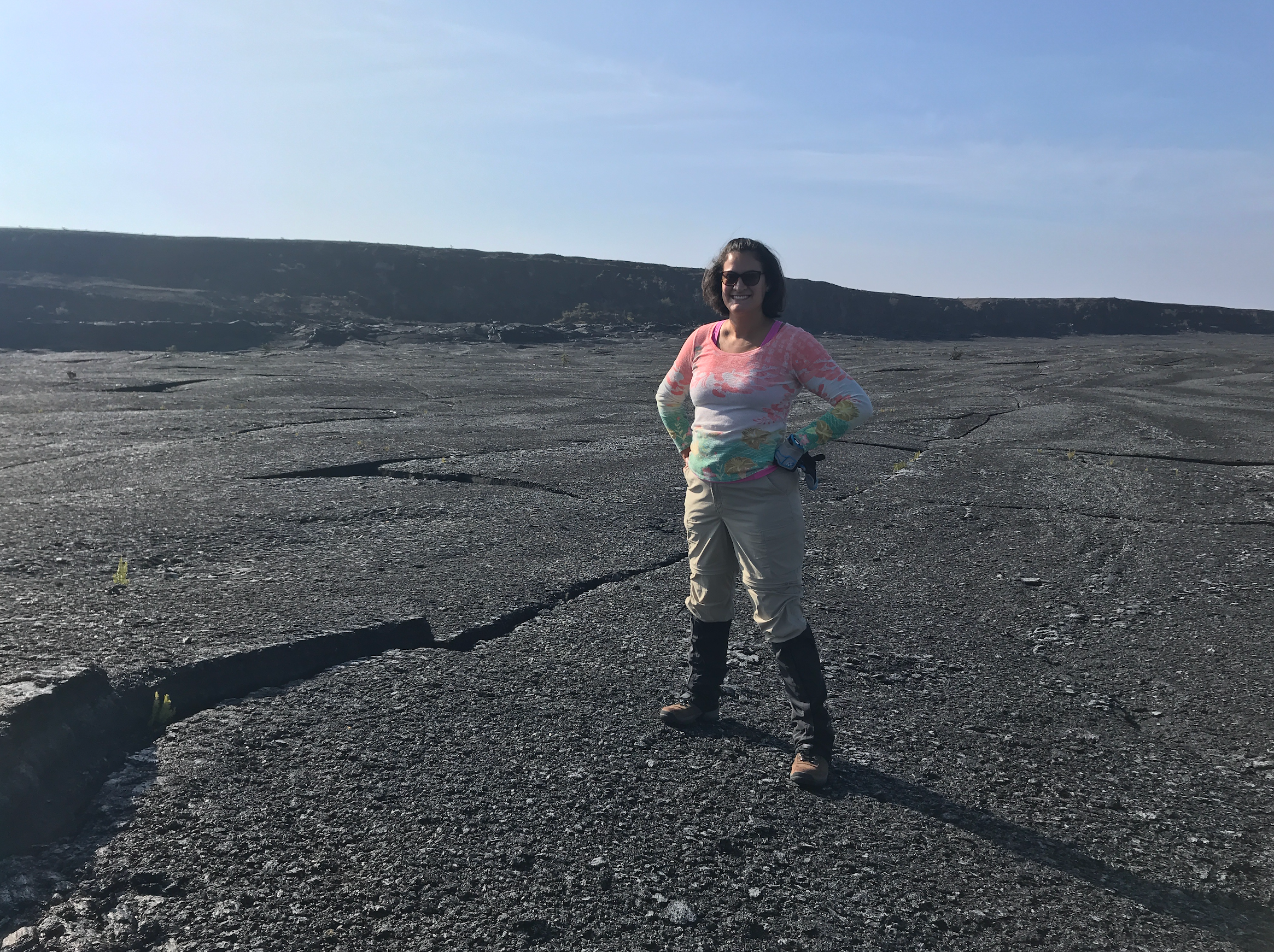
During her NASA career, Santiago-Materese traveled to Hawaii to investigate a planetary analog, a type of terrestrial environment that has very similar characteristics to those we might find on other worlds.
Image credit: Delia Santiago-Materese
At NASA Ames, Santiago-Materese held various roles, ranging from social media and open science to lunar sciences. She then became a program officer for the Solar System Workings program in the Planetary Science Division at NASA Headquarters as part of a detail, or temporary assignment. And then, she took off for Maryland along with her family.
Enabling Science
Santiago-Materese sums up her current role as a program scientist as the “science liaison” between NASA Headquarters and a mission. “When you do program scientist work, you might not be specialized or an expert in the exact science, but you need to be able to understand it and talk about it, to understand its importance,” she explains. “In general, we are supporting other people so they can do science.” In this endeavor, being someone who “gets more energy from working with people” is useful… and necessary: “You are having conversations all day long” with colleagues from different disciplines— from science and engineering to finance.
The Juno mission, in orbit around Jupiter since 2016, and Dragonfly, which is scheduled to launch no earlier than July 2028, are part of NASA’s New Frontiers program. Santiago-Materese also oversees the array of missions in the Discovery program, which includes ongoing science missions like Psyche and Lucy—heading to different asteroids—and future missions to Venus.
For Santiago-Materese, sharing her unconventional path can be valuable for students and youth in general, especially those who are unsure of what they want to do. “Your dream job,” she says, “you might not know it exists, or maybe it doesn’t exist today.” Beyond that, this zigzagging path has led her to accumulate experiences and relationships with different people, which she treasures even as she sets off for her next destination.
An Alien World
About two years out from Dragonfly’s launch, it is no surprise that this robotic mission takes up much of Santiago-Materese’s time. “Dragonfly feels like a combination of all my different experiences over time,” she reflects. And it signifies, to some extent, a return to her roots: it is an astrobiology mission. Although not designed to detect life, Dragonfly will investigate prebiotic chemistry: the chemical processes that could have led to the emergence of life on Earth.
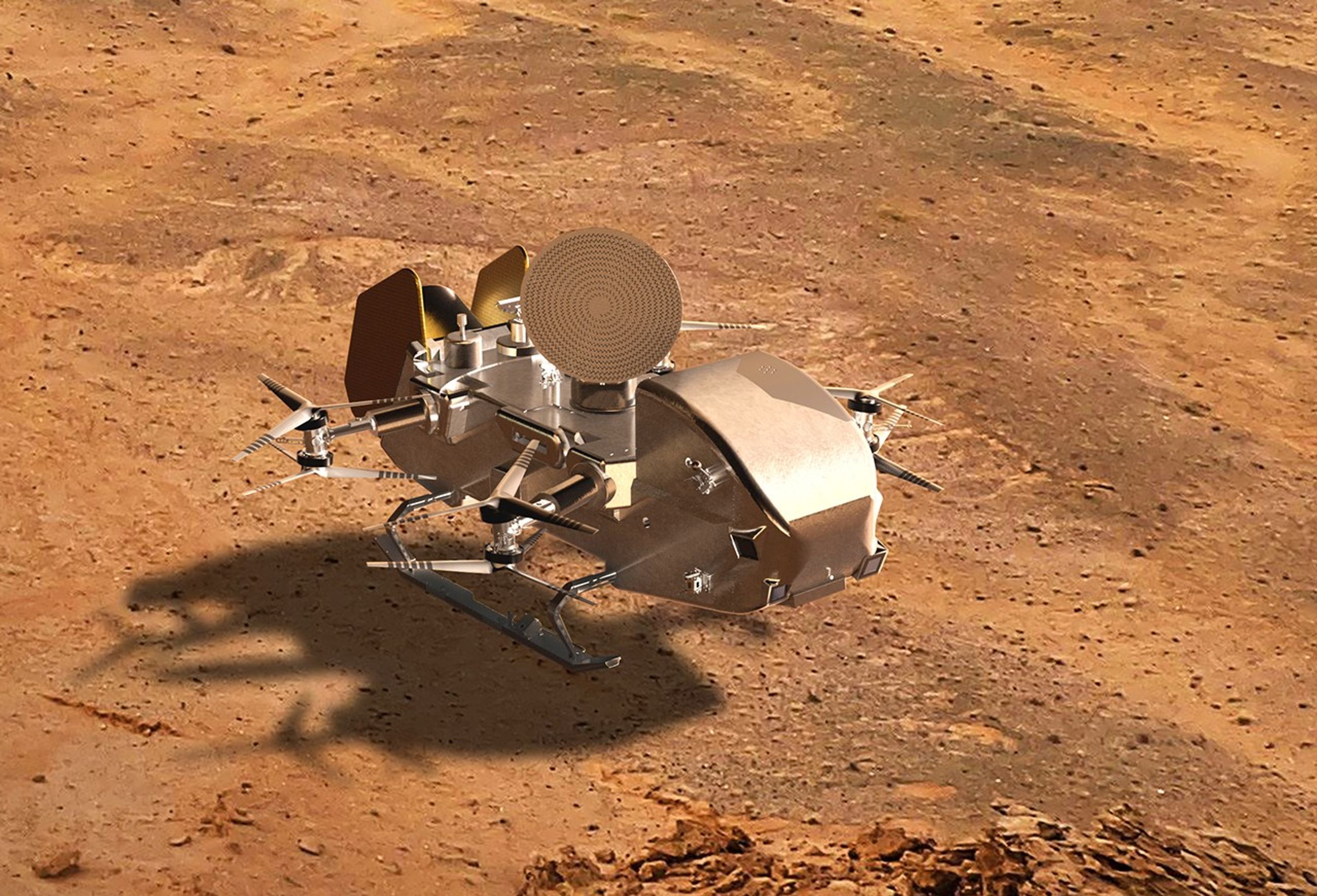
Digital concept of NASA’s Dragonfly lander on the surface of Saturn’s moon Titan.
NASA/Johns Hopkins APL/Steve Gribben
Dragonfly will embark on a journey of about six years to the surface of Titan. The spacecraft will carry an array of science instruments and will be the first NASA science mission to explore another world by flying from location to location. This car-sized rotorcraft will touch down at various geological sites of interest to analyze the moon’s composition and its habitability potential.
When it arrives at Titan, it will encounter a landscape that is strange and familiar at the same time: it could be a window into Earth’s remote past. This frozen world has a thick atmosphere and clouds drifting across the sky; dunes, lakes, rivers, canyons and mountains. Titan even has a process equivalent to our water cycle. However, on Titan, it is not water that flows but hydrocarbons, primarily methane and ethane. “It’s a more methane-based chemistry, so it is very alien, and that is what I really love about Titan,” says Santiago-Materese. And on this moon, organic molecules abound.
These molecules contain carbon and are used by all known forms of life. They are fundamental to understanding the origin of life, as they can be produced by both biological and non-biological processes. On Titan, these organic molecules fall to the surface and form dense deposits over its bedrock of water ice. Scientists believe that the complex chemistry precursor to life could be triggered there if provided with a little liquid water, such as that generated by an asteroid impact.
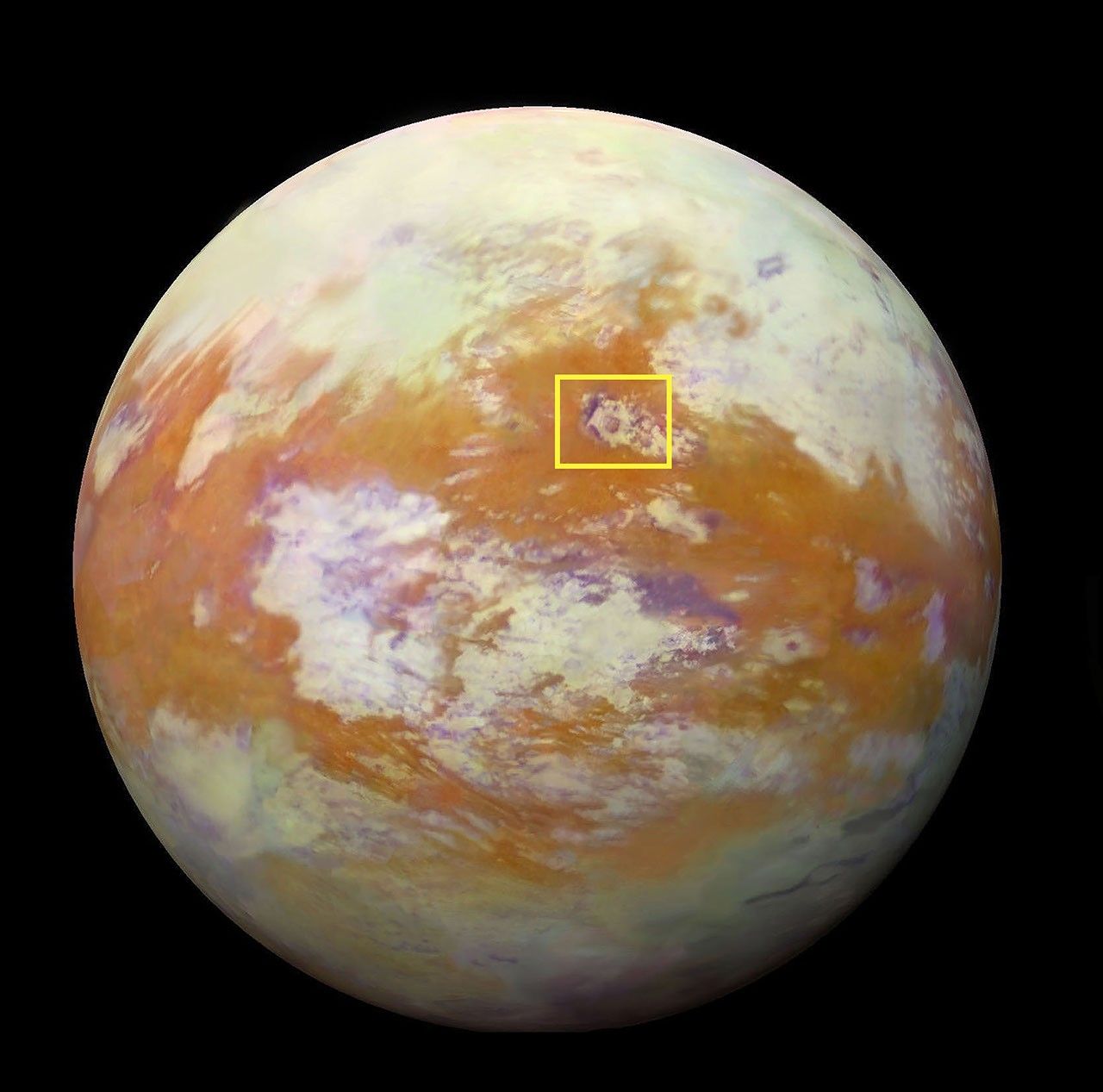
Selk Crater, an 80-kilometer (50-mile) diameter impact site highlighted in this infrared image of Titan, is a key destination for Dragonfly. The rotorcraft will touch down near Selk and explore various sites, analyzing the surface chemistry to investigate the frozen remains of what could have been prebiotic chemistry in development.
NASA/JPL-Caltech/University of Nantes/University of Arizona
Santiago-Materese is especially excited about what the Dragonfly Mass Spectrometer (DraMS) instrument will help discover. DraMS, designed and built at NASA’s Goddard Space Flight Center in Greenbelt, Maryland, will analyze samples from Titan’s surface. “The more complex things get, the more interesting things happen,” she says. “So I’m curious: just how complex do the molecules get? Will we find any interesting patterns?”
But in science, every time you ask a question, a new one arises. Dragonfly will try to answer several of them. “When you have a planet with complex chemistry but not life, what happens? What is there before life?” the program scientist wonders.
Titan, a valuable natural laboratory, “is going to completely change our understanding of what another world can be like,” she anticipates. In addition to what the scientific community expects to discover thanks to Dragonfly, Santiago-Materese is interested in the potential unexpected findings. “There are very defined science goals, but a lot of it is exploratory work,” she explains. “It is kind of nice to know that there is a big range [of possibilities], that we could be very surprised.”
By Noelia González, NASA’s Goddard Space Flight Center, Greenbelt, Maryland
NASA’s Neil Gehrels Swift Observatory is back to studying the universe, even as the aging spacecraft continues to lose altitude and a planned mission to raise its orbit has been scaled back. Two of Swift’s three science instruments are operating again after months of conservation measures designed to reduce atmospheric drag and keep the observatory [...]
A new images from the NASA/ESA Hubble Space Telescope reveals LHA 120-N44, a striking nebula located roughly 160,000 light-years away in the Large Magellanic Cloud, a satellite galaxy of the Milky Way.
The spacecraft carrying European and Japanese scientific probes is completing its eight-year journey and will arrive at Mercury on September 3, where it faces a series of challenging maneuvers to study the scorching planet. The BepiColombo mission was launched from Earth in 2018 on a complex trajectory to investigate the smallest and least-studied planet in […]
At a spry 36-years-young, the NASA/ESA Hubble Space Telescope just keeps on going. The groundbreaking observatory recently took a new image of a sprawling nebula located in the Large Magellanic Cloud (LMC). The LMC is the largest of the small galaxies that orbit our home Milky Way galaxy, and it’s only 160,000 light-years away. Since it is relatively close by, astronomers can more easily observe star birth hot spots like LHA 120-N44 (or N44).
N44 is located in the constellation Dorado. It is dominated by two main features—a large central void and an outer shell made of dense, dusty gas.
The central void is considered a “superbubble,” that spans about 210 by 140 light-years across. N44’s superbubble void was created by the powerful stellar winds and explosive supernovae from the glittery stars at the center.
The shell surrounding the superbubble is made of all of the gas that was expelled when these stars in the void were born. Once the gas was swept away, it compressed and formed a shell around the superbubble. Now, new stars are forming in this compressed gas shell, making it an interesting target for astronomers. They are using N44 to study how stars form in this type of cosmic environment.
“Their goal is to understand how long it takes from the collapse of cold gas clouds into dense knots to the moment nuclear fusion ignites in the heart of a newborn star,” NASA writes.
The gas shell surrounding N44’s superbubble has intrigued astronomers for over half a century. It is energized by ultraviolet radiation from massive stars, which makes it glow and highlights several distinct features. In the 1950s, astronomer Karl Henize first catalogued the distinct features within the nebula’s star-forming complex.
One feature is a smaller bubble (cataloged as N44F). It is an interstellar bubble blown by the intense stellar winds coming from one hot and massive star and is located in the upper-right corner of the new image.
This Hubble Space Telescope image features the picturesque nebula LHA 120-N44, or N44. The interstellar bubble N44F is at the top right corner. Image: NASA, ESA/Hubble, D. Gouliermis.
This Hubble Space Telescope image features the picturesque nebula LHA 120-N44, or N44. The interstellar bubble N44F is at the top right corner. Image: NASA, ESA/Hubble, D. Gouliermis.
The data used in this image is from observing program #14689; PI: Gouliermis. It used Hubble to survey N44 and take a census of its stars, cataloguing roughly 500,000 stars within the cluster, and some interlopers drifting in front of the nebula. Of the stars the team surveyed, roughly 30,000 are what astronomers call pre-main-sequence stars. These baby stars have not begun to fuse hydrogen into helium in their cores. Hubble’s highly-sensitive instruments were able to pick out faint objects in crowded clusters to find these young stars at work.
NASA’s Hubble Space Telescope has glimpsed a strange ten-sided atmospheric wave at Saturn’s south pole, the first regular-sided jet pattern ever observed there.
In a recent paper published in Science Advances, researchers examined Saturn’s peculiar decahedron, detecting signs of an entirely new atmospheric phenomenon for the gas giant. A similar hexagon-shaped wave resides at Saturn’s north pole but differs in noticeable ways.
Years of Hubble observations from 2023 to 2025 allowed the team to trace subtle hints that they eventually resolved into the decagonal wave at Saturn’s south pole.
Observing the Solar System
“We’ve never seen anything quite like this in Saturn’s southern hemisphere,” said co-author Amy Simon, OPAL principal investigator, at NASA’s Goddard Space Flight Center in Greenbelt, Maryland. “The northern hexagon has been there every time we’ve looked for more than 40 years. This feature is different — it appears to be strengthening, giving us the rare opportunity to watch a giant atmospheric pattern develop.”
Since its 1990 launch into low Earth orbit, the Hubble Space Telescope has been observing our solar system, uncovering new details about our planetary neighbors. One such project is the Outer Planet Atmospheres Legacy (OPAL) program, which began collecting data with observations of Uranus in 2014 and now provides the crucial evidence for this discovery, with high-resolution images that resolve murky hints from ground-based observations.
As Saturn’s seasons changed, its south pole came into alignment with ground-based observatories. In images from those telescopes submitted to the Planetary Virtual Observatory Laboratory, amateur astronomers Trevor Barry and Jean-Paul Oger, along with Agustín Sánchez-Lavega of the University of the Basque Country in Spain, noticed something interesting happening on the gas giant.
Since 2023, the decagon has continued to develop in what scientists believe may be a new atmospheric pattern on Saturn. Credit: NASA, ESA, STScI, Agustin Sánchez-Lavega (UPV), Amy Simon (NASA-GSFC), Michael Wong (UC Berkeley); Image Processing: Alyssa Pagan
A Strange Band on Saturn
The researchers spotted an undulating band along Saturn’s south pole, which, in further 2025 ground-based telescope images, began to suggest a decagonal (ten-sided) structure. With its incredible image clarity and spatial resolution, Hubble’s imagery finally allowed researchers to resolve the decagonal shape with certainty.
“Given Saturn’s symmetry in its north-south jet stream system, we have been searching for a counterpart to Saturn’s northern hexagon on the south pole in Hubble images since 1990,” said lead author Agustín Sánchez-Lavega of the University of the Basque Country in Spain. “Images from NASA’s Cassini spacecraft, which orbited Saturn between 2004 and 2017, showed no inkling of a long-lived formation, either. The Hubble data confirmed the feature’s presence back to 2023.”
The wave is an interesting three-dimensional feature that extends through multiple layers of the atmosphere within one of the planet’s jet streams. Because Hubble can image the planet in multiple wavelengths, the decagon’s location appears to shift between observations, as each wavelength penetrates the atmosphere to a different degree.
Questions About Saturn
“The most intriguing part to me is that this seems to have just formed recently,” said Simon. “The question is, why did it suddenly form now when we haven’t seen one before?”
Recognizing Saturn’s decagonal wave is only a first step. Follow-up observations to collect more data and computer models to piece together what is occurring on the planet will be required to firmly grasp the phenomenon. Questions remain about how it formed, how long it may last, and how similar it is compared to the northern hexagonal wave.
One thing the team will be sure to watch for in their continued observations is whether the shape evolves or maintains its decagonal structure. Their continued work could provide important new insights into how atmospheric dynamics operate on gas giants and what they can reveal about our own planet’s atmospheric phenomena.
Ryan Whalen covers science and technology for The Debrief. He holds an MA in History and a Master of Library and Information Science with a certificate in Data Science. He can be contacted at ryan@thedebrief.org, and follow him on Twitter @mdntwvlf.
For almost five decades, Saturn’s north pole has been famous for hosting a bizarre, six-sided jet stream known as the hexagon, a feature first spotted by NASA’s Voyager spacecraft in the 1980s and still churning today.

 Login

 In August 2026, a series of powerful winter storms transformed parts of northern Chile’s Atacama Desert, covering the famously dry landscape in an unusual layer of snow. Snow is not unheard of in the Atacama. Significant falls occurred in 2025 and, before that, in 2011. But one of the August 2026 storms stood out because [...]