For the first time in decades, NASA has rolled out one of its iconic astronaut training aircraft with a bold, new look.
The space agency debuted a new livery on one of its T-38 jets in celebration of its program to return astronauts to the Moon. The Artemis design retains nods to what made the "white rocket" immediately recognizable, but adds a new colorway and painted graphics to make clear where NASA is headed.
"This new 'Artemis' livery has a black and white paint scheme with blue and red stripes that separate those two paint schemes," said Sean Brady, who proposed and designed the new livery while serving as the T-38 project pilot in NASA's Aircraft Operations Division (AOD), part of the Flight Operations Directorate at Johnson Space Center in Houston. "The Artemis program logo in the back and a picture of the Moon is on the left and right side of the rear fuselage."
Lindsey Waitt, engineer with NASA’s Exploration Ground Systems Program, participates in a terminal countdown simulation for Artemis III on Thursday, Aug. 6, 2026, inside Firing Room 1 of the Rocco A. Petrone Launch Control Center at NASA’s Kennedy Space Center in Florida.
NASA/Clayton Rougelot
As a young girl raised in Worcester, Massachusetts, Lindsey Waitt dreamed of working for NASA. Her dream is now a reality as she embarks on her role as a NASA test project engineer with the Artemis launch team – an integral part of the agency’s missions that will enable humans to return to the surface of the Moon after launching from NASA’s Kennedy Space Center in Florida.
When she was in middle school in the late 1990’s, Waitt recalls meeting NASA Space Shuttle astronauts Michael Lopez-Alegria and Albert Sacco, Jr., a former professor at the college, during a visit to Worcester Polytechnic Institute (WPI) in Worcester, Massachusetts. She was inspired while listening to them recount their spaceflight experiences including an experiment on conducting research for growing cells on the Moon. She even posed for a picture and got their autographs. Little did young Waitt know, these would not be the only astronauts she would meet.
Lindsey Waitt (far right), poses for a photograph with NASA astronaut Michael Lopez-Alegria and her cousin at Worcester Polytechnic Institute in Massachusetts.
Photo credit: NASA/Lindsey Waitt
Her passion for learning about all things space and engineering led Waitt back to WPI where she studied engineering, absorbing different disciplines. She received her Bachelor of Science degree in Mechanical Engineering with a concentration in aerospace engineering and she left the school fueled by her passion to be a part of America’s space agency.
After graduation, she worked as a systems engineer on radar flight test missions for a defense contractor, and while excelling in her role, she realized it wasn’t the aerospace engineering field that she desired.
“It was an exciting program, and it was meaningful to be a part of a project focused on protecting the country from enemy attacks. But it wasn’t space,” Waitt said.
As the wife of a now retired sergeant first class officer in the United States Army, Waitt and her family traveled around the world during her husband’s enlistment, and she continued to follow NASA missions from around the globe. While Waitt was dedicated to raising her three young boys, she simultaneously pursued her master’s degree in Space Operations from the University of Colorado in Colorado Springs. Twelve years later, she made the courageous decision to fully return to her first career passion – working for NASA – despite nay-sayers suggesting too much time had passed for her to return to the industry.
The sky is not the limit, it's wide open now. The universe is the limit.
Lindsey waitt
Test project engineer
Waitt vividly remembers watching NASA astronauts Doug Hurley and Bob Behnken soar skyward during NASA’s first commercial crew mission to the International Space Station in 2020. Watching alongside her family, she even set up a rocket-shaped tent, and she and her children pretended to blast off from their yard as they cheered excitedly as the astronauts lifted off from what would be her future place of work.
After moving to Florida in 2022 to work at a small satellite company in Cape Canaveral, as a systems engineer and program manager, she continued to search for opportunities to work for the agency. Waitt vividly remembers watching Artemis I with her family. They had just moved to the Sunshine State, and she woke up in the early hours of the morning to watch the historic launch, having no idea she would be working on the next Artemis mission – the first time NASA sent humans around the Moon in over 50 years!
In 2024, Waitt began her career at Kennedy working for a contractor as a test project engineer during the Artemis II launch. As “problem-solvers,” test project engineers are the main hub of experts for technical tests and launch activities and they work to coordinate resolutions across the different subsystems that may arise during the dynamic operations associated with a rocket launch. Leading up to the Artemis II launch in April, Waitt quickly became certified to sit on the launch console during the dynamic pre and post-launch operations for the massive SLS (Space Launch System) rocket and Orion spacecraft and she eagerly watched from outside Kennedy’s Launch Control Center as the four crew members lifted off the launch pad towards the Moon.
When NASA announced its insourcing initiative earlier this year, Waitt seized the opportunity to fully realize her dream. She applied for a position and is now a NASA civil servant supporting the Artemis launch team as a test project engineer for NASA– a core position for the agency’s launch team. With Artemis III in front of her, Lindsey will see the buildup of launch operations from start to finish.
As the only female of the 14 test project engineers who work on the Artemis launch team, Waitt said she was fully embraced by the colleagues she stands beside.
“Everybody’s very open and welcoming,” Waitt said. “I’ve worked on teams before, but it’s never been like this. Everyone is so passionate about the mission, and everybody is working together to get things done quickly, but safely – that’s always first priority. We Are Going.”
This opportunity didn’t happen by chance. Waitt is embracing life’s journey and focused on making her dream come true, one launch at a time. “The sky is not the limit – it’s wide open now,” Waitt said. “The universe is the limit.”
The fully-integrated LEMS (Lunar Environment Monitoring Station) ready for environmental testing. A small suitcase-size instrument suite built at NASA Goddard, LEMS is designed to carry out continuous, long-term monitoring of the seismic environment at the Moon, including surface motion caused by moonquakes and meteorite impacts in the lunar south polar region.
NASA Goddard/Mike Guinto
NASA has declared “wrenches down” on the first completed payload designed for Artemis astronauts to deploy on the Moon’s surface. Engineers working on NASA’s Lunar Environment Monitoring Station, or LEMS, have completed hardware development and testing and the payload is ready for its permanent home near the lunar South Pole. With the hardware complete, LEMS is ready to support one of the Artemis program’s core goals: enabling sustained lunar science and exploration.
The LEMS instrument package contains two highly sensitive seismometers that will monitor ground vibrations from moonquakes and meteorite impacts, providing scientists with insights into the Moon’s interior and the seismic hazards astronauts might encounter at the surface. Its modular design allows the system to be adapted or expanded to host new instruments in the future, creating a reusable platform that can evolve as scientific priorities grow.
The payload will remain in a clean room at NASA’s Goddard Space Flight Center in Greenbelt, Maryland, where it was built, until it is assigned to an Artemis mission for deployment to the lunar surface.
“The completion of the LEMS scientific instrument is a major step in a new era of lunar surface science. Innovative science experiments will uncover, measure, and reveal the Moon’s secrets while astronauts open new frontiers for discovery,” said Joel Kearns, deputy associate administrator for exploration, Science Mission Directorate, NASA Headquarters in Washington. “And, behind the scenes, countless teams across NASA and our partners are pushing the boundaries of what surface instruments can do, building the tools that will make future exploration possible and safer.”
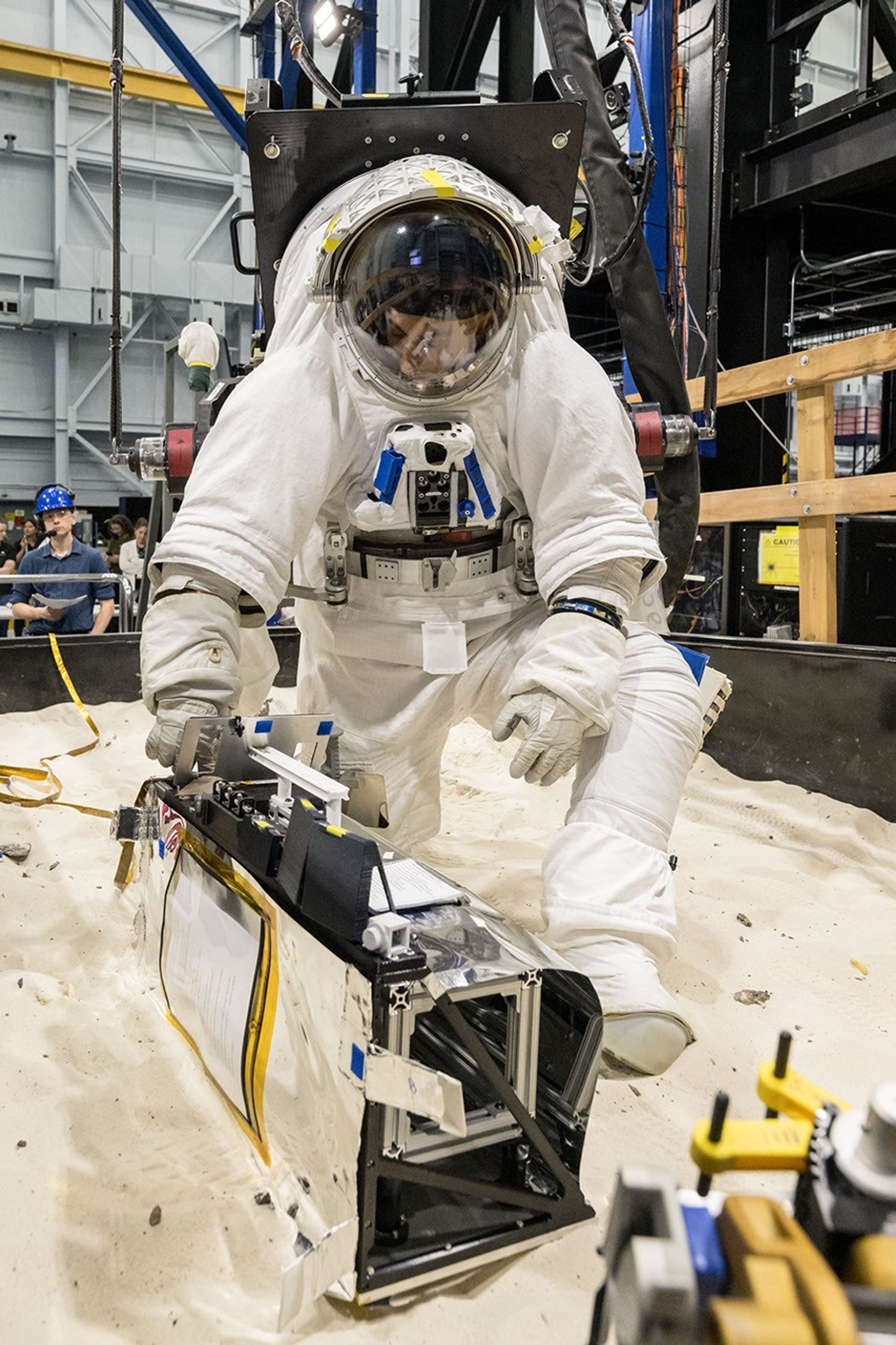
A scientist wearing NASA’s xEMU prototype space suit is testing the handling of a mockup version of NASA’s Lunar Environment Monitoring Station, or LEMS. The testing took place at the Active Response Gravity Offload System, a simulated reduced gravity environment at NASA’s Johnson Space Center in Houston.
NASA Johnson
The LEMS payload builds on a legacy of lunar seismic tracking. Apollo astronauts deployed a network of seismometers on the Moon’s nearside equatorial region between 1969 and 1972. Those instruments operated until 1977, recording about 13,000 moonquakes and other ground vibrations that helped scientists begin to understand the composition of the Moon’s interior. For decades, researchers have hoped to spread more seismometers, updated with new technologies, across the lunar surface.
Now, LEMS will carry the first seismometers to be deployed by future astronauts to listen for faint ground vibrations, collecting new clues to the Moon’s internal structure and ongoing seismic activity. The sensors will be the most compact, sensitive, and energy-efficient seismometers ever built for planetary exploration.
LEMS itself is about the size of a small suitcase, weighing 11 pounds in the Moon’s low-gravity environment. It will carry not just these seismic sensors, but everything it needs to function independently of humans after deployment. LEMS is built to manage its own power production via a lightweight, flexible solar array that conforms to the shape of the LEMS unit. It also will manage its operational activities to ensure continuous data collection based on a preset plan, and monthly data transmission to Earth. The payload will do all this while maintaining a stable internal temperature throughout the massive day-to-night temperature swings of the South Pole region.
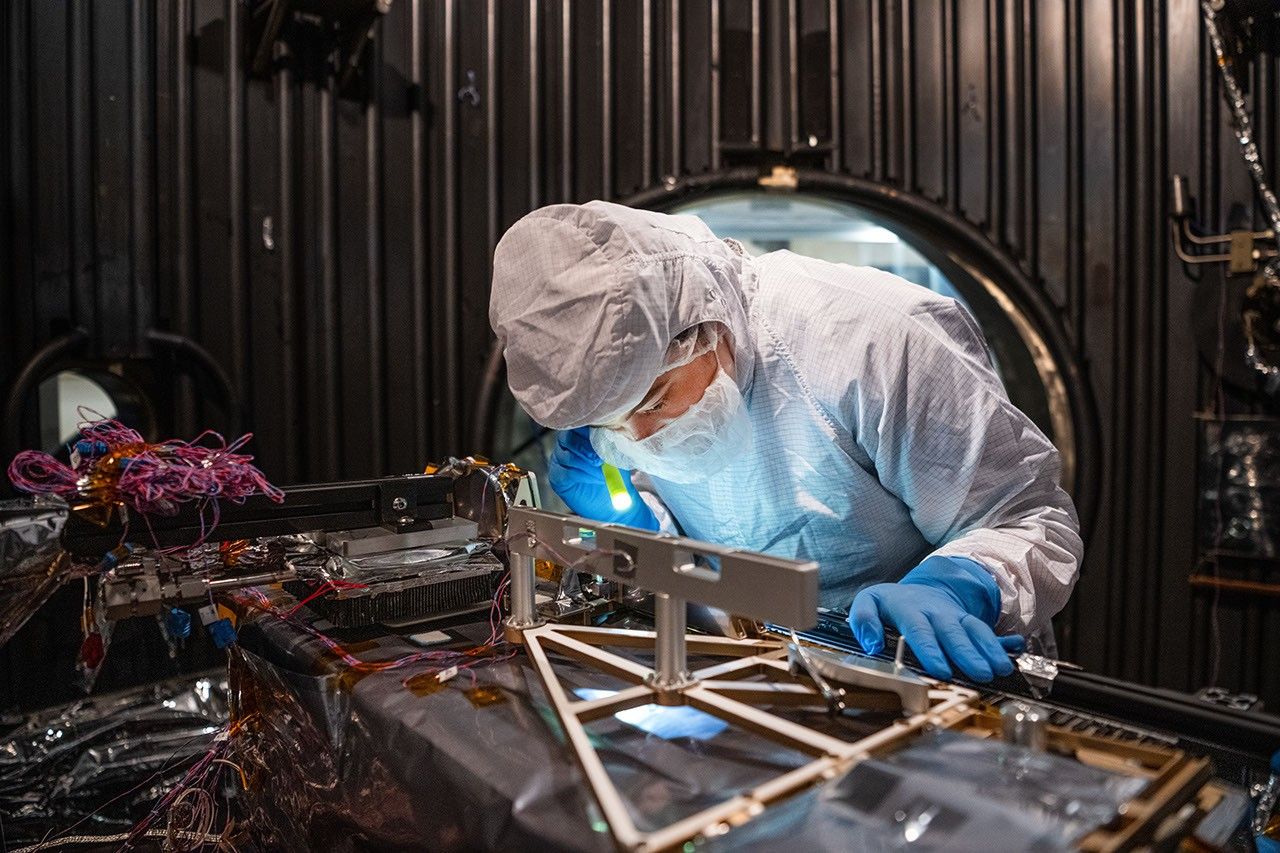
Mechanical Engineer Brie Ludwig inspects the Lunar Environment Monitoring Station (LEMS) in preparation for testing in a thermal vacuum chamber at Goddard Space Flight Center in Greenbelt, Maryland, on March 31, 2026. LEMS is a compact, autonomous, and self-sustaining seismometer suite designed to carry out continuous, long-term monitoring of the lunar seismic environment at the South Polar region.
NASA/Denny Henry
“When we conceived of LEMS, we weren’t just thinking about the next mission, we were thinking about the next generation of lunar exploration,” said Mehdi Benna, a University of Maryland Baltimore County scientist who leads LEMS from NASA Goddard. “Our vision was to create a scientific buoy for the Moon. Like an ocean buoy on Earth, LEMS is designed to be easy to build, adaptable to different scientific objectives, and capable of operating independently for years.”
Before any surface science could happen, Benna and his team had to ensure that LEMS could survive the trip to the Moon and the harsh environment of its surface. Over the past five months, LEMS and its components have been subjected to a demanding series of environmental and operational tests. Engineers verified LEMS can endure the violent shaking of launch, the journey to the lunar surface, and the Moon’s temperature and radiation environment. The team also showed that the instrument package’s mechanical and electrical design is safe for astronaut handling.
The LEMS payload was built to operate through the lunar night, which lasts two Earth weeks, without external power assistance or a heat source. Past lunar surface instruments relied on radioisotope heaters for warmth and power. But LEMS instead will withstand temperatures that dip to minus 400 degrees Fahrenheit in some areas by using advanced insulation materials, low-thermal-conductivity cables that minimize heat loss, and a thermal regulator that conducts heat away during the day to prevent overheating and helps retain heat at night.
These innovations reduce mass and power needs, setting the stage for lighter, energy-efficient instruments that can operate continuously at future Artemis landing sites and the NASA-led Moon Base.
The LEMS payload is led by University of Maryland Baltimore County and University of Maryland College Park. Technical implementation is led by NASA Goddard. The University of Arizona, in partnership with Silicon Audio, Inc., supplied LEMS’ two state-of-the-art seismometers. Morehead State University in Kentucky provided LEMS’ telecommunication system and will operate the instrument on the surface. Washington University in St. Louis will manage the instrument’s data processing and dissemination to the larger scientific community.
Moon dust looks soft in photographs, but it is a difficult material for machines and people. The grains are sharp, abrasive and electrically clingy. NASA engineers at Johnson Space Center are using a dedicated test facility to find out how tools, joints and spacesuits will cope with it before Artemis astronauts return to the lunar […]
As NASA sets its sights on long-term exploration of the Moon and Mars, the agency is increasing the cadence of its Artemis missions. Helping bring these plans to fruition is Tom Percy, manager of systems engineering and integration for NASA’s Human Landing System Program.
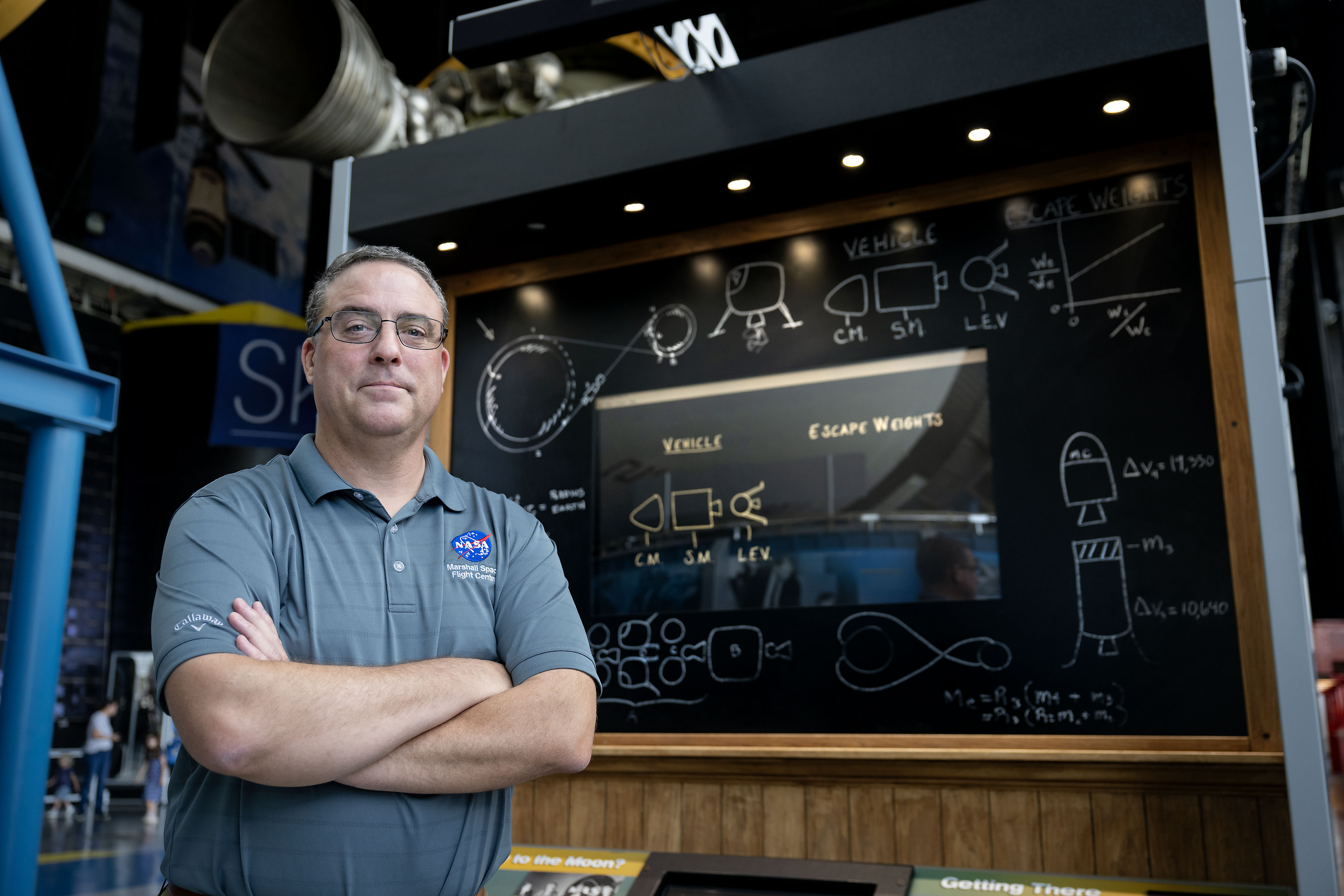
Tom Percy, manager of systems engineering and integration for NASA’s Human Landing Systems Program, stands in front of an Apollo Program lander exhibit at the U.S. Space and Rocket Center in Huntsville near NASA’s Marshall Space Flight Center.
NASA/Charles Beason
Percy serves as a focal point in working with providers SpaceX and Blue Origin to accelerate and streamline systems designs, manufacturing, testing, and certification. He ensures the crewed landers that SpaceX and Blue Origin are developing for Artemis are designed, built, tested, and will operate with other NASA exploration assets safely and effectively.
“You might say that all human landing system integration work lands on my desk. And with the rest of my talented, hard-working systems engineering and integration team, we’re working to make it all happen,” Percy said.
A native of North Easton, Massachusetts, Percy earned a bachelor’s degree in mechanical engineering from the Rochester Institute of Technology in Rochester, New York, where he first got hands-on experience working on designs that could be applied to NASA’s sustainable lunar architecture.
“As an undergrad, I served as president of the Rochester Institute of Technology’s chapter of the American Society of Mechanical Engineers. To get some real-world engineering experience, we decided to participate in the Great Moonbuggy Race,” Percy said. “Now called the Human Exploration Rover Challenge, the competition is held annually at NASA’s Marshall Space Flight Center in Huntsville, Alabama.
“At the time, I had never heard of Marshall Space Flight Center,” said Percy. “But our student team designed and built a rover and traveled to Huntsville for the race. That’s when I learned about some of the projects in Marshall’s diverse portfolio that the center works for NASA. And that’s when I began planning to make my way to NASA Marshall for my career.”
Percy chose to move south and earn a master’s degree in aerospace engineering from the Georgia Institute of Technology in Atlanta. His research in the advanced propulsion lab and courses in space systems design culminated in a spacecraft design course and the chance to work directly with engineers at Marshall.
Since landing at Marshall in 2003, Percy has been involved in evaluating transportation architecture options for human deep space exploration, including missions to land astronauts on the Moon and Mars. He also has expertise in space transportation, including advanced propulsion technology development; trajectory analysis; and spacecraft and mission concept development. Percy earned a doctorate in aerospace systems engineering from the University of Alabama in Huntsville.
The range of experience comes together in his current role as manager of human landing systems engineering and integration.
“The world watched the amazing success of Artemis II. NASA and our commercial providers are looking forward to flying again soon and executing increasingly complex Artemis missions,” Percy said.
Through the Artemis program, NASA will send astronauts on increasingly complex missions to explore more of the Moon for scientific discovery, economic benefits, establish an enduring human presence on the lunar surface, and to build on our foundation for the first crewed missions to Mars.
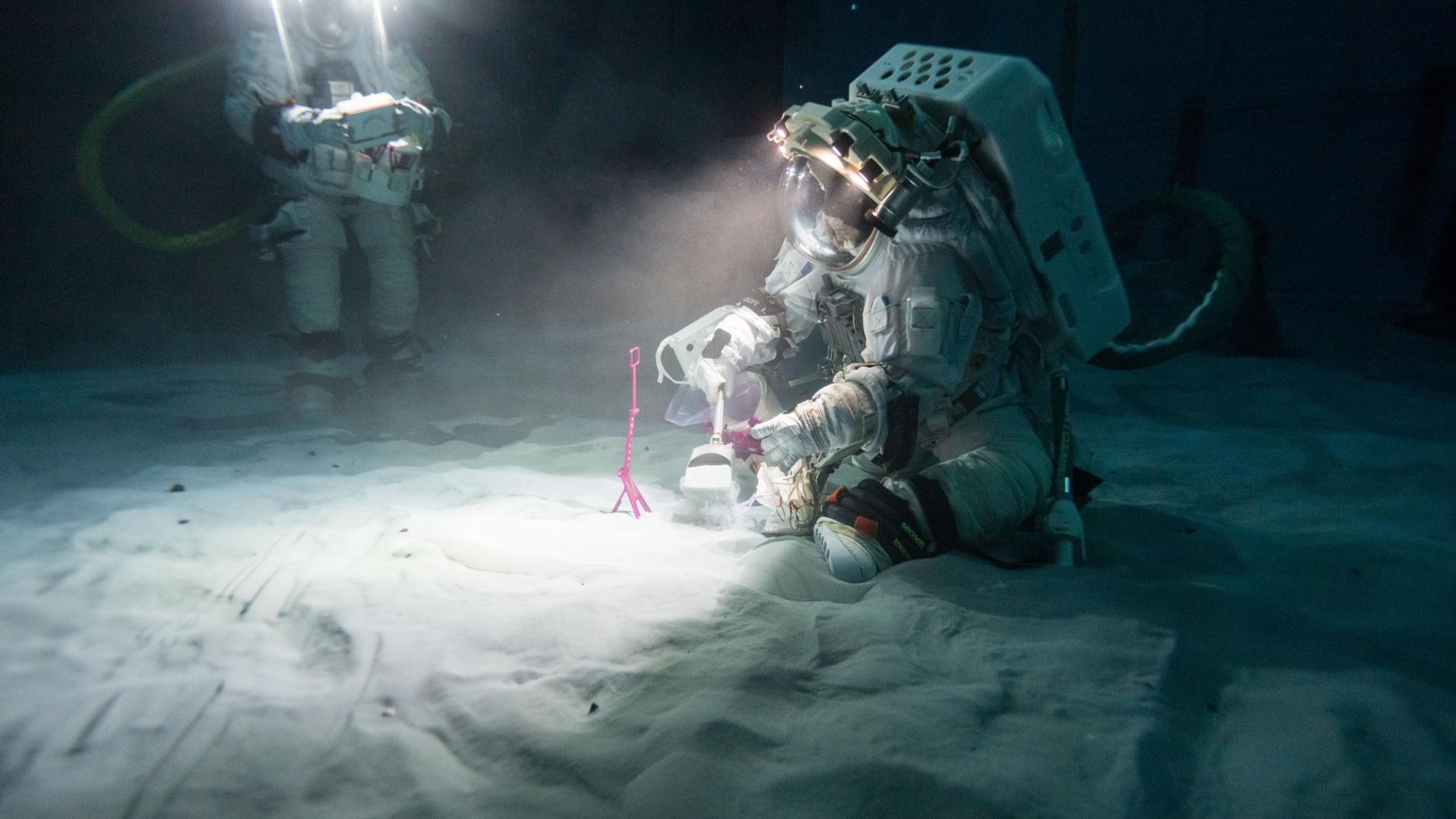
Exploration geologists and Artemis science officers Trevor Graff, left, and Angela Garcia carry out a lunar training development run at NASA's Neutral Buoyancy Laboratory (NBL) in Houston. (Image credit: NASA)
Sometimes to go to the moon, you first have to go underwater.
NASA is currently developing the training program for NASA's Artemis astronauts, some of whom could set foot on the moon during the agency's planned Artemis IV mission. As part of that development, two agency scientists recently donned Artemis moonsuits and took to NASA's underwater training facility.
What is it?
These photos show two NASA exploration geologists and Artemis science officers practicing using the same types of geology tools that astronauts might use when they explore the moon.
The scientists also "deployed a mock lunar payload under low-angle lighting conditions," according to a NASA statement accompanying the photo. NASA is currently aiming to place astronauts at the lunar south pole, where many areas remain in permanent shadow. As such, future lunar explorers may have to operate in near-total darkness and learn how to carry out their missions with very little light.
Exploration geologists and Artemis science officers Trevor Graff, left, and Angela Garcia carry out a lunar training development run at NASA's Neutral Buoyancy Laboratory (NBL) in Houston. (Image credit: NASA)
Why is it incredible?
The fact that NASA is preparing to send humans back to the moon is incredible in itself. Humanity hasn't set foot on our natural satellite since 1972. While NASA still has many technical hurdles to cross when it comes to developing and selecting a moon lander, the agency is pushing ahead with developing the training it will use to prepare its astronauts to explore the lunar surface.
For this particular part of Artemis training development, NASA placed two scientists in its Neutral Buoyancy Laboratory (NBL), a 40-foot-deep (12-meter) pool at NASA's Johnson Space Center in Houston. The particular test in these photos was "the first time that two geologists were suited up simultaneously for lunar geology training in the NBL," according to NASA's statement.
For these tests, a portion of the underwater laboratory was outfitted with soil and rocks that simulate the surface of the moon. The buoyancy of the pool can be manipulated in order to simulate different levels of gravity, helping astronauts train for spacewalks or for exploring other worlds like the moon.
SpaceX was more than lucky Friday, sending its 13th full-scale Starship test flight halfway around the world from South Texas to an on-target, intact splashdown in a remote section of the Indian Ocean.
Starship has made precise splashdowns before. This time, however, the ship gently tipped over and came to rest floating in a remote stretch of ocean west of Australia. Previous splashdowns ended with conflagrations, an outcome SpaceX officials have come to expect with each water landing of Starship.
The buoyant Starship looked to be in fine shape after reaching the Indian Ocean. SpaceX engineers flew drones over the vehicle to inspect its heat shield, getting their best look yet at how more than 18,000 ceramic tiles insulating the ship's stainless steel airframe weathered the trip to space and back. The tiles withstood temperatures up to 2,600° Fahrenheit (1,430° Celsius) as Starship streaked back into the atmosphere at the end of its hourlong flight from Starbase, Texas.
An image shows the B-1 and B-2 test stands at NASA’s Stennis Space Center near Bay St. Louis, Mississippi, on July 7, 2026. The test stand features dual, vertical firing positions built in the 1960s to test Saturn V rocket stages that carried humans to the Moon during the Apollo Program. The B-1 position, right, is equipped for single engine tests, while the B-2 position is designed to test full rocket stages. NASA announced an agreement with Blue Origin on July 24, 2026, to use the B-2 test stand for engine testing to advance rocket development for future missions to the Moon under the Artemis program.
Credit: NASA/Danny Nowlin
NASA and Blue Origin announced Friday they recently agreed to conduct second stage hot fire testing for the company’s New Glenn rocket on the B-2 test stand at the agency’s Stennis Space Center near Bay St. Louis, Mississippi.
The annex to a reimbursable Space Act Agreement signed earlier this month highlights NASA’s commitment to working alongside commercial partners toward Artemis missions in 2027 and beyond.
“Stennis continues to be a hub for the commercial space industry,” said Sen. Roger Wicker. “Mississippi warmly welcomes Blue Origin’s return to the coast and to our legendary rocket testing facilities.”
“The success of Artemis II has roots at NASA Stennis, and I’m excited about the prospect of Blue Origin establishing a rigorous test program in Mississippi as part of future American crewed missions to the Moon and beyond. I hope its use of B-2 test stand becomes a long-term arrangement that broadens our state’s contribution to space exploration. I will certainly do what I can to make that a reality,” said Sen. Cindy Hyde-Smith.
“Mississippi continues to play a vital role in America’s space program, and this agreement between NASA and Blue Origin is another major win for Stennis Space Center. The world-class capabilities at the B-2 test stand will help advance the next generation of rocket propulsion while supporting high-skilled jobs and strengthening our nation’s leadership in space exploration. I look forward to seeing the innovation that comes from this partnership,” said Rep. Mike Ezell.
Testing, targeted to begin this fall, directly supports NASA’s work to achieve the national goal of landing American astronauts on the surface of the Moon and building a Moon Base near the lunar South Pole. These efforts aim to strengthen American leadership in space, unlock scientific discovery, drive innovation with industry, and prepare for human missions to Mars.
“Winning the new space race means moving faster and working alongside a strong commercial industry. Supporting Blue Origin at NASA’s Stennis Space Center puts world-class American infrastructure to work advancing the capabilities needed to return astronauts to the Moon, establish a sustained lunar presence, and prepare for Mars. Partnerships like this strengthen our industrial base and help ensure the United States remains the world’s leader in space,” said NASA Administrator Jared Isaacman.
Building on the successful Artemis II flight from April, Artemis III is a highly choreographed, multi-launch campaign that will require four astronauts to test rendezvous and docking capabilities of NASA’s Orion spacecraft with commercial human landing systems from Blue Origin and SpaceX in low Earth orbit.
In addition, Blue Origin’s New Glenn will be used to launch missions that will land on the Moon.
“We are proud to partner with NASA and build on our shared commitment to returning America to the Moon and our broader mission to build a road to space for the benefit of Earth,” said Blue Origin CEO Dave Limp. “Stennis helped take Americans to the Moon, and through this partnership, it will help take us back.”
In May, NASA announced the first three Moon Base missions to begin building sustained operations, including an award to Blue Origin to launch a robotic mission this fall. The company’s Blue Moon Mark 1 Endurance lander will deliver NASA payloads to the lunar South Pole’s Shackleton Connecting Ridge, demonstrating capabilities that reduce risk for astronauts to land on the Moon during Artemis IV and V in 2028.
To support upcoming testing at Stennis, NASA will provide the engineers, equipment, and building services needed to design, build, and install parts that will prepare the B-2 for second stage testing of the rocket named in honor of the late NASA astronaut John Glenn, the first American to orbit Earth. The rocket’s second stage is powered by two BE‑3 engines that use liquid oxygen and liquid hydrogen propellants, with each engine generating 200,000 pounds of thrust in vacuum.
In addition to providing hands‑on technical support, NASA also will assist Blue Origin’s test operations by providing dedicated workspace and sharing agency expertise and lessons learned from propulsion testing conducted at the test stand.
Blue Origin will work toward second stage rocket testing on a stand with a history of testing rocket stages for Moon missions dating back to the 1960s. The agency constructed the stand to test the Saturn V rocket stages that carried humans to the Moon during the Apollo Program. More recently, NASA conducted a Green Run test series of the SLS core stage on the stand before the Artemis I test flight.
For more information about NASA’s Artemis program, visit:
The moon's south pole has long been the target of NASA's Artemis lunar landing missions, but one Artemis astronaut is questioning if that's still the best plan.
NASA's Victor Glover, who piloted the Artemis II mission around the moon this past April, proposed a different approach while speaking at the NASA Exploration Science Forum at the agency's Ames Research Center in California on July 21, according to a report published on Space News. "I think we need to be realistic and work our way to the south pole, and maybe not try to go there first," Glover said.
Instead, Glover suggested aiming closer to the moon's equator, where missions can land in areas not at risk of falling out of daylight, and in regions reachable by orbits that allow for quick transfers back to Earth in case of an emergency, according to Space News. That argument aligns with other recent Artemis program changes that NASA has introduced to gradually expand successive mission goals, but whether space agency officials will take his advice depends on what the top priority for Artemis moon landings is deemed to be.
NASA astronaut Victor Glover, the pilot of the Artemis II moon mission. (Image credit: NASA)
NASA has long targeted the lunar south pole due to its abundance of water ice. Permanently shadowed areas inside craters in this region are believed to harbor large ice deposits, which scientists believe can be used as a resource in the production of several space-travel essentials, like potable water, radiation shielding and rocket fuel. That goes a long way toward achieving the Artemis program's ultimate goal of creating a sustainable, long-term base on the surface of the moon, and using the lessons learned in building that outpost to enable the eventual occupation of Mars.
There is, however, a secondary motivation behind NASA's ramped-up urgency to see its Artemis missions succeed in a timely manner. China has also set its sights on the lunar surface, stoking fears in some U.S. officials about the implications of Chinese astronauts staking some sort of claim at the moon's south pole before American astronauts are able to get there.
During a Senate Commerce Committee hearing last year, several space industry experts, including former NASA Administrator Jim Bridenstine, urged lawmakers not to let that happen. Mike Gold, president of civil and international space at Redwire, told senators that China beating the U.S. back to the moon would mean "a global realignment that will impact our economy, our tax base, our ability to innovate and our national security."
If not just getting back to the moon first, but being the first with boots on the ground at the south pole, is the priority, Glover's suggested approach may not get NASA there in time. China is making fast progress with its lunar program; it has already demonstrated robotic landings and sample returns on both the moon's near and far side and begun developing hardware for a crewed landing by 2030.
NASA's next Artemis mission, Artemis III, is scheduled for next year. It will launch four astronauts aboard the Orion space capsule for rendezvous and docking tests with the program's two commercial lunar lander vehicles, SpaceX's Starship and Blue Origin's Blue Moon. If all goes according to plan on that mission, NASA is targeting late 2028 for the program's first moon landing on Artemis IV. To pull that off, one of the two landers has to be up to the task, and both have faced significant delays that have raised questions about their readiness on NASA's timeline.
To facilitate south pole landings, NASA previously laid out a lunar near-rectilinear halo orbit (NRHO) — a high-altitude, elliptical polar orbit — where Orion would dock with the lunar Gateway space station, and then crews would transfer to and undock aboard one of the Artemis landers to descend to the surface. Gateway is no longer part of the picture, however; the agency has sidelined that outpost to push ahead with a surface base.
But NRHO on its own also introduces some complications that SpaceX and Blue Origin have raised while developing their lunar landers, as well as safety concerns for astronauts facing a potential emergency situation on the moon's surface. Because of its highly elliptical shape and long orbital period, opportunities to launch from the moon's south pole to rendezvous with Orion in NRHO open up just once a week.
To highlight the potential risks imposed by relying on an NRHO, Glover brought up a hypothetical situation — an astronaut health issue that requires a medical evacuation just after landing at a lunar south pole moon base.
"You’re stuck for a week," Glover said. "That’s a big deal to me, and I don’t like that plan … The equator gives me opportunity to save that person."
If the point of Artemis' returning astronauts to the moon as soon as possible is landing there at all, then there's no need for the first of those missions to aim for the south pole, Glover argued. "If you want to go fast, go familiar … If we want to land soon, familiar, daylight, equator."
"I think we need to be realistic and work our way to the south pole, and maybe not try to go there first," he added.
SpaceX is also eyeing an equatorial orbit when Starship flies on the Artemis IV mission, and NASA may already be quietly shifting the mission's landing site to a higher latitude. During a June 9 event that revealed the Artemis III, SpaceX Customer Operations and Integration Vice President Jessica Jensen outlined an Artemis IV mission plan with Starship that didn't involve NRHO.
"We have an updated plan with NASA that includes docking Starship with Orion in Earth orbit instead of NRHO, and then we use Starship to actually do the translunar injection with Orion attached," Jensen said, stressing the same benefits that Glover expressed during the July 21 forum.
"The crew can also abort off the lunar surface nearly any time, versus waiting up to days from NRHO," she said. "In addition to improving crew safety, these new Artemis IV orbits also significantly lower the amount of propellant Starship needs to aggregate in space, since we now just have a more direct route to the moon, and this lower schedule risk overall."
The pilot of Artemis 2 says NASA’s return to the moon should start with human landings in less challenging equatorial regions rather than go directly to the south pole.
Orion is getting an upgrade on Artemis III, and the astronauts aboard are getting WiFi (sort of).
NASA is partnering with SpaceX to equip the Orion spacecraft for Artemis III with a pair of Starlink mini laser terminals, designed to operate on SpaceX's existing Starlink network. The two panels will be installed on Orion's exterior, and will augment the spacecraft's existing communications systems.
The added capability is expected to provide a greater data capacity from Orion to NASA's mission control in Houston, which may include high-definition live video from orbit. The mission is currently scheduled for the second half of 2027, and will also include another sizable contribution from SpaceX: a Starship rocket.
SpaceX currently operates more than 10,000 Starlink spacecraft in LEO, which provide satellite internet coverage across nearly the entire globe to commercially-available wireless terminals about the size of a laptop. Combined, those more than 10,000 and counting satellites are equipped with over 25,000 lasers currently in operation in LEO to maintain the network's interconnectedness, according to a NASA update.
The company previously demonstrated the Starlink constellation's use as a communication relay network during the privately funded Fram2 mission that launched the first human into a polar orbit around Earth in 2025. SpaceX frequently utilizes its high-data capabilities to stream high-definition live views of its Falcon 9 and Starship rocket launches from orbit.
Artemis III is the third in a program of NASA missions with the goal of returning astronauts to the moon and establishing a permanent base on its surface. Artemis III is designed as a practice run for NASA's Orion capsule to rendezvous and dock with the program's commercial lunar lander vehicles, Starship, and Blue Origin's Blue Moon spacecraft, in low Earth orbit (LEO). That's a lot closer to home compared to the Artemis II mission that NASA launched in April of this year.
Artemis II was Orion's first flight with astronauts onboard, and flew a 10-day mission around the far side of the moon. NASA used laser communications during Artemis II as well, using terminals on Orion and ground stations at NASA's Jet Propulsion Lab in California and White Sands Complex in New Mexico to transmit data loads too big for the agency's Near Space and Deep Space radio networks. With flight sticking to LEO during Artemis III, communication limitations become a lot easier to surmount.
If all goes according to plan during Artemis III, NASA has scheduled the first Artemis moon landing on the following mission, Artemis IV. NASA is targeting 2028 to launch Artemis IV, and has selected Starship as the lunar lander that will return astronauts to the lunar surface.
NASA is picking up the pace on its Artemis III mission preparations, pressing forward on multiple fronts to assemble launch vehicle hardware and beginning routine simulations inside Artemis mission control.
The agency is "full steam ahead," according to a July 13 NASA update. Across Kennedy Space Center (KSC) in Florida, components of Artemis III's Space Launch System (SLS) rocket are coming together, undergoing tests and awaiting transportation for final integration ahead of next year's launch. NASA is targeting mid-to-late 2027 for Artemis III, which will launch four astronauts into low Earth orbit (LEO) aboard the Orion spacecraft. It will be the second crewed mission of NASA's Artemis program, which aims to establish a permanent human presence on the moon.
Artemis III will be a critical stepping stone in NASA's lunar landing architecture, despite the mission not actually flying to the moon. Instead, SLS will launch Orion and its four-person crew into LEO for rendezvous and docking operations with the program's two commercial lunar lander vehicles: SpaceX's Starship and Blue Origin's Blue Moon spacecraft.
With the completion of the massively successful Artemis II mission that flew astronauts around the moon in April and the second half of 2026 beginning to count down, NASA has shifted into full gear to complete assembly and testing of the hardware that will launch Artemis III.
Several components for the mission's SLS rocket have arrived in the Vehicle Assembly Building (VAB) at KSC. The SLS core stage was delivered at the end of April, and it was connected with the rocket's engine block section in May. The first two of the core stage's four RS-25 engines arrived in June and will be installed on the SLS engine block once the remaining two are delivered, after which NASA plans to begin integration with the mobile launch platform (MLP) and launch operations tests. A temporary weather cap was also delivered in June, which will protect the stage when NASA transports it to the launch pad for tests before the full vehicle is stacked.
The bottom segments of both SLS solid rocket boosters (SRBs) were delivered over the last week, and they have been mounted on the MLP, according to NASA's update. The upper SRB segments arrived at KSC via train in June and will undergo inspection and testing before the twin boosters are fully stacked.
Per NASA: Artemis launch director Charlie Blackwell-Thompson participates in the launch countdown simulation on July 2, 2026, in Firing Room 1 of the Launch Control Center.NASA/Chad SiwikPer NASA: Employees pose for a photograph following work inside the VAB to secure the left-hand aft assembly solid rocket booster segment to the mobile launcher at the VAB on July 9, 2026.NASA/Ben SmegelskyPer NASA: The left-hand and right-hand aft assembly solid rocket booster segments for NASA’s Artemis III SLS (Space Launch System) rocket are secured to the mobile launcher at the agency’s Vehicle Assembly Building at NASA’s Kennedy Space Center in Florida on July 11, 2026. NASA/Frank MichauxPer NASA: Artemis III astronauts Randy Bresnik and Andre Douglas visit the Multi-Payload Processing Facility at NASA's Kennedy Space Center on July 10, 2026.NASA/Cory Huston
Inside KSC's Neil Armstrong Operations and Checkout Building, the Artemis III Orion is making significant progress — engineers have now finished installation of the spacecraft's heat shield.
Artemis III will be the first Orion mission to use an upgraded heat shield, featuring design improvements gleaned from analysis of unexpected wear on the heat shield flown on Artemis I. Orion's service module is also currently inside the Operations and Checkout Building and recently completed acoustic testing. Both the service module and Orion capsule are now being prepared for joining and eventual transportation to the VAB for stacking.
The pieces for Artemis III are coming together at @NASAKennedy.The twin solid rocket boosters? They’re getting stacked.The launch team? They’re simulating the countdown.The heat shield? It’s now attached to the Orion spacecraft.Full steam ahead for Artemis III. pic.twitter.com/2f92kv6HEiJuly 13, 2026
On the personnel side of things, Artemis III team members at KSC have begun monthly launch simulation tests to hone procedures for SLS propellant loading, terminal count operations (the final 10 minutes prior to liftoff) and launch day operations. Those tests will continue regularly leading up to Artemis III's launch next year, according to NASA.
As teams across NASA are busy readying all the pieces for Artemis III, others are looking ahead to the program's first lunar landing, planned for Artemis IV. That mission, scheduled for late 2028, will deliver a crew of astronauts to the surface of the moon for the first time since 1972. The SLS that will get them there is also coming together piece by piece.
The liquid oxygen (LOX) tank for the Artemis IV SLS core stage was recently relocated within NASA's Michoud Assembly Facility in New Orleans, positioning the tank for testing as it enters its next phase of production.
How NASA’s Artemis III Lander Test Will Pave Way for Moon Landings
Before Artemis astronauts land on the Moon’s surface in 2028, NASA will conduct the Artemis III demonstration mission in 2027, allowing teams on Earth and in orbit to practice rendezvous and docking operations between commercial human landing systems and the Orion spacecraft. Data from that mission, along with future uncrewed demonstration missions at the Moon, will support astronaut safety and mission success for crewed lunar landings.
NASA is working with two American companies to develop the human landing systems that will safely transport astronauts from lunar orbit to the Moon’s surface and back for future Artemis missions. For Artemis III, both SpaceX and Blue Origin will fly test versions, or test articles, of the crewed landers that will be used for future Moon landings. The lander test articles will launch by commercial rockets, while the Artemis III crew will launch to low Earth orbit in Orion atop the agency’s SLS (Space Launch System) rocket.
Stage setting for crewed flights
NASA and the human landing system providers have been working closely together to plan and determine capabilities for the Artemis III mission. With missions fast approaching, both SpaceX and Blue Origin are optimizing hardware availability and capability. SpaceX plans to use the company’s latest version of Starship and basis of the future Starship HLS, called Version 3, while Blue Origin will test their planned HLS crew cabin, allowing each company to apply lessons learned prior to uncrewed and crewed missions on the Moon.
“Each human landing system provider has taken a different approach to the Artemis III mission,” said Steve Creech, program manager, Human Landing System Program, NASA’s Marshall Space Flight Center in Huntsville, Alabama. “Ultimately, SpaceX and Blue Origin have put forward a list of aggressive objectives and goals intended to complement upcoming uncrewed demonstration missions at the Moon so that we can gain both understanding and confidence in the spacecraft and launch vehicles prior to a crewed landing. The lander prototype designs will inform future development efforts and will continue to mature over the next year.”
For the Artemis III mission, the Blue Moon test lander will be based on Blue Origin’s current architecture for its Mark 2 crew lander, incorporating all the major avionics and flight software and control systems to ensure flight operations from this demonstration mission can directly translate to crewed lunar flights. Up to two crew members, donning orange Orion crew survival system suits, will open the hatch to enter the Blue Origin test lander. The production hardware must incorporate many of the same systems and subsystems, including an Environmental Control and Life Support System (ECLSS), a crew cabin, and avionics.
These artist’s concepts depict Blue Origin’s Blue Moon Mark 2 human landing system test article in Earth orbit and docked with NASA’s Orion spacecraft as part of NASA’s upcoming Artemis III demonstration mission in low Earth orbit.
Blue Origin
These artist’s concepts depict Blue Origin’s Blue Moon Mark 2 human landing system test article in Earth orbit and docked with NASA’s Orion spacecraft as part of NASA’s upcoming Artemis III demonstration mission in low Earth orbit.
Blue Origin
The Blue Origin lander also will fly with an instrumented lunar surface spacesuit mass simulator. Like the suited “Moonikin” manikin that flew aboard Orion during the uncrewed Artemis I test flight, the low-fidelity spacesuit mass simulator will provide real-time feedback about the environment within the Blue Moon crew cabin.
SpaceX’s Starship lander test article will use a Starship Version 3, currently in production and testing, with an added docking system installed on the nose of the 171-foot (52-m) spacecraft, enabling NASA and SpaceX to evaluate how the entire integrated stack of Orion and the Starship test lander interact. NASA and SpaceX are identifying controllability and communications tests for the Artemis III mission. Astronauts will not enter the Starship test lander during Artemis III.
These artist’s concepts depict NASA’s Orion spacecraft and SpaceX’s Starship human landing system test article during docking operations as part of NASA’s upcoming Artemis III demonstration mission in low Earth orbit.
SpaceX
These artist’s concepts depict NASA’s Orion spacecraft and SpaceX’s Starship human landing system test article during docking operations as part of NASA’s upcoming Artemis III demonstration mission in low Earth orbit.
SpaceX
Launch cadence
NASA, SpaceX, and Blue Origin will launch three of the world’s most powerful rockets within a short timeframe of one another, exercising ground processing, launch crews, and facilities as well as control centers, networking, and data exchange at key sites across the country during two separate, back-to-back rendezvous and docking maneuvers between Orion and the lander test articles, before a safe splashdown of the Artemis III crew in Orion.
“Artemis III will be a highly choreographed dance with a demanding launch sequence across multiple launch pads and equally demanding mission operations for our ground and flight crews, making it one of the most complex and ambitious missions NASA has ever undertaken,” said Jeremy Parsons, Artemis program manager. “The demonstration mission will set the stage before our next giant leap. NASA’s expertise in systems engineering and integration, as well as launch and mission operations in low Earth orbit, will bring the mission together.”
For future crewed missions to the Moon, NASA and one of the commercial lander partners will execute a “dual launch campaign,” prepositioning the lander in orbit to await a crewed Orion, launched on SLS. Launching the three rockets in succession of one another for Artemis III offers a unique opportunity to practice launch processing and operations.
Blue Origin’s lander test article is planned to launch first and will be able to loiter in space for up to 30 days, allowing for checkouts in orbit prior to the launch of SLS and Orion from Launch Complex 39B at NASA’s Kennedy Space Center in Florida. The Blue Origin test article will launch at a set trajectory to meet a designated “parking” orbit for these systems checks.
Artemis III will be a highly choreographed dance with a demanding launch sequence across multiple launch pads and equally demanding mission operations for our ground and flight crews, making it one of the most complex and ambitious missions NASA has ever undertaken.
Jeremy Parsons
Artemis program manager
Following the completion of Blue Origin’s rendezvous and docking operations testing and the Artemis III crewed launch on SLS, SpaceX will launch its Starship lander test article to rendezvous with Orion and its crew for its phase of on-orbit testing.
Throughout the Artemis III mission, Orion will fly in a circular orbit. All three rockets will have more launch opportunities than are available for a lunar mission and will be able to reach the designated mission altitude in a single launch.
Docking operations
During docking and undocking operations, Orion and the Artemis III crew will use the lander test articles as the targets, while Orion will operate as the chaser spacecraft. This is the same configuration planned for future crew landing mission to the Moon.
NASA will ensure both test landers are mission ready and crew safe prior to Artemis III. These verifications will be based on functional and performance requirements for the test lander designs and hazard controls for hardware and software, ensuring the Artemis III astronauts inside Orion are safe throughout both docking phases of the mission.
SpaceX and Blue Origin have already tested their docking capabilities for their respective landers on the ground. SpaceX’s docking capability was qualified in 2023; Blue Origin conducted development ground testing on its pressurized docking system earlier this year.
A key difference between the docking capabilities of both lander test articles will be the location of docking. Orion will dock along the side of the Blue Moon test lander, adjacent to the crew cabin. Later, Orion will dock nose-to-nose with the giant SpaceX test lander.
Software testing between spacecrafts will help demonstrate that the commercial human landing system prototypes and Orion can meet at a precise time and location in space. When Orion docks with the Blue Moon test lander, the Orion spacecraft’s software will control the docked spacecraft. Meanwhile, the SpaceX test article will control the docked spacecraft for the second portion of the mission. During the docking phases, teams with NASA and the commercial partners will be able to test hardware and software interoperability, as well as dynamics of how the integrated lander-Orion spacecraft moves in space.
Through the Artemis program, NASA will send astronauts to explore the Moon for scientific discovery, economic benefits, and to build the foundation for the first crewed missions to Mars – for the benefit of all.
Sending humans to Mars and returning them safely to Earth would be one of the most complex endeavors that humans have ever carried out. The number of issues that must […]
The assembly of NASA's next Artemis rocket is well underway, with the recent arrival of one of the launch vehicle's solid fuel booster sections to the agency's integration facility at Kennedy Space Center in Florida.
The bottom segment of the left-hand solid rocket booster (SRB) that will help launch Artemis III was transported to KSC's Vehicle Assembly Building (VAB) this week, according to a NASA social media post. It's one of two SRBs that will be affixed to either side of NASA's Space Launch System (SLS) rocket, which together provide a combined 7.2 million pounds of force — more than 75% of the rocket's power at liftoff.
"Soon, assembly of the rocket will begin as we prepare to send crew aboard Orion to test the rendezvous and docking capabilities needed for future lunar landings," the NASA post said.
It took about one year for NASA to stack the Artemis II SLS once each of the rocket's components were delivered to the VAB. The same timeline gives Artemis III a small amount of wiggle room, as it progresses toward a targeted launch in mid-to-late 2027 — and stacking of the entire rocket may not begin immediately.
The Artemis III SLS core stage arrived in the VAB in May. Unlike the core stage's arrival for Artemis II, Artemis III's was delivered without the engine section. Once that's attached, it may be some time before other components are stacked onto the main vehicle. NASA Administrator Jared Isaacman has said that the agency aims to complete a wet dress rehearsal on the rocket before the end of the year. In the meantime, other SLS components and SRB segments will continue arriving at the VAB.
Each SRB stands about 177 feet (54 meters) tall. They're packed with polybutadiene acrylonitrile (PBAN), ammonium perchlorate, and aluminum powder, which bring their combined weight to 3.2 million pounds (1.45 million kg). Unlike liquid-fueled rocket engines, once the SRBs' solid propellants ignite, they cannot be turned off. Without them, the four RS-25 engines on SLS's core stage would not be powerful enough to lift the rocket off the launch pad.
NASANASANASA
Artemis III will be the second crewed mission of the Artemis program — NASA's next-generation push to return astronauts to the moon. And, while Artemis III itself won't actually fly to the moon, it will help progress the hardware and spacecraft technologies the space agency needs to ensure success on future missions to the lunar surface.
Like Artemis II, which flew four astronauts on a 10-day mission around the moon in April, the Artemis III astronauts will launch on SLS aboard the Orion spacecraft — but they won't fly beyond low Earth orbit this time. Instead, the four-person crew will spend about two weeks testing out rendezvous and docking procedures with prototypes for the two Artemis moon landers, both of which have been privately contracted by NASA.
Big move for @NASAArtemis III!The left-hand aft assembly solid rocket booster segment for NASA’s Space Launch System arrived at the Vehicle Assembly Building at Kennedy Space Center. This segment is part of one of two boosters that will provide more than 75% of the rocket’s… pic.twitter.com/L7k4Qh3Jn9July 8, 2026
The space agency has partnered with SpaceX and Blue Origin for those vehicles, each of which is expected to launch once the Artemis III crew are on orbit. They'll first meet up with Blue Origin's lander, Blue Moon. After docking, the astronauts will have the opportunity to enter Blue Moon's crew cabin, where they will also have the chance to test parts of the Artemis extravehicular activity (EVA) suit designed for astronauts to wear on the lunar surface.
A rendezvous with SpaceX's Starship will follow Orion's stint with Blue Moon. SpaceX has indicated it will fly a boilerplate Starship V3 (Version 3) vehicle equipped with a docking adapter, but it will not have a crew cabin. V3 is SpaceX's newest version of Starship, which has been upgraded for high launch efficiency and capacity, but it will lack a fully developed life support system in time for the Artemis III launch next year.
If all goes according to plan and NASA is able to maintain its current mission timeline, the first moon landing of the Artemis program will take place on Artemis IV, scheduled to launch in late 2028.
Nearly 150 million people shared in the "moon joy" of Artemis II on NASA channels, setting a new agency record in the process.
NASA numbers indicate that 149.4 million people used agency platforms in March and April to follow the four astronauts of Artemis II as they prepped for their mission, lifted off aboard the Space Launch System rocket, flew by the moon and finally splashed down in the Pacific Ocean. The viewership figure includes the mission's 24/7 livestreams of mission activities and views from the Orion spacecraft.
"Artemis II's human‑spaceflight narrative, real‑time crew updates, and highly visual moments drew millions of new followers across platforms," the agency stated of the historic lunar flyby mission, which ran from April 1 to April 10.
Glover, Koch and Hansen became the first Black person, woman and non-American, respectively, to fly beyond low Earth orbit, and the crew engaged repeatedly in live events with politicians, journalists, students and other audiences from afar.
The live broadcast drew praise on social media for showing the work of the astronauts, including struggles with toilet venting, the crew's descriptions of the lunar surface and a moving group hug when the crew suggested naming a lunar crater after Wiseman's late wife, Carroll.
Launch (April 1)
NASA's official Artemis II launch webcast reached a peak of nearly 3.67 million simultaneous viewers. That's a record, surpassing other big launches in recent agency history, NASA stated, including that of the uncrewed Artemis I mission to lunar orbit in November 2022 or the James Webb Space Telescope in December 2021. (The agency did not disclose in the release how many views each event received.)
Roughly 16.6 million people watched the Artemis II launch live across agency platforms, with that number rising to 23.9 million views when taking into account those who tuned in after the fact. NASA's Spanish-language broadcast alone received a "landmark peak" of 458,366 simultaneous views, which has since risen to 2.8 million total views, according to the agency.
Lunar flyby (April 6)
NASA's lunar flyby broadcast alone "delivered one of the largest peak audiences ever recorded," according to the agency. As many as 1,471,069 people tuned in at the same time. Nearly 900,000 of those folks watched on YouTube, and about 190,000 viewers tuned in via X or Twitch.
The Artemis II crew saw a solar eclipse from beyond the moon's far side. (Image credit: NASA)
Splashdown (April 10)
The dramatic reentry, splashdown and recovery of the four Artemis 2 astronauts generated a peak of 3,838,418 live viewers on agency platforms — nearly 5% higher than the liftoff's peak viewership.
NASA attributed the increase to interest in the "riskiest moments" that some global news outlets highlighted about the mission, "particularly Orion's re-entry and heat‑shield performance." (Unexpected issues with Artemis I's heat shield drew concerns from some when the agency flew the same design on Artemis II — although all turned out well, partly because NASA modified Artemis II's reentry trajectory.) Some news outlets, however, have said global interest came because the astronauts showed "worldly harmony" and shared their experiences with "heartfelt words."
Total, non-simultaneous live views of the splashdown on agency platforms clocked in at 24.1 million, which rises to 29.5 million when taking into account people who tuned in after the fact. But when bringing in a selection of the major broadcasters who covered the landing, NASA said that viewership rose to "hundreds of millions of potential viewers worldwide."
The agency focused on select streaming platforms in its analysis, including HBO Max, Netflix, Peacock and Amazon Prime Video. News networks were not included. The streaming platforms released subscriber numbers, but not mission viewership numbers. HBO Max had between 120 million and 150 million global subscribers during the mission, Netflix 325 million paid global subscribers (as Netflix allows some account sharing), Peacock between 36 million and 41 million U.S. subscribers, and Amazon Prime Video up to 275 million global subscribers, according to NASA.
Websites
NASA said a "major surge" came in agency website traffic because of Artemis II.
Entire mission: NASA.gov received 125.1 million page views during the mission, which was a 150% increase over the 50 million who logged in during the entire month of March. A website showing Orion's orbit, called "Artemis II Mission in Real Time," or AROW, "surpassed" 11 million cumulative views since launch, although NASA did not say whether the AROW views continued to be counted after the mission concluded.
Launch day (April 1): The mission's debut brought 17.6 million page views across all NASA sites, from 8.3 million individual visitors.
Lunar flyby (April 6): More than 16.5 million page views came to NASA websites from 6.2 million individual visitors. As a part of the total page views, the NASA homepage got 2.3 million, while AROW showed 1.9 million.
Splashdown (April 10): More than 6.1 million people logged on to NASA websites on splashdown day, generating 16 million page views. Of that figure, AROW alone generated 1 million page views.
Social media
NASA tracked 261 million individuals engaging with its social media accounts (which were not specified) between March 27 and April 13. Splashdown was the only milestone selected for individual analysis, with 35 million engagements shown on April 10.
"Public reaction to NASA's Artemis II mission remained largely steady across launch week, with neutral and positive posts dominating the online conversation. Neutral sentiment consistently led daily discussion, ranging from 47 to 60%, while positive reactions accounted for 30 to 42%, fueled by excitement over the crew's historic lunar journey, striking mission imagery, and renewed interest in deep space exploration," the agency stated of the engagement.
NASA also noted "strong amplification" on social media from "major news outlets, brands, and international partners." The Canadian Space Agency, working with other Canadian government departments and agencies, was the major international partner on Artemis II because of Hansen and backup CSA astronaut Jenni Gibbons (who also served as CAPCOM during lunar flyby), among other mission contributions. CSA hosted several live mission events in Canada, and had extensive social media engagement. The European Space Agency, which contributed the service module for Orion, also posted frequently during the mission.
NASA experienced "major social media growth" through Artemis II, with these figures below said to encompass the milestones between liftoff and splashdown. "Collectively, these gains highlight how Artemis II's human‑spaceflight narrative, real‑time crew updates, and highly visual moments drew millions of new followers across platforms," the agency stated.
NASA's Instagram added 4.6 million followers. (The agency did not include the baseline number of followers during the mission in April, but as of July 7 it stands at 104 million).
NASA's Artemis account on Instagram grew by 2 million, which was said to be "a 66 percent increase" while the mission was ongoing.
The agency also noted "significant gains" on X, Facebook and YouTube. Numbers were not released for X. YouTube subscribers increased by 2 million during the mission in April; the baseline number was not disclosed, but as of July 7 numbers stand at 15 million. Facebook reached 1.7 million more people; as of July 7, the agency has 28 million followers on that platform.
The Artemis 2 crew during their historic moon mission. (Image credit: NASA)
Miscellaneous
NASA also highlighted a selection of its campaigns before and during the mission to engage the public's interest but released few metrics about how these contributed to overall viewership and engagement.
The moon-mascot campaign: Thousands of people from 50 countries contributed ideas for a zero-gravity indicator for Artemis II, which ultimately ended up being "Rise" from eight-year-old Lucas Ye.
Sending public names to the moon: Rise carried an SD card containing 5.6 million names submitted, from individuals around the world, to fly around the moon.
Other partnerships: Artemis II was also highlighted on a Google Doodle on April 1, a Spotify playlist that featured the crew's wakeup songs, and on Merriam-Webster's Facebook page.
Along with Ars Technica Space Editor Eric Berger; the director of research at Quilty Space, Caleb Henry; and the host of the Main Engine Cut Off podcast, Anthony Colangelo, spoke about various topics. Chief among them was the implications of this failure for NASA's attempt to land humans on the Moon for the Artemis IV mission. Blue Origin and SpaceX are both building landers to support this goal and the rockets to deliver them to the Moon.
During the conversation, Berger reported that the current Blue Origin "architecture" for a human mission would require four launches of new variant of the New Glenn rocket, known as 9x4, because it has nine first stage engines, and four upper stage engines. This is a more powerful version than the "7x2" variant that exploded a little more than a month ago. Blue Origin has not set a target date for the 9x4 rocket's debut, but some sources have indicated the company is targeting late 2027 or early 2028.
A lot has changed since NASA last sent astronauts to the moon — including the attitudes of those space explorers.
That's the view of Victor Glover, the NASA astronaut who served as pilot on the Artemis 2 mission around the moon's far side this past April.
"When you look back on the Apollo missions, there was a lot more competition back in the office. Everybody wanted to be the first, and then everybody wanted to be the next," Glover told Angels Broadcast Television on June 12, shortly before he threw out the first pitch before a baseball game between the Los Angeles Angels and the Tampa Bay Rays.
"I think our office learned a lot from them," he added. "There are some good things about that. It makes you work really hard, but it also can create some unnecessary conflict. And so my office really wants to support everybody — wants you to be the guy that does it, and somebody just gets picked to do it, and that's OK."
Glover and his Artemis 2 crewmates — NASA's Reid Wiseman and Christina Koch and Jeremy Hansen of the Canadian Space Agency — did indeed seem to forge a very strong bond during their training and their time in space.
For example, shortly before Artemis 2's April 1 launch, Glover, Koch and Hansen came up with a plan to name a crater on the moon after Wiseman's wife Carroll, who died of cancer in 2020.
"They said the three of them had talked, and they would like to do this," Wiseman said on April 6, the day Artemis 2 looped around the moon and got farther from Earth than any crewed mission ever had. "That was an emotional moment for me. And I just thought that was just a total treasure, that they had thought through this, and they had offered this."
Wiseman, Artemis 2's commander, said he broke down when Hansen radioed mission control with the naming request. In fact, all four astronauts were overcome with emotion at that moment.
"That was, I think, where the four of us were the most forged, the most bonded, and we came out of that really focused on that day ahead," Wiseman said.
This image taken by Buzz Aldrin of the Apollo 11 landing site is the only good picture of mission commander Neil Armstrong on the lunar surface. (Image credit: NASA)
The atmosphere was a bit different during the 1960s and early 1970s, as Glover noted; undercurrents of competition and rivalry reportedly ran through the Apollo crews.
For example, multiple people, including Apollo 17 astronaut Gene Cernan, have said that Buzz Aldrin lobbied to be the first person to set foot on the moon, an honor that eventually went to Apollo 11 crewmate Neil Armstrong. (Aldrin has disputed this version of events, saying he didn't want to be the first-ever moonwalker.)
There are other big differences between Artemis and Apollo, of course. Apollo was designed to get people to the moon before the Soviet Union could do so, a goal that was regarded as a national security imperative because it would demonstrate American technological supremacy. As a result of this need for speed, Apollo did not build anything permanent on the moon, leaving behind only flags, footprints and defunct spacecraft.
Artemis, on the other hand, aims to establish a permanent and sustainable presence on Earth's nearest neighbor. If all goes to plan, NASA will build one or more moon bases near the lunar south pole, then use the skills and knowledge gained from this endeavor to get astronauts even farther afield — to Mars.

 Login