❌

Normal view

Did Venus eat its own moon?

8 September 2026 at 22:00

Scientists may finally know why Venus, Earth's twin, lacks a moon, finding that the hottest planet in the solar system may have consumed its own natural satellite.

Venus is often referred to as Earth's twin due to its size, mass, rocky composition, and distance from the sun, but there are some glaring differences between the two planets. Aside from Venus' blisteringly hot temperature, which could melt lead, incredible surface pressure, violent high-speed winds, and clouds of sulfuric acid, one of the key differences between Earth and Venus can be seen from afar. While our planet has a constant companion in the form of the moon, Venus lacks a moon of its own. In fact, the only solar system planets lacking moons are Venus, the second planet from the sun, and Mercury, the closest planet to the sun.

One question that scientists have puzzled over for years is whether Venus always lacked a moon, or if the hottest planet in the solar system once had a natural satellite and somehow lost it. Now, a team of researchers may have arrived at an answer, determining the fate that would have befallen a hypothetical moon orbiting Venus.

"I have always had a fascination with moon formation and evolution in the solar system, and particularly with Venus since my research is centered around its evolution and potential for past habitability," team leader Stephen R. Kane of the University of California, Riverside told Space.com. "Venus is Earth's twin, and both are nearly identical in size, mass, and composition. However, Earth has a large moon, and Venus has no moon at all, not even a small captured satellite.

"Venus undoubtedly experienced large impacts, just as Earth has, and so has had as much, if not more, opportunity to form a moon similar to what we see in our own skies."

Kane and colleagues constructed a simulation to test their ideas of what could have become of the Venusian moon.

"The work involved going back to fundamental physics and creating the simulation from the ground up, which I validated by ensuring I could reproduce the evolution of the Earth-moon system," Kane said. "The moment I realized that our model provided a complete explanation for Venus not having a moon was an exciting one!"

Did Venus consume its own moon?

The team modelled a gravitational tug-of-war between Venus, a hypothetical moon, and the sun, following this forward over billions of years.

"This is the same physics that governs our own moon, which is slowly drifting away from Earth. We ran the calculations across a wide range of possibilities for how fast Venus was spinning and how massive its moon might have been, using two independent mathematical descriptions of how tides work," Kane explained.

The researcher said that this was done so the conclusions reached wouldn't hinge on one set of assumptions. They found in most cases a Venusian moon would not drift safely outward the way ours does. Instead, the modelling showed that a moon orbiting Venus would eventually reverse its course and spiral inward, causing it to be torn apart by the planet's gravity.

Kane and colleagues found that possessing an intimidating size wouldn't guarantee a Venusian moon's survival, either.

"An interesting aspect is that a heavier moon is destroyed faster, since a massive moon would drain Venus's spin so efficiently that it hastens its destruction," Kane added.

A striped brown sphere against a black background

Venus as seen from Earth may look peaceful, but up close, it is a hellish world that may have destroyed its own moon. (Image credit: Starry Night)

But are there any circumstances under which a Venusian moon could have survived?

"Survival came down to two main things: Venus had to be spinning fast when the moon formed, with a day shorter than about 12 hours, and the moon couldn't be too massive, up to roughly the mass of our own moon," team leader Stephen R. Kane of the University of California, Riverside told Space.com. "In that narrow window, the moon migrates outward and stabilizes, much as Earth's did. Outside that range, the moon is unfortunately doomed to be consumed by Venus.

"So a surviving moon would have had to be modest in size, orbiting a rapidly spinning early Venus, which are conditions that don't match what we think early Venus was actually like."

We may never conclusively know if Venus has indeed destroyed its own moon, as Kane thinks that collecting direct evidence from astronomical observations will be very difficult.

"Finding direct observational evidence is pretty tough. A moon lost billions of years ago would leave little to no direct trace we can point a telescope at today, so we can't observe the event itself," Kane said. "However, there are indirect avenues. For example, if a moon was destroyed and its debris rained down on Venus, it could have left a chemical fingerprint in the planet's surface or atmosphere, and upcoming missions to Venus, including NASA's DAVINCI (Deep Atmosphere Venus Investigation of Noble gases, Chemistry, and Imaging) probe, will measure atmospheric composition in detail."

If missions such as DAVINCI could help us develop a better understanding of the Venusian interior, then this would also improve the models such as the one used in this research. That is because the outcomes of such models depend on properties of Venus's interior, which aren't currently well understood.

"There's a broader test beyond our solar system because our results predict that slowly rotating, Venus-like planets around other stars should generically lack large moons, so as astronomers begin searching for moons around exoplanets, that's a prediction that can eventually be checked against real data," Kane said.

A spherical silver spacecraft against a fiery orange background

An artist's depiction of the DAVINCI probe nearing the surface of Venus. (Image credit: NASA's Goddard Space Flight Center)

Kane and colleagues don't intend to rest on their laurels while further data from Venus or even Venus-like exoplanets are delivered. They have plenty to work on in the meantime.

"There are numerous implications of our work that I would like to explore further. These include the compositional and atmospheric effects of a Venusian moon consumption event that may be testable now," Kane concluded. I would also like to explore similar effects for Mercury and Mars, and conduct further studies on exoplanet cases where such moon collision scenarios may have occurred."

The team's research is available as a pre-peer-reviewed paper on the repository site arXiv.
Scientists Discover How Extraterrestrial Life Could Thrive In the Harsh Acidic Clouds Surrounding Venus

1 September 2026 at 13:12

A new theoretical kind of extraterrestrial life could survive the harsh acid clouds of Venus, according to MIT researchers.

Despite longstanding conceptions that Venus would be too deadly for even the hardiest of extremophiles, new evidence suggests a rethinking of life from the ground up may be in order. The work was revealed in a recent paper published in the Proceedings of the National Academy of Sciences, which describes how extraterrestrial life could form from peptides to thrive only in such a hostile environment.

Based on recent evidence, it may be time to cast a wider net in the search for extraterrestrial life and look at planets that bear little resemblance to Earth.

The Brutal Venusian Environment

“We really don’t know the full extent of what planet archetypes are out there,” said senior co-author Sara Seager, the Class of 1941 Professor of Planetary Sciences in the Department of Earth, Atmospheric and Planetary Sciences and a professor at MIT’s departments of Physics and of Aeronautics and Astronautics. “We’re seeking exoplanets that might be a true Earth twin, but what if they’re all Venuses? Our findings definitely open up a whole range of possibilities.”

About 30 to 40 miles above Venus’s scorching surface, which reaches temperatures close to 900° F, lies a pocket of milder temperatures that some scientists think may be conducive to life. However, this region’s heavy cloud cover poses its own challenges. Instead of being composed primarily of water, the clouds on Venus are 98% sulfuric acid, which is strong enough to dissolve metals and would kill any known life on Earth.

While traditional astrobiological thinking held that this would be far too extreme for complex biological molecules to hold together, new evidence is overturning that idea. Recent work at MIT suggests that peptides can endure such challenging conditions, maintaining their stability and adopting shapes useful to biological processes.

“If peptides find their way to that cloud layer of concentrated sulfuric acid, they will stay and be stably preserved in that cloud of droplets,” said senior co-author Mei Hong, an MIT professor of chemistry and one of the senior authors of the new study. “And once these macromolecules have a defined three-dimensional structure, they can potentially have a function.”

Seeding Extraterrestrial Life

Following the concept of panspermia, which holds that the building blocks of life are transmitted throughout the universe on meteoroids, asteroids, and comets, the researchers investigated whether any building blocks could survive the Venusian conditions to give rise to extraterrestrial life.

Work began in Seager’s lab in 2020, studying how biological molecules could endure the stress of such an acidic environment. With nuclear magnetic resonance spectroscopy, they analyzed the structures of molecules in sulfuric acid solution. Surprisingly, nucleic acids, lipids, and amino acids all maintained their integrity under acidic conditions. 

The next step was to investigate whether peptides could likewise hold their integrity and also assume useful biological shapes. They were surprised to find how resilient the peptides were, holding on for weeks at a time. Ironically, the lack of water in the environment could be a blessing, as without it, the hydrolysis reaction that breaks down peptides cannot occur.

“Without water, an acid that you would consider a harsh solvent suddenly is not as menacing as one might think,” Hong said.

New Concepts in Extraterrestrial Life

Additionally, the sulfuric acid molecules acted as scaffolds, allowing biologically useful shapes to form that otherwise wouldn’t, such as omega loops, which are found in some naturally occurring proteins on Earth but not typically in peptides.

“What hadn’t been known is that peptides can survive so well and have specific three-dimensional shapes in an acidic environment,” Hong explained.

Follow-up work will take these ideas even further, synthesizing a DNA alternative called PNA, made from peptides. Their existing work shows that a single PNA strand is stable in sulfuric acid, but the new research will attempt to recreate DNA’s double-strand structure with peptides. They also plan to investigate whether long peptides can hold omega loops under these acidic conditions. 

Based on their results, extraterrestrial life could easily be hiding in environments highly divergent from anything seen on Earth. Continued investigation may reveal that rather than being poisonous, environments like Venus may be the only places certain lifeforms could exist.

The paper, “Peptides Adopt Stable Omega-loop Structures in Concentrated Sulfuric Acid,” appeared in Proceedings of the National Academy of Sciences on September 4, 2026.

Ryan Whalen covers science and technology for The Debrief. He holds an MA in History and a Master of Library and Information Science with a certificate in Data Science. He can be contacted at ryan@thedebrief.org, and follow him on Twitter @mdntwvlf.

La rotation de Vénus cache-t-elle la clé de son climat infernal ?

19 August 2026 at 06:08
Nous cherchons à savoir si la vie est un phénomène rare ou universel dans l'Univers observable et, plus généralement, une planète comme la Terre. Pour cela, il faut étudier le vaste monde des exoplanètes, en particulier celles potentiellement habitables. Sur ce chemin, encore long, on aimerait...

Aug. 10, 1990: Magellan enters venusian orbit

10 August 2026 at 14:00

On Aug. 10, 1990, the Magellan orbiter arrived at Venus and was inserted into orbit. Its goal was to map the surface of the planet, using radar to peer beneath the cloudy atmosphere. Launched aboard the Space Shuttle Atlantis in May 1989, Magellan was the first deep space probe launched from a shuttle. Budget constraintsContinue reading "Aug. 10, 1990: Magellan enters venusian orbit"

The post Aug. 10, 1990: Magellan enters venusian orbit appeared first on Astronomy Magazine.

What’s Up: August 2026 Skywatching Tips from NASA

31 July 2026 at 23:35

A solar eclipse, the Perseids, bright Venus after sunset, and a deep partial lunar eclipse highlight August’s skywatching.

Skywatching Highlights

  • Aug. 5: Last Quarter Moon
  • Aug. 12: Total solar eclipse across northern Russia, Greenland, Iceland, northern Spain, and part of Portugal; partial eclipse in parts of the U.S.; New Moon
  • Aug. 12-13: Perseid meteor shower peak under dark skies
  • Aug. 14-16: Venus reaches greatest eastern elongation and shines low in the west after sunset
  • Aug. 27-28: Partial lunar eclipse visible from much of North and South America and parts of Europe and Africa

Transcript

A solar eclipse, one of the year’s best meteor showers, Venus at its brightest in the evening sky, and a lunar eclipse to close out the month.

That’s “What’s Up” for August.

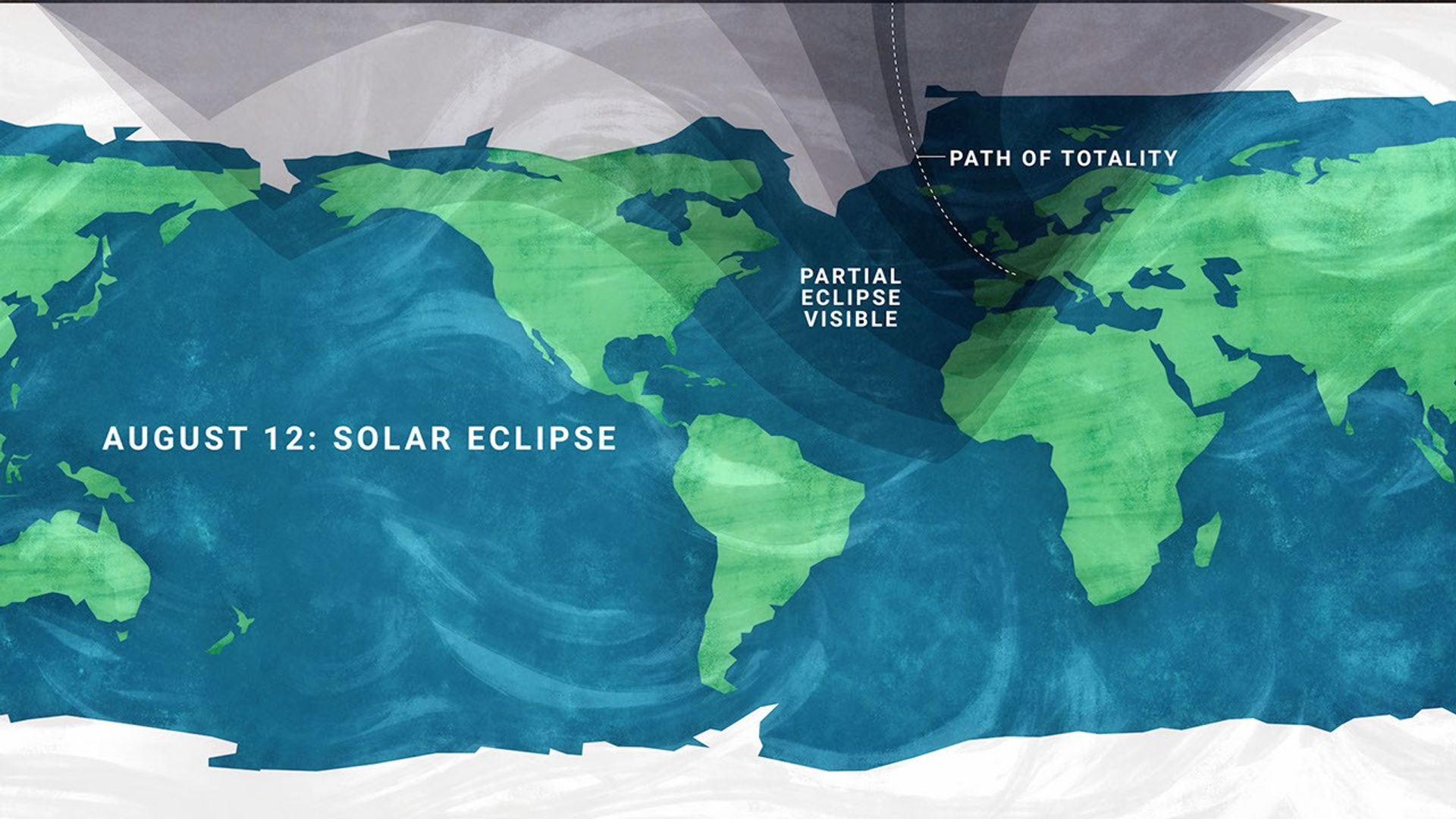
On Aug. 12, a total solar eclipse crosses northern Russia, Greenland, Iceland, and northern Spain, with a small corner of Portugal inside the path of totality.

In parts of the United States, from Alaska to North Carolina, the eclipse is partial. The Moon will take only a small bite out of the Sun, and the amount of coverage will vary with location.

A stylized flat map of the Earth indicating the viewing areas for a solar eclipse, with text on the left reading 'AUGUST 12: SOLAR ECLIPSE'. A semi-transparent dark shadow covers the northern portion of the globe, fanning out from the top edge. Within this shadow, a thin dotted line arcs down from the Arctic, crossing near Greenland and Iceland, passing over the Iberian Peninsula (Spain and Portugal), and ending near the Mediterranean Sea; this line is labeled 'PATH OF TOTALITY'. The broader shaded region surrounding this line is labeled 'PARTIAL ECLIPSE VISIBLE', and it covers northern North America, the Arctic, all of Europe, northern Africa, and northern and western Asia. The unshaded regions covering the rest of the map, including most of the United States, South America, central and southern Africa, and Australia, indicate areas where the eclipse will not be visible.
A map showing viewing areas of the August 2026 total solar eclipse.
NASA/JPL-Caltech

Remember to watch safely. Use certified eclipse glasses or a safe solar viewer any time any part of the Sun is visible. Regular sunglasses are not safe. And never use binoculars, a telescope, or a camera without a solar filter made for the front of the optics.

Later that same night, the Perseid meteor shower will light up the sky, peaking the evening of Aug. 12 into the early morning hours of the 13th. And with a New Moon arriving on the 12th, the skies will be ideally dark.

The Perseids happen every year when Earth passes through a debris stream left behind by Comet Swift-Tuttle. As those tiny bits of comet dust hit our atmosphere at high speed, they burn up as bright streaks of light.

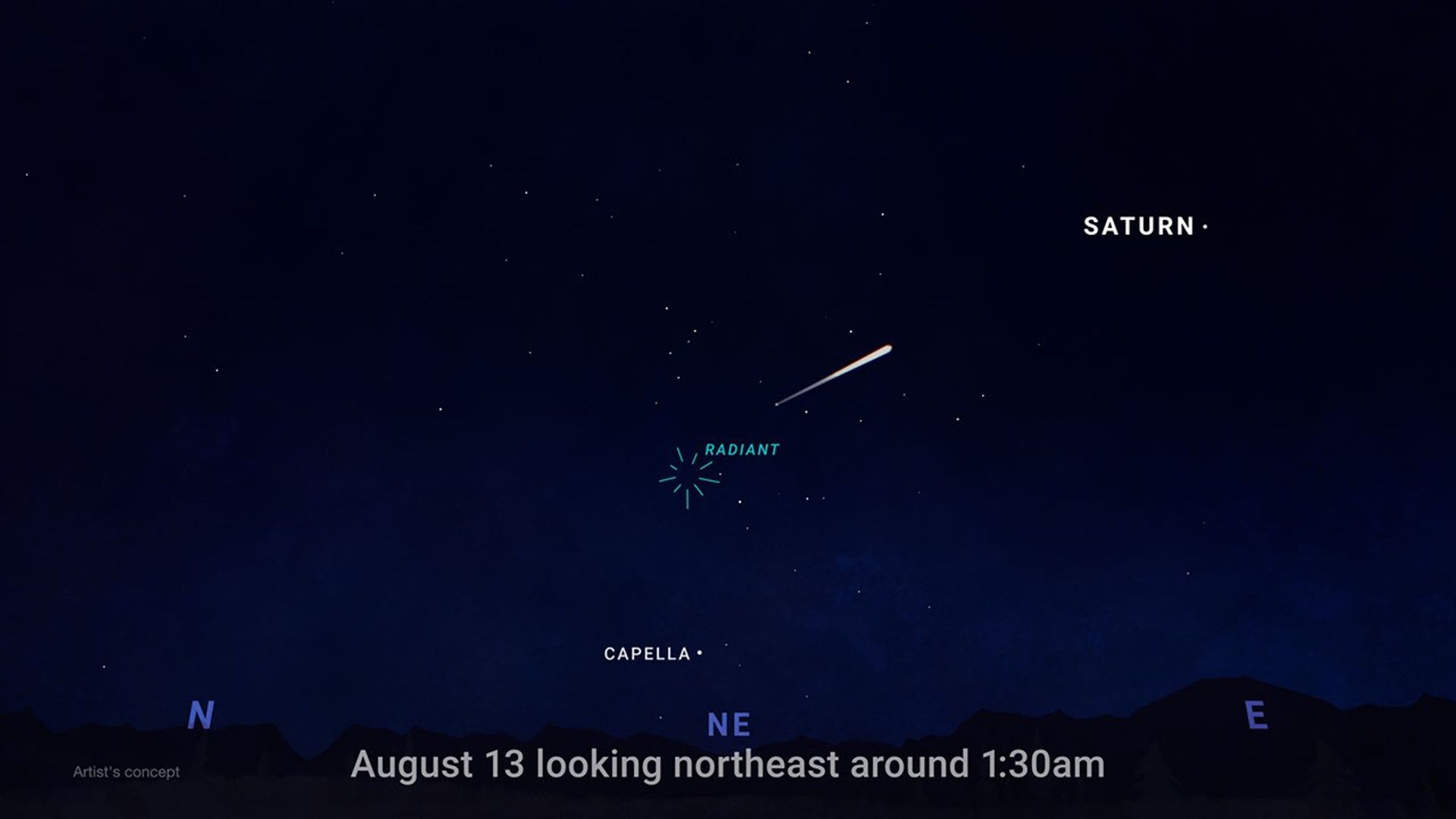
To view this meteor shower, look toward the northeast once it’s fully dark and watch for the constellation Perseus to clear the horizon. This is where the meteors originate, but let your eyes wander, because they can flash across any part of the sky.

For the best view, stay out late as the stars climb higher, find a dark open spot, and give your eyes 30 minutes to adjust.

An illustration of the night sky showing where to look for meteors, with text at the bottom reading 'August 13 looking northeast around 1:30am.' The bottom of the image shows a dark, silhouetted horizon of hills, marked with blue compass directions N (North), NE (Northeast), and E (East). In the center of the sky above NE is a teal burst icon labeled 'RADIANT,' indicating the point from which meteors appear to originate. A bright, white meteor streaks across the dark, starry sky, pointing back toward the radiant. Two other bright celestial objects are labeled: the star 'CAPELLA' is situated low in the sky below the radiant, and the planet 'SATURN' is positioned high up in the upper right corner. Small text in the bottom left corner reads 'Artist's concept.'
This illustration shows where in the night sky to look for the Perseid meteor shower.
NASA/JPL-Caltech

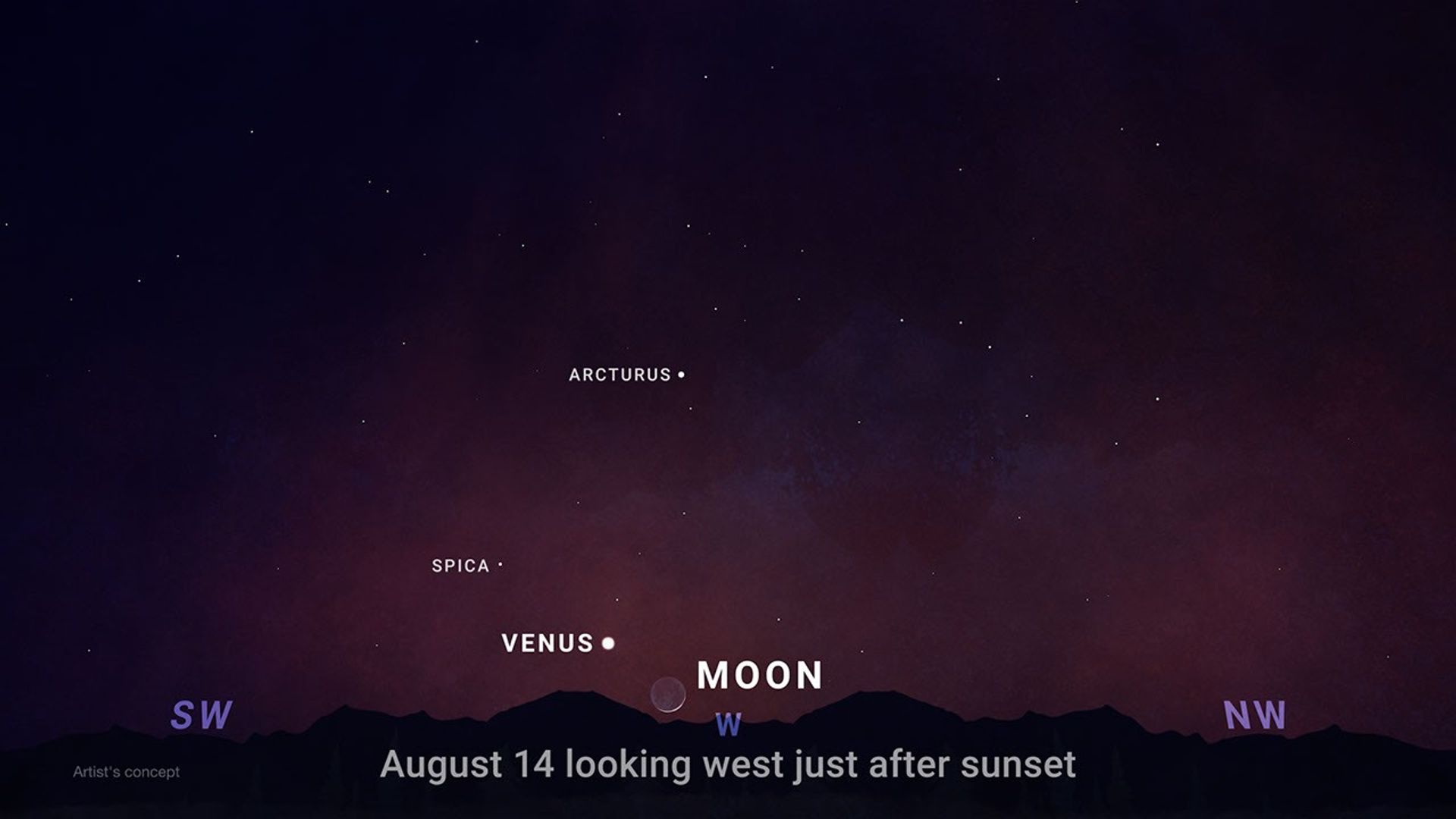
Aug. 14-16, Venus reaches its greatest eastern elongation, which is its widest apparent separation from the Sun during this evening appearance.

Look low in the western sky shortly after sunset for the bright object that will outshine every star around it. Through a telescope after sunset, Venus will look close to half lit, like a tiny lunar phase.

An illustration of the evening sky shortly after sunset, showing the positions of celestial objects. Text at the bottom center reads 'August 14 looking west just after sunset'. The bottom edge features a silhouetted, dark horizon of hills or mountains. Above the horizon, compass directions are indicated in purple: 'SW' (Southwest) on the left, 'W' (West) in the center, and 'NW' (Northwest) on the right. In the center, sitting very low on the horizon, is a faint crescent moon, labeled 'MOON'. Just to the left and slightly above the moon is a bright, white dot labeled 'VENUS'. Higher up and to the left of Venus is a smaller white dot labeled 'SPICA'. Above and to the right of Spica, towards the center of the image, is another labeled star, 'ARCTURUS'. The sky transitions from a deep reddish-purple near the horizon to dark blue at the top, sprinkled with numerous faint stars. In the bottom left corner, small text reads 'Artist's concept.'
This illustration shows where to observe Venus after sunset in August.
NASA/JPL-Caltech

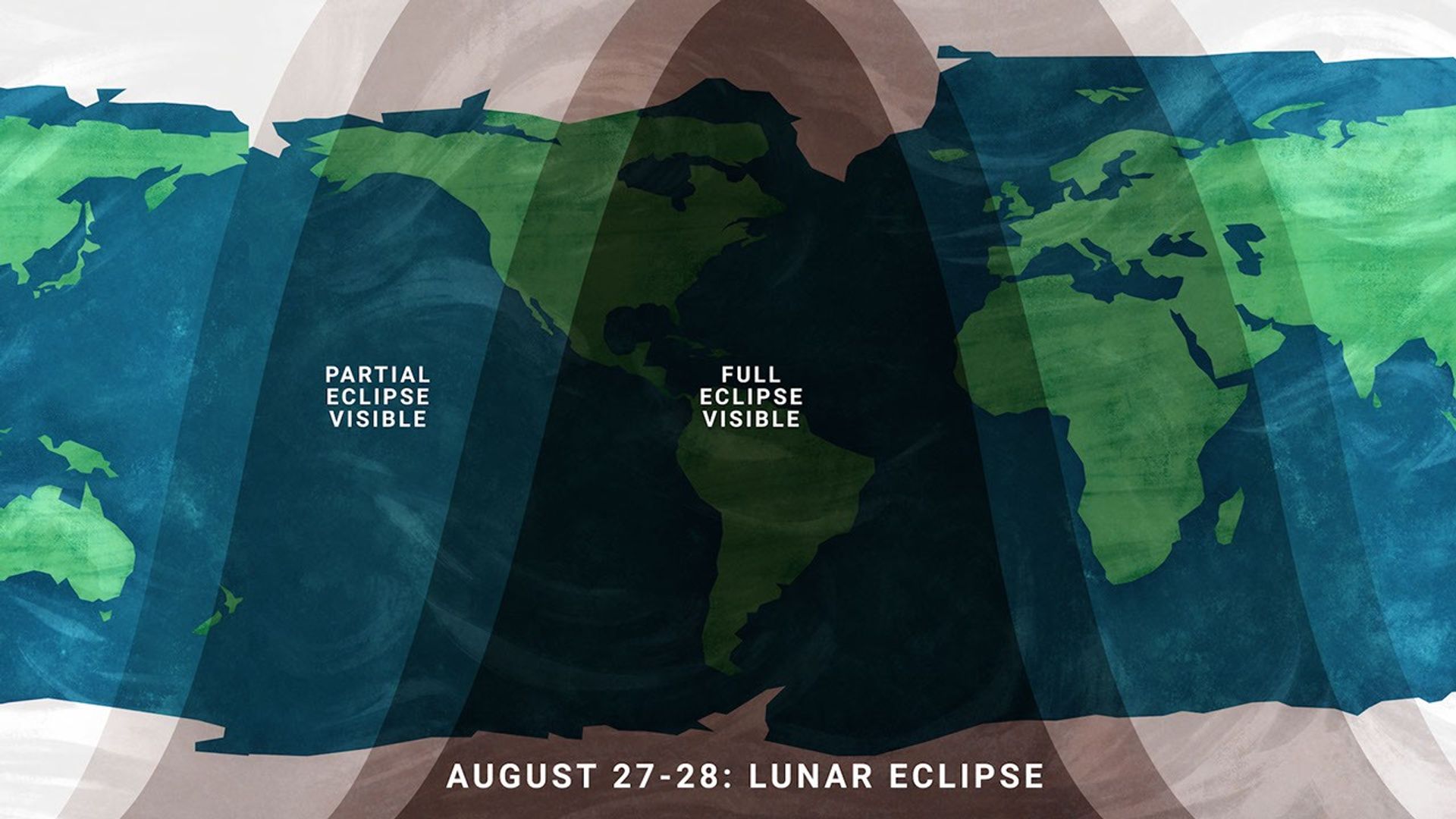
On the night of Aug. 27, continuing into Aug. 28 for some time zones, the Full Moon slips through Earth’s shadow, resulting in a partial lunar eclipse. It will be visible from much of North and South America and parts of Europe and Africa.

A stylized flat map of the Earth indicating the viewing areas for a lunar eclipse, with text at the bottom reading 'AUGUST 27-28: LUNAR ECLIPSE'. Large, semi-transparent dark bands arch across the map to represent visibility zones. The darkest central band, labeled 'FULL ECLIPSE VISIBLE', covers all of North America and South America, as well as the eastern Pacific Ocean and western Atlantic Ocean. Flanking this central region on the left and right are lighter shaded bands labeled 'PARTIAL ECLIPSE VISIBLE'. The western partial eclipse band covers the western Pacific Ocean and New Zealand, while the eastern partial eclipse band covers Europe and Africa. The unshaded outer regions of the map, including most of Asia and Australia, are areas where the eclipse will not be visible.
Viewing areas for the August 2026 lunar eclipse.
NASA/JPL-Caltech

At maximum eclipse, about 93% of the Moon’s diameter will be inside Earth’s dark central shadow, called the umbra. The Moon will not be completely covered, but it can look dramatically darkened, with a rusty, coppery tint along the covered edge.

Unlike a solar eclipse, a lunar eclipse is safe to watch with just your eyes. Binoculars or a small telescope can give you a closer view of Earth’s curved shadow moving across the Moon.

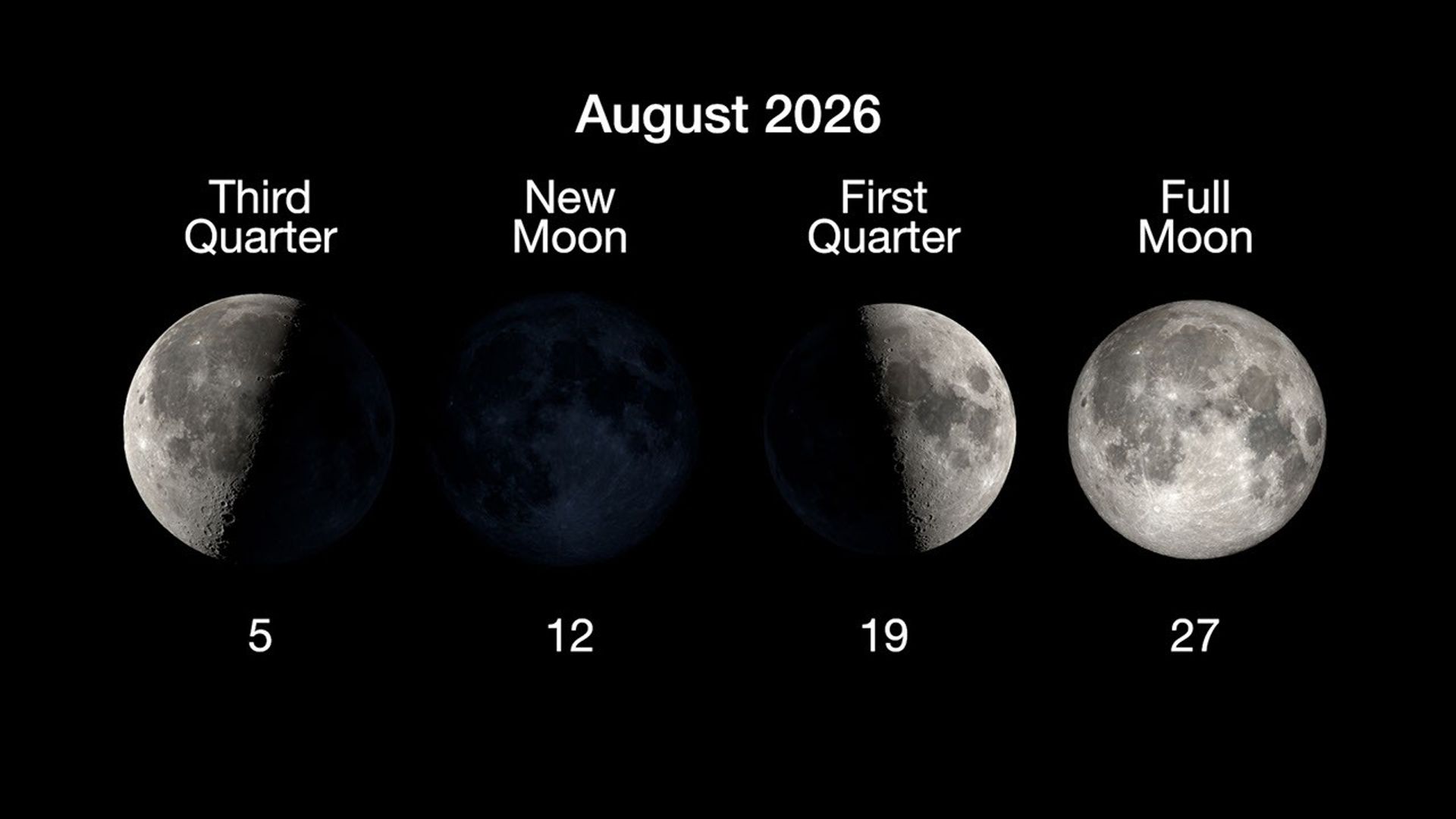
Here are the phases of the Moon for August.

An infographic on a black background titled 'August 2026' showing four primary phases of the Moon arranged in a horizontal row. Each phase features an image of the Moon with text above indicating the phase name and a number below indicating the date in August. From left to right:  'Third Quarter' on the 5th, showing the left half of the Moon illuminated. 'New Moon' on the 12th, showing the Moon's face completely in shadow. 'First Quarter' on the 19th, showing the right half of the Moon illuminated. 'Full Moon' on the 27th, showing the entire face of the Moon illuminated.
NASA/JPL-Caltech

You can stay up to date on all of NASA’s missions exploring the solar system and beyond at science.nasa.gov. I’m Raquel Villanueva from NASA’s Jet Propulsion Laboratory, and that’s What’s Up for this month.

Keep Exploring

Discover More Topics From NASA

The post What’s Up: August 2026 Skywatching Tips from NASA appeared first on NASA Science.

💾

A solar eclipse, one of the year's best meteor showers, Venus at its brightest in the evening sky, and a partial lunar eclipse to close out the month.On Augu...

What’s Up: August 2026 Skywatching Tips from NASA

31 July 2026 at 23:35

A solar eclipse, the Perseids, bright Venus after sunset, and a deep partial lunar eclipse highlight August’s skywatching.

Skywatching Highlights

  • Aug. 5: Last Quarter Moon
  • Aug. 12: Total solar eclipse across northern Russia, Greenland, Iceland, northern Spain, and part of Portugal; partial eclipse in parts of the U.S.; New Moon
  • Aug. 12-13: Perseid meteor shower peak under dark skies
  • Aug. 14-16: Venus reaches greatest eastern elongation and shines low in the west after sunset
  • Aug. 27-28: Partial lunar eclipse visible from much of North and South America and parts of Europe and Africa

Transcript

A solar eclipse, one of the year’s best meteor showers, Venus at its brightest in the evening sky, and a lunar eclipse to close out the month.

That’s “What’s Up” for August.

On Aug. 12, a total solar eclipse crosses northern Russia, Greenland, Iceland, and northern Spain, with a small corner of Portugal inside the path of totality.

In parts of the United States, from Alaska to North Carolina, the eclipse is partial. The Moon will take only a small bite out of the Sun, and the amount of coverage will vary with location.

A stylized flat map of the Earth indicating the viewing areas for a solar eclipse, with text on the left reading 'AUGUST 12: SOLAR ECLIPSE'. A semi-transparent dark shadow covers the northern portion of the globe, fanning out from the top edge. Within this shadow, a thin dotted line arcs down from the Arctic, crossing near Greenland and Iceland, passing over the Iberian Peninsula (Spain and Portugal), and ending near the Mediterranean Sea; this line is labeled 'PATH OF TOTALITY'. The broader shaded region surrounding this line is labeled 'PARTIAL ECLIPSE VISIBLE', and it covers northern North America, the Arctic, all of Europe, northern Africa, and northern and western Asia. The unshaded regions covering the rest of the map, including most of the United States, South America, central and southern Africa, and Australia, indicate areas where the eclipse will not be visible.
A map showing viewing areas of the August 2026 total solar eclipse.
NASA/JPL-Caltech

Remember to watch safely. Use certified eclipse glasses or a safe solar viewer any time any part of the Sun is visible. Regular sunglasses are not safe. And never use binoculars, a telescope, or a camera without a solar filter made for the front of the optics.

Later that same night, the Perseid meteor shower will light up the sky, peaking the evening of Aug. 12 into the early morning hours of the 13th. And with a New Moon arriving on the 12th, the skies will be ideally dark.

The Perseids happen every year when Earth passes through a debris stream left behind by Comet Swift-Tuttle. As those tiny bits of comet dust hit our atmosphere at high speed, they burn up as bright streaks of light.

To view this meteor shower, look toward the northeast once it’s fully dark and watch for the constellation Perseus to clear the horizon. This is where the meteors originate, but let your eyes wander, because they can flash across any part of the sky.

For the best view, stay out late as the stars climb higher, find a dark open spot, and give your eyes 30 minutes to adjust.

An illustration of the night sky showing where to look for meteors, with text at the bottom reading 'August 13 looking northeast around 1:30am.' The bottom of the image shows a dark, silhouetted horizon of hills, marked with blue compass directions N (North), NE (Northeast), and E (East). In the center of the sky above NE is a teal burst icon labeled 'RADIANT,' indicating the point from which meteors appear to originate. A bright, white meteor streaks across the dark, starry sky, pointing back toward the radiant. Two other bright celestial objects are labeled: the star 'CAPELLA' is situated low in the sky below the radiant, and the planet 'SATURN' is positioned high up in the upper right corner. Small text in the bottom left corner reads 'Artist's concept.'
This illustration shows where in the night sky to look for the Perseid meteor shower.
NASA/JPL-Caltech

Aug. 14-16, Venus reaches its greatest eastern elongation, which is its widest apparent separation from the Sun during this evening appearance.

Look low in the western sky shortly after sunset for the bright object that will outshine every star around it. Through a telescope after sunset, Venus will look close to half lit, like a tiny lunar phase.

An illustration of the evening sky shortly after sunset, showing the positions of celestial objects. Text at the bottom center reads 'August 14 looking west just after sunset'. The bottom edge features a silhouetted, dark horizon of hills or mountains. Above the horizon, compass directions are indicated in purple: 'SW' (Southwest) on the left, 'W' (West) in the center, and 'NW' (Northwest) on the right. In the center, sitting very low on the horizon, is a faint crescent moon, labeled 'MOON'. Just to the left and slightly above the moon is a bright, white dot labeled 'VENUS'. Higher up and to the left of Venus is a smaller white dot labeled 'SPICA'. Above and to the right of Spica, towards the center of the image, is another labeled star, 'ARCTURUS'. The sky transitions from a deep reddish-purple near the horizon to dark blue at the top, sprinkled with numerous faint stars. In the bottom left corner, small text reads 'Artist's concept.'
This illustration shows where to observe Venus after sunset in August.
NASA/JPL-Caltech

On the night of Aug. 27, continuing into Aug. 28 for some time zones, the Full Moon slips through Earth’s shadow, resulting in a partial lunar eclipse. It will be visible from much of North and South America and parts of Europe and Africa.

A stylized flat map of the Earth indicating the viewing areas for a lunar eclipse, with text at the bottom reading 'AUGUST 27-28: LUNAR ECLIPSE'. Large, semi-transparent dark bands arch across the map to represent visibility zones. The darkest central band, labeled 'FULL ECLIPSE VISIBLE', covers all of North America and South America, as well as the eastern Pacific Ocean and western Atlantic Ocean. Flanking this central region on the left and right are lighter shaded bands labeled 'PARTIAL ECLIPSE VISIBLE'. The western partial eclipse band covers the western Pacific Ocean and New Zealand, while the eastern partial eclipse band covers Europe and Africa. The unshaded outer regions of the map, including most of Asia and Australia, are areas where the eclipse will not be visible.
Viewing areas for the August 2026 lunar eclipse.
NASA/JPL-Caltech

At maximum eclipse, about 93% of the Moon’s diameter will be inside Earth’s dark central shadow, called the umbra. The Moon will not be completely covered, but it can look dramatically darkened, with a rusty, coppery tint along the covered edge.

Unlike a solar eclipse, a lunar eclipse is safe to watch with just your eyes. Binoculars or a small telescope can give you a closer view of Earth’s curved shadow moving across the Moon.

Here are the phases of the Moon for August.

An infographic on a black background titled 'August 2026' showing four primary phases of the Moon arranged in a horizontal row. Each phase features an image of the Moon with text above indicating the phase name and a number below indicating the date in August. From left to right:  'Third Quarter' on the 5th, showing the left half of the Moon illuminated. 'New Moon' on the 12th, showing the Moon's face completely in shadow. 'First Quarter' on the 19th, showing the right half of the Moon illuminated. 'Full Moon' on the 27th, showing the entire face of the Moon illuminated.
NASA/JPL-Caltech

You can stay up to date on all of NASA’s missions exploring the solar system and beyond at science.nasa.gov. I’m Raquel Villanueva from NASA’s Jet Propulsion Laboratory, and that’s What’s Up for this month.

Keep Exploring

Discover More Topics From NASA

It Appears the Reports of Venus’s Death Were Greatly Exaggerated—New Models Suggest the Planet is Still Geologically Active

26 July 2026 at 12:07

New computer models of Venus’s surface features, including ridges likely caused by volcanic activity, have determined that the second rock from the Sun remains geologically active to this day.

The ETH Zurich research team behind the new Venusian models, which suggest that Venus may still have active volcanoes, said their findings could help planned NASA and ESA missions select the most promising targets. The new models could also help in the search for rocky planets outside of our Solar System, including those that may support life.

Venus Previously Considered Geologically Dormant for Over 100 Million Years

Venus has long fascinated planetary scientists due to its similarities. For example, the planet’s mass and circumference make it roughly 95% the same size as Earth overall. However, although Venus’ elliptical orbit brings it closer to Earth than any other planet in the Solar System, its extreme surface temperatures and toxic atmosphere make it inhospitable to life as we know it.

Ground and space observations have detected rift valleys on Venus’s surface, which the research team notes indicate tectonic activity. Some can measure up to 10,000 kilometers and resemble the longest ridges on Earth. Although the timing of Venus’ rift formations remains uncertain, the team said most scientists have typically considered the planet to be geologically dormant. Some estimates have put their formation more than 100 million years ago.

Curious if data captured by space and ground-based observatories could provide enough information to answer the timing question, a research team from ETH led by Taras Gerya, a Professor of Geodynamics at the Department of Earth and Planetary Sciences, decided to plug that data into computer models. According to their results, the reports of Venus’ demise may have been greatly exaggerated. 

Models Reveal Planet Likely Supports Active Volcanoes

Working under Professor Gerya’s supervision, Master’s candidate and lead author of the paper detailing the team’s work, Xi Yang, and colleagues employed computer models to simulate the planet’s rifts in high-resolution and 3D. The team said these models allowed them to “accurately replicate these rift structures” in a level of detail never achieved. The data also allowed them to perform simulations to best determine how they originally formed.

Critically, the team notes that earlier attempts to model Venus’ tectonic history and potential ongoing activity had been mostly two-dimensional. Yang’s team also said those earlier models had relied on “simplified material assumptions” that his team was able to expand upon.

After completion, the models yielded several compelling results. First, they indicated that the broad ridges geologists call ‘rift flanks’ form along the edges of rift valleys at a time when the rifts are still “geologically young.” Specifically, the team’s models suggested that these flanks formed when Venus was still either actively moving or had only recently stopped moving.

A closer look at the simulations also suggested that these geological rifts open over a much shorter time scale than previously assumed, with an estimated rate between 3 and 10 centimeters per year. The models also indicated that rift flanks tend to flatten very quickly once the movement ends.

“The older the rift system, the less steep and narrow its flanks,” they explained.

A comparison to erosion patterns on Earth also supported a more recent time frame for the rift flank formations spotted on the Venusian surface from the Magellan probe during its 1990s mission. The team said that these formations and their models suggest that “Venus remains an active planet with a more dynamic interior than had been previously believed.”

“Venus remains geologically “alive” and even hosts active volcanoes,” they explained.

Planned NASA & ESA Missions Could Confirm Models

When discussing the implications of their work, Professor Gerya said the findings “help us to better assess the tectonic activity on Venus.” The team noted that their models could also guide future missions by pinpointing potentially active regions worthy of closer examination.

The ETH team said their study also has planetary formation implications, particularly for rocky planets like Venus and Earth. Such data could prove valuable in the search for rocky exoplanets, including the type that may host life.

Moving forward, the study authors noted that NASA and the European Space Agency (ESA) are actively preparing “multiple missions” to explore Venus in further detail. ETH geophysics professors Paul Tackley and Gerya, and their team of collaborators, are already participating in ESA’s EnVision mission.

The work includes developing instruments for the orbiter to analyze the surface in greater detail. Scheduled for launch in the early 2030s, the team said that EnVision will explore the planet more thoroughly than previous efforts “from its core to its upper atmosphere.”

The study “Recent active rifting on Venus revealed by wide rift flank uplifts” was published in Nature Geoscience.

Christopher Plain is a Science Fiction and Fantasy novelist and has spent the last six years as Associate News Editor and Head Science Writer at The Debrief. Follow and connect with him on X, learn about his books at plainfiction.com, or email him at christopher@thedebrief.org.

Earth May Have Been Sending Microscopic Hitchhikers Toward Venus for a Billion Years

2 July 2026 at 13:03

A new model suggests that asteroid impacts on Earth may have occasionally launched microscopic material into space that could have reached Venus’s atmosphere over billions of years. Some of this material may even have temporarily remained suspended in the planet’s cloud layers under certain conditions.

The idea is based on the theory of panspermia, which suggests that life, or the building blocks of life, can move between planets on debris created by asteroid impacts. Scientists have often discussed the possibility of microbes traveling between Earth and Mars, and even the possibility of Earthly organisms reaching locations as far away as Jupiter’s moons.

Now, interest in the possibility of microscopic life in Venus’s dense, sulfur-rich clouds has made Venus a focus for similar studies of interplanetary transfer.

A team from Arizona State University, the Johns Hopkins University Applied Physics Laboratory, and Sandia National Laboratories recently explored this idea in a study presented at the 2026 Lunar and Planetary Science Conference. They used the Venus Life Equation, a framework made in 2021 by planetary scientist Noam Izenberg and his team. This equation considers three main factors: origination, robustness, and continuity. These factors help estimate the likelihood that life exists on Venus today. If panspermia occurred, it would mean that any life on Venus, if it exists at all, would not necessarily have originated there.

A Rock Becomes a Delivery Vehicle

Before considering the possibility of life originating on Venus, the researchers first addressed a fundamental question: could any material from Earth realistically survive the journey to Venus?

When an asteroid hits Earth hard enough to send material into space, that material faces intense shock, high heat, radiation, and the vacuum of space. Studies of meteorites found on Earth show that organic compounds can survive both ejection and travel between planets. However, an important question remains: what happens when this debris enters Venus’s atmosphere at high speed?

To study this process, the researchers used the pancake model. This model helps researchers analyze how meteors break apart when they enter an atmosphere. In this model, a meteor entering Venus’s atmosphere experiences intense heating and breaks into fragments. These fragments spread out into a flattened cloud of debris called ‘cells.’ Some of these cells are small enough to stay suspended in Venus’s clouds, instead of falling to the surface, where survival would be much less likely.

The Math of Interplanetary Hitchhikers

Their calculations indicate that, depending on the assumptions used, between 2 and 4 billion cell-sized fragments may have reached the clouds of Venus. Even accounting for a 99% loss during transit, billions of cell-sized fragments could be delivered. The model further estimates that approximately 100 cells could arrive in Venus’s clouds each year, amounting to roughly 20 billion over the past billion years, which corresponds to the estimated age of Venus’s current surface.

Like the Drake Equation, this model involves significant uncertainty because researchers cannot directly measure many of its parameters. The researchers note these limitations. Their model assumes that each meteor produces a single debris cloud, whereas real atmospheric breakups are more complex. The team’s size estimates are also based on Earth data rather than Venus-specific observations. Still, the results suggest that even single meter-sized meteors could deliver large numbers of cell-sized fragments, and the total transfer over Venus’s history suggests that interplanetary transfer to Venus may be more common over geological time than previously assumed.

Life on Venus?

Venus is considered a relatively low-risk target for spacecraft contamination under planetary protection guidelines. The results of this study imply that natural processes may have been transferring material from Earth to Venus for a billion years, independent of human activity.

So far, no mission has found life in Venus’s clouds. However, future astrobiology missions are expected to directly search for it. If life is discovered, these models show that scientists will then need to determine whether it originated on Venus or arrived from Earth.

Austin Burgess is a writer and researcher with a background in sales, marketing, and data analytics. He holds an MBA, a Bachelor of Science in Business Administration, and a data analytics certification. His work focuses on breaking scientific developments, with an emphasis on emerging biology, cognitive neuroscience, and archaeological discoveries.

Levez les yeux demain soir : Vénus et la Lune vont offrir un superbe spectacle

16 June 2026 at 17:33
Demain soir, le spectacle ne sera pas sur le terrain. À la tombée de la nuit, Vénus aura rendez-vous avec la Lune. Que vous y voyiez un symbole ou pas, cette conjonction vaudra bien le coup d’œil.

Vénus tourne à l’envers : une catastrophe cosmique pourrait enfin expliquer pourquoi

16 June 2026 at 12:27
Vénus est la seule planète du Système solaire à tourner aussi lentement et dans le sens opposé à celui de la plupart de ses voisines. Selon une nouvelle étude, cette étrange rotation pourrait être l'héritage d'un impact titanesque survenu aux débuts du Système solaire.

Don’t Miss: Venus Is About To Disappear Behind the Moon

Venus Moon Occultation 2023A disappearing Venus, a planet parade, and the start of summer make June a must-see month for skywatchers. June brings several notable skywatching events, including a close meeting between Venus and Jupiter, a rare occasion when the Moon moves in front of Venus, the arrival of astronomical summer, and the return of favorite deep-sky sights. [...]

FIRST VISIBLE LIGHT IMAGES OF VENUS’ SURFACE FROM SPACE CAPTURED BY PARKER SOLAR PROBE

29 January 2023 at 19:58

NASA’s Parker Solar Probe captured the first visible light images of Venus from space. The images, taken during two recent flybys, show a faint glow from the surface, revealing features like continents, plains, and plateaus. The images could help scientists learn about Venus’s geology and mineral make-up and understand why it became inhospitable while Earth […]

The post FIRST VISIBLE LIGHT IMAGES OF VENUS’ SURFACE FROM SPACE CAPTURED BY PARKER SOLAR PROBE appeared first on Science Bulletin.

Earth May Be Seeding Venus With Life, According to New Research

30 May 2026 at 22:39
Venus Cloud Layers in UltravioletModels suggest that impact-ejected material from Earth could reach Venus’ clouds and potentially survive there briefly. Panspermia is the idea that life, or the ingredients needed for life, can move through space on asteroids, comets, and other objects. If life’s building blocks appear on one planet, a powerful impact could blast material from its surface [...]
❌