
❌

Normal view

Is this Microsoft’s canceled Surface Phone from 2014? Mysterious Windows Phone prototype appears in new photos

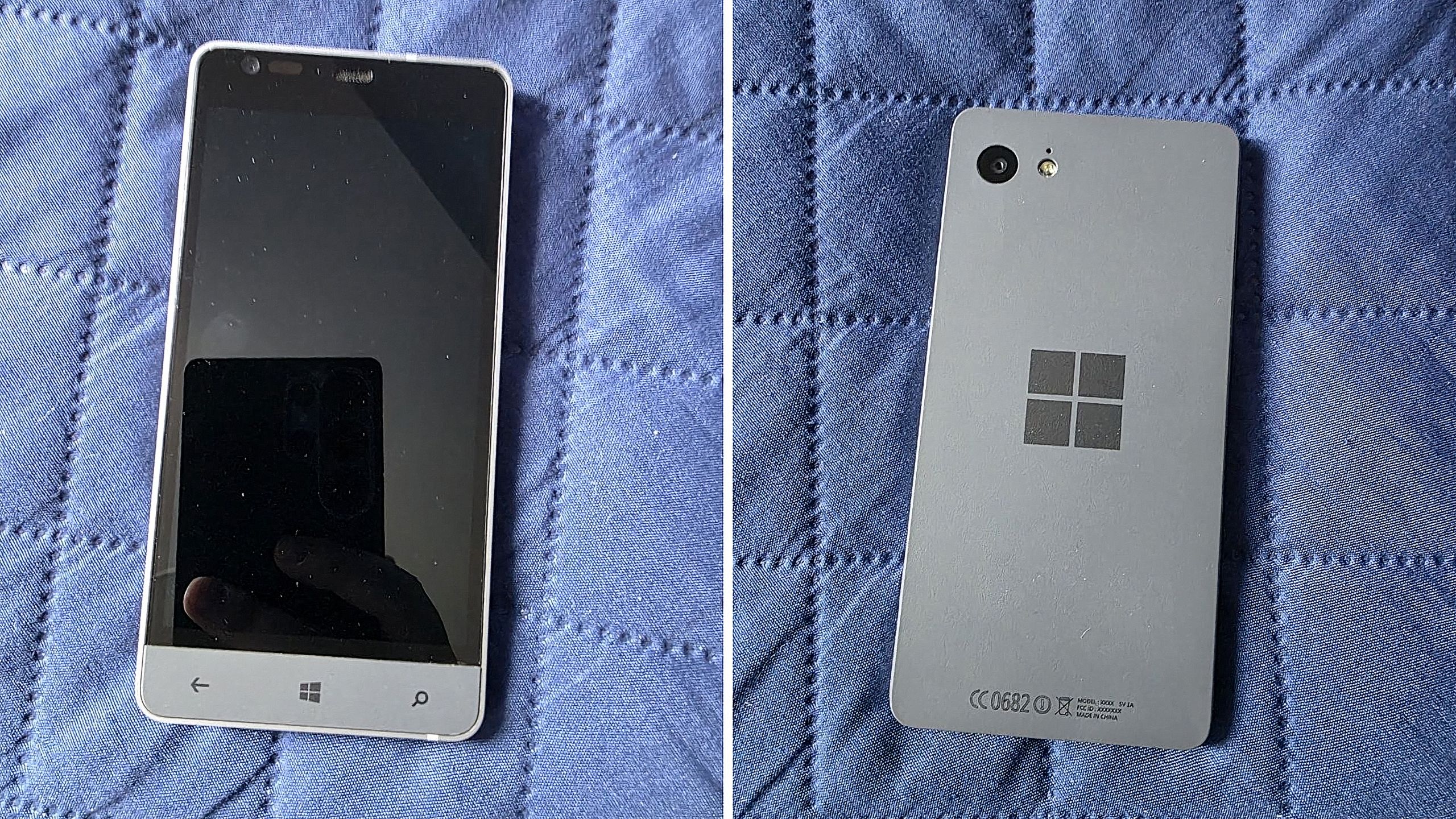
Before Microsoft acquired Nokia, the company was heavily rumoured to be working on its own in-house Windows Phone device that was expected to ship in 2014 under the Surface moniker alongside its Surface Pro device. Unfortunately for Windows Phone fans, such a device never saw the light of day, but newly published images of a mysterious prototype might have just given us our first and only look at what Microsoft was exploring internally.

Possibly codenamed Raven, there isn't much information available about this prototype, other than the fact that it’s from the 2013-2014 time frame and is running an early pre-release build of Windows Phone 8.1. It’s powered by an unknown Qualcomm chip, has a 720p screen, features a Microsoft logo on the back, and a silver metal frame that matches the colour of the Surface 2 that released that same year.

We can see in the photos that it has dedicated hardware keys for navigation, which are also coated in the same silver color as the chassis. The build of Windows Phone that it’s running appears to be from September 2013, and is from an internal development branch building towards what eventually became Windows Phone 8.1.

Windows Phone Prototype

Real images of this mysterious Windows Phone prototype. (Image credit: Telegram/Discord)

While not viewable in the images, I understand the device features individual up and down volume buttons and a camera button on the right-hand side of the device, and a power button on the top of the device. It also features a micro-USB port and headphone jack on the bottom side, and a SIM card slot on the left side.

This is likely one of dozens of prototype designs that Microsoft’s hardware teams cooked up during this era, but it’s certainly a fascinating look at what could have been, and it does look so clean. Development on this device was likely paused once Microsoft moved to acquire Nokia in 2014.

Back in 2013, I remember hearing from sources that Microsoft was experimenting with the concept of a "Skype Phone," a Windows Phone device with mobile data that utilized Skype for calls and messaging instead of traditional carrier networks. Perhaps this device was going to be that? Who knows.

The Surface Phone we eventually got arrived as the Surface Duo, which started development in 2016 and launched to the public in 2020. In that time, Microsoft shipped Nokia designs in the form of the Lumia 640, 650, 950, and 550 running Windows Phone, before abandoning the platform in 2017.

Click to join us on r/WindowsCentral

Join us on Reddit at r/WindowsCentral to share your insights and discuss our latest news, reviews, and more.

Metasurface Breakthrough Makes Blistering Laser Light Speeds a Reality

4 August 2026 at 13:24

The speed of laser light is due for a major upgrade after an international collaboration of scientists has developed a breakthrough nanomaterial. The new metasurface can steer and shape light beams at unprecedented speeds of just 74 quadrillionths of a second.

Scientists at UC Berkeley and Tel Aviv University revealed their new optical surface, developed in a Caltech lab, in a recent paper published in Nature Nanotechnology.

According to the team behind the breakthrough, their work will have ramifications for communications, sensing, imaging, and even quantum technologies, providing a new benchmark for “high-speed” light manipulation.

Light Control

Since the fiber-optic advancements of the 1980s, lasers and light pulses have underpinned some of our most crucial cutting-edge technologies. Advanced computers, communications systems, sensors, and even the elusive quantum systems all rely on controlling light.

While the speed of light is so incredibly fast that physicists consider it a constraint on the maximum speed that matter can travel through the vacuum of space, the speed at which our technology reacts to it is far slower.

The scientists’ breakthrough metasurface contains silicon structures even smaller than the wavelength of light, resulting in an ultra-thin surface. Silicon’s optical properties change upon bombardment with laser pulses, a property that the team strongly enhanced with their nanostructure design. In their design, the properties of the material are modified via light pulses, which alter how the material influences a second beam of light impacting its surface. Notably, their metasurface allows for control of a beam of light without any moving parts, such as mirrors or lenses.

Real World Results

The team conducted laboratory tests in which they manipulated light beams by up to 13 degrees and reshaped them into different patterns.

“The key idea was to create a metasurface whose optical response is not fixed once it is fabricated,” said lead author Dr. Claudio Hail. “By changing the illumination pattern, we can reconfigure how the device steers and shapes light, and do so on an ultrafast timescale.”

“For me, the most exciting aspect is seeing an idea that had been with us for years become an experimental reality,” said co-author Dr. Lior Michaeli. “The ultrafast effect we wanted to use is naturally very weak. We had to design the metasurface so that it would amplify the effect enough not only to measure it, but to use it to steer and shape light.”

While the metasurface produced record-breaking speeds under laboratory observations, exactly how fast it can operate remains uncertain. The researchers note that the switching time and the duration of the laser pulse were extremely close, which indicates that quicker pulses could push the optical surface’s speed even higher.

The Future of Light Technologies

One of the major potential advances that could come from this new metasurface includes systems that carry information primarily with light, end-to-end. Current communications systems use light to transmit messages, but those messages are converted into electrical signals for processing. By increasing the speed at which light can be manipulated, this would reduce the necessity to convert light signals into electrical ones, removing unnecessary actions in computing.

“This work points to a broader opportunity: using engineered structures to strengthen interactions between light and matter and turn them into tools for control, sensing, and information processing,” Dr. Michaeli said. “This is closely connected to research directions we are now pursuing at Tel Aviv University.”

Despite its promise, the work is still in the fundamental phase. Although not yet ready for practical use, the metasurface offers promise in future ultra-fast computing applications, where it may soon help to cut out the middleman of electronic conversion.

The paper, “Ultrafast, Reconfigurable All-Optical Beam Steering and Spatial Light Modulation,” appeared in Nature Nanotechnology on June 22, 2026.

Ryan Whalen covers science and technology for The Debrief. He holds an MA in History and a Master of Library and Information Science with a certificate in Data Science. He can be contacted at ryan@thedebrief.org.

Microsoft Surface Laptop 8 review: a quality PC whose trackpad taps you back

Snappy performance, long battery life, great keyboard and excellent new haptic touchpad make the best of Windows 11

Microsoft’s Surface laptop for consumers is back, faster and with longer battery life and a hefty price increase because of the high cost of memory and chips.

The Surface Laptop 8 is a straight replacement for the seventh edition from 2024, which was the first of Microsoft’s new generation of ARM-based, Qualcomm-powered PCs designed to better rival Apple’s MacBook Air and other thin and light machines.

Continue reading...

© Photograph: Samuel Gibbs/The Guardian

© Photograph: Samuel Gibbs/The Guardian

© Photograph: Samuel Gibbs/The Guardian

Microsoft's Surface Laptop Ultra looks like its first true MacBook Pro competitor

1 June 2026 at 21:13

Dell, Asus, Lenovo, HP, MSI, Acer, and Gigabyte are among the PC makers that are designing systems around Nvidia's RTX Spark, Nvidia's new Arm-based chip for Windows PCs. But the flagship RTX Spark PC may be from the same company that makes Windows: the new Microsoft Surface Laptop Ultra is a high-end RTX Spark system that will offer up to 128GB of unified memory for "creators, developers, and AI builders."

Microsoft says the Laptop Ultra will be available "later this year" but didn't discuss any specific pricing or configuration options.

The Laptop Ultra will slot in above the regular Qualcomm Snapdragon-based Surface Laptops in Microsoft's lineup. Microsoft has made high-end Surface devices with more powerful CPUs and GPUs before, but to date, they've also come with convertible designs that may have limited their appeal. The first was the old Surface Book, with its fully detachable screen and bendy-straw hinge that didn't close all the way; the second was the Surface Laptop Studio, with its chunky design and sliding screen. The Laptop Ultra is Microsoft's first attempt to follow the MacBook Pro formula: it's like the other Surface Laptops, just with more power.

Read full article

Comments

© Microsoft

❌