For the first time, astronomers combined Hubble and Webb space telescopes to hunt down some of the smallest, faintest objects ever spotted in the outer Solar System.
Dr. Delia Santiago-Materese wants things to get complex
From terrestrial animals to experiments in microgravity and Martian clouds, this NASA program scientist’s career path links diverse challenges. Today, she supports a mission to Saturn’s moon Titan, a world teeming with organic molecules that could hold valuable clues about the origin of life.
When novelty is your hobby, you already have a large part of the recipe for a career full of challenges. That is why Dr. Delia Santiago-Materese describes her path within NASA as “meandering.” Her diverse roles have taken her to low Earth orbit, to the clouds of Mars, and to the surroundings of Jupiter. Now, they are also bringing her closer to the surface of Titan, an intriguing moon of Saturn. Woven together by her exploring spirit and a perennial curiosity, all these experiences have one point in common: life.
Today, Santiago-Materese is part of the Planetary Science Division at NASA Headquarters in Washington. The main decoration in her office is a model of Jupiter, larger than a basketball, resting next to a scale model of the spacecraft exploring it, Juno. Small black and red pins with the inscription “Dragonfly” rest in the center of a round table. Several framed diplomas cover a wall. From here, Santiago-Materese does “a little bit of everything” on any given workday as a program scientist for the Juno and Dragonfly missions, and for the Discovery program, which features a portfolio of several missions in our cosmic neighborhood.
This medley of roles is no coincidence. Santiago-Materese describes herself as someone who does not pursue a single goal, but rather diverse interests that she discovers along the way. “I am always looking for something new to add to my experiences,” she says, “because I think I also get bored easily.”
Santiago-Materese holds her model of Jupiter, just outside her office. As a program scientist for Juno—a mission studying this planet—for Dragonfly, and for the Discovery program, she guides these projects by promoting leadership based on kindness and respect: “Every person brings something unique.”
NASA/Noelia González
The daughter of a military family, Santiago-Materese was born in Spain by coincidence. Her roots are actually on another continent: her mother is Mexican-American and her father is Puerto Rican. From her time in Spain, she only keeps some baby photos; she lived part of her life in Texas and then in California, which she considers her home—despite having spent her childhood summers in San Sebastián, Puerto Rico. It was in the Golden State where she first imagined herself as a veterinarian and decided to study Biological Sciences. And it was during her studies at Stanford University, “just around the corner” from NASA’s Ames Research Center in California’s Silicon Valley, that Santiago-Materese discovered astrobiology.
This elective course brought her closer to a discipline that, to some extent, was in its infancy. Today, NASA’s Astrobiology Program investigates life in the universe on many levels: how it began, how it evolved here on Earth, and where it might exist elsewhere. And that was how Santiago-Materese realized that biology and space were not two isolated things, she recounts.
Rodents, Insects, and Martian Clouds
After finishing her studies, Santiago-Materese completed a one-year internship at the San Francisco Zoo. But the unknown that astrobiology presents continued to intrigue her, so she went back to one of her professors to inquire more about it. She asked around and found someone at Lockheed Martin, a company that often contracts with NASA on space projects. They were looking for people for a new project studying the nutrition of the food bars for rodents traveling to space aboard the space shuttle.
Santiago-Materese has applied that formula ever since: identifying what truly interests her and finding the right person to ask questions. If people “don’t know what you’re interested in, they can’t help you,” she explains. After experience with the Space Shuttle Program, including managing databases for science payloads aboard the space shuttle, she went on to work with the International Space Station, which was then beginning its legacy of over 25 years in Earth orbit. She supported the development of biological experiments in microgravity, this time with fruit flies. But Santiago-Materese wanted to keep moving farther from Earth and investigate future space destinations.
This curiosity led her to the Martian sky. As part of her graduate studies at the University of California, Santa Cruz, Santiago-Materese investigated the Martian atmosphere, focusing on ice in the clouds and the development of climate models for the Red Planet. She earned her master’s degree and would later return to complete her doctorate under the NASA Pathways program, which is one of the agency’s primary early-career hiring pathways. She would defend her thesis six months after giving birth to her first daughter (one of the achievements she is most proud of, she says). That is why, although she loves the “weird” planets of the outer solar system, she is “more of a Mars person,” by training.
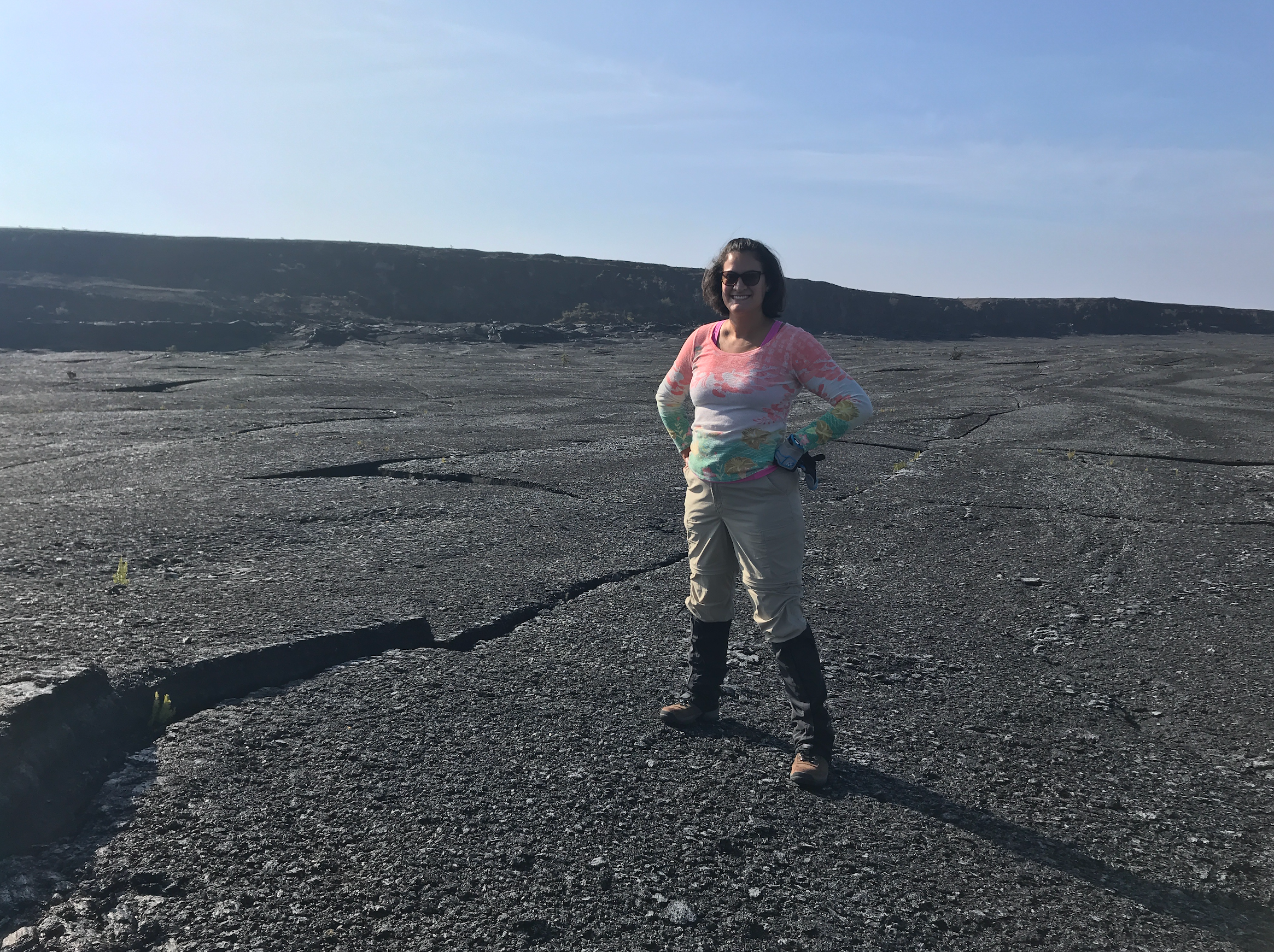
During her NASA career, Santiago-Materese traveled to Hawaii to investigate a planetary analog, a type of terrestrial environment that has very similar characteristics to those we might find on other worlds.
Image credit: Delia Santiago-Materese
At NASA Ames, Santiago-Materese held various roles, ranging from social media and open science to lunar sciences. She then became a program officer for the Solar System Workings program in the Planetary Science Division at NASA Headquarters as part of a detail, or temporary assignment. And then, she took off for Maryland along with her family.
Enabling Science
Santiago-Materese sums up her current role as a program scientist as the “science liaison” between NASA Headquarters and a mission. “When you do program scientist work, you might not be specialized or an expert in the exact science, but you need to be able to understand it and talk about it, to understand its importance,” she explains. “In general, we are supporting other people so they can do science.” In this endeavor, being someone who “gets more energy from working with people” is useful… and necessary: “You are having conversations all day long” with colleagues from different disciplines— from science and engineering to finance.
The Juno mission, in orbit around Jupiter since 2016, and Dragonfly, which is scheduled to launch no earlier than July 2028, are part of NASA’s New Frontiers program. Santiago-Materese also oversees the array of missions in the Discovery program, which includes ongoing science missions like Psyche and Lucy—heading to different asteroids—and future missions to Venus.
For Santiago-Materese, sharing her unconventional path can be valuable for students and youth in general, especially those who are unsure of what they want to do. “Your dream job,” she says, “you might not know it exists, or maybe it doesn’t exist today.” Beyond that, this zigzagging path has led her to accumulate experiences and relationships with different people, which she treasures even as she sets off for her next destination.
An Alien World
About two years out from Dragonfly’s launch, it is no surprise that this robotic mission takes up much of Santiago-Materese’s time. “Dragonfly feels like a combination of all my different experiences over time,” she reflects. And it signifies, to some extent, a return to her roots: it is an astrobiology mission. Although not designed to detect life, Dragonfly will investigate prebiotic chemistry: the chemical processes that could have led to the emergence of life on Earth.
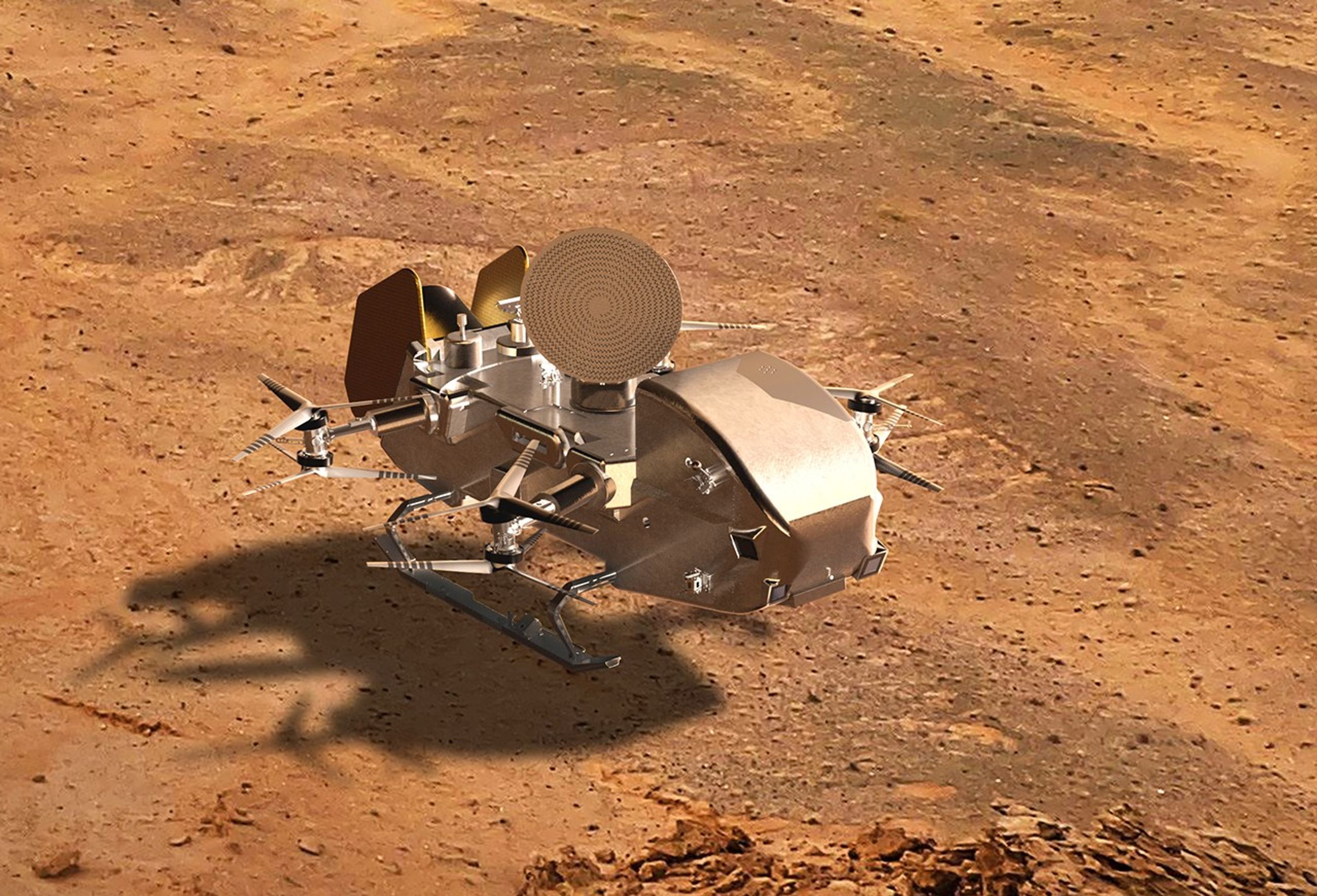
Digital concept of NASA’s Dragonfly lander on the surface of Saturn’s moon Titan.
NASA/Johns Hopkins APL/Steve Gribben
Dragonfly will embark on a journey of about six years to the surface of Titan. The spacecraft will carry an array of science instruments and will be the first NASA science mission to explore another world by flying from location to location. This car-sized rotorcraft will touch down at various geological sites of interest to analyze the moon’s composition and its habitability potential.
When it arrives at Titan, it will encounter a landscape that is strange and familiar at the same time: it could be a window into Earth’s remote past. This frozen world has a thick atmosphere and clouds drifting across the sky; dunes, lakes, rivers, canyons and mountains. Titan even has a process equivalent to our water cycle. However, on Titan, it is not water that flows but hydrocarbons, primarily methane and ethane. “It’s a more methane-based chemistry, so it is very alien, and that is what I really love about Titan,” says Santiago-Materese. And on this moon, organic molecules abound.
These molecules contain carbon and are used by all known forms of life. They are fundamental to understanding the origin of life, as they can be produced by both biological and non-biological processes. On Titan, these organic molecules fall to the surface and form dense deposits over its bedrock of water ice. Scientists believe that the complex chemistry precursor to life could be triggered there if provided with a little liquid water, such as that generated by an asteroid impact.
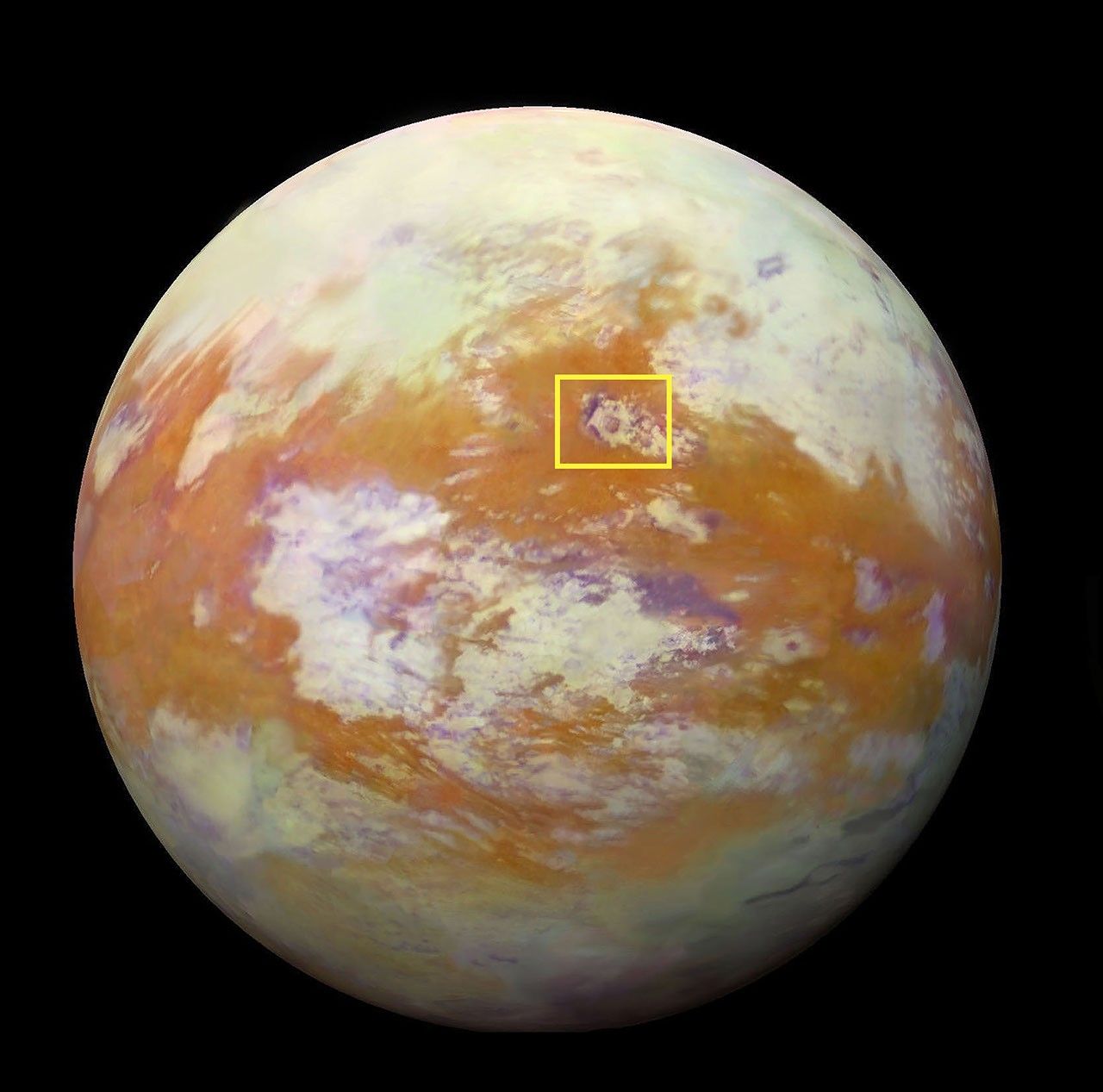
Selk Crater, an 80-kilometer (50-mile) diameter impact site highlighted in this infrared image of Titan, is a key destination for Dragonfly. The rotorcraft will touch down near Selk and explore various sites, analyzing the surface chemistry to investigate the frozen remains of what could have been prebiotic chemistry in development.
NASA/JPL-Caltech/University of Nantes/University of Arizona
Santiago-Materese is especially excited about what the Dragonfly Mass Spectrometer (DraMS) instrument will help discover. DraMS, designed and built at NASA’s Goddard Space Flight Center in Greenbelt, Maryland, will analyze samples from Titan’s surface. “The more complex things get, the more interesting things happen,” she says. “So I’m curious: just how complex do the molecules get? Will we find any interesting patterns?”
But in science, every time you ask a question, a new one arises. Dragonfly will try to answer several of them. “When you have a planet with complex chemistry but not life, what happens? What is there before life?” the program scientist wonders.
Titan, a valuable natural laboratory, “is going to completely change our understanding of what another world can be like,” she anticipates. In addition to what the scientific community expects to discover thanks to Dragonfly, Santiago-Materese is interested in the potential unexpected findings. “There are very defined science goals, but a lot of it is exploratory work,” she explains. “It is kind of nice to know that there is a big range [of possibilities], that we could be very surprised.”
By Noelia González, NASA’s Goddard Space Flight Center, Greenbelt, Maryland
NASA’s Neil Gehrels Swift Observatory is back to studying the universe, even as the aging spacecraft continues to lose altitude and a planned mission to raise its orbit has been scaled back. Two of Swift’s three science instruments are operating again after months of conservation measures designed to reduce atmospheric drag and keep the observatory [...]
A new images from the NASA/ESA Hubble Space Telescope reveals LHA 120-N44, a striking nebula located roughly 160,000 light-years away in the Large Magellanic Cloud, a satellite galaxy of the Milky Way.
The spacecraft carrying European and Japanese scientific probes is completing its eight-year journey and will arrive at Mercury on September 3, where it faces a series of challenging maneuvers to study the scorching planet. The BepiColombo mission was launched from Earth in 2018 on a complex trajectory to investigate the smallest and least-studied planet in […]
At a spry 36-years-young, the NASA/ESA Hubble Space Telescope just keeps on going. The groundbreaking observatory recently took a new image of a sprawling nebula located in the Large Magellanic Cloud (LMC). The LMC is the largest of the small galaxies that orbit our home Milky Way galaxy, and it’s only 160,000 light-years away. Since it is relatively close by, astronomers can more easily observe star birth hot spots like LHA 120-N44 (or N44).
N44 is located in the constellation Dorado. It is dominated by two main features—a large central void and an outer shell made of dense, dusty gas.
The central void is considered a “superbubble,” that spans about 210 by 140 light-years across. N44’s superbubble void was created by the powerful stellar winds and explosive supernovae from the glittery stars at the center.
The shell surrounding the superbubble is made of all of the gas that was expelled when these stars in the void were born. Once the gas was swept away, it compressed and formed a shell around the superbubble. Now, new stars are forming in this compressed gas shell, making it an interesting target for astronomers. They are using N44 to study how stars form in this type of cosmic environment.
“Their goal is to understand how long it takes from the collapse of cold gas clouds into dense knots to the moment nuclear fusion ignites in the heart of a newborn star,” NASA writes.
The gas shell surrounding N44’s superbubble has intrigued astronomers for over half a century. It is energized by ultraviolet radiation from massive stars, which makes it glow and highlights several distinct features. In the 1950s, astronomer Karl Henize first catalogued the distinct features within the nebula’s star-forming complex.
One feature is a smaller bubble (cataloged as N44F). It is an interstellar bubble blown by the intense stellar winds coming from one hot and massive star and is located in the upper-right corner of the new image.
This Hubble Space Telescope image features the picturesque nebula LHA 120-N44, or N44. The interstellar bubble N44F is at the top right corner. Image: NASA, ESA/Hubble, D. Gouliermis.
This Hubble Space Telescope image features the picturesque nebula LHA 120-N44, or N44. The interstellar bubble N44F is at the top right corner. Image: NASA, ESA/Hubble, D. Gouliermis.
The data used in this image is from observing program #14689; PI: Gouliermis. It used Hubble to survey N44 and take a census of its stars, cataloguing roughly 500,000 stars within the cluster, and some interlopers drifting in front of the nebula. Of the stars the team surveyed, roughly 30,000 are what astronomers call pre-main-sequence stars. These baby stars have not begun to fuse hydrogen into helium in their cores. Hubble’s highly-sensitive instruments were able to pick out faint objects in crowded clusters to find these young stars at work.
NASA’s Hubble Space Telescope has glimpsed a strange ten-sided atmospheric wave at Saturn’s south pole, the first regular-sided jet pattern ever observed there.
In a recent paper published in Science Advances, researchers examined Saturn’s peculiar decahedron, detecting signs of an entirely new atmospheric phenomenon for the gas giant. A similar hexagon-shaped wave resides at Saturn’s north pole but differs in noticeable ways.
Years of Hubble observations from 2023 to 2025 allowed the team to trace subtle hints that they eventually resolved into the decagonal wave at Saturn’s south pole.
Observing the Solar System
“We’ve never seen anything quite like this in Saturn’s southern hemisphere,” said co-author Amy Simon, OPAL principal investigator, at NASA’s Goddard Space Flight Center in Greenbelt, Maryland. “The northern hexagon has been there every time we’ve looked for more than 40 years. This feature is different — it appears to be strengthening, giving us the rare opportunity to watch a giant atmospheric pattern develop.”
Since its 1990 launch into low Earth orbit, the Hubble Space Telescope has been observing our solar system, uncovering new details about our planetary neighbors. One such project is the Outer Planet Atmospheres Legacy (OPAL) program, which began collecting data with observations of Uranus in 2014 and now provides the crucial evidence for this discovery, with high-resolution images that resolve murky hints from ground-based observations.
As Saturn’s seasons changed, its south pole came into alignment with ground-based observatories. In images from those telescopes submitted to the Planetary Virtual Observatory Laboratory, amateur astronomers Trevor Barry and Jean-Paul Oger, along with Agustín Sánchez-Lavega of the University of the Basque Country in Spain, noticed something interesting happening on the gas giant.
Since 2023, the decagon has continued to develop in what scientists believe may be a new atmospheric pattern on Saturn. Credit: NASA, ESA, STScI, Agustin Sánchez-Lavega (UPV), Amy Simon (NASA-GSFC), Michael Wong (UC Berkeley); Image Processing: Alyssa Pagan
A Strange Band on Saturn
The researchers spotted an undulating band along Saturn’s south pole, which, in further 2025 ground-based telescope images, began to suggest a decagonal (ten-sided) structure. With its incredible image clarity and spatial resolution, Hubble’s imagery finally allowed researchers to resolve the decagonal shape with certainty.
“Given Saturn’s symmetry in its north-south jet stream system, we have been searching for a counterpart to Saturn’s northern hexagon on the south pole in Hubble images since 1990,” said lead author Agustín Sánchez-Lavega of the University of the Basque Country in Spain. “Images from NASA’s Cassini spacecraft, which orbited Saturn between 2004 and 2017, showed no inkling of a long-lived formation, either. The Hubble data confirmed the feature’s presence back to 2023.”
The wave is an interesting three-dimensional feature that extends through multiple layers of the atmosphere within one of the planet’s jet streams. Because Hubble can image the planet in multiple wavelengths, the decagon’s location appears to shift between observations, as each wavelength penetrates the atmosphere to a different degree.
Questions About Saturn
“The most intriguing part to me is that this seems to have just formed recently,” said Simon. “The question is, why did it suddenly form now when we haven’t seen one before?”
Recognizing Saturn’s decagonal wave is only a first step. Follow-up observations to collect more data and computer models to piece together what is occurring on the planet will be required to firmly grasp the phenomenon. Questions remain about how it formed, how long it may last, and how similar it is compared to the northern hexagonal wave.
One thing the team will be sure to watch for in their continued observations is whether the shape evolves or maintains its decagonal structure. Their continued work could provide important new insights into how atmospheric dynamics operate on gas giants and what they can reveal about our own planet’s atmospheric phenomena.
Ryan Whalen covers science and technology for The Debrief. He holds an MA in History and a Master of Library and Information Science with a certificate in Data Science. He can be contacted at ryan@thedebrief.org, and follow him on Twitter @mdntwvlf.
For almost five decades, Saturn’s north pole has been famous for hosting a bizarre, six-sided jet stream known as the hexagon, a feature first spotted by NASA’s Voyager spacecraft in the 1980s and still churning today.
NASA has decided to use a simpler spacesuit for its initial missions to the lunar surface, Ars has learned.
The agency announced the decision during an internal meeting this week as it seeks to accelerate its program to land humans at the south pole of the Moon as early as 2028. At the direction of Artemis Program Manager Jeremy Parsons, NASA will work with Axiom Space to develop a "Sortie Suit" variant of the planned spacesuit for the lunar surface.
Sources said the Sortie Suit will be used for the initial landing missions flown on landers developed both by SpaceX and Blue Origin. Among the goals of the initiative are to lower the mass of the spacesuit, reduce its complexity, and simplify interfaces between the spacesuits and lunar landers.
In November of last year, scientists warned of a “severe” solar storm, the strongest in over two decades, colliding with the Earth.
Solar storms are the result of a surge in solar activity, with the Sun unleashing a barrage of charged particles that can trigger spectacular auroras — and wreak havoc with communications satellites and radio signals — when they reach the Earth’s magnetosphere.
Beyond being ferocious enough to delay the launch of a Mars-bound NASA spacecraft, the storm wreaked absolute havoc with GPS systems back on the ground for hours at a time. As detailed in a new paper published in the journal Geophysical Research Letters, a team of scientists found that global navigation satellite systems experienced “significant positioning errors” of over 33 feet during the superstorm, “large enough to disrupt precision agriculture and autonomous transportation industries” across the continental United States.
That’s enough risk to warrant a careful study on these types of events can impact human activity on Earth.
“The results underscore the importance of accurate understanding of various space weather phenomena to enhance our predictive capabilities through coordinated observations and physics‐based modeling and ultimately reducing disruptions to RF applications during space weather events,” the paper reads.
The researchers analyzed observations from several scientific instruments spread out across the US to watch the chaos unfold last November. The Aurora Oval, a ring-shaped area of pronounced activity around the Earth’s geomagnetic north pole where auroras conventionally occur, was pushed south toward the equator. This triggered a “horizontally extended band of intense density gradients” in the upper atmosphere, causing fluctuations in how long signals take to travel through it.
The result: “significant positioning errors at mid-latitudes,” the researchers noted.
The researchers also found that as the auroras became brighter, the observed irregularities became more intense, deteriorating GPS accuracy accordingly.
Fortunately, while farming equipment like GPS-equipped tractors would’ve likely been affected, the November storm occurred long after the farming season concluded.
“Had the November superstorm occurred during the farming season in the American sector, it could have caused significant economic losses for the American farming industry, in addition to affecting the autonomous transportation industry,” the paper reads.
Perhaps the biggest question going into the Artemis II mission this spring was how the heat shield at the base of the spacecraft would perform during reentry through Earth's atmosphere.
The ablative heat shield, designed to char upon reentry while keeping the crew safe, had experienced unexpected losses of large chunks during a test flight in late 2022. After much deliberation, and not without controversy, NASA decided to fly the Artemis II heat shield as is but modify the spacecraft's reentry trajectory.
Obviously, the heat shield worked. The crew of Artemis II, led by commander Reid Wiseman, safely splashed down in the Pacific Ocean after a triumphant trip around the Moon. Afterward, they and other NASA officials offered general comments, saying the heat shield looked good.
Searching for Another Earth with the Nancy Grace Roman Space Telescope
In NASA’s mission fact sheet, Roman’s planners pose several questions. These include:
How common are solar systems like our own?
What kinds of planets exist in the cold, outer regions of planetary systems?
What determines the habitability of Earth-like worlds?
Although scientists have used several methods to detect exoplanets, including Earth-like planets, Roman will employ three. These include the transit method, microlensing, and direct imaging. NASA said the combination of approaches will allow mission scientists to conduct a “sweeping search expected to uncover around 100,000 new exoplanets — a staggering leap compared to the nearly 6,200 currently known.”
“It is hoped that Roman will discover thousands of new exoplanets and significantly expand our knowledge of the diversity of planetary systems in our Galaxy,” explained Associate Professor Edita Stonkutė, an astrophysicist at Vilnius University unconnected to the Roman team, in a statement emailed to The Debrief.
Microlensing Can Reveal Earthlike Planets Orbiting Sunlike Stars
Most exoplanets have been detected by the dimming of their host star when they transit between it and Earth, giving the transit method its name. Roman plans to use that same method for most of its larger planetary detections. However, among the expected tens of thousands of transit-method detections, mission planners expect a small but sizeable percentage to come from microlensing.
NASA said the “light-bending” microlensing phenomenon occurs when two distant stars “align closely from our vantage point.” Due to the strength of the nearer star’s gravity, the light from the more distant one is “warped” around the nearer one, essentially focusing it very briefly for a distant observer.
“If the alignment is especially close, the nearer star acts like a cosmic lens, focusing and magnifying light from the background star.” Professor Stonkutė explained. “By analysing these changes, astronomers can determine that the planet exists and estimate its mass and orbital characteristics.”
Critically, Professor Stonkutė also noted that microlensing can occur with objects other than stars, including exoplanets.
“This is Precisely Where Roman Has the Edge”
Using its Wide-Field Array, Roman will monitor hundreds of millions of stars. NASA said the observatory will monitor these target stars for “tiny surges in starlight” that typically signal a microlensing event.
Although the transit method is employed to detect larger exoplanets, NASA noted that microlensing “specializes in finding planets like those in our solar system.” The space agency added that this includes “worlds as lightweight as Mars in their star’s habitable zone or farther out.”
A star’s habitable zone is typically defined as the orbital plane where an exoplanet could sustain liquid water on its surface, a key ingredient for life as we know it.
Professor Stonkutė described microlensing as “particularly valuable” since it can detect planets that are difficult to spot with other planet-hunting methods. The professor said this includes “small Earth-like planets located far from their star.” The Roman team hopes to find “more than 1,000 microlensing planets.”
The professor warned that “most microlensing events cannot be predicted in advance.” As a result, telescopes need to actively scan large areas of the sky to increase the chances of a microlensing detection
“This is precisely where Roman has the edge over other telescopes that have searched for exoplanets using different methods,” the professor added.
A “Stepping Stone” Toward NASA’s Habitable Worlds Observatory Concept
While Roman is tasked with directly imaging exoplanets, finding another Earth around a Sun-like star will still require an indirect detection, most likely from a microlensing event. However, the Roman team notes that their observatory “will provide a crucial stepping stone for NASA’s Habitable Worlds Observatory concept.”
According to the space agency, that “flagship” telescope, still awaiting final approval, “would be designed to photograph Earth-like planets for the first time ever.”
Roman may also be able to scan the atmospheres of planets detected with the transit method. The space agency said Roman “would also look for signs of life called biosignatures by measuring atmospheric gases like oxygen and ozone that could signal the presence of living things.”
Christopher Plain is a Science Fiction and Fantasy novelist and has spent the last six years as Associate News Editor and Head Science Writer at The Debrief. Follow and connect with him on X, learn about his books at plainfiction.com, or email him at christopher@thedebrief.org.
For the first time in more than 30 years, NASA has no firm plans to send any new landers or rovers to Mars. Instead, the agency's near-term focus at the red planet is on aerial drones, a pioneering mode of exploration that didn't seem realistic until a few years ago.
The first real use of drones for science at Mars will come with the SkyFall mission, a fleet of three helicopters set for launch as soon as late 2028. SkyFall's helicopters will ride to the red planet with NASA's Space Reactor-1 "Freedom" mission, which has the primary objective of demonstrating nuclear electric propulsion in deep space.
The launch schedule is aggressive for SR-1 Freedom and SkyFall, projects that didn't even exist in NASA's portfolio six months ago. NASA's plan for the SR-1 Freedom mission, estimated to cost $2.1 billion, calls for repurposing the core module of the canceled Gateway lunar space station into a testbed for nuclear electric propulsion. SkyFall will build on NASA's success with the Ingenuity helicopter, an experimental vehicle that became the first rotorcraft to fly on another world in 2021.
NASA's $4.3 billion Nancy Grace Roman Space Telescope, equipped with a 300-megapixel camera sighted through a refurbished spy mirror, launched Sunday from Kennedy Space Center in Florida on a mission to reveal the mysterious forces driving the Universe.
The new mission will extend the vision of NASA's other famous observatories, providing a field of view 100 times wider than the Hubble Space Telescope and complementing the groundbreaking work of the James Webb Space Telescope. Roman is just the second NASA-led astrophysics mission to launch this century, following the launch of Webb in 2021.
Unlike Webb, which suffered many years of delays before reaching space, Roman arrived at the launch pad nine months before NASA's commitment to send it skyward by May 2027.
As is standard procedure for major NASA missions, the US space agency held a post-launch news conference on Sunday morning at Kennedy Space Center in Florida to provide information about how the Nancy Grace Roman Space Telescope was faring during its initial maneuvers.
What was not standard, however, is what happened in the middle of the news conference. A little less than half an hour in, NASA Administrator Jared Isaacman looked down at his mobile phone, and then stood up and walked away from the dais where he had been seated behind a table along with other NASA officials. He briefly left the room.
Isaacman returned about a minute later, phone in hand, apologizing for interrupting NASA's chief of science, Nicky Fox, as she was speaking about the mission. "The President of the United States of America would like to address and congratulate everyone on this mission," Isaacman said, returning to his seat.
When NASA announced that the new Nancy Grace Roman Space Telescope will perform its science duties from a point in space known as Lagrange 2, many observers noted that the space agency’s current state-of-the-art space observatory, the James Webb Space Telescope, shares this same orbital location.
Due to the extremely sensitive nature of both satellites and their sensors, and the irreplaceable scientific value they will provide in the future, it might seem natural to wonder whether these two space observatories are at risk of a deep-space collision.
Fortunately, that’s a very unlikely prospect, and here’s a look at all the space separating Roman and Webb—and how NASA will ensure the two observatories remain safely apart.
Nancy Grace Roman Space Telescope Heading for Lagrange 2
Many scientific satellites reside a little over 200 miles above Earth in an orbital plane called Low Earth Orbit (LEO). This proximity enables communication with Earth and offers the potential for future servicing missions.
For example, NASA’s groundbreaking Hubble Space Telescope orbits LEO at about 300 miles above Earth. This proximity enabled servicing missions that have kept Hubble delivering valuable scientific data for over three and a half decades since its 1990 launch. Still, LEO also limits which missions Hubble can undertake.
More recently, NASA launched JWST. However, unlike Hubble, Webb rocketed roughly one million miles from Earth before arriving at Lagrange 2. According to a NASA fact sheet detailing the Roman Space Telescope’s mission, this location offers several benefits over LEO.
“At L2, the gravity of the Sun and Earth, together with an object’s motion around the Sun, let it stay lined up with Earth as they orbit,” NASA explains, “allowing Roman to have a relatively steady orbit without using much fuel.”
NASA also notes that heat from Earth, the Sun, and the Moon has less impact on infrared telescopes designed to “see” heat. L2 also offers JWST and Roman, “a constant, unobstructed view of a wide swath of the sky.”
“Earth won’t block much of Roman’s view since it will be so distant,” NASA explains.
Is There a Danger of a Roman-JWST Collision?
Instead of sitting still at the heart of L2, NASA notes that Webb “traces out a large orbit around the actual L2 point.” For comparison, the space agency noted that JWST’s orbit around L2 is “much larger than the Moon’s orbit around Earth.”
Like Webb, the Nancy Grace Roman Space Telescope is also destined for L2. The new space telescope will also trace out an orbit around L2 rather than remaining comparatively stationary.
Because of the wide orbits of both spacecraft and the efforts of the mission’s controllers, NASA said the two valuable space telescopes “will easily be kept far apart.”
Five-Year Mission Could Stretch to Ten or Beyond with Refueling
Like previous NASA missions, Roman will have a primary lifetime and a backup plan if the observatory remains viable after the first mission ends. For Roman, both the primary and secondary missions are slated for five years, bringing the observatory’s planned potential lifetime up to a possible ten years.
Notably, several NASA missions have continued to deliver scientific data well beyond their planned primary and secondary missions. Perhaps the most famous example is Voyager 1. Launched in 1977, the interplanetary mission has since left the solar system and continues to return data from beyond the heliopause, an area of deep space over 14 billion miles from Earth.
When discussing what obstacles may result in a shorter mission profile, NASA said that “fuel is expected to be the mission’s life-limiting resource.”
“While NASA does not currently have an ability to service observatories at L2, Roman is designed to be refuellable,” they added.
Christopher Plain is a Science Fiction and Fantasy novelist and has spent the last six years as Associate News Editor and Head Science Writer at The Debrief. Follow and connect with him on X, learn about his books at plainfiction.com, or email him at christopher@thedebrief.org.
During a visit to Johnson Space Center, President Trump on Friday signed an executive order to establish a new commission with the purpose of creating the first national space academy.
"It's clear that we will need to educate and train an entire generation of skilled service members, engineers, and civil operators, and everything else to do what we have to do," Trump said. "I will sign an executive order to begin the process of creating a new national academy. It's called the US Space Academy. That's a big deal."
The proposed United States Space Academy would fall under the jurisdiction of NASA, and according to US space officials, is not intended be a traditional service academy in the sense that it educates and trains officers for the armed services, such as the Air Force Academy.

 Login