The mathematical universe is boundless and heterogeneous, encompassing, over here, truths about numbers and equations; there, the logic of shapes and spaces; and over there, the study of change and probability. Its domains have grown organically over centuries, each centered around its own objects, methods, and questions. That’s why it’s so surprising when direct connections between different…
OpenAI said Tuesday that one of its unreleased artificial intelligence models had solved a mathematical puzzle that has eluded mathematicians for generations, a claim that also drew a fight with rival researchers over credit.
OpenAI said Tuesday that one of its unreleased artificial intelligence models had solved a mathematical puzzle that has eluded mathematicians for generations, a claim that also drew a fight with rival researchers over credit.
Company behind ChatGPT says 10,000 of its AI systems cracked the Navier-Stokes problem in 88 hours
OpenAI claims to have solved a major mathematics problem that has stumped humans for nearly a century after spending millions of dollars on the artificial intelligence-led endeavour.
The company behind ChatGPT said it had cracked the Navier-Stokes problem, one of seven Millennium Prize Problems published by the Clay Mathematics Institute to highlight some of the biggest unsolved puzzles in the field.
Jacob Tsimerman, a recent recipient of the Fields Medal, believes that higher mathematics can help curb the dangers of runaway artificial intelligence.
On the morning of Tuesday, September 8, mathematicians at OpenAI announced that a group of 10,000 autonomous AI agents under their direction, running on an advanced model not available to the public, had found a “singularity” in the Navier-Stokes equations in three dimensions — thus resolving one of the six remaining Millennium Prize Problems posed in 2000 by the Clay Mathematics Institute…
Over dinner at a gaming convention around 2010, board game designer James Ernest turned to his friend Eric Harshbarger and asked a question: Could you design a set of dice so that each player in a group — whether two people or any number — could grab one, roll and have a perfectly equal shot at going first? The rule is simple: Roll your dice, and whoever lands the highest number goes first. The hard part is making that outcome truly fair for every player, no matter how many are at the table.
There could be no ties and no rerolls.
Harshbarger, a mathematician at Auburn University in Alabama, didn't have an answer that night. But the question stuck. Over the next 15 years, he and a loose network of collaborators casually worked to crack what became known as the "go first dice" problem.
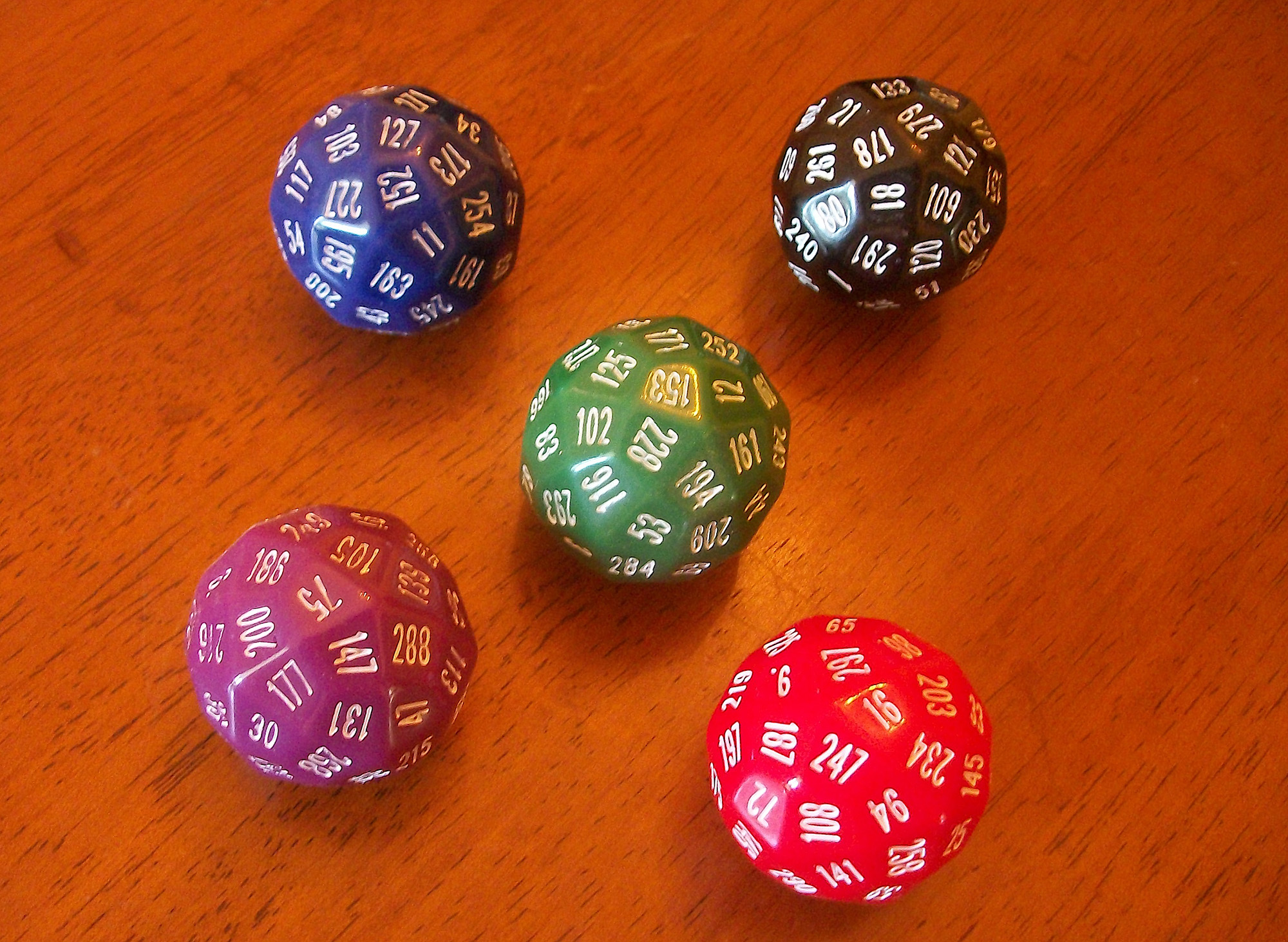
Now, they finally have the answer: a set of five 60-sided dice, collectively engraved with every number between 1 and 300, with no repeats. To mark the achievement, Harshbarger built five giant, wooden replicas of these hexecontahedrons (60-sided 3D shapes), each carved from a different type of wood. They are now on permanent display in Auburn's new mathematics building.
The problem with dice
To understand why it was so hard to crack the problem, it helps to understand the simple part.
"The easy thing is to avoid ties; you just put different numbers on all the dice," Harshbarger told Live Science. "The problem comes in how you distribute those different numbers across the dice so that the probability is equal not only for the whole set but for any subset."
That second condition is what makes the problem devilish. Ernest's request wasn't just that eight players could roll fairly; it was that any subset of players could grab any dice from the bag roll and still have equal odds. If five people are playing, each takes a die. Three people? Same thing. The numbers on each die had to be arranged so that the fairness held no matter how many people showed up to play.
Harshbarger looped in his childhood friend Robert Ford, a mathematician at Dalton State College. Within weeks, they had a three-player solution: numbers 1 through 18, spread across three standard six-sided dice in exactly the right arrangement. Four 12-sided dice, Ford later worked out entirely by hand, could accommodate four players fairly.
By 2012, Harshbarger was giving talks about the four-player set at math conferences, and The Guardian covered the story. His inbox erupted. He started selling handmade sets from home — buying blank, 12-sided dice; etching numbers onto each face with a laser cutter in his workshop; and then inking every number by hand. At his peak, he was dropping off 30 envelopes at the post office at a time, several times a week, shipping sets to customers around the world.
But as the team dug deeper into the math, they discovered that the dice were doing something even more remarkable than they'd realized: The configurations determined not only who went first but also the entire turn order, with every possible sequence of players equally likely to come up.
"If four people rolled, the chance that players finished in the order A, B, C, D was just as likely as C, B, D, A, or any of those combinations," Harshbarger said. "'Go first dice' is actually a bit of a misnomer, because they do much more than just determine who goes first; they actually determine the ordering of all the players."
This property, which the team calls permutation fairness, became the standard they chased for every set of dice from that point on.
More combinations than atoms in the universe
Four players was one thing. Five was another entirely.
Mathematically, the team knew a five-player same-shape set was feasible. But finding it meant searching an incomprehensibly large space of possible number arrangements.
"We're talking literally more than the number of atoms in the universe — like 10 to the 128th power combinations," Harshbarger said. "There's just no way, even if we had a billion billion years and all the computers, all the AI. We still couldn't do it today."
They couldn't brute-force their way to an answer. They needed mathematical shortcuts: symmetries and patterns to shrink the search space. But even then, years passed without a practical solution. Every path they found hit the same wall: dice too large to hold, too many sides to manufacture.
"My goal was a set for five players that can actually be manufactured, that you can hold in your hand, that board gamers could buy and roll," Harshbarger said. "Even for a problem that is silly and pointless as far as gameplay — just mathematically, can you buy these things and roll them, and they work? You can't do that with 180-sided dice."
The five go-first dice, each with 60 sides, are designed so that any subset of players can grab one, roll and have an equal chance of winning. Each of these dice carries a unique set of numbers from 1 to 300. (Image credit: Eric Hashbarger )
Then, in mid-2023, Canadian software engineer Paul Meyer emailed Harshbarger out of the blue. He had been studying patterns in Harshbarger's four-player data and had written a program to exploit them. He hadn't expected it to work right away.
It did. Meyer found a configuration offive 60-sided dice that satisfied every condition.
"I double-checked his work and went, 'Oh my goodness; we've been searching for so long for this. This is amazing,'" Harshbarger said.
The four-player set had long since been picked up by retailers —Maths Gear in the U.K. andMath Art Fun in the U.S. — so Harshbarger had stopped hand-making those years earlier. Now, the five-player version was real and small enough to manufacture.
But the story had one more turn. Auburn University was building a new home for its mathematics department and was looking for sculptural ideas to fill it. Harshbarger proposed building giant versions of the five new dice out of wood. The department agreed.
He spent months in his wood shop, constructing five oversize dice. Each is from a different type of wood: pine, poplar, oak, walnut or mahogany. The five sculptures now stand inAuburn's new math building, which opened this fall.
For Harshbarger, the whole point is making math impossible to walk past.
"When people see giant dice or little dice, they're fascinated just by the geometry," he said. "The hope is, they see these things and go, 'Oh, this is math too, and this is interesting.' Some of the most fun math problems are ones that are easily understood and not easily answered."
For the first time, physicists have measured the tiny quantum shift an object acquires by falling through Earth's gravity — an effect of Einstein's relativity that was predicted almost a century ago but never observed.
Researchers placed ultracold rubidium atoms into a superposition, a quantum state in which a single particle takes two paths at once. In this experiment, one path put the atom in free fall while the other kept it motionless. Recombining the atoms revealed an almost imperceptible difference between the two paths.
The measurement, published Sept. 2 in the journalScience Advances, shows that Einstein's equivalence principle — the idea at the heart of general relativity — still holds when it is pushed into the quantum world, creating a small but tantalizing link between relativity and quantum mechanics.
"The principle says that acceleration and gravity cannot be distinguished locally," Vlatko Vedral, a physicist at the University of Oxford and a co-author of the new study, told Live Science via email.
Einstein's happiest thought
The classic illustration of the equivalence principle is a thought experiment known as Einstein's elevator. A person sealed in a windowless elevator cannot tell whether the floor is pressing against their feet because the elevator is parked motionless on Earth or because it is being accelerated through empty space. Einstein called that realization the "happiest thought" of his life and built general relativity around it.
For heavy, everyday objects, the equivalence principle has been tested to extraordinary precision. Quantum objects are a different matter. They behave like waves, and each wave carries a quantity called phase — essentially, where its crests and troughs sit. Phase cannot be seen directly, but when two versions of the same particle are recombined, any mismatch between their phases shows up as an interference pattern. The two waves reinforce each other in some places and cancel each other out in others, thereby changing the odds of where the particle turns up.
Theory says that a wave in free fall should build up phase relative to an identical wave held still and that this phase should grow with the cube of the falling time. Therefore, doubling the fall time multiplies the effect eightfold. Charles Galton Darwin, a grandson of the famous naturalist, and Earle Kennard both documented this prediction in 1927 — but no one had measured it until now.
An atom that falls and stays still at once
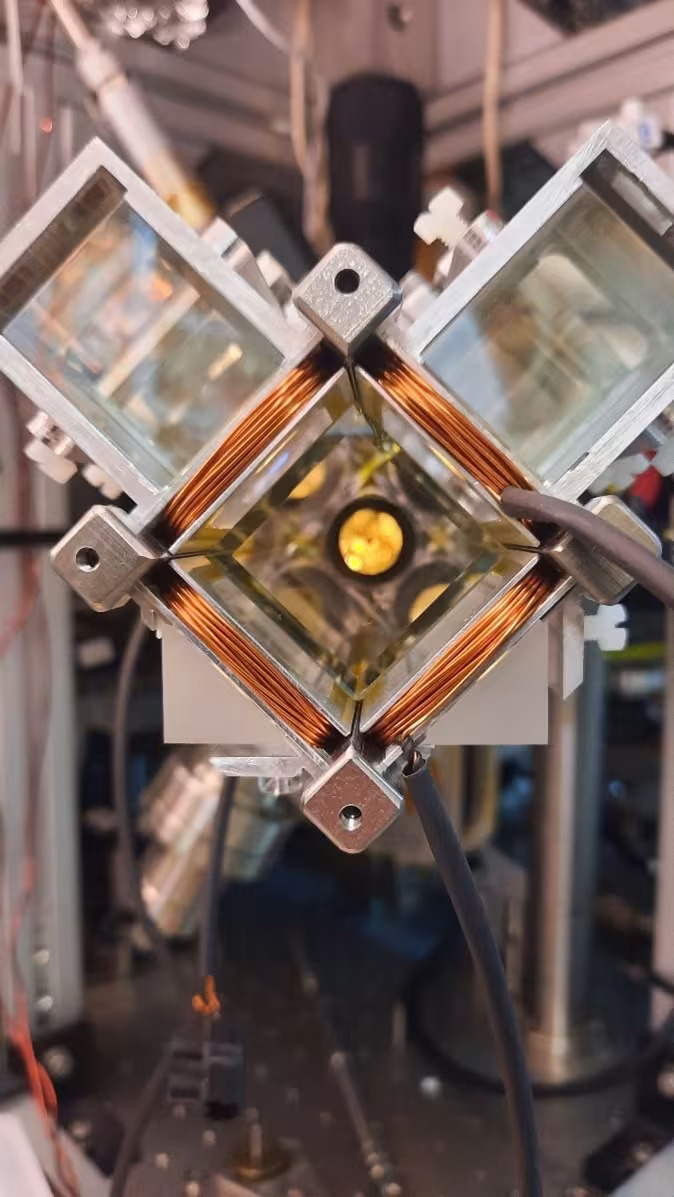
This apparatus, called 2D MOT, feeds the science chamber with cold atoms. (Image credit: Or Dobkowski)
Catching the effect required an instrument with one arm genuinely at rest with respect to Earth and the other in genuine free fall — something no previous experiment could supply. Matter-wave experiments going back to the neutron interferometry of the 1970s had measured gravity in other ways, but never with that pair of trajectories.
The team behind the new study, led by physicistRon Folman at Ben-Gurion University of the Negev in Israel, chilled roughly 20,000 rubidium atoms into anexotic state of matter called a Bose-Einstein condensate, released them from their magnetic trap and ran the interferometer about 113 micrometers beneath an "atom chip" patterned with gold wires only 2 micrometers thick.
Radio and microwave pulses put each atom into a superposition of two magnetic states. A magnetic kick launched one of them upward, and a fraction of a millisecond later, a second pulse made that half insensitive to magnetic fields so that it rose and fell under gravity alone. The other half remained magnetically sensitive and felt a force tuned to cancel gravity exactly, leaving it suspended in place.
At the top of the arc, the two halves of a single atom stood about 7.5 micrometers apart — about seven times the width of the atomic wave itself — before the sequence was reversed to bring them back together. The team named the device the quantum Galileo interferometer, after the scientist who first argued that all objects fall at the same rate.
"Two different accelerations can be superposed, zero [acceleration] and the Earth's gravitational acceleration, and the resulting quantum interference measured," Vedral said.
A phase predicted almost 100 years ago
The researchers tracked the interference signal as they stretched the free-fall time to about 2.4 milliseconds. Across 633 runs over 5.3 hours, they recorded 13 complete oscillations, each one a full cycle of phase built up between the two halves of the atom. The growth followed the cube of the falling time, matching the theoretical model to within about 2.5%.
"The phase between the two elements of the superposition, which grows as the cube of the duration of the experiment and which was predicted a long time ago, in 1927, has now finally been observed for the first time," Vedral said.
The result matters because the same phase can be derived in two completely different ways: One treats gravity as a force acting on a quantum wave; the other moves into the falling frame, where gravity vanishes, and invokes the equivalence principle. Both give the same answer, and that agreement is what allows quantum mechanics and general relativity to coexist.
"They tell us that, at this level of accuracy, there is no conflict between quantum physics and gravity," Vedral said. "In other words, the equivalence principle is perfectly compliant with quantum mechanics."
The difficulty of bringing the two halves back together
The hardest part of the experiment was the recombination. Because the two halves of the atom end up moving at very different speeds, returning them to overlap in both position and motion is extremely demanding. Physicists Marlan Scully, Berthold-Georg Englert and Julian Schwinger named the problem the "Humpty-Dumpty effect." The magnetic fields also curve across the atom cloud, distorting the two halves in different ways.
The contrast of the interference fringes started at 80% for short runs and faded to 20% for the longest run, setting a practical ceiling on how long the experiment can run. The authors also cautioned that their measurement does not rule out every theory in which the equivalence principle breaks down, because some of those theories predict the same phase.
The team now wants to test the equivalence principle under more general conditions, such as the "same experiment in a rotating frame," Vedral said. "Even more interestingly, performing an experiment in which two such systems are superposed and can gravitationally affect one another" would further test the results, he added.
That last idea points toward one of the field's central open questions. Scaling up the technique from atoms to far heavier objects, such as nanodiamonds, would let physicists ask whether gravity itself follows quantum rules and would open a route to testing the conjecture — championed by study co-author and Nobel laureate Roger Penrose — that gravity is what destroys quantum superpositions in the first place.
Mathematicians are witnessing a profound shift in their field. AI systems are now producing proofs, spotting connections between distant fields, and, in a few cases, solving problems that had stumped mathematicians for decades. The pace of progress over the past several months has raised challenging questions: What can AI systems actually do? And what happens to the more human…
Every second of every day, Earth is bombarded by particles from outer space. Some of these particles are obstructed by our planet's atmosphere but can spray down other particles, while others can zoom through the atmosphere and easily pass through anything, including us.
You won't feel these particles darting through you, but it raises a question: How many cosmic particles are actually passing through your body at any moment?
The most common particles that stream through us from outer space are ghostly specks known as neutrinos. "An estimated 100 trillion neutrinos pass through each of us every second," Michael Pravica, a professor of physics at the University of Nevada, Las Vegas, told Live Science.
Neutrinos barely interact with regular matter. Nearly all of them pass through us and the rest of the planet without leaving a trace. "The fact that most of these particles never interact with us demonstrates that there is an underlying reality to our existence, much of which we are not even aware of," Pravica said.
Neutrinos originate from nuclear activity. Nearly all of the neutrinos zipping through us come from the nuclear fusion reactions that power the sun, although some neutrinos originate much farther away, even other galaxies, Lu Lu, an assistant professor of physics at the University of Wisconsin-Madison, told Live Science.
Cosmic rays are mostly either protons, which are the nuclei of hydrogen atoms, or the atomic nuclei of heavier elements (which contain both protons and neutrons), such as helium or iron. Electrons and positrons (the antimatter counterparts of electrons) also make up a tiny fraction of cosmic rays.
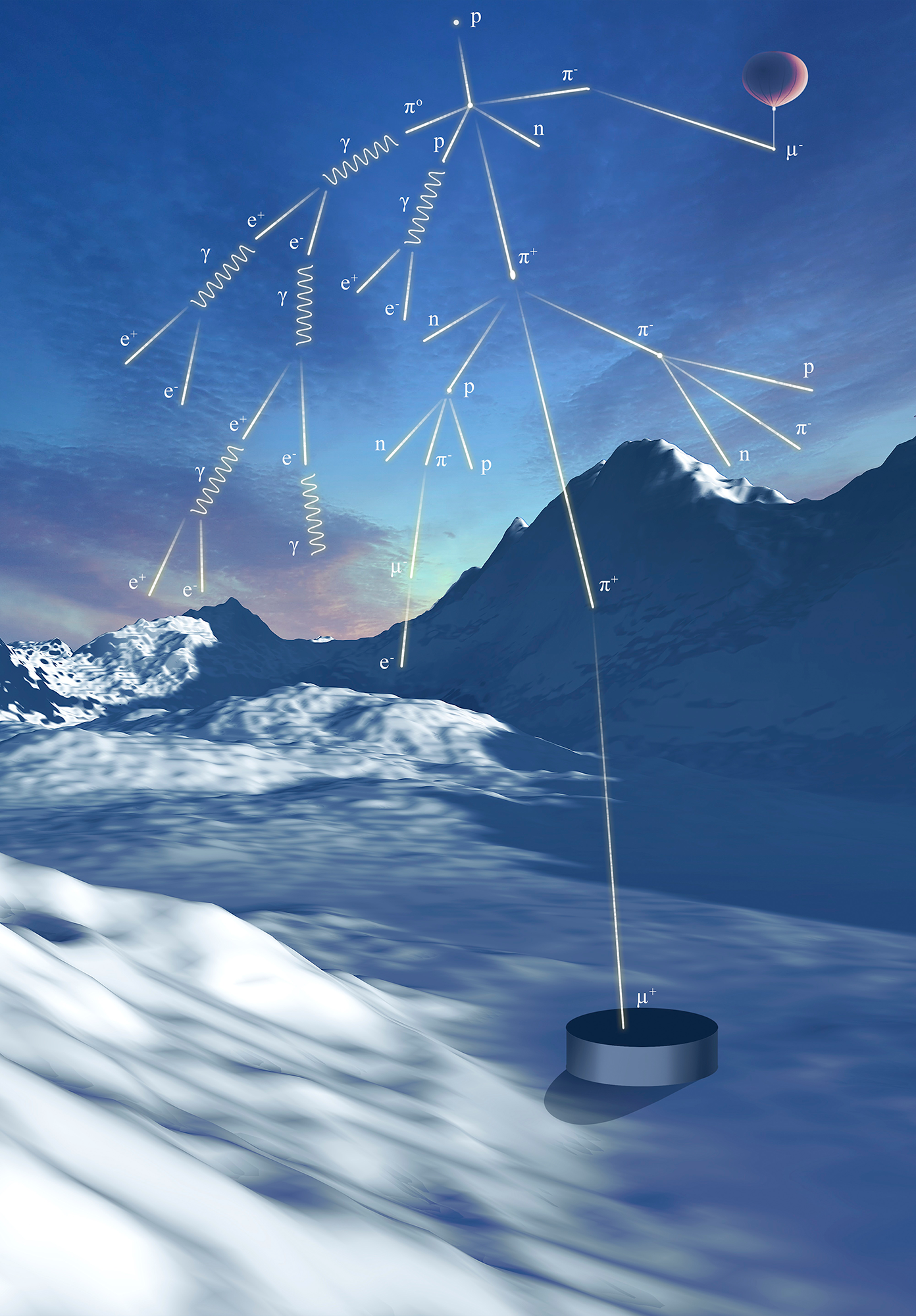
When cosmic rays hit Earth, they are generally blocked by molecules of air high in our planet's atmosphere, Lu said. However, these collisions can generate showers of secondary particles that make it to the ground. These include muons, which are negatively charged subatomic particles that are much like electrons except more than 200 times more massive.
At sea level on Earth, about one muon passes through per 0.15 square inch (1 square centimeter) per minute, Lu said. "For a person, the number ranges from tens to hundreds per second," she noted. "Roughly one or two pass through a hand each second."
Because muons are electrically charged, they can interact with matter they encounter. "Their paths can be made visible in a cloud chamber," a box of vapor in which a trail of mist can be seen when a charged particle streaks through the vapor, Lu said.
In contrast, neutrinos are not electrically charged. They also have almost no mass. These two qualities make it very difficult to detect neutrinos, which is why they're often dubbed "ghost particles."
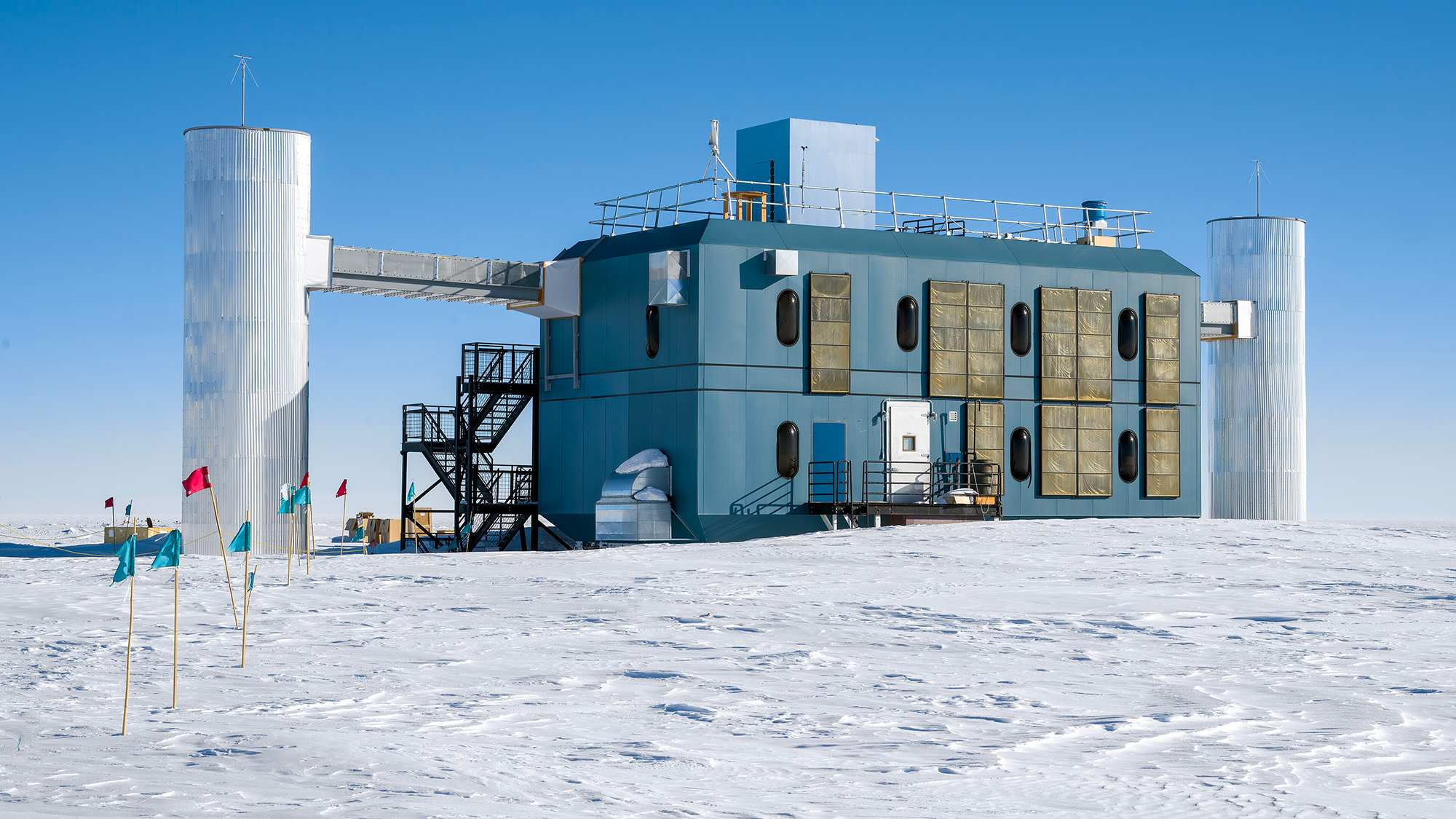
The IceCube Neutrino Observatory in Antarctica. (Image credit: Christopher Michel, CC BY-SA 4.0)
Detecting cosmic particles
Scientists estimate the number of neutrinos that pass through our bodies by recording "the tiny fraction that happen to collide with matter inside or close to a detector," Lu said. "Everything else follows by working backward from those few."
For instance, the IceCube Neutrino Observatory in Antarctica surrounds 0.24 cubic mile (1 cubic kilometer) of ice with thousands of light sensors. "When a neutrino interacts with an atomic nucleus in the ice, it produces fast-moving charged particles, and those particles emit a faint flash of blue Cherenkov light, which the sensors record," Lu said. "From the pattern and brightness of that light, we can reconstruct the neutrino's energy and direction."
To estimate how many neutrinos pass through Earth based on these recorded interactions, "we account for the size of the detector, how long it operated, its detection efficiency, and the probability that a neutrino of a given energy interacts at all," Lu said. "It is a bit like estimating the number of fish in a river from the few caught in a very coarse net. If you know the size of the net, how long it was in the water, and how easily fish slip through it, you can work backward to the whole river."
This illustration shows how cosmic rays — electrically charged, highly energetic particles — interact with Earth's atmosphere. Although the atmosphere obstructs cosmic rays, they can spray down secondary particles, including muons. Research into these secondary particles can be carried out with atmospheric balloons or advanced detectors built underground or underwater, to shield them from other radiation. (Image credit: MARK GARLICK/SCIENCE PHOTO LIBRARY via Getty Images)
When it comes to the neutrinos that IceCube studies, although trillions pass through each of our bodies every second, nearly none of them interact with our atoms. "You would expect no more than roughly one interaction in your body, perhaps a few, over an entire lifetime," Lu said.
These rare interactions would have virtually no effect on us. Given how little energy such an interaction would deposit, such neutrinos "pose no health risk at all," Lu said.
In contrast, the showers of particles resulting from cosmic ray impacts can potentially affect human biology. "At ground level, muons dominate the penetrating charged particles reaching us from cosmic-ray showers," Lu said. "At higher altitudes, and especially during air travel, other secondary particles, particularly neutrons, contribute a significant share of the biologically relevant dose."
Still, any effects from these cosmic-ray showers are generally small. "For an average person, cosmic radiation contributes roughly 0.4 millisieverts per year, about the same as a few chest X-rays spread across the year, out of a total natural background of about 2.4 millisieverts from all sources," Lu said. "The dose varies with altitude, latitude and shielding. At typical ground level, muons and other cosmic-ray particles are not considered a significant health hazard. Life on Earth has been bathed in them from the beginning."
So, every second, there are about 100 trillion neutrinos and tens to hundreds of muons passing through your body per second, and maybe a tiny scattering of neutrons and other cosmic particles or debris from cosmic particles impacting the atmosphere.
These cosmic particles may lead to a variety of discoveries. For instance, scientists have used muon detectors to identify hidden passageways in pyramids. And "high-energy neutrinos allow us to study some of the most violent and otherwise hidden environments in the universe, such as the regions surrounding black holes, exploding stars and other powerful cosmic accelerators," Lu said.
"Because neutrinos interact so weakly, they can escape from dense regions that light may not be able to penetrate," she explained. "They therefore carry information directly from the places where some of nature's most energetic particles are produced."
All in all, "the particles streaming through us are a constant reminder that we are not separate from the universe," Lu said. "We are part of a cosmic story stretching back 13.8 billion years."
See how much you know about black holes with our black hole quiz!
Author: Melissa Lee, Senior Lecturer, School of Mathematics, Monash University
Some weeks ago, artificial intelligence company OpenAI announced ten advances in mathematics and computer science made with their as-yet unreleased model Astra. The discoveries cover a wide range of mathematical fields, including geometry, cryptography and coding theory.
These ten are just the latest in a rapidly growing list of mathematical breakthroughs made by generative artificial intelligence (AI) systems.
OpenAI accompanied the announcement with a statement on “responsibility to the mathematical community”. Here, the company acknowledges concerns about attribution, accountability for the correctness of AI-assisted results, and the changing nature of mathematical discovery.
The statement reflects a growing understanding that the remarkable technical advances due to AI are only part of a bigger story about what mathematics means, and what its future will look like.
Image created by ChatGPT when prompted this: illustration for an article titled “Generative AI has changed mathematics forever”. Source: OpenAI / ChatGPT
AI is raising big questions
Large language models (LLMs) such as ChatGPT and Claude are creating disruptions in all parts of the mathematical community.
University departments are grappling with the ethical implications of these tools in their research and teaching. Editorial boards of many peer-reviewed journals are being inundated with AI-written papers and must decide how to assess and disclose the use of generative AI. The arXiv preprint repository has seen a sharp increase in mathematical submissions in recent months.
Funding agencies are starting to develop policies governing acceptable use of AI in applications and assessment.
Broader philosophical questions about how and why mathematics is done in the first place are hard to avoid.
If an LLM can discover a proof, construct an example, or formulate a new question, is there anything uniquely valuable about human mathematical creativity? Is mathematics mostly about producing new theorems, or is it about developing understanding? When a machine contributes to a discovery, who should get the credit?
Growing concern – but little consensus
Among working mathematicians, there is little consensus about the answers. Some have genuine anxiety about the future of the discipline. One mathematician wrote that the advance of AI-assisted mathematics had triggered a “profound spiritual crisis”.
Others have tried to articulate principles for integrating AI into research in a responsible way. The recent Leiden Declaration, signed by thousands of mathematicians from around the world, argues AI should augment rather than replace human mathematical creativity. At the same time, it emphasises transparency, accountability, and proper attribution.
Two weeks ago at the International Congress of Mathematicians, the largest and most prestigious meeting in the field, Terence Tao spoke about “the age of AI”. The famous Fields medallist urged mathematicians to think ahead. In his view, the question is how AI systems might be incorporated into research to strengthen the culture and values of mathematics.
Two attitudes to AI
Two collaborations from my own research over the past few weeks show just how varied these attitudes have become.
My colleague Saul Freedman and I announced an answer to the “semiregularity problem” about highly symmetric networks. This had been the subject of dozens of peer-reviewed papers over several decades.
From the outset, Saul made it clear he did not want AI used in any way during our collaboration due to his concerns about the environmental and social impacts of the technology. Therefore, the work proceeded entirely without the use of these tools.
After we announced our result, two colleagues told me they had independently tried to use LLMs to solve the same problem without success.
AI-powered discovery – with human connection
In contrast, a couple of weeks ago another colleague, Aluna Rizzoli, emailed to tell me he had found an object that collaborators and I had spent over two years searching for. We had used considerable computing resources, but Aluna had used an OpenAI model and a supercomputing cluster. His computation took a mere 43 hours.
The method ChatGPT had generated, working within the intriguingly named “Monster group”, relied on a much more intricate version of an existing algorithm. It would have taken my collaborators and me months to develop this generalisation.
Perhaps the most striking aspect is what happened next. Rather than “scooping” our ongoing work, Aluna invited us to write a joint paper based on the discovery, which appeared on arXiv last week.
Working out where AI fits
Each of these collaborations produced important mathematical advances, yet they embody starkly contrasting attitudes to generative AI.
One deliberately excluded the technology on ethical grounds, while the other embraced it as an indispensable research partner, without abandoning the etiquette of mathematical research. Neither approach appears inherently incompatible with doing excellent mathematics.
That is perhaps the defining feature of the current moment. Rather than converging on a single view, mathematicians are still working out where AI fits within the research process.
The conversation is no longer about whether LLMs are capable of contributing to mathematics research. Instead, we are talking about how their use can be reconciled with the values of collaboration, transparency, and intellectual integrity that form the foundation of our discipline.
The panel explores Samsung’s entry into the credit card market, why iPhone owners continue to resist switching to Android, and the growing influence of AI across technology and society. Discussion ranges from AI escaping coding sandboxes and solving long-standing mathematical problems to AI-generated music and the impact of European Union regulations on innovation, competition, consumer […]

 Login