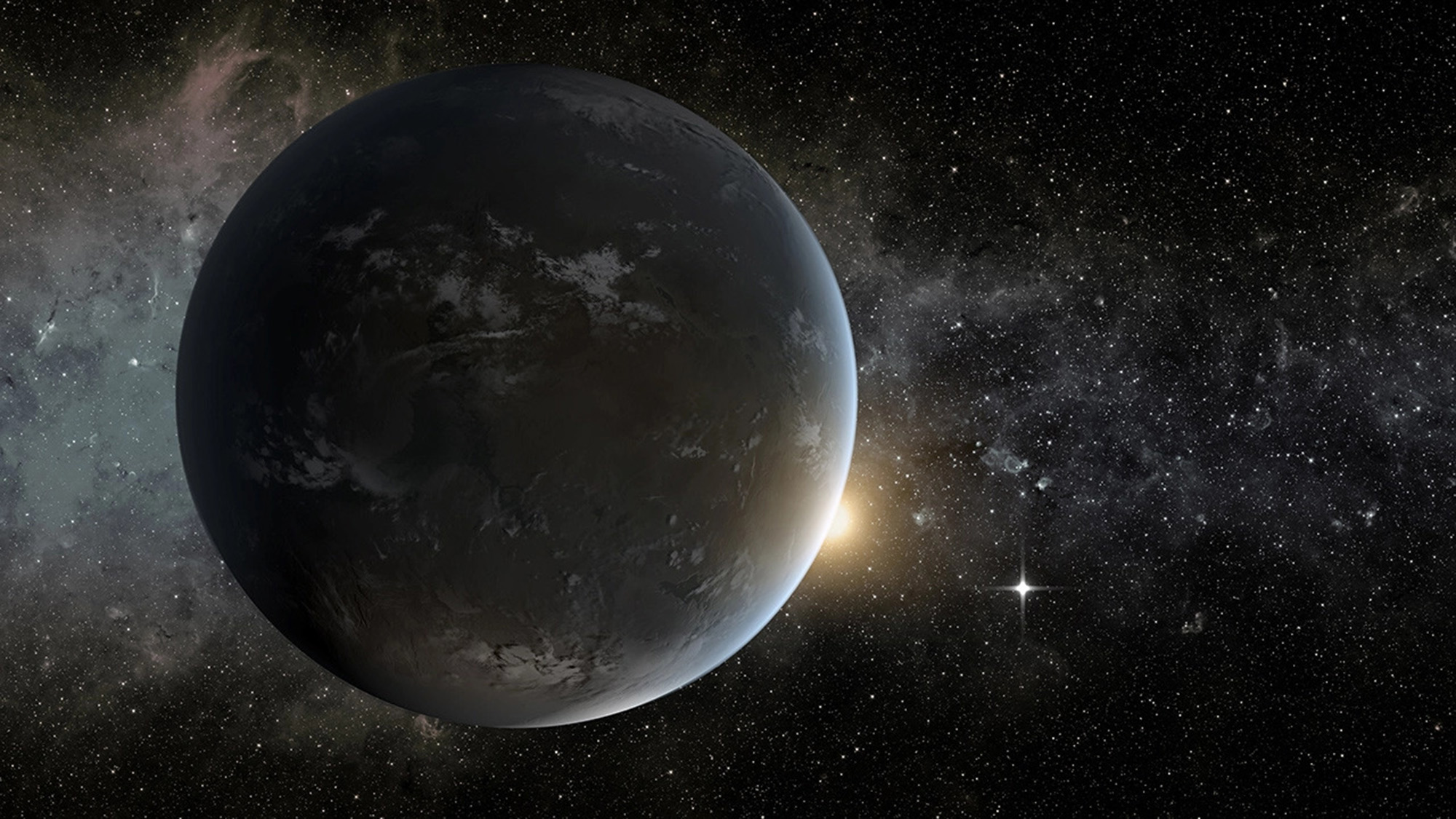
Wouldn’t a free-floating planet eventually cross paths with a star or even a black hole and start revolving around it? YinToronto, Ontario Free-floating planets (FFPs) or rogue planets are bodies that move through space by themselves, not locked into an orbit around a star. While some may have begun as typical planets flung out ofContinue reading "Why aren’t free-floating planets captured when they fly past stars?"
Beyond the solar system, the line between planet and star can get blurry. Astronomers call objects that fall between the size ranges of planets and stars substellar objects. One type of substellar object, called a brown dwarf, forms from collapsing gas clouds like a star, but is not quite massive enough to fuse hydrogen in its core. Some can briefly fuse a heavier form of hydrogen, known as deuterium, in their cores, though never enough to produce starlight. Others are small and cold enough to develop complex atmospheres.
Recently, astronomers discovered a new type of substellar object in a star-forming region of the Milky Way Galaxy called IC 348. Using observational data from the JWST’s Near InfraRed Spectrograph (JWST NIRSpec), they found objects 0.2% to 1.2% the mass of the Sun that float freely like stars but have carbon-containing molecules called hydrocarbons in their atmospheres. Because these objects are smaller than known brown dwarfs and have evidence of hydrocarbons, scientists refer to them as H-type objects.
To investigate what H-type objects are and where they fit within the spectrum of substellar objects, researchers Richard J. Parker and Catarina Alves de Oliveira analyzed survey data on stars and substellar objects in IC 348, then conducted follow-up simulations to uncover how H-type objects formed. The main question they asked was whether H-type objects form from collapsing gas clouds, like brown dwarfs and stars, or develop around host stars before being ejected and drifting freely through space, like planets.
First, they reviewed the observational records of IC 348 obtained with the JWST NIRSpec and the near-IR spectrograph SpeX at the NASA Infrared Telescope Facility. IC 348 has 495 stars and brown dwarfs combined, as well as 9 H-type objects. Estimates for the age of this star-forming region range from either 1 to 3 million years or 5 to 6 million years, depending on how different teams calculated it. From there, Parker and Alves de Oliveira compared where the stars, brown dwarfs, and H-type objects were located within the cluster. They found no unique spatial distribution among the 3 types of objects.
Then, the team simulated the evolution of IC 348 over 10 million years to determine which initial conditions would result in a spatial distribution closest to the survey data. They simulated an initial giant gas cloud and used a mathematical function to distribute its mass among the 495 constituent objects. The researchers then placed a Jupiter-sized planet around each simulated star that was approximately the Sun’s mass to determine whether they could grow and escape their home star and become H-type objects. They also repeated the simulations by placing the Jupiter-sized planets at distances from the Sun similar to those of Earth, Jupiter, and Neptune, and varied the sizes and star densities of the simulated IC 348 regions.
They found that if Jupiter-sized planets orbited their stars at roughly Jupiter’s distance from the Sun, then 5 to 15 of them could escape their stars in a region like IC 348, which would roughly match the number of known H-type objects. However, the escaped planets were distinctly more spread-out than the observed H-type objects, which share a similar spatial distribution with the cluster’s stars and brown dwarfs. Since the simulations did not match the observed distribution, the researchers suggested that these H-type objects are likely a new sub-category of very small brown dwarfs rather than escaped planets.
Although this study favors a brown dwarf origin for H-type objects, the exact details of how they formed remain up for debate. Astronomers still have multiple competing theories about how ordinary brown dwarfs form. Perhaps they are ejected from their gas cloud before fully forming, have their outer layers stripped by radiation from a nearby massive star, or simply form like stars on a slightly smaller scale. Regardless, future researchers will continue to explore this murky area of substellar astronomy.
Searching for Another Earth with the Nancy Grace Roman Space Telescope
In NASA’s mission fact sheet, Roman’s planners pose several questions. These include:
How common are solar systems like our own?
What kinds of planets exist in the cold, outer regions of planetary systems?
What determines the habitability of Earth-like worlds?
Although scientists have used several methods to detect exoplanets, including Earth-like planets, Roman will employ three. These include the transit method, microlensing, and direct imaging. NASA said the combination of approaches will allow mission scientists to conduct a “sweeping search expected to uncover around 100,000 new exoplanets — a staggering leap compared to the nearly 6,200 currently known.”
“It is hoped that Roman will discover thousands of new exoplanets and significantly expand our knowledge of the diversity of planetary systems in our Galaxy,” explained Associate Professor Edita Stonkutė, an astrophysicist at Vilnius University unconnected to the Roman team, in a statement emailed to The Debrief.
Microlensing Can Reveal Earthlike Planets Orbiting Sunlike Stars
Most exoplanets have been detected by the dimming of their host star when they transit between it and Earth, giving the transit method its name. Roman plans to use that same method for most of its larger planetary detections. However, among the expected tens of thousands of transit-method detections, mission planners expect a small but sizeable percentage to come from microlensing.
NASA said the “light-bending” microlensing phenomenon occurs when two distant stars “align closely from our vantage point.” Due to the strength of the nearer star’s gravity, the light from the more distant one is “warped” around the nearer one, essentially focusing it very briefly for a distant observer.
“If the alignment is especially close, the nearer star acts like a cosmic lens, focusing and magnifying light from the background star.” Professor Stonkutė explained. “By analysing these changes, astronomers can determine that the planet exists and estimate its mass and orbital characteristics.”
Critically, Professor Stonkutė also noted that microlensing can occur with objects other than stars, including exoplanets.
“This is Precisely Where Roman Has the Edge”
Using its Wide-Field Array, Roman will monitor hundreds of millions of stars. NASA said the observatory will monitor these target stars for “tiny surges in starlight” that typically signal a microlensing event.
Although the transit method is employed to detect larger exoplanets, NASA noted that microlensing “specializes in finding planets like those in our solar system.” The space agency added that this includes “worlds as lightweight as Mars in their star’s habitable zone or farther out.”
A star’s habitable zone is typically defined as the orbital plane where an exoplanet could sustain liquid water on its surface, a key ingredient for life as we know it.
Professor Stonkutė described microlensing as “particularly valuable” since it can detect planets that are difficult to spot with other planet-hunting methods. The professor said this includes “small Earth-like planets located far from their star.” The Roman team hopes to find “more than 1,000 microlensing planets.”
The professor warned that “most microlensing events cannot be predicted in advance.” As a result, telescopes need to actively scan large areas of the sky to increase the chances of a microlensing detection
“This is precisely where Roman has the edge over other telescopes that have searched for exoplanets using different methods,” the professor added.
A “Stepping Stone” Toward NASA’s Habitable Worlds Observatory Concept
While Roman is tasked with directly imaging exoplanets, finding another Earth around a Sun-like star will still require an indirect detection, most likely from a microlensing event. However, the Roman team notes that their observatory “will provide a crucial stepping stone for NASA’s Habitable Worlds Observatory concept.”
According to the space agency, that “flagship” telescope, still awaiting final approval, “would be designed to photograph Earth-like planets for the first time ever.”
Roman may also be able to scan the atmospheres of planets detected with the transit method. The space agency said Roman “would also look for signs of life called biosignatures by measuring atmospheric gases like oxygen and ozone that could signal the presence of living things.”
Christopher Plain is a Science Fiction and Fantasy novelist and has spent the last six years as Associate News Editor and Head Science Writer at The Debrief. Follow and connect with him on X, learn about his books at plainfiction.com, or email him at christopher@thedebrief.org.
Artist’s concept of the Nancy Grace Roman Space Telescope (Credit: NASA).
Welcome to this special edition of The Intelligence Brief… This week, NASA is preparing to launch the Nancy Grace Roman Space Telescope, its next flagship space observatory and a mission poised to transform our understanding of distant worlds and some of the universe’s greatest mysteries. In our analysis, we’ll be looking at 1) how Roman’s powerful Wide Field and Coronagraph instruments will survey the cosmos on an unprecedented scale, 2) how the telescope could discover thousands of new exoplanets—including elusive rogue worlds—and directly image planets around other stars, 3) how Roman will survey more than a billion galaxies in search of new clues about dark matter and dark energy, and 4) why its combination of Hubble-like image quality and an enormously wider field of view could usher in a new era of astronomical discovery.
Quote of the Week
“We are poised at the brink of unfathomable scientific discovery.”
– Julie McEnery, Roman’s senior project scientist at NASA Goddard
If you enjoy the news and perspectives offered by The Debrief, make sure that you aren’t missing our stories by making us one of your “preferred sources” on Google News. You can simply follow this link to add The Debrief to your list of favorites, and you can read more about Google’s preferred sources in our article here.
Get all the latest stories from The Debrief, with more breaking stories at the end of this week’s newsletter.
NASA’s Nancy Grace Roman Space Telescope Prepares for Lift-Off
On Sunday morning, NASA will set a new milestone with the launch of the Nancy Grace Roman Space Telescope, setting the course for discoveries that may include new insights into some of the universe’s greatest mysteries.
As NASA’s next flagship space observatory, this powerful new telescope is designed to discover thousands of distant worlds while also probing the lingering mysteries of dark matter and dark energy. Named after Nancy Grace Roman, NASA’s first chief of astronomy and an early advocate for the efforts that led to the launch of the Hubble Space Telescope, the new space observatory bearing her name is poised to offer one of the most detailed views of our universe ever captured.
Scheduled to lift off aboard a SpaceX Falcon Heavy rocket on August 30, 2026, at 7:26 a.m. EDT, the Roman telescope’s mission is comparable in ambition to those of the Hubble and James Webb Space Telescopes, but also very different in many respects. Here’s a look at what to know about this historic mission, what it may help researchers uncover, and why it could set the pace for a range of important scientific advancements in the coming years.
Roman’s Historic Mission to Observe the Cosmos
At the heart of its mission, Roman will offer astronomers a remarkably wide view of the cosmos. Surveying immense portions of the sky, the powerful instruments on board the telescope will capture high-resolution imagery comparable to Hubble at certain optical and infrared wavelengths—imagery that could dramatically reshape scientists’ understanding of both planets and the universe they inhabit.
In terms of the technologies it will carry with it into space, Nancy Grace Roman Space Telescope will rely on two primary instruments: its Wide Field Instrument (WFI) and Coronagraph Instrument. The WFI is equipped with a 300-megapixel near-infrared camera enabling wide-area imaging and spectroscopy, allowing Roman to conduct large-scale surveys with great precision and sensitivity—all of which make it ideal for use in the hunt for dark energy, exoplanets, and other hard-to-spot cosmic phenomena.
Meanwhile, Roman’s Coronagraph Instrument is designed specifically for imaging and studying exoplanets. Equipped for both imaging and spectroscopy, the coronagraph will suppress the overwhelming glare of distant stars, potentially making much fainter planets orbiting nearby visible. According to NASA, Roman’s powerful Coronagraph will be the first instrument deployed on a space observatory to leverage “numerically optimized, precision-fabricated coronagraph masks.”
By suppressing the overwhelming glare of distant stars so that much fainter planets around them become visible, Roman’s Coronagraph could achieve as much as 100 times the performance of existing facilities, offering a promising chance that some of the faintest planets in the cosmos—some as much as a billion times fainter than their host stars—could become visible.
With a little luck, Roman could also break new ground with the first direct imagery of an exoplanet possessing rings. Going beyond its immediate discoveries, the coronagraph will also demonstrate technologies that could eventually be incorporated into future observatories, including NASA’s proposed Habitable Worlds Observatory.
A New Era of Planet Hunting
Presently, astronomers have confirmed roughly 6,000 planets beyond our Solar System. However, once Roman’s mission gets underway, that number could see a dramatic increase.
One of the ways it will achieve such landmark detections will be with the help of gravitational microlensing, which relies on detecting how the gravity of a foreground object can magnify light from a source much farther away. Using microlensing alone, there is a good chance Roman may discover several hundred—but more likely thousands—of planets, which may include worlds small enough that they have eluded previous detection using existing methods.
Along with the planets it discovers, astronomers anticipate that Roman will also find several new additions to the growing catalog of “rogue planets,” mysterious planetary bodies that wander through the cosmos without orbiting a star.
Additionally, NASA says that anywhere from 60,000 to 200,000 additional candidate planets could be revealed through transit observations, though only a fraction of these are expected to be confirmed through additional observations.
Mapping the Dark Universe
Arguably, one of the most significant components of Roman’s mission involves its study of the unseen side of the cosmos: the mysterious phenomena known as dark energy and dark matter.
In search of answers to such mysteries, Roman will soon begin scanning more than a billion galaxies as it maps the structure and evolution of the universe throughout cosmic history, providing data that will at the very least help researchers narrow down the most promising interpretations among a range of competing explanations for dark energy.
Simultaneously, the telescope will probe dark matter, the unseen material whose gravitational effects are currently needed to explain phenomena in our universe that include the motions of galaxies, as well as the evolution of some of the largest structures in the cosmos.
Hubble’s Vision, But at Far Greater Scale
In many ways, what Roman is expected to achieve will be comparable to its predecessor, the Hubble Space Telescope, although at a far greater scale.
At some wavelengths, Roman will be capable of producing images that approach the clarity of Hubble’s iconic views of our universe, all while capturing as much as 100 times more of the sky with each observation. By capturing more of the sky with each image it produces, Roman’s efforts to map the universe could occur at a remarkable pace—perhaps a thousand times faster than those of its predecessor.
A Historic Mission Lifts Off This Sunday
If all goes according to plan, Roman will be launched aboard a SpaceX Falcon Heavy rocket at 7:26 a.m. EDT this Sunday, Aug. 30. NASA will begin live coverage of Roman’s launch on Sunday at 6:20 a.m. Eastern Time, and you can follow the updates online with NASA’s free streaming platforms.
Once it lifts off, Roman will be carried 930,000 miles from Earth to the Sun-Earth Lagrange Point 2 region, which is the same location where the James Webb Space Telescope is currently operating. After it reaches orbit, for the next 90 days, Roman will undergo commissioning, after which science operations are expected to begin sometime in early 2027.
The observatory’s primary mission will last five years, although Roman could potentially remain operational for more than a decade, offering astronomers an unprecedented look at our universe and possibly a few answers to some of the most baffling questions about our universe.
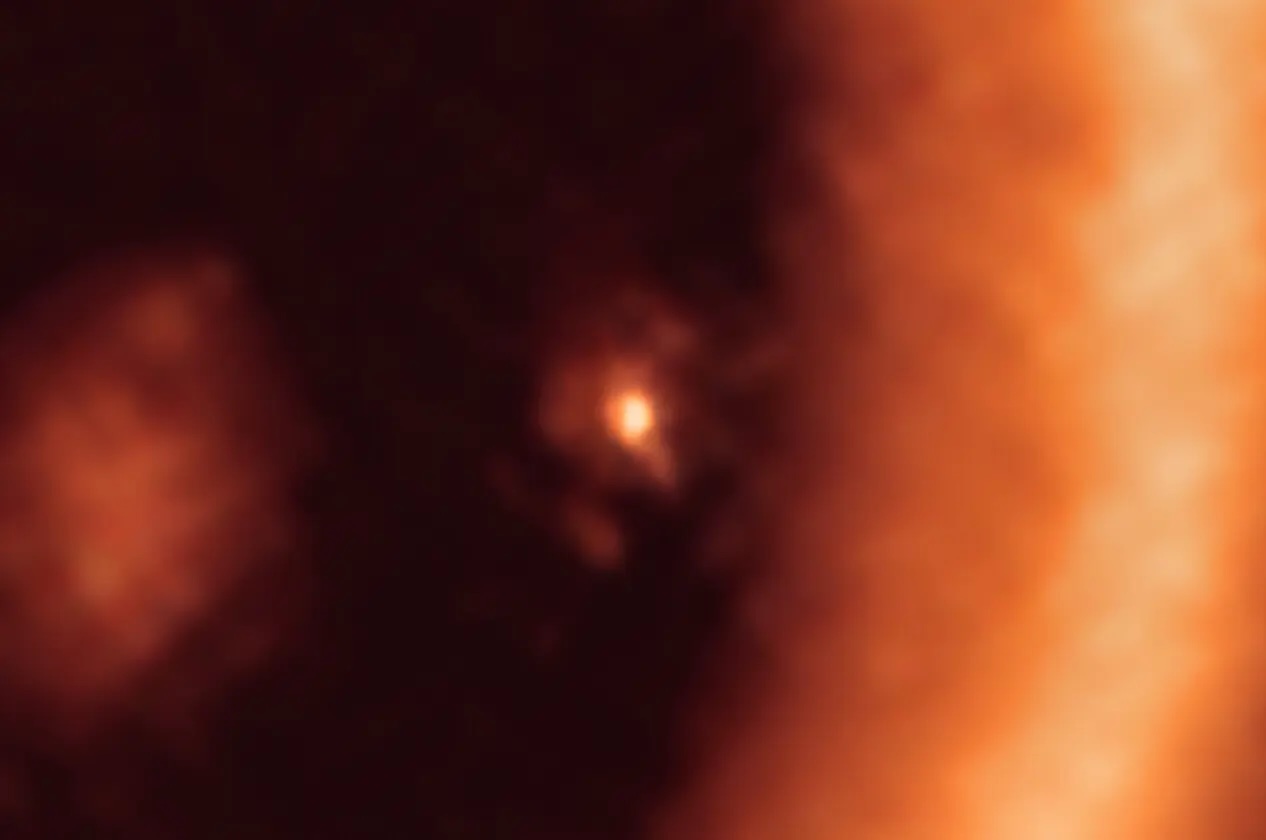
New research suggests that the circumplanetary disk surrounding the exoplanet PDS 70c contains a ring of dense dust, and the conditions within this ring may allow baby moons to form.
The young star PDS 70 has become famous for its protoplanetary disk and its two growing giant planets, PDS 70b and PDS 70c. At least one of these planets is surrounded by a disk of its own; in 2019, researchers using the Atacama Large Millimeter/submillimeter Array (ALMA) reported the first-ever observation of a circumplanetary disk around PDS 70c, and later observations with ALMA brought clearer views of this disk.
There’s still debate over the exact source of the emission detected by ALMA. Does this emission come from dust, and if so, how is the dust distributed? Is the disk optically thick or optically thin? Does the emission even come from dust, or could it instead be free–free emission from unbound electrons navigating a charged-particle maze?
Dust Diagnosis
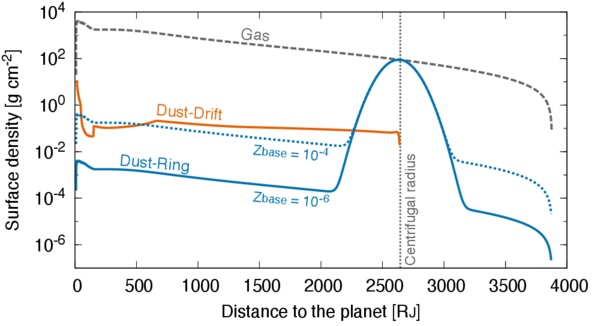
Yuhito Shibaike (Kagoshima University) and collaborators recently examined the hypothesis that the emission from PDS 70c’s circumplanetary disk arises from dust distributed in an optically thick ring. To test this hypothesis, the team explored two possible dust distributions, which they call “drift” and “ring.” In the drift model, dust grains within the circumplanetary disk migrate inward toward the planet, leaving much of the disk optically thin. Modeling suggests that this migration is typical in protoplanetary disks, and it might be common in circumplanetary disks as well.
Dust and gas surface density for the modeled disks in the drift (orange) and ring (blue) models. Click to enlarge. [Adapted from Shibaike et al. 2026]
In the ring model, the dust grains are concentrated within an optically thick ring at a certain distance from the planet. Simulations suggest that the formation of this type of dust ring is feasible, arising from a localized increase in gas density, outflows, or other causes.
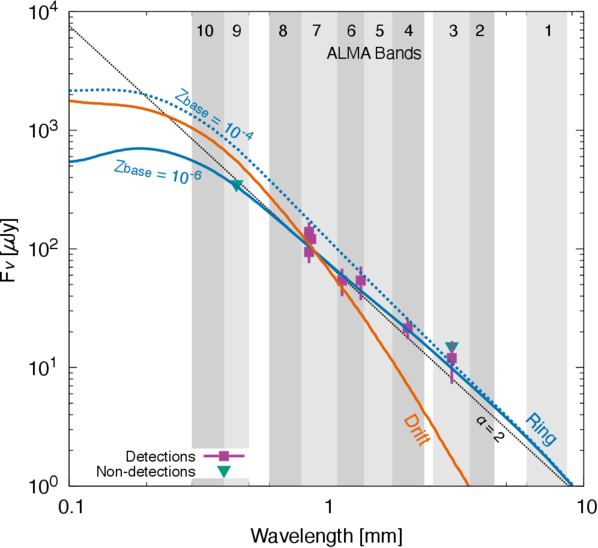
Shibaike and coauthors found that the ring model naturally reproduced the observed spectral energy distribution for a range of reasonable parameters. The drift model, on the other hand, required an unrealistically high dust-to-gas ratio for the material accreted onto the circumplanetary disk from the parent protoplanetary disk to reproduce the observed spectral index.
Future Prospects and Moon-Making Possibilities
Comparison of ALMA observations (colored symbols) and model predictions (colored lines) from the drift (orange) and ring (blue) models. Click to enlarge. [Adapted from Shibaike et al. 2026]
This work demonstrated the feasibility of the dust-ring model, but it didn’t rule out a contribution due to free–free emission from unbound electrons, which has also been proposed to explain the disk’s appearance. The team noted that distinguishing between thermal dust emission and free–free emission is challenging with existing data, as the two sources produce spectral energy distributions with similar shapes.
Luckily, this likely won’t remain a mystery forever: the next-generation Very Large Array, which is anticipated to begin full science operations in the mid-2030s, should be able to resolve the location of the dust within the circumplanetary disk and illuminate the source of emission.
Finally, if the dust surrounding PDS 70c is concentrated within a ring, what does that mean for the possibility of moons forming within the disk? Shibaike and collaborators found that the conditions within the ring likely satisfy the requirements of both the streaming instability and the gravitational instability, which are required for dust grains to clump together and form the rocky building blocks of baby moons. Perhaps the PDS 70 system will one day be the site of not only a circumplanetary disk, but an exomoon as well!
Citation
“Interpreting ALMA Multiwavelength Continuum Observations of PDS 70 c: An Optically Thick Dust Ring in the Circumplanetary Disk,” Yuhito Shibaike et al 2026 ApJL1006 L26. doi:10.3847/2041-8213/ae86f5
Ultra-hot Jupiter WASP-121b is once again puzzling astronomers. New JWST observations have revealed aspects of this superheated planet’s atmosphere that models cannot yet explain.
An Extreme Planet
Among the more than 6,000 known exoplanets, there are many types of worlds that aren’t represented in our solar system. The most exotic and unfamiliar planets might be the ultra-hot Jupiters: giant planets nestled so close to their host stars that they are tidally locked, with temperatures on their permanently starlit sides climbing to thousands of degrees.
WASP-121b, which circles its F-dwarf host star every 30.5 hours, is one of the best-studied ultra-hot Jupiters. Previous work has started to reveal the complexity of its atmosphere, and now, data from JWST have opened a new window onto WASP-121b’s behavior.
New View from JWST
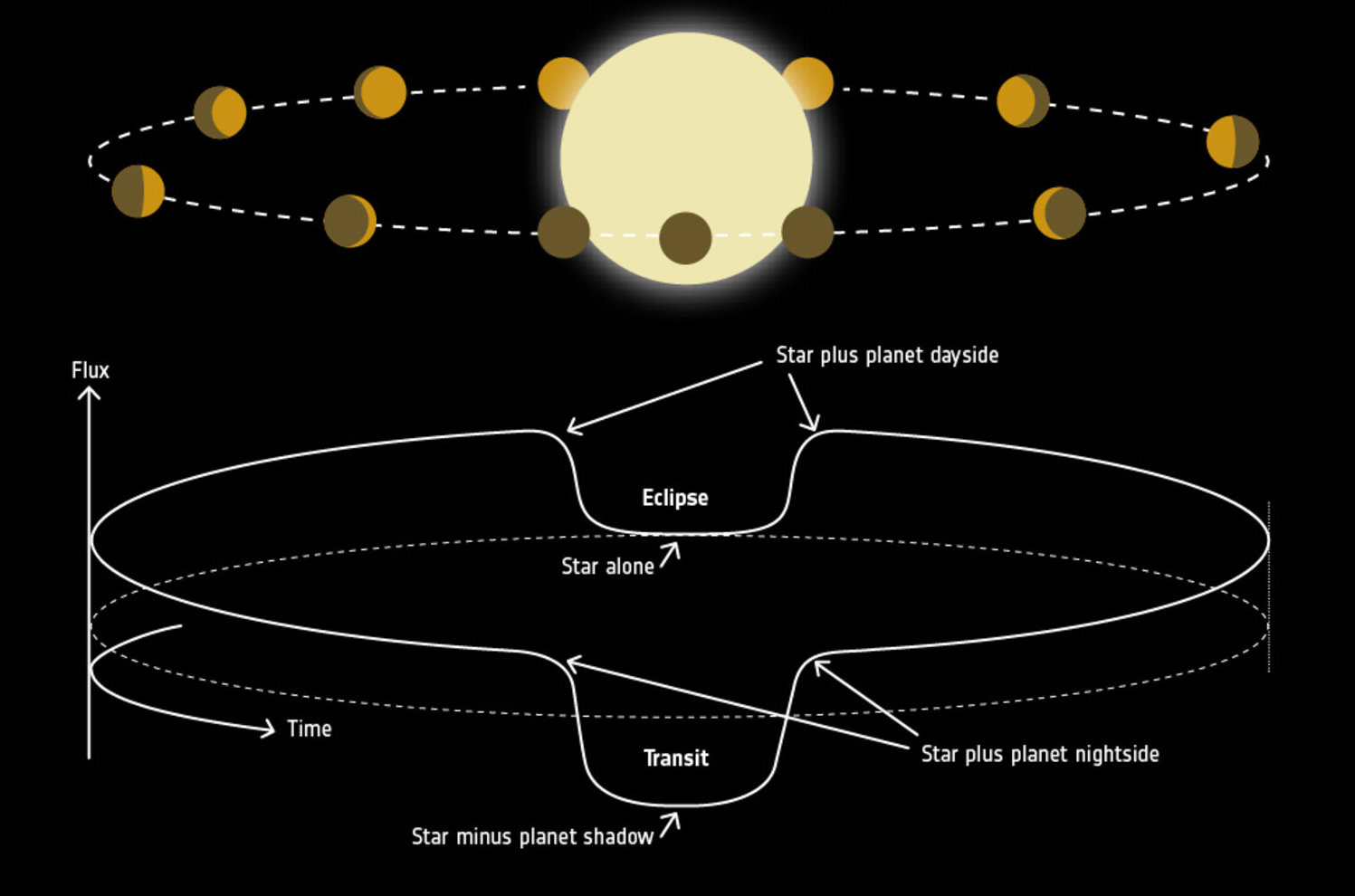
A representation of an exoplanet’s phase curve. Click to enlarge. [ESA]
To learn more about WASP-121b’s atmosphere, Robert C. Frazier (University of Michigan) and collaborators analyzed JWST Near Infrared Imager and Slitless Spectrograph (NIRISS) observations covering more than one full orbit of the planet. These observations allowed them to construct the system’s phase curve, which describes the total amount of emitted and reflected light from the planet and its host star over an entire orbit.
The team used two 3D general circulation models to predict the planet’s atmospheric structure and extract synthetic spectra and phase curves to compare against the JWST observations. Using nine model configurations in total, the team varied several inputs, including sources of atmospheric opacity, sources of atmospheric drag, and assumptions about whether clouds are able to form on the planet’s cooler nightside.
Left with a Mystery
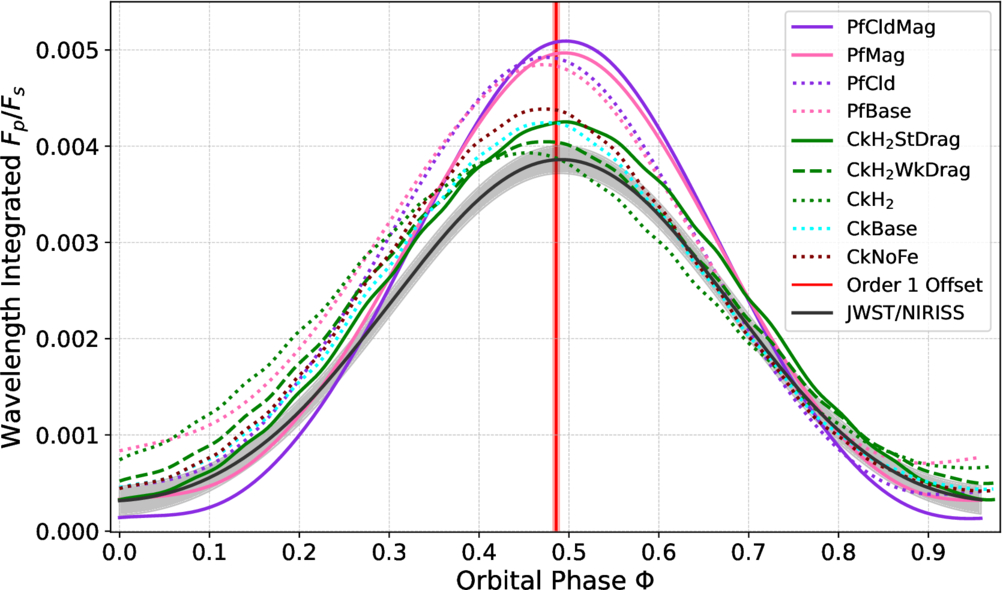
Frazier and collaborators found two aspects of WASP-121b’s phase curve that their models couldn’t explain: the planet emits less light overall than predicted, and the location of its phase-curve offset changes with wavelength.
Modeled phase curves, shown as the flux of the planet divided by the flux of the star, for WASP-121b (colored solid and dotted lines) compared to the best fit to the JWST observations (black line). Click to enlarge. [Frazier et al. 2026]
The models predict, on average, 12–15% more emission from the planet than observed. This discrepancy might be traced back to how the planet’s radius is determined, which is a simple-sounding task that can be deceptively difficult; WASP-121b isn’t perfectly spherical, and its emitting area changes with wavelength, making it challenging to normalize the planet’s radius for use in models.
The phase-curve offset is the difference between a planet’s sub-stellar point (where the star is directly overhead) and the brightest point in the planet’s atmosphere. In general, some degree of offset is expected because planetary winds tend to whisk heat away from the sub-stellar point, placing the brightest point somewhere to the east (usually). For WASP-121b, the offset is unexpectedly small — suggesting a source of drag in the atmosphere that prevents winds from transporting heat away from the sub-stellar point — and it’s larger at shorter wavelengths. This wavelength dependence isn’t predicted by any of the models, and it’s not clear what causes it.
These results demonstrate something remarkable: that our observations of a planet nearly 900 light-years away have become so precise that they’re pushing our already complex models to include more physics — an exceptionally exciting motivation for model improvement!
Citation
“The Days Drag On on WASP-121 b: Interpreting Its NIRISS Spectroscopic Phase Curve with General Circulation Models,” Robert C. Frazier et al 2026 ApJ1004 102. doi:10.3847/1538-4357/ae69ca
Astronomers have found a third giant planet around Beta Pictoris, one of the best-known young planetary systems near Earth. The discovery is striking because the planet was not first picked out as a bright dot in a telescope image. NASA’s James Webb Space Telescope found it in the spectrum of light coming from the system: […]
NASA is currently targeting August 30 for the launch of the Nancy Grace Roman Space Telescope from Florida. The date can move, as launch dates do, but the mission is close enough to the pad that its central idea deserves a clear look: Roman will survey huge stretches of the universe in one exposure, gathering […]
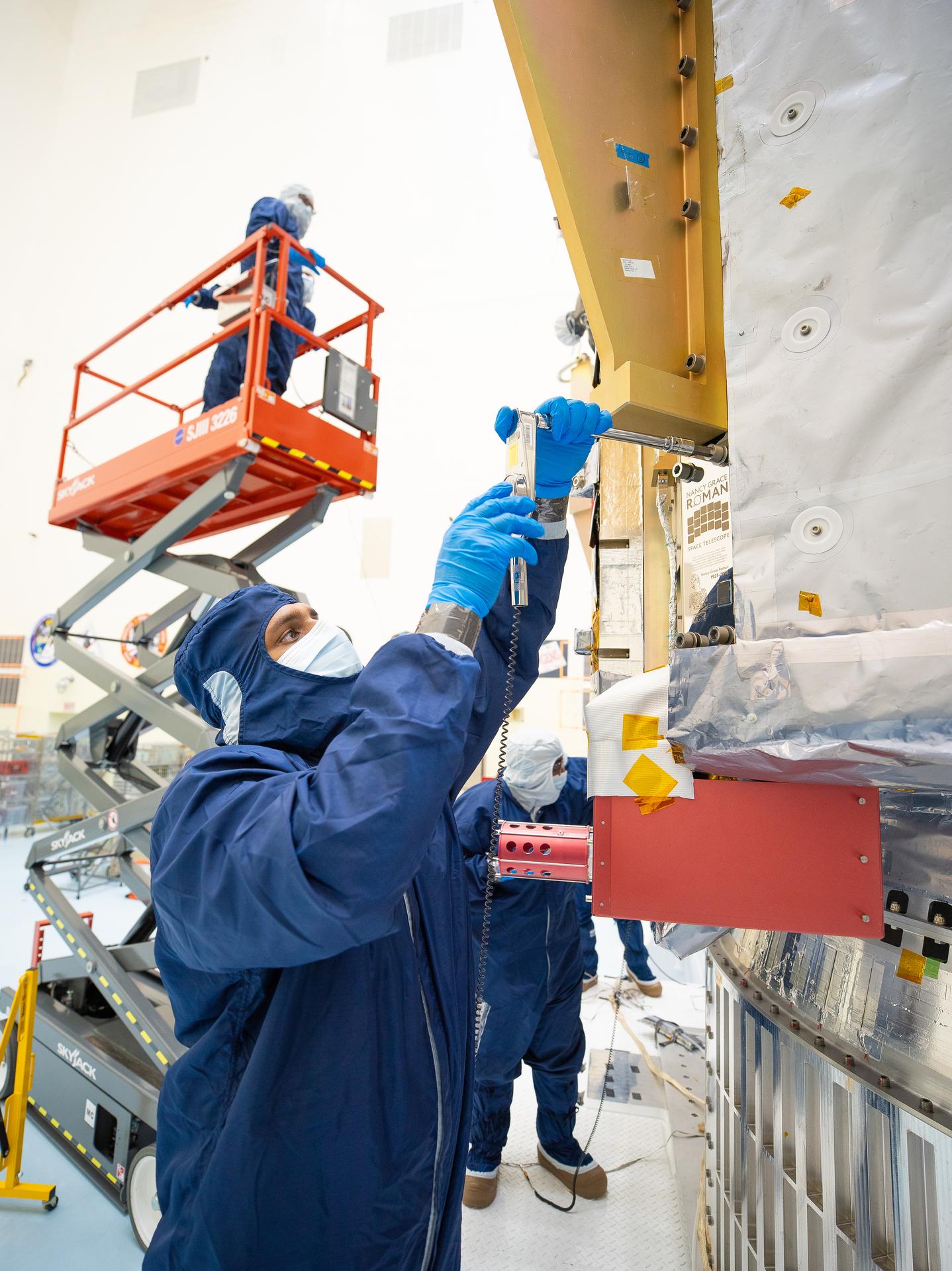
On July 27, technicians at NASA’s Kennedy Space Center in Florida installed a memory card containing 1,350,144 names as part of a commemorative plaque on the Nancy Grace Roman Space Telescope. The names were submitted by people globally, including astronauts from Artemis II and Artemis III. The memory card will travel with the Roman observatory to the Sun-Earth Lagrange point 2, or L2, about one million miles from Earth, where the Sun’s and Earth’s gravity balance out.
Roman is named after Dr. Nancy Grace Roman, NASA’s first chief astronomer and one of the architects of the agency’s modern science program. Roman championed space-based observatories that could study the universe from above Earth’s hazy atmosphere while making their data broadly available to the scientific community.
NASA and SpaceX are targeting launch for no earlier than 7:26 a.m. EDT Sunday, Aug. 30 aboard a SpaceX Falcon Heavy from Launch Complex 39A at Kennedy.
Since the discovery of the first world beyond the solar system in the 1990s, astronomers have become adept at spotting extrasolar planets, or exoplanets. But while NASA's exoplanet catalog has burgeoned to over 6,000 confirmed entries, moons around these worlds, known as exomoons, have proved elusive.
In fact, we have failed to make a single confirmed discovery of an exomoon despite being certain that just as the planets of the solar system have their own natural satellites, worlds in other star systems must have them too.
Now, this controversial drought of exomoons may have become even more confusing and, frankly, weird. That is because while studying a strange star system called CD-35 2722 with the Very Large Telescope (VLT), astronomers have discovered an object that could be an exomoon, or it could be something that forces us to rethink our very definition of what a "moon" is and what a "planet" is.
The star CD-35 2722 is located around 73 light-years away and has around half the mass of the sun. It is orbited by a "failed star" or brown dwarf. These stellar bodies get their unfortunate nickname because they form like other stars but fail to gather enough mass to trigger the fusion of hydrogen to helium in their cores. In terms of mass, brown dwarfs are more massive than the largest gas giant planets, but smaller than the smallest stars, usually with around 13 to 80 times the mass of Jupiter, or around 0.013 to 0.08 times the mass of the sun.
The newly discovered object in CD-35 2722 is certainly moon-like, but rather than orbiting a planet as the moons in the solar system do, it orbits the system's brown dwarf.
"This system is somewhat hard to define using solar-system-based words like 'planet' and 'moon.' The exosatellite is clearly massive enough to be a planet, but it does not orbit a star, though it orbits an object that orbits a star," team leader Kevin Hoy of the Universidad Diego Portales and the Millennium Nucleus of Young Exoplanets and their Moons (YEMS) in Chile, said in a statement.
"Being the third wheel in this system makes us want to call it a moon, even if it is nothing like the small, rocky moons we have in our system."
The team's research was published on Wednesday (July 22) in the journal Nature.
Erm... It's definitely an exosatellite
The team currently isn't able to definitively claim this object in CD-35 2722 is an exomoon, because that would require really nailing down a new definition of what a moon is.
"The satellite we report is a giant gaseous body orbiting a highly massive companion, itself several times the mass of Jupiter. We have a clear delineation between the planets and the sun in the solar system, so defining things like moons is simple," team member Alice Zurlo of the Universidad Diego Portales said. "In the CD-35 2722 system, where we are blurring the lines between stars, planets, and moons, the whole thing becomes more complicated to describe."
Zurlo and colleagues can, however, confidently claim this is an exosatellite, meaning it is a first-of-its-kind detection no matter what the future holds for its classification.
The Extremely Large Telescope (ELT), currently under construction in Chile, could be integral in the hunt for exomoons and exosatellites. (Image credit: ESO/G. Vecchia)
It is hoped that the Extremely Large Telescope (ELT) currently under construction in Chile, will make a massive impact in the hunt for exomoons, and now, other exosatellites.
Until these objects begin to be uncovered, one thing this discovery re-emphasizes is something that astronomers have been gleefully discovering ever since the first exoplanet was spotted: planetary systems come in a variety of diverse, weird and wonderful forms.
Editor’s Note:Astrobites is a graduate-student-run organization that digests astrophysical literature for undergraduate students. As part of the partnership between the AAS and astrobites, we occasionally repost astrobites content here at AAS Nova. We hope you enjoy this post from astrobites; the original can be viewed at astrobites.org.
If you’re a fan of Stranger Things like me, you’ll know of the Upside Down: a mirror world similar to our own, but with very different rules. Imagine Mars in the Upside Down, where it is no longer our next-door neighbor but a planet hundreds of light-years away. An astronomer on this Upside Down Earth would be looking at a distant speck with a transit signal barely distinguishable from noise. In this world, Mars would no longer be familiar but completely foreign, with unknown properties. Kane et al. suggest that treating Mars as if it were a stranger is a useful way to think about exoplanet science today.
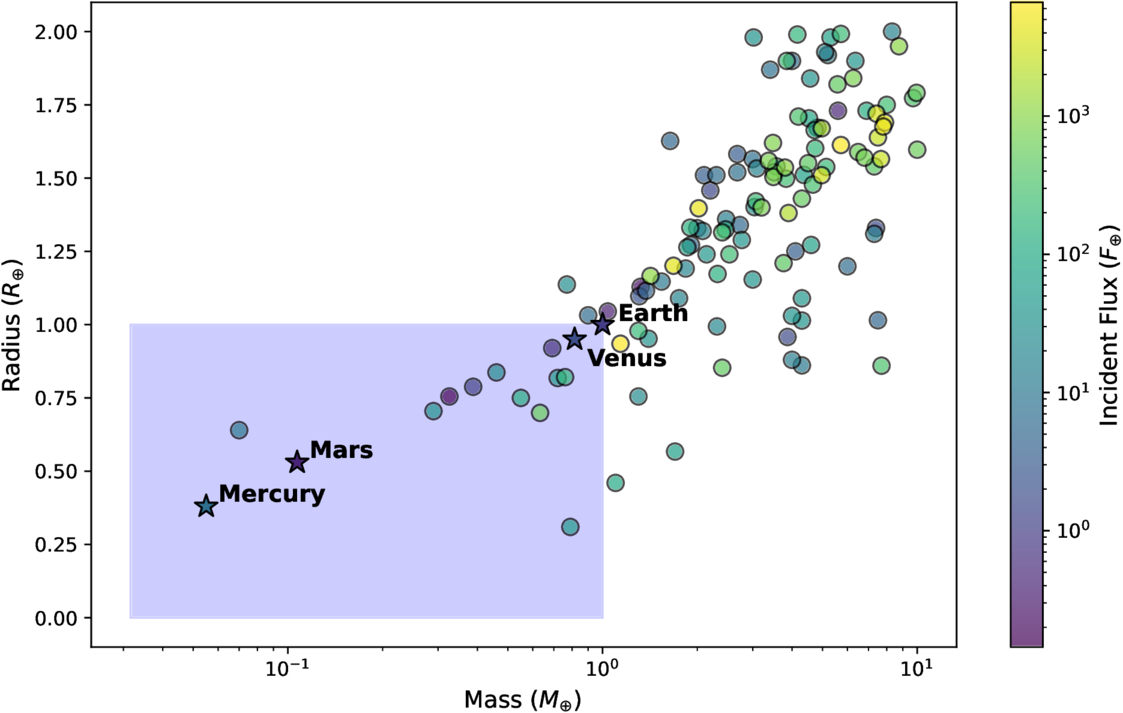
JWST is hunting for atmospheres on small rocky planets around other stars. However, only a select few Mars-like exoplanets have been discovered (Figure 1). This is because sub-Earth planets are small and hard to detect, testing the bounds of current technology. The ones that have been discovered, such as TRAPPIST-1h and Kepler-138b, were detected due to favorable geometry. They happen to orbit very close to a low-mass star or sit in resonant multi-planet systems, which amplify the signal we are looking for. True Mars analogs with low flux and moderate orbital periods remain out of reach. This is precisely what makes Mars itself so important scientifically — it is the only planet of this type we can study up close.
Figure 1: A plot of confirmed exoplanets by mass and radius. Most confirmed exoplanets are larger and more massive than Earth. Mars-like planets (dots in the blue box) are rare in confirmed exoplanet detections. [Kane et al. 2026]
Getting to Know Mars, Getting to Know All About Mars
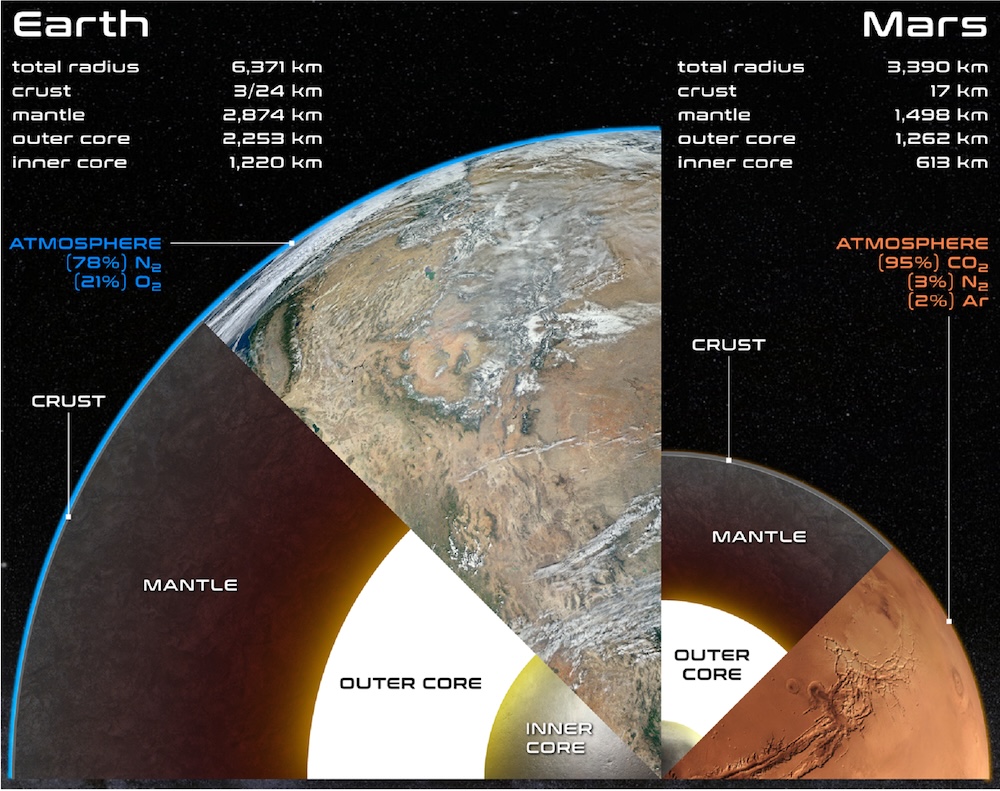
We know a lot about Mars in comparison to other planets thanks to rovers (such as Curiosity and Perseverance), atmospheric orbiters (such as Mars Atmosphere and Volatile EvolutioN and the Mars Orbiter Mission), and other science missions (Figure 2). We know it once had water features with neutral pH and favorable chemistry for life from sedimentary evidence at the Gale and Jezero craters. We know its atmosphere is 95% CO2 with a surface pressure less than 1% of Earth’s. We know it once had an active magnetic dynamo, but the dynamo died out about 4 billion years ago, leading to solar wind steadily stripping away Mars’s atmosphere over time.
Figure 2: Earth and Mars to scale, showing their internal structures and atmospheres. Despite being neighbors, Mars is dramatically smaller with a thin CO2 atmosphere, similar to the planets JWST is struggling to characterize. [Kane et al. 2026]
But in the Upside Down, we would know none of this since Mars would be so distant. With current technology, this Upside Down Mars would be essentially undetectable using transit signals, radial velocity measurements, and spectrographs.
Beyond Our Backyard
JWST is currently studying the small rocky TRAPPIST-1 planets and is finding little evidence of atmospheres. The authors of today’s article explore the idea that these exoplanets are similar to Mars and perhaps are undergoing processes that strip away their atmospheres and create optimal conditions for life only for short durations. Using Mars as a blueprint, the authors show how we can better understand exoplanet processes, including volatile delivery and loss, photochemistry, climate evolution, obliquity forcing, planetary architecture, and intrinsic magnetism. For example, measurements of noble gases directly fingerprint Mars’s atmospheric escape process, and the authors argue these give us a calibration framework for interpreting future exoplanet spectra.
The upcoming Nancy Grace Roman Space Telescope’s microlensing survey will start revealing how common true Mars analogs actually are throughout the galaxy, while the future Habitable Worlds Observatory will attempt direct imaging of nearby candidates with unprecedented precision. Together, these missions will tell us whether Mars-like outcomes (brief habitability, catastrophic atmospheric loss, barren surfaces, etc.) are the default fate for small rocky planets. Interpreting that data will require the exact framework this article builds: one grounded in the only Mars analog we can study in detail.
Original astrobite edited by Sandy Chiu.
About the author, Ben Sherwin:
I am a physics PhD student and a National Science Foundation Graduate Research Fellow at Stanford University, working with Josh Frieman. I am interested in theoretical and observational cosmology, specifically in cross-correlations between the cosmic microwave background and tracers of large-scale structure.
Astronomers have found the strongest evidence yet that a rocky planet beyond our solar system has managed to hold onto an atmosphere — a crucial ingredient for life as we know it.
The discovery marks the first time scientists have detected an atmosphere surrounding a rocky planet orbiting in the habitable zone of another star, the region around a star where temperatures could enable liquid water to exist on a planet's surface. The findings, published July 16 in the journal Science, could help astronomers narrow the search for potentially habitable worlds beyond our cosmic backyard.
"It's absolutely exciting," Edward Schwieterman, associate professor of astrobiology at the University of California, Riverside, who was not involved in the study, told Live Science in an email. "We are getting closer to studying the atmospheres of worlds that could plausibly harbor life, with evidence of that life embedded in their observable spectra."
The planet, known as LHS 1140 b, lies about 48 light-years away from Earth and orbits a small, cool red dwarf star. At roughly 5.6 times Earth's mass, the exoplanet is classified as a super-Earth: a rocky planet larger than our own but much smaller than gas giants like Neptune.
It receives less than half the sunlight Earth gets, giving it an estimated surface temperature of around minus 53 degrees Fahrenheit (minus 47 degrees Celsius), according to previous estimates not accounting for an atmosphere. That makes the planet cold, but in the range astronomers consider potentially habitable.
Cosmic gas leak
Scientists have discovered thousands of exoplanets over the past few decades, including many rocky worlds. But determining whether those planets have atmospheres has proven far more difficult, because atmospheres around rocky planets are incredibly thin compared with those of giant planets, making them much harder to detect across vast cosmic distances.
Instead of looking for the atmosphere directly, the researchers behind the new study searched for a subtle clue that one existed: helium gas leaking into space. Using the WINERED spectrograph on the Magellan Clay Telescope in Chile, the team watched LHS 1140 b cross in front of its star and let a sliver of starlight filter through the planet's atmosphere on its way to Earth. As it did, the team looked for a tiny dip in the star’s light at the exact wavelength of infrared light that helium blocks — a telltale sign that gas was streaming off the planet and into space.
The prediction rested entirely on a mathematical model that had never been confirmed for a rocky planet. However, in September 2024, the team caught LHS 1140 b and a smaller, hotter neighboring planet, LHS 1140 c, transiting their star on the same night, less than 40 minutes apart. The researchers detected a clear helium signal from LHS 1140 b, while LHS 1140 c showed nothing.
NASA concept art depicting LHS 1140 b as a rocky super-Earth — a type of potentially habitable planet most similar to our own. (Image credit: NASA)
The contrast matters: LHS 1140 c orbits much closer to its star than LHS 1140 b does and receives roughly five times the radiation, yet it's also smaller and less gravitationally bound — conditions that should make any escaping gas easier, not harder, to spot. Finding nothing there suggests LHS 1140 c's atmosphere was stripped away long ago, while LHS 1140 b, sitting farther out in cooler, calmer conditions, has managed to hold onto its own.
The discovery addresses a question astronomers have been working to answer for decades.
"Twenty years ago we wondered whether other terrestrial-type planets even existed," study co-author Robin Wordsworth, a professor of Earth and planetary sciences at Harvard, said in a statement. "Then we learned they're common, and found some in the habitable zone. The next question was whether any of them had managed to keep an atmosphere. Now we know at least one has."
A step forward in the hunt for life
The find is especially notable because red dwarf stars like LHS 1140 can bombard nearby planets with high-energy radiation capable of stripping atmospheres away over time. Based on the star's estimated age of at least 3.1 billion years, the researchers say LHS 1140 b's atmosphere has likely persisted despite that bombardment, suggesting some rocky planets around these common stars can hang onto their atmospheres for far longer than once assumed.
But the researchers caution that detecting helium does not mean the planet is inhabited — or even that it is habitable. The observations reveal only the planet's thin upper atmosphere, not its full composition. Scientists still don't know whether LHS 1140 b has oxygen, carbon dioxide, water vapor or other gases that could make its surface more Earth-like and hospitable to life.
Instead, the discovery opens a new way to study distant rocky worlds.
"The study demonstrates that, at least in some cases, we will be able to begin characterizing the atmospheres of potentially habitable planets," Schwieterman said. "If only rocky planets orbiting Sun-like stars retained atmospheres, we might have to wait one to two decades for the launch of the Habitable Worlds Observatory to search for biosignatures on rocky planets. I'm certainly excited about what comes next!"
Future observations will aim to determine what the rest of LHS 1140 b's atmosphere is made of and investigate whether it may harbor oceans or other features associated with habitability.
If there’s extraterrestrial life anywhere in the galaxy, chances are, it could be on LHS 1140b.
Astronomers have found that the exoplanet 48 light years away is spewing helium into space, a strong sign that it harbors a robust atmosphere, they reported in a new study published in the journal Science.
And that’s not all: it’s also a rocky world like our own, and orbits within its star’s habitable zone, the region around a star where a planet can maintain liquid — and possibly life-harboring — water on its surface.
If their findings are borne out, then it’s the first ever Earth-like exoplanet we’ve seen with an atmosphere stable enough to support life — and could vindicate the belief that there’s a whole host of similar planets out there, rather than our own being a rare anomaly in the cosmos.
“When there’s one, there’s more in exoplanets,” Sara Seager, an astrophysicist at MIT who was not involved in the study, told the New York Times. “Hopefully this is the start of something new.”
“At this point, we have absolutely no evidence for life on the planet,” lead author Collin Cherubim, a planetary scientist at Harvard University, added to the newspaper. “But we think all of the really important, essential ingredients are there.”
Spotting exoplanets is rare. While we have catalogued millions of stars, we have only confirmed around 6,000 worlds outside our solar system. Finding ones with an atmosphere is even rarer, since their signals are faint compared to the light of the planet’s star. In many cases, the planets with atmospheres are gas giants, which are unlikely to support life.
A key detail is that LHS 1140b orbits a red dwarf. Planets around red dwarfs are easier to spot because the diminutive stars are fainter, meaning it’s more noticeable when a planet passes in front of them. But since they emit less heat, a potentially habitable planet needs to orbit much closer to to them than we do our Sun. That could be a problem because red dwarfs are believed to be highly volatile. A closely orbiting planet would be in danger of being battered by solar flares and other powerful outbursts, which could strip it of its atmosphere and sterilize developing lifeforms.
The astronomers, however, found that LHS 1140b has a helium-rich atmosphere despite being — or because it’s in — the star’s habitable zone, demonstrating that the volatility of red dwarfs may not be as much as a problem as once thought (though this one appears to be less active than its cousins). They used a theoretical computer model of exoplanet atmosphere evolution that tracked how lighter elements like hydrogen and helium would be ejected by the outbursts of its host star, Science explained. When they applied it to LHS 1140b, which was first discovered in 2017, it predicted that its upper atmosphere would be dominated by helium, a promising sign that it’s capable of supporting life.
“Twenty years ago we wondered whether other terrestrial-type planets even existed,” Robin Wordsworth, a professor of earth and planetary sciences at Harvard, said in a statement about the work. “Then we learned they’re common, and found some in the habitable zone.”
“The next question was whether any of them had managed to keep an atmosphere,” he added. “Now we know at least one has.”
Most of the gas in the Universe is a mixture of hydrogen and helium. It's thought that the initial atmospheres of most planets also start out that way. However, over billions of years, as planets evolve, the composition of their atmospheres may shift. Hydrogen can react with other chemicals, and both it and helium can be lost to space. Venus, Earth, and Mars are thought to have second atmospheres, with their original hydrogen/helium envelopes having been lost and/or transformed.
The dynamics of loss are complicated. Lighter elements are lost more easily, but hydrogen can be protected by being incorporated into molecules like methane and ammonia. The gravity of the body can help retain some molecules, and a magnetic field can limit radiation's ability to blast material out of the atmosphere. Proximity to a star will matter too, both because of the radiation it produces and because it can heat the atmosphere and expand it to where gravity's influence is less substantial.
Given all these complications, it can be difficult to know what to expect to find on exoplanets. But a study in Wednesday's issue of Nature describes observations of helium being lost from the atmosphere of an exoplanet orbiting the star LHS 1140, about 50 light-years away. Based on the rate at which the helium is being lost, we can infer something about the remaining atmosphere.
This might be the closest we've gotten to finding a planet that could support life: Astronomers have detected an atmosphere around an Earth-like, rocky planet orbiting in the habitable zone around its star, a monumental first.
The rocky planet, called LHS 1140 b, is 48-light-years away from Earth and according to this new research, it has an atmosphere that contains helium. It is also the first rocky planet to have an atmosphere be detected directly. This is the first rocky planet to be found with an atmosphere that is also in the habitable zone, meaning it's at the right distance away from its star for liquid water to potentially exist on the planet. As we continue to search the cosmos for planets that can be considered "habitable," this planet checks more boxes than almost anything we've ever seen.
"We have actually detected directly the helium present in the atmosphere itself, and that's the first direct detection for any rocky exoplanet, which is really exciting … and then there's this added bonus that it's in the habitable zone, which is super exciting for astrobiology and habitability and searching for life," lead author Collin Cherubim, who recently earned his Ph.D. from Harvard University, told Space.com. "It feels kind of surreal."
What's this planet like?
Let's explore this planet and the system where it "lives."
This exoplanet, or planet outside of our solar system, was first discovered in 2017 by a team led by astronomer Jason Dittmann who is now a co-author on this new discovery.
"This planet was found like 10 years ago, and we're just now saying, okay, that's an atmosphere," Dittman told Space.com. "We're slowly narrowing the gap and checking these boxes … we're finding a planet that's rocky, a planet that's of the right temperature and now … it's like okay, we finally found one that has an atmosphere."
And being a rocky planet, "there's definitely a surface … it's made of rocks," Dittman said. What does the planet's surface look like? We can't say yet, but the researchers who found this planet's atmosphere think there's a good chance it could have water.
While it orbits a red dwarf star, which is smaller and cooler than the sun, it orbits closer than we do to our star, maintaining a temperature that keeps the planet in the "Goldilocks zone" where liquid water could exist on its surface.
"It probably also has a lot of water," Cherubim said. "If it has some amount of atmosphere that can provide a bit of a greenhouse effect, which we know that it does now … it will very likely be what we consider to be habitable conditions on Earth, and conditions that would likely support liquid water."
So is it Earth-like? While it's certainly not an Earth copy, this planet can be considered Earth-like in two main ways, Cherubim shared. One: its overall composition. The planet is rocky, likely with an iron core and (now we know) it has an atmosphere. And two: the planet's temperature is just right for liquid water, which is necessary for life at least as far as we understand it on our planet.
Finding an atmosphere
The discovery of the first exoplanet was confirmed just over 30 years ago. Since then, scientists have found over 6,000 exoplanets and counting. And while a few rocky planets have been found in their star's habitable zone, it wasn't until now that an atmosphere has been confirmed around a rocky planet in the habitable zone.
One reason why scientists have had a hard time finding such planets with atmospheres is their stars. LHS 1140 b orbits the most common type of star, a red dwarf, which is about one-third the size of our sun. This type of star remains active for a lot longer than stars like our sun. This activity means it releases bursts of extreme radiation like solar flares and coronal mass ejections. And typically, the extreme radiation around these stars totally strips the atmospheres from the planets orbiting them, so astronomers have wondered if planets orbiting these stars can have an atmosphere at all.
"This discovery is a big deal because it's showing that at least this rocky planet has retained an atmosphere over billions of years," Cherubim said. It's "a bona fide, robust way of saying yes, atmospheres can survive on rocky exoplanets."
It's possible that other gases beyond helium are in the planet's atmosphere, and it's possible that some of its atmosphere was previously stripped away by its star's radiation. But the red dwarf that this planet orbits is roughly 6 billion years old, a few billion years older than the age at which their extreme radiation activity begins calming down. So while some helium is still slowly escaping the planet's atmosphere over time, the team expects the planet to retain an atmosphere, Dittman shared. After all, even Earth's helium is slowly escaping our own atmosphere.
The proof is in the atmosphere
To prove that this planet has an atmosphere, the team started with a prediction that Cherubim made during graduate school. It all started with a theoretical model and a sneaking suspicion that there must be rocky exoplanets with atmospheres other than Earth.
"This came out of a very specific prediction from a planetary evolution model that I actually developed myself, from scratch, from first principles, for my Ph.D. as a theorist, and I made a very specific prediction about this planet," Cherubim said. "And then I went out and did a pretty unexpected, weird thing using this technique that's typically reserved for observing giant planets, and I used it for a rocky planet, which nobody has done before.
"And lo and behold, I made this measurement that was actually consistent with my prediction. And it was really nice to kind of close the whole loop of the scientific method."
The team took the theoretical model that Cherubim developed in graduate school and put it to the test using the Warm Infrared Echelle (WINERED) Spectrograph on the Magellan Observatory in Chile. And with their observations, they were able to see LHS 1140 b and another planet both transit, or pass in front of, their star in the same night. With this spectrographic data, they could identify the signatures of molecules in the atmospheres of these planets as they passed in front of the star. And while one planet yielded no results, this planet showed a direct, undeniable helium signature.
Are there aliens?
When looking at a planet that is rocky, has an atmosphere, and is in the habitable zone (meaning it could have liquid water), the question of life comes up quite quickly.
But the researchers don't have enough data to make that conjecture. "I'm not claiming this planet has life," Cherubim made clear. With further investigation, scientists could better understand what else might be in this planet's atmosphere, and they could confirm if it has water. Further observations might not be able to confirm habitability or identify any life on the planet, but they could at least help us to better understand planets like this.
With this being the first planet of its kind discovered, further exploration will help us to put the pieces together. But it is certainly a major step forward in the eternal human quest to answer the question: are we alone?
It has taken over ten years, but astronomers have finally won a prolonged game of cosmic hide-and-seek with a planet hiding around the star Beta Pictoris. The extrasolar planet, or exoplanet, is known as Beta Pictoris d. It is found 63 light-years away and has two planetary siblings, which were caught some time ago.
This new exoplanet is 100 times fainter than its sibling Beta Pictoris b, which was the first planet discovered in the system. That makes Beta Pictoris d the faintest exoplanet ever seen from Earth.
Like its previously discovered sibling, Beta Pictoris d is a gas giant. However, unlike Beta Pictoris b and Beta Pictoris c, it is much further away from its parent star and is thus much cooler than its siblings. The newly discovered world is also smaller than the previously seen world around Beta Pictoris. While both Beta Pictoris b and Beta Pictoris c have around 10 times the mass of Jupiter each, Beta Pictoris d has only around 2.4 times the mass of the solar system's most massive world. That makes it one of the lightest exoplanets ever directly imaged by a ground-based telescope.
"Planet d, it seems, has been playing a game of hide-and-seek with us for over a decade, and only now can we say ‘found you!’" team member Jayne Birkby an astronomer at the University of Oxford in the UK, said in a statement.
The discovery of Beta Pictoris d helps clear up a puzzle regarding a disk of dust and debris in this planetary system, which is theorized to be made of the leftovers of planet formation. That is because this newly found world has exactly the right mass and location needed to explain both the odd shape of this debris disk and its location.
11 years of hide-and-seek
The team behind this discovery wasn't initially looking for a third planet around Beta Pictoris. Instead, they were simply attempting to learn more about the system's first planet.
"This was a serendipitous discovery," team co-leader Ben Sutlieff, an astronomer at the University of Edinburgh said. "We initially wanted to look more at a known planet in the system, Beta Pictoris b, to see how it changed over time."
That was until they spotted telltale signs of another planet around the same star. Delving back into 11 years of archival data, the team found the third planet lurking in various images.
Marked with an arrow is Beta Pictoris d, the third planet discovered around the star Beta Pictoris. (Image credit: ESO/B. Sutlieff, M. Bonse et al.)
To consider how impressive it is to directly image a planet outside the solar system, consider that of the over 6,000 worlds in NASA's exoplanet catalog, less than 100 were discovered using direct imaging. Such detections are so tricky because they require picking out the thermal glow of a planet from the glare of its parent star.
Catching a direct image of an exoplanet as faint as Beta Pictoris d is a major step forward for this technique.
"The new planet is 100 times fainter than Beta Pictoris b, the famous planet in the same system, making it the faintest exoplanet ever imaged directly from Earth," team co-leader and European Southern Observatory researcher Markus Bonse said.
An illustration of the three planets of Beta Pictoris. (Image credit: Robert Lea (created with Canva))
The discovery of Beta Pictoris d makes the Beta Pictoris system just the second in which more than two worlds have been directly imaged. The first was HR 8799, which is located around 133 light-years away.
"Systems with multiple directly imaged exoplanets are the 'holy grails' of discoveries, because they can teach us a lot about what different exoplanets are like in the same formation environment," Sutlieff said
Thus, the discovery of Beta Pictoris d via direct imaging should encourage further direct imaging of planetary systems which may also harbor faint planets. This is an investigation that could be picked up by the Extremely Large Telescope (ELT), currently under construction in the Atacama Desert of northern Chile.
"Planets seem to have friends," team member Beth Biller, of the University of Edinburgh in the UK, said. "Many of the famous directly imaged exoplanet systems seem to have multiple giant planets in the same system, and likely there are even more lower-mass planets hiding in these systems that might be revealed with instruments on the ELT."

 Login