
❌

Normal view

Complexities and Mysteries in the Atmosphere of Ultra-Hot Jupiter WASP-121b

12 August 2026 at 22:48

illustration of WASP-121b

Ultra-hot Jupiter WASP-121b is once again puzzling astronomers. New JWST observations have revealed aspects of this superheated planet’s atmosphere that models cannot yet explain.

An Extreme Planet

Among the more than 6,000 known exoplanets, there are many types of worlds that aren’t represented in our solar system. The most exotic and unfamiliar planets might be the ultra-hot Jupiters: giant planets nestled so close to their host stars that they are tidally locked, with temperatures on their permanently starlit sides climbing to thousands of degrees.

WASP-121b, which circles its F-dwarf host star every 30.5 hours, is one of the best-studied ultra-hot Jupiters. Previous work has started to reveal the complexity of its atmosphere, and now, data from JWST have opened a new window onto WASP-121b’s behavior.

New View from JWST
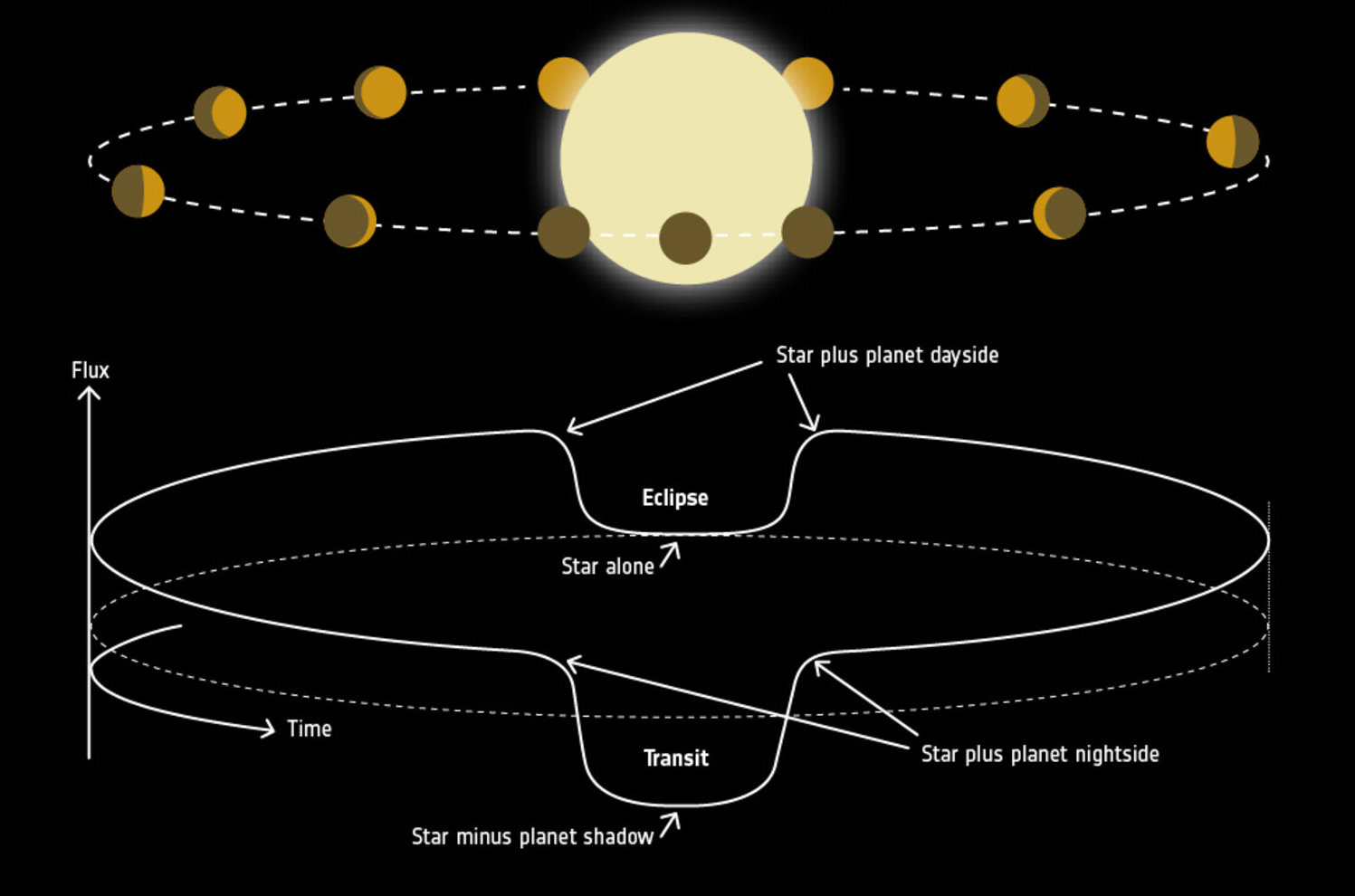
representation of an exoplanet's phase curve

A representation of an exoplanet’s phase curve. Click to enlarge. [ESA]

To learn more about WASP-121b’s atmosphere, Robert C. Frazier (University of Michigan) and collaborators analyzed JWST Near Infrared Imager and Slitless Spectrograph (NIRISS) observations covering more than one full orbit of the planet. These observations allowed them to construct the system’s phase curve, which describes the total amount of emitted and reflected light from the planet and its host star over an entire orbit.

The team used two 3D general circulation models to predict the planet’s atmospheric structure and extract synthetic spectra and phase curves to compare against the JWST observations. Using nine model configurations in total, the team varied several inputs, including sources of atmospheric opacity, sources of atmospheric drag, and assumptions about whether clouds are able to form on the planet’s cooler nightside.

Left with a Mystery

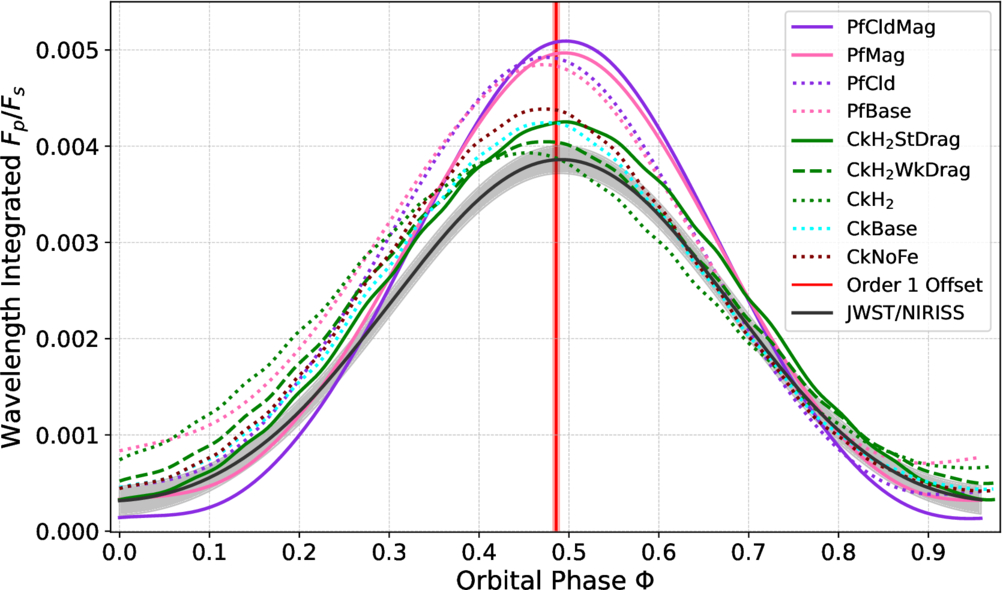
Frazier and collaborators found two aspects of WASP-121b’s phase curve that their models couldn’t explain: the planet emits less light overall than predicted, and the location of its phase-curve offset changes with wavelength.
phase curve of WASP-121b

Modeled phase curves, shown as the flux of the planet divided by the flux of the star, for WASP-121b (colored solid and dotted lines) compared to the best fit to the JWST observations (black line). Click to enlarge. [Frazier et al. 2026]

The models predict, on average, 12–15% more emission from the planet than observed. This discrepancy might be traced back to how the planet’s radius is determined, which is a simple-sounding task that can be deceptively difficult; WASP-121b isn’t perfectly spherical, and its emitting area changes with wavelength, making it challenging to normalize the planet’s radius for use in models.

The phase-curve offset is the difference between a planet’s sub-stellar point (where the star is directly overhead) and the brightest point in the planet’s atmosphere. In general, some degree of offset is expected because planetary winds tend to whisk heat away from the sub-stellar point, placing the brightest point somewhere to the east (usually). For WASP-121b, the offset is unexpectedly small — suggesting a source of drag in the atmosphere that prevents winds from transporting heat away from the sub-stellar point — and it’s larger at shorter wavelengths. This wavelength dependence isn’t predicted by any of the models, and it’s not clear what causes it.

These results demonstrate something remarkable: that our observations of a planet nearly 900 light-years away have become so precise that they’re pushing our already complex models to include more physics — an exceptionally exciting motivation for model improvement!

Citation

“The Days Drag On on WASP-121 b: Interpreting Its NIRISS Spectroscopic Phase Curve with General Circulation Models,” Robert C. Frazier et al 2026 ApJ 1004 102. doi:10.3847/1538-4357/ae69ca

The post Complexities and Mysteries in the Atmosphere of Ultra-Hot Jupiter WASP-121b appeared first on AAS Nova.
Astronomers Find the Strongest Evidence Yet That Alien Planets Have Magnetic Fields

8 June 2026 at 12:02
Illustration of the Sun and Earth with magnetic field lines in space.The winds on seven hellish alien worlds are moving in the wrong direction. That strange anomaly just cracked open one of exoplanet science's biggest mysteries.

Are Hot Sub-Neptunes Just Failed Hot Jupiters? Maybe.

20 May 2025 at 17:00

Illustration of a sub-Neptune exoplanet and its host star

Editor’s Note: Astrobites is a graduate-student-run organization that digests astrophysical literature for undergraduate students. As part of the partnership between the AAS and astrobites, we occasionally repost astrobites content here at AAS Nova. We hope you enjoy this post from astrobites; the original can be viewed at astrobites.org.

Title: The Hottest Neptunes Orbit Metal-Rich Stars
Authors: Shreyas Vissapragada and Aida Behmard
Authors’ Institutions: Carnegie Science Observatories; Flatiron Institute and American Museum of Natural History
Status:
Published in AJ

Sub-Neptune exoplanets, those between the size of Earth (1.0 REarth) and Neptune (4.0 REarth), are the most common type of planet discovered to date, with every other star hosting at least one on average. However, the class of “sub-Neptunes” is itself divisible into sub-categories based on the planet’s orbital period: these are called “hot,” “warm,” and “cold” for planets that are very close to their star, at a medium distance from their star, and farthest out, respectively. While the lines dividing these three categories are a little blurry, recently the community has begun roughly defining them as those with orbital periods shorter than 3.2 days (hot), those with periods between 3.2 and 5.7 days (warm), and those with periods longer than 5.7 days (out to 100 days, cold). The orbital period of the planet is directly related to the planet’s distance from its host star, so planets with longer orbital periods are farther out from their stars.

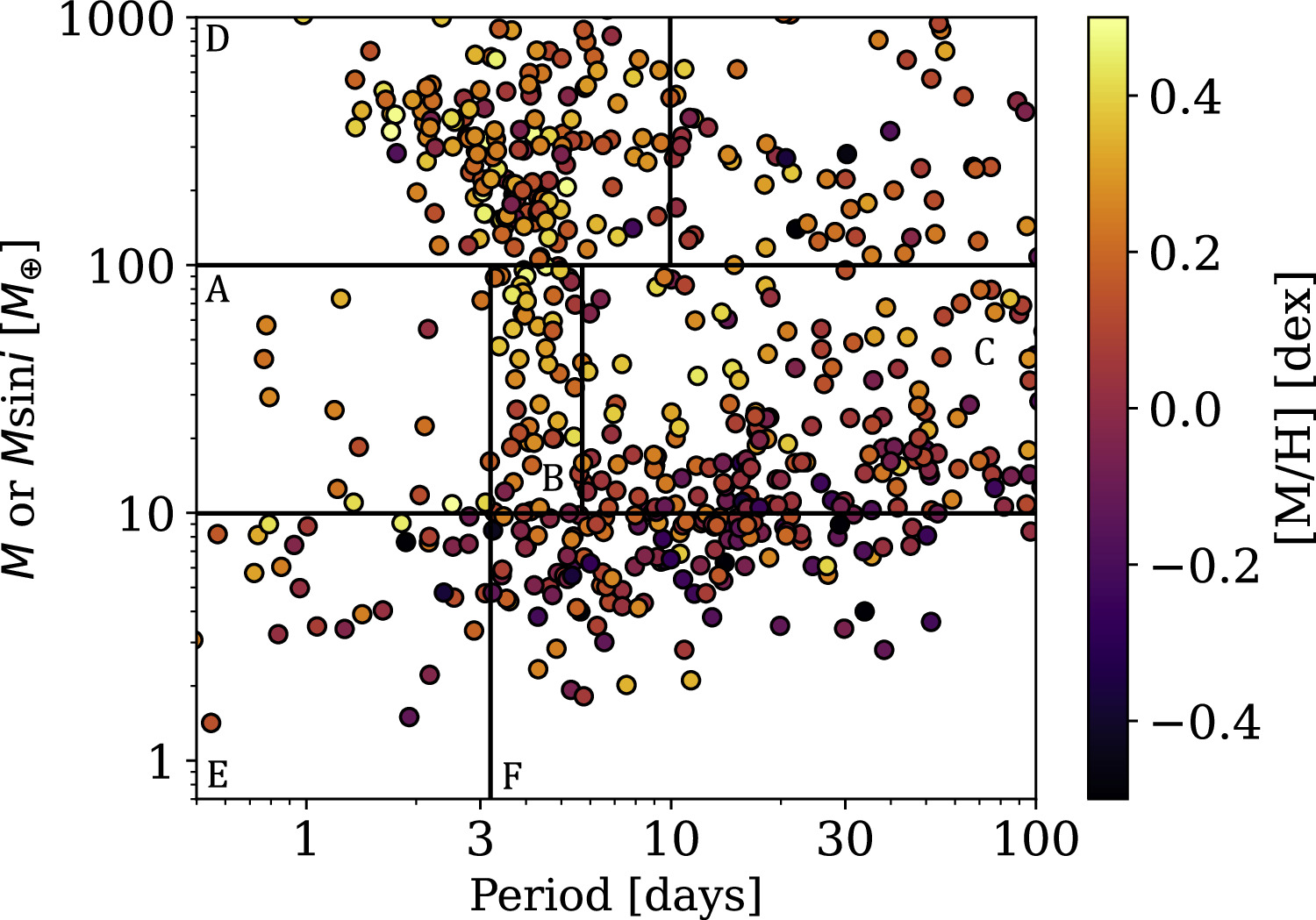
Furthermore, it seems that planets in these three categories are not equally abundant across the galaxy: cold sub-Neptunes are far more common than warm sub-Neptunes, which in turn are more common than hot sub-Neptunes. In fact, hot sub-Neptunes are seemingly so rare that exoplanet scientists have coined the term “the Neptune desert” to convey the emptiness of this region of parameter space (see Figure 1 below). But if sub-Neptunes are so common overall, why are the hottest of this class of planets so rare?

There are a few working hypotheses for how hot sub-Neptunes form, each of which predicts that their formation be very rare. First, perhaps they formed in the same way as the common cold versions, but through unique circumstances avoided having their atmospheres stripped by photo-evaporation from the star. Second, they may have formed via collisions of many small planets in the early days of the planetary system, creating one large planet on a short orbit. Or third, they could be “failed” hot Jupiters, meaning they initially formed as much more massive Jupiter-like planets and then, through one or more mechanisms, lost most of their mass until reaching their present-day size.

Today’s Astrobite reports on an article that attempts to find the most likely of these three formation mechanisms. The authors focus on the metallicity of the host stars of hot Neptunes (defined as those with masses between 10 and 100 Earth masses) and ask the question, “Do the host stars of hot Neptunes have a similar metallicity distribution to host stars of any other class(es) of planets?” The idea being, if another class of planets forms around similar host stars, perhaps the planets themselves formed through similar mechanisms.

The authors set out to test the hot Neptune (A) host-star population against four other populations of planet hosts: warm Neptunes (B), cold Neptunes (C), hot Earths (E), and hot Jupiters (D). See Figure 1 for where these populations lie on the period–mass plane. Metallicity studies are often difficult to perform for a number of reasons: first, it is difficult to measure precise metallicity for a single star, and second, data from different instruments and/or different measurement techniques are often inconsistent with each other. The authors have come up with a way to get around both of these issues by using a single source for their data: the Gaia mission’s radial-velocity spectrometer, through which they were able to collate precise measurements in a homogeneous fashion.

plot of mass versus period for different exoplanet host stars

Figure 1: The mass–period plane of exoplanets with metallicity color-coded. The lettered boxes denote different classes of planets, with hot sub-Neptunes marked as “A.” The authors compare the host stars of these planets to the host stars of other populations of planets. The orbital period of the planet is on the x-axis, the mass (or best mass estimate) is on the y-axis, and color indicates metallicity. [Vissapragada & Behmard 2025]

With this data, the authors find that the metallicity distribution of the host stars for hot Neptunes is similar to that of both warm Neptunes and hot Jupiters, but different for hot Earths and cold Neptunes. This means that hot and warm Neptunes likely formed via the same mechanism as hot Jupiters, or are themselves the remnants of hot Jupiters that just couldn’t hold onto most of their mass for one or multiple reasons. This has implications for our understanding of planet formation in general, and better contextualizing of the hot Neptune desert in particular. If hot Neptunes are the remnants of failed hot Jupiters, then perhaps they will exhibit other qualities that are known in the hot Jupiter population. For example, that they are usually found as single-planet systems, or with a distant giant planet or star that could have facilitated high-eccentricity migration. In future studies, it will be interesting to target these hot sub-Neptunes with JWST and compare their transmission spectra with those of hot Jupiters to see if the atmospheres of these two kinds of planets are consistent with one another as well.

Original astrobite edited by Catherine Slaughter.

About the author, Jack Lubin:

Jack received his PhD in astrophysics from UC Irvine and is now a postdoc at UCLA. His research focuses on exoplanet detection and characterization, primarily using the Radial Velocity method. He enjoys communicating science and encourages everyone to be an observer of the world around them.

The post Are Hot Sub-Neptunes Just Failed Hot Jupiters? Maybe. appeared first on AAS Nova.

To Be or Not to Be Aligned: Exploring Spin–Orbit Alignment Trends for Exoplanetary Systems

2 May 2025 at 17:00

hot jupie

Understanding exoplanetary system architectures is crucial to uncovering how planetary systems form and evolve. A recent study homes in on the XO-3 system to explore how planets orbit their host stars and what that may mean for their formation pathways.

Alignment Trends

Observations of exoplanetary systems have unveiled multiple interesting properties and characteristics that have expanded our understanding of planet formation beyond our solar system. One such property is the spin–orbit alignment — the direction a planet orbits its host star with respect to the star’s spin. In our solar system, the planets orbit in the same direction the Sun is spinning, but for many exoplanets, this is not the case.

stellar obliquity diagram

Star–planet systems demonstrating spin–orbit alignment and an example of a 40 degree spin–orbit misalignment. Click to enlarge. [AAS Nova/Lexi Gault]

Over the last few years, researchers have noticed a trend in which systems with high planet-to-star mass ratios tend to be more aligned, while planets with smaller mass ratios tend to exhibit larger spin–orbit misalignment. For example, hot Jupiters orbiting small, cool stars tend to remain aligned, while hot Jupiters orbiting massive, hot stars often are misaligned. 

There’s one exception to this trend: planet XO-3b. Orbiting a hot star and within a high planet-to-star mass ratio system, XO-3b was the first exoplanet observed with a high spin–orbit misalignment and has thus been the subject of multiple studies. However, its orbital angle is still uncertain. If this planet is truly an outlier, this would further complicate our understanding of planet formation mechanisms.

Getting to Know XO-3b 

To confirm whether XO-3b is a true outlier and understand why this planet does not bend to the trend, Jace Rusznak (Indiana University) and collaborators acquired new observations of the XO-3 system with NEID, a radial velocity instrument on the WIYN 3.5-meter telescope. By observing how the star’s radial velocity changes as the planet passes in front of the star, they can precisely determine the spin–orbit alignment of the planet as well as measure the properties of the XO-3 system.

Combining the new radial velocity measurements with previous Transiting Exoplanet Survey Satellite (TESS) data for XO-3b, the authors determine that the planet has a spin–orbit misalignment of 40.2 degrees. To confirm that this planet is truly an outlier, the team constructs a sample of single-star exoplanetary systems using the NASA Exoplanet Archive. They find a statistically significant difference in the alignment of systems with planet-to-star mass ratios above and below 2×10⁻³. With a high planet-to-star mass ratio of 9×10⁻³, the XO-3 system is unusually misaligned compared to other systems with similar planet-to-star mass ratios. 

spin orbit misalignment

Spin–orbit angle distribution for cool-star systems (top) and hot-star systems (bottom) as a function of planet-to-star mass ratio. The location of the XO-3 system is labeled, showing its high misalignment compared to other systems of similar planet-to-star mass ratios. Click to enlarge. [Rusznak et al 2025]

Undetected Companion

Now left with the conundrum of how XO-3b wound up misaligned, the authors consider the possibility of an undetected stellar binary companion that could have pulled the planet out of line. Previous observations of XO-3 did not directly observe a physically associated stellar companion, but errors in the Gaia astrometry of the star are atypically high for a single-star system. These errors could be the result of an undetected stellar companion gravitationally interacting with both XO-3 and its planet. 

Further observations of the XO-3 system are required to confirm that the system is actually a stellar binary, but if a second star is found, XO-3b would no longer be an outlier in the spin–orbit alignment versus planet-to-star mass ratio trend. This would increase the significance of the emerging relationship that, for single-star systems, planets with high planet-to-star mass ratios tend to be aligned even around hot stars, suggesting that planets in such systems are born aligned and stay that way.

Citation

“From Misaligned Sub-Saturns to Aligned Brown Dwarfs: The Highest Mp/M* Systems Exhibit Low Obliquities, Even around Hot Stars,” Jace Rusznak et al 2025 ApJL 983 L42. doi:10.3847/2041-8213/adc129

The post To Be or Not to Be Aligned: Exploring Spin–Orbit Alignment Trends for Exoplanetary Systems appeared first on AAS Nova.

Searching for planets in a galaxy far away

4 May 2026 at 12:00

The Star Wars series depicted alien heroes fighting against evildoers and their planet-destroying superweapons “a long time ago in a galaxy far, far away.” But what do scientists really know about alien planets in distant galaxies beyond our own? These worlds, known as extragalactic exoplanets, are expected to exist, assuming the Milky Way is no different from other galaxies. However, we have yet to find them since other galaxies are still too far, far away for modern exoplanet-observing techniques.

Recently, a team of astronomers analyzed a stream of over 700,000 stars that the Milky Way likely absorbed from the dissolving Sagittarius dwarf galaxy. These stars are very distant, so the team investigated whether any of them host large, close-orbiting exoplanets called hot Jupiters, which are relatively easy to find.  

They established a set of 3 criteria to narrow down their list of stars. First, each star should appear bright enough when observed by the Transiting Exoplanet Survey Satellite, or TESS, to ensure high-precision results from the team’s data processing software. Second, each star must have more than a 50% likelihood that it originated from the Sagittarius dwarf galaxy, based on motion and position measurements from the Gaia mission. Finally, each star should have a radius of less than twice the Sun’s, as it’s easier to find planets around smaller stars. They used these criteria to limit their candidate list to around 20,000 stars.

After selecting their candidate stars, the team analyzed publicly available TESS catalog data using the software packages eleanor and TESS-Gaia Light Curve, or TGLC. These tools allowed them to plot each star’s brightness over time, in graphs called light curves. Then, the astronomers looked for periodic brightness dips in these light curves as evidence that an exoplanet passed in front of the star. From this, they excluded several thousand additional stars with too much light interference from their surroundings, reducing their final sample size to just over 15,000 stars.

To find hot Jupiters, the team looked for brightness dips at intervals of 14 hours to 10 days, which is the typical orbital period range for hot Jupiters. Then, they used geometry to derive each exoplanet’s radius from the fraction of the starlight it blocked. They excluded candidates with dips corresponding to objects with radii at least twice that of Jupiter’s, as these are likely caused by orbiting companion stars rather than exoplanets.

Among all the stars they surveyed, the team’s strongest candidate to host a hot Jupiter was a star labeled TIC 92223525. They calculated that this star could host an exoplanet with a radius 1.76 times the size of Jupiter’s and an orbital period of 7.2 days. However, when they reviewed this star’s light curve, they found that it was likely contaminated by its neighbor, TIC 92223526. The regular brightness dips from this system of orbiting stars mimicked that of an exoplanet, creating a false positive for TIC 92223525 that was difficult to detect during initial screening. As a result, the team ultimately excluded this candidate, leaving them with no confirmed exoplanets.

The researchers drew several conclusions from their inability to find hot Jupiters in their sample of stars from the Sagittarius dwarf stream. They estimated that if more than 1% of these stars hosted hot Jupiters, it would have been highly unlikely not to detect one in a sample of over 15,000 stars. This places an upper limit of about 1% on the occurrence rate of hot Jupiters. If this estimate is accurate, then even an ideal exoplanet search team would need to examine over 11,000 stars to find an extragalactic hot Jupiter. Accounting for more realistic levels of scientific uncertainty, a future team would likely need to study at least 80,000 stars to find one. 

Although this survey of the Sagittarius dwarf stream yielded null results, the team suggested that future researchers continue searching it and other star streams from different galaxies. Scientists have identified over 20 such streams in the Milky Way. Researchers studying these streams could find the first extragalactic exoplanet or provide evidence that other galaxies produce fewer hot Jupiters than our own. But let’s hope none of them find the first extragalactic Death Star!

The post Searching for planets in a galaxy far away appeared first on Sciworthy.

❌