For the first time, astronomers combined Hubble and Webb space telescopes to hunt down some of the smallest, faintest objects ever spotted in the outer Solar System.
Solar system simulations starting from varied initial conditions suggest that Earth-like planets can emerge naturally from planet formation. Computer simulations of planetary systems can now begin from thousands of different starting conditions, allowing researchers to explore how worlds might emerge without assuming the final outcome. Over the past three decades, these models have advanced from [...]
A few hundred million years after the Big Bang, the first stars ignited—literally the "let there be light" moment for the universe. Now known to astronomers as Population III, or Pop III, stars, these giants were very different from the stars we know today. They formed from pristine hydrogen and helium, with almost no "metal" (i.e., other elements) holding them back. They were also huge, growing to tens to hundreds of times larger than the sun. And they died young, in many cases collapsing into the universe's earliest black holes.
A new image of the Helix Nebula reveals how dying stars return material to the galaxy. The Helix Nebula offers a rare look at what happens after a dying star releases its outer layers into space. New observations show fragments of that material colliding with surrounding gas, breaking apart, and beginning their return to the [...]
For the first time, astronomers have pointed NASA’s two flagship space telescopes at the same patch of sky beyond Neptune and let them work as a team. Hubble handled the visible light. Webb handled the infrared. Together, they picked out 27 previously unknown trans-Neptunian objects, or TNOs — small, icy bodies that drift in the […]
The moon may have formed in as few as five hours after the cataclysmic collision between Earth and a long-lost protoplanet, new simulations suggest. The surprising findings could help shed light on other historic impacts throughout our cosmic neighborhood and beyond.
Lunar rocks collected during NASA's Apollo missions have provided evidence to support this theory, dubbed the giant impact hypothesis. These samples also tell us that the moon is around 4.5 billion years old, meaning the collision occurred roughly 100 million years after the sun was born. But although scientists have previously simulated the impact event, it has been tricky to ascertain exactly how the moon formed and how long it took to emerge after the Earth-Theia collision.
In the new study, published Sept. 1 in The Astrophysical Journal Letters, researchers conducted a series of simulations focusing on the varying potential geological properties of both Earth and Theia prior to their collision. This factor has been relatively understudied until now.
"When you simulate the Earth and the moon as colliding bodies with [different] geologic properties, it changes how the moon forms out of that impact — that's something we considered unnecessary before," study first author Adeene Denton, a geologist and planetary scientist at the Southwest Research Institute in Boulder, Colorado, said in a statement.
Researchers simulated the ancient collision between Earth and Theia using a range of different geological properties and found that, with the right conditions, the moon could take shape in a matter of hours. (Image credit: Courtesy of SwRI)
Until now, simulations of the Earth-Theia impact have focused mainly on the masses of the colliding neighbors. But in the new study, the researchers were most interested in the material strength of the two bodies, particularly the hardness of their exteriors.
"Models have evolved to include material strength, something that's really important when you're studying collisions between smaller bodies like asteroids," Denton said. "We weren't sure if it would matter for the moon or not. When we did the simulations, we found it actually matters quite a bit."
The main factor in the strength of colliding bodies is temperature. Both Earth and Theia were very young when they smashed together, so they were still hot and had soft or molten surfaces. These properties would have cushioned the collision, allowing the debris to stay largely intact and enabling the moon to form more quickly. But when the giant impact hypothesis was first proposed (in 2001), researchers initially thought the collision occurred much later, meaning that the bodies would have cooled and become more brittle. In this case, their collision would have created a larger field of rocky debris that would have taken longer to coalesce.
Researchers simulated the collision using a range of potential temperatures and found that under the most extreme scenario — where the pair were at their hottest — the moon could have formed in just five hours. However, this is just one potential outcome, and there is no way of knowing exactly how hot — and, therefore, how strong — Earth and Theia really were when they smashed together.
When the moon took shape, it was initially covered with a magma ocean that took hundreds of millions of years to solidify. Even then, its increased proximity to Earth meant that it was likely a volcanic hellscape. However, over time, it moved away from our planet, cooling further, and it is now assumed to be geologically dead. (The moon is continuing to slowly move away from us and could eventually escape our planet's gravity entirely, if the dying sun doesn’t destroy it and us first in around 5 billion years.)
Additionally, the findings could have implications in the search for exomoons — the hypothetical moons of distant exoplanets, which have so far remained elusive, according to Live Science's sister site Space.com. Until now, one of the main ways astronomers have been hunting for these alien satellites is by looking for debris fields around exoplanets. However, if the moon is anything to go by, these debris fields could be very short-lived and difficult to identify.
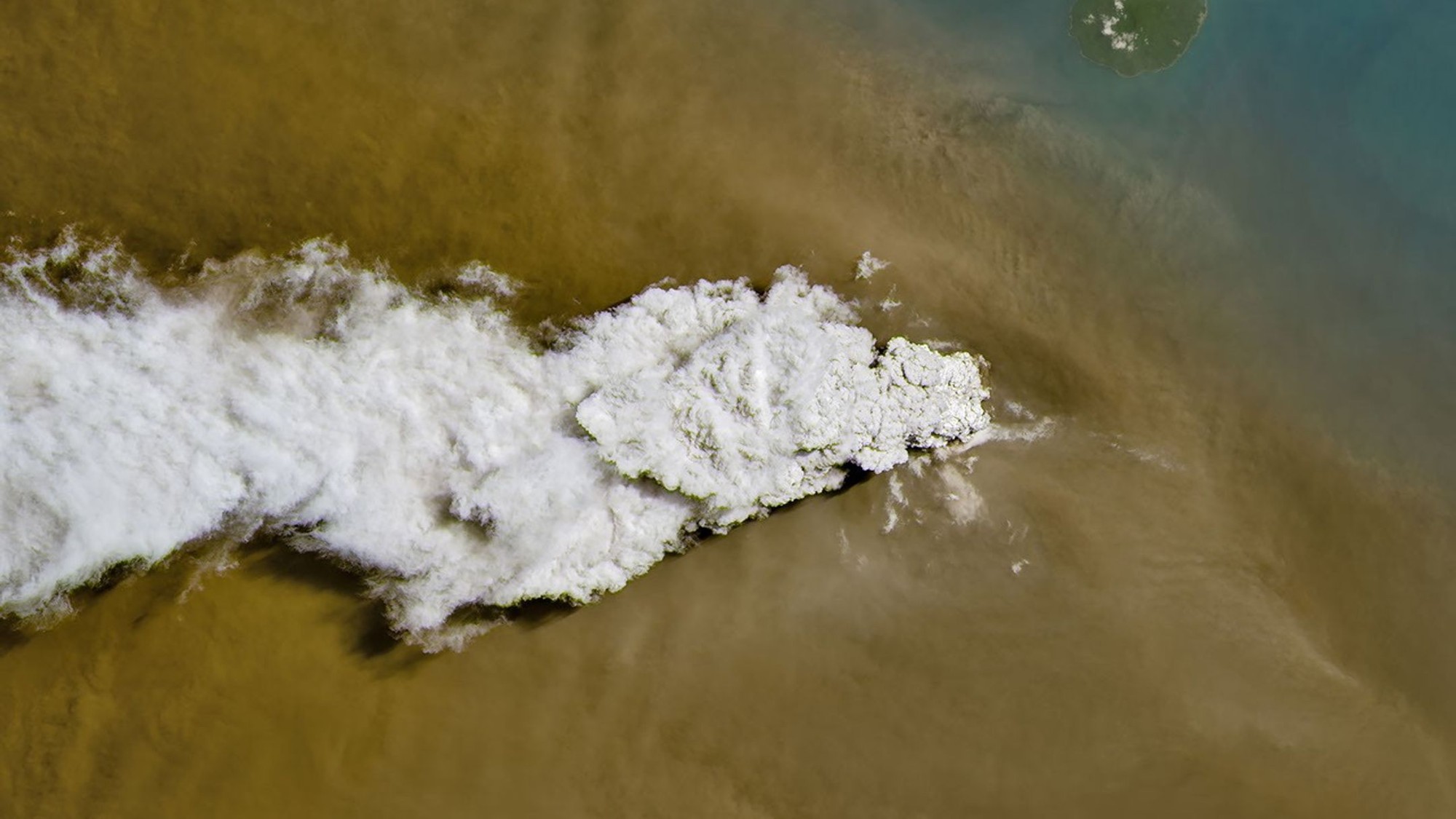
The Anak Krakatau volcano began erupting on Sept. 4, 2026, as seen here on Sept. 5 by the Landsat 8 satellite jointly operated between NASA and the U.S. Geological Survey (USGS) (Image credit: NASA Earth Observatory/Michala Garrison)
A volcano on an Indonesian archipelago began erupting on Sept. 4, and satellites in orbit have been watching closely.
What is it?
The volcano Anak Krakatau started spitting out ash and lava on Sept. 4. On an archipelago between Sumatra and Java, the island volcano's sudden eruption grounded flights, closed schools and even stopped fishing in the area.
The volcano launched ash into the air and into the city of Jakarta and the Lampung province during a 25-hour-long eruption. But even following this eruption, Anak Krakatau remained active throughout the weekend. In fact, the volcano is still so active that it could erupt again soon.
But it wasn't just people on Earth watching the volcano erupt this past weekend. The Landsat 8 satellite, operated by NASA and the U.S. Geological Survey (USGS), spotted a white plume of volcanic gas billowing into the atmosphere all the way from space. The white plumes of gas are thought to mainly contain water vapor, carbon dioxide and sulfur dioxide, while ash and debris make up the brown clouds surrounding the plumes.
Why is it incredible?
While Anak Krakatau simmers after this most recent eruption, this event isn't a major shock, as the volcano sits in what is known as the "Ring of Fire." This "ring" (a loose term, as it's not exactly a ring) snakes about 25,000 miles (40,000 kilometers) around the Pacific Ocean and includes over 750 volcanoes, some dormant and some active.
In fact, in Indonesia alone there are 500 volcanoes, and 127 of them are active, including Anak Krakatau. And this volcano has a particularly interesting story: It emerged from the sea in 1927, rising from the caldera formed by the 1883 eruption of Krakatau (also known as Krakotoa), which was one of the most famous and destructive volcanic events in history. (Anak Krakatau means "child of Krakatau" in the Indonesian language.)
While not all geologists agree on the exact margins of the Ring of Fire, it rests on a string of tectonic plates and has existed for over 35 million years. And not only is this ring home to hundreds of volcanoes, it's also a hot spot for earthquakes.
Researchers developed a model showing how lava-covered planets close to their stars can hold onto their atmospheres, which could help guide the search for life beyond our solar system. Some planets orbit so close to their stars that intense radiation should strip away their atmospheres. Yet several of these scorching, lava-covered worlds still retain thick [...]
When Edward Emerson Barnard peered through the 36-inch refractor at Lick Observatory on Sept. 9, 1892, and spotted Amalthea, it marked the first discovery of a moon of Jupiter in 280 years. Galileo had discovered the four largest jovian moons – Io, Europa, Ganymede, and Callisto – in 1610. Though this fifth moon was closerContinue reading "Sept. 9, 1892: Edward Emerson Barnard sees Amalthea"
Astronomers have found the first direct evidence that a wandering black hole can feed itself by dragging gas along in its wake as it moves through its galaxy. It's the first direct evidence of an accretion channel long predicted in theory but never before observed. The paper describing this discovery was posted to the arXiv preprint server on Aug. 11.
China is making progress on its Tianwen 3 Mars sample return mission, which aims to bring back to Earth roughly 500 grams (17.6 ounces) of Red Planet collectibles in 2031.
According to the China National Space Administration, the Tianwen 3 mission will have a lander, an ascender, a service capsule, an orbiter and an Earth reentry module.
If all goes to plan, Tianwen 3 will launch in 2028 on two Long March 5 heavy-lift rockets from the Wenchang Space Launch Site on the island of Hainan, China's southernmost province.
Sputnik moment
"The Tianwen 3 mission is progressing smoothly, with intensified efforts being made to overcome technical challenges," Hou Zengqian, the mission's chief scientist, recently told CCTV, a state-run Chinese broadcaster.
"The probe equipment has entered the prototype development phase, and scientifically, many scientist teams from across the country are working together to tackle the challenges in accordance with the mission's scientific objectives," Hou added.
Meanwhile, NASA's plans for hauling Mars samples to Earth are murky at the moment. So China appears to be in the lead to notch a major space milestone.
"If accurate, this represents a Sputnik moment," said former NASA "Mars Czar" Scott Hubbard, referring to the reported Tianwen 3 progress.
"China will not only grab the headlines but may be the first to find evidence of life on another planet," Hubbard, who also previously directed NASA's Ames Research Center in Silicon Valley, told Space.com.
Diagram of China's Tianwen 3 Mars sample return mission. (Image credit: The University of Hong Kong/Zengqian Hou, et al.)
Top scientific priority
"The Tianwen 3 mission will look for microbial traces potentially similar to early forms of life on Earth, while also taking into consideration the possibility of unknown forms of life that may have emerged through Mars' unique evolutionary history, providing crucial evidence to answer this major scientific question," Hou told the state-run Xinhua news agency in a recent interview.
Searching for potential signs of life on Mars is the top scientific goal of the Tianwen 3 mission, Hou said on Sept. 3 during the 2026 International Deep Space Exploration Conference on, which was held in Hefei, the capital of eastern China's Anhui Province.
Landing site
China's Mars sample-return trek will be launched "around 2028" on two Long March 5 rockets departing from the Wenchang Space Launch Site in China's southernmost island province of Hainan. (Launch windows for Mars missions come around just once every 26 months. The next one opens in November-December of this year, and the one after that, which Tianwen 3 apparently is targeting, runs from December 2028 to January 2029.)
Hou also said China expects to finalize the landing site for the mission by the end of 2026, with Chinese specialists advancing work on a next-generation geological map of Mars in its entirety.
If everything goes according to plan, the mission will collect samples from the Martian surface and then send them back to Earth around 2031.
"Regardless of whether signs of life are found, the returned Martian samples will have irreplaceable scientific value," Hou said.
Tackle the challenges
Hou added that analyses of the returned samples at microscopic, molecular and isotopic scales could deepen our understanding of Mars' geology and environment, as well as the evolution of habitability and the conditions under which life may originate.
According to Hou, Mars sample return is an extremely complex project, with landing-site selection, planetary protection and contamination control, and the identification of potential signs of life among its key challenges.
Chinese Mars researchers are selecting candidate landing sites for the mission based on factors that include geological age, history of water activity, habitability and the potential for preserving biosignatures.
Planetary protection lab
Xinhuareported last month that a "planetary protection laboratory" is to be built in the first phase of Hefei's Deep-Space Science City in east China's Anhui Province, citing the Deep Space Exploration Laboratory (DSEL).
"The planetary protection laboratory will implement a two-way protection system that guards both the returning Martian samples and Earth's biosphere," Xinhua reports.
The lab's tasks encompass sample sterilization, unsealing, processing and biological risk assessment. "The facility is designed to support the implementation of major deep-space missions and to enable scientific research on Martian samples," added Xinhua.
China "will follow the planetary protection policies of the Committee on Space Research, to prevent biological contamination of Mars by terrestrial organisms and to protect Earth from any potential extraterrestrial life forms that may be carried back in the samples," said Li Hang, director of the development planning department at DSEL, according to Xinhua.
You can view a video about China's Mars sample return plans here.
Dark energy is one of the least satisfying names in astronomy because it sounds more specific than it is. Scientists did not discover a glowing substance called dark energy. They gave that name to the unknown influence associated with the accelerating expansion of the universe. The evidence is strong that the expansion is speeding up […]
Picture a moonless night, far from any city. Look straight at the point in the sky opposite the Sun — the antisolar point, where the Sun would appear if you could see it through the Earth. There, faintly, you might make out an oval-shaped glow, 8 to 10 degrees across. For scale, that’s roughly the […]
NASA’s Neil Gehrels Swift Observatory is back to studying the universe, even as the aging spacecraft continues to lose altitude and a planned mission to raise its orbit has been scaled back. Two of Swift’s three science instruments are operating again after months of conservation measures designed to reduce atmospheric drag and keep the observatory [...]
Scientists may finally know why Venus, Earth's twin, lacks a moon, finding that the hottest planet in the solar system may have consumed its own natural satellite.
Venus is often referred to as Earth's twin due to its size, mass, rocky composition, and distance from the sun, but there are some glaring differences between the two planets. Aside from Venus' blisteringly hot temperature, which could melt lead, incredible surface pressure, violent high-speed winds, and clouds of sulfuric acid, one of the key differences between Earth and Venus can be seen from afar. While our planet has a constant companion in the form of the moon, Venus lacks a moon of its own. In fact, the only solar system planets lacking moons are Venus, the second planet from the sun, and Mercury, the closest planet to the sun.
One question that scientists have puzzled over for years is whether Venus always lacked a moon, or if the hottest planet in the solar system once had a natural satellite and somehow lost it. Now, a team of researchers may have arrived at an answer, determining the fate that would have befallen a hypothetical moon orbiting Venus.
"I have always had a fascination with moon formation and evolution in the solar system, and particularly with Venus since my research is centered around its evolution and potential for past habitability," team leader Stephen R. Kane of the University of California, Riverside told Space.com. "Venus is Earth's twin, and both are nearly identical in size, mass, and composition. However, Earth has a large moon, and Venus has no moon at all, not even a small captured satellite.
"Venus undoubtedly experienced large impacts, just as Earth has, and so has had as much, if not more, opportunity to form a moon similar to what we see in our own skies."
Kane and colleagues constructed a simulation to test their ideas of what could have become of the Venusian moon.
"The work involved going back to fundamental physics and creating the simulation from the ground up, which I validated by ensuring I could reproduce the evolution of the Earth-moon system," Kane said. "The moment I realized that our model provided a complete explanation for Venus not having a moon was an exciting one!"
Did Venus consume its own moon?
The team modelled a gravitational tug-of-war between Venus, a hypothetical moon, and the sun, following this forward over billions of years.
"This is the same physics that governs our own moon, which is slowly drifting away from Earth. We ran the calculations across a wide range of possibilities for how fast Venus was spinning and how massive its moon might have been, using two independent mathematical descriptions of how tides work," Kane explained.
The researcher said that this was done so the conclusions reached wouldn't hinge on one set of assumptions. They found in most cases a Venusian moon would not drift safely outward the way ours does. Instead, the modelling showed that a moon orbiting Venus would eventually reverse its course and spiral inward, causing it to be torn apart by the planet's gravity.
Kane and colleagues found that possessing an intimidating size wouldn't guarantee a Venusian moon's survival, either.
"An interesting aspect is that a heavier moon is destroyed faster, since a massive moon would drain Venus's spin so efficiently that it hastens its destruction," Kane added.
Venus as seen from Earth may look peaceful, but up close, it is a hellish world that may have destroyed its own moon. (Image credit: Starry Night)
But are there any circumstances under which a Venusian moon could have survived?
"Survival came down to two main things: Venus had to be spinning fast when the moon formed, with a day shorter than about 12 hours, and the moon couldn't be too massive, up to roughly the mass of our own moon," team leader Stephen R. Kane of the University of California, Riverside told Space.com. "In that narrow window, the moon migrates outward and stabilizes, much as Earth's did. Outside that range, the moon is unfortunately doomed to be consumed by Venus.
"So a surviving moon would have had to be modest in size, orbiting a rapidly spinning early Venus, which are conditions that don't match what we think early Venus was actually like."
We may never conclusively know if Venus has indeed destroyed its own moon, as Kane thinks that collecting direct evidence from astronomical observations will be very difficult.
"Finding direct observational evidence is pretty tough. A moon lost billions of years ago would leave little to no direct trace we can point a telescope at today, so we can't observe the event itself," Kane said. "However, there are indirect avenues. For example, if a moon was destroyed and its debris rained down on Venus, it could have left a chemical fingerprint in the planet's surface or atmosphere, and upcoming missions to Venus, including NASA's DAVINCI (Deep Atmosphere Venus Investigation of Noble gases, Chemistry, and Imaging) probe, will measure atmospheric composition in detail."
If missions such as DAVINCI could help us develop a better understanding of the Venusian interior, then this would also improve the models such as the one used in this research. That is because the outcomes of such models depend on properties of Venus's interior, which aren't currently well understood.
"There's a broader test beyond our solar system because our results predict that slowly rotating, Venus-like planets around other stars should generically lack large moons, so as astronomers begin searching for moons around exoplanets, that's a prediction that can eventually be checked against real data," Kane said.
An artist's depiction of the DAVINCI probe nearing the surface of Venus. (Image credit: NASA's Goddard Space Flight Center)
Kane and colleagues don't intend to rest on their laurels while further data from Venus or even Venus-like exoplanets are delivered. They have plenty to work on in the meantime.
"There are numerous implications of our work that I would like to explore further. These include the compositional and atmospheric effects of a Venusian moon consumption event that may be testable now," Kane concluded. I would also like to explore similar effects for Mercury and Mars, and conduct further studies on exoplanet cases where such moon collision scenarios may have occurred."
The team's research is available as a pre-peer-reviewed paper on the repository site arXiv.
A cubic meter of lunar soil might be one of our best bets for finding physical proof that another advanced civilization once existed somewhere in the Milky Way, according to a new paper to be published in the International Journal of Astrobiology.
Physicists around the world remain deeply divided on key mysteries of the universe, from dark matter to quantum gravity. The standard cosmological model failed to gain majority support, and no leading theory dominated the survey results. The largest survey ever conducted among physicists worldwide reveals surprisingly little agreement on some of the field’s biggest mysteries, [...]
Astronomers have combined 2,884 Type Ia supernovae -- which are used to measure cosmic distances -- with cosmic microwave background and galaxy-mapping data, deepening cracks in the standard ‘cosmological constant’ model.
On Sept. 8, 2016, the Origins, Spectral Interpretation, Resource Identification, and Security – Regolith Explorer (OSIRIS-REx) mission launched from Cape Canaveral, setting off on its 4.4-billion-mile (2 billion kilometers) journey to asteroid Bennu. About the size of an SUV, the OSIRIS-REx spacecraft carries several cameras, an altimeter used to create maps of Bennu, and anContinue reading "Sept. 8, 2016: OSIRIS-REx launches"

 Login