Google’s $4.1 billion EU Android fine launches a debate over technology regulation, encryption backdoors, age verification, app-store mandates, and the political tension between the United States and Europe. Chuck Joiner, David Ginsburg, Eric Bolden, Jim Rea, and Marty Jencius also explores an unusual national time capsule, compares Evernote, Apple Notes, GoodNotes, Notion, and Notability, discusses vibe coding, and considers JustWatch as TV Time shuts down.
This MacVoices Live! starts out with the introduction of the new Foreshadowing Tech series, mark the end of the British Tech Network after 18 years, and examine Apple-related privacy, politics, and search issues. Chuck Joiner, David Ginsburg, Jeff Gamet, Guy Serle, Web Bixby, Eric Bolden, Marty Jencius, and Jim Rea discuss Canada’s encryption proposal and Apple’s response, the Towson Apple Store closure, DuckDuckGo’s surge after Google search changes, and Meta’s AI pendant ambitions.
Romanian army divers used explosives to destroy two Russian-made drones found floating in the Black Sea near Romania’s largest natural gas project, according to the NATO member country’s defense minister.
Defense Minister Radu Miruță posted a Facebook video supposedly showing one of the drones being blown up in the water by explosive ordnance disposal divers of the Romanian army on August 11, as reported by Reuters and other news outlets. The drones were first spotted in the water by a ship working in the vicinity of the Neptun Deep—an offshore gas project under development in the Black Sea that will make Romania the largest gas producer in the European Union.
A Romanian Coast Guard ship that responded with army soldiers aboard found two drifting Gerbera-type drones of Russian design along with other debris. Miruță also disclosed that Romania had reached out to “Ukrainian partners who confirmed that the systems do not belong to them.”
Apple is working on a new feature that will support cross-device copy and paste between iOS devices and Windows PCs.
Microsoft asked for the feature using Apple’s EU interoperability request system for developers, which Apple implemented to comply with the Digital Markets Act. Apple began evaluating the request in March, and on June 26, proposed a project plan.
[…]
Apple proposed a solution that would let an iPhone share and import items from the pasteboard to a paired accessory, like a Windows PC. Apple plans to use a solution similar to the Accessory Notifications option it added for third-party wearables in the EU in iOS 26.5. Users would need to give a paired device one-time permission to paste content from an iPhone.
[…]
Apple says introducing cross-device copy and paste is a significant engineering effort, with work expected to be complete by fall 2027.
I wonder whether Apple will restrict this to the EU.
Apple has agreed to acquire PlasmaSolve, a Czech materials science company specializing in plasma simulation software, according to a regulatory notice published today on the European Commission’s website, as spotted by MacRumors
Earlier this year, Apple informed the European Union that it would acquire the entire issued share capital of PlasmaSolve s.r.o. through a subsidiary and hire certain employees from the firm. PlasmaSolve develops solutions, including plasma simulation software, to design and optimize plasma-based manufacturing processes.
Founded in 2016, the company has focused on creating simulation tools to help manufacturers work with various plasma-related technologies. Its website remains active and details grant funding it has received for its research over the years.
PlasmaSolve’s primary product is MatSight, a suite of applications designed to help manufacturers simulate the results of vapor deposition processes for metals. Apple has used this technology for years across multiple products, including various iPhone models, to apply a durable thin film to casings that helps minimize scratching and other damage.
No financial terms or further details about the deal’s timeline were disclosed in the regulatory filing.
MacDailyNews Take: The acquisition underscores Apple’s continued investment in advanced materials and manufacturing processes that improve the durability and quality of its devices.
Please help support MacDailyNews — and enjoy subscriber-only articles, comments, chat, and more — by subscribing to our Substack: macdailynews.substack.com. Thank you!
Companies must ensure people know when they are interacting with artificially generated images, audio and text designed to look real
From apparently conspiring to steal elections to abusing staff or performing embarrassing dance moves, the last few years have seen plenty of fake content made about politicians intended to malign its targets and mislead the public.
Now EU rules aim to stem the flood of this deceptive content: starting from Sunday, artificially generated images, audio and text designed to look authentic must be labelled.
The Guardian journalist who targeted the Free Speech Union with a story stuffed with misinformation, Aisha Down, is a "Senior Tarbell Fellow". Charlotte Gill investigates what that means.
U.S. President Donald Trump today said on Truth Social that his administration plans to launch an investigation into fines the European Union has levied against tech companies like Apple, Google, and Meta for violating antitrust and Digital Markets Act rules.
Trump called the European Union's conduct "illegal and highly unethical," vowing to get the penalties reversed and planning to institute a "substantial tariff."
The European Union is at it again and, as usual, taking direct aim at GREAT American Companies! After having fined Apple, for no reason at all, 15 Billion Dollars, Meta, 3 Billion Dollars, Amazon 2.5 Billion Dollars, and many others, we have just been informed that Google, a truly advanced and amazing group, has been fined yet another 1 Billion Dollars, without explanation. This brings the Google total to over 18 Billion Dollars! This illegal and highly discriminatory practice started at these high levels during the first year of the Sleepy Joe Biden Administration, but it's not going to continue during the Trump Administration. The United States of America is not a "PIGGYBANK" for Europe, nor will we allow it to be! Please let this TRUTH serve to represent that we will immediately initiate a 301 Investigation into the practice of "ROBBING" American Companies and, in turn, the American Taxpayer. The European Union will pay a very big price for this illegal and highly unethical conduct, which I have consistently warned them about. The penalties will be entirely reversed and, we anticipate, a substantial TARIFF to be placed on them at the earliest possible moment.
Apple was fined $570 million in 2025, Meta was fined $840 million in 2024 and $200 million in 2025, and Google was fined $1 billion this week after a $4.5 billion Android fine was upheld earlier this month.
Trump previously threatened European tariffs if the EU did not stop targeting U.S. companies, and the Office of the United States Trade Representative has also threatened to implement fees and restrictions on European services and companies.
Trump has focused heavily on tariffs during his second term, affecting U.S. companies and consumers. A 10 percent blanket tariff Trump enacted earlier this year expired today. The Trump administration implemented new tariffs to replace them, accusing 60 countries of failing to "impose and effectively enforce a prohibition on the importation of goods produced with forced labor." The tariffs will affect goods from the UK, China, and the European Union, among others.
Dr. Tsimerman won one of four Fields Medals, an award for top mathematicians under 40, for his work on the André-Oort conjecture, but is now changing his focus to artificial intelligence.
Google was today fined €890 million ($1 billion) by the European Union for breaching antitrust rules with regard to its search and Google Play store services.
The European Commission found that Google had broken the Digital Markets Act (DMA) by using its dominant position in the search market to favour its own services, like shopping and hotel deals, over those of rivals.
The Commission also said that the company had abused its position by preventing developers from directing users to cheaper ways to buy apps and app subscriptions on websites and alternative app stores.
The Commission noted that Google has begun testing changes to how its own services are placed in search results and rolled out changes to its steering terms, which the EU’s main executive body described as substantial progress towards compliance.
“Google has fallen short of effective compliance with the Digital Markets Act, and today we have taken decisive yet balanced enforcement action sanctioning these breaches,” said Teresa Ribera, Executive Vice-President for Clean, Just and Competitive Transition.
“The best products should succeed because they’re better, not because they’re owned by the company running the search engine. And European consumers have a right to be told by app developers where to sign up to the best offers, even when the app store owner does not get a cut.”
With search, Google is required to share with competitors — search engines and AI chatbots alike — a massive amount of user data from Google Search user interactions. What terms people search for, what they click on in results, what languages and devices they use. It’s all ostensibly anonymized but that’s tricky when it comes to search terms. A lot of the terms people type into web search fields are to some degree personally identifying. The EC seems to be saying it’s Google’s problem to filter out things like passwords and usernames and omit them from the shared datasets. Google can charge money for this access, but only under “fair, reasonable, and non-discriminatory (FRAND)” prices, based on a Commission-defined methodology.
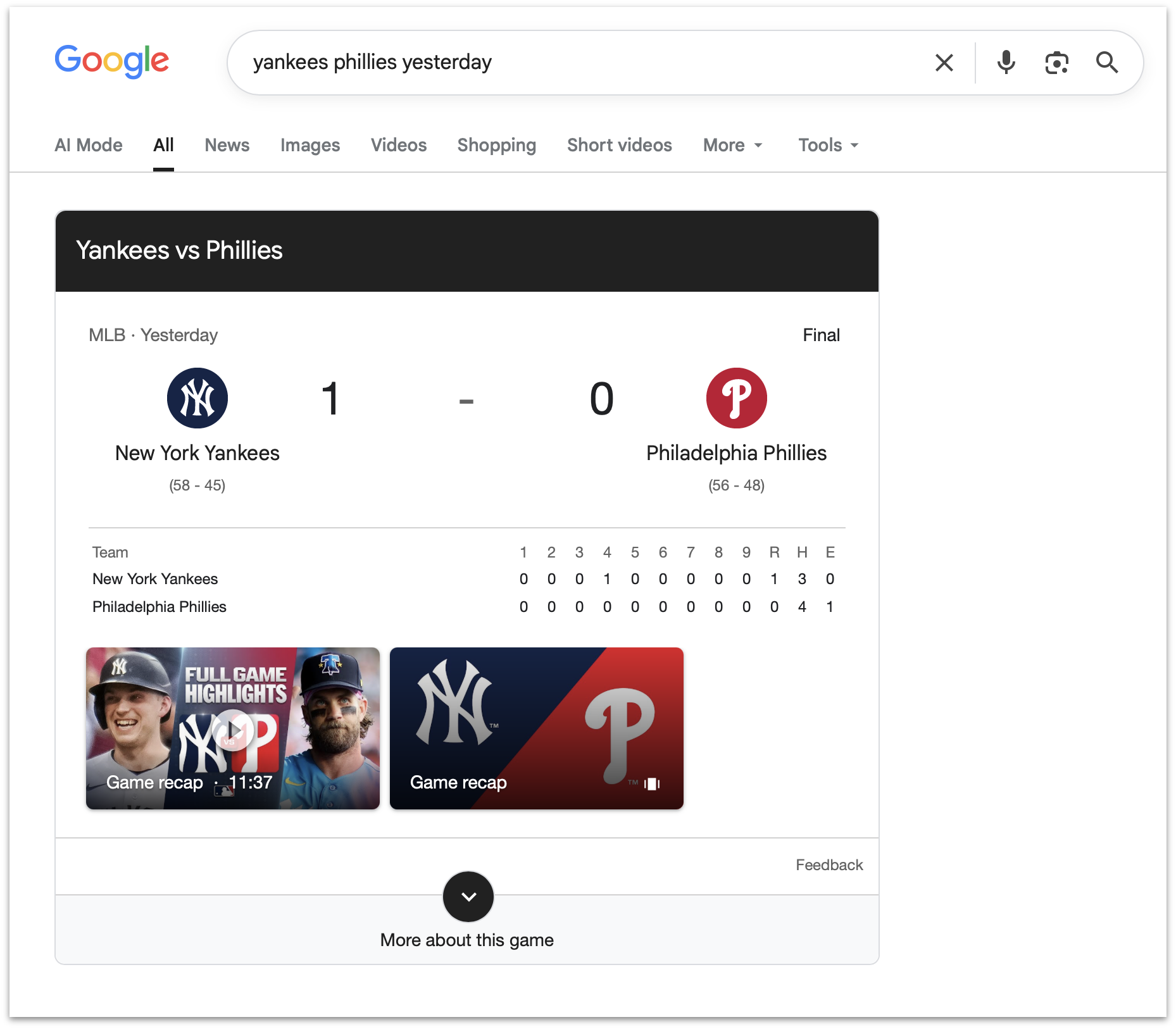
So if you search for the score of a sporting event, it’s illegal in the EU for Google to show you the score, like this search I just tried. What the EC is saying is that because Google Search is so popular, it’s no longer allowed to improve.
It drives me insane when in Europe the link between Google Search and Google Maps is broken and I often have to copy paste an address between the two. Thanks EU, what if I like Google’s integrations?
They could have simply added a selector when a user first clicks on the maps preview in the search result, and then remembered it on device or across that user’s account.
But of course, then the user could choose a competitor’s product and Google would have to honor it. That would be horrible, so instead they just made the user experience worse for everyone and elegantly made people blame the EU.
Back in 2018, Google was handed a record-setting 4.34 billion-euro ($4.9 billion) fine in Europe for abusing its monopoly on Android. The company has spent the intervening years challenging that decision, but the continent’s highest court has put a stop to that. The Court of Justice of the European Union has affirmed the penalty, meaning Google is out of options.
[…]
The EU took issue with Google search and Chrome being the default options on Android. Even devices made by other companies, such as Samsung and Xiaomi, include Google apps as the default per the Android licensing agreement, giving Google an unfair advantage, according to European antitrust regulators. This is not to be confused with a 2.95 billion euro ($3.45 billion) fine against Google’s advertising monopoly issued by the European Union last year.
There’s never a reason not to string the appeal process out, but it’s especially true when your profits are growing at an exceptional rate. By growing their profits around 5×, they’ve reduced the relative sting of this fine by 5×
Firm told to treat third-party services that appear in its results in ‘fair and non-discriminatory manner’
Google has been fined a total of €890m (£760m) by the EU for breaches of online competition laws by its search and app store services.
The European Commission, the EU’s executive arm, said Google had broken the Digital Markets Act by giving priority to its own services, such as shopping and hotel deals, in search results over those of its rivals.
President Donald Trump holds a signed executive order on tariffs, in the Rose Garden at the White House in Washington, D.C., April 2, 2025.
A group of 25 U.S. lawmakers has sent a letter to President Trump calling on his administration to confront the European Union’s digital regulations, which they describe as discriminatory policies aimed at American technology giants.
In the letter, obtained by Reuters, the Republican lawmakers – including key members of the House trade subcommittee – urged the president to consider launching Section 301 investigations under U.S. trade law. Such probes could pave the way for tariffs or other retaliatory measures against the EU if talks fail to resolve the issues.
The central target of the complaint is the EU’s Digital Markets Act (DMA), which designates major U.S. companies – including Amazon, Apple, Google, Meta, Microsoft, and Booking Holdings – as “gatekeepers” subject to strict behavioral rules. Lawmakers argue the rules unfairly burden American firms while sparing European and Chinese competitors.
Key concerns raised in the letter:
• Cloud services: The likely inclusion of Amazon Web Services and Microsoft’s cloud business under DMA oversight would impose “unprecedented regulatory burdens” not faced by European or Chinese rivals.
• Google fines: An expected European Commission fine against Google this week for alleged DMA violations ignores the company’s significant changes to its search services.
• Inconsistent enforcement: Apple, Meta, and Amazon have been labeled gatekeepers based on user numbers in Europe, while Chinese platforms like Temu and AliExpress have been excluded.
“We write to bring to your attention the many ways the EU continues to pursue anti-competitive acts, policies, and practices as a tool of economic extraction and regulatory coercion against American firms,” the letter states. It warns that EU access to the U.S. market “is not guaranteed” if the discriminatory practices continue.
The European Commission has not yet responded to the letter. It maintains that its rules apply neutrally to promote fair competition and do not single out any country.
This latest congressional push aligns with President Trump’s long-standing criticism of EU digital policies and could signal a more aggressive U.S. trade posture toward Brussels in the coming months. Lawmakers emphasized that dialogue should be attempted first, but “all available tools” – including tariffs – remain on the table if needed.
The move highlights ongoing transatlantic tensions over technology regulation, data privacy, and market access that have persisted for years and are now poised to test the new Trump administration’s approach to international trade.
MacDailyNews Take: Good. The DMA does far more harm than good.
The European Union arose because the Europeans couldn’t compete on their own with the rest of the world, so they each lined up to surrender their national sovereignty, unique cultures, and dignity for an undemocratic, opaque, wasteful, bloated, bureaucratic quasi-governmental blob – and, even with the EU’s thumbs all over the scale, they still can’t compete. – MacDailyNews, March 4, 2024
Please help support MacDailyNews — and enjoy subscriber-only articles, comments, chat, and more — by subscribing to our Substack: macdailynews.substack.com. Thank you!
The European Commission yesterday adopted new exemptions to its Batteries Regulation that free the Apple Watch and AirPods from having to offer user-removable and replaceable batteries.
[…]
The reasoning largely mirrors why devices like electric toothbrushes were already exempt: Opening a compact, sealed enclosure and failing to reseal it properly could let water in and create a safety risk. Products can also qualify for exemption if their construction makes battery removal inherently dangerous, or if there is no realistic way to build in user access given current manufacturing methods.
[…]
The iPhone was already exempt from the removability rule under the original regulation, thanks to its battery cycle life and water resistance rating.
This is one of those exceedingly rare cases where EU legislation has produced an unambiguously good outcome: from February 2027, Logitech’s European wireless devices will ship with hard-pack, user-replaceable batteries, and Logitech will sell certified replacements.
Apple’s challenge against the EU’s designation of its App Stores and iOS platform as “gatekeepers” was dismissed by Europe’s top court on Wednesday, reports Reuters.
[…]
The company also disputed the classification of iMessage as a number-independent interpersonal communications service, or NIICS, which would subject the app to EU telecoms rules. But the General Court said Apple’s actions regarding the iMessage service are inadmissible.
Back in 2023, Apple acknowledged that it qualified under the then-new definition of being what the EU called a gatekeeper service. But key to that is the size of the operation, and since 2024, Apple has been claiming it runs five smaller App Stores rather than one large one.
[…]
“Irrespective of the devices in question,” ruled the judges, “those stores have the same purpose, namely to connect app developers with end users in order to facilitate the distribution of software applications.”
Apple disagreed with the decision but didn’t say yet if it would appeal. “We firmly believe the DMA’s mandate goes beyond what is lawful and proportionate, threatening to erode decades of privacy and security protections we’ve built and leaving our users vulnerable to new risks,” an Apple spokesperson said in a statement to multipleoutlets. “We will continue advocating for the innovation and privacy our European customers deserve.”
Apple still has two cases pending with EU courts. The first is a challenge to the EU Commission’s decision last year forcing Apple to open iOS to third-party developers, and the second is an appeal against the €500 million fine imposed in April last year for anti-steering violations.

 Login