❌

Normal view

NASA Completes Astronaut-Deployed Science Instrument for Lunar Surface

11 August 2026 at 20:41
Rectangular box-shaped device resting on a metal table. The front face is covered with a grid of many small black rectangular panels bordered in white. Metal components, brackets, and small box units are mounted along the top. The background shows a large windowed wall with a blurred American flag and an Artemis flag visible behind the device.
The fully-integrated LEMS (Lunar Environment Monitoring Station) ready for environmental testing. A small suitcase-size instrument suite built at NASA Goddard, LEMS is designed to carry out continuous, long-term monitoring of the seismic environment at the Moon, including surface motion caused by moonquakes and meteorite impacts in the lunar south polar region.
NASA Goddard/Mike Guinto

NASA has declared “wrenches down” on the first completed payload designed for Artemis astronauts to deploy on the Moon’s surface. Engineers working on NASA’s Lunar Environment Monitoring Station, or LEMS, have completed hardware development and testing and the payload is ready for its permanent home near the lunar South Pole. With the hardware complete, LEMS is ready to support one of the Artemis program’s core goals: enabling sustained lunar science and exploration.

The LEMS instrument package contains two highly sensitive seismometers that will monitor ground vibrations from moonquakes and meteorite impacts, providing scientists with insights into the Moon’s interior and the seismic hazards astronauts might encounter at the surface. Its modular design allows the system to be adapted or expanded to host new instruments in the future, creating a reusable platform that can evolve as scientific priorities grow.

The payload will remain in a clean room at NASA’s Goddard Space Flight Center in Greenbelt, Maryland, where it was built, until it is assigned to an Artemis mission for deployment to the lunar surface.

“The completion of the LEMS scientific instrument is a major step in a new era of lunar surface science. Innovative science experiments will uncover, measure, and reveal the Moon’s secrets while astronauts open new frontiers for discovery,” said Joel Kearns, deputy associate administrator for exploration, Science Mission Directorate, NASA Headquarters in Washington. “And, behind the scenes, countless teams across NASA and our partners are pushing the boundaries of what surface instruments can do, building the tools that will make future exploration possible and safer.”
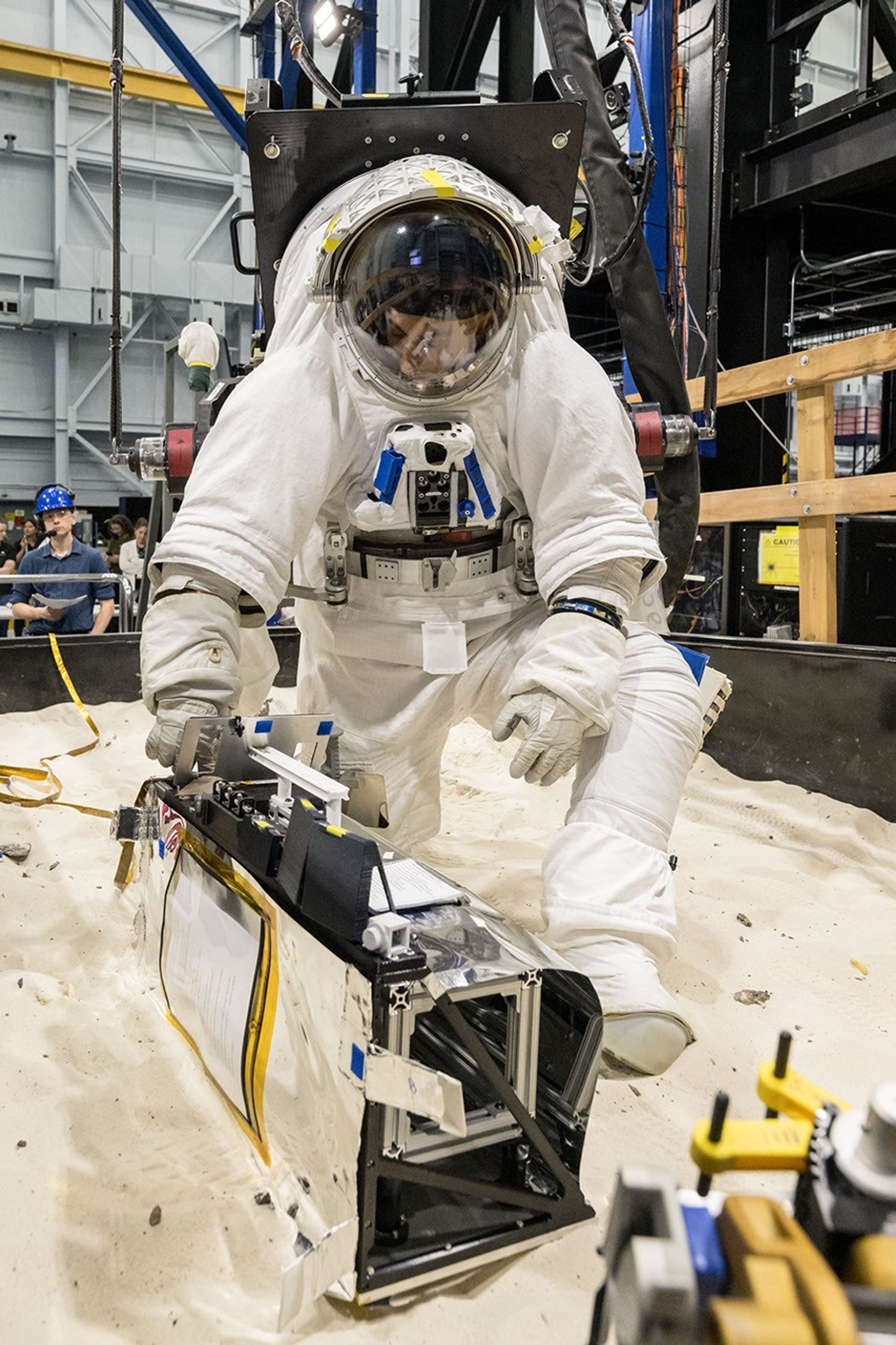
An astronaut in a white spacesuit kneels in simulated lunar soil while working with scientific equipment in a large testing facility. Staff members and support structures are visible in the background.
A scientist wearing NASA’s xEMU prototype space suit is testing the handling of a mockup version of NASA’s Lunar Environment Monitoring Station, or LEMS. The testing took place at the Active Response Gravity Offload System, a simulated reduced gravity environment at NASA’s Johnson Space Center in Houston.
NASA Johnson

The LEMS payload builds on a legacy of lunar seismic tracking. Apollo astronauts deployed a network of seismometers on the Moon’s nearside equatorial region between 1969 and 1972. Those instruments operated until 1977, recording about 13,000 moonquakes and other ground vibrations that helped scientists begin to understand the composition of the Moon’s interior. For decades, researchers have hoped to spread more seismometers, updated with new technologies, across the lunar surface.

Now, LEMS will carry the first seismometers to be deployed by future astronauts to listen for faint ground vibrations, collecting new clues to the Moon’s internal structure and ongoing seismic activity. The sensors will be the most compact, sensitive, and energy-efficient seismometers ever built for planetary exploration.

LEMS itself is about the size of a small suitcase, weighing 11 pounds in the Moon’s low-gravity environment. It will carry not just these seismic sensors, but everything it needs to function independently of humans after deployment. LEMS is built to manage its own power production via a lightweight, flexible solar array that conforms to the shape of the LEMS unit. It also will manage its operational activities to ensure continuous data collection based on a preset plan, and monthly data transmission to Earth. The payload will do all this while maintaining a stable internal temperature throughout the massive day-to-night temperature swings of the South Pole region.
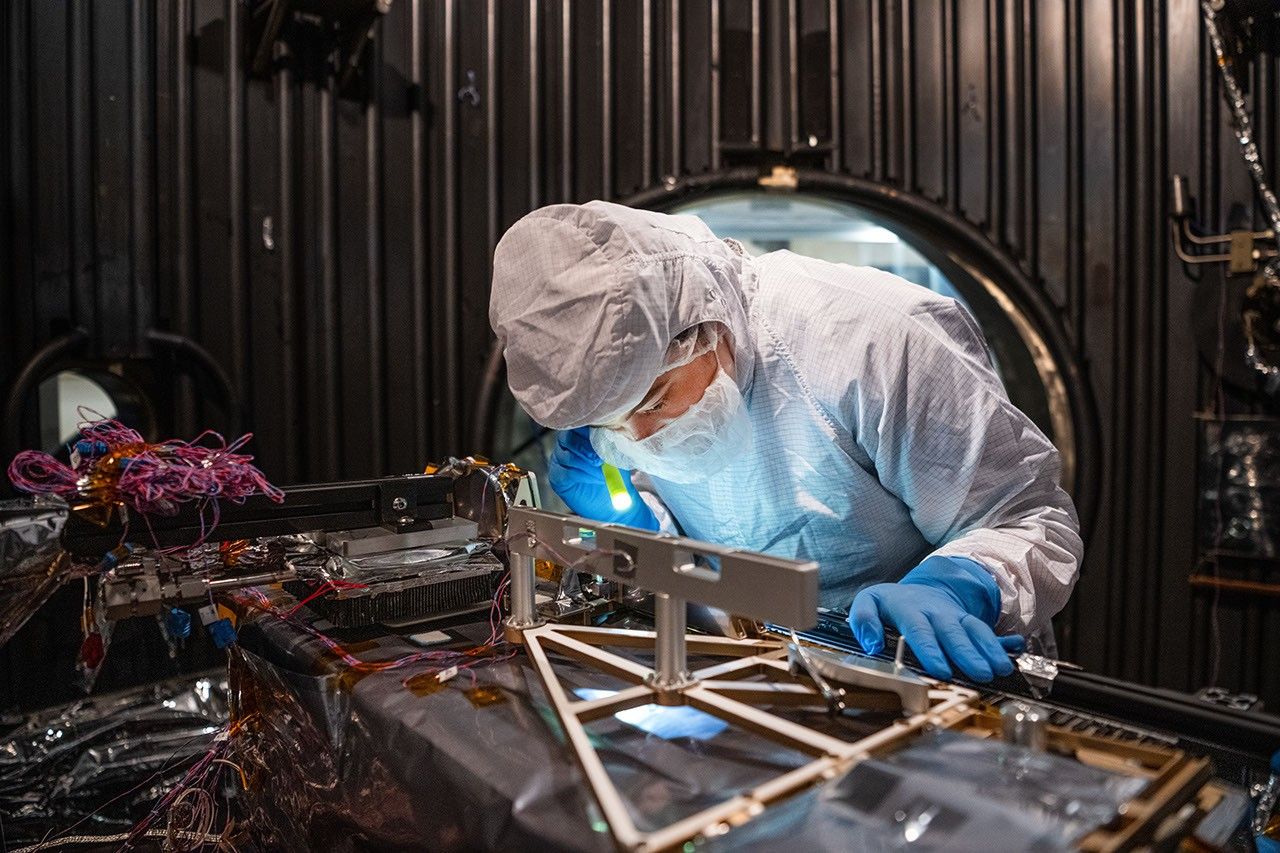
A technician in a white clean-room suit and blue gloves uses a small flashlight to inspect a spacecraft instrument inside a dark testing chamber. Colorful wires and metallic components surround the instrument.
Mechanical Engineer Brie Ludwig inspects the Lunar Environment Monitoring Station (LEMS) in preparation for testing in a thermal vacuum chamber at Goddard Space Flight Center in Greenbelt, Maryland, on March 31, 2026. LEMS is a compact, autonomous, and self-sustaining seismometer suite designed to carry out continuous, long-term monitoring of the lunar seismic environment at the South Polar region.
NASA/Denny Henry

“When we conceived of LEMS, we weren’t just thinking about the next mission, we were thinking about the next generation of lunar exploration,” said Mehdi Benna, a University of Maryland Baltimore County scientist who leads LEMS from NASA Goddard. “Our vision was to create a scientific buoy for the Moon. Like an ocean buoy on Earth, LEMS is designed to be easy to build, adaptable to different scientific objectives, and capable of operating independently for years.”

Before any surface science could happen, Benna and his team had to ensure that LEMS could survive the trip to the Moon and the harsh environment of its surface. Over the past five months, LEMS and its components have been subjected to a demanding series of environmental and operational tests. Engineers verified LEMS can endure the violent shaking of launch, the journey to the lunar surface, and the Moon’s temperature and radiation environment. The team also showed that the instrument package’s mechanical and electrical design is safe for astronaut handling.

The LEMS payload was built to operate through the lunar night, which lasts two Earth weeks, without external power assistance or a heat source. Past lunar surface instruments relied on radioisotope heaters for warmth and power. But LEMS instead will withstand temperatures that dip to minus 400 degrees Fahrenheit in some areas by using advanced insulation materials, low-thermal-conductivity cables that minimize heat loss, and a thermal regulator that conducts heat away during the day to prevent overheating and helps retain heat at night.

These innovations reduce mass and power needs, setting the stage for lighter, energy-efficient instruments that can operate continuously at future Artemis landing sites and the NASA-led Moon Base.

The LEMS payload is led by University of Maryland Baltimore County and University of Maryland College Park. Technical implementation is led by NASA Goddard. The University of Arizona, in partnership with Silicon Audio, Inc., supplied LEMS’ two state-of-the-art seismometers. Morehead State University in Kentucky provided LEMS’ telecommunication system and will operate the instrument on the surface. Washington University in St. Louis will manage the instrument’s data processing and dissemination to the larger scientific community.

Aug. 9, 1976: Luna 24 blasts off

9 August 2026 at 14:00

The Soviet Luna program, designed for lunar research and mission planning, ran from 1959 to 1976. On Aug. 9, 1976, Luna 24, the final mission of the program, launched from the Baikonur Cosmodrome in present-day Kazakhstan. The probe landed on the Moon’s surface nine days later, in the Mare Crisium (Sea of Crises), a previouslyContinue reading "Aug. 9, 1976: Luna 24 blasts off"

The post Aug. 9, 1976: Luna 24 blasts off appeared first on Astronomy Magazine.

Before and After Views of SpaceX Rocket's Moon Crash

By: BeauHD
8 August 2026 at 16:34
A South Korean lunar orbiter has captured the first before-and-after images of the Moon's crash scene caused by a stray SpaceX Falcon 9 rocket. The Associated Press reports: The Korea Aerospace Research Institute's Danuri spacecraft flew over the impact site soon after the Falcon 9 upper stage inadvertently plowed into the moon on Wednesday. Danuri made multiple passes, snapping photos from lunar orbit that were released by the space agency Thursday. The terrain is noticeably darker where the rocket hit and carved out a crater, sending dust and rock everywhere. Korean space officials said Danuri gathered before and after shots. NASA expects its Lunar Reconnaissance Orbiter to fly over the crash site next week to view the aftermath. You can view the images here.

Read more of this story at Slashdot.

SpaceX serious about building factories on the moon: 'It’s going to happen,' Elon Musk says

7 August 2026 at 22:00

As usual, SpaceX is dreaming big.

The company plans to build factories on the moon, using robots to do much of the heavy lifting, Elon Musk said on Tuesday (Aug. 4) during SpaceX's first-ever quarterly earnings call.

"We are going to land a lot of tonnage on the moon," he said. "We're going to build the factories on the moon. The robots will be helpful with that."

This is not a newly revealed vision; Musk first laid it out in February, in a blog post that announced SpaceX's purchase of xAI, a company that the billionaire entrepreneur founded in 2023. But Musk doubled down on it this week, showing investors that off-Earth manufacturing is very much front-of-mind for SpaceX.

The factories in question will build SpaceX's Starmind AI satellites, if all goes according to plan. The company aims to operate a million-strong Starmind constellation in Earth orbit in the coming years, and then go farther afield with the craft after that.

Eventually, SpaceX wants to launch locally made Starmind satellites off the lunar surface using electromagnetic mass drivers — basically, extremely powerful rail guns.

"Using robots on the moon to scale up manufacturing on the moon — which, I know it sounds, like, super sci-fi right now, but it's going to happen — will enable us to build the mass accelerator on the moon," Musk said.

"And if you have a mass accelerator on the moon, and you have solar and radiator production on the moon, you can — I know this sounds totally nuts — but you can you can probably scale to 1,000 times the economy of Earth in terms of intelligence launched to space, but probably, you know, maybe even a million times," he added.

"Solar and radiator production" refers to the manufacture of key Starmind satellite components: solar panels to power them and radiators to dump the large amounts of heat they'll produce into the vacuum of space.

A rendering of one of SpaceX's planned

A rendering of one of SpaceX's planned "Starmind" AI satellites in orbit. (Image credit: SpaceX)

Musk didn't provide details about the robotic lunar labor force. But he's presumably counting on Optimus, a humanoid robot built by another one of his companies, the carmaker Tesla. Musk has previously said that SpaceX will launch some Optimus units to Mars in the near future, to help pave the way for human settlement of the Red Planet.

Those robots will fly on Starship, SpaceX's fully reusable next-gen megarocket, which is currently gearing up for its 14th test flight. Indeed, Starship is key to most of the company's plan's both in Earth orbit and beyond.

"Starship aims to quadruple payload capacity and reduce launch costs by 10 times compared to our Falcon 9 rocket, unlocking significant capabilities across all of our business segments," SpaceX Chief Financial Officer Bret Johnsen said during Tuesday's earnings call.

"We continue to make progress building the infrastructure required to support thousands of Starship launches per year, including accelerating Raptor and launch vehicle production, the buildout of our gigabays, and making significant progress towards activating multiple launch pads at Starbase and in Cape Canaveral at Pad 39A and Pad 37," he added. (Raptor is the engine that powers Starship, and Starbase is SpaceX's South Texas site, which serves as the current hub of Starship manufacturing, testing and launch activities.)

Tuesday's call was a landmark for SpaceX — its first as a publicly traded company. Musk founded SpaceX as a private concern in March 2022 and took it public this past June, via the richest IPO in history.

The IPO raised $86 billion and valued SpaceX at $1.77 trillion. Only six American companies had higher market capitalizations at the time — NVIDIA, Apple, Alphabet (Google), Microsoft, Amazon and the semiconductor manufacturer Broadcom. (Market caps fluctuate all the time, going up and down with companies' stock prices.)

The main point of Tuesday's call was to discuss SpaceX's first-ever earnings report, which covered the second quarter of this year. The company's revenue over that stretch was $7.8 billion, a 92% increase over the same period in 2025, according to the report. SpaceX lost more money than it made during Q2 2026, but the shortfall was considerably smaller than in Q2 2025 — $541 million versus $1.0 billion.

SpaceX rocket's impact crater on the moon spied by Korean lunar orbiter (photos)

6 August 2026 at 16:24

The final resting place of SpaceX's moon-smashing rocket has been found.

The Korea Pathfinder Lunar Orbiter, known as Danuri, has captured imagery of the crater blasted out by the Falcon 9 upper stage that slammed into the moon early on Wednesday morning (Aug. 5).

"Danuri began observations about 30 minutes before the collision and, through orbit control, passed over the impact site multiple times, conducting a total of 8 imaging sessions," officials with the Korea Aerospace Research Institute (KARI) said via X this morning (Aug. 6). "Through this observation, changes in the terrain around the impact site and traces of ejecta spread were confirmed."

"Danuri secured both pre-collision and immediate post-collision footage, enabling analysis of changes caused solely by the collision and providing important research data," they added in the X post, which shared several before-and-after images of the impact site.

a photograph of a grey mottled surface on which a dark oval area is circled in white

Before-and-after imagery of the impact site. (Image credit: KARI)

The Falcon 9 in question launched on Jan. 15, 2025, sending two private robotic moon landers — Firefly Aerospace's Blue Ghost and ispace's Resilience — to a high, moon-crossing Earth orbit. The duo then made their own way to the moon; Blue Ghost landed successfully on March 2 of that year, but Resilience crashed during its touchdown attempt.

The Falcon 9's first stage came back to Earth shortly after liftoff for recovery and reuse, as such boosters commonly do. Falcon 9 upper stages, by contrast, are expendable. SpaceX usually disposes of them in Earth's atmosphere, but the upper stage on the Blue Ghost-Resilience mission used almost all of its fuel getting its payloads to their distant destination. So the 8,800-pound (4,000 kilograms) rocket body remained up there, orbiting Earth — until solar activity and gravitational forces pushed it on a collision course for the moon.

a photograph of a grey mottled surface on which a dark oval area is circled in white

Another before-and-after image, with the "before" photo taken by NASA's Lunar Reconnaissance Orbiter back in 2015. (Image credit: KARI)

That collision occurred at 2:34 a.m. EDT (0634 GMT) on Wednesday, according to KARI officials — right in line with predictions. Scientists calculated some other parameters ahead of time as well. For example, the rocket body probably hit the moon at about 5,400 mph (8,690 kph), gouging out a crater up to 89 feet (27 meters) wide.

The new observations by Danuri, as well as future work by other lunar probes, will help verify such predictions.

"The observation data secured by Danuri will be linked with follow-up observations from NASA's Lunar Reconnaissance Orbiter (LRO) and utilized in international collaborative research," KARI officials said in the X post.

It may be that some ground-based telescopes caught the impact as well. Astronomers at the Instituto de Astrofísica de Andalucía in Spain believe they captured a video of ejected material blasting off of the lunar surface around the predicted time of impact:

Our team at @iaa_csic has captured the impact on the Moon of the upper stage of a Falcon 9 rocket. We attach a preliminary video showing the evolution of the ejected material. The black area corresponds to the lunar disk @SpaceX @JuanLuisRizos @elonmusk @tiempobrasero @A3Noticias… pic.twitter.com/5Ry7hRdCeSAugust 6, 2026

The Falcon 9 upper stage wasn't the first rocket body to slam into the moon. The third stage of a Chinese Long March 3C crashed into the lunar surface on March 4, 2022, for example. And the third stage of NASA's Saturn V rocket gouged out craters during multiple Apollo moon missions.

Danuri is South Korea's first lunar probe. The spacecraft launched on Aug. 4, 2022 atop a Falcon 9 and began circling the moon four months later. It carries six payloads, five of them provided by Korean universities and research organizations. The sixth is a NASA instrument called ShadowCam, which hunts for signs of water ice in permanently shadowed regions at the lunar poles.

SpaceX’s Falcon 9 wasn't the first rocket to crash into the moon. Here's a rundown

A spent rocket body hitting the moon made headlines this week, but the reality is that the unplanned collision by a SpaceX upper stage was just the latest in a long history of human-made objects meeting their end by impacting the lunar surface.

Astronomers around the world kept their telescopes trained on the moon early Wednesday morning (Aug. 5), when the rocket stage from a January 2025 U.S. commercial lunar landing mission was calculated to strike the celestial body. Though the fate of the SpaceX Falcon 9 part was unintentional — solar activity and gravitational forces caused the stage to slam into the moon — the impact offered a rare opportunity to try to observe the flash from the impact and the plume of lunar material it sent flying.

By noon (EDT) on Wednesday, there were no confirmed reports of the impact being caught on film, but a telescope in Chile spotted the debris plume, according to the Associated Press.

"This rare occurrence has decades of history, going back to the Apollo era," wrote Jared Isaacman, NASA's administrator, in a post to his social media accounts. "The reality is that meteoroids strike the lunar surface hourly, with impacts comparable to this upper stage occurring roughly every six days."

Inventorying the impacts

The moon is peppered with the scattered metal remains of missions that missed their mark, came down too quickly or were purposefully sent careening into the regolith to learn more about the makeup of Earth's natural satellite.

In fact, the very first mission to successfully fly by the moon was intended to be an impactor. The former Soviet Union's Luna 1 probe was designed to hit the moon but instead zoomed past its target and entered orbit around the sun on Jan. 2, 1959.

Luna 2, launched nine months later, became humanity's first object to reach the lunar surface, purposefully slamming into Sinus Lunicus ("Bay of Lunik"), along the southeastern edge of Mare Imbrium, on Sept. 14, 1959.

The U.S. followed suit, though not as NASA intended, with the Ranger 4 probe impacting the far side of the moon on April 26, 1962. The mission had included an impactor, but both it and its lander failed to operate due to a failure to deploy the spacecraft's solar arrays.

Once humans began arriving on the moon with NASA's Apollo program, scientists found another reason to direct spent rocket and spacecraft stages into a collision course with the surface. Beginning with Apollo 11 in 1969 and concluding with Apollo 16 in 1972, seismometers were placed on the moon to measure natural "moonquakes" and the effects on the moon when the missions' Saturn SIV-B stages and Apollo lunar module descent stages made hard landings.

The data collected helped geologists learn more about the interior makeup of the moon, including that a rocky mantle exists under the outer crust.

four side-by-side images of moon craters, seen from space by a lunar orbiter

These four images, captured by NASA's Lunar Reconnaissance Orbiter, show craters formed by impacts of Apollo SIV-B stages. Crater diameters range from 35 to 40 meters (38.2 to 43.7 yards) in the longest dimension. (Image credit: NASA/Goddard/Arizona State University)

After Apollo, planned impacts (and missions) slowed down, if not outright stopped, but the SpaceX collision on Wednesday was not the first in more than 50 years. Between 1993 and today, 11 probes — four from China, three from Japan, two from the U.S. and one each from India and the European Space Agency (ESA) — were intentionally deorbited at the end of the end of their missions around the moon.

Some of these impacts were performed to discard the craft, but others — like Lunar Prospector, LCROSS and Chandrayaan-1 — helped confirm the presence of water by examining the resulting plume.

Unintentional collisions are fewer in number, as are rocket stages, but are not unprecedented. A rocket body that hit the moon's far side in March 2022, leaving behind a small double crater, was later identified as a Long March 3C rocket that launched China's Chang'e 5-T1 mission around the moon in 2014.

Litter versus liability

Without a large human population on the moon, the risk that these planned and unplanned impacts present at current is minimal. But the concern rises as NASA and other world space agencies, as well as commercial interests, begin to increase the pace on establishing their now-planned sustainable facilities for astronauts to live and work on the lunar surface.

"The future lunar base will incorporate reusable spacecraft that not only deliver astronauts and payloads, but also become part of the infrastructure itself," Isaacman said in his post, referring to how reuse can be a way to reduce the number of vehicles needed to be discarded of on the moon.

The Artemis Accords, an internationally agreed-upon set of standards led by NASA and currently signed onto by 70 countries, also includes a provision for its members that spacecraft and their associated rocket components must be disposed of safely.

A SpaceX rocket just crashed into the moon. Now, the race is on to get a look at the impact site

5 August 2026 at 18:43

Early this morning, a SpaceX rocket slammed into the moon at seven times the speed of sound. Now, lunar orbiters are trying to get a look at the aftermath.

This morning (Aug. 5) at about 2:35 a.m. EDT (0635 GMT), the upper stage of a SpaceX Falcon 9 rocket crashed into the moon. To dissect what exactly happened, scientists are looking for imagery of the crash site, with the help of a couple of moon probes.

"NASA’s Lunar Reconnaissance Orbiter and NASA’s ShadowCam instrument on the Korea Pathfinder Lunar Orbiter will look for opportunities to capture before‑and‑after imagery of the impact site," NASA spokesperson Rob Garner, of NASA's Goddard Space Flight Center in Maryland, told Space.com. "Image availability depends on several factors, including the impact location, lighting conditions, and when each spacecraft’s orbit next carries it over the area, which may take a few days to receive any imagery."

While you've likely seen the first stages of Falcon 9 rockets gracefully land back on Earth for reuse, the rocket's 9,000-pound (4,000 kilograms) upper stage is disposable. Typically, it's sent to burn up in our atmosphere after its missions are over.

However, that wasn't possible with this rocket, which launched two private lunar landers — Firefly Aerospace's Blue Ghost and Tokyo-based ispace's Resilience — to a high, moon-crossing Earth orbit in January 2025. The Falcon 9 upper stage used most of its fuel getting to this distant location and couldn't make it back to deorbit in Earth's atmosphere.

So the company performed a different maneuver to take care of this upper stage, Julianna Scheiman, director of NASA science and Dragon programs at SpaceX, said during a press conference on Aug. 3.

"For high-energy missions, we need to perform a different maneuver to ensure the second stage itself is safe per the appropriate rules and regulations, and so we did that here," she said.

But the rocket body was still subject to natural forces, which acted on it over time.

"What has happened is, essentially, a mixture of solar activity and gravity forces have put it on a path towards the moon," Scheiman said.

The Falcon 9 upper stage ended up slamming into the moon this morning at about 5,400 mph (8,690 kph). It likely blasted out a crater up to 89 feet (27 meters) wide, according to scientists' calculations.

This was certainly not the original intended outcome for this rocket. But it presents an opportunity for researchers, who plan to take advantage of it to learn more about the moon.

"NASA’s Meteoroid Environments Office will attempt to image the impact around the predicted time using ground‑based telescopes at the agency's Marshall Space Flight Center in Huntsville [Alabama]," Garner added. "Because the impact flash and plume are expected to be faint, the chance of seeing anything from Earth remains low, and local weather can affect observations as well. Any data collected will help scientists better understand impacts from artificial objects and the potential effects on future lunar exploration."

Today's impact took place on the sunlit side of the moon, the brightness of which made observations difficult for skywatchers hoping to watch the crash from afar with telescopes. But the two lunar orbiters might be able to see not just the crash and impact crater but also the plume of dust kicked up by the rocket's death dive.

So far, observations from Earth have revealed some information. Scientists at the Lowell Observatory in Flagstaff, Arizona reported detections of a lunar plume from the impact.

"We can safely say that we measured a response from the rocket stage impact as a sodium and lithium gas plume a few 10’s of kilometers in size lasting between 5 and 10 minutes after impact," Carl Schmidt told Inside Outer Space's Leonard David.

Sodium and Lithium observations of lunar plumes from lunar impact by SpaceX rocket.

Detections by the Lowell Observatory in Flagstaff, Arizona, show evidence of a plume on the moon caused by the impact of a SpaceX rocket on Aug. 5, 2026. (Image credit: Carl Schmidt/Lowell Observatory)

Such images of the event would provide "an opportunity to test pipelines for measuring flash properties to locate impact events seismically, and to better understand the multi-modal hazards posed to future lunar infrastructure and astronauts from space debris impacting the moon," researchers led by Benjamin Fernando of Los Alamos National Laboratory in New Mexico wrote in a recent paper discussing the then-upcoming event.

So hold tight, as researchers are now eagerly collecting and analyzing the images captured by these orbiters, and we might get images of the rocket crash, the lunar plumes and remaining aftermath soon.

SpaceX Achieves Its First Moon Landing by Accidentally Crashing Into It at 5,400 Miles Per Hour, Causing Huge Explosion and 60-Foot Crater

5 August 2026 at 15:46

At long last, a Moon landing for SpaceX — just not the kind it was hoping for.

After months of anticipation, a discarded upper stage of a SpaceX Falcon 9 rocket is believed to have careened into the Moon on early Wednesday morning. It exploded on impact, causing a flash that may have been visible from Earth, and created a large crater.

Astronomers, who have been closely monitoring the stray rocket, projected it would smash into the lunar surface at 5,400 miles per hour, which is about seven times the speed of sound here on our home planet. At such a velocity, NASA estimated it would blow open a crater about 60 feet wide and 12 feet deep, though others have estimated that it could be up to 100 feet wide.

SpaceX CEO Elon Musk has been promising the Moon when it comes to SpaceX’s lunar ambitions. Its Starship megarocket is being built to bring cargo to the lunar surface, and hopefully deposit NASA astronauts there in a historic return. He even plans to construct a Moon base with a factory that can churn out AI satellites. But so far, no SpaceX craft has made it into the Moon’s orbit, let alone land on it.

The discarded Falcon 9 rocket part had been lingering in space for over a year. It was jettisoned during a January 2025 mission that brought two lunar landers, Firefly’s Blue Ghost and ispace’s Hakuto-R, to the Moon. Astronomers soon suspected that it would fall into the Moon’s orbit, and in late April, a report more or less confirmed suspicions that it would slam into the rocky satellite.

Because the explosion — or in SpaceX’s euphemistic parlance, the rapid unscheduled disassembly — was difficult to observe in the moment, it might take some time before scientists can piece together everything that happened.

Another crater will make little difference to the Moon. Because it has no protective atmosphere, it’s surface is bombarded by meteoroids on a daily basis. One “with the same energy as the upper stage hits the Moon about every six days,” according to NASA.

Still, the impact will raise questions about the best practices for space junk and whether it’s negligent to discard spent rocket parts near the Moon’s orbit.

This isn’t the first time that human debris has smashed into the lunar surface. NASA deliberately steered the discarded stages of its Saturn V rockets into the Moon during the Apollo missions in the 1970s. And in 2009, it also crashed a rocket part into the Moon to study the impact.

Scientists will similarly hope to learn more from the accidental SpaceX crash landing, including insights into the physics of the material kicked up by the explosion in a low gravity environment, where ejecta could travel for miles.

“This may be of some — probably minor — scientific interest, and we may learn some things from it,” Bill Gray, an astronomer who created the Project Pluto software used to track near-Earth objects, and who published the report predicting the rocket part’s crash landing, wrote on his website. “It doesn’t present any danger to anyone, though it does highlight a certain carelessness about how ​leftover space hardware (space junk) is disposed of.”

More on SpaceX: SpaceX Stock Hammered After Starship Booster Fails in First Launch Since IPO

The post SpaceX Achieves Its First Moon Landing by Accidentally Crashing Into It at 5,400 Miles Per Hour, Causing Huge Explosion and 60-Foot Crater appeared first on Futurism.

An Out-of-Control SpaceX Rocket May Have Struck the Moon with the Force of Three Tons of TNT—Here’s What We Know

5 August 2026 at 15:08

A portion of an out-of-control SpaceX rocket is believed to have collided with the Moon on Wednesday, producing a new impact crater.

The roughly 8,800-pound rocket stage is suspected of striking the lunar surface at around 2:35 a.m. EDT, with a force comparable to three tons of TNT, according to experts. The new impact crater and resulting cloud of lunar dust could help scientists glean new insights into how impacts have shaped the Moon’s surface over time.

As of 9 a.m. EDT Wednesday, observations have yet to confirm whether the collision occurred, although it was suggested that a faint flash of light might be visible in the suspected region, located near Einstein Crater, using Earth-based telescopes. No obvious signs of the crash were reported by amateur astronomers.

Einstein crater Falcon 9
NASA Lunar Orbiter 4 image of Einstein Crater, which is the rough location where the Falcon 9 is suspected of impacting with the lunar surface (Image Credit: NASA/Public Domain)

Additional imagery may have been obtained from any of the several ground-based observatories in the United States that were monitoring for signs of an impact, although analysis of any imagery collected this morning could take several days.

Imagery obtained by NASA’s Lunar Reconnaissance Orbiter is expected to capture images of the newly formed crater in the days ahead.

How Did a SpaceX Rocket Stage Collide with the Moon?

The rocket stage originated from a Falcon 9 launch in 2025, which carried a pair of lunar landers toward the Moon.

One was Blue Ghost, a lunar lander developed by Texas-based Firefly Aerospace as part of NASA’s Commercial Lunar Payload Services (CLPS) initiative under the Artemis program. Blue Ghost shared its ride with Japanese company Ispace’s Resilience lunar lander, with each mission aiming to promote a future sustainable lunar economy and provide transportation services for government and private-sector customers.

While most SpaceX rocket upper stages burn up in Earth’s atmosphere during reentry, or are deposited in the ocean following their launches, the stage from the Falcon 9 launch in question remained in space after its fuel was expended, since the lunar mission necessitated additional velocity to escape Earth’s orbit.

Despite these conditions, SpaceX had not intended for one of its rocket stages to collide with the Moon. It was revealed earlier this year that the combined influence of gravitational forces and solar activity was anticipated to alter the spacecraft’s trajectory enough to place it on a collision course with Earth’s natural satellite.

Having exhausted its propellant during its primary mission, the rocket stage had no way to perform course adjustments to prevent the collision.

“It’s very infrequent to have things like the Falcon 9 second stage crash into the moon,” NASA Administrator Jared Isaacman said during a live segment on Fox News. “It’s not a big deal right now. The moon has clearly seen better days,” Isaacman added.

No Risk to Earth, and Insights May Be Beneficial

Fortunately, NASA officials have confirmed there is no danger posed to Earth from this morning’s collision. Additionally, the impact could offer some benefits by providing scientists with a unique opportunity to observe a new crater’s formation, which may shed light on how such events have shaped the lunar surface over time.

Specifically, the fact that this impact was predicted well enough in advance to potentially allow for imagery to be obtained during or shortly after the new crater was formed, could provide rare insights into the dynamics of how craters on the Moon develop.

Additional information from the impact plume produced as lunar regolith is ejected from the impact site could offer valuable data for space agencies like NASA, which are currently preparing for a sustained human presence on the Moon.

Space Debris is Still a Concern

Although the impact this morning was largely benign, this incident does underscore the growing challenge of managing space debris.

Abandoned rocket hardware and other debris from space missions can pose long-term risks. While remaining in orbit, such materials can damage operational satellites or other spacecraft. Once they make their way back into Earth’s atmosphere, these leftovers from past space missions can sometimes survive reentry, even though they are designed to disintegrate when subjected to such conditions.

In recent years, a growing number of components associated with SpaceX rockets have survived reentry and collided with Earth. In May 2024, The Debrief was the first to report that an object discovered on a stretch of property in the Western North Carolina mountains was likely space debris from a SpaceX launch, which NASA officials later confirmed.

More recently, a series of unusual metallic spheres were discovered by residents of a beachside community in Australia, which were also confirmed to have been materials associated with a SpaceX launch.

Fortunately, no injuries or damage to property have been reported following these events.

As lunar orbiters begin returning images of the impact site, scientists hope the unexpected crash will provide a valuable new dataset for understanding one of the Solar System’s most heavily cratered worlds.

Micah Hanks is the Editor-in-Chief and Co-Founder of The Debrief. A longtime reporter on science, defense, and technology with a focus on space and astronomy, he can be reached at micah@thedebrief.org. Follow him on X @MicahHanks, and at micahhanks.com.

A SpaceX rocket will hit the moon at 5,000 mph tonight. Experts explain what you could see, and when.

4 August 2026 at 17:36

An abandoned part of a SpaceX Falcon 9 rocket is projected to crash into the moon at 2:35 a.m. EDT on Aug. 5 — and two new studies suggest the event may be visible in telescopes from parts of North and South America, providing both amateur and professional astronomers with a rare, real-time viewing opportunity. Both studies are available as preprints on the arXiv server.

The impending Aug. 5 impactor is the truck-sized spent upper stage of a Falcon 9 rocket. In 2005, the rocket boosted two privately owned landers into orbit around the moon, before leaving its upper stage in an elliptical orbit around Earth, according to OrbitalRadar.com.

A report earlier this year estimated that the collision would occur near the moon's Einstein crater, with the rocket grinding into the lunar surface at a speed of 5,436 mph (8,748 km/h). Although that sounds fast, it's about six times slower than a natural impactor, like an asteroid, would hit.

What can you see with a telescope?

The initial impact flash of the collision — which will last less than a second and be hidden on the sunlit side of the moon — will likely be invisible to casual skywatchers, according to one of the new studies. The brightest estimates for the impact put it at 20 times dimmer than Saturn. The resulting crater likely won't be visible from Earth, as the study estimates that the hole is relatively small and shallow ‪—‬ about 90 feet (27 meters) wide and up to 16 feet (5 m) deep.

A figure showing various images of the moon with different colored arcs on them

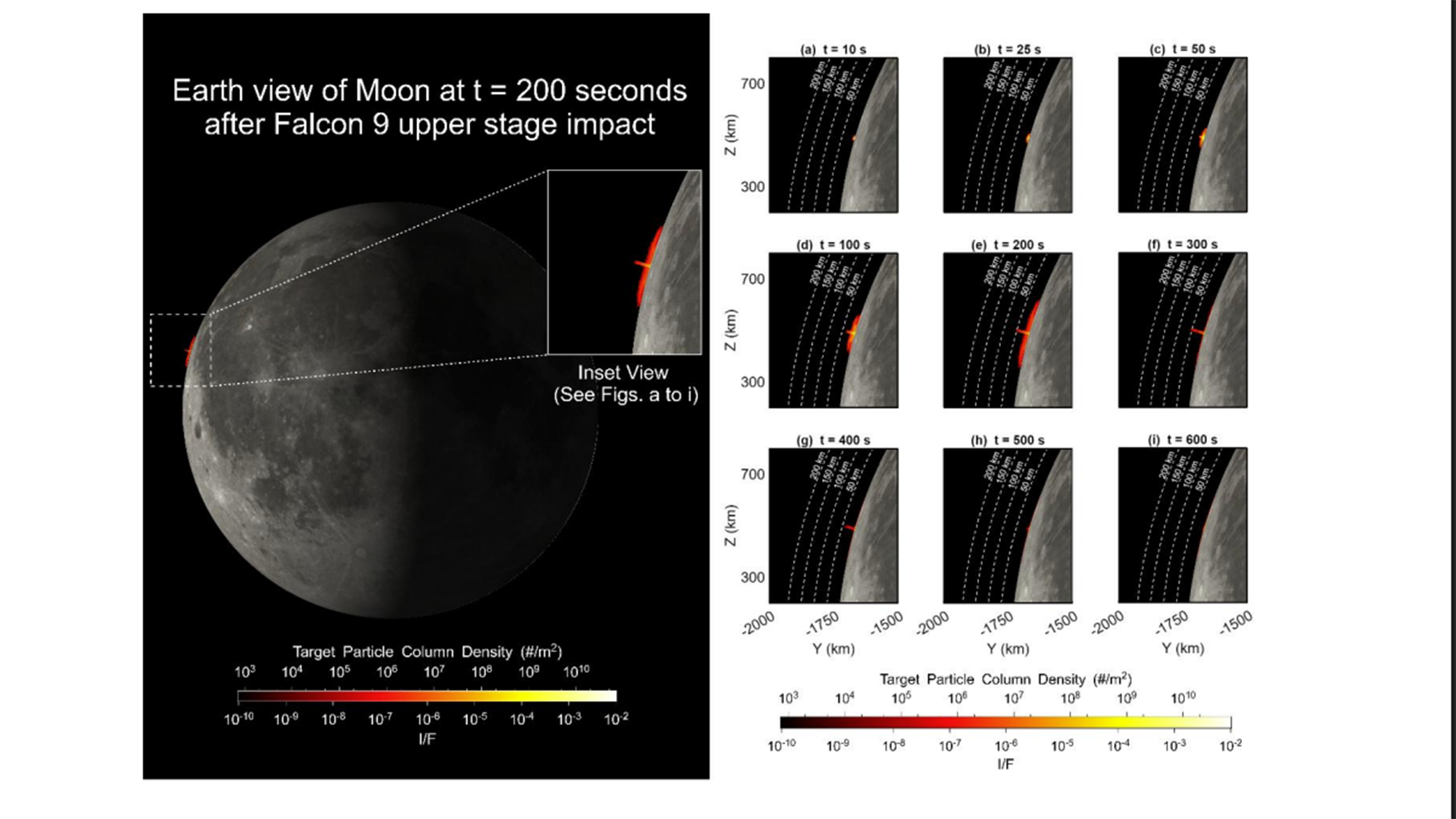
Simulations show that the plume may have a central spike up to 31 miles (50 kilometers) high. (Image credit: Jo et al. 2026, )

More promising for Earthbound skywatchers is the plume of regolith (and potentially water vapor) the impact will loft. The plume will likely reach several miles in height, with computer-based simulations from the second study showing it may tower up to 31 miles (50 km) high. This will make it visible over the moon's limb as a cloud, with the debris spreading up to 112 miles (180 km) from the impact site.

The plume will hang above the lunar surface much longer than the flash ‪—‬ for up to 400 seconds, or close to seven minutes; during this time, it will scatter sunlight toward Earth. Even then, the plume will be too faint to be observed with the naked eye, William Jo, a graduate research assistant at the University of Texas at Austin and co-author of the second study, told Live Science in an email. Viewers will need a good backyard telescope to see it.

"Where the science is"

Although the event will be dim and occur on the sunlit portion of the moon, skywatchers are gearing up to watch it. Benjamin Fernando, a postdoctoral researcher at Los Alamos National Laboratory and co-author of the first study, told Live Science in an email that there "will be an observing campaign involving professional and amateur astronomers from around the world."

In particular, he said, folks in South America and continental North America — where it will be night, with the moon high above the horizon — will have the best chance of seeing it, although you will need at least a 4-inch (10 centimeters) telescope.

However, Jo was less optimistic. "I don't think it would be an easy task for an amateur astronomer," he said, but if they know exactly where to point their telescope and tackle atmospheric refraction, they might see the plume. Nonetheless, he urged well-equipped observers to try observing the plume, as that is "where the science is."

This science, Jo said, would help researchers understand how everything delivered to or disposed of on the moon will ultimately affect the lunar surface. "This would be useful for studying disposal methods for upper stages, maybe how far ejecta will travel, and whether or not the ejecta will hit sensitive instruments, or in the far future lunar bases," he added.

Previous collisions of human-made objects on the moon have likewise led to some major scientific insights. For example, the 2009 crash of a Centaur rocket's upper stage was analyzed by NASA's Lunar Crater Observation and Sensing Satellite mission, which revealed subsurface ice near the lunar south pole. As a result, the lunar south pole is now considered the most coveted location for moon missions that aim to establish a permanent human presence on Earth's satellite.

How much do you know about the moon? Test your lunar smarts with our moon quiz!

Rocks From the Moon’s Far Side Are Rewriting Lunar History

2 August 2026 at 12:58
Moon Surface DetailsThe Moon’s far side is overturning a long-held theory, revealing that the early Solar System’s asteroid assault may have faded slowly instead of exploding in one catastrophic burst. For decades, scientists have debated whether the early Solar System endured one sudden, catastrophic wave of asteroid strikes or a much longer period of gradually fading violence. [...]

Astronomers May Have Found the First Moon Beyond Our Solar System

2 August 2026 at 11:48
Artist’s Impression of CD 35 2722, a System With a Moon Like ObjectA Jupiter-mass object orbiting a brown dwarf could become the first confirmed moon beyond our Solar System. A massive object appears to be circling a brown dwarf in the CD-35 2722 system, but calling it a moon is not straightforward. Unlike moons in our Solar System, it does not orbit a planet. Instead, it travels [...]

EAGLE

31 July 2026 at 23:02

EAGLE

Explorer for Artemis Geology, Lunar, and Earth — a NASA satellite program to study surface biology and geology on Earth, with technologies that could support future missions to the Moon and Mars.

Future Mission

NASA’s EAGLE program — Explorer for Artemis Geology, Lunar, and Earth — will be a series of satellite missions studying surface properties using technologies for Earth observation that will also benefit future missions to the Moon and Mars, where they could identify critical resources and safe landing sites.

The satellites making up the first two EAGLE missions will study biology and geology on Earth’s surface to support agriculture, disaster response, and other needs. Each mission will carry a different instrument with capabilities that complement each other. The first mission (EAGLE-VSWIR) is scheduled to take flight in 2028.

Mission Type

Orbiter

Target

Earth, Moon, Mars

Launch

No earlier than 2028

Objective

Study surface composition and changes

  • EAGLE-VSWIR

    EAGLE-VSWIR (Visible to Shortwave Infrared) will observe the Earth’s surface every 16 days with a high-resolution imaging spectrometer, which measures light reflected from the planet’s surface, separating wavelengths across the visual and into the infrared spectrum. The patterns created by light being reflected or absorbed across this spectral range act like fingerprints, letting scientists identify the composition of the surface. 

    A similar instrument, NASA’s EMIT (Earth Surface Mineral Dust Source Investigation), has been monitoring Earth from the International Space Station since July 2022, characterizing the surface mineral composition of Earth’s arid lands, monitoring ecosystem status, and tracking health and safety hazards — such as methane leaks and acid mine drainage — among other applications.

    EAGLE-VSWIR will have 25 times more capability than EMIT has today. This technological leap will allow scientists to map surface deposits of critical and rare-earth minerals, strengthen food security, and aid wildfire prevention and recovery. It can also highlight environmental hazards such as oil spills or landslide risks, and monitor water quality and availability.

    Region of Nevada as observed by NASA's EMIT with spectrum on right edge
    The front of this image cube shows a region in Nevada observed by NASA’s EMIT imaging spectrometer; the cube’s sides show the spectral fingerprint for every point in the image and can be used to discover mineral resources. EAGLE-VSWIR will have 25 times greater performance beyond NASA’s current state-of-the-art EMIT.
    NASA/JPL-Caltech
  • EAGLE-TIR

    The EAGLE-TIR mission will provide Thermal InfraRed (TIR) imagery when it launches two to three years after EAGLE-VSWIR, measuring energy emitted from the surface and producing data that scientists can use to map temperature, composition, and critical mineral deposits. On Earth that would let researchers monitor wildfires and volcanic activity, track drought and water use by crops, study urban heat islands, observe the rates that snow or ice accumulates or melts, and better understand Earth’s resilient ecosystems.

    EAGLE-TIR follows on from ECOSTRESS (ECOsystem Spaceborne Thermal Radiometer Experiment on Space Station), which has been observing Earth from the International Space Station since 2018. ECOSTRESS was designed to study how different ecosystems respond to drought and water stress, and the data has provided a vital understanding of how plants’ water use changes throughout the day. Since ECOSTRESS also measures emitted energy in the thermal infrared, its surface-temperature products have also been used for urban planning and wildfire monitoring. 

    Further innovation and lessons learned from ECOSTRESS has led to EAGLE-TIR, which will carry a multi-band thermal radiometer. EAGLE-TIR’s great strength compared to existing missions is that it provides detailed imagery of the entire globe every two days, day and night, at multiple wavelengths not available from other instruments.

    Aerial view of Namib desert in Infrared captured by ECOSTRESS
    This image shows the minerals contained in Namibian dunes using ECOSTRESS data. EAGLE-TIR will have more spectral channels to enable even better mineral discrimination.
    NASA/JPL-Caltech
  • EAGLE Program

    By advancing vital techniques for measuring our planet’s surface composition, resources, and hazards, the EAGLE program addresses critical needs in Earth observation, with technologies that can also transfer to planetary exploration, where they’ll serve as pathfinders for future missions to the Moon and Mars.

    015B0489.NEF
    As the Artemis II crew came close to passing behind the Moon and experiencing a planned loss of signal, they captured this image of a crescent Earth setting on the Moon’s limb on April 6, 2026.
    NASA
Featured Video

EAGLE

NASA unveiled the EAGLE program as one part of its “Ignition” event on March 24, 2026, when it announced a wide-ranging series of transformative agencywide initiatives. With EAGLE (the Explorer for Artemis Geology, Lunar, and Earth missions), NASA will deploy breakthrough hyperspectral images across Earth with later missions anticipated for the Moon and Mars in rapid succession. On Earth they’ll identify critical minerals for national security, enable precision agriculture, and support disaster response. On Earth and at Mars they will locate critical minerals and resources such as ice for propellants, rare-earth elements for technology, and construction materials for habitats.

EMIT

EMIT (Earth Surface Mineral Dust Source Investigation) measures the mineral composition of Earth’s dust source regions, to help scientists understand how they heat or cool our planet.

Learn More About EMIT

ECOSTRESS

ECOSTRESS (ECOsystem Spaceborne Thermal Radiometer Experiment on Space Station) is accurately measuring the temperature of plants on Earth.

Learn More About ECOSTRESS

The post EAGLE appeared first on NASA Science.

💾

Join us for continuing coverage as our leaders discuss the agency's implementation of the National Space Policy and our plans to advance science and discover...

A SpaceX rocket will crash into the moon next week, and scientists aren't sure what to expect

30 July 2026 at 11:00

On Aug. 5, Earth's moon is due for a human-made, high-speed impact from an identified flying object: a spent SpaceX Falcon 9 upper stage. The event will lead to a literal "dust up" on the lunar landscape.

That Falcon 9 upper stage is a leftover from the launch that sent Firefly's Blue Ghost-1 lander to the moon on Jan. 15, 2025. Onboard the same flight was the Hakuto-R Mission 2, called Resilience, a robotic lunar lander developed by the Japanese company ispace.

And according to a new study by an international team published on the open-source arXiv server, the resulting impact plume may briefly be bright enough to see against the dark sky near the moon's edge. That means it might be visible to moongazers with sufficiently sensitive telescopes.

This head-on collision of the errant stage is expected to occur near the Einstein and Bell craters near the western lunar limb. It may well be visible to ground and space-based assets. Indeed, putting aside all the unknowns and modeling uncertainties, some specialists suggest if you've got the time and observational prowess, it might be worth a look.

Visible ejecta spike

Using special physics simulations to model the impact, William Jo, a graduate research assistant at the University of Texas, Austin and colleagues predict the debris plume from the impact will have the central ejecta spike reaching roughly 47 miles to over 60 miles (75 kilometers to 100 kilometers) altitude.

"Our calculations suggest the plume should be several orders of magnitude brighter than the dark-sky background for the first few minutes after impact," Jo told Space.com. "So the plume should be visible, though I'd stress this is a single nominal case. The real one will look different, and the numbers are on the optimistic side. But the point worth making is that the flash isn't really the story here."

Jo emphasized that there's great slam-dunk science to be had. "Watching this one gives us a rare chance to open up ejecta-plume science and calibrate those models against a real event, which matters for every future thing we deliver to the moon," Jo said.

an animation showing a red plume expanding upward from a mottled grey surface

An animation predicting the evolution of the target ejecta column density, rendered on the lunar surface at the predicted impact site near Einstein crater by William Jo et al. (Image credit: William Jo/UT Austin)

Implications for future moon missions

According to new research led by Benjamin Fernando of the Los Alamos National Laboratory in New Mexico, the impact flash and resultant ejecta plume are "potentially observable" from ground- and space-based observational facilities.

"This event provides an opportunity to attempt the recording of an artificial impact in real-time; although many of the properties of the event (such as visual magnitude) are imprecisely predicted at present," Fernando and colleagues report.

Moreover, this rocket stage meets moon occasion yields an opportunity to test a pipeline for localizing impacts on the lunar surface for future seismic experiments, investigating the dust and plume dynamics from impact events on the moon, and considering hazards from artificial space debris impacts that future astronauts on the lunar surface might have to avoid, Fernando and team members point out.

"The maximum ballistic range of resolved particles is found to be slightly under 1,000 km, which is far enough to be significant from the perspective of presenting a hazard to future astronauts or infrastructure across much of the lunar surface," Fernando et al wrote in the study.

dozens of people smile for a portrait in front of a large white cylinder in a massive warehouse

A SpaceX photo of one of the company's Falcon 9 second stages, taken in 2022. A similar second stage is expected to impact the moon in August 2026. (Image credit: SpaceX)

Before and after

Brent Garry is a project scientist for NASA's Lunar Reconnaissance Orbiter (LRO) at Goddard Space Flight Center in Greenbelt, Maryland. LRO will be passing over the projected rocket stage crash site about seven days prior to the impact and about seven days after the impact, Garry explains.

"After the impact we might have a little bit more knowledge of where it is. We can do some additional targeting about a week after the impact and get some targeting over where the site is," said Garry, as noted in earlier Space.com reporting.

Meanwhile, Jo at the University of Texas, Austin underscores the fact that a spent rocket stage is a hollow, spacecraft-like body, and there are very few impact models for human-made objects like it. They seem to produce very different plumes than natural impactors, like asteroids or comets do. But Jo stresses that the real scientific contributions will come by studying the moments after the impact.

"My concern is that most observers will stop at the sub-second flash and never track down the ejecta, which is the part that should actually be visible, and where the science is."

❌