❌

Normal view

Why Do Stars Twinkle While Planets Usually Look Steady?

10 August 2026 at 13:00

Stars do not actually switch their lights on and off when they twinkle. The flicker happens between the star and your eyes, as its light passes through Earth’s moving atmosphere. Planets are affected by the same air, but they usually look steadier because their light arrives from a small disk rather than a single point. […]

The post Why Do Stars Twinkle While Planets Usually Look Steady? appeared first on Curiosmos.

Starlink Satellites Reveal a Hidden Atmosphere 300 Miles Above Earth

9 August 2026 at 19:38
Modern Space Telecommunications Satellite Orbiting EarthSatellites designed to provide internet service are now serving an unexpected second purpose: helping scientists map the nearly invisible atmosphere at the edge of space. Researchers at Kyoto University have used orbital changes from about 1,200 Starlink satellites to map Earth’s thermosphere, a thin and difficult-to-observe region of the upper atmosphere. Their analysis produced the [...]

Soot from rocket launches is polluting Earth’s upper atmosphere

16 June 2026 at 09:00

Black carbon particles released by rocket launches remain in the upper atmosphere for much longer than sooty particles produced by sources on the ground. This finding, which comes from a study led by researchers at University College London (UCL), UK, suggests that the soot created in deploying “megaconstellations” containing hundreds or thousands of satellites could have poorly understood and potentially serious consequences for the Earth’s climate.

“Rocket launches are a unique source of pollution, injecting harmful chemicals directly into the upper layers of the atmosphere and contaminating Earth’s last remaining relatively pristine environment,” says the study’s lead author, UCL atmospheric chemist Connor Barker.

The number of rockets being launched into space has increased dramatically since 2019, and the trend shows few signs of stopping. This year has already seen more launches than the whole of 2020, and space industry experts believe the eventual total could surpass 2025’s figure of 329. The increase has primarily been driven by the Falcon 9 rockets launched by the US firm SpaceX, though China also logged a record 92 launch attempts in 2025.

“An unregulated geoengineering experiment”

In the new work, Barker and colleagues analysed data from rocket launches and satellite re-entries from 2020 to 2022. Their results, which they detail in Earth’s Future, show that the soot particles lingering in the upper atmosphere are 540 times more effective at altering climate than ground-based soot emissions from sources such as cars and power plants.

“Space industry pollution is like an unregulated geoengineering experiment,” says Barker. Soot particles from burning kerosene in rocket fuel absorb sunlight, he explains, which prevents it from reaching the Earth’s surface. The result is a small cooling effect, which might sound like a good thing in the context of rising global temperatures. However, Barker stresses that this cooling is minimal compared to the global warming caused by other human-generated emissions, while the particles themselves could have “many other serious unintended consequences”.

Predictions likely to underestimate future impact

As well as quantifying recent space industry emissions, the researchers make predictions about future ones. According to their calculations, by 2029 the space industry will be releasing about 870 tonnes of soot into the atmosphere each year. By way of comparison, Baker notes that according to the latest UK government figures, the annual emissions of the country’s entire passenger car fleet amounted to just 728 tonnes.

The team based its predictions on projections of data from 2020-2022, which is considered the beginning of the megaconstellation satellite era. Because of this, Barker cautions that they are likely to be underestimates, making the problem even more urgent. “It is critical that we understand the environmental impacts of satellite megaconstellations now while their impact is small, before any unforeseen consequences are difficult to reverse or repair,” he tells Physics World.

While scientists have made great progress in the last few years, Baker says that are still large uncertainties in our emission estimates for the industry and our understanding of how they affect the atmosphere. “We hope that this work spurs further research to measure space industry emissions and highlights the need to regulate the geoengineering impacts of the space industry,” he says.

Team leader Eloise Marais, a professor of atmospheric chemistry and air quality at UCL, echoes this sentiment. “So far, there has been limited effort to effectively regulate this type of pollution,” she says.

The researchers are now working on an emissions tracker to visualize these emissions across the entire space age. “We are also using satellite imagery to remotely detect and quantify rocket launch emissions,” Barker reveals.

The post Soot from rocket launches is polluting Earth’s upper atmosphere appeared first on Physics World.

“A Major Milestone in the Search for Life on Other Planets”: First Ever Detection of an Atmosphere Around an Earth-Like, Habitable Zone Rocky Exoplanet

18 July 2026 at 14:44

An international research team led by Harvard scientists has announced the first-ever detection of an atmosphere on an Earth-like rocky exoplanet, LHS 1140 b, orbiting within its star’s habitable zone, only 48 light-years away.

The researchers behind the historic discovery, which they are calling “a major milestone in the search for life on other planets,” said the detection of an atmosphere on an Earth-like rocky exoplanet offers the strongest evidence to date that worlds with similar compositions and temperatures to Earth that are also capable of supporting life could exist beyond our solar system.

Models Predicted First Earth-like Rocky Habitable Zone Exoplanet Atmosphere

In a statement announcing the detection of an atmosphere around a habitable-zone rocky exoplanet, the discovery was motivated by theoretical predictions suggesting that LHS 1140 b may contain an atmosphere. The planet was even more tantalizing because its orbit around its host red dwarf star allows for liquid water on its surface, a key ingredient for life as we know it.

Although thousands of exoplanets have been confirmed since 1995, including habitable-zone rocky worlds similar in size and composition to Earth, the team notes that determining whether any of these potential Earth analogs maintain an atmosphere. Like water, an atmosphere is considered a likely necessity for life to emerge.

“An atmosphere is essential for a planet to support life as we know it,” explained Collin Cherubim, the lead author of a study detailing the findings, who recently earned his Ph.D. in Earth and Planetary Sciences from Harvard University.

Robin Wordsworth, the Gordon McKay Professor of Environmental Science and Engineering and Professor of Earth and Planetary Sciences at Harvard, said that as recently as twenty years ago, astronomers still didn’t know if other, terrestrial-type planets “even existed.” However, he explained, they quickly found that this type of planet was common, including some orbiting within their star’s habitable zone.

“The next question was whether any of them had managed to keep an atmosphere,” the professor added.

Infrared Observations Confirm Historic First  

Before performing any direct observations, the team used computer models to predict what they might find on LHS 1140 b. As noted, those models predicted an upper atmosphere rich in helium. The models also suggested that the atmospheric helium was slowly escaping into space.

To test the model’s predictions, Cherubim and colleagues gained access to the Warm Infrared Echelle (WINERED) Spectrograph on the Magellan Observatory in Chile. The team noted that this powerful telescope allowed them to observe an alignment of LHS 1140 b and another planet transiting its star “on the same night.”

When analyzing the data, the team found that one of the planets appeared to lack any measurable atmosphere. However, as their models had predicted, helium was actively escaping from LHS 1140 b. The finding confirmed that this rocky exoplanet orbiting within its star’s habitable zone was actively maintaining an atmosphere.

David Charbonneau, the head of the Harvard Department of Astronomy and an astronomer at the Center for Astrophysics | Harvard & Smithsonian, and Cherubim’s co-advisor with Wordsworth, was initially skeptical because the entire concept was based on a mathematical prediction of a phenomenon astronomers had never witnessed directly. However, Professor Charbonneau ended up praising the student’s determination and follow-through, which led to the historic detection.

“Collin analyzed the planets we knew about and predicted that this one would have a helium atmosphere,” Charbonneau said. “Then he organized telescope time, got the data, and the detection was statistically rock solid.”

“Hopefully it’s just the First of Many More Observations to Come”

When discussing the implications of the findings, Cherubim noted that “this is the first time anyone has found an atmosphere on a rocky planet in the habitable zone of another star.” Professor Wordsworth agreed, once again noting that until now, planets in these categories with atmospheres had been purely theoretical.

“Now we know at least one has,” the professor said.

The data also suggest that LHS 1140 b’s atmosphere has likely survived for more than three billion years, roughly three-quarters of Earth’s existence. This durability makes LHS 1140 b an excellent candidate for future exoplanet atmosphere studies.

More broadly, the team said that using ground-based observatories to search for escaping gases, such as the helium detected leaving LHS 1140 b, “may become an important tool for studying atmospheres on rocky exoplanets.” They also note the potential value of atmospheric detection for astrobiologists searching for signs of life in the cosmos.

As for Cherubim, he plans on following up his historic discovery with a more detailed analysis of the planet’s atmospheric composition. He also said he would like to investigate the possible presence of surface oceans or other planetary characteristics typically associated with habitability and life. The entire team also said they would like to use Cherubim’s model to search for similar Earth-like, habitable-zone rocky exoplanets.

“This has been a model validation, and hopefully it’s just the first of many more observations to come,” Cherubim said.

The study, “Helium escaping from the atmosphere of a nearby rocky exoplanet orbiting in a habitable zone,” was published in Science.

Christopher Plain is a Science Fiction and Fantasy novelist and Head Science Writer at The Debrief. Follow and connect with him on X, learn about his books at plainfiction.com, or email him directly at christopher@thedebrief.org.

Researchers Warn Rising CO₂ May Already Be Changing Human Blood Chemistry

Red Blood DropletsA population study suggests the human body may already be responding to changes in the composition of the atmosphere. The air outside may be leaving a subtle signature in human blood. Researchers have identified gradual changes in a key carbon dioxide-related blood marker and warn that it could approach the upper limit of its healthy [...]

Atlantic Ocean Slowdown Could Supercharge California Storms

Atmospheric River Forming Over the Pacific NorthwestA new study shows how changes in ocean circulation could reshape global rainfall patterns. A storm reaching California can begin with changes thousands of miles away in the Atlantic Ocean. Climate modeling suggests that as one of the planet’s major ocean circulation systems weakens, more moisture could be directed toward the West Coast while snowfall [...]

Astronomers Probe Chemistry of Giant Exoplanet Beta Pictoris b

9 July 2026 at 16:02
This artist’s impression shows how the gas giant exoplanet inside the disc of Beta Pictoris may look. Image credit: L. Calçada / ESO.

Using the upgraded GRAVITY+ instrument on ESO’s Very Large Telescope Interferometer (VLTI), astronomers have measured the ratio of carbon isotopes in the atmosphere of the young exoplanet Beta Pictoris, offering new insights into how giant planets form.

The post Astronomers Probe Chemistry of Giant Exoplanet Beta Pictoris b appeared first on Sci.News: Breaking Science News.

James Webb Spots Something Strange Between Day and Night on an Alien Planet

Exoplanet WASP-121 bJames Webb has revealed that the sunrise and sunset sides of WASP-121 b have surprisingly different atmospheres. Astronomers using the James Webb Space Telescope (JWST) have discovered striking differences between the morning and evening sides of the atmosphere of WASP-121 b, an ultra-hot gas giant located far beyond our solar system. The findings provide the [...]

NASA-Funded Study Shows Wildfire Smoke’s Hidden Ozone Toll

4 June 2026 at 19:01
5 Min Read

NASA-Funded Study Shows Wildfire Smoke’s Hidden Ozone Toll

Canadian wildfire smoke carried carbon monoxide — a building block of ground-level ozone — thousands of miles downwind in June 2023.
Credits:
NASA’s Goddard Space Flight Center

Wildfire smoke is stoking a new challenge for cleaner air. A NASA-supported study published Thursday found that, over the last decade, wildfires have worsened ground-level ozone pollution across much of the contiguous United States, creating unhealthy air far from active flames.

Wildfires have become an increasingly important contributor to ground-level ozone, or smog, across much of the United States, researchers report June 4 in the journal Science. Nationally, fires offset nearly four years’ worth of ozone-control gains, with larger setbacks in the West and Midwest.

Smoke often is associated with the soot, ash, and other fine particles that make the air look hazy. But wildfires also emit gases such as carbon monoxide, which can help form surface ozone in sunlight when other pollutants are present. Surface ozone is an invisible pollutant harmful to human health, plants, and crops. As smoke plumes travel and mix with other pollution, those reactions can drive ozone increases hundreds or even thousands of miles from active fires.

“NASA Earth observations, along with ground monitoring networks, help reveal air quality risks from wildfires that can cross state lines, giving air quality managers better decision-making information as wildfire smoke affects more communities,” said John Haynes, manager of NASA Earth Action’s Health and Air Quality program at the agency’s Headquarters in Washington. “This is a strong example of NASA science serving communities here in the U.S.”

Building a clearer ozone picture

High in the atmosphere, ozone shields Earth from harmful ultraviolet radiation. Near the ground, however, ozone can irritate lungs, worsen asthma and other respiratory diseases, and increase health risks for children, older adults, outdoor workers, and people with existing health conditions.

To track surface ozone changes, researchers turned to deep learning, a form of artificial intelligence that finds patterns across large datasets. They used it to build a first-of-its-kind dataset estimating daily surface ozone from 2003 to 2024 on a kilometer-by-kilometer grid — about 0.6 miles on each side — across the contiguous U.S. The work received support from NASA’s Health and Air Quality program and other NASA grants.

The scientists combined data from about 1,000 ground-based air quality stations with atmospheric model data, weather information, wildfire pollution data, and satellite-derived information, including products from the Visible Infrared Imaging Radiometer Suite (VIIRS) and the Moderate Resolution Imaging Spectroradiometer (MODIS) instruments.

Smoke from Canada’s 2023 wildfires spread across North America. Tan to deep red colors show smoke intensity, estimated from black carbon in NASA’s GEOS-FP model.
NASA’s Scientific Visualization Studio (SVS) and NASA’s Global Modeling Assimilation Office (GMAO)

Their analysis revealed two distinct periods. From 2003 to 2015, U.S. ground-level ozone generally declined as emissions of ozone-forming pollutants decreased. After 2015, however, those gains slowed or reversed in many places. By comparing estimated ozone levels with scenarios that removed wildfire influence, the researchers found that pollution from wildfires was a main factor in that shift.

Without the wildfire contribution, ground-level ozone in the Midwest, for example, would likely have continued to decline. Instead, wildfires erased about 5.3 years’ worth of ozone-control progress since 2015.

“People in the Midwest may think fires burning far away will not affect them,” said the study’s corresponding author Jun Wang, an atmospheric scientist at the University of Iowa in Iowa City. “But once wildfire pollution is in the air, it can move across regions. Pollution from one place can affect air quality in another.”

Measuring the health toll

The study also found that wildfire-driven ozone increased exposure to unhealthy air and likely contributed to premature deaths. Premature deaths associated with long-term wildfire-related ozone exposure in the U.S. increased by an estimated 318 deaths per year after 2013, with the post-2013 average 46% higher than in the previous decade. The researchers calculated premature deaths using average lifespan, ozone exposure estimates, and population density.

The 2023 Canadian wildfires showed how widely those risks can spread, with smoke-driven ozone increases stretching across the Midwest and into parts of the Northeast and South. Overall, from 2022 to 2024, wildfires exposed an additional 43 million people in the U.S. to conditions that did not meet current federal air quality standards for ozone, the researchers estimated.

Capturing that national picture is difficult from ground monitors alone. Ground monitors remain the backbone of U.S. air quality tracking, but they do not cover every community. NASA’s scientifically validated satellite observations and models help researchers and agencies see air quality patterns across states, regions, and fire seasons.

That broader air quality work includes newer missions such as TEMPO (Tropospheric Emissions: Monitoring of Pollution). Launched in 2023, TEMPO is NASA’s first mission to use a space-based spectrometer to provide hourly daytime measurements of air quality over North America. Its view is sharp enough to distinguish pollution patterns, including surface ozone, across areas only a few square miles wide, a major improvement over earlier satellites.

Together, these capabilities help researchers and agencies see smoke-related ozone patterns that might otherwise be harder to detect, especially in rural and remote areas.

The work also points toward a practical use of NASA science during fire season. Wang’s team has used NASA support to develop FireAQ, a decision-support system that brings satellite observations, model forecasts, and fire and aerosol products into weekly briefings with state and local air quality officials. The goal is to help officials see where smoke-related pollution may move next and give communities better information.

About the Author

Emily DeMarco

Emily DeMarco

Writer/Editor (IV), Earth Science Division

Share

Details

Last Updated
Jun 05, 2026
Contact
Emily DeMarco
Location
Goddard Space Flight Center

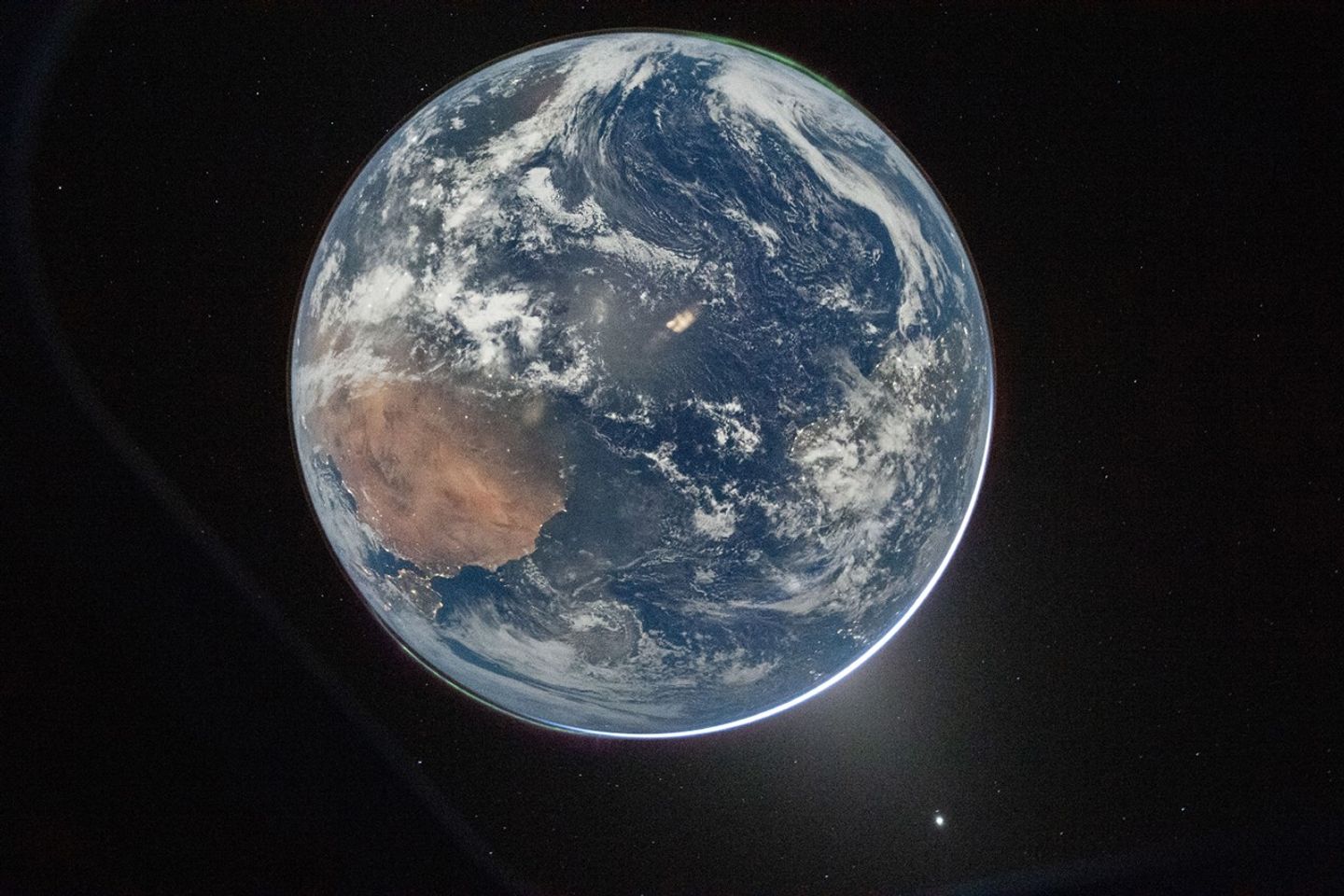
A Moonlit Earth as Seen From Artemis II

4 June 2026 at 05:01
Earth’s full disk is seen through the window of a spacecraft. The glow of aurora, a sliver of the Sun, and fuzzy zodiacal light surround the planet, and city lights are visible on the continents.
April 2, 2026

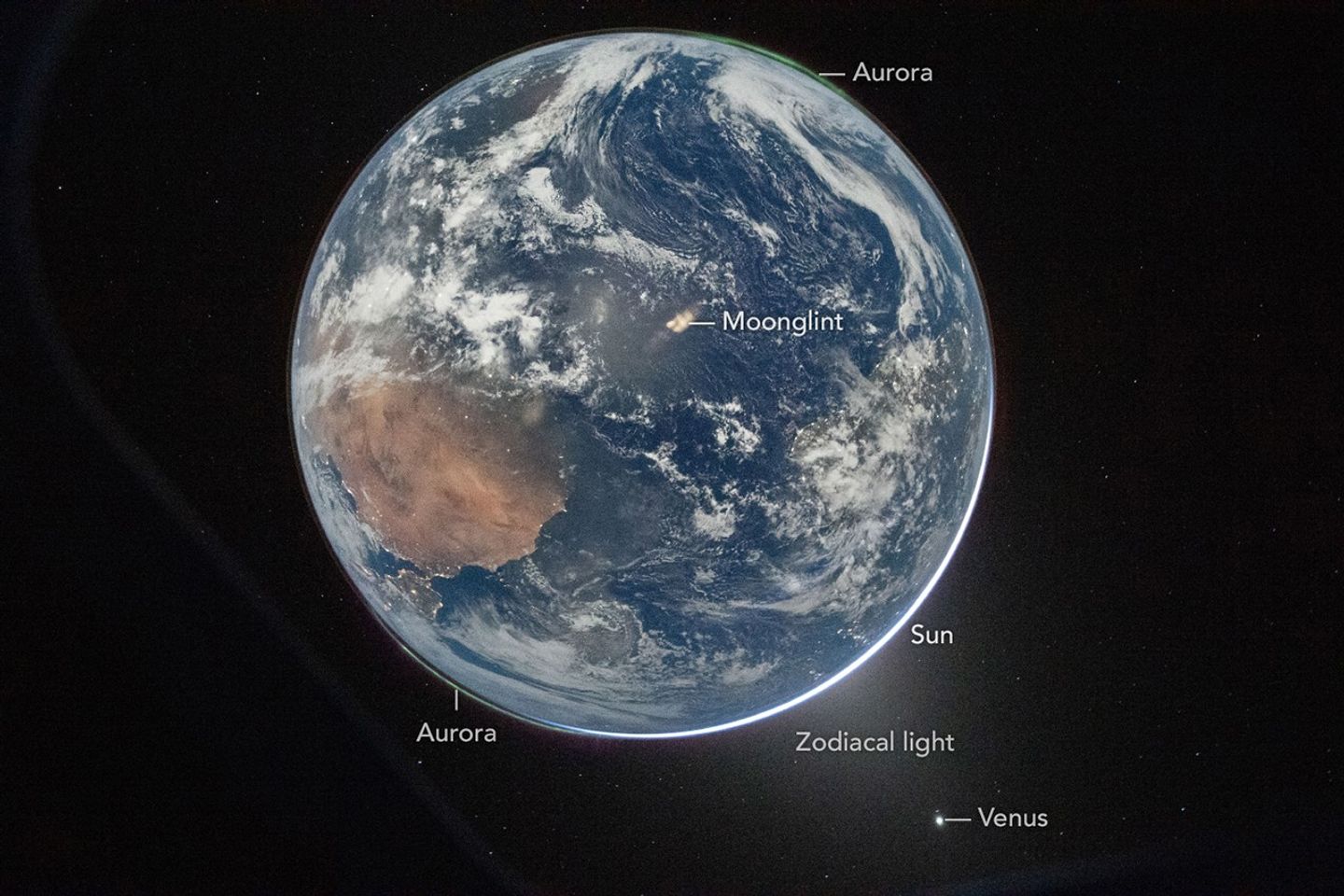
One of the first images transmitted back to Earth from the Artemis II mission was a stunner. In a single image, Earth’s full disk appears amid celestial phenomena that illustrate its place in the solar system. And although the visible hemisphere appears to be awash in sunlight, it is actually lit by moonlight. The astronauts’ vantage point provided a rare opportunity to capture nighttime features—most notably lights from human habitation—from a new perspective.

An Artemis crew member captured the photo from the Orion spacecraft after it completed the translunar injection burn, which sent the spacecraft out of Earth orbit and on a trajectory toward the Moon. In the photo, Earth eclipses the Sun from Orion’s perspective, leaving only a small sliver of its bright light visible around the bottom right edge. Green auroras, caused by charged particles from the Sun interacting with Earth’s upper atmosphere, glow around the north and south poles (lower left and upper right, respectively).

The Sun’s light also produces the fuzzy glow, known as zodiacal light, that appears to the lower right of Earth. This phenomenon comes from sunlight reflecting off interplanetary dust. Skywatchers on Earth may see it at certain times of year around dawn or dusk as a faint column of light extending up from the horizon. Data collected by NASA’s Juno spacecraft on its journey to Jupiter suggest that Mars may be a significant source of the dust particles that produce zodiacal light. Earth’s other planetary neighbor, Venus, appears as the bright object in the bottom right of the image.

Earth’s full disk is seen through the window of a spacecraft. Various features are labeled. The glow of aurora, a sliver of the Sun, and fuzzy zodiacal light surround the planet, and city lights are visible on the continents.
April 2, 2026

On Earth itself, city lights are evidence of human activity. Bright areas appear in Spain, Portugal, and northern Africa (lower left), sub-Saharan Africa (center left), and Brazil (center right). Digital camera technology—with help from the illumination of a full Moon—made it possible to see these and other details of Earth’s surface and atmosphere in low light. The crew set the camera’s ISO to 51,200 to make it highly sensitive to light. For comparison, an ISO setting of 100 or 200 is common for daytime photography.

Previous nighttime views of Earth taken from spacecraft may look very different from this photo but have also inspired and enlightened. For instance, the Apollo 12 crew photographed Earth eclipsing the Sun in 1969; astronaut Alan Bean would go on to depict his impressions of the event in paintings.

More recently, astronauts aboard the International Space Station have photographed the planet at night from low Earth orbit, while NASA’s Black Marble nighttime lights product suite uses satellite observations to produce science-quality records of nighttime lights at daily, monthly, and yearly time scales. Those programs provide sustained data records, while the Artemis II photo is distinctive as a single human-captured full-disk view showing many low-light features at once.

Cindy Evans, senior exploration scientist in the Astromaterials Research and Exploration Science Division at NASA’s Johnson Space Center, was working in the Science Evaluation Room during the Artemis II mission and was one of the first people on Earth to see the image. Evans was struck both by its beauty and the perspective revealed by all the visible solar system features. “I love the image so much because it was taken with Earth in moonshine, and shows Earth as a solar system body, a dynamic planet interacting with the solar wind, and a place harboring life,” she said.

The image is scientifically valuable, as well, said Miguel Román, Deputy Director for Atmospheres and Data Systems at NASA’s Goddard Space Flight Center. “It speaks powerfully to the breadth of what NASA does across science and human exploration,” he said. Román studies artificial light at night, as viewed from space, as a measurable signal of human activity.

“[This photo] reminds us that Earth at night is visually compelling, physically complex, and scientifically underexplored,” Román said. “I see this image as a glimpse of what Earth science can become in the future.”

NASA images prepared for Earth Observatory by Lauren Dauphin. Story by Lindsey Doermann.

References & Resources

You may also be interested in:

Stay up-to-date with the latest content from NASA as we explore the universe and discover more about our home planet.

Great Balls of Fire

4 min read

An astronaut on the International Space Station was surprised to photograph a shower of light streaking through the darkness while…

Article

Earthset From the Lunar Far Side

2 min read

The crew of NASA’s Artemis II mission captured extraordinary images of our home planet during their journey around the far…

Article

Shades of a Lunar Eclipse

3 min read

A series of nighttime satellite images revealed how moonlight reaching Earth varied throughout a total lunar eclipse.

Article

Earth’s Atmosphere: A Shield by Design

13 February 2025 at 23:24
The Earth's atmosphere, though thin, protects against meteors and asteroids, causing most to burn up upon entry. Significant impacts, like the Vredefort and Chicxulub craters, demonstrate catastrophic events, which occurred during or just after the Genesis Flood, highlighting a biblical perspective on geological history.

❌