The sharpest images ever taken of the Sun’s surface reveal ribbons of solar plasma curling into tight, wave-like vortices near the edge of a sunspot — a pattern never before seen on our star. The experiment behind the discovery was designed to push the technical limits of a new camera system, not hunt for newContinue reading "World’s largest solar telescope reveals the Sun’s hidden texture"
This image of the sun — the sharpest ever snapped — was captured by the NSF Inouye solar telescope. (Image credit: NSF, NSO, AURA, MPS, Inouye Tel)
Scientists have captured the sharpest image ever of our sun's surface. This view has revealed incredible new details about the inner mechanisms driving stellar activity.
What is it?
An international team of researchers using the U.S. National Science Foundation's Inouye Solar Telescope has captured the highest-resolution view of the sun's surface.
In analyzing observations from this telescope, the team, made up of researchers from the National Solar Observatory, the NSF NCR High Altitude Observatory and the German Max Planck Institut für Sonnensystemforschung, discovered strange patterns on the sun's surface. The whirling patterns, they found, are actually evidence of what's called Kelvin-Helmholtz instability (KHI), or instability that happens when there is a change in velocity of fluids.
Why is it incredible?
This image is groundbreaking. Capturing the highest-resolution view of the sun's surface is a massive accomplishment, and in the time-lapse video above, you can even see the fluid dynamics on the surface of the sun in motion.
But this view is much more than a beautiful, high-resolution image. These observations have revealed swirls on the sun's surface at the edges of the magnetic areas, allowing the team to identify KHI on the sun's surface. This fluid instability has long been suspected on the sun, but these observations are the first time they have ever been directly seen like this.
“We believe that the discovery of Kelvin-Helmholtz Instability in the solar photosphere, backed up by analysis of numerical simulations, is a major step forward in our understanding of the dynamics and evolution of solar and stellar plasma, and will serve as a basis for future discoveries," David Boboltz, the deputy director at the National Solar Observatory, said in a statement.
A paper describing these findings was published recently in the journal Nature.
Pluto's atmosphere appears to be freezing out as the dwarf planet moves ever further away from the sun, according to careful observations of Pluto astronomers made as it was seen passing in front of stars in the sky.
Pluto is already cold. Its surface temperature is about –382 degrees Fahrenheit (–230 degrees Celsius), while its upper atmosphere is a little warmer at –333 degrees Fahrenheit (–203 degrees Celsius). As Pluto moves away from the sun it will grow even colder and its nitrogen-rich atmosphere should start to collapse and freeze out, condensing as frost on the frigid surface.
Now, a team led by Amanda Sickafoose of Arizona's Planetary Science Institute believe they have seen the onset of this process. "We're at a particularly interesting point for Pluto," said Sickafoose in a statement. "Our work suggests that the atmosphere has recently started decreasing in pressure."
Pluto's orbit is highly elliptical and very oblique to the ecliptic plane of the solar system. In fact, so eccentric is Pluto's orbit that for ten years either side of its perihelion in 1989 (when Pluto was closest to the sun), it was actually closer to the sun than Neptune was.
However, ever since 1989 Pluto has been moving away from the sun on its 248-year-long orbit – we've not even seen Pluto complete half of its orbit yet since its discovery in 1930. Pluto will reach its furthest point from the sun – called aphelion – in the year 2114 when it will be about 49 astronomical units (7.3 billion kilometers/4.6 billion miles) distant.
When NASA's New Horizons mission flew past Pluto in July 2015, it measured Pluto's atmospheric pressure to be 10 microbars. This is a tiny amount, millions of times lower than the atmospheric pressure on Earth, resulting from Pluto's thin nitrogen atmosphere that also contains hazes made from organic molecules including methane and carbon monoxide.
An image taken by NASA's New Horizons spacecraft that offered scientists the first look at Pluto's atmosphere in infrared wavelengths when it was taken in July 2015. (Image credit: NASA/JHUAPL/SwRI)
With New Horizons now having flown past Pluto and deeper into the Kuiper Belt, astronomers have to instead rely on more distant and less direct means of keeping tabs on Pluto's atmosphere. From our point of view on Earth, Pluto is sometimes seen to pass in front of a distant star. This is called a stellar occultation. When an airless body, such as an asteroid, occults (or hides) a background star the star's light winks out in an instant, before suddenly reappearing. When there is an atmosphere involved, however, the light of the star doesn't go out all at once when blocked by Pluto, but steadily fades as the atmosphere scatters and refracts the starlight before the star vanishes behind the dwarf planet's solid body.
Between 2017 and 2023, Sickafoose's team probed Pluto's atmosphere during ten occultations of stars ranging in brightness from about magnitude 12 to magnitude 18, far below naked-eye visibility.
Observing stellar occultations is not always a simple matter. They are not visible from everywhere on Earth, but only along narrow tracks, often in difficult to reach areas. The tracks, which are just a few kilometers wide, are effectively Pluto's shadow falling on the Earth. By spacing observers across the width of the track, it is possible to measure the extent of Pluto's atmosphere (there usually also has to be an unlucky observer just outside the track to confirm that is indeed the edge of the shadow track).
"I'm constantly amazed at how the simple technique of watching starlight dim and reappear allows us to study a thin atmosphere – a few millionths of the Earth's – on a world two-thirds the size of our moon and 30 times farther from the sun," said Sickafoose.
Of the ten occultations, four could be seen from observatories in multiple locations, which meant that the different observatories could confirm each other's results.
"We often prefer to observe predicted occultations that have shadow paths over large observatories because that equipment and data have proven successful," said Sickafoose. "Then, we try to improve those datasets by collaborating with local observers in the shadow paths."
Light curve from the June 1, 2026 occultation, observed from Savannah Skies Observatory in Chillagoe, Queensland, Australia. The gray vertical lines indicate different stages of the occultation. The baseline flux level contains combined light from the star and the Pluto system (Pluto plus all of its moons). The flux drops gradually as the starlight bends and scatters in Pluto's atmosphere, reaching nearly zero flux as defined by only light coming from the Pluto system. As the star appears on the other side of Pluto, the light gradually reappears in the atmosphere before returning to full strength. (Image credit: A. Sickafoose/Planetary Science Institute)
Previous work had suggested that Pluto's atmosphere began freezing out in 2018, but Sickafoose's team found that actually, Pluto's atmosphere remained constant from 2015 to midway through 2021. However, between mid-2021 and the last occultation that Sickafoose's team observed in 2023, Pluto's atmospheric pressure dropped by 16 per cent.
The pressure drop was deduced from the light curves, which show how the star's brightness changed with time during an occultation. The light curves revealed that while the structure of Pluto's upper atmosphere remained fixed, the lower atmosphere changed.
Sickafoose's team interprets this as being the haze particles settling towards lower latitudes. This is what is expected to happen when the atmospheric pressure drops.
"I am hopeful that we'll be able to get more data in the next years to decades to specifically confirm or refute this trend," said Sickafoose.
It is thought that Pluto's atmosphere won't have completely frozen onto the dwarf planet's surface by the time it reaches aphelion, and then as Pluto begins moving in towards the sun once more the feeble solar heating that Pluto receives will slowly begin to increase, causing nitrogen frost to sublimate from the surface and thicken the atmosphere once more.
The Oort Cloud is one of the strangest places in the Solar System because it has never been seen directly. Astronomers infer its existence from the paths of long-period comets: icy bodies that spend most of their lives in deep space and only occasionally fall toward the Sun. NASA describes the Oort Cloud as a […]
Planetary researchers analyzing images from NASA’s New Horizons spacecraft have found evidence that liquid nitrogen may still be seeping up from beneath the dwarf planet’s giant glacier, Sputnik Planitia, marking the first suggested case of recently flowing liquid on Pluto’s surface.
The company plans to build factories on the moon, using robots to do much of the heavy lifting, Elon Musk said on Tuesday (Aug. 4) during SpaceX's first-ever quarterly earnings call.
"We are going to land a lot of tonnage on the moon," he said. "We're going to build the factories on the moon. The robots will be helpful with that."
This is not a newly revealed vision; Musk first laid it out in February, in a blog post that announced SpaceX's purchase of xAI, a company that the billionaire entrepreneur founded in 2023. But Musk doubled down on it this week, showing investors that off-Earth manufacturing is very much front-of-mind for SpaceX.
The factories in question will build SpaceX's Starmind AI satellites, if all goes according to plan. The company aims to operate a million-strong Starmind constellation in Earth orbit in the coming years, and then go farther afield with the craft after that.
Eventually, SpaceX wants to launch locally made Starmind satellites off the lunar surface using electromagnetic mass drivers — basically, extremely powerful rail guns.
"Using robots on the moon to scale up manufacturing on the moon — which, I know it sounds, like, super sci-fi right now, but it's going to happen — will enable us to build the mass accelerator on the moon," Musk said.
"And if you have a mass accelerator on the moon, and you have solar and radiator production on the moon, you can — I know this sounds totally nuts — but you can you can probably scale to 1,000 times the economy of Earth in terms of intelligence launched to space, but probably, you know, maybe even a million times," he added.
"Solar and radiator production" refers to the manufacture of key Starmind satellite components: solar panels to power them and radiators to dump the large amounts of heat they'll produce into the vacuum of space.
A rendering of one of SpaceX's planned "Starmind" AI satellites in orbit. (Image credit: SpaceX)
Musk didn't provide details about the robotic lunar labor force. But he's presumably counting on Optimus, a humanoid robot built by another one of his companies, the carmaker Tesla. Musk has previously said that SpaceX will launch some Optimus units to Mars in the near future, to help pave the way for human settlement of the Red Planet.
Those robots will fly on Starship, SpaceX's fully reusable next-gen megarocket, which is currently gearing up for its 14th test flight. Indeed, Starship is key to most of the company's plan's both in Earth orbit and beyond.
"Starship aims to quadruple payload capacity and reduce launch costs by 10 times compared to our Falcon 9 rocket, unlocking significant capabilities across all of our business segments," SpaceX Chief Financial Officer Bret Johnsen said during Tuesday's earnings call.
"We continue to make progress building the infrastructure required to support thousands of Starship launches per year, including accelerating Raptor and launch vehicle production, the buildout of our gigabays, and making significant progress towards activating multiple launch pads at Starbase and in Cape Canaveral at Pad 39A and Pad 37," he added. (Raptor is the engine that powers Starship, and Starbase is SpaceX's South Texas site, which serves as the current hub of Starship manufacturing, testing and launch activities.)
Tuesday's call was a landmark for SpaceX — its first as a publicly traded company. Musk founded SpaceX as a private concern in March 2022 and took it public this past June, via the richest IPO in history.
The IPO raised $86 billion and valued SpaceX at $1.77 trillion. Only six American companies had higher market capitalizations at the time — NVIDIA, Apple, Alphabet (Google), Microsoft, Amazon and the semiconductor manufacturer Broadcom. (Market caps fluctuate all the time, going up and down with companies' stock prices.)
The main point of Tuesday's call was to discuss SpaceX's first-ever earnings report, which covered the second quarter of this year. The company's revenue over that stretch was $7.8 billion, a 92% increase over the same period in 2025, according to the report. SpaceX lost more money than it made during Q2 2026, but the shortfall was considerably smaller than in Q2 2025 — $541 million versus $1.0 billion.
Astronomers using the 4-m Daniel K. Inouye Solar Telescope in Hawaii have detected tiny plasma vortices on the Sun’s surface (photosphere) for the first time, revealing a long-suspected process that could transport energy into the million-degree corona.
Picture it: A swarm of tiny robot helicopters descends through a reddish-brown sky, landing gracefully on the Martian surface. What are they wearing? Tiny capes.
NASA's SkyFall mission will send a trio of mini rotorcraft to Mars equipped with ground penetrating radar technology which happens to look like little capes. These uniquely designed swaths of fabric look decidedly strange or even accidental in new videos from NASA's Jet Propulsion Laboratory (JPL) that show the little drones practice landing. But these capes are actually flexible antennae that will allow the craft to peer beneath the Red Planet's surface in search of water ice.
"The only way to detect shallow subsurface ice remotely is to fly close to the ground," Adrian Tang, SkyFall’s ground-penetrating radar lead instrument scientist at JPL, said in a statement on Thursday (Aug. 6). "By flying low and slow, a SkyFall helicopter could capture radar images that resolve the fine layering where dry soil gives way to ice, detecting its presence and mapping its extent."
Orbiting spacecraft have studied Mars for decades, imaging the planet and mapping it with radar. But from orbit, their radar is unable to see the first few feet of material just below the planet's surface — a zone where scientists expect to find shallow ice deposits mixed in with the rocks and dust. This work could be important for future astronauts who need to better understand the ground below their feet for safety reasons, and for future travelers searching for accessible ice to process for drinking water, oxygen and fuel.
Skyfall will follow in the footsteps of Ingenuity, the first rotorcraft on another world, which hitched a ride to Mars aboard NASA's Perseverance rover. The new choppers are based heavily on Ingenuity, which weighed just 4 pounds (1.8 kilograms) here on Earth. But Skyfall will be more capable than Ingenuity, whose main job was to show that choppers can explore the thin skies of Mars.
SkyFall's tiny cape ground-penetrating radar, which uses a type of flexible antenna called Vivaldi that was invented back in 1978, is designed to survey up to 16 feet (5 meters) below the Martian surface. The radar will be able to reach anywhere from several yards below the planet's surface to the uppermost layers of surface material.
And the antenna's unique design ensures that the SkyFall drones will be able to make these subsurface observations without damaging the equipment during landing.. The antenna is extremely lightweight, and the team miniaturized it to be both the right size and shape to fit the tiny helicopters, which sit just 6 inches (15 centimeters) above the ground at rest. The tricky thing was, the designers had to miniaturize the radar antennae while maintaining functionality. But they did just that, and these tiny radar capes will be able to bend and move out of the way as the rotorcraft do their thing, flying above and landing on the Red Planet.
"Although we managed to shrink the antenna quite a bit, it is about 1.5 times longer than the helicopter’s legs," Christine Gebara, SkyFall ground-penetrating radar mechanical lead at JPL, added in the statement.
"That means during landing, the Vivaldi has to bend out of the way — and if it lands on a rock, it bends even further," she added. "But when the helicopter takes off again, the antenna must spring back into place for data collection. Because SkyFall is expected to make dozens of flights exploring Mars, we needed an antenna that could repeatedly handle those pressures without losing its shape in flight."
A radar engineer at NASA JPL works to test the antenna on the SkyFall helicopter. (Image credit: NASA/JPL-Caltech)
To make these little capes capable of withstanding incredible feats on another world, the engineers behind the helicopters covered the antenna in layers of polyester and Vectran, a flexible (but incredibly strong) material that was previously used for the airbag that cushioned NASA's Spirit and Opportunity Mars rovers during their touchdowns in 2004. The antenna's shape is also reinforced with flexible fiberglass tape springs and a lightweight structure. In total, each antenna weighs a miniscule 5 ounces (142 grams).
But a crafty design isn't enough. Getting to Mars is no small feat, and NASA needs to be sure that these little helicopters and their gear are up to the challenge. So, in JPL's Environmental Test Laboratory, which recreates different elements of environments beyond Earth, the SkyFall team put the rotorcraft and its little radar antenna to the test. They bent and flexed the antenna over and over, recreating multiple landings on the surface, exposed the craft to extreme temperatures, and continually checked to make sure that, throughout this testing, the helicopter could still transmit and receive radar signals. At the end of this testing, the antenna had endured 200 simulated Mars landings and was still working just fine. That is more than twice the number of landings expected from the mission.
"This test checked every box it was supposed to and answered our biggest technical questions," Tang added. "While we still have work ahead of us before the antenna is fully flight-qualified, this was a major milestone, and the hardware performed exactly as expected."
The trio of SkyFall helicopters will put their radar capes to the ultimate test when they fly to Mars. NASA plans to launch this mission to the Red Planet in 2028 aboard NASA's Space Reactor-1 Freedom, the first nuclear fission-powered interplanetary spacecraft.
The final resting place of SpaceX's moon-smashing rocket has been found.
The Korea Pathfinder Lunar Orbiter, known as Danuri, has captured imagery of the crater blasted out by the Falcon 9 upper stage that slammed into the moon early on Wednesday morning (Aug. 5).
"Danuri began observations about 30 minutes before the collision and, through orbit control, passed over the impact site multiple times, conducting a total of 8 imaging sessions," officials with the Korea Aerospace Research Institute (KARI) said via X this morning (Aug. 6). "Through this observation, changes in the terrain around the impact site and traces of ejecta spread were confirmed."
"Danuri secured both pre-collision and immediate post-collision footage, enabling analysis of changes caused solely by the collision and providing important research data," they added in the X post, which shared several before-and-after images of the impact site.
Before-and-after imagery of the impact site. (Image credit: KARI)
The Falcon 9 in question launched on Jan. 15, 2025, sending two private robotic moon landers — Firefly Aerospace's Blue Ghost and ispace's Resilience — to a high, moon-crossing Earth orbit. The duo then made their own way to the moon; Blue Ghost landed successfully on March 2 of that year, but Resilience crashed during its touchdown attempt.
The Falcon 9's first stage came back to Earth shortly after liftoff for recovery and reuse, as such boosters commonly do. Falcon 9 upper stages, by contrast, are expendable. SpaceX usually disposes of them in Earth's atmosphere, but the upper stage on the Blue Ghost-Resilience mission used almost all of its fuel getting its payloads to their distant destination. So the 8,800-pound (4,000 kilograms) rocket body remained up there, orbiting Earth — until solar activity and gravitational forces pushed it on a collision course for the moon.
Another before-and-after image, with the "before" photo taken by NASA's Lunar Reconnaissance Orbiter back in 2015. (Image credit: KARI)
That collision occurred at 2:34 a.m. EDT (0634 GMT) on Wednesday, according to KARI officials — right in line with predictions. Scientists calculated some other parameters ahead of time as well. For example, the rocket body probably hit the moon at about 5,400 mph (8,690 kph), gouging out a crater up to 89 feet (27 meters) wide.
The new observations by Danuri, as well as future work by other lunar probes, will help verify such predictions.
"The observation data secured by Danuri will be linked with follow-up observations from NASA's Lunar Reconnaissance Orbiter (LRO) and utilized in international collaborative research," KARI officials said in the X post.
It may be that some ground-based telescopes caught the impact as well. Astronomers at the Instituto de Astrofísica de Andalucía in Spain believe they captured a video of ejected material blasting off of the lunar surface around the predicted time of impact:
Our team at @iaa_csic has captured the impact on the Moon of the upper stage of a Falcon 9 rocket. We attach a preliminary video showing the evolution of the ejected material. The black area corresponds to the lunar disk @SpaceX @JuanLuisRizos @elonmusk @tiempobrasero @A3Noticias… pic.twitter.com/5Ry7hRdCeSAugust 6, 2026
The Falcon 9 upper stage wasn't the first rocket body to slam into the moon. The third stage of a Chinese Long March 3C crashed into the lunar surface on March 4, 2022, for example. And the third stage of NASA's Saturn V rocket gouged out craters during multiple Apollo moon missions.
Danuri is South Korea's first lunar probe. The spacecraft launched on Aug. 4, 2022 atop a Falcon 9 and began circling the moon four months later. It carries six payloads, five of them provided by Korean universities and research organizations. The sixth is a NASA instrument called ShadowCam, which hunts for signs of water ice in permanently shadowed regions at the lunar poles.
A spent rocket body hitting the moon made headlines this week, but the reality is that the unplanned collision by a SpaceX upper stage was just the latest in a long history of human-made objects meeting their end by impacting the lunar surface.
Astronomers around the world kept their telescopes trained on the moon early Wednesday morning (Aug. 5), when the rocket stage from a January 2025 U.S. commercial lunar landing mission was calculated to strike the celestial body. Though the fate of the SpaceX Falcon 9 part was unintentional — solar activity and gravitational forces caused the stage to slam into the moon — the impact offered a rare opportunity to try to observe the flash from the impact and the plume of lunar material it sent flying.
By noon (EDT) on Wednesday, there were no confirmed reports of the impact being caught on film, but a telescope in Chile spotted the debris plume, according to the Associated Press.
"This rare occurrence has decades of history, going back to the Apollo era," wrote Jared Isaacman, NASA's administrator, in a post to his social media accounts. "The reality is that meteoroids strike the lunar surface hourly, with impacts comparable to this upper stage occurring roughly every six days."
Inventorying the impacts
The moon is peppered with the scattered metal remains of missions that missed their mark, came down too quickly or were purposefully sent careening into the regolith to learn more about the makeup of Earth's natural satellite.
In fact, the very first mission to successfully fly by the moon was intended to be an impactor. The former Soviet Union's Luna 1 probe was designed to hit the moon but instead zoomed past its target and entered orbit around the sun on Jan. 2, 1959.
Luna 2, launched nine months later, became humanity's first object to reach the lunar surface, purposefully slamming into Sinus Lunicus ("Bay of Lunik"), along the southeastern edge of Mare Imbrium, on Sept. 14, 1959.
The U.S. followed suit, though not as NASA intended, with the Ranger 4 probe impacting the far side of the moon on April 26, 1962. The mission had included an impactor, but both it and its lander failed to operate due to a failure to deploy the spacecraft's solar arrays.
Once humans began arriving on the moon with NASA's Apollo program, scientists found another reason to direct spent rocket and spacecraft stages into a collision course with the surface. Beginning with Apollo 11 in 1969 and concluding with Apollo 16 in 1972, seismometers were placed on the moon to measure natural "moonquakes" and the effects on the moon when the missions' Saturn SIV-B stages and Apollo lunar module descent stages made hard landings.
The data collected helped geologists learn more about the interior makeup of the moon, including that a rocky mantle exists under the outer crust.
These four images, captured by NASA's Lunar Reconnaissance Orbiter, show craters formed by impacts of Apollo SIV-B stages. Crater diameters range from 35 to 40 meters (38.2 to 43.7 yards) in the longest dimension. (Image credit: NASA/Goddard/Arizona State University)
After Apollo, planned impacts (and missions) slowed down, if not outright stopped, but the SpaceX collision on Wednesday was not the first in more than 50 years. Between 1993 and today, 11 probes — four from China, three from Japan, two from the U.S. and one each from India and the European Space Agency (ESA) — were intentionally deorbited at the end of the end of their missions around the moon.
Some of these impacts were performed to discard the craft, but others — like Lunar Prospector, LCROSS and Chandrayaan-1 — helped confirm the presence of water by examining the resulting plume.
Unintentional collisions are fewer in number, as are rocket stages, but are not unprecedented. A rocket body that hit the moon's far side in March 2022, leaving behind a small double crater, was later identified as a Long March 3C rocket that launched China's Chang'e 5-T1 mission around the moon in 2014.
Litter versus liability
Without a large human population on the moon, the risk that these planned and unplanned impacts present at current is minimal. But the concern rises as NASA and other world space agencies, as well as commercial interests, begin to increase the pace on establishing their now-planned sustainable facilities for astronauts to live and work on the lunar surface.
"The future lunar base will incorporate reusable spacecraft that not only deliver astronauts and payloads, but also become part of the infrastructure itself," Isaacman said in his post, referring to how reuse can be a way to reduce the number of vehicles needed to be discarded of on the moon.
The Artemis Accords, an internationally agreed-upon set of standards led by NASA and currently signed onto by 70 countries, also includes a provision for its members that spacecraft and their associated rocket components must be disposed of safely.
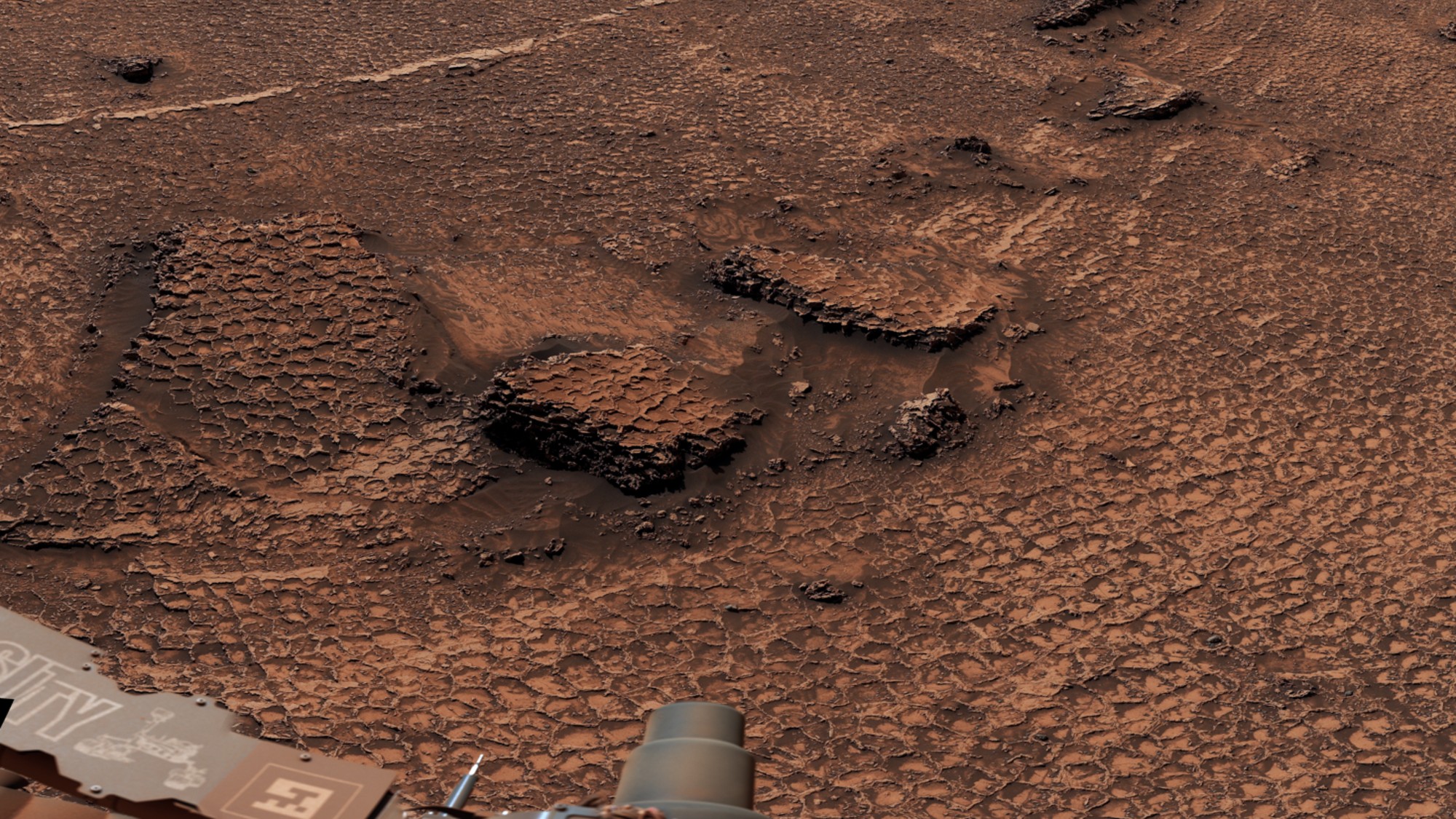
NASA’s Curiosity rover has stumbled on the largest patch of polygon-shaped ground fractures it has ever seen on Mars, a discovery that could reveal more about the planet’s watery past.
Early this morning, a SpaceX rocket slammed into the moon at seven times the speed of sound. Now, lunar orbiters are trying to get a look at the aftermath.
This morning (Aug. 5) at about 2:35 a.m. EDT (0635 GMT), the upper stage of a SpaceX Falcon 9 rocket crashed into the moon. To dissect what exactly happened, scientists are looking for imagery of the crash site, with the help of a couple of moon probes.
"NASA’s Lunar Reconnaissance Orbiter and NASA’s ShadowCam instrument on the Korea Pathfinder Lunar Orbiter will look for opportunities to capture before‑and‑after imagery of the impact site," NASA spokesperson Rob Garner, of NASA's Goddard Space Flight Center in Maryland, told Space.com. "Image availability depends on several factors, including the impact location, lighting conditions, and when each spacecraft’s orbit next carries it over the area, which may take a few days to receive any imagery."
While you've likely seen the first stages of Falcon 9 rockets gracefully land back on Earth for reuse, the rocket's 9,000-pound (4,000 kilograms) upper stage is disposable. Typically, it's sent to burn up in our atmosphere after its missions are over.
However, that wasn't possible with this rocket, which launched two private lunar landers — Firefly Aerospace's Blue Ghost and Tokyo-based ispace's Resilience — to a high, moon-crossing Earth orbit in January 2025. The Falcon 9 upper stage used most of its fuel getting to this distant location and couldn't make it back to deorbit in Earth's atmosphere.
So the company performed a different maneuver to take care of this upper stage, Julianna Scheiman, director of NASA science and Dragon programs at SpaceX, said during a press conference on Aug. 3.
"For high-energy missions, we need to perform a different maneuver to ensure the second stage itself is safe per the appropriate rules and regulations, and so we did that here," she said.
But the rocket body was still subject to natural forces, which acted on it over time.
"What has happened is, essentially, a mixture of solar activity and gravity forces have put it on a path towards the moon," Scheiman said.
The Falcon 9 upper stage ended up slamming into the moon this morning at about 5,400 mph (8,690 kph). It likely blasted out a crater up to 89 feet (27 meters) wide, according to scientists' calculations.
This was certainly not the original intended outcome for this rocket. But it presents an opportunity for researchers, who plan to take advantage of it to learn more about the moon.
"NASA’s Meteoroid Environments Office will attempt to image the impact around the predicted time using ground‑based telescopes at the agency's Marshall Space Flight Center in Huntsville [Alabama]," Garner added. "Because the impact flash and plume are expected to be faint, the chance of seeing anything from Earth remains low, and local weather can affect observations as well. Any data collected will help scientists better understand impacts from artificial objects and the potential effects on future lunar exploration."
Today's impact took place on the sunlit side of the moon, the brightness of which made observations difficult for skywatchers hoping to watch the crash from afar with telescopes. But the two lunar orbiters might be able to see not just the crash and impact crater but also the plume of dust kicked up by the rocket's death dive.
So far, observations from Earth have revealed some information. Scientists at the Lowell Observatory in Flagstaff, Arizona reported detections of a lunar plume from the impact.
"We can safely say that we measured a response from the rocket stage impact as a sodium and lithium gas plume a few 10’s of kilometers in size lasting between 5 and 10 minutes after impact," Carl Schmidt told Inside Outer Space's Leonard David.
Detections by the Lowell Observatory in Flagstaff, Arizona, show evidence of a plume on the moon caused by the impact of a SpaceX rocket on Aug. 5, 2026. (Image credit: Carl Schmidt/Lowell Observatory)
Such images of the event would provide "an opportunity to test pipelines for measuring flash properties to locate impact events seismically, and to better understand the multi-modal hazards posed to future lunar infrastructure and astronauts from space debris impacting the moon," researchers led by Benjamin Fernando of Los Alamos National Laboratory in New Mexico wrote in a recent paper discussing the then-upcoming event.
So hold tight, as researchers are now eagerly collecting and analyzing the images captured by these orbiters, and we might get images of the rocket crash, the lunar plumes and remaining aftermath soon.
Scientists observing the Sun with the Daniel K. Inouye Solar Telescope have caught a wave-like shape that's never been seen on the Sun's visible surface.
A close-up of the polygon fractures discovered by NASA's Curiosity Mars rover highlights their honeycomb-like textures. (Image credit: NASA/JPL-Caltech/MSSS)
NASA's Curiosity Mars rover spotted surprising shapes in the Red Planet soil while exploring a large valley.
What is it?
These images were captured on June 19 and 20, 2026, or the 4,930th and 4,931st Martian days of Curiosity's mission. They show honeycomb-like patterns referred to as "polygonal fractures" found in a valley on Mars known as Valle Grande. They measure about 1.5 to 3 inches (4 to 8 centimeters) across.
While Curiosity has seen other curious geometric patterns on Mars before, scientists were surprised by this most recent find.
"We've seen a lot of fascinating landscapes through Curiosity's eyes, but this sea of polygons took our breath away," project scientist Ashwin Vasavada of NASA's Jet Propulsion Laboratory said in a statement. "We measured their shapes and chemistry carefully and are hopeful there are clues in the data as to how these features formed."
A panorama taken by NASA's Curiosity Mars rover showing a large field of hexagonal shapes in the Martian soil. (Image credit: NASA/JPL-Caltech/MSSS)
Why is it incredible?
This field of polygons in Valle Grande extends as far as Curiosity's instruments could see, even around the base of a steep hill scientists named "Miraflores."
NASA's Curiosity Mars rover captured this sand-capped butte, nicknamed "Miraflores," estimated to be about 20 feet (6 meters) tall, on June 11, 2026. (Image credit: NASA/JPL-Caltech/MSSS)
While mission scientists have theories about how these structures form, it ultimately remains a mystery how they formed.
It's thought that changes in temperatures on Mars could have caused water to squeeze through sediment layers, but scientists will need to collect more data before they can reach a conclusive answer.
Planting boots on Mars is hard enough. But getting "breathing room" on the Red Planet without inhaling toxic dust is yet another issue.
Given NASA's plans to eventually put astronauts on the Red Planet, the agency assembled a Martian Dust Limit Working Group earlier this year to review what's known and unknown about the toxicological hazard to human crews from exposure to Mars dust. The ultimate goal was to establish a permissible exposure limit for humans on the Red Planet by compiling a comprehensive set of expert perspectives regarding Martian dust toxicology, exposure pathways and mitigation strategies.
The working group's conclusions reinforced the view that an initial Martian dust standard "must balance conservatism with operational feasibility while accommodating architectural and scientific uncertainty," the report states. Furthermore, the report explains, "as additional Martian data and toxicological research become available, this standard should be periodically revisited to ensure continued protection of crew health during human exploration of Mars."
Unique study
A panel member for that study was Brian Hynek professor in the Department of Earth Science and a research associate at the Laboratory for Atmospheric and Space Physics, both at the University of Colorado, Boulder.
"It was a unique study," Hynek told Space.com, conducted by NASA specialists, space medicine experts, habitat designers, including toxicologists, volcanologists and geologists. "The task was to help gauge health hazards to humans, both for short and long-term stays," he said.
Just highlighting the differences between the moon and Mars played a role, said Hynek. "The moon is worse in some ways and Mars is worse in other ways."
Disneyland of dust
To be sure, one outcome from Apollo moonwalkers – the "dusty dozen" – is that dealing with lunar dust proved to be troublesome, much more than expected. The aged moon is a Disneyland of dust and crews that went there attested to that fact.
Once out and about, moonwalkers coped with very fine, tiny particles composed of sharp, glassy material. Lunar dust stuck to everything it came in contact with; dust eroded their spacesuits, caused overheating on equipment and instrumentation, compromised seals on their spacesuits, even irritated the eyes and lungs of moonwalkers.
"On Mars, dust particles are a little more rounded, not as jagged and cutting into you. But then you have all the extra chemical components and minerals that you don't have on the moon, like really unhealthy perchlorates," Hynek said. "We can use the lunar knowledge, but Mars is a totally different place," he added.
At the conclusion of Apollo 17's mission in December 1972, moonwalking suits and space helmets are covered by lunar dust. (Image credit: NASA)
Heavy metals
Hynek noted that Martian dust is known to contain various carcinogens, such as silica and numerous heavy metals. He co-authored a recent paper on "Potential Health Impacts, Treatments, and Countermeasures of Martian Dust on Future Human Space Exploration."
"There's talk about growing crops on Mars," Hynek observed. "The martian soil is full of all these nasty chemicals. So the astronauts might get more exposure from what they are growing on Mars than the actual airborne dust," said Hynek.
Then there's the dust that will assuredly find its way into the habitat, Hynek said, so engineers are looking at filtering systems and just how much time will be required to clean the inside of the habitat.
"It's good to have the forethought and to start considering the Martian dust and its hazards. It poses a lot more health hazards than the lunar dust," Hynek concluded.
Learned our lesson
Joel Levine, a research professor in applied science at William and Mary in Williamsburg, Virginia, is a leading expert on lunar dust, engineering and safety concerns. He was not a panel member of the NASA report.
Levine cited earlier thinking from a recent National Academy of Sciences report on human exploration of Mars. Two goals noted in that 2026 report are Mars dust-related:
Determine what controls the onset and evolution of major dust storms, which dominate present-day atmospheric variability.
Characterize the effects of Martian dust on human physiology and hardware lifetime.
"This indicates that Mars dust is on the minds of mission planners! This is good news based on our experience with lunar dust on the Apollo landings," said Levine. "It looks like we learned our lesson about dust at future human landing sites."
Levine stated that Mars sample returns would be very helpful to characterize Martian dust samples for chemical composition and other qualities. "Unfortunately, it does not look like the Mars samples already collected will ever be returned to the Earth for analysis," he said.
Martian dust seen on NASA's Perseverance rover on July 27, 2026 (Sol 1932) by the rover's Right Mastcam-Z camera. (Image credit: NASA/JPL-Caltech/ASU)
Major takeaways
Shaunna Morrison, an associate professor in the Department of Earth and Planetary Sciences at Rutgers University in New Jersey, served as a panel member on the Martian Dust Limit Working Group.
"One of the major takeaways from the Mars dust working group is that martian dust is a real crew-health and engineering issue, but it is also a tractable one if it is treated as a design requirement from the beginning," Morrison emphasized.
The worry is not that Mars dust is uniquely or catastrophically toxic based on what we know now, Morrison told Space.com.
"The concern is that future crews will be living and working in a closed habitat, repeatedly going outside, bringing dust back in on suits and equipment, in a low-humidity environment," said Morrison. That's a condition in which small particles are more prone to becoming airborne and potentially inhaled, she said, and potentially crew members being exposed to fine respirable particles over many days.
A region-wide seasonal dust storm obscures the Jezero Crater in this image from NASA's Mars Perseverance rover, acquired using its Left Mastcam-Z camera on Aug. 20, 2024 (Sol 1244, or Martian day 1,244 of the rover's mission). (Image credit: NASA/JPL-Caltech/ASU)
Prevention first
Morrison said that a key point is that we do not have as yet returned samples of authentic airborne martian dust. So NASA has to build a conservative standard using the best available evidence: lunar dust toxicology, Mars simulant studies, and the very extensive chemical and mineralogical datasets from Mars rovers and landers, she pointed out.
"The best strategy is prevention first," Morrison said. "Keep as much dust as possible outside the habitat, remove it quickly when it gets in, monitor airborne particles, and design the system so crews are not relying on medical countermeasures after exposure," she advised.
High-resolution images from ESO’s Very Large Telescope and the Large Binocular Telescope reveal that the E-type asteroid (44) Nysa may be unlike any other world in the Solar System, with three connected lobes and a newly discovered satellite that could help explain how the bizarre object formed.
Pluto’s tenuous atmosphere appears to have begun contracting after years of holding steady, according to a new study published in the Planetary Science Journal.
The Moon’s far side is overturning a long-held theory, revealing that the early Solar System’s asteroid assault may have faded slowly instead of exploding in one catastrophic burst. For decades, scientists have debated whether the early Solar System endured one sudden, catastrophic wave of asteroid strikes or a much longer period of gradually fading violence. [...]
Scientists once suspected that a brutal, years-long winter starved the dinosaurs following an asteroid impact 66 million years ago. New evidence suggests a more violent end: widespread firestorms that may have burned even thick-skinned dinosaurs to a crisp within hours.
The roughly six-mile-wide (10-kilometer-wide) asteroid struck Mexico's Yucatán Peninsula, excavating the Chicxulub crater and vaporizing enormous quantities of rock. Some of that material condensed into tiny droplets called spherules, which spread around the planet before falling back through Earth's atmosphere at several miles per second.
As the spherules slowed, their kinetic energy became heat, producing an intense pulse of thermal radiation. Earlier models suggested the effect would have resembled a worldwide broiler that was potentially deadly to exposed, thin-skinned animals, but not powerful enough to ignite vegetation across the globe.
A new study argues that those calculations overlooked a crucial ingredient: a thick layer of fine silicate dust formed from rock vapor that did not initially condense into spherules. Evidence for that dust emerged in 2023 from the Tanis fossil site in North Dakota, where researchers identified a layer of extremely fine, impact-derived material deposited above the spherules. A similar dust layer has since been documented at the K–Pg boundary (which divides the "age of reptiles" and the "age of mammals") in Raton Basin across the Colorado–New Mexico border.
"It reinvigorated my interest in what happened to the leftover vapor — that's where this work started," lead author Brandon Johnson, a planetary scientist at Purdue University, said in a statement.
The dust would have acted like an insulating blanket, preventing thermal radiation from escaping into space and redirecting more heat toward Earth’s surface. The researchers estimated that the surface heat pulse could have been about 3.5 times more intense than what was suggested by models considering the falling spherules alone. "We're in the realm where we might be essentially killing off everything within that first hour or two," Johnson said.
The radiation may not have directly ignited thick pieces of wood, but it exceeded ignition thresholds for grass, lichen, and pine needles, which could have fueled larger fires. The study also found that exposed terrestrial animals may have received about 17 times the thermal dose considered lethal to humans.
Animals sheltering underground or in water would have had a better chance of surviving the initial heat pulse. Afterward, the same dust may have blocked sunlight for years, triggering the prolonged "impact winter" more typically blamed for the dinosaurs' extinction.
There is, however, a missing element: the wildfire evidence that supports this dust-caused inferno theory has only been found in North America. "It could be that we will eventually find the record of completely global wildfires," said Alfio Alessandro Chiarenza, a paleontologist at University College London who was not involved in the study. "We just don't have it so far."
The study was published on July 28 in the journal JGR Biogeosciences.
A solar eclipse, the Perseids, bright Venus after sunset, and a deep partial lunar eclipse highlight August’s skywatching.
Skywatching Highlights
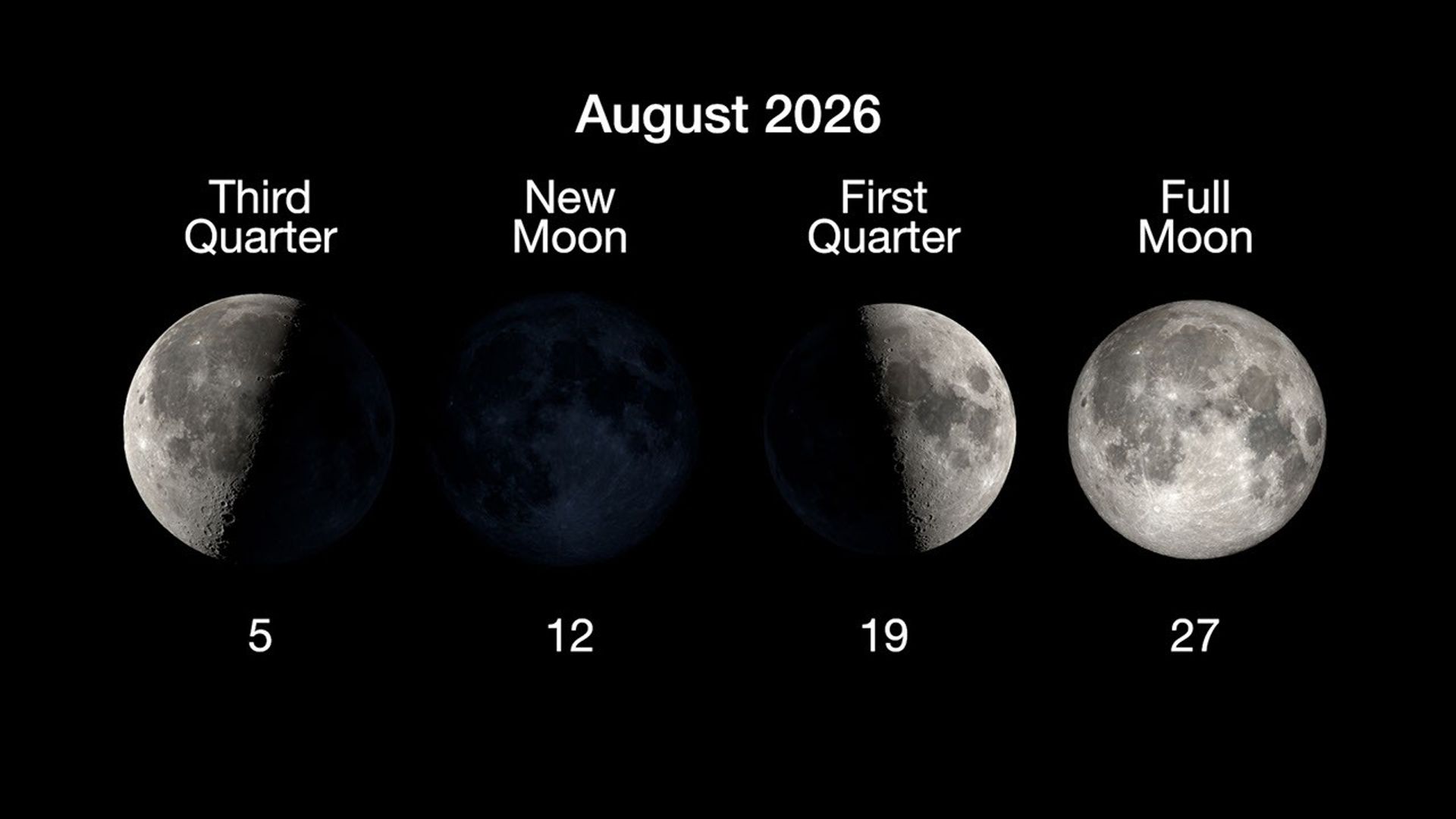
Aug. 5: Last Quarter Moon
Aug. 12: Total solar eclipse across northern Russia, Greenland, Iceland, northern Spain, and part of Portugal; partial eclipse in parts of the U.S.; New Moon
Aug. 12-13: Perseid meteor shower peak under dark skies
Aug. 14-16: Venus reaches greatest eastern elongation and shines low in the west after sunset
Aug. 27-28: Partial lunar eclipse visible from much of North and South America and parts of Europe and Africa
Transcript
A solar eclipse, one of the year’s best meteor showers, Venus at its brightest in the evening sky, and a lunar eclipse to close out the month.
That’s “What’s Up” for August.
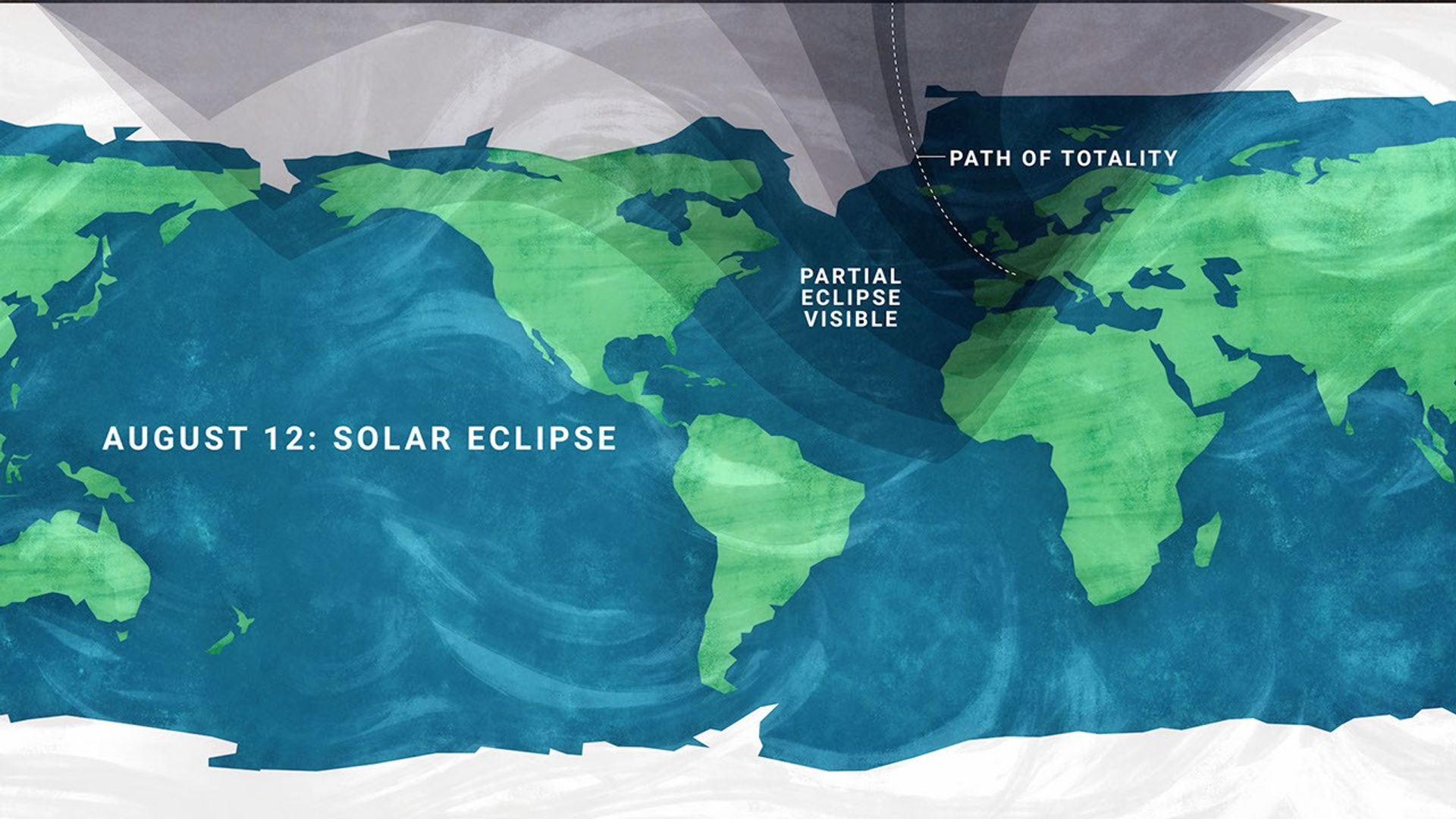
On Aug. 12, a total solar eclipse crosses northern Russia, Greenland, Iceland, and northern Spain, with a small corner of Portugal inside the path of totality.
In parts of the United States, from Alaska to North Carolina, the eclipse is partial. The Moon will take only a small bite out of the Sun, and the amount of coverage will vary with location.
A map showing viewing areas of the August 2026 total solar eclipse.
NASA/JPL-Caltech
Remember to watch safely. Use certified eclipse glasses or a safe solar viewer any time any part of the Sun is visible. Regular sunglasses are not safe. And never use binoculars, a telescope, or a camera without a solar filter made for the front of the optics.
Later that same night, the Perseid meteor shower will light up the sky, peaking the evening of Aug. 12 into the early morning hours of the 13th. And with a New Moon arriving on the 12th, the skies will be ideally dark.
The Perseids happen every year when Earth passes through a debris stream left behind by Comet Swift-Tuttle. As those tiny bits of comet dust hit our atmosphere at high speed, they burn up as bright streaks of light.
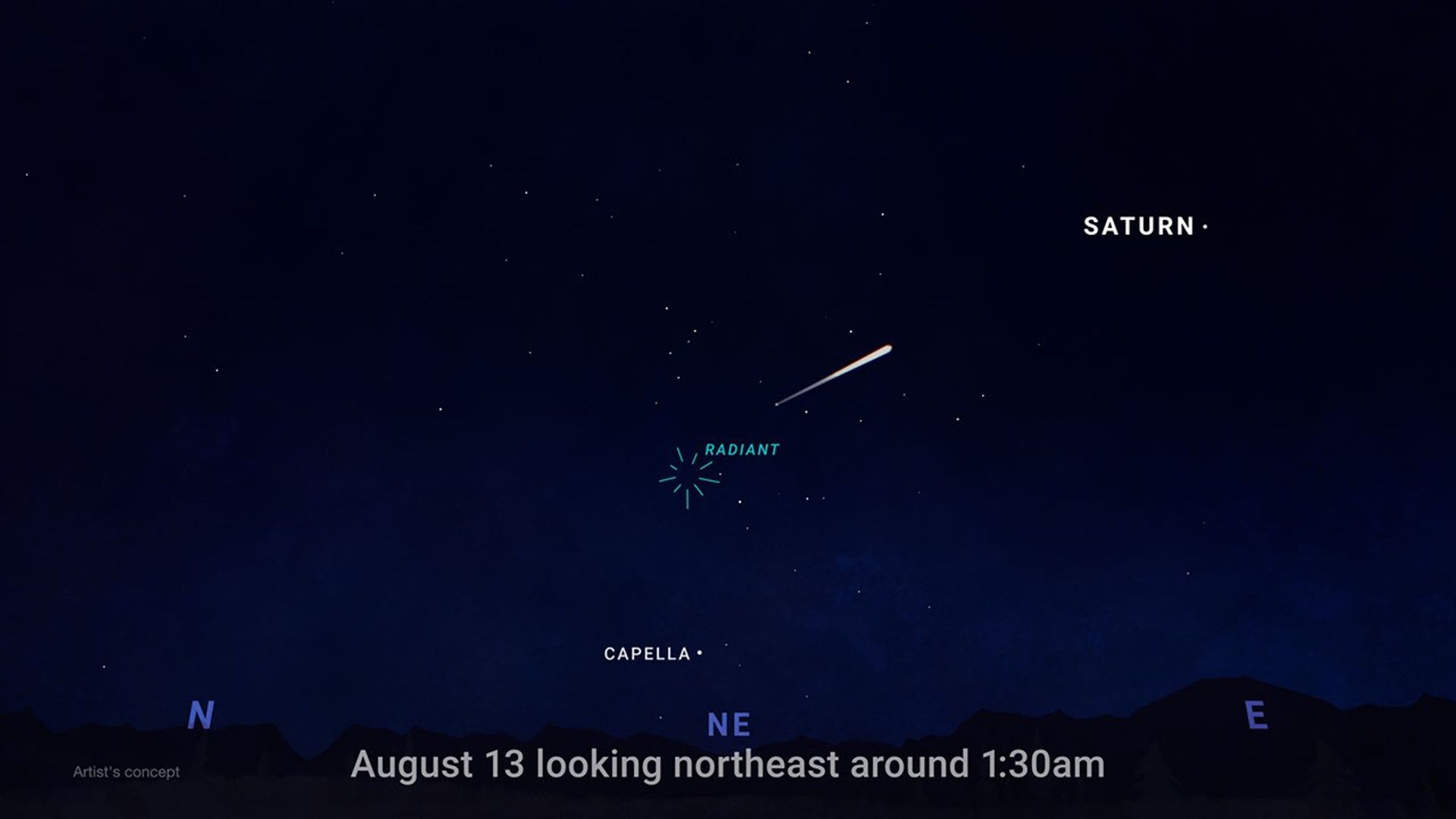
To view this meteor shower, look toward the northeast once it’s fully dark and watch for the constellation Perseus to clear the horizon. This is where the meteors originate, but let your eyes wander, because they can flash across any part of the sky.
For the best view, stay out late as the stars climb higher, find a dark open spot, and give your eyes 30 minutes to adjust.
This illustration shows where in the night sky to look for the Perseid meteor shower.
NASA/JPL-Caltech
Aug. 14-16, Venus reaches its greatest eastern elongation, which is its widest apparent separation from the Sun during this evening appearance.
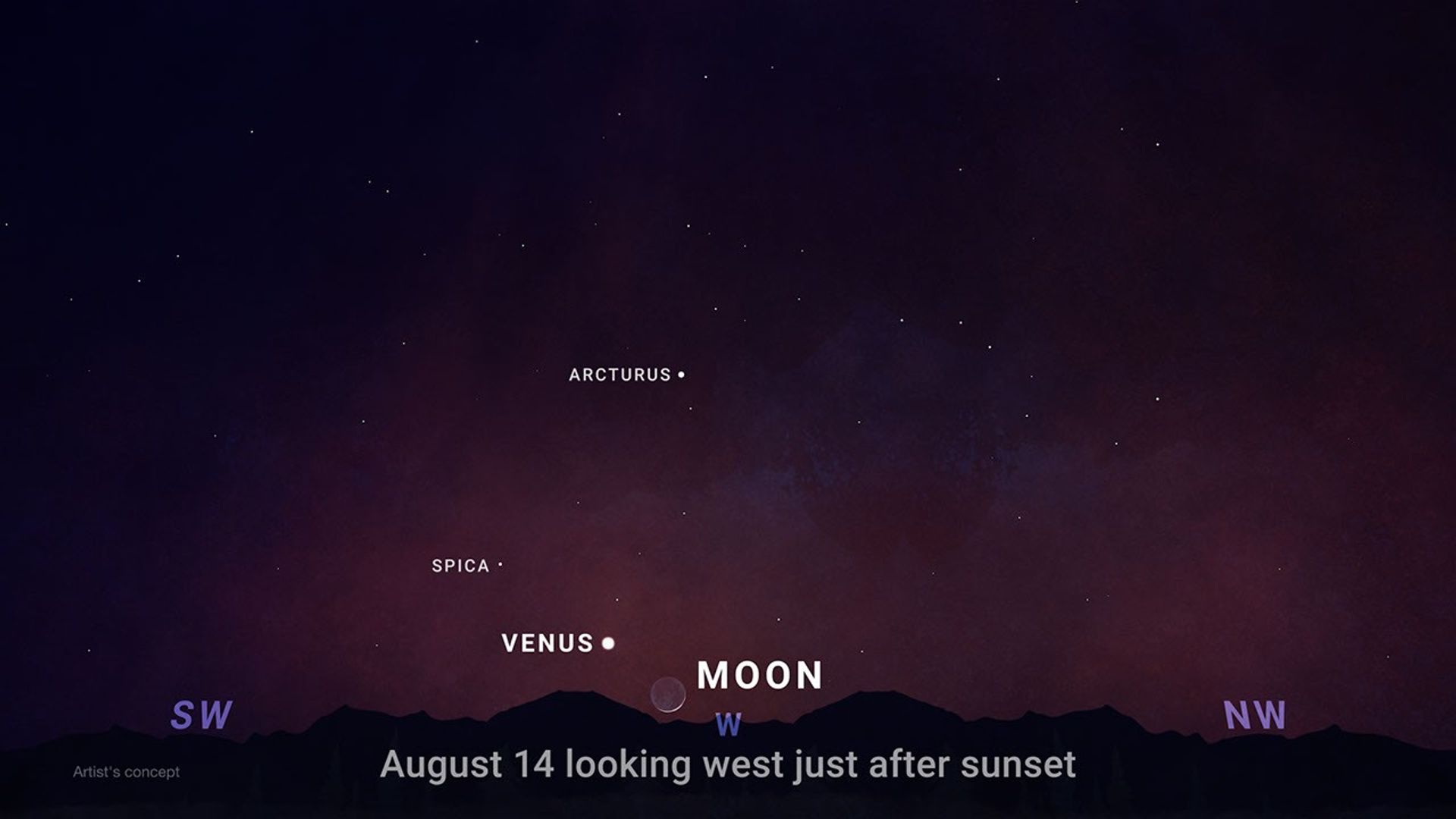
Look low in the western sky shortly after sunset for the bright object that will outshine every star around it. Through a telescope after sunset, Venus will look close to half lit, like a tiny lunar phase.
This illustration shows where to observe Venus after sunset in August.
NASA/JPL-Caltech
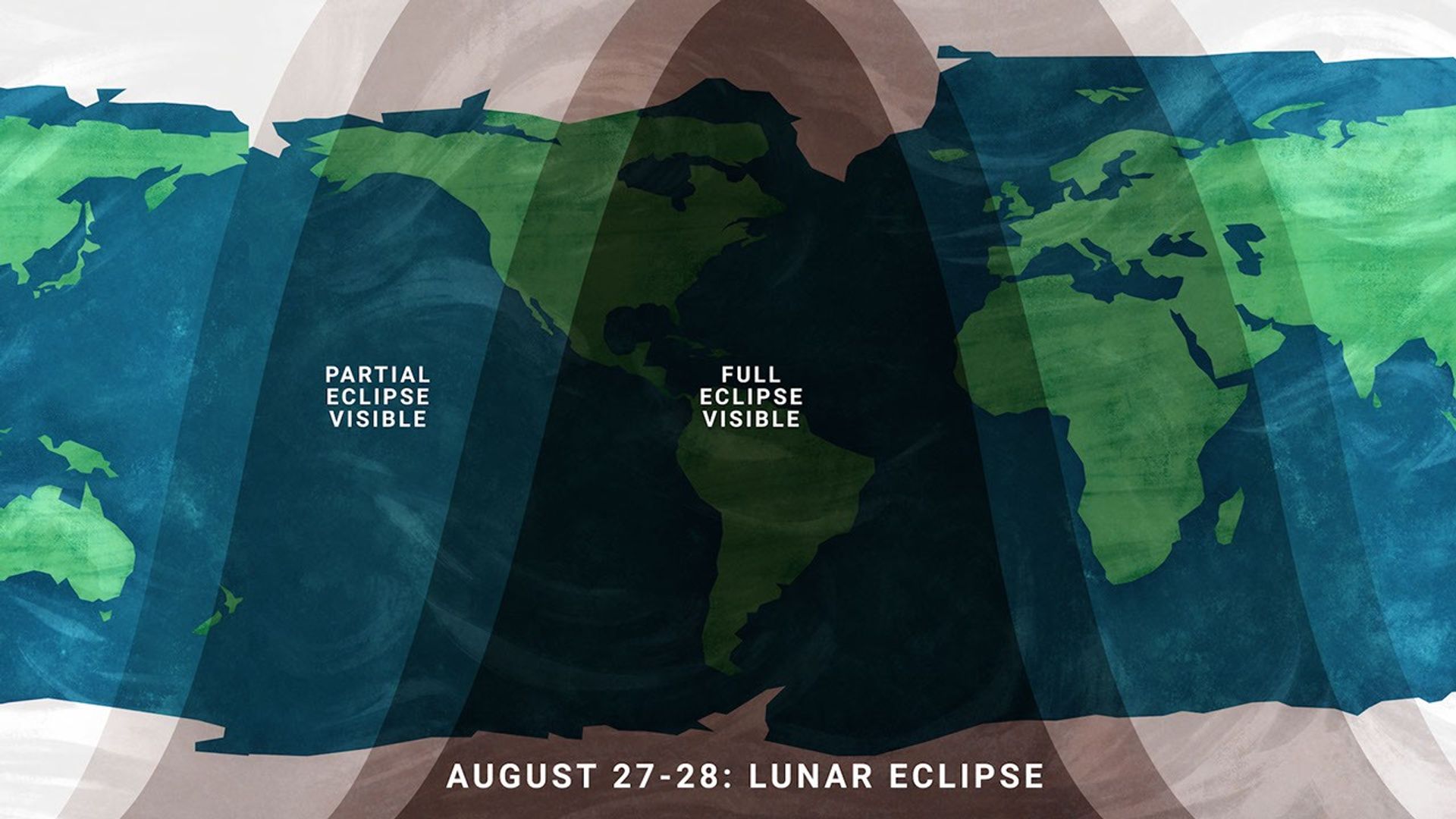
On the night of Aug. 27, continuing into Aug. 28 for some time zones, the Full Moon slips through Earth’s shadow, resulting in a partial lunar eclipse. It will be visible from much of North and South America and parts of Europe and Africa.
Viewing areas for the August 2026 lunar eclipse.
NASA/JPL-Caltech
At maximum eclipse, about 93% of the Moon’s diameter will be inside Earth’s dark central shadow, called the umbra. The Moon will not be completely covered, but it can look dramatically darkened, with a rusty, coppery tint along the covered edge.
Unlike a solar eclipse, a lunar eclipse is safe to watch with just your eyes. Binoculars or a small telescope can give you a closer view of Earth’s curved shadow moving across the Moon.
Here are the phases of the Moon for August.
NASA/JPL-Caltech
You can stay up to date on all of NASA’s missions exploring the solar system and beyond at science.nasa.gov. I’m Raquel Villanueva from NASA’s Jet Propulsion Laboratory, and that’s What’s Up for this month.
A solar eclipse, one of the year's best meteor showers, Venus at its brightest in the evening sky, and a partial lunar eclipse to close out the month.On Augu...

 Login