I'm paying more council tax than No 10 Downing Street – and have 540 asylum seekers camped next door, making homes unsellable. Is this your idea of levelling up, Andy? asks Madeleine Gillies.
Educators & Teens Get Hands-On With TEMPO Data to Help Investigate Local Air Quality
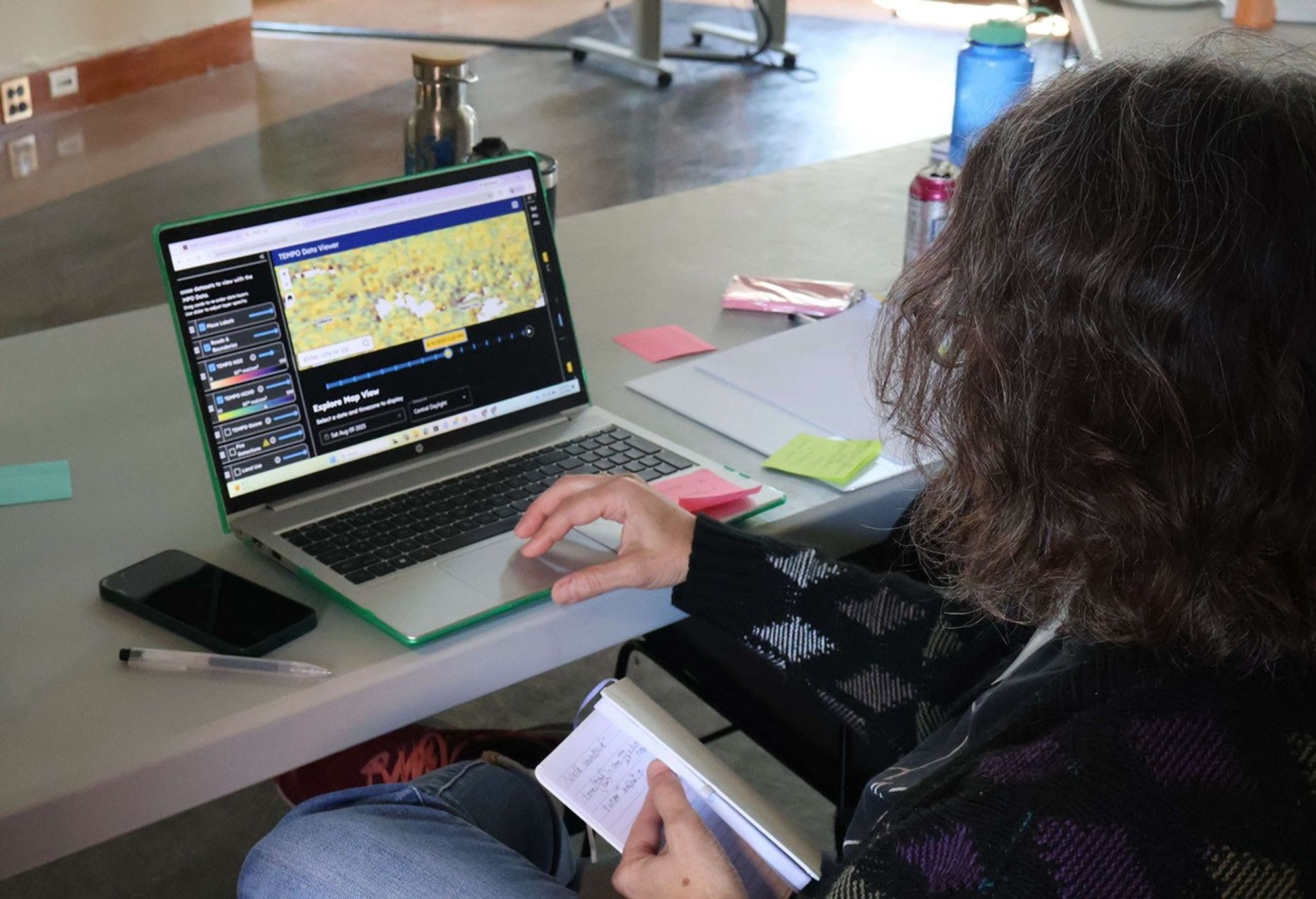
An educator explores NASA’s TEMPO mission data using the CosmicDS TEMPO-Lab viewer during a hands-on immersion session at the BEST AQI Leadership Institute.
Credit: Devika Elakara
The NASA Science Activation Program’s Cosmic Storytelling with NASA Data (CosmicDS) project, led by Harvard University in Cambridge, Massachusetts, works to bring authentic NASA data into the hands of educators and learners. From July 27–29, 2026, the CosmicDS team partnered with the Smithsonian Institution’s BEST AQI (Breathing Easier: Supporting Teen Air Quality Investigations) project to host a Leadership Institute at the Center for Astrophysics | Harvard & Smithsonian (CfA) in Cambridge, MA. The Institute brought together 13 formal and informal educators who serve as advisors to BEST AQI, an initiative that guides teens through their own air quality research to support actions that improve air quality in their communities.
On Day 1 of the Institute, the CosmicDS Science Principal Investigator Pat Udomprasert led a hands-on immersion session introducing educators to TEMPO-Lab, a free online tool built with NASA Science Activation Program funding. TEMPO-Lab lets learners explore and analyze near-real-time air quality measurements collected by NASA’s TEMPO (Tropospheric Emissions: Monitoring of Pollution) mission, which measures pollution across North America hourly during daylight hours. During Days 2 and 3 of the Institute, as educators worked together to co-develop BEST AQI curriculum and resources, they used TEMPO-Lab to build case studies covering a variety of real-world air quality scenarios, including wildfire smoke and emissions from rush-hour traffic, power plants, and agriculture. These case studies will give the teens in their programs a strong foundation for investigating air quality where they live and deciding what actions they might take in their own communities.
One moment made the workshop especially memorable. During a science briefing, TEMPO scientist Heesung Chong shared that a new beta-version ground-level ozone data product had recently become available. TEMPO-Lab’s flexible design made it possible for CosmicDS software developer and educator John Lewis to integrate the new data product into the tool overnight, letting workshop participants explore cutting-edge ozone data themselves the very next morning. It was a striking example of how CosmicDS’s data tools can match the pace of active NASA science, giving educators and their learners access to data almost as soon as scientists themselves do.
“The BEST AQI Leadership Institute reinforced the value of the TEMPO-Lab as a tool for empowering youth to investigate local air quality issues using authentic NASA data. Educators were excited not only by the scientific capabilities of the platform, but by its potential to help young people use evidence to make informed decisions and contribute to positive change in their communities.”
— Erika Wright, Education Specialist, Smithsonian Astrophysical Observatory (SAO), and BEST AQI Principal Investigator
Equipping educators with both the technical skills and the curriculum to bring NASA air quality data into their classrooms matters because it builds data literacy skills that teens can carry into any career, while also giving them the tools to investigate issues that affect their health and their own communities. Air quality is a subject teens can see, smell, and feel the effects of — and BEST AQI is designed to help them turn that lived experience into evidence-based understanding and, ultimately, action.
The CosmicDS team will continue supporting these efforts in the year ahead. The 13 educators who attended this Leadership Institute plan to share the BEST AQI toolkit and TEMPO-Lab with approximately 100 additional educators across their partner sites in South Dakota, Maryland, and New York, potentially extending this work to thousands of teen air quality researchers.
Cosmic DS is supported by NASA cooperative agreement award number 80NSSC21M0002 and is part of the NASA Science Activation Program portfolio, which connects learners with authentic NASA science experiences through partnerships with educators and community organizations.
This idea is so powerful—and so longed for—that it’s escaped containment among the Apple crowd. I’ve seen everything from Linux distro to phone updates referred to as Snow Leopard releases, when their vendors cite stability and bug fixes over new features. Likewise, people plead with their vendors for a Snow Leopard release when they feel quality has slipped.
People conflate a bunch of different ideas when talking about Snow Leopard:
Were there really zero no features? No, but there were fewer user-facing ones.
Was the initial release especially low in bugs? No, but it was better than Leopard’s.
Did it feel faster? Yes.
Was the final release especially low in bugs? Yes, it was fantastic.
Was it just because of the longer release cycle before Lion? No, they really did focus on quality for the initial release. And they didn’t add as much stuff mid-cycle as they did with Tiger and Leopard.
Snow Leopard’s stated goal internally was reducing bugs and increasing quality. That is a fact, not marketing. I am not sure why people on the internet don’t believe that, but I was there. If you wanted to ship a feature you had to get explicit approval from leadership and the bar was high. In normal feature releases it operated bottom up “here is what we are planning to ship” and in Snow Leopard it was top down “can we ship this?”.
AFAIK Snow Leopard was the first release of this kind (the first release I worked on was Jaguar or Puma), and was a direct response to taking 8 software updates to stabilize 10.5 and the severity of the bugs found during that cycle and the resulting bad press. Leopard was a HUGE feature release and with it came tons of (bad) bugs.
[…]
Testing was basically engineers, internal QA, some strategic partners like Adobe and MS, and the Apple Seed program (which was tiny). There was very little automated testing. Apple employees are not representative of the population and QA coverage is never very complete. And we sometimes held back features from seed releases when we were worried about leaks, so it wasn’t even the complete OS that was being tested.
Software updates are always needed, though the issues they fix became less severe over time due to larger seeds (aka betas), recovery partitions, and better / more modern development practices. But I can tell you FOR A FACT that Snow Leopard had fewer major bugs over its lifetime, coalesced very quickly, and was extremely solid when Lion was released.
I agree with you that Snow Leopard was billed as no USER VISIBLE features. But people did NOT just fix niggling bugs, it was an architecturally huge release. E.g., it introduced GCD. And unless I’m confusing the year, it rewrote the Mail backend to use it and mail hasn’t had reliable search since.
My memory is that quality was so low that we pushed back the release. With the extra time we did manage to fix enough bugs that it was well received. But internally it was more destabilizing than most releases due to the amount of architectural churn.
Yeah as someone else that worked on Snow Leopard I found this article and ones like it a bit silly. They’re a lot like the old “debug code” posts on Mac forums back in the day trying to explain why Puma was slow (no, you’ve got a G3 and an unaccelerated video card).
Tiger and Leopard were sprawling releases. Tiger covered 32-bit and 64-bit PowerPC, then 32-bit x86, then 64-bit x86 Macs. Tiger was also what I guess I’d say is the first “modern” OSX release, with subsystems like launchd and a more mature OpenDirectory replacing older NeXT subsystems.
Leopard in my experience was a train wreck. It shipped a lot of new features, both user facing and back end frameworks, but the development was seriously impacted from teams losing engineers to iOS. Leopard had features planned assuming 100% availability of SWE’s resources but ended up with 40-50% of SWE’s resources (made up numbers based on my feels at the time). Many new frameworks in Leopard did not land or get stable until very late in the development cycle which meant everything downstream had to scramble right before GM. It was 100% the case that Leopard was not really stable until 10.5.8 and still sucked IMHO.
There was a lot of clean-up needed in MacOS and that was Snow Leopard. It was not a perfect release but 10.6.3 (the second disc pressing IIRC) and onward were very stable. Dropping PowerPC support really helped focus QA since they didn’t need the massive array of test hardware Tiger and Leopard required. You also didn’t need to wrangle builds for four architectures, including multiple compilers as a few libraries (if not whole frameworks) were compiled with ICC on x86 for performance reasons.
The “Snow Leopard wasn’t that great” meme is weird. I’m sure it had its problems like every OSX release did. Unfortunately most OSX releases broke someone’s workflow. Snow Leopard ware no different. But it was always billed internally as a “no new features” release and those features that it did ship faced a very high bar to get in the release. I definitely look back on Snow Leopard as a high water mark for macOS quality in terms of a release.
If you weren’t there then you don’t know why I considered getting a “10.6.8” tattoo at one point. Boot Camp was no longer siloed, zero-drama Exchange support was baked in, Quicktime X hauled ass, and It was the definitive answer to the smoldering wreckage of Vista.
Snow Leopard has always remained the best Apple OS in my memory. For me Mail search was perfect all the time, once spotlight finished indexing it was incredible, iTunes, finder, everything just worked. The consistency was felt everywhere…
Explorer for Artemis Geology, Lunar, and Earth — a NASA satellite program to study surface biology and geology on Earth, with technologies that could support future missions to the Moon and Mars.
Future Mission
NASA’s EAGLE program — Explorer for Artemis Geology, Lunar, and Earth — will be a series of satellite missions studying surface properties using technologies for Earth observation that will also benefit future missions to the Moon and Mars, where they could identify critical resources and safe landing sites.
The satellites making up the first two EAGLE missions will study biology and geology on Earth’s surface to support agriculture, disaster response, and other needs. Each mission will carry a different instrument with capabilities that complement each other. The first mission (EAGLE-VSWIR) is scheduled to take flight in 2028.
Mission Type
Orbiter
Target
Earth, Moon, Mars
Launch
No earlier than 2028
Objective
Study surface composition and changes
EAGLE-VSWIR
EAGLE-VSWIR (Visible to Shortwave Infrared) will observe the Earth’s surface every 16 days with a high-resolution imaging spectrometer, which measures light reflected from the planet’s surface, separating wavelengths across the visual and into the infrared spectrum. The patterns created by light being reflected or absorbed across this spectral range act like fingerprints, letting scientists identify the composition of the surface.
A similar instrument, NASA’s EMIT (Earth Surface Mineral Dust Source Investigation), has been monitoring Earth from the International Space Station since July 2022, characterizing the surface mineral composition of Earth’s arid lands, monitoring ecosystem status, and tracking health and safety hazards — such as methane leaks and acid mine drainage — among other applications.
EAGLE-VSWIR will have 25 times more capability than EMIT has today. This technological leap will allow scientists to map surface deposits of critical and rare-earth minerals, strengthen food security, and aid wildfire prevention and recovery. It can also highlight environmental hazards such as oil spills or landslide risks, and monitor water quality and availability.
The front of this image cube shows a region in Nevada observed by NASA’s EMIT imaging spectrometer; the cube’s sides show the spectral fingerprint for every point in the image and can be used to discover mineral resources. EAGLE-VSWIR will have 25 times greater performance beyond NASA’s current state-of-the-art EMIT.
NASA/JPL-Caltech
EAGLE-TIR
The EAGLE-TIR mission will provide Thermal InfraRed (TIR) imagery when it launches two to three years after EAGLE-VSWIR, measuring energy emitted from the surface and producing data that scientists can use to map temperature, composition, and critical mineral deposits. On Earth that would let researchers monitor wildfires and volcanic activity, track drought and water use by crops, study urban heat islands, observe the rates that snow or ice accumulates or melts, and better understand Earth’s resilient ecosystems.
EAGLE-TIR follows on from ECOSTRESS (ECOsystem Spaceborne Thermal Radiometer Experiment on Space Station), which has been observing Earth from the International Space Station since 2018. ECOSTRESS was designed to study how different ecosystems respond to drought and water stress, and the data has provided a vital understanding of how plants’ water use changes throughout the day. Since ECOSTRESS also measures emitted energy in the thermal infrared, its surface-temperature products have also been used for urban planning and wildfire monitoring.
Further innovation and lessons learned from ECOSTRESS has led to EAGLE-TIR, which will carry a multi-band thermal radiometer. EAGLE-TIR’s great strength compared to existing missions is that it provides detailed imagery of the entire globe every two days, day and night, at multiple wavelengths not available from other instruments.
This image shows the minerals contained in Namibian dunes using ECOSTRESS data. EAGLE-TIR will have more spectral channels to enable even better mineral discrimination.
NASA/JPL-Caltech
EAGLE Program
By advancing vital techniques for measuring our planet’s surface composition, resources, and hazards, the EAGLE program addresses critical needs in Earth observation, with technologies that can also transfer to planetary exploration, where they’ll serve as pathfinders for future missions to the Moon and Mars.
As the Artemis II crew came close to passing behind the Moon and experiencing a planned loss of signal, they captured this image of a crescent Earth setting on the Moon’s limb on April 6, 2026.
NASA
Featured Video
EAGLE
NASA unveiled the EAGLE program as one part of its “Ignition” event on March 24, 2026, when it announced a wide-ranging series of transformative agencywide initiatives. With EAGLE (the Explorer for Artemis Geology, Lunar, and Earth missions), NASA will deploy breakthrough hyperspectral images across Earth with later missions anticipated for the Moon and Mars in rapid succession. On Earth they’ll identify critical minerals for national security, enable precision agriculture, and support disaster response. On Earth and at Mars they will locate critical minerals and resources such as ice for propellants, rare-earth elements for technology, and construction materials for habitats.
EMIT
EMIT (Earth Surface Mineral Dust Source Investigation) measures the mineral composition of Earth’s dust source regions, to help scientists understand how they heat or cool our planet.
Join us for continuing coverage as our leaders discuss the agency's implementation of the National Space Policy and our plans to advance science and discover...
[… Apple] decides to do a big feature. The circus comes to town, they build the feature, they launch it, they leave town, and that feature sits there.
And the problem is, there’s bugs, things are broken, and in Year Two, you’re like, “You’re going to fix all the things that were broken in the thing you shipped last year, right?” And in the last decade, I would say, a lot of times what happens is they just don’t. And if you’re lucky, they’ll fix it Year Three or Year Four, […] give it a polish.
The thing that troubles me most about Apple software quality in general is the feeling like they don’t have the people to own the thing that they launch. They build the thing that they launch, and then those people go off and do something else, and nobody is maintaining and improving the thing that’s there.
I think this is spot on, and said really well. Are you honest with yourself about resourcing and focus for right after the launch and then later on? Have you really thought about worst case and best case scenarios vis-à-vis bug reports, latency, user feedback, and craft/quality however you define it? Have you actually started to make room for those outcomes ahead of time?
For me, an ongoing tension with Apple is Finder, so central to my (and I imagine many people’s?) use of a Mac, but rewritten at some point eons ago in a new framework that caused all sorts of problems, and then pretty much abandoned like a proverbial American city’s downtown.
Revealing files in the Finder and Mail’s table view sort indicators have been broken for me since Big Sur. Disk Utility still doesn’t work as well as before its El Capitan rewrite. But these aren’t even big new features.
The issue really, that Jason pins down, is that it’s so easy to use incremental development, agile development, sprints, whatever, as a method to do the wrong thing. If you have a year-long schedule, it is easier to say “I will take care of the Finder”, and within the scope of that is a number of features that need be built, but there’s also room for ongoing maintenance. Within the confines of sprint planning, within a culture that sheepishly focuses on the wrong thing, or is obsessed by following the wrong number, or worries about the internal politics of appearing to not have it together, all of a sudden the same work, scheduled into 3 week long sprints, looks like poison.
I know of plenty of organizations that make this work. That have the maturity and discipline and culture to see bugs and defects for what they are, to allocate plenty of time to them and to focus extra time on them with regular intervals.
Apple at WWDC 2026 today said it has made several responsiveness improvements across its software ecosystem, speeding up system animations, app launching, and much more.
Although there’s no obvious connection between the Tahoe and Golden Gate names to indicate a “tock” release, Apple devoted the first chunk of the WWDC keynote to how OS 27 will address user and developer complaints about OS 26.
[…]
Apple also made a big deal about performance improvements, smoothing system animations, launching iPhone and iPad apps up to 30% faster, displaying new photos in the Photo Library up to 70% faster, transferring files via AirDrop up to 80% faster, and moving files from an iPad to an external drive is up to 5x faster, so it compares with macOS transfer speeds. A new CPU Scheduler promises to improve iPhone performance even on older models back to the iPhone 11, which may encourage more people with older iPhones to upgrade.
I’m way more interested in bug fixes, but optimizations and refinements are great, too. Simply limiting the number of new features creates space to improve the software quality, though, it’s not clear to me whether there are really fewer new features or if it’s just that they mostly fall under the single heading of AI.
Something I’ve noticed about performance work is that people really want there to be A Cause for improvements. A new technology, something old no longer holding things back, “removing the debug logging”, etc…
The truth of the matter is that 97% of the time the enabling thing for performance work is engineers having time in the schedule to sit down with the tools (usually a sampling profiler) and grind out small wins over and over.
There’s no magic bullet that replaces good engineering.
It sounds like the magic bullet is a reasonable release schedule. You’ve always had the power, my dear Craig. You just had to learn it for yourself.
The moment the keynote used the phrases “sweating the details” and “attention to detail,” it was clear that beyond AI and Siri features, this year is about small fixes and improvements. In more private settings, Apple folks specifically referenced Snow Leopard and iOS 12, two updates that saw Apple take a pause from huge feature roll-outs and prioritize speed and bug fixes a bit more.
But to be clear, referencing Snow Leopard does not mean “no new features.” Like Apple’s 27 releases, Snow Leopard was full of dozens, if not hundreds, of new features—they were just scattered small improvements throughout the system.
The older I get and the longer I do this development work I realize time is short and we may not get to all the things we want to do in life. So when we are forced to wait yet another year for some fixes to a framework we’ve been trying to use for several yearly cycles already it can be disappointing to say the least.
[…]
Unlike past years there is no clear Apple mandated work. Thank god. I can focus on what I want to build without having to adopt my code to an ill conceived UI update that will be semi-discarded the following year.
New NASA Earth Missions Gear Up to Start Science Flights
Satellite imagery captured wildfires burning hot enough to generate pyrocumulonimbus clouds north of Lake Superior in July 2026. NASA aircraft will help scientists study the powerful storms as they develop.
Credits: CSU/CIRA & NOAA
Landslides in Alaska. Air quality in Atlanta. Fire clouds out West. From the Arctic fringes to farm country, NASA’s newest class of suborbital Earth Venture missions is gearing up to deliver science that will benefit communities in the United States and beyond.
The six projects will mobilize hundreds of scientists and pilots from NASA, the U.S. Navy, universities, and other institutions over the next several years. While the investigations range across topics, a defining feature of suborbital missions is the use of sensors mounted on aircraft.
Airborne remote sensing serves as a bridge between ground-based instruments and satellites. Data collected via planes, helicopters, drones, and balloons can fill in gaps in computer models used by weather forecasters, city planners, and others.
When wildfires create their own weather
The first project to take wing this summer is Injected Smoke and PYRocumulonimbus Experiment (INSPYRE), led by the Naval Research Laboratory. From mission headquarters in Colorado, the team will chase one of the least understood forms of severe weather on Earth: towering “fire clouds” generated when extreme wildfires burn hot enough to brew their own thunderstorms.
Pyrocumulonimbus clouds crackle with lighting in imagery captured over Utah and Colorado by the GOES-18 satellite in early July 2026.
CSU/CIRA & NOAA
Smoky and crackling with lightning, these unique storms can create blind spots for aviators above and spark new blazes below. Measuring and mapping the dangerous storms as they develop in real-time will help scientists forecast them in the future. Several aircraft, including NASA’s high-altitude ER-2, flying out of Montana, will carry a large suite of instruments over wildfire-generated storm systems. Among them will be two state-of-the-art infrared wildfire trackers, which were developed at NASA’s Jet Propulsion Laboratory (JPL) in Southern California and will be flying as part of the agency’s FireSense program.
Testing the air over farmland, megacities
Agricultural emissions represent an important and understudied part of Earth’s land and atmosphere systems. The FarmFlux mission, which kicks off this year, will deploy more than a dozen sensors to measure ozone, methane, ammonia, particulates, and other pollutants rising from agricultural lands and animal farms stretching from the Midwest to California’s Central Valley. These emissions affect human health, global climate, and stratospheric ozone. The mission is led by NASA’s Goddard Space Flight Center in Greenbelt, Maryland, along with Colorado State University, and Boston University.
NASA’s 777 aircraft is gearing up to start science flights. Structural modifications – like enlarged cabin windows and instrument portals – have transformed the former passenger plane into a flying laboratory. It’s seen here at Langley Research Center in Hampton, Virginia, in April 2026.
NASA/Ryan Hill
Two North American cities with air quality concerns are Atlanta and Mexico City. But the causes differ, with weather and terrain playing a role. To explore these differences, the Hemispheric Airborne Measurements of Air Quality (HAMAQ) mission will investigate areas of poor air in the two capitals and test how satellite information can help forecasting and mitigation efforts. The team will deploy two aircraft at different altitudes: NASA’s P-3B will fly close to the surface, directly measuring fine particle and gaseous pollutants, while the recently acquired 777 science jet will soar high above, mapping pollution with remote sensors. NASA’s Langley Research Center in Hampton, Virginia, is leading the mission.
Fast-changing north
As the Arctic warms at least twice as fast as the rest of Earth, data collected today can help guide communities on the front lines of change.
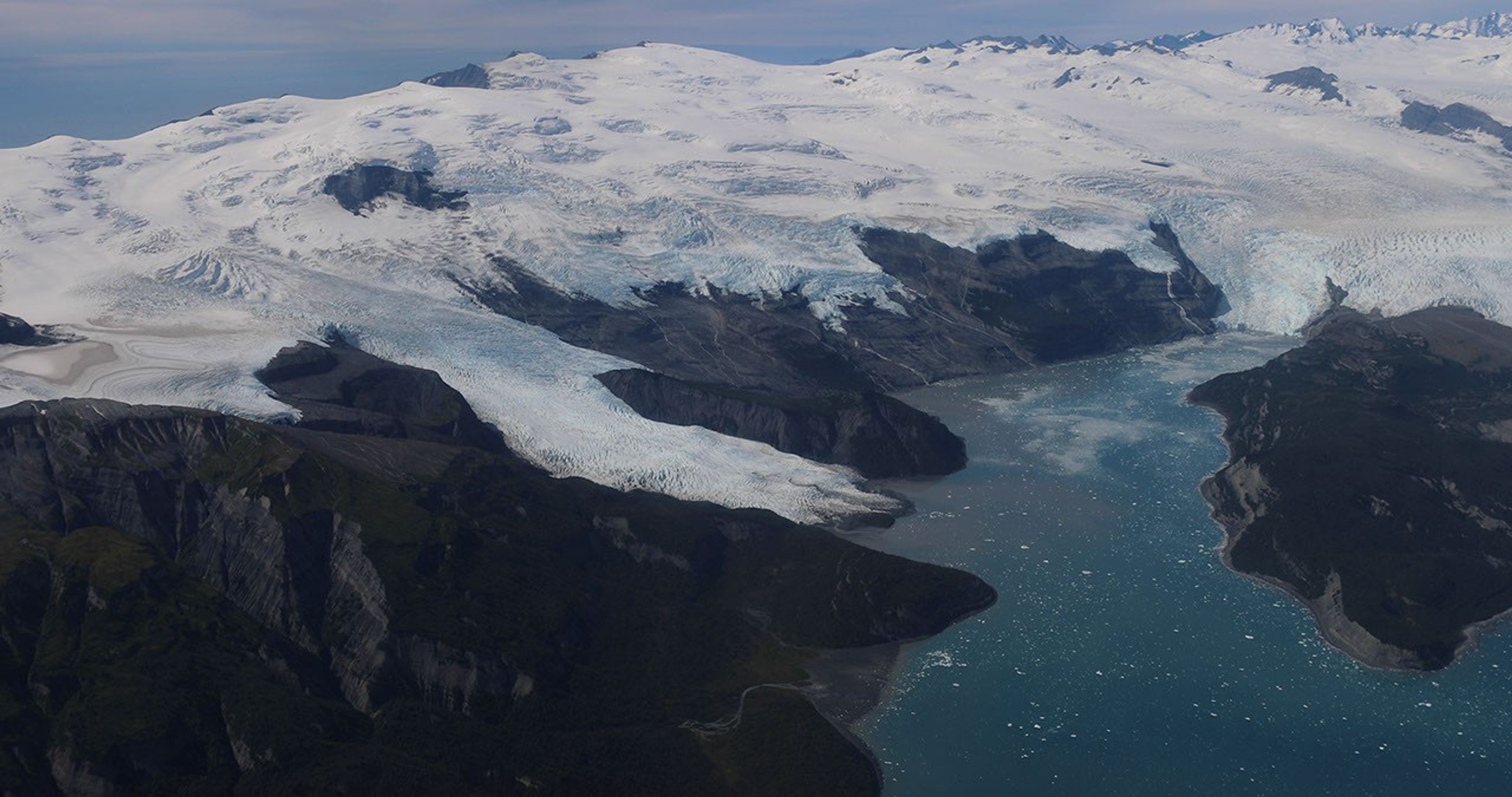
Alaska’s glaciers are losing ice and contributing to sea level rise. NASA is tracking the changes from land, air, and space.
NASA
The Snow4Flow campaign, led by the University of Arizona, seeks to measure and model how far and fast glaciers are retreating in the far north. Traversing remote icescapes across Alaska, the Yukon, Arctic Canada, Greenland, and Svalbard, Norway, they’ll sound both the near-surface and frozen depths of hundreds of glaciers while flying over in a modernized WWII-era aircraft outfitted with a scanning laser altimeter and two custom radars. Their observations, combined with satellite data and advanced models of snowfall and glacier flow, will advance our understanding of how glaciers behave in different regions of the Arctic. The mission seeks to uncover not just what these glaciers look like beneath the surface today, but the processes that will drive changes in the future.
As permafrost thaws, rivers on the doorstep of the Arctic become conveyor belts of carbon and sediment. NASA Goddard, and the City College of New York lead a multidisciplinary team studying how rivers, lagoons, and estuaries across Alaska’s North Slope interact with the Arctic Ocean. The project, called Frontlines of Rapidly Transforming Ecosystems (FORTE) will combine optical and radar measurements from satellites, planes, high-tech research vessels, drones, and underwater autonomous systems to track microscopic marine life, water flow, and chemistry. The team will collaborate with local and tribal communities to sustain observations over time and apply NASA assets to address emerging local needs and decision-making priorities.
Landslide triggers
When a slow-moving landslide in California suddenly collapsed and buried a section of coastal highway in 2017, scientists at NASA JPL wanted to know how precipitation swings played a role. JPL studies how water infiltrates and destabilizes hillslopes all over the world. The Landslide Change Characterization Experiment (LACCE) project will combine airborne synthetic aperture radar with land-based sensors to track how slopes in California are responding to a world of intensifying droughts and downpours. The project also takes aim at emerging landslide hazards in Alaska, where rapidly retreating glaciers are accelerating slope movements that have the potential to create mega-tsunamis.
This series of images shows the collapse of the Mud Creek landslide in May 2017 along the Big Sur coast in Central California, and the subsequent repairs to Highway 1, which was damaged during the event.
Andy Ritchie/USGS Pacific Coastal and Marine Science Center
NASA’s Earth Venture Suborbital program, designed to be nimble and high impact, was established following a recommendation by the National Research Council in 2007. In the decades since, teams have studied phenomena, including blizzards, coral reefs, and ocean whirlpools.
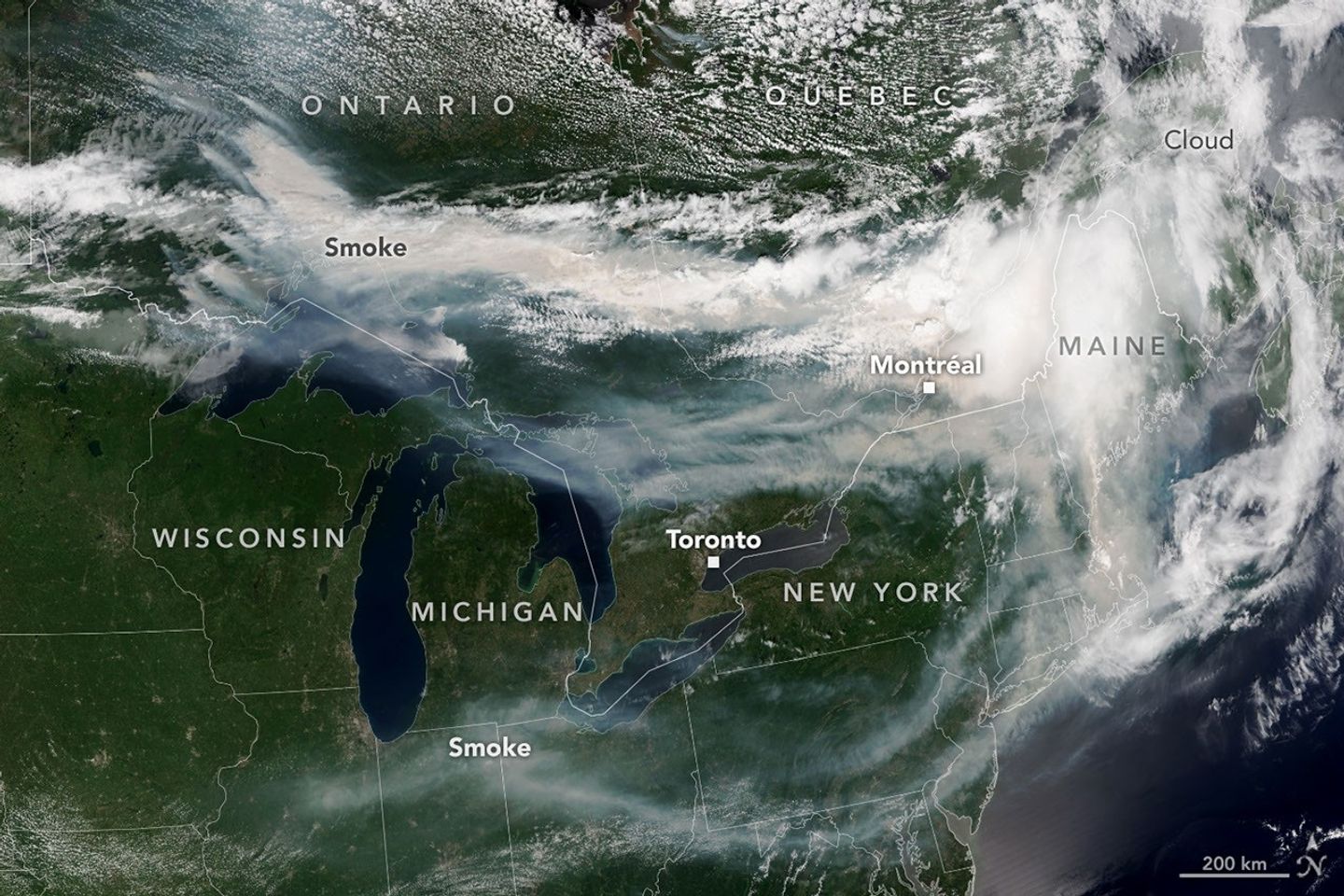
Smoke from wildland fires pours eastward over Canada and the U.S. in an image captured on the afternoon of July 14, 2026, by the VIIRS (Visible Infrared Imaging Radiometer Suite) on the NOAA-21 satellite.
NASA Earth Observatory/Lauren Dauphin
After a slow start to Canada’s 2026 fire season, activity picked up by the end of June amid dry, warm conditions and returned closer to the 25-year average. By mid-July, almost 850 fires were actively burning across the country, according to the Canadian Interagency Forest Fire Centre. More than 180 of those were burning in Ontario.
This NOAA-21 image, acquired on the afternoon of July 14, 2026, shows smoke billowing from the Ontario fires. Winds carried the smoke primarily southeast over much of the southern part of the province, as well as parts of Quebec and the U.S. Midwest and Northeast, tinting the sky shades of gray and yellow and the Sun orange in many areas.
The smoke’s impact on air quality varied, depending largely on altitude. In areas where smoke was high in the atmosphere, air quality impacts were negligible; where it drifted closer to the ground, conditions worsened. Air quality in Toronto, for instance, reached unhealthy levels, according to AirNow. People in the southern parts of the province were also grappling with a heat wave, compounding the health risks.
Much of the smoke came from fires in Northwestern Ontario, where eight blazes saw significant growth on July 13 and 14. The fires prompted officials to issue evacuation orders for several communities in this part of the province, according to news reports.
As of July 14, fires across Canada have burned 1.9 million hectares (4.7 million acres) since the start of the year—still well below the season totals from the extreme fire years of 2023 and 2025. How the rest of the season plays out remains to be seen. A seasonal fire outlook—compiled by wildland fire experts from the U.S., Canada, and Mexico—shows where fire conditions are more or less likely through July, August, and September.
NASA Earth Observatory image by Lauren Dauphin, using VIIRS data from NASA EOSDIS LANCE , GIBS/Worldview , and the Joint Polar Satellite System (JPSS). Story by Kathryn Hansen.
Downloads
July 14, 2026
JPEG (3.96 MB)
References & Resources
AirNow (2026, July 15) Wildfires. Accessed July 15, 2026.
Aldi has announced a new range of mini cooling fans
There's a tripod fan, a multi-directional globe fan, and an evaporative cooler
They'll be available in the middle aisle from July 2, starting at £6.99
Aldi, famed for its bargain home gadgets, has just announced a new set of budget-friendly cooling fans to help you stay cool without burning a hole in your wallet. The set of three fans will be available in the middle aisle of Aldi stores from July 2, so although they won't be able to stop you sweating during the current heatwave, you can make sure you're prepared the next time the temperature soars.
For me, the most interesting fan in the collection is the £6.99 Fan with Flexible Tripod. Not only is this the cheapest option, it's also the most flexible — literally. Its Joby GorillaPod-style legs bend and grip, so you can position it just right on your desk, wrap it around the handlebar of a pushchair, or attach it to a treadmill at the gym.
(Image credit: Aldi)
Another intriguing option is the Portable Air Cooler with LED (£14.99), which lowers the temperature in your room using water and ice evaporative technology. Water absorbs quite a lot of heat when it evaporates, which has a significant cooling effect, which makes this kind of device (also charmingly known as a 'swamp cooler') an effective way to keep your cool without raising your electricity bill.
Finally, we have the Globe Fan with Multi Direction (£39.99), which looks more like a typical desk fan, but has an unusual "360-degree auto-rotating" head that pans all the way around your room. It comes with a remote control, and has three modes: Natural Wind, Drying (for laundry), and Sleep.
If you can't wait until next week and are willing to splash some more cash for quicker relief, we've rounding up all the best Amazon Prime Day deals on heatwave essentials including fans, portable air conditioners, and ice cream makers.
I tested a mess-free smart misting fan with powerful yet quiet performance and a budget-friendly price — here’s why it’s a must-have device for the summer.

 Login