Earth itself may be one of the world’s largest detectors for ultralight dark matter. Earth may already contain one of the largest dark matter experiments ever built. Instead of relying only on specialized equipment inside a laboratory, scientists have found a way to use the planet’s magnetic field, atmosphere, and surface as parts of a [...]
Scientists in China predict that stacking two microscopic layers of boron could set a new record for superconductivity. Superconductors are materials that conduct electricity with zero resistance. Traditional types need temperatures close to absolute zero to work, requiring complex and expensive cooling equipment.
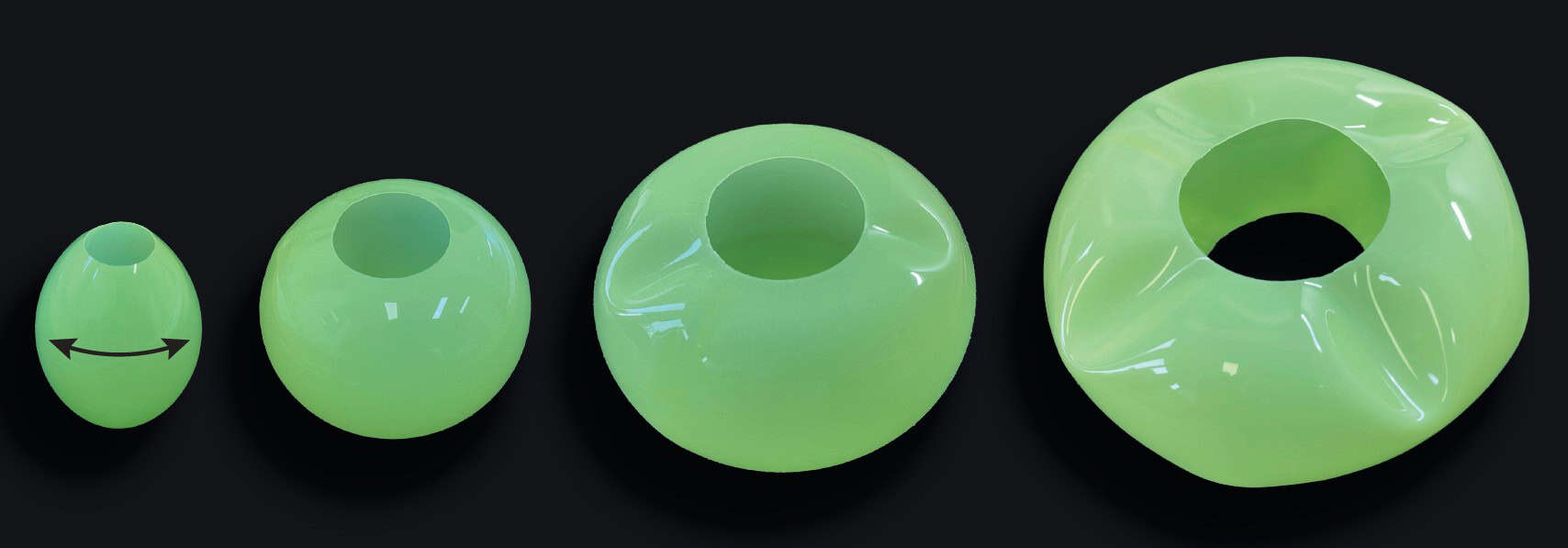
More dimples A series of hollow objects made from elastic sheets. The size of the objects increases in the directions indicated by the arrows. The number of buckles in the object is seen to increase as its shape changes. (Courtesy: Yafei Zhang)
A new mechanism governing the geometric shapes of growing elastic sheets has been identified by a trio of physicists in Israel. Through a combination of simulations and experiments, Eran Sharon and colleagues at the Hebrew University of Jerusalem showed that the dimpled patterns that form in a growing elastic object have topological origins.
This mechanism is unrelated to geometric incompatibilities, which are known to dimple natural materials. The discovery could lead to a deeper understanding of how complex shapes emerge in the natural world – and to the development of new artificial materials.
Thin sheets are ubiquitous in nature: examples include leaves, petals, and the cellular linings of organs and blood vessels. The complex makeup of natural sheets means that local regions within them have preferred mechanical rest states that are incompatible with those of other regions. As a result, there is no way to arrange the sheet so that every part is simultaneously stress free – leading to effects like wrinkling, bending, and buckling.
Called geometric incompatibility, this phenomenon is responsible for numerous geometric forms in the natural world, enabling growing tissues to shape themselves without any external influence. For some time, researchers have attempted to mimic these natural mechanisms in synthetic materials.
Richness of shapes
“Looking at natural growth processes, as in plants growth, or embryo development, we see amazing richness of shapes and shape development that currently cannot be achieved with conventional fabrication methods,” says Sharon.
Sharon’s group has already shown that many patterns in nature can be understood in terms of the Gauss and Mainardi-Codazzi-Peterson incompatibilities – which were developed in the 19th century. Together with team member Michael Moshe, whose group explores the interplay between mechanics and geometry in soft materials, their work led to discoveries including the mechanical origins of shape selection in rose petals.
Now, Moshe and Sharon have teamed-up with Yafei Zhang to identify a phenomenon that cannot be explained by those mechanical instabilities. In their experiment, they started with a uniform elastic sheet formed into a hollow sphere, with circular holes at each pole. When they added wedges of material into the sheet to mimic growth, it initially behaved like a smooth, growing sphere – but only up to a certain point.
Missing mechanism
“The growing sheet satisfies the established local compatibility conditions, and is thus expected to show smooth ‘boring’ shape,” Moshe explains. “Yet it unexpectedly, develops a crumpled appearance, suggesting that an important shaping mechanism was missing from the existing framework.”
Important clues came when the team cut into the crumpled sphere along a meridian, from pole to pole. Instantly, the crumpling disappeared, and the sphere relaxed back to its original smooth shape. This effect also occurs in simulations of a smoothly growing sphere.
With no changes to the Gauss or Mainardi-Codazzi-Peterson incompatibilities governing the mechanical forces in the sheet, the trio concluded that the sudden transformation emerged from an entirely different mechanism, rooted in the mathematical principles of topology. In this view, unlike smooth geometric transformations such as bending, stretching, or twisting, which preserve a shape’s mechanical properties, cutting introduces a sudden transformation that changes its mechanical behaviour.
In this way, the meridional cut brought the sphere into a new topological state. “Unlike conventional incompatibility, this frustration is topological in character, and can be quantified by a global measure,” Moshe explains. “It provides a new mechanism by which growing sheets can select complex, wrinkled or dimpled shapes.”
The trio’s discovery now raises new mathematical questions about the limits of growing elastic sheets, beyond which their smooth geometries can no longer be maintained. “What we have discovered that the geometrical principles we knew before should be supplemented with topological considerations, leading to an even wider class of shaping principles,” Sharon says. “This allows a better understanding of morphogenetic processes and expands our abilities to shape synthetic structures.”
In turn, the team’s insights could uncover new understanding of how shaping mechanisms could be harnessed, perhaps leading to the discovery of new metamaterials, with shapes and mechanical functions programmed into their growth.
Ruthenium dioxide (RuO2) is a metal oxide that commonly serves as an important metallic conductor, quantum material and industrial electrocatalyst. While there have been debates surrounding the magnetic properties of RuO2, it is generally thought to be nonmagnetic in its bulk form. But now, a new study, published in Science Advances, has found that very thin layers of RuO2 can become magnetic when its lattice is placed under strain.
A dupla abordou ainda seu método de direção, destacando que incentivaram os atores a atuarem como se o título se tratasse de um drama, mesmo sendo uma comédia.
Na sequência, um clipe exclusivo foi exibido para a plateia (e a plataforma brinca com a impossibilidade de exibir o trecho na íntegra, mostrando apenas um retrato da dupla), com Daley e Goldstein comentando o uso de efeitos práticos para as cenas do longa-metragem.
“Mayday” retrata uma dupla composta de um piloto da Marinha dos Estados Unidos e um ex-agente da KGB, que embarcam em uma improvável jornada de fuga que mistura ação, espionagem e humor. O filme chegará no dia 4 de setembro ao Apple TV.
Os realizadores comentaram a história da nova temporada, incluindo o seu tema central (a manipulação e o controle de memórias como ferramenta de sobrevivência e poder), além da dinâmica dos personagens.
O elenco discutiu sua experiência no set ao dirigir veículos esportivos reais para gravações de cenas de ação, destacando ainda a dinâmica de amizade dos personagens e as locações ao redor do mundo, que incluíram países como Budapeste, Marrocos e Eslováquia.
A narrativa se centra em um grupo de amigos de infância que têm suas vidas viradas ao avesso quando um agente secreto da CIA, Sean (interpretado por Cena), volta à sua cidade natal e envolve os companheiros em uma aventura mirabolante para salvar o mundo.
O elenco discutiu os desafios de interpretar várias versões dos seus personagens, e Crouch mencionou aquilo que os fãs podem esperar da nova temporada.
Embora uma terceira temporada ainda não tenha sido confirmada, Braga brincou com a possibilidade de futuros episódios se passarem no Brasil.
Os realizadores discutiram a evolução da produção, a aclamação dela junto à crítica especializada e os desafios relativos à complexidade da narrativa e da mistura dos gêneros de comédia e horror.
O Apple TV está disponível no aplicativo Apple TV em mais de 100 países e regiões, seja em iPhones, iPads, Apple TVs, Macs, dispositivos Android, smart TVs ou online — além de também estar em aparelhos como Roku, Amazon Fire TV, Chromecast com Google TV, consoles PlayStation e Xbox. O serviço custa R$29,90 por mês, com um período de teste gratuito de 7 dias. Por tempo limitado, quem comprar e ativar um novo iPhone, iPad, Apple TV ou Mac ganha 3 meses do Apple TV. Ele também faz parte do pacote de assinaturas da empresa, o Apple One.
NOTA DE TRANSPARÊNCIA: O MacMagazine recebe uma pequena comissão sobre vendas concluídas por meio de links deste post, mas você, como consumidor, não paga nada mais pelos produtos/serviços usando os nossos links de afiliado.
If you’ve ever kept a drink cool on a hot summer day by placing it inside a frozen, gel-filled sleeve, you’ll understand the appeal of phase change materials (PCMs). The reason these sleeves work so well (and so much better than simply putting your drink in a cold bath or cool room) is that the solid inside them has a high latent heat, meaning it can absorb relatively large quantities of energy before melting and beginning to warm up.
But what if surrounding your drink with a frozen PCM isn’t enough? What if you want to cool your drink more quickly and evenly? One option would be to create a PCM sleeve with fin-shaped extensions that protrude into your drinking vessel. These fins would cool your drink – or, equivalently, allow your drink to melt the PCM – much more efficiently than a simple sleeve. But what should the fins look like? How far apart should they be? And how many of them do you need?
These are the questions that Paolo Proia, Mauro Sbragaglia and Giacomo Falcucci considered in a study published in EPL– though not with the aim of keeping their drinks cold. As researchers at the University Tor Vergata of Rome, Italy, Proia, Sbragaglia and Falcucci are interested in PCMs that store and release heat like a battery. Such materials are useful in fields such as electronics and refrigeration where heat is a common byproduct. Other applications include maintaining the efficiency of solar panels by preventing them from getting too hot and keeping buildings cool in the daytime via insulation.
Physics World spoke with them about their work.
What was your motivation for doing this research?
Our interest in PCMs stems, in part, from our interest in their many applications, especially in the ecological transition to less carbon-intensive fuels. PCMs are particularly good at managing heat in hydrogen storage with metal hydrides, for example, because storing hydrogen in these materials produces heat, while releasing the hydrogen requires it. Using a PCM to store the heat of the adsorption process and give it back during the release means that the produced heat doesn’t go to waste. Instead, it improves the efficiency of the process.
We’re also fascinated by the complexity of the equations involved. The coupling of fluid and temperature dynamics already causes interesting phenomena such as convection. By adding a phase transition to the mix, you introduce a moving boundary that complicates the system even more, both phenomenologically and analytically, since the describing equations must account for it.
We started this paper as a way of extending our previous work on the insertion of fins inside a PCM to three dimensions. PCMs are exceptionally good in latent heat but severely lacking in sensible heat; in other words, they store heat well, but they absorb and release it poorly. Fins are useful in relieving this flaw since they enhance the heat transfer surface and provide a horizontal heat source, which is instrumental for the development of convection, the main driver of heat transfer in this kind of system. By switching to a 3D system, we had more freedom to explore complex layouts of multiple fins and the importance of their relative position.
Phase change modellers: (left-right) Paolo Proia, Mauro Sbragaglia and Giacomo Falcucci. (Courtesy: Paolo Proia)
What is the most important advance in the paper?
The most important result is that naively inserting fins too close to each other can cause interference. If there are overlaps in the fins’ “influence zone”, the system will waste energy by, in effect, trying to melt something that was already molten from heating by a nearby fin. Moreover, by comparing a single fin and multiple fins with the same total surface, we found that the latter configuration benefits from the gaps between the fins. This is because the substance in these gaps melts early and starts acting as an extra heating surface, contributing to the development of bigger convective structures.
Why is it so challenging to model melting in phase change materials in 3D?
Beyond the analytical requirements we already mentioned, the success of this type of modelling depends on having a resolution that is high enough to capture correctly all the phenomena in the system. This means the number of computational sites N must be sufficiently large. In 2D, we “only” have N2 sites to model, but in 3D, this scales to N3. That creates a challenge because making N too large would severely slow down the simulation. Moreover, we must be sure to respect the restraints on the physical parameters for which the lattice Boltzmann method is a correct approximation of the equations involved. So, we underwent a thorough validation process to pinpoint the best parameters for the algorithm.
What do you plan to do next?
First, we’d like to further optimize the code. The main bottleneck is the speed of a single iteration. Ideally, we’d like to study a wider range of layouts and physical conditions, but with the code we have now, that would impact heavily on performance. For example, a slower-melting substance requires more iterations to completely melt, which translates into more real-life time to model, sometimes outside the limits of feasibility. This problem would obviously be solved if we can make a single iteration faster.
Another issue we have is that some ranges of physical parameters can make the simulation unstable. Fortunately, there exist some remedies to this, and we plan to eventually adopt them.
Finally, we would be happy to see other researchers use these findings in their own optimization studies on fin shapes and spatial layouts. It would also be very interesting to see someone study this problem from an analytical angle or to see some experimental validation. In the medium term, we are planning to conduct our own experiments to use as a benchmark for our computational results.
One of the most striking discoveries in condensed matter physics over the past few years is that simply rotating one atomically thin crystal on top of an identical layer can create entirely new electronic behavior. This idea became famous in 2018, when physicists found that graphene sheets stacked at a very particular “magic angle” could turn into a superconductor, even though a single sheet of graphene is not. That discovery launched an entire field, sometimes called twistronics, built around moiré patterns: the large-scale interference patterns that appear when two crystal lattices are laid on top of each other with a slight mismatch in angle or spacing. In many materials, these patterns reshape how electrons move, sometimes producing superconductivity or other exotic collective states.
Moiré collapse
Most of this research has focused on materials whose crystal structure looks roughly the same in every direction, such as graphene, where the interesting physics shows up only at very small twist angles, close to perfect alignment. Now, a team of researchers instead looks at a strongly directional material: bilayer black phosphorus, whose atomic structure behaves very differently along two perpendicular directions in the plane, somewhat like a fabric that stretches easily one way but not the other. That built-in directionality turns out to change the whole logic of moiré physics, producing an effect the authors call moiré collapse. 1
Moiré collapse in twisted anisotropic homobilayers. Source: D. J. P. de Sousa et al. (2026) Proc. Natl. Acad. Sci. U. S. A. doi: 10.1073/pnas.2527371123 / fair use
In black phosphorus, the two layers start out rotated 90 degrees relative to each other. As that angle is dialed away from 90 degrees, the moiré pattern does something unusual. Rather than staying a two-dimensional pattern, like a slowly shifting checkerboard, it stretches more and more along one direction until, at a specific angle that depends only on the material’s own geometry, it effectively stops repeating in the other direction altogether. What remains behaves like a one-dimensional crystal, even though the material is still built from ordinary two-dimensional atomic sheets. For twisted bilayer black phosphorus, the calculations place this collapse at a twist of about 71.6 degrees, or equivalently about 18.4 degrees away from the initial 90-degree arrangement.
Pure geometry
This transformation has nothing to do with how electrons repel or attract each other; it is pure geometry. The mathematical description of the moiré pattern, expressed in terms of the directions in which its periodicity repeats, is squeezed from two independent directions down to one. In ordinary space, this means the pattern keeps a well-defined repeat distance along one axis while stretching out indefinitely along the other, with no repeating pattern left in that direction at all.
Such a dramatic structural change reshapes the electrons riding on top of it. At the untwisted 90-degree configuration, the anisotropy of one layer happens to cancel out the anisotropy of the other, so electrons move about equally well in every in-plane direction. As the twist angle approaches the collapse point, that cancellation breaks down. The electron energy bands become sharply directional, and electrons increasingly travel along one preferred line rather than spreading across the plane. Their energy spectrum starts to show the telltale fingerprints of one-dimensional systems, including sharp spikes in the density of available electron states known as one-dimensional van Hove singularities.
Luttinger liquid physics
One-dimensional conductors behave very differently from ordinary metals. In a three-dimensional metal, electrons can mostly be treated as independent particles that only weakly notice one another. Confine them to a single dimension, however, and that picture stops working: electrons cannot slip past each other, so they are forced to move collectively, in a coordinated wave-like fashion. The framework that describes this collective behavior, called Luttinger liquid theory, traces back to work by Sin-Itiro Tomonaga in 1950 and Joaquin Luttinger in 1963, and it has since been confirmed experimentally in systems such as carbon nanotubes. In a Luttinger liquid, the basic excitations are not single electrons at all, but collective ripples of charge and spin, and this leads to electrical transport properties that look qualitatively different from those of a normal metal.
The calculations in this study show that moiré collapse naturally sets up the conditions Luttinger liquid physics requires. As the collapse angle is approached, the one-dimensional electronic channels that form become progressively less coupled to their neighbors, making the correlated, wave-like behavior increasingly favorable. The analysis estimates a Luttinger parameter of about 0.3 for the collapsed black phosphorus system, a value indicating strong electron-electron interactions, and it predicts distinctive collective charge oscillations and unusual, non-metallic patterns in electrical conduction that could, in principle, be measured in the laboratory.
A notable feature of this mechanism is that the electron bands stay quite dispersive even at collapse, with electron speeds exceeding 100 kilometers per second. This sets it apart from most previously studied moiré systems, including twisted graphene, where strong correlations usually arise because the electronic bands become extremely flat and electrons effectively slow to a crawl. Here, the correlated behavior instead comes from the geometric collapse of the moiré lattice itself, with fast-moving electrons confined to one dimension rather than slow ones spread over two.
Moiré collapse is not a peculiarity of one material
To test these ideas, the researchers combined simplified mathematical models with detailed first-principles calculations of the atomic and electronic structure. Beyond black phosphorus, they found the same collapse in twisted bilayer tin selenide, another layered material with strongly directional bonding. The details of the electronic structure differ somewhat because of the specific atomic orbitals involved, but the same geometric collapse into quasi-one-dimensional channels appears, suggesting the phenomenon is not a peculiarity of one material but a general consequence of twisting any sufficiently anisotropic crystal.
Taken together, the findings outline a different strategy for engineering exotic quantum matter. Instead of hunting for a special magic angle that flattens electronic bands, as in twisted graphene, this approach relies on a purely geometric collapse angle at which a two-dimensional moiré material naturally turns one-dimensional. If confirmed in experiments, it would offer a new and versatile platform for studying Luttinger liquids and other correlated electronic phases that only emerge when electrons are squeezed into moving along a single line.
Author: César Tomé López is a science writer and the editor of Mapping Ignorance
Disclaimer: Parts of this article may have been copied verbatim or almost verbatim from the referenced research paper/s.
References
D. J. P. de Sousa, S. Lee, F. Guinea, and T. Low (2026) Moiré collapse and Luttinger liquids in twisted anisotropic homobilayers Proc. Natl. Acad. Sci. U. S. A. doi: 10.1073/pnas.2527371123↩
Many of today’s electronic devices — from the semiconductors in your cell phone to the photovoltaic cells in your solar panels — are built on thin-film substrates. The thin film is an electronically conductive material while the substrate is an inert material. Or is it?
Physicists and materials scientists have long assumed substrates do not react to electrical stimulus, but new research from the University of California San Diego Alex Frañó’s lab and a team of collaborators has shown that substrates are not inert after all. The discovery 1 has the potential to help engineers build the dense, three-dimensional, brain-inspired computer chips needed for more energy-efficient computing.
Source: Unsplash
In a human brain, a vast network of neurons works across different regions, enabling every thought and action we take. Yet thoughts that are quick and simple for humans — recognizing faces, differentiating a cat from a dog or solving a captcha — can be devilishly hard and energy-intensive for computers. Quantum materials may provide a solution.
It was this quest to develop new materials that led Frañó’s lab to study vanadium dioxide thin-film devices. When a voltage is applied to the thin film, an electric filament forms — something similar happens when the Earth and atmosphere create a voltage strong enough to result in lightning. The filament in the thin film drives the device’s electrical spiking, much like the signals in our neurons.
This reaction has been studied countless times in labs around the world, but Frañó’s lab was implementing a new technique, developed by graduate student Elliot Kisiel, called dark-field X-ray microscopy. Kisiel, who spent most of his graduate studies at Argonne National Laboratory and is now a Mayer Postdoctoral Fellow there, developed the tool to combine the best of two worlds: electron microscopy and X-ray diffraction.
“Dark-field X-ray microscopy gives us the ability to look at an entire device in one image, which not only greatly improves how fast we can perform these measurements, but also allows us to study the areas surrounding the devices with high fidelity,” he stated.
A changing substrate
Since the lenses for X-rays are often thick and, therefore, absorb most of the X-rays that pass through them, the team needed to look at something that provided more signal, which is why they decided to look at the substrate during some of their preliminary testing with this new technique.
What they saw was completely unexpected: not only was there a change in the thin film, but there was also a change in the substrate, showing for the first time that the two parts were sharing energy or “coupled.” This discovery went against everything scientists had assumed about substrates for decades.
Materials for a new age of computing
Thin films are so called because they are vanishingly thin — around 100 nanometers — while the substrates they sit on can be 10,000 times thicker. Despite their lopsided sizes, in this experiment, the thin film was able to push and pull on the substrate. Frañó likened the discovery to a tree on a mountaintop being able to move the entire mountain. Furthermore, the substrate also acted on the thin film, each pushing and pulling on the other.
They spent the next four years making sure what they saw wasn’t a fluke. They not only reproduced the results doing the research exactly as they had done it the first time, but they also reproduced the results when they changed certain aspects of the sample, such as the thickness and material of the substrate. They also tested their results using different instrumentation. Much of that work was done at Argonne, which has a synchrotron facility that produces high brilliance X-rays, and at Brookhaven National Laboratory, home to the world’s only all-electric ultrafast electron microscope, which is able to capture exactly how a working device behaves under realistic operating conditions.
It wasn’t a fluke.
“The assumption that substrates are inert needs to be rethought,” Frañó stated. “Going forward, we have to assume that the substrate is undergoing changes when the film is. This is a transformational notion that counters decades of previous supposition.”
This paper is a companion to a paper that was published last year in ACS Nano2. In that paper, they used dark-field X-ray microscopy to study the thin film, while this paper focuses on the substrate. Together they illustrate how one research result leads to the next research inquiry.
In Frañó’s case, the question he now asks himself is, “What can we do with this new substrate discovery? If a tree is moving the whole mountain, let’s find a way to capitalize on that.”
One idea is that the substrate can act as a medium that can couple materials on either end of the substrate. Currently, thin film devices are connected two-dimensionally, but if researchers could build on both sides of a substrate, it would allow for three-dimensionality, opening up the possibility of denser, more interconnected computer chips, and bringing us one step closer to the next generation of computing.
References
Elliot Kisiel et al. (2026) Dynamic asymmetric strain imprinted into substrates by an oxide thin film doi:10.1126/science.adt9347↩
Elliot Kisiel et al. (2025) High-Resolution Full-Field Structural Microscopy of the Voltage-Induced Filament Formation in VO2-Based Neuromorphic Devices. ACS Nano doi: 10.1021/acsnano.4c14696↩
The second season of “Dark Matter” premieres Friday, August 28 on Apple TV.
On Saturday, in San Diego Comic-Con’s Hall H, the stars and creative team behind Apple TV’s critically acclaimed sci-fi thriller “Dark Matter” unveiled the trailer for the upcoming second season. Based on the blockbuster novel by bestselling author Blake Crouch — who also created the series and serves as showrunner — “Dark Matter” stars and is executive produced by Golden Globe nominee Joel Edgerton and Academy Award winner Jennifer Connelly. The 10-episode second season premieres globally on Friday, August 28, 2026 on Apple TV with the first episode, followed by one new episode every Friday through October 30, 2026.
Hailed as one of the best sci-fi novels and celebrating the 10th anniversary of its release this year, “Dark Matter” is a story about the road not taken. In season one, the series followed Jason Dessen (Edgerton), a physicist, professor and family man who — one night while walking home on the streets of Chicago — is abducted into an alternate version of his life. Wonder quickly turns to nightmare when he tries to return to his reality amid the mind-bending landscape of lives he could have lived. Season two picks up with the Dessens as they settle into a quiet life in a world that finally seems safe, until the unimaginable forces them to run once again. As Jason’s obsession with the Box deepens, Daniela’s (Connelly) growing paranoia pushes her to the brink, and their son Charlie (Oakes Fegley) starves for a sense of stability as their family is threatened. Elsewhere, Amanda (Alice Braga) and Ryan (Jimmi Simpson) join forces in a desperate attempt to find their way home. With Blair (Amanda Brugel) determined to stop him, Leighton (Dayo Okeniyi) relentlessly chases his grand vision of creating a perfect world.
In addition to Edgerton and Connelly, the ensemble cast returning for season two includes Braga, Simpson, Okeniyi, Fegley and Brugel.
Alongside the season two premiere, the “Dark Matter” universe expands with the launch of “Dark Matter: The Official Podcast.” Hosted by “Dark Matter” author and showrunner Crouch and executive producer Jacquelyn Ben-Zekry, the podcast takes listeners deeper into the series with a robust roster of cast members, key creatives and industry experts. Together, they explore the show’s biggest moments, the science behind the multiverse, the creative process and how the series expands beyond Crouch’s original novel.
New podcast episodes will be released alongside each episode throughout the season, beginning with a special catch-up episode ahead of the season two premiere that recaps the key moments from season one and invites fans back into the many worlds of “Dark Matter.” Each episode will feature an extensive lineup of cast and creative guests, including Edgerton, Connelly, Braga, Simpson, Brugel, Okeniyi, Margo Martindale, Fegley, Chris Diamantopoulos, Matt Tolmach and some surprise guests, including content creators and authors who are superfans of the show.
“Dark Matter” is produced for Apple TV by Sony Pictures Television. Crouch serves as creator, executive producer, showrunner and writer alongside executive producers Tolmach, Richard Lederer and Ben-Zekry, who co-wrote every episode of season two with Crouch. In addition to starring, Edgerton and Connelly also serve as executive producers.
“Dark Matter: The Official Podcast,” produced by Sony Pictures Television, will be available to watch and listen on Apple Podcasts, the Sony Pictures Television YouTube channel and the Apple TV YouTube channel.
Apple TV offers premium, compelling drama and comedy series, feature films, groundbreaking documentaries, and kids and family entertainment, and is available to watch across all of a user’s favorite screens. After its launch on November 1, 2019, Apple TV became the first all-original streaming service to launch around the world, and has premiered more original hits and received more award recognitions faster than any other streaming service in its debut. To date, Apple Original films, documentaries and series have been honored with 850 wins and 3,800 award nominations and counting including multi-Emmy Award-winning and history-making comedies “The Studio” and “Ted Lasso,” global cultural phenomenon “Severance,” Apple’s most-viewed drama “Pluribus,” Academy Award Best Picture winner “CODA” and Academy Award winner “F1,” the highest-grossing sports feature of all time.
MacDailyNews Note: Apple TV is available on the Apple TV app in over 100 countries and regions, on over 1 billion screens, including iPhone, iPad, Apple TV 4K, Apple Vision Pro, Mac, popular smart TVs from Samsung, LG, Sony, VIZIO, TCL and others, Roku and Amazon Fire TV devices, Chromecast with Google TV, PlayStation and Xbox gaming consoles, and at tv.apple.com, for $12.99 per month with a seven-day free trial for new subscribers. For a limited time, customers who purchase and activate a new iPhone, iPad, Apple TV 4K or Mac can enjoy three months of Apple TV for free.
Please help support MacDailyNews — and enjoy subscriber-only articles, comments, chat, and more — by subscribing to our Substack: macdailynews.substack.com. Thank you!
Static electricity is one of those everyday phenomena that turns out to be much more complicated than you might expect. Indeed, our guest in this episode of the Physics World Weekly podcast has devoted much of his career to understanding how objects exchange electrical charge – a process that he says scientists are mostly “clueless” about.
Based at the Institute of Science and Technology Austria, Scott Waitukaitis is in conversation with Physics World’s Margaret Harris. He explains how his early work in granular physics opened his eyes to the many unsolved problems related to static electricity. They also chat about some of Waitukaitis’s current research projects including his quest to understand the role that adsorbed molecules play in how an object is charged.
A 201-million-year-old climate catastrophe turned Europe into a landscape of fern savannahs that repeatedly caught fire, according to new research published in the journal Nature Geoscience.
A head-on collision with another galaxy billions of years ago may have dramatically reoriented the Milky Way’s disk, according to new supercomputer simulations that reveal how violent mergers can leave spiral galaxies looking surprisingly normal today.
Researchers at the University of Michigan have created a device that enables them to control the flow of electrons through a semiconductor using only laser light—no electrical power source required.
When two pulses of different colored lasers (the two waves at the top of the image) light meet in a new device created at the University of Michigan, researchers create a beam of electrons (small golden particles) that flows in a controllable direction. By changing the laser colors, the electron beam can sweep through different directions like the beam of a lighthouse. Illustration: Yiming Gong
This device was built 1 to explore fundamental physics and realize a previously unobserved behavior, but it could also open doors for new applications in areas that bridge optics and electronics, including sensing, imaging and telecommunications. The phenomenon could help improve how signals are sent through and between devices, as well as create new opportunities to store more information in those signals.
“This electrical device that we manufactured at the Lurie Nanofabrication Facility has the potential to turn into something that measures different aspects of light,” said Yiming Gong, who helped lead the project as a doctoral student in the U-M Department of Physics. “But this originates from a very fundamental level of physics, which is the interference between different optical absorption processes.”
The researchers showed they could induce the orderly flow of electrons through a semiconductor using two different colors of light. By rotating the polarization of the two optical fields—the direction that the light waves wiggle—the researchers could also control the direction of the electronic current.
“This isn’t the way things normally work. When you think about electrons moving through a material, they’re moving because you’ve applied an electrical field and they actually bounce around and drift across the materials. Here, using light, you can actually sort of squirt the electrons in a specific direction without applying an electric field,” said U-M physicist Steven Cundiff, senior author of the team’s report.
Although previous work had shown the ability of light to get electrons flowing with light alone, this work goes a step further and shows the light gets electrons flowing in a narrow beam in a specific direction.
“The light no longer merely switches the current on; it also aims it,” Cundiff said.
Cundiff likens this to a lighthouse, which sweeps a beam of light by rotating its lamp. Here, the beam is made of electrons and that beam can be rotated by rotating the polarization of the two phase-coherent optical fields.
The phenomenon relies on quantum interference, which arises when two colors of light drive different absorption pathways to the same final state. The light transfers energy to the semiconductor material in discrete, or quantized, packets called photons, which mobilize the material’s electric charge carriers.
In the set-up, the incident light is absorbed by two routes at once, and the routes can be thought of as overlapping ripples, Cundiff said. Those ripples line up and enhance each other for electrons traveling a certain direction, but cancel each other out for electrons moving in other directions.
A collaborator on an earlier project, J.E. Sipe of the University of Toronto, had predicted it would be possible to create such an “electron lighthouse.” Now, working with the Lurie Nanofabrication Facility, Gong was able to realize such a device.
“The LNF is an amazing facility,” Gong said, adding it was a painstaking process to meld the device’s materials together in a way that didn’t introduce any extraneous electric fields.
“That was the biggest puzzle to solve for me, because there isn’t a standard way to do that. So I worked with the LNF staff to play around with different recipes and temperatures to come up with a manufacturing process.”
References
Yiming Gong, Kai Wang, and Steven T. Cundiff (2026) Directional Photocurrent Generated by Quantum Interference Control Phys. Rev. Lett. doi: 10.1103/3v91-5pzf↩
Using the largest sample yet of particles called beauty mesons, physicists with the CMS Collaboration at CERN’s Large Hadron Collider (LHC) refined a decades-old test of the subtle imbalance that let our Universe exist at all.
This image, which combines a background view from the Dark Energy Camera Legacy Survey with two inset images from the Very Large Telescope, shows an unusual pair of galaxies in the Fornax Cluster. The galaxies FCC 224 and FCC 240 are under scrutiny because they may have formed via a high-velocity collision between dwarf galaxies — the so-called “bullet-dwarf” model. Using new spectroscopy from the Very Large Telescope, Maria Luísa Buzzo (Yale University) and collaborators analyzed the ages and kinematics of the galaxies’ stars as well as the unusually bright globular clusters swirling around each galaxy. These data suggest that both galaxies are deficient in dark matter, and their stellar populations and globular clusters are all roughly 10 billion years old. The lack of dark matter and the uniform stellar ages are both consistent with the bullet-dwarf model, in which the collision strips away dark matter and ignites a burst of star formation. Since this type of collision can create more than two remnants, the team suggests searching along the trajectory defined by FCC 224 and FCC 240 for more fragments from the collision, some of which may contain the galaxies’ lost dark matter. To learn more about these galaxies and what they might mean for the bullet-dwarf mechanism, be sure to check out the full research article linked below.
Citation
“Dark-Matter-Deficient Twins: FCC 224 and FCC 240 as Possible Analogs of NGC 1052-DF2 and DF4,” Maria Luísa Buzzo et al 2026 ApJ1005 15. doi:10.3847/1538-4357/ae7349
I had a simple task that involved Apple Home. If you use Apple Home, you know what happened next. Tears, frustration, the arrival of batteries, paperclips pushed into hard-to-reach holes, many online searches, and—if you are lucky, as I was—success.
Siri, am I lazy?
My goal was straightforward: can I know if the garage door is open without going to look? Early in the pandemic, we occasionally forgot to close it. While there was a locked door between the garage and the house, it still felt like we were playing with fire, as someone could steal a bike or other lesser goodies from the garage.1 The garage is on our basement floor (ground level on one half of the house), and the last thing I enjoy doing at night is walking downstairs before bed to check the door.2
I purchased an Eve Door & Window Contact Sensor to have this capability reported by Apple Home, joining a growing set of HomeKit devices, including our front-door deadbolt. Because of our old-style single-piece swing-up garage door, I had a heck of a time finding the right place and right adhesive to stick the sensor where it was close enough for the two components to register.
The red-on-pink Characteristic is Shortcuts tells me it couldn’t read anything back from the sensor.
I spent enough time on the vagaries of physics and materials that I was probably more frustrated than I needed to be when I tried to make a workflow with the danged thing. An Automation wouldn’t work because I wanted an alert, not for the sensor to trigger other Home devices. A Shortcut should have worked, but after many hours of trying over weeks, I was unable to get anything reliable to happen. The Automation was quite simple: at 9 p.m., check the state of the sensor, and send me a message if the sensor shows Open rather than Closed. I left it in place and walked away for literally years.
After recently installing a back-driveway camera, I was determined to get this sensor online.3 First, I replaced the battery, which had died during my period of disinterest. The Eve sensor uses a weird, tiny battery: a 3.6V 1/2 AA (ER14250). After that arrived, using some better adhesive—thin-film 3M 468MP—I positioned the sensor pieces in a better location and more securely.
Now it should work! Except that after adding it, I saw Characteristic in red text on a pink background in Shortcuts. Some online research led me to reset the sensor by inserting a paperclip into a hole I hadn’t noticed. After re-pairing the sensor, I was in business! Or was I?! The sensor wasn’t responding, despite recent status updates.
Threading the sensor through the house needle
The working Shortcut tests for the garage door sensor‘s state being Open or Closed, and acts accordingly.
This led me to the next culprit: the garage is too far away (one floor and the other end of the house) from my Apple TV, which acts as a Matter controller, while the Eve sensor relies on Thread as its communication protocol. What’s a Matter controller?4 And what’s Thread?
Matter is an overarching standard, painstakingly developed even as low-power sensing devices and other equipment proliferated in silos. Matter enables Amazon Alexa, Apple Home, Google Home, and Samsung SmartThings devices to communicate across a network, regardless of the network transport medium (Ethernet, Thread, or Wi-Fi). This prevents you from needing ecosystem-specific hubs and lets manufacturers build to a common standard.
Thread fits into this mix as a low-power, wireless networking standard for sensors, allowing them to communicate their status without rapidly draining their batteries, as would happen with Wi-Fi.5 Apple initially supported Thread with a proprietary standard, HomeKit-over-Thread, and later added direct Matter support. The Eve sensor was just old enough that it was running on the older standard, but the Eve app allowed me to apply a firmware upgrade. I could then migrate the sensor to Matter, which seems to be more reliable.
Apple made things a little confusing here, too. The 1st-generation Apple TV 4K supports Matter, but lacks a Thread radio, so it can’t work with Thread-based devices. The 2nd generation added that radio, so you can do Matter over Thread. But then, with the 3rd generation, Apple bifurcated Thread hardware support: the 64 GB Wi-Fi only model lacks a Thread radio; you have to spend the now-whopping $249 for a 128 GB Wi-Fi + Ethernet version if you want to use Thread.
Failing an Apple TV 4K with Thread, you can use a Thread border router (TBR), which sometimes comes with sensor kits. This plugs into your network via Wi-Fi or Ethernet and bridges to the Thread network, allowing the Apple TV’s Matter controller to work with the Home app on your devices for automations, notifications, and so forth.
It’s that easy, folks. Sigh.
I do own a 3rd-generation Apple TV 4K with Wi-Fi + Ethernet, because I am a fancy man and a big spender, but I really wanted the reliability of plugging it into my Ethernet network. Yet, I couldn’t get the Eve sensor’s Thread radio to reach across my house to talk to the Apple TV. I bought a TBR, thinking it would solve the problem.
By the time the TBR was delivered, however, the garage door sensor magically connected via Thread to the Apple TV and has been rock solid. The TBR that arrived, on the other hand, I was unable to pair and get working, so back it goes for a refund.
Now my nightly Shortcut works! The only fly in that ointment is that the sensor status reports as Closed or Open in iOS and iPadOS, but as 0 (closed) or 1 (open) in the macOS Home app, in both macOS 26 and the beta of 27. I can live with running the Shortcut from my phone.
Shortcuts in macOS can’t seem to read the Home sensor’s text labels of Open and Closed, seeing 1 and 0 instead.
[Got a question for the column? You can email glenn@sixcolors.com or use/glennin our subscriber-only Discord community.]
Bikes were in short supply and sold at outrageous prices in the early pandemic, partly because supply chains to import new ones were halted. Then, there was a glut when life allegedly returned to normal. ↩
I mean, I don’t enjoy doing it as the final thing of the evening. English is complicated. The last thing I enjoy doing before bed is some crossword puzzles while listening to a podcast. ↩
New research is revealing possible links between one of the most enduring cosmic mysteries—dark matter—and the existence of a “hidden” fifth dimension.
Dark matter is widely believed to exist according to several leading cosmological theories, although this nonluminous material remains invisible through direct detection. However, its presence can be inferred through the gravitational influence this mysterious form of matter has on the surrounding universe.
Now, according to researchers at the University of Sheffield, one reason dark matter may have remained so elusive involves the possibility that it exists within a “hidden” dimension—a concept that has gained traction in past research.
The Sheffield team’s recent look at this possibility, detailed in a study published in Physical Review D, takes the concept one step further by introducing a new potential framework that could help reveal clues to the behavior of dark matter, as well as why astronomers have had such a hard time detecting it.
A Dark Secret Lurking in a Hidden Dimension?
In their new research, the Sheffield team says that dark matter may be lurking within a hidden dimension accompanied by dark photons, a variety of particles among those which physicists call “hidden sector particles,” and which are believed to represent potential force carriers for dark matter.
Due to the specific geometry present within this hidden dimension, a phenomenon known as dark matter resonance may occur, where dark photons align in specific arrangements.
“Dark matter resonance is already known to be a powerful idea,” according to Yu-Dai Tsai, Ph.D., a Royal Society Dorothy Hodgkin Senior Research Fellow at the University of Sheffield and one of the new paper’s coauthors.
Tsai adds that the concept has “the potential to change our understanding of how dark matter was produced in the early universe and how we search for it today,” although reconciling it with our current understanding of dark matter has presented issues for researchers in the past, which include questions about its specific origins.
“Many previous resonant dark matter models have treated the resonance as an assumption,” Tsai recently said in a statement. “[Our team’s] work gives a possible deeper origin for it: The resonance may come directly from the geometry of hidden dimensions.”
Unlocking Dark Matter Resonance
According to Tsai and his co-author, Taegyu Lee, understanding dark matter resonance more fully could hold significant implications for unlocking new clues about how matter behaved at early stages in our universe, and why that may differ significantly from what astrophysicists see occurring right now.
“This resonance can make dark matter interactions much stronger at crucial epochs in cosmic history,” Tsai says. “Crucially, the model allows for these strong interactions in the past while still explaining why dark matter appears so inert and hard to detect today.”
Although Tsai concedes that the concept of dark matter resonance has been explored in the past, unlike previous studies, the Sheffield duo’s new work suggests that dark matter may essentially be “in tune” with conditions in a hidden fifth dimension already, arising naturally from its innate mathematical structure.
Tsai says this approach toward understanding dark matter, if correct, “would represent a profound advance in humanity’s knowledge of the cosmos and what it is made of.”
A New Approach Toward Unraveling Dark Matter’s Mysteries
Fundamentally, the team’s findings point to promising new ways physicists may be able to explore the underlying mysteries of both dark matter and the possibility of additional dimensions in which it may operate.
“Our research gives physicists clear new targets in the search for dark matter,” Tsai says, “while connecting two of the biggest ideas in fundamental physics: the mystery of dark matter and the existence of hidden dimensions.”
Micah Hanks is the Editor-in-Chief and Co-Founder of The Debrief. A longtime reporter on science, defense, and technology with a focus on space and astronomy, he can be reached atmicah@thedebrief.org. Follow him on X @MicahHanks, and at micahhanks.com.
Dark matter interactions may be a hidden “dark force,” unexpectedly constraining our Universe’s expansion and structural development, according to researchers.
In a recent paper published in the Journal of Cosmology and Astroparticle Physics, researchers identified unexpected effects arising from dark matter particles interacting with one another and clustering via a hidden dark force.
Typically, scientists can only study the invisible—and still purely theoretical—dark matter through its gravitational effects on ordinary matter. However, the new research explores how dark matter may also influence itself.
Exploring the Dark Force
As scientific instruments become more precise, researchers continue to uncover mysteries once hidden at the fuzzy edges of our understanding of the cosmos. One such puzzle involves discrepancies in measurements of the Universe’s density over time. Within the widely accepted ΛCDM model of cosmology, observations of cosmic expansion and the growth of large-scale structures have not always aligned with theoretical expectations.
To address these tensions, researchers have proposed a theoretical dark force—a previously unrecognized attractive force that acts only between dark matter particles. Such a force could influence both the expansion of the Universe and the formation of cosmic structures, potentially helping reconcile current models with recent observations.
“What we really know about dark matter has so far been learned only through its gravitational effects,” said co-author Zachary Weiner, a researcher at the Perimeter Institute for Theoretical Physics. “That leaves open the possibility that dark matter might have additional interactions that are hidden from ordinary matter.”
Investigating the Dark Force
The researchers examined models in which dark matter particles interact through a long-range force beyond gravity. By combining cosmological observations with theoretical calculations, they searched for evidence of how such a force might affect both the growth of cosmic structures and the expansion history of the Universe.
At first glance, the prediction seemed straightforward: if an additional attractive force pulls dark matter particles together, it should enhance their ability to cluster, potentially explaining why some observations suggest a denser cosmic landscape than expected.
“The first thing you would expect is that giving dark matter an additional attractive force should make structures grow faster,” Weiner explained. “But another effect comes into play at the same time.”
A Surprising Discovery
The researchers’ results revealed a more complicated picture. While a dark force does cause dark matter to cluster more efficiently, it also alters the expansion of the Universe in a way that causes dark matter particles to become effectively lighter over time.
As a result, the additional clustering is not strong enough to significantly increase matter’s gravitational imprint on the cosmic microwave background. Instead, the net effect is to suppress the overall growth of cosmic structure.
According to the researchers, this previously unrecognized interaction could play an important role in new cosmological models developed to explain observations from the Dark Energy Spectroscopic Instrument (DESI) in Tucson, Arizona. If confirmed, the effects of a dark force may need to be incorporated into future efforts to understand the evolution of the Universe.
As astronomers peer farther into space and deeper into cosmic history with ever-greater precision, studies like this may help explain subtle discrepancies that have long remained hidden.
“The Universe is often more subtle than our intuition,” Weiner concluded. “That’s exactly why we have to keep testing these ideas.”
Ryan Whalen covers science and technology for The Debrief. He holds an MA in History and a Master of Library and Information Science with a certificate in Data Science. He can be contacted at ryan@thedebrief.org, and follow him on Twitter @mdntwvlf.

 Login

 Earth itself may be one of the world’s largest detectors for ultralight dark matter. Earth may already contain one of the largest dark matter experiments ever built. Instead of relying only on specialized equipment inside a laboratory, scientists have found a way to use the planet’s magnetic field, atmosphere, and surface as parts of a [...]