Exploring the Foundations of the Scientific Revolution


![]()
Only one white dwarf star has ever been caught eating an asteroid. Recently, however, astronomers may have found another that just finished its meal.
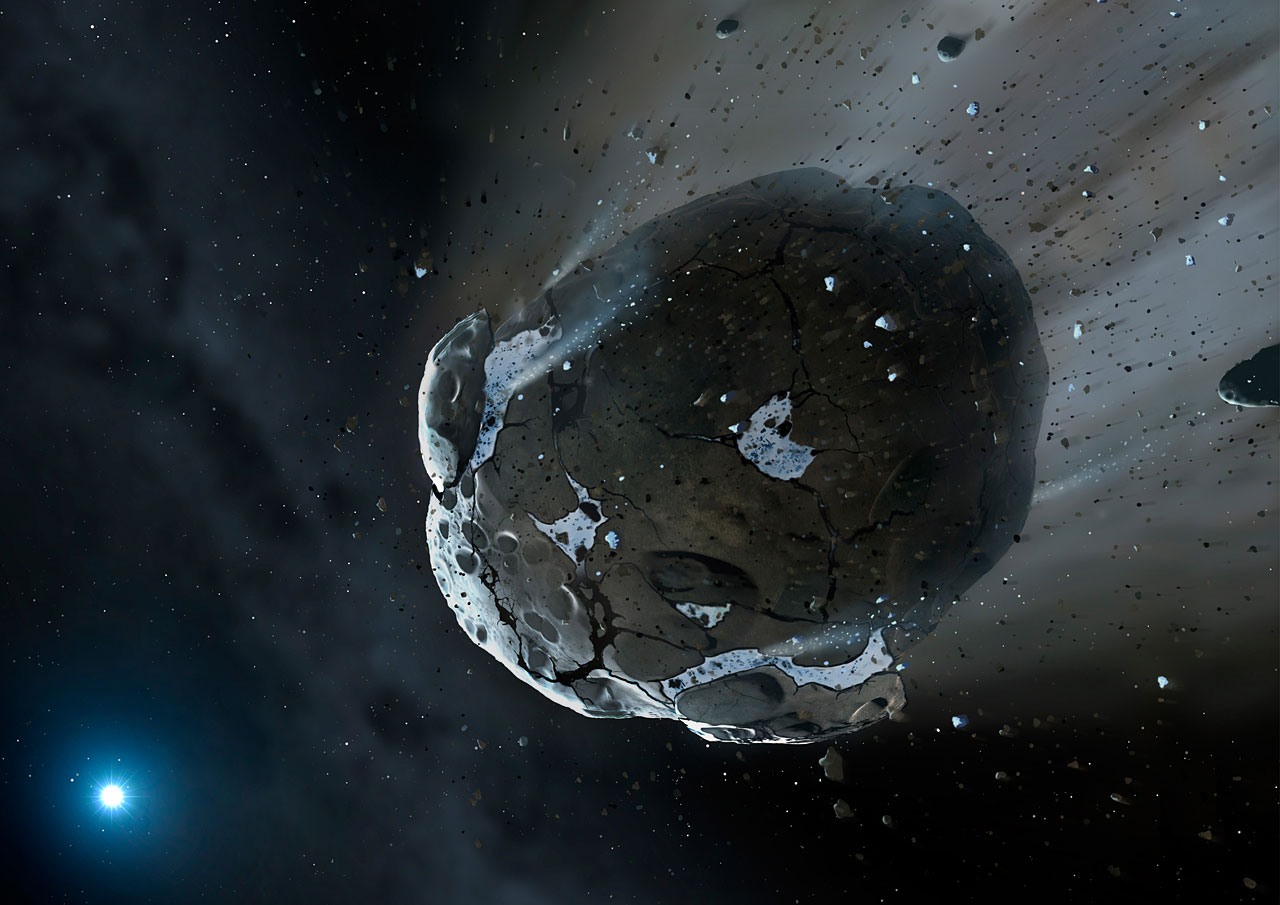
Although stars like our Sun don’t explode in violent supernovae like their massive counterparts, they don’t slink quietly into a peaceful old age either. When a solar-mass star reaches the end of its main sequence life, it first swells dramatically (the Sun may eventually grow so large that it consumes Earth and the device you’re reading this on), then shrinks down to a tiny but incredibly hot ember known as a white dwarf.
An artist’s impression of an asteroid breaking up near a white dwarf star. [NASA, ESA, M.A. Garlick (space-art.co.uk), University of Warwick, and University of Cambridge]
However, although researchers have found these stains in over a quarter of white dwarfs and consequently have reasoned that asteroid snacking must be common, they’ve only ever caught one star mid-meal. Recently, Ben Zuckerman (University of California, Los Angeles) and a team of collaborators may have found another, though it may have just finished dining.
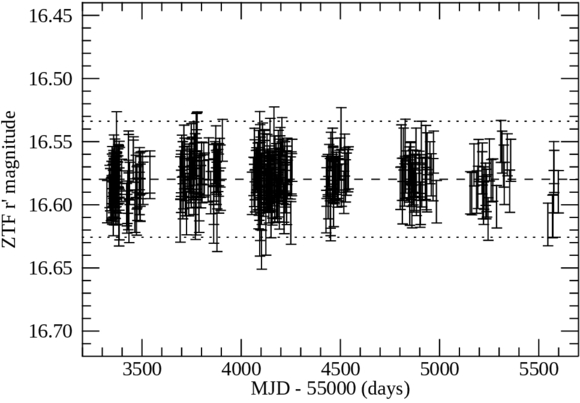
The light curve of WD J0234-0406 measured by the Zwicky Transient Facility. Unlike WD 1145+017, which frequently changes brightness, this white dwarf appears remarkably steady despite the high-velocity gas surrounding it. [B. Zuckerman et al. 2026]
The researchers suggest that this relative quiet is a matter of timing. While asteroids are actively breaking up around WD 1145+017, the parent bodies that supplied the gas and dust around WD J0234-0406 may have shattered long ago and have already been either vaporized or ground down into smaller particles. All that is left over are the crumbs slowly spiraling toward the star.
Although WD J0234-0406’s meal may not be as dramatic as WD 1145+017’s feast, it’s still exciting to expand the sample of known white dwarf-asteroid interactions. And, with the upcoming release of data from the DESI survey poised to reveal the spectra of tens of thousands of white dwarfs, the sample is likely to grow again soon.
“High-velocity Circumstellar Gas Orbiting a White Dwarf Star,” B. Zuckerman et al 2026 ApJ 1004 254. doi:10.3847/1538-4357/ae23c4
The post Finishing Off an Asteroid appeared first on AAS Nova.
An international research team has uncovered how LUCA, the last common ancestor of all life on Earth, split into the first two branches of organisms—bacteria and archaea—allowinglife to thrive innew conditions and spread to other biomes.
Scientists from the Institute of Molecular Evolution at Heinrich Heine University Düsseldorf (HHU) led the research, revealing their findings in a recent paper published in Science Advances, investigating these early cells’ metabolisms.
The team discovered that the chemical reactions and energy sources behind these two types of cells told unique stories of separate evolutions, in new work that sheds light on the primordial processes that gave rise to some of Earth’s first free-living cells.
Roughly four billion years ago, life on Earth emerged as the first cells formed, most likely at hydrothermal vents, before evolving to explore new biomes.
“We would see two very different kinds of cells emerging, pioneer bacteria and pioneer archaea, making their first attempts at life outside the confines of a hydrothermal vent,” said lead author Natalia Mrnjavac, a biologist at the University of Düsseldorf.
The new study investigated protein structures, chemical reactions, and genomes involved in the evolution of these early free-living cells.
“These comparisons are giving us unprecedented insights into the phase of evolution when metabolism catalysed by enzymes was arising from spontaneous reactions catalysed by metals in the Earth’s crust,” said senior author William Martin, a Düsseldorf biologist.
Among the new work’s major findings is a consideration of the entire set of 420 chemical reactions involved in metabolism that produce amino acids, RNA bases, and vitamins from the raw materials of hydrogen, ammonia, and carbon dioxide.
These reactions are preserved for modern researchers inside the genetic code, allowing the team to make a surprising discovery: about half of LUCA’s reactions were catalyzed by environmental metals instead of enzymes produced by the organism itself.
“Metals that naturally occur in hydrothermal vents can replace a surprisingly large number of enzymes in metabolism,” said co-author Harun Tüysüz, an inorganic chemist from the Max-Planck-Institut für Kohlenforschung and the IMDEA Materials Institute in Madrid.
In this study, the team reconstructed catalysis evolution from metal-only to a metal-enzyme hybrid present in LUCA, and finally to the divergence of the bacterial and archaeal lineages. This evolution helped life move on from the hydrothermal vents inhabited by the first cells by replacing the inorganic catalysts provided by that environment with new enzymes.
“We can see cases where the ancestors of bacteria and archaea independently evolved structurally distinct enzymes to catalyse the same essential metabolic reaction,” Mrnjavac explained, adding that “such parallel inventions could have paved the way to the independent emergence of free-living bacteria and archaea.”
A primary question involves what supplied the energy driving metabolic reactions in early life on Earth. A compound named ATP is the primary metabolic driver in most organisms today, but it comes from enzymes and is not present in hydrothermal vents. The researchers identified a new energy source in palladium, a natural catalyst used by chemists and also plentiful in hydrothermal vents.
“When we react phosphite, a form of phosphorus that naturally occurs in hydrothermal vents, with organic compounds, we get metabolic phosphorylation reactions overnight in water. Phosphite and palladium replace ATP and enzymes; it’s amazing, and it makes early evolution a lot easier to grasp,” Schlikker said.
Understanding the interconnection between so many reactions presents a significant mathematical challenge. For this reason, the team included not just biologists, but network scientists tasked with ordering the reactions by their complexity, which the researchers hoped would indicate the sequence in which they evolved. Using a machine learning algorithm, the team discovered that a clear order did appear to exist.
“The new data leave only one conclusion,” Martin concluded. “The bacteria and archaeal lineages made the transition to the free-living state independently. Only free-living cells are alive.”
“Let’s call it by name,” Martin added. “We are looking at one origin of the genetic code, but two origins of life.”
The paper, “Intermediate Stages in the Origin of Metabolism at a Phosphorylating Hydrothermal Vent,” appeared in Science Advances on August 5, 2026.
Ryan Whalen covers science and technology for The Debrief. He holds an MA in History and a Master of Library and Information Science with a certificate in Data Science. He can be contacted at ryan@thedebrief.org.

New research traces the origins of our metabolism back in time
The post Life Originated Twice on Earth appeared first on Nautilus.

A team of researchers from the University of Sydney and the University of Glasgow argues that dietary sugars, not animal foods, may have played the decisive role in the expansion of the human brain over the past 4 million years, as hominin brain size grew nearly fivefold, from about 300 grams in early relatives like […]
The post Study Points to Sugar, Not Just Meat, as Fuel for Human Brain Evolution appeared first on Sci.News: Breaking Science News.
More than 150 years after Charles Darwin first wondered whether certain sticky-leaved Saxifraga plants might be secretly carnivorous, Kunming Institute of Botany researcher Tao Deng and colleagues say they have finally confirmed it.
The post Scientists Add Unlikely New Member to World’s Carnivorous Plants appeared first on Sci.News: Breaking Science News.
Paleontologists working in southern Wyoming have identified a previously unknown species of omomyid primate, adding a new chapter to the story of one of the best-studied fossil lineages in North America.
The post Tiny New Primate Species Emerges from 50-Million-Year-Old Wyoming Sandstone appeared first on Sci.News: Breaking Science News.
![]()
Editor’s Note: Astrobites is a graduate-student-run organization that digests astrophysical literature for undergraduate students. As part of the partnership between the AAS and astrobites, we occasionally repost astrobites content here at AAS Nova. We hope you enjoy this post from astrobites; the original can be viewed at astrobites.org.
Title: The JWST EXCELS Survey: Insights into the Nature of Quenching at Cosmic Noon
Authors: Maya Skarbinski et al.
First Author’s Institution: Johns Hopkins University
Status: Published in ApJ
Look at an image of the sky taken with a sufficiently sensitive telescope, and you’ll quickly notice that galaxies tend to cluster into two main types: blue spiral galaxies, which have flat disk shapes with a central bulge, and red elliptical galaxies, which look like spherical or elliptical balls of red stars. Blue spiral galaxies can form tens to hundreds of stars every year, while elliptical galaxies have completely stopped forming stars, meaning that some process has to transform star-forming spirals into non-star-forming, or “quiescent,” elliptical galaxies. To form the current population of massive elliptical galaxies, this process had to be common about 2–3 billion years after the Big Bang at “cosmic noon,” the period when star formation in the universe peaked. The processes that “quench” star formation in massive galaxies are still being studied, and one of the best ways to study them is to find galaxies that recently quenched and look for clues about the processes that quenched them.
Post-starburst galaxies are galaxies that have rapidly quenched after a short burst of star formation. Because these galaxies quenched so quickly and so recently, it’s often possible to find signs of whatever quenched them, like the signatures of past galaxy mergers, feedback from supermassive black hole accretion, or the shutoff of gas flowing into the galaxy. Rapid quenching is pretty uncommon now, but it was a much more common way for galaxies to quench at cosmic noon. Understanding post-starburst galaxies at cosmic noon is therefore critical for understanding the formation of massive elliptical galaxies in the local universe.
Today’s article uses data from the JWST Early eXtragalactic Continuum and Emission Line Survey (EXCELS) to identify post-starburst galaxies at cosmic noon and try to determine why they quenched. EXCELS is a spectroscopic survey, so the authors get a spectrum for every galaxy. The spectrum encodes information about the galaxy’s stellar population, including the mass of stars in the galaxy, the number of stars forming every year, and the history of star formation throughout the galaxy’s life.
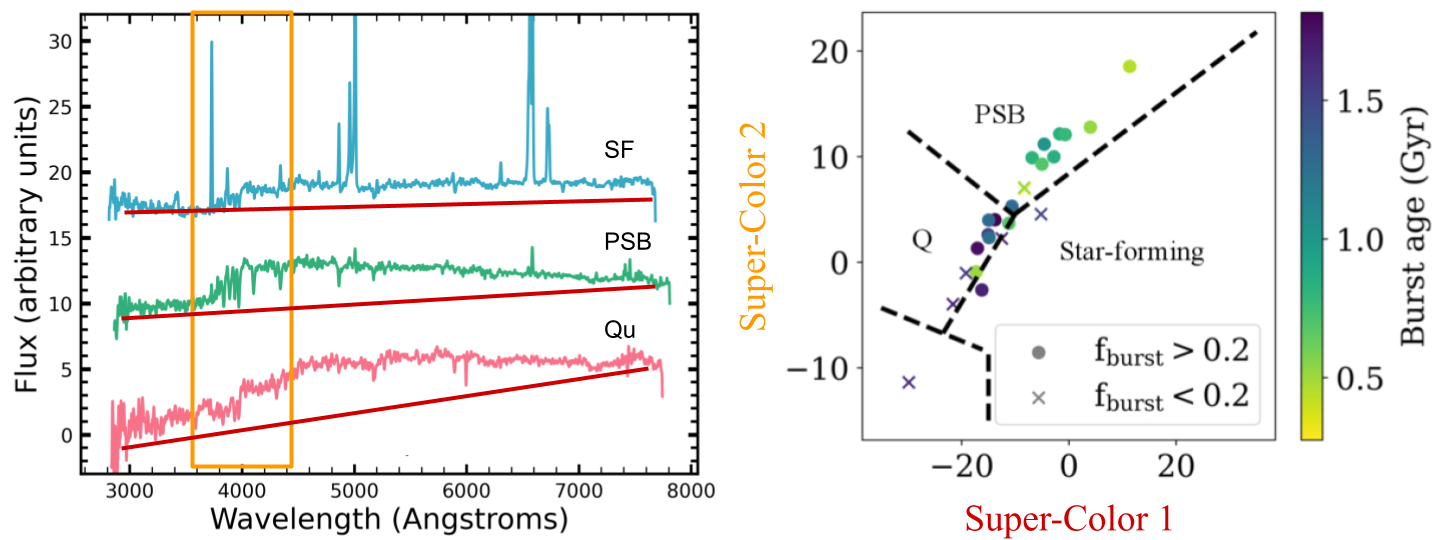
The authors use a technique called principal component analysis to further divide the sample into young and old post-starbursts. Principal component analysis is a machine-learning technique that learns the most important features of a data set. This technique is used for “dimension reduction,” or reducing the number of data points needed to learn something about the object. A typical spectrum has hundreds or even thousands of data points, which means performing data analysis on a spectrum can be very computationally expensive. Principal component analysis takes these thousands of data points and learns broad patterns that correlate with each other. These patterns are called “supercolors” in the context of spectral data, and they encode things like the overall shape and color of the spectrum as well as the spectral shape around key features (see Figure 1 for a visualization). Since the overall shape, color, and emission/absorption line features of a spectrum come from the galaxy’s stellar population, this method can be used to identify galaxies with lots of star formation a billion years ago but very little star formation today — in other words, post-starburst galaxies.
Figure 1: An example of principal component analysis for sample star-forming (SF), quiescent (Qu), and post-starburst (PSB) galaxy spectra (left-hand side). Principal component analysis simplifies a many-dimensional data set (for example, spectra) into fewer dimensions. In this case, Super-Color 1 measures the overall color of the spectrum (shown on the left-hand side as the slope of the spectra, marked with red lines), while Super-Color 2 measures the shape of the spectrum around 4,000 angstroms (orange box). The authors use principal component analysis to identify post-starburst galaxies for further analysis (right-hand side). [Adapted from Skarbinski et al. 2026]
First, the authors measure something called a “quenching timescale,” which they define as the length of time between when the galaxy’s star formation rate peaked and when it fell low enough that the galaxy was quenched. The quenching timescale depends on which process shut down star formation in the galaxy — feedback from black hole accretion or star formation should cause fast quenching, while galaxies that are starved of gas from the intergalactic medium should quench more slowly. The authors find that 15 of their galaxies quenched in under 500 million years, 6 took between 500 million and 1 billion years, and 3 took longer than 1 billion years to quench. The galaxies that had the highest peak star formation rates quenched the fastest, suggesting that feedback from star formation could have played a role in quenching these galaxies.
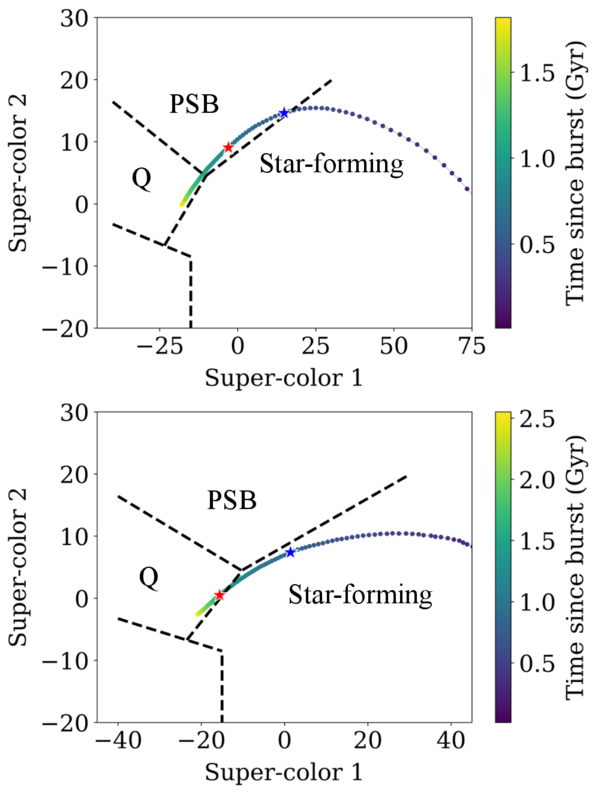
Figure 2: Possible evolutionary tracks in supercolor for two example galaxies as they quench. The galaxy in the top panel quenches quickly and has post-starburst supercolors for about a billion years, while the galaxy in the bottom panel quenches without ever going through the post-starburst phase. The authors use these tracks to determine how important the post-starburst phase is for quenching massive galaxies. [Skarbinski et al. 2026]
While the post-starburst phase is important, the different quenching timescales present across the sample suggest that multiple pathways existed to quench galaxies at cosmic noon, similar to what has been found in less-distant galaxies and at cosmic noon in other samples. This is also supported by the fact that four of the five galaxies with sufficient data show evidence of an actively accreting supermassive black hole that may help shut down star formation in many (but perhaps not all) massive galaxies. While the precise processes that quench massive galaxies are still uncertain, one thing is clear: JWST EXCELS at solving the mystery!
Original astrobite edited by Anavi Uppal.
About the author, Margaret Verrico:
I am a fourth-year graduate student at the University of Illinois Urbana-Champaign. I study the connection between supermassive black hole transients and their host galaxies. I am also an avid knitter and reader, and I am passionate about opening up STEM opportunities for people of all backgrounds.
The post EXCELlent Work, Detectives! Solving the Murder of Star Formation in Galaxies with JWST appeared first on AAS Nova.
Name: Rock crystal scraper
What it is: A stone tool made from microcrystalline quartz
Where it is from: Dordogne, southwestern France
When it was made: Between 45,000 and 80,000 years ago
A century ago, American archaeologists excavating at a cave site in France unearthed a cache of seven rock crystal tools made by Neanderthals. The discovery was one of the first to prove that Neanderthals were not the unintelligent brutes that many scientists of the time believed they were.
This rare quartz scraper was found at the archaeological site of Abri Des Merveilles in the Dordogne region of France in 1924 by a team from the American School of Prehistoric Research (now a department at Harvard University) led by George MacCurdy. The unique tool is now in the collection of France's National Archaeological Museum.
Neanderthals typically crafted their stone tools from flint or chert because these rocks would predictably fracture into sharp edges. But a small handful of Neanderthal sites in Europe have yielded tools made from microcrystalline quartz, also known as rock crystal, resulting in stunningly clear scrapers and points.
According to MacCurdy's April 1931 excavation report, this was the first rock crystal tool the team discovered. It is transparent but yellow-tinged, and it may have been used as a combination scraper and point. In addition to six other rock crystal tools, MacCurdy found tiny rock crystal chips that meant the tools were likely fashioned on-site in the cave. The rocks may have tumbled downstream from the headwaters of the Vézère, a tributary of the Dordogne River that runs near the site. Abri des Merveilles has never been precisely dated. However, based on stratigraphy, tool types and the presence of a Neanderthal molar, the rock crystal tools were likely made between 45,000 and 80,000 years ago.
MacCurdy's discovery proved that Neanderthals, not modern humans (Homo sapiens), were the first to create innovative tools from rock crystal — a conclusion that surprised many scientists of the time.
A century ago, most experts believed that Neanderthals were ape-like and unintelligent, thanks in large part to paleoanthropologist Marcellin Boule's 1909 analysis of a Neanderthal skeleton from the site of La Chapelle-aux-Saints in France. The skeleton of an older male Neanderthal with osteoarthritis influenced Boule's incorrect characterization of Neanderthals as knuckle-dragging cavemen. This perception of Neanderthals lasted well into the 21st century, when paleogeneticists finally proved that Neanderthals and modern humans mated.
MacCurdy, however, saw the rock crystal tools as an indication that Neanderthals had a sense of aesthetics. "We are accustomed to think of Neandertal man as devoid of the artistic sense," he wrote, because, a century ago, archaeologists had not yet found evidence of Neanderthal rock art, carved artifacts, engravings or use of pigments.
The Neanderthal "was not an artist in the strict sense; that he had an eye for beauty of form and color is evident from even the limited use he made of rock crystal," MacCurdy wrote in the journal PNAS in November 1931. "Neandertal man must also be given credit for discernment of beauty and quality of the material employed in his industry."
According to France's National Archaeological Museum, which profiled this tool as their Object of the Month in September 2025, MacCurdy drew highly innovative conclusions about Neanderthals from the rock crystal tools, which helped pave the way for our modern understanding of our enigmatic extinct cousins.
For more stunning archaeological discoveries, check out our Astonishing Artifacts archives.
Can you put together last week's Astonishing Artifact?