After nearly two decades of work, scientists have completed a wiring diagram of the central nervous system of an adult male fruit fly (Drosophila melanogaster).
A nova ferramenta permite gerar vídeos e efeitos sonoros a partir da própria linha do tempo, dentro do Premiere.
Para utilizar a Generative Media Tool, basta selecionar o trecho da linha do tempo em que você deseja criar, descrever aquilo que deverá ser gerado, escolher um dos modelos de IA suportados pela ferramenta (Adobe Firefly, Google Veo, Runway, Luma ou Kling) e pronto, o conteúdo gerado já estará presente no seu projeto.
Divulgação/Adobe
Os materiais feitos por IA são adicionados como clipes editáveis, permitindo que o usuário os manipule como quiser. Além disso, caso seja da sua preferência, a ferramenta possui a capacidade de utilizar quadros de vídeos já existentes como referência para aquilo que será gerado, tornando o recurso ideal para estender determinadas cenas.
Já em matéria de áudio, o Premiere possui agora ferramentas (implementadas em fase beta) para tratamento e separação de vozes em falas simultâneas.
Divulgação/Adobe
A Adobe também atualizou o Color Mode, destinado a correções de cor realizadas dentro do Premiere, oferecendo tanto visuais cinematográficos com os novos Style Modules (com os modos Vignette e Midtones) quanto a Auto Color Tool, que corrige automaticamente a exposição e a temperatura de um clipe ou uma sequência.
Por fim, a empresa também anunciou a chegada do seu assistente de IA para os usuários do After Effects (em versão beta), permitindo tanto a novos usuários da ferramenta quanto aos editores mais experientes manipular projetos e criar efeitos a partir de comandos em linguagem natural.
Todas essas novidades já estão disponíveis para os assinantes da suíte Adobe Creative Cloud.
Dr. Delia Santiago-Materese wants things to get complex
From terrestrial animals to experiments in microgravity and Martian clouds, this NASA program scientist’s career path links diverse challenges. Today, she supports a mission to Saturn’s moon Titan, a world teeming with organic molecules that could hold valuable clues about the origin of life.
When novelty is your hobby, you already have a large part of the recipe for a career full of challenges. That is why Dr. Delia Santiago-Materese describes her path within NASA as “meandering.” Her diverse roles have taken her to low Earth orbit, to the clouds of Mars, and to the surroundings of Jupiter. Now, they are also bringing her closer to the surface of Titan, an intriguing moon of Saturn. Woven together by her exploring spirit and a perennial curiosity, all these experiences have one point in common: life.
Today, Santiago-Materese is part of the Planetary Science Division at NASA Headquarters in Washington. The main decoration in her office is a model of Jupiter, larger than a basketball, resting next to a scale model of the spacecraft exploring it, Juno. Small black and red pins with the inscription “Dragonfly” rest in the center of a round table. Several framed diplomas cover a wall. From here, Santiago-Materese does “a little bit of everything” on any given workday as a program scientist for the Juno and Dragonfly missions, and for the Discovery program, which features a portfolio of several missions in our cosmic neighborhood.
This medley of roles is no coincidence. Santiago-Materese describes herself as someone who does not pursue a single goal, but rather diverse interests that she discovers along the way. “I am always looking for something new to add to my experiences,” she says, “because I think I also get bored easily.”
Santiago-Materese holds her model of Jupiter, just outside her office. As a program scientist for Juno—a mission studying this planet—for Dragonfly, and for the Discovery program, she guides these projects by promoting leadership based on kindness and respect: “Every person brings something unique.”
NASA/Noelia González
The daughter of a military family, Santiago-Materese was born in Spain by coincidence. Her roots are actually on another continent: her mother is Mexican-American and her father is Puerto Rican. From her time in Spain, she only keeps some baby photos; she lived part of her life in Texas and then in California, which she considers her home—despite having spent her childhood summers in San Sebastián, Puerto Rico. It was in the Golden State where she first imagined herself as a veterinarian and decided to study Biological Sciences. And it was during her studies at Stanford University, “just around the corner” from NASA’s Ames Research Center in California’s Silicon Valley, that Santiago-Materese discovered astrobiology.
This elective course brought her closer to a discipline that, to some extent, was in its infancy. Today, NASA’s Astrobiology Program investigates life in the universe on many levels: how it began, how it evolved here on Earth, and where it might exist elsewhere. And that was how Santiago-Materese realized that biology and space were not two isolated things, she recounts.
Rodents, Insects, and Martian Clouds
After finishing her studies, Santiago-Materese completed a one-year internship at the San Francisco Zoo. But the unknown that astrobiology presents continued to intrigue her, so she went back to one of her professors to inquire more about it. She asked around and found someone at Lockheed Martin, a company that often contracts with NASA on space projects. They were looking for people for a new project studying the nutrition of the food bars for rodents traveling to space aboard the space shuttle.
Santiago-Materese has applied that formula ever since: identifying what truly interests her and finding the right person to ask questions. If people “don’t know what you’re interested in, they can’t help you,” she explains. After experience with the Space Shuttle Program, including managing databases for science payloads aboard the space shuttle, she went on to work with the International Space Station, which was then beginning its legacy of over 25 years in Earth orbit. She supported the development of biological experiments in microgravity, this time with fruit flies. But Santiago-Materese wanted to keep moving farther from Earth and investigate future space destinations.
This curiosity led her to the Martian sky. As part of her graduate studies at the University of California, Santa Cruz, Santiago-Materese investigated the Martian atmosphere, focusing on ice in the clouds and the development of climate models for the Red Planet. She earned her master’s degree and would later return to complete her doctorate under the NASA Pathways program, which is one of the agency’s primary early-career hiring pathways. She would defend her thesis six months after giving birth to her first daughter (one of the achievements she is most proud of, she says). That is why, although she loves the “weird” planets of the outer solar system, she is “more of a Mars person,” by training.
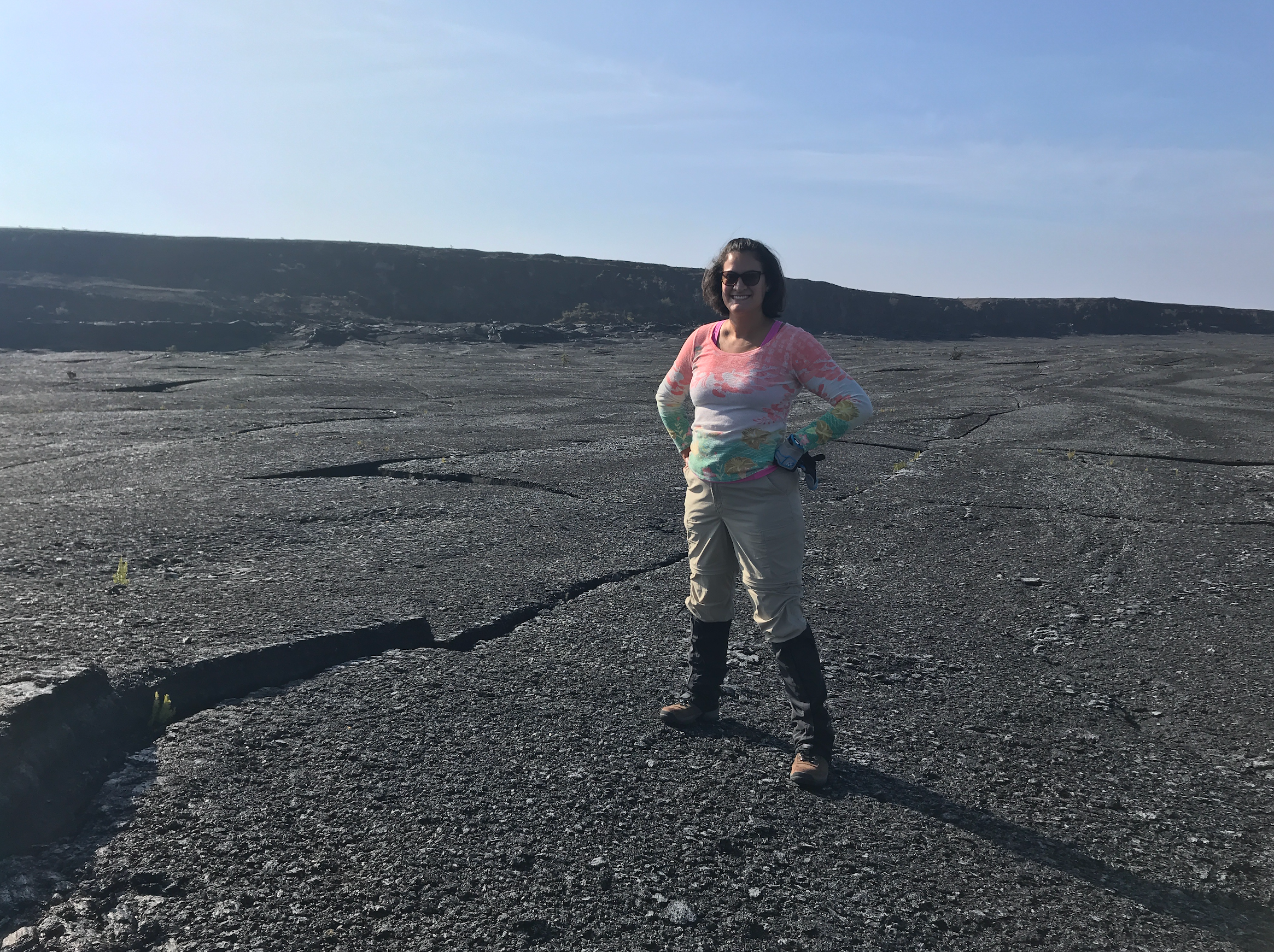
During her NASA career, Santiago-Materese traveled to Hawaii to investigate a planetary analog, a type of terrestrial environment that has very similar characteristics to those we might find on other worlds.
Image credit: Delia Santiago-Materese
At NASA Ames, Santiago-Materese held various roles, ranging from social media and open science to lunar sciences. She then became a program officer for the Solar System Workings program in the Planetary Science Division at NASA Headquarters as part of a detail, or temporary assignment. And then, she took off for Maryland along with her family.
Enabling Science
Santiago-Materese sums up her current role as a program scientist as the “science liaison” between NASA Headquarters and a mission. “When you do program scientist work, you might not be specialized or an expert in the exact science, but you need to be able to understand it and talk about it, to understand its importance,” she explains. “In general, we are supporting other people so they can do science.” In this endeavor, being someone who “gets more energy from working with people” is useful… and necessary: “You are having conversations all day long” with colleagues from different disciplines— from science and engineering to finance.
The Juno mission, in orbit around Jupiter since 2016, and Dragonfly, which is scheduled to launch no earlier than July 2028, are part of NASA’s New Frontiers program. Santiago-Materese also oversees the array of missions in the Discovery program, which includes ongoing science missions like Psyche and Lucy—heading to different asteroids—and future missions to Venus.
For Santiago-Materese, sharing her unconventional path can be valuable for students and youth in general, especially those who are unsure of what they want to do. “Your dream job,” she says, “you might not know it exists, or maybe it doesn’t exist today.” Beyond that, this zigzagging path has led her to accumulate experiences and relationships with different people, which she treasures even as she sets off for her next destination.
An Alien World
About two years out from Dragonfly’s launch, it is no surprise that this robotic mission takes up much of Santiago-Materese’s time. “Dragonfly feels like a combination of all my different experiences over time,” she reflects. And it signifies, to some extent, a return to her roots: it is an astrobiology mission. Although not designed to detect life, Dragonfly will investigate prebiotic chemistry: the chemical processes that could have led to the emergence of life on Earth.
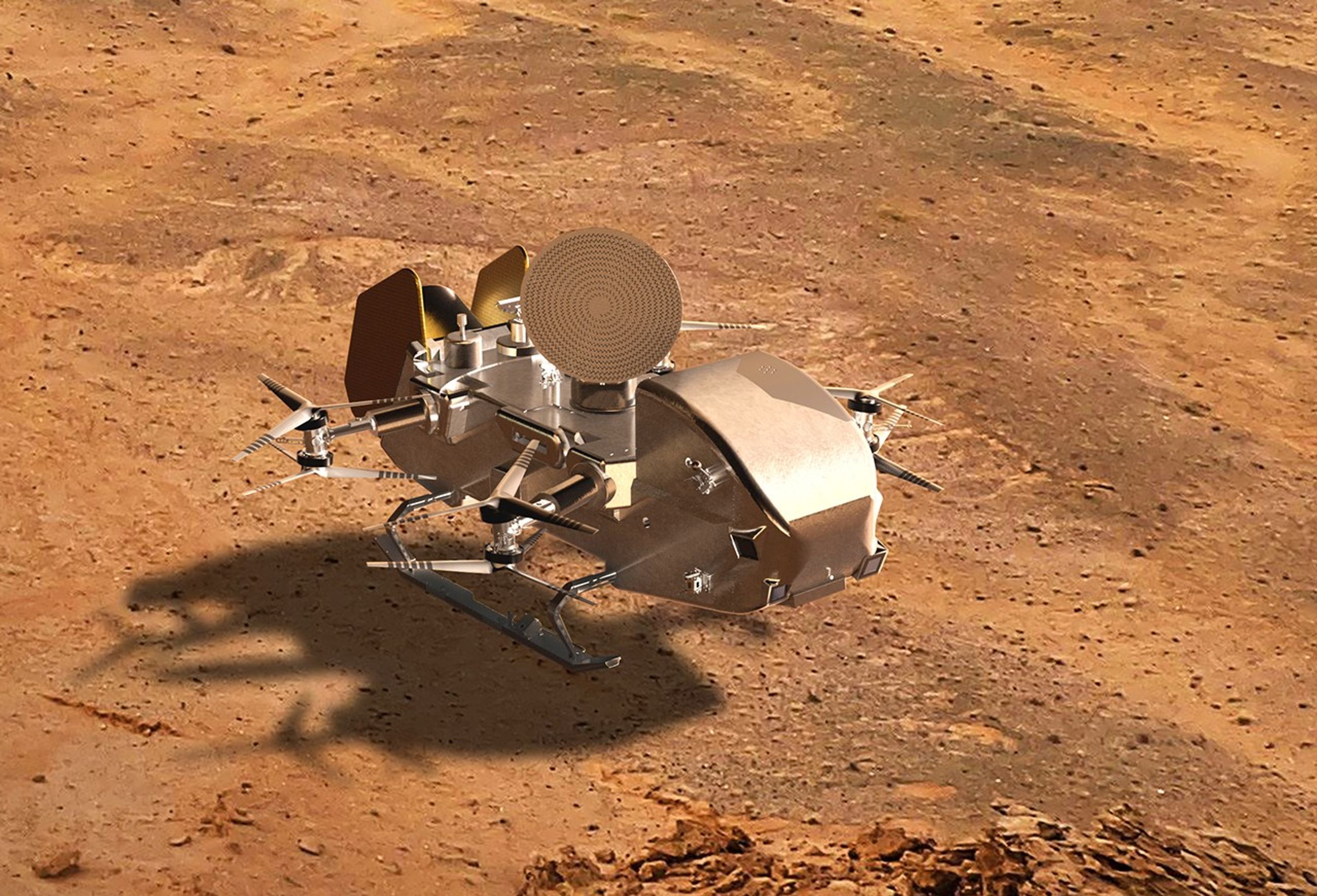
Digital concept of NASA’s Dragonfly lander on the surface of Saturn’s moon Titan.
NASA/Johns Hopkins APL/Steve Gribben
Dragonfly will embark on a journey of about six years to the surface of Titan. The spacecraft will carry an array of science instruments and will be the first NASA science mission to explore another world by flying from location to location. This car-sized rotorcraft will touch down at various geological sites of interest to analyze the moon’s composition and its habitability potential.
When it arrives at Titan, it will encounter a landscape that is strange and familiar at the same time: it could be a window into Earth’s remote past. This frozen world has a thick atmosphere and clouds drifting across the sky; dunes, lakes, rivers, canyons and mountains. Titan even has a process equivalent to our water cycle. However, on Titan, it is not water that flows but hydrocarbons, primarily methane and ethane. “It’s a more methane-based chemistry, so it is very alien, and that is what I really love about Titan,” says Santiago-Materese. And on this moon, organic molecules abound.
These molecules contain carbon and are used by all known forms of life. They are fundamental to understanding the origin of life, as they can be produced by both biological and non-biological processes. On Titan, these organic molecules fall to the surface and form dense deposits over its bedrock of water ice. Scientists believe that the complex chemistry precursor to life could be triggered there if provided with a little liquid water, such as that generated by an asteroid impact.
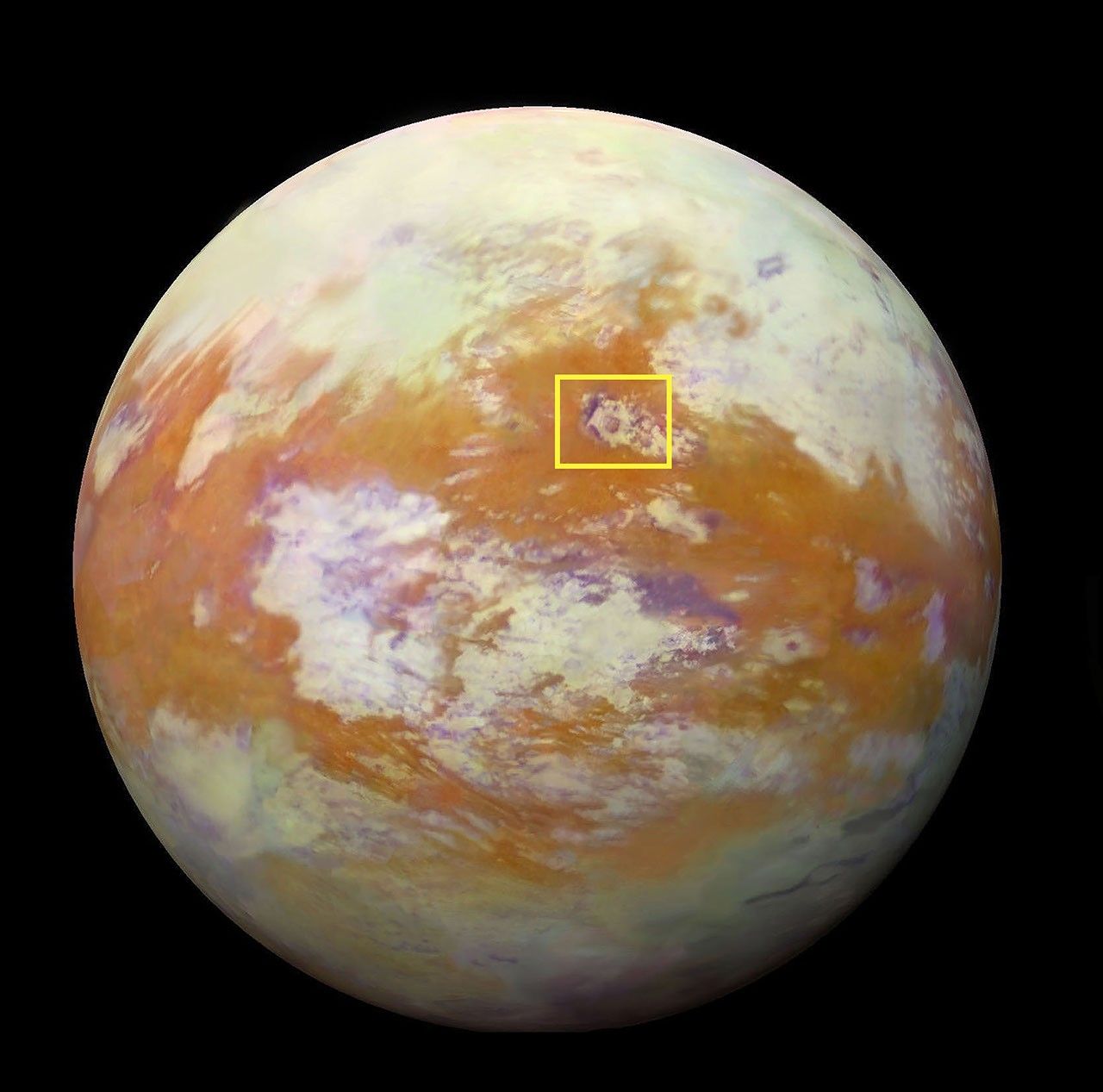
Selk Crater, an 80-kilometer (50-mile) diameter impact site highlighted in this infrared image of Titan, is a key destination for Dragonfly. The rotorcraft will touch down near Selk and explore various sites, analyzing the surface chemistry to investigate the frozen remains of what could have been prebiotic chemistry in development.
NASA/JPL-Caltech/University of Nantes/University of Arizona
Santiago-Materese is especially excited about what the Dragonfly Mass Spectrometer (DraMS) instrument will help discover. DraMS, designed and built at NASA’s Goddard Space Flight Center in Greenbelt, Maryland, will analyze samples from Titan’s surface. “The more complex things get, the more interesting things happen,” she says. “So I’m curious: just how complex do the molecules get? Will we find any interesting patterns?”
But in science, every time you ask a question, a new one arises. Dragonfly will try to answer several of them. “When you have a planet with complex chemistry but not life, what happens? What is there before life?” the program scientist wonders.
Titan, a valuable natural laboratory, “is going to completely change our understanding of what another world can be like,” she anticipates. In addition to what the scientific community expects to discover thanks to Dragonfly, Santiago-Materese is interested in the potential unexpected findings. “There are very defined science goals, but a lot of it is exploratory work,” she explains. “It is kind of nice to know that there is a big range [of possibilities], that we could be very surprised.”
By Noelia González, NASA’s Goddard Space Flight Center, Greenbelt, Maryland
On Friday, researchers announced the completion of a map of every neuron in the brain of a male fruit fly. The "connectome" provides a tool that can accelerate neurobiology research. But it also provides an opportunity to do some science on its own, as the connectome of a female Drosophila had been completed earlier this year. The work also provided the team behind it the opportunity to refine tools that are likely to be applied to ever-more complex nervous systems, including (potentially) those of vertebrates.
The new work involved a collaboration between biologists at the Howard Hughes Medical Institute's Janelia Research Campus and computer scientists at Google—both acknowledge that neither could have done the project without the other. Preparation of an entire brain for imaging at the necessary resolution requires a distinct set of skills, as does interpreting what those images indicate. But building a complete picture of the hundreds of millions of synapses in a brain as small as the fruit fly's is a task that can't be achieved by humans in a manageable amount of time.
The people behind the effort expect that in the long term, the effort will be worth it, as the connectome could give neurobiologists a valuable tool for understanding how the brain works.
More than 150 years after Charles Darwin first wondered whether certain sticky-leaved Saxifraga plants might be secretly carnivorous, Kunming Institute of Botany researcher Tao Deng and colleagues say they have finally confirmed it.
A Adobeanunciou hoje o lançamento de um plugin unificado para o ChatGPT, reunindo mais de 70 ferramentas criativas da seu suíte diretamente na interface do chatbot por inteligência artificial (IA) da OpenAI.
O plugin conta com ferramentas de aplicativos da Adobe que já possuíam integração com o ChatGPT, além de novos recursos do Adobe Express, Photoshop, Firefly, Premiere, Acrobat, Lightroom, Illustrator, InDesign e Adobe Stock, permitindo que os usuários possam criar peças publicitárias ou adaptar um vídeo para diferentes redes sociais sem precisar alternar entre aplicativos.
A novidade faz parte da estratégia da Adobe de expandir a compatibilidade dos seus recursos com as ferramentas de IA generativa; em junho, a empresa já havia mencionado que levaria esses recursos inclusive para rivais do ChatGPT, como o Claude. No Copilot, no Gemini e no Slack eles chegarão “em breve”, segundo a empresa.
Grande novidade: um novo plugin da Adobe já está disponível no @ChatGPT da @OpenAI! Mais de 70 ferramentas — incluindo @Photoshop, @AdobeFirefly, @Lightroom e @Acrobat — reunidas em um único chat. Crie mockups com suas fotos. Adapte vídeos para qualquer plataforma. Transforme um modelo em um PDF com acabamento profissional. Saiba mais: adobe.ly/3TDrxff
Ainda conforme a desenvolvedora, a novidade foi pensada para “facilitar e agilizar a transformação de ideias em conteúdo de alta qualidade dentro do ChatGPT”, mas a empresa destaca que, para necessidades criativas “mais profundas”, os seus aplicativos nativos seguem sendo a primeira opção.
Questionada pela AI Magazine se o uso dos recursos incorporados ao ChatGPT poderia rivalizar com o uso dos aplicativos nativos, a líder de produtos de IA agêntica da Adobe, Deepti Pradeep, respondeu o seguinte:
Dentro do ChatGPT, a experiência é transformadora: em vez de escolher plugins da Adobe separadamente, os usuários podem experimentar uma única experiência da Adobe que traz o Photoshop, Acrobat, Express e mais juntos.
Nós acreditamos que a consolidação adiciona mais valor aos usuários do ChatGPT. Fora dele, nossos aplicativos nativos permanecem essenciais para um controle mais profundo, preciso e avançado dos fluxos de trabalho.
Para iniciar, é possível utilizar algumas funcionalidades do plugin como convidado, embora a Adobe recomende fazer login com a sua conta para “desbloquear recursos adicionais”.
O plugin da Adobe já está disponível tanto no app quanto na versão web do ChatGPT.
A Adobeanunciou a adição de novos recursos temporários impulsionados por inteligência artificial (IA) ao Project Indigo, seu app de câmera exclusivo para iOS, com a ferramenta AI Playground.
Os quatro principais recursos de IA do Project Indigo incluem a manipulação de objetos (Object Editing, ou “edição de objeto”, em tradução direta), a estilização de uma foto em uma determinada técnica artística (Styles, ou “estilos”), o feedback por IA das suas fotos (Photo Guidance, ou “orientação fotográfica”) e a edição a partir de comandos de linguagem natural (Custom Edit, ou “edição customizável”).
Divulgação/Adobe
De forma opcional, a Adobe afirmou ainda que o acesso ao AI Playground estará restrito a uma parcela dos usuários do Project Indigo, sem menção aos critérios exatos de disponibilização. O teste ocorrerá durante algumas semanas e a ideia é compreender o uso de IA no app, embora ela reitere seus pilares de privacidade:
Quem aceitar participar precisará concordar em compartilhar apenas as interações com os botões do recurso. A Adobe afirma que não acessará os comandos digitados, nem as imagens, não fará upload delas para seus servidores e não as utilizará para treinar modelos de IA. Como não há login, todos os dados coletados são anônimos. Quem preferir não participar pode recusar e continuar usando o aplicativo normalmente.
Recursos como a estilização de fotos ou a remoção de objetos farão uso do modelo Nano Banana, do Google, ou dos próprios modelos Firefly da Adobe, mas ela reitera que o leque de modelos poderá se expandir no futuro.
Por fim, a Adobe explicou ainda que os modelos atuais de geração de imagens produzem apenas resultados com alcance dinâmico padrão (SDR 1Standard dynamic range, ou faixa dinâmica padrão.) e, para preservar a aparência das fotos capturadas com HDR 2High dynamic range, ou ampla faixa dinâmica. pelo Project Indigo, a empresa desenvolveu um modelo próprio de ML 3Machine learning, ou aprendizado de máquina. que converte automaticamente o resultado gerado pela IA para HDR, utilizando a foto original como referência, sem empregá-la para treinar modelos de IA.
Heliconius butterflies inhabit the rainforests of Central and South America, where most adult butterflies live only a few weeks. In the study, Heliconius hewitsoni reached a maximum lifespan of 348 days, while a related species, Dione juno, only survived about 14 days under observed conditions. This represents a 25-fold difference in maximum lifespan between two closely related species.
Old Age Without the Decline
Heliconius butterflies not only live longer than their relatives, but also show slower physical decline with age. The team, in collaboration with the Smithsonian Tropical Research Institute in Panama, measured grip strength in aging butterflies to assess physical decline. Older Heliconius hecale performed as well as the younger individuals tested, showing no detectable age-related decline in grip strength.
The team combined butterfly house data, mark–recapture field studies, and controlled lab experiments. In these cases, Heliconius butterflies consistently showed longer lifespans, lower mortality rates, and slower rates of aging than closely related species that do not feed on pollen.
The Pollen Connection
One hypothesis for their extended lifespan focuses on their unusual adult diet. While most butterflies feed only on nectar, Heliconius also consumes pollen, which was thought to provide the nutritional basis for its extended lifespan.
To test this idea, researchers compared pollen-feeding Heliconius hecale with its non-pollen-feeding relative, Dryas iulia. H. hecale maintained body mass and muscle performance longer than D. iulia. Even without pollen in its diet, H. hecale still outlived its relative by a wide margin. This suggests that diet alone does not explain Heliconius’s extended lifespan.
Dr. Jessica Foley, the study’s lead author from the University of Bristol’s School of Biological Sciences, explained that insects already show a huge range of lifespans. Some, like mayflies, live only a few days, while ant and termite queens can survive for decades. “This represents a roughly 5,000-fold difference within the class, compared with around a 100-fold difference in lifespan observed in mammals.”
Heliconius butterflies are notable because they have evolved both longer lifespans and slower rates of aging, allowing them to outlive close relatives from which they diverged only recently in evolutionary history.
A New Model for an Old Problem
Most aging research uses a limited set of laboratory organisms, such as mice, worms, and fruit flies, to study biological aging mechanisms. The heliconius butterfly provides a unique opportunity to study a long-lived species closely related to short-lived species, allowing for direct comparison in a natural context. Foley noted that comparing these two groups “can help reveal how lifespan is extended, making them a highly promising new model for research into the biology of aging and longevity.”
If pollen feeding and longevity evolved together but are not entirely dependent on each other, the next step is to identify the genetic and physiological changes responsible for both traits. Understanding these mechanisms in Heliconius butterflies could provide insight into how aging evolves across species.
Austin Burgess is a writer and researcher with a background in sales, marketing, and data analytics. He holds an MBA, a Bachelor of Science in Business Administration, and a data analytics certification. His work focuses on breaking scientific developments, with an emphasis on emerging biology, cognitive neuroscience, and archaeological discoveries.
Entomologists have compiled decades of data from butterfly houses, wild field studies, and lab experiments to build the most comprehensive picture yet of how long Heliconius butterflies live and how slowly they age.

 Login