❌

Normal view

After 24 years, Return to Castle Wolfenstein is finally distributed uncut in Germany — game was censored due to strict laws regarding Nazi symbolism

9 August 2026 at 11:40

Some announcements arrive with fireworks, while others show up as a single easily missed tweet during a flurry of QuakeCon announcements to quietly close one of the longest-running oddities in PC gaming. After roughly 25 years, Return to Castle Wolfenstein (RTCW) is finally available in Germany in its original, uncut form. Bethesda Deutschland dropped the news amidst its QuakeCon announcements, bringing an end to a censorship saga regarding Nazi symbolism that stretches all the way back to the game's original 2001 release.

A Return to Castle Wolfenstein screenshot showing the Norway level and the submarine you board at the end.

The game's environments are surprisingly varied despite the relatively primitive technology in use. This level is set in Norway. (Image credit: Bethesda Softworks)

If you weren't around for PC gaming in 2001, it's hard to overstate how different the landscape looked. NVIDIA's GeForce 3 had only recently introduced programmable shaders to consumer graphics cards, the ATI Radeon 8500 was fresh competition, Windows XP was brand new, and legendary pioneers 3dfx had just disappeared after being acquired by NVIDIA. Broadband internet was becoming more common, but plenty of multiplayer sessions still happened over LANs, and a Pentium III or Athlon paired with 256 MB of RAM was enough to run one of the latest engine technology showcases.

Built on id Tech 3, perhaps better known as the tech that powered the incredible Quake III Arena, Grey Matter's Return to Castle Wolfenstein looked fantastic for its day, and it also inherited the series' unmistakable identity. See, ever since Castle Wolfenstein in 1981, and even more so after Wolfenstein 3D essentially invented the first-person shooter as we know it a decade later, the games have been about one thing above all else: shooting Nazis.

That identity created a problem in Germany. For decades, games depicting Nazi symbolism faced legal and regulatory hurdles that films did not, resulting in a heavily modified German version. In RTCW, swastikas disappeared, Nazi organizations were renamed, Heinrich Himmler became the fictional "Heinrich Höller," and references to the Third Reich gave way to the equally fictional "Wolf Clan."

At first glance, that sounds like the sort of censorship that simply strips away context, yet RTCW was already a strange game. The opening hours suggest a relatively grounded World War II action title. You wake up in a prison with a knife, you fight Nazis in a castle, and things seem normal for about a whole hour before rapidly veering into supernatural pulp. Within a few missions, you're fighting zombies, exploring haunted crypts, and watching the SS dabble in increasingly implausible occult experiments.

An RTCW screenshot showing the final boss, Heinrich I, flanked by several undead enemies.

The final boss Heinrich is barely mentioned before the end of the game, making him quite a surprise if you aren't paying close attention to the story. (Image credit: Alan Chan/MobyGames)

By the end, the final boss isn't Hitler (mech suit or no) or a secret superweapon, but Heinrich I, historically known as Henry the Fowler. He was a real 10th-century German king, supposedly resurrected in the game through dark ritual. He's also somewhat infamously a surprisingly manageable final boss, making for a finish both absurd and anticlimactic after the game's escalating parade of undead knights and bizarre experiments.

Seen through that lens, the censored version accidentally became a different story. Instead of Nazis attempting to exploit medieval occult power, it played more like an ancient secret society preserving itself across the centuries before trying to resurrect its long-dead founder. It's arguably a cleaner fantasy premise. The "Wolf Clan" makes more narrative sense once the game fully commits to gothic horror. However, it does make the opening chapters, where an OSS Ranger is somehow investigating a shadowy organization seemingly unrelated to the wider war, a bit awkward.

The catch, of course, is that it stops feeling much like Wolfenstein. The series' DNA is inseparable from infiltrating Nazi strongholds and sabotaging increasingly desperate attempts to turn the tide of World War II. Remove that element, and the title itself starts to feel like an artifact from another game series altogether.

A screenshot of a briefing screen from Return to Castle Wolfenstein, showing how detailed the mission briefings were.

These surprisingly detailed mission briefings had to be fully reworked for the German version of the game. (Image credit: Bethesda Softworks)

It's a curious example of something that occasionally happens with censorship across entertainment. More often than not, edits simply leave a work feeling diminished. Every so often, though, these constraints produce something unexpectedly memorable. The Texas Chain Saw Massacre owes much of its enduring reputation to how much horror it leaves to implication rather than explicit gore, and that decision was made due to the ratings board. Similarly, action film edits for TV often cut gory death scenes, which can ironically improve the pacing of the film.

Return to Castle Wolfenstein belongs in that same conversation, albeit for different reasons. The German version wasn't a better version of the game in any objective sense, but it accidentally shifted the genre. Instead of occult Nazis, it became a story about an ancient cult whose descendants had survived into the modern era. That's a premise that I personally find more appealing and even internally consistent, even if it comes at the expense of the series' defining theme.

A RealRTCW mod screenshot showing improved texturing and lighting over the base game.

The RealRTCW mod offers widescreen support and improved texturing and lighting over the base game. (Image credit: RealRTCW Team)

So, after a quarter of a century, German players can finally buy the same uncensored game that much of the rest of the world has had since 2001. It's ironic, and it's about time, too. While Germany relaxed its gaming rules in 2018, allowing modern entries like The New Order to go uncut in 2019, Grey Matter's 2001 classic remained stuck in censorship limbo until now. For game preservation, historical authenticity, and simple consumer choice, that's unquestionably the right outcome. Yet it also marks the quiet retirement of one of gaming's strangest alternate versions; a release that, through a combination of legal necessity and narrative coincidence, accidentally stumbled into telling a very different and potentially more compelling story.

Folks in Germany should now be able to pick up the uncensored version of the classic game on sale for just two dollars at Steam and GOG, or you can get a bundle that includes the original Wolfenstein 3D for just a dollar more. If you grab it, make sure to check out the RealRTCW overhaul mod that radically improves the game with modern features like proper widescreen support and cleaner OpenAL audio.

Atari ST Public Floppy Database now open for everyone — online archive originally designed for ST flash cart packed with classics and homebrew

8 August 2026 at 13:15

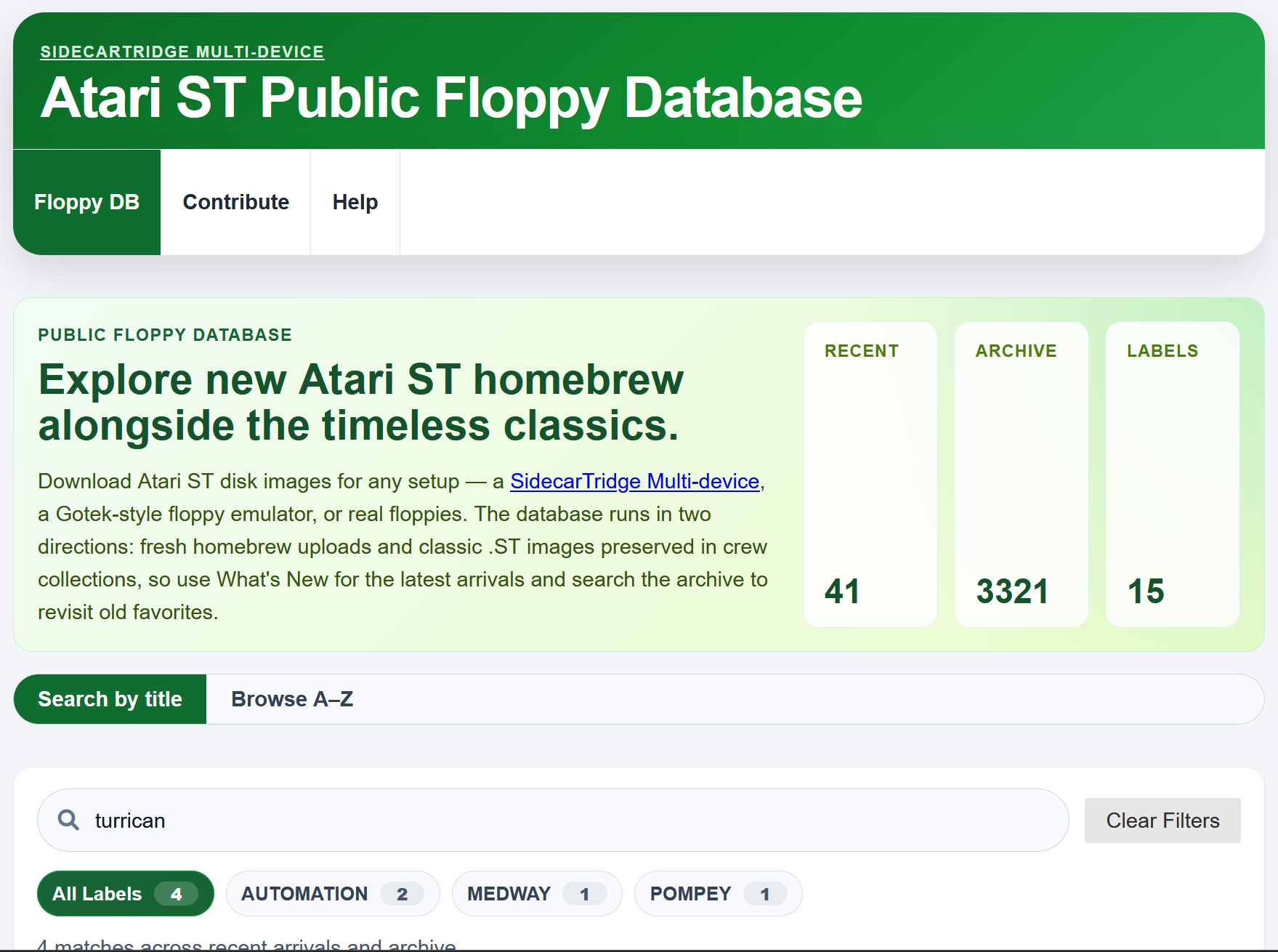
An extensive Atari ST floppy disk database can now easily be accessed by all netizens. Originally created to serve floppy images to the owners of the SidecarTridge multi‑function hardware add‑on for the Atari ST family (ST, STE, Mega ST, TT, Falcon), anyone can now browse, search, and download the .ST files to use with other hardware, emulators, or even to rewrite the disk images to actual floppies.

The Atari ST Public Floppy Database browser from the SidecarTridge Multi-device is now open on the web to everyone.Until now, searching that community-curated archive of floppy images meant firing up your Atari ST with a SidecarTridge Multi-device. The search lived inside the…July 21, 2026

After reading the announcement, I decided to check out the online repository. My favorite old platformer series was there, with more than one disk featuring the legendary Turrican and Turrican II releases. I also checked and confirmed public domain/shareware favorites like Gravity Force were available, as was Llamatron, and the mono high-resolution Bolo. Some things I looked for, like the Stupendous Demo, seemed to be missing, as were serious art and DTP tools I used to dabble with in the 90s.

Atari ST screenshots

(Image credit: Tom's Hardware)

The database is pleasingly new and regularly maintained, though. For example, it has 41 Atari ST disks flagged as recent arrivals. These are a mix of old releases being added, and some extremely new titles like new homebrew games, and a collection of demos released at Sommerhack 2026 just last month.

As indicated in the intro, this disk database was originally collated for direct access via hardware designed to bring several modern conveniences to those who still cling to original Atari ST-family computers. The SidecarTridge slots into the computer’s cartridge port, hence the name. It is much more than a ‘Gotek-style’ flash card floppy loader, though. This Raspberry Pi Pico W RP2040 microcontroller-powered device can also load different ROMs (the Atari ST’s entire OS and GEM desktop were loaded from ROM for super-fast,t no-disk-needed booting) via its microSD card slot. It also provides hard disk emulation, networking features (Wi-Fi for downloading Atari ST Public Floppy Database disks), access to RTC, and modern keyboards, mice, and other peripherals.

Microsoft Paint used as a 'monitor' to run Doom at up to 35 fps, project released by firm's Azure CTO — runs actual Doom engine and loads real shareware DOOM1.WAD

2 August 2026 at 15:14

Another day another Doom port, but the new DoomPaint stands out from the crowd for a few reasons. Firstly, it has been developed by Mark Russinovich, the Microsoft Azure CTO. Secondly, DoomPaint runs the actual original shareware Doom release using MS Paint as the monitor or viewport for in-game action. That’s different, and it is remarkable to read that the OLE clipboard hack behind this latest Doom escapade allows the game to run at a fair pace, up to 35 FPS, but might also sometimes be “spreadsheet-tier,” according to the author.

“The actual Doom engine (ViZDoom) runs the real shareware DOOM1.WAD — with the BSD-licensed Freedoom WADs covering the episodes shareware doesn't ship — and renders headlessly,” explains Russinovich on the project GitHub page. “Every frame is placed on the Windows clipboard and pasted into Paint's canvas as a genuine document edit.” The Microsoft CTO adds that the relatively low frame rate “is part of the charm” of DoomPaint, but 35 FPS isn’t bad, if you can make it, especially in 1990s PC gaming terms.

There are files, resources and instructions on how to run DoomPaint on the GitHub site. Depending on your machine you may be able to run this version of Doom at a full 35 FPS at 320 x 200, or even 640 x 400 pixels. It even includes sound and music.

Towards the end of the README file, Russinovich says that “Paint renders the game but does not compute it. Paint computes nothing. Paint has never computed anything. That's the joke.” DoomPaint is distributed under the MIT license.

Russinovich started at Microsoft in 2006, where he’s transformed SysInternals into the backbone of Windows diagnostics. More recently he’s shaped Azure’s architecture, security, and reliability. Over the past year he has, accidentally or by design, become well known as a leading voice behind addressing the many shortcomings of Windows 11.

It's therefore kind of surprising that this busy CTO has time to fiddle with projects like DoomPaint. However, the most dedicated coding and computer enthusiasts will also code and compute in their spare time.

Commemorative golden Doom floppy disks go up for pre-order — pair of limited edition dummy ‘imitation gold plating’ disks and a box are $30 at GameStop

2 August 2026 at 13:45

GameStop has listed a Doom Floppy Disk Limited Edition Imitation Gold Plated Replica at $29.99. Let’s unpick that for a moment. These are imitation floppy disks coated in imitation gold, delivered in a commemorative box. There’s a display stand included, too. However, these are non-functioning 'floppy disks' inspired by the Doom v1.2 shareware release and don’t contain any game data. Doom's single-level ‘Knee‑Deep in the Dead’ shareware release is still free to download, though, as it has been for many years.

Doom Floppy Disk Limited Edition Imitation Gold Plated Replica
GameStop and Fanattik
Doom Floppy Disk Limited Edition Imitation Gold Plated Replica
GameStop and Fanattik
Doom Floppy Disk Limited Edition Imitation Gold Plated Replica
GameStop and Fanattik

“What's more retro than obsolete technology?” asks Fanattik, the collectibles maker behind this useless physical media. “Celebrating the humble 3½-inch, 1.44 MB floppy disk that the game was originally released on back in 1993, this limited edition Doom Floppy Disk Replica plated with imitation gold comes in a box displaying the original game artwork, has a display stand included, and is individually numbered as one of 5,000 worldwide.” Pre-orders are now open at GameStop in the US for $29.99 or directly from Fanattik in the UK at £19.99.

The 89 x 89 mm dimensions of the golden-but-not-gold and 3.5-inch-but-not-floppies make them at least the correct size. However, if I were buying fake floppies, I think I would appreciate a movable protective sliding mechanism and the write-protect cutout toggle to move, so I could fidget with them from time to time.

Also, in some ways, it is ironic that game media is now being licensed and hawked to fans, at non-trivial prices, without any game data contained on them. This seems to be a growing trend as the games industry moves inexorably to a digital-only future. People still covet the physical media so much that they are now willing to pay for it, even without any game data or download code being associated with it.

The original Doom v1.2 shareware edition was released on two floppy disks in Feb 1994, and it is famous for adding modem support to this seminal game. If you paid and registered Doom v1.2, you would get four floppy disks from id Software containing the full three-episode campaign. The registered release disk set stayed on four floppies until the CD-ROM era.

Prolific Team Fortress 2 collector is selling his in-game case arsenal for an estimated $100,000 — 1.7 million items collected over 10 years are enough to fund a house purchase

Team Fortress 2 cases are worth pocket change. There are a few select cases that scale up to a few dollars, and even fewer with a market price in the double digits, but the vast majority of cases are worth a few pennies, no more than a Steam Trading Card. But one player, Vincent Stech, started collecting cases nearly a decade ago, racking up over 1.7 million cases across several Steam accounts. And now, he’s selling the whole collection, with an estimated value of $100,000.

Stech started collecting cases around Team Fortress 2’s last major update, in late 2017, outside of annual Halloween events that persisted through 2022. In order to accumulate so many cases, Stech largely automated the process, noting that he was careful not to upset the string-pullers at Valve as he amassed a stash of seemingly innocuous digital assets.

“That’s always been one of my biggest fears over the past decade, is one day they wake up like ‘hey, we don’t like what this guy’s doing,’” Stech told Tom's Hardware. “Because I know people with accounts with like 50,000 items that won’t load, and Valve won’t delete the items off their account, so they just can’t access Team Fortress 2 inventory ever again on their main account.”

Before understanding Stech’s process, however, we have to start with how Team Fortress 2’s in-game economy works. Like other Valve titles, you’re able to list items you earn in-game on the Steam Community Marketplace, selling them for real dollars or spending real dollars of your own to buy other items. That’s the normal way of doing things, but this in-game economy has grown beyond the bounds of Steam. A lot of transactions happen off the platform.

Backpack

(Image credit: Backpack)

Websites like backpack.tf and stntrading.eu take trading off of Steam, allowing you to use in-game crafting materials (along with keys) to buy and sell items. There are several reasons for these third-party marketplaces to exist, not the least of which is bot automation, which is against Steam’s Terms of Service. This exchange of in-game currency for items happens through trades on Steam, creating a separate marketplace where real money doesn’t change hands.

That’s not where Stech started. “Team Fortress 2 cases, they weren’t worth anything. They were… people were just giving them away because they take inventory spots,” Stech said. “People were deleting things, and so I decided to scoop them up.”

The problem Stech quickly ran into was inventory space. You can only have a few thousand items in your inventory (Stech told me 4,000 for Team Fortress 2, others say it’s around 2,000). Regardless of the number, it’s far too low a limit to amass nearly 2 million items, even with dozens of alternative accounts. Stech bypassed this issue by using the community marketplace. He listed the cases at very high prices where they were unlikely to sell. That’s because you can have tens of thousands of items on the market “before Steam gets really angry at you.” It effectively multiplies inventory space.

Team fortress 2 inventory

(Image credit: Vincent Stech)

As his inventory began to grow, Stech started automating the process of taking inventory and accepting trades, the latter of which was handled through a simple batch file. At first, Stech was just buying cases in bulk at relatively low prices, but the inventory escalated once he started digging into Steam’s local pricing in different regions.

“In Venezuela and, like, Russian [Rubles]... they are very weak currencies compared to the U.S. dollar,” Stech said. “What I found out is the lowest you can sell an item on Steam for us is three cents. For them, it’s a 10th of a penny. So I found this one guy in Venezuela… he would buy almost every case off the Steam Community Market for their extremely low price, and then he would sell it to me, and I would just give him, like, keys. And he was actually a doctor in Venezuela, and they don’t make much at all by comparison to, like, what $50 would be in USD. So a large majority of his income was case money.”

For context, $50 is equivalent to just over 37,000 bolívares (the official currency of Venezuela).

Stech’s first cash-out from Steam was $50 when he was around 16 years old. A few years later, he cashed out $2,500 to buy his first car. Stech stopped collecting cases about three years ago, and now, he’s looking to sell off the entire collection, which he estimates is worth around $100,000.

Selling this collection is no easy feat, however. For starters, Steam can break when trades get too large, necessitating hundreds of trades across dozens of different accounts. Further, Stech controls quite a large portion of known cases. “At one point, I calculated I had, like, 17% of all TF2 cases that are publicly known… I would have an extremely hard time selling it off because I am a large [portion] of the market. It’s like, you know, Elon Musk couldn’t dump a lot of his stock.”

Stech has, apparently, found a buyer that wants the whole collection, however, and the selling process is already underway. “The transaction has kind of started… he has admin privileges on the trade offers he sends to my accounts, so my accounts just automatically accept any trade from him,” Stech said. “An option was for him to just buy the accounts, but we know that is very bannable, so we haven’t done that.”

Stech says he expects to have the process complete around October. Just as he used case money to buy his first car, he says he plans to use the money from the sale as a down payment on a house.

Sony doubles down on axing physical game discs — CFO reiterates 'we’re going to cautiously move this forward'

1 August 2026 at 12:00

Despite widespread public backlash, Sony has reaffirmed its plan to transition PlayStation to an all-digital platform during the company's FY26 Q1 earnings call. The company is moving forward with ending the production of physical game discs in January 2028. After this date, the company will no longer manufacture physical media for new game releases. This decision gives PlayStation fans and retailers a little over a year and a half to prepare for the change.

When asked about Sony's decision to end production of physical game discs during the Q&A session, Lin Tao, Executive Officer and CFO for Sony, replied that:

"On this point, we announced that January 2028 onwards, we will no longer be manufacturing game discs. One and a half years ahead. We made this announcement at this time. There are various reasons we made this decision."

Tao further explains the rationale behind the digital paradigm shift, a move that was met with negative criticism from PlayStation fans and parts of the industry.

"The biggest being that the digitalization of content overall has been progressing. That’s the big factor. It’s not just for PlayStation, but for all kinds of contents; digitalization is progressing. When we think about the future, we put in a lot of thought and time; we cautiously considered this, we came to this conclusion, we’re going to cautiously move this forward.

To this decision, we have received various opinions; people have strong views. We understand that the community has put forth those views to us.

Games are loved by many people. It’s a form of entertainment that’s loved by people; it’s connected to people’s fond memories in many cases. We understand those emotions. We want to consider that."

According to Sony's financial results for FY26 Q1, which covers the period from April to June, the company raked in $1.2 billion in digital game revenue. In stark contrast, physical game sales brought in only $128 million for Sony, meaning digital revenue was more than 9X higher than physical sales. The growth in digital sales and the disparity with physical sales shows why Sony is eager to go all in on digital.

Sony was asked directly about the impact of discontinuing physical discs. In response, Ishii, a Corporate Communications executive at the company, provided the following statement:

"Well, up until 2028, well, at this point in time, well, we are not seeing any impact on our business as of now. Going forward, about the content sales, I think a large part is already digitized.

Therefore, as a result of the discontinuation of a disc, we don’t see that there will be any negative impact on our business. However, as I already said, the users, the players, have attachments, and we have to think about how to respond to that feedback."

Phasing out game discs will undoubtedly have a significant financial impact on gamers. Physical game discs not only provide ownership, but they also come with the benefit of resale. Gamers can recoup some of what they paid for it once they are finished playing. The extinction of game discs represents the loss of the ability to share physical games with friends and family. The PlayStation platform does not support sharing digital games, unlike services like Valve’s Steam Families or Nintendo’s Virtual Game Cards.

Game discs enable gamers on a tight budget to purchase second-hand copies of games at great prices at their local game stores or online marketplaces. For instance, used copies of The Last of Us Part I, which came out four years ago, go for as little as $25, while the digital version remains priced at around $69.99 on the PlayStation Store. Even during major promotional events like Days of Play or Black Friday, digital discounts have rarely brought prices below $29.99. Second-hand physical copies are simply a more affordable choice for many players.

Without game discs, PlayStation console owners will have to rely more on internal storage, and when that depletes, they will have to expand the storage with the best PS5 SSDs. The issue is that SSDs are ludicrously expensive right now due to the storage shortage, which could last way beyond January 2028.

The discontinuation of physical discs does not just affect consumers but also retailers. However, Sony expects limited business impact in that aspect since the digital transition has somewhat started a long time ago. Tao elaborated, "For the last 30 years, we have been selling PlayStation, and the retail partners have always been important to us. With the completion of the disc production, we communicated this at an early stage so that we have enough time to be able to listen to various partners’ voices.”

Tao continued, “In North America, this has already happened, but without discs. In the package, there’s a code. That’s how they sell in North America. About the retailers, there are regional characteristics. For each regional partner, we try to have thorough dialogues so that we can end up in a win-win situation. Now, the differentiation from PC. We don’t feel that the disc is the factor to differentiate from the PC."

Gamers are actively voicing their opposition to Sony’s move away from physical media. DoesItPlay, a community dedicated to game preservation, has organized a large-scale boycott dubbed #PSBlackout, urging PlayStation users worldwide to turn off their consoles for an entire week, from August 23 to August 30. The X post has amassed over 1.8 million views and 7,500 shares, but it is uncertain how many users will participate. In addition to this digital protest, a Change.org petition with more than 350,000 signatures is asking for Sony to reconsider its decision to end physical game production.

Sony has been winding down its physical media production over the years (for example, physical boxes with a download code), so it was just really a matter of time before the PlayStation ecosystem adapted to the changes. Unfortunately, the die is cast, and there are rumors that Sony has already started repurposing its factories for other endeavors. There is little to no hope that Sony will reverse its decision to discontinue physical game discs.

97 untouched Duck Hunt and Super Mario Bros. cartridges worth thousands discovered in retro shop storage room — never-before-seen version of popular NES games include five perfect 10 PSA items

A retro shop owner based in Waukesha, Wisconsin, located some 15 miles west of Milwaukee, discovered that he was holding on to a rare stash of NES carts in his storage room. According to Nintendo Wire, these cartridges were never-before-seen versions of Duck Hunt and Super Mario Bros., which were some of the most popular games on the Nintendo Entertainment System. What’s more important is that these haven’t been opened, and the original owner said that these supposedly came directly from Nintendo of America. Their condition is so pristine that PSA (Professional Sports Authenticator) gave them extremely high grades of no less than 9.6, with five units getting the coveted perfect 10.

Kevin Braun, the owner of the retro shop OneStopWonders, said that a person sold him the cartridges years ago and that they’ve just been sitting untouched in his storage unit. The man said that his grandfather owned a business that recovered precious metals from circuit boards, and that this box was supposedly sold to him for salvaging. It’s unknown how it ended up in storage instead of recycling, but Braun bought it from the seller, thinking he could resell it in his shop for around $10 to $15 each.

Thankfully, he forgot about these cartridges until his friend and EIC of Nintendo Wire, Jason Ganos, got a chance to look at them. When he saw the carts for the first time, Ganos knew that he was looking at something special but didn’t realize how exceptional they were until he shared the find on a high-end gaming Facebook group. Two different people working as directors at different grading companies then reached out to him, telling him that there was something strange about these cartridges. They then asked for more photos of one cartridge and the manual and even told him to disassemble one unit for a deeper inspection.

This is where he discovered that these cartridges were some of the last produced units made during the 40th week of 1993. The manuals weren’t seen before, either, with the back page saying, “maintenance or service,” whereas previous known versions said, “maintenance or repair.” Because of these finds, he proceeded to take a flight to PSA in California early the next morning, where the grading company confirmed its authenticity.

It seems that the cartridges in the box were made as replacements for warranty repairs or refurbished consoles, or as part of a bundle that never saw release. We would never know which is true, though, unless Nintendo of America confirms why they were made. If you’re an avid collector or simply want to get your hands on an original Nintendo game that hasn’t been released, three carts will be auctioned off at Goldin Auctions starting August 12.

It’s unclear how much these carts will go for, but it’s estimated that they’d cost at least four digits, with the perfect 10s possibly hitting five digits. This is possible, given that an ultra-rare NES Gold Nintendo World Championships cartridge auction sat at $77,000 and probably sold for a much higher price. So, if you want to get your hands on this, you’d better have a war chest of at least $100,000 to guarantee that you can get one — just don’t blow on it if you insert it in your NES console and it doesn’t work for the first time.

Lost one-of-a-kind Nintendo DS cartridge hits eBay for $9,100 — PokePark Fishing Contest designed to delete itself after 12 hours, game so rare it was only distributed to theme park attendees in 2005

1 August 2026 at 10:00

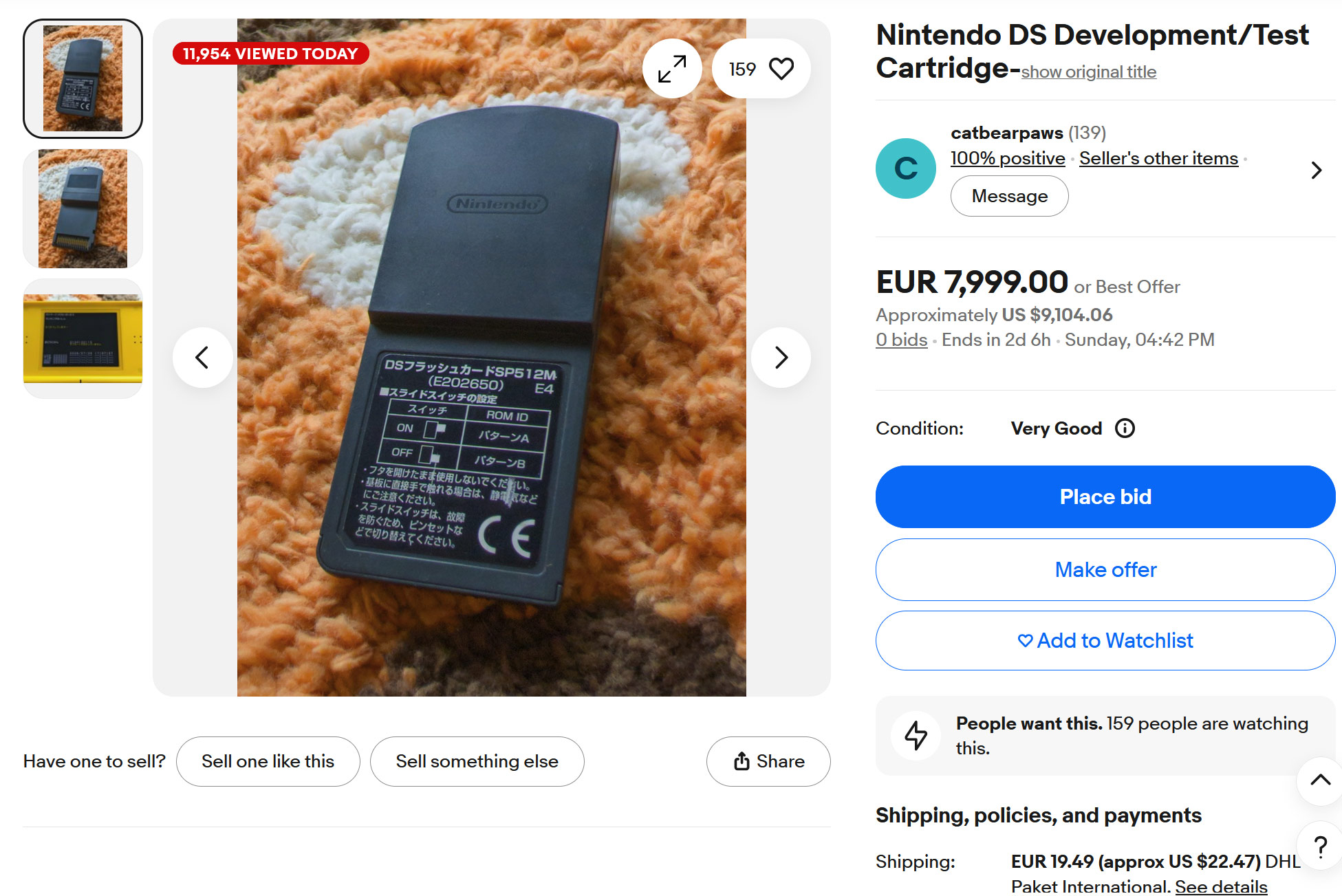
A Nintendo DS game that was classified as ‘lost media’ for nearly two decades is currently within tantalizing reach of video gaming fans and archivists. All the fans need is about $9,100, and no rival bidders on an eBay auction for an ultra-rare, perhaps one-of-a-kind, development cartridge thought to contain the PokePark Fishing Contest DS minigame.

Ultra-rare Nintendo DS Pokemon game on eBay

(Image credit: eBay)

Japanese game archaeology enthusiast Yoshino @ Federation (renpou.com) shared details of the eBay auction and its significance to their tens of thousands of social media followers.

So, what’s the deal with PokePark Fishing Contest DS, and why is it ultra-rare or even classified as ‘lost media?’ This fishing mini-game was lost for several reasons. Firstly, it was a download-only title. Secondly, its distribution was limited to those attending a short-lived Pokémon theme park venue in Japan (PokePark 2005). It also eluded archivists because it would be removed from a DS handheld when it was powered off, or after a 12-hour limit, whichever triggered first.

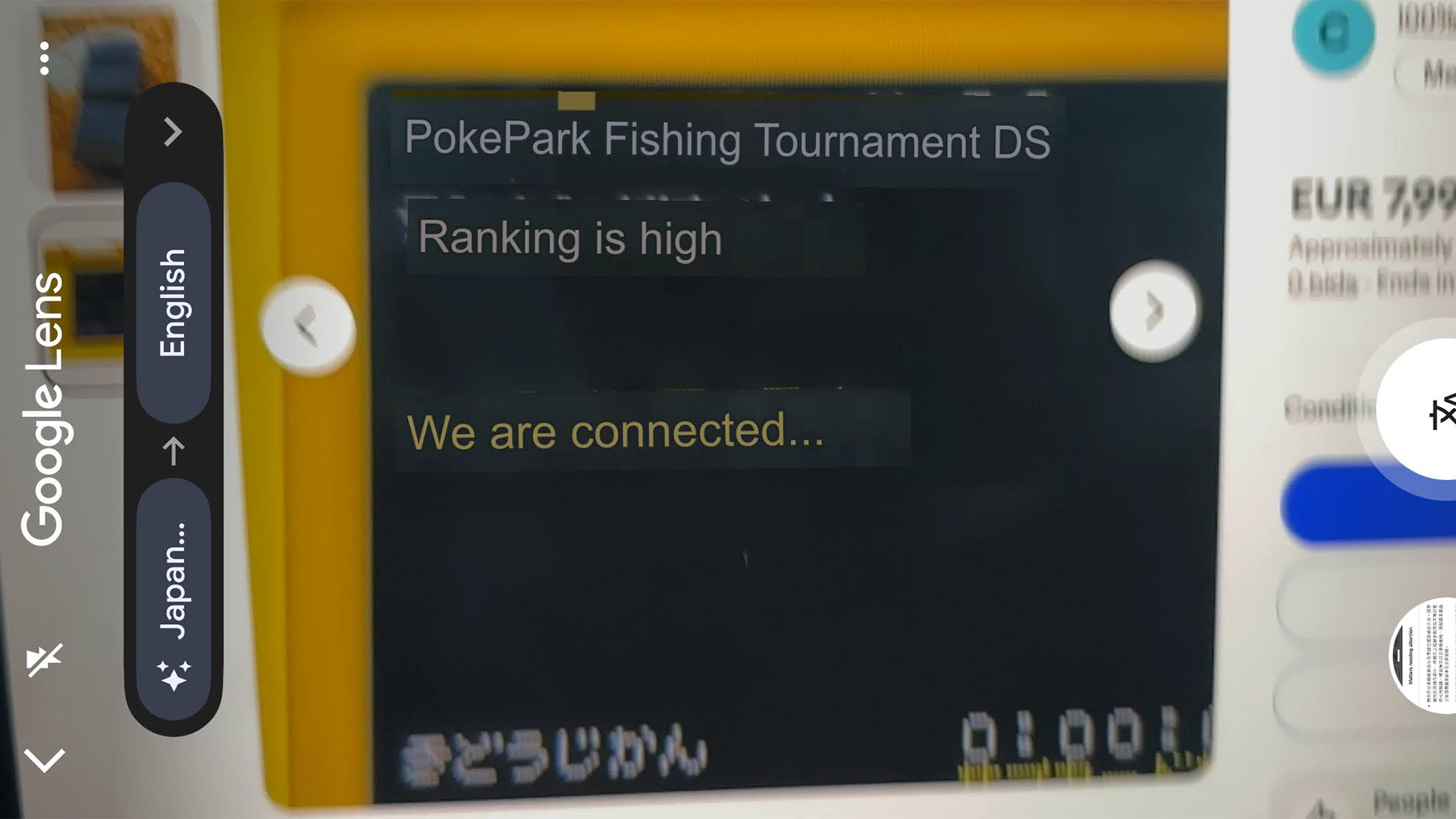
The eBay listing shows a large development and testing cartridge, front and back. There’s also an image showing the cartridge working. However, the on-DS-screen proof of viability is limited to “a Japanese-language screen indicating a high-score ranking communication program.”

The Germany-located seller, catbearpaws, says the cart was acquired as part of a private lot, and is selling the hardware as-is, with no promises regarding functionality, compatibility, or provenance. Catbearpaws has a 100% selling record and is asking for bids starting at €7,999 ($9,100), with less than three days left to run. They also may accept offers via the eBay Make Offer button/process.

Ultra-rare Nintendo DS Pokemon game on eBay

Machine translation of eBay listing Nintendo DS screen content (Image credit: eBay)

Our machine-translated version of the eBay listing screen content appears to confirm that this is indeed a dev cart that was used for hosting “PokePark Fishing Contest DS” assets of some kind. Whether a playable version of the game can be downloaded, transmitted, or extracted from this hardware remains to be seen. As mentioned, the seller isn’t guaranteeing anything about this expensive but potentially important retro gaming artifact.

PS5 emulation hits new milestone in record time, multiple 3D games now playable in Kyty — Performance and support steadily improving with 30 FPS gameplay possible today

The state of PlayStation 5 emulation has been rapidly evolving, partially in response to Grand Theft Auto 6's release later this year. The latest milestone is the first 3D games being playable at very respectable framerates of around 30 frames per second.

The two emulators at the forefront of all this are KytyPS5 and SharpEmu, the former of which is intensely focused on expanding compatibility. KytyPS5 was already able to boot 3D titles and go until their loading screens, with at least two smaller games actually rendering graphics. Now, the same emulator can run two 3D games at around 30 FPS, though there are some glitches.

The first game is XIII, the 2020 remake of the 2003 classic, and it's "playable" at up to 30 FPS with real-time gameplay that accepts player input. We put playable in quotation marks because there are very obvious visual glitches that manifest in the environment not rendering correctly. The textures seem to be broken in multiple scenes, though they don't entirely kill the immersion. XIII is a relatively lightweight game but its cell-shaded aesthetic might be adding to emulation complexity.

Another playable title joins the growing list for the Kyty PS5 emulator.XIII is now playable at around 30 FPS.Current status:• Playable• Runs at 30 FPS• Minor graphical issues remainIt's another encouraging step for PS5 emulation, with compatibility continuing to… pic.twitter.com/5rEpvcbvTbJuly 29, 2026

The same person who tested XIII also tested Teenage Mutant Ninja Turtles: Wrath of the Mutants and managed to run it at just under 25 FPS with real-time gameplay. The game crashes on the first launch, but once initialized, it's stable and does not seem to have any bugs or glitches like XIII. The framerate looks visibly choppy but is undeniably impressive, on a technical level. Kyty can run other 3D PS5 games as well, but not nearly at this level of performance.

Kyty PS5 emulator keeps making impressive progress.Teenage Mutant Ninja Turtles: Wrath of the Mutants is now playable at around 22-24 FPS.Current status:• In-game• 22-24 FPS• Crashes on the first launch• Runs without further crashes after restartingI feel it's… pic.twitter.com/pCkHu11cbIJuly 29, 2026

KytyPS5 is advancing at a faster pace than SharpEmu, and that's true for the most part, but not out of stagnation. The team behind SharpEmu is busy tackling a different challenge: accuracy and infrastructure setup rather than game-specific compatibility, per its GitHub repo. In other words, it means fixing low-level issues that are preventing games like Astro Bot from currently reaching the gameplay state.

Both emulators are now part of an unexpected emulation race. With GTA 6 just a few months away and GTA 5 already booting in Kyty, it clearly has the better support for now, and its demos are very promising. SharpEmu's work will undoubtedly help the emulation scene at large, along with RPCSX and other independent developers. The craziest part is that you can try all of this at home for free, and just by doing that you're already contributing to the scene.

Ambitious gamer turns fanless Subway menu PCs into gaming rigs — passive Intel Core i3 units manage just 15 fps in GTA V and 25 fps in Minecraft

31 July 2026 at 11:20

An intrepid TechTuber has tested a trio of passive mini PCs from the Subway sandwich chain to check if they can be repurposed for gaming fun. In a recent video, Garkus indicates that the three Intel Skylake-powered mini PCs that had been displaying sandwich menus above the serving counters for a decade but were saved from scrap/landfill, alongside a matching set of LG digital signage TVs. Spoiler: they are too puny for mainstream AAA gaming in 2026, even after doubling the RAM installed.

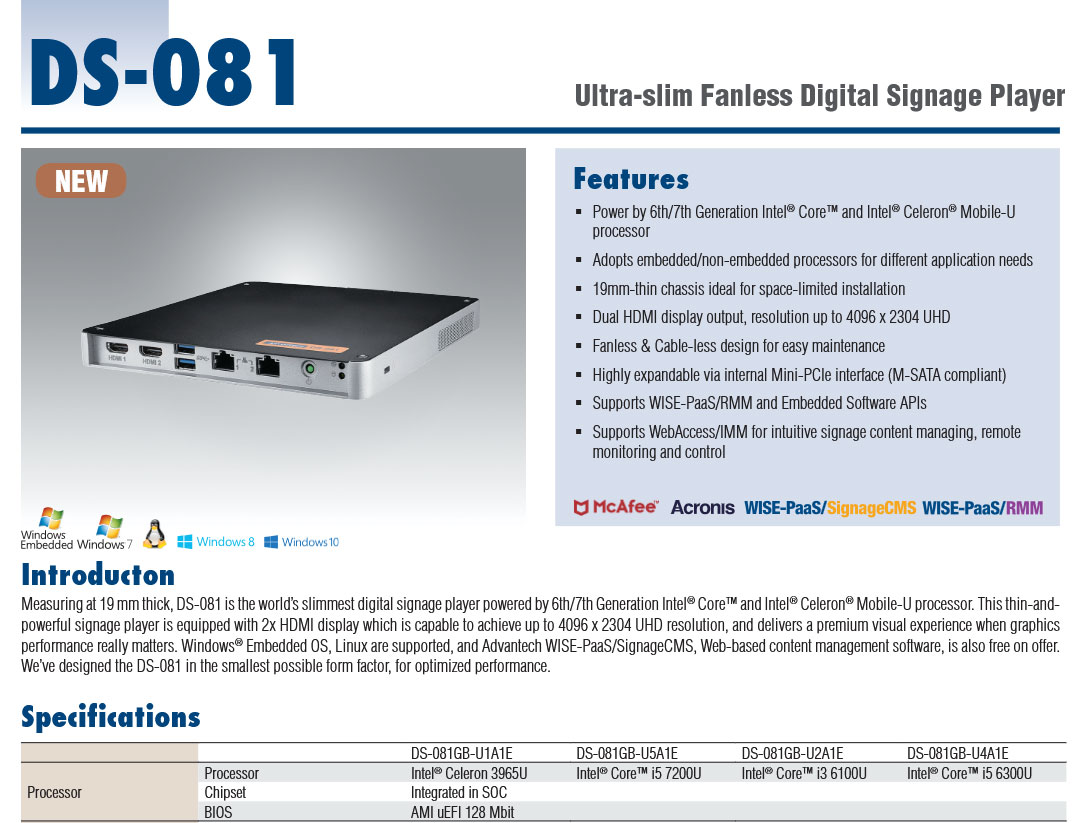
Before getting on with the digital signage-to-gaming conversion, Garkus investigated the hardware in hand. Labeling indicated that the three slim mini PCs were all Advantech DS-081 models (official PDF link). Pondering over that data sheet, we see that the variant with the Intel Core i3 6100U, as these were, carries the full designation of DS-081GB-U21A1E.

The processor is now both long in the tooth and low powered, so immediately we know this 2C/4T @ 2.3 GHz CPU, configured to suck between 7.5W and 15W, won’t be ideal for modern AAA titles. Moreover, the iGPU is the Intel HD Graphics 520 with 24 EUs and clocks up to just 1.00 GHz, sharing the DDR4 system RAM.

A DS-081GB-U2A1E is quite expandable for such a small, low-powered set-it-and-forget-it unit. It has twin HDMI 1.4, twin Ethernet, four USB 3, audio in/out, and an RS-232 serial port accessible from the outside. Inside, users can configure the machine via twin DDR4-2133 SODIMM slots (up to 32GB total), a SATA III HDD/SSD, and an mSATA port that looked like it was an M.2 2242 slot in the video. This passive machine is designed to run signage 24/7 in environments with 0 ~ 40° C (32 ~ 104 ° F) ambient temperatures.

Advantech DS-081 passive mini PC for digital signage

(Image credit: Advantech DS-081)

Setup and gaming

These systems were found to actually come with just 4GB of RAM (one slot used) and with a 64GB SATA SSD installed. They booted to Windows and went straight to kiosk mode, displaying the Subway sandwich menu. We saw an extra 4GB DDR4 stick added to bring the test system(s) up to 8GB RAM in total.

After a bit of OS wrangling, Garkus decided to set up the salvaged trio of passive mini PCs as follows. One kept Windows 10, another got Bazzite Linux (because SteamOS balked at the SATA-only storage), then another went Hackintosh with macOS Monterey installed.

Gaming tests began with a very light test. The system ran Peggle, and this 2D puzzler posed no problems. After this modest victory, Garkus ambitiously leapt straight to GTA V. This legendary but now older title could only reach a frame rate of about 15 fps. But it was found to have defaulted to high settings, took ages to get ready to run on Bazzite, then crashed on exit.

Probably not following best benchmarking practice, the tech tinkerer appears to have decided to test Mario Kart Wii emulation performance while GTA V was still compiling shaders… Later, a test run in Minecraft delivered a wildly inconsistent but roughly 25 fps performance. As is now established as the Garkus testing MO, resolution, quality settings, and so on weren’t shared.

To conclude the gaming part of the video, the TechTuber suggests that these ex-kiosk machines are probably best suited to emulating older consoles up to the PS2 and original Xbox era. We think that for PS2 emulation, you will still need to restrict yourself to lighter titles and reduced settings for smooth action.

❌