The first study of its kind shows that ecosystems experience far more cumulative heat than standard measurements reveal. A marine heatwave may have an official beginning and end, but the warm water affecting an ecosystem often does not. Like a pot that continues absorbing heat over time, coastal waters can remain unusually warm for weeks [...]
Climate change's impacts are being felt everywhere, from health and food security to extreme weather, sea level rise and collapsing ecosystems. World leaders have been slow to adapt to the warnings, despite an ever-growing body of evidence showing the compounding risks of greenhouse gas emissions.
But despite fossil fuels remaining the world's primary source of energy and emissions continuing to rise, there are changes afoot.
In his book "Despite it All" (Granta, 2026), author and journalist Fred Pearce looks at the shifts that have taken place over the last 40 years, highlighting how far humanity has come in the green transition. He believes this progress gives us reason to hope that we can eventually overcome the challenges we face today.
Pearce spoke with Live Science about his book, which has been shortlisted for the 2026 Royal Society Trivedi Science Book Prize.
Hannah Osborne: There are a lot of positive environmental stories throughout the book, including those that aren't necessarily being told. Do you think that there is a growing appetite for positive climate news now? And will it help us?
Fred Pearce: I detect a kind of desire to be told something other than it's all hopeless and there's nothing we can do. Some people are therefore saying, "Well, what can I do?" And they're very sort of personal stories about how they can contribute. But also people who think more, if you like, strategically: What can the world do, what can governments do, what, how can we influence that?
I try not to write what I think people want to read. I try to write what I want to say. And it seems to me that we do so many things so badly, whether it's managing our resources or water or handling forests or the climate, or pollution or whatever. We do things so badly that there is a great deal of scope for doing things a lot better. So, we need optimists and we need pessimists. We need pessimists to point out the problems. We need optimists to come up with some solutions or suggest where [there are] half open doors that we can push open.
I wrote this book in that kind of spirit to say "Look, yes, things are bad, yes, I'm not denying that they're bad, but there's an awful lot that we can do about it and in some cases are doing about it." That then divides into whether we're talking about human activity, our technical solutions to climate change. Tech fixes are good, not bad, which is something that can be a hard sell in the environment community sometimes, so I want to stress that.
I went to the Earth Summit 30 years ago where they agreed [upon] the original climate change convention. Back then they said we [need to] prevent dangerous climate change, but they really didn't know much about how to do it. Wind turbines were just, you know, a few masts on a hill in California. Nobody was dealing much in solar power because it was just so expensive. It had been developed for powering satellites and electric cars. Nobody was talking about [it].
We have made quite a lot of progress and it's not fast enough and CO2 emissions are stable, they're not going down. We need to do a hell of a lot more and we may have passed climate tipping points. I'm not denying any of that, but rather than throwing up our hands or saying it's hopeless, let's get on with the tech, let's also recognize that nature is very good at recovering. You destroy a forest, a rainforest, it doesn't mean that it's destroyed forever. It will, given the chance, come back if we give it room. So let's give forests room to recover.
In large parts of the world it's already happening — in Europe, even in North America. Agricultural land is being abandoned, and when it's abandoned nature comes back and not necessarily in the sort of ways that we might think. But nature does come back, stuff regrows. We can see how evolution is being kickstarted, if you like, by the chaos that we're creating. That's not to say we shouldn't stop creating the chaos, but we can see how nature recovers.
These are things that we can recognize and respond to; giving nature room to recover, rewilding projects, therefore I'm all in favor of [them]. We're not rewilding where we're trying to garden nature to get back to some sort of perfected past, a pristine system where we thought that everything was great — pre-industrial revolution or before Europeans arrived in North America or whatever it might be. But, we can give nature room to evolve and adapt and change. We can see that nature's doing that all the time, with or without climate change and with or without humans. Nature is constantly, if you like, remaking itself.
I'm not saying nature always comes back in ways that we approve of. Let's recognize the distinction between our sort of slightly romanticized idea of what nature should be and what nature actually is.
HO: You talk about rewilding and letting nature take its course, but how do humans fit in with this? Can we adapt our own perceptions of what nature is allowed and what's not?
FP: I think we can probably forget about what's allowed and what's not. Nature will do what it wants to do. We pride ourselves on our ability to garden nature in a way, or manage ecosystems. We're not really very good at it. Nature will very often take over and do what it wants to do.
Some of the world's biggest rewilding projects have gone quite badly wrong because we haven't quite thought it through. The one I'm thinking of really is the large project in the Netherlands where they're trying to sort of recreate ancient European ecosystems and they ended up with mass deaths of animals because their conception of the ecosystem didn't quite figure out. They then largely abandoned the project because they didn't like to see large numbers of animals dying.
A hardline rewilder would say let nature take its course. I see the case for that, and often I would support that, but we have our own sensibilities and our own concerns and we are living in a world where we are very much in charge of what's going on. So while I'm in favor of standing back and letting nature take its course, we have our own sensibilities, and it's not wrong for us to want to intervene sometimes.
The UN International Conference on Population and Development in Cairo in 1994. (Image credit: Getty Images)
HO: There's a chapter on human population and fertility rates, and how this is very much a climate change story as well. We're now seeing a lot of the rhetoric around this, and rights being stripped back and taken away. What's it like for you, having seen the changes from the UN International Conference on Population in Mexico in the 80s, to Cairo in the 90s to now?
FP: It's an extraordinary story. I've been working on these issues for 40 years now so I've seen a number of changes. Some of the changes I've seen are how technical fixes somehow became a reality when they seemed very distant a while ago.
But our perceptions change too on many things. We are, in many ways, more attuned to environmental issues now than we were 30 or 40 years ago. One of the big changes that I've seen is the notion of the population bomb, which for much of the 20th century was seen as the number one issue. People would say, "Well, there's no point in fixing the climate, there's no point in reducing our pollution because there are more and more people on the planet, and we're kind of doomed for that reason."
Well, it hasn't [happened]. When I went to my first international conference, which was the UN Population Conference in Mexico City in 1984, that was all the rage. They gave the UN Population prize to the mastermind of China's one child policy, which — in terms of human rights and what I would regard as acceptable human behavior — was dreadful. But such was the concern about population issues that they wanted to give a prize to the operator of that program.
A lot has changed. A feminist agenda, if I could put it that way, and I would say that approvingly, has taken over in reproductive politics. I saw it at a UN population conference in Cairo in 1994, 10 years after the Mexico event, that we need to assert reproductive rights. Many environmentalists said that's a cop out. It was all "it's feminist perspective, but it's dooming us."
Well, it didn't, because what we found was that by and large, women wanted to have smaller families because their children got to grow up. Medical improvements meant that you didn't have to have four or five children to secure the next generation. Two would usually do, sometimes you just wanted one. Women wanted to have lives outside the home. The population people seemed to be a bit surprised by that.
The environmental agenda was a very male-dominated one for a long time. So that came as a bit of a surprise, but the net result is that we've halved our fertility rates. They're more or less down to replacement levels [of reproduction] now globally.
I'm not just talking about Europe or North America. I'm talking about almost everywhere except Africa, and African levels have come down. Sometimes they're coming down to super low levels, so that people are now talking about not having enough babies and how we can encourage people to have babies. There are parts of the world where we're down to one child per woman and even a bit less.
My argument is that we need to carry on. Not take a sort of Elon Musk approach [or] send the women back to the home and [do] reproduction and that's what their job is. We need to complete the feminist revolution so that women have more rights, can make better choices, and indeed couples can make more and better choices about the family size that they want. We can arrange things so that it is possible to have children and a career, or make it easier to do that, and at that point probably reproduction levels will come back up.
What I'm really saying is that the agenda is now vastly different from what it was as recently as the 1980s and, and into the 1990s. The population bomb is being defused, to put it simply, there's a residual momentum effect which means that our numbers will carry on going up a bit. Sure, that creates strains on the planet, but we're not now talking about double the world population every 30 years, which is what was being talked about back in the mid 20th century. It's tailing off.
We now have, if you like, a consumption bomb more than a population bomb. The global issue is consumption in the rich world, and that's what's stressing the planet now — not too many babies in poor parts of the world.
It's important to level up, but also level down from the obscene riches that we see among a small number of individuals
HO: Inequality between the super rich and people in developing countries is becoming more and more stark. How do we bridge the gap to make sure there's a reasonable living standard for regular people without a huge cost to the environment?
FP: The truth is, and the numbers have been done by a number of different people, a reasonable standard of living for everybody on the planet is perfectly feasible without destroying the planet.
We need to do some things better, we need to have better technology, but for me, right up there with climate change is an issue of global inequality. When I was young, it was taken [that] inequalities were diminishing and it was taken almost as read that they would carry on diminishing, and a lot of aid policies were directed towards that. That's kind of disappeared since the sort of Reaganomics of the 1980s, all the changes in the finance system and perhaps the fall of the Berlin Wall, which meant that the sort of socialist or, or equality-based agendas collapsed politically.
We're now finding increased inequality, and that, it seems to me, is a threat to the lives of millions and billions of humans, but also to global stability and our ability perhaps to manage.
Serious global issues like climate change and many others are all undermined by the political stresses and economic stresses created by rising inequality. I see them going together.
It's also clear that it's important to level up, but also level down from the obscene riches that we see among a small number of individuals, who seem to be accumulating a greater share of the world's wealth, whether we're talking about dollars or natural resources.
HO: You have a whole chapter on renewables and how they're outpacing fossil fuels. They're the cheaper alternative. How do you see the political opposition to clean energy panning out over the next five to 10 years?
FP: It's fizzling out. It's a weird political backlash and yes, any big social trend or economic trend, they all have backlashes and it feels to me like this is it. What we see in the real world is that the U.S. — not just the U.S., but principally the U.S. — are in a state of near denial about climate and they're wanting to go back to fossil fuels.
In the rest of the world, if you look at it in terms of geopolitics of [the] U.S. versus China, then the U.S. is pushing this rather old agenda of fossil fuels, and China is absolutely going to reap the benefits in many, many ways in its drive towards renewables. China has been a really bad story in the past with its coal burning — and it's still building a few coal-fired power stations. But the really big story is how China has been principally responsible for bringing down the costs of renewable energy, particularly solar power.
You can now go to the most remote corners of rural Africa and you find people putting up their solar panels to recharge car batteries so that they can run their lights in the evening or whatever it is. And then you've got megacities operating using increasing amounts of solar power. India is getting on the bandwagon as well. It's got the fastest growing solar energy economy in the world.
In the real world, renewable [energy] is mostly cheaper than fossil fuels. It is also quicker to install, you don't have to build a huge power station, you can do it in bits and pieces, bolt bits on.
Yes, there are grid issues and they need to be addressed, and there are limits on operating. There are challenges, but renewables are just growing so fast, and it is growing so fast because it is so cheap.
And it's become so cheap, to put it very simply, because the Chinese 20 or 30 years ago decided this is what's going to happen. While everybody else was sort of talking about it and fussing about it and doing it in research labs, the Chinese kind of got to grips with it. I remember back in the 1990s talking about people who were going into China and coming back and telling me stories about how the Chinese are really serious about renewable energy. To be honest, I didn't quite believe them, but they were right, and 30 years on, the world is living with the benefits. That's true whether you're talking about Europe or rural Africa or big cities in Asia or wherever. It's coming.
There will be different solutions in different places and there are undoubtedly things that are harder to do than, you know, running our national grids on renewable energy, which is becoming really quite easy and something that everybody wants to do. The cement industries, fertilizers perhaps, some of these industries will take some more technical innovation. But it's happening, these are technical fixes that are working in the real world. Will we do it in time? Well, we're a bit late on the case, but we are on the case.
A large data center being built in Vernon, California. (Image credit: Myung J. Chun/Getty Images)
HO: We're now seeing a massive rise in AI data centers as well. Is this bad tech, shall we say?
FP: It's a serious issue. Partly because they're growing so fast — they can't just plug into the grid because the grid really can't deliver, so these companies are developing their own energy systems. Even in the U.S. they are very often renewable systems because they're cheaper. If you've got a data center out in Texas, then you're going to use wind power or solar power because it's cheaper and you're in control of it.
I suppose we reach a point where [we have to decide], do we want to reduce our use of energy or have almost as much energy as we want, but just green it and green it very fast. It is true that if all the renewable investment is going into electricity for data centers, that leaves less investment for other sectors of the economy, so I'm sure there are trade-offs, and I'm not saying that we should embrace data centers. But they can be a driving force for adoption of different forms of energy, renewable energy, and for perhaps changes in the grid systems as well.
I think we can have both. I think we need to have both because we're probably not going to stop the data engines, so we've got to find ways of greening them. There are issues and there are challenges ahead, and I don't want to diminish any of those, but you know, let's, let's be hopeful.
The title of the book uses the word hopeful rather than optimist because I don't want to sound Panglossian, but I do want to inject some hope.
HO: When you started writing the book, what did you hope people would take from it, and did that change after you'd finished?
FP: Well it kind of evolved. It began as an idea to sort of [be a] retrospective of my reporting, and then the publisher said, "Well, the story changes rather a lot along the way, so rather than just showcasing your reporting over 40 years, why don't you showcase the change, and be hopeful in the context of how things have changed over the last 40 years?"
That was [the] kind of starting point, and we sharpened up on it, as we went along it did become "Despite It All" and you know, the title is important, and not diminishing the "All." There's a lot of bad stuff out there, but despite it all we can have hope and we can find, develop and demand solutions.
HO: Did you find anything during the process of writing the book that surprised you?
FP: As I say, it started as a sort of retrospective project and going through it, [there were places I went years ago] and it did look bad, then I checked up on what had happened over the intervening years and suddenly things looked a lot better.
I went to Alaska and saw how the conflicts over managing caribou herds and the huge migrations that go on and it felt like that was doomed. I was talking to people who were hunting the animals and they were trying to protect them because they wanted to hunt them, therefore they wanted them still to be there, which is kind of counterintuitive for many environmentalists, but you know, they were the best defenders of the caribou because they ate them.
But it felt doomed, and yet 20 years later I checked out the numbers and the population of that herd has doubled and tripled. So stuff does happen and I suppose my surprise was how much good change I found when I looked into it further. Maybe that's me being better at looking for good news stories. I've written quite a lot of "bad news" books over the years and done a lot of "bad news" journalism over the years, so I certainly don't discount that. But if you step back and you think, well did good stuff happen? Well, yeah, sometimes it did.
The bison herds are coming back on the plains of parts of North America, if you go to Montana. The ranches are disappearing and big areas are being set aside for bison, and I've been seeing how farmland in parts of southern and eastern Europe has been abandoned over the years. It's not necessarily good news that we're abandoning farmland, but again, the way that nature comes back and woodlands are growing, there are more forests in Europe than there have been for probably centuries.
There's a lot of bad stuff to say. But it does seem to me that we have to not just cling onto, but embrace good stuff and try [to] take it forward.
Something I really hadn't thought about till I went back was what were the big issues in the 1980s, 1970s when I started out. Well, all our industrial rivers in Britain were filthy. Now our industrial rivers are relatively clean. It's our agricultural rivers that are filthy, so, I mean, there's been a big change there.
Nobody has to talk much about the ozone layer now. That was the number one issue in the mid 1980s, and the absolutely terrifying prospect if we hadn't fixed that. But it's been fixed.
We banned the chemicals that were doing it.
Remember acid rain, lead in petrol. They were hot topics, headline news, part of the rise of the environmental agenda in the 1980s — and they're the ones that we don't have to talk about anymore.
Now we're talking about climate change. I think there are other things coming up. I think the issue of nitrogen pollution is a fast growing one, and we need technical solutions to that.
The green revolution of crops, the high-yielding crops, which got us out of a cycle of ever worsening hunger and famines in the mid 20 century. That was a solution which created new problems. Those crops grew very well, but they required large amounts of inputs, including water, and water is now a growing issue — finding enough irrigation water, but also fertilizer and other agrichemicals. We're now reaping some of the bad effects of that, and we need to solve that. Scientists I know are working on, if you like, high-yielding crops that don't require so much fertilizer and don't require so much water.
It's doable because as I think I said at the start, we do a lot of things really very badly, but that does give us a lot of scope to do things a lot better, so let's get on with it.
This interview has been condensed and edited lightly for clarity.
Granta Books
Despite It All
In "Despite it All," Fred Pearce looks at the positive environmental changes that have taken place over the last four decades, from the defused population bomb to the unstoppable rise of renewables. While acknowledging there is still an enormous amount of work to prevent the worst impacts of climate change, Pearce shows there is hope for the future — HO
Biodiversity loss has been recognized as a threat to global stability for decades. The decline in overall diversity of species on our planet, either through extinction or a fall in abundance, can culminate in ecosystem collapse.
But in this excerpt from "Despite it All" (Granta, 2026), author and journalist Fred Pearce looks at the remarkable resilience of nature. If we can put aside our notions of what should and shouldn't be in a given environment and leave nature to adapt and thrive, we may begin to see the gains needed to support a healthy biosphere.
"Despite it All" has been shortlisted for the 2026 Royal Society Trivedi Science Book Prize.
If we are serious about rewilding, then we need to accept that it will take its own course.
Often invasive species are just the first stage of an ecological resurgence. They are the first movers, and their infestations are short-lived. In time, diversity usually returns — even if it's not always the same diversity as was there before. We should recognize that. We need to be as adaptable as nature itself, and jettison our more romantic notions about biodiversity and pristine environments.
So do many oldschool ecologists, says Chris Thomas, an ecologist at the University of York. They too often simply ignore any bits of nature that do not meet their expectations of what "should" be present. "The establishment of successful species in new locations is commonly interpreted as further evidence that the Earth's system is departing from a more desirable state," he told me.
So when biodiversity assessments are conducted, "alien" species lurking in the undergrowth are simply not counted. As outsiders, they are deemed not to belong to the ecosystem they inhabit. Thomas says that, in Britain, official records show biodiversity in decline, even though, if we add all losses and all gains together, "it is unequivocally true that the total number of species in Britain is increasing."
Most of the gains — the weeds, pests and alien species — are kept off the biodiversity books. This amounts to an ecological catch-22. Biodiversity can only ever decrease, as new species are seen as inimical to the local environment, and each year millions of pounds, dollars and euros are being spent to eliminate them.
We spend huge amounts of money trying to eradicate weeds, many of which may be beneficial for the environment. (Image credit: Catherine Falls Commercial/Getty Images)
Of course, it sometimes makes practical sense to eradicate invaders. I don't say we shouldn't try to keep out pests that cause short-term ecological mayhem and economic damage. But if we choose to get rid of new species, we can't then hold up our hands in horror at declining biodiversity. And besides, ecologically as much as socially, migrants can stir things up to good effect. They interact with other species — eating or being eaten, pollinating, and rotting after death to nurture new organisms.
We should embrace novel ecosystems that contain both what we regard as native species and the feral, opportunistic interlopers that find their new environment congenial. In his book about weeds, British naturalist Richard Mabey celebrated what he called these "outlaw plants" and showed how they have had a hand in shaping not only our landscape but our civilization, becoming crops, medicines and sources of beauty and creative inspiration.
It is easy to be nostalgic about past ecosystems as a golden age. But what we imagine to be the perfect ecological state — a supposedly natural order of things that often gets called "the balance of nature" — was mostly itself a passing phase. Nature is always moving on. And more often than we realize, humans have had a hand in what we now like to regard as natural.
We should be careful not to let our reverence for the pristine blind us to the environmental potential of today's wastelands
Environmental scientist Erle Ellis, who runs the Anthroecology Lab of the University of Maryland, argues persuasively that most of the planet has been heavily influenced by human activity for thousands of years, including places such as the Amazon that we often think of as untouched. We have, in effect, long lived on a "used planet," and humans and nature have not historically been at odds. The most biodiverse places are often those where people have lived the longest. By constantly tending the land, past civilizations created ever-changing mosaics of habitats where more species thrived than in places with less human interference.
So, we should be careful not to let our reverence for the pristine blind us to the environmental potential of today's wastelands, backwoods, abandoned fields, scrublands and no-go areas. In a Good Anthropocene we are likely to need more of them.
There is a final reason for believing that nature is equipped for recovery from almost anything we can throw at it. The apparent chaos of the Anthropocene is turbocharging evolution itself. Every perturbation of our environment creates an opportunity for existing species to adapt or for new ones to evolve, says Chris Thomas.
Plant evolution is happening at an increasing rate as species adapt to changing conditions. Allowing it to happen could help increase biodiversity. (Image credit: Rosmarie Wirz/Getty Images)
I first met Thomas in 2004, when he had just published an influential paper warning that climate change could wipe out a quarter of the world's species this century. He called it "terrifying." It was headline news. Two decades later, he has not changed that forecast, but he has added an important rider. Despite the coming extinction holocaust, he told me, "the Anthropocene could raise biological diversity."
His research is showing that evolution in the twenty-first century is speeding up to fill the gaps left by the extinctions — delivering new and better-adapted species. "The seeds of recovery are already visible," he told me. "Genes are jumping around. New species are beginning to emerge." Rob Dunn, an ecologist at North Carolina State University, agrees. In his book "A Natural History of the Future," he says that this evolutionary spurt is happening fastest in urban landscapes, where species are adapting to city life with almost as much alacrity as newly arrived humans.
This urban ecological renaissance resembles the story of the finches on the Galápagos archipelago, which Charles Darwin observed to have evolved different beaks to match the food on the different islands. In modern cities, house mice have evolved to produce saliva with a chemical make-up better able to digest the carbohydrates available in urban food; cockroaches and bedbugs have developed resistance to pesticides and even learned to avoid sugar-impregnated bait; London's pigeons have learned to commute on the Underground. We have clothes moths and carpet beetles.
Such natural innovations may not always be cuddly, but they do show that nature is on the prowl in the Anthropocene. So where is biodiversity headed? It is undeniable that most species of plants and animals are currently in numerical decline in a human-centric world.
This global disturbance is favouring some generalists — so-called superspecies — that can occupy a wide range of habitats, displacing local, rare and specialist species. Locally, however, biodiversity has sometimes increased substantially, especially in the rich kaleidoscopes of gardens, parks, toxic brownfield sites, roadside verges and so on that humanity has helped create.
Such places may become crucibles for a biodiversity rebound. Understanding this reality should change how we do conservation. We should not abandon nature to its fate. Some of our favourite species will pass into history unless we act to save them, and I'd vote for action any day. But it does mean embracing rather than rejecting the processes of change. Change in the Anthropocene is good. We should be grateful that nature is finding a way.
This is an extract from Despite it All by Fred Pearce, published by Granta.
amazon
Despite It All: A Handbook for Climate Hopefuls
In "Despite it All," Fred Pearce looks at the positive environmental changes that have taken place over the last four decades, from the defused population bomb to the unstoppable rise of renewables. While acknowledging there is still an enormous amount of work to prevent the worst impacts of climate change, Pearce shows there is hope for the future — HO
Explorer for Artemis Geology, Lunar, and Earth — a NASA satellite program to study surface biology and geology on Earth, with technologies that could support future missions to the Moon and Mars.
Future Mission
NASA’s EAGLE program — Explorer for Artemis Geology, Lunar, and Earth — will be a series of satellite missions studying surface properties using technologies for Earth observation that will also benefit future missions to the Moon and Mars, where they could identify critical resources and safe landing sites.
The satellites making up the first two EAGLE missions will study biology and geology on Earth’s surface to support agriculture, disaster response, and other needs. Each mission will carry a different instrument with capabilities that complement each other. The first mission (EAGLE-VSWIR) is scheduled to take flight in 2028.
Mission Type
Orbiter
Target
Earth, Moon, Mars
Launch
No earlier than 2028
Objective
Study surface composition and changes
EAGLE-VSWIR
EAGLE-VSWIR (Visible to Shortwave Infrared) will observe the Earth’s surface every 16 days with a high-resolution imaging spectrometer, which measures light reflected from the planet’s surface, separating wavelengths across the visual and into the infrared spectrum. The patterns created by light being reflected or absorbed across this spectral range act like fingerprints, letting scientists identify the composition of the surface.
A similar instrument, NASA’s EMIT (Earth Surface Mineral Dust Source Investigation), has been monitoring Earth from the International Space Station since July 2022, characterizing the surface mineral composition of Earth’s arid lands, monitoring ecosystem status, and tracking health and safety hazards — such as methane leaks and acid mine drainage — among other applications.
EAGLE-VSWIR will have 25 times more capability than EMIT has today. This technological leap will allow scientists to map surface deposits of critical and rare-earth minerals, strengthen food security, and aid wildfire prevention and recovery. It can also highlight environmental hazards such as oil spills or landslide risks, and monitor water quality and availability.
The front of this image cube shows a region in Nevada observed by NASA’s EMIT imaging spectrometer; the cube’s sides show the spectral fingerprint for every point in the image and can be used to discover mineral resources. EAGLE-VSWIR will have 25 times greater performance beyond NASA’s current state-of-the-art EMIT.
NASA/JPL-Caltech
EAGLE-TIR
The EAGLE-TIR mission will provide Thermal InfraRed (TIR) imagery when it launches two to three years after EAGLE-VSWIR, measuring energy emitted from the surface and producing data that scientists can use to map temperature, composition, and critical mineral deposits. On Earth that would let researchers monitor wildfires and volcanic activity, track drought and water use by crops, study urban heat islands, observe the rates that snow or ice accumulates or melts, and better understand Earth’s resilient ecosystems.
EAGLE-TIR follows on from ECOSTRESS (ECOsystem Spaceborne Thermal Radiometer Experiment on Space Station), which has been observing Earth from the International Space Station since 2018. ECOSTRESS was designed to study how different ecosystems respond to drought and water stress, and the data has provided a vital understanding of how plants’ water use changes throughout the day. Since ECOSTRESS also measures emitted energy in the thermal infrared, its surface-temperature products have also been used for urban planning and wildfire monitoring.
Further innovation and lessons learned from ECOSTRESS has led to EAGLE-TIR, which will carry a multi-band thermal radiometer. EAGLE-TIR’s great strength compared to existing missions is that it provides detailed imagery of the entire globe every two days, day and night, at multiple wavelengths not available from other instruments.
This image shows the minerals contained in Namibian dunes using ECOSTRESS data. EAGLE-TIR will have more spectral channels to enable even better mineral discrimination.
NASA/JPL-Caltech
EAGLE Program
By advancing vital techniques for measuring our planet’s surface composition, resources, and hazards, the EAGLE program addresses critical needs in Earth observation, with technologies that can also transfer to planetary exploration, where they’ll serve as pathfinders for future missions to the Moon and Mars.
As the Artemis II crew came close to passing behind the Moon and experiencing a planned loss of signal, they captured this image of a crescent Earth setting on the Moon’s limb on April 6, 2026.
NASA
Featured Video
EAGLE
NASA unveiled the EAGLE program as one part of its “Ignition” event on March 24, 2026, when it announced a wide-ranging series of transformative agencywide initiatives. With EAGLE (the Explorer for Artemis Geology, Lunar, and Earth missions), NASA will deploy breakthrough hyperspectral images across Earth with later missions anticipated for the Moon and Mars in rapid succession. On Earth they’ll identify critical minerals for national security, enable precision agriculture, and support disaster response. On Earth and at Mars they will locate critical minerals and resources such as ice for propellants, rare-earth elements for technology, and construction materials for habitats.
EMIT
EMIT (Earth Surface Mineral Dust Source Investigation) measures the mineral composition of Earth’s dust source regions, to help scientists understand how they heat or cool our planet.
Join us for continuing coverage as our leaders discuss the agency's implementation of the National Space Policy and our plans to advance science and discover...
Google briefly allowed anyone to create AI-modified versions of satellite imagery available in Google Earth—before quickly reversing its decision as people shared examples of AI-generated pictures that illustrated the potential for misinformation and disinformation.
There is no shortage of generative AI tools that already allow people to create AI-modified images of real buildings and cities based on user prompts. But Google’s aborted attempt to incorporate its Nano Banana 2 AI image generator as a Google Earth feature made it even easier for anyone to create modified versions of authentic imagery depicting real locations—something that Google boasted about when initially promoting the new feature.
“For the first time, you can generate custom images using Google Earth’s satellite, aerial, and 3D imagery alongside Nano Banana, which creates concepts grounded in the real world,” wrote Bryan Horowitz, product manager for Google Earth, in a company blog post on July 30.
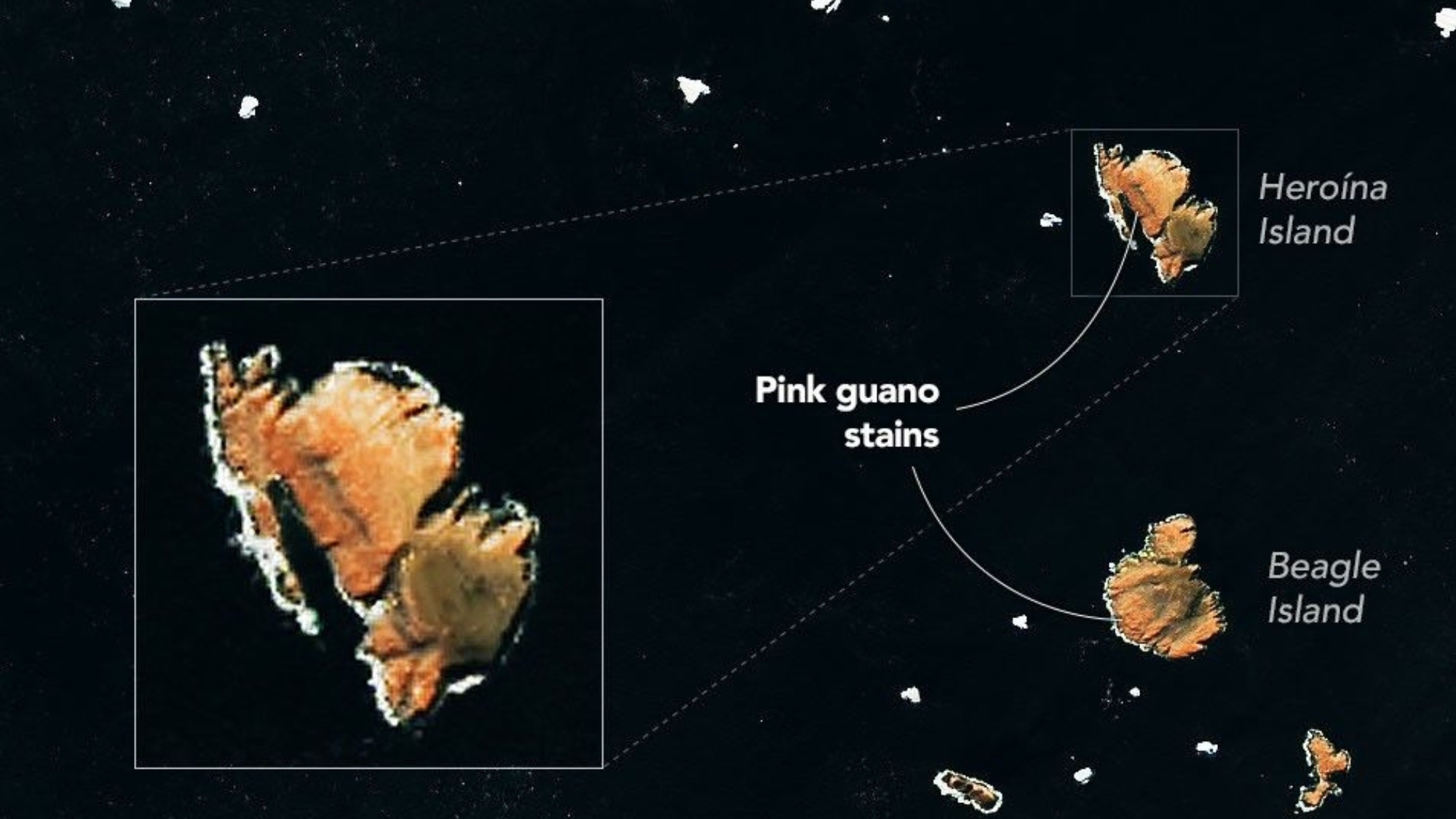
Pieces of sea ice drift near Antarctica's Danger Islands in this image, acquired on Jan. 22, 2023, by the Landsat 8 satellite. Several of the islands are stained pink by guano from Adélie penguins with a krill-rich diet. (Image credit: NASA Earth Observatory/Michala Garrison)
The diets of penguins on Antarctica's Danger Islands can be seen from space. At least indirectly.
Using satellite images captured by the Landsat 8 spacecraft operated by NASA and the United States Geological Survey, scientists can track changes in Adélie penguins' diets based on the color of their guano, or droppings.
What is it?
The image above shows pinkish-orange guano staining large sections of some of the Danger Islands, Heroína Island and Beagle Island. The penguins that live there eat a diet rich in krill, small marine crustaceans that are bright pink in color due to a specific type of algae upon which they feed.
A group of Adelie penguins jumping from ice pebble to ice pebble on a beach of Paulet Island on the tip of the Antarctic Peninsula. (Image credit: Wolfgang Kaehler/LightRocket via Getty Images)
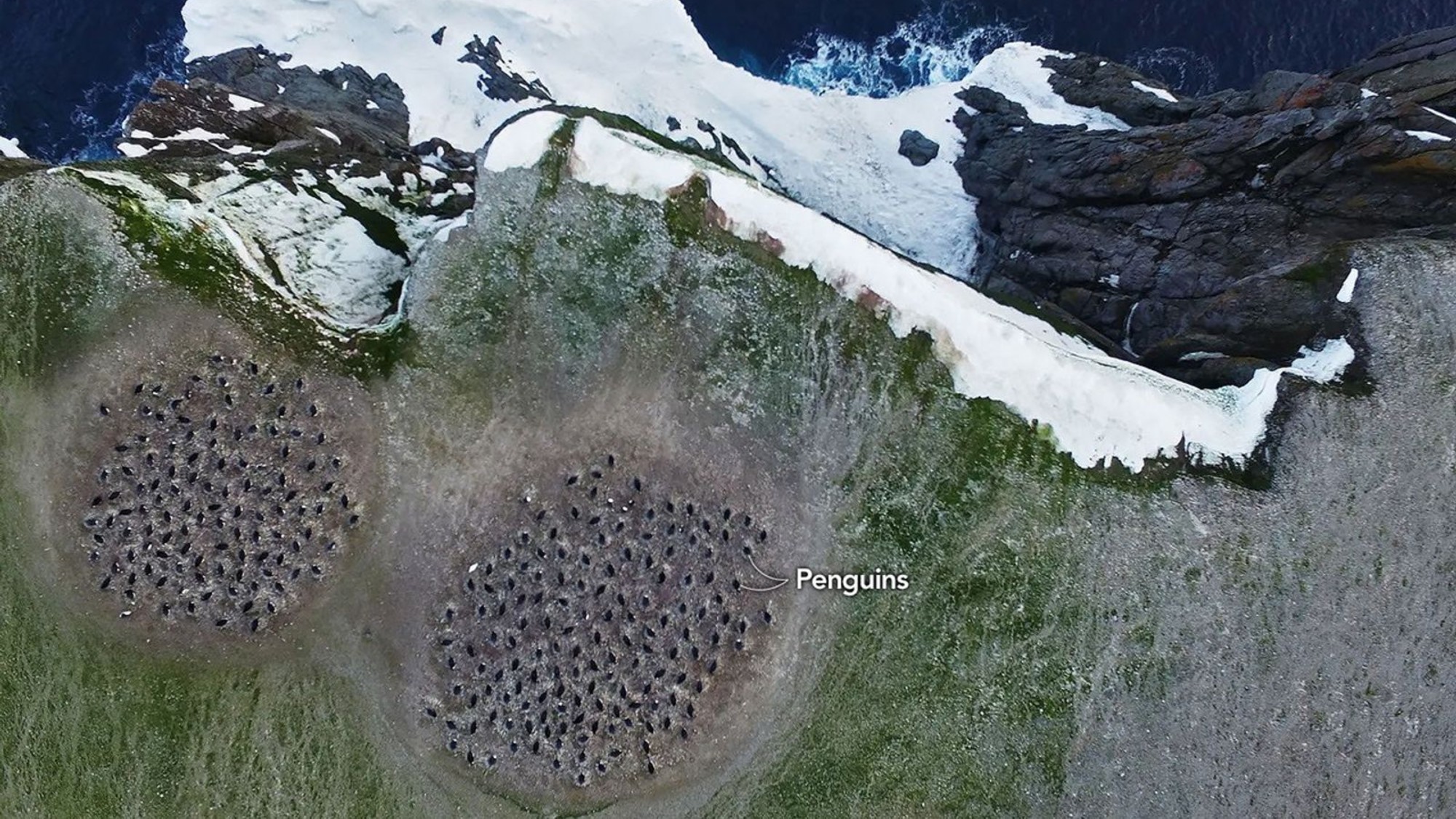
The bright pink color of the penguins' droppings stands out in satellite imagery, allowing researchers to monitor the birds' populations from space. But scientists wanted a closer look, and collected drone imagery as well, as seen in the image below.
A colony of Adélie penguins is visible in this image captured by a drone during a research expedition to the Danger Islands. (Image credit: Thomas Sayre-McCord/WHOI/MIT)
Why is it incredible?
It's pretty amazing that the diet of a specific population of birds can be monitored from 438 miles (705 kilometers) above Earth's surface. The imagery collected by Landsat-8 helped scientists locate where the penguin colonies might be, allowing them to find them in-person and collect guano samples. Those samples contained evidence of what the penguins were eating over time.
Researchers are using those satellite images and samples to track how the penguins' diet might be affected by changes in sea ice conditions, according to a NASA statement.
"Sea ice is such a hugely important factor in the Antarctic marine environment," said Clemson University biologist Casey Youngflesh who led a study comparing the penguins' diet and sea ice conditions. "The structure of the region's food web is changing in response."
The end of July brings the Alpha Capricornids and the Southern Delta Aquarids, both of which will be most active on Thursday night into Friday morning.
The Chicxulub impact not only plunged Earth into an impact winter but also produced a dust blanket that later overheated the planet, according to new research from Purdue University and the University of Colorado, Boulder.
While millions around the world grappled with extreme heat this month, a research station in Antarctica recorded Earth's coldest temperature since 2012.
The high-altitude research station, named Concordia, logged a low of minus 119.4 degrees Fahrenheit (minus 84.1 degrees Celsius) on July 18, according to data from the station.
Concordia is located in the interior of the Antarctic continent, which is currently in the dead of winter with no sunlight. Temperatures at the station regularly fall below minus 112 F (minus 80 C) this time of year — so the new reading isn't unprecedented, but it's still significant.
"Even here, where extreme cold is expected, temperatures below minus 84 C are remarkable and highlight how variable Antarctic weather can still be," Gabriele Carugati, the station leader at Concordia for Italy's National Antarctic Research Program (PNRA), told Live Science over a video call from the station.
The French Polar Institute Paul-Émile Victor, which runs Concordia with the PNRA, sent Live Science raw data from July 18, which showed the temperature dropping to minus 84.1 C twice, at 6:25 a.m. and 6:34 a.m. local time.
The extreme chill at Concordia stands in sharp contrast to the sweltering heat that many countries are currently experiencing. North America and Europe have been battling heat waves this summer, with Western Europe recording the hottest June on record. Meanwhile, wildfires are raging in Canada, the U.S., France, Spain and other countries.
Globally, average temperatures are going up as humans pump more heat-trapping greenhouse gases into the atmosphere. However, Earth's weather systems are complex, and climate change doesn't mean that everywhere gets hotter all of the time.
"Climate change describes the long-term global trends, while individual weather events can still [bring] exceptional cold," Carugati said. "Antarctica is influenced by complex atmospheric processes, so an extreme low temperature at one location does not contradict the broader picture of global warming."
"Astronauts of ice"
Concordia is considered the most remote and extreme research station in the world. Built on top of a 10,800-foot-thick (3,300 meters) ice cap, the station is used for a variety of purposes, including seismic observations, astronomy and the modeling of Earth's past climates, according to the French Polar Institute Paul-Émile Victor.
"Concordia is a special place because it sits at over 3,200 meters [10,500 feet] above sea level on the Antarctic Plateau, and more than 1,000 kilometers [600 miles] from the coast," Carugati said. "During winter, there is no sunlight for months, the atmosphere is extremely dry and stable, and under clear skies, heat continuously escapes to space because there are no clouds, allowing temperatures to fall to extraordinary levels."
Concordia's environment is so harsh and isolated that the station is also used to improve our understanding of the physical, mental and social challenges astronauts experience in space. Carugati noted that the only person at the station who is not researching the environment is a European Space Agency biomedical doctor, who is studying the researchers who work there, nicknamed "astronauts of ice."
Planes can't fly to Concordia once winter sets in, and it's around 370 miles (600 kilometers) from the nearest research station. That technically makes crews more isolated than astronauts on the International Space Station, which orbits about 250 miles (400 km) above Earth, according to the European Space Agency.
What is the coldest temperature ever recorded?
The coldest temperature ever recorded at Concordia was minus 120.5 F (minus 84.7 C), logged in the winter of 2010, according to the Italian Antarctic Meteo-Climatological Observatory. However, another high-altitude research station in East Antarctica has the all-time record for the coldest temperature ever recorded on Earth. Russia's Vostok weather station, the nearest station to Concordia, recorded a temp of minus 128.6 F (minus 89.2 C) in July 1983, according to the World Meteorological Organization.
Satellite data suggests that temperatures can drop as low as minus 144 F (98 C) in East Antarctica, according to a 2018 study published in the journal Geophysical Research Letters. However, even though Antarctica is the coldest and driest continent, it's not immune to global warming.
Major glaciers and the ice sheet they support are at risk in West Antarctica, with the Antarctic Peninsula — which extends out of the western side of the continent — experiencing the most rapid warming. A study published in February in the journal Frontiers in Environmental Science found that decisions made on greenhouse gas emissions today will determine how much the peninsula will change in the coming centuries, with sea ice, ice shelves and glaciers, along with the penguins that live on them, at risk of disappearing.
Concordia sits on the largest ice sheet on Earth. This sheet in East Antarctica is more stable than the smaller sheet of West Antarctica, but it is still vulnerable to rising temperatures. An unprecedented Antarctic winter heat wave in March 2024 saw temperatures near Concordia rise to a record high of 15.1 F (minus 9.4 C) — about 32 F (18 C) warmer than the previous March maximum. This East Antarctic heat wave was amplified by global warming, according to a study published in April in the journal npj Climate and Atmospheric Science.
Earth recently entered an El Niño, the warm phase of a multiyear natural climate pattern, which could bring unprecedented temperature extremes to an already-warming world. Carbon Brief, a U.K. based outlet that reports on climate news and policy, has predicted that 2026 is likely to be the second-warmest year on record, behind 2024, with the intensifying El Niño increasing the likelihood that 2027 will be the warmest year ever recorded.
For now, at Concordia, the researchers are continuing their work in the blistering cold of Antarctica's winter. Carugati noted that the latest extreme-temperature data will inform forecasts and long-term climate monitoring.
"Extreme observations like this help scientists better understand atmospheric processes and improve the climate models," he said.
An ecological "superspreader" event may be imminent as more than 1,500 ships continue to idle in the closed Strait of Hormuz, with the potential to cause serious impacts for human health and global marine ecosystems, scientists warn.
In a study published July 22 in the journal Biological Invasions, scientists explain how the hundreds of stranded commercial vessels sitting idle on both sides of the strait are being colonized by marine microbes, algae, seaweed, barnacles and other invertebrates. The problem is that once these ships start moving again, these organisms will be spread all around the world.
"The unprecedented scale and duration of this spring and summer mass lay-up of large commercial ships has created ideal conditions for a marine invasive species 'super-spreader' event," Mario Tamburri, a professor at the University of Maryland Center for Environmental Science and first author of the study, said in a statement.
The Iran War is already having devastatingimpacts around the world. After the U.S. and Israel launched strikes on Iran on Feb. 28, Tehran retaliated by restricting shipping traffic through the Strait of Hormuz — a critical shipping route that connects the Persian Gulf and the Gulf of Oman and facilitates the transport of 20% of the world's oil supply, according to the U.S. Energy Information Administration.
But the economic impacts of the waterway's prolonged closure are only part of the story.
While it's common for cargo ships to linger for a day or two at most ports, the study authors say these organisms — which are arriving from all over the world and are now mixing and spreading among the other stationary vessels — really begin to flourish after about 10 days of inactivity.
When ships are idle for longer than 10 days, these organisms start to colonize "aggressively" as the special coatings that protect ships from contamination start to work less effectively, the researchers write. And once these organisms are brought into new environments, they can wreak havoc on local ecosystems.
"Marine invasions are hard to predict but it is possible for several species to establish themselves in new habitats and with some causing significant environmental and economic impacts," Tamburri told Live Science in an email.
Tamburri pointed to the example of zebra mussels (Dreissena polymorpha) in the Great Lakes. The mollusks, which are native to Europe and Asia, are thought to have been introduced to the U.S. in the 1980s via water discharged from large European cargo ships, according to the U.S. Geological Survey.
The impacts of these invasive animals are widespread: They filter out algae that native species need for food and attach to native mussels, preventing them from moving, feeding or reproducing, according to the National Park Service (NPS). They also clog pipes and water supply systems, which cost millions of dollars to fix.
Each female zebra mussel can produce thousands of eggs, so once populations are established, there is "very little" that can be done to remove them, the NPS notes.
In addition to outcompeting native species for space and resources, invasive species can spread disease.
"One of the less perceptible concerns from biological invasions is the potential spread of infective stages of parasites and diseases that are either entrained within ship ballast tanks or associated with organisms attached to ship hulls," April Blakeslee, an associate professor of biology at East Carolina University, told Live Science in an email. Parasites and diseases introduced by ships could then spill over to native species, which could affect ecologically and/or commercially valuable species, or possibly pose concerns for human health, Blakeslee added.
In other words, these species could spread diseases with the potential to infect local wildlife and humans, as well as fisheries and aquaculture.
Tamburri said the areas most at risk are first ports of call with similar temperatures and salt levels to the Gulf region, particularly ports in India, Singapore, Greece, Spain, the Netherlands and several ports in the Middle East.
So what can be done to stop this "superspreading" event before it happens? According to the researchers, cleaning ships in the water before they leave the Gulf region could significantly reduce the spread of these organisms. Estimating the risks posed by specific ships before departure and setting up monitoring networks and early detection systems at high-risk ports may also limit the damage.
"While the human and economic consequences of events like the war in the Middle East will always remain the highest priority, ecological impacts cannot be overlooked," the researchers wrote.
Fjords are long, narrow arms of the sea that often reach far inland. They are typically flanked by tall, steep cliffs on either side. Below water, their trenches often plunge much deeper than the open sea to which they connect.
Fjords are usually formed by glaciers. This sets them apart from other types of narrow valleys, or gorges. As glaciers slowly make their way to the ocean, they can carve deep channels through the terrain. These channels remain even after the glaciers have melted and filled with water, creating fjords.
Fjords are long, narrow arms of the sea that often stretch far inland. Joern Siegroth/Getty Images
These dramatic landscapes offer sweeping vistas of craggy cliffs and majestic mountains that inspire awe. Some scenes in TheLord of the Rings movies were filmed in the fjords of New Zealand. For instance, aerial shots showing the fictional River Anduin get their steep, forested terrains from Fiordland National Park.
However, Norway holds the record for most fjords. It has more than 1,200. The largest is Sognefjord. This fjord stretches 205 kilometers (127 miles) inland. Steep mountains and cliffs rise up to two kilometers (1.2 miles) above the water below. This water hides a deep underwater trench that plunges up to 1.3 kilometers (0.8 mile) below sea level.
A powerful earthquake struck southwestern Japan Tuesday afternoon local time, collapsing part of a shopping mall, toppling a stone wall at the centuries-old Kumamoto Castle, and sending more than 150,000 people to evacuation shelters, the BBC reported.
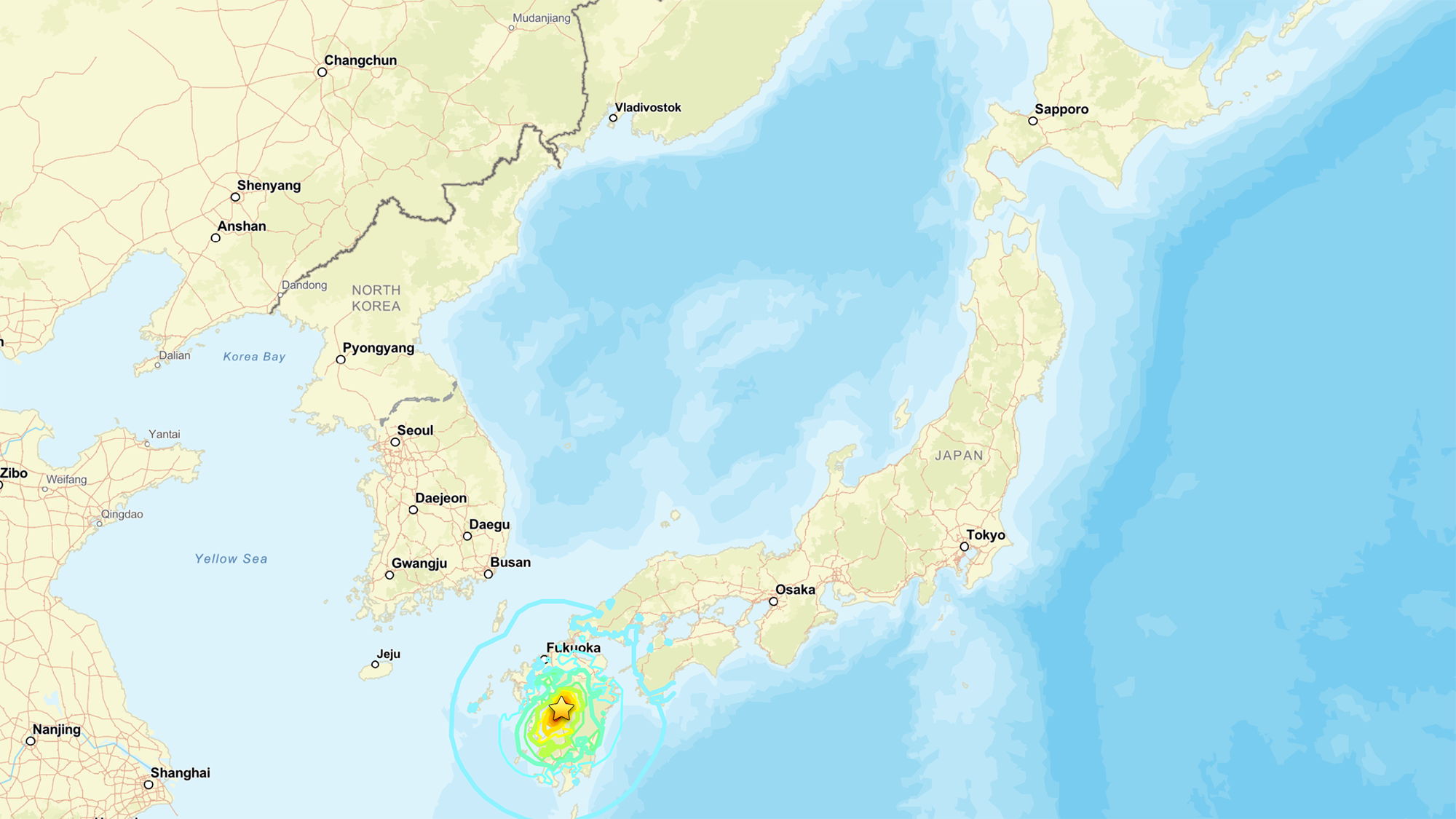
The quake, which the U.S. Geological Survey (USGS) measured as a magnitude 6.8, hit at 4:27 p.m. local time near Kumamoto, a city of more than 700,000 people located on the island of Kyushu in southern Japan.
Thousands of homes lost power, and roads buckled across the region. The second floor of a shopping center collapsed, trapping shoppers inside, according to the BBC report; some of these people were evacuated and later hospitalized. A brief tsunami warning was issued and lifted within an hour.
A map showing the location of the July 2026 earthquake. (Image credit: National Tsunami Warning Center (ATWC), Pacific Tsunami Warning Center (PTWC), USGS National Earthquake Information Center, PDE)
The USGS measurement is different from the magnitude 7.1 reported by the Japan Meteorological Agency, "primarily because the agencies are reporting different magnitude types," the USGS reported. While Japan is looking at local magnitude, the USGS measured the moment magnitude, which is derived from the physical size of the fault rupture and gives the "most reliable estimate of earthquake size" for large earthquakes, since local-magnitude scales can lose accuracy once a rupture grows big enough, the USGS reported.
These measurements are helpful, as "different magnitude types capture different characteristics of earthquake source processes," the USGS noted. Local magnitude, for example, reflects how strongly the ground shook nearby, while moment magnitude reflects the total energy released across the fault.
Why this quake is scientifically interesting
Japan sits atop one of the most active plate boundaries on Earth, where the Philippine Sea Plate dives beneath the Eurasia Plate. That process, known as subduction, is responsible for the massive, tsunami-generating earthquakes that periodically strike offshore Japan, and it's been studied intensively for decades.
But Tuesday's earthquake didn't occur at the boundary itself. Instead, the rupture happened within the Eurasia Plate, more than 60 miles (100 kilometers) inland from where the plates meet, Jeffrey Park, a theoretical seismologist at Yale University, told Live Science. Roughly 90% of earthquakes happen at plate boundaries, where the constant grinding of two plates builds up stress until a fault gives way. Quakes that strike farther inside a plate — sometimes called intraplate earthquakes — are rarer and less understood, though scientists suspect that stress transmitted through the plate can reactivate old, dormant faults far from the boundary that produced it.
According to Park, the fault in Tuesday's earthquake moved in a way that suggests the plate tore horizontally as it was twisted by subduction occurring at an angle.
The USGS describes this event as shallow strike-slip faulting: the two sides of the fracture slid past each other horizontally, rather than one side thrusting up and over the other. This faulting style, combined with the shallow depth of just 6 miles (10 kilometers) down, points to the same type of rupture behind Kyushu’s deadly 2016 Kumamoto earthquake sequence.
That inland location is also why the quake didn't generate a damaging tsunami, despite the brief precautionary warning. Tsunamis are produced when a big event — such as an earthquake, volcanic eruption or landslide — displaces water; the force from that displacement then propagates as a wave.
Tuesday's rupture stayed entirely on land, so it never pushed the seafloor up the way offshore quakes do. That's why the tsunami risk stayed low, even with the brief precautionary warning. Still, an inland quake isn't automatically off the hook: if the shaking triggers a landslide that spills into the sea, that alone can generate a tsunami.
The depth mattered just as much as the location. The quake was shallow enough to concentrate its energy near the surface, which Park said explains the structural damage.
"Because it is shallow it will cause more structural damage than a similar-sized event that might occur deeper and offshore," he told Live Science in an email.
Earthquake country
Severalearthquakeshave already clustered in the area, and numerous aftershocks are expected over the coming days. Japan experiences roughly 1,500 earthquakes annually, making it one of the most seismically active countries on the planet — a byproduct of sitting at the junction of several tectonic plates.
To protect itself, Japan has spent decades — and learned from painful lessons from disasters like the 2011 Tohoku earthquake and tsunami — engineering a response system built for exactly this scenario.
Bullet trains are programmed to halt automatically the instant seismic sensors detect a major earthquake, a safeguard Park pointed to as a defining feature of the country's earthquake readiness. That automatic shutdown extends to other transit and utility systems, part of a broader early-warning network that alerts the public within seconds of a quake's detection, giving people crucial time to take cover before shaking arrives.
Japan's investment in its infrastructure may help to explain why, even after a magnitude 7 event near a city of 700,000, Japan's death toll and damage have historically been far lower than those from comparable quakes elsewhere in the world.
Search-and-rescue efforts are continuing in Kumamoto, with CNN reporting that between 20 and 30 employees remained unaccounted for at the Aeon Mall in Kashima Town, where the building’s second floor had collapsed. Firefighters were also working to reach the site and contain nearby fires.
What's in the photo? Folded layers of rock left over from an ancient continental collision
Which satellite took the photo? NASA's Terra satellite
When was it taken? April 11, 2011
This striking satellite photo shows a multicolor "fan" of folded rocks sculpted by a longtime collision between two of Earth's tectonic plates.
The geological feature, known as an imbricate fan, is located around 3 miles (5 kilometers) east of the town of Murgha Kibzai in Pakistan's Balochistan province. The photographed section of folded rocks measures around 9 miles (15 km) across, but the fan stretches up to 55 miles (89 km) from end to end, well beyond the area in this image.
The dramatic structure sits at an altitude of around 5,000 feet (1,500 meters) in the Sulaiman Range, a series of mountains that covers around 2,500 square miles (6,500 square kilometers) of Pakistan and Afghanistan. ("Sulaiman" means "of Solomon," in reference to the biblical figure King Solomon, and the range's largest peak is Takht-e-Sulaiman, which translates to "Throne of Solomon.")
This is one of several unique features that emerged along the boundary between the Eurasian and Indian tectonic plates, which have been colliding for more than 60 million years. At one point during this tectonic tug-of-war, the two plates became somewhat intertwined, allowing the fan to take shape, according to NASA's Earth Observatory.
"As India moved northward, it began to rotate in a counter-clockwise direction, wrenching the northwestern part of the Indian plate backwards into part of the Eurasian plate," Earth Observatory representatives wrote. "The countervailing forces put the rocks of the Sulaiman Range in a unique compressional vice, causing many of its faults to curve and stretch in convoluted ways."
The Sulaiman Range is full of unique geological features that were birthed by the collision between the Indian and Eurasian plates. (The imbricate fan is located on the far right of this wide-field image.) (Image credit: NASA/Terra)
The fan is made up of alternating layers of sandstone, which appear dark in the image, and limestone, which has a much lighter hue. These sedimentary rocks were formed by "thrust faults" that shot upward from the boundary between the Eurasian and Indian plates and became entangled as the boundary moved back and forth.
The satellite image is false-color, meaning it includes wavelengths of the electromagnetic spectrum that are not normally visible to humans. This helps to accentuate the differences between the two rock types, although they can also be easily distinguished with the naked eye. Pockets of vegetation appear in red throughout the image.
The photo is a small part of a larger, wide-field image (see above), which showcases several other intriguing geological features across the Sulaiman Range in false color.
Continental collision
The collision between the Eurasian and Indian plates became inevitable around 80 million years ago, when dinosaurs still ruled Earth, according to the Earth Observatory. At this point, the pair became locked on a collision course, with each plate moving more than 8 inches (20 centimeters) per year — around twice the speed of the fastest tectonic plates today.
Around 60 million years ago, the plates slowly slammed together. Normally, this would cause the smallest tectonic plate to sink below the other. However, the two plates' massive size meant neither receded. Instead, the continental crust along the boundary grew thicker, and the ground buckled, folded and pushed upward.
The Indian and Eurasian plates have been locked in a tectonic tug-of-war for more than 60 million years. Their collision birthed the Sulaiman Range, alongside the Karakoram and the Himalayas. (Image credit: Getty Images)
This process created not only the Sulaiman Range but also the Karakoram (a huge mountain range that spans the borders of China, India, Pakistan, Tajikistan and Afghanistan) and the Himalayas — the two tallest mountain ranges on Earth, according to the Earth Observatory.
This collision continued at full speed for around 30 million years, before eventually slowing down. However, the two plates are still technically colliding today, making the region a major earthquake hotspot.
A 2019 astronaut photo shows off ancient lava flows that once oozed down the jet-black slopes of the Toussidé volcano in northwestern Chad. An intriguing volcanic "skull" also lurks in the aerial image.
A 2025 astronaut photo shows a massif made of concentric mountain ridges in the Libyan desert. The rocky walls contain ancient artworks and are occasionally used to contain herds of grazing cattle.
What it means: A seamount is an undersea mountain that rises at least 3,300 feet (1,000 meters) above the seafloor but does not come close to breaking the surface. According to the National Oceanic and Atmospheric Administration, there are at least 100,000 seamounts in the oceans, and less than 0.1% of them have been explored. Seamounts typically form from volcanic activity, and many host dramatic communities of sea life — from coral, to sharks, to an assortment of weird jellyfish-looking things.
How to use it in a sentence: Every time marine biologists explore a seamount with their remotely operated vehicles, they seem to discover a new universe of strange and blobby deep-sea creatures.
Can you crack our science word of the day puzzle, Chain Word?
What it means: In Latin, "Pando" means "I spread." And boy, does it. Pando is a clonal stand of aspen trees in Utah that weighs about 13 million pounds (6 million kilograms), making it the world's heaviest living organism ever found. Its 40,000 trees cover 106 acres (43 hectares) in Fishlake National Forest, and they're all connected by a single, sprawling root system. Some DNA analysis suggests that this many-fingered megatree is tens of thousands of years old.
How to use it in a sentence: When you walk through Pando, what seems like a normal stroll through an aspen grove is actually a trip through a single, ancient living being.
Can you crack our science word of the day puzzle, Chain Word?
What it means: The ascendency of mammals, the birth of the Himalayas, the diversification of birds — Earth's in its Cenozoic era, baby!
The Cenozoic is the geological era happening right now. It started 66 million years ago with the abrupt mass extinction known as the Cretaceous-Paleogene extinction event, when a massive asteroid hit Earth and wiped out the nonavian dinosaurs. It's been a busy few tens of millions of years, ushering in such hits as Earth's first cacti, whales and most (if not all) of the Grand Canyon.
How to use it in a sentence: The Cenozoic is called the Age of Mammals, but the University of California Museum of Paleontology in Berkeley would like you to know it could have been called the Age of Teleost Fish, if mammals weren't so dang self-centered.
Can you crack our science word of the day puzzle, Chain Word?
Un internaute a découvert qu’un satellite de télécommunication Starlink de SpaceX est passé devant un satellite d’imagerie de la surface Terre pendant qu’il survolait le Texas. L’image a été retrouvée sur Google Earth. Que nous dit cet événement pas si anodin que cela ?

 Login

 The first study of its kind shows that ecosystems experience far more cumulative heat than standard measurements reveal. A marine heatwave may have an official beginning and end, but the warm water affecting an ecosystem often does not. Like a pot that continues absorbing heat over time, coastal waters can remain unusually warm for weeks [...]