❌

Normal view

Advertising Cognitive Dissonance

24 July 2026 at 19:09

John Gruber (Mastodon):

This to me is proof that Apple leadership is suffering from cognitive dissonance over their slide into advertising. They’re conflating cause and effect. The Apple brand stands for high-quality superior user experiences because the devices and software Apple makes traditionally deliver high-quality superior user experiences. The work Apple ships is what makes the brand what it is. But now they’re stricken with the mindset that it’s the Apple brand that makes something a high-quality superior experience.

[…]

If you refuse to admit that the ads make these services worse, you also can’t admit that there’s a reason to offer an ad-free experience. So the thinking is something like “Apple always focuses on the user experience, and never deliberately makes the user experience worse. Therefore, if an Apple service shows ads, those ads are high quality and don’t detract from the quality of the product or the experience of using it. Therefore, there’s no reason to offer users a paid ad-free tier, because there’s no reason to want to avoid Apple’s ads.”

What a brand stands for can change over time. It’s eventually determined by the products, not the mantras.

  • “It just works.”
  • “A thousand no’s for every yes.”
  • “What happens on your iPhone, stays on your iPhone.”
  • “Music runs deep in Apple’s DNA.”
  • “Design is how it works.”

Manton Reece (2010):

I feel bad admitting it, because some of my friends are betting on iAd revenue to feed their family, but I’m just not on board with Apple running an advertising network. I don’t want to see ads in my apps, and I don’t want Apple to ever lose even a little of what it means to be a product-driven company.

Previously:

Update (2026-07-28): John Gruber (Mastodon):

The whole thing is funny because at a fundamental level we all just know in our bones that Apple never even considered putting “Intel Inside” stickers on Macs.

[…]

Apple still treats its hardware with that level of respect. With reverence. iPhones don’t even say “iPhone” on the hardware. No model or serial numbers. No small print. Just an Apple logo on the back.

[…]

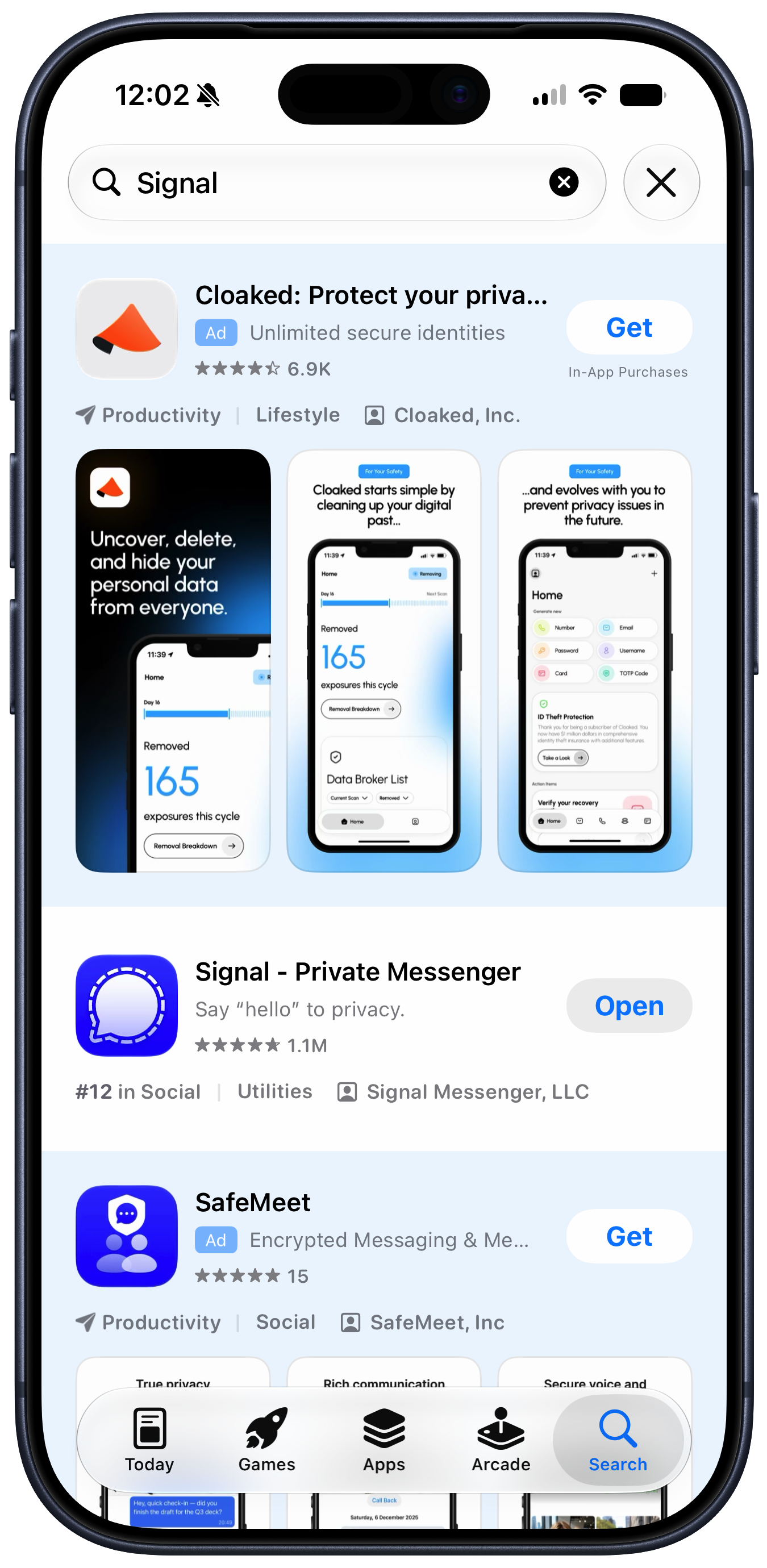
Putting themselves in customers’ shoes today, how many ads do Apple’s executives want stuck in the results when they search for an app in the App Store? We know the honest answer. But the answer evidenced by the actual App Store is “Two really big ones, including one in the first spot.”

At least you could peel off the stickers.

Jason Snell:

While Apple can spin adding ads to Apple Maps as a revolutionary new way for businesses to be discovered, it’s telling that its initial announcement was hidden inside a press release about an entirely different product, and introduced as “Enhanced Discoverability in Apple Maps.” Those choices show that this isn’t something Apple is actually proud of—and that the people in charge of communicating and explaining Apple’s decisions to the world are at odds with those who are making the decisions about expanding revenue.

[…]

To this day, you’re confronted with an ad for Creator Studio every time you create a new document in those apps, and their default toolbars contain buttons that won’t work unless you subscribe to the bundle. As a result, Apple has essentially turned its free productivity suite—software that was designed to enhance the inherent value of Apple’s products—into a freemium package with upsell to a creative professional subscription bundle that’s irrelevant (and a terrible value!) for most of its existing users.

[…]

There are many more examples. Using notifications to promote subscriptions and badging the Settings app to push AppleCare plans are among the ways Apple has chosen to intervene in the user experience to drive revenue. I’m actually not opposed to the idea that Apple should communicate opportunities for its customers to get more out of their devices—but it should be careful not to cross the line into actively annoying those customers. If someone doesn’t want to see what you offer, you need to accept that and go away—not keep needling them. Apple often falls on the wrong side of that line.

[…]

It makes me wonder if the people making these decisions at Apple have lost track of the Apple brand and what it stands for.

John Gruber:

What Snell’s column makes clear is that the incremental revenue Apple is gaining from putting shitty ads in its software comes at a price. They’re withdrawals from Apple’s brand equity. And I would argue that the value they’re detracting from the brand far out-values the dollar amount they’d padding to Apple’s bottom line.

[…]

If your competitors’ stores all smell like dogshit, don’t aim to have the store that smells the least like shit. Aim to have a store that smells pristine. “Our stores only carry a vague whiff of dogshit” is not insanely great.

Hotelling’s Law, like I was saying.

Adam Chandler:

This is not an “update”. This is an advertisement.

Update (2026-07-29): John Gruber:

The people haven’t changed, but Apple has. Strong leaders inevitably shape the personality — the spirit — of organizations over time. Apple in 2011 was peak Steve Jobs Apple. Apple in 2026 is peak Tim Cook Apple. But it was Cook who popularized the “you’re not the customer, you’re the product” argument against “free with ads” online services. But that was in 2014.

Marcin Wichary:

“Slippery slope” is a perfect term. But I wanted to add something here. In my experience, in the realm of UI, there is no middle notch. I’ve seen it time and time again… the moment you open the door to One, Infinity starts exerting its pull[…]

Previously:

Update (2026-08-03): Jon Snader:

I HATE, HATE, HATE having ads pop up when I’m trying to do something else. It’s bad enough on Web sites where at least they have the excuse of having to make money some how but it rises to intolerable when they put them up on a device I’ve already paid for.

The annoyance is reason enough to dislike Apple’s ads but for me the worst thing is that they’re corrupting and inevitably lead to the user being replaced by the advertiser as the customer.

Update (2026-08-05): John Gruber:

Only search engines that agree to pay Apple for the traffic are in the list, and there’s no option for users to add custom ones.

Tyler Hall:

It says a lot about modern Apple that I can’t find an unsubscribe link in this marketing email.

John Gruber:

Apple News ads have been going down the toilet for years, but it didn’t used to be literal.

Golden Gate Application Support Protection

24 July 2026 at 19:07

Wojciech Reguła:

Looks like moving the user’s TCC db to /private/var/containers/Data/ProtectedSystem/[UUID]/Data/Library/Application Support/com.apple.TCC/ was not the only change in the whole privacy castle of macOS 27. (What btw was a great move as now attackers with full disk access permissions can’t modify your privacy settings)

macOS 27 quietly ships a new privacy mechanism I hadn’t seen documented anywhere: it extends the com.apple.macl protection that has always guarded sandboxed apps’ ~/Library/Containers/<bundle-id>/Data folders to a hand-picked set of non-sandboxed apps’ ~/Library/Application Support/<name> folders too. I noticed it by accident — Firefox’s profile folder was suddenly inaccessible from Terminal, while MacPass, a password manager sitting right next to it, was wide open. That asymmetry didn’t sit well with me, so I pulled the thread. It ends in a hardcoded app allowlist baked into /usr/libexec/sandboxd (thx @ciphwall for the hint), meant to be updated live via XProtect.

Previously:

How to Hide an Update in the Mac App Store

24 July 2026 at 19:07

Jeff Johnson:

Although you can hide and unhide apps in your App Store purchase list, it turns out that hiding an app in the App Store purchase list does not hide the app in the updates list! I honestly can’t figure out the benefit of hiding an app in the App Store. The list of your purchased apps—a misnomer, as the list includes free apps—is practically unusable anyway: you can neither sort nor search the list. Maddeningly, the Mac App Store sorts your purchased apps by date of first install rather than by name, so it’s difficult even to scan the list manually to find a specific app.

[…]

You can clear the Updates list in the Mac App Store by deleting some cache files on disk, but that’s at best a momentary solution. The unwanted update will return eventually, or immediately if you use the Reload Page (⌘R) command.

A more lasting solution is, counterintuitively, to install the update. The trick is that you can keep more than one copy of a Mac App Store app on disk.

I wonder how long you can keep using the old version. You won’t be able to download it again. You can save a backup, but as some point a certificate will expire or you’ll get a new Mac and need a new receipt file. In theory, the store should be able to fetch one for you, but I wouldn’t rely on that long-term.

Previously:

Recording the iPhone Screen With a Mac

24 July 2026 at 19:07

Marcin Wichary:

This instruction is a fever dream of three weird things in sequence:

  • What on earth is “QuickTime”?
  • I am recording with a player?
  • Why can’t I choose the option [“New Screen Recording”] that describes exactly what I want to do?

[…]

It’s noticing this kind of complexity, places where an easy way was chosen, design debt accumulated, and things got simply too weird. Apple allowed three weird things to accumulate here.

It makes sense in terms of the history and how the technology works, but from a clean slate one might expect this functionality to be in the Screenshot app, Screen Sharing, iPhone Mirroring, or perhaps even Finder.

Previously:

Anthropic Book Training Settlement

23 July 2026 at 20:47

AP (Hacker News):

A federal judge has approved a $1.5 billion copyright settlement in which artificial intelligence company Anthropic will pay thousands of authors about $3,000 per book after using pirated copies of their works to train its Claude chatbot.

[…]

Bestselling thriller novelist Andrea Bartz first brought the suit with two other authors in 2024. It’s the first major settlement in dozens of AI copyright lawsuits that are still working their way through courts.

Dare Obasanjo:

Somewhat ironic given recent claims from Anthropic about others training their AI on its work.

Previously:

EU Antitrust Fines for Google Search and Play Store

23 July 2026 at 20:47

Tim Hardwick (Wired):

Google was today fined €890 million ($1 billion) by the European Union for breaching antitrust rules with regard to its search and Google Play store services.

The European Commission found that Google had broken the Digital Markets Act (DMA) by using its dominant position in the search market to favour its own services, like shopping and hotel deals, over those of rivals.

The Commission also said that the company had abused its position by preventing developers from directing users to cheaper ways to buy apps and app subscriptions on websites and alternative app stores.

Sergiu Gatlan:

The Commission noted that Google has begun testing changes to how its own services are placed in search results and rolled out changes to its steering terms, which the EU’s main executive body described as substantial progress towards compliance.

“Google has fallen short of effective compliance with the Digital Markets Act, and today we have taken decisive yet balanced enforcement action sanctioning these breaches,” said Teresa Ribera, Executive Vice-President for Clean, Just and Competitive Transition.

“The best products should succeed because they’re better, not because they’re owned by the company running the search engine. And European consumers have a right to be told by app developers where to sign up to the best offers, even when the app store owner does not get a cut.”

John Gruber (Mastodon):

With search, Google is required to share with competitors — search engines and AI chatbots alike — a massive amount of user data from Google Search user interactions. What terms people search for, what they click on in results, what languages and devices they use. It’s all ostensibly anonymized but that’s tricky when it comes to search terms. A lot of the terms people type into web search fields are to some degree personally identifying. The EC seems to be saying it’s Google’s problem to filter out things like passwords and usernames and omit them from the shared datasets. Google can charge money for this access, but only under “fair, reasonable, and non-discriminatory (FRAND)” prices, based on a Commission-defined methodology.

Previously:

Update (2026-07-27): John Gruber:

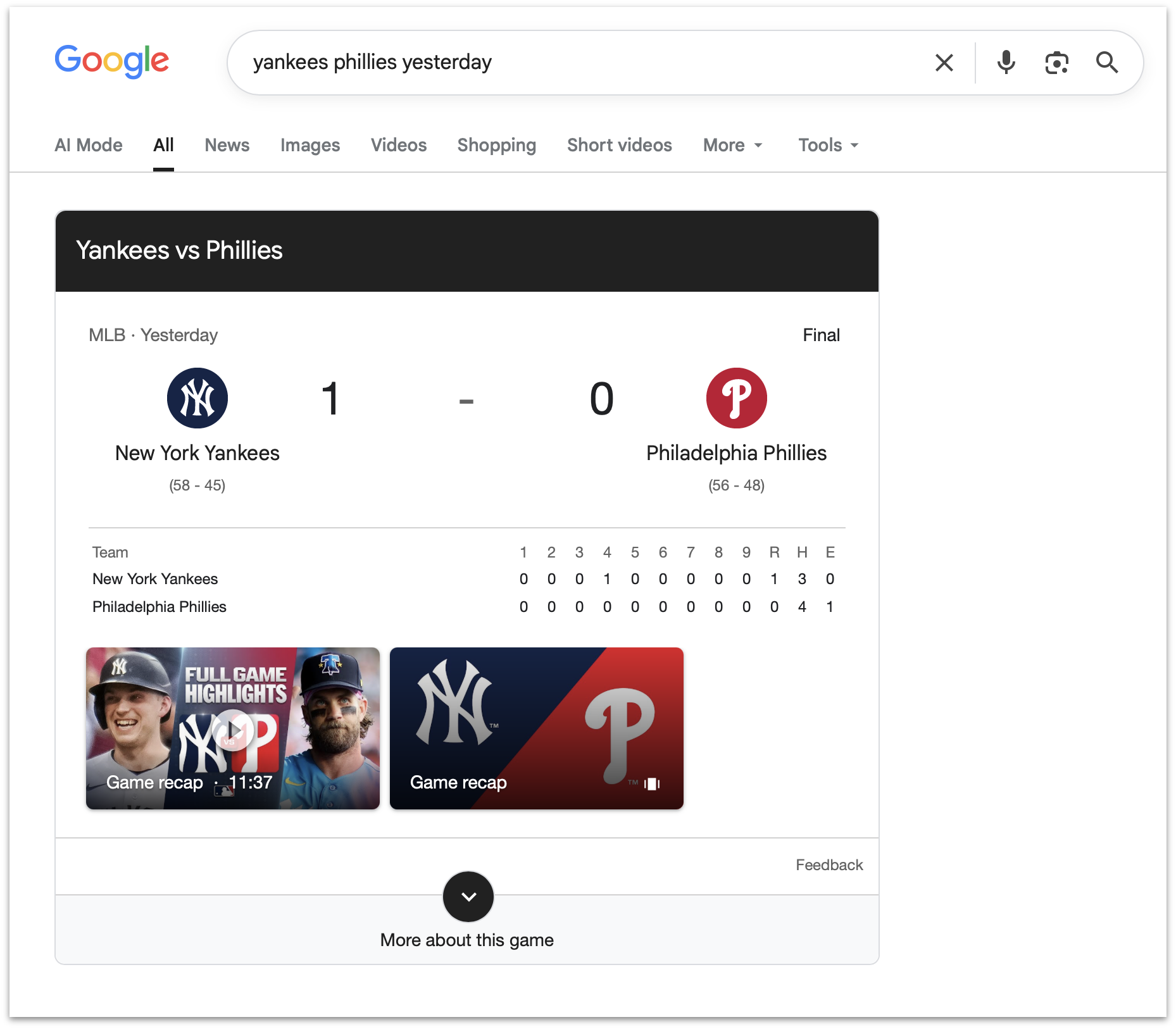
So if you search for the score of a sporting event, it’s illegal in the EU for Google to show you the score, like this search I just tried. What the EC is saying is that because Google Search is so popular, it’s no longer allowed to improve.

plantain:

It drives me insane when in Europe the link between Google Search and Google Maps is broken and I often have to copy paste an address between the two. Thanks EU, what if I like Google’s integrations?

phiresky:

They could have simply added a selector when a user first clicks on the maps preview in the search result, and then remembered it on device or across that user’s account.

But of course, then the user could choose a competitor’s product and Google would have to honor it. That would be horrible, so instead they just made the user experience worse for everyone and elegantly made people blame the EU.

See also: Hacker News.

Google Loses Final EU Antitrust Appeal

23 July 2026 at 20:46

Ryan Whitwam (PDF, Reddit):

Back in 2018, Google was handed a record-setting 4.34 billion-euro ($4.9 billion) fine in Europe for abusing its monopoly on Android. The company has spent the intervening years challenging that decision, but the continent’s highest court has put a stop to that. The Court of Justice of the European Union has affirmed the penalty, meaning Google is out of options.

[…]

The EU took issue with Google search and Chrome being the default options on Android. Even devices made by other companies, such as Samsung and Xiaomi, include Google apps as the default per the Android licensing agreement, giving Google an unfair advantage, according to European antitrust regulators. This is not to be confused with a 2.95 billion euro ($3.45 billion) fine against Google’s advertising monopoly issued by the European Union last year.

Arjun Kharpal:

In 2022, a lower EU court reduced the fine to the current 4.1 billion euros from 4.34 billion euros previously.

Google has argued that the Android operating system provides choice for users and supports developers and businesses across Europe.

Via John Gruber:

Google last year booked $132 billion in profit; this fine is about 3 percent of that..

[…]

There’s never a reason not to string the appeal process out, but it’s especially true when your profits are growing at an exceptional rate. By growing their profits around 5×, they’ve reduced the relative sting of this fine by 5×

Previously:

Apple Loses Masimo Appeal

23 July 2026 at 20:46

Marcus Mendes:

Apple’s requests to overturn a $634 million patent verdict and secure a new trial in its long-running legal battle with Masimo were denied.

Wesley Hilliard:

There doesn’t appear to be any other path for appeal or recourse, as the judge rejected both requests for either a new judgement or trial.

[…]

In the end, Masimo didn’t succeed in getting the Apple Watch banned or fundamentally redesigned. It won an empty victory with the funds it will be paid, and the patents affecting the lawsuit will expire in 2028 and 2029 anyway.

Paul Terpstra:

Although the ruling confirms the financial penalty, it does not affect current Apple Watch users. The smartwatch’s blood oxygen monitoring feature remains available after Apple introduced a software update in January 2024 that allowed sales to continue despite earlier legal challenges.

Previously:

Whisper and SpeechAnalyzer

22 July 2026 at 21:34

Om Malik (2023):

One of the key advantages of MacWhisper, as it utilizes the Whisper technology, is its superior accuracy in transcriptions compared to other services I have used. I was an early adopter of Rev.com and eventually switched to Otter.ai, for which I paid approximately $100/year. However, I have since canceled my subscription.

[…]

After comparing the audio transcripts from MacWhisper and Otter, I found that while Otter’s formatting is superior, there is hardly any difference in the transcriptions. I started with the free model, which was sufficient for my needs, and eventually upgraded to the large models. Nowadays, I primarily use MacWhisper to transcribe my voice memos, which I then import into Lex.Page.

Bon Adamson:

Whisper, which is made by OpenAI, has the distinct advantage of allowing you to transcribe audio in almost any language you may ever need to. For the time being, Otter can only transcribe English. The benefits of better accuracy and accurate punctuation that the service already holds over Siri hold up across other languages as well. If you’re looking to transcribe non-English audio accurately, Whisper is definitely the best option available on Mac.

Dan Moren:

By taking advantage of OpenAI’s Whisper framework, Audio Hijack can now take any audio it’s recording and generate a text transcript. While this process was possible before—see Jason’s lengthy post about his workflow—it required a lot of fiddling and several different tools to accomplish; it’s certainly a lot easier to simply drop Audio Hijack’s block into your existing session. If you record multiple sources, it can even appropriately label each one—though if you record multiple people via one input, say the other end of a Zoom call, it can’t distinguish between the various participants.

Inscribe (2026, Hacker News):

Apple’s new SpeechAnalyzer is the most accurate on-device speech engine we tested. It beat every Whisper model we ship, including Whisper Small, on both the clean and the noisy half of LibriSpeech, while running roughly three times faster than Small. And the API it replaces, SFSpeechRecognizer, came last on clean speech: behind even Whisper Tiny, a 40MB model.

[…]

The new API cuts word error rate by 3.5 to 4x on the same audio: from 9.02% to 2.12% on clean speech, and from 16.25% to 4.56% on noisy speech. There is no accuracy trade-off to weigh; the new API wins everywhere we measured, and it produces punctuated, cased text where the legacy engine’s output is rougher.

[…]

All five engines ran comfortably faster than real time: between roughly 12x and 40x on the M2 Pro, meaning an hour of audio transcribes in about 1.5 to 5 minutes on-device. SpeechAnalyzer was about 3x faster than Whisper Small per second of audio while beating it on accuracy.

Yuki:

SpeechAnalyzer’s ReportingOption.fastResults reads like a knob you’d reach for when you want to trade power for latency. That framing is what cost me the afternoon.

[…]

If a recording matters — and in a notes app, a lost meeting is the worst thing that can happen to a user — then the container you write while recording has to be PCM in CAF. Not m4a, and not AAC-in-CAF either.

[…]

AVAudioEngine’s inputNode silently ignores your device selection

[…]

I wanted summarization to run on-device. Everything else in Nib’s transcription path does, the audio never leaves the machine, and it would have been a much cleaner story to tell.

But 4,096 tokens for the Foundation Models isn’t enough.

Previously:

CrashStealer

22 July 2026 at 21:34

Thijs Xhaflaire (via Ric Ford):

Jamf Threat Labs discovers and investigates CrashStealer, a C++ macOS infostealer that impersonates Apple's crash-reporting framework to harvest browser credentials, cryptocurrency wallets and keychain data, encrypting stolen files with AES-GCM before exfiltrating them to a remote command-and-control server.

[…]

Unlike the payload it eventually installs, the dropper is properly code signed and notarized: it is a universal (arm64 and x86_64) binary signed with the Developer ID Emil Grigorov (WWB7JA7AQV), has hardened runtime enabled, and carries a stapled notarization ticket. Notably, the disk image itself is signed as well, not just the application inside it, which is uncommon in malicious DMG delivery where the container is typically left unsigned.

[…]

That file supplies the curl command the dropper runs next. Staging the first hop on a trusted developer domain keeps the initial network activity inconspicuous.

[…]

[The script] clears extended attributes on the staged bundle with xattr -cr, makes the inner binary executable, strips the payload's existing signature and re-signs it ad-hoc (codesign --remove-signature followed by codesign -s - --force --deep --no-strict), registers it with Launch Services via lsregister -f, and finally launches it in the background with open -g -n.

Previously:

Sunsetting Google Earth for Mac

22 July 2026 at 21:33

The Google Earth Team:

We’re continuing to make Google Earth on web and mobile (Android | iOS) the best place for people to get helpful geospatial insights. While you can continue using the legacy Google Earth Pro desktop app, it will no longer be available for new downloads beginning on June 25, 2027. We encourage using web and mobile for the best Google Earth experience.

Via Nick Heer:

This is a two-factor loss: the MacOS app is Intel-based and, thus, will no longer be supported by the system come next year.

[…]

On the Google Earth community thread, you will find comments from people with all sorts of interesting use cases for the desktop app.

Rui Carmo:

This is going to be the end of an era for me. One of the first things I did with the early versions of Google Earth was wire it up to Vodafone’s mobile network data, producing some genuinely unique–for the time, at least–visualisations of network usage over time.

Previously:

Apple Park: Designed to Isolate

21 July 2026 at 21:29

Malcolm Crawford (Mastodon):

The open-plan floors make it hard to concentrate. The building is so large that getting from one meeting to the next eats real time out of the day. It’s common for people to run meetings with colleagues over Webex — colleagues on the same campus, sometimes no more than two hundred yards away.

Ironically, Apple Park replaced a campus that did far better on the same measure without ever trying to. Infinite Loop produced far more of the accidental, cross-team contact Apple Park was explicitly built to create. Working out why starts with what Infinite Loop got right by accident. It continues with what the research on office proximity says about why that kind of thing happens at all. And it ends with what Apple Park could become instead — including a version of the fix Apple already trusts enough to run for a hundred people a year.

[…]

There’s no obvious focal point for the whole site — most sections have their own sitting area and their own coffee bar, but nothing plays the role Caffè Macs and the IL1 coffee bar played together at Infinite Loop. Caffè Macs at Apple Park seats a thousand people and feels built for throughput, not conversation. Everything is organised per-segment rather than around a shared centre, which is convenient for the people in that segment and useless for the discovery-by-accident that made the old campus work.

[…]

By multiple accounts from people who were there during design and construction, the site was flagged as under-provisioned for meetings and conferences before it even opened.

Via Jason Anthony Guy:

Apple Park is a beautiful structure, but is not terribly conducive to focused or collaborative work. Even as an occasional visitor I found it overwhelming. Employees sit shoulder to shoulder, voices bounce off and bleed through glass walls, and privacy is a virtual impossibility. My friends and colleagues who worked there regularly found it difficult to be productive.

I worked in Infinite Loop (Building 3, 2nd floor) for thirteen years (right below Developer Publications, where Malcolm spent a good portion of his Apple career). I loved IL because its design made serendipitous encounters easy. Whether it was sitting outside Caffè Macs or in the IL 1 Atrium, I would inevitably bump into someone and have a conversation that furthered an in-flight project, sparked something new, or simply reinforced the social ties that bind colleagues.

It helped that at that time, Apple had perhaps 10,000 employees, most of whom were in or near IL. After iPhone came about and IL started getting locked down, much of the natural collaboration dissipated, disappearing behind badged doors and disclosures.

Ken McLeod:

IL provided a place to focus on your work[1], as well as seating spaces that are out of the flow of traffic where you can have an informal meeting[2]. At AP, every collaborative space is effectively in the middle of a hallway. That turns out to be enormously distracting, both to you and to those people trying to work in the glass bullpen right next to it.

[1] before all cubicles and offices became multi-person shared spaces

[2] before all those spaces were filled in with more offices

Helge Heß:

“The IL1 atrium really was the crossroads of the company in those days” I really don’t think that this is true literally by any means. Assuming “those days” overlap with the time I’ve been there (pre Park). The XFs in IL have been extremely scarce. IL was way too small and overloaded, I’d actually say it was very similar to Apple Park. No one really wanted to work there in those tiny offices with multiple people 🤷‍♀️

Steve Hayman:

I loved the IL1 atrium. I’d sit there and hope that someone like MMalc would wander by, and they often did. It was a real destination for field people who didn’t get to visit the mothership very often. I miss that. AP had nothing like it.

Eric Schwarz:

I think of my days in college—most dorms residence halls were not air conditioned, so at the end of August, you had to open your window (often to place a box fan) and door to create some airflow. People walking through the building would meet by chance. Newer buildings tended to be less lively and more like a hotel—all the doors closed and rarely much activity. Through renovations, most of the buildings have had air conditioning added, dropping those interactions over the years.

Previously:

Update (2026-07-22): Dr. Drang:

As you may know, the Lumon Industries building that Mark, Helly, Irving, and Dylan work in is a former Bell Labs facility in Holmdel, New Jersey. I first learned about the building several years ago, when I read Jon Gertner’s excellent history of The Labs, The Idea Factory. It’s a distinctive place designed by Eero Saarinen in the early 60s.

Bell Labs was known for the fruitful collaboration of its researchers, often started through chance meetings in the hallways of other Bell Labs facilities. The new Holmdel building was supposed to further that sort of teamwork, but things didn’t work out as planned.

macintog:

I worked in IL1 for over a decade. The day I saw the open-plan spaceship, I knew I would never set foot inside. There are more rewarding ways to work in a barn.

The EnshAIttification of Day One

21 July 2026 at 21:28

Aleem Shaun:

I’ve used Day One for more than a decade. It was an excellent journalling app. Private, minimal, easy to use, with excellent features such as geolocation, weather, ‘On this Day’, and book printing. Features that got out of the way and either worked quietly in the background or appeared only when you summoned them. That’s changed.

Now there are new subscription tiers. Previously, the tiers were Free and Premium. Simple. Premium included sync and a few other things that I can’t remember, but it was compelling enough that I’ve been a Premium subscriber from the beginning. Now, without consultation, I’m Silver (not Premium), and there’s a new, more expensive AI-driven tier, Gold. I don’t object solely on that basis. You would think I could just choose to remain on ‘Silver’ and all would be well. But no. Even with these features turned off in settings, I’m visually prompted in the app to upgrade to Gold and use the Daily Chat (with AI), which I’ve turned off and can only use if I upgrade. And yet, there it is, taunting me.

Via Eric Schwarz:

Even Apple is guilty of doing this in the Settings app and the former iWork apps.

Previously:

Apple Services Price Hikes 2026

21 July 2026 at 21:27

Chance Miller:

Here are the new monthly prices for Apple Music and Apple One as of today:

Apple Music

Apple One

The price increases for Apple Music come after Spotify announced its own round of price hikes earlier this year, which Apple poked fun at on social media. Even with today’s price hikes, though, Apple Music remains cheaper than Spotify.

Lee Peterson:

Apple Music no longer makes sense when I’m already paying for YouTube Premium. Apple Music goes up to £11.99, YouTube Premium is £12.99 and on top of a good music service you get no ads on YouTube.

Mike Rockwell:

Distilling my longtime argument down to its simplest bit, I’d ask “do you want to pay $10 a month for music for the rest of your life?”

But truly, it was never going to just be $10 per month. The price was going to go up over time. It was going to get more expensive to have access to the same music.

If you purchase your music, though, I think most people would reach a point in their life where they stop buying new music entirely or they’re only buying a few albums per year. The cost of music would go down for you over time.

That was my thinking, too, but then I found that music I’ve purchased from Apple won’t work on my HomePod. I refuse to condone that behavior, so now I have two solid reasons not to subscribe to Apple Music.

Joe Rossignol:

While the monthly and annual prices of AppleCare+ plans for Macs and iPads received a slight increase this week, AppleCare One continues to start at $19.99 per month in the U.S., making the multi-device plan even more valuable.

Previously:

Apple Financial Statements: Products vs. Services

21 July 2026 at 21:27

John Gruber (Mastodon, 2):

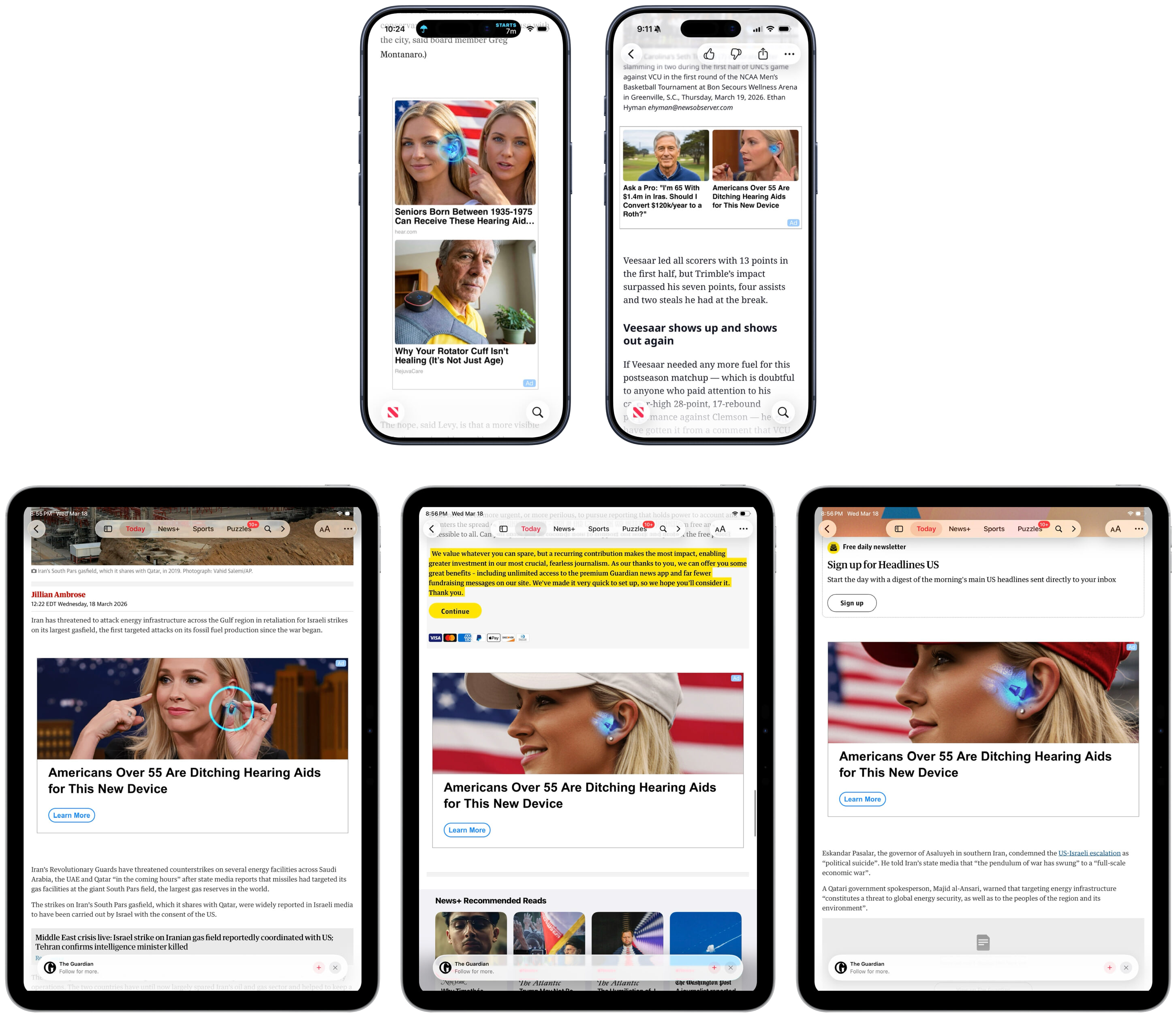
Some of [Cook’s letter] remains true, but has lost some truthiness — and truthiness matters. But some of it is no longer true, period. It’s no longer just “one small part” of Apple’s business that serves advertisers. Here in 2026, search results in the App Store not only show paid ads — frequently for casinos — but the search results are visually dominated by paid ads now that Apple has added a second ad to results. Apple News+ is a paid subscription that offers a genuinely great value for the number of paywalled publishers whose content it includes, but articles on the News app tend to include the weirdest AI-generated ads on the Internet. (How many young blond women am I supposed to believe need hearing aids?) And — at this writing, still “coming soon” — Apple is launching ads on Apple Maps. Apple Maps remains free of charge to use, so according to Tim Cook, we’re not the customer. We’re the product. Or, if you prefer, our frustration is the product.

[…]

The ratio of ads to organic results in App Store search — especially when measured in screen area — is clearly not aligned with Cook’s 2014 statement that “Our software and services are designed to make our devices better. Plain and simple.” Obviously not. App Store search today is designed primarily to generate more revenue for Apple. That’s not criminal, but it’s a change.

[…]

What gave Tim Cook’s privacy letter heft in 2014 wasn’t just the clarity of its plain language, but the fact that you didn’t have to take his word for it that the ads Apple showed you respected your privacy, because Apple didn’t show you ads in 2014. Apple today can’t say that.

[…]

John Ternus should return Apple’s privacy policy to its 2014 clarity. The trust Apple would earn from such a move would far out-value whatever revenue these ads pad to their already hefty and ever-increasing quarterly Services numbers.

I wish that were the case, but I fear this is kind of a Hotelling’s Law situation, where Apple can get most of the benefit by being just slightly better on this axis. Where else do its customers have to go?

Jeff Johnson (Mastodon):

In the second fiscal quarter of 2018, services generated $9 billion in revenue (net sales), whereas in Q2 2026, that amount had grown to $31 billion! In this blog post, I want to focus on understanding the relative financial importance of products and services for Apple.

[…]

In 2025, services were 42% of Apple gross margin. How does 26% of net sales become 42% of gross margin? The explanation is that services have a much lower cost of sales. The products gross margin was 37% of products net sales, while the services gross margin was an astonishing 75% of services net sales. In other words, Apple services are almost pure profit!

Does this 75% account for TV and movie production costs?

With persistent general inflation, consumers do not have unlimited money to spend on Apple products. At least in the near future, it’s reasonable to question how much further room is available for growth in profits from Apple products. To satisfy the demands of investors, Apple executives including CEO-elect John Ternus may be forced to rely even more than before on growth in services, which do not face as much pressure on cost of sales as hardware products.

Previously:

Licensing a Mac App With RevenueCat

20 July 2026 at 16:28

Jared Sorge:

I know there are options out there like Paddle, FastSpring, and Lemon Squeezy that have worked for many apps like mine over the years. But I also wanted something simple for my users. Not to mention Apple Pay was a must-have.

I believe all the services he mentions do support Apple Pay.

  • RevenueCat serves as the source of truth for whether or not a customer is licensed.

  • I create RevenueCat customer IDs from local iCloud identifiers (more specifically, calling userRecordID() on my CKContainer in CloudKit).

  • When the user makes a purchase, they earn an entitlement that I look for in Arborist to grant them a license.

He doesn’t need to run his own server, and the purchases are automatically tied to the user’s iCloud account, so there are no e-mails or serial numbers to deal with. On the other hand, well, it’s all dependent on the Apple Account.

The app, which helps manage Git worktrees, is shipping now.

Previously:

Git Tower 17

20 July 2026 at 16:27

Bruno Brito (release notes):

In Tower 15, we introduced the “Fully Merged” badge and Automatic Branch Management to help you keep your repository tidy. With Tower 17, we’re taking the detection behind that badge to a whole new level. […] Tower now matches your local branches against merged pull requests from your hosting service, such as GitHub or GitLab.

[…]

Trust is everything when deleting branches — so we redesigned the “Fully Merged” hint view to show you exactly which checks matched.

[…]

One that is particularly noteworthy is that updating submodules is now significantly faster! Tower gathers each submodule's Git data concurrently instead of one at a time—something you will especially notice in repositories with many submodules.

I’m sad that they got rid of the yellow icon.

Previously:

Siri AI Beta

20 July 2026 at 16:27

Federico Viticci (Mastodon):

The AI frontier from the two big labs (and – we have to be honest with the numbers here – probably SpaceXAI and Meta now, too) is in a completely different league at the moment. I spent my first couple of weeks with Siri AI trying to convince myself that I could replace Codex with Siri AI, and that was the wrong approach. There is a potential future in which Siri AI can become a more proactive and capable agent, but that’s not what Apple is shipping this year.

[…]

Siri AI is a dramatically better Siri for typical Siri stuff. The new Siri understands your commands and nuanced requests better because of the LLMs behind it; it can often perform multiple requests in one go (such as setting multiple timers with one command); the new expressive (and customizable!) voices sound great, and they’re terrific at reading and summarizing notifications. Apple’s first advantage compared to other chatbots is right here: only Siri can integrate with the iPhone and iPad to this extent, so even if the Foundation models aren’t as smart as the competition, Siri can do a lot more for most people on their devices because neither OpenAI nor Anthropic have OSes they can control.

[…]

The biggest issue I’ve encountered is the inconsistency of it all. Very often, the new Siri AI still replies with a generic “Uh oh, something went wrong“ error that doesn’t explain what the error was or why it happened. Sometimes, I ask a question via voice, and it errors out, but then a few seconds later, I type the same question in the app, and it’s fine.

[…]

My problem is that, right now with Apple’s own apps, both the index and Siri’s ability to perform actions are very inconsistent. The assistant hallucinates abilities it doesn’t have, and it frequently just doesn’t work.

Dan Moren:

The good news is that Siri AI is capable: impressively so, at times. In the lowest of low bars, it certainly beats the pants off the previous incarnation of Siri, but its access to your own personal data and all of the app on your phone also unlocks a host of new possibilities.

But it’s also not without the pitfalls that underlie all LLM-powered chatbots: errors in understanding, hallucinations, and so on.

[…]

The app itself is pretty barebones, letting you view those conversations in List or Grid layouts, select multiple conversations to delete them, and pin or rename any single conversation. In Settings : Siri, you can choose to either open to the overview or to a new conversation and decide whether old conversations are kept for 30 days, 1 year, or forever. It’s a little strange that one-off queries (“What’s the average height of the Norwegian World Cup team?”) are stored alongside more involved conversations (“Can you help me build a specific RSS feed for this site?”); I also ended up with a few orphan blank “New conversations” which I deleted, but it’d be nice if you could filter to find those. Conversations are fully searchable and sync between devices via iCloud.

John Voorhees:

Despite the current limitations, if you use chatbots as a replacement for Google Search, you’ll probably have a good experience with the new Siri app. That’s because even in these early betas, if you ask Siri something like, “Give me a day trip itinerary for a trip to Chicago this Saturday,” you’re likely to get good but pretty middle-of-the-road recommendations. From there, though, you can drill down with follow-up queries to get something more in line with your tastes. The results include source links you can follow, too. Given the ad-strewn mess that web search has become, using Siri for this sort of thing is a meaningfully better experience.

The one caveat on Siri’s world knowledge is that it’s roughly 2-3 weeks stale in some places.

[…]

A good example is Music. You can prompt Siri to play a song, but most of the rich metadata in the app isn’t exposed to Siri, which is a shame because it is exposed elsewhere, for example to AppleScript.

Previously:

Update (2026-08-04): Benjamin Mayo:

Thanks to the top-to-bottom revamp that is Siri AI, Siri is reliably intelligent. Finally. We are still in the midst of beta season, and Apple is yet to confirm whether Siri AI will formally launch with iOS 27 in September or sometime later in the year, but the feature is up to scratch. There are bugs and glitches and edge-case quirks, but on the whole, it wipes the floor with old Siri and is competent enough to supplant my everyday usage of other chatbots too.

[…]

Siri AI can get a snapshot of what’s on screen, but it cannot control the UI for you autonomously. As such, if you ask it to do something outside of its library of available app actions, it will say it can’t do that. Often, it can quote the relevant steps for you to do it yourself, but obviously that falls short of the ideal experience. This feels a bit lacklustre to people already embracing AI agents en masse. Claude and Codex on Mac do not hit these walls; they are all too keen to move your mouse for you and run terminal commands until the job is done.

Previously:

notarytool Can’t Handle Zip64 Files

20 July 2026 at 16:27

Wade Tregaskis:

In short: if you have any file in your app (or whatever it is you’re trying to get Apple to sign) that is over 4 GiB, you must use a disk image (DMG) to package it for notarytool, not a zip file.

This is because support for files larger than 4 GiB requires using the “Zip64” zip file format, which would be fine except Apple’s notary servers can’t handle them.

Previously:

Update (2026-07-22): Rosyna Keller:

It’s recommended to notarized exactly what you’re going to ship to users and shipping zips is extremely risky because you never know what tool the user will use to decompress the file.

Multiple unzipping tools will strip necessary extended attributes that could cause the code signature to fail to validate. This is especially true if you put non-code files in “code places” and they have to be signed with an extended attribute.

San Francisco Demands Removal of Nudify Apps

17 July 2026 at 22:16

Matt Burgess (MacRumors, ArsTechnica):

On Thursday, San Francisco city attorney David Chiu sent legal notices to Apple and Google demanding that they remove from their app stores 13 face-swapping apps, which allow users to create AI-generated nonconsensual nude images. The letters say the Silicon Valley giants should stop “aiding and abetting” the sale of explicit deepfake images and “sever” business relationships with the app developers.

[…]

Researchers have repeatedly found and reported apps in Apple’s App Store and Google’s Play Store that allow people to generate sexual images using AI—including some apps being rated as suitable for use by children. While new laws and bans aim to tackle the scourge of explicit deepfakes online, technology and social media companies consistently direct millions of people toward the harmful tech.

Both Apple and Google have developer policies that prohibit pornography, abuse, and harassment on their platforms.

Burgess gives the impression, which is my base assumption, that these 13 apps were clear about what they do, so App Review has no excuse for missing them. But I’m sure it’s keeping us all safe in other regards.

Meanwhile, in a preprint research paper published in May, researchers from Cornell University and Georgetown University identified 420 apps offering general face-swapping capabilities on Google’s and Apple’s app stores. They tested 155 to see if they could be used to create face swaps with nude images; in 70 percent of cases, it was possible, with the apps not including safety measures to prevent this.

Previously:

Update (2026-07-21): Danny Bradbury:

Chiu isn’t arguing that hosting an app automatically makes a platform liable for what it does. Platform operators already won that battle with Section 230 of the Communications Decency Act. That 30-year-old law says websites generally aren’t responsible for content posted by users, allowing platforms to host user-generated content without getting sued every time someone defames someone in a comment thread.

Courts have often extended those protections to cover app stores too. Apple and Google are treated as distributors of whatever a third-party developer uploads, rather than publishers.

Chiu is attempting to sidestep that argument by focusing on the companies’ payment systems, noting that Apple and Google collect a cut of every in-app purchase. According to the Tech Transparency Project (TTP), that means they profit from apps that generate revenue by creating non-consensual intimate imagery.

❌