Interfaces between air and water are omnipresent in nature and in industrial processes, but we understand surprisingly little about what goes on there. Researchers in Germany now report that a new spectroscopy technique could reshape our understanding of the molecular structure of these aqueous interfaces and the dynamical processes at play. Their discoveries could lead to better models of atmospheric processes and improved electrochemical devices such as batteries, to name but two examples.
When air and water meet, the interface between them strongly influences the behaviour of the first four layers of water. This interfacial water, as it is known, is only 7-8 angstroms thick, and the water below it behaves like a bulk liquid. To study interface effects, researchers therefore need to probe only these four layers and characterize the way their H2O molecules are oriented.
Probing the H-O-H bending vibration
One way to do this is to observe the bending vibration of the H-O-H structure, as this parameter approximately aligns with the water molecule’s dipole. In particular, one can analyse how the anisotropic bending mode changes with the thickness of the interfacial water. This can be calculated using a factor known as the depth-dependent second-order susceptibility, 𝜒(ଶ)(𝑧).
There is a problem with this approach, however, because it requires the H-O-H bending vibration to originate from the electric dipole of H2O and to contain only an interfacial dipolar signal. This is not always the case because electric quadrupolar signals from the bulk of the sample, as well as magnetic dipolar signals, can also contribute to the spectra.
These other signals do not provide any information on the orientations of the H2O dipole. Worse, they can mask the structural information that researchers are looking for. This means they either need to be ruled out or have their contributions to the overall signal removed.
A tuneable visible upconversion
The new technique, developed by Martin Thämer and colleagues in the Nonlinear Interfacial Spectroscopy Group of the Fritz-Haber Institute der Max-Planck-Gesellschaft, involves feeding the 800-nm-wavelenght light output from a Ti:sapphire laser into two independent optical parametric amplifiers. The first amplifier produces mid-infrared light through a process called difference frequency generation (DFG) and the second produces a signal beam that is subsequently doubled in frequency to produce a tuneable visible upconversion.
Using these two beams, the researchers irradiated the surface of a water sample and excited nonlinear vibrations in the water molecules. This excitation generates two new light beams at different visible frequencies. By measuring the differences in the phase and amplitude of these beams, the team was able to isolate the vibrational response of the interfacial water layer and separate it from the bulk-water quadrupole term.
Thämer and colleagues then combined their spectra with high level molecular dynamics simulations developed by their colleagues at the Frei Universität Berlin to determine the precise orientations of the water molecules in the interfacial region.
Traditional description is insufficient
Traditionally, the structure of interfacial water is described in terms of water molecules pointing up or down (the “tilt angle”). However, based on the team’s results, Thämer says this description is insufficient. An additional orientation parameter is required, namely the “water twist angle”, or the molecule’s rotation about the axis of its dipole. “The new picture of the water structure we present is layered one with alternating twist and tilt angles that indeed extends over only four molecular water layers,” Thämer tells Physics World.
Looking ahead, the researchers, who detail their work in Science Advances, say they now plan to study other aqueous interfaces, including charged interfaces and biomolecular systems.
An outbreak of parasitic illness linked to iceberg lettuce is affecting nine U.S. states, federal health officials have announced. That's up from the five affected states that were identified in earlier stages of the officials' investigation.
This lettuce-related outbreak is one of several in the U.S. that are being caused by the parasite Cyclospora cayetanensis, which can enter the body when someone consumes food or water contaminated with the organism. The federal government has not officially identified a source of contamination in the other Cyclospora outbreaks yet, although some state officials have mentioned potential culprits. (North Carolina officials have pointed to cilantro and parsley, for example.)
The nine-state outbreak linked to iceberg lettuce includes cases in Illinois, Indiana, Kansas, Kentucky, Michigan, Ohio, Oklahoma, Pennsylvania and West Virginia, according to the Food and Drug Administration (FDA). To date, 1,947 people have been infected across these states and reported eating Taco Bell before they got sick. There have been 98 hospitalizations and no deaths.
Specifically, the infections have been linked to lettuce sourced from central Mexico, prompting Taylor Farms to remove all of its iceberg lettuce from that region from the U.S. market. The company has also issued a recall. A complete list of recalled products can be found on the FDA's website.
The recall affects products that were distributed in the nine states listed above, as well as additional states, all of which are listed on the FDA's website. Consumers, restaurants and retailers that purchased or received recalled lettuce are advised to discard it immediately and not consume it.
"We also expect to continue to see the number of confirmed cases rise, despite the recall, due to the fact that it can take as long as six weeks for CDC [Centers for Disease Control and Prevention] and state officials to determine if a sick person is part of this outbreak," the FDA's latest update notes. "FDA will continue to work with federal and state partners to investigate this multistate outbreak and ensure products implicated in this outbreak have been removed from the market."
This article is for informational purposes only and is not meant to offer medical advice.
In U.S. states such as California, driver’s licenses and state IDs can be added to Apple Wallet, enabling residents to seamlessly and securely add and present their IDs using iPhone or Apple Watch.
Utah residents may soon be able to store their driver’s licenses and IDs in Apple Wallet on iPhone and Apple Watch. MacRumors has uncovered references to a Utah ID in Apple’s backend systems, indicating the company is actively working on support. While the state already offers a mobile driver’s license through a standalone app, that solution currently lacks Apple Wallet integration.
Utah’s mobile driver’s license FAQ page still says that it is still in the initial planning process of adding Utah IDs to Apple Wallet, but it may not be up to date.
The site also says that when Apple Wallet integration launches, iPhone users who already use the mobile app for their Utah ID will be able to download it to Apple Wallet.
Apple announced plans to add Utah driver’s licenses and IDs to the Apple Wallet app way back in 2021, but no integration has materialized. Utah was one of the first states Apple mentioned when rolling out the feature.
Other states planning to add support for driver’s licenses in Apple Wallet include Connecticut, Kentucky, Mississippi, Oklahoma, and Virginia.
MacDailyNews Note: Multiple states and Puerto Rico have already implemented support for users to store their driver’s licenses and IDs in Apple Wallet on iPhone and Apple Watch, including:
Arkansas*
Arizona
California
Colorado
Georgia
Hawaii
Illinois
Iowa
Maryland
Montana
New Mexico
North Dakota
Ohio
West Virginia
*some users in specific jurisdictions in Arkansas may still see staggered access depending on whether their state agency has finalized all local database integrations.
Please help support MacDailyNews — and enjoy subscriber-only articles, comments, chat, and more — by subscribing to our Substack: macdailynews.substack.com. Thank you!
CEO Chris O’Shea defends Centrica’s plans as it reports rise in retail profits following focus on bigger margins
The owner of British Gas has claimed that most households would rather speak with an AI chatbot than deal with the company’s staff as it prepares to cut 1,300 jobs from its call centres and back office.
Centrica, the supplier’s FTSE 100 owner, plans to cut 800 jobs as the company carries out a “targeted deployment of AI tools”, on top of the 500 cuts it confirmed last month.
Oracle’s July 2026 Critical Patch Update, its largest ever, contains 1,449 new security patches spanning 32 product families, from Oracle Database and E-Business Suite to PeopleSoft, GoldenGate, Java SE, and Fusion Middleware.
Fusion Middleware was particularly hard hit, with new security patches for 355 security vulnerabilities, 219 of them remotely exploitable without authentication, meaning they can be exploited over a network without requiring user credentials. Ten of them scored a “perfect” 10.0 on the Common Vulnerability Scoring System (CVSS).
These included easily exploitable vulnerabilities allowing unauthenticated attackers with network access via HTTP to compromise Oracle Data Integrator, Oracle Access Manager, Oracle HTTP Server, Oracle Platform Security for Java, Oracle WebCenter Content, Service Delivery Platform, or Oracle Weblogic Server Proxy Plug-in,
No other products were found to have quite such extreme vulnerabilities, but there were plenty of others scoring almost as badly.
Two critical flaws in Oracle Database Server
The most severe flaw Oracle patched in its flagship database product is CVE-2026-61211, a vulnerability in the RDBMS component’s DBMS_CLOUD package with a CVSS score of 9.9.
This easily exploitable vulnerability allows a low-privileged attacker having Execute DBMS_CLOUD privilege with network access via Oracle Net to compromise the RDBMS, Oracle said in the patch update statement. “While the vulnerability is in RDBMS, attacks may significantly impact additional products (scope change). Successful attacks of this vulnerability can result in takeover of RDBMS,” it warned.
The flaw affects Database Server versions 19.3 through 19.31 and 23.4.0 through 23.26.2.
Sanchit Vir Gogia, chief analyst at Greyhound Research, said the 9.9 score should be read as serious but conditional. Exposure depends on configuration, he said: On customer-managed databases, DBMS_CLOUD is absent until installed, and grants and network access lists determine the radius from there. “Where DBMS_CLOUD is broadly granted and reachable, the emergency is real and the window is seventy-two hours; where it is absent, the accelerated database wave will do.”
Vibhum Dubey, a cybersecurity researcher and red teamer, said the flaw stood out to him because it checks several boxes that concern defenders.
“Database servers often hold an organization’s most valuable data, so even if exploitation is not publicly observed yet, I don’t think this is the kind of issue you leave until the next routine maintenance window if your environment is exposed,” Dubey said.
A second Database Server flaw, CVE-2026-47040, affects Connection Manager in Oracle Net Services, is remotely exploitable without credentials. Oracle’s risk matrix lists six Database Product vulnerabilities in this cycle as reachable over a network with no authentication required, the statement added.
CVE-2026-7383, an OpenSSL-related TLS vulnerability, affects two products, Database Server and Autonomous Health Framework, since both bundle the same third-party component. Oracle’s advisory notes the Database Server patch for that CVE also resolves 19 related OpenSSL CVEs bundled into the same fix.
Oracle GoldenGate received 27 new patches, nine of which do not require authentication to exploit, including CVE-2026-2332, a flaw in the Big Data and Application Adapters component tied to Eclipse Jetty, the statement added.
There were also two critical flaws in Oracle’s TimesTen in-memory database.
The remainder of the release spans E-Business Suite, WebLogic Server, PeopleSoft, Siebel, JD Edwards, Communications, Retail Applications, Utilities Applications, MySQL, Solaris and VM VirtualBox.
Volume repair
Gogia said the volume itself marks a shift.
“At 1,449 patches, against 481 in April 2026 and 309 a year earlier, patch load has outgrown the queue built to hold it,” he said. He recommended a tiered response: “The reachable and the reported inside seventy-two hours, the trusted core inside ten days, the rest by risk before the October release.”
He also flagged a specific risk in how organizations might triage E-Business Suite. “Oracle’s advisory concedes that E-Business Suite exposure sits partly in underlying Database and Fusion Middleware versions outside the E-Business Suite matrix. The fastest way to mis-prioritise this release is to patch by product logo instead of trust boundary.”
Third Tuesday, quarterly cycle
The July release is the third quarterly Critical Patch Update of 2026, and the first since the introduction in May of the monthly Critical Security Patch Update program.
Gogia said Oracle has effectively layered a second cadence on top of the existing one rather than replacing it.
“Quarterly Critical Patch Updates remain and stay cumulative; monthly Critical Security Patch Updates now sit on top,” he said, adding that enterprise adoption of the new rhythm remains low because of “certification obligations, regression exposure and scarce specialist hours.”
Dubey made a similar point about organizational readiness: “In large enterprises, patching is rarely a technical problem. It is an operational one. Database administrators, application owners, infrastructure teams, business stakeholders, and change advisory boards all have to align.”
Niyati Daftary, principal analyst at Gartner, said the release underscores a broader shift in how patching is approached.
“Patching is no longer a race to remediate every vulnerability. It is a discipline of identifying the exposures that matter most and reducing business risk as efficiently as possible,” she said, adding that organizations should prioritize based on exposure, business impact and exploitability, starting with internet-facing assets and mission-critical systems.
Daftary pointed to continuous threat exposure management and adversarial exposure validation as increasingly relevant frameworks, since CVSS scores “measure theoretical severity rather than actual enterprise risk.” Patching alone will not be sufficient, Daftary said, and organizations should continue investing in defense in depth, including behavioral threat detection and incident response.
Oracle’s next cumulative Critical Patch Update will come on Oct. 20, 2026, with smaller Critical Security Patch Updates on Aug. 18 and Sept. 15.
Oracle is expanding its Cloud@Customer on-premises portfolio with a managed database offering that it says will enable enterprises to run databases, applications, and AI agents in their own data centers, helping CIOs modernize mid-sized workloads while meeting data residency, regulatory, and low-latency requirements.
The hybrid cloud offering, Base Database Cloud@Customer, combines existing database and infrastructure services such as the Base Database Service and Data Infrastructure Cloud@Customer X11 platform. It is designed for enterprises that do not need the scale of Exadata Cloud@Customer but still want their infrastructure and AI capabilities on-premises, managed by Oracle, the company said.
The Cloud@Customer X11 platform itself consists of two Oracle X11 compute servers and shared all-flash storage, offering up to 60 usable processor cores and 660 GB of memory per server, 47.2 TB of storage, and 10/25 GbE networking.
For regulated industries or restricted connectivity
Analysts see the new offering filling a gap for enterprises that want the operational and economic benefits of the cloud but cannot send their data to a public cloud because of legal restrictions or technology limitations.
These enterprises, according to Ashish Chaturvedi, executive research leader at HFS Research, are likely to be in regulated industries such as financial services, healthcare, government, and defense that must comply with data residency requirements, or needing low-latency access from remote sites to operational databases.
The offering could also appeal to enterprises modernizing mid-sized workloads at remote locations or within individual business units that could never justify the investment in a full Exadata rack, said Amit Chandak, chief analytics officer at IT consulting firm Kanerika.
In all cases, Chaturvedi said, the appeal of the offering is its managed nature, which takes away the burden of looking after the underlying infrastructure.
Deployment and maintenance becomes easier too, said Michael Leone, principal analyst at Moor Strategy and Insights: “They get automation that mid-size teams rarely have the staff to build. Clustering, patching, standby databases, and backups arrive configured instead of hand-assembled because the offering is managed.”
The economics are equally compelling, Chaturvedi said. The pay-as-you-go pricing model, combined with online compute scaling, helps enterprises avoid overprovisioning and paying license fees for idle cores, which is a “classic waste” of fixed on-premises systems, he said.
Private AI behind the firewall
Beyond the operational and economic benefits, the architecture of the new offering enables databases, applications, VMs, and AI agents to be collocated on the same platform, removing what Chaturvedi called “the single biggest blocker” to AI adoption in regulated environments: the need to keep private data behind the firewall.
“For a CIO in a regulated sector who wants to deploy AI agents but can’t let regulated data touch an external model API, that’s a real unlock,” Chaturvedi said.
More so because most AI offerings, at least in their present form and state, cannot guarantee sensitive data protection, said Igor Ikonnikov, advisory fellow at Info-Tech Research Group.
Even if Base Database Cloud@Customer turns out more expensive than fully cloud-based options, “It’s still attractive as it eliminates reputational and economic risk caused by possible AI-induced data leakage,” Ikonnikov said.
The offering’s consolidation of databases, applications, and AI agents will also simplify deployment of AI-based workflows, said Forrester principal analyst Noel Yuhanna. “It reduces stack complexity and helps accelerate development cycles, deliver real-time data, and eliminate data movement challenges.”
Despite those advantages, Chandak cautioned that the offering is unlikely to see broad adoption outside Oracle’s existing customer base: “If a company isn’t already on Oracle, the pull is weak. You don’t buy into Oracle’s database just to get this.”
Enterprises seeking similar hybrid cloud capabilities have no shortage of alternatives: AWS, Microsoft, Google Cloud, IBM, Dell Technologies, and HPE all offer combinations of on-premises infrastructure, cloud management, and AI services.
However, those alternatives typically require customers to integrate multiple software and hardware components rather than consume them as a single managed offering.
Oracle’s differentiation, although narrow, is hard to match, Chaturvedi said: “The vertical integration of database, engineered hardware, cloud management, high-availability architecture, and now private AI, all engineered together and delivered as a managed on-prem subscription should be genuinely convenient and attractive.”
The offering is compatible with Oracle AI Database 26ai and Oracle Database 19c in Enterprise Edition and Standard Edition configurations. It also supports Oracle Real Application Clusters, Oracle Data Guard, and Zero Data Loss Recovery Appliance through Oracle-managed cloud automation for high availability and disaster recovery, the company said.
Base Database Cloud@Customer is now generally available, Oracle said. It did not provide pricing.
The research team behind the new analysis said the evidence also suggests that the ancient cave has been in continuous use throughout the entire timespan, offering scientists a rare glimpse into the magic and spiritual beliefs of Australia’s ancient inhabitants.
Oral Traditions Said Coggs Cave was Used for Magic and Spiritual Rituals
According to a statement announcing the ‘magical’ discovery, 19th-century ethnographic reports recorded a network of caves in Gippsland and the Southern Victorian Alps. Those same reports also noted that local oral traditions suggested that the caves were used by powerful women and men called “mulla-mullung” and other spiritual practitioners for magic, healing, and “cursing” rituals.
Previous archaeological expeditions determined that these caves, including the study site at Cloggs Cave, were occupied throughout the past 25,000 years. However, little direct evidence has been provided to support the oral traditions of magic and healing taking place within the caves.
Instead of cave art or other magical relics that may not have survived the passage of time, the research team, led by Dr Elle Grono, School of Culture, History and Language, ANU College of Asia and the Pacific, Australian National University, Canberra, Australia, focused on phytoliths, which are microscopic silica bodies from plants recovered from Cloggs Cave. To gain insight into the potential uses of Cloggs Cave, the studied phytoliths were recovered from its buried deposits.
GunaiKurnai Elder Uncle Russell Mullett at the cave entrance of Cloggs Cave (Image Credit: Jess Shapiro, courtesy of GunaiKurnai Land and Waters Corporation).
When detailing the process, Dr. Grono said that phytoliths have the advantage of mostly accumulating where a plant decays. Conversely, plant pollen can be dispersed by winds or insects, diminishing some of their historic site value. This difference is critical, Grono said, because phytoliths found inside Cloggs Cave must have come from humans or other animals bringing them inside.
“No plants grow inside the cave due to a lack of light, so the phytoliths must have been carried in by people or by animals such as possums on their fur or through their scats,” the team leader explained.
Excavation of Ashy Deposits Includes Unexpected “Standing Stone”
To determine the taxonomic groups of the thousands of recovered phytoliths, the team examined the samples under a microscope. To ensure the samples were from plants brought into the cave by humans and not animals, the team used specimens collected from one pit that was 1.5 meters deep and a second that was 2.3 meters deep.
Grono said the team also exclusively studied half-burnt phytoliths from “ashy” layers within the pits. The researcher noted that this extra selection criterion also helps ensure the samples came from samples brought into the caves by humans, “as unburnt ones might have arrived through either means.”
Microscopic images of burnt grass phytoliths from Cloggs Cave. Most of the images depict phytoliths from the inflorescences and leaves of grasses. The scale bar indicates 20 microns. Refer to the journal article for details (Image Credit: Grono, David, Mullett, Stevenson, Petchey, Delannoy, McDowell, Miller, Morley, Fresløv, Jenkin, and GunaiKurnai Land and Waters Aboriginal Corporation).
The top layer of the two pits consisted of 73 thin, ashy layers of burnt plant material. When the research team performed optically stimulated luminescence and carbon dating tests to establish when the material was laid down, the latter via accelerator mass spectrometry, the results placed the deposition of the material between 4,400 and 1,600 years ago.
When searching through the ashy pits, the team found a 28-cm-high “standing” stone. They note that subsequent analysis showed that the stone was likely erected in Cobbs Cave “by Old Ancestors for ritual purposes around 2,000 years ago.”
A 2,000-year-old standing stone, depicted during excavations. Burnt phytoliths came from the ashy layers surrounding the standing stone (Image Credit: Bruno David, courtesy of GunaiKurnai Land and Waters Corporation).
The “Old Ancestors” Were Selective About Which Grasses Were Brought Inside
When the analysis was complete, the team had identified 29 different phytolith types representing a wide range of plants. This included woody plants, herbs, and grasses.
The team determined that as much as 97% of the burnt matter came from grass. This included disparate species, such as grasses that prefer temperate or cooler climates and grasses that prefer warm and humid conditions to thrive, deposited in the same ash layer.
“Here we show that the Old Ancestors selected whole grasses from the wider landscape and carried them into Cloggs Cave to spread out in thin layers and burn,” Dr. Grono said. “Over time, sediments covered these burnt layers, preserving each layer on top of another over thousands of years.”
The researchers said the taxonomic analysis revealed that the “Old Ancestors” were selective of which grass types they brought into the cave and which ones they omitted. For example, they avoided what the team noted were “diverse species” of grasses still plentiful in nearby riparian forest and open woodland before European settlement.
“The phytoliths found at Cloggs Cave were from different parts of grass plants such as stems, leaves, flowers, and roots, indicating that whole grasses were brought in, including the inedible parts,” Grono explained.
Selection and Burning Consistent With “Magic and Rituals”
Although there is no direct record of the reason the ancient people selected and burned grass inside of Cobbs Cave, dating back thousands of years, Professor Bruno David from Monash University, who co-led the excavations with GunaiKurnai Land and Waters Corporation, said the behavior is “consistent with GunaiKurnai traditional practices of using ash to perform magic and rituals.” Professor David also noted the practice could allow the participants to track the footsteps of anyone entering the cave, “including spirit beings.”
The team also found macro-botanical evidence, including fat-smeared trimmed wooden sticks from Casuarina trees, in deeper and older pit deposits. Professor David said this discovery suggests that “other kinds of rituals using woody plants” were also performed in Cobbs Cave.
When discussing the historical significance of the discovery, the researchers said that finding partially or completely burned phytoliths “throughout the dated deposits” suggests that humans intentionally brought selected plants and grasses into the cave and burned them “over the entire timespan of the past 25,000 years.”
Christopher Plain is a Science Fiction and Fantasy novelist and has spent the last six years as Associate News Editor and Head Science Writer at The Debrief. Follow and connect with him on X, learn about his books at plainfiction.com, or email him at christopher@thedebrief.org
U.S. health officials have identified shredded iceberg lettuce served at Taco Bell as one source of contamination behind an outbreak of parasitic infections affecting over 1,000 people.
The outbreak has been caused by the protozoan parasite Cyclospora cayetanensis, which can enter the body when someone consumes food or water contaminated with the parasite. Since May 1, there have been 1,644 confirmed cases across Indiana, Kentucky, Ohio, West Virginia and Michigan, which is currently the hardest-hit state.
(Health officials are also investigating additional cases of Cyclospora infection in the U.S. that have yet to be linked to this specific lettuce-related outbreak. Those other potential cases remain under investigation and total over 5,100, per the Centers of Disease Control and Prevention (CDC).)
In the five-state outbreak, there have been 94 hospitalizations and no deaths to date.
Through an investigation, health officials found that all 1,644 of the sickened people with confirmed cases of Cyclospora reported eating Taco Bell in Indiana, Kentucky, Michigan, Ohio or West Virginia before becoming ill. Interviews with the affected individuals suggested that shredded lettuce might be a common source of exposure.
The Food and Drug Administration (FDA) then investigated the source of the lettuce, identifying a single supplier of iceberg lettuce from Mexico that was used by Taco Bell locations where the people ate before becoming ill. News reports have named California-based Taylor Farms as the supplier.
"FDA is working directly with the identified supplier to determine if potentially contaminated shredded iceberg lettuce remains on the market," an FDA notice states. "As part of this investigation, FDA and state partners have initiated collection of product samples for testing and analysis."
The investigation is ongoing, and additional sources of contamination or affected restaurants could possibly be identified later, the FDA noted. In the meantime, Taco Bell has said it will stop using lettuce from the implicated supplier.
"Taco Bell is working to stop use of all lettuce implicated by this investigation. Not all Taco Bell locations in these states received implicated product," the FDA statement says.
Currently, the CDC is warning consumers not to eat shredded iceberg lettuce served at Taco Bell locations in Indiana, Kentucky, Michigan, Ohio or West Virginia.
Case counts reported by individual states may differ from the FDA's and CDC's counts, because states may include both probable and confirmed cases. The FDA and CDC will update their totals once they can confirm additional cases reported to them.
Symptoms of Cyclospora infection typically emerge two to 14 days after a person consumes the parasite. These symptoms include watery diarrhea, fatigue, cramping, bloating, gas and loss of appetite, and without treatment, they can last between a few days to a month or more. The infection is treated with an antibiotic, which blocks the parasite's ability to multiply.
This article is for informational purposes only and is not meant to offer medical advice.
O EX30 é o Volvo mais pequeno e mais acessível da gama, e um dos SUV elétricos compactos mais interessantes do mercado. Testámos a versão P5 Plus, com bateria de 55 kWh, e ficámos rendidos ao bom ambiente a bordo, e com a eficiência superior à anunciada. Mas não conseguimos ignorar algumas decisões de design que dão que pensar numa marca com o histórico de segurança da Volvo.
On Aug. 12, I get to fulfil a lifelong ambition. I'll take a flight to Madrid and travel northwest to the city of Valladolid by rail, before striking out for Valoria la Buena — a charming town in central Spain with a population of less than 1,000.
There, I'll bear witness to one of the most spectacular naked eye shows that the solar system has to offer: a total solar eclipse. My first total solar eclipse.
Don't get me wrong. I've been obsessed with eclipses my entire life. I just haven't found myself in the right place at the right time to experience totality until now. 10-year-old me came pretty close during a deep partial eclipse in 1999, when I caught a fleeting glimpse of the moon's silhouette taking a bite out of the sun in the cloud-ridden skies over the United Kingdom.
Smash cut 20-something years later and I'm inexplicably the Skywatching Writer for Space.com, where one of the major perks of the job is being sent to report on eclipses. Things aligned quite nicely.
The DEB is a network of enthusiastic solar observers led by professional astronomers who use standardized telescopes and software to share inspiring eclipse imagery to the public, while also capturing valuable scientific data on the sun's disk and golden atmosphere.
It was Greenwald who scouted Valoria la Buena as a prime location to observe the eclipse. He's since been hard at work liaising with DEB initiative leadership to test software updates and troubleshoot other issues, while also travelling toMexico to help train student members of the team ahead of their expedition to Spain. Two more eclipse enthusiasts are due to join the group once it arrives in Madrid, making it a wonderfully international affair.
Less than a month out, things are pretty settled, and a kind of nervous anticipation has taken hold. Flights and trains are booked, and I have a pair of Celestron EclipSmart 10x42 binoculars and the EclipSmart 3-Piece Solar Eclipse Observing and Imaging Kit, courtesy of Celestron. Also hats and an ungodly amount of suntan lotion. I'm bald after all, so the sun is my greatest natural predator.
Of course, preparations can only get you so far. Once we get to Valoria la Buena on Aug. 10 there'll still be important work to do. The first order of business for Charles and his DEB team will be to stake out a location with a clear line of sight to the west for their equipment. Totality will occur with the sun less than 10 degrees above the horizon — roughly the width of your clenched fist held at arm's length — so line of sight will be everything.
We'll also be at the mercy of the weather. Clouds could easily arrive to hide the cosmic show from view — especially with the eclipse so low on the horizon. The DEB team also has to find a spot with good connectivity, which will allow them to broadcast near-live images of our parent star for the public to enjoy and scientists to pore over.
The sun's atmosphere shines out from behind the moon during a total lunar eclipse. (Image credit: Photo by Keegan Barber/NASA via Getty Images)
All being well, myself, the DEB team and over 15 million others in the path of totality will bear witness to a heartstopping display of orbital mechanics that crescendos with the fleeting artificial night of totality, as the moon blocks the last sliver of the sun from view. Space.com's Skywatching Editor Daisy Dobrijevic will also be on hand to report on the total solar eclipse as it unfolds in the skies over Greenland.
Editor's Note: Want to share your eclipse photography with Space.com's readers? Then please send your photos and comments, along with your name and location to spacephotos@space.com.
ARK augmented reality describes a form of spatial interaction in which artificial intelligence does more than place digital objects in the physical world. It uses knowledge from foundation models to understand unfamiliar scenes, generate useful information and adapt its response to the person, task and environment.
The concept comes from a 2023 research paper titled “ArK: Augmented Reality with Knowledge Interactive Emergent Ability.” Its authors proposed a system that transfers knowledge from large foundation models into new physical and virtual environments. Instead of training an AI agent separately for every room, object or activity, ArK uses existing knowledge memory to interpret what it sees and generate appropriate 2D or 3D content.
Traditional augmented reality places information over reality. ARK augmented reality tries to understand reality before deciding what should appear.
That distinction creates a compelling direction for Apple. Vision Pro already blends digital content with physical space. Apple Intelligence adds language, image understanding and personal context. Visual Intelligence lets users look at objects, text and scenes before asking for information. Siri AI adds a conversational layer. ARKit, RealityKit and visionOS provide the spatial foundation.
Apple now has many of the components required to build a knowledge layer over the physical world.
ARK Augmented Reality Goes Beyond Digital Overlays
Most familiar augmented reality experiences are relatively fixed. A furniture app places a digital sofa in a room. A navigation app displays arrows over a street. A museum app identifies an artwork. A repair app shows where a component belongs.
These experiences can be useful, but they usually depend on predefined content and rules. The system recognizes a known object or location, then presents prepared information.
ARK augmented reality proposes something more adaptive. A knowledge-enabled system could enter an unfamiliar environment, interpret what is present and generate assistance based on a broader understanding of objects, relationships and possible actions.
A user looking at a complicated electrical panel would not only see labels. The system could identify the panel type, explain the purpose of each section, compare the arrangement with standard configurations and warn the user not to touch dangerous components.
A student examining a machine could ask how it works and receive a spatial explanation attached to its real parts. A surgeon could review anatomical information positioned around a medical model. A technician could receive repair guidance even when the exact equipment had not been included in a previous training dataset.
The display becomes less like a floating screen and more like an informed interpretation of the environment.
Image Credit: Apple Inc.
Why Apple Is Positioned to Build It
Apple’s advantage would not come from inventing every part of ARK augmented reality. It would come from combining hardware, software, artificial intelligence and personal context into one controlled ecosystem.
Vision Pro already understands rooms, surfaces, hands, eyes and objects well enough to place digital content convincingly in physical space. Its cameras and sensors continuously map the environment while visionOS manages windows, volumes and immersive experiences.
Apple Intelligence provides another layer. Foundation models can interpret language, summarize information, generate content and connect requests with app actions. Visual Intelligence can identify text, images and real-world objects. Siri AI can act as the conversational interface.
The Apple ecosystem also provides personal context that a generic AR platform may not have. Calendar knows the user’s schedule. Maps understands location. Photos contains visual history. Notes and Mail hold project information. Health contains personal trends. Home understands rooms, accessories and automations.
An Apple-built knowledge layer could combine the environment in front of the user with the information already available across trusted devices and apps.
A person preparing for a meeting could look at a conference room and see the agenda, participant names and relevant documents arranged around the table. A traveler could look across a train station and receive directions connected to the correct platform, departure time and digital ticket. A homeowner could examine a room and see live information from temperature, air-quality and energy sensors.
The physical environment becomes the interface.
Vision Pro Is the Laboratory
Vision Pro is the obvious development platform for this idea because it already offers the cameras, displays, sensors and processing required for advanced spatial understanding. Its size and price limit broad adoption, but those same characteristics allow Apple and developers to test experiences that would be harder to build first on lightweight glasses.
ARK augmented reality on Vision Pro could become especially useful in enterprise environments. Apple already promotes the headset for employee training, product design, field service, collaboration and specialized visualization.
A worker could enter an unfamiliar facility and receive contextual instructions attached to real equipment. An engineer could inspect a physical prototype while design changes, performance data and maintenance history appear around it. A new employee could learn a workflow through spatial guidance generated from company manuals and operational knowledge.
The system would not need to display every available fact. It would need to understand which information fits the current task.
That is where AI knowledge becomes more valuable than a traditional AR overlay. Too much information can be as disruptive as too little. A strong system should filter, prioritize and explain rather than cover the room with floating labels.
The iPhone Could Bring ARK to More People
Vision Pro may be the development environment, but iPhone could provide the scale. The iPhone already combines cameras, LiDAR on Pro models, location, motion sensing, Visual Intelligence and Apple Intelligence.
An iPhone-based ARK experience would be less continuous because users would need to hold up the device. It could still deliver useful knowledge interaction without requiring a headset.
A user could point the camera at a plant and receive care guidance based on its species, visible condition, local weather and placement in the room. Someone assembling furniture could receive generated guidance positioned over the actual parts. A shopper could compare products by looking at them rather than manually searching for each model.
The difference from ordinary visual search would be interaction. The user could ask follow-up questions, change the goal and let the system update the visual guidance.
Future glasses could eventually make the experience persistent. The iPhone would help Apple develop the intelligence, privacy controls and app ecosystem before lightweight eyewear becomes ready.
A World That Explains Itself
The most ambitious version of ARK augmented reality is a world in which information is attached to objects, places and situations only when requested or needed.
A city could become understandable without searching through maps, review sites and separate transit apps. Buildings could reveal history. Streets could explain temporary closures. Restaurants could surface reservations, dietary options and accessibility details. Public transport could show the correct entrance and platform.
Inside a home, Apple’s knowledge layer could explain energy use, identify maintenance problems and guide repairs. In a classroom, physical models could become interactive lessons. In healthcare, patients could receive visual instructions for approved home procedures or medication devices.
The experience would depend on context rather than menus. The user looks, asks and receives information positioned where it belongs.
This is the transition from augmented reality as decoration to augmented reality as understanding.
Privacy Will Decide Whether It Works
A knowledge layer capable of understanding the physical world also creates serious privacy questions. The system may see homes, workplaces, documents, faces, screens and private conversations. The more context it receives, the more useful it becomes. The same access can also make it invasive.
Apple’s privacy architecture could become one of its strongest advantages. On-device processing would allow some scene understanding without sending continuous camera feeds to external servers. Private Cloud Compute could handle more complex requests while preserving stricter controls than an ordinary cloud AI service.
Apple would also need visible controls over what is analyzed, remembered and shared. A user should know when the system is interpreting the environment and whether information is temporary or retained. Workplaces and public spaces would need rules for recording, identification and sensitive data.
ARK augmented reality cannot become socially acceptable if people feel that nearby devices are constantly cataloging them.
The successful version would behave less like surveillance and more like intentional assistance. The user asks for understanding. The system processes only what is needed. The knowledge disappears when the task ends unless the user chooses to save it.
Image Credit: Apple Inc.
Developers Could Build Knowledge Worlds
Apple would not need to create every knowledge experience itself. visionOS, ARKit, RealityKit and App Intents could let developers connect specialized knowledge with physical environments.
A medical company could build guidance for approved equipment. A manufacturer could create spatial maintenance systems. A university could attach interactive explanations to laboratories and museums. A retailer could create product comparisons based on inventory and customer preferences.
Apple could provide the shared intelligence layer: scene understanding, object recognition, language interaction, privacy permissions and spatial presentation. Developers would provide the trusted domain knowledge.
This division would be essential. General AI can explain many things, but professional environments require verified information. A generated answer about a historical building has different consequences from an answer about industrial machinery or medical treatment.
Apple’s platform could distinguish between general knowledge and certified domain sources, allowing users to see where information comes from before acting.
From Spatial Computing to Contextual Computing
Apple describes Vision Pro as a spatial computer because digital content can occupy physical space. ARK augmented reality suggests the next progression: contextual computing.
A spatial computer knows where digital content is placed. A contextual computer understands why the content is useful in that location, what the user is trying to accomplish and which knowledge should appear.
That would connect several Apple strategies that currently look separate. Vision Pro supplies spatial awareness. Apple Intelligence supplies reasoning and generation. Siri AI supplies conversation. Visual Intelligence supplies real-world understanding. The ecosystem supplies personal context.
Together, they could create a system that does not wait for users to open the correct app and search through the correct menu. The environment itself becomes the starting point.
Apple’s opportunity is to make that interaction restrained rather than overwhelming. The company does not need to cover reality with digital noise. It can use design, privacy and contextual intelligence to make information appear only when it improves the moment.
ARK augmented reality offers a useful description of that future. Reality remains visible. Knowledge becomes interactive. The computer begins to understand the world in front of the user instead of asking the user to translate everything into a search box.
A new Bayesian system called ALADYNOULLI is designed to forecast how multiple diseases unfold over time from longitudinal electronic health record (EHR) histories. The work targets a central challenge in longitudinal modelling: evaluating prediction without “information leakage,” so that future diagnoses never influence training for past timepoints. By explicitly simulating real clinical follow-up, the researchers aim to make risk estimates more trustworthy for decision-making.
In the primary assessment, ALADYNOULLI produced dynamic 1-year forecasts at 10 fixed moments during follow-up, starting at enrollment and extending to years 1 through 9. At each timepoint, models were retrained using only data available up to that moment, then tested on 1-year outcomes. The key metric was the median area under the receiver operating characteristic curve (AUC) across these dynamic evaluations, summarizing how predictive accuracy changes as new diagnoses accumulate.
The study spans 28 diseases and reports robust discrimination for several clinically important endpoints. Performance was strong for atherosclerotic cardiovascular disease (ASCVD), breast cancer, atrial fibrillation, heart failure, and Parkinson’s disease, with AUC values of 0.879, 0.867, 0.801, 0.811, and 0.796, respectively. Importantly, the evaluation excluded people with prevalent disease at prediction time, aligning the comparisons with prospective risk.
ALADYNOULLI was also benchmarked against established clinical risk tools where feasible. At enrollment, static models trained only on baseline information were compared for both 1-year and 10-year horizons. While longer-term predictions naturally degraded, ALADYNOULLI retained meaningful power—for example, for ASCVD at 10 years—highlighting the advantage of learning from longitudinal EHR trajectories rather than relying solely on cross-sectional inputs.
Calibration analyses further supported reliability: predicted and observed event rates matched closely across millions of at-risk patient-time observations. The researchers report a mean squared error on calibration of 4.67 × 10⁻⁷, with mean predicted rates (5.55 × 10⁻⁴) closely tracking mean observed rates (5.45 × 10⁻⁴). This suggests not only ranking accuracy, but also quantitative risk realism.
To test whether results were driven by subtle temporal artifacts, the team ran sensitivity analyses that excluded events occurring shortly before prediction and varied washout windows. They also examined alternative horizons and a dynamic 10-year rolling interpolation strategy, which updates risk estimates as annual information becomes available. Together, these checks help confirm that temporal patterns are being learned in a causally aligned manner.
Overall, the findings position ALADYNOULLI as a clinically relevant framework for multi-disease risk forecasting, combining longitudinal EHR modelling with predictive discrimination and calibration. By rigorously preventing leakage and validating dynamic follow-up scenarios, the approach offers a pathway toward more actionable, time-aware risk prediction in real-world healthcare settings.
Subject of Research: Longitudinal EHR-based multi-disease risk prediction using Bayesian modelling and genetic/EHR integration Article Title: A Bayesian framework for longitudinal EHR and genetic discovery. Article References: Urbut, S.M., Ding, Y., Nakao, T. et al. A Bayesian framework for longitudinal EHR and genetic discovery. Nature (2026). https://doi.org/10.1038/s41586-026-10780-5 Image Credits: AI Generated DOI:https://doi.org/10.1038/s41586-026-10780-5 Keywords: longitudinal EHR, Bayesian framework, disease risk prediction, dynamic forecasting, temporal validation, calibration, AUC, ASCVD
A new study in Nature Communications reports that subducting slabs can become effectively “stalled” for long periods—not simply due to mantle temperature or plate motion, but because distinct rock assemblages within the downgoing plate alter how the slab interacts with the surrounding mantle. Using geophysical constraints combined with thermodynamic modeling, the researchers argue that slab dynamics depend on whether the slab interior is dominated by hydrated ultramafic lithologies or by comparatively dry basaltic components.
The central finding is that wet harzburgite—an olivine-rich, ultramafic rock—can sustain slab stagnation by promoting hydration-related weakening processes and controlling the timing and location of mineral transformation. In parallel, the team shows that dry basaltic slab assemblages can also contribute to stagnation, but through a different pathway: by limiting certain water-driven reactions while still maintaining a mechanically coherent, slow-moving interface at depth.
According to the authors, the fate of volatiles is the key variable. As the slab descends, pressure and temperature drive phase changes and dehydration reactions. These reactions can either increase or decrease the effective viscosity and friction along plate boundaries, shifting the balance between slab pull and mantle resistance. Where hydration is sustained, water remains available to weaken lithospheric portions that would otherwise become too rigid to decouple.
In the wet harzburgite scenario, dehydration and metamorphic reactions are predicted to sustain zones of reduced strength within the slab, preventing it from sinking efficiently into the lower mantle. This creates a feedback loop: slower descent limits thermal loss, which in turn preserves conditions that keep the weakening processes active.
In the dry basaltic scenario, the model emphasizes that even without abundant water, basaltic mineralogy can maintain mechanical coupling over a broader depth range. The study suggests that dry assemblages may delay the development of decoupling horizons, thereby prolonging stagnation until the slab eventually transitions to a different rheological regime.
The researchers also connect their results to the observed diversity of subduction-zone behavior, where some slabs advance smoothly while others appear to linger at mantle depths. By treating rock composition explicitly rather than assuming uniform slab properties, the work offers a framework for interpreting why similar plate boundary geometries can yield markedly different slab lifetimes.
Crucially, the analysis links mineral stability, dehydration partitioning, and viscosity contrasts into a single physical narrative. This moves slab “stalling” away from a purely geometric explanation and toward a lithology-driven process that can be tested against seismic signatures.
The findings will likely influence how future models incorporate water budgets and rock types in subduction simulations. If validated by geophysical observations, the wet-versus-dry assemblage distinction could become a practical lever for predicting which slabs will stagnate and for how long.
In short, the study portrays slab stagnation as a sustained state maintained by the contrasting rheological effects of hydrated harzburgite and comparatively dry basaltic materials, reshaping our understanding of how deep Earth water and rock chemistry govern plate evolution.
Subject of Research: Subduction zone dynamics and slab stagnation mechanisms
Article Title: Slab stagnation sustained by wet harzburgite and dry basaltic slab assemblages.
A new study published in Communications Earth & Environment reports that central Tibet’s rugged mountain architecture was not built in a single burst. Instead, it was shaped by long-lived crustal shortening that persisted after a major ocean closed during the Cretaceous period—when the Bangong–Nujiang Ocean shut down and the surrounding plates collided.
The research team, led by Zhang, Liu, Lin, and colleagues, examines how tectonic forces transferred through the region during and after ocean closure. Their central finding is that shortening did not simply end when the ocean vanished. Rather, the continental collision continued to drive deformation well beyond the immediate collision event, helping sustain mountain growth over extended geological time.
To reach this conclusion, the authors combine regional tectonic constraints with structural observations that reflect how stress and strain were distributed through the Tibetan crust. They interpret the evolving patterns of deformation as evidence for sustained compression, including the way different crustal levels responded to continued convergence.
The study frames the Bangong–Nujiang Ocean closure as a pivotal tectonic switch: once the ocean disappeared, the mechanical coupling between continental blocks increased. That change allowed compression to remain effective, promoting ongoing uplift and crustal thickening in central Tibet.
Importantly, the paper links this sustained shortening to the broader development of Tibetan topography. Rather than treating uplift as a short-lived response to a single collisional moment, the results support a scenario in which post-closure tectonics kept feeding the mountain belt for millions of years.
By addressing the timing and persistence of shortening, the work helps refine how geologists explain the thick crust beneath Tibet and the coexistence of active deformation with long-term structural inheritance. The authors suggest that the region’s growth reflects both the closure of an ocean basin and the prolonged geodynamic consequences of that closure.
The findings also carry implications for how future modeling efforts should represent continental collisions. They highlight that plate-tectonic reorganizations can create enduring mechanical conditions, sustaining deformation even after the most dramatic phase of convergence has passed.
With the DOI link and citation tied to the 2026 publication, the study—understood through its title and approach—offers a clear, data-driven narrative: central Tibet’s rise reflects sustained shortening following Cretaceous ocean closure, shaping a mountain system that kept growing long after the ocean was gone.
Subject of Research: Tectonics and mountain growth in central Tibet following the Cretaceous closure of the Bangong–Nujiang Ocean
Article Title: Sustained shortening following Cretaceous Bangong–Nujiang Ocean closure shaped central Tibetan mountain growth.
Bacterial cellulose—nature’s own polymer scaffold—is gaining attention as a renewable feedstock for supercapacitor electrodes. With modern devices demanding fast charge, high power bursts, and long cycle life, researchers are searching for electrode materials that combine performance with sustainability.
A new systematic literature review led by Prof. Dahlang Tahir at Hasanuddin University, Indonesia, maps how bacterial cellulose-derived carbon (BCC) is turned into energy-storage electrodes—and why some fabrication paths outperform others. The study synthesizes evidence from the scientific record to clarify which processing choices control electrochemical behavior.
The review focuses on BCC as a precursor to porous carbon. Bacterial cellulose forms a naturally pure, interconnected network of nanoscale fibers, and heat treatment can convert that architecture into carbon structures with tunable porosity—critical for charge storage. The authors emphasize that electrical performance is not just a matter of “making carbon,” but of preserving and engineering the fiber network before carbonization.
Across 49 Scopus-indexed journal articles, the team compares major strategies including direct carbonization, chemical activation to enlarge pore systems, heteroatom doping to modify surface chemistry, and composite fabrication with materials that can add rapid redox (pseudocapacitive) contributions.
A recurring message is the importance of pre-carbonization drying. Freeze-drying appears as the most commonly used approach because it limits collapse of the wet nanofiber structure during water removal. Since pore architecture governs ion access and charge transport, maintaining nanoscale structure can translate into higher effective capacitance.
The review also distinguishes test formats. Three-electrode measurements are frequently reported, but two-electrode devices better represent real supercapacitor operation, where electrode–electrode interactions shape performance.
When processing is optimized, the results point toward a pathway for BCC-based electrodes to rival or surpass commercial activated carbon under comparable conditions. Activation and heteroatom doping generally increase accessible surface area and create additional active sites, while composites often achieve the strongest capacitance by combining electrical double-layer effects with fast surface reactions.
Yet the authors warn that progress is constrained by inconsistent experimental reporting, uneven protocols, and limited mechanistic understanding. To move beyond laboratory demonstrations, they call for predictive design, data-driven structure–performance models, scalable carbonization methods, and robust flexible devices resistant to deformation and humidity.
Subject of Research: Supercapacitor electrodes using bacterial cellulose-derived carbon Article Title: Bacterial cellulose-derived carbon electrodes for supercapacitors: Fabrication strategies, electrochemical performance, and mechanical properties — A review News Publication Date: 9 June 2026 Web References: https://doi.org/10.1016/j.est.2026.123044 References: 10.1016/j.est.2026.123044 Image Credits: Lightenoughtotravel from Wikimedia Commons
Keywords
bacterial cellulose; supercapacitors; porous carbon; freeze-drying; chemical activation; heteroatom doping; electrode materials; two-electrode testing; pseudocapacitance; sustainable energy storage
Les anticorps thérapeutiques ont déjà transformé la prise en charge de nombreux cancers et de maladies auto-immunes ou inflammatoires. Leur force : reconnaître avec une grande précision une cible biologique impliquée dans une maladie.
Viltrox has announced its new AF 26mm F2.8 EVO lens
It's available in Sony E and Nikon Z-mount versions, and costs $299 / £279
It measures 23.8mm thick and weighs 4.6oz / 130g
Chinese lens manufacturer Viltrox is having a prolific year, and it's now followed up a recent pair of medium-telephoto primes for APS-C cameras with a completely new 26mm f/2.8 pancake lens.
The AF 26mm F2.8 EVO is part of the same mid-range series as my recently tested AF 90mm F2.2 EVO, and is available for Sony E and Nikon Z-mount cameras at launch. It costs $299 / £279 (Australia price TBC).
Compact size and light weight are the aim here — the 26mm F2.8 is just 23.8mm thick and tips the scales at 4.6oz / 130g. I can see it pairing nicely with a Sony A7C / A7C II or Nikon Zf as a casual, everyday lens offering surprisingly sharp image quality.
It's not the smallest autofocus full-frame lens in Viltrox's range, mind you — that accolade goes to the AF 28mm F4.5. However, given the bright f/2.8 aperture and the features on board, the new 26mm lens seems impossibly small.
Those features include a dust- and splash-resistant machined metal construction, dedicated aperture and focus rings, a metal rear mount with a USB-C port for firmware updates, and a STM focus motor for snappy autofocus.
ViltroxViltroxViltroxViltroxViltroxViltrox
And there's more: the AF 26mm F2.8 EVO ships with a magnetic lens cap that snaps into place, eliminating the fiddling that comes with traditional pinch-release lens caps.
It's part of a lens cap system which includes a magnetic lens hood, which also works with magnetic lens filters. Alternatively, traditional screw-on filters work too, via the 43mm thread.
I hope other lens manufacturers follow Viltrox's lead — lens caps can be a real pain to remove and re-attach, but a magnetic type simplifies the process.
Optically, we have a simple construction of eight elements in six groups, with a minimum focus distance of 0.2m which results in a 0.2x maximum magnification, for reasonable close-up photography.
The Viltrox AF 26mm F2.8 EVO is available immediately in Sony E and Nikon Z versions from Amazon US and Viltrox's official store. There's no word yet on whether L-mount or Fujifilm X-mount versions are on the way.
Yes, Fujifilm X is APS-C format, but I can see the full-frame Viltrox lens working well with these crop-sensor cameras, even for Sony and Nikon, on which it would offer an equivalent 39mm focal length.
It's yet another new Viltrox lens available for Nikon Z cameras, which suggests that the Nikon vs Viltrox lawsuit from earlier this year has quietly been resolved. I hope that's the case, because Viltrox has consistently produced excellent optics, and the AF 26mm F2.8 EVO looks like an impressive addition. Look out for my in-depth review, coming soon.
On Aug. 12, 2026, skywatchers across the U.K. will experience a rare astronomical double-header: a deep partial solar eclipse before sunset followed, hours later, by the peak of the annual Perseid meteor shower. Although the path of totality will sweep from Greenland and Iceland to Spain, it will miss Britain entirely. However, the solar eclipse will still be dramatic, with up to 96% of the sun obscured for viewers in the far southwest.
This will be the U.K.'s deepest partial solar eclipse since 2015, and timing will be everything. The eclipse reaches its peak around 7:00-7:16 p.m. BST, with the sun hanging low above the west-northwest horizon as a narrowing crescent shortly before sunset. Because the sun will be relatively low, choosing the right location will matter far more than traveling huge distances. Coastal viewpoints, hilltops and open landscapes with unobstructed western horizons will offer guaranteed views — if the sky is clear.
The locations below prioritize another crucial factor: dark skies. While the eclipse will be visible almost everywhere in the U.K. and most will be happy to see it from close to where they live, the real reward comes after darkness falls, when the Perseids begin flashing across the sky. Find somewhere remote, stay overnight — ideally camp — and this could become one of the most memorable observing sessions of the year.
During a partial solar eclipse, it is NEVER safe to look directly at the sun without solar eclipse glasses designed for solar viewing. Read our guide on how to observe the sun safely.
1. Hugh Town
The Isles of Scilly will see the largest eclipse in the U.K. (Image credit: Westend61 via Getty Images)
Location: St. Mary's Island, Isles of Scilly, U.K.
Max eclipse: 96.4% at 7:16 p.m. BST
Sun position: 13° above west-northwest horizon
Eclipse window: 6:19-8:10 p.m. BST
Sunset: 8:49 p.m. BST
Light pollution: 3.2 Bortle/SQM 21.86
Cloud risk: 74%
The Isles of Scilly combine Britain's deepest partial eclipse with some of southern England's darkest skies. From Hugh Town and nearby west-facing beaches on St Mary's, the eclipsed sun will hang low above the Atlantic Ocean late in the day. Later that night, with minimal light pollution and broad sea horizons, the islands are an exceptional place to watch the Perseid meteor shower beneath pristine late-summer skies.
2. Land's End
Land's End will see one of the biggest eclipses on the U.K. mainland. (Image credit: PKM1 via Getty Images)
Location: Sennen, Penzance, England
Max eclipse: 95.9% at 7:16 p.m. BST
Sun position: 13° above west-northwest horizon
Eclipse window: 6:19-8:10 p.m. BST
Sunset: 8:47 p.m. BST
Light pollution: 3.1 Bortle/SQM 21.85
Cloud risk: 71%
Land's End is one of the best places on mainland Britain to watch the eclipse because of its vast Atlantic horizon and minimal obstruction toward the west-northwest. The sun will appear heavily eclipsed as it descends toward the ocean before sunset. After dark, the remote far-western location and low levels of artificial light make this region an outstanding destination for viewing the Perseid meteor shower.
3. Boscastle
Boscastle's River Valency valley will frame the eclipsed sun. (Image credit: Graham Custance Photography via Getty Images)
Location: Cornwall, England
Max eclipse: 94.7% at 7:15 p.m. BST
Sun position: 13° above west-northwest horizon
Eclipse window: 6:18-8:09 p.m. BST
Sunset: 8:45 p.m. BST
Light pollution: 4.0 Bortle/SQM 21.71
Cloud risk: 76%
Boscastle's narrow harbor and dramatic valley may create a natural frame for the eclipsed sun as it sinks toward the Atlantic. The village's northwest-facing coastline offers clear views toward the low evening eclipse, while the surrounding Cornish countryside remains relatively dark after sunset. Once twilight fades, the cliffs and headlands nearby become excellent places to watch for bright Perseid meteors.
4. Exmoor Dark Sky Reserve
Exmoor Dark Sky Reserve is a great choice for an eclipse and the Perseids. (Image credit: Devon and Cornwall Photography via Getty Images)
Location: Exmoor National Park, Somerset and north Devon, England
Max eclipse: 93.7% at 7:14 p.m. BST
Sun position: 12° above west-northwest horizon
Eclipse window: 6:17-8:08 p.m. BST
Sunset: 8:42 p.m. BST
Light pollution: 3.9 Bortle/SQM 21.67
Cloud risk: 69%
Exmoor combines elevated moorland, dramatic coastline and protected dark skies, making it ideal for both the eclipse and the Perseids. Coastal viewpoints such as Valley of Rocks and Heddon's Mouth offer clear west-facing horizons for the low-eclipsed sun before sunset. Later that night, Exmoor's status as a Dark Sky Reserve makes it perfect for seeing bright Perseid meteors — and the Milky Way.
5. Rhossili Bay
Rhossili Bay in the Gower has a west-facing beach and dark skies at night. (Image credit: Chris Griffiths via Getty Images)
Location: Gower Peninsula, Swansea, Wales
Max eclipse: 93.8% at 7:13 p.m. BST
Sun position: 13° above west-northwest horizon
Eclipse window: 6:16-8:07 p.m. BST
Sunset: 8:46 p.m. BST
Light pollution: 4.0 Bortle/SQM 21.63
Cloud risk: 73%
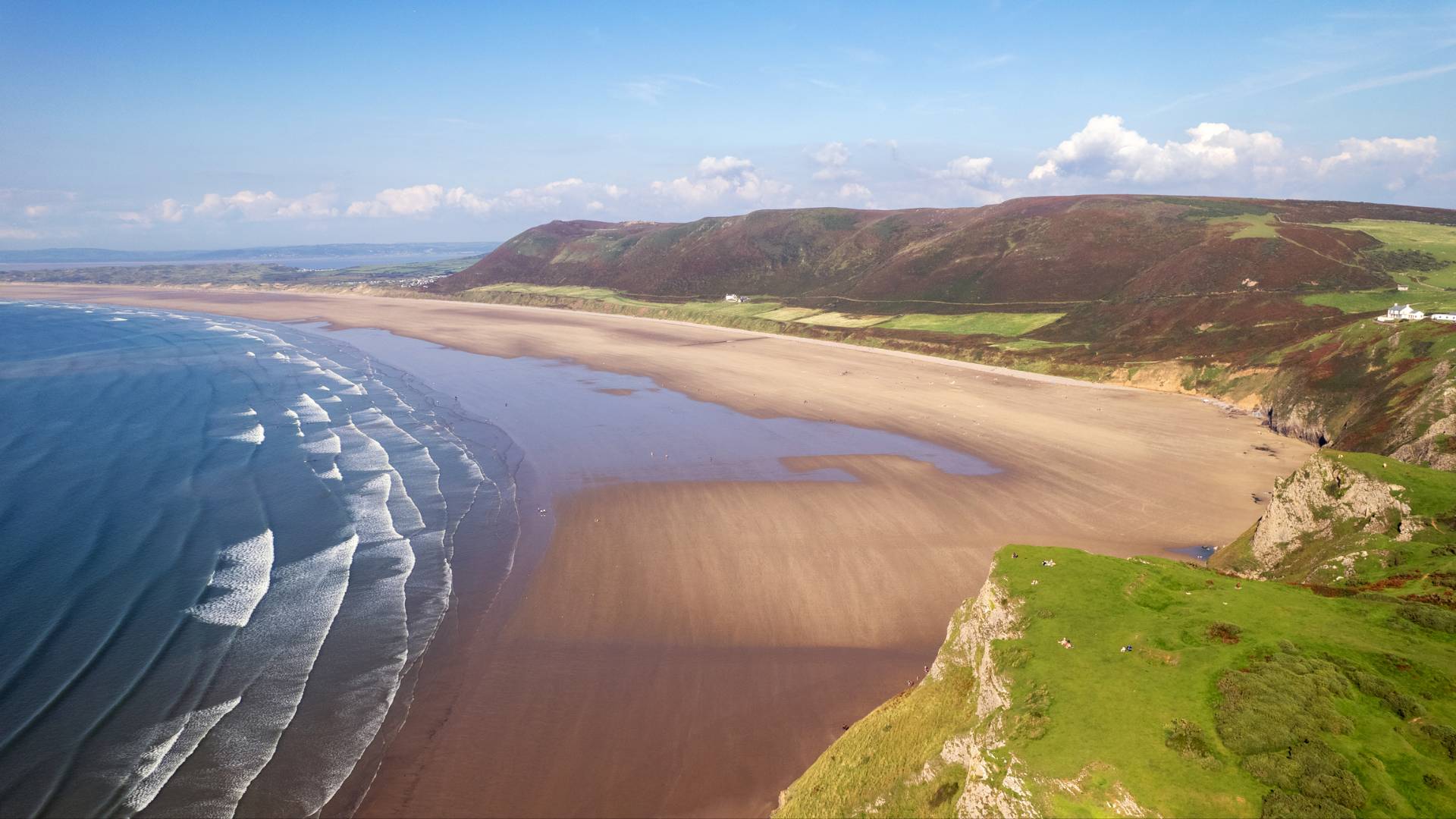
Rhossili Bay's enormous west-facing beach and elevated clifftops make it ideal for watching a low eclipse unfold above the sea. Located on the Gower Peninsula, the area is a Dark Sky Community that retains relatively dark skies despite its popularity during the day. As darkness falls later that evening, the open coastal landscape provides excellent visibility for Perseid meteors.
6. Strumble Head
Strumble Head in west Wales has a clear western horizon and dark skies. (Image credit: Andrea Ricordi, Italy via Getty Images)
Location: Pencaer, Pembrokeshire, west Wales
Max eclipse: 94.0% at 7:13 p.m. BST
Sun position: 14° above west-northwest horizon
Eclipse window: 6:15-8:07 p.m. BST
Sunset: 8:51 p.m. BST
Light pollution: 3.3 Bortle/SQM 21.84
Cloud risk: 70%
Strumble Head offers one of the clearest west-facing horizons in Wales, with the eclipsed sun appearing above the Irish Sea beside its iconic lighthouse. The remote Pembrokeshire coastline experiences very little artificial light, helping preserve dark skies after sunset. Once the eclipse ends, this rugged headland becomes an excellent place to watch the Perseids, with broad ocean views and little interference from nearby towns.
7. Llŷn Peninsula
The remote Lleyn Peninsula is close to a Dark Sky Sanctuary. (Image credit: WLDavies via Getty Images)
Location: Llŷn Peninsula, Gwynedd, north Wales
Max eclipse: 93.3% at 7:11 p.m. BST
Sun position: 14° above west-northwest horizon
Eclipse window: 6:14-8:05 p.m. BST
Sunset: 8:52 p.m. BST
Light pollution: 2.9 Bortle/SQM 21.91
Cloud risk: 70%
The remote Llŷn Peninsula projects deep into the Irish Sea, offering expansive views toward the west-northwest horizon, where the eclipsed sun will appear before sunset. It is also one of the darkest regions in Wales, lying close to the protected skies of Ynys Enlli (Bardsey Island) Dark Sky Sanctuary. With minimal light pollution and wide rural vistas, the peninsula becomes a superb location for watching Perseid meteors later that same night.
8. Galloway Forest Dark Sky Park
The shore of Clatteringshaws Loch in Galloway Forest Park. (Image credit: Flavio Vallenari via Getty Images)
Location: Galloway Forest Park, Dumfries and Galloway, Scotland
Max eclipse: 91.8% at 7:07 p.m. BST
Sun position: 14° above west-northwest horizon
Eclipse window: 6:10—8:01 p.m. BST
Sunset: 8:47 p.m. BST
Cloud risk: 85%
Galloway Forest Park was Britain's first Dark Sky Park and remains one of the country's premier stargazing destinations. Open western views around Clatteringshaws Loch, along with other viewpoints away from the forests, make it well-suited to the low evening eclipse. After twilight fades, exceptionally dark skies reveal the Milky Way in striking detail, creating near-perfect conditions for viewing the Perseid meteor shower in the early hours — if the sky is clear.
9. Northumberland Dark Sky Park
Sunset at Kielder Water in Northumberland. (Image credit: Paul Hayes via Getty Images)
Location: Northumberland National Park and Kielder Water & Forest Park, Northumberland, England
Max eclipse: 90.4% at 7:07 p.m. BST
Sun position: 13° above west-northwest horizon
Eclipse window: 6:10-8:00 p.m. BST
Sunset: 8:49 p.m. BST
Light pollution: 3.3 Bortle/SQM 21.82
Cloud risk: 90%
Northumberland's Dark Sky Park combines remote landscapes with some of England's darkest skies. Locations around Kielder Water and Northumberland National Park provide broad views toward the low west-northwest eclipse shortly before sunset. Later that night, the region becomes one of the finest places in Europe to watch the Perseids, with frequent views of the Milky Way and bright meteors overhead. Check for any events at Kielder Observatory.
10. Giant's Causeway
Giant's Causeway will have a great view of the eclipse. (Image credit: Francesco Vaninetti Photo via Getty Images)
Location: Bushmills, Northern Ireland
Max eclipse: 93.1% at 7:07 p.m. BST
Sun position: 16° above the west horizon
Eclipse window: 6:09-8:02 p.m. BST
Sunset: 9:31 p.m. BST
Light pollution: 4.2 Bortle/SQM 21.52
Cloud risk: 81%
The Giant's Causeway in Northern Ireland offers a spectacular foreground for the eclipse, with the sun appearing low above the Atlantic beyond the famous basalt columns. Although the skies here are not as dark as in some rural parks, the north Antrim coastline still experiences relatively modest light pollution. Nearby coastal viewpoints and beaches provide good conditions for watching Perseid meteors later that night beneath expansive northern skies.
Que mangeaient les bâtisseurs du plus vieux village du monde, il y a 12 000 ans ? En analysant les vestiges de Karahan Tepe, en Turquie, des archéologues ont percé le secret de leur menu. Gazelle sauvage et légumineuses : le carburant, peut-être, de l'une des premières grandes aventures humaines.

 Login