
❌

Normal view

Podcast Rewind: Fable, SteamOS on Android, and Voice-Created Shortcuts

17 July 2026 at 18:55

Enjoy the latest episodes from MacStories’ family of podcasts:

AppStories

This week, Federico and John look at their experiences with Claude Fable 5 and how it differs from other models and break down the controversial changes made by OpenAI to its ChatGPT Mac app.

Then on AppStories+, John and Federico contrast their experiences with Fable 5 and OpenAI’s new family of GPT 5.6 models.

NPC: Next Portable Console

This week, Brendon and John go it alone with more bizarre news from AYANEO, a new tease and OS update from Anbernic, Valve’s e-ink Steam Machine faceplate, Armada bringing SteamOS to Android handhelds, and more.

On NPC XL, John and Brendon check on handheld gaming halfway through the year and look forward to what the rest of 2026 may have in store for the hobby.

Comfort Zone

Matt has been doing tons with Quick Reads, Chris has all the small things, and everyone creates Shortcuts WITH THEIR VOICE.

This week’s Cozy Zone sees the boys competing in Niléane’s Great Star Wars Quotes Quiz, and it goes… let’s just say “good and bad.”

MacStories Unwind

On a special Saturday edition of MacStories Unwind, Federico and John talk live music, blockbuster movies, and their ongoing experiments with Markdown text editors.


AppStories, Episode 493, ‘Fable 5 and OpenAI’s Curious ChatGPT Update’ Show Notes

This episode is sponsored by:

  • Daylite: The only made-for-mac CRM solution. Start your free trial today.

App State

Anthropic’s Claude Fable 5

What did OpenAI Do to ChatGPT?

AppStories+ Post-Show

Subscribe to AppStories+

Visit AppStories.net to learn more about the extended, high bitrate audio version of AppStories that is delivered early each week and subscribe.


NPC, Episode 88, ‘SteamOS Comes to Android Handhelds’ Show Notes

The Latest Portable Gaming News

Subscribe to NPC XL

NPC XL is a weekly members-only version of NPC with extra content, available exclusively through our new Patreon for $5/month. Each week on NPC XL, Federico, Brendon, and John record a special segment or deep dive about a particular topic that is released alongside the “regular” NPC episodes. You can subscribe here.


Comfort Zone, Episode 109, ‘You Can’t Kill Chrome’ Show Notes

Things Discussed

Cozy Zone

For even more from the Comfort Zone crew, you can subscribe to Cozy Zone. Cozy Zone is a weekly bonus episode of Comfort Zone where Matt, Niléane, and Chris invite listeners to join them in the Cozy Zone where they’ll cover extra topics, invent wilder challenges and games, and share all their great (and not so great) takes on tech. You can subscribe to Cozy Zone for $5 per month here or $50 per year here.


MacStories Unwind, ‘Text Editor Experiments’ Show Notes

Live Music

A Summer Blockbuster

Text Editor Experiments

MacStories Unwind+

We deliver MacStories Unwind+ to Club MacStories subscribers ad-free with high bitrate audio every week. To learn more about the benefits of a Club MacStories subscription, visit our Plans page.


MacStories launched its first podcast in 2017 with AppStories. Since then, the lineup has expanded to include a family of weekly shows that also includes MacStories Unwind, Magic Rays of Light, Comfort Zone, NPC: Next Portable Console, and First, Last, Everything that collectively, cover a broad range of the modern media world from Apple’s streaming service and videogame hardware to apps for a growing audience that appreciates our thoughtful, in-depth approach to media.

If you’re interested in advertising on our shows, you can learn more here or by contacting our Managing Editor, John Voorhees.
Podcast Rewind: Surviving Email, Sony Controversies, a Snick Challenge, and John Explains the Boonies

10 July 2026 at 21:12

Enjoy the latest episodes from MacStories’ family of podcasts:

AppStories

This week, Federico and John talk about the 10+ email apps they’ve used over the years and how recent spikes in email volume have caused them to change their approaches.

On AppStories+, Federico and John update listeners on their summertime agentic coding projects.

NPC: Next Portable Console

This week, Steam Machine ordering follow-up and Sony’s many controversial announcements.

On NPC XL, what’s going on with AYANEO and the Pocket MICRO 2? Plus, the RG Rotate gets clock faces, and Apple brings PC gaming on the Mac closer to reality.

Comfort Zone

Chris explains how he’s using Parchment, Matt gets all in your face about calendars, and everyone competes to see who can handle using Snick for the longest.

On Cozy Zone, the gang shares their development tips and setups.

MacStories Unwind

This week, John heads to the mountains while Federico cooks on a beach, the origin of “the boonies,” and narrow mountain roads, plus a TV and movie pick.


AppStories, Episode 492, ‘Email Survival Guide’ Show Notes

This episode is sponsored by:

  • Decagon: The AI concierge for every customer. Get a personalized demo.

Email Survival Guide

AppStories+ Post-Show: Our Latest Agentic Coding Projects

  • John
    • ReMarkable Paper Pure as an input device
    • Creating an “areas of work” Codex orchestration system
  • Federico
    • Shortcuts Playground 2.0
    • MacRemote, an app that creates a remote MCP server for Mac CLIs and local MCPs usable by any app that supports MCP

Subscribe to AppStories+

Visit AppStories.net to learn more about the extended, high bitrate audio version of AppStories that is delivered early each week and subscribe.


NPC, Episode 87, ‘PlayStation Pulls the Plug on Physical Discs’ Show Notes

Follow-Up

Sony’s Big Bad Week

Other News

Subscribe to NPC XL

NPC XL is a weekly members-only version of NPC with extra content, available exclusively through our new Patreon for $5/month. Each week on NPC XL, Federico, Brendon, and John record a special segment or deep dive about a particular topic that is released alongside the “regular” NPC episodes. You can subscribe here.


Comfort Zone, Episode 108, ‘My Magic Mouse Is Pregnant’ Show Notes

Things Discussed

Cozy Zone

For even more from the Comfort Zone crew, you can subscribe to Cozy Zone. Cozy Zone is a weekly bonus episode of Comfort Zone where Matt, Niléane, and Chris invite listeners to join them in the Cozy Zone where they’ll cover extra topics, invent wilder challenges and games, and share all their great (and not so great) takes on tech. You can subscribe to Cozy Zone for $5 per month here or $50 per year here.


MacStories Unwind, ‘Out in the Boonies’ Show Notes

Out in the Boonies

Picks

MacStories Unwind+

We deliver MacStories Unwind+ to Club MacStories subscribers ad-free with high bitrate audio every week. To learn more about the benefits of a Club MacStories subscription, visit our Plans page.


MacStories launched its first podcast in 2017 with AppStories. Since then, the lineup has expanded to include a family of weekly shows that also includes MacStories Unwind, Magic Rays of Light, Comfort Zone, NPC: Next Portable Console, and First, Last, Everything that collectively, cover a broad range of the modern media world from Apple’s streaming service and videogame hardware to apps for a growing audience that appreciates our thoughtful, in-depth approach to media.

If you’re interested in advertising on our shows, you can learn more here or by contacting our Managing Editor, John Voorhees.
Podcast Rewind: AI Aggregators, Fable 5, Steam Machine Pricing, and Chris’s App

3 July 2026 at 19:26

Enjoy the latest episodes from MacStories’ family of podcasts:

AppStories

This week, Federico and John talk about the state of AI aggregator apps and their future prospects before checking in on their current AI app setups for the AppStories+ post-show.

NPC: Next Portable Console

This week, Federico, Brendon, and John consider the Steam Machine’s pricing and early reviews.

On NPC XL, Brendon fulfills a long-ago Switch 2 promise, surprising John and Federico.

Comfort Zone

Niléane invested in a fast-appreciating asset (air conditioner), CHRIS MADE AN APP, and everyone surprises everyone else with their favorite challenges.

On Cozy Zone, we tier list the biggest iPhone features over the year.

MacStories Unwind

This week on MacStories Unwind, Federico and John are burning up Claude Fable 5 tokens as fast as they can, while Federico finds the time to try a brand new Switch 2 game.


AppStories, Episode 491, ‘Are AI Aggregators Worth It?’ Show Notes

This episode is sponsored by:

  • Mercury Weather: Forecasts, beautifully done. Download now for free.
  • Claude: For problems worth solving — get started with Claude today.

AI Aggregator Apps

Subscribe to AppStories+

Visit AppStories.net to learn more about the extended, high bitrate audio version of AppStories that is delivered early each week and subscribe.


NPC, Episode 86, ‘Did You Put Your Email in the Bucket?’ Show Notes

The Steam Machine

Subscribe to NPC XL

NPC XL is a weekly members-only version of NPC with extra content, available exclusively through our new Patreon for $5/month. Each week on NPC XL, Federico, Brendon, and John record a special segment or deep dive about a particular topic that is released alongside the “regular” NPC episodes. You can subscribe here.


Comfort Zone, Episode 107, ‘The Year of Our Lord, Zork’ Show Notes

Things Discussed

Cozy Zone

For even more from the Comfort Zone crew, you can subscribe to Cozy Zone. Cozy Zone is a weekly bonus episode of Comfort Zone where Matt, Niléane, and Chris invite listeners to join them in the Cozy Zone where they’ll cover extra topics, invent wilder challenges and games, and share all their great (and not so great) takes on tech. You can subscribe to Cozy Zone for $5 per month here or $50 per year here.


MacStories Unwind, ‘Burning Tokens Before the Clock Runs Out’ Show Notes

Fable 5

Picks

Unwind Deal

  • Sherlock from the BBC is just $24.99 in the TV app.

MacStories Unwind+

We deliver MacStories Unwind+ to Club MacStories subscribers ad-free with high bitrate audio every week. To learn more about the benefits of a Club MacStories subscription, visit our Plans page.


MacStories launched its first podcast in 2017 with AppStories. Since then, the lineup has expanded to include a family of weekly shows that also includes MacStories Unwind, Magic Rays of Light, Comfort Zone, NPC: Next Portable Console, and First, Last, Everything that collectively, cover a broad range of the modern media world from Apple’s streaming service and videogame hardware to apps for a growing audience that appreciates our thoughtful, in-depth approach to media.

If you’re interested in advertising on our shows, you can learn more here or by contacting our Managing Editor, John Voorhees.
Podcast Rewind: WWDC Reflections, Thunderbolt Hubs, and Prime Day Finds

26 June 2026 at 21:58

Enjoy the latest episodes from MacStories’ family of podcasts:

AppStories

This week, John and Federico are back home and reflect on all the WWDC announcements, including Siri AI, Apple Intelligence, design changes, developer tools, and more.

On AppStories+, we check in on our research setups and how they fared at WWDC.

NPC: Next Portable Console

This week, nose-bleed prices, foldables get wise to handheld gaming, and new products are teased and released by a long list of companies.

On NPC XL, Federico and John cover the pre-review news and rumors about the Steam Machine, plus John’s new Mobapad Switch 2 controller.

Comfort Zone

The gang’s back together! Niléane has a new window management system, Matt wonders if Thunderbolt is too fast, and everyone recovers from letting AI take the wheel for the week.

On Cozy Zone, Niléane has a new place, and it only seemed proper to roast her new setup.

MacStories Unwind

This week, Federico and John share their Amazon Prime Day finds before Federico recommends a pair of videogames for the weekend.


AppStories, Episode 490, ‘WWDC Debrief’ Show Notes

This episode is sponsored by:

  • Mercury Weather: Forecasts, beautifully done. Download now for free.
  • Decagon: The AI concierge for every customer. Get a personalized demo.

Apple Intelligence and Siri AI

iOS 27 Design

Xcode and Developer Tools

Apple Photos and Image Playground

AppStories+ Post-Show

Subscribe to AppStories+

Visit AppStories.net to learn more about the extended, high bitrate audio version of AppStories that is delivered early each week and subscribe.


NPC, Episode 85, ‘TrimUI Goes Android’ Show Notes

Follow-Up

  • SN Operator arriving across Europe and the U.S.
  • Super expensive PS5 SSDs released

The Latest Portable Gaming News

Subscribe to NPC XL

NPC XL is a weekly members-only version of NPC with extra content, available exclusively through our new Patreon for $5/month. Each week on NPC XL, Federico, Brendon, and John record a special segment or deep dive about a particular topic that is released alongside the “regular” NPC episodes. You can subscribe here.


Comfort Zone, Episode 106, ‘Matt’s Big Chonker’ Show Notes

Things Discussed

Cozy Zone

For even more from the Comfort Zone crew, you can subscribe to Cozy Zone. Cozy Zone is a weekly bonus episode of Comfort Zone where Matt, Niléane, and Chris invite listeners to join them in the Cozy Zone where they’ll cover extra topics, invent wilder challenges and games, and share all their great (and not so great) takes on tech. You can subscribe to Cozy Zone for $5 per month here or $50 per year here.


MacStories Unwind, ‘Prime Day Deal Hunters’ Show Notes

Amazon Prime Day Finds

Picks

Unwind Deal

MacStories Unwind+

We deliver MacStories Unwind+ to Club MacStories subscribers ad-free with high bitrate audio every week. To learn more about the benefits of a Club MacStories subscription, visit our Plans page.


MacStories launched its first podcast in 2017 with AppStories. Since then, the lineup has expanded to include a family of weekly shows that also includes MacStories Unwind, Magic Rays of Light, Comfort Zone, NPC: Next Portable Console, and First, Last, Everything that collectively, cover a broad range of the modern media world from Apple’s streaming service and videogame hardware to apps for a growing audience that appreciates our thoughtful, in-depth approach to media.

If you’re interested in advertising on our shows, you can learn more here or by contacting our Managing Editor, John Voorhees.
Podcast Rewind: A Sitcom Plea and Stories from WWDC

19 June 2026 at 21:42

Enjoy the latest episodes from MacStories’ family of podcasts:

Comfort Zone

It’s another duo week as Matt is out there… destroying lives??? Despite that, Chris and Niléane talk about the DMA and cool stuff in the OS 27 betas, and Chris has some stories from WWDC.

On Cozy Zone, the gang goes through their next three apps they would install on their Macs, and it leads to some hard (and surprising) decisions.

MacStories Unwind

This week, Federico learns about Philadelphia and college mascots before making a sitcom plea. Meanwhile, John’s been listening to Olivia Rodrigo’s new album and buying concert tickets.


Comfort Zone, Episode 105, ‘My Dinner with Ternus’ Show Notes

Things Discussed

Cozy Zone

For even more from the Comfort Zone crew, you can subscribe to Cozy Zone. Cozy Zone is a weekly bonus episode of Comfort Zone where Matt, Niléane, and Chris invite listeners to join them in the Cozy Zone where they’ll cover extra topics, invent wilder challenges and games, and share all their great (and not so great) takes on tech. You can subscribe to Cozy Zone for $5 per month here or $50 per year here.


MacStories Unwind, ‘Please Help, We Need Sitcoms’ Show Notes

Philadelphia

Picks

Unwind Deal

MacStories Unwind+

We deliver MacStories Unwind+ to Club MacStories subscribers ad-free with high bitrate audio every week. To learn more about the benefits of a Club MacStories subscription, visit our Plans page.


MacStories launched its first podcast in 2017 with AppStories. Since then, the lineup has expanded to include a family of weekly shows that also includes MacStories Unwind, Magic Rays of Light, Comfort Zone, NPC: Next Portable Console, and First, Last, Everything that collectively, cover a broad range of the modern media world from Apple’s streaming service and videogame hardware to apps for a growing audience that appreciates our thoughtful, in-depth approach to media.

If you’re interested in advertising on our shows, you can learn more here or by contacting our Managing Editor, John Voorhees.
Cosmic “galaxy-killing wind” may explain why some galaxies died so young

14 June 2026 at 14:12

Astronomers have discovered a powerful “galaxy-killing wind” in the early universe that may help solve one of the biggest mysteries in modern astronomy: why so many massive galaxies stopped forming stars much earlier than scientists expected. The discovery suggests that some young galaxies grew rapidly and then died just as quickly, not because of exotic […]

The post Cosmic “galaxy-killing wind” may explain why some galaxies died so young appeared first on Knowridge Science Report.

NASA’s James Webb Space Telescope Spots a Hidden ‘Galaxy Killer’ Lurking in the Early Universe

13 June 2026 at 16:48


The James Webb Space Telescope (JWST) has revealed a cosmic catastrophe, as winds extinguished a star-forming galaxy in the early universe, offering new insight into earlier strange observations.

Cosmic winds may destroy entire galaxies, according to new JWST research exploring the lingering mystery of why certain parts of the universe are unexpectedly devoid of growth.

The findings were published in a recent paper in the Monthly Notices of the Royal Astronomical Society, revealing galactic-scale death in a universe just one billion years old, and potentially answering questions about previous troubling JWST observations.

James Webb Space Telescope Observation

Observations made by the JWST revealed cold gas, an essential star-forming material, blowing out of the CRISTAL-2 galaxy in a massive plume, severely degrading its ability to produce new stars. According to the researchers, it would take less than 50 million years for the galaxy to be completely dead if this activity keeps up, a mere blink in the scheme of a 13.8 billion-year-old universe.

Astronomers consider galaxies to be “dead” if they are no longer capable of producing fresh stars. Traditionally, astronomers expected that it would take billions of years for an old galaxy to slowly run out of fuel and burn out. However, JWST observations have continually captured events in the early universe that were not expected to occur until much later.

One of these was finding a host of dead galaxies in the early universe shortly after it first became operational in 2022. How galaxies could die so close to the beginning of the universe, without sufficient time to burn through their cold gas supplies, has long perplexed scientists.

Explaining Galaxy Death

As researchers began considering various explanations for the phenomenon, they initially settled on dark energy, essentially explaining one unknown with another. Dark energy is a theoretical substance that scientists believe drives the expansion of the universe and was once a stronger force than it is now. While the Dark Energy Spectroscopic Instrument survey revealed last year that dark energy appears to be weakening over time, an exotic galaxy-killer is not required, according to this latest research.

Instead, researchers offer a much simpler explanation of powerful cosmic winds in the remote past. Conventional thinking has it that such powerful winds could only be generated by a supermassive black hole, yet these new observations challenge that assumption.

JWST Reveals the Culprit

CRISTAL-02 is a galaxy still in the making, composed of several smaller galaxies in the final stages of merging into a single system. Because the early universe was far denser than it is today, such collisions were much more common. During these mergers, gravitational forces funnel vast amounts of gas toward the galactic centers, triggering intense bursts of star formation.

Observations of CRISTAL-02 by the James Webb Space Telescope and the Atacama Large Millimeter/submillimeter Array (ALMA) revealed a star formation rate roughly twice that of similar galaxies. Ironically, this extraordinary burst of stellar activity is also generating a powerful cosmic wind that is stripping away the very gas needed to form new stars.

Compounding the effect, many of the newly formed stars rapidly exhaust their fuel and end their lives as supernovae, producing additional outflows that further deplete the galaxy’s star-forming material.

Together, these processes appear capable of shutting down star formation far more quickly than astronomers previously believed possible. Going forward, ongoing JWST observations are likely to continue challenging astronomers’ assumptions, as more evidence indicates that nearly half of the early universe’s massive galaxies were interacting—a finding which also suggests early “galactic deaths” like these may not be all that rare, after all.

The paper, “Multiphase Images of a Powerful Supernova-Driven Wind in the Early Universe,” appeared in Monthly Notices of the Royal Astronomical Society on June 10, 2026.

Ryan Whalen covers science and technology for The Debrief. He holds an MA in History and a Master of Library and Information Science with a certificate in Data Science. He can be contacted at ryan@thedebrief.org, and follow him on Twitter @mdntwvlf.

Astronomers Finally Find Milky Way’s Missing Black Hole Wind

8 June 2026 at 18:42
This image shows the evidence for the wind blowing away from Sagittarius A*: the white dot in the center of the image shows the supermassive black hole; in orange is data from ALMA, mapping the location of cold gas composed of carbon monoxide in the image; in blue is X-ray data from Chandra; a large cone-shaped cavity, visible as an absence of cold gas in the ALMA data, is filled by hot X-ray-emitting gas in the Chandra data. Image credit: NASA / CXC / UMass / Wang et al. / ALMA / ESO / NAOJ / NRAO / Longmore et al. / Minniti et al.

After a 50-year search, astronomers have uncovered evidence that Sagittarius A* -- the 4.3-million-solar-mass black hole that resides at the center of our Milky Way Galaxy -- is blowing a hot cosmic wind into its surroundings, carving out a giant cavity near the Galaxy’s heart.

The post Astronomers Finally Find Milky Way’s Missing Black Hole Wind appeared first on Sci.News: Breaking Science News.

Astronomers Find the Strongest Evidence Yet That Alien Planets Have Magnetic Fields

8 June 2026 at 12:02
Illustration of the Sun and Earth with magnetic field lines in space.The winds on seven hellish alien worlds are moving in the wrong direction. That strange anomaly just cracked open one of exoplanet science's biggest mysteries.

When Winds Collide: Predicting the Effects of Stream Interaction Regions

14 January 2026 at 17:00

Illustration of the solar wind interacting with Earth's magnetic field

What happens when pileups of solar wind plasma collide with Earth’s protective magnetosphere? New work uses machine learning to examine how strongly these events affect our planet’s magnetic field.

Plasma Pileups

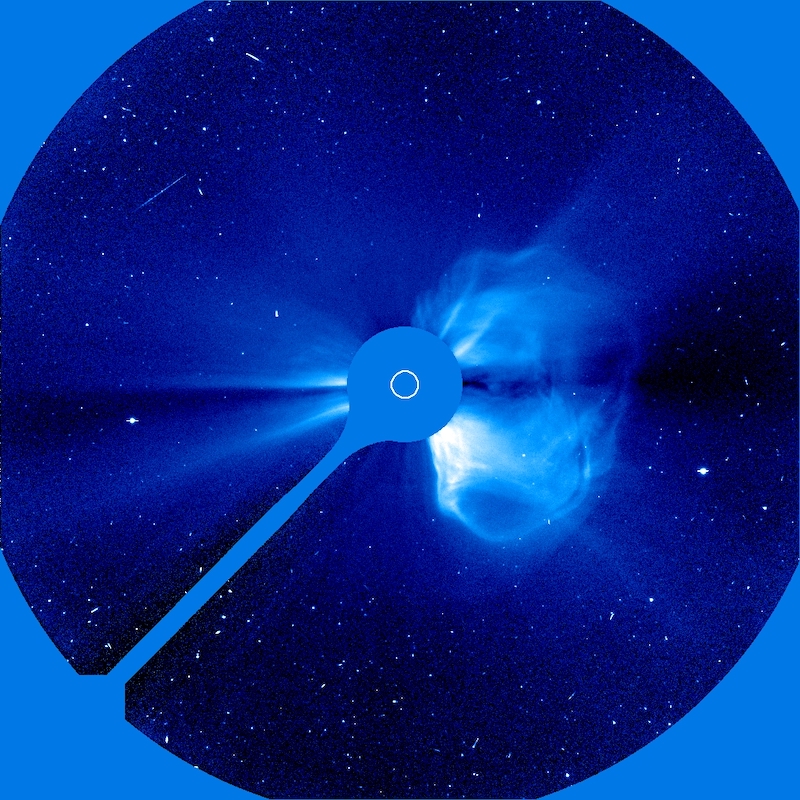
photograph of a coronal mass ejection

The Solar & Heliospheric Observatory (SOHO) took this coronagraphic image of a coronal mass ejection on 20 April 1998. [SOHO (ESA & NASA)]

Geomagnetic storms driven by solar activity paint night skies with glowing aurorae, but they also threaten spacecraft electronics with showers of high-energy particles. While immense eruptions of solar plasma and magnetic fields called coronal mass ejections are the most infamous example of solar activity, a team led by Yudong Ye (Sun Yat-Sen University) recently focused on another, less destructive form of activity: stream interaction regions.

Stream interaction regions arise when slow-moving solar wind is struck from behind by faster-moving solar wind emitted later. The collision of the two solar wind streams creates a tangle of compressed plasma and strong magnetic fields capable of peeling back Earth’s protective magnetosphere and dumping in high-energy charged particles, with beautiful yet harmful results.

Machine Learning Method

Though stream interaction regions are less disruptive than coronal mass ejections, they’re far more common; they frequently needle Earth’s magnetosphere, especially during the calmer years of the Sun’s activity cycle. Predicting how strongly a stream interaction region will influence Earth’s magnetosphere — in other words, how geoeffective it is — is challenging, however. When two streams of solar wind collide, their properties combine in complex and nonlinear ways that traditional statistical investigations have struggled to pin down.

Now, Ye and collaborators have used machine learning to study the properties and impact of stream interaction regions in a physically meaningful way. They performed their study on a sample of 879 stream interaction events for which there is abundant information, such as temperature, magnetic field strength and direction, and solar wind conditions before and after the event.

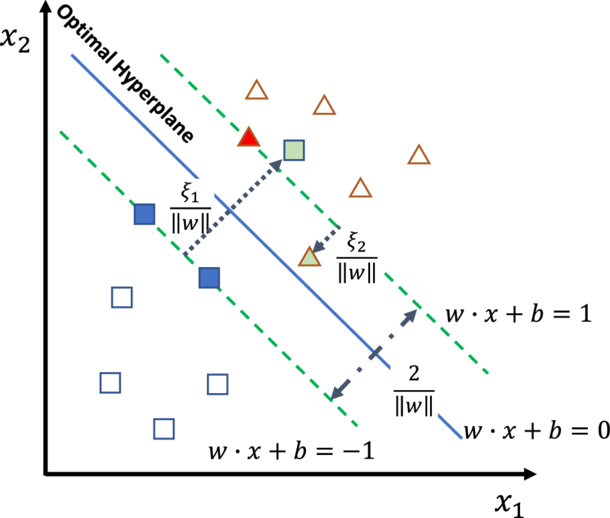
illustration of the support vector machine framework

Illustration of the authors’ support vector machine framework. The optimal hyperplane is the boundary that best divides the data by maximizing the distance between the boundary and the data points nearest to it; these points are called support vectors. Square and triangle symbols represent two classes of data. Click to enlarge. [Ye et al. 2025]

Ye’s team based their framework on a support vector machine classifier: a classical machine learning algorithm that draws a mathematical boundary between groups of data while maximizing the distance between the boundary and the data points nearest to the dividing line. The support vector machine algorithm is well-suited to the task of modeling the geoeffectiveness of stream interaction regions because it doesn’t require a particularly vast dataset, can tolerate misclassified events, and allows for a physical interpretation of the results.

A Physical Interpretation

The team first reined in the model’s complexity by identifying the most important features in the dataset. They then determined which features or combination of features had the largest contribution to the output — in other words, which physical parameters most strongly determined the geoeffectiveness of the event.

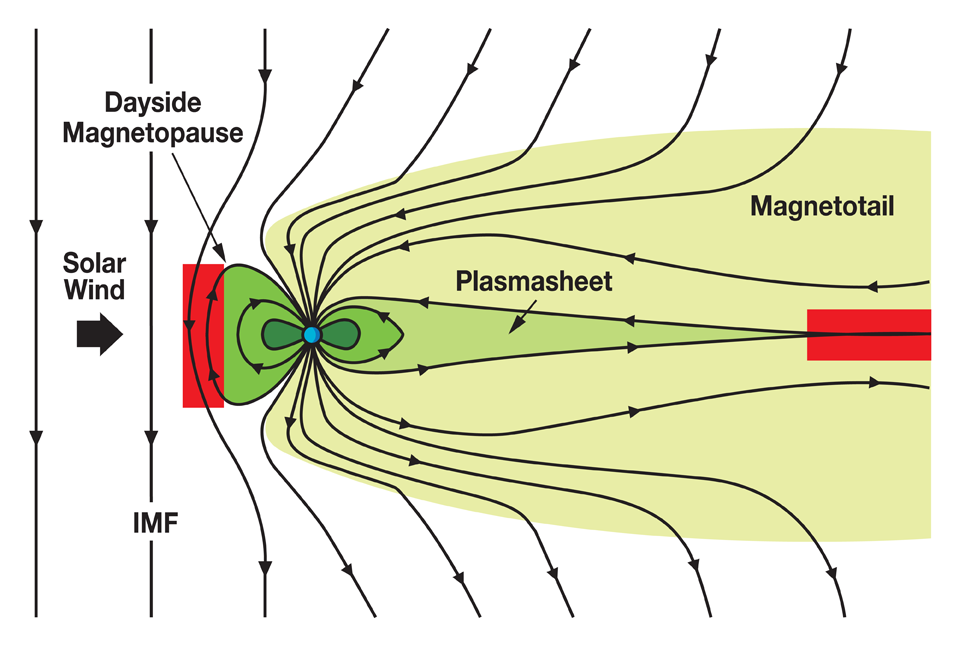
illustration of magnetic reconnection in Earth's magnetosphere

Illustration of how the interplanetary magnetic field (IMF) interacts with Earth’s magnetosphere. When the IMF points southward, as it does in this diagram, the impact on Earth’s magnetosphere is increased, with magnetic reconnection occurring in the red areas. Click to enlarge. [NASA]

Ye and collaborators found that the strongest determinants of an event’s geoeffectiveness were how long the solar wind was directed southward, the strength of the solar wind electric field, and the average and minimum strengths of the southward-pointing solar wind magnetic field. These results align with the current understanding of how energy is transferred from the solar wind to Earth’s magnetosphere through magnetic reconnection, a release of magnetic energy driven by rearrangement of magnetic fields. This shows how classical machine learning methods can enhance our ability to predict the outcome of oncoming space weather while simultaneously examining the physical drivers of the event.

Citation

“Assessing the Geoeffectiveness of Stream Interaction Regions Through Physically Interpretable Machine Learning,” Yudong Ye et al 2025 ApJ 993 10. doi:10.3847/1538-4357/ae0454

The post When Winds Collide: Predicting the Effects of Stream Interaction Regions appeared first on AAS Nova.

Minding the Gaps in Solar Wind Data

9 July 2025 at 17:00

solar wind

Spacecraft scattered throughout the solar system keep tabs on the solar wind, but the measurements are dotted with data gaps. How can scientists prevent these gaps from biasing their studies of the solar wind?

Sampling the Solar Wind

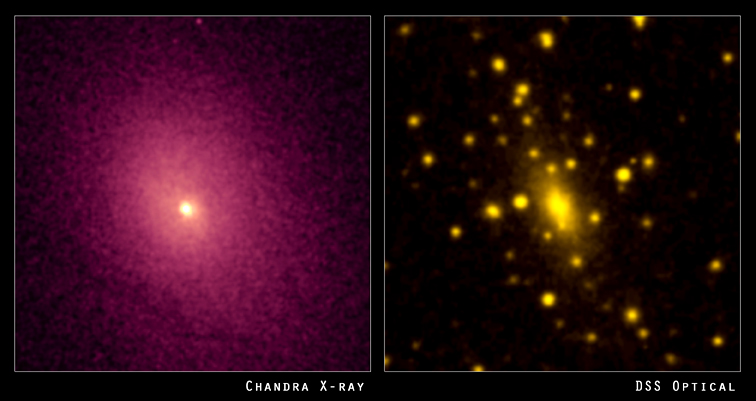
intracluster medium

Left: the distribution of hot gas between the galaxies in the cluster Abell 2029. Right: the visible light from the galaxies in the cluster. [X-ray: NASA/CXC/UCI/A.Lewis et al. Optical: Pal.Obs. DSS]

The solar wind is a tenuous, fast-moving, turbulent plasma that constantly streams out from the Sun. Studying the solar wind is important for understanding how potentially damaging space weather events like coronal mass ejections travel through the solar system. Solar wind studies also have far-reaching implications, since solar-wind-like plasmas exist throughout the universe, such as in the sparse medium between galaxies in a cluster.

Luckily, there are many spacecraft that sample the solar wind from various locations within our solar system. Unluckily, many of these spacecraft do not continuously monitor the solar wind. For example, when a spacecraft orbiting a planet dips into the planet’s atmosphere, this detour creates an hours-long gap in solar wind monitoring.

The Impact of Data Gaps

How do these data gaps affect studies of the solar wind? In a recent research article, Daniel Wrench and Tulasi Parashar (Victoria University of Wellington) approached this question in terms of how gaps affect the structure function: a mathematical description of how the solar wind fluctuates over different length or time scales.

Wrench and Parashar introduced random artificial gaps into data from the Parker Solar Probe, which monitors the solar wind continuously, and compared the structure functions calculated from the continuous and interrupted data sets. They used the difference between the true structure function — calculated from the continuous data set — and the structure functions from the artificially gapped data sets to develop a correction factor.

bar plot of correction method performance

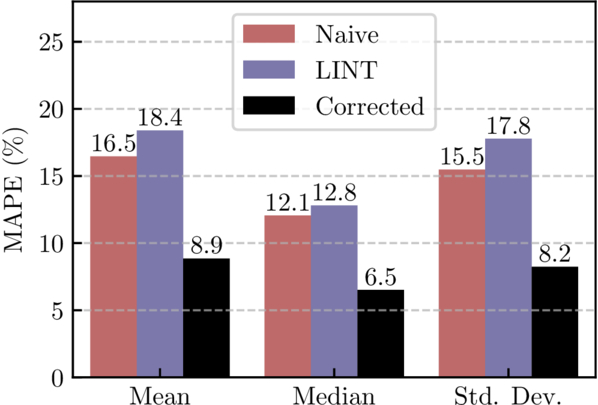
Performance of the correction factor method (black) compared to the uncorrected, gapped data (red) or gaps filled using linear interpolation (blue). MAPE is the mean absolute percentage error. [Wrench & Parashar 2025]

The team then tested their correction factor using data from the Wind spacecraft, which continuously monitors the solar wind from the L1 Lagrange point. The team calculated the structure function from 1) the continuous data set, 2) the artificially gapped data, 3) the gapped data with linear interpolation used to fill the gaps, and 4) the gapped data with the correction factor applied. This test showed that the correction factor performs better than other commonly used gap-handling methods, such as linear interpolation, which can systematically underestimate the structure function. Using the correction factor, the error in the structure function remained below 50% even when 95% of the data were missing.
plot of structure function from Voyager 1 data

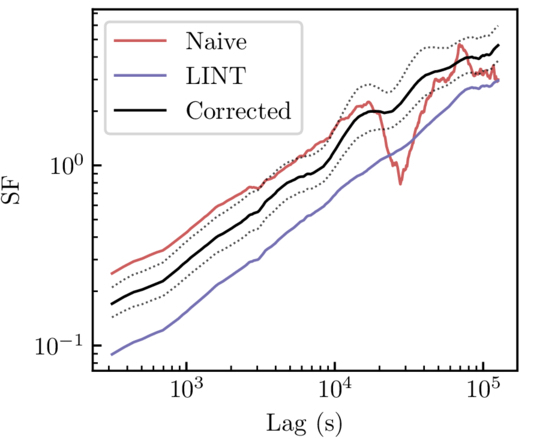
Structure function calculated from uncorrected Voyager 1 data (red), linearly interpolated data (blue), and corrected data (black). Both the linear interpolation method and the correction factor method remove the artifact around a lag of 3×10⁴ seconds, but the correction factor method does not suppress the signal like the linear interpolation method does. [Adapted from Wrench & Parashar 2025]

Correcting Voyager 1

Finally, the authors applied their validated method to data from Voyager 1. Data from the two Voyager spacecraft are extremely scientifically valuable — no other spacecraft have ventured as far from the Sun and can measure the solar wind at such large distances. The data are also extremely sparse; one segment used in this work was missing 85% of the data. This means that an effective method of correcting these data has potentially huge scientific significance.

Wrench and Parashar applied their correction factor to the Voyager 1 data, showing that this method handily removes artifacts while avoiding the underestimation introduced by linear interpolation. While the authors saved the interpretation of the newly corrected Voyager 1 data for future research, this study makes it clear that even large data gaps needn’t hinder studies of the solar wind.

Citation

“Debiasing Structure Function Estimates from Sparse Time Series of the Solar Wind: A Data-Driven Approach,” Daniel Wrench and Tulasi N. Parashar 2025 ApJ 987 28. doi:10.3847/1538-4357/addc6a

The post Minding the Gaps in Solar Wind Data appeared first on AAS Nova.

Soaring solar and a surge in hydro push more coal off the US grid

22 May 2026 at 18:22

Last year, the first few months of data from the US grid suggested that fears of a data-center-driven surge in demand were becoming a reality. Demand had risen by about 3 percent, triggering a surge in coal, interrupting what had been a long downward trend. But over the course of the year, both trends slowed considerably.

A year later, all of that seems to be in the past, as the US has returned to its normal pattern: slow growth, with renewables pushing coal off the grid. The one oddity is that hydroelectric production has surged without a corresponding increase in capacity, likely due to unusually warm weather in the western US causing the snowpack to melt early. That may have consequences later in the year.

Pushing fossil fuels out

Overall demand in the US grew by only 1.5 percent in the first quarter of 2026 compared to the same period the year before. Often, changes in demand during this part of the year are driven by weather-related heating demand. But the US had an unusual combination set of weather conditions to start 2026, with the western half baking in unseasonal warm temperatures, while the eastern half suffered a deep freeze. So we'll probably need data from more of the year before we read too much into the small rise in demand we've seen so far.

Read full article

Comments

© Getty Images

❌