❌

Normal view

Jennifer Aniston deixa futura série do Apple TV baseada em livro de Jennette McCurdy

23 July 2026 at 20:54

Informações do TMZ dão conta de que a atriz Jennifer Aniston deixou o elenco da vindoura série do Apple TV inspirada em “Estou Feliz Que Minha Mãe Morreu” (“I’m Glad My Mom Died”), aclamado livro de memórias da atriz de “iCarly” Jennette McCurdy.

Segundo as fontes consultadas pelo veículo, a decisão de Aniston foi motivada por conflitos de agenda. Elas também afirmaram que a série segue em produção e que os roteiros dos episódios estão em desenvolvimento ativo.

Anunciada pelo serviço de streaming em julho do ano passado, a série promete trazer, ao longo de dez episódios, um relato comovente e hilário das lutas de McCurdy como ex-atriz mirim, enquanto lida com a sua mãe autoritária e dominadora.

Como comentamos na época, Aniston estava escalada para interpretar justamente a mãe da autora do livro, além de assinar como produtora executiva pela Echo Films. Ela, no entanto, não é a única a se despedir do projeto, já que Jason Reitman (creditado originalmente como diretor) abandonou a série poucos meses após o seu anúncio por conta de divergências criativas com McCurdy, segundo informações do Puck.

Desenvolvida pelo Apple Studios como uma comédia dramática, “I’m Glad My Mom Died” é produzida, escrita e apresentada por McCurdy e Ari Katcher. Sharon Horgan e Stacy Greenberg pela Merman; Dani Gorin, Tom Ackerley e Josey McNamara pela LuckyChap; bem como Jerrod Carmichael e Erica Kay integram a equipe de produtores executivos.

Aniston, vale lembrar, estrela o sucesso “The Morning Show” — série do Apple TV que, como ficamos sabendo mais cedo, será encerrada após sua quinta temporada, prevista para 2027.

O Apple TV está disponível no aplicativo Apple TV em mais de 100 países e regiões, seja em iPhones, iPads, Apple TVs, Macs, dispositivos Android, smart TVs ou online — além de também estar em aparelhos como Roku, Amazon Fire TV, Chromecast com Google TV, consoles PlayStation e Xbox. O serviço custa R$29,90 por mês, com um período de teste gratuito de 7 dias. Por tempo limitado, quem comprar e ativar um novo iPhone, iPad, Apple TV ou Mac ganha 3 meses do Apple TV. Ele também faz parte do pacote de assinaturas da empresa, o Apple One.

NOTA DE TRANSPARÊNCIA: O MacMagazine recebe uma pequena comissão sobre vendas concluídas por meio de links deste post, mas você, como consumidor, não paga nada mais pelos produtos/serviços usando os nossos links de afiliado.

Quinta e última temporada de “The Morning Show”, do Apple TV, estreará em 2027

23 July 2026 at 18:14

Primeira série original lançada globalmente pelo Apple TV, “The Morning Show” chegará ao fim com sua quinta temporada, conforme anunciou hoje o serviço de streaming da Maçã em comunicado para a imprensa.

O retorno da produção, que conta com Reese Witherspoon e Jennifer Aniston como protagonistas e produtoras executivas, está marcado para o ano que vem, com boa parte do elenco já conhecido e algumas adições.

Retornarão Billy Crudup, Mark Duplass, Nestor Carbonell, Karen Pittman, Greta Lee, Nicole Beharie e Jon Hamm. Jeff Daniels, Reneé Rapp, Jesse Williams, Sean Hayes, Lizzy Caplan e outros nomes chegarão para completar o time.

Divulgação/Apple

Ao longo de suas quatro temporadas, “The Morning Show” já foi indicada a diversas premiações (vencendo algumas delas) e debateu temas como a pandemia de COVID-19 e assédio, tendo como pano de fundo os bastidores do telejornalismo.

Além das protagonistas, Charlotte Stoudt (também showrunner), Mimi Leder (também diretora), Michael Ellenberg, Lauren Neustadter, Kristin Hahn, Zander Lehmann e Micah Schraft serão produtores executivos.

O Apple TV está disponível no aplicativo Apple TV em mais de 100 países e regiões, seja em iPhones, iPads, Apple TVs, Macs, dispositivos Android, smart TVs ou online — além de também estar em aparelhos como Roku, Amazon Fire TV, Chromecast com Google TV, consoles PlayStation e Xbox. O serviço custa R$29,90 por mês, com um período de teste gratuito de 7 dias. Por tempo limitado, quem comprar e ativar um novo iPhone, iPad, Apple TV ou Mac ganha 3 meses do Apple TV. Ele também faz parte do pacote de assinaturas da empresa, o Apple One.

NOTA DE TRANSPARÊNCIA: O MacMagazine recebe uma pequena comissão sobre vendas concluídas por meio de links deste post, mas você, como consumidor, não paga nada mais pelos produtos/serviços usando os nossos links de afiliado.

Benicio del Toro se junta a Ben Stiller em “Protective Custody”, do Apple TV

22 July 2026 at 19:29

O Apple TV anunciou hoje que o ator Benicio del Toro fará sua estreia em um papel de destaque na série de comédia “Protective Custody”, futura produção estrelada e produzida por Ben Stiller que foi anunciada em maio deste ano.

A produção girará em torno de um financista desacreditado acusado de fraude em larga escala e colocado sob custódia. Na cadeia, ele se verá obrigado a lidar com a política da prisão, recuperar sua reputação e enfrentar as consequências de seus atos enquanto aguarda o julgamento.

Benicio Del Toro is set to make his leading comedy series debut on Apple TV.

Also starring and executive produced by Ben Stiller, and hailing from Emmy Award-winner Mike Judge, Emmy Award-winner Steve Hely and Dave King, comes a new series about a disgraced financier navigating… pic.twitter.com/3rglVYsR7C

— Apple TV (@AppleTV) July 22, 2026

“Protective Custody” também marcará o reencontro entre del Toro e Stiller, que já colaboraram na minissérie “Escape at Dannemora”. A produção marca, ainda, a estreia de Stiller como protagonista em uma série de comédia roteirizada, fora do formato de esquetes.

A produção será comandada por Steve Hely, Dave King e pelo diretor Mike Judge — que também serão roteiristas e showrunners. A produção executiva será de Stiller, John Lesher, Ben Silverman, Howard Owens, Rodney Ferrell, Michael Rotenberg, Oly Obst e Nanette Burstein.

O Apple TV está disponível no aplicativo Apple TV em mais de 100 países e regiões, seja em iPhones, iPads, Apple TVs, Macs, dispositivos Android, smart TVs ou online — além de também estar em aparelhos como Roku, Amazon Fire TV, Chromecast com Google TV, consoles PlayStation e Xbox. O serviço custa R$29,90 por mês, com um período de teste gratuito de 7 dias. Por tempo limitado, quem comprar e ativar um novo iPhone, iPad, Apple TV ou Mac ganha 3 meses do Apple TV. Ele também faz parte do pacote de assinaturas da empresa, o Apple One.

NOTA DE TRANSPARÊNCIA: O MacMagazine recebe uma pequena comissão sobre vendas concluídas por meio de links deste post, mas você, como consumidor, não paga nada mais pelos produtos/serviços usando os nossos links de afiliado.

Apple poderá lançar programa de assinatura de iPhones, iPads, Macs e Apple Watches em breve

21 July 2026 at 17:12

De acordo com informações da Bloomberg, a Apple lançará na próxima semana o “Apple Upgrade”, um serviço de assinatura que incluirá iPhones, iPads, Macs e até mesmo Apple Watches.

Desenvolvida em parceria com a empresa financeira Klarna Group Plc, a iniciativa será disponibilizada primeiro apenas nos Estados Unidos — tanto em lojas físicas da Maçã quanto na Apple Store Online.

Assim como outros programas do tipo, o “Apple Upgrade” permitirá que os usuários quitem o dispositivo antecipadamente durante o contrato, façam um upgrade para um modelo mais recente antes do fim da assinatura ou fiquem com o aparelho ao final do período de locação. Ainda segundo as informações, é possível que taxas adicionais sejam cobradas em casos específicos.

Mais precisamente, aluguéis de iPhones e Apple Watches terão uma duração de 24 meses, enquanto Macs e iPads poderão ser usados por 36 meses. Sujeito a uma análise de crédito antes da contratação do serviço, o usuário sempre poderá devolver o seu aparelho ao final do período de locação.

A Bloomberg disse ainda que o plano da Maçã é divulgar o “Apple Upgrade” como uma forma de realizar pagamentos menores do que os oferecidos por programas de financiamento tradicionais. Além disso, ela estaria se preparando para descontinuar o iPhone Upgrade Program e a modalidade de financiamento tradicional para abrir espaço para a nova oferta.

Ao contrário do iPhone Upgrade Program, no entanto, o “Apple Upgrade” não incluirá o AppleCare; dispositivos de entrada — como o Apple Watch SE 3, o iPad (A16 Bionic), o iPhone 16 e o MacBook Neo — não estarão disponíveis no novo programa; por fim, usuários corporativos e estudantes também ficarão de fora da brincadeira.

Rumorado há alguns anos — e supostamente cancelado internamente pela companhia no final de 2024 — o “Apple Upgrade” chegará pouco tempo depois de a Apple aumentar os preços de vários de seus produtos em decorrência da crise de DRAM 1Dynamic random access memory, ou memória dinâmica de acesso aleatório., provocada pela alta demanda por chips de memória no mercado de inteligência artificial.

Notas de rodapé

  • 1
    Dynamic random access memory, ou memória dinâmica de acesso aleatório.

“iPhone 20 Pro Max” poderá chegar com tela de quase 7 polegadas

21 July 2026 at 13:24

Fontes da cadeia de suprimentos dão conta de que a Apple estaria avaliando a utilização de uma tela maior para o iPhone — de quase 7 polegadas, mais especificamente — em um futuro próximo.

A informação veio do leaker Digital Chat Station, o qual comentou na rede social chinesa Weibo que o tamanho físico do novo painel seria de exatas 6,96 polegadas. Ele especula que essa ampliação deverá acontecer no “iPhone 20 Pro Max”, a versão maior da edição comemorativa de 20 anos da linha, marcada para chegar em 2027, sucedendo o “iPhone 18 Pro Max”.

Caso o rumor se confirme, esse se tornará o maior painel já utilizado em um iPhone (embora a diferença em relação às 6,86″ do iPhone 17 Pro Max seja pequena), número suficiente para que o arredondamento das campanhas publicitárias da Apple dê conta de uma tela de 7″. 

A proposta dos modelos comemorativos de 20 anos, conforme especulam vários insiders, é de uma tela sem intervenções, com bordas curvas. Segundo Mark Gurman, da Bloomberg, esses novos iPhones deverão contar com um chip “A21” de 2 nanômetros, que poderá estar presente ainda na segunda geração do iPhone dobrável. Resta a dúvida se a Apple pulará a linha “iPhone 19” e seguirá direto com o “20” (ou “XX”), como fez com os iPhones 8/8 Plus e o iPhone X, em 2017.

iPhone 17 Pro Max

Cores: prateado, laranja-cósmico ou azul-intenso
Armazenamento: 256GB, 512GB, 1TB ou 2TB
R$ 10.499,00
R$ 12.499,00

iPhone 17 Pro

Cores: prateado, laranja-cósmico ou azul-intenso
Armazenamento: 256GB, 512GB ou 1TB
R$ 9.777,77
R$ 11.499,00

NOTA DE TRANSPARÊNCIA: O MacMagazine recebe uma pequena comissão sobre vendas concluídas por meio de links deste post, mas você, como consumidor, não paga nada mais pelos produtos/serviços usando os nossos links de afiliado.

via MacRumors

Lewis Pullman entra para o elenco de “Guilty Creatures”, série do Apple TV

20 July 2026 at 18:42

Anunciada no último dia 6/7 pelo Apple TV, a série “Guilty Creatures” — que terá Julia Garner como protagonista — teve mais um nome anunciado para o seu elenco: o ator americano Lewis Pullman.

O próprio perfil oficial do serviço de streaming anunciou o novo integrante da série, que é uma adaptação do livro “Guilty Creatures: Sex, God, and Murder in Tallahassee, Florida”, de Mikita Brottman.

Lewis Pullman joins Julia Garner in #GuiltyCreatures, the true crime thriller adapted from Mikita Brottman's book coming to Apple TV. pic.twitter.com/YE73edpQPM

— Apple TV (@AppleTV) July 20, 2026

A história acompanha um romance sucedido por um assassinato envolvendo “dois amantes jovens, adultos, mas tementes a Deus” e uma investigação que tentará desvendar o custo emocional de se viver como assassinos por 18 anos.

Essa fascinante narrativa de crimes reais, ambientada em um pano de fundo de sexo e assassinato no Panhandle da Flórida, promete se tornar um clássico instantâneo.

De acordo com a Apple, “Guilty Creatures” será produzida pelo Tomorrow Studios (parceira do ITV Studios) como fruto de um acordo com a Alma Margo e a Fortunate Jack Productions.

Enquanto Craig Gillespie será o diretor, Stuart Zicherman será showrunner e também atuará como produtor executivo ao lado de Garner, Brottman, Marty Adelstein, Becky Clements, Alissa Bachner e Annie Marter.

O Apple TV está disponível no aplicativo Apple TV em mais de 100 países e regiões, seja em iPhones, iPads, Apple TVs, Macs, dispositivos Android, smart TVs ou online — além de também estar em aparelhos como Roku, Amazon Fire TV, Chromecast com Google TV, consoles PlayStation e Xbox. O serviço custa R$29,90 por mês, com um período de teste gratuito de 7 dias. Por tempo limitado, quem comprar e ativar um novo iPhone, iPad, Apple TV ou Mac ganha 3 meses do Apple TV. Ele também faz parte do pacote de assinaturas da empresa, o Apple One.

NOTA DE TRANSPARÊNCIA: O MacMagazine recebe uma pequena comissão sobre vendas concluídas por meio de links deste post, mas você, como consumidor, não paga nada mais pelos produtos/serviços usando os nossos links de afiliado.

Apple teria descartado dois modelos do Mac Pro, incluindo um com chip Intel

20 July 2026 at 15:14

Na edição mais recente da sua newsletter “Power On”, o jornalista da Bloomberg Mark Gurman comentou sobre os planos da Apple envolvendo o Mac Pro antes de anunciar a sua descontinuação no início do ano — incluindo dois modelos descartados e variantes ainda mais poderosas dos chips Apple Silicon do que as da linha Ultra — e a implementação da inteligência artificial (IA) no atendimento do Genius Bar.

Segundo o Gurman, a Apple desenvolveu pelo menos dois modelos do Mac Pro que nunca viram a luz do dia: um com processador da Intel — mesmo depois do lançamento da linha M1, curiosamente —, de codinome J170, para atender casos específicos; e outro equipado com o M3 Ultra, chamado internamente de J190 e previsto para ser lançado junto da última leva do Mac Studio, que chegou ao mercado no começo do ano passado. 

Um caminho possível para a linha seria um suposto chip superior aos do sufixo Ultra; citado pelo jornalista como a variante “Extreme”, ele teria como objetivo oferecer o dobro de núcleos de CPU 1Central processing unit, ou unidade central de processamento. e GPU 2Graphics processing unit, ou unidade de processamento gráfico. em relação aos do Ultra, e o desenvolvimento do projeto chegou até o M3 antes de ser encerrado devido à preocupação com custos e demanda.

Genius Bar com IA?

Na mesma edição, o jornalista comentou que a Apple passou a testar a implementação de um sistema que utiliza IA para registrar conversas entre clientes e funcionários do Genius Bar.

Divulgação/Apple

Intitulado Live Notes, o recurso opcional testado em algumas Apple Stores permitiria que os funcionários do Genius Bar registrassem transcrições dos seus atendimentos com uma ferramenta capaz ainda de resumir as interações com os clientes. Ambas as partes deverão consentir com a gravação e o resultado final é passível de ajustes, sendo adicionado ao iPad do funcionário como parte do registro do atendimento ou reparo.

Ainda assim, o teste gerou preocupações entre os empregados, os quais temem que esses registros poderão ser usados para metrificar avaliações de desempenho e o trabalho dos colegas. A Apple teria descartado essa possibilidade, afirmando que as gravações não serão armazenadas e que nem mesmo os gerentes possuirão acesso às transcrições.

Notas de rodapé

  • 1
    Central processing unit, ou unidade central de processamento.
  • 2
    Graphics processing unit, ou unidade de processamento gráfico.

Apple evitou citar Jony Ive em processo contra a OpenAI

20 July 2026 at 13:36

Desde que a Apple levou a OpenAI aos tribunais por uma suposta violação de segredos industriais e propriedade intelectual, a ausência do nome de Jony Ive no processo tem sido motivo de especulações, considerando que o ex-executivo da Maçã e braço direito de Steve Jobs é uma peça relevante para o desenvolvimento de hardwares da dona do ChatGPT.

No ano passado, a startup de Ive, a io Products, foi adquirida pela OpenAI por US$6,5 bilhões. Desde então, o estúdio de design independente LoveFrom (também comandado pelo ex-Apple) passou a ser o espaço da gigante de inteligência artificial (IA) para a supervisão do design da sua linha de hardware. Nesse processo, mais de 400 funcionários trocaram a Maçã pela empresa de Sam Altman — entre eles, Tang Tan e Chang Liu, acusados de instruírem a revelação de protótipos da Maçã para quem estivesse em entrevista com a empresa de IA.

Para Mark Gurman, jornalista da Bloomberg, existem duas explicações lógicas para Ive ter ficado de fora das acusações: a ausência de provas que comprovem seu vínculo com o esquema e a sua relação de proximidade com a viúva de Jobs, Laurene Powell Jobs.

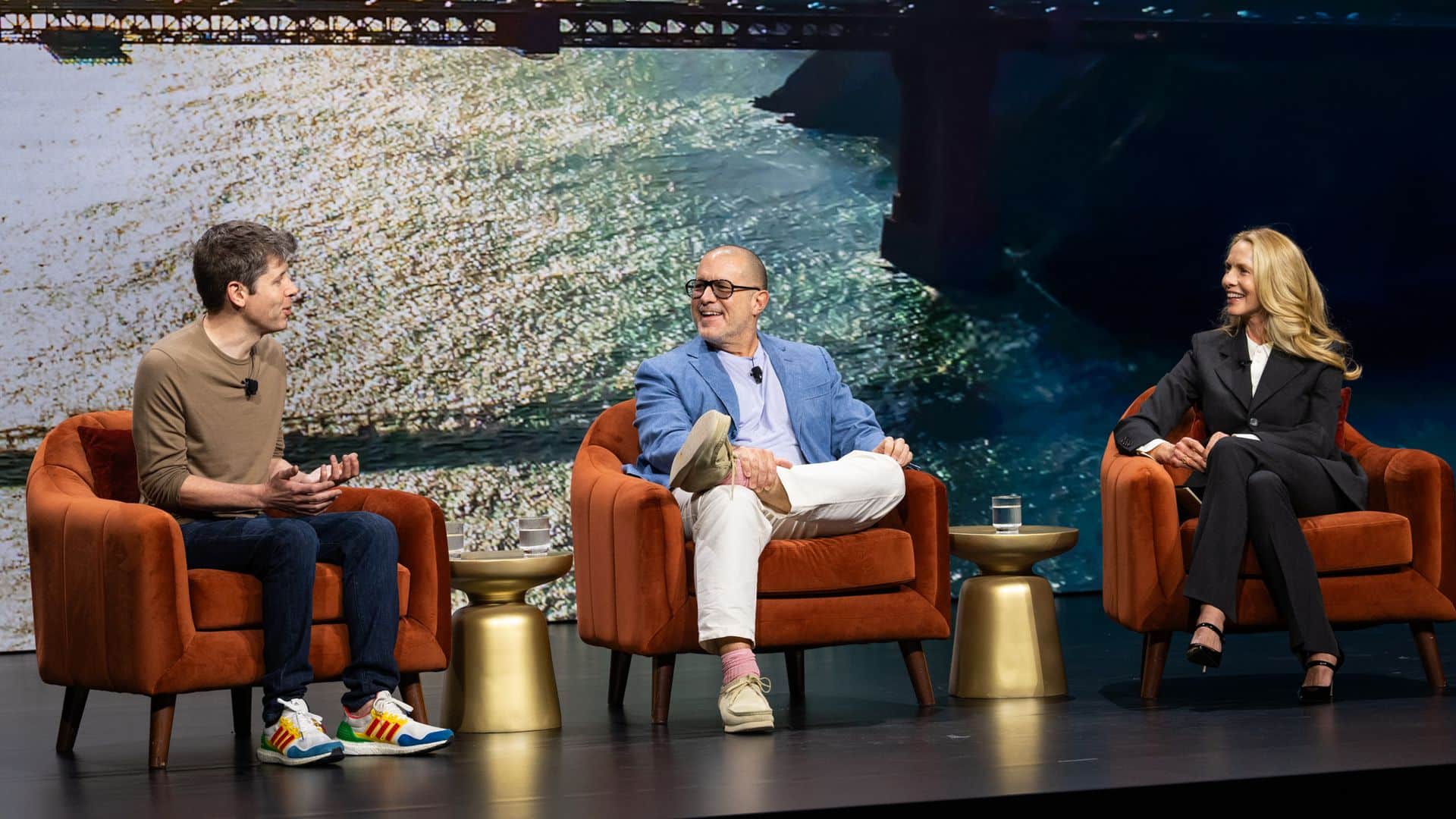
Jony Ive, Sam Altman e Laurene Powell Jobs

Próxima de Tim Cook e de outros executivos da empresa — além de manter uma relação de longa data com Ive —, ela continua circulando com naturalidade entre ambos os lados, tendo inclusive participado da última WWDC como convidada.

Laurene também é uma das principais investidoras dos projetos de Ive e esteve ao lado dele e de Altman quando os dois revelaram que o primeiro dispositivo de IA da OpenAI já estava em desenvolvimento. Para Gurman, esse conjunto de relações pode ter contribuído para evitar que o nome do ex-chefe de design da Apple fosse envolvido diretamente na disputa judicial, especialmente na ausência de evidências que o ligassem ao suposto vazamento de informações.

Apple’s lawsuit against OpenAI could derail the AI giant’s hardware ambitions to challenge the iPhone

13 July 2026 at 14:13
Jony Ive
Jony Ive

According to Bloomberg News‘ Mark Gurman, Apple’s aggressive lawsuit accusing OpenAI of systematically stealing its intellectual property poses a significant threat to the AI company’s efforts to develop consumer hardware devices that could rival the iPhone — potentially disrupting those plans long before any courtroom resolution.

The Core Allegations

Apple filed the blockbuster suit last week, claiming OpenAI orchestrated a coordinated effort to misappropriate trade secrets. Key details include:

• OpenAI allegedly encouraged former and prospective Apple employees to bring unreleased product information, prototypes, CAD designs, and supplier details to interviews and new roles.

• OpenAI instructed hires on evading Apple’s security protocols, reportedly using a checklist tied to its former iPhone design leadership.

• Specific individuals named include OpenAI’s Chief Hardware Officer Tang Tan (a 24-year Apple veteran who led iPhone and Apple Watch design) and engineer Chang Liu, who allegedly retained access to Apple systems post-departure to download confidential files on unreleased products.

Apple claims it has uncovered a “pattern of theft” involving more than 400 former employees now at OpenAI. The suit also implicates io Products (Jony Ive’s hardware startup, acquired by OpenAI for $6.5 billion), describing OpenAI’s emerging hardware efforts as “rotten to its core” due to reliance on misappropriated secrets.

Why This Matters for OpenAI’s iPhone Rival Plans

OpenAI has been aggressively building a hardware division to create AI-powered consumer devices — potentially including a smartphone or agent-based hardware that could bypass traditional app ecosystems and compete directly with Apple’s ecosystem dominance. This push gained momentum with the io Products acquisition and talent poaching from Cupertino.

Gurman’s reporting highlights how the lawsuit creates immediate headwinds:

• Talent and Reputation Risks: Even without a final verdict, the public accusations could slow recruiting, damage partnerships, and invite scrutiny from suppliers wary of legal entanglement.

• Injunctive Relief: Apple is seeking court orders to bar OpenAI from using the alleged secrets, return materials, and preserve evidence—moves that could force redesigns or delays in OpenAI’s device timeline.

• Broader Competitive Tension: The clash comes amid a strained partnership (Apple integrates ChatGPT into Siri and Apple Intelligence), with both sides eyeing greater independence in AI hardware. OpenAI’s ambitions to reduce reliance on the iPhone now face a major legal and PR obstacle.

OpenAI’s Response and Context

OpenAI has denied the claims, stating it has “no interest in other companies’ trade secrets” and remains focused on innovative technology.

The suit escalates existing frictions, including reports of OpenAI previously considering legal action against Apple over their integration deal.
‎
MacDailyNews Take: OpenAI has always been skeevy, from eschewing its open source roots to Sam Altman to desperately overpaying for a washed Jony Ive. Just plain skeevy.

If ever a Skynet would arise, we expect it would spring from the diseased loins of OpenAI.

This isn’t just a legal spat, it’s a flashpoint in the intensifying battle for the future of AI devices. Apple is fiercely protecting the decades of innovation behind its hardware supremacy, while OpenAI bets big on disrupting it with AI-first experiences. As Gurman notes, the disruption to OpenAI’s plans could be swift and substantial, regardless of how the case ultimately resolves in court.


‎
Please help support MacDailyNews — and enjoy subscriber-only articles, comments, chat, and more — by subscribing to our Substack: macdailynews.substack.com. Thank you!

Support MacDailyNews at no extra cost to you by using this link to shop at Amazon.

The post Apple’s lawsuit against OpenAI could derail the AI giant’s hardware ambitions to challenge the iPhone appeared first on MacDailyNews.

Two Trump health nominees crash and burn in tense Senate hearing

16 July 2026 at 23:33

Two nominees for high-profile health roles in the Trump administration faced scrutiny from the Senate health committee Wednesday—and both crashed and burned in their own special ways.

The Senate Committee on Health, Education, Labor, and Pensions (HELP) scrutinized Erica Schwartz, the nominee for director of the Centers for Disease Control and Prevention, and Sean Kaufman, up for the role of assistant secretary for preparedness and response.

Schwartz's assignment

Public health experts were "cautiously optimistic" about Schwartz's nomination. She is well-respected and holds views in line with evidence-based medicine, including being supportive of vaccinations—in contrast to anti-vaccine Health Secretary Robert F. Kennedy Jr., whom she will serve under. She is also highly qualified for the role, with a medical degree, a master's degree in public health, and a law degree. She's had a long career as a Navy Officer and previously held the roles of chief medical officer for the US Coast Guard and deputy surgeon general in the first Trump administration.

Read full article

Comments

© Getty | Finn Gomez

OpenAI adia o seu primeiro equipamento de IA, mas lança acessório para programadores

16 July 2026 at 14:39

O esperado primeiro equipamento de inteligência artificial da OpenAI continua envolto de mistério e voltou a ser adiado. A equipa, liderada por Jony Ive, o “pai” do iPhone, está a recrutar elementos para a sua equipa diretamente da Apple.

The post OpenAI adia o seu primeiro equipamento de IA, mas lança acessório para programadores appeared first on Tek Notícias.

Martin Sweatman dell'Università di Edimburgo ha individuato in uno dei pila…

15 July 2026 at 22:18
Martin Sweatman dell'Università di Edimburgo ha individuato in uno dei pilastri di Göbekli Tepe il più antico calendario solare della storia, composto da 365 giorni, mesi lunari e giorni extra. Secondo l'analisi geometrica e astronomica del ricercatore, le incisioni a forma di "V" e i simboli zoomorfi del sito descrivono con estrema precisione l'impatto di uno sciame di frammenti di cometa avvenuto circa 13.000 anni fa.

Saltzman’s farewell warning: Prepare for war in space to preserve peace

15 July 2026 at 19:14

In his final public speech as Space Force chief, Gen. Chance Saltzman called for combat credibility, stronger alliances and realism about the limits of procurement reform

The post Saltzman’s farewell warning: Prepare for war in space to preserve peace appeared first on SpaceNews.

Isaacman attends Soyuz launch of ISS crew

15 July 2026 at 10:21
Soyuz launch

A new crew arrived at the International Space Station on July 14 on a launch witnessed in person by NASA Administrator Jared Isaacman.

The post Isaacman attends Soyuz launch of ISS crew appeared first on SpaceNews.

A Solution to a Famous Feynman Problem, ‘Psychedelic’ Breathwork, and an Odd Stone Sphere is Unearthed

14 July 2026 at 15:36
Feynman Sprinkler
Credit: NYU’s Applied Mathematics Laboratory

This week in science and technology news we’re covering at The Debrief: For decades, physicists have argued about Richard Feynman’s Sprinkler Problem, involving the question of how a reverse sprinkler would operate. Now we may finally know the answer… elsewhere, new studies reveal how breathwork may trigger psychedelic-like states, emotional breakthroughs, and psychological insights without drugs. Meanwhile, a stone sphere unearthed at an archaeological site in Azerbaijan is reportedly unlike anything previously documented in the South Caucasus.

Also, in an exclusive feature, University of Toronto bioethicist KM Bowman, Ph.D., writes for The Debrief about his firsthand experience with uncontacted indigenous tribes: “Through the haze stood a man. Barely clothed, carrying what appeared to be a weapon of some form, he remained motionless for only a few seconds before silently disappearing back into the forest.” In his essay, Bowman shares his experience and asks whether governments can protect “the uncontacted.”

Finally, here’s a look at more stories The Debrief is tracking right now…

The Uncontacted: Living in Voluntary Isolation, These Are the People Governments Pretended Didn’t Exist

14 July 2026 at 14:19

Deep within the world’s remaining equatorial forests, the last uncontacted Indigenous peoples continue to live in near-total isolation. They represent humanity’s final societies that have consciously chosen to remain beyond the reach of the modern world. Their existence is extraordinary not only because of who they are, but because of what their survival reveals about ourselves.

For decades, however, governments found it politically and economically convenient to pretend that many of these people did not exist.

That chapter is, thankfully, drawing to a close. Today, Peru, Brazil, and other South American nations officially recognize the existence of Indigenous peoples living in voluntary isolation. Yet the history of denying their existence remains one of the most revealing episodes in the modern relationship between development, politics, and human rights. It reminds us that before forests are exploited, the people living within them are often rendered politically invisible.

The lesson extends far beyond the Amazon.

Throughout history, governments have rarely denied the existence of people simply because evidence was lacking. In colonial times, the existence of indigenous societies and cultures had no bearing on European immigrant expansion. Their cultures were considered primitive, and civility and religion would be the great benefits of settler expansion. In the 20th and 21st centuries, denial served a more practical purpose. If no one officially occupied a forest, there were no communities whose rights required protection. No Indigenous reserves needed to be established. Logging concessions could be issued, roads extended, mines approved, and oil exploration expanded with fewer legal obstacles. Recognition would carry consequences.

Once governments acknowledge uncontacted peoples, they assume obligations under national constitutions, international human rights law, the United Nations Declaration on the Rights of Indigenous Peoples (UNDRIP), and, in many countries, ILO Convention 169. Suddenly, economic development must coexist with human rights.

For years, this tension played out repeatedly in the Peruvian Amazon.

As proposals emerged to establish reserves for Indigenous peoples living in voluntary isolation, regional politicians and government officials questioned whether these communities existed at all. They argued there was insufficient evidence despite decades of documentation by anthropologists, Indigenous organizations, and conservation scientists. Shelters, cultivated gardens, footprints, arrows, abandoned camps, aerial observations, and repeated eyewitness accounts painted an increasingly compelling picture. Yet recognition often lagged precisely where logging, oil, gas, or mining interests sought access.

In retrospect, this was never simply an anthropological debate. It was an economic one.

The existence of uncontacted peoples transformed forests from potential commercial assets into protected Indigenous territories. Recognition restricted extraction. Denial facilitated it.

Fortunately, much of that official denial has now ended. Governments increasingly recognize that uncontacted peoples do exist and deserve legal protection. Yet the episode leaves behind an important lesson: political narratives often reflect competing economic interests as much as objective evidence. The question is no longer whether uncontacted peoples exist. The question is whether governments possess the political will to protect them.

The irony is profound. The same territories that some once wished to portray as empty are now recognized as among the most important ecosystems on Earth.

Study after study demonstrates that Indigenous territories, particularly those occupied by peoples living in voluntary isolation, experience significantly lower rates of deforestation than surrounding forests. These landscapes contain extraordinary biodiversity, protect countless species yet to be documented by science, regulate regional rainfall, and store immense quantities of carbon essential to moderating global climate change.

Protecting uncontacted peoples, therefore, serves two inseparable purposes.

It safeguards fundamental human rights while simultaneously protecting some of humanity’s greatest environmental assets. In the western Amazon, where I have spent time working, these realities become impossible to separate.

This region contains the greatest concentration of uncontacted peoples anywhere on Earth. It is also among the richest expressions of biological diversity on the planet. Yet it remains under relentless pressure from illegal logging, mining, expanding road networks, narcotics trafficking, and land speculation. While Peru and Brazil have established large protected Indigenous territories, enforcement has weakened in many areas as criminal organizations and commercial interests increasingly penetrate previously inaccessible forests.

Every encounter between outsiders and uncontacted peoples carries enormous risk.

Centuries of violence, exploitation, and disease can be compressed into a single unexpected meeting. Illegal miners, loggers, and land invaders increasingly enter territories occupied by isolated peoples, provoking confrontations that neither side seeks. Fatal encounters have occurred involving both Indigenous defenders protecting their ancestral lands and outsiders venturing into territories they had no right to enter.

I experienced something that profoundly altered my appreciation of this reality.

On a recent expedition, I awoke before dawn to a river wrapped in mist beneath a pale orange sky. Overnight storms had left the air heavy with humidity as I walked along a stretch of exposed sand. Through the haze stood a man. Barely clothed, carrying what appeared to be a weapon of some form, he remained motionless for only a few seconds before silently disappearing back into the forest.

The encounter was brief, but penetrating. Ten thousand years faded away.

We were outside any officially protected Indigenous territory and had taken every precaution to avoid contact. Yet there he was, undeniably real. His footprints remained impressed in the wet sand long after he disappeared.

They reminded me that debates over whether isolated peoples exist are ultimately settled not by ideology, but by reality itself. These communities continue to live within forests that many outsiders still view primarily through the lens of economic opportunity.

Throughout the Americas, first contact repeatedly brought catastrophic epidemics, displacement, exploitation, and cultural destruction. Peoples living in voluntary isolation possess little immunity to common infectious diseases carried unknowingly by outsiders. Even a well-intentioned contact can prove devastating.

Some argue that continued isolation is no longer realistic—that climate change, expanding infrastructure, and globalization make eventual integration inevitable.

I believe this misunderstands both ethics and history.

It assumes that outside society possesses the right to determine other people’s future. It repeats the paternalism that has accompanied Indigenous dispossession for centuries. Respect requires something more difficult. It requires restraint.

The greatest lesson we should draw from the period when governments denied the existence of uncontacted peoples is not simply that denial was wrong. It is that economic convenience can shape political reality in dangerous ways. When forests are viewed primarily as timber, minerals, or agricultural land, it becomes remarkably easy to overlook the people who stand in the way of exploitation.

Today, official denial has largely given way to official recognition.  That represents genuine progress. But recognition alone is insufficient if protections exist only on paper while illegal logging, mining, and organized crime continue to erode Indigenous territories on the ground.

Over the years, I have seen echoes of this same struggle elsewhere. In the highlands of Papua New Guinea, where stone tools were still in use, communities sought to preserve traditions against an advancing modern world. On India’s Andaman Islands, members of the Jarawa halted a military convoy I was travelling with, bows drawn, defending the integrity of their homeland. Across continents, the underlying question remains remarkably consistent: can modern societies respect the right of other cultures not to become like us?

The uncontacted peoples of this world challenge our assumptions about progress itself. Their existence reminds us that development is not the only measure of a society, and that autonomy sometimes means choosing a different path altogether.

Their territories also remind us that some of the world’s most effective conservationists have never described themselves as environmentalists. By simply defending their lives and territory, they have preserved ecosystems that benefit every person on Earth.

The people governments once pretended did not exist have become some of the planet’s important guardians. Protecting them is no longer only about correcting historical injustice. It is about recognizing that human rights, biodiversity, and climate stability are inseparable. Their silence in the forest is not absence. It is sovereignty.

Yet the story of the uncontacted has another, profound consideration for our era that extends far beyond remote forests. The history of the uncontacted tells us that for years, some governments denied the existence of people who were demonstrably there because acknowledging them carried political and economic costs. As we search for life beyond Earth, humility demands that we distinguish between what has not yet been confirmed and what may simply remain beyond our present ability—or willingness—to acknowledge.

History repeatedly warns against confusing the limits of our knowledge with the limits of reality.

Kerry Bowman, PhD, is a Canadian bioethicist and environmentalist. An instructor at the University of Toronto, he currently holds an academic appointment in the Faculty of Medicine and School of the Environment.  Bowman’s recent work includes two major conservation projects in the Western Amazon and the Eastern Congo, focusing on the intersection of human health with factors such as deforestation, biodiversity loss, and emerging zoonotic diseases.

Feynman’s Famous Physics Problem of a Sprinkler Running in Reverse has a Surprising New Solution

14 July 2026 at 13:29

For decades, physicists have debated Richard Feynman’s famous Sprinkler Problem—the question of how a reverse sprinkler would behave—and now researchers may have finally found the answer.

Made famous in Feynman’s 1985 memoir, Surely You’re Joking, Mr. Feynman!, the problem concerns the spin direction of a sprinkler-like device inside a pool that draws water inward instead of spreading it out. The researchers revealed their experimental results, based on tests with a variety of custom sprinklers, in a recent paper published in the Proceedings of the National Academy of Sciences, adding new life to the long-standing physics debate.

Feynman Experiments

“This work provides the experimental answer for Feynman’s Sprinkler Problem by showing, across several sprinkler types, how the angular momentum of water flows drives sprinklers’ rotation,” said senior author Leif Ristroph, an associate professor at New York University’s Courant Institute School of Mathematics, Computing, and Data Science.

The significance of the work extends well beyond an esoteric question about a hypothetical device, providing new insights into the physics of fluid dynamics. Feynman famously attempted to investigate the problem experimentally during the 1940s, though his apparatus reportedly failed dramatically before producing a definitive result. During his lifetime, Feynman discouraged naming the problem after himself, noting that it built upon ideas first explored by physicist Ernst Mach in the 1880s.

“Our findings provide a firmer understanding of how components respond to fluid flows—knowledge that can guide future engineering and technological advances for devices, such as turbines, that convert these flows into energy,” said co-author Brennan Sprinkle, an assistant professor at Colorado School of Mines.

Feynman Sprinkler
A visualization of Feynman’s reverse sprinkler, using particles and with false color (Image Credit: NYU’s Applied Mathematics Laboratory)

Exploring Feynman

This isn’t the team’s first work on Feynman’s Sprinkler Problem, as it builds on what they reported in an earlier 2024 paper. Unlike Feynman himself, the researchers managed to make their reverse sprinkler rotate, leading to intriguing new physics discoveries. In that work, they discovered that a reverse sprinkler would operate much like a conventional one, though at about 50 times the slower rate.

While traditional sprinklers act like a rocket of water, the Feynman sprinkler is comparable to an inside-out rocket, shooting towards the junction of the arms at the device’s center. Inside that central chamber, the team discovered something interesting: the water jets do not collide head-on, which produces the sprinkler’s reverse rotation, in what the researchers dubbed the momentum flux theory.

That 2024 study was limited to traditional sprinklers with S-shaped arms, leaving the researchers to ponder how alternate shapes would impact the water flow. After fabricating their own series of sprinkler designs, the researchers tested water flow in both forward and reverse directions, measuring torque, flow rate, and rotational motion.

Testing Theories

One of the theories they tested was Ernest Mach’s 1883 theory that the fluid and sprinkler would swirl in opposite directions, but they found it did not align with the reverse rotations and torques observed in their experiments. They also tested a theory originally attributed to Feynman and later refined by others, which suggested that water flow at the outer edges of the sprinkler arms drove rotation; however, the team’s observations showed this is not the case.

Their observations supported the team’s existing momentum flux theory in both the forward and reverse directions, across all sprinkler shapes. According to their work, the shape of the sprinkler arms controls the flow of the water jet.

“By showing that momentum flux is the answer to Feynman’s Sprinkler Problem,” Ristroph concluded, “our findings address a long-standing open problem in flow physics and provide useful knowledge about how these devices work and their effectiveness.

The paper, “Geometry Controls Momentum Flux in the Sprinkler Problem,” appeared in the Proceedings of the National Academy of Sciences on July 13, 2026.

Ryan Whalen covers science and technology for The Debrief. He holds an MA in History and a Master of Library and Information Science with a certificate in Data Science. He can be contacted at ryan@thedebrief.org, and follow him on Twitter @mdntwvlf.

❌